Despite more than a decade of discussion, current hospital stockpiles of antidotes for chemical terrorism are probably inadequate to address a mass-casualty event.Reference Dart, Borron and Caravati1Reference Dart, Goldfrank and Chyka2Reference Dart, Stark, Fulton, Koziol-McLain and Lowenstein3 With regard to organic phosphorus compound toxicity, stocking of the 2 antidotes, atropine and pralidoxime (2-PAM), are of great concern. Although atropine is commonly stored in hospitals for a variety of indications, a typical organic phosphate–poisoned patient may require in excess of 20 mg on the first day of treatment.Reference Dart, Borron and Caravati1Reference Eddleston, Buckley and Checketts4 Similarly, although the optimal dose of 2-PAM is debated, a randomized controlled trial in humans demonstrated a benefit of 2-PAM used in a bolus dose of 2 g, followed by a continuous infusion at 1 g/h.Reference Pawar, Bhoite, Pillay, Chavan, Malshikare and Garad5 In contrast to atropine, 2-PAM has no clinical indications other than organic phosphorus poisoning and is relatively expensiveReference Dart, Borron and Caravati1; therefore, 2-PAM is less likely to be available in large quantities. A survey of hospitals in British Columbia, Canada, demonstrated that only 65% stocked the recommended minimal 2-PAM dose of 3 g,Reference Wiens, Zed and Lepik6 which by current standards would treat only a single adult patient for less than 2 hours. Other instances of inadequate preparedness are described in multiple studies.Reference Juurlink, McGuigan, Paton and Redelmeier7Reference Plataki, Anatoliotakis, Tzanakis, Assithianakis, Tsatsakis and Bouros8Reference Teresi and King9Reference Woolf and Chrisanthus10
We have described the excellent stability of premixed atropine solutions, including 1 sample that was more than 50 years beyond its expiration date.Reference Schier, Ravikumar, Nelson, Heller, Howland and Hoffman11 Shortly thereafter, we released recently expired 2-PAM to another country after an international plea for assistance.Reference Bouchard, Mercurio-Zappala and Abreu12 Although the patients appeared to respond to therapy, because 2-PAM often is given simultaneously with atropine and dosed empirically, clinical improvement may not be directly correlated with pharmacological stability. We, therefore, chose to analyze the chemical stability of expired 2-PAM that was maintained in the New York City Poison Control Center because of our long-standing practice not to discard certain expired antidotes in preparation for acts of chemical terrorism.
METHODS
The following samples were used: lyophylized 2-PAM (protopam chloride, lot 1XKE, expiration date September 1986, Ayerst Laboratories, Rouses Point, NY) that was maintained according to the manufacturer's recommendations for 20 years beyond the labeled shelf life, solubilized 2-PAM contained in MARK I autoinjectors (lot 8T5404/8S4021, expiration date February 2003, Meridian Medical Technologies, Columbia, MD) that was stored properly for 4 years beyond its labeled shelf life, and fresh reagent grade 2-PAM (Sigma-Aldrich, St Louis, MO) was used as a standard control.
An Agilent LC/MSD 1100 with diode-array detector and an Agilent Sorbax SB-C-18, 4.6 × 150 mm, 5-μm, column (Agilent Technologies, Santa Clara, CA) were used with the following solvent system: water with 0.01% trifluoroacetic acid and methanol with 0.01% trifluoroacetic acid. This method involved only minor variations of a procedure previously described for liquid chromatography quantitationReference Medicis, Stork, Howland, Hoffman and Goldfrank13 to facilitate mass spectrometry analysis. Results were repeated 3 times to ensure consistency.
RESULTS
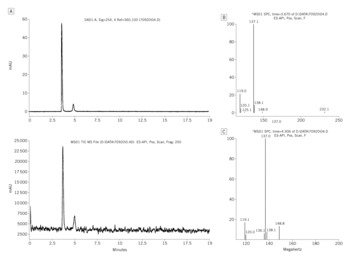
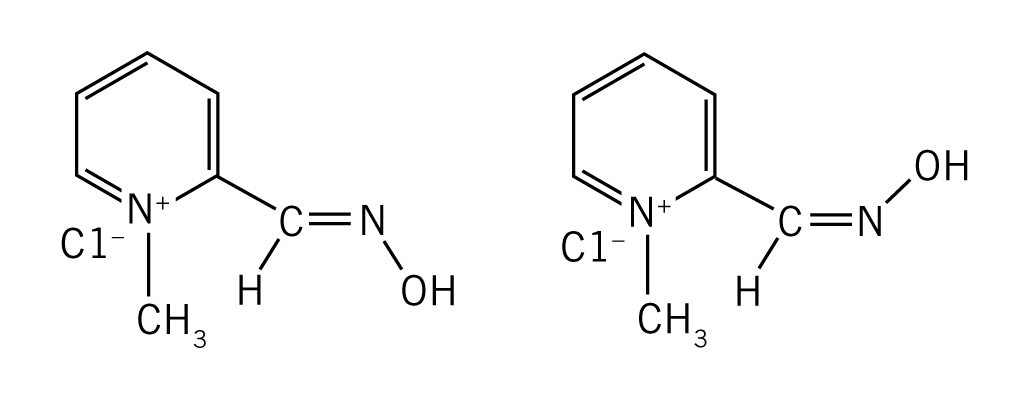
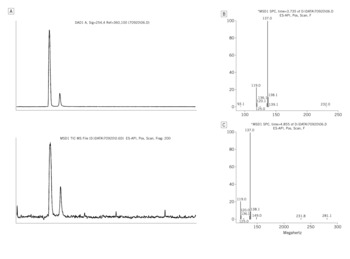
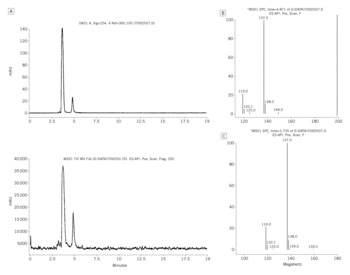
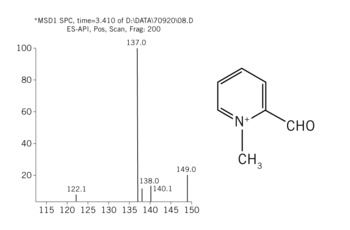
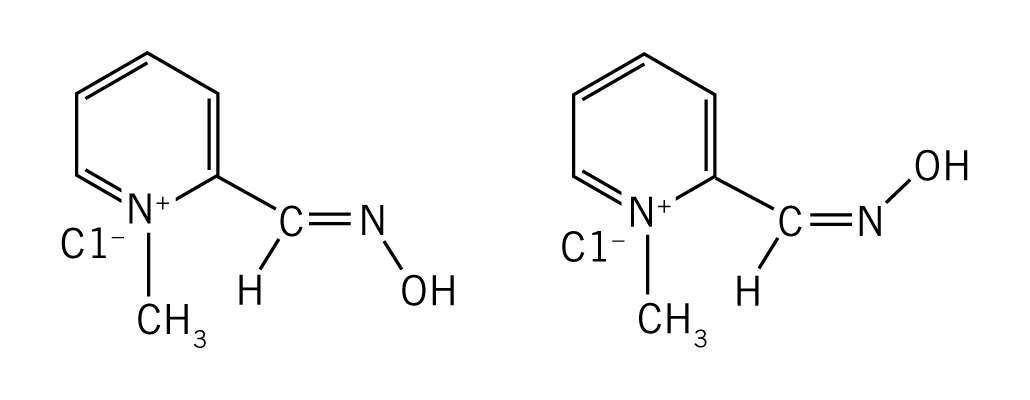
The liquid chromatography/mass spectrometry for reagent-grade 2-PAM is shown in Figure 1. Although 2 peaks are noted on the chromatogram, their identical mass spectra suggest the presence of isomers, as shown in Figure 2. The samples of lyophylized 2-PAM that were 20 years past their expiration date retained their white color as powder and were clear and colorless in solution. Both the liquid chromatogram and mass spectra (Figure 3) were essentially identical to those of the reagent-grade standard, and no additional peaks were resolved. The autoinjector discharged a clear, yellowish solution. In addition to the 2 peaks identified for lyophylized 2-PAM, a small third peak was identified(Figure 4) with a mass spectrum corresponding to the reported N -methyl pyridinium carboxaldehyde degradation product (Figure 5). Repeated analyses were identical for all of the specimens.
Liquid chromatography/mass spectrometry of reagent grade pralidoxime.
A. Liquid chromatography/mass spectrometry of fresh reagent-grade pralidoxime.
B, C. Spectra of peaks identified at 3.67 and 4.936 minutes, respectively. These spectra suggest that these 2 peaks represent isomers of pralidoxime.

Chemical structure of the 2 pralidoxime isomers identified in Figure 1.
Liquid chromatography/mass spectrometry of expired lyophylized pralidoxime.
A. Liquid chromatography/mass spectrometry of lyophylized pralidoxime properly stored for 20 years beyond its expiration date.
B, C. Spectra of peaks identified at 3.735 and 4.855 minutes, respectively.

Liquid chromatography/mass spectrometry of expired autoinjector pralidoxime.
A. Liquid chromatography/mass spectrometry of autoinjector pralidoxime properly stored for 3 years beyond its expiration date.
B, C. Spectra of peaks identified at 3.335 and 4.871 minutes, respectively.

Mass spectrometry corresponding to the peak at 3.410 minutes in Figure 4.
A. This spectrum is consistent with that reported for the N-methyl pyridinium carboxaldehyde degradation product (structure shown).

COMMENT
US drug manufacturers are required to label drugs with an expiration date or shelf life that is based on stability testing as defined by law (21 CFR 211.137 and 21 CFR 211.166). Contrary to popular opinion, this does not mean that the drug is unstable or lacks potency beyond that date, but rather that potency and stability have been studied for that duration and that no evidence has been collected beyond that duration. Stability is determined in part by intrinsic properties of the drug, its formulation (liquid vs lyophylized powder), and conditions of storage such as light, temperature, and humidity.
One review concluded that good evidence exists that many drugs retain 90% of their potency beyond 5 years postexpiration date and that there are “virtually no reports of toxicity from degradation products of outdated drugs.”14 This principle has been used in the Shelf Life Extension Program, which is administered by the Food and Drug Administration for the Department of Defense and the Strategic National Stockpile.Reference Lyon, Taylor, Porter, Prasanna and Hussain15 Under the Shelf Life Extension Program, more than 100 different drugs have been studied, including autoinjectors containing atropine and 2-PAM, atropine solution, and powdered 2-PAM. Samples of powdered 2-PAM were determined to be stable for a mean of 88 months (range 23–186) beyond their labeled expiration dates. Similarly, Schroeder and colleagues demonstrated room air stability of autoinjectors filled with unbuffered pralidoxime at approximately 10 years beyond their listed shelf life.Reference Schroeder, DiGiovanni, Von Bredow and Heiffer16 The results presented here are consistent with the other investigations but are noteworthy in that we have extended the analysis out to 20 years for lyophilized pralidoxime. In addition, using mass spectrophotometrywe have easily identified small quantities of degradation products when present.
Limitations
Several limitations of the work are noted. First, we are unable to infer anything about the biological efficacy of expired 2-PAM. Although we provide evidence of chemical stability, and this suggests retained biological efficacy, it is possible that a degradation product was unable to be identified using this methodology, or that the small amount of degradation product identified for the autoinjector samples could be harmful. It should be noted, however, that we released some pralidoxime from our supplies that was 3.5 years beyond its shelf life, and both a satisfactory clinical outcome and no adverse effects were reported.Reference Bouchard, Mercurio-Zappala and Abreu12
In addition, only 1 sample of properly stored drug from a single lot for both the lyophilized powder and the autoinjector was studied. It is possible that other lots of the drug from the same manufacturers could have possessed different stability levels. Because of the need for multiple comparisons and value of these antidotes, we analyzed only a small number of samples. Similarly, the same drug from different manufacturers may have different stability levels and any drug stored under different conditions could be either more or less stable.
CONCLUSIONS
When properly stored, lyophylized 2-PAM appears to be chemically stable for at least 20 years beyond its expiration date. Although the relative amount of degradation product found in solubilized (autoinjector) 2-PAM was small, it is unclear whether this degradation product is biologically relevant as an antidote, possesses unknown activity, is inert, or is potentially toxic. Additional studies should be considered to extend the shelf life of rarely used antidotes that are essential for adequate disaster preparedness. These studies should evaluate multiple samples from multiple manufacturers that have been stored under a variety of conditions that encompass predictable events. The biological effects of all degradation products must be studied rigorously. Although this research offers encouraging evidence about the potential stability of properly stored 2-PAM, the use of outdated product cannot be recommended until approved by the appropriate regulatory agencies.