Introduction
The incidence of coronary heart disease is increasing, with recent figures from the British Heart Foundation estimating that 2.7 million people in the UK suffer from this condition.1 Combined with this, there is an exponential growth in percutaneous coronary interventions. Around two million patients undergo coronary dilatation each year in Western countries.Reference Eagle, Berger, Calkins, Chaitman, Ewy and Fleischmann2 Consequently, we are encountering more and more patients in our clinical practice who are taking antiplatelet agents.
Particularly challenging is the peri-operative management of patients with a coronary stent (in many cases, new, drug-eluting coronary stents). Reports of late coronary and carotid artery stent occlusion, particularly in the peri-operative period after discontinuation of an antiplatelet drug,Reference Newsome, Weller, Gerancher, Kutcher and Royster3 have served to heighten concern. Furthermore, with figures suggesting that approximately 5 per cent of patients undergo non-cardiac surgery within the first year of stenting,Reference Smith, Feldman, Hirshfeld, Jacobs, Kern and King4 we face a growing clinical problem.
Although multidisciplinary advice should be sought, as surgeons we are involved in the decision-making process of whether to continue antiplatelet agents and risk bleeding, or to stop medication and risk thrombosis in the post-operative period.
This review provides an overview of the pharmacology and clinical indications for the commonly encountered antiplatelet agents, and contains guidelines on their management in the peri-operative period, with particular reference to ENT operations.
Classification of antiplatelet agents
The main antiplatelet agents used in cardiology are salicylates (i.e. aspirin), adenosine diphosphate receptor antagonists (e.g. clopidogrel), phosphodiesterase inhibitors (e.g. dipyridamole) and glycoprotein IIb/IIIa inhibitors (such as tirofiban, abciximab and eptifibatide).
Aspirin
Aspirin exerts its antiplatelet action by acetylating and irreversibly inactivating the cyclo-oxygenase 1 enzyme, resulting in blockade of the thromboxane A2 synthesis pathway. With the platelet unable to synthesise thromboxane A2 (a potent platelet aggregator and vasoconstrictor in the prostaglandin biosynthetic pathway), it loses its ability to increase platelet aggregation.
For a normal adult, a standard adult dose of 50–150 mg is given; a daily dose beyond 150 mg increases haemorrhagic risk without increasing protection.Reference Peters, Mehta, Fox, Zhao, Lewis and Kopecky5 The onset of action of aspirin is rapid, approximately 30 minutes, and the platelet effect is irreversible, i.e. it will persist for the life of the platelet (the mean lifespan of which is 8–10 days in circulation). The ability of platelets to aggregate is partially restored within 4–5 days of stopping aspirin.Reference Harder, Klinkhardt and Alvarez6
Aspirin has a central role in the prevention of thromboembolic events associated with atherosclerotic disease, and is the leading therapeutic drug for secondary prevention. It is usually given as lifelong therapy, as it has been shown to decrease the myocardial reinfarction rate by 30 per cent and the subsequent stroke rate by 25 per cent.7, Reference Harrington, Becker, Ezekowitz, Meade, O'Connor and Vorchheimer8 In primary prevention, aspirin is indicated when the 10-year risk of vascular events exceeds 10 per cent.Reference Rodondi and Cornuz9 The use of aspirin alone, immediately after stent insertion, is not sufficient to prevent stent thrombosis, hence the use of adjunctive antithrombotic therapy.
Adenosine diphosphate receptor antagonists
Clopidogrel is a thienopyridine that irreversibly inhibits the low-affinity adenosine diphosphate receptor P2Y12 on the platelet membrane. This results in selective inhibition of adenosine diphosphate induced platelet aggregation, due to prevention of conversion of the glycoprotein IIb/IIIa receptor to its active form. Clopidogrel increases bleeding time to 1.5 to 3 times that of normal after 3–7 days of treatment;Reference Harder, Klinkhardt and Alvarez6 replenishment of the platelet population is needed to overcome its effects.
Clopidogrel is indicated for the primary prevention of thromboembolic events in those patients intolerant or allergic to aspirin.
Clopidogrel also provides enhanced protection when combined with aspirin. The Clopidogrel in Unstable angina to prevent Recurrent Events (known as the CURE) studyReference Yusuf, Zhao, Mehta, Chrolavicius, Tognoni and Fox10 demonstrated that the addition of clopidogrel to aspirin resulted in an additional 10 per cent relative risk reduction in patients with non-ST-segment elevation acute coronary syndrome or unstable angina.
Current UK guidelines, based on recommendations from the National Institute for Health and Clinical Excellence, suggest that clopidogrel should be given for 12 months following non-ST-segment elevation myocardial infarction,11 and for four weeks (if commenced within 24 hours) following ST-segment elevation myocardial infarction.12
Following percutaneous coronary intervention and stenting, clopidogrel is continued for a minimum of 12 months following placement of drug-eluting stents, or for six weeks following placement of bare metal stents; these recommendations are based on findings from the Percutaneous Coronary Intervention – Clopidogrel in Unstable angina to prevent Recurrent Events (know as the PCI-CURE) trialReference Mehta, Yusuf, Peters, Bertrand, Lewis and Natarajan13 and the Clopidogrel for the Reduction of Events During Observation (know as the CREDO)Reference Steinhubl, Berger, Mann, Fry, DeLago and Wilmer14 trial.
Ticlopidine belongs to the same family as clopidogrel, but its use has now been virtually abandoned due to the high frequency of side effects.
Prasugrel is one of several new drugs that also act at the P2Y12 receptor. Like clopidogrel, it binds irreversibly to the adenosine diphosphate receptor, and it has been suggested to be an even more potent inhibitor of platelet function. Of note, in the phase III trial prasugrel administration was associated with a significantly increased incidence of major adverse bleeding events compared with clopidogrel (2.4 versus 1.8 per cent).Reference Wiviott, Braunwald, McCabe, Montalescot, Ruzyllo and Gottlieb15
Phosphodiesterase inhibitors
The most commonly encountered phosphodiesterase inhibitor is dipyridamole, which acts via a variety of mechanisms to reduce platelet adenosine uptake and therefore to inhibit platelet adhesion. This drug inhibits the production of thromboxane synthase, thus reducing levels of thromboxane A2. Dipyridamole exerts a moderate antiplatelet effect, lasting around 24 hours after administration.
Dipyridamole is used for the prevention of thromboembolic events in patients with prosthetic heart valves, in combination with oral anticoagulation. It is also recommended by the National Institute for Health and Clinical Excellence for secondary prevention of cerebrovascular accident and transient ischaemic attack, in combination with aspirin, if clopidogrel is not tolerated.16
Other phosphodiesterase inhibitors include the I-2 prostaglandin epoprostenol and its analogue iloprost, both used intravenously with a brief antiplatelet effect (less than 3 hours).
Glycoprotein IIb/IIIa receptor antagonists
Platelet glycoprotein IIb/IIIa receptor antagonists are used for the prevention of immediate thrombosis of coronary stents, and are prescribed for 24–48 hours after percutaneous coronary intervention.Reference Montalescot, Barragan, Wittenberg, Ecollan, Elhadad and Villain17 These drugs act on the glycoprotein IIb–IIIa binding site on the platelet membrane and interfere with the final common pathway of platelet aggregation. Tirofiban and eptifibatide are competitive receptor inhibitors, with a half-life of up to 2 hours. In contrast, abciximab produces almost irreversible inhibition, via a monoclonal antibody directed against the glycoprotein IIb/IIIa receptor, the effect of which (i.e. prolongation of bleeding time to more than 30 minutes) lasts more than 12 hours after stopping the infusion.Reference Tcheng, Ellis, George, Kereiakes, Kleiman and Talley18
Haemorrhagic risks of antiplatelet agents
Antiplatelet agents are associated with an increased rate of spontaneous haemorrhage. The rate of severe spontaneous bleeding recorded in various trials is increased with dual antiplatelet therapy, compared with aspirin therapy alone; a rate of 0.7–1.13 per cent (representing a 37 per cent increase in relative risk) was seen in the Antithrombotic Trialists' Collaboration (known as the ATC) trial,7 and a rate of 2.7–3.7 per cent (a 27 per cent increase in relative risk) in the CURE trial.Reference Yusuf, Zhao, Mehta, Chrolavicius, Tognoni and Fox10
A meta-analysis of five randomised trials, including more than 75 000 patients, compared the risk of bleeding in subjects at high risk of future cardiovascular events who were taking combined clopidogrel and aspirin, compared with those taking aspirin alone.Reference Eikelboom and Hirsh19 Adding clopidogrel to aspirin increased the relative risk of bleeding by as much as 50 per cent, and the absolute risk by as much as 1 per cent.
The use of dipyridamole has also been associated with an increased risk of bleeding events; a meta-analysis of 3304 patients found a 6.7 per cent rate of spontaneous haemorrhage attributed to its use.Reference Serebruany, Malinin, Eisert and Sane20
In the peri-operative period, the continuation of agents with an inhibitory effect on platelets may be expected to have associated bleeding risks. In a meta-analysis of 49 590 patients, of which 14 981 were taking aspirin,Reference Burger, Chemnitius, Kneissl and Rucker21 low-dose aspirin increased the rate of complications due to bleeding by a factor of 1.5, in a variety of surgical procedures (dental, ophthalmic, visceral and minor general surgery, endoscopies, biopsies, and catheter dialysis). However, the surgical result was not compromised, except for intracranial surgery and transurethral prostatectomy. The authors concluded that low-dose aspirin should not be discontinued before an intended operation or procedure, unless there is a very high bleeding risk associated with it.
Aspirin has been associated with a rise in the bleeding rate in specific procedures. In the case of cardiac surgery with cardiopulmonary bypass, a review of 50 studies revealed an average increase in bleeding of 300 ml per patient.Reference Belisle and Hardy22 During transurethral prostatectomy, the blood transfusion rate was increased by a factor of 2.7 in patients on aspirin compared with control groups,Reference Thurston and Briant23 with two fatalities noted.
There is less literature available on the effects of clopidogrel in the peri-operative period. Data from cardiac surgery suggest that blood loss is increased by 30–50 per cent, but in most of the studies intra-operative heparinisation was used for cardiopulmonary bypass. Clopidogrel intake during the last four days before coronary artery bypass grafting has been shown to be an independent predictor of both re-operation for the control of haemorrhageReference Kapetanakis, Medlam, Boyce, Haile, Hill and Dullum24 and blood transfusion,Reference Chu, Wilson, Novick, Stitt and Quantz25 although surgical outcome and mortality was unaffected.Reference Kapetanakis, Medlam, Boyce, Haile, Hill and Dullum24
With regard to non-cardiac surgery, patients taking dual antiplatelet agents after percutaneous coronary intervention, who underwent vascular, orthopaedic or visceral surgery, had an increased transfusion rate (42.6, versus 38.5 per cent in controls).Reference Wilson, Fasseas, Orford, Lennon, Horlocker and Charnoff26 Ernst et al. Reference Ernst, Eberhardt, Wahidi, Becker and Herth27 reported excessive bleeding after transbronchial biopsy in patients taking clopidogrel (89 per cent) or dual therapy (100 per cent), compared with controls (3.4 per cent), although no patient required transfusion and bleeding was controlled endoscopically in all cases.
With regards to ENT procedures, Sargi and CasianoReference Sargi and Casiano28 retrospectively analysed differences in estimated blood loss in patients undergoing endoscopic sinus surgery and receiving either anticoagulant or antiplatelet treatment (n = 42), matched with a control group. There was no statistically significant difference in blood loss between the groups, and there were no reported major post-operative bleeding incidents related to anticoagulation. However, it must be noted that these authors' local policy was for patients to cease their aspirin, and also clopidogrel if relevant, two weeks prior to surgery, and to restart therapy three days post-operatively.
In a prospective, randomised, controlled trial, the use of aspirin as an analgesic agent following paediatric tonsillectomy resulted in an increased rate of secondary haemorrhage (3.1 per cent), compared with 0.5 per cent in a control group taking acetaminophen.Reference Stage, Jensen and Bonding29 This led the authors to conclude that aspirin was not a suitable post-operative analgesic.
Effects of withdrawal of antiplatelet agents
Although antiplatelet agents may increase the risk of surgical bleeding, their discontinuation in the peri-operative period confers considerable morbidity and mortality. In one study,Reference Collet, Montalescot, Blanchet, Tanguy, Golmard and Choussat30 the withdrawal of antiplatelet agents was an independent risk factor for death in 1368 consecutive patients admitted with an acute coronary syndrome. In Burger and colleagues' meta-analysis,Reference Burger, Chemnitius, Kneissl and Rucker21 withdrawal of aspirin in the three weeks prior to surgery led to a three times greater risk of cardiac complications.
Following percutaneous coronary intervention, the premature discontinuation of clopidogrel was the most significant independent predictor of stent thrombosis in a study of 2229 patients with drug-eluting stents and a thrombosis rate of 1.5 per cent during the first year, with a mortality rate linked to stent thrombosis of 45 per cent.Reference Iakovou, Schmidt, Bonizzoni, Ge, Sangiorgi and Stankovic31 Stopping clopidogrel to allow major surgery during the first three weeks after percutaneous coronary intervention and stenting leads to mortality rates ranging from 30Reference Ferrari, Benhamou, Cerboni and Marcel32 to 86 per cent.Reference Sharma, Ajani, Hamwi, Maniar, Lakhani and Waksman33 In patients who have had drug-eluting stents inserted, numerous studies have identified the premature interruption of antiplatelet agents as a significant risk factor for delayed stent thrombosis.Reference Jeremias, Sylvia, Bridges, Kirtane, Bigelow and Pinto34–Reference Urban, Gershlick, Guagliumi, Guyon, Lotan and Schofer39 In addition, increased mortality has been reported in patients taking antiplatelet drugs whose surgery is delayed to allow coagulation variables to normalise.Reference Harty, McKenna, Moloney, D'Souza and Masterson40
Peri-operative management
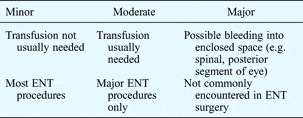
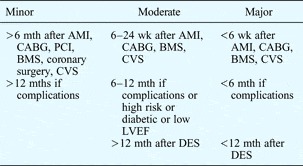
Evidence for the continuation or cessation of antiplatelet agents in the peri-operative period is lacking for non-cardiac procedures; however, based on the potential complications of cessation of therapy, particularly following percutaneous coronary intervention with drug-eluting stents, several guidelines have been published.Reference Lecompte and Hardy41–Reference Servin45 All of these guidelines are based on the stratification of risk, in terms of both potential for haemorrhage and risk of thrombosis. A useful summary was published by Llau et al. and is shown in Tables I and II.Reference Llau, Lopez-Forte, Sapena and Ferrandis44
Haemorrhagic risk in peri-operative period: summary

Adapted from Llau et al. Reference Llau, Lopez-Forte, Sapena and Ferrandis44 with permission.
Thrombotic risk in peri-operative period: summary

Adapted from Llau et al. Reference Llau, Lopez-Forte, Sapena and Ferrandis44 with permission. AMI = acute myocardial infarction; CABG = coronary artery bypass grafting; PCI = percutaneous coronary intervention; BMS = bare metal stent; CVS = cerebrovascular stroke; LVEF = left ventricular ejection fraction; DES = drug-eluting stent; mth = months; wk = weeks
In general, most ENT procedures can be regarded to pose a minor or moderate haemorrhagic risk (Table I). However, it must be emphasised that there is no general consensus on how these patients should be managed, and that any decision made locally should be based on agreement between anaesthetists, surgeons, haematologists and cardiologists.
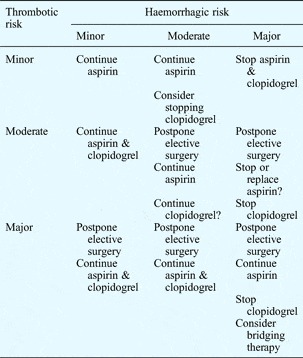
For patients who are not at a high risk of cardiac events (typically, patients receiving aspirin for primary prevention of myocardial infarction or stroke, discontinuation of all antiplatelet drugs (in the case of aspirin, 7–10 days prior to surgery) is recommended.Reference Chassot, Delabays and Spahn42, Reference Douketis, Berger, Dunn, Jaffer, Spyropoulos and Becker43
For those patients with minor thrombotic risk (most likely taking aspirin only), all are in agreement that aspirin should be continued unless there is a major haemorrhagic risk.
In those patients with moderate thrombotic risk (typically taking aspirin and clopidogrel), aspirin should be maintained. The continuation of clopidogrel is more controversial, with both its continuationReference Chassot, Delabays and Spahn42 and cessationReference Douketis, Berger, Dunn, Jaffer, Spyropoulos and Becker43 suggested in the literature. If clopidogrel is stopped, this should be done 5–10 days before surgery, depending on the haemorrhagic risk.
The exception to this is when there is major haemorrhagic risk, in which case elective surgery should be postponed. If an emergency procedure is necessary, clopidogrel and aspirin should be stoppedReference Douketis, Berger, Dunn, Jaffer, Spyropoulos and Becker43, Reference Llau, Lopez-Forte, Sapena and Ferrandis44 or converted to ibuprofen.Reference Chassot, Delabays and Spahn42
If a major risk of thrombosis exists, surgery should be avoided if possible. If surgery is absolutely necessary, antiplatelet agents should be continued wherever possible (in the case of minor or moderate haemorrhagic risk).
In the case of major (or arguably moderate) haemorrhagic risk, aspirin should be continued but clopidogrel could be stopped before surgery. In this instance, some authors recommend bridging therapy,Reference Chassot, Delabays and Spahn42, Reference Llau, Lopez-Forte, Sapena and Ferrandis44 i.e. an infusion of tirofiban plus eptifibatide and unfractionated heparin started three days before surgery and maintained until six hours before surgery.Reference Broad, Lee, Conroy, Bolsin, Orford and Black46 The above recommendations are summarised in Table III.
Peri-operative management of antiplatelet agents: summary of recommendations

Conclusion
Otorhinolaryngological surgeons are increasingly encountering patients taking a variety of antiplatelet agents. The premature withdrawal of antiplatelet agents has been highlighted as a potential cause of mortality and morbidity, especially in the case of drug-eluting stents. Conversely, although evidence from non-cardiac surgery is limited, the haemorrhagic risk associated with the continuation of antiplatelet agents is modest and not associated with increased morbidity for the majority of procedures. For these patients, the risk of thrombosis versus the risk of haemorrhage must be considered, with decisions about the continuation of treatment made after multidisciplinary consultation.