Introduction
Blepharospasm (BS) is one type of focal dystonia. It is characterised by involuntary contractions of the orbicularis oculi muscle with subsequent recurrent and involuntary blinking of the eyes. At onset, it appears as an increased frequency of blinking, but it can become quite disabling and even progress to functional blindness Reference Defazio, Abbruzzese, Livrea and Berardelli(1).
There are growing bodies of evidence linking genetic mutations and dystonia Reference De Carvalho Aguiar and Ozelius(2). However, neuropathological and pathophysiological aspects underlying dystonia are largely unknown Reference Liu, Yianni, Wang, Bain, Stein and Aziz(3,Reference Holton, Schneider and Ganesharajah4).
Recent studies have yielded conflicting results regarding the occurrence of non-motor disorders in focal dystonia, such as psychiatric syndromes and cognitive deficits (Reference Tinazzi, Rosso and Fiaschi5–Reference Dias, Doyle, Kummer, Cardoso, Caramelli and Teixeira9). These symptoms seem to support the current model of a dysfunction within corticostriatal circuitry in focal dystonia development Reference Berardelli, Rothwell, Hallett, Thompson, Manfredi and Marsden(10). The investigation of a possible association between psychiatric disorders and primary dystonia offers the opportunity to clarify this issue, since the brain circuits involved in some psychiatric conditions are already described Reference Insel(11,Reference Dias, Hounie, Corrêa and Teixeira12). For instance, obsessive-compulsive disorder (OCD) has been consistently associated with striatal abnormalities and, hence, fronto-striatal dysfunction.
Studies assessing systematically psychiatric disorders in focal dystonia are lacking in the literature Reference Dauer, Burke, Greene and Fahn(13). Nevertheless, psychiatric comorbidities are frequently reported in these patients and seem to be related to significant impact on clinical control and quality of life (Reference Hall, McGwin and Searcey14–Reference Gündel, Wolf and Xidara17).
The aim of this study was to investigate the frequency of psychiatric disorders and the severity of these symptoms in BS patients. For comparison, patients with hemifacial spasm (HS) were recruited. HS is characterised by non-voluntary contractions of the orbicularis oculi muscle and may evolve to compromise other muscles of one-half of the face. Although these two conditions are very similar in terms of symptoms and subjective impairment, HS results from peripheral facial nerve damage and is not related to basal ganglia dysfunction Reference Nielsen(18). Thus, HS constitutes an ideal control group for studies investigating the pathophysiology of non-motor symptoms of BS.
Methods
Fifty-one patients followed at the Movement Disorders Clinic of the University Hospital, Federal University of Minas Gerais (UFMG) were included in this study. Written informed consent was obtained from all patients. The study was approved by the local ethics committee.
Twenty-two patients (M/F, 7/15) diagnosed with primary BS participated in the study. A previous careful investigation of secondary or symptomatic causes of dystonia was performed. For comparison, 29 patients with HS (M/F, 7/22) were studied.
Patients underwent neurological and psychiatric examinations. The Mini Mental State Examination (MMSE) was administered to exclude patients with a cognitive performance suggestive of cognitive decline or dementia Reference Folstein, Robins and Helzer(19,Reference Brucki, Nitrini, Caramelli, Bertolucci and Okamoto20). All patients had been treated with botulinum toxin at least once before the inclusion in this study.
Psychiatric examination included a structured clinical interview for current psychiatric disorders according to Diagnostic Statistical Manual, fourth edition (DSM-IV) (MINI-Plus), and psychometric scales, including the Yale-Brown Obsessive Scale (YBOCS) Reference Asbahr(21), the Beck Depression Inventory (BDI) Reference Gorenstein and Andrade(22), the Hamilton Rating Scale for Depression (HRSD) Reference Moreno, Moreno, Gorenstein, Andrade and Zuardi(23), the Hamilton Anxiety Scale (HAS) Reference Lima(24) and the Liebowitz Social Anxiety Scale (LSAS) Reference Terra, Barros and Stein(25).
Comparisons of categorical variables between groups were performed by the Fisher's exact test. For continuous variables, Mann-Whitney U test was used. All p-values were two-tailed and a significance level of 0.05 was chosen. Statistical analysis was performed using the SPSS v15.0 software (SPSS Inc., Chicago, IL, USA).
Results
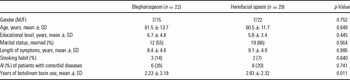
Patients with BS or HS did not differ in gender, age, educational level, disease duration or cognitive performance (Table 1). The group of patients with BS was in use of botulinum toxin for a longer period of time than the group of patients with HS (p = 0.011).
Demographic and clinical features of patients with blepharospasm and those with hemifacial spasm

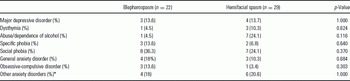
Table 2 shows the frequency of current psychiatric disorders in both groups. BS and HS patients did not differ in frequency of any disorder. However, the frequency of major depression and anxiety disorders were remarkably high in both groups. Suicidal ideation was present in 4.5 and 13.7% of BS and HS patients, respectively (p = 0.374). None of our patients were diagnosed with psychotic or bipolar disorders.
Frequency of current psychiatric diagnosis in blepharospasm and hemifacial spasm patients

* Include hypochondria, body dysmorphic disorder, panic disorder, post-traumatic stress disorder.
Also, the frequency of psychiatric drugs did not differ between groups. Three (15.8%) patients with BS and six (26.1%) patients with HS were in the use of antidepressants (p = 0.714). Three (15.8%) patients with BS and three (11.5%) patients with HS were in the use of benzodiazepines (p = 1.000).
In line with the aforementioned results, the scores in psychometric scales were similar in both groups (Table 3).
Comparison of scores from blepharospasm and hemifacial spasm patients in different psychometric scales

LSAS, Liebowitz Social Anxiety Scale; HAS, Hamilton Anxiety Scale; BDI, Beck Depression Inventory; HRSD, Hamilton Rating Scale for Depression; YBOCS, Yale-Brown Obsessive-Compulsive Scale.
* As most of the patients did not score in YBOCS, the frequency of patients scoring in this scale was used for comparison (Fisher's exact test).
Discussion
According to the current study, patients with BS or HS do not show significant differences in frequency and severity of psychiatric symptoms. Our findings is in contrast with some studies in which anxiety and depressive symptoms were described as more frequent in BS patients than in HS subjects (Reference Hall, McGwin and Searcey14,Reference Broocks, Thiel, Angerstein and Dressler26,Reference Scheidt, Schuller, Rayki and Kommerell27). Hall et al. evaluated 159 BS patients and 91 HS patients by phone call using DSM-IV criteria for the diagnosis of anxiety disorders and the Center of Epidemiologic Studies Depression Scale (CESD) for depression diagnosis Reference Tinazzi, Rosso and Fiaschi(5). They found that BS patients were more prone to symptoms of depression and anxiety than HS patients. Although this study had a large size sample, the absence of a structured clinical interview performed face to face may have influenced the results. We intended to overcome this limitation by using a structured clinical interview and several psychometric scales validated for the Brazilian population (Reference Asbahr21–Reference Terra, Barros and Stein25,Reference Amorim28).
Some previous studies have focused in obsessive-compulsive phenomena in BS with conflicting results (Reference Broocks, Thiel, Angerstein and Dressler26,Reference Bihari, Pigtt, Hill and Murphy29,Reference Munhoz, Teive and Della Coletta30). There are some phenomenological similarities between dystonia and OCD regarding persistent, perseverative, repetitive and involuntary nature of symptoms Reference Cavallaro, Galardi and Cavallini(31). It has been postulated that corticostriatal dysfunction is involved in the pathophysiology of the two disorders Reference Jenike(32,Reference Hallett33). However, Munhoz et al.'s study did not find a higher frequency of OCD in BS patients when compared with patients suffering from HS Reference Munhoz, Teive and Della Coletta(30). In the current study, there was a trend for more BS patients to score in the YBOCS (Table 3). YBOCS is considered a reliable method for assessment of OCD symptoms Reference Dias, Doyle, Kummer, Cardoso, Caramelli and Teixeira(9). The frequency of OCD in the group of patients with BS was also remarkably high, despite the lack of statistical difference from the HS group. The lack of statistical significance was probably because of the reduced size of the samples.
The duration of botulinum toxin use was significantly longer in BS patients than in HS patients (Table 1). We believe this datum does not prevent the comparison between both groups, since gender, age, educational level, disease duration and disease severity were similar. However, the fact that the administration of botulinum toxin can decrease cortical somatosensory activity warrants mention Reference Peller, Zeuner and Munchau(34). This observation is relevant because of the new pathophysiological model of dystonia that proposes an original deficit or dysfunction in the somatosensorial cortex Reference Liu, Yianni, Wang, Bain, Stein and Aziz(3,Reference Abbruzzese, Marchese, Buccolieri, Gasparetto and Trompetto35). According to this model, a combination of environmental triggers and genetic predisposition leads to plastic changes in cortical areas. It has been suggested that the repetition of a patterned movement, such as that performed by a professional musician or a writer, may induce plastic changes in the brain altering some cortical functions, including the control of movement, leading to dystonia Reference Stefan, Kunesch, Benecke and Classen(36). These plastic changes have been suggested to be extendable to higher cortical areas, such as the ones involved in motor preparation and sensory representation, and thus could interfere in some neuropsychological tasks Reference Berg, Hermann and Muller(37). Indeed, some deficits have been found in the performance of patients with primary dystonia in tasks assessing attentional and executive functions Reference Scott, Gregory and Wilson(38). Nevertheless, it is still lacking scientific evidence connecting this pathophysiological model to the higher frequency of some psychiatric disorders in this population. In this case, it seems that the basal ganglia model still gives the best explanations Reference Scott, Gregory and Wilson(38). However, our findings regarding the frequency of psychiatric symptoms in BS do not support these hypotheses.
BS and HS are diseases that cause significant impairment and have serious anti-aesthetic effect. The patients suffer from prejudice and are stigmatised. The observed similar frequency of psychiatric symptoms in both diseases may reflect the difficulty of living with a neurological disease with those characteristics Reference Phelan, Link and Dovidio(39,Reference Garcia and Crocker40). Indeed, despite the similar frequency of psychiatric disorders in both BS and HS, we observed that the frequency of some psychiatric disorders, such as major depression and general anxiety disorder, seems to be higher in patients with these diseases than in general population. Previous studies have also noticed an increased frequency of psychiatric disorders in BS Reference Bihari, Pigtt, Hill and Murphy(29,Reference Wenzel, Schnider, Griengl, Birner, Nepp and Auff41). The lack of a healthy control group in our study and its small sample size prevents definitive conclusions. Moreover, patients were recruited in a tertiary centre, where patients with a more severe disease are usually referred to. Altogether, these limitations may have some implication in the external validity of our study.
In conclusion, patients with BS do not seem to have more psychiatric disorders than those with HS. This observation helps to elucidate the great controversy that exists in the literature concerning the frequency of psychiatric symptoms in dystonia. The fact that primary dystonia is a rare disease and patients are usually attended in tertiary centres turns difficult the development of studies with adequate sample size and controls group. The little knowledge about other aspects of primary dystonia prevents the best approach to the disease. An additional work with proper methodology investigating the neuroimaging, immunology, genetics, neuropathology and clinical aspects of BS is necessary.