The Classic Maya royal court has emerged in recent years as a focus of scholarship, combining the best of new epigraphic and archaeological interpretations (Christie Reference Christie2003; Evans and Pillsbury Reference Evans and Pillsbury2004; Inomata and Houston Reference Inomata and Houston2001b, Reference Inomata and Houston2001c). The court, understood both as a social entity and a physical locus of power (Inomata and Houston Reference Inomata, Houston, Inomata and Houston2001a:3), was a vital institution both for the roles it played in polity administration and organization, and for its position as an exemplary politico-religious space from which cultural ideals were disseminated. In the context of today's intellectual milieu, in which increasing attention is being paid to commoners, households outside of the site center, and the diverse nature of lived experience of Maya people who were not members of the upper echelons (Lohse and Valdez Reference Lohse and Valdez2004; Robin Reference Robin2003), examination of the court also illuminates the reciprocal relationships that bound together different levels of Maya society and the ways in which cultural forms originating from the top were imitated, appropriated, or changed among Maya individuals in other contexts. The language of status and identity discussed in this article would have been part of a shared knowledge system (Bourdieu Reference Bourdieu1984), controlled by elites but also comprehensible to nonelites, thus providing mutually intelligible ideas of power and difference (Inomata Reference Inomata, Hruby and Flad2007:132).
The widening of research foci to include various segments of the sociopolitical hierarchy suggests an increasingly refined understanding of difference and inequality and of how they were indexed, among the Classic Maya. However, in many ways, archaeologists' understanding of status, especially as emically conceived, remains cloudy. Many scholars have moved beyond the sole use of material rubrics to classify social standing (e.g., based on presence or absence of certain important materials, such as jade, or on a typology of difference, such as classification of architectural elaboration) and now recognize the importance of combining material manifestations with other types of evidence, including epigraphic and iconographic data. Such synthetic approaches allow researchers to disentangle issues of material wealth (previously often used as a shorthand for status) and social power, which encompasses issues of authority and standing that overlap, but are not synonymous, with wealth (see, for example, McAnany Reference McAnany, Sabloff and Henderson1993). Still, debates continue about Classic Maya class organization, the meaning of “elite” identity, and how social or status difference may be recognized archaeologically.
This article explores a practice-oriented approach to status and identity assertion to investigate Classic Maya hierarchical organization and to understand both the human and nonhuman agents that played a part in constituting courtly communities, as experienced in face-to-face interactions, and also as enacted in contrast between different sites (Anderson Reference Anderson1983; Barth Reference Barth and Barth1969). Such communities would have been distinct in different polities, representing local expressions of hierarchical organization and idealized ways of being (Barth Reference Barth and Barth1969; Jones Reference Jones1997); at the same time, however, courts across the Maya lowlands were constructed using a largely shared vocabulary of values, roles, and material culture (Bourdieu Reference Bourdieu1984). Although the Classic-era experience—by courtiers themselves, as well as other members of a polity—would have been primarily of a local courtly community, the mutual legibility of symbols and components across the Maya lowlands does suggest a shared acknowledgment of the particular social and political space of the court that crossed terrestrial boundaries (Reents-Budet Reference Reents-Budet, Inomata and Houston2001:222). Knowledge systems (including beliefs and values, as well as skills such as specialized craft production and hieroglyphic writing) that helped to define membership in courtly groups therefore played a part in both uniting and dividing populations within and between particular polities (Baines and Yoffee Reference Baines, Yoffee, Feinman and Marcus1998; Inomata Reference Inomata, Inomata and Coben2006:205–212; Triadan Reference Triadan, Inomata and Coben2006:160–161)—experiences that would have been represented in both the material record and in the lived experience of individuals.
The goal of this article is to imagine some of the key, shared characteristics of the social communities of the court, as they would have been experienced at various sites. Equally important to these imaginings is the emphasis on a collective sense of community, and the ways in which hierarchical organization implicated, and was acted out among, groups of people, not by single leaders or thin ranks of a privileged handful. Let me be clear: I do not envision an explicitly expressed sense of united elite identity among high-ranking courtiers across the Maya lowlands. Rather, I explore shared mechanisms and concepts evidenced in analogous courtly institutions at sites throughout the Maya area. These mechanisms suggest that the Late Classic period, in particular, involved a broadly shared conception of local governance via the royal court. These ideas moved, in part through the use of text and in part through the performances of the court, beyond individual interactions to influence both noncourt members in a particular community and also people in other polities entirely (Anderson Reference Anderson1983), even while individual polities asserted distinctive and contrasting identities through these same courtly institutions.
Investigating lived experiences within the court is part of a critical treatment of the court as an actively constituted social space, a view that privileges the actions and perspectives of past agents and emphasizes the importance of a recursive structural approach to understanding the creation and negotiation of different identities in the Classic Maya world (Bourdieu Reference Bourdieu1977; Giddens Reference Giddens1984). As part of considering courtly institutions as actively constituted communities, this article focuses on elite practice, with the idea that understanding embodied actions and ideals will help to reveal aspects of elite lifestyles (reflected by certain tastes and related behaviors); these, in turn, shed light on Maya concepts of social organization and differentiation (Bourdieu Reference Bourdieu1977, Reference Bourdieu1984).
The present study examines ceramic vessels painted with depictions of court scenes, which provide a rich trove of data for examining questions of how status differences were expressed and experienced within this particular context, as well as the avenues by which identity formation took place and was articulated. These data reveal complex patterns of shared and differentiated identities operating simultaneously as part of courtly strategies of political control. The results of this study provide a significant added dimension to how differentiated identities may be conceptualized for the Classic Maya, from an emic and embodied perspective. Perhaps most importantly, this work investigates the social groups of courtly communities by bridging nonmaterial and material processes of identity negotiation. This is seen through a dual engagement with ceramic vessels as both literal and metaphorical containers for courtly substances, through the embodied form of the pot as a valued and circulated object, and through the representations of courtly ideals in painted decoration.
READING PAINTED VESSELS TO UNDERSTAND SOCIAL COMMUNITIES
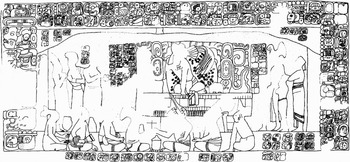
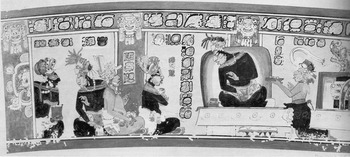
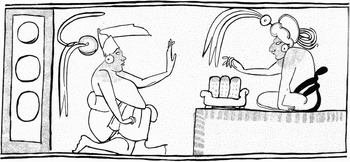
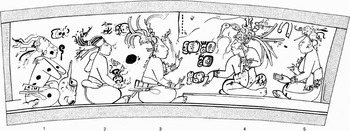
Even though issues of status and identity can be, and have been, approached through a variety of lines of archaeological, epigraphic, and iconographic evidence, painted ceramic vessels provide a particularly intriguing point of entry into this topic. The small size and relatively small time investment in production of ceramic vessels (as compared with, for example, the construction of a building or the carving of a stela) make such objects useful records of a variety of choices that went into their production. Additionally, vessels record scenes and texts of a very different genre than those found on carved monuments (Reents-Budet Reference Reents-Budet, Inomata and Houston2001:218). Figure 1, Piedras Negras Panel 3, shows a very rare naturalistic depiction of the court on a carved stone monument, which contrasts with more formal and formulaic scenes typically found on this medium. Figure 2, a rollout drawing of a painted ceramic vessel, shows a typical courtly scene of the type found on such vessels. The size, production investment, and resulting large number of specimens mean that such ceramic objects, and associated images, more readily display variation (on temporal, spatial, and stylistic axes) than some other types of remains in the archaeological record, especially compared with large-scale representations such as murals or stelae. Such variations in production (especially notable in the Late Classic period [Reents-Budet 1998]) is not only useful to modern scholars attempting to decipher change over time, local trends, and the meaning of variation, but also would have been legible, and meaningful, to the Classic Maya. In this way, the choices involved in, for example, the representations of the court on such vessels can be seen as decisions—selected from an implicit range of modes of depiction—that reveal ideas about presentation of self and group (related, in turn, to conceptions of status and identity). As will be seen, the intended audience appears to have been both members of a given polity, who would have recognized familiar courtly symbols and ideas, and those of other polities who would have read the contrasting assertions of politico-religious authority centered in a competing court. The roles of such images in both consolidating unified identities and serving to distinguish different ones, a topic that will be returned to below, replicates one of the important functions of the institution of the court itself as a mechanism of simultaneous unification and differentiation.
The ruler within the courtly community, in a rare depiction on a carved stone monument (Piedras Negras Panel 3). Monument located in the Museo Nacional de Arqueología y Etnología, Guatemala City, Guatemala. Drawing by Linda Schele, © David Schele, courtesy of the Foundation for the Advancement of Mesoamerican Studies, Inc., www.famsi.org (from Schele and Friedel Reference Schele and Freidel1990:Figure 7:21).

The ruler within the courtly community, as depicted on a painted ceramic vessel. Vessel located at Dumbarton Oaks, Washington, DC. Drawing by Diane Griffiths Peck (from Benson Reference Benson and Robertson1974:Figure 10).

In the same way that a courtly performance represents not daily practices but rather societal ideals and key structures (Geertz Reference Geertz1980), so should the images on ceramic vessels be read not as realistic snapshots of the court, but instead as idealized concepts of what a court should look like (Reents-Budet Reference Reents-Budet, Inomata and Houston2001:223). Rather than being a liability, such idealized assertions—if acknowledged as such—may be usefully read to reveal an emic language of courts, made up of constituent elements, coming together as a dynamic institution. For the purposes of the present study, parsing complex images into a grammar of representation reveals shared concepts of the court across the Lowland Maya landscape as a central institution of the Late Classic period, as well as providing a point of departure in understanding differences and an emergent understanding of local identities.
Past studies of style and iconography, as well as paste composition, related to vessels depicting courtly contexts have revealed “ceramic stories” that illuminate elites, courts, and processes of production (Houston Reference Houston and Houston1998; Reents-Budet Reference Reents-Budet1994; Reents-Budet Reference Reents-Budet, Inomata and Houston2001). Reents-Budet (Reference Reents-Budet1994), in particular, provides an important starting point for the present study in simultaneously understanding such objects as bearers of iconographic messages and embodied valuables that were possessed and moved within social networks. Building on these ideas, this study works to animate the insights of other scholars and offer new ones to yield not a static snapshot of the court, nor an enumeration or description of people and things but, rather, a dynamic record of the court in which the actions and interactions of courtly agents bring life to identities and ideals. In turn, these courtly practices may then be connected to the material players—both objects and architecture—that similarly helped to structure courtly communities.
SOCIAL SPACES OF THE COURT
Within the twinned understanding of “court” as both people and place, the experiential emphasis of the present work makes the social space of the court, as represented on painted vessels, a logical starting place. Patterns of status marking and differentiation that indicate concepts of inequality will be discussed, but first some basic patterns of how individuals are arranged in a court should be mentioned. In architecturally framed court scenes, significantly, the ruler is frequently pictured in the company of others, emphasizing his authority in contrast with one or more other people. Connections between individuals, shown in these images through physical location in the scene, gaze, and gesture, act as pictorial markers of the complex networks of relationships that form a social and political hierarchy.
Examining and understanding these legible depictions underscore the importance of talking about a visual grammar. Through the recognition of common elements that are repeated, and the ability to recognize when they are varied in significant ways, one can begin to read these scenes in a way that emphasizes the aspects that would have been most important to Maya viewers, as well as parsing units and entities that would have made up the institution of the court. Reents-Budet's (2001:223) previous work in thinking about a visual grammar of Maya courts provides a stepping-off point for the present work, which delineates not only elements, including essential members and activities (Reents-Budet Reference Reents-Budet, Inomata and Houston2001:213), but also seeks to relate them in a lived space. In particular, the elements identified here provide a vocabulary with which to discuss power in the court, as it is embodied through social interactions and key materializations.
In addition to providing insight into what is known about the inner workings of these powerful spaces, working out the constituent units of a court provides a way of understanding commonalities among different courts, and identifying the significant parts of court that are emphasized in many, or most, representations of courtly spaces. These courtly units become particularly important in dissecting concepts of status when the court is understood as, inherently, a place of difference. Within the confines of the court, close attention was paid to differentiation; hieroglyphic texts have revealed that multiple formalized titles provided specific offices that defined courtly roles for certain elite individuals (Jackson Reference Jackson2005). As will be demonstrated, acknowledgment and enactment of difference also structured courtly interaction in pervasive ways.
LIVED AND LIVELY COMMUNITIES: BODIES AND STATUS
Spatial Organization
Continuing the examination of social spaces of courts in which relative identities and positions were articulated, attention must be turned to bodies within the courtly space and how the arrangements and dispositions of these bodies determined interactions, enacted status, and provided a way of understanding status as related to action and practice. Images of courts, both those packed with members and those showing only the interaction of the ruler and another individual, may be read through a spatial hierarchy that privileges the vertical plane (with higher-placed individuals similarly ranking higher) (Houston Reference Houston and Houston1998:343–344), as well as differentiating right- vs. left-hand spaces, with the right side being dominant (but right/left distinctions nonetheless understood as complementary) (Houston Reference Houston and Houston1998:341; Palka Reference Palka2002). These spatial organizations, which help to differentiate space as well as establish primacy, provide an easily accessible organizational scheme that positions different courtly attendees in relative relationship to each other, revealing social concepts of proper place (Bourdieu Reference Bourdieu1984). In this way, the organization of bodies in these depictions, and in the actual lived space of the court, would have provided an important marker of social position and status. Proximity to the ruler, as the apical body in this gathering, is especially revealing in understanding courtly standing.
Other repeated groupings or positionings include the person who is frequently seen directly behind the throne of the ruler (especially in instances in which the throne has a backrest or pillow), lines of multiple supplicants in front (to the viewer's left) of the ruler, and—in a few instances—other individuals, presumably members of the royal family, who share the throne itself with the ruler (Houston and Stuart Reference Houston, Stuart, Inomata and Houston2001:72–73). Each of these categories indicates set and repeated identities that are associated with functional roles and spatial locations in the court, and begin to provide a visual rubric for interpreting scenes as part of legible depictions of social order.
However, status in these embodied forms depends on much more than placement of an individual; these placements are indicative of interaction and connection highlighted between different individuals. Taking ideas about bodily experience of the court and the marking of inequality a step further, attention may be drawn to the physical connections, differentiations, and disjunctions portrayed (and experienced) through gaze and gesture.
Vision and Gaze
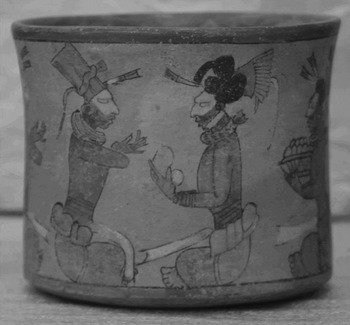
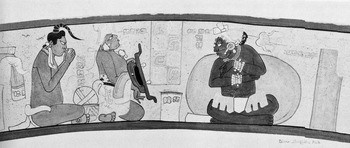
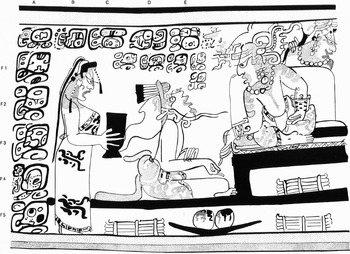
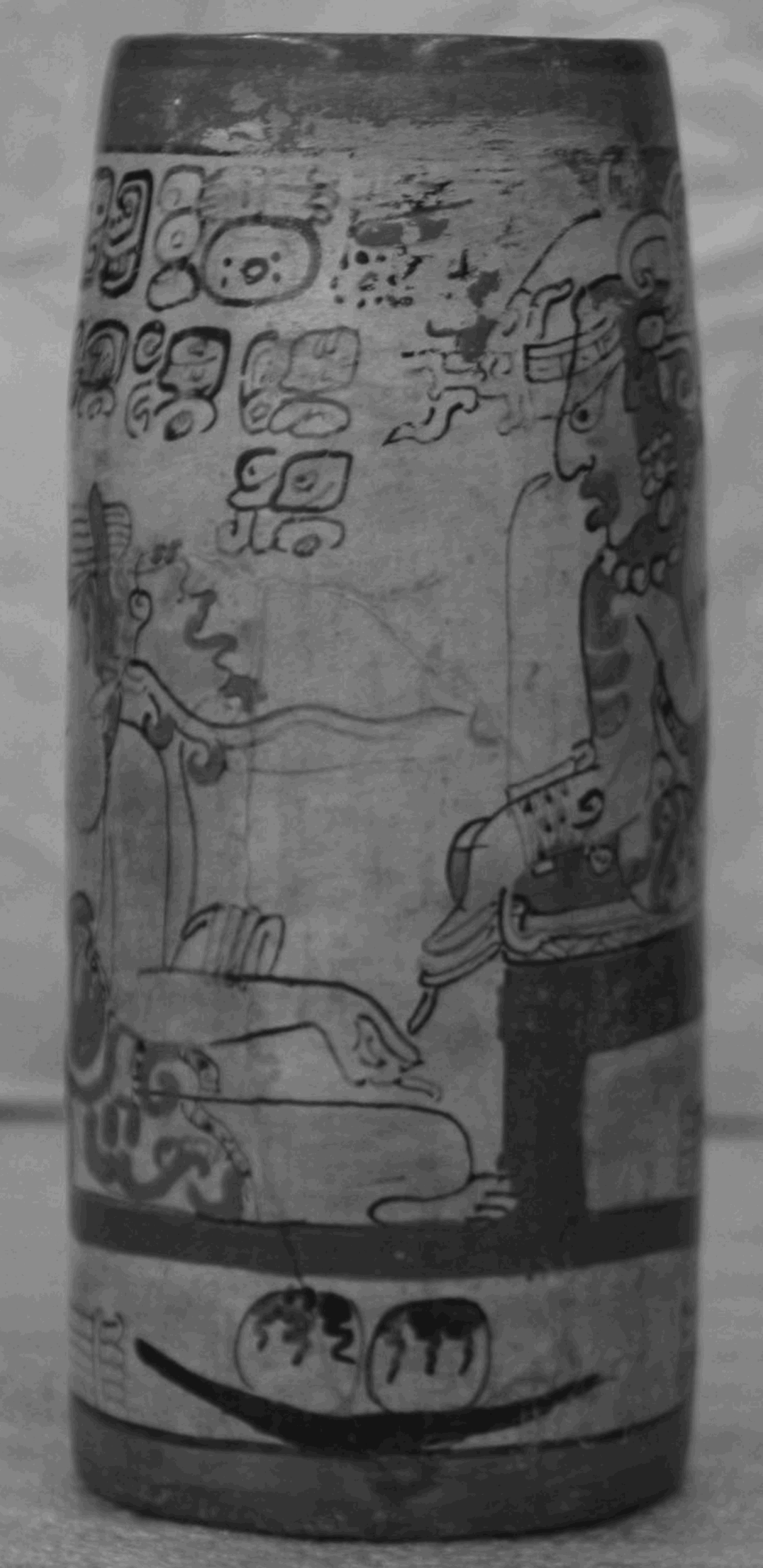
Careful looking and directed gazes appear to play a part in the arrangement of individuals within the court, as shown in the visual engagement between two interacting court members in Figure 3. Hieroglyphic texts suggest that one of the critical roles that officers of the court played was as “witnesses,” who through presence and visual connection served to support, affirm, and acknowledge the actions carried out by the ruler (Houston et al. Reference Houston, Stuart and Taube2006:172–173). In Maya contexts, visual attention is framed in an active light (vs. passive looking): the Classic Maya conceptualized visual senses as projective, with the power of sight emanating from the eye and taking part in a creative act of perception (Houston et al. Reference Houston, Stuart and Taube2006:163–175). Given this active importance of the power of sight, following the gazes of various actors in a given courtly scene becomes significant in identifying connective relationships (even across different vertical/hierarchical levels), as well as locating places of rupture in which individuals situated on the right (upper, or dominant) and left (lower, more base) sides do not meet eyes. Figure 4 depicts such a moment of disconnection between a dominant figure on the right, who meets his own eyes in a mirror, and two subordinate figures on the left who gaze up and down, diverting their eyes from their superior. The projective concept of vision in this context supports the role of vision in relationships, with bonds being created and reinforced through visual acknowledgment; Houston et al. (Reference Houston, Stuart and Taube2006:173) connect the idea of witnessing with that of authorization among high status individuals.
Gazes in the court. Vessel located in the Gardiner Museum of Ceramic Art, Toronto, Ontario. Photo by author, courtesy of the Gardiner Museum of Ceramic Art.

Rupture of gaze, signifying social differentiation and disconnection. Vessel located at Dumbarton Oaks, Washington, DC. Drawing by Diane Griffiths Peck (from Benson Reference Benson and Robertson1974:Figure 11).

The presumed audiences of such courtly tableaux—both individuals in proximity to the lived space of the court, and the audience viewing depictions painted on vessels (Houston Reference Houston and Houston1998:361; Reents-Budet Reference Reents-Budet, Inomata and Houston2001:202)—also involved a visual disconnection. The figures shown on these vessels do not look outward to engage with such viewers, who were allowed to watch but were not drawn directly into the scene. Understandings of the court as a theater (Geertz Reference Geertz1980; Inomata Reference Inomata, Ruiz, de León and Martínez2001a, Reference Inomata, Inomata and Coben2006) describe effectively this dynamic of performers and viewers that characterizes the distanced visual engagement of those observing the court. One other important viewer is worth mentioning: the artist, who was the first to look carefully at the scene, during the very process of production, and who controlled the dynamics of gaze portrayed and experienced through such pots. The artist's specialized training and talent in painting a courtly scene is a reminder that the unmarked, quotidian act of looking becomes charged through its intersection with particular systems of knowledge, meaning, and value wielded by the artist and others in the court.
The privilege of direct or connective gaze not only suggests one element of a codified set of performed behaviors that defines elite identities, and differentiates among ranked elite identities, but also signals the ways in which ordinary actions and nonmaterialized patterns (not directly recoverable through the archaeological record) structured social interaction and marked difference in a lived context. One of the challenges faced in entertaining these proposals of status-related differential behaviors is to connect such intangibles with archaeological evidence in a way that allows for both the reconciliation of these types of evidence and the recruitment of material culture studies into a larger understanding of the lived experience of identity formation and assertion in, and beyond, the Classic Maya court.
Bodily Gesture
In addition to connection forged, or disconnection emphasized, through visual contact or lack thereof, gesture also forms an important aspect of bodily positioning and the demonstration of interaction, as recorded in the stylized arm positions adopted by many in these scenes, such as the gestures of outstretched arms seen on the vessel in Figure 5. Despite studies of the communicative language that such patterned gestures would have conveyed (Ancona-Ha et al. Reference Ancona-Ha, Pérez de Lara, Van Stone, Kerr and Kerr2000; Benson Reference Benson and Robertson1974; Miller Reference Miller1981), the meanings of these positions remain largely inaccessible to a modern audience. The folded arms and outstretched hands that characterize many depictions of courtly figures are, like the directed gazes already discussed, projective in that they implicate space and meaning outside of the contained body and similarly serve to move the discourse of courtly status from individual bodies and into the space between them.
Stylized gestures as projective discourse. Vessel from Burial 196 located in the Morley Museum, Tikal, Guatemala. Drawing by Virginia Greene (from Coe Reference Coe1988:52).

Such gestures in many cases seem to be extended toward specific individuals, and in some cases, merge into categories of touch or near-touch (the “zone of contact” [Houston Reference Houston and Houston1998:341]), as can be seen between the hands of the two central figures in Figure 6. Such instances serve to emphasize the special nature of physical proximity, in which those closest to the ruler have the most direct access to this politico-religious axis. They also highlight the types of intangible social exchanges that happened through these interactions—perhaps most explicitly represented by the presence of “holiness” or “preciousness,” (or, if understood more abstractly, “value”) represented by a strategically positioned glyph, passing between the fingertips of a ruler and subordinate in one courtly scene, seen in Figure 6 (Stuart 1998).
Physical contact and touch within courtly relationships. Vessel (K512) located in the Princeton Art Museum, Princeton, New Jersey (from Coe Reference Coe1973:Figure 43).

Though in many ways still opaque, the use of mutually intelligible bodily gestures supports the framing of the court as a theater (Inomata Reference Inomata, Ruiz, de León and Martínez2001a), even in private and closed contexts vs. moments of public ritual, with the acting out of scripted roles as part of the re-creation of certain identities. The circulation of projected essences, coupled with the codification of bodily movement and position, helps to define individual roles in the court through proximity and connection and serves the paradoxical courtly function of providing a shared, connected communicative identity (perhaps even representing a concept of elite practice [Bourdieu Reference Bourdieu1977, 1984]), while simultaneously emphasizing difference and inequality between individuals (Reents-Budet Reference Reents-Budet, Inomata and Houston2001:216).
Formalized Roles for Courtly Bodies
In thinking about bodies within courtly communities, and differentiated identities therein, one other topic, not entirely resolved, arises in looking at these images: that of courtly membership. Quite a bit is known about titled offices within the court from the hieroglyphic data (Houston and Stuart Reference Houston, Stuart, Inomata and Houston2001; Jackson Reference Jackson2005; Jackson and Stuart Reference Jackson and Stuart2001); yet, that information is very clearly incomplete. Though it has been critical to an understanding of Late Classic period power structures to identify and track sajals, ajk'uhuuns, and other formal office holders, depictions of the court show many more individuals present and engaged than can be accounted for with the relatively limited descriptions of titled officials. It is certain that there are textual records missing (stone monuments that have been looted, or that have not survived, as well as records on other types of media that are no longer extant) that might help account for additional office holders beyond those who are known. It seems equally certain that some high-status members of the court would not have held one of the identified official titles or formal positions (Jackson Reference Jackson2005), even while enjoying the perquisites of courtly access. These apparently untitled individuals, who may have constituted a subcommunity in flux according to the political fortunes of the moment (perhaps akin to postcontact principales, representing a group of “eligibles” [Restall Reference Restall1997:69]), represent a significant lacuna in our grasp of the court as an institution.
Ceramic images, which provide a greater database of actual court scenes than seen on carved monuments, have the potential for providing a window onto this question, and merit additional systematic study in the future with regard to this question. What emerges from the present analysis is the ways in which status differentiation in the bodily marked ways discussed provides a regular, patterned, and legible mode of differentiating individuals who have access to the same space—that of the court. Seating or standing position, gesture, and gaze thus become known and codified organizing principles of differentiated identities in a way that may have echoed the differences conveyed by formal titles. One even wonders if these modes of specification of difference represent different points in the development of an increasingly complex articulated hierarchy. Had the Late Classic era extended further, perhaps such bodily differences would have eventually been translated into additional named positions—a progression of differentiation from “he who stands to the right and gestures to the second lieutenant” to “he who venerates” (one proposed reading for ajk'uhuun) (Jackson and Stuart Reference Jackson and Stuart2001:225).
WIDER VIEWS ON SOCIAL COMMUNITIES: COURTLY VARIATION AND CONTRASTING IDENTITIES
Up to this point, this article has focused on patterns that emerge in examining courtly depictions, representing commonalities across polities in the marking of difference within the space of the court. However, to effectively contextualize the meanings of courtly action and behavior, it is critical to identify relevant external points of contact with a given court. Ceramic imagery indicates engagement with other communities that acted to define local courtly identities: specifically, regional stylistic differences provided visually distinguishable and contrasting versions of courtly institutions. Such regional differences served as outside contexts against which a local court asserted a distinctive identity, defined in part through interaction (Barth Reference Barth and Barth1969; Dumont Reference Dumont1980; Jones Reference Jones1997).
In an earlier section, elements of a shared grammar of courtly depiction were identified, and yet, even given these suggested similarities in depiction across the lowland Maya landscape, it is easy to visually detect regional stylistic differences that transcend the different hands of distinctive artists or workshops, and that represent local understandings of artistic values and conventions of depiction (Ball Reference Ball, Sabloff and Henderson1993; Masson Reference Masson, Masson and Freidel2002). Work by Reents-Budet et al. (Reference Reents-Budet, Bishop, MacLeod and Reents-Budet1994) has helped to define not only visually distinctive regional styles, but also to attach varying chemical signatures to these artistic styles, reflecting the different materials in the production process used and emphasizing the profoundly local character of both the image and the object. One can contrast, for example, Figure 6 (with its fine line and minimal use of color) and Figure 9 (which uses color boldly and highlights contrasts between thin and thick lines) to easily recognize differing styles. These innovations are especially notable in the Late Classic period (Reents-Budet Reference Reents-Budet, Costin and Wright1998), and their distribution may be used to trace the outlines of the political environment of this era (Reents-Budet et al. Reference Reents-Budet, Bishop, Taschek and Ball2000:117).
The variegated political landscape of the Late Classic period means that many individual polities had their own courts. Ideas of courtly identity must thus be examined as a topic of negotiation between courts in different places, reflecting the ways in which elites at a given site would have defined themselves in light of other competing polities and individuals. The movement of images in ceramics, as part of pots that were gifted or traded, would have entailed the circulation of different types of courtly representation, yielding recognizable assertions of local identity. The stylistically different examples mentioned earlier are relatively radical examples of divergence in representation; one can imagine that even much more subtle choices about the type of line, color, or content in such depictions would have been meaningful, and recognizable, to those in regular contact with such vessels.
These variations in courtly imagery support the idea that although there existed shared conceptions of the nature of a courtly institution across the Maya Lowlands, within a prescribed range of possibilities, the precise forms that courts took varied from polity to polity (Reents-Budet Reference Reents-Budet, Inomata and Houston2001:222). Evidence from the hieroglyphic texts bolsters the concept that shared ideas of the nature of a “court” were present throughout the lowlands at the same time that divergent, local versions were in use. Specifically, hieroglyphic data have confirmed that across the lowlands, the patterns of titles used—drawing from a set of five formal positions—differed from place to place, yielding mutually intelligible, but variable, courtly institutions (Jackson Reference Jackson2005; Stuart Reference Stuart1983). Both text and image are thus used to mark, and contrast, local identity in ways that would have been clear to those able to read the texts on these vessels, as well as those interacting primarily with the images. Even in the midst of constructing locally salient styles, and communities, Maya elites at many sites were aware of the parameters of what a court “looked like” in the context of the wider Maya Lowlands.
Regionally varying artistic styles play a complementary role in demonstrating that courts were composed and expressed in different ways in different places. Given the portable (and prestigious) nature of these ceramic objects, they would have frequently moved beyond the borders of their home polity as part of courtly visits and gifting (LeCount Reference LeCount1996), suggesting that not only were interpretations of the nature of the court locally determined, but also that such local manifestations were asserted at home and abroad as an aspect of polity identity. In this sense, different courts acted competitively and recognized themselves as exhibiting differently defined identities. Representations of the court were used to suggest not just inequality or hierarchy in one place, but an asserted difference in (and inequality of) regionally divergent versions of courts. Such contrasts, made apparent as the result of a constellation of artistic and political decisions, highlight the tensions that existed between courts, each of which would have conceived of itself as the central ritual/political axis.
WIDER VIEWS ON SOCIAL COMMUNITIES: SUPERNATURAL PARALLELS
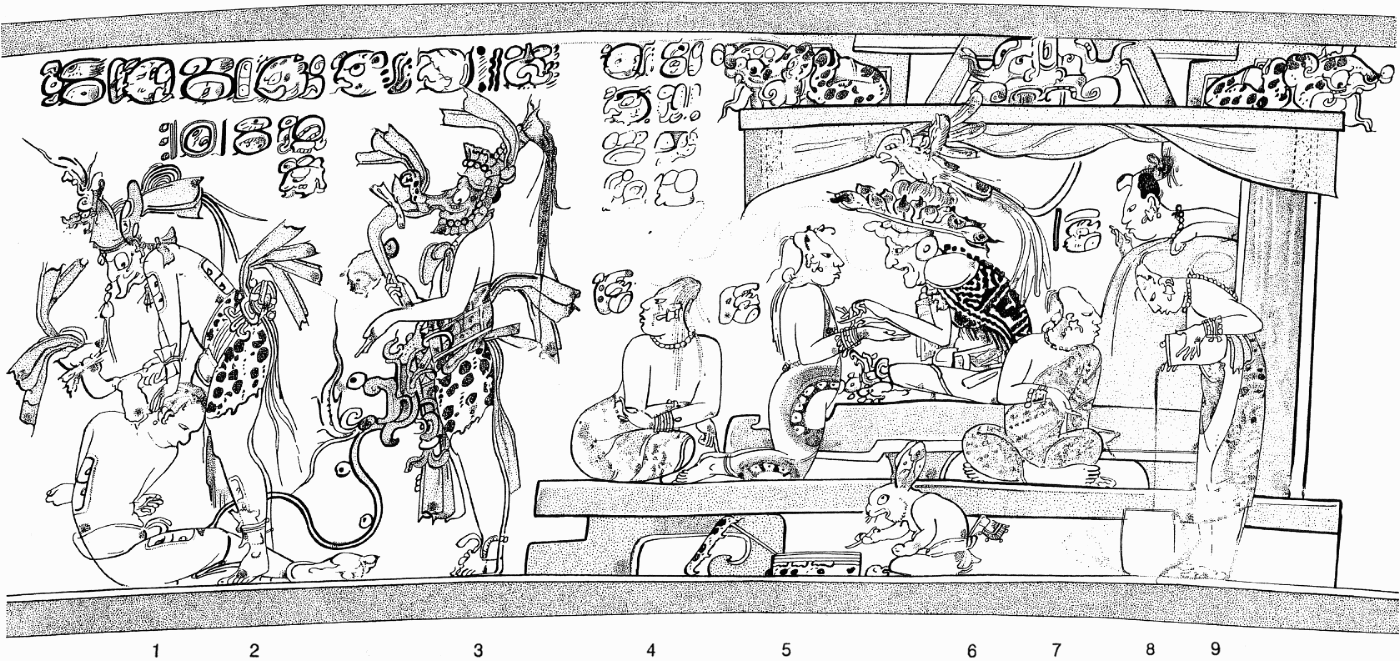
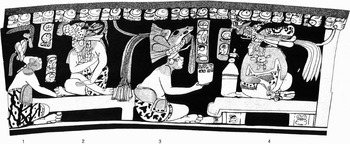
In addition to the wider social world of other polities' courts, depictions on ceramic vessels set up an explicit connection with another outside referent: supernatural courts. There are, in fact, quite a few depictions of courts on ceramic vessels that are not located in an earthly realm, nor are populated by human individuals. Important ideas about the origins of the court and the significance of differentiation emerge from understanding the complementary duality of depictions of human and godly courts. Figure 7 shows a supernatural court, which follows many patterns of depiction of a human court, but is occupied by supernatural individuals. The representation of supernatural courts further highlights an engagement with external contexts in defining the court, through the drawing of explicit parallels between these two spaces—worldly and otherworldly. Both types of external context (supernatural courts and regionally variant courts) show the importance of situating local courts within the ideational topography in which they operated and indicate the awareness of court members of analogous spaces in other places and realms.
The supernatural court as a parallel to human-occupied courts. Vessel located in the Princeton Art Museum, Princeton, New Jersey (from Coe Reference Coe1973:Figure 42).
Studies of elite courtiers based on hieroglyphic texts and depictions on carved monuments have indicated that one source of prestige for courtly elites derived from the close connections they drew between their roles in a historical court and parallel, otherworldly forces (Jackson Reference Jackson2005:237–238, 625–626). Realms of historical political spaces and cosmological gatherings are drawn together and framed as overlapping through the use of political titles expressing connection to gods rather than rulers, and more broadly, through the construction of analogies that express the roles of the court as echoing those of the gods (Fash Reference Fash and Webster1989; Houston Reference Houston and Houston1998:352–356; Jackson Reference Jackson2005:238, 294–296, 302).
Adding to these known intersections between worlds, images on painted ceramics depict both apparent courts that are populated by deities, as well as “mixed courts” that show interaction between humans and gods. Significantly, the images of ceramic vessels that fall into these categories seem to follow similar rules of depiction and tropes of bodily relationships as courts that represent human actualities or ideals. Some scholars have suggested that depictions of supernaturals may involve an inversion of typical spatial patterns of orientation (Houston Reference Houston and Houston1998:341; Palka Reference Palka2002:431). Even in cases in which the expected organizational tropes are inverted, the contexts are still relationally recognizable as courts, even if clearly signaling—through their opposition to the norm—a special space.
The implied or asserted connections between historical, or worldly, courts and their parallel meeting places in, or of, the otherworld reveal a number of important things about Classic Maya courts that refine an understanding of courtly locales. Perhaps most importantly, this supernatural connection sheds light on the political changes and machinations of the Late Classic era, a period that is well-understood as representing a period of sociopolitical shift, involving increasing numbers of elites and titled elites (Houston Reference Houston1993; Houston and Stuart Reference Houston, Stuart, Inomata and Houston2001; Jackson Reference Jackson2005). In particular, the use of formalized titles grew sharply throughout the entire Late Classic period. This change in usage shows a political strategy employed by increasingly embattled Maya rulers, who may have been attempting to consolidate weakened power and/or keep potential insurgents close at hand (Fash Reference Fash1988; Fash and Stuart Reference Fash, Stuart and Culbert1991), and represents the importance of a robust court community as a collective locus of power. The representations of deity-inhabited courts in this period, and the explicit parallels represented between human and supernatural courts, reveal something of how this institution was conceptualized. Specifically, the Late Classic power sharing of courtly communities was seen as (or, represented by savvy rulers as) natural and divinely sanctioned, echoing arrangements that organized power at the highest, divine levels of existence.
In addition to shedding light on Maya understandings of the origins and meaning of courts, depictions on ceramics of supernatural courts provoke a shift in the understanding of power dynamics in Late Classic society. As part of an increasingly clear understanding of the types of power sharing occurring in the Late Classic period, these parallels indicate that cosmological sources of power and authority that have often been associated primarily with the ruler himself, a key intermediary between worlds, may also have been accessible to the courtly community as a whole. This realization further contributes to an understanding of elite status, emphasizing that one of the privileges that differentiated elites who were part of courtly communities was access to, and relationship with, otherworldly entities and power, not just proximity to a historical political authority and associated courtly material trappings. In this way, patterns of ritual action and access that once were the domain of the k'uhul ajaw become shared in the Late Classic period, along with the material and political aspects of authority embodied in other Late Classic markers of organizational change, such as the use of the council house (Fash et al. Reference Fash, Lane, Larios, Schele, Stomper, Stuart and Fash1992) as a space of shared decision making.
MATERIALIZATIONS OF COURTLY COMMUNITIES
Thinking about the impact of Late Classic ideas and experiences on action and space brings the present argument to a consideration of materializations of the courtly practices discussed. Here, materializations are considered both in terms of the architecture of the court as a bounded space and, finally, in terms of the ceramic vessels themselves, carrying the images that have been considered in this study. In each of these cases, the raw physical materials are imbued with social power due to the transformative processes of both production and perception of the materialized form (McAnany Reference McAnany, Sabloff and Henderson1993).
Architectural Space of the Court
The idea of the court encompasses both the social and physical spaces inhabited by elite individuals at the heart of the polity (Inomata and Houston Reference Inomata, Houston, Inomata and Houston2001a:3), and as such, patterns of representation may be expected to reflect both the social community of the court and the physical/spatial aspects of courtly materializations that framed these individuals. Architecture of the court is typically represented on ceramic imagery through pillars, the ceiling, and sometimes stairs, as well as the throne or bench on which the ruler sits (Houston Reference Houston and Houston1998; Reents-Budet Reference Reents-Budet, Inomata and Houston2001), as seen in Figure 8, in which the ruler is seated on a bench and framed by architectural elements.
Architectural framing of the physical space of the court. Vessel located in the Gardiner Museum of Ceramic Art, Toronto, Ontario. Photo by author, courtesy of the Gardiner Museum of Ceramic Art.

The framing of walls and roof, as discussed in detailed examinations of architectural depictions by other scholars (Houston Reference Houston and Houston1998; Reents-Budet Reference Reents-Budet, Inomata and Houston2001), serves as a reminder of the built environment that literally contains the court and, metaphorically, acts as a container for the social substances that characterize the court (Moore Reference Moore1996). The internal location of courtly consultations stresses their privacy (or, if partially visible through doorways, their architectural separation) and the importance of architectural spaces as contextualizing devices for the types of interactions that occurred within these spaces, in contrast to those interactions occurring outside. The implication that courtly performances—not just in formally scripted moments of ritual actions, but also during periods of social interactions (scripted in another way)—may have been partly visually accessible to some noncourt members supports the idea of the court as a place of cultural production, with behavioral and bodily ideals presented for replication, though likely in modified form, outside of the space of the court.
In addition to architectural framing, representations of the court frequently feature a throne or bench on which the central individual is seated (Harrison Reference Harrison, Inomata and Houston2001; Reents-Budet Reference Reents-Budet, Inomata and Houston2001:203–204), an item that may be read as central to his identity among a hierarchically organized set of individuals and which serves to elevate his body above the others depicted. Furthermore, the trope of sitting, and being seated upon a special seat, recurs in text and image as a critical device for distinguishing individuals holding official office, as seen in the use of the verb chum, referring to seating, as a descriptor of accession. Thrones, thus, not only represented a particular perk of elite status, but also served as a materialized reminder of the ritual process through which an individual acceded to a particular office, and thus to a particular locus within a larger hierarchy. In this way, thrones in courtly scenes, and within the actual space of the court itself, should be seen as more than imperial furniture, and instead provide insight into materialized sources of status within the court as well as the active importance objects play in the identities constructed within the court.
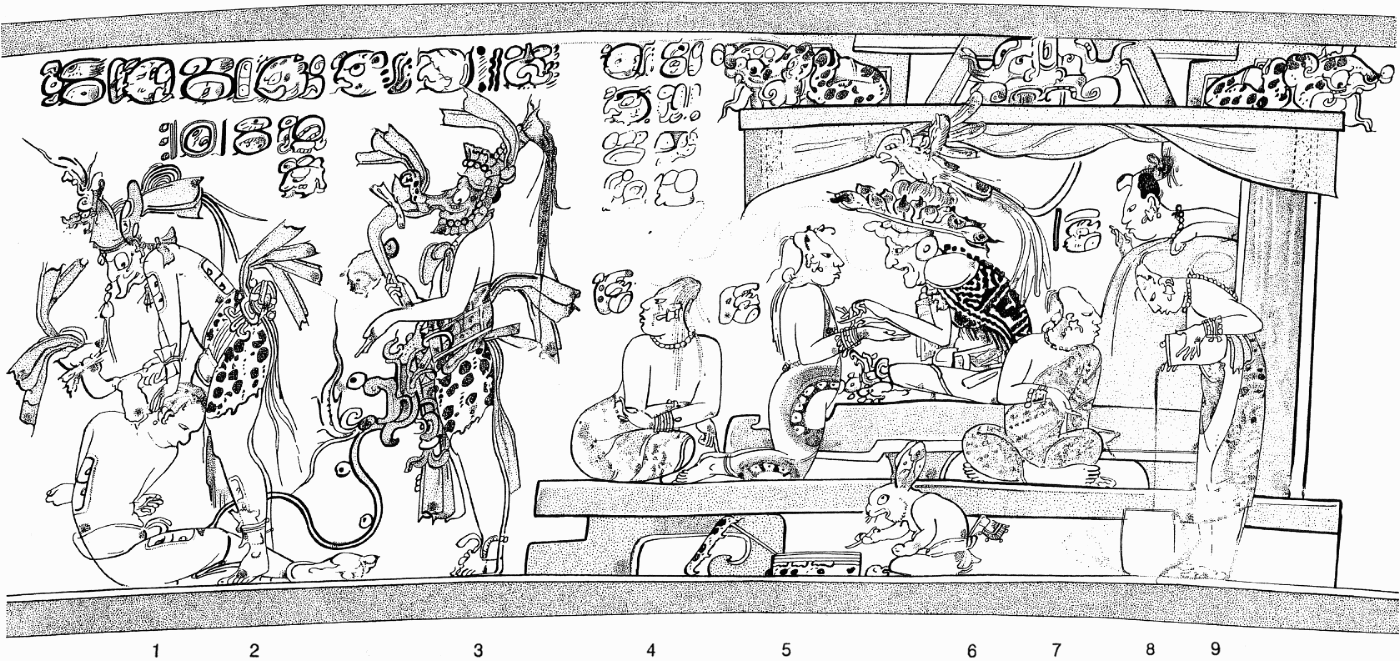
The masonry of walls and benches shown in courtly scenes is often augmented by a less literal building material: hieroglyphic texts (Reents-Budet Reference Reents-Budet, Inomata and Houston2001:202–203). The image in Figure 9 shows such an instance, in which the framing of the central image is accomplished by a row and column of hieroglyphs, serving the same visual function as more traditional architectural elements would. Inscriptions may form framing devices in such images. In a literal sense, they may be understood as adorning structural elements (reflected in archaeological contexts through, for example, hieroglyphic benches such as the elaborate ones found at Copan [Fash Reference Fash1991]), but in many cases, columns of text stand alone in representations, with glyphs serving a structural function. The use of glyphs to mark the charged surface of the throne and delimit the spatial container of the physical court highlights text as a limited resource, representing the power and separation of specialized knowledge, employed both to indicate the outside edges of the court, and to underscore—literally, in the case of the throne—the place of the ruler.
Hieroglyphic texts, representing limited resources, as a structural frame for the court. Vessel located in the Gardiner Museum of Ceramic Art, Toronto, Ontario (from Coe Reference Coe1973:Figure 27).

Significantly, in some images, this same role is played by pseudoglyphs, which take on the gesture of text without providing the informational content (Calvin Reference Calvin2006). In the case of pseudotexts, one sees the role that textual display (not just specific textual information and literacy related to real texts) played in marking the other and special space of the court, and those who used it. Although, presumably, beautifully executed painted vessels with actual hieroglyphic texts on them would have been especially valued in the courtly exchange of such exemplary representations, Calvin (Reference Calvin2006:223–224) has noted that vessels with pseudoglyphs have ended up in notably high status burial contexts, indicating that the textual gestalt of pseudoglyphs is not exclusively a result of lack of prestige, coupled with lack of knowledge. Instead, the form (vs. the content) should be recognized as paramount, with pseudoglyphs effectively communicating messages of historical precedent, restricted knowledge, and supernatural creation in the same way that real hieroglyphic texts, filled with specific information, would have.
Pots as Objects
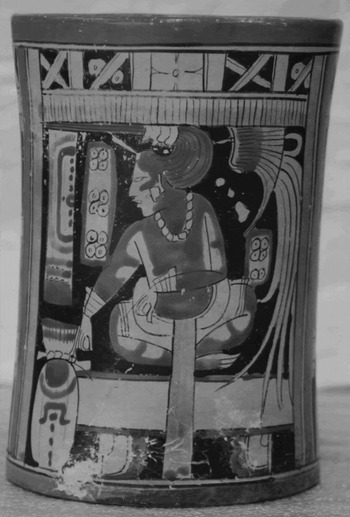
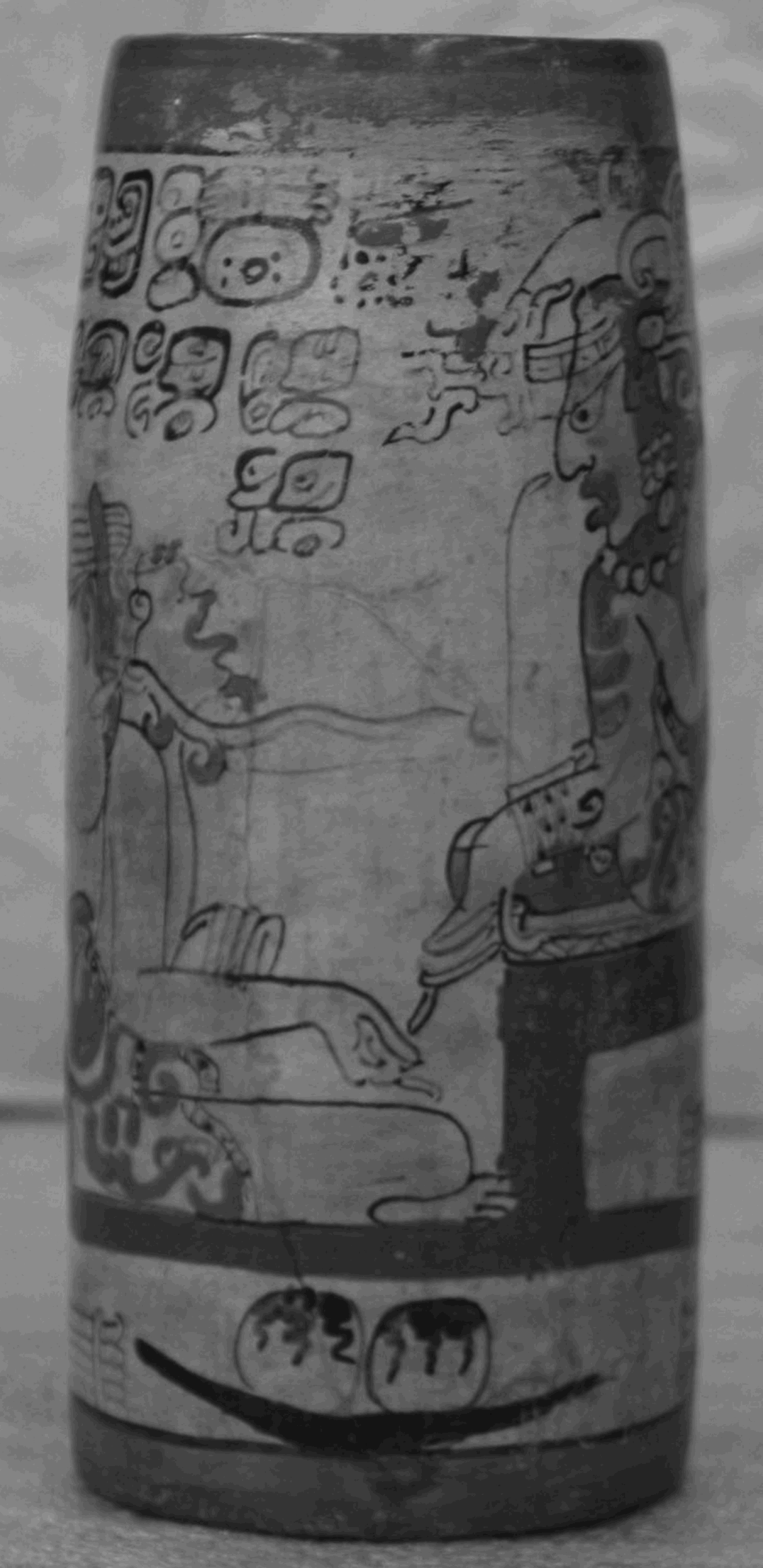
Considering ceramic vessels, in particular, as communicative (and even active) objects within the court forces a recasting of the gaze, pulling back from the images—often shown as rectangular rollout photographs—that have been the primary focus of this article so far, and reengaging with the objects themselves that carry such depictions. One can contrast Figures 9 and 10, different types of representations of the same ceramic vessel, to see the differences between approaching the pot as primarily a vehicle for an iconographic depiction (Figure 9) or as an object in its own right (Figure 10). Primary standard sequence texts painted on these vessels, which often name the form of the vessel, remind us of the Maya experience of these objects as functional forms (Houston et al. Reference Houston, Stuart and Taube1989; Stuart Reference Stuart and Kerr1989). Important information is dually encoded in painted ceramics, both as part of the images under discussion here, and in the form of the vessel as a valued and circulated status object. These painted ceramic vessels, bearing representations of the court, afford an opportunity to unite an understanding of materialized versions of ideas (in this case, representations of status, identity, and value in the form of polychrome vessels) with iconographic renderings of related lived experiences (here, the enacted differentiation of the court). These are not only complementary lines of evidence, but also ones that were directly related for the Maya and would have been experienced and understood together, through their confluence in, and on, the form of a particular vessel. The analytic refocusing on these objects not only as economically significant commodities, but also as agents for transmission of value, or values (or, “incarnated signs” that communicate social and political messages [Appadurai Reference Appadurai and Appadurai1988:38]), provides a key point of contact between the world of material remains and the community experience that is the emphasis of this study (Appadurai Reference Appadurai and Appadurai1988).
Seeing pots as objects vs. pots as vehicles for iconographic representation. Vessel located in the Gardiner Museum of Ceramic Art, Toronto, Ontario. Photo by author, courtesy of the Gardiner Museum of Ceramic Art.
Whereas the previous discussion highlighted the embodied, and largely nonmaterial, forms that status may take, material objects also clearly play an important part in courtly performances of identity, and represent some of the tangible essences and valuables that circulated within the court. Certainly, bodily experience is intertwined with the presence and usage of certain types of objects (one imagines the smooth exterior of a burnished vessel, the scent or taste of cacao) (Bourdieu Reference Bourdieu1984:77; Reents-Budet Reference Reents-Budet, Inomata and Houston2001:224). Just as bodily dispositions such as gaze and gesture were argued to provide insight into the relationships and inequalities of the court, valued material objects (such as ceramics, but also including other gift and tribute items) similarly trace connections, obligations, and entanglements, and act as currency in the ongoing identity negotiations that would have marked courtly experience. Additionally, as objects loaded with meaning (aesthetic, social, economic), they reflect certain tastes that mark elite cultural competency in accessing and appreciating such objects (Bourdieu Reference Bourdieu1984).
In this light, it is productive to keep a close eye on fineware pots in the archaeological record and to trace their production and subsequent movements through stylistic and chemical analyses. However, to view these objects as passive fails to acknowledge the complexity of interaction between humans and the objects with which they interact and the active roles that such objects play in, for example, creating and asserting identities. Considering a dissolution of the Cartesian-inspired dichotomy of human and object (Boast Reference Boast1997:174) and a softening of boundaries between different classificatory distinctions of our world (Latour Reference Latour1993) acknowledges the fundamental imbrication of human experience with the material world (Boast Reference Boast1997:180) and leads to a shift in how material culture is understood and interpreted by archaeologists. In particular, anthropological and archaeological goals of accessing emic worldviews demand that our own cultural assumptions about human relationships with the surrounding world are examined carefully and, in some cases, set aside (Tanner and Osborne Reference Tanner, Osborne, Osborne and Tanner2007:21). In entertaining the idea that objects may act as agents (even if as secondary agents, to use Gell's term, serving as extensions or delegates of the intention and will of a human being [Boast Reference Boast1997:188; Gell Reference Gell1998:20–21]), these objects then become social mediators between people (Dant Reference Dant1999:13), understood to cause things to happen in some way (Gell Reference Gell1998:16–17), and also act as “trustworthy witnesses” (Latour Reference Latour1993:23) (the latter describing a function that resonates with known roles within the Classic Maya court). Acknowledging the ceramic vessels under discussion here as nonhuman agents inspires a reengagement with “how objects construct the subject” (Olsen Reference Olsen2003:100), impacting how human actors move, think, feel, and act in an inhabited world. Objects become fellow “participant[s] in the discussion” of a particular social world (Boast Reference Boast1997:190). In the case of the court, painted ceramic vessels act in part as a mirror for courtly members, reflecting back, and reinforcing, their own impressions of their distinctive lifestyle.
Gell (Reference Gell1998:24) has observed that “art objects lead very transactional lives.” Understanding objects as active agents demands an examination of their lifecycle of use, including the processes and contexts of their production, contextualized as a social process (Flad and Hruby Reference Flad, Hruby, Hruby and Flad2007). Classic Maya beliefs associated with specialized craft production suggest that even the creation of special, elite-owned or -commissioned objects can reveal how such objects marked distinctive elite actions and knowledge. At Aguateca, Inomata has explored the close association of specialized types of craft production with the court, representing another form of specialized knowledge (Inomata Reference Inomata2001b; Inomata and Triadan Reference Inomata and Triadan2000). Buenavista del Cayo provides another likely example of a palace-tied ceramic workshop similarly indicating the connection between elites and specialized production (Reents-Budet et al. Reference Reents-Budet, Bishop, Taschek and Ball2000). Production of these types of objects is further framed in an exemplary fashion through the connection of the creative acts of such artisans in producing beautiful or special objects with the creative powers of the gods (Inomata Reference Inomata2001b; Reents-Budet Reference Reents-Budet, Costin and Wright1998). Inomata (Reference Inomata, Hruby and Flad2007:131) argues that the value and prestige connected to the creation of objects, as well as the specialized knowledge involved, move processes of artistic production into an explicitly political sphere; such technical knowledge is coupled with the knowledge necessary to read such expressions (Appadurai Reference Appadurai and Appadurai1988:41).
Post-production, ceramic vessels as portable objects have the possibility of moving, both within and beyond a polity (Coggins Reference Coggins1975; LeCount Reference LeCount1996; Reents-Budet Reference Reents-Budet1994; Schele and Mathews Reference Schele, Mathews and Culbert1991)—an idea already mentioned in terms of stylistic differences that assert local identities outside of a polity. Pots, and other gift and tribute items, help to frame economic wealth as a dynamic category that regulates and marks changing identities, negotiated relationships, and the success (or failure) of enacted strategies, rather than acting as a static index of social standing. The exchange of such pots, and their removal from the initial context of manufacture, indicates the value placed on the relationships (economic or social) that structured these objects' movements and reveals their active role in facilitating such relationships.
In addition, viewing ceramic vessels in their role as objects reminds us of the importance of retaining an explicitly archaeological perspective on them, of considering their contexts and the ways such information impacts interpretation. In moving our attention over the course of this article between the painted scenes that decorate these vessels and the vessels as objects, I attempt to engage with material culture and materialized aspects of certain values and meanings as part of understanding both the iconographic depictions on such pots and the ways such objects played roles in ancient Maya social lives. Although relating depictions and styles employed on particular vessels to specific excavation data is beyond the scope of the present article, such studies represent an important next step: by examining these objects within the specific contexts of their manufacture, use, and deposition, they become socialized within distinctive spaces. Further work on these local connections might focus on possible echoes of the built environment in painted imagery (e.g., Houston Reference Houston and Houston1998:362; though Reents-Budet [2001:204–205] observes a “lack of architectural specificity” in these depictions), intersections—or lack thereof—between the context of deposition (whether tomb or midden) and the depicted context of use, and even the identity and belongings of the person with whom it was associated (in the case of burial contexts, a common space from which such objects are recovered). Overall, this tack of investigation will further develop the important connections between analysis of these objects as “art” (carrying detailed scenes and images) and as “artifact” (playing a part in ancient lives as material culture).
Even though investigating objects through this combined archaeological and iconographic perspective will add important insights to the work of this article, it also must be acknowledged that such an endeavor will be inherently challenging due to the often sketchy proveniences of these finely decorated objects. Unfortunately, many are removed from their places of deposition by looters and in the process lose valuable contextual information. Other such objects, such as many in museums, were recovered in earlier eras of archaeology in which different standards of information recording prevailed, depriving the modern researcher of desired detail. All of the objects depicted in this article have been excavated by archaeologists or are in museums that are open to the public, indicating that their process of acquisition meets modern ethical standards (though some may debate whether such standards, especially for museum acquisition, should be even higher), and that they are visually available to researchers and laypeople alike. These challenges point to the critical importance of objects being recovered in scientific excavations, with provenience and context fastidiously recorded. Additionally, the importance of ongoing engagement with existing museum collections is highlighted here: many artifacts, both ceramic vessels and other types, already residing in museums deserve additional investigation to reconstruct their life histories, before and after excavation, and to extract as much information from them as possible.
Through their cosmological connections, their travels to different polities, and their roles in maintaining relationships, ceramic vessels may be conceptualized as courtly players in their own right, material complements to the human actors who populated the court. In fact, returning to the depictions of courts of ceramic vessels, one notices that a commonly depicted element in painted courtly scenes is ceramic vessels themselves. The courtly scene in Figure 11, for example, shows a lidded vessel placed on the bench next to the courtier on the right of the image; the same individual is also being offered a ceramic vessel decorated with glyphs by the supplicant to the left of his throne. Pots—acting as nonhuman agents—are seen seated on thrones, in close proximity to the body of the ruler; moving between individuals, thus facilitating the personal and material interactions that formed the fabric of the court; and “seated” below and in front of the throne (lined up, analogous to other court members), and often holding food, consumption of which provides another avenue for social integration and differentiation within the court (LeCount Reference LeCount2001). Their role is clearly relational (Gell Reference Gell1998:22), underscoring the point that interpretive avenues must widen beyond understanding such artifacts as solely vehicles for meaning (Tanner and Osborne Reference Tanner, Osborne, Osborne and Tanner2007:23). In addition, such objects are related to expression of identity in a courtly context through the recursive owning and gifting of visual expressions of the nature of the court—and, specifically, individualized local courts. Ceramic vessels, along with the other valued objects portrayed in courtly scenes, act as mediators of the relationships that enliven the court, whether between the ruler and other individuals present, or between the ruler and not-present entities. Such apparently inert objects serve as material representations of relationships of inequality (stemming from economic obligation, social debt, differential power access, etc.) that, in turn, serve to arrange the dynamic bodies that populate the court.
Depictions of ceramic vessels on ceramic vessels, acting as courtly players. Vessel located in the New Orleans Museum of Art, New Orleans, Louisiana (from Coe Reference Coe1973:Figure 29).

The dual roles of pots as both literal and metaphorical containers means that while they may hold material—and archaeologically detectable—substances such as cacao, or meat, or tamales, they simultaneously hold intangible substances such as specialized knowledge, local identities, or personal connections that would have been as real and important to Classic Maya individuals as foodstuffs. The goal for archaeologists is, through the material remains of the archaeological record, to access both tangible and intangible substances to understand how these “things” were used to position self and other in a mutually intelligible social network of the past.
CONCLUSIONS
These reflections have approached Late Classic Maya courtly communities with optimism and imagination, in an effort to explore a lively world in which an ideational interest in the past firmly intersects with material evidence, and the materializations of those ideas. In addition to shedding light on the institution of the court and the status structures that formed it, the data examined here also yielded some ruminations on the imbrication of the material and immaterial and suggested how these might productively be examined in considering courtly communities from a lived perspective.
The court emerges, in this study, as an institution marked by regular rules: patterns appear showing how individuals are spatially and socially organized and how they interact from those places. The importance of continual restructuring of such positions is emphasized through the quotidian nature of many of these “acts of positioning,” such as gesture, gaze, and—one might imagine—speech acts, which played key parts in establishing a regular and coherent practice of the court. Fluent use of these practices represented another kind of specialized knowledge. Significantly, these types of actions would not have required the public performance of formalized ritual events (another avenue for courtly assertions of power) to convey and reinforce messages about roles within the court.
These perspectives, and speculations, on what the courtly experience of hierarchy might have been like emphasize the importance of relative relationships between individuals in addition to inherent possession of power (Dumont Reference Dumont1980). The set of relationships identified here indicate the paradoxical nature of royal courts. These are communities based on shared practice and mutually intelligible action, yet these actions are explicitly used in the service of pervasive enaction of differentiation. The past communities that I have imagined in this article represent explicitly recognized collectives of power within individual courts, but they might also include less formally articulated communities of shared understandings of distinctively Late Classic versions of political organization, yielding not a formal pan-Maya elite community but rather a common and agreed-upon set of rules and practices for understanding difference and how it served to organize individuals and groups. In understanding these important ideas of difference, the key aspects of courtly depictions indicate that, although material display (including not only objects, but also architecture, hieroglyphic texts, costumery, and other luxury items) certainly is of importance in demonstrating one's position, understanding the material world as containing intangible (that is, nonmaterialized) essences may prove useful in forging connections between emic perspectives on status and the archaeological record.
Archaeologically, these observations suggest that, when interpreted in concert with primary sources such as iconographic depictions and hieroglyphic records, material remains encountered in the archaeological record may be recast as meaningful agents (rather than passive possessions) within the mental landscapes of past human actors. Specifically, this article outlines parameters of a particular kind of social community, repeated in various courts across the Maya area, and, in the process, suggest how objects served to reinforce the identities within this social and physical space. This perspective suggests that archaeological investigations, in addition to ongoing goals of determining context and meaning for recovered objects, must also perceive them as involved in two-way relationships with the people who used them and consider both how individuals acted upon and used the objects and how the objects impacted past individuals.
Such a relational approach to reconstructing social and material aspects of past communities will prove important, and applicable, to contexts far outside of the royal court as well. In much humbler contexts, differentiated relationships between individuals, and profound relationships between humans and objects, would also have structured daily discourse and provided local affirmations of identity. Reading perishable architecture and utilitarian pottery as containers for essences related to self and community serves as a critical reminder about the ways in which differentiation of individuals and groups into agreed-upon identities occurred at all levels of Maya society (not only the upper echelons), and are processes that can be read through the material partners implicated in such expressions. Understanding local Classic Maya identities and communities at all status levels is a goal within our grasp.
RESUMEN
La cerámica pintada de los mayas del período clásico tardío muestra escenas de la corte real, y puede proveer una vista a esta comunidad de la corte como institución construida por relaciones entre individuos y manifestada por acción y práctica. Por ejemplo, se pueden estudiar las ubicaciones relativas de cuerpos en los dibujos, los gestos codificados de brazos y manos, y las miradas que conectan gente diferente. Se puede examinar la cerámica como objetos que circularon, y representaron los valores de la corte en forma material. Al mismo tiempo, funcionaron como vehículos de iconografía que comunicaban representaciones ideales de la jerarquía de la corte y como esta jerarquía fue construida. A través de estas dos líneas de evidencia, arqueólogos pueden integrar más efectivamente las investigaciones materiales e iconográficas. Afirmaciones de identidad y estatus se examinaron por la manera en que están “contenidas” en las vasijas decoradas, y emergen caracterizadas por una serie de unificaciones y oposiciones simultáneas. Este fenómeno se manifiesta en ejemplos como los contrastes entre los estilos artísticos de ciudades diferentes en representar imagenes de la corte, representando concepciones locales de la institución de la corte; sin embargo, todas las representaciones se conforman a conceptos sobre la estructura de una corte compartidos en todas las tierras bajas mayas. También, se examinan los paralelos interesantes entre cortes del mundo humano y cortes supernaturales, lo cual provee un origen cosmológico para las estrategias políticas de los reyes del clásico tardío en usar cortes como un espacio de poder compartido. El enfoque en compartimientos e interacciones, y también en los modos en que dichos objetos jugaron un papel en la corte favorecen un entendimiento de una corte maya como entidad étnica y una perspectiva más amplia sobre los procesos de la identidad y la diferenciación entre los mayas clásicos.
ACKNOWLEDGMENTS
The initial idea of looking at ceramic vessels to understand nontitled members of the court emerged quite a few years ago after David Stuart encouraged me to consider looking at imagery on ceramics in addition to the monuments and texts I was then examining—thanks to him for setting me off on a very interesting trail. This article has been significantly strengthened and clarified through the very helpful commentary of Takeshi Inomata and Francisco Estrada-Belli; many thanks to them for their incisive critiques. In the course of writing this article, Justin Kerr kindly answered a variety of my questions surrounding painted ceramic vessels. Thanks to the Foundation for the Advancement of Mesoamerica Studies, Inc., and Sylvia Perrine for granting me the permission to use one of Linda Schele's fine drawings. I am grateful to the Gardiner Museum of Ceramic Art in Toronto, and Sue Jefferies and Siobhan Boyd in particular, for generously allowing me to photograph vessels in the collection there. I also thank Susanna Rosenbaum and Francisco Estrada-Belli for their editing help on the Spanish summary. As ever, all errors and shortcomings there, and in all parts of the article, are my own.