Introduction
Glycine soja Sieb. & Zucc. (also known as wild soybean) is an annual twining plant in the family Leguminosae (Hymowitz, Reference Hymowitz1970). The species is native to East Asia with a wide ecological and geographical range, and thus is adapted to varied environmental conditions (Li et al., Reference Li, Zhou, Ma, Jiang, Jin, Zhang, Guo, Zhang, Sui, Zheng and Zhang2014; Leamy et al., Reference Leamy, Lee, Mjuacic, Quigley, Nelson, Luo, Chen, Peregrine and Song2016). Wild soybean is believed to be the ancestor of cultivated soybean (Glycine max L. Merr.), which was domesticated more than 3000 years ago (Carter et al., Reference Carter, Nelson, Sneller, Cui, Boerma and Specht2004). Though wild and cultivated soybeans are similar in genetic makeup and are cross-compatible, the species are distinct in many agro-morphological characteristics as well as in seed composition (Hermann, Reference Hermann1962; Liu et al., Reference Liu, Fujita, Yan, Sakamoto, Xu and Abe2007; Wee et al., Reference Wee, Hashiguchi, Ishigaki, Muguerza, Oba, Abe, Harada and Akashi2017; La et al., Reference La, Large, Taliercio, Song, Gillman, Xu, Nguyen, Shannon and Scaboo2019). Wild soybeans harbour a broader genetic diversity than cultivated soybeans and possess important genes/loci involved with disease resistance, stress tolerance, nutrition and yield (Hyten et al., Reference Hyten, Song, Zhu, Choi, Nelson, Costa, Specht, Shoemaker and Cregan2006; Kofsky et al., Reference Kofsky, Zhang and Song2018). Thus, wild soybeans are a rich and valuable genetic resource that need to be characterized and conserved in order to maintain plant genetic diversity and sustain crop improvement. In Japan, wild soybeans have been collected from diverse habitats throughout the country and preserved as useful germplasm resources in the National BioResource Project for almost two decades (Hashiguchi et al., Reference Hashiguchi, Abe, Aoki, Anai, Suzuki and Akashi2012).
Free amino acids, important seed compounds, play vital roles in many seed metabolic processes, serving as precursors for numerous key metabolites during seed development and providing signal and regulatory molecules in plant responses to stress (Rai, Reference Rai2002; Amir et al., Reference Amir, Galili and Cohen2018). Under abiotic stress, significant alterations in the levels of some amino acids have been observed in leguminous seeds, implying a role of legume amino acids in the adaptation to harsh conditions (Labanauskas et al., Reference Labanauskas, Shouse, Stolzy and Handy1981; Nayyar et al., Reference Nayyar, Kaur, Singh and Upadhyaya2006; Chebrolu et al., Reference Chebrolu, Fritschi, Ye, Krishnan, Smith and Gillman2016; Yobi et al., Reference Yobi, Bagaza, Batushansky, Shrestha, Emery, Holden, Turner-Hissong, Miller, Mawhinney and Angelovici2020). Despite the importance of free amino acids in legume seeds, free amino acid profiles of diverse germplasm accessions have not previously been reported. Thus, investigation of seed amino acid levels in wild soybean resources will not only reveal the diversity of wild soybeans but may also offer new variations for further improvement of the amino acid composition in cultivated crops. Therefore, the objective of this study was to assess the phenotypic variation in free amino acid content in the seeds of wild soybean germplasm collected from a broad geographical range in Japan.
Materials and methods
Plant materials
A total of 316 accessions of wild soybean used in this study were collected from throughout Japan and were obtained from Legumebase (http://www.legumebase.brc.miyazaki-u.ac.jp/), a resource centre curated by the National BioResource Project Lotus and Glycine. The collection sites of all accessions are shown in online Supplementary Fig. S1 and Table S1. Planting was carried out in June 2017 in a greenhouse at the Kibana Agricultural Science Station, University of Miyazaki, Japan (31°49′44″N and 131°24′43″E). Each of the accessions was sown in triplicate in 9 cm diameter pots arranged in a randomized block design and grown to maturity in the greenhouse. The fertilizer (40.2, 113.9, 107.2 kg/ha of N: P2O5: K2O, respectively) and calcium (100 kg/ha) were applied at sowing. Seeds of all 316 accessions were harvested at maturity stage and were subsequently stored for 6 months at 4°C prior to free amino acid analysis. In addition, the seeds of two cultivated soybean cultivars, ‘Fukuyutaka’ and ‘Williams 82’, were used in the comparison of free amino acid content.
Free amino acid extraction and sample preparation
Approximately 1 g of seeds was ground to a powder in liquid nitrogen using a TissueLyser II (Qiagen, Venlo, The Netherlands). The seed powder was then transferred to a 2 mL microcentrifuge tube and stored at −80°C until the extraction. The Bligh and Dyer method (Bligh and Dyer, Reference Bligh and Dyer1959) was adopted with minor modification for the extraction of free amino acids. Seed powder (60 mg) was mixed and homogenized with 240 μl of Milli-Q water, and the tube was vigorously vortexed for 30 s. Methanol (600 μl) and chloroform (300 μl) were added to the sample and vortexed for 30 s. An additional 300 μl of chloroform and 300 μl of Milli-Q water were added, and the tube was vortexed again for 30 s. The extract was centrifuged at 10,000 g for 5 min at 4°C. The upper (aqueous) phase was collected and transferred to a new 2 ml microcentrifuge tube and evaporated overnight using a CVE-3100 vacuum centrifugal evaporator (EYELA, Tokyo, Japan) equipped with a Uni trap UT-1000 cold glass trap (EYELA, Tokyo, Japan). Milli-Q water (200 μl) was added to dissolve the dried pellets, followed by filtration through a 0.45 μm PTFE filter (Hawach Scientific, Shaanxi, China). The filtrates were then stored at −80°C prior to analysis. All of the extractions were performed in triplicate for each accession.
Free amino acid analysis
The methods for sample preparation, derivatization and free amino acid measurement in our study were adopted with minor modification from Yoshida et al. (Reference Yoshida, Kondo, Yamamoto, Kageyama, Ozawa, Shimbo, Muramatsu, Imaizumi, Mizukoshi, Masuda and Nakayama2015). An 80 μl aliquot of each seed extract was added to 20 μl of Milli-Q water, 50 μl of APDSTAG™ Wako Amino Acids Internal Standard Mixture Solution (isotope-labelled amino acid) (Wako, Osaka, Japan), and 50 μl of acetonitrile (Wako). The free amino acids presented in each seed extract were measured by liquid chromatography–mass spectrometry analysis using an UF-Amino Station (Shimadzu, Kyoto, Japan). Amino Acid Analysis Reagent (for LC/MS) (APDSTAG™) (Wako) and APDSTAG™ Wako Borate Buffer (Wako) were used for the derivatization of amino acids. Separation was carried out on a Shim-pack UF-Amino column (100 mm × 2.1 mm; 2 μm) (Shimadzu). The mobile phase combined solvent A (APDSTAG™ Wako Eluent (Wako)) and solvent B (acetonitrile). The elution gradient was as follows: initial, 0.01 min 2% B, 2 min 6% B, 6 min 30% B, 6.01 min 60% B, hold for 1 min, 7.01 min 2% B, hold for 5 min. The flow rate was 0.3 ml/min. The column temperature was maintained at 40°C, and the injection volume was 10 μl. Data were acquired by using LabSolutions software version 5.60 SP2 (Shimadzu) and AmiNavi software version 2.2.1.0 (Shimadzu).
Statistical analyses
Descriptive statistics (means, minimums, maximums, standard deviations and coefficients of variation) were calculated for each free amino acid. Pearson's correlation coefficients (r) were computed and later used to construct a correlation network to assess and visualize the relationships among seed amino acids. Tukey's honest significant difference tests were conducted, and boxplots were drawn showing the distribution of the seed amino acid content of wild soybeans across different regions of origin. The principal component analysis (PCA) was carried out to compare free amino acid composition among wild soybean accessions and cultivated soybeans, and to identify unique accessions. All statistical analyses were performed using R software, version 4.0.2 (R Core Team, 2020). The geographical distribution map of the free amino acid content of wild soybean seeds was created by QGIS software, version 3.4 (QGIS Development Team, 2020).
Results
Variation in the free amino acid content of wild soybean seeds
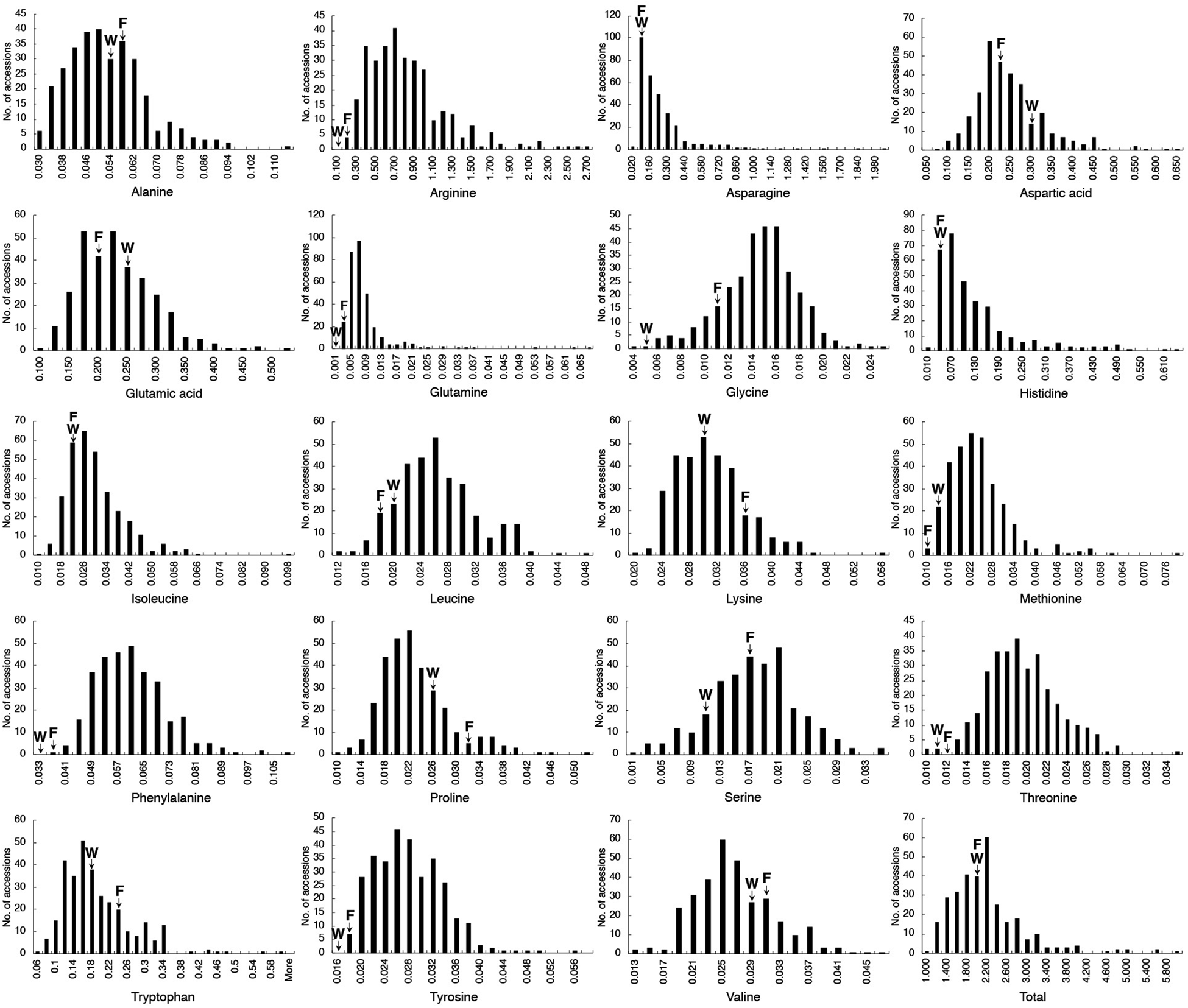
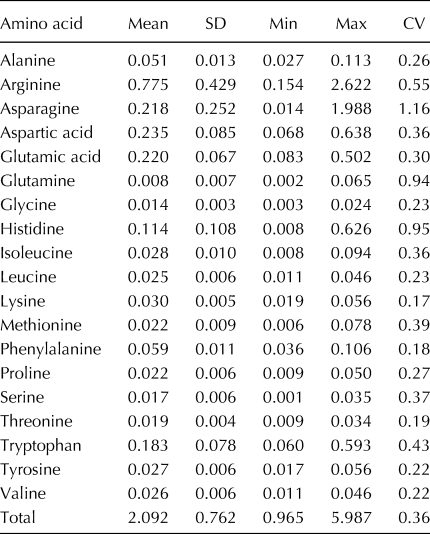
The free amino acid content determined in the seeds from each accession of wild soybean is shown in online Supplementary Table S1. Means, standard deviations, minimums, maximums and coefficient of variation (CV) values for the content were then calculated and are presented in Table 1. The total free amino acid content of the 316 wild soybean accessions ranged from 0.965 to 5.987 mg/g dry weight (DW), which represents a 6.2-fold difference. The widest variation was observed for asparagine, histidine and glutamine as indicated by the CV values of 1.16, 0.95 and 0.94, respectively. Arginine (0.55) and tryptophan (0.43) had medium-to-high CV values. The smallest variation within the accessions belonged to lysine (0.17), phenylalanine (0.18) and threonine (0.19). Arginine (0.775 mg/g DW) was the predominant free amino acid in wild soybean seeds and accounted for 37.06% of the total free amino acid content. The content of aspartic acid (0.235 mg/g DW, 11.24%), glutamic acid (0.220 mg/g DW, 10.54%), asparagine (0.218 mg/g DW, 10.40%) and tryptophan (0.183 mg/g DW, 8.74%) were relatively high compared to other amino acids found in wild soybean accessions. In contrast, the least abundant amino acids were glutamine (0.008 mg/g DW, 0.36%), glycine (0.014 mg/g DW, 0.67%), serine (0.017 mg/g DW, 0.79%) and threonine (0.019 mg/g DW, 0.91%). Next, we investigated the frequency distribution of the free amino acid content of wild soybean seeds in comparison to that of cultivated soybean seeds (Fig. 1). Most of the wild soybean accessions had higher amounts of amino acids than either of the two cultivated soybeans, most notably arginine, asparagine, glutamine, histidine, methionine, phenylalanine, threonine and tyrosine.
Frequency distributions of the free amino acid content (mg/g seed dry weight) of wild soybean seeds. Values for cultivated soybeans are indicated by arrows (W: ‘Williams 82’, F: ‘Fukuyutaka’).

The free amino acid content of seeds from 316 accessions of wild soybeans

Mean, minimum and maximum values are expressed as mg/g seed dry weight. SD and CV indicate standard deviation and coefficient of variation, respectively.
Correlation network analysis of free amino acids in wild soybean seeds
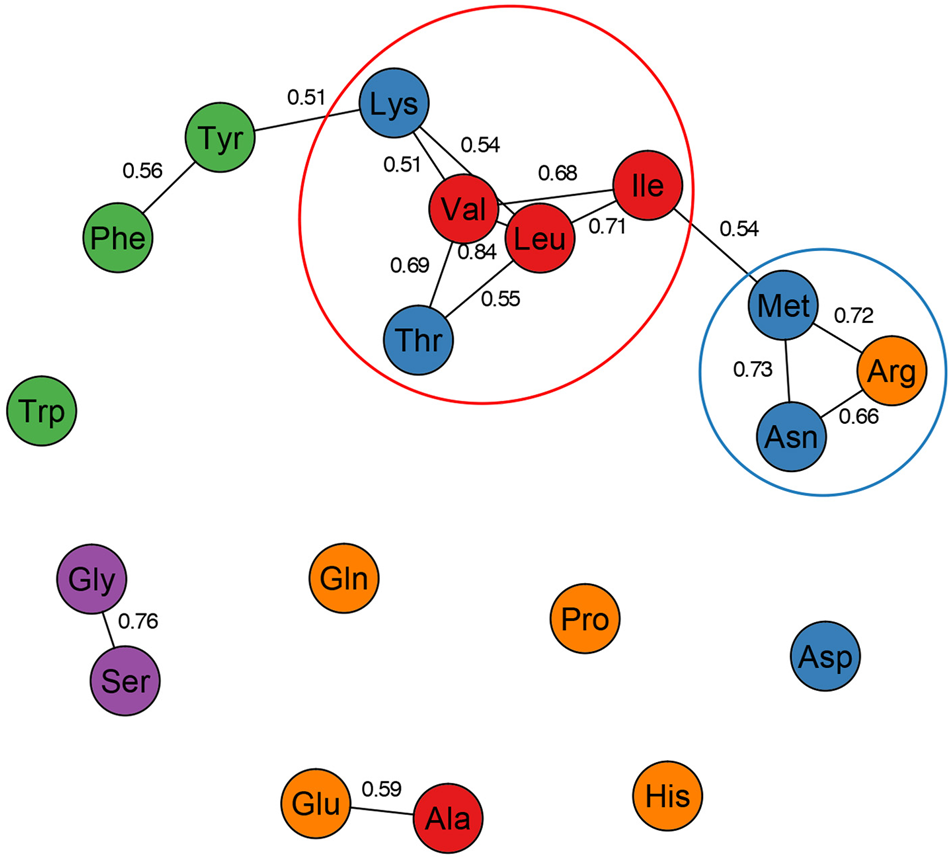
A correlation network based on the free amino acid content of wild soybean seeds was constructed to assess and visualize the relationships among the amino acids (Fig. 2). The correlation coefficient threshold for the network was set at 0.5 with P values less than 0.05. The significant correlations among amino acid levels in the wild soybean seeds measured in this study were all positive. The correlation network grouped five seed amino acids (isoleucine, leucine, lysine, valine and threonine) together with strong correlation coefficient values (Fig. 2, red circle). Among this group of amino acids, the highest correlation coefficient (r) value was found between valine and leucine (r = 0.84), followed by isoleucine and leucine (r = 0.71), valine and threonine (r = 0.69), and isoleucine and valine (r = 0.68), respectively. A second group including arginine, asparagine and methionine were also observed in the network as indicated by r values of 0.73, 0.72 and 0.66 for the correlations between asparagine and methionine, arginine and methionine, and arginine and asparagine, respectively (Fig. 2, blue circle). The network also revealed significant positive relationships between glycine and serine (r = 0.76), alanine and glutamic acid (r = 0.59), phenylalanine and tyrosine (r = 0.56), and lysine and tyrosine (r = 0.51). In contrast, aspartic acid, glutamine, histidine, proline and tryptophan were not significantly correlated with other amino acids.
Correlation network analysis of free amino acid contents of wild soybean seeds based on Pearson's correlation coefficient. A correlation coefficient threshold was set at 0.5 with a P value of less than 0.05. Nodes represent different free amino acids, and the node colours represent the respective biosynthetic pathways (red, pyruvate and BCAA; blue, aspartate; green, shikimate; purple, serine; orange, glutamate). The numbers associated with the black lines between nodes represent correlations between each free amino acid.

Effect of the region of origin on the free amino acid content of wild soybean seeds
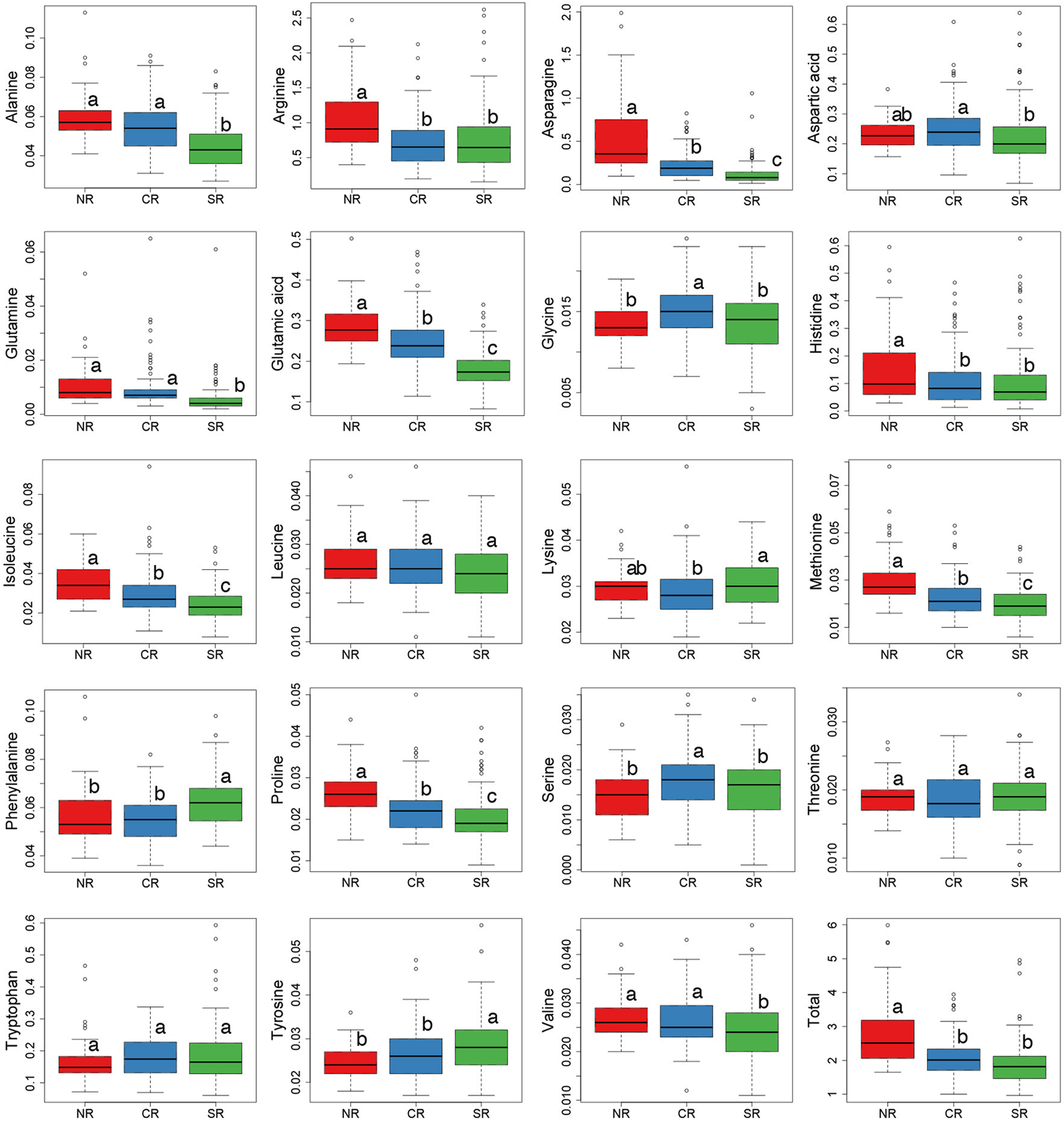
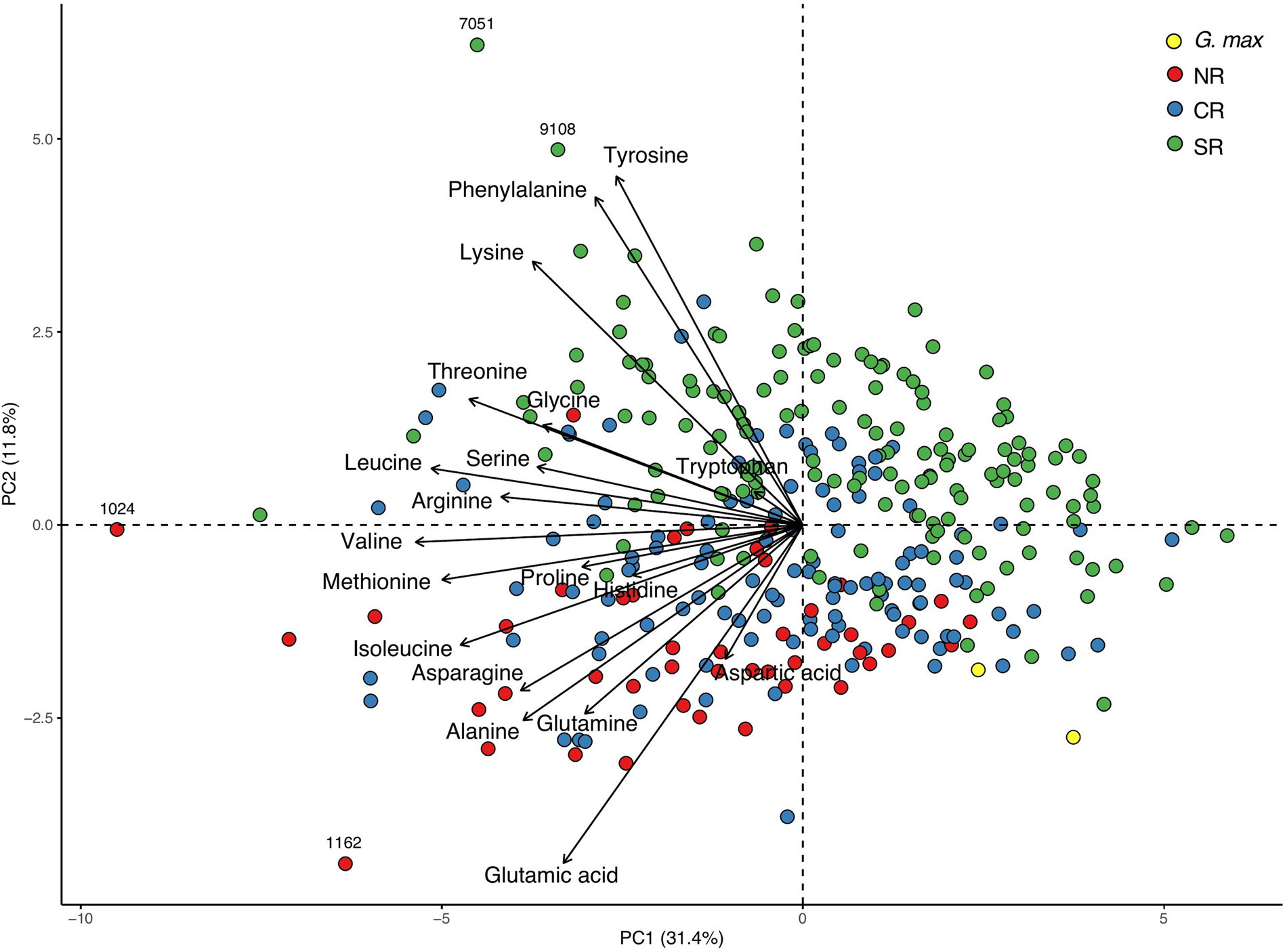
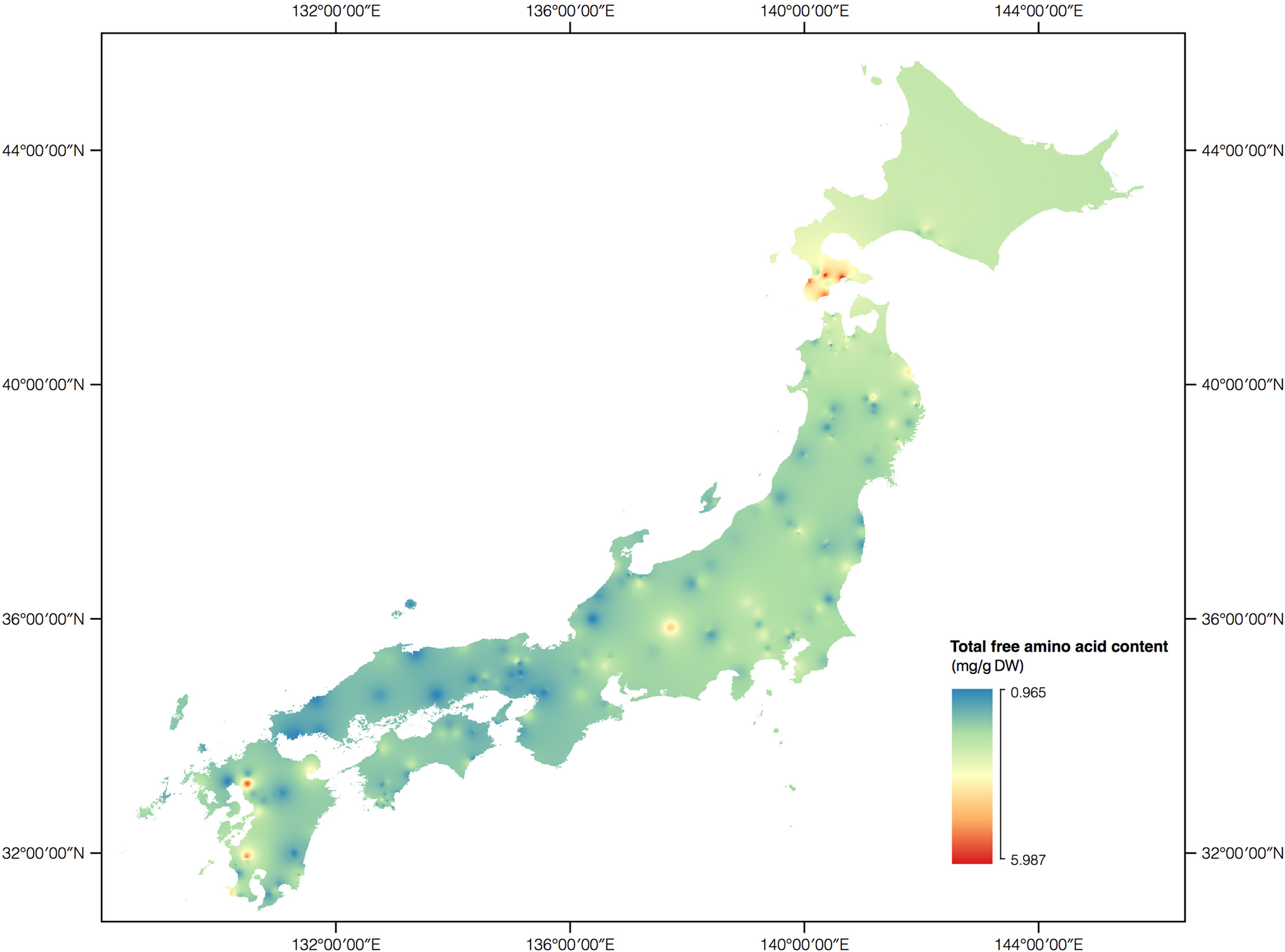
In order to understand the effect of the region of origin on the free amino acid content of wild soybean seeds, the 316 wild soybean accessions were divided into three regions, the northern region (NR) (40°40′48.1″N to 45°31′22″N), the central region (CR) (35°50′14.1″N to 40°40′48″N) and the southern region (SR) (30°59′40.1″N to 35°50′14″N) (online Supplementary Fig. S1). Boxplots were constructed to display the overall distribution of the total free amino acid content of the wild soybean seeds across three different regions of origin (Fig. 3). Wild soybeans from different regions of origin showed significantly different mean contents of several amino acids. Specifically, the content of four amino acids derived from glutamate (arginine, glutamic acid, histidine and proline), two amino acids derived from aspartate (asparagine and methionine) and one amino acid derived from pyruvate (isoleucine) were significantly higher in the accessions from the NR. Conversely, the highest two aromatic acids (phenylalanine and tyrosine) and lysine contents were measured in the accessions from the SR. In addition, the PCA showed several distinct accessions with a noticeable higher amount of the particular amino acids, which corresponded to the regions of origin of the accessions, e.g. 7051 and 9108 from the SR, and 1024 and 1162 from the NR (Fig. 4). The PCA also revealed that the accessions tended to be distributed according to their regions of origin. Particularly, the accessions from the SR were more frequently distributed around lysine, phenylalanine, tryptophan and tyrosine content variables. Whereas, the accessions from the NR were distributed close to the alanine, asparagine, aspartic acid, glutamic acid and glutamine variables. Meanwhile, the accessions from the CR were intermediate between the SR and the NR. Finally, the geographical distribution of the total free amino acid content quantified in this study was mapped and visualized in Fig. 5. The total amino acid content in wild soybean seeds tended to increase with increasing latitude and longitude. Additionally, significant correlations between the total free amino acid content and the latitude (r = 0.334) and longitude (r = 0.274) of the collection sites of the wild soybeans were also detected.
Variation in the free amino acid content (mg/g seed dry weight) of wild soybean seeds from three regions of origin. NR, northern region; CR, central region; SR, southern region. Different lowercase letters (a, b and c) indicate statistically significant differences at a P value of <0.05.

Principal component analysis based on free amino acid composition of 316 wild soybean accessions and two cultivated soybeans. Each dot represents an individual, and the dot colours represent the species and the regions of origin (yellow, cultivated soybean; red, northern region; blue, central region; green, southern region).

Distribution of the total free amino acid content of wild soybean accessions collected in Japan.

Discussion
The germplasm of wild crop relatives is an excellent genetic reservoir of useful traits that should be beneficial for crop improvement. Having a well-characterized phenotypic and genotypic database of the genetic resources will accelerate the effective use and conservation of the germplasm (Dempewolf et al., Reference Dempewolf, Baute, Anderson, Kilian, Smith and Guarino2017). A few investigations of selected seed components in wild soybean germplasm have been reported (Fukui et al., Reference Fukui, Taira, Kaizuma and Taira1972; Kaizuma and Fukui, Reference Kaizuma and Fukui1974; Leamy et al., Reference Leamy, Zhang, Li, Chen and Song2017; Wee et al., Reference Wee, Hashiguchi, Ishigaki, Muguerza, Oba, Abe, Harada and Akashi2017; La et al., Reference La, Large, Taliercio, Song, Gillman, Xu, Nguyen, Shannon and Scaboo2019). Among these reports, phenotypic and/or genotypic variation in the seed composition of wild soybean (G. soja) compared with cultivated soybean (G. max) was evident; however, the free amino acid profile of wild soybean germplasm was not previously analysed. Here, we evaluated the phenotypic variation in free amino acid content in the seeds of 316 wild soybean accessions collected throughout Japan.
In a previous report, the genetic variation among wild soybeans in northern Japan was found to be distinct from that in southern Japan, whereas wild soybeans from central Japan have variations found in both regions (Kuroda et al., Reference Kuroda, Kaga, Tomooka and Vaughan2006). In addition, the seed composition of wild soybean accessions from the region with the highest annual temperature in Japan (southern area) was significantly different from other regions of the country (Wee et al., Reference Wee, Hashiguchi, Ishigaki, Muguerza, Oba, Abe, Harada and Akashi2017). Thus, we also classified wild soybean accessions by geographical region. We found that several free amino acid levels significantly differed across different regions of origin, and observed that several accessions from the specific regions were noticeably higher in the particular amino acid contents compared to other accessions. Additionally, a significant correlation between latitude and longitude of the collection sites and the total free amino acid content of seeds was also detected. Taken together, these results suggest a relationship between the geographical region of origin and the content of free amino acids. Since all of the accessions were grown under the same environmental conditions in the present study, the genetic background might be a reason for the difference in seed amino acid content in wild soybean accessions.
The content of free amino acids in soybean seeds was significantly associated with seed protein level (Wang et al., Reference Wang, Zhou, Shi, Yang, Yan, Zhao, Yang and Guan2019) and various types of metabolites (Lin et al., Reference Lin, Rao, Shi, Hu, Cheng, Wilson, Zhang and Quan2014), indicating their major regulatory roles in soybean seed metabolism. However, little is known about the relationships among amino acids in legume seeds. In Arabidopsis and tomato (Solanum lycopersicum), analyses of correlation networks based on the seed amino acid content revealed that most of the amino acids with strong and positive associations corresponded to their biosynthetic and/or metabolic pathways (Angelovici et al., Reference Angelovici, Fait, Zhu, Szymanski, Feldmesser, Fernie and Galili2009, Reference Angelovici, Batushansky, Deason, Gonzalez-Jorge, Gore, Fait and DellaPenna2017; Toubiana et al., Reference Toubiana, Semel, Tohge, Beleggia, Cattivelli, Rosental, Nikoloski, Zamir, Fernie and Fait2012). Our correlation network also demonstrated that the significant relationships among the amino acids of wild soybean seeds were all positive. As three amino acids (isoleucine, leucine and valine) were clustered into the same group with a high correlation coefficient, their levels would be synchronously regulated. Indeed, they are categorized as branched-chain amino acids (BCAA) and commonly share metabolic enzymes. Though aspartate showed no correlation for any amino acid, lysine and threonine which are the products of aspartate were associated. In addition, asparagine and methionine which also belong to the aspartate family of amino acids were sequentially linked with isoleucine in the correlation network analysis. These results suggest that BCAA biosynthesis and aspartate metabolism are coordinately regulated via an unknown mechanism in wild soybeans. The significant correlation between glycine and serine would be reasonable since they are interconvertible via glycine hydroxymethyltransferase. These results will be useful for further studies on seed metabolic pathways of free amino acid in wild soybean and other legumes.
In conclusion, we present diverse information on the phenotypic variation in free amino acid content of the seeds of wild soybean germplasm collected from broadly distributed geographical locations throughout Japan. These data would strengthen the conservation programme of wild soybean resources in Japan and selection of wild soybean accessions with desirable traits for use in future legume breeding programmes.
Supplementary material
The supplementary material for this article can be found at https://doi.org/10.1017/S1479262121000071
Acknowledgements
The wild soybean accessions used in this study were kindly provided by the LegumeBase (http://www.legumebase.brc.miyazaki-u.ac.jp/). This study was supported by the National BioResource Project (NBRP) of the Japan Agency for Medical Research and Development (AMED).