


Sir, all my litigations they’re seeking to restrain;
Four or five small issues are all that now remain;
One suit against my husband, and another suit
Against my father and my children; why they do’t
I know not, nor can tell what woes they have denounced
Against me, miserable; but they have pronounced
This judgement: that, supplied with food and clothing due,
For th’ balance of my life I am forbid to sue. Footnote 1
In his 1697 comedy Les Plaideurs (The Suitors), French playwright Jean Racine introduces the courtroom-obsessed character of the Countess de Pimbesche, a caricature of the litigious woman in the early modern era. Racine and his contemporaries in Western Europe were familiar with women who, despite the legal discrimination against their sex, had to defend themselves in court against charges of all kinds and who took to court themselves if they thought their interests, or those of their families, had been infringed upon. This was also the case for the Council of Brabant, the highest court in the duchies of Brabant and Limburg. In 1652, Simonne Saincte, widow of François Porte, brought before the Council an appeal case against Jean de Houx, the husband of her stepdaughter Louise Porte. At stake in the case was François Porte’s estate—specifically the part that Simonne, under the law of Nivelles, a town south of Brussels, had to bequeath to the children of the first bed. In the pleadings, Simonne (or her lawyer) stressed her great poverty, the fact that she had to feed four small children (other documents mention five), the high grain price, and the damage caused to her by the numerous armies roaming the southern Netherlands. She appealed to the Council of Brabant because that court had traditionally acted as “protector of the poor widows and orphans.” Her emotional plea yielded nothing, however: the case against Jean de Houx was dropped, and the councilors ordered Simonne to pay all court costs. It is noteworthy, however, that they also stated that the widow was “ignorant of the style and manner of litigation.” This ignorance had obviously not prevented Simonne, whose lawsuit had previously been heard by the aldermen’s courts at Bornival and Nivelles, from subsequently appealing to the supreme court in Brabant. Equally interesting is the fact that her stepdaughter Louise did not act personally in court. The case revolved around Louise’s portion of the inheritance of François Porte, but it was her husband who defended her interests.Footnote 2
Simonne Saincte’s actions illustrate what several historians have shown for different regions: Despite the significant legal and cultural barriers early modern women had to overcome to go to court, many creatively managed to surmount them and regularly made use of the services offered by lawcourts to assert their rights.Footnote 3 Other women preferred, or were obliged, to be represented by an adult man. That women also litigated in Brabant and Limburg should thus come as no surprise. Ever since the Middle Ages, the Low Countries, to which both duchies belonged, were a region in which women played a substantial public role in trade and crafts, in administering estates, and in signing contracts.Footnote 4 But was this reflected in greater than average recourse to courts? The first aim of this article is to examine to what extent women acted as plaintiffs in Brabant and Limburg and on which subject matters they initiated lawsuits. We can thus compare what we know about the legal position of women with judicial practice. The main focus will be on the Council of Brabant in the seventeenth and early eighteenth centuries, but given the extraordinary nature of this princely lawcourt, parts of this contribution consist of comparative analyses with two municipal lawcourts: the aldermen’s benches of Vilvoorde and Tienen. This article thus helps to assess the exceptionality of the Council. The second objective is to determine whether women who decided to go to court proceeded in different ways than male litigants. I will therefore compare the beginning (the entry in the courtroom roll or distribution book) and end (the judgment) of civil suits in the three aforementioned lawcourts. In so doing, this article gives quantitative indications and two possible explanations for gendered uses of justice.
To be clear, this article is not about women who had to appear in criminal courts, but about women appearing in civil cases—lawsuits that were not the results of ex officio prosecutions. These represent the vast majority of all cases—over 90% according to the estimations of Hervé Piant. As C. W. Brooks already stated for early modern England, these cases touched upon the lives of many more people than criminal cases, including men and women from all ranks and standings.Footnote 5
Female Uses of Justice: Current Scholarship
This contribution is intellectually indebted and aims to contribute to the “uses of justice” approach with its bottom-up perspective on litigation. The concept was coined by the German historian Martin Dinges with a focus on criminal justice, but ensuing generations of scholars have adapted it to the sphere of civil justice.Footnote 6 Aries van Meeteren expanded it to “instrumental use of forums” (Dutch: instrumenteel forumgebruik) to include authorities other than courtrooms involved in conflict resolution, such as craft guilds, urban militia, neighborhoods, Church sessions or consistories, notaries and scribes, and peacemaking bodies.Footnote 7 Given that most early modern court cases ended after their initial stages and never led to a final verdict, I argue that if historians wish to accurately reconstruct the backgrounds of the litigants, they must distinguish between those initiating a case in the hopes of engineering a quick out-of-court settlement and those who were prepared—or forced—to proceed until the bitter end. Only if we measure litigation in its different stages, however time-consuming that undertaking might be, will we obtain a precise picture of how different categories of litigants in the early modern era used lawcourts to resolve their conflicts.
Since the 1990s, the gap between norm and practice concerning women’s legal status has become evident. Even in regions with strong legal discrimination, such as England with its strict rules of coverture affecting married women, and an inheritance regime that favored sons, or Normandy, scholars have described women’s creative ways to mitigate the impact of those draconian regulations.Footnote 8 Tim Stretton was among the first to systematically trace female litigants. He concluded that women in Elizabethan England were remarkably active in courts, with almost one-third of cases in the central Court of Requests involving female plaintiffs or defendants. In exceptional cases, and despite coverture, wives even sued their husbands.Footnote 9 Aries van Meeteren made similar observations for mid-seventeenth-century Leiden in the Dutch Republic: many women legally acted without appointing guardians, which the law prescribed. Nevertheless, most plaintiffs were men, which van Meeteren attributed to the dominance of financial disputes. Since these had an impact on the entire household, the man often represented the entire family in such cases.Footnote 10 Griet Vermeesch focused on one specific group of women in Leiden—single mothers. She argued that if certain conditions were met—for example, if these single mothers stemmed from families that were beneficiaries of poor relief, or if their fathers were still alive—they were not the helpless victims they were long assumed to be but could exert legal agency in cases concerning their illegitimate children.Footnote 11
For the southern Netherlands, Laura Van Aert was the first to examine female involvement in lawsuits. Focusing on sixteenth-century Antwerp in Brabant, she observed, just like van Meeteren, that women sometimes appeared in court without a guardian. In other cases, the appointment of a guardian was a mere formality. Examples from the Council of Brabant confirm Van Aert’s findings. In 1678–80, Clara Meys and her husband, solliciteur Gobin, sued Gisbertus Moringh, who acted as husband and guardian of Elisabeth Martini. Meys and Gobin claimed compensation for seizure of goods. Some documents in the file only mention Clara Meys as plaintiff; in others, her husband is said to act on her behalf. This suggests that she acted autonomously in at least part of the suit.Footnote 12 Based on similar cases, Van Aert concluded that women and men in Brabant were more equal than customary law suggested.Footnote 13 As a result of these and other studies, ever more scholars are looking at female litigants in terms of bargaining power and agency rather than of restriction and discrimination. From this perspective, women no longer appear legally incapable but instead very much able to act except in some areas where they needed their husband’s consent.Footnote 14
Female Litigants in Brabant and Limburg: Legal and Institutional Contexts
Despite the insightful contribution by Van Aert, the presence of women in courtrooms in the early modern southern or Habsburg Low Countries (or Netherlands), to which both Brabant and Limburg belonged (see Map 1), has never been systematically scrutinized and compared with court use by men. That is unfortunate, given several specificities in the legal position of women in these regions. In both Brabant and Limburg, the marital status of women determined which rights they could claim. This was the case in many parts of Europe, but the early urbanization of the medieval Low Countries led to a gradual shift toward greater equality between the sexes both in the city, where the law adapted to the commercial and industrial activities within the city walls, and in the countryside. For instance, the shares of inheritances were equal for sons and daughters, fathers and mothers had the same rights in exercising parental authority, and spouses were quasi-equals in the management of common goods during marriage, meaning that a husband could not dispose of the main property without his wife’s consent.Footnote 15
The duchies of Brabant and Limburg in the Low Countries, c. 1680. Map by Ward Leloup, adapted from the dataset by Rombert Stapel, 2016, “Mint Authorities of the Low Countries,” https://hdl.handle.net/10622/HPIC74, IISH Data Collection, V3.

In theory, an unmarried Brabantine woman needed a guardian (Dutch: voogd/momboor) even for the management of her own goods, but this regulation was relaxed in parts of the duchy during the early modern era. In 1658, for instance, the 21-year-old beguine Isabella Roll provided a bond for widow Joanna vander Beken “out of her own and free will, not forced by anyone.”Footnote 16 Moreover, certain deeds such as wills and marriage contracts were excluded from this restriction. Among adult women, widows enjoyed the greatest freedom of action, as (legally) they replaced their deceased husbands as heads of their families. Again, however, the law in Brabant prescribed the appointment of a guardian for each agreement a widow concluded. A married woman faced more restrictions. She was legally incapable on principle and stood under the authority or guardianship of her husband. Without his consent she could not contract, take legal action, or act as a guarantor. In theory, this meant that a wife could not act in court without her husband’s cooperation. However, there were some exceptions to this rule as well. A married woman could file a complaint if she was the victim of defamation or if her husband was absent or incapacitated and could defend herself if she was prosecuted for a crime. She could also initiate a case to have her marriage declared invalid or to seek a separation. Finally, as a mother she could act as guardian of her children.Footnote 17 The case of Clara Meys mentioned above suggests that women sometimes waged law independently in ways that legal procedures should not have allowed.
Apart from the law, the socioeconomic and institutional character of a region also influenced access to justice.Footnote 18 Brabant was densely populated by early modern standards.Footnote 19 In 1709, the urbanization rate was 45 percent, significantly higher than the average for the Habsburg Netherlands as a whole. Brussels was the residence of the governor-general (the representative of the Habsburg ruler), the governor-general’s court, and most of the central administrative institutions for the entire Habsburg Netherlands. The city therefore had a larger than average number of elite residents and government officials.Footnote 20 Antwerp had had to cede its role as the main trading metropolis in Northwestern Europe to Amsterdam in the 1580s because of the Dutch Revolt but remained an important regional commercial and financial center long afterward. By 1755, however, Brabant’s urban population share had dropped to around 34 percent.Footnote 21 A growing majority of the Brabanters thus lived in the countryside, which was characterized by large regional differences in soil fertility and types of agriculture.Footnote 22
The Council of Brabant, the first lawcourt under scrutiny, was the supreme court of this region from c. 1430 until its abolishment in 1795, and both urbanites and villagers could make use of its services.Footnote 23 The councilors administered law in the name of the prince. In criminal cases, it had jurisdiction over a limited number of offenses specifically reserved for the prince’s adjudication, such as counterfeiting, rioting, and all possible variants of lèse-majesté. In civil cases, it dealt with so-called “fiscal matters”—disputes concerning the rights of the ruler, his or her jurisdiction and domains, and anything relating to the work of the princely officers of justice and tax collectors. Conflicts of jurisdiction between officials or administrations were also part of the Council’s competence, as were cases about infringements against the rule of law and cases involving nobles or collaborators of the Council.Footnote 24 Abbots, abbesses, prelates, and administrators of hospitals and other pious foundations could likewise use this court. A further type of dispute handled by the Council concerned contracts and wills it had registered. Finally, widows, orphans, and so-called miserabiles personae (e.g., long-term sick or elderly persons, members of mendicant orders) could bring their cases against debtors directly before the Council.Footnote 25
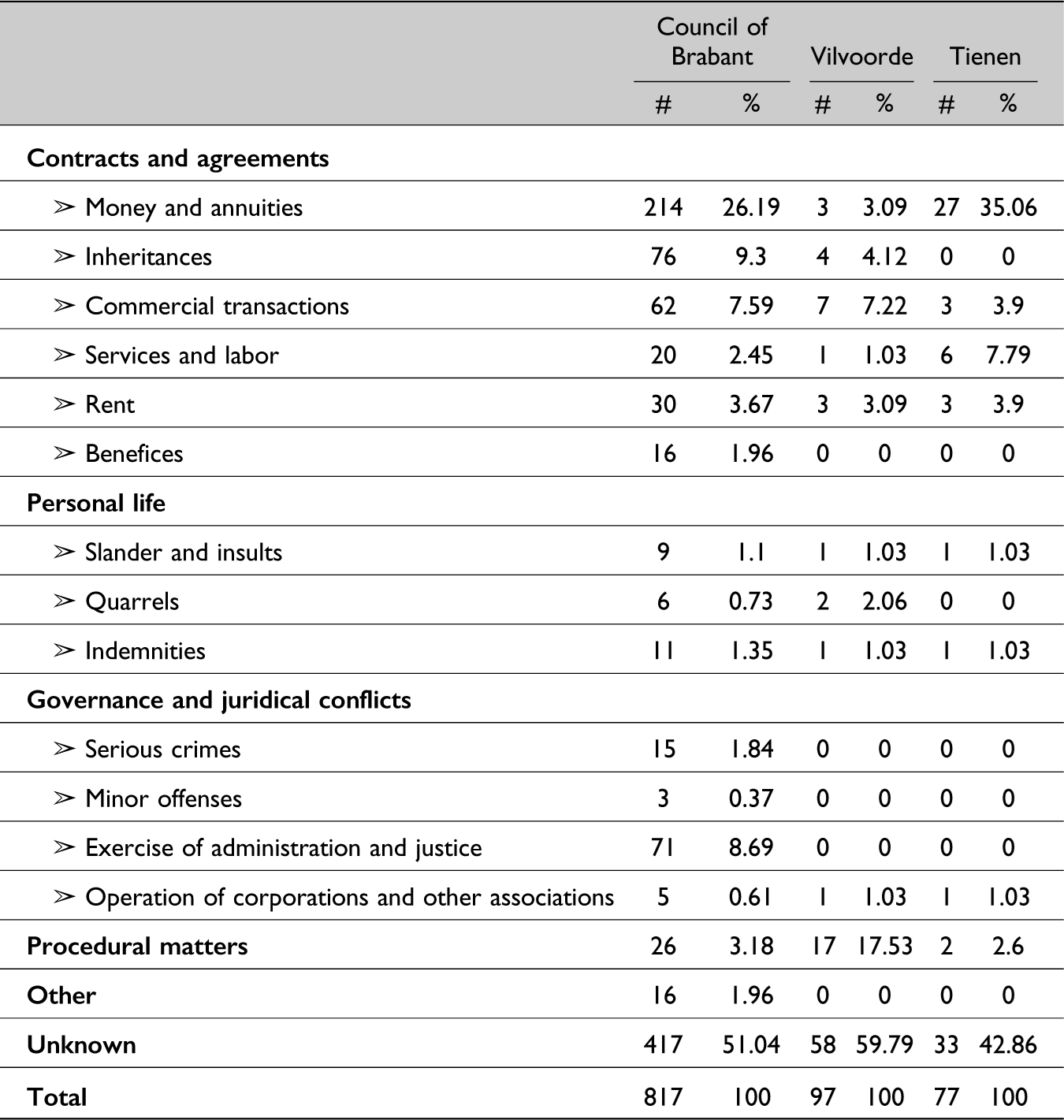
In practice, certain categories dominated the court’s business. Table 1 shows the subject matters of the final judgments for the three courts under scrutiny. In each one, around half of the subjects could be determined. In the Council of Brabant, by far the most important subcategory is “money and annuities,” accounting for over a quarter of all judgments.Footnote 26 “Inheritances” and “Commercial transactions” follow in importance. A fourth significant subcategory, mirroring the Council’s role as a supralocal arbiter warranting the rule of law and good policing and justice, concerns disputes over the exercise of administration and justice.Footnote 27
Subjects of Lawsuits According to the Judgments (Sample Years Council of Brabant: 1626, 1651, 1680, 1701; Sample Years Vilvoorde: 1630–32, 1650–51; Sample Years Tienen: 1650–52, 1685–90)

Table 1. Long description
A table comparing subjects of lawsuits across three courts: Council of Brabant, Vilvoorde, and Tienen. The table has 15 rows and 6 columns. The columns are labeled with the courts and their respective data in number and percentage. The rows are grouped into categories: Contracts and agreements, Personal life, Governance and juridical conflicts, Procedural matters, Other, and Unknown. Each category has subcategories with corresponding data. For example, under Contracts and agreements, subcategories include Money and annuities, Inheritances, Commercial transactions, Services and labor, Rent, and Benefices. The data shows the number and percentage of lawsuits for each subcategory across the three courts. Notable trends include a high percentage of Unknown subjects in all courts, with the Council of Brabant having the highest at 51.04 percent. Money and annuities are the most common known subject in the Council of Brabant at 26.19 percent, while Procedural matters are most common in Vilvoorde at 17.53 percent.
Sources: RABru, RvB–griffies, 754, 755, 803, 804, 861, 862, 916, 917, 918, 1031, 1032, 1121, 1122, 1145, 1146, 1161, and 1162; RAL, Vilvoorde, 28 and 29; RAL, Schepenbank Tienen, 2039 and 2040.
Territorially, the Council of Brabant also acted as the supreme court of appeals for the tiny Duchy of Limburg and the so-called “Landen van Overmaas,” situated roughly where present-day Belgium, the Netherlands, and Germany meet.Footnote 28 This rural area featured a strong proto-industry, especially in metallurgy, concentrated along the banks of the Meuse and Vesdre rivers. At the end of the eighteenth century, its population surpassed 100,000.Footnote 29
The Council’s authority over Limburg implies that my analyses of its archives cover both duchies, even though the share of Limburg cases is much lower. Moreover, for municipal lawcourts, I have selected the aldermen’s benches of two towns in Brabant: Vilvoorde, barely 10 km north of Brussels, and Tienen, some 45 km to the east (see Map 1).Footnote 30 Aldermen’s benches held administrative, normative, and judicial competencies. In the latter category, they had jurisdiction over all criminal and civil matters not explicitly assigned to other courts and can be considered the regular lawcourts ordinary people in the southern Low Countries would turn to for disputes with relatives, neighbors, or business partners.
In contrast to the Council of Brabant, different judgment registers exist for criminal and civil matters. Only the latter have been included here, which explains the absence of serious crimes and minor offenses (see Table 1). The predominance of lawsuits over contracts and agreements is similar to what we see in the Council of Brabant. Other subcategories are less prominent or even absent, such as disputes over benefices and cases over the exercise of administration and justice—two topics that belonged to the Council’s exclusive jurisdiction.Footnote 31 Later in this contribution, I will come back to these subjects and relate them to male and female plaintiffs. Nevertheless, as I will demonstrate in the following sections, the final judgments do not give us a complete picture of the (fe)male uses of justice. They are the finishing stage of a minority of cases, as a consequence of which we need additional sources that help us reconstruct gender patterns at the start of the cases. For the Council of Brabant, there are courtroom rolls and distribution books, while for the aldermen’s benches there are different rolls.
Sampling and Methodology
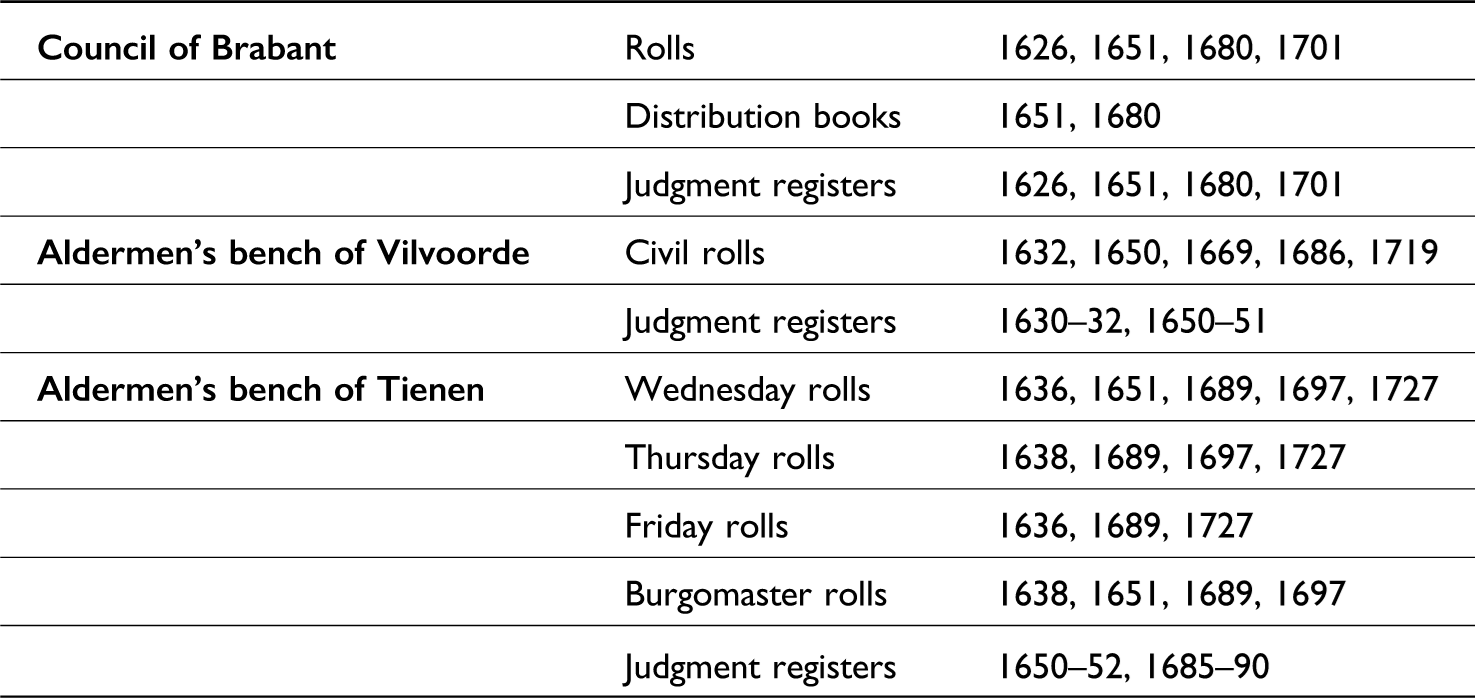
The choice of the seventeenth and early eighteenth centuries is largely dictated by the sources. Only from the seventeenth century onward do we have collections of court rolls and distribution books that allow for quantitative analysis of all cases started. I opted for four sample years at 25-year intervals (see Table 2).Footnote 32 Due to some glaring gaps in the rolls between 1669 and 1679, 1680 was the closest I could get to 1676.Footnote 33 These sample years largely coincide with what historians have come to call the “Great Litigation Decline”: a gradual decrease in litigiousness in the seventeenth and eighteenth centuries after the peak usually situated in the late fifteenth and sixteenth century—the “Legal” or “Litigious Revolution.”Footnote 34
Sample Years for Rolls, Distribution Books, and Judgment Registers in Three Brabantian Lawcourts

Table 2. Long description
The table shows sample years for court rolls, distribution books, and judgment registers in three Brabantian law courts. It has three main sections: Council of Brabant, Aldermenʼs bench of Vilvoorde, and Aldermenʼs bench of Tienen. The table has 3 columns: Type of document, Description, and Years. The Council of Brabant section includes rows for Rolls, Distribution books, and Judgment registers with corresponding years. The Aldermenʼs bench of Vilvoorde section includes rows for Civil rolls and Judgment registers with corresponding years. The Aldermenʼs bench of Tienen section includes rows for Wednesday rolls, Thursday rolls, Friday rolls, Burgomaster rolls, and Judgment registers with corresponding years.
For the aldermen’s benches, it was impossible to select the same samples as for the Council, given the difficulty of finding complete rolls series for entire calendar years. As much as possible, I selected sample years spread evenly across the seventeenth and early eighteenth centuries to enable comparison: five for Vilvoorde and six for Tienen (see Table 2). Vilvoorde’s clerk kept a criminal and a civil roll, the latter of which I have used. However, these rolls never mention whether cases were new or not, which is why I had to apply a slightly different and more time-consuming method to analyze them: I listed all cases that were heard at least once during a specific calendar year. The aldermen in Tienen organized their civil court sessions differently, with the aldermen sitting on Wednesdays, Thursdays, and Fridays, and a fourth session presided over by the burgomaster. For each session series, they kept a separate register, hence the names of the different rolls: Wednesday rolls, Thursday rolls, Friday rolls, and burgomaster rolls. Because of the summary information in the rolls and the lack of a thorough local history elaborating on the administration of the town, the exact allocation of cases per weekday remains unclear. Only for 1689 have all rolls survived. I analyzed five more years for which at least two sets are preserved in their entirety. Contrary to Vilvoorde and similar to the Council of Brabant, the Tienen rolls indicate which cases were new.
The most common civil procedure in the seventeenth-century Council of Brabant was the roll procedure, named after the deputation of two councilors and a clerk (the so-called rol) who were appointed to prepare each trial instead of overloading the full corps of councilors with all the steps of every single lawsuit. It is the procedure that allows the beginning of trials to be adequately reconstructed with the greatest ease due to the relatively good preservation of the rolls series.Footnote 35 Nevertheless, two additional civil procedures existed alongside the roll procedure. The commissioners’ procedure (procedure voor commissarissen) was initially established for urgent matters and cases requiring discretion, and from 1691 onward also applied to fiscal cases involving towns and villages. It was faster but more expensive. Unfortunately, the sources do not provide a complete overview of the cases initiated before the commissioners.Footnote 36 Finally, there was the so-called communicatoire procedure. It was officially established in 1668, but the preserved archives make clear that it was in steady use before then. It would outnumber the other procedures by the eighteenth century. The series “files of sealed letters” (liassen van gezegelde brieven), which contains all incoming petitions, theoretically allows these cases to be searched. However, this is unfeasible given the sheer volume of the respective files—large bundles containing hundreds of incoming documents per year including, for example, applications for pardon letters, seizures of goods, printing patents, the clearing of a merchant’s reputation after bankruptcy, and simple requests to start a lawsuit. Neither is there certainty with regard to their completeness. Fortunately, however, ten (fragments of) seventeenth-century distribution books have survived that allow us to scrutinize the number of communicatoire cases, two of which cover my sample years 1651 and 1680. They specify the distribution of cases by the chancellor among the councilors at every procedural stage.Footnote 37 As with the rolls, we can easily identify the new cases because the distribution books mention the names of the documents that were distributed, and hence the stage of the trial mentioned. I only selected those cases with the heading rescriptie (French: rescription; in the legal sense, a written response to a claim), or documents that exceptionally replaced those rescripties. They were the first documents following the request to adjudicate a certain case.
The selection of the judgment registers posed additional challenges. The judgments for the four sample years of the Council of Brabant have been nicely preserved. For Vilvoorde and Tienen, that was not always the case. Moreover, due to the low number of judgments, I decided to expand the judgment samples to several years (see Table 2). I also included judgments on serious and petty crime, given that the exact procedure (criminal or civil) is not always easy to identify from the verdicts. As Table 1 shows, these numbers are limited. Moreover, for the Council of Brabant, I had to combine judgment registers and so-called “dicta,” which are short notes merely indicating the involved parties and the decision by the judges. The judgment registers are a separate form of registration parallel to these dicta, in theory only containing the final decision if one of the parties was willing to pay for an engrossment on parchment. It is necessary to combine both series to obtain a complete picture.Footnote 38 For 1680 and 1701, there is another very voluminous series of judgments registered by the Council of Brabant’s secretaries—an independent administration besides the court clerks who kept the judgment registers. Eddy Put has claimed that these secretaries’ judgments are mostly interlocutory, which our investigation confirms. I therefore decided not to consider this series, thereby possibly omitting a limited number of final verdicts.Footnote 39
Finally, it is important to keep in mind that I count cases rather than individual litigants—one, two, three, or more plaintiffs could be involved against one, two, three, or more defendants—and that I focus on plaintiffs only. The reason for the latter choice is that plaintiffs made a deliberate choice to go to court—in other words, they consciously decided to put pressure on their adversaries via the formal judicial system. This article therefore focuses on groups that were not drawn into a lawsuit but chose that option themselves, although we must take into account the possibility that at least some conflicting parties may have jointly decided that their dispute should be brought before a court, or that some suits were counter suits—defendants in one suit becoming plaintiffs in another.
The Beginning: Courtroom Rolls and Distribution Books
In this section, the influx of new cases in the three lawcourts takes center stage. As indicated before, each of these courts listed cases in dedicated registers. The “rolls” of the Council of Brabant are large-sized quires with many dozens of pages. The clerk noted down all court cases that would appear at the next hearing, first the new cases and thereafter those at an advanced stage. During the court session, he concisely recorded in the margins what was decided, for example, the time limit for presenting new evidence, an adjournment of the case, or the determination of court fees. Given that Brabant was a bilingual principality and the Council adopted the language of the parties, these rolls—just like the judgment registers—are partly in Dutch and partly in French.Footnote 40 Information about the litigants is brief. It usually includes the term of address, name, titles of nobility, the name of the deceased spouse in the case of a widow, and sometimes (but far from systematically) the domicile or professional activity of the persons involved. Thus, on April 19, 1651, the Council heard the cases of Jacques van Hulst, “warden of the town hall of Antwerp,” “colonel” Martin De Mangel, and Joseph Loreau, “bailiff of Seneffe,” among others.Footnote 41 The social background of the users of the Council of Brabant is highly diverse, including noblemen and commoners, city dwellers like the aforementioned beguine Isabella Roll and villagers like Simonne Saincte, regular and secular clergy, princely officials, members of craft guilds, peasants, lawyers, and merchants alike. Much to the frustration of this historian, and contrary to the judgments registers, the subject matters are missing entirely in the rolls. The main drawback resulting from this is that we cannot compare them with the judgments and cannot know which subject matters were more likely than others to be settled out-of-court. Moreover, sometimes only one or two plaintiffs are mentioned by name followed by the Latin phrase cum suis (Dutch: ende consorten). If we cannot double-check this information against a judgment or case file, it is impossible to know whether the additional persons were women or men.Footnote 42 As a consequence, I chose to ignore the cum suis/ende consorten labels in my calculations.Footnote 43 Despite their shortcomings, the rolls nonetheless allow us to reconstruct the number of new lawsuits and the parties initiating them.Footnote 44 The information in the two distribution books, moreover, is equally succinct as in the rolls. We do not know the subject of the disputes, but we can differentiate between female plaintiffs, male plaintiffs, and groups of people starting a lawsuit.Footnote 45
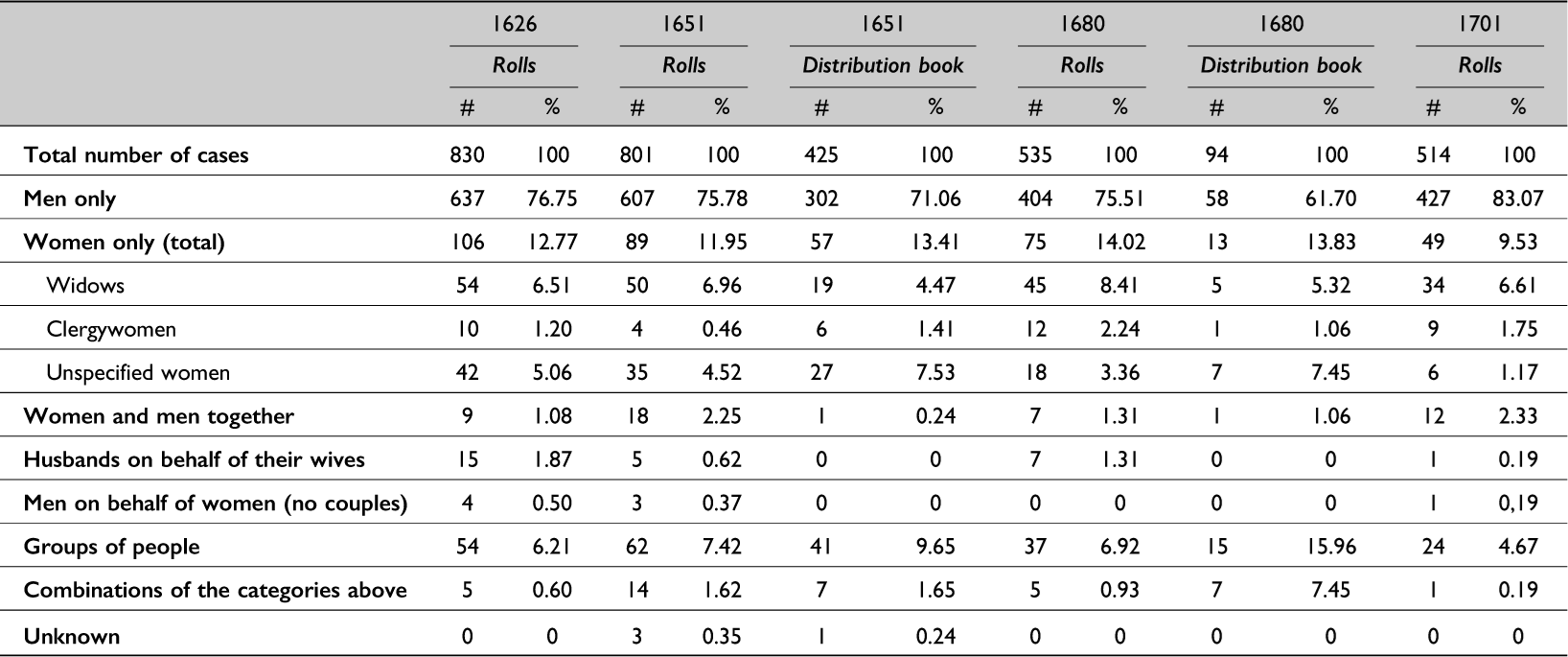
When looking at the gender ratio, the consistency across the four sample years in the rolls procedure is striking (see Table 3). The share of cases brought by one or more women varies between 9.53% and 14.02%; the share of those brought only by men is between 75.51% and 83.07%. Between 0.39% and 2.29% were initiated by men on behalf of women (most often husbands standing for their wives), and between 1.08% and 2.33% by men and women (most often married couples). The category “groups of people” includes (representatives of) legal entities (e.g., “the deans of the sockmaker’s guild in Leuven” or “the mayor, aldermen, and council of Breda”) as well as plaintiffs who are only mentioned as a group and not by name (e.g., “the laborers of the Sint-Pietersvliet in Antwerp,” “the heirs of Gillis Perremans,” or “the inhabitants of the district of Homburg”). The latter category most likely sometimes included women, at least implicitly.Footnote 46
Number of New Cases in the Rolls and Distribution Books for the Communicatoire Procedure of the Council of Brabant, per Category of Plaintiffs

Table 3. Long description
The table presents data on the number of new cases in the Rolls and Distribution Books for the Communicatoire Procedure of the Council of Brabant, categorized by types of plaintiffs across different years. The table has 12 columns and 11 rows, including headers and labels. The columns are labeled with years and types of records (Rolls, Distribution book), and the rows are labeled with categories of plaintiffs. The categories include Total number of cases, Men only, Women only (total), Widows, Clergywomen, Unspecified women, Women and men together, Husbands on behalf of their wives, Men on behalf of women (no couples), Groups of people, Combinations of the categories above, and Unknown. Each cell contains the number and percentage of cases for each category and year. Notable trends include the consistently higher percentage of cases brought by men only across all years, ranging from 61.70% to 83.07%. The percentage of cases brought by women only varies between 9.53% and 14.02%. The category Groups of people shows varying percentages, with the highest being 9.65% in 1651 Distribution book and the lowest being 4.67% in 1701 Rolls. The table provides a detailed breakdown of the distribution of cases by different categories of plaintiffs over the specified years.
Sources: RABru, RvB–griffies, 71, 72, 73, 74, 156, 157, 158, 159, 240, 241, 242, 243, 315, 316, 317, 1875, and 1879.
The results for the communicatoire procedure concerning female plaintiffs are very similar to those for the roll procedure: 13.41% and 13.83%, respectively (the average for the roll procedure in the four sample years studied is 12.07%). The proportion of men shows a downward outlier for 1680, with only 61.70% of all cases—considerably less than in any other sample year.Footnote 47 The big difference between the two procedures lies with the groups of people that filed lawsuits. In the communicatoire procedure, this rises to 9.65% in 1651, and even 15.96% in 1680.
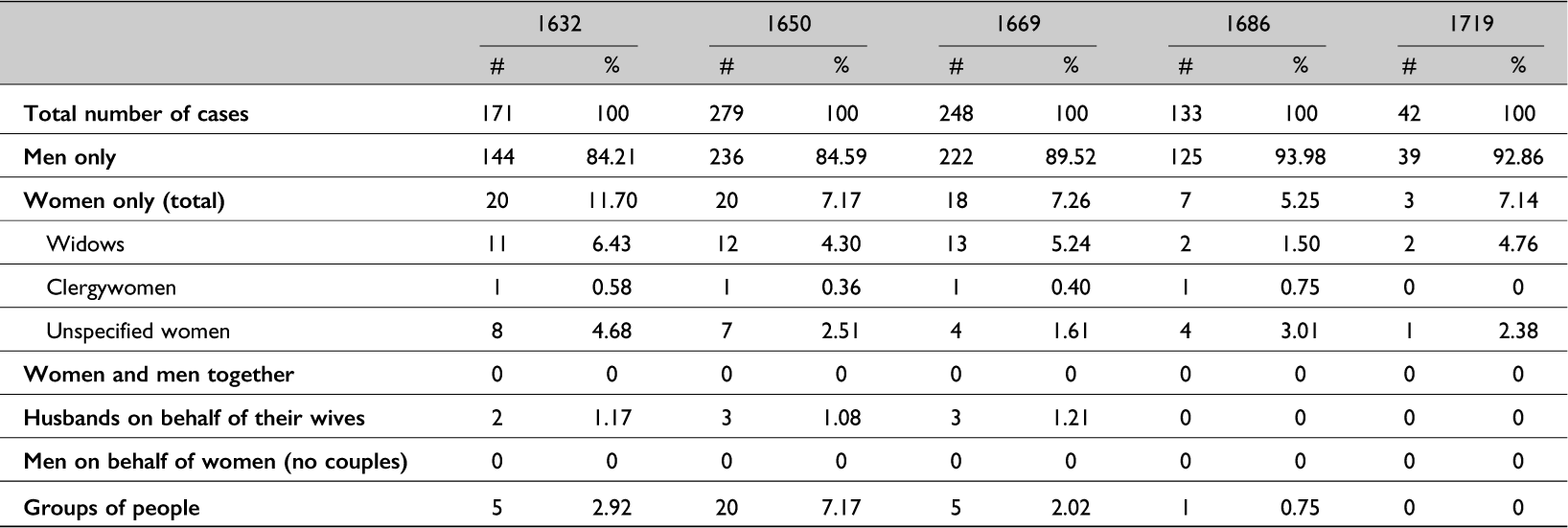
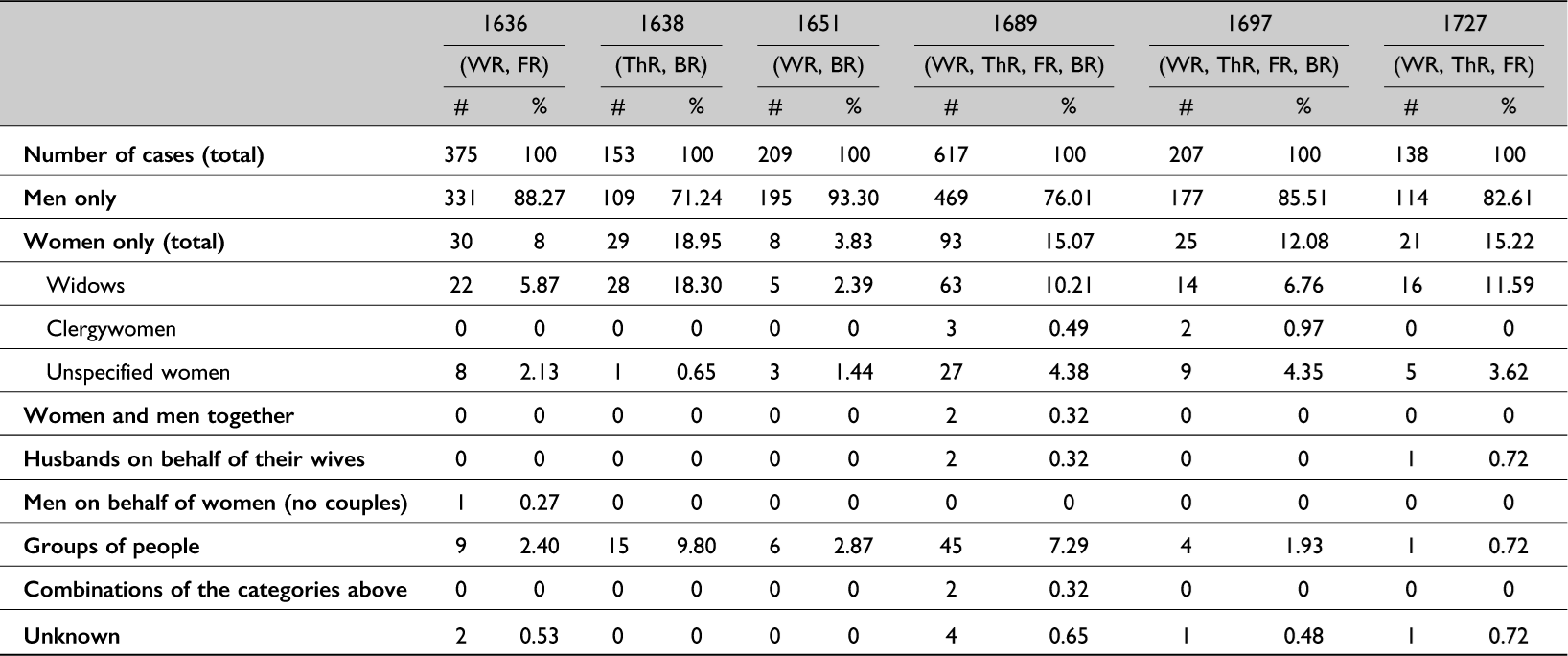
The rolls that have been conserved for the aldermen’s benches allow for an analogous analysis and reconstruction of plaintiffs. At the Vilvoorde bench, the proportion of women fluctuates between 5.25% and 7.26%, except for the outlier of 11.70% in 1632 (see Table 4). The female share is thus on average 4% to 5% lower than at the Council of Brabant, which may reflect the latter’s care for widows and indigent persons. The number of legal entities, local administrations, craft guilds, and other groups is also much lower than at the Council, again reflecting the latter’s specific jurisdiction. Fluctuations in the gender ratio were greater in Tienen than in Vilvoorde (see Table 5), but the reasons remain unclear. The proportion of women varies between 3.83% and 18.95%, with an average of 12.19%. The number of cases brought by one or more men never drops below 70%.
Number of Unique Cases in the Civil Rolls of the Aldermen’s Bench in Vilvoorde, Per Category of Plaintiffs

Table 4. Long description
The table presents the number of unique cases in the civil rolls of the aldermenʼs bench in Vilvoorde, categorized by plaintiffs. It includes data for the years 1632, 1650, 1669, 1686, and 1719. The table has 12 rows and 10 columns. The columns are labeled with the years and the rows are labeled with categories of plaintiffs. The categories include Total number of cases, Men only, Women only (total), Widows, Clergywomen, Unspecified women, Women and men together, Husbands on behalf of their wives, Men on behalf of women (no couples), and Groups of people. Each cell contains the number and percentage of cases for each category and year. For example, in 1632, there were 171 total cases, with 144 men only (84.21 percent) and 20 women only (11.70 percent). The table shows fluctuations in the proportion of women plaintiffs over the years, with the highest percentage being 11.70 percent in 1632 and the lowest being 5.25 percent in 1686.
Sources: RAL, Schepenbank Vilvoorde, 135, 145, 148, and 151.
Number of New Cases in the Civil Rolls of the Aldermen’s Bench in Tienen, Per Category of Plaintiffs (Wednesday Rolls = WR; Thursday Rolls = ThR; Friday Rolls = FR; Burgomaster Rolls = BR)

Table 5. Long description
The table presents the number of new cases in the civil rolls of the aldermen’s bench in Tienen, categorized by plaintiffs. It includes data from the years 1636, 1638, 1651, 1689, 1697, and 1727. The table has 13 rows and 12 columns. The columns are labeled with the years and types of rolls: Wednesday Rolls (WR), Thursday Rolls (ThR), Friday Rolls (FR), and Burgomaster Rolls (BR). The rows are labeled with categories of plaintiffs: Number of cases (total), Men only, Women only (total), Widows, Clergywomen, Unspecified women, Women and men together, Husbands on behalf of their wives, Men on behalf of women (no couples), Groups of people, Combinations of the categories above, and Unknown. Each cell contains the number and percentage of cases for each category and year. Notable trends include the consistently high percentage of cases involving men only, which ranges from 71.24 percent to 93.30 percent across the years. The percentage of cases involving women only is generally low, ranging from 3.83 percent to 18.95 percent. The number of cases brought by groups of people and combinations of categories is relatively low across all years.
Sources: RAL, Schepenbank Tienen, 2007/1, 2008, 2017, 2018, 2022, 2025, 2028, 2031, 2032, 4633, 5711, 5721, 5725, and 5739/2.
What these percentages indicate is that the gender ratios in Brabant lawcourts are in line with what we find elsewhere in early modern Europe. In Zoë Schneider’s dataset of 1,220 cases heard by three different lower princely and seigneurial courts in Normandy from 1680 to 1745, women appear as plaintiffs in 12.54% of cases.Footnote 48 Amy Erickson arrives at 17% and 26% female plaintiffs versus 80% and 70% males, respectively, at the Court of Chancery in London—one of the central courts of equity for England and Wales—for 1558–1603 and 1613–1714.Footnote 49 Chris Brooks undertook the same analysis for the King’s Bench and Common Pleas, two important English common lawcourts, for 1560, 1606, and 1640. Here, widows acted as plaintiffs in 6%, 2%, and 4% of cases in the King’s Bench and 9%, 4%, and 6% of cases in the Common Pleas.Footnote 50 For the Juridiction royale in Montreal, David Gilles identifies 15.5% cases with female litigants between 1740 and 1760.Footnote 51 And in the more than 100,000 preserved case files of the aldermen’s bench of the Liberty of Bruges (Brugse Vrije), the large rural district surrounding the city of Bruges in the County of Flanders, about 5,000 cases (5%) included female litigants.Footnote 52 Unfortunately, neither Gilles nor Ingelbrecht distinguishes between plaintiffs and defendants. If we exclude specific courts or procedures where women were disproportionately involved, such as defamation suits and cases concerning marriage and morality,Footnote 53 then the proportion of women seldom exceeds 20%. We can thus conclude that Brabant, despite its high levels of urbanization and commercialization, does not differ from the general gender patterns elsewhere in Western Europe and European colonies.
The End: Judgments
Let us now turn to the final stages of the lawsuits to see what the impact of counting different source series or different stages of the lawsuits can be. We know that numerous lawsuits in the early modern era never led to final judgments; litigation was often simply a strategy for placing pressure on the opponent to reach a negotiated solution. Craig Muldrew, for example, has argued that the ability to go to court was a prerequisite for the seventeenth-century English credit system to function properly, with its countless discussions about debt and its myriad out-of-court settlements.Footnote 54 Aries van Meeteren has observed that the large majority of cases in Leiden’s magistrates’ court had not previously been treated by a subaltern lawcourt such as the college of vredemakers (“peacemakers”), as the law prescribed. In both courts, litigants preferred to reach a quick settlement rather than win the case in the courtroom.Footnote 55
By stopping a procedure after the initial stages and reaching a compromise, many litigants avoided escalating legal costs, a situation that also applies to the three Brabantian courts under scrutiny here. Each of these three offered paid services. The litigants had to pay court fees for every stage in the trial and stamp duties on all official documents, in addition to what they paid their lawyers for drafting pleadings and proctors for representing them in the courtroom. Everyone was entitled to request pro bono legal aid for part or all of the case, but few case files contain traces of pro bono litigation. The cost of litigation has not yet been examined for any of the three courts investigated, but Ans Vervaeke and Griet Vermeesch established that for courts in neighboring Flanders, many cases did not go beyond the second phase, which helped avoid soaring expenditure.Footnote 56 In other words, we must consider possible distinctions between individuals who initiated lawsuits with the intention to quickly reach an informal settlement and those who had the means and tenacity to persevere until a final decision. Even though both options partly depended on the intentions and tactics of the opposing party, these are two very different “uses of justice” which have seldom been analyzed separately.Footnote 57 Comparing sources on the beginnings and ends of lawsuits is one means to chart these differences.
I therefore went through the same process for the end of the lawsuits—the final judgments—as for the rolls and distribution books. The lower numbers confirm that only a minority of cases led to a final verdict, even more so since the Council of Brabant’s judgment registers cover cases from the three aforementioned civil procedures. To be clear: I ommitted interlocutory judgments. They mainly concern procedural matters, for example, allowing a longer period of time to submit certain documents, or permitting witnesses to be heard and thus providing additional evidence. Usually, these interlocutory judgments contain a phrase like “before rendering a final judgment, the court instructs that…” and can therefore easily be excluded.
For the Council of Brabant, I selected the same sample years as for the rolls and distribution books. Given that lawsuits could drag on during several calendar years, only some of the cases in these samples are the same as those in the rolls and distribution books’ datasets. In theory, one could follow each case through the successive weekly rolls, but since there are hundreds of cases per roll and one case could appear in dozens of rolls, this would be an enterprise of Herculean proportions without any certainty that seemingly finished suits did not have legal repercussions and were not continued at some point (or by succeeding parties after the initial litigants had died, the so-called resumenten). Nevertheless, the consistency of results indicates that the gender patterns I discern do not depend on these specific samples.
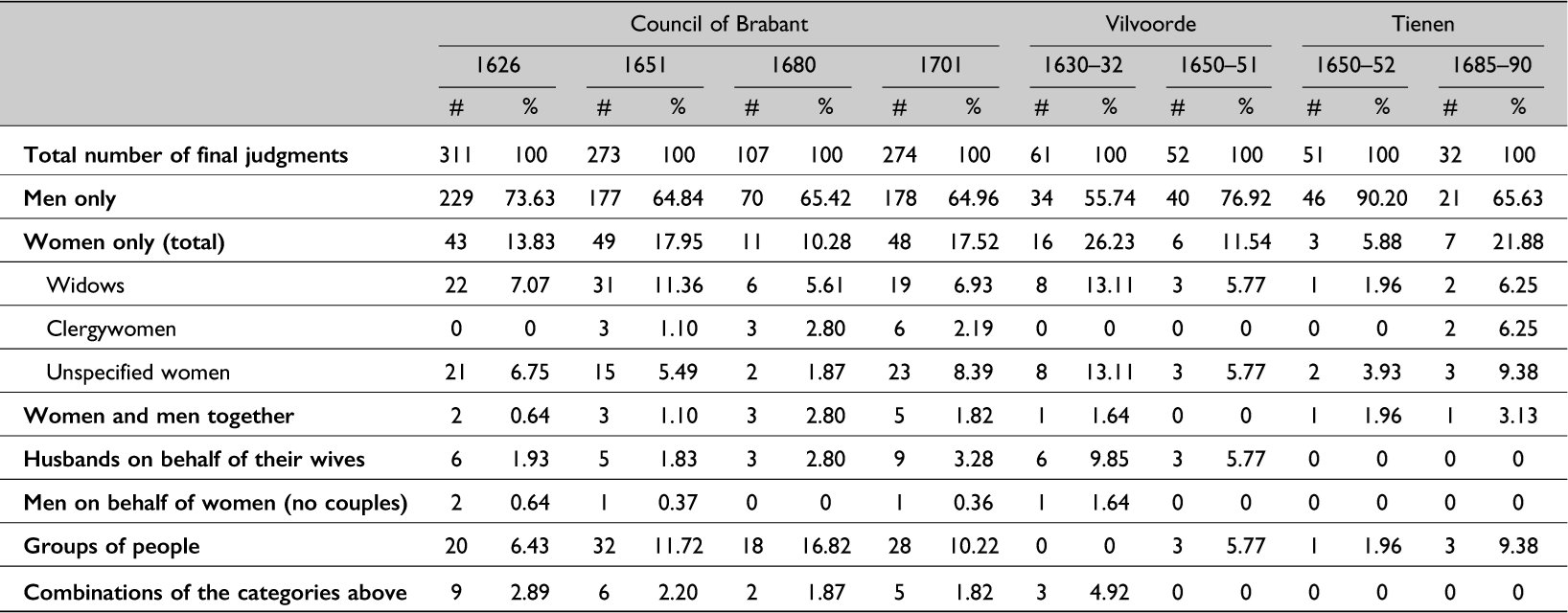
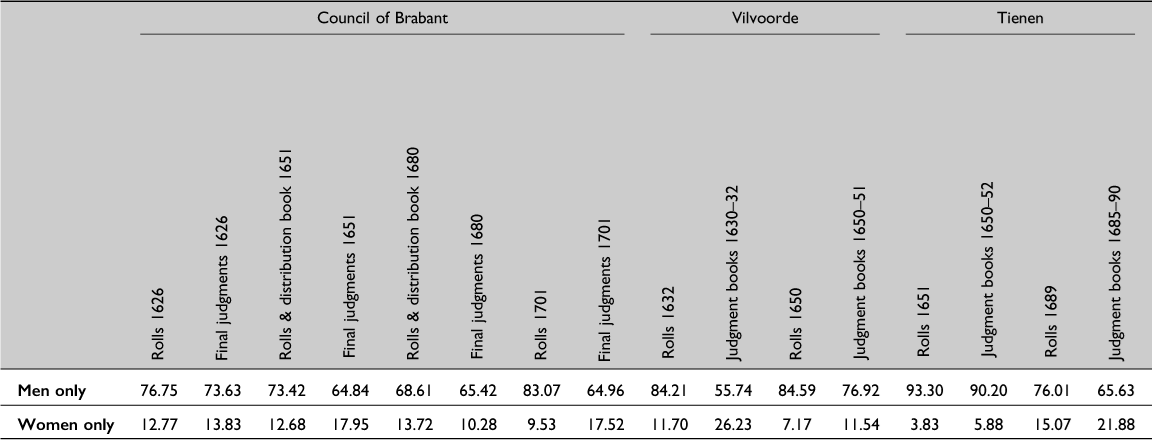
Based on the figures in Tables 6 and 7, we can compare the numbers of female and male plaintiffs in the judgments of the Council with the rolls and distribution books. We find that the relative proportion of women increases except in 1680, the year with the highest portion of women both in the rolls and the distribution book. In 1701, the ratio of women almost doubles if we compare the started and finished cases in that year. We find the same pattern in four different samples from the judgment registers of Vilvoorde and Tienen: here, too, the relative proportion of women increases while that of men decreases if we compare with the rolls.Footnote 58
Number of Final Judgments in three Brabantian Lawcourts, Per Category of Plaintiffs

Table 6. Long description
The table presents the number of final judgments in three Brabantian law courts, categorized by types of plaintiffs over different years. It includes data from the Council of Brabant for the years 1626, 1651, 1680, and 1701, and from Vilvoorde for the periods 1630-32 and 1650-51, and from Tienen for the periods 1650-52 and 1685-90. The table has 12 columns and 10 rows, including headers and categories. The columns are labeled with the years and locations, and the rows are labeled with different categories of plaintiffs such as Total number of final judgments, Men only, Women only (total), Widows, Clergywomen, Unspecified women, Women and men together, Husbands on behalf of their wives, Men on behalf of women (no couples), Groups of people, and Combinations of the categories above. Each cell contains the number and percentage of plaintiffs in each category for the respective years and locations. Notable trends include the relative proportion of women increasing over time, except in 1680, and the ratio of women almost doubling in 1701 when comparing started and finished cases.
Sources: RABru, RvB–griffies, 754, 755, 803, 804, 861, 862, 916, 917, 918, 1031, 1032, 1121, 1122, 1145, 1146, 1161, and 1162; RAL, Vilvoorde, 28 and 29; RAL, Schepenbank Tienen, 2039 and 2040.
Proportion of Men and Women only as plaintiffs in Rolls/Distribution Books versus Judgments (in %)

Table 7. Long description
The table compares the proportions of men and women as plaintiffs in various legal records across different years and locations. It has 2 rows and 12 columns. The columns are labeled as follows: Rolls 1626, Final judgments 1626, Rolls Vmathbin(&) distribution book 1651, Final judgments 1651, Rolls Vmathbin(&) distribution book 1680, Final judgments 1680, Rolls 1701, Final judgments 1701, Rolls 1632, Judgment books 1630-32, Rolls 1650, Judgment books 1650-51, Rolls 1651, Judgment books 1650-52, Rolls 1689, Judgment books 1685-90. The rows are labeled as Men only and Women only. Row 1: Men only. Rolls 1626, 76.75; Final judgments 1626, 73.63; Rolls Vmathbin(&) distribution book 1651, 73.42; Final judgments 1651, 64.84; Rolls Vmathbin(&) distribution book 1680, 68.61; Final judgments 1680, 65.42; Rolls 1701, 83.07; Final judgments 1701, 64.96; Rolls 1632, 84.21; Judgment books 1630-32, 55.74; Rolls 1650, 84.59; Judgment books 1650-51, 76.92; Rolls 1651, 93.30; Judgment books 1650-52, 90.20; Rolls 1689, 76.01; Judgment books 1685-90, 65.63. Row 2: Women only. Rolls 1626, 12.77; Final judgments 1626, 13.83; Rolls Vmathbin(&) distribution book 1651, 12.68; Final judgments 1651, 17.95; Rolls Vmathbin(&) distribution book 1680, 13.72; Final judgments 1680, 10.28; Rolls 1701, 9.53; Final judgments 1701, 17.52; Rolls 1632, 11.70; Judgment books 1630-32, 26.23; Rolls 1650, 7.17; Judgment books 1650-51, 11.54; Rolls 1651, 3.83; Judgment books 1650-52, 5.88; Rolls 1689, 15.07; Judgment books 1685-90, 21.88.
In other words, when women decided to bring a case before the Council of Brabant, they were more likely to proceed until the judges delivered a binding final verdict.Footnote 59 Based on the numbers for the start and end of the cases in the Council, we can calculate odds ratios to see how likely cases filed by women or men were to proceed to the final stages (see Table 8). They confirm the aforementioned patterns: all ratios except for 1680 are higher than 1, indicating that female plaintiffs were more likely to persevere until the final verdict. In 1651, the chance they did so was more than twice as high as what could be expected for male plaintiffs. Given its relatively low number of overall cases and higher number of female cases, 1680 is somewhat unusual.
Odds Ratios for Lawsuits Initiated by Women in the Council of Brabant to Proceed to a Final Judgment, as Compared to Lawsuits Initiated by Men (Based on the Numbers in Tables 3 and 6)

Table 8. Long description
The table presents odds ratios for lawsuits initiated by women in the Council of Brabant to proceed to a final judgment, compared to those initiated by men. It has four columns and two rows. The columns are labeled with years: 1626, 1651, 1680, and 1701. The row is labeled Odds ratios. The values in the table are as follows: Row 1: 1626, 1.248; 1651, 2.095; 1680, 0.79; 1701, 1.399.
Understanding Women’s Litigation
How are we to interpret this perseverance of women in Brabantian courtrooms? Several explanations come to mind, even though additional qualitative research will be needed to test both of them. A first hypothesis is that women had fewer opportunities than men to settle their disputes out of court. As mentioned before, a common feature of early modern conflict resolution is that many individuals preferred to solve their disputes informally. At most, they used the courts instrumentally to increase their chances of success in private negotiations.Footnote 60 Yet in terms of sociability—and thus of chances for out-of-court resolution—we must consider gender differences. New research shows that women generally visited inns and alehouses less than men did, even though they were not the exclusively male space they were long thought to be.Footnote 61 And yet they were exactly the places where many transactions—and probably also the arbitration to end the disputes those transactions generated—took place.Footnote 62 Furthermore, women’s activities in early modern craft guilds were increasingly marginalized, even though women in the Low Countries continued to be heavily involved in economic processes.Footnote 63 In his analysis of the judicial registers of five different craft guilds in Leiden, van Meeteren finds only limited numbers of female plaintiffs.Footnote 64 Nevertheless, to adequately assess these numbers, we also need reliable numbers of the women involved in these guilds. Moreover, these records show the formal adjudicating activities in craft guilds rather than informal negotiation. In other words, there was no radical exclusion of women from public life, but they did face discrimination compared to men. Can these differences help explain the divergence in terms of lawsuits? Ariadne Schmidt argues the opposite, namely that women were more likely to take advantage of informal opportunities. This may indicate why lower numbers of women went to court.Footnote 65 However, she focuses on the reasons for not litigating, not the impact of different forms of sociability on pending lawsuits.
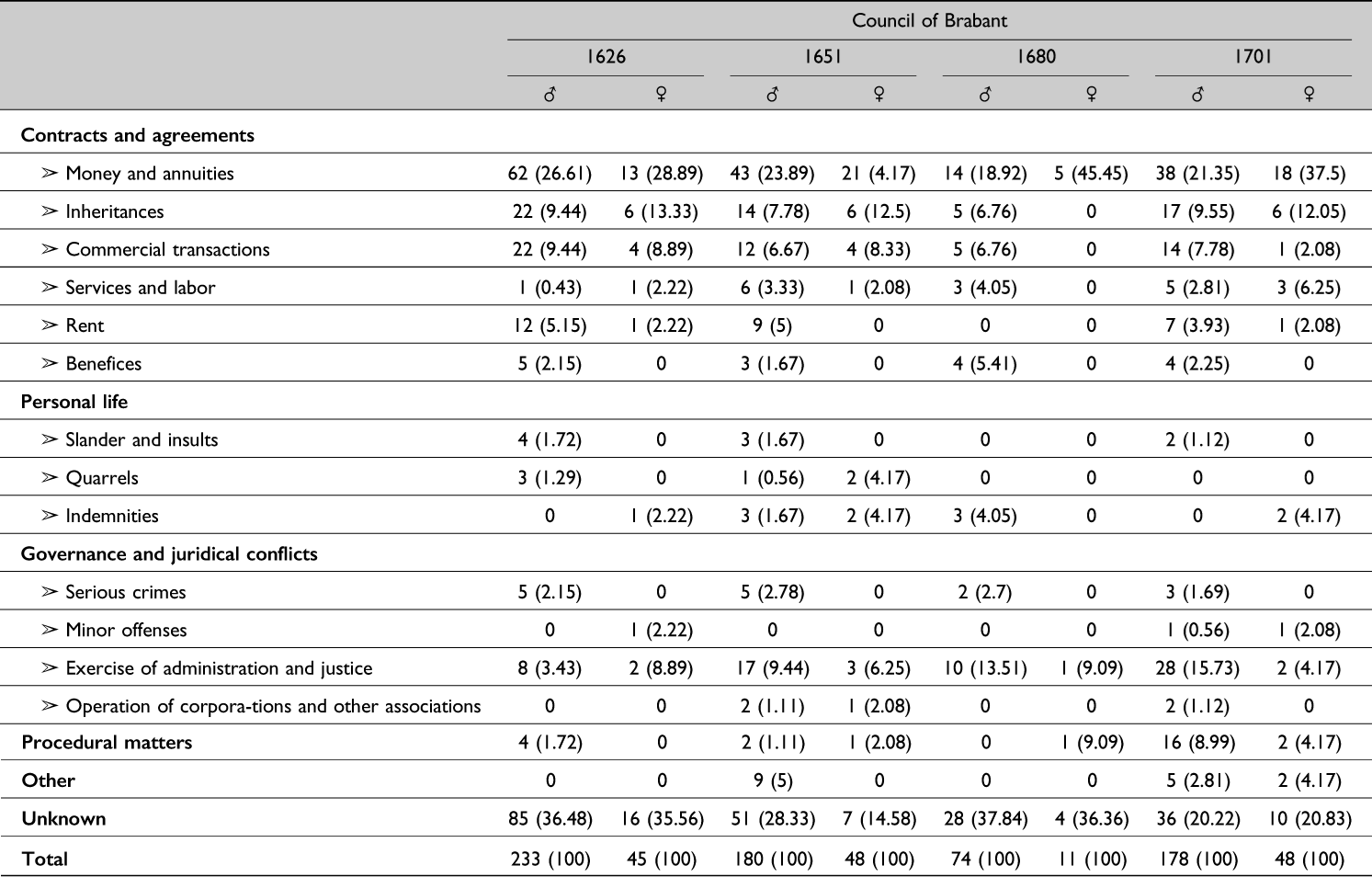
A second hypothesis is that a final judgment explicitly laying down their rights benefited women comparatively more than men. Women’s legal status was more precarious, and it was subject to major changes throughout their lives: Any change in marital status (from unmarried to married, from married to widowed, from widowed to remarried, etc.) had potentially far-reaching repercussions for a woman, making it plausible that she might have a stronger interest in asserting—and being able to prove—her rights. A breakdown of the subject matters of the judgments of the Council of Brabant per year and per category of litigants (see Table 9) lends support to this second hypothesis. The two main categories for women—”money and annuities” and “inheritances”—together fluctuate between 63.16% and 71.43% of all judgments that could be tagged (with an average of 67.16% over the four sample years), whereas for men they make up between 38.73% and 56.76% (with an average of 46.61%). Women barely filed any suits concerning rent and lease, commercial transactions, or the functioning of administration and justice, meaning they litigated on a restricted number of topics compared to men. The fact that inheritances, as well as debts and annuities linked to contested inheritances, accounted for a large portion of female litigation is in line with what Tim Stretton has found for sixteenth-century England. In search of explanations, he stresses, among other things, that the transition into widowhood brought not only a restored legal status but also responsibilities for an estate, which placed pressure on affected women to take legal action. Widows also took to court more often in the first year after the death of their husbands, indicating that they needed to settle associated matters—perhaps also in preparation for a new marriage.Footnote 66 The findings in Table 9 may thus help to explain why women brave enough to go to court were proportionately more determined to obtain a final verdict.
Subjects of Lawsuits According to the Judgments by the Council of Brabant (Absolute Numbers; Percentages Between brackets)

Table 9. Long description
A table comparing the subjects of lawsuits by the Council of Brabant across different years and categories of litigants. The table has 15 rows and 8 columns. The columns are labeled with years (1626, 1651, 1680, 1701) and gender symbols (male, female). The rows are labeled with different categories of lawsuits: Contracts and agreements (Money and annuities, Inheritances, Commercial transactions, Services and labor, Rent, Benefices), Personal life (Slander and insults, Quarrels, Indemnities), Governance and juridical conflicts (Serious crimes, Minor offenses, Exercise of administration and justice, Operation of corporations and other associations), Procedural matters, Other, and Unknown. Each cell contains the number and percentage of lawsuits for each category and gender. Notable trends include a higher percentage of women filing lawsuits related to money, annuities, and inheritances compared to men. Women also filed fewer lawsuits in categories like rent, commercial transactions, and the functioning of administration and justice.
Sources: RABru, RvB–griffies, 754, 755, 803, 804, 861, 862, 916, 917, 918, 1031, 1032, 1121, 1122, 1145, 1146, 1161, and 1162; RAL, Vilvoorde, 28 and 29; RAL, Schepenbank Tienen, 2039 and 2040.
Unfortunately, the case files and the judgments hardly ever disclose why the litigants had taken particular procedural roads, even though they often contain concise information about previous steps taken to solve the dispute—one can think of the use of arbiters, the registration of specific titles or witness accounts with notaries or simultaneously starting parallel lawsuits in different courts. To definitively explain why women were more likely to proceed further during the trial, we probably must look beyond the archives left by the lawcourts. We need both qualitative and quantitative research about different informal, semi-formal, and formal forums for dispute settlement, as Aries van Meeteren has brought together for 1664–8 in Leiden. In an ideal world, we could connect our findings with information about notaries’ services, to name one example. Notaries played a prominent role in conflict resolution in local communities, but so far their activities have seldom been examined. Van Meeteren is an exception. He concluded for Leiden that men dominated and that those women who did make use of a notary were usually not married. Nevertheless, looking at contracts and agreements, his results show one category in which women were more strongly involved: inheritances. In these cases, up to a third of the initiating parties were women. The sample is small, and van Meeteren stresses that in cases of inheritance women and men more often asked for registration together, but nevertheless this endorses my findings.Footnote 67 In a contribution on female uses of criminal procedures in early modern Bologna, Sanne Muurling demonstrates how women, even lower-class women, made clever use of the different formal procedures to pursue personal goals, thereby explicitly nuancing Martin Dinges’ assumption that women would be more inclined to make use of more informal or extrajudicial forms of social control. The formal, state-sanctioned judicial instruments offered these Bolognese women bargaining power to settle their conflicts.Footnote 68 Proceeding until the very end in a civil case and leaving with a binding verdict might have been a comparable method for women to obtain additional power to negotiate.
Finally, given that men faced less legal discrimination relating to litigating in court, a third hypothesis might be that they more readily initiated suits with the sole intention of intimidating the opponent and forcing them to the informal bargaining table. My datasets can neither confirm or refute this hypothesis, which requires further research into how socially acceptable it was for both genders to take legal action, as Tim Stretton has attempted to do for England. Based on a close reading of legal writings, conduct books, satire, and drama, he outlined the contours of an ideal picture of litigious women who modestly defended their rights with the help of males (relatives, professionals) and acknowledges the widespread fear of women who stepped outside of that script to resolutely raise their voice themselves.Footnote 69
Conclusion
Shortly before 1650–51, Anne Anthoine, together with her husband and guardian, had been the plaintiff against Antoinette de Tsestich in a case about arrear payments of an annuity, the seizure of land, and contract forgery. All of these disputes were related to the inheritance of Anne’s deceased brother. Although she was married and her husband is mentioned in some documents, she proceeded highly independently. In 1649, for example, she addressed an official request to the Chancellor of the Council of Brabant, stating, among other things, that her husband “does not wish to intervene in [the case about] the inheritance.” In a document drafted afterward, he confirmed having full knowledge of the request and gave his wife his authorization for this step. Furthermore, this suit was incorporated into the file of another (related) case where Anne Anthoine was forced to defend herself before the Council of Brabant against nobleman Paul Roels, lord of Traulée and mayeur (the officer of justice responsible for suing perpetrators) of the town of Nivelles. In his remonstrance to the court, Roels mentions how Anne traveled specifically to Nivelles to arrange witnesses, once more confirming her independence.Footnote 70 Cases like these illustrate that women did not shy away from litigation; Racine’s caricature of Countess de Pimbesche was based on substance. But unlike the countess’s lamentations, Anne’s case shows that at least some husbands fully supported their wives in their judicial endeavors.
This contribution aimed at zooming out from concrete cases like Anne Anthoine’s and reconstructing male and female litigation patterns on a larger scale for three lawcourts. Comparing the gender ratio among plaintiffs between the start of civil lawsuits and the final judgments provides evidence of gendered litigation patterns: When women went to court, they were more likely than men to proceed to the finish. Moreover, women sued on a more restricted range of topics than men, with inheritances and the administration of debts representing the most important ones. The differences are significant and highlight the need to distinguish between the succeeding stages of lawsuits when studying the uses of justice. It also serves as a methodological warning for anyone willing to count categories of litigants in judicial archives. Additional research on other courts, also outside the Low Countries, is needed to ascertain whether female perseverance in court was a common feature in early modern Europe. Furthermore, we can only draw final conclusions upon analyzing parallel judicial, infrajudicial, and extrajudicial forums for conflict resolution, including notaries, craft guilds, the local clergy, or the leaders of the neighborhood.
Moreover, this contribution also demonstrates that the proportion of women in civil court cases was not higher in Brabant than elsewhere. However, within Brabant we witness a clear distinction: The share of female plaintiffs was noticeably higher at the princely Council of Brabant. This is an argument for further investigating the accessibility of the princely councils in the Habsburg Netherlands, such as the Council of Flanders and the Great Council of Malines, as well as the backgrounds of their users and their reasons for employing these councils’ services.
Finally, the results raise several questions. The sources of the Brabant lawcourts do not enable us to verify which disputes were more likely to result in quick out-of-court negotiations and which subject matters were comparatively more likely to be pushed to the judicial finish. While certain differences between male and female uses of justice can be identified, they await a definitive explanation. To what degree were women barred from (or impeded in) resolving conflicts out of court? Did they need formal judgments more than men did to properly organize their lives? Quantitative research alone will not suffice to answer these questions. What is required is qualitative analysis of case files to elucidate the concrete choices of women like Anne Anthoine, or like Simonne Saincte and Louise Porte, mentioned at the start of this contribution.
Acknowledgements
A research leave at Saint Mary’s University in Halifax, Canada, in the fall of 2024, allowed me to complete my databases on litigants in Brabantian courts and write a first draft of this article. I presented my results at the Stokes Seminar at Dalhousie University and at the History Seminar Series at Saint Mary’s University, and I am very grateful for the comments I received on both occasions. I am especially indebted to Tim Stretton for the brainstorm we had about early modern women in court and his precious feedback on different draft versions of my contribution. I also owe words of thanks to research and teaching assistant Ward Leloup and three students (Brecht Liefsoens, Mariam Sarhdaoui and Charlotte Van Riet) for their help with entering data into the databases that form the basis for this research. Wouter Ryckbosch suggested me to include odds ratios, and Heidi Deneweth made valuable observations about female plaintiffs. Finally, I am deeply indebted to the anonymous reviewers who, in a very elaborate fashion, commented on earlier versions and made this text much better than it originally was.
Competing interests
The author declares none.



 Open access

