I. INTRODUCTION
The high melting temperature (2003 K), appreciable creep resistance, and excellent high strength of NbCr2 Laves phase make it an attractive candidate for high-temperature structural applications. Reference Jiang1–Reference Nie, Lu, Wang, Chen and Niu3 The major limitation of NbCr2 Laves phase has been the lack of ductility and toughness in the monolithic intermetallic at room temperatures. However, dual phase alloys of a Laves phase and bcc phase have shown remarkable enhancement in fracture toughness, which may combine the excellent high-temperature properties of NbCr2 Laves phase and toughen from the second phases by means of mechanisms such as ductile phase toughening, fiber toughening, and grain refinement toughening. For this reason, a considerable effort was initiated to study the effects of adding various metal and ceramic phases to NbCr2 Laves phase. Reference Li, Li, Gao and Gong4–Reference Aoyama and Hanada10 Takeyama Reference Takeyama and Liu6 found that the incorporation of a ductile Cr-solid solution showed promising effects in improving the fracture toughness of the NbCr2 Laves phase. Also, Aoyama Reference Aoyama and Hanada10 reported that the NbCr2/Cr in situ composites exhibited extremely high yield stresses at elevated temperatures. Shayesteh Reference Shayesteh, Mirdamadi and Razavi5 has explored the potentially beneficial effects of adding Al2O3 to NbCr2 Laves phase. However, the maximum toughening increment is achieved only when the second phase can exhibit significant plastic deformation prior to fracture. This is easier to achieve when the second phase is in the form of a continuous network but in terms of maintaining some elevated temperature capability it may be desirable to have the metallic phase in the form of discrete particles. Unfortunately, this special kind of microstructure cannot be achieved through the usual preparing methods, i.e., vacuum arc-melting Reference Li, Li, Gao and Gong4,Reference Takeyama and Liu6–Reference Cady, Chen, Kotula, Mauro and Thoma9 and hot pressing, Reference Nie, Lu, Wang, Chen and Niu3,Reference Shayesteh, Mirdamadi and Razavi5 since either high temperatures or long sintering duration is required, which would result in compositional segregation, coarsens microstructure, and other metallurgical defects, and severely degrade the desired mechanical properties.
The present work investigates the effect of adding soft Cr phase on the mechanical properties of NbCr2 Laves phase with the intent of creating a high fracture toughness NbCr2-based composite. Special attention will be paid to examine whether the incorporation of Cr would provide a source of extrinsic toughening in NbCr2 Laves phase. The Cr phase was chosen because it has excellent creep resistance and can form in situ composite with the NbCr2 Laves phase, Reference Stein, He and Wossack11 yet at the same time flexible. Secondly, it was proposed that chromium addition to NbCr2 Laves phase would provide both intrinsic and extrinsic toughening via solution toughening, ductile-phase toughening, and grain refinement toughening mechanisms. Furthermore, the possible synergistic effect of combined toughening mechanisms represents an exciting possibility in these materials.
To fabricate these composites consisted of NbCr2 matrix and a continuous network of Cr phase, the spark plasma sintering (SPS) was used for it can obtain a homogeneous and accurately controlled microstructure (in morphology, phase fraction, and size). The SPS is a relatively new sintering technique that can be used to produce nearly full dense samples at lower temperatures and shorter times than conventional sintering techniques would allow. This investigation is an attempt to understand the toughening of NbCr2 Laves phase through second Cr phase consolidated by SPS, which will provide a more general understanding for mechanical behavior of Laves phases and similar complex intermetallics.
II. EXPERIMENTAL PROCEDURE
A. Alloy preparation
A bulk NbCr2 ingot was prepared by arc melting with high purity metals (Nb: 99.99 wt% and Cr: 99.9 wt%) under a titanium-gettered argon atmosphere. Detailed phase constitution using x-ray diffraction (XRD) (not shown in this paper) indicated that the ingot was consisted of entirely NbCr2 Laves phase. Then, the ingot was made into powders of 300 mesh (∼48 μm) by grinding and milling for ∼0.5 h. Samples with nominal compositions of NbCr2-10wt%Cr, NbCr2-20wt%Cr, and NbCr2-30wt%Cr were prepared through mixing the NbCr2 and Cr powders. The sample with a weight of 7 g was poured into a high-density graphite die with an inner diameter of 20 mm and compacted by a SPS machine (SPS, 331Lx, Fuji Electronic Industrial Co., Ltd., Tokyo, Japan). Thin graphite foils were placed between powders and graphite die surfaces to prevent welding and facilitate easy removal of the sintered compact. The mixtures were sintered under 30 MPa for 5 min at 1673 K in conditions of vacuum (1 Pa) with a constant heating rate of 100 K/min.
B. Microstructure characterization
The compacts were grinded with 80-grit emery papers to remove surface contamination from graphite foil and then cleaned in an ultrasonic ethanol bath. Then, the sintered compacts were cut using electro discharge machining and the density was determined by Archimedes' method using water immersion. X-ray diffraction (XRD) was carried out on the polished compacts using a diffractometer (XRD, TD-3500, Dandong Tongda Science and Technology Co., Ltd., Liaoning, China) employing Cu Kα x-rays.
Then, the metallographic process involved grinding, mechanical polishing, and chemical etching with a solution of 15 g KOH, 15 g K3Fe (CN)6, and 90 mL H2O. A scanning electron microscopy (SEM, JSM-6700F, JEOL Ltd., Tokyo, Japan) equipped with an energy dispersive spectrometer were used to characterize the microstructures.
C. Nanoindentation
Nanoindentation experiments were performed on a MTS Nano Indenter® XP instrument (G200, Keysight Technologies, Palo Alto, California) with a three-sided pyramidal Berkovich indenter by using the continuous stiffness measurement technique. Reference Li and Bhushan12 To get reliable mechanical properties and prevent interference from environmental fluctuation, each test was performed when the thermal drift dropped down to 0.01 nm/s. At least 20 indentations were performed on each sample and the distance between the adjacent indents was kept at least 25 μm apart to avoid mutual interferences.
D. Room temperature fracture toughness
The fracture toughness of the samples were evaluated at room-temperature by a microhardness tester with a Vickers indenter (Duramin-A300, Duramin Struers, Copenhagen, Denmark), the tests were carried out at a load of 1000 g and at a constant dwell time of 15 s. The data on each sample were averages of ten indentations. The impression diagonals and the introduced crack length were observed using an optical microscope (Lecia DM4000M, Leica Microsystems, Wetzlar, Germany). The room-temperature fracture toughness values (K IC) were calculated from the following equations Reference Anstis, Chantikul, Lawn and Marshall13 :
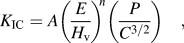 $${K_{{\rm{IC}}}} = A{\left( {{E \over {{H_{\rm{v}}}}}} \right)^{\!\!n}\left( {{P \over {{C^{{3 \mathord{\left/ {\vphantom {3 2}} \right. \kern-\nulldelimiterspace} 2}}}}}} \right)\quad ,$$
where P is the load; H v, the hardness value; C, the average crack length; E, Young's modulus, which can be obtained from the Nano Indenter test; A and n are constants, which are taken as 0.016 and 0.5, respectively, for relatively brittle materials. Reference Sakai and Bradt14 At least six points on each disk were selected for Vickers hardness testing.
III. THEORY
The analytic method developed by Oliver and Pharr Reference Oliver and Pharr15 was used to obtain the hardness (H) and Young's modulus (E) of the SPS-processed compact from the load–displacement curves. The hardness is defined as the applied indentation load divided by the projected contact area and from the load–displacement curve, hardness can be obtained at the peak load as,
 $$H = {{{P_{{\rm{max}}}}} \over {{A_{\rm{c}}}}}\quad ,$$
where A c is projected contact area between the indenter and the sample surface at the maximum indentation load, P max. For a Berkovich indenter, the projected contact area can be described as,
 $${A_{\rm{c}}} = 24.56h_{\rm{c}}^2 + {C_1}{h_{\rm{c}}} + {C_2}h_{\rm{c}}^{1/2} + {C_3}h_{\rm{c}}^{1/4} + \cdots + {C_8}h_{\rm{c}}^{1/8}\quad ,$$
where C 1 through C 8 are constants. The lead term describes a perfect Berkovich indenter, the others describe deviations from the Berkovich geometry due to blunting of the tip, Reference Shayesteh, Mirdamadi and Razavi5 and h c is contact depth, which is given by:
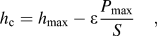 $${h_{\rm{c}}} = {h_{{\rm{max}}}} - \varepsilon {{{P_{{\rm{max}}}}} \over S}\quad ,$$
where ε is geometry constant of the indenter [for a Berkovich indenter, ε = 0.75 (Ref. Reference Oliver and Pharr15)], h max is maximum indentation depth, and S is contact stiffness measured by the initial slope of unloading curve described as,
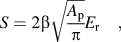 $$S = 2\beta \sqrt {{{{A_{\rm{p}}}} \over \pi }} {E_{\rm{r}}}\quad ,$$
where β is denoted as the contact stiffness of material and a geometric constant with β = 1.034 for Berkovich indenter, Reference Oliver and Pharr15 the reduced elastic modulus, E r, can be calculated from the following equation:
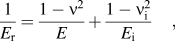 $${1 \over {{E_{\rm{r}}}}} = {{1 - {\nu ^2}} \over E} + {{1 - \nu _{\rm{i}}^2} \over {{E_{\rm{i}}}}}\quad ,$$
where E and ν are the elastic modulus and Poisson's ratio for the sample, respectively, and E i and νi are the same quantities for the indenter. For diamond indenter tip, E i = 1141 GPa and νi = 0.07. Reference Oliver and Pharr15,Reference Tabor16
IV. RESULTS AND DISCUSSION
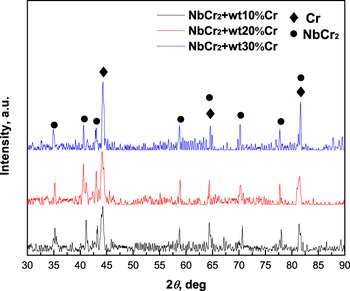
Figure 1 displays the XRD patterns of the sintered samples after SPS, showing that most of the observed XRD peaks are identical to those of NbCr2 (ICDD card PDF#65-9006) and Cr phase (ICDD card PDF#06-0694). From these patterns it is clear that no peaks can be observed for other phases. In addition, the peaks of NbCr2 in these samples were found to slightly shift to lower angles, suggesting the increase of the unit cell volume which may originate from solution of Cr atoms. Meanwhile, the unit lattice constant of Cr phase in these samples are also became larger, which may resulted in substituting of Nb at Cr sites as the atomic radius of Cr (0.185 nm) is smaller than that of Nb (0.208 nm).
XRD patterns of Laves phase NbCr2-based composites toughened with different contents of Cr phase sintered at 1673 K.

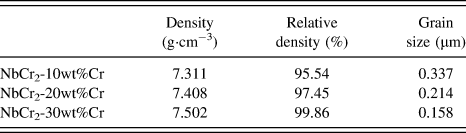
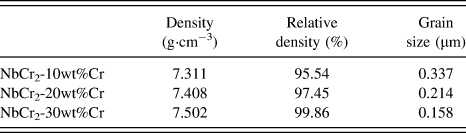
The other characterizations of the SPS-processed samples are summarized in Table I. The grain size was observed to decrease gradually with the Cr content. According to the Nb–Cr phase diagram, the NbCr2 Laves phase can react with Cr phase through the eutectic reaction. In this case, the addition of Cr phase will decrease the liquidus temperatures of the NbCr2-based composites. Correspondingly, the undercooling of the melt increased with the increase of Cr content under the same sintering temperature. Thus, the grain size decreased gradually with the Cr content and led to the increase of hardness with increasing the Cr content. The alloys exhibit a very high densities with refined grain sizes when compared with the samples prepared by mechanical alloying and hot pressing. Reference Xiao, Lu, Hu, Huang, Nie and Fu17 The significant grain refinement may be attributed to the fact that the surface of the powder particles experience a severe plastic deformation during milling, which leads to a higher activation of recrystallization according to the present widely accepted mechanism of SPS. In addition, the process of mechanical milling also help for the grain refinement during SPS due to the increase of distortion energy. However, the grain refinement caused by the milling process can be neglected as the milling process only lasted for 0.5 h and the main aim of the milling was to mix the powders well. In this case, the mechanical properties of these alloys with refined grains may be improved markedly.
The densities and grain sizes of the NbCr2-based composites with different contents of Cr phase sintered at 1673 K.
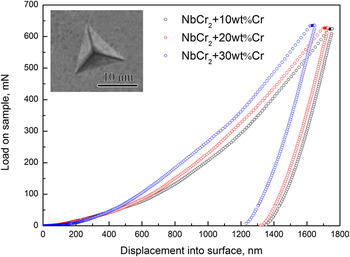
The hardness and Young's modulus of these sintered alloys were investigated by nanoindentation measurements on the polished surfaces. Figure 2 compares the representative load–displacement (P–h) responses of the bulk samples with different contents of Cr phase consolidated at 1673 K. It shows that the samples with different contents of Cr phase exhibit almost the same load during loading. Meanwhile, no pop-in events were observed in the present studies indicates that shear band activity during plastic deformation of this alloy is not very pronounced.
Representative nanoindentation load–displacement curves of the bulk samples with different contents of Cr phase consolidated at 1673 K. The inset shows the SEM nanoindentation impression of NbCr2-10wt%Cr sintered sample.

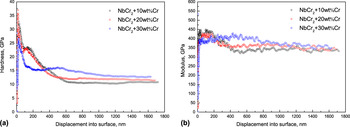
Figure 3 depicts the variation of hardness (H) and Young's modulus (E) with the indentation depth for the samples with different Cr contents. As is seen, the hardness decreased with the indentation depth, which is similar to that reported for other alloys during nanoindentation test. Similarly, the Young's modulus also decreased with the applied load. Such mechanical softening has been reported for other alloys Reference Wang, Wang, Li, Wang, Wang and Han18–Reference Jang, Yoo, Kim, Oh, Choi and Bei20 and can be attributed to the net creation of free volume during plastic deformation.
Hardness (a) and Young's modulus (b) of the NbCr2/Cr alloys with the indentation depth for the different Cr contents.

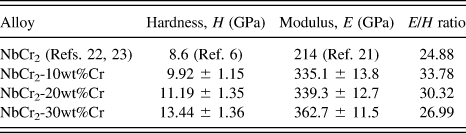
The average values of hardness and Young's modulus are listed in Table II. It can be seen that both the hardness and Young's modulus of the SPS'ed NbCr2-based composites exceed that of the NbCr2 Laves phase [hardness: 8.6 GPa, Reference Takeyama and Liu6 Young's modulus: 214 GPa (Ref. Reference Ormeci, Wills, Chen, Albers, Thoma and Mitchell21)] and increased gradually with the Cr contents. In general, the hardness of the NbCr2/Cr composites should decrease with the increase of Cr phase content since the hardness of Cr phase is only 1.9 GPa, which is far smaller than the NbCr2 Laves phase. The enhancement in H and E of the SPS'ed NbCr2-based composites can be ascribed to fine grain and interface toughening. The bulk refined NbCr2-based composites have significant volume fractions of grain boundaries and interfaces. The grain boundaries and interfacial structure are barriers that impede dislocation motion and, therefore, they are effective strengthening mechanism, and can offer drastically improved strength over the conventional coarse-grained NbCr2 Laves phase alloy.
The hardness, Young's modulus, and E/H of the bulk NbCr2/Cr alloys.
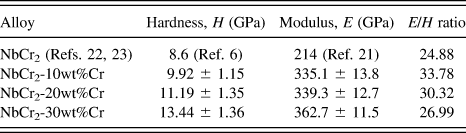
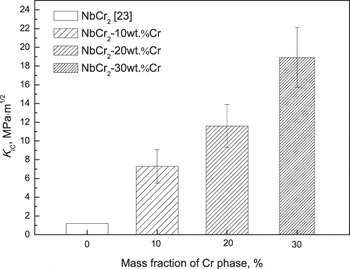
In addition to H and E, Table II also shows the values of E/H ratios, which is a reliable indicator of fracture toughness according to Eq. (1). The E/H ratios of the SPS-processed samples became larger than that of the NbCr2 Laves phase (24.88). Therefore, the fracture toughness of the SPS-processed samples may be enhanced. Figure 4 shows the measured room-temperature fracture toughness of the NbCr2/Cr composites. It can be seen that the fracture toughness of the bulk samples increased with the contents of Cr phase. The fracture toughness of NbCr2-10wt%Cr, NbCr2-20wt%Cr, and NbCr2-30wt%Cr increased from 7.3 MPa·m1/2 to 11.6 MPa·m1/2 and 18.9 MPa·m1/2, which are about 6, 10, and 16 times higher than that of the as-cast NbCr2 Laves phase. In this case, the microstructure of the SPS-processed NbCr2 alloy needs to be examined with the aim of revealing the toughening and strengthening mechanisms.
Room-temperature fracture toughness of the NbCr2/Cr composites fabricated by SPS together with the monolithic NbCr2 Laves phase produced by arc melting.

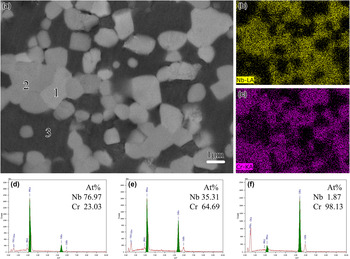
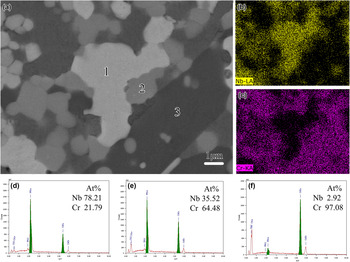
The representative SEM image for NbCr2-10wt%Cr sample is shown in Fig. 5 along with the EDS maps of the associated elements presented in the alloy. It can be seen that the ductile Cr phase was well distributed among the NbCr2 matrix when compared to the samples prepared by arc melting. Reference Li, Li, Xue and Fu7,Reference Li, Li, Xue and Fu8 However, detailed analysis using SEM shown in Fig. 5 indicated that three phases, differing in contrast, were observed in the bulk sample. Combined with the EDS results showing in Figs. 5(d), 5(e) and 5(f), the three phases were identified to be Cr, NbCr2 Laves phase and Nb solid solution, respectively. From the XRD patterns showing in Fig. 1 it is clear that the compacts were consisted of entirely NbCr2 and Cr. The reason for not seeing the Nb solid solution by XRD is due to the fact that its content is below the detection limit of the XRD analysis method as well as the tested samples were all bulk materials.
SEM and EDS analysis of NbCr2-10wt%Cr sintered using the SPS at 1673 K for 5 min: (a) typical SEM image; (b) the EDS map for niobium distribution; and (c) the EDS map for chromium distribution; (d), (e) and (f) are the EDS line for positions 1, 2 and 3 denote in (a), respectively.

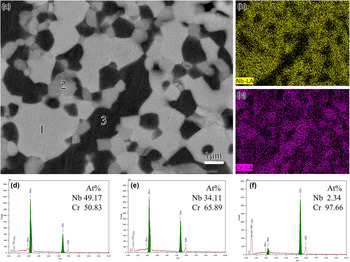
The same examinations were performed for the SPS-processed NbCr2-20wt%Cr and NbCr2-30wt%Cr samples, as presented in Figs. 6 and 7, respectively. It can be observed from the EDS maps that a relative amount of Cr solid solution and small amounts of Nb solid solution were formed in the microstructure. In this condition, the significant enhancement in mechanical properties of the NbCr2 Laves phase toughened by Cr phase fabricated by SPS can be ascribed to dual ductile phase toughening and interface toughening mechanisms.
SEM and EDS analysis of NbCr2-20wt%Cr sintered using the SPS at 1673 K for 5 min: (a) representative SEM image; (b) the EDS map for niobium distribution; and (c) the EDS map for chromium distribution; (d), (e), and (f) are the EDS line for positions 1, 2, and 3 denote in (a), respectively.

SEM and EDS analysis of NbCr2-30wt%Cr sintered using the SPS at 1673 K for 5 min: (a) representative SEM image; (b) the EDS map for niobium distribution; and (c) the EDS map for chromium distribution; (d), (e), and (f) are the EDS line for positions 1, 2, and 3 denote in (a), respectively.

It is known that both the Cr solid solution and Nb solid solution have quite low hardness, but exhibit excellent ductility. Thus, the soft Cr phase and Nb phase tend to display good deformation behavior and undertake plenty deformation. In addition, the Cr and Nb solid solutions with the bcc crystal structure have been indicated effective in preventing cracks propagate originating in the NbCr2 Laves phase, Reference Lee, Liaw, Liu and Chou24 which may lead to the substantial increase in the fracture toughness. Meanwhile, abundant NbCr2/Cr interfaces were introduced in the microstructure due to the significantly grain refinement. The interface is helpful in improving the fracture toughness by inhibiting the crack propagation, which further enlarges the fracture toughness. Reference Lee, Liaw, Liu and Chou24
The formation mechanism of Nb solid solution during the SPS may associate with the intrinsic characteristics of NbCr2 Laves phase and the unique mechanism of SPS. According to the binary Nb-Cr phase diagram, Reference Stein, He and Wossack11 the NbCr2 Laves phase exhibits a solid solubility of 3 at%∼6 at%Cr. At the beginning of the SPS, the current density on the outer surface of the particle becomes very high, which leads to a significant temperature rise on the powder surface due to joule heating. Thus, partial melting would occur on the surface of the powder. Reference Song, Liu and Zhang25 In this condition, the Cr atoms will diffuse into the NbCr2 Laves phase due to the chemical potential difference, and resulting in the formation of supersaturation NbCr2 Laves phase. With the aid of pulsed D.C. imposed during the SPS, Nb solid solution nucleus would precipitate from the supersaturation NbCr2 Laves phase. With the atomic diffusion proceed, trace amounts of Nb solid solution would be formed at the grain boundaries.
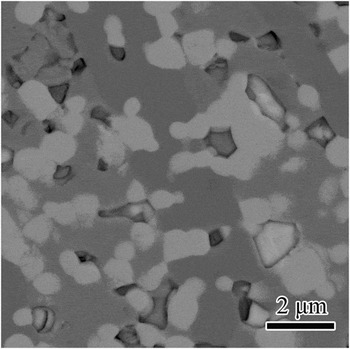
In addition, some micro-viods were observed to occur in the microstructure of SPS'ed NbCr2-30wt%Cr alloy as shown in Fig. 8. The formation of micro-voids can be ascribed to the following two reasons. Firstly, insufficient densification during the SPS as suggested by the measured relative density shown in Table I. Secondly, the formation of micro-viods can be ascribed to the Kirkendall effect, which basically refers to a nonequilibrium mutual diffusion process through an interface of two metals so that vacancy diffusion occurs to compensate for the unequal material flow. Reference Yin, Rioux, Erdonmez, Hughes, Somorjai and Alivisatos26 Due to the difference in diffusion rates between the Cr and Nb components, the Kirkendall effect can give rise to void formation near the interface and within the fast-diffusion side. Furthermore, the existence of micro-viods will increase the possibility of crack formation and thus degrade the mechanical properties.
SEM image of Kirkendall voids formed in the NbCr2-30wt%Cr sample fabricated by SPS consolidated at 1673 K.

Furthermore, it can predict that there will be downsides in mechanical properties (including hardness, modulus, and fracture toughness) of the SPS-processed NbCr2-based composites when we keep increasing the sintering temperature according to the present results. The main reason lies in the fact that the grain will be coarsened under higher sintering temperature. In this case, the amount of grain boundaries will be reduced and therefore weaken the effects of fine-grain and interface toughening. The increase of sintering pressure is thought to increase the mechanical properties of the SPS-processed NbCr2-based composites due to the accelerating of densification and reducing of micro-voids.
V. CONCLUSION
In summary, the XRD, SEM, and nanoindentation techniques were used to investigate the characterization and mechanical properties of Laves phase NbCr2-based composites toughened with Cr phase fabricated by SPS. A beneficial effect of an increase in the mechanical properties of NbCr2 Laves phase consolidated by SPS is found. Micro mechanical properties analysis show that the hardness of the SPS-processed composites increase from 9.92 ± 1.15 GPa to 11.19 ± 1.35 GPa and 13.44 ± 1.36 GPa with the Cr content increasing from 10 wt% to 20 wt% and 30 wt%, which are even higher than that of the monolithic NbCr2 Laves phase. The enhancement can be ascribed to the remarkable refinement of grain size caused by the SPS technique. More importantly, the room temperature fracture toughness of NbCr2-10wt%Cr, NbCr2-20wt%Cr, and NbCr2-30wt%Cr alloys attain 7.3 MPa·m1/2, 11.6 MPa·m1/2, and 18.9 MPa·m1/2, which are increased by about 608%, 967%, and 1550% over the as-cast NbCr2 Laves phase (1.2 MPa·m1/2). The remarkable enhancement in room temperature fracture toughness can be attributed to the introducing of Cr phase and the formation of Nb solid solution as well as the significantly grain refinement based on the microstructural analysis. The formation of Nb solid solution may result in the nonequilibrium mutual diffusion under the imposed pulsed current.
ACKNOWLEDGMENTS
This research was financially supported by the fund of the State Key Laboratory of Solidification Processing in NWPU (SKLSP201507), the Youth Foundation of Taiyuan University of Technology (2014TD010) and the Qualified Personnel Foundation of Taiyuan University of Technology (tyut-rc201421a).