INTRODUCTION
Small-scale artisanal fisheries in the Caribbean have transformed coral reefs in ways that seriously compromise their ecological and economic value (Hawkins & Roberts, Reference Hawkins and Roberts2004). The impact of exploitation does not depend only on the exploitation pressure, but also depends on the vulnerability of the species regarding exploitation (de Boer et al., Reference de Boer, Pereira and Guissamulo2000). Marine invertebrates are vulnerable to overfishing because they are easy to catch by shore gleaning, reef-walking, snorkelling, or diving. However, some species seem particularly vulnerable, principally those unable to escape depredation, species with large body size at maturity, and rare or stressed species (de Boer et al., Reference de Boer, Pereira and Guissamulo2000). As many invertebrates are broadcast spawners, successful reproduction is density dependent, and reducing densities may lead to a disproportionate reduction in fertilization and subsequent recruitment (Uthicke & Benzie, Reference Uthicke and Benzie2000). The ecological consequences of fishing these animals are unknown, even though some have been shown to have important functions in their environment (Uthicke, Reference Uthicke2001). Therefore, it is possible that removal of these animals reduces the overall productivity of affected reefs.
The impact of coral reef fisheries is not only of ecological concern, it is also of great social and economic concern because three-quarters of the world's coral reefs lie within developing countries where subsistence economies predominate (Salvat, Reference Salvat1992; Whittingham et al., Reference Whittingham, Campbell and Townsley2003). Artisanal and traditional fisheries in Madagascar target a wide range of exploitable resources from inter-tidal to in- and off-shore waters; finfish, elasmobranchs, marine mammals, sea turtles, crustaceans, cephalopods, gastropods, bivalves, echinoderms, colloid-bearing seaweeds and even seabirds (Cooke et al., Reference Cooke, Lutjeharms, Vasseur, Goodman and Benstead2003), providing a key source of income and food. Traditional fishing activities are principally on foot or from non-motorized pirogues (wooden dug-out boats locally known as lakana), compared with the use of larger motorized vessels officially referred to as artisanal fishing (Cooke et al., Reference Cooke, Lutjeharms, Vasseur, Goodman and Benstead2003). The Vezo fishermen of western Madagascar use the boats for the most valuable and sizeable target taxa such as vertebrates, crustaceans and cephalopods, whilst the women and children collect invertebrates, such as molluscs from the shore and lagoons at low water periods (Barnes et al., Reference Barnes, Rawlinson, Zucco, Lawford and Purnell2001). In some parts of the world this gleaning of invertebrates on foot may account for as much catch as the activities of men fishing from boats (Chapman, Reference Chapman1987). It is the invertebrate fishery that is described here and will be termed ‘traditional’.
Current demographic pressures and socio-economic problems in Madagascar are resulting in greater exploitation of marine resources and raising questions on the sustainability of reef fisheries, particularly in the western provinces of Toliara and Mahajunga (Laroche et al., Reference Laroche, Razanoelisoa, Fauroux and Rabenevanana1997). In the Toliara region, a five-fold increase in the number of fishers in a period of 17 years has been recorded (DRH/FAO, 1992). This increase has been due mainly to the 324% increase in the human population in the region between 1975 and 1993 (Cooke et al., Reference Cooke, Ratomahenina, Ranaivoson and Sheppard2000), but also to the migration of traditionally farming and gathering ethnic groups (e.g. the Mahafaly, Andandroy and Mikea) to coastal areas in order to supplement their incomes and diets through fishing (McVean et al., Reference McVean, Hemery, Walker, Ralisaona and Fanning2005).
On coral reefs of the Toliara region, the average size of fish caught over the last 15 years has decreased and reef fish surveys show that high fishing pressure has led to a concentration of effort on lower-value species (Laroche et al., Reference Laroche, Razanoelisoa, Fauroux and Rabenevanana1997). There has been widespread overexploitation of holothurians (Conand et al., Reference Conand, Galet-Lalande, Randriamiarana, Razafintseheno and De San1997), and dramatic collapses in tonnage of shells exported during the 1980s (Vasseur et al., Reference Vasseur, Gabrie and Harmelin-Vivien1988). However, there have been no published studies on multi-phyla invertebrate fisheries in this region. Here we present a study designed to give information on the traditional invertebrate fishery in the Anakao region of south-western Madagascar. There is also a lack of information on the diversity and ecology of coastal invertebrate assemblages in this region and in Madagascar as a whole. This study may also serve to provide valuable data on the diversity and relative abundance of invertebrate species at a time when pressure on coastal environments is increasing and extensive oil exploration is taking place off western Madagascar in the Mozambique Channel (Rawlinson, 2008, personal observation). Our study addresses the following questions: (i) what is the timing, effort and purpose of the fishery?; (ii) which species are targeted and does this differ between four sites?; (iii) what is the natural abundance of targeted species at the four sites, and what is their relative food value?; and (iv) what influence does the fishery have on the target species?
MATERIALS AND METHODS
The study area
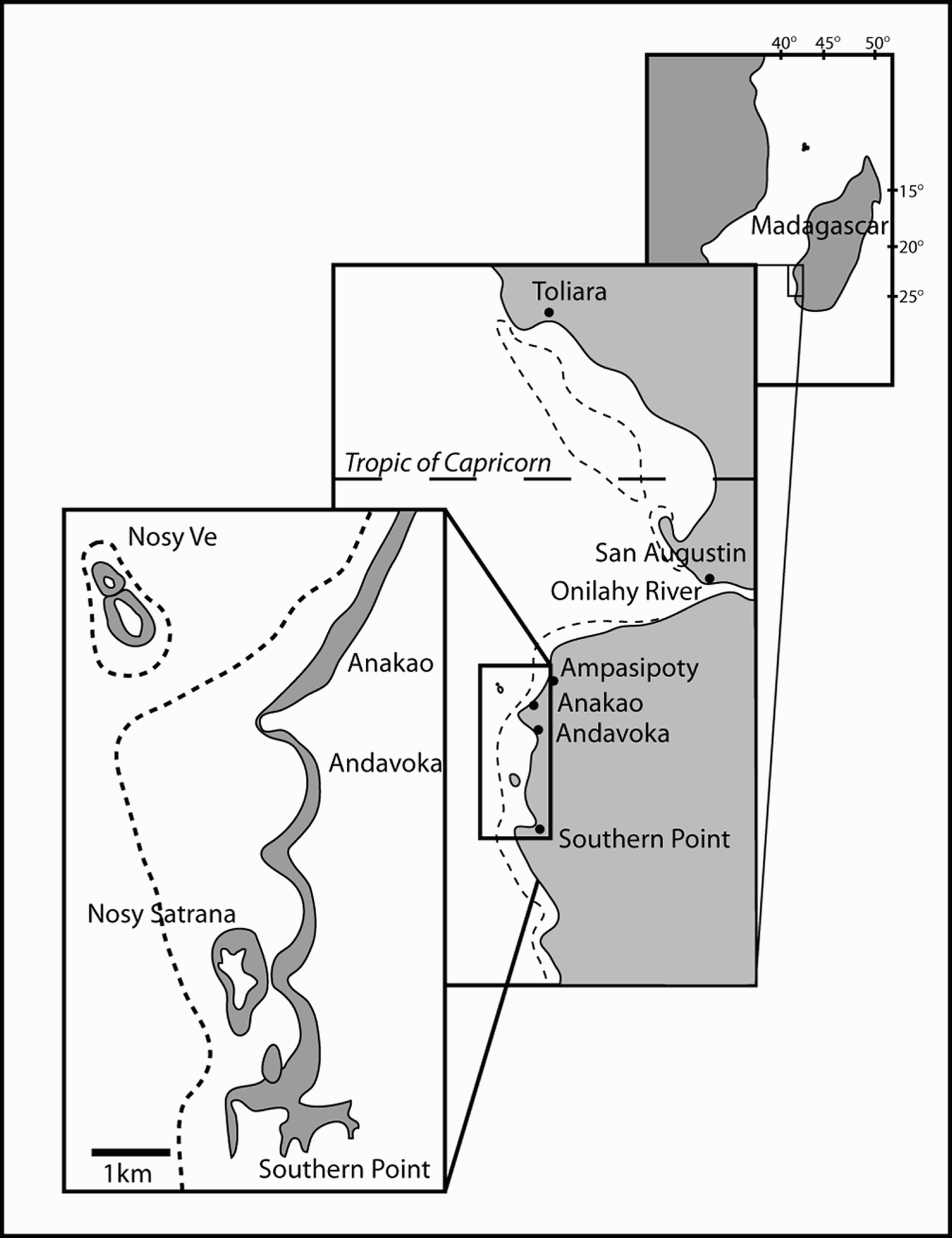
Coral reefs and lagoonal areas extend over 600 km along the south-western coast of Madagascar. Those of the Toliara region, especially the ‘Grand Récif’, a true barrier reef, are best described (reviews in Thomassin, Reference Thomassin1971; Frontier, Reference Frontier1978). Approximately 40 km south of the major port of Toliara is the village of Anakao, the site of this study (Figure 1). At Anakao there is a narrow lagoon enclosed by a fringing reef 500 m offshore, just south of Anakao, the reef extends further seaward and the lagoon widens. The small island of Nosy Ve (3 km offshore of Anakao) possesses a well-developed outer reef. The shores in this area, which are a few hundred metres wide at most, comprise extensive seagrass meadows, sand flats, limestone rock, mangroves and fringing coral reefs. Despite the southerly latitude, the coral reefs may be species-rich (Pichon, Reference Pichon1978; Barnes & Bell, Reference Barnes and Bell2002), although the high storm exposure and oceanographic phenomena have resulted in some bleaching and mortality of corals (Cooke et al., Reference Cooke, Ratomahenina, Ranaivoson and Sheppard2000). The tidal range varies between about 1 m on neap tides to over 2 m on spring tides.
The position of the Anakao region study area in the Toliara province of south-western Madagascar in the west Indian Ocean. Intertidal shallows along the 6 km area of coastline are shaded. Toliara ‘Grand Récif’ is indicated by the grey dotted line.

Traditional fisheries were studied in the Anakao region at four sites (Figure 1). Anakao and Andavoka, Nosy Satrana and Southern Point (2 km, 4 km and 6 km south of Anakao respectively) were essentially similar except for the occurrence of mangrove solely at Southern Point. The Anakao region currently has little population and restricted access (mainly boat), but its proximity to Toliara, the recent influx of farmers affected by drought and increasing popularity for tourism will lead to inevitable pressure on resources. Shore gleaning is an important source of food as well as bait for fishing at Anakao (Barnes et al., Reference Barnes, Rawlinson, Zucco, Lawford and Purnell2001). Marine resources are managed by a local fishermen's association and agreed on by social convention (dina); the reef around Nosy Ve is a designated controlled area for fishing where destructive methods are banned, and a small patch of lagoon reef (named ‘Aquarium Nord’) has been totally closed to fishing (Rakotoarison, Reference Rakotoarison1999).
Data collection and analysis
To measure the timing, effort and purpose of the fishery the number of collectors gleaning the shore, the distance they walked to catch area (effort, km) and the type of target species collected were observed and recorded from May to September 2000 in each of the four sites within the Anakao region. Some further discrete observations were made around the fringing coral reef of Nosy Ve. The influence of collectors' age on catch composition and target species size was assessed. The age of collectors was recorded as merely child or adult. A two-sample Kolmogorov–Smirnov test was used to measure whether the distributions of target species size for child and adult collectors have the same mean, standard deviation and shape.
Target species were measured and counted in a random selection of willing volunteer villagers on completion of their daily collections. Over 60 total daily catches and 1200 animals from collectors were identified and measured from each of the four sites during the four-month study period. The proportional importance of target species was tabulated in terms of absolute frequency of collection and number of collectors targeting it. The natural abundance of target mollusc species was assessed and ranked in each of the sites by placement of multiple random 4 m2 quadrats and casual observations (for highly mobile species). The amount of edible mass gained from the mean size (of caught individuals across sites) was assessed for each target mollusc species and ranked.
The influence of the fishery on target species was assessed by comparing the sizes of selected mollusc species in recent catches with those from middens (piles of previously caught shells). Size variation is shown using length–frequency histograms and analysed using a one-way ANOVA.
RESULTS
Timing, effort and purpose of fisheries
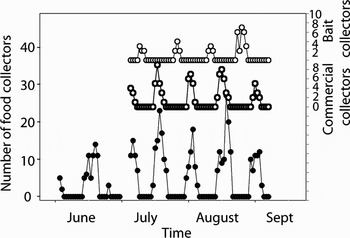
The purpose of the Anakao invertebrate fishery was tripartite; the collection of bait, commercial and subsistence target species. These collections occurred for 2 to 3 hours over low water and were sequential with respect to daily tidal range. Bait samples were collected exclusively during neap tide low water periods, commercial species mainly during the onset of spring tide low water and food species throughout spring tide low water periods. Food collection involved the most people per unit time and was spread over the greatest period of time (Figure 2). There was little difference in the magnitude or timing of these three activities over the study period irrespective of variability in spring tide range in successive spring tides.
Traditional harvesting effort with time in the Anakao region, south-western Madagascar. Left axis (black circles) indicates the number of shore gleaners for invertebrate food. Right axis (white circles—top) indicates the number of shore diggers of bait and (white circles—middle) the number of collectors searching for saleable species (mainly holothurians).

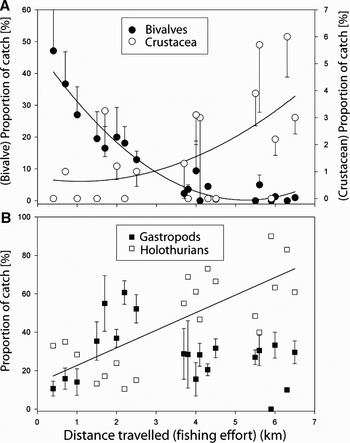
Timing, effort and purpose of shore gleaning were, therefore, all linked to the tidal state (low or high) and magnitude (range) but also to site and gender/age of collector. The bait species Nerita plicata Linneaus, 1758, and Nerita textilis Gmelin, 1791 (gastropod molluscs) were only collected at one site (Andavoka), as was another gastropod Terebralia palustris Linneaus, 1758 (at Southern Point). Aside from site-specific bait gathering, ‘catch’ composition was strongly correlated with distance travelled to catch area (effort). The catch component of different taxa did, however, show different types of relationship with effort required. The proportion of bivalve molluscs collected decreased logarithmically with distance travelled whilst that of crustaceans increased in a similar way (Figure 3A). The proportion of holothurians collected increased linearly with distance travelled by shore gleaners and gastropod importance was greatest at mid-distance (Figure 3B). Cephalopod collection was stable irrespective of distance (plot not shown).
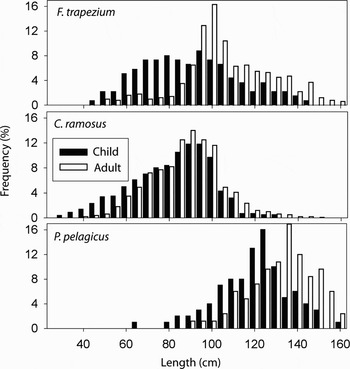
Target species choice and size was influenced by collector gender and age. Typically only men collected bait species. Collection of the major crustaceans (prawns, Panulirus sp. and Scylla serrata) and octopus was likewise mostly male and entirely adult undertaken. Holothurians were mostly collected my women. Edible gastropods and bivalves were collected by women and children. Children typically collected more of the abundant but low value species and targeted a greater variety of species. The size of target species also varied with collector age, such that children generally tended to collect smaller individuals of the same species (Figure 4), e.g. Fasciolaria trapezium L. 1758 and Portunus pelagicus Fox, 1926 (Kolmogorov–Smirnov two-sample statistic, P < 0.001 for both species). The size of Chicoreus ramosus L. 1758 caught by children and adults showed similar length distributions and frequencies, with no statistical difference between the two collector groups.
Target species
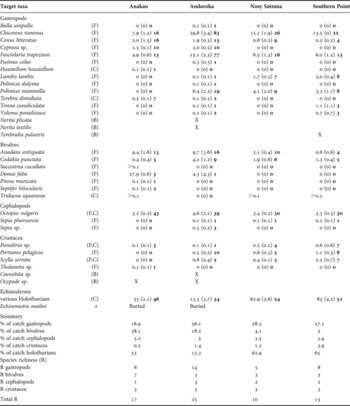
More than 34 taxa from three phyla were caught. Molluscs constituted the greatest number of target species and by far the most individual food or bait items collected. There was a degree of site variability both in terms of the number and identity of mollusc species targeted, the proportions of each collected and the proportion of collectors collecting them. The catches at Andavoka were composed of 20 species, compared with 14 at Anakao, 13 at Southern Point and 10 at Nosy Satrana. Chicoreus ramosus was the most and F. trapezium the second-most important target gastropod species at all four study sites (Table 1). The level of importance, particularly of C. ramosus, did vary substantially. Only F. trapezium and octopus were observed to be collected at Nosy Ve (reserve) and even then only on two occasions. Most other gastropods were collected opportunistically and represented small proportions of overall catch by site. Some of the shore species, e.g. Lambis lambis L.1758, were caught in larger numbers in the subtidal. Other species (e.g. Charonia tritonis L.1758), were only caught in the subtidal by fishermen based from boats. Although the numbers of some species of bivalves collected were comparable with those of gastropods, the proportion of collectors targeting them was low. The small bivalve Donax faba Gmelin, 1791 was dug up in very large numbers by just a few collectors near to Anakao but otherwise only the large Codakia punctata L.1758 was taken in any numbers beside the most popular shell: the ark Anadara antiquata L. 1758. Many collectors targeted cephalopods (mainly octopus). Sometimes, as with certain shells (such as Tritonia, Harpa or Terebra), these were sold to the few hotels in the region. Therefore, amongst the mollusc species most of the effort focused on one species of each class: C. ramosus (gastropod), Anadara antiquata (bivalve) and Octopus vulgaris Cuvier, 1797(cephalopod). More than 23% of collections surveyed during the study period were constituted solely of molluscs. Typically this was by design as up to 10% of collectors set out to find octopus only.
Target species of traditional invertebrate fisheries in south-western Madagascar (F, food item; B, bait item; C, commercial item; +, other). Data presented as mean proportion of individual specimens caught (+SE) of four monthly surveys (each survey N > 1200). Values in bold are proportions (%) of collectors surveyed who collected target species. The four localities are as described in Figure 1.

Few crustaceans were collected despite diverse and abundant potentially edible species. No crustacean species were collected by more than 10% of collectors and no (intertidal) collector solely took Crustacea. Scylla serrata, formed less than 3% of catch and was generally only taken on the basis of opportunistic finding. However, this species was, like octopus, large and high yield when found. A commercial fishery for Scylla serrata was noted at the mangroves of the Onilahy river-mouth near St Augustin (Figure 1) (where the mangroves were more extensive than at Southern Point). Prawns (Penaeus latisulcatus Kishinouye, 1896) and lobsters (Panulirus sp.) formed the basis of a small-scale commercial subtidal fishery operated by small groups of fishermen using pirogues. Both ghost crabs (Ocypode sp.) and hermit crabs (Coenobita sp.) were collected for bait, the former at low water (Figure 2) and the latter at night. Legs were removed from ghost crabs and hermit crabs were extracted from the mollusc shells they occupied. Hermit crabs were infrequent at Anakao, but both bait species were common at Nosy Satrana and Southern Point though neither were collected.
The echinoderms collected were not for consumption (directly) or bait. The holothurians gathered were taken to Anakao village, dried and then sold for export. Holothurians dominated the catches (>50%) at Nosy Satrana and Southern Point and were targeted by more than half of the collectors (Table 1). Echinoids were picked up and put into pits dug in the sand and then covered over. The purpose of this was an attempt to reduce the frequency of echinoid spine related foot injuries to the intertidal gleaners who were mostly barefoot.
Natural abundance of target species and edible mass
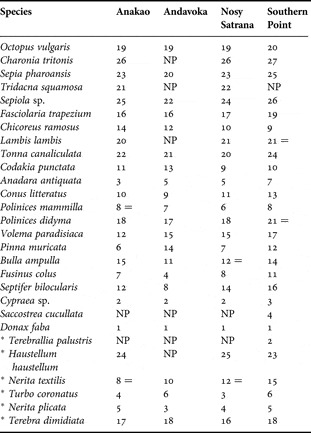
The abundance of target mollusc species differed relatively little between the four sites, with one or two exceptions (Table 2). The bivalves D. faba and A. antiquata and the gastropods Cypraea sp., N. plicata and Turbo coronatus Gmelin, 1791 were ubiquitous throughout the study area. In contrast C. tritonis, and the cephalopods, Haustellum haustellum L. 1758 and Tonna canaliculata L.1758 were uniformly rare at all the sites (including Nosy Ve).
Traditionally fished molluscs listed in order of average food value (i.e. edible mass per individual (Octopus vulgaris has greatest food mass)) and showing ranked abundance at each site (1 = most abundant). *, species not eaten; NP, not present.

The most targeted mollusc species (Table 1) were amongst those producing the most return (edible tissue mass). The high individual yield species were, however, the least abundant species in the study area and those with little edible tissue were the most abundant. Of note is that target gastropods (C. ramosus and F. trapezium) and bivalves (D. faba and A. antiquata) were no more abundant at Andavoka and Anakao (respectively) despite the pattern of collection illustrated in Figure 3. The most rare of the target species, C. tritonis, was not observed to be collected some time (months) before. The absence of certain species, such as Terebralia palustris, from study sites was due to the absence of suitable habitat (mangrove).
Proportion of various taxa in catches of traditional fishery in the Anakao region, south-western Madagascar, with effort (distance travelled by shore gleaners). Data are presented as mean and standard error (catch proportion defined by numbers not mass). Curves in upper graph are quadratic fit (significant at P <0.05) to show logarithmic change. Line in lower graph (holothurians) is significant (at P <0.05) and included to show linear change.

Length–frequency of gastropods (Fasciolaria trapezium and Chicoreus ramosus) and a crustacean (Portunus pelagicus) for child and adult collectors in south-western Madagascar. Sample size of both gastropods is N = 150 and for P. pelagicus N = 100.

Influences on target species
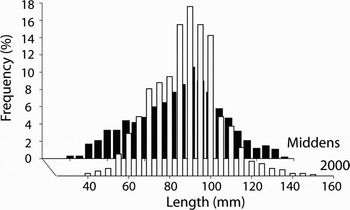
Piles of discarded shells of various target species, such as Chicoreus ramosus and Terebralia palustris, were left as middens on the shores of the study sites. Although few target species were represented in old middens most target mollusc species were, during the study period, collected in only small numbers comprising small and insignificant middens. It was, therefore, difficult to establish whether the variety of species targeted has changed. The most heavily collected gastropods did not seem to have changed in length over the period of midden accumulation. Old midden C. ramosus shells and those collected over the study period had a similar size spectrum (Figure 5) and the former were not significantly larger than the latter. Bait shell collection, which was also restricted to a few highly abundant and large species in mangroves, showed a similar pattern. Terebralia palustris shells from middens at least 5 years old (ascertained by local interviews) were not significantly different in size (GLM ANOVA, P > 0.05) from those collected for bait in June–September 2000.
Length–frequency of gastropod Chicoreus ramosus in recent middens and June–September 2000 collections. Sample sizes are N = 150 for both collections.

DISCUSSION
Marine invertebrates were gleaned from shores and lagoons for three main purposes in the Anakao region; local consumption, export to foreign food markets and bait items for fin-fisheries. Tidal cycle underpins when, which and what gleaners elect to fish. In turn, what they fish appears to determine where they fish. As collection of bait species occurred over neap tides and the collection of food and saleable species occurred over spring tides, the typical number of days per month spent gleaning by the community were approximately 20. This equates to approximately 60 hours of gleaning per month, which is probably an underestimate, as night-time catches were not recorded. In Ampasipoty, a small village 2 km north of Anakao, 95% of villagers also glean during night tides (McVean et al., Reference McVean, Hemery, Walker, Ralisaona and Fanning2005). Night-time gleaning was observed around Anakao and Andavoka during the study period, implying that the catch data reported here are only a proportion of the total catch from the area.
Gathered foods of any kind are highly important to general subsistence because they are considered abundant, predictable and require less energy and technology to find than hunted (fished) food. Also when the hunt fails, gathered food serves to fill the subsistence gap until hunting improves (Chapman, Reference Chapman1987). As with invertebrate fisheries elsewhere in the world, such as Oceania, it is generally the women that undertake the shore and lagoon gleaning. In Micronesia, women glean the reefs and lagoons daily (Murai, Reference Murai1954) compared with 6–7 day periods of over spring tides in Anakao. Whether the shorter time spent gleaning here is due to a productive fin-fishery providing enough food for the remainder of the month or to the inaccessibility of suitable gleaning habitats during neap tides, or a combination of both factors, is unclear. Yet the discovery of patterns explaining the distribution of small-scale fishers and the dynamics of resource use could help design management that promotes sustainable harvests and predict fisher responses to management (Abernethy et al., Reference Abernethy, Allison, Molloy and Coté2007).
In comparison to west Indian Ocean invertebrate fisheries in Mozambique, Tanzania and northern Madagascar, the fishery in the Anakao region is considered to be relatively low impact, with fewer species targeted and fewer saleable species caught (Barnes et al., Reference Barnes, Rawlinson, Zucco, Lawford and Purnell2001), for example, 56 species of molluscs were counted in recent middens on Inhaca Island, Mozambique (de Boer et al., Reference de Boer, Pereira and Guissamulo2000), compared with 26 species in the Anakao region catches. In spite of this, there were several indications of over-exploitation of invertebrate stocks including the absence of many large bodied species, low abundance of high yield species, greater catch effort needed for high yield taxa, and higher diversity of targeted species at sites of higher human habitation.
At all four sites in the study area high yield, larger bodied molluscs were relatively rare whereas low yield smaller individuals were abundant. This size–abundance relationship is often cited as an effect of fishing pressure (e.g. de Boer et al., Reference de Boer, Pereira and Guissamulo2000; Hawkins & Roberts, Reference Hawkins and Roberts2004). To confirm whether low abundance of high value species is a consequence of long-term gleaning in the area would require comparisons of abundance at sites with little to no fishing pressures, such as stretches of unpopulated coastline or marine protected areas. The small 4 ha marine reserve ‘Aquarium Nord’ off Nosy Ve may harbour larger bodied molluscs, but it is also possible that fishing there before its designation as a reserve in 1999 may have altered the pool of species available to colonize and repopulate the protected and surrounding areas. An alternative method is to analyse shell remains in middens (Hockey & Bosman, Reference Hockey and Bosman1986). No large shells were found in the middens examined around Anakao; if they were more prevalent in the past it is more likely that they were sold in the marine curio trade in Toliara.
Collectors travelling further to obtain products is one factor proposed by Conand (in Gabrié et al., Reference Gabrié, Vasseur, Maharavo, Randriamiarana, Mara, McClanahan, Obura and Sheppard2000) to indicate an over-exploited fishery. Greater effort was expended to collect the commercially valuable and higher yield taxa (holothuria and crustacea) whereas gastropods and bivalves were collected relatively close to the starting point (within approximately 3 km). There was no relationship between distance and the number of cephalopods caught, perhaps due to the greater mobility of these creatures. Crustaceans and holothurians could, therefore, be considered the most over exploited invertebrate taxa in the area. As gastropod and bivalve collection required intermediate and little effort respectively, populations of these groups would be considered less negatively influenced by the fishery. Certain large species, such as Tritonia species shells, are, however, likely to have been impacted heavily in the past.
Mollusc species were the most targeted taxa for local consumption. At Anakao a higher proportion and species richness of bivalves were collected compared with the other sites. This targeting of lower yield food items could be an indication that higher yield, more vulnerable species have been overfished. Less specialized diets comprising an increased number of species are often indicative of higher exploitation pressure (de Boer et al., Reference de Boer, Pereira and Guissamulo2000). Comparisons of catch composition moving south along the coastline from Anakao to Andavoka, Southern Point and Nosy Satrana reveal that the higher yield taxa (gastropods and holothurians) become more important components of the fishery with greater distance from Anakao; this may indicate a spatial gradient of fishing pressure related directly to the relative distribution of human population along the coastal site.
A further indicator of over-exploitation is the reduction in mean shell length in molluscs (de Boer et al., Reference de Boer, Pereira and Guissamulo2000). However, comparisons of recent catch and five year old middens of two heavily targeted gastropods Chicoreus ramosus and Terebralia palustris, showed no significant change in mean size. Either the impact of human exploitation on these species is minimal or the time span is too small to detect the impact of exploitation. Over longer time scales both Chicoreus ramosus and Terebralis palustris have shown significant reduction in mean shell size in a similar fishery in Mozambique (de Boer et al., Reference de Boer, Pereira and Guissamulo2000). This shell size reduction was related to life history, with conspicuous surface dwellers suffering significantly larger reduction over time than burrowers (de Boer et al., Reference de Boer, Pereira and Guissamulo2000).
Species vulnerable to overexploitation are those that are accessible, have large size at maturity and high chance of recruitment failure. These include many of the gastropod species caught in this study, as well as the holothurians and to some extent the cephalopods. Other species, such as the bivalves Anadara antiquata and Donax faba, which are abundant, able to hide in the substrate and have high growth rates are less vulnerable to depletion (de Boer et al., Reference de Boer, Pereira and Guissamulo2000). The invertebrate fishery at this site, therefore, is targeting most heavily the exploitation of vulnerable species, highlighting the need for more in-depth work on the status and population dynamics of species such as Chicoreus ramosus and Fasciolaria trapezium, in order to establish sustainable resource extraction.
The dominance of holothurian species in catches and the greatest proportion of gleaners targeting this group at three of the four sites would suggest that shore gleaning is primarily undertaken for profit in the Anakao region. Sea cucumber collecting provides the primary source of income for a significant proportion of the Anakao population, and villagers can earn between US$ 30.00–60.00 family−1 month−1 (McVean et al., Reference McVean, Hemery, Walker, Ralisaona and Fanning2005). Crustaceans were caught for bait, commerce and food, although they formed a relatively small component of the fishery. Few species were targeted and few individuals were caught despite diverse and abundant potentially edible species. This is in contrast to a similar fishery on Inhaca Island, Mozambique, where crustaceans comprise a majority of the diet (de Boer et al., Reference de Boer, Pereira and Guissamulo2000).
Over the past ten years, with increasing populations of fishers and growing tourism in the Anakao region, concerns have arisen about the sustainability of the artisanal and traditional fisheries, and their impact on the marine ecosystem. In consequence a variety of resource management options are being considered and are already in place. Firstly, in order to preserve and restore species and habitats, a locally managed marine protected area (MPA) was created around Nosy Ve in 1999 with controlled and no-fishing zones (Rakotoarison, Reference Rakotoarison1999). This led to anecdotal reports of improved catch of fish per unit effort in the controlled zone, and a marked increase in fish biomass in the total reserve (Cooke et al., Reference Cooke, Lutjeharms, Vasseur, Goodman and Benstead2003). The effectiveness of this protection for invertebrate stocks is unknown and gleaning was observed within the reserve. In poor tropical countries maximizing profits from natural resources is driving the management of coastal zones, as such only small areas of ocean will be fully protected from resource extraction, and only when there is a healthy tourism industry (McClanahan, Reference McClanahan1999). Anakao's growing tourism industry could, therefore, help fund more effective management of the reserve and potentially lead to its expansion. Secondly, educating all ages and sexes of the community about the biology of target species and the relationship between resource management and sustainability will assist in implementing fishing regulations and gain support for MPAs. The considerable ecological knowledge of the local marine environment accumulated by the gleaners (in particular the women who are most familiar with this environment) should be incorporated into management plans. Thirdly, two specific suggestions for maintaining economic and ecological sustainability of Toliara's coral reef resources have been proposed: encouraging fishermen to exploit offshore large pelagic fishes (Laroche & Ramananarivo, Reference Laroche and Ramananarivo1995) and the development of coastal invertebrate aquaculture (Jangoux et al., Reference Jangoux, Rasoforinina, Vaitilingon, Ouin, Seghers, Mara and Conand2001).
Invertebrate fishers in the Anakao region are an important stakeholder group that depend on the coastal environments for income and subsistence. This study has identified the key resource users, the patterns of fisher behaviour and patterns of depletion in this fishery as well as recording ecological data on the abundance of species targeted for local consumption. This information is essential for effective and efficient management practices. Although holistic investigations into fisheries generally require one or more years of intensive study prior to the formulation of a strategy (Friedlander et al., Reference Friedlander, Nowlis, Sanchez, Appeldoorn, Usseglio, McCormick, Bejarano and Mithcell-Chui2003), this study provides a ‘snapshot’ useful for ecosystem management at a time when coastal habitats are rapidly being degraded. Conservation and sustainable management of Toliara's coastal resources must be one of the major coastal and environmental challenges in Madagascar today (Cooke et al., Reference Cooke, Lutjeharms, Vasseur, Goodman and Benstead2003).
ACKNOWLEDGEMENTS
The authors wish to thank all the scientific staff, logistic staff and volunteer research assistants of the Frontier Madagascar Marine Research Programme, particularly those of phase III. This is a collaborative venture between the Society for Environmental Exploration (SEE) in the UK and the Institut Halieutique et des Sciences Marines (Université de Toliara). We would like to thank Andrew Cooke and Dr Man Wai Rabenanavana for their advice. In addition we are grateful to Rod Arnold for aid with data collection at Anakao and finally we would also like to thank Jo and (particularly) Finn Barnes for generating much enthusiasm amongst local people to work with us.