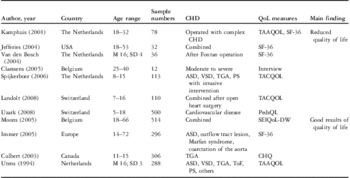
Congenital heart disease has been shown at times to have a negative impact on the health-related quality of life of patients. Although the majority of congenital heart disease can be corrected or palliated, it may be regarded as “never going away”.Reference Bhat and Sahn 1 Some studies have observed a reduced health-related quality of life in children, adolescents, and adults with congenital heart disease.Reference Kamphuis, Ottenkamp and Vliegen 2 – Reference Uzark, Jonesa, Burwinkleb and Varnic 8 However, others have showed improved health-related quality of life in the congenital heart disease population.Reference Immer, Althaus, Berdat, Saner and Carrel 9 – Reference Utens, Verhulst and Erdman 12 These differences may be explained partly by the severity of the current or residual heart conditions and/or the differences in health-related quality of life measurement instruments used in such studies. Table 1 summarises a number of papers outlining measures used and their main findings.
Summary of reviewed papers of quality of life in child and adolescents with heart disease.

ASD = atrial septal defect; CHD = congenital heart disease; CHD-TAAQOL = Congenital Heart Disease-TNO/AZL Child Quality of Life; CHQ = Child Health Questionnaire; PedsQL = The Paediatric Quality of Life Inventory; PS = pulmonary stenosis; QoL = quality of life; SEIQoL-DW = Schedule for the Evaluation of Individual Quality of life Direct Weighting; SF-36 = 36-Item Short Form Health Survey; TGA = transposition of the great arteries; ToF = tetralogy of Fallot; VSD = ventricular septal defect
Demographic status, personal and social environment, and economic status may contribute to health-related quality of life. In addition, health-related quality of life is determined not only by the patient's physical condition or socio-economic status, but also by the emotional responses to problems that arise.Reference Leventhal and Colman 13 Psychosocial factors such as illness understanding, personality, social support, and anxiety and depression become especially important in patients with chronic disease.
An accurate knowledge of chronic disease may be associated with less distress, fewer complications, and improved psychological functioning, and may be associated with improved health-related quality of life.Reference Eiser, Patterson and Casas 14 A clear understanding of their illness is likely to reduce the patients’ confusion, improving “healthy” behaviours for coping with a chronic condition. However, children and adolescents appear to be less concerned by their illness. The understanding of their cardiac conditions by the affected children and adolescents with heart disease also seems limited.Reference Veldtman, Matley and Kendall 15 , Reference Chessa, De Rosa and Pardeo 16
A feeling of optimism and a sense of coherence are classified as psychological dimensions in personality; both have been found to be positively associated with the well-being of a person.Reference Chang, D'zurilla and Maydeu-Olivares 17 , Reference Antonovsky 18 A depressed disposition in young adults with congenital heart disease had a negative impact on health-related quality of life.Reference Rose, Kohler, Kohler, Sawitzky, Fliege and Klapp 19 However, there is no published literature assessing how dispositional optimism in adolescents with congenital heart disease affects their health-related quality of life. A sense of coherence is a mixture of optimism and control.Reference Antonovsky 18 The concept of the sense of coherence was developed to explain why people might have different responses when faced with similar stressful events. Those with a strong sense of coherence are generally more resilient to stress and are better able to seek a solution to cope with the problem.Reference Wolff and Ratner 20 A strong sense of coherence has been significantly correlated with improved quality of life and can be a protective factor for people facing stresses such as illness or examinations.Reference Fok, Chair and Lopez 21 , Reference Boscaglia and Clarke 22 Patients with congenital heart disease might develop a stronger sense of coherence than normal control populations.Reference Moons and Norekval 23 Such a strong sense of coherence may improve the health-related quality of life of patients who have a chronic health condition.
Social support has been widely considered to directly relate to health-related quality of life. Adequate social support provided by family, friends, and other significant people, such as health professionals and teachers, has been found to act as a protective factor for stressful life events and mental health problems.Reference Zimet, Dahlem, Zimet and Farley 24 However, little information is available on how such social support affects adolescents with congenital heart disease. Cardiac abnormalities are usually diagnosed at a young age and often require early intervention and long-term follow-up and ongoing care. It would be very helpful to know what adolescents with congenital heart disease need and how to provide such support.
This study evaluated the health-related quality of life in adolescents with heart disease and sought to determine its relationship with their personal knowledge of their cardiac abnormalities, their feelings of optimism, a sense of coherence, the degree of social support, and their level of the anxiety and depression. The significant predictors were to be clarified.
Materials and methods
As part of a larger study, adolescents who were relatively well and with a wide spectrum of cardiac abnormalities were consecutively recruited from an ambulatory setting over a 15-month period from 2007 to 2009. Patients were included in this study if they were between 12 and 20 years and had a cardiac condition. Syndromes that included cardiac abnormalities such as Marfan syndrome, Noonan syndrome, and Holt–Oram syndrome were excluded. Patients were categorised into five groups according to the severity of their current or residual abnormality: trivial, mild, moderate, severe, or incapacitating, the grading being influenced by their functional capacity and their investigation findings. The severity was assessed by their clinical findings and investigations and “objectively” determined by their attending cardiologist. The Cardiologist's Perception of Medical Severity Scale was used to assess their severity.Reference DeMaso, Campis and Wypij 25 Five classes were categorised:
Class 1: Trivial – insignificant disorder, no interventions, good clinical status, medical review not strictly necessary.
Class 2: Mild – disorder requires no further operative interventions, functionally normal, post-operative normalisation of clinical condition, medical review every 3–5 years, competitive sports permitted.
Class 3: Moderate – marked disorder, has had or will need relatively straightforward interventions, functionally good, medical restrictions, medical review every year.
Class 4: Severe – significant disorder, has had or will need major difficult interventions, moderately reduced functional status functioning at own pace medical review every 3–6 months.
Class 5: Incapacitating – only palliative interventions available, poor functional status, ±cyanosis, frequent medical reviews.
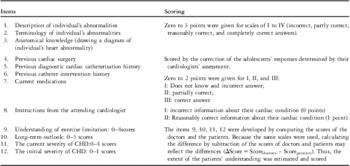
Adolescents were asked to complete a set of questionnaires that included the Cardiac Knowledge Questionnaire (self-designed, see Table 2), the Hospital Anxiety and Depression Scale, Multidimensional Scale of Perceived Social Support, Life Orientation Test-Revised, Sense of Coherence-13 and Paediatric Quality of Life Inventory 3.0-Cardiac Module.
Measures used to assess patients’ cardiac knowledge and understanding.

CHD = congenital heart disease
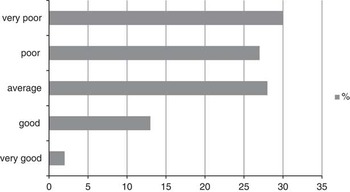
The total score range is from 0 to 30. The higher scores refer to better knowledge and understanding. The cut-off scores: 24–30 (80–90%) indicate very good; 21–23 (70–80%) good; 18–20 (60–70%) average; 15–17 (50–60%) poor; and 0–14 (0–49%) very poor knowledge and understanding
Measurement and instruments
The Hospital Anxiety and Depression Scale was used to indicate the presence and severity of mild degrees of mood disorder – anxiety and depression.Reference Zigmond and Snaith 26 It includes 14 items: items 1, 3, 5, 7, 9, 11, and 13 test for anxiety, the remaining items test for depression. The scores of each item range from 0 to 3. Scores of more than 11 refer to probable depression or anxiety, where patients may be diagnosed with an anxiety or depressive disorder and may require intervention; scores of 8–11 are in the range for possible depression or anxiety, where regular follow-up is required to monitor mood status; readings of 0–7 suggest normal findings.
The Multidimensional Scale of Perceived Social Support was used to assess the adolescents’ social support networks, including 12 items: support from family (items 3, 4, 8, 11), friends (items 6, 7, 9, 12), and significant others (items 1, 2, 5, 10).Reference Zimet, Dahlem, Zimet and Farley 24 Each item had response options ranging from 7 to 1: “very strongly agree, agree, mildly agree, neutral, mildly disagree, disagree and very strongly disagree”. The sum of the three scales yielded a global perceived social support score. The final score used to assess the level of social support was calculated as the sum divided by item numbers. The higher the points, the better the social support received.
Life Orientation Test-Revised is a bi-dimensional measure of dispositional optimism and pessimism.Reference Chang, D'zurilla and Maydeu-Olivares 17 It includes 10 items using the following response format: 0 = strongly disagree, 1 = disagree, 2 = neutral, 3 = agree, 4 = strongly agree. Items 2, 5, 6, and 8 are filler items. The summations of non-filler questions are the final scores. The overall scores can range from 0 to 24. The higher the score up to 24, the more optimistic in outlook the respondent is.
Sense of coherence-13 measures comprehensibility, manageability, and meaningfulness, which are related to the individual's view of the world when meeting stress.Reference Antonovsky 18 It has 13 items, and sense of coherence values are also described as mean total scores ranging from 1 to 7. The final score used to assess the level of sense of coherence is calculated as the sum divided by item numbers. The higher the points, the better the sense of coherence perceived.
Paediatric Quality of Life Inventory3.0-Cardiac Module assesses health-related quality of life in children and adolescents with congenital heart disease.Reference Uzark, Jonesa, Burwinkleb and Varnic 8 The 27 items were divided into six parts: heart problems and treatment, treatment with heart medicine (optional), perceived physical appearance, treatment anxiety, cognitive problems, and communication. The response format is on a 5-point scale of frequency, “0 = never”, “1 = almost never, “2 = sometimes”, “3 = often”, “4 = almost always.” The scores of Paediatric Quality of Life Inventory3.0-Cardiac Module were reversed and linearly transformed to a 0–100 scale to facilitate statistical analysis, so that the higher scores refer to better health-related quality of life.
Ethics approvals were obtained from both the relevant University and Hospital Ethics Committees. Informed written consent was obtained from both patients and parents if the child was younger than 16 years of age and the patients themselves if over 16 years.
Data analysis
Analysis of variance was used to assess the difference between the five groups of patients with trivial, mild, moderate, or severe cardiac status. Pearson Correlation was used to identify correlated factors. Multiple regressions were used to analyse how these related factors from the above scales influenced the health-related quality of life of the adolescents. Three factors were entered as independent variables including the scores of perceived cardiac knowledge, the scores of the Multidimensional Scale of Perceived Social Support, Life Orientation Test-Revised, and Sense of Coherence-13, which had been shown to be significantly correlated with health-related quality of life. The dependent variable was the scores of health-related quality of life.
Results
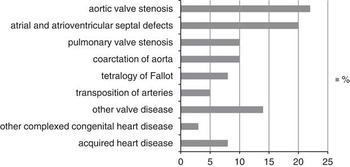
A total of 136 adolescents aged 12 to 20 years were recruited, but only 114 with completed data were included in the study. Most (90%) of the participants had congenital heart disease. Their previous diagnoses are summarised in Figure 1 and included unoperated pulmonary or aortic valve stenosis. Others had an arterial switch for transposition of the great vessels or a Fallot repair. Complex heart disease included a Fontan circulation for pulmonary atresia and a univentricular heart, whereas acquired heart disease included Kawasaki Disease, cardiomyopathies, and arrhythmias.
Cardiac diagnoses (n = 114).

Nearly all (98%) were in New York Heart Association Class I. Approximately half of the participants (52%) had had previous surgery and/or catheter intervention. The majority (73%) of the patients had trivial or mild residual cardiac abnormalities Class 1 and 2. Only 5% were in the severe group Class 4 and included those with a Fontan circulation, dilated cardiomyopathy etc. The rest were in the moderate Class 3, and none belonged to Class 5. The adolescents’ health-related quality of life was not significantly correlated with the severity of their heart disease. There were two (2%) patients who were above the cut-off score for probable depression and a further seven (6%) patients who were in the range of possible depression, while six (5%) had probable anxiety, and 25 (22%) were in the range for possible anxiety. There were seven (6%) adolescents who were likely to have both anxiety and depression.Reference Wang, Hay, Clarke and Menahem 27
A Knowledge and Understanding Scale was developed for the study. The scores of overall knowledge and understanding ranged from 9 to 25, with a mean of 17.5 (SD = 3.6) (see Fig 2).
Ranking of adolescents’ knowledge and understanding of their heart disease (n = 114).

Health-related quality of life was found to be associated with multiple factors. It was negatively associated with the degree of anxiety and depression (Pearson correlation, r = −0.57, p < 0.01), but positively associated with a feeling of optimism (r = 0.39, p < 0.001), good social support – especially family subscale(r = 0.27, p < 0.01), a better knowledge and understanding of their cardiac condition (r = 0.31, p < 0.01), and a sense of coherence (r = 0.24, p < 0.01).
Following the calculation of correlations by bivariables separately, multiple linear regressions were used to analyse how the correlated multiple factors determined the dependent variable – health-related quality of life. There were five variables that were significantly associated with health-related quality of life: the adolescents’ knowledge and understanding of their cardiac abnormality, the degree of social support, a sense of coherence, a feeling of optimism, and the degree of anxiety and depression.
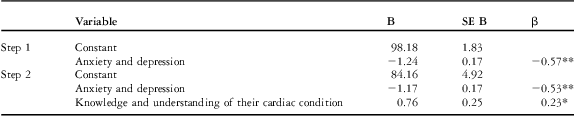
Using the stepwise multiple regressions method, a significant model emerged: F = 51.9, p < 0.0001. The model explained 36% of the variance (adjusted R2 = 0.36). The significant predictor was anxiety and depression (p < 0.0001), followed by the adolescents’ knowledge and understanding (p < 0.0001). Social support, a feeling of optimism, and sense of coherence were excluded because they had less influences on health-related quality of life than anxiety and depression and the adolescents’ knowledge and understanding of their cardiac condition. Table 3 summarised the predictor variables included in the model.
The unstandardised and standardised regression coefficients with health-related quality of life as dependent variable.

R 2 = 0.33 for Step 1; ΔR 2 = 0.03 for Step 2
**p < 0.001; *p < 0.01
Discussion
This study highlighted the importance of recognising the adolescents’ anxiety and depression and their contribution to their health-related quality of life.Reference Wang, Hay, Clarke and Menahem 27 Recognising and treating the anxiety and/or depression may improve the adolescents’ quality of life, even those with relatively “minor” heart abnormalities, as our cohort comprised ambulatory patients most of whom were relatively well and in New York Heart Association Class 1. Yet none of the affected adolescents were recognised by their attending cardiologist and referred on to a mental health specialist.
The adolescents’ knowledge and understanding of their cardiac condition were found to be another important predictor of health-related quality of life here assessed on the basis of their response to detailed questionnaires and by asking the adolescents to draw their congenital heart abnormality. The majority failed to provide accurate drawings.Reference Wang, Hay, Clarke and Menahem 28 Adolescents who demonstrated a better knowledge and understanding of their cardiac condition appeared to have a better health-related quality of life. This close relationship should be brought to the attention of those caring for these patients. Further studies aimed to improve the knowledge and understanding of adolescents about their heart condition may confirm an overall improvement in their health-related quality of life.
An association between social support and health-related quality of life has been demonstrated. Such family support is important to patients with heart disease.Reference Tong and Kools 29 The level of social support has been previously shown to have contributed to the psychological and social component of the health-related quality of life in patients with congenital heart disease.Reference Rose, Kohler, Kohler, Sawitzky, Fliege and Klapp 19 Open communication between patients and their health professionals, and/or patients and their parents and health professionals may be necessary to learn more of the adolescents’ requirements, and help to avoid over-protection and reduce dependency.
In the current study, a feeling of optimism was significantly and positively correlated with health-related quality of life. Such a feeling of optimism involves a positive attitude in the perception and expectation of life, and may be a protective factor for patients with cardiac disease.Reference Chessa, De Rosa and Pardeo 16 , Reference Chang, D'zurilla and Maydeu-Olivares 17 This observation indicates that achieving if possible a state of optimism (see Table 4) may benefit health-related quality of life further aided by a reduction of depression and anxiety.
Eight tips for creating optimism (adapted from Murray and Fortinberry, 2004Reference Murray and Fortinberry 30 ).

In addition, our study demonstrated that a strong sense of coherence was significantly positively associated with improved health-related quality of life but to a lesser degree. This finding is partly consistent with previous studies that found a strong sense of coherence improved the health-related quality of life in patients with a chronic health condition.Reference Boscaglia and Clarke 22
Although some studies have reported that the severity of heart disease largely influenced the quality of life,Reference Kamphuis, Ottenkamp and Vliegen 2 – Reference Uzark, Jonesa, Burwinkleb and Varnic 8 the current study involving adolescents who were mainly well and seen in an ambulatory setting did not support this finding. Neither the severity of the previously treated heart condition, nor its residual lesions had a significant association with health-related quality of life, although there was a significant influence on the health-related quality of life subscale of physical functioning to a lesser degree. In other words, those adolescents with a more severe cardiac abnormality were as expected more limited in their exercise tolerance.
Limitations
Most of our subjects, as are most adolescents with heart disease, belonged to New York Heart Association Class 1 and had little limitation in their exercise tolerance. Nevertheless, the findings are significant and correlate with Moons et alReference Moons, Van Deyk, De Geest, Gewillig and Budts 10 who concluded that the severity of the cardiac lesion was not the main determinant of health-related quality of life. It would be of interest to repeat the study in more severely affected adolescents, especially those being readmitted for further surgery, which could be the focus of a further study.
Case vignette
Emma (ID 31), aged 14 years, had an atrial septal defect repaired at 5 years of age. She had no residual lesion apart from the occasional ectopic. She had the lowest score for health-related quality of life. She had no depression, with a score of zero on Hospital Anxiety and Depression Scale. Her anxiety level was 9, indicating probable anxiety requiring assessment. She felt that she was receiving a low level of social support from her family, friends, and other important figures in her life. In addition, she had a low sense of optimism and coherence. Her knowledge and understanding of her cardiac condition was very poor, scoring 9 against a mean of 16.
Emma's cardiac condition was not an issue for her because she had had an excellent outcome from her cardiac surgery. The reasons why she had a very poor quality of life were considered to be related to her high level of anxiety, her negative personality traits, a poor knowledge and understanding of her cardiac condition, and suboptimal social support. She reported that her ability to exercise was moderately affected by her cardiac condition, which was not consistent with her cardiologist's assessment, who felt she should have no limitations in her exercise tolerance. Her perceived poor social support may have arisen from living with her mother and stepfather.
Conclusions
Adolescents with heart disease had a poor knowledge and understanding of their heart condition and that appeared to influence their health-related quality of life. The present study demonstrated that despite the good surgical outcomes even in those born with major congenital abnormalities over one-third of the adolescent patients without haemodynamically significant lesions still had concerns about themselves, which influenced their day-to-day life. The adolescents’ knowledge and understanding of their cardiac condition need to be addressed by health professionals who must develop specific age- and gender-appropriate education programmes to meet the specific psychological needs of the affected adolescents, as has been done for parents with a foetus or infant with congenital heart disease.Reference Caldera, Ha and Menahem 31 , Reference Ha, Hay and Menahem 32 Recognising and dealing with the adolescents’ anxiety and depression may also be helpful.
Acknowledgements
The authors thank those cardiologists who allowed their patients to be studied, as well as the patients and parents who agreed to participate in the study.