Introduction
‘There is no disappointment so numbing…as someone no better than you achieving more.’ Joseph Heller
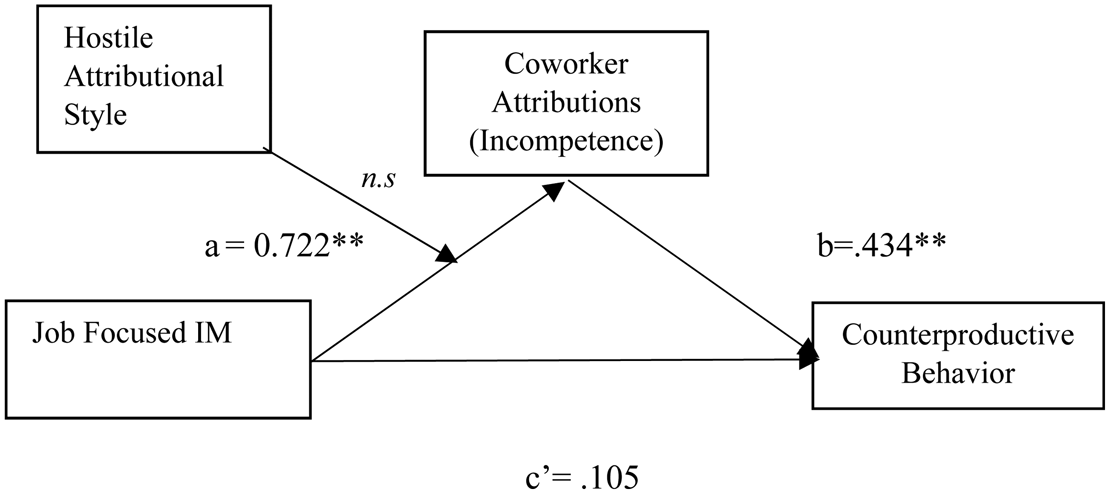
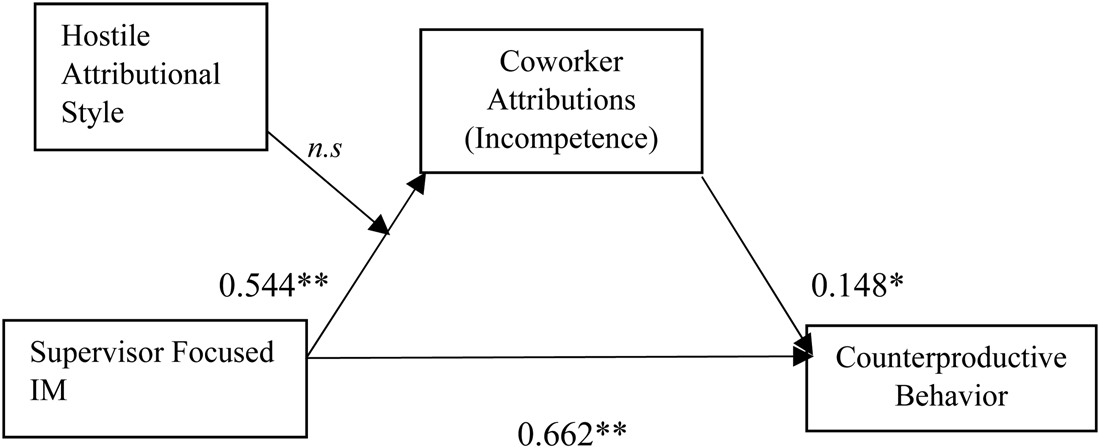
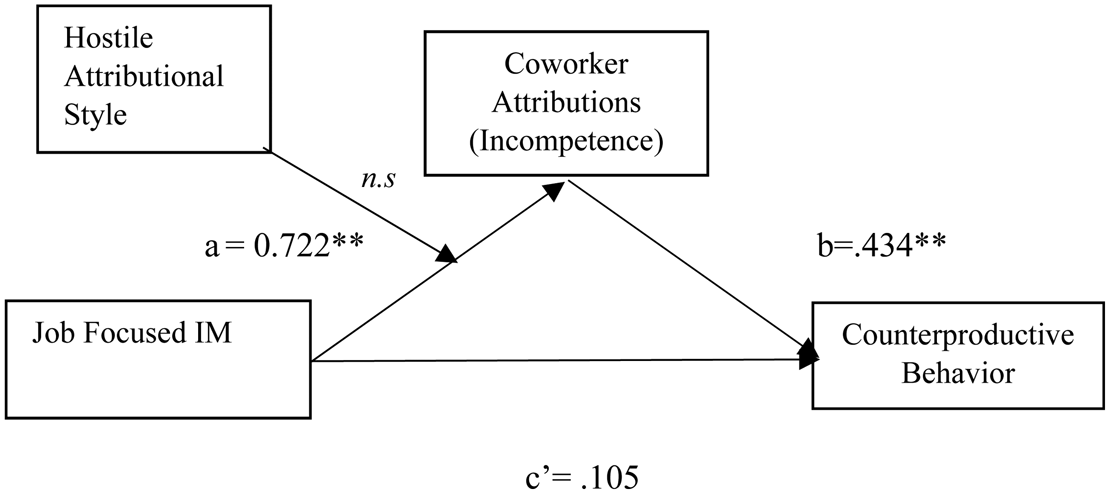
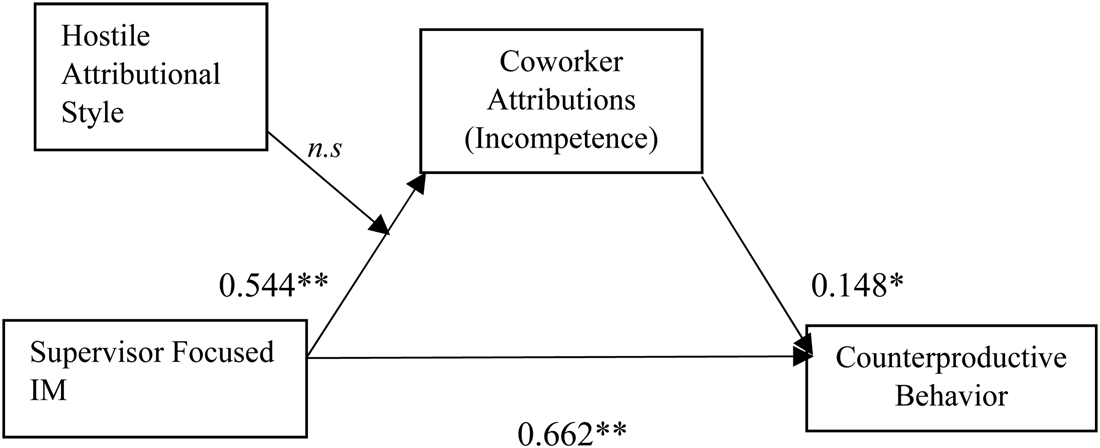
The above quotation illustrates the typical thought process of a person comparing his achievements to those of another, undeserving individual. It implies that the observer contemplates their own relative standing, mourns another's undeserved achievement, and sees it as being nonattributable to their competence, worth, or effort. The psychological phenomenon of observing another's behavior, ascribing it to competence/incompetence, and seeking ways to reduce the disturbing outcome differential manifests itself in conspicuous ways at the workplace and calls for scholarly attention. Another's organizational rewards are disturbing and people wish to diminish the outcome differential between themselves and the person in question. In this study, we explore an envious observer's perspective of a higher achiever's efforts at gaining prominence (impression management [IM]), their attributions, and hostile responses. We also investigate if a hostile attributional style influences these attributions and ensuing hostile behavior toward the actor. Hence, we examined the relationship between IM (both job-focused and supervisor-focused) by a higher achiever and coworker's attributions. The coworker's attributions were further examined with coworker's counterproductive work behaviors. The moderating role of hostile attributional style was also tested on the relationship between IM and coworker's attribution (see Figures 1 and 2).
The moderated mediation model (job-focused IM)
The moderated mediation model (supervisor-focused IM)
As organizations foster cut throat environments that reward employees differentially, competitive dynamics such as envy and competition become pervasive in the work environment (Menon & Thompson, Reference Menon and Thompson2010; Tai, Narayanan, & McAllister, Reference Tai, Narayanan and McAllister2012). Such organizations inherently foster competition for organizational outcomes, supervisor attention, and other organizational resources and opportunities. By making IM behaviors rewarding, such work environments render IM by coworkers displeasing because it entails positive outcomes will follow for the actor (Turnley, Klotz, & Bolino, Reference Turnley, Klotz, Bolino, Giacalone and Promislo2013; Vonk, Reference Vonk1998). Others have also hinted at the unsavory aspect of IM owing to some degree of manipulation involved (Foulk & Long, Reference Foulk and Long2016). From a coworker's perspective, IM directed toward the supervisor has also been termed as the slimy behavior (Vonk, Reference Vonk1998) and as ‘boot-licking’ or ‘apple polishing’ (Bolino, Long, & Turnley, Reference Bolino, Long and Turnley2016; Eastman, Reference Eastman1994). Despite the abundance of literature pointing to this direction, the literature investigating coworker's perspective of another's IM and their reactions is limited. A theoretical explanation elaborating the observer's perspective of a coworker's IM in the modern day competitive workplace is warranted. Practically, such an investigation is indispensable in order to develop a better understanding of competition dynamics and workplace behavior.
The desire that the high performing coworker loses their advantage is evident in a working environment (Sterling & Labianca, Reference Sterling and Labianca2015). Deliberate attempts at reducing the outcome differential between oneself and someone who receives greater outcomes involve counterproductive behavior (CWB) targeted toward them in attempts to reduce their relative advantage (Duffy & Shaw, Reference Duffy and Shaw2000; Gino & Pierce, Reference Gino and Pierce2009; Kim & Glomb, Reference Kim and Glomb2014). Given that IM by a coworker is threatening to one's relative standing by being rewarding at one's expense (Turnley, Klotz, & Bolino, Reference Turnley, Klotz, Bolino, Giacalone and Promislo2013), these behaviors by a coworker are likely to elicit behavioral means of reducing the pain of a potentially larger outcome differential. CWBs toward the target of upward comparisons as a result of attributions have been reported in earlier studies (Khan, Quratulain, & Bell, Reference Khan, Quratulain and Bell2014).
Based on the attribution theory that suggests others' personally relevant behaviors draw attributions that shape people's reactions, we adopt an attributional lens in proposing that coworker IM is personally relevant by being potentially rewarding, and draws attributions that shape coworker reactions to the person managing impressions. This paper contributes to the literature in a number of ways. First, unlike extant literature on IM that is replete with the supervisor's perspective of impression managing individuals and actors' outcomes, it investigates a previously ignored member of the IM situation: the envious coworker. This salient perspective holds substantial implications for practitioners and scholars in understanding the dynamics of workplace behavior. Second, in elaborating the attributional perspective of the observing coworker, this study explains why the observer is likely to behave counterproductively toward the impression managing individual. This perspective should help scholars develop a better understanding of workplace behavior in the context of competition since the real world does not involve isolated situations but is a complex mix of workplace behaviors and coworker attributions of those behaviors occurring concurrently. Third, it expands existing knowledge on IM by showing that scholarly attention toward IM has practical utility in terms of preventing unfavorable working environment if seen from a coworker's perspective as opposed to the dominant view of IM rewards for actors. This study responds to calls for more work on attributions (Dasborough, Harvey, & Martinko, Reference Dasborough, Harvey and Martinko2011; Martinko, Harvey, & Dasborough, Reference Martinko, Harvey and Dasborough2011) in order to develop a deeper understanding of workplace behavior.
A coworker's impression management and the search for attributions
Like the natural tendency to make comparisons, humans are also prone to making self-presentations in social situations (Goffman, Reference Goffman1959; Jones & Pittman, Reference Jones, Pittman and Suls1982). IM is a set of behaviors that attempt to gain the actor prominence by controlling other's attributions and impressions of oneself (Bolino, Long, & Turnley, 2016). These behaviors are motivated by the yearning to appear likable and competent and are often exhibited as a means to secure some desired ends, for example, securing a job through managing impressions during interviews (Jones & Pittman, Reference Jones, Pittman and Suls1982; Roulin, Bangerter, & Levashina, Reference Roulin, Bangerter and Levashina2014). Supervisor-focused IM (henceforth SFIM) refers to favor-doing and ingratiatory behaviors toward the supervisor that are rewarding in the form of positive supervisor evaluations that enable interpersonal attraction leading to career success (Bolino, Klotz, & Daniels, Reference Bolino, Klotz and Daniels2014; Judge & Bretz, Reference Judge and Bretz1994; Wayne & Liden, Reference Wayne and Liden1995). Job-focused IM (henceforth JFIM) refers to self-promotion as a superior worker (Wayne & Ferris, Reference Wayne and Ferris1990) and may secure the socially skilled actor high performance ratings (Harris, Kacmar, Zivnuska, & Shaw, Reference Harris, Kacmar, Zivnuska and Shaw2007) and increase their likelihood of achieving a permanent placement following interviews (Zhao & Liden, Reference Zhao and Liden2011). It has even been reported that a candidate's poor impression during an initial phase of the interview can be improved during subsequent phase(s) with behaviors that convey competence information (Swider, Barrick, Harris, & Stoverink, Reference Swider, Barrick, Harris and Stoverink2011). In essence, IM techniques are, on the whole, rewarding. For the remainder of this paper, IM techniques are not distinguished and no differences are hypothesized for this study because both IM techniques are rewarding and the literature suggests both are viewed negatively by coworkers (Turnley, Klotz, & Bolino, Reference Turnley, Klotz, Bolino, Giacalone and Promislo2013).
Research on IM implies that a coworker's IM is self-relevant because it is displeasing (Vonk, Reference Vonk1998). A potential reason is that because the workplace is a competitive environment where coworkers compete for organizational rewards and supervisory attention, such behavior by a coworker reflects relatively unfavorably on oneself. Turnley, Klotz, and Bolino (Reference Turnley, Klotz, Bolino, Giacalone and Promislo2013) argued that crafting an image for oneself at the workplace using IM techniques comes at the expense of coworkers. Foulk and Long (Reference Foulk and Long2016) argued that supervisory ingratiation – a form of SFIM – has an unsavory aspect for coworkers that should inhibit the positive information about the supervisor the behavior conveys. Thus, IM behaviors are a likely concern for the envious coworker who risks a disadvantage in being evaluated relative to the impression managing comparison with others.
Impression management and behavior-noncorrespondent, self-serving attributions
Self-serving attributions involve placing oneself in a positive light by taking credit for success and externalizing blame for unfavorable experiences such as failure. Literature consistently shows that self-serving attributions are ego defenses as they serve the important function of protecting the self-concept (Huff & Schwenk, Reference Huff, Schwenk and Huff1990; Zuckerman, Reference Zuckerman1979) by maximizing rewards and minimizing unfavorable or disturbing feelings. For example, leaders and subordinates may attribute poor performance to each other following unfavorable performance feedback (Dobbins & Russell, Reference Dobbins and Russell1986). Additionally, because suspicion helps overcome the correspondence bias (Fein, Reference Fein1996; Fein, Hilton, & Miller, Reference Fein, Hilton and Miller1990), self-serving attributions are likely to be behavior-noncorrespondent for the envier who is suspicious and more attentive to the envied person. The literature shows that attentional biases are inherent in upward comparisons, for example, envy (Zhong, Liu, Zhang, Luo, & Chen, Reference Zhong, Liu, Zhang, Luo and Chen2013). For example, Crusius and Lange (Reference Crusius and Lange2014) demonstrated that the envious person's information processing is directed in ways that lend greater attention to the envied person. This implies that the envier is less likely to fall prey to the former's potentially rewarding, strategic IM behaviors that convey likability and competence information about them. Therefore, a coworker is likely to draw behavior-noncorrespondent, self-serving attributions for likability and competence a coworker's IM suggests.
Because a coworker's competence and likability-inducing IM behavior is disturbing, it is seen as a threat to the envious observer's self-concept who seeks to invalidate this disturbing information through attributions that affirm their belief in their own competence. Feelings of injustice in envy (Smith & Kim, Reference Smith and Kim2007) imply that the malicious envier perceives another's advantage as undeserved, and therefore draws attributions of the latter's incompetence in order to validate their own deservingness (van de Ven, Zeelenberg, & Pieters, Reference van de Ven, Zeelenberg and Pieters2012). Thus, the counterfactual thinking of an envious person (van de Ven & Zeelenberg, Reference van de Ven and Zeelenberg2015) triggers incompetence attributions regarding the impression managing coworker who receives superior organizational rewards. These attributions of incompetence are self-serving and are not necessarily accurate descriptions of reality (Dobbins & Russell, Reference Dobbins and Russell1986; Jones & Nisbett, Reference Jones and Nisbett1971) but provide the envier a cushion against their disadvantage relative to the superior performer.
These attributions of incompetence serve a self-protective function by implying that the person managing impressions is successful not because of their ability but because of these behaviors. By being self-serving, these attributions imply that because the envied person engages in strategically managing their impressions by behaving in a likable manner toward the supervisor and plays up their achievements while trivializing errors, they are in fact, incompetent. This perspective is significantly substantiated by a recent literature that suggests incompetent people are more likely to engage in IM (Abbas, Raja, Anjum, & Bouckenooghe, Reference Abbas, Raja, Anjum and Bouckenooghe2018). Perhaps social interaction and work experience are likely to inform individuals the competence of an impression managing coworker. Our assumption is in line with the literature that suggests that the envier perceives the envied person as worthless (Van Osch, Zeelenberg, & Breugelmans, Reference Van Osch, Zeelenberg and Breugelmans2017).
Hypothesis 1 There will be a positive relationship between IM by a coworker (both JFIM and SFIM) and the observer's attribution of their incompetence.
Attributions of coworker incompetence and counterproductive workplace behavior
At the workplace, unfavorable behavior may take on either a hostile aggressive or nonhostile counterproductive form directed toward the organization or its members (Griffin & Lopez, Reference Griffin and Lopez2005; Marcus, Taylor, Hastings, Sturm, & Weigelt, Reference Marcus, Taylor, Hastings, Sturm and Weigelt2016). Interpersonal CWB is volitional behavior directed toward another with the purpose of inflicting physical and/or psychological harm by violating their interests, ridiculing, blocking access to information, and undermining their performance, etc. (Spector, Fox, Penney, Bruursema, Goh, & Kessler, Reference Spector, Fox, Penney, Bruursema, Goh and Kessler2006). Primarily, the target is the source (organization/supervisor/coworker) of discomfort such as stress, inequity, and envy, etc. (Barclay & Kiefer, Reference Barclay and Kiefer2017; Jones, Reference Jones2009). CWB follows adverse emotions such as anger at the discomforting experiences (Khan, Quratulain, & Crawshaw, Reference Khan, Quratulain and Crawshaw2013) with the aim to restore equity, balance the scales, and ‘feel better’ following disturbing emotions/experiences (Ferris, Spence, Brown, & Heller, Reference Ferris, Spence, Brown and Heller2012; Shoss, Jundt, Kobler, & Reynolds, Reference Shoss, Jundt, Kobler and Reynolds2016). CWBs are invariably triggered by a threat to one's self-concept such as esteem threat and injustice (Ferris et al., Reference Ferris, Spence, Brown and Heller2012).
Citing a social exchange perspective, the literature suggests that CWB toward a person seen to receive superior outcomes is exacerbated when that person's advantage is seen as unfair (Cohen-Charash & Mueller, Reference Cohen-Charash and Mueller2007). These findings showing factors that provoke CWB are salient for the current study because our focus is the perspective of an envious person. Envy entails a sense of injustice and the envier's attributions of the coworker's incompetence are likely to prompt CWB toward them. Attributions that the coworker is incompetent are essentially an indication of the belief that their advantage is undeserved.
Impression management, attributions and counterproductive workplace behaviors
The literature suggests that the envier's attempts at equity restoration through CWBs toward the envied actor follow the latter's unfair advantages in a self-relevant domain (Tai, Narayanan, & McAllister, Reference Tai, Narayanan and McAllister2012). As envy is an action-oriented emotion, it provokes CWB in order to reduce another's advantage by undermining, restricting their access to information, and providing them inaccurate information, etc. (see Cohen-Charash & Mueller, Reference Cohen-Charash and Mueller2007 for a discussion; Duffy, Scott, Shaw, Tepper, & Aquino, Reference Duffy, Scott, Shaw, Tepper and Aquino2012). The literature shows that this attempt at influencing the target's performance and reputation follows upward comparisons when the outcome differential is perceived as either fair or unfair (Cohen-Charash & Mueller, Reference Cohen-Charash and Mueller2007; Khan, Quratulain, & Bell, Reference Khan, Quratulain and Bell2014).
From an attributional perspective, an individual's counterproductive responses to unfavorable situations depend on their judgment of causality (Spector & Fox, Reference Spector and Fox2010). The literature has shown that attributions for unfavorable situations provide grounds for justifying deviance (Harvey, Martinko, & Borkowski, Reference Harvey, Martinko and Borkowski2017). Furthermore, Brees, Mackey, and Martinko (Reference Brees, Mackey and Martinko2013) presented an attributional approach toward understanding aggression at the workplace, arguing that anger following external, stable attributions for unfavorable situations determines targeted aggression. Attribution theory implies that the envious coworker's response to an experienced situation is a result of the attributions they assign it (Kelley, Reference Kelley and Levine1967; Weiner, Reference Weiner, Sorrentino and Higgins1986).
In a real-world setting that involves co-occurrence of emotions, attributions, and reactions, the envier's attributions of another's behavior should explain CWB directed toward them. It should also better serve practitioners and scholars, as opposed to studies that investigate the concepts in isolation. Most importantly, because a coworker's IM behavior constitute an unfavorable experience by potentially rewarding the actor at one's expense (Turnley, Klotz, & Bolino, Reference Turnley, Klotz, Bolino, Giacalone and Promislo2013; Vonk, Reference Vonk1998), it is likely to provoke CWB toward them through negative, self-serving coworker attributions. Self-serving attributions that the coworker is incompetent place the blame for the envious person's disadvantaged position on the coworker, providing them grounds for attempting to negatively influence the former's performance and status. Thus, insofar as behavior follows one's causal explanations, vis. attributions (Kelley, Reference Kelley and Levine1967), the actor's personally relevant and potentially rewarding IM behavior; by further threatening the envier's self-concept and standing within the organization; should trigger CWB toward him.
Hypothesis 2 IM (both JFIM and SFIM) by the higher achiever will lead to CWB by the coworker.
Hypothesis 3 Attributions of the actor's incompetence will mediate the relationship between their IM (both JFIM and SFIM) and the observer's CWB toward them.
The moderating role of hostile attributional style
As a naïve psychologist, the coworker is motivated to search for causal reasoning behind another's personally relevant and potentially rewarding IM (Heider, Reference Heider1958). The nature of attributions drawn is influenced by the attributing person's predisposition to make similar attributions across similar situations, that is, attributional style (Schulman, Reference Schulman, McClellan and Seligman1995). As biases in casual explanations, attributional styles influence the process of causality seeking by influencing affective reactions to and perceptions of real-world situations (Brees, Martinko, & Harvey, Reference Brees, Martinko and Harvey2016; Schinkel, van Vianen, & Ryan, Reference Schinkel, van Vianen and Ryan2016; Zhou, Yan, Che, & Meier, Reference Zhou, Yan, Che and Meier2015). Attributional styles also determine the extent to which unfavorable workplace outcomes will be attributed to an external entity such as another individual (Martinko, Moss, Douglas, & Borkowski, Reference Martinko, Moss, Douglas and Borkowski2007).
A hostile attributional style is a tendency to make external and stable attributions for unfavorable situations (Douglas & Martinko, Reference Douglas and Martinko2001; Weiner, Reference Weiner, Sorrentino and Higgins1986). A hostile attributional style influences causality seeking in such a way that the perceived cause is also seen as remaining stable over time. A hostile attributional style is associated with negative perceptions of the workplace (Martinko, Harvey, Sikora, & Douglas, Reference Martinko, Harvey, Sikora and Douglas2011). Reactions include increased turnover intentions, reduced job satisfaction, perceptions of abusive supervision and higher incidence of aggressive behavior (Chiu & Peng, Reference Chiu and Peng2008; Harvey, Harris, & Martinko, Reference Harvey, Harris and Martinko2008; Martinko et al., Reference Martinko, Harvey, Sikora and Douglas2011; Zhou et al., Reference Zhou, Yan, Che and Meier2015). It is salient for self-serving attributions because it involves placing the blame for a disturbing experience external to the self while providing the predisposition to redress it through hostility. As such, the envier's attributional style is an important factor in a causal search for another's behavior because it enables attributing the behavior to an external, stable cause.
We contend that IM by a coworker presents a strong self-relevant situation (Turnley, Klotz, & Bolino, Reference Turnley, Klotz, Bolino, Giacalone and Promislo2013) that should trigger a search for causal attributions wherein the attributing envier's hostile attributional style will influence stronger attributions of the coworker's incompetence.
Hypothesis 4 The relationship between the coworker's IM (both JFIM and SFIM) and the observer's attributions of their incompetence will be more pronounced for individuals with a hostile attributional style.
The literature shows that a hostile attributional style influences hostile and CWBs at work (Chao, Cheung, & Wu, Reference Chao, Cheung and Wu2011). An attributional approach toward understanding workplace aggression (Brees, Mackey, & Martinko, Reference Brees, Mackey and Martinko2013) suggests that a hostile attributional style will indirectly influence CWB toward a recipient of superior work outcomes through attributions that externalize responsibility for an unfavorable situation. Furthermore, given that the envier seeks ways to allay the pain of upward comparisons (Tai, Narayanan, & McAllister, Reference Tai, Narayanan and McAllister2012), the envier who is predisposed to making external, stable attributions for unfavorable situations is more likely to target the envied person counterproductively. Given that feelings of envy already motivate equity-restoring hostile behavior, a hostile attributional style should further render individuals more predisposed to experiencing anger and attempting to restore equity through aggression (Douglas & Martinko, Reference Douglas and Martinko2001).
Hypothesis 5 The indirect effect of IM (both JFIM and SFIM) by the higher achiever on the observer's CWB toward them through attributions of the actor's incompetence will be more pronounced for individuals with a hostile attributional style.
Methodology
Method
Sample and procedure
The sample was job holders of middle-level management positions in various service sector organizations in Pakistan. Three hundred questionnaires were distributed along with a cover letter. The cover letter elaborated the academic purpose of the survey and ensured respondents confidentiality of any information provided. The sample included respondents from the telecom, banking, medical, insurance, and technology sectors. Data for the independent variables and moderator were collected at T1. For mediating and dependent variables, data were collected at T2, with a time lag of 3 months to allow for potential attributions and behavioral effects to occur. In order to match the respondents, a code was assigned. Of the 200 questionnaires received, 142 were included in the final analysis after omitting for missing or incomplete responses. Males made up 57% of the sample, while 43% of the sample were females. In total, 76.8% of the comparison coworkers were males while 23.2% were females. Males made up an overwhelming 90.8% of the supervisors.
The survey included two sections for variable scales and demographics. For the scales section, respondents were asked to recall a coworker with whom they often compare themselves and someone who also enjoys superior organizational outcomes for which they are also striving. The premise was that comparison in a domain where respondents feel another person outperformed them despite their own efforts would indicate the respondents' envy. The appraisal pattern that involves keen observance of coworkers and a comparison of their deservingness relative to one's own is evident in envy (van de Ven, Zeelenberg, & Pieters, Reference van de Ven, Zeelenberg and Pieters2012). Because envious people engage in comparisons frequently, their perspective of coworker IM is of most significance from a practical perspective (Khan, Quratulain, & Bell, Reference Khan, Quratulain and Bell2014; Veiga, Baldridge, & Markóczy, Reference Veiga, Baldridge and Markóczy2014) as opposed to that of a neutral observer or the individual's own outcomes. Demographic section included age, gender, and tenure.
To rule out other effects, we controlled for neuroticism and dispositional envy that are known to influence CWB. We also controlled for the coworker's and the supervisor's gender because the literature suggests that gender influences observer evaluations of the impression managing individual (Bolino, Klotz, & Daniels, Reference Bolino, Klotz and Daniels2014).
Instrumentation
Impression management by coworker. IM behaviors were assessed using the scale developed by Wayne and Ferris (Reference Wayne and Ferris1990). SFIM and JFIM were assessed using seven and 12 items, respectively (Wayne & Liden, Reference Wayne and Liden1995). For eliciting responses regarding IM by a coworker who receives superior outcomes, items were adopted to reflect the behavior by a coworker ‘X’, with whom respondents routinely compare themselves and who outperforms them on important organizational outcomes such as rewards and recognition, etc., for which they are also striving. The word envy was not used to prevent any bias. Respondents were asked how frequently the coworker ‘Takes an interest in his/her immediate supervisor's personal life,’ etc. Anchoring points: 1 (Never) to 5 (Always).
Attributions of incompetence. Incompetence attributions were assessed using a modified version of the three-item perceived competence scale (Kim, Dirks, Cooper, & Ferrin, Reference Kim, Dirks, Cooper and Ferrin2006). A sample item is ‘X is not very capable of performing his/her job.’ Anchoring points: 1 (Strongly Disagree) to 5 (Strongly Agree).
Counterproductive workplace behavior. Counterproductive work behavior was assessed using the 12-item CWB scale (Cohen-Charash & Mueller, Reference Cohen-Charash and Mueller2007). The scale has been reliably used in previous studies involving envy (Khan, Quratulain, & Bell, Reference Khan, Quratulain and Bell2014). Respondents were asked the extent to which each statement accurately represented their behavior toward the coworker ‘X.’ Sample items: ‘try to sabotage X's performance.’ Anchoring points: 1 (Not representative at all) to 5 (Very Representative).
Attributional style. Hostile attributional style was measured using the Organizational Attributional Style Questionnaire-OASQ (Campbell & Martinko, Reference Campbell and Martinko1998; Kent & Martinko, Reference Kent, Martinko and Martinko1995). Respondents were asked to consider three unfavorable workplace scenarios (e.g., ‘you were passed over for a promotion’) and asked to indicate the extent to which they believed these outcomes were internally or externally caused (1 = ‘completely due to me,’ 5 = ‘completely due to other people or circumstances’) for the locus of causality dimension (α = .705), and stable or unstable over time (1 = ‘Remains stable,’ 5 = ‘Changes over time’) for the stability dimension (α = .728).
Controls. In order to rule out any gender effects on the evaluation of IM, the gender of the envied coworker and of the supervisor was controlled. Other demographic controls included respondent gender, age, and tenure. Neuroticism and Dispositional envy were also controlled to rule out potential effects on the mediator or outcome variables.
Dispositional envy. Dispositional envy was assessed using the eight-item scale developed by Smith, Parrott, Diener, Hoyle, and Kim (Reference Smith, Parrott, Diener, Hoyle and Kim1999).
Neuroticism. This variable was measured using the eight-item neuroticism scale (John, Donahue, & Kentle, Reference John, Donahue and Kentle1991).
Results
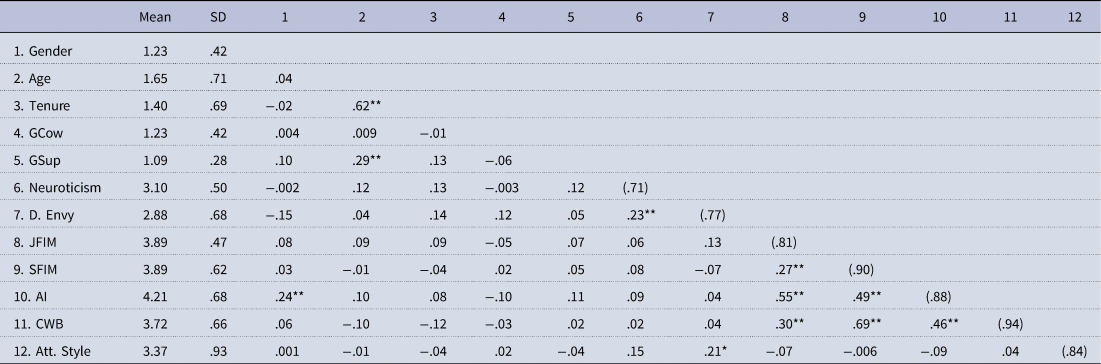
Table 1 shows means, standard deviations, correlations, and α reliabilities. Results show that IM techniques were significantly correlated with CWBs (JFIM: r = .30, p < .01; and SFIM: r = .69, p < .01). Furthermore, attributions of coworker's incompetence were also significantly correlated with JFIM and SFIM (r = .55 and r = .49, p < .01) and with CWBs (r = .46, p < .01). These results were consistent with our predictions. However, contrary to predictions, hostile attributional style was uncorrelated with coworker attributions and CWB (r = −.09 and r = .04, n.s).
Means, standard deviations, correlations and reliabilities
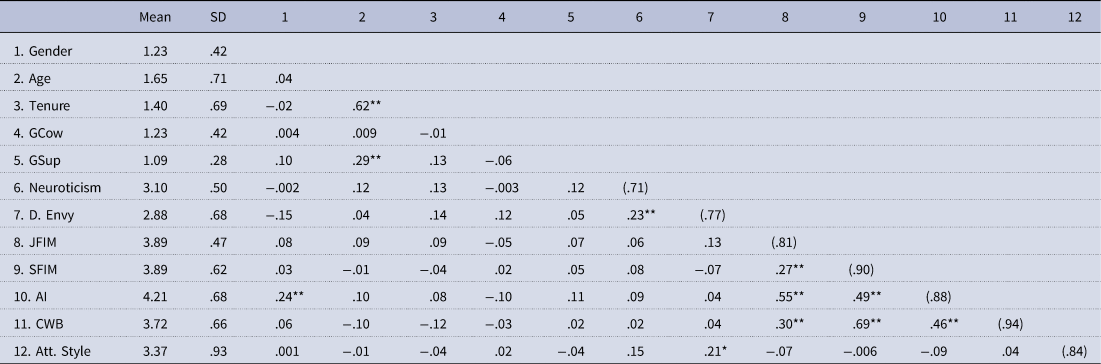
GCow = gender of coworker, GSup = gender of supervisor, D. Envy = dispositional envy, JFIM = job-focused impression management, SFIM = supervisor-focused impression management, AI = attributions of incompetence, CWB = counterproductive workplace behavior, Att. Style = attributional style.
**Correlation is significant at the .01 level (two-tailed).
*Correlation is significant at the .05 level (two-tailed).
We checked for common method bias effects by conducting Harman's single factor test. Results of the test showed that the first factor accounted only for 32% of the total variance in the model. Common method bias is present if a single factor accounts for a dominant percentage of variance in the model (Podsakoff, MacKenzie, Lee, & Podsakoff, Reference Podsakoff, MacKenzie, Lee and Podsakoff2003). Because this was not so for our model, the possibility of common method bias was ruled out. Multicollinearity effects were ruled out by using mean-centered variables for the interaction terms following suggestions in the literature (Cohen, Cohen, West, & Aiken, Reference Cohen, Cohen, West and Aiken2013). Analysis was conducted using the PROCESS tool developed by Hayes (Reference Hayes2012). This tool allows testing for individual models using one predictor at a time. For analyses involving moderation, separate models were run for each IM technique. Controls were included and PROCESS reported their effects as covariates.
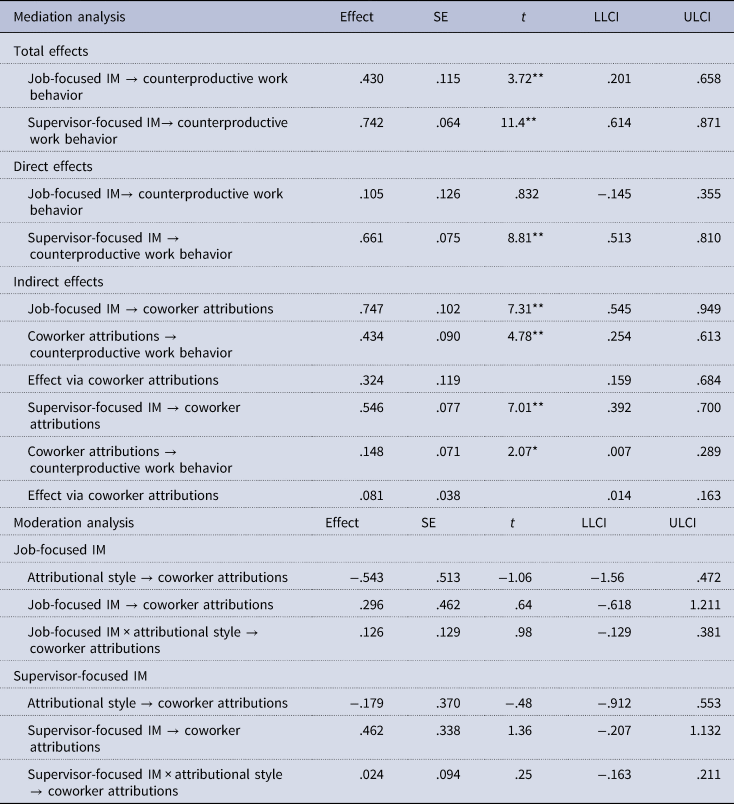
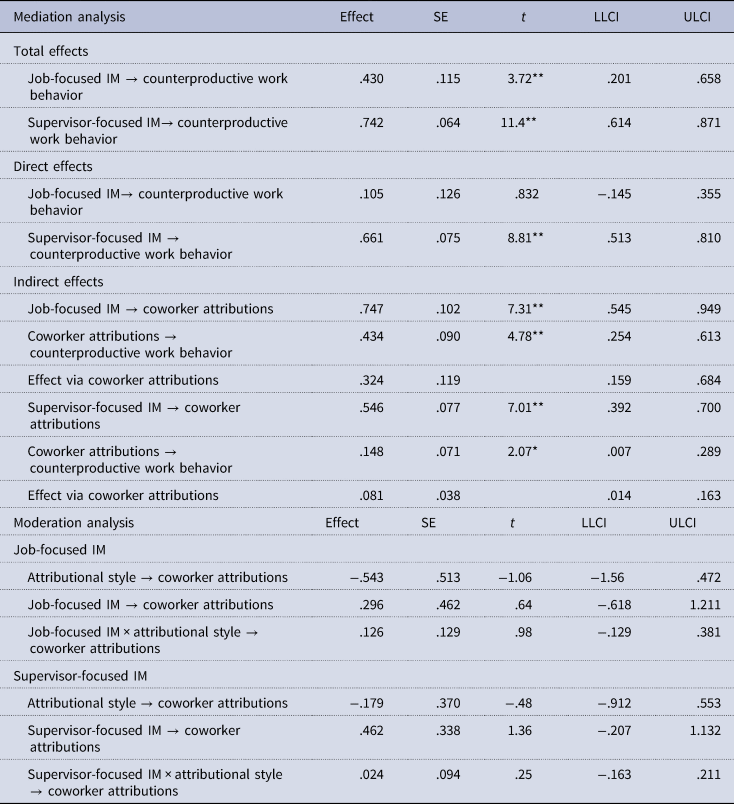
Table 2 shows significant paths from JFIM to coworker attributions (β = .747, F (8,133) = 9.16, p < .001, R 2 = .355) and from SFIM to coworker attributions (β = .546, F (8,133) = 8.545, p < .001, R 2 = .340), providing support for Hypothesis 1. Results also show statistically significant total effects of JFIM (β = .429, p < .001) and SFIM (β = .742, p < .001) on CWBs. Both the total effect models were statistically significant (JFIM: F (8, 133) = 2.296, p < .05, R 2 = .121; SFIM: F (8, 133) = 17.349, p < .001, R 2 = .511), providing support for Hypothesis 2. Although it was not hypothesized, results also show significant effects from coworker attributions to CWB for the job-focused model (β = .434, p < .001) and the supervisor-focused model (β = .148, p < .01). Mediation Hypothesis 3 was supported by results that show the bootstrapped 95% confidence intervals for indirect effect from SFIM (β = .324, CI [.159, .684]) and SFIM (β = .081, CI [.014, .163]) to CWB did not contain zero.
Moderation and mediation analysis
N = 142.
*p < .01.
**p < .001.
IM = impression management.
For moderation, two models were run separately for each IM technique. Control variables were included which PROCESS reported as covariates. Among the controls, respondent gender had a significant effect on attributions for both IM models. Results show that the effects of the interaction terms of attributional style with IM techniques were statistically not significant and that the 95% bootstrapped confidence intervals contained zero. The overall models containing these interaction terms with JFIM (F (10, 131) = 9.436, p < .001, R 2 = .363) and SFIM (F (8, 133) = 17.349, p < .001, R 2 = .353) were significant, with no significant increase in R 2 due to interaction terms (ΔR 2 = .005 and ΔR 2 = .000, n.s).
Hypothesis 5 predicted moderated mediation paths. Moderated mediation was run separately for both IM techniques. Controls were added for both the models which PROCESS reported as covariates. No control variables had significant effects. Figures 1 and 2 show the moderated mediation paths for the job-focused and supervisor-focused models. Because the individual interaction terms did not predict coworker attributions, we expected the moderated mediation models would also be unsupported. Results for the index of moderated mediation for both IM techniques showed that the bootstrapped 95% confidence intervals contained zero. There were no conditional indirect effects at low, average, and high values of attributional style for both job-focused and supervisor-focused models (see Table 3). Hence, Hypothesis 5 for moderated mediation was not accepted.
Conditional indirect effects at low, average and high values of attributional style

Discussion
Our study shows that individuals seek external attributions in the actor's incompetence for esteem-protection. The esteem-protective function of external attributions has been previously identified in other achievement-related situations (Crocker & Major, Reference Crocker, Major, Zanna and Olson1994: 292; Major, Kaiser & MacCoy, 2003). Indeed, Weiner's (Reference Weiner1985, Reference Weiner, Sorrentino and Higgins1986) attributional theory proposes that individuals in negative situations seek external attributions because they are esteem-protecting. Self-protective attributions in situations involving comparisons were implied by Cohen-Charash and Mueller (Reference Cohen-Charash and Mueller2007). In response to calls for more work in organizational behavior from an attributional perspective (Harvey, Madison, Martinko, Crook, & Crook, Reference Harvey, Madison, Martinko, Crook and Crook2014; Martinko, Harvey, & Dasborough, Reference Martinko, Harvey and Dasborough2011), this study extends previous envy literature (Tai, Narayanan, & McAllister, Reference Tai, Narayanan and McAllister2012) in elaborating that attributions may explain how coworkers may become the target of another's CWB.
Although the literature suggests that perceptions of justice may reduce counterproductive work behaviors among envious people (Khan, Quratulain, & Bell, Reference Khan, Quratulain and Bell2014), we reasoned that counterproductive work behavior toward higher achievers may actually be exacerbated when the comparison person is seen as attempting to draw greater supervisory attention through IM. Although unfairness was not included as a variable in the current study, we elucidate from an IM perspective that in the competitive present-day work environment, the use of IM is seen unfavorably by coworkers (Turnley, Klotz, & Bolino, Reference Turnley, Klotz, Bolino, Giacalone and Promislo2013); hence, they signify unfair means of progressing at one's expense. Our results demonstrated that such attempts of IM are seen as resulting from the actor's incompetence in the work domain that in turn leads to efforts at restoring equity by settling scores with the impression managing individual. This is in line with the literature that suggests harmful behavior is directed toward another in attempts to ‘settle scores’ and diminish the outcome differential (Heider, Reference Heider1958; Khan, Quratulain, & Bell, Reference Khan, Quratulain and Bell2014).
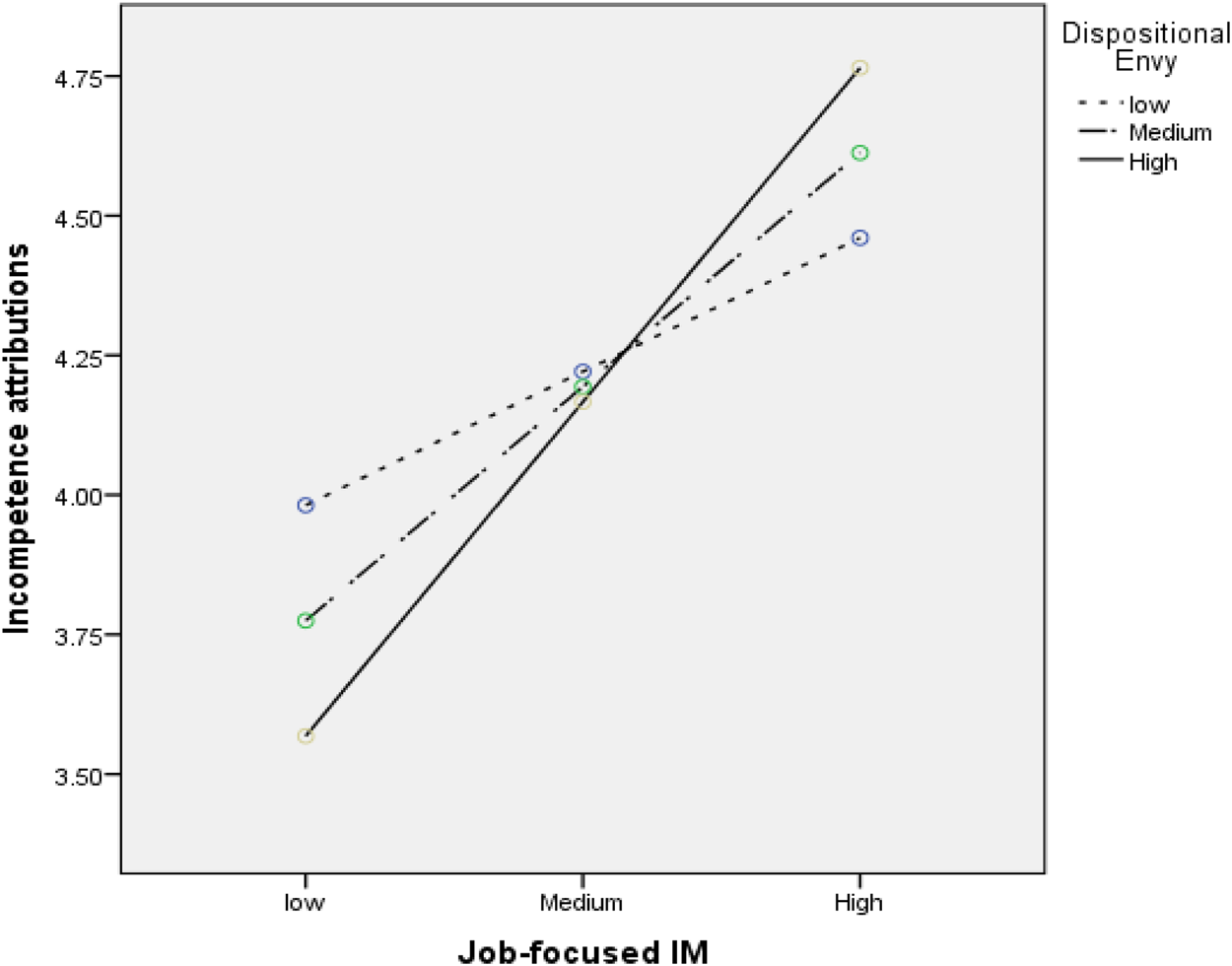
We were unsure why dispositional envy did not correlate with CWB. Although it was not hypothesized, these results warrant attention. Perhaps the results can be discussed in light of a social and cultural context. Harmful behaviors resulting from envy are less likely in social contexts where individuals identify with their coworkers as this leads to a belief that potential targets are deserving of some degree of compassion (Duffy et al., Reference Duffy, Scott, Shaw, Tepper and Aquino2012). Similarly, in line with the social/cultural context argument, perhaps the collectivist culture of Pakistan also plays a role. O ‘boyle, Forsyth, Banks, and Mcdaniel (Reference O ‘boyle, Forsyth, Banks and Mcdaniel2012) argued that collectivist cultures greatly value the norms of reciprocity and are likely to be intolerant of violations of these collectivistic values in the form of CWB. In line with their argument, we tentatively reason that cultures with collectivistic values suppress the expression of envy in the form of CWB. An ad-hoc analysis was performed to test if envy played a moderating role for the two IM techniques. There was a significant effect of the interaction term envy×JFIM (Figure 3) on attributions which shows envious people are more likely to infer incompetence for a coworker who engages in JFIM. Results showed no interaction between envy and each IM technique in predicting CWB. Moderated mediation results showed significant effects for the JFIM model but not for the SFIM model. This mediated moderation effect for the JFIM model highlights the importance of incompetence attributions in explaining CWB responses, an important contribution of this study.
Post-hoc analysis: the moderating role of envy
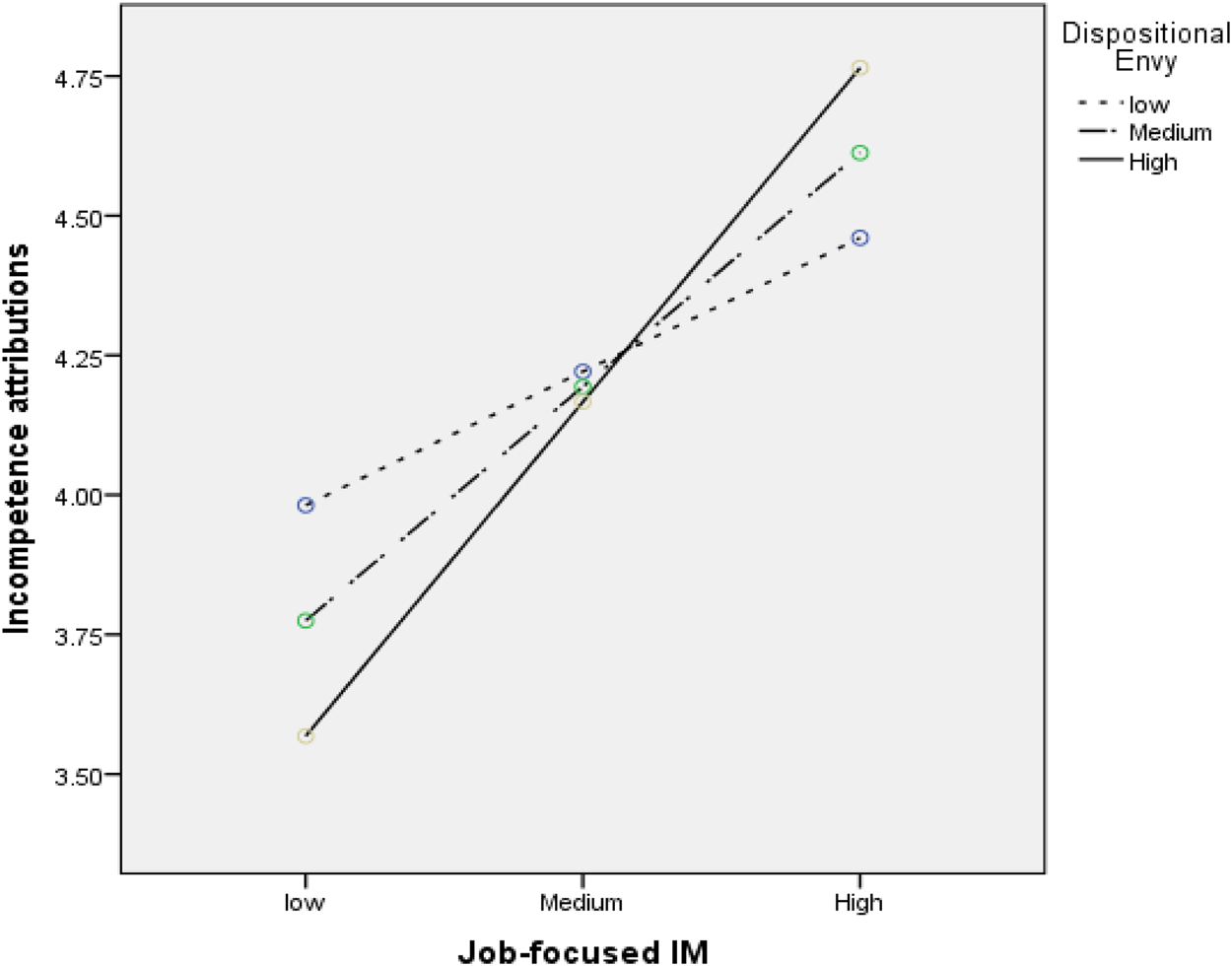
We have two plausible but tentative explanations for the inconsistent results regarding the role of envy for the two IM techniques. First, perhaps SFIM is sufficiently aversive to render envy less relevant in eliciting incompetence attributions. This means that regardless of one's tendency to experience envy, an observer is likely to attribute a coworker's SFIM to the actor's attempts at concealing incompetence. Second, coworker attempts at appearing competent and hardworking (JFIM) draw stronger attributions of incompetence by the envious observer because envy itself entails an egocentric bias that the other person is less deserving of the coveted outcomes. This bias influences behavior-noncorrespondent attributions (incompetence) for the competence information JFIM attempts to convey.
Although we had predicted hostile attributional style would influence greater external attributions, and CWB, our results did not support our hypotheses. We presume that the unsavory aspect of a coworker's IM attempts renders the observer's hostile attributional style irrelevant. This is an important finding because it suggests that a coworker's attempts at gaining prominence through nonperformance means are sufficiently distasteful to render their IM displeasing, without regards to their hostile attributional style. Thus, although the literature suggests that a hostile attributional style should predict external attributions and ensuing hostile behavior, our study is among the first to show that in case of IM by a recipient of greater outcomes, the observer's attributional style is rendered less significant.
Our study is among the first to empirically substantiate adverse outcomes of coworker IM and their potential for affecting the work environment by prompting CWBs. Considering that organizations in the present day have become internally competitive where an increment in one member's achievements comes with at least an incrementally reduced reward(s) for others, a member's efforts at securing supervisory attention and organizational rewards through job and SFIM are seen rather skeptically (Turnley, Klotz, & Bolino, Reference Turnley, Klotz, Bolino, Giacalone and Promislo2013). In explaining this phenomenon, we draw our argument from attribution theory to demonstrate that the coworker sees such attempts at gaining prominence as an indication of the actor's incompetence and/or his efforts to conceal it.
Following from these findings, IM attempts to signal the observer the actor's reliance for success on these influence tactics rather than their competence. Such attributions serve a self-protective function on the part of the observer that confirms them their own deservingness and implicitly, the existence of unfair decision processes that refuse them a fair position and rewards. Our study paves the way for future studies on attribution and IM, elaborating that IM studies that do not consider the coworker miss out on elucidating important implications for the work environment and organizational behavior.
Limitations and future directions
Our study provides grounds for a new domain of research on the social side of organizations. We reasoned that incorporating a coworker's perspective offers greater insight into the dynamics of IM and organizational behavior. Future studies should incorporate a realistic viewpoint involving all stakeholders involved (supervisors and coworkers) as opposed to adopting an isolated approach. Future studies should investigate IM from the perspective of different groups of coworkers and supervisors (in-group vs. out-group colleagues and supervisors).
It is pertinent to note that while we frequently refer to envy literature, our study does not warrant strong conclusions on envy. Our findings from the post-hoc analysis suggest that future studies should test the reactions of an envious versus nonenvious observer more thoroughly for various IM techniques. This could help develop an understanding of coworker attributions for various IM types based on hard versus soft techniques and self-praising versus other-praising techniques. Studies could also elaborate if attributions and observer reactions vary for IM by coworkers belonging to the supervisor's ingroup/outgroup. Furthermore, studies should incorporate other attributional styles (e.g., self-serving attributional style) in investigating the neutral and envious coworker's reactions to coworker IM.
Studies should also investigate if the locus of the envier's external attributions may be the supervisor as the recipient of praise and ingratiation. Because the supervisor is the decision maker behind decisions that people managing impressions seek to influence, it would be interesting to see what attributions an observing coworker makes regarding them.
Our study is limited in its generalizability until similar findings are established in other cultures. Although the unappealing character of a coworker's attempts at gaining prominence through influence techniques is likely to persist across cultures, variations may exist in attributions and reactions to coworker IM based on the degree of achievement orientation. For example, it is likely that achievement orientation in the form of the culture's masculinity score influences stronger adverse reactions by finding greater offense in a competitor's influence tactics. The literature suggests more aggressive competition and stronger violent responses to conflict in highly masculine cultures (van de Vliert, Schwartz, Huismans, Hofstede, & Daan, Reference van de Vliert, Schwartz, Huismans, Hofstede and Daan1999). Individuals are also likely to be more motivated to maintain positive self-views through external attributions in these cultures. Because the sample for the current study was from Pakistan which has an exactly intermediate score on this cultural dimension, the current study may be generalizable across cultures with a somewhat similar masculinity score such as Malaysia, Israel, and India. Future studies should be conducted in masculine cultures with masculinity scores varying considerably from Pakistan's score, such as the United States, Austria, Sweden, and the Netherlands.
Managerial implications
Managers in the present-day corporate world are presented with a challenge to effectively manage competition and politics in ways that minimize their adverse effects. Because competitive environments reward employees differentially (Menon & Thompson, Reference Menon and Thompson2010), managers should be vigilant against rewarding IM attempts to prevent negative coworker behaviors. IM attempts directed toward managers are pleasant, and so may often be undetected. Our study shows that IM behaviors that position the actor as competent and likable toward the supervisor are an issue of grave concern because they have the potential to affect coworker behavior. One practical suggestion is for managers to focus on reducing negative competition within the organization. We suggest that managers should be cognizant of subordinate behaviors intended to acquire organizational rewards through ingratiation, flattery, and an exaggeration of one's abilities and achievements. This is essential to the overall organization's success as well as their own. Park, Westphal, and Stern (Reference Park, Westphal and Stern2011) demonstrated that ignorance of such behavior results in persistently low firm performance by making the CEO overconfident in their biased decision making. Keeves, Westphal, and McDonald (Reference Keeves, Westphal and McDonald2017) showed that while ingratiation is pleasing, it damages the ingratiated manager's reputation. Adverse effects of IM can be considerably reduced by making rewards decisions transparent. Managers should be mindful against rewarding or unknowingly encouraging IM behaviors. To eliminate these concerns among subordinates, transparent reward allocation processes should be put into practice. Employees who are taken into confidence through the transparency of reward allocation decisions are less likely to impute a coworker's success to their influence tactics and incompetence, thereby, less likely to negatively influence the work environment.
Acknowledgment
This paper is a part of the first author's PhD, for which she received a scholarship from the Higher Education Commission of Pakistan.
Declarations of interest
None.