


Introduction
In United States ambulatory practices, urinary tract infections (UTIs) account for approximately 10 million office visits and an estimated 15% of all outpatient antibiotic prescriptions each year.Reference Advani, Luck and Chang1,Reference Flores-Mireles, Walker, Caparon and Hultgren2 Yet inappropriate prescribing for these infections remains widespread.Reference Advani, Luck and Chang1,Reference Flores-Mireles, Walker, Caparon and Hultgren2 Prior studies estimate that 50%–70% of antibiotic prescriptions for UTI may be inappropriate, including treatment of asymptomatic bacteriuria (ASB), use of non-first-line agents, and excessive treatment durations.Reference Clark, Durkin and Olsen3–Reference Murray, Shimabukuro, Khalfay, Chiang and Lenore Ackerman5 The 2019 Infectious Diseases Society of America guidelines recommend against screening for or treating ASB in most patient populations because unnecessary treatment exposes patients to adverse drug events, Clostridioides difficile infection, and antimicrobial resistance without improving clinical outcomes.Reference Nicolle, Gupta and Bradley6 Together, the high visit and prescribing volume and frequency of inappropriate treatment make UTIs a high-yield target for outpatient antimicrobial stewardship.
Prior studies have reported temporal variation in antibiotic prescribing across outpatient and emergency department settings, with day-of-week differences attributed variably to patient mix and to care-delivery context.Reference Bishara, Hershkovitz, Paul, Rotenberg and Pitlik7–Reference Peng, He, Hayen, Hall and Liu10 However, these studies have generally examined heterogeneous infection types and have relied on prescribing volume or reviewer-judged appropriateness rather than objective diagnostic criteria. Whether an end-of-week pattern exists specifically for ambulatory UTI management, where explicit laboratory criteria (urine culture and pyuria) permit an objective definition of unnecessary prescribing, has not been characterized. This represents an important gap, because UTIs are among the highest-volume drivers of outpatient antibiotic use and inappropriate prescribing, making any systematic temporal excess a concrete and modifiable stewardship target.Reference Peng, He, Hayen, Hall and Liu10
This gap became apparent during a clinical decision-support implementation study for UTI at our institution, in which clinic nurses, during qualitative interviews, repeatedly described a perceived end-of-week prescribing pattern: patients contacting clinics near the end of the week for urinary symptoms, with concern that limited weekend follow-up may favor empiric treatment.Reference Qin, Balasta and Purcell11 This clinical observation, together with the absence of UTI-specific data, motivated the present analysis. We hypothesized that encounters occurring Friday through Sunday would have higher odds of both unnecessary antibiotic prescribing and any antibiotic prescribing than encounters occurring Monday through Thursday.
Methods
Study design and population
We performed a planned encounter-level cross-sectional analysis of preimplementation data from a study evaluating implementation of a clinical decision-support tool for UFI at the University of Pennsylvania.Reference Qin, Balasta and Purcell11 Preimplementation data were collected from July 2024 through January 2025. Inclusion criteria were adult outpatient encounters (age ≥ 18 yr) in urogynecology or family medicine, the two ambulatory specialties with the highest volume of UTI-related encounters in our health system,Reference Critchlow, Kuzma, Koelper, Agrawal, Dutcher and Arya12 with an ICD-10 code for acute cystitis (N30.00, N30.01, N30.90, N30.91, N39.0) and/or a urine culture order. Exclusion criteria were pregnancy, immunosuppression (CD4 count < 200/mm3), and urine cultures obtained as preprocedure screening. Patients could contribute more than one encounter. This study was approved by the University of Pennsylvania Institutional Review Board (Protocol #857597). This analysis is reported in accordance with the Strengthening the Reporting of Observational Studies in Epidemiology guideline for cross-sectional studies.
In both practices, Monday through Friday patients with urinary symptoms call the clinic or send a patient portal message and undergo nurse telephone triage, with family medicine patients having an option of an in-person visit with a nurse practitioner if deemed appropriate after phone triage. On Saturdays and Sundays, family medicine calls are handled by a paid on-demand service staffed by clinicians who are not the usual weekday providers, and urogynecology calls are handled by an on-call clinical fellow and attending from the division. Related contacts within a single episode of care (e.g.,, a nurse triage telephone call followed by an in-person visit) were abstracted as one encounter, and a subsequent encounter was abstracted only if it occurred more than 30 days after the first.
Exposure and outcome definitions
Encounters were categorized as weekday (Monday through Thursday) or end-of-week (Friday through Sunday). Friday was included in the end-of-week group a priori because the qualitative FRUTI (Friday urinary tract infection) observation centered on anticipatory prescribing before reduced weekend access to routine clinic follow-up. For consistency with the prespecified analysis, we refer to Friday-Sunday encounters as the weekend group in tables and model estimates.
The primary outcome was unnecessary antibiotic prescribing, defined as antibiotic treatment meeting at least 1 of 3 prespecified criteria: (A) ASB; (B) antibiotic prescribing in the absence of pyuria (urine WBC ≤ 10 per high-power field); or (C) antibiotic prescribing when the urine culture was, or subsequently proved to be, negative or nondiagnostic (no growth, culture not indicated, or contaminated or mixed).Reference Critchlow, Kuzma, Koelper, Agrawal, Dutcher and Arya12,Reference Agrawal, Ikpeama and Koelper13 Mixed cultures were defined as growth of three or more organisms, and positive cultures as growth of at least 100,000 colony-forming units/mL of a uropathogen. These categories were not mutually exclusive. The secondary outcome was any antibiotic prescribing.
Urinary symptoms consistent with UTI were dysuria, urinary frequency, urgency, suprapubic pain, and hematuria, each abstracted from encounter documentation as present, absent, or not documented. Nonspecific symptoms (fatigue or malaise, delirium or confusion, decreased appetite, weakness or falls, urine odor, urine discoloration, and unspecified abdominal pain) were recorded separately and were not considered UTI symptoms.
Statistical analysis
Baseline characteristics were compared between weekday and weekend groups using t tests for continuous variables and χ2 or Fisher exact tests for categorical variables, as appropriate. For patient-level descriptive analyses, patients were classified according to the day-of-week group of their first eligible encounter. Subsequent encounters were reviewed to identify patients who later contributed an encounter in the opposite day-of-week group.
Because patients could contribute more than one encounter, associations with antibiotic prescribing were estimated using generalized estimating equations (GEE) with a binomial distribution and logit link. The patient was specified as the repeated-subject variable, an independent working correlation structure was used, and robust sandwich standard errors were calculated to account for within-patient correlation across repeated encounters. Unadjusted odds ratios (ORs) were estimated in separate models for each predictor and antibiotic outcome.
For the primary adjusted analyses, GEE models using the same specification were used to estimate the association between weekend encounters and each antibiotic outcome. Covariates were age, sex, race, clinic type, and insurance type, selected based on their potential associations with healthcare utilization and antibiotic prescribing. Age was entered as a continuous variable in years; age categories (18–39, 40–59, and ≥60 yr) were used only for presentation of unadjusted associations. Encounters were assigned to the clinic of the clinician who ordered urine testing; 4 follow-up encounters with clinicians outside either clinic were assigned to the patient’s enrolling clinic. Reference categories were weekday (Monday–Thursday), female sex, White race, private insurance, and family medicine.
As a secondary analysis, we assessed whether the end-of-week association differed by clinic (effect modification). The association was estimated separately within each clinic using unadjusted and adjusted GEE models with the specification described above, and a clinic × end-of-week interaction term was tested in the full cohort, with and without the other covariates; an interaction P < .05 was considered evidence of effect modification. Sex was omitted from urogynecology models because all urogynecology patients were female.
Race was missing for 27 encounters (3.5%) and was retained as an “Unknown” category in the primary analysis; ethnicity was used for descriptive purposes only and was not an adjustment covariate. Age, sex, clinic type, and insurance type were complete. Given the low proportion of missing covariate data, no multiple imputation was performed. Sensitivity analyses refit the primary adjusted models (1) without clinic type, and (2) after excluding encounters with missing race (n = 753). All tests were 2-sided, and P < .05 was considered statistically significant. Analyses were performed using IBM SPSS Statistics, Version 28 (IBM Corp., Armonk, NY, USA). Because this was a planned encounter-level cross-sectional analysis of preimplementation data, no a priori sample size calculation was performed; all eligible preimplementation encounters were included.
Results
Study population
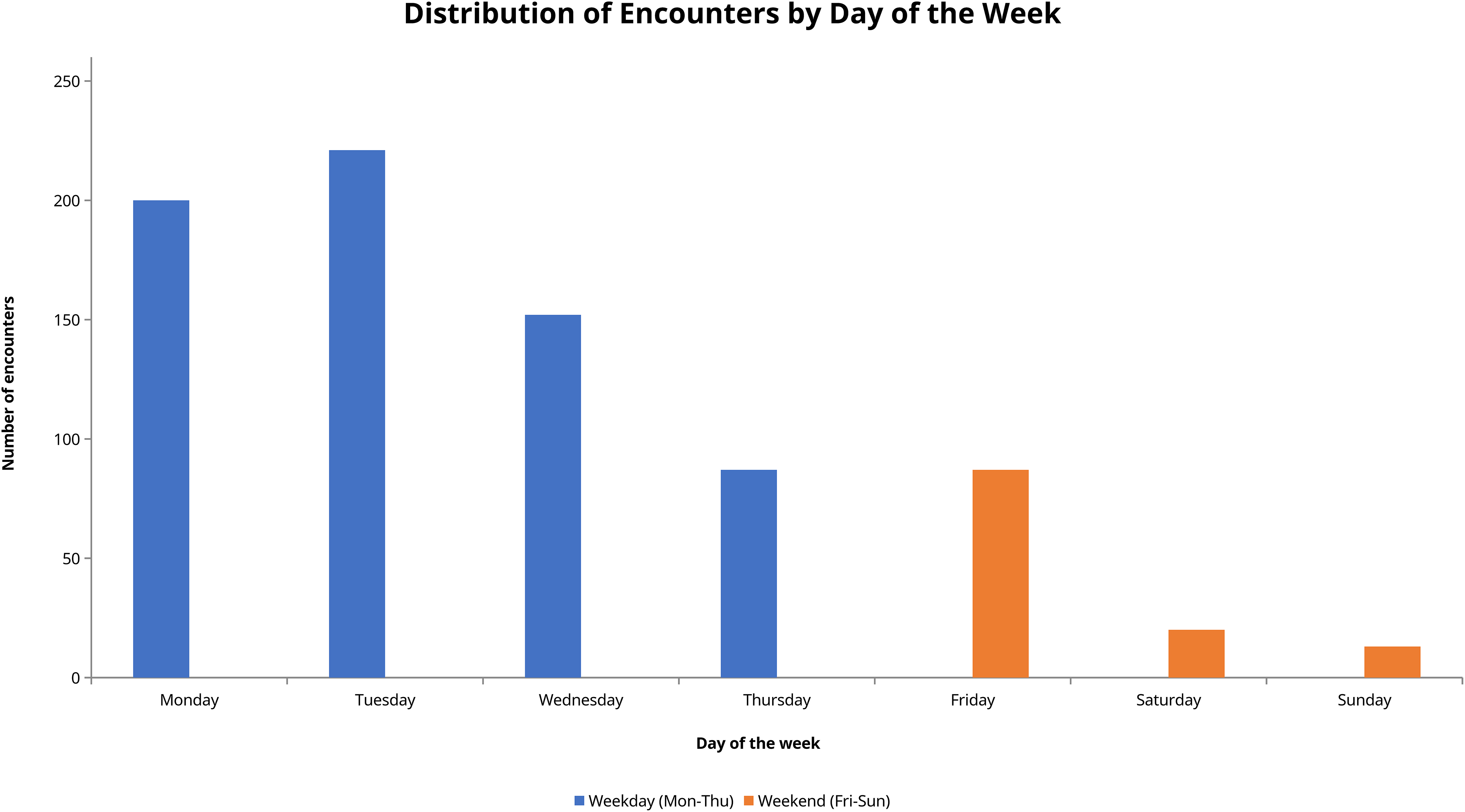
A total of 640 patients contributed 780 encounters. Each patient was classified according to the day-of-week group of the first eligible encounter, yielding 553 weekday-index and 87 weekend-index patients (Table 1). Among the 640 patients, 45 (7.0%) contributed encounters to both groups: 31 had a weekday-index encounter followed by a weekend encounter, and 14 had a weekend index encounter followed by a weekday encounter. Of the total encounters, 660 (84.6%) occurred Monday through Thursday and 120 (15.4%) Friday through Sunday (Figure 1). Encounter volume was highest on Tuesday (221, 28.3%) and Monday (200, 25.6%), followed by Wednesday (152, 19.5%), Thursday (87, 11.2%), Friday (87, 11.2%), Saturday (20, 2.6%), and Sunday (13, 1.7%). Encounters included an in-person visit in 597 (76.5%), a telephone call in 289 (37.1%), and a patient portal message in 131 (16.8%). Emergency department, urgent care, and other (15) contact types were uncommon, and an encounter could include more than one contact type. Urine testing was ordered by 87 clinicians. Friday encounters were managed by the usual weekday clinicians: 85 of 87 were managed by clinicians who also managed Monday-Thursday encounters. Among encounters managed by the 31 clinicians with both Friday and Monday–Thursday encounters, any antibiotic prescribing was 57.6% (49/85) on Fridays vs 38.4% (210/547) Monday–Thursday, and unnecessary prescribing was 31.8% (27/85) vs 21.6% (118/547).
Distribution of encounters by day of the week in the analytic cohort. Weekday encounters were defined as Monday through Thursday and weekend encounters as Friday through Sunday. Labels above bars show the number of encounters and percentage of total encounters for each day.

Patient characteristics by day-of-week group

Table 1. Long description
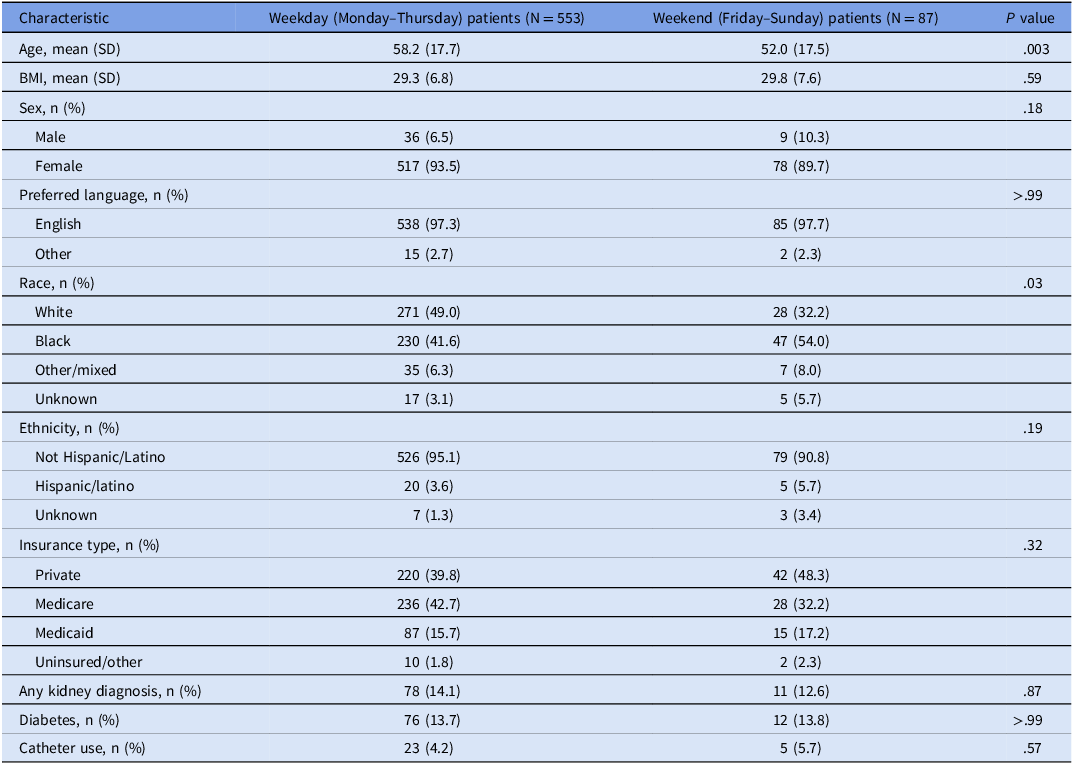
A table comparing patient characteristics by day-of-week group. The table has 12 rows and 4 columns. The columns are labeled ‘Characteristic’, ‘Weekday (Monday-Thursday) patients (N = 553)’, ‘Weekend (Friday-Sunday) patients (N = 87)’, and ‘P value’. The rows include characteristics such as Age, BMI, Sex, Preferred language, Race, Ethnicity, Insurance type, Any kidney diagnosis, Diabetes, and Catheter use. Each row provides specific data for weekday and weekend patients, along with a P value indicating statistical significance. Notable trends include differences in age, race, and insurance type between the two groups.
Patient-level characteristics were based on each patient’s first eligible encounter during the study period. Patients contributing multiple encounters were assigned to a single day-of-week group according to the day of their first eligible encounter. Values are presented as n (%) unless otherwise indicated. P values were calculated using t tests, χ2 tests, or Fisher exact tests, as appropriate.
In patient-level baseline comparisons, the weekend group was younger than the weekday group (mean age, 52.0 vs 58.2 yr; P = .003) and included a higher proportion of Black patients (54.0% vs 41.6%; P = .03) (Table 1). Sex, preferred language, ethnicity, insurance type, BMI, kidney disease, diabetes, and catheter use did not differ significantly between groups.
Unadjusted associations with antibiotic prescribing
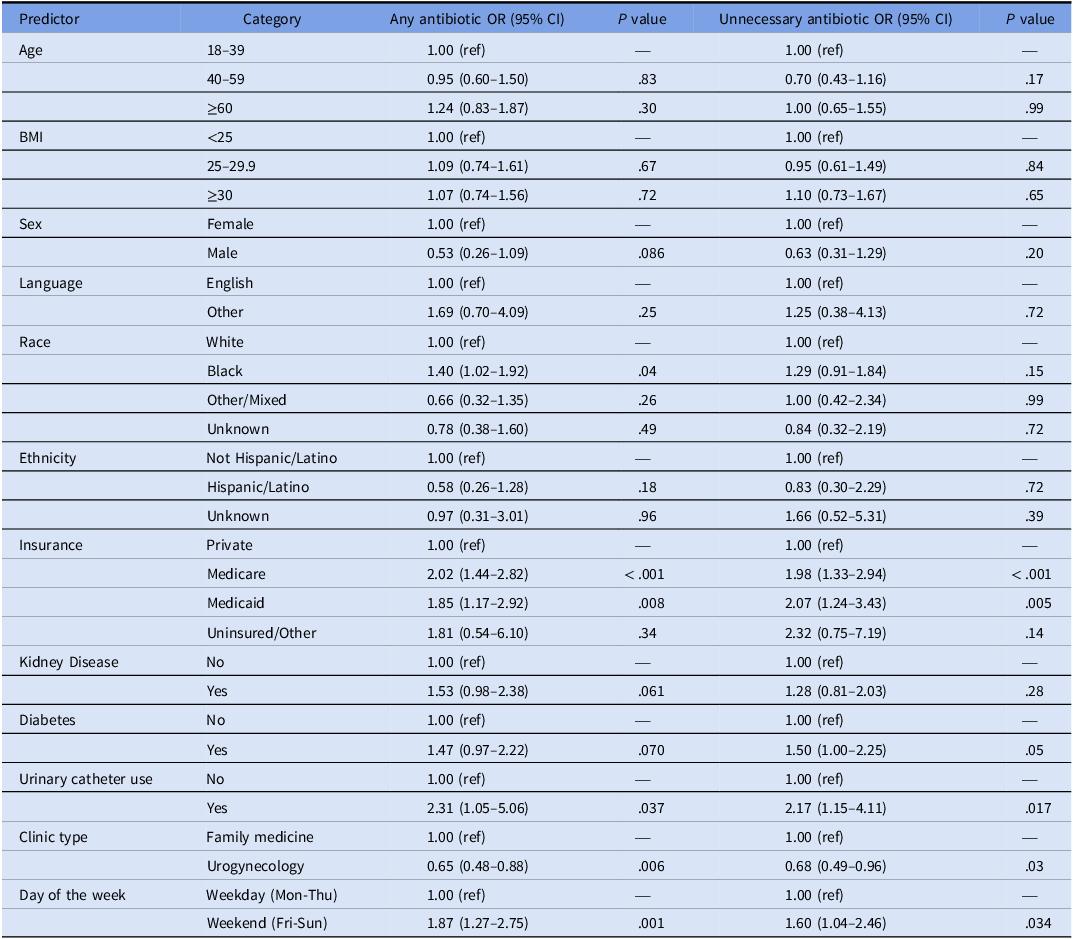
Antibiotics were prescribed in 261/660 weekday encounters (39.5%) and 66/120 weekend encounters (55.0%). Weekend encounters had higher odds of any antibiotic prescribing (OR, 1.87; 95% CI, 1.27–2.75; P = .001). Unnecessary antibiotics were prescribed in 144/660 weekday encounters (21.8%) and 37/120 weekend encounters (30.8%), corresponding to higher odds of unnecessary prescribing on weekends (OR, 1.60; 95% CI, 1.04–2.46; P = .034) (Table 2).
Unadjusted associations with any and unnecessary antibiotic prescribing

Table 2. Long description
A table with 16 rows and 6 columns comparing odds ratios (OR) and P values for any antibiotic and unnecessary antibiotic prescribing across different predictors. Columns are labeled Predictor, Category, Any antibiotic OR (95% CI), P value, Unnecessary antibiotic OR (95% CI), and P value. Predictors include Age, BMI, Sex, Language, Race, Ethnicity, Insurance, Kidney Disease, Diabetes, Urinary catheter use, Clinic type, and Day of the week. Each predictor has multiple categories with corresponding OR and P values. Notable trends include higher odds of antibiotic prescribing for Medicare and Medicaid insured patients, those with urinary catheter use, and weekend encounters.
CI, confidence interval; OR, odds ratio; ref, reference category. Unadjusted ORs were estimated using separate encounter-level generalized estimating equation models with a binomial distribution and logit link. Patient was specified as the repeated-subject variable, with an independent working correlation structure and robust sandwich standard errors to account for within-patient correlation across repeated encounters. Day of week was categorized as weekend (Friday–Sunday) versus weekday (Monday–Thursday).
Age was not significantly associated with either outcome in unadjusted models. Black race was associated with higher odds of any antibiotic prescribing (OR, 1.40; 95% CI, 1.02–1.92; P = .04). Medicare and Medicaid insurance were associated with higher odds of both any and unnecessary antibiotic prescribing. Urinary catheter use was associated with higher odds of both any antibiotic prescribing (OR, 2.31; 95% CI, 1.05–5.06; P = .037) and unnecessary prescribing (OR, 2.17; 95% CI, 1.15–4.11; P = .017) (Table 2). Urogynecology encounters had lower odds than family medicine encounters of both any antibiotic prescribing (OR, 0.65; 95% CI, 0.48–0.88; P = .006) and unnecessary prescribing (OR, 0.68; 95% CI, 0.49–0.96; P = .03) (Table 2).
Adjusted weekend association
After adjustment for age, sex, race, clinic type, and insurance type, weekend encounters remained associated with significantly higher odds of any antibiotic prescribing (aOR, 1.78; 95% CI, 1.19–2.66; P = .005) (Table 3). For unnecessary antibiotic prescribing, the adjusted point estimate was similar in direction and magnitude, but the confidence interval included 1 (aOR, 1.52; 95% CI, 0.97–2.39; P = .066). In sensitivity analysis omitting clinic type, both associations were statistically significant (any antibiotic, aOR, 1.97; 95% CI, 1.32–2.93; P < .001; unnecessary antibiotic, aOR, 1.65; 95% CI, 1.06–2.59; P = .028). In a complete-case sensitivity analysis excluding 27 encounters with missing race (n = 753), results were similar to the primary analysis (any antibiotic, aOR, 1.72; 95% CI, 1.14–2.60; P = .009; unnecessary antibiotic, aOR, 1.53; 95% CI, 0.96–2.43; P = .074).
Adjusted association between weekend encounters and antibiotic prescribing

Table 3. Long description
The table presents data on the adjusted odds ratio (OR) of antibiotic prescribing on weekends compared to weekdays, with a focus on any antibiotic prescribed and unnecessary antibiotic prescribed. It includes three columns: Outcome, Adjusted OR (Friday–Sunday vs Monday–Thursday), 95% CI, and P value. The table has four rows of data: Any antibiotic prescribed with an OR of 1.78, 95% CI of 1.19–2.66, and P value of .005; Unnecessary antibiotic prescribed with an OR of 1.52, 95% CI of 0.97–2.39, and P value of .066; Any antibiotic prescribed, model without clinic type with an OR of 1.97, 95% CI of 1.32–2.93, and P value of <.001; Unnecessary antibiotic prescribed, model without clinic type with an OR of 1.65, 95% CI of 1.06–2.59, and P value of .028.
aOR, adjusted odds ratio; CI, confidence interval. Adjusted associations were estimated using encounter-level generalized estimating equation models with a binomial distribution and logit link. Patient was specified as the repeated-subject variable, with an independent working correlation structure and robust sandwich standard errors to account for within-patient correlation across repeated encounters. Primary models included weekend status, age as a continuous variable, sex, race, clinic type, and insurance type. Reference categories were weekday (Monday–Thursday), female sex, White race, family medicine, and private insurance. † Sensitivity analysis omitting clinic type (originally specified covariate set).
Types of unnecessary antibiotic prescribing
Among the three criteria defining unnecessary prescribing, prescribing when the culture was negative or nondiagnostic was more frequent on weekends (15.0% vs 7.1%; P = .004). Asymptomaic bacteriuria occurred in 8.3% of weekend and 10.6% of weekday encounters (P = .45) and prescribing in the absence of pyuria occurred in 15.0% and 10.2%, respectively (P = .12) (Table 4). By individual day, unnecessary prescribing was highest on Friday (28/87, 32.2%), compared with 19.5% to 24.4% Monday through Thursday. Saturday (5/20) and Sunday (4/13) estimates were based on few encounters (Supplementary Table S1). Among encounters with prescribing when the culture was negative or nondiagnostic, the culture was contaminated or mixed in 14 of 18 Friday–Sunday and 34 of 47 Monday–Thursday encounters. Most prescriptions in this category were empiric, written before the culture resulted (16 of 18 and 43 of 47, respectively). Overall, empiric prescribing at the time of the encounter accounted for 41 of 66 Friday–Sunday prescriptions (62.1%) and 133 of 261 Monday–Thursday prescriptions (51.0%).
Unnecessary antibiotic prescribing criteria by day-of-week group

Table 4. Long description
A table comparing unnecessary antibiotic prescribing criteria by day-of-week group. The table has 8 rows and 4 columns. The columns are labeled Reason, Weekday, N = 660, Weekend, N = 120, and P value. The rows are labeled Any unnecessary antibiotic prescribing, A. Asymptomatic bacteriuria (no documented urinary symptoms and positive urine culture), B. Absence of pyuria (WBC ≤ 10/high-power field), C. Negative or non-diagnostic urine culture, No growth, and Contaminated or mixed. The values in the table are as follows: Row 1: Any unnecessary antibiotic prescribing, 144 (21.8 percent), 37 (30.8 percent), .034. Row 2: A. Asymptomatic bacteriuria (no documented urinary symptoms and positive urine culture), 70 (10.6 percent), 10 (8.3 percent), .45. Row 3: B. Absence of pyuria (WBC ≤ 10/high-power field), 67 (10.2 percent), 18 (15.0 percent), .12. Row 4: C. Negative or non-diagnostic urine culture, 47 (7.1 percent), 18 (15.0 percent), .004. Row 5: No growth, 13 (2.0 percent), 4 (3.3 percent), .35. Row 6: Contaminated or mixed, 34 (5.2 percent), 14 (11.7 percent), .006.
Unnecessary antibiotic prescribing was defined as antibiotic treatment meeting≥1 of the following prespecified criteria: (A) asymptomatic bacteriuria; (B) antibiotic prescribing in the absence of pyuria (urine WBC ≤ 10/high-power field); or (C) antibiotic prescribing when the urine culture was, or subsequently proved to be, negative or non-diagnostic (no growth, culture not indicated, or contaminated or mixed). Percentages were calculated using all weekday (N = 660) or weekend (N = 120) encounters as the denominator. Categories were not mutually exclusive. Criterion C is shown in total and by culture result; no encounters met criterion C on the basis of culture not indicated. P values were calculated using Pearson χ2 tests.
Clinic-stratified analysis
Urogynecology accounted for 469 encounters (371 patients) and family medicine for 311 encounters (273 patients). Friday–Sunday encounters made up 10.4% (49/469) and 22.8% (71/311) of encounters, respectively. Urogynecology patients were older than family medicine patients (mean age, 64.4 vs 48.0 yr), all were female (Supplementary Table S2), and repeat encounters were more common in urogynecology (98 of 469 encounters vs 38 of 311). In both clinics, point estimates indicated higher odds of any and unnecessary antibiotic prescribing for Friday–Sunday encounters (Table 5). In urogynecology, antibiotics were prescribed in 53.1% of Friday–Sunday vs 36.0% of Monday–Thursday encounters (aOR, 2.09; 95% CI, 1.14–3.83), and unnecessary antibiotics in 24.5% vs 20.0% (aOR, 1.31; 95% CI, .64–2.69). In family medicine, the corresponding proportions were 56.3% vs 45.8% (aOR, 1.56; 95% CI, .91–2.65) and 35.2% vs 25.0% (aOR, 1.80; 95% CI, .99–3.27). The clinic-weekend interaction was not statistically significant for any antibiotic prescribing (P = .50) or unnecessary antibiotic prescribing (P = .54).
Association of Friday–Sunday encounters with antibiotic prescribing, stratified by clinic type

Table 5. Long description
The table presents data on antibiotic prescribing outcomes in urogynecology and family medicine clinics, comparing Monday-Thursday and Friday-Sunday encounters. It has four rows and five columns. The columns are labeled Clinic, Outcome, Mon-Thu, n/N (%), Fri-Sun, n/N (%), Unadjusted OR (95% CI), and Adjusted OR (95% CI). The rows are labeled with the clinic type and outcome categories. For urogynecology, any antibiotic prescribing occurred in 36.0% of Monday-Thursday encounters and 53.1% of Friday-Sunday encounters, with an adjusted odds ratio of 2.09. Unnecessary antibiotic prescribing occurred in 20.0% of Monday-Thursday encounters and 24.5% of Friday-Sunday encounters, with an adjusted odds ratio of 1.31. For family medicine, any antibiotic prescribing occurred in 45.8% of Monday-Thursday encounters and 56.3% of Friday-Sunday encounters, with an adjusted odds ratio of 1.56. Unnecessary antibiotic prescribing occurred in 25.0% of Monday-Thursday encounters and 35.2% of Friday-Sunday encounters, with an adjusted odds ratio of 1.80.
CI, confidence interval; GEE, generalized estimating equation; OR, odds ratio. n indicates encounters. ORs compare Friday–Sunday with Monday–Thursday encounters (reference) and were estimated using encounter-level GEE models with a binomial distribution and logit link, with patient as the repeated-subject variable, an independent working correlation structure, and robust sandwich standard errors. Encounters were assigned to the clinic of the clinician who ordered urine testing; 4 follow-up encounters with clinicians outside either clinic were assigned to the patient’s enrolling clinic (family medicine). Four patients contributed encounters to both clinics. *Adjusted for age (continuous), sex, race, and insurance type; sex was omitted from urogynecology models because all urogynecology patients were female. P values for the clinic × weekend interaction (full cohort, 780 encounters): any antibiotic, P = .48 unadjusted and P = .50 adjusted; unnecessary antibiotic, P = .62 unadjusted and P = .54 adjusted.
Discussion
In this planned analysis of ambulatory encounters for urinary symptoms, encounters occurring Friday through Sunday were associated with significantly higher odds of antibiotic prescribing than Monday–Thursday encounters. Overall prescribing increased from 39.5% on weekdays to 55.0% on weekends, an absolute difference of 15.5 percentage points, and this association remained significant after adjustment for clinic type and demographic characteristics (aOR, 1.78; 95% CI, 1.19–2.66). Unnecessary prescribing increased from 21.8% to 30.8%, an absolute difference of 9.0 percentage points. The adjusted point estimate was similar in direction and magnitude across model specifications, but the association was attenuated and did not reach statistical significance after adjustment for clinic type (aOR, 1.52; 95% CI, 0.97–2.39). The end-of-week excess was concentrated in prescribing when the urine culture was negative or nondiagnostic (15.0% vs 7.1%), indicating that the additional end-of-week prescriptions were disproportionately unsupported by objective diagnostic criteria. Together, these findings provide quantitative support for the end-of-week prescribing pattern described by clinic nurses and identify the end of the week as a potentially important target for outpatient UTI stewardship.
The two clinics differed substantially in patient population and in the proportion of end-of-week encounters (Supplementary Table S2), making clinic type a plausible confounder that we included in the primary adjusted models and separately examined as an effect modifier. For any antibiotic prescribing, the association remained significant after clinic adjustment, indicating that the end-of-week pattern is not explained by differences in clinic volume across the week. For unnecessary prescribing, adding clinic type changed the estimate only modestly (aOR, 1.65 to 1.52), but the confidence interval widened to include 1, likely reflecting the smaller number of events for this outcome.
Temporal variation in antibiotic prescribing has been described in several prior settings, but the patterns and their attributed causes have differed. Friday prescribing was 23% higher than other weekdays in German primary care,Reference Kuehlein, Szecsenyi, Gutscher and Laux9 weekend antibiotic therapy was less often appropriate in an emergency department,Reference Bishara, Hershkovitz, Paul, Rotenberg and Pitlik7 and after-hours upper respiratory tract infection consultations in Australian primary care were associated with more prescribing,Reference Peng, He, Hayen, Hall and Liu10 whereas higher out-of-hours prescribing in the Netherlands was largely explained by patient mix.Reference Debets, Verheij and van der Velden8 These studies examined heterogeneous infection types and relied on prescribing volume or reviewer-judged appropriateness rather than explicit diagnostic criteria. All were conducted outside the United States, and to our knowledge no prior study has examined an end-of-week pattern in US ambulatory UTI care where the majority of US-based prescribing occurs. This study adds a diagnostic-criteria lens to prior work on temporal prescribing variation, applying prespecified criteria for unnecessary prescribing so that its component patterns can be examined across the week. The clearest component difference was prescribing when the urine culture was negative or nondiagnostic, which occurred in 15.0% of weekend encounters compared with 7.1% of weekday encounters. Because weekend prescriptions were more often unsupported by culture results, the end-of-week excess appears to reflect empiric, anticipatory treatment rather than confirmed infection, raising the question of what drives this pattern.
This anticipatory prescribing likely reflects both patient- and clinician-level factors. Patients may seek care before the weekend with greater urgency, and clinicians may have a lower threshold for empiric treatment when follow-up or diagnostic testing seems less accessible. In our health system, urine cultures typically result 48 to 72 hours after collection, so a culture obtained on a Friday typically results on Sunday or Monday. Several of these drivers are modifiable and could be assembled into a weekend-specific stewardship bundle. Because the risk that untreated uncomplicated cystitis progresses to pyelonephritis is low (approximately 1%–2%), symptom-focused nonantibiotic management may be appropriate, particularly in patients with milder symptoms.Reference Frimodt-Møller and Bjerrum14,Reference Kaußner, Röver and Heinz15 Candidate components include counseling patients that antibiotics carry real harms (eg, adverse drug events, Clostridioides difficile infection, and selection for resistant organisms), clarifying that on-call clinicians are available at many practices for weekend symptom escalation, and pairing these measures with electronic health record-based clinical decision support, such as end-of-week diagnostic prompts, delayed-prescribing pathways, or structured follow-up plans, which has improved guideline-directed UTI prescribing in other settings.Reference Gohil, Septimus and Kleinman16,Reference Köves, Cai and Veeratterapillay17 Whether such a bundle reduces end-of-week prescribing without delaying appropriate therapy should be evaluated prospectively.
A structural difference in weekend access between the two clinics may also be relevant. The urogynecology practice provides weekend on-call coverage by division physicians at no additional cost to patients, allowing symptoms that persist after a Friday encounter to be reassessed and a pending culture to be acted on without committing to empiric therapy at the index encounter. In family medicine, weekend symptom escalation is routed to a fee-based telemedicine service, which may give clinicians and patients a stronger incentive to prescribe before the weekend. This asymmetry offers a plausible workflow-level explanation for why clinic type behaved as a confounder and is consistent with the numerically larger end-of-week estimate for unnecessary prescribing in family medicine than in urogynecology, although the clinic × end-of-week interaction was not significant and the pattern was reversed for any antibiotic prescribing. Because weekend access pathways, their use, and associated out-of-pocket costs were not captured at the encounter level, this mechanism should be considered hypothesis-generating. Where weekend escalation carries a cost or access barrier, providing a no-cost nurse- or clinician-led weekend call-back pathway and setting the expectation at the index visit that pending cultures will be reviewed promptly may be as important as decision-support prompts for reducing end-of-week overuse.
Strengths of this study include an encounter-level analysis, accounting for repeated encounters within patients, and the use of prespecified clinical criteria to distinguish overall from unnecessary antibiotic prescribing. In addition, the cohort included two practices that differ substantially in patient population and weekend coverage with our urogynecology practice serving older, exclusively female patients with more frequent repeat encounters and weekend coverage by on-call division physicians compared to a family medicine practice serving a younger, predominantly Black population with a higher proportion of Medicaid-insured patients and weekend coverage by an on-demand service. The end-of-week association was directionally consistent in both practices with no significant clinic-weekend interaction, suggesting that the pattern is not specific to a single patient population, specialty, or coverage model, and that end-of-week stewardship efforts may be relevant to both primary and specialty care.
Several limitations warrant mention. First, the single-center design and relatively small Friday–Sunday group limit generalizability. Friday accounted for 87 of 120 weekend-group encounters (72.5%) so the findings are best interpreted as an end-of-week association rather than evidence of a distinct Saturday/Sunday effect. Clinic-stratified estimates were also imprecise because each clinic contributed relatively few Friday–Sunday encounters (49 in urogynecology and 71 in family medicine), and interaction tests had limited power to detect moderate differences between clinics; the absence of a significant interaction should not be interpreted as evidence that the association is identical across clinic types. Because clinic type is associated with other workflow differences, including weekend access pathways, residual confounding by unmeasured clinic-level processes cannot be excluded despite adjustment and stratification. Second, because day-of-week exposure was defined at the encounter level, 45 of 640 patients (7.0%) contributed encounters to both groups though regression models accounted for within-patient correlation. Third, provider-level factors, patient acuity, and real-time availability of laboratory results were not fully captured and may contribute to residual confounding. Although Friday encounters were managed by the same clinicians who managed weekday encounters, clinician-level variation was not modeled, and the abstracted clinician was the clinician who ordered urine testing, who may not always have been the prescriber. Encounter timing within the day was also not captured, so we could not assess cumulative decision fatigue, which has been associated with increasing antibiotic prescribing over the course of primary care clinic sessions.Reference Linder, Doctor and Friedberg18 Fourth, race was missing for 3.5% of encounters, although complete-case sensitivity analyses yielded similar estimates. Finally, the unnecessary-prescribing definition depended on documented symptoms and laboratory data, creating potential for misclassification when clinical information was incompletely documented, and the nondiagnostic culture category combined no growth and contaminated or mixed results, which differ clinically. As an observational cross-sectional analysis, the study cannot establish causality.
In conclusion, ambulatory encounters occurring Friday through Sunday were associated with significantly higher odds of any antibiotic prescribing than Monday–Thursday encounters. The association with unnecessary prescribing was similar in direction and magnitude across model specifications but did not reach statistical significance after adjustment for clinic type. The end-of-week excess was concentrated in prescribing when urine cultures were negative or nondiagnostic, indicating that objective, laboratory-based criteria can localize where end-of-week overuse occurs. These findings identify the end of the week, and the diagnostic uncertainty and limited weekend follow-up that accompany it, as a potentially modifiable stewardship target. Multisite validation and prospective evaluation of targeted clinical decision support and structured follow-up pathways are warranted.
Supplementary material
The supplementary material for this article is available at https://doi.org/10.1017/ash.2026.10957.
Author contribution
LAQ—conceptualization, data curation, methodology, formal analysis, writing—original draft, review, and editing, funding acquisition; RP, ML, HG—data curation; GRC—conceptualization, writing—original draft, review, and editing; LAA—conceptualization, methodology, writing—review and editing, funding acquisition, and supervision.
Financial support
This work was supported by the American Urogynecologic Society Fellows Research Award.
Competing interests
All authors: No reported conflicts of interest.
Patient consent statement
This study was approved by the University of Pennsylvania Institutional Review Board (Protocol #857597), which granted a waiver of informed consent for this retrospective analysis of existing records.
Research transparency and reproducibility
The data underlying this article are available from the corresponding author upon reasonable request.





 Open access

