Introduction
Cauliflower (Brassica oleracea L.var. botrytis) is a popular and economically important winter vegetable grown on more than 35,700 ha in Nepal, or almost 13% of vegetable crop area, with an average yield of 16 t ha−1 (MoALD, 2019). Although national production of vegetables, including cauliflower, is increasing, their productivity is low and significant imports are needed to meet domestic demand (Ojha, Reference Ojha2016). Lower cauliflower productivity is associated mainly with poor on-farm nutrient management, such as unbalanced and inefficient fertilization (Belbase and Bc, Reference Belbase and Bc2020; Neupane et al., Reference Neupane, Aryal, Chhetri and Regmi2020).
Nepali farmers’ fertilizer use is skewed towards excessive nitrogen (N) applications, with low or negligible use of secondary nutrients and micronutrients (Baral et al., Reference Baral, Pande, Gaihre, Baral, Sah, Thapa and Singh2020), resulting in reduced nitrogen use efficiency (NUE) and large N losses to the environment through leaching, surface run off, volatilization, nitrification and denitrification (Gaihre et al., Reference Gaihre, Singh, Islam, Huda, Islam, Satter, Sanabria, Islam and Shah2015; Wang et al., Reference Wang, Lv, Coulter, Xie, Yu, Li, Zhang, Tang, Niu and Gan2020). Besides affecting crop yields, such practices reduce soil fertility and help explain the wide gap between attainable yields and actual farm yields (Devkota et al., Reference Devkota, Devkota, Khadka, Khadka, Paudel, Acharya and McDonald2018; Shrestha et al., Reference Shrestha, Huang, Gautam and Johnson2016).
Previous studies have cited N among the most limiting nutrients for crop productivity (Dhakal et al., Reference Dhakal, Baral, Pokhrel, Pandit, Thapa, Gaihre and Vista2020; Shrestha and Maskey, Reference Shrestha and Maskey2005). In Nepal, farmers use conventional urea (CU) as a N source, which is associated with lower NUE (20–35%), reducing crop productivity and farm profits (Naz and Sulaiman, Reference Naz and Sulaiman2016). Lower NUE, along with possible reduced soil fertility and crops yields, is also associated with the application of fertilizers at fixed rates across different soil types and agro-ecologies, as well as inappropriate timing and inefficient application. Therefore, it is critical to find strategies to improve NUE and crop productivity. Following the 4Rs (right source, right rate, right time and right placement) for fertilizer use has been shown to improve crop productivity and NUE (Jones, Reference Jones2021; Snyder, Reference Snyder2017) and could also work for vegetable farmers in Nepal.
Previous studies have shown that enhanced efficiency nitrogen fertilizers (EENFs), including slow and controlled release fertilizers and coated fertilizers, can improve NUE, allowing farmers to use much less fertilizer with no yield penalty and reduce N losses to the environment (Chen et al., Reference Chen, Suter, Islam, Edis, Freney and Walker2008; Gaihre et al., Reference Gaihre, Singh, Islam, Huda, Islam, Satter, Sanabria, Islam and Shah2015), contributing to sustainable development goals (Zhang et al., Reference Zhang, Davidson, Mauzerall, Searchinger, Dumas and Shen2015). Polymer- and sulfur-coated fertilizers (polymer-coated urea (PCU) and sulfur-coated urea (SCU)) enable the slow release of the fertilizer, i.e., the rate of dissolution and N availability is based on the plant’s physiological requirement over a cropping period (Morgan et al., Reference Morgan, Cushman and Sato2009; Trenkel, Reference Trenkel1997; Van Eerd et al., Reference Van Eerd, Turnbull, Bakker, Vyn, McKeown and Westerveld2017). In addition to agronomic and environmental benefits, EENFs are economically viable because they can be applied only once, saving time and labour compared with multiple, split applications of granular urea (Simonne and Hutchinson, Reference Simonne and Hutchinson2005). Furthermore, the higher productivity of vegetables fertilized using EENF can offset the higher costs of PCU and SCU (Simonne and Hutchinson, Reference Simonne and Hutchinson2005; Wang et al., Reference Wang, Lv, Coulter, Xie, Yu, Li, Zhang, Tang, Niu and Gan2020). Several previous studies have documented the beneficial effects of EENF over conventional granular urea in saving N (Trenkel, Reference Trenkel2010) and increasing vegetable productivity and farm profitability (Guertal, Reference Guertal2009; Sikora et al., Reference Sikora, Niemiec, Szeląg-Sikora, Gródek-Szostak, Kuboń and Komorowska2020; Van Eerd et al., Reference Van Eerd, Turnbull, Bakker, Vyn, McKeown and Westerveld2017; Wang et al., Reference Wang, Lv, Coulter, Xie, Yu, Li, Zhang, Tang, Niu and Gan2020). Wang et al. (Reference Wang, Lv, Coulter, Xie, Yu, Li, Zhang, Tang, Niu and Gan2020) reported that PCU applied at 31% less N increased winter chives yields by 37% over yields of chives grown with CU (100% N).
Another promising technique is applying fertilizer sub-surface or in the plant root zone, commonly called urea deep placement (UDP). For ease of deep placement, prilled or granular urea is compressed to a large granule (1–3 g) called a urea briquette (UB). The briquettes are placed 5–10 cm below soil surface and increase NUE, crop productivity and farm profitability over use of conventional granular urea (Agyin-Birikorang et al., Reference Agyin-Birikorang, Winings, Yin, Singh and Sanabria2018; Chen et al., Reference Chen, Wang, Ma, Zou and Jiang2020; Gaihre et al., Reference Gaihre, Singh, Islam, Huda, Islam, Satter, Sanabria, Islam and Shah2015; Pooniya et al., Reference Pooniya, Shivay, Pal and Bansal2018; Wang et al., Reference Wang, Lv, Coulter, Xie, Yu, Li, Zhang, Tang, Niu and Gan2020). Placement of UB in the root zone helps to retain N longer and slow its release, making the nutrient continuously available as and when needed by crops (Agyin-Birikorang et al., Reference Agyin-Birikorang, Winings, Yin, Singh and Sanabria2018; Baral et al., Reference Baral, Pande, Gaihre, Baral, Sah, Thapa and Singh2020). In general, deep placement of UB with 20–35% less nitrogen maintained (Agyin-Birikorang et al., Reference Agyin-Birikorang, Winings, Yin, Singh and Sanabria2018; Baral et al., Reference Baral, Pande, Gaihre, Baral, Sah, Thapa and Singh2020) or increased crop yield by 25%, compared with conventional application of urea (Derrick et al., Reference Derrick, Etienne and Mathusalem2017). These results suggest that yield increments with UB were not consistent across crops and sites.
Most previous studies have shown the potential of EENFs such as PCU, SCU and UB for cereal grain production, with few studies focusing on vegetable crops (Simonne and Hutchinson, Reference Simonne and Hutchinson2005) or the effects of EENF on yields and NUE in Cole crops, particularly cauliflower (Van Eerd et al., Reference Van Eerd, Turnbull, Bakker, Vyn, McKeown and Westerveld2017). In this study, for the first time in Nepal, three different EENF products were tested for their agronomic and economic effects on cauliflower productivity. We assessed the potential of three EENFs (PCU, SCU and UB) to improve agronomic NUE, cauliflower productivity and farm profitability, using data from multilocation trials covering different agroecological zones and districts over two cropping seasons between 2018 and 2020. We hypothesized that the use of EENF increases agronomic NUE, curd yield and farmers’ income, compared with CU and farmers’ current nutrient management practices (FP).
Material and Methods
Site description and weather conditions
Field trials were conducted during 2018–2020 across seven districts; five in the Mid-hills (Dang, Palpa, Doti, Kavre and Surkhet) with average elevations ranging from 557 to 2512 m above sea level (masl) and subtropical climates and two in the Terai (Bardiya and Kailali) with average elevations from 112 to 117 masl and tropical climates (Fig. S1). The main cropping patterns are cauliflower–wheat–rice in the Terai and cauliflower–maize in the Mid-hills.
In the first year (November 2018 to March 2019), average minimum and maximum temperatures during the growing period were 11.0 °C (ranges from 6.7 to 14.7 °C) and 22.7 °C (ranges from 17.3 to 27.2 °C), respectively, across the districts. Similarly, in the second year (November 2019 to March 2020), average minimum and maximum temperatures were 13.2 °C (ranges from 8.8 to 16 °C) and 23.6 °C (ranges from 17.5 to 27.2 °C), respectively (Fig. S2). Average total rainfall across the districts was 120 ± 42 mm (ranging from 76 to 201 mm) and 181 ± 6 mm (ranging from 76 to 201 mm) during first and second year, respectively. Both temperatures and rainfall were moderate in Doti and Kavre and high in for other districts (Fig. S2)
Soil physicochemical properties
Triplicate soil samples were collected from each plot at a depth of 10 cm and pooled into a composite sample for each plot. Each sample was analysed for soil pH, organic matter (OM), texture, total N, and available P2O5 and K2O, using visible-near-infrared diffuse reflectance spectroscopy (VisNIR-DRS) (Table 1). About 20% of the samples were analysed using wet chemistry to calibrate, build a partial least square regression (PLSR) model and determine the soil physiochemical properties through spectroscopy.
Soil characterization across the study districts (mean ± SE)

Soil pH was measured in a 1:2.5 water suspension using a digital pH meter (buffering at pH 7 and 4). Organic carbon was determined as per Walkley and Black (Reference Walkley and Black1934). Total N was analysed through Kjeldahl’s method, in which samples are digested with sulphuric acid, distilled into a boric acid solution, following the titration of borate anions with standardized hydrochloric acid, to calculate the nitrogen content. Available P was determined through a modified Olsen’s bicarbonate method, in which phosphate was extracted from the soil using a 0.5 N sodium bicarbonate solution adjusted to pH 8.5. The complex formed by the reaction between desorbed phosphate ions and molybdate was reduced using ascorbic acid to form a blue colour and the absorbance of the solution was measured at 880 nm using a spectrophotometer (Olsen and Sommers, Reference Olsen and Sommers1982). Available K was determined using the neutral ammonium acetate method, where potassium is extracted from the soil with an ammonium acetate solution at 1:10 (soil: extractant ratio) and measured by a flame photometer. Soil texture was analysed using the hydrometer method (Bouyoucos, Reference Bouyoucos1936), and the textural class was determined based on the USA Department of Agriculture (USDA) classification system. Soils were classified as silt loam and moderately acidic (pH ranging from 5.8 to 6.9). OM ranged from 1.5 to 3.4%, total N from 0.09 to 0.19%, available P2O5 from 33.9 to 89.3 mg kg−1 and available K2O from 79.1 to 234.3 mg kg−1 (Table 1).
Experimental set-up and cultivation practices
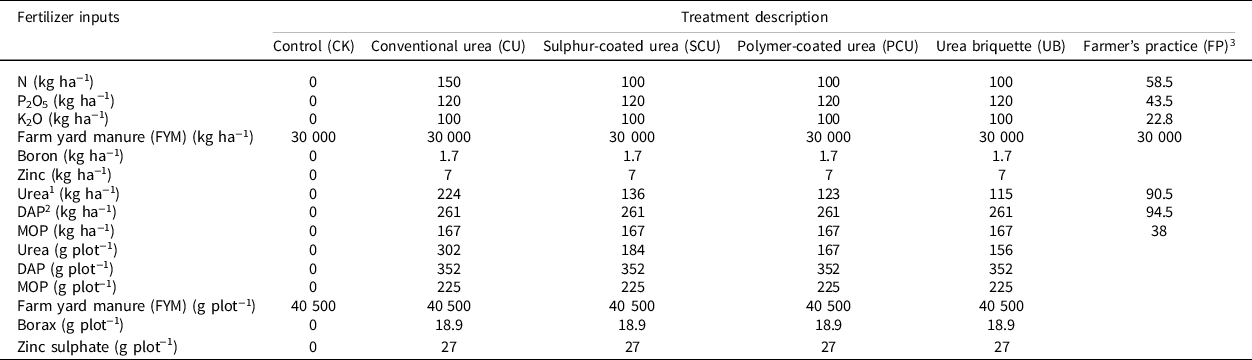
A total of 81 field trials were established across 7 districts in 2 agroecological regions, the Mid-hills (subtropical climate) and Terai (tropical climate), during November-February 2018 (n = 49) and 2019 (n = 32). Twelve field trials were established in Dang, 14 in Palpa, 12 in Doti, 9 in Kavre, 17 in Surkhet, 8 in Bardiya and 9 in Kailali. Trials were conducted with a farmer cooperative that distributes subsidized fertilizers to farmers. Within each cooperative, three farmers’ field was selected randomly for the trials. In each trial, we set up five treatments, including the control (without fertilizer; CK) and CU, PCU (44% N, 90 days release; PUREKOTETM, Pursell Agri-Tech LLC, AL 35 150, USA), SCU (39% N, 13.8% S, Thiogro ES, Shell, Canada) and UB in a randomized complete block design with three replications in each cooperative. In the CU treatment, granular urea was applied at 150 kg N ha−1, a rate considered optimum, based on the multilocation N rate field trials conducted across the study districts in 2017 (Fig. S3). Considering the higher N use efficiency of EENF (Agyin-Birikorang et al., Reference Agyin-Birikorang, Winings, Yin, Singh and Sanabria2018; Baral et al., Reference Baral, Pande, Gaihre, Baral, Sah, Thapa and Singh2020; Wang et al., Reference Wang, Lv, Coulter, Xie, Yu, Li, Zhang, Tang, Niu and Gan2020), N rates in PCU, SCU and UB were reduced by 33% (100 kg N ha−1), compared with CU. Phosphorus (P2O5) and potassium (K2O) fertilizers were applied at the same rate for all the treatments (120:100 kg P2O5: K2O ha−1) in the form of diammonium phosphate (DAP) and muriate of potash (MOP). Treatment plots measured 13.5 m2 (4.5 m × 3 m).
For land preparation, each plot was plowed two to three times with moldboard plow. Hybrid cauliflower varieties (‘Snow Crown’ in the Mid-hills and ‘Snow Mystique’ in the Terai) were planted at a spacing of 60 cm × 45 cm. The full dosage of DAP (120 kg P2O5 ha−1), MOP (100 kg K2O ha−1) and micronutrients (Boron [1.7 kg ha−1] in the form of Borax and Zinc [7 kg ha−1] in the form of zinc sulphate) were applied equally in all treatment plots during planting at a depth of 5 cm and 5–7 cm apart from seedlings. In EENF treatments, a full dosage of PCU and SCU was applied at a depth of 5 cm and 5–7 cm apart and one UB (weigh 2.7 g each) per plant at a depth of 7–10 cm and 5–7 cm apart, as a basal application. In the CU treatment, granular urea was top dressed at a depth of 5 cm in two equal splits (30 and 50 days after plantation; Table 2). Hand weeding and earthing up (5 cm high) were carried out twice at 30 and 50 days after plantation. Blanching was performed to protect the curd from sunlight and improve texture or flavour by covering the curd with outer leaves and tying them with a twine or rubber band for 4–5 days. Irrigation, pest and disease management and other routine agronomic practices were performed as and when needed.
Description of the treatments; enhanced efficiency nitrogen fertilizers (EENFs), i.e., sulphur-coated urea (SCU), polymer-coated urea (PCU) and urea briquette (UB) along with conventional urea (CU), control (CK) and farmers practices (FP) across seven districts for the year 2018 and 2019 (n = 81)
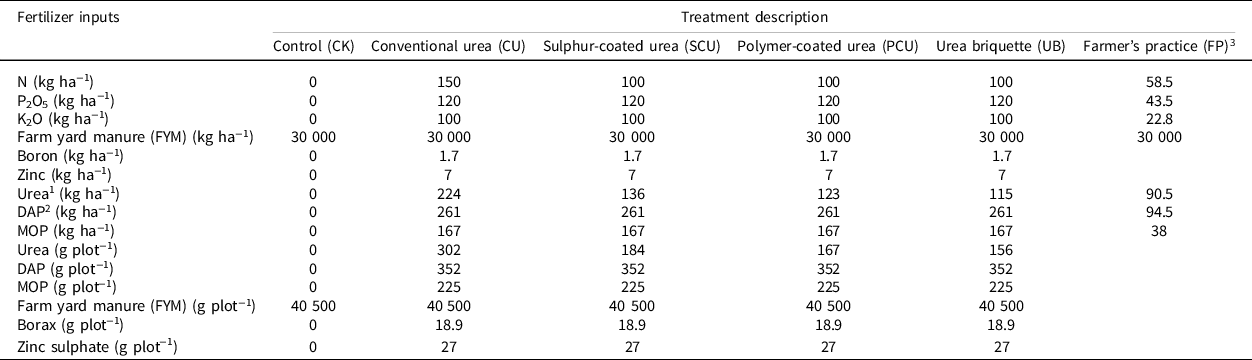
1 Urea applied in the form of CU and UB contains 46% N, SCU contains 39% N and 13% elemental sulphur and PCU contains 44% N.
2 DAP contains 46% P2O5 and 18% N.
3 Average use of NPK across the districts by farmers. Farmers practice treatment was included to compare the cauliflower yield across the districts compared with various N source treatments.
Farmer’s nutrient management practices
To compare the yield benefits of EENFs over those resulting from farmers’ traditional practices, we added the treatment ‘farmers’ nutrient management practices (FP).’ To assess FP yields, fertilizer rates and profits, we conducted surveys (n = 105) and crop cuts (n = 35) in the fields of farmers located near experiment sites (one farmer per experiment). Farmers were interviewed using a structured questionnaire in ‘open data kit’ software. For crop-cuts, three quadrants of 1 m2 = 3 m2 in total were selected randomly from farms adjoining trial sites and harvested to record the yield (Fermont and Benson, Reference Fermont and Benson2011).
Farmers’ fertilizer use varied across the districts. On average, N fertilizer use by farmers was 58.5 kg ha−1 (ranging from 33 to 88 kg N ha−1), which is 70% less than the government’s recommendation (RP) of 200:120:100 kg N P2O5 K2O ha−1 (Figure 1). NPK rates in Dang and Palpa were lower than that in other districts. Similarly, the average application rates of P2O5 and K2O were 43.5 kg ha−1 (ranging from 18 to 56 kg P2O5 ha−1) and 22.8 kg ha−1 (ranging from 1 to 42 kg K2O ha−1), which is 64% and 77% less than the RP, respectively (Figure 1). NPK fertilizer rates for the Mid-hills and the Terai were similar (Figure 1).
N (a), P (b) and K (c) fertilizer applied by farmers across the districts; Dang (n = 35), Palpa (n = 9), Doti (n = 12), Kavre (n = 6), Surkhet (n = 12), Bardiya (n = 15) and Kailali (n = 16). Sign (×) in the middle of the boxplot refer to the average amount of NPK fertilizers used by the farmers. Blue horizontal solid line in each figure (a, b & c) represents the existing blanket NPK fertilizers recommendation rate in Nepal. Dashed blue line in figure (a) represents the optimum N rate identified through the project across the district locations.

Yield and nitrogen use efficiency (NUE)
Cauliflower was harvested from three quadrants of 1 m2 (3 m2 in total) in each treatment plot, when the curds had attained proper size and compactness. Harvesting was performed manually by cutting the stem 3–5 cm above soil surface, excluding the 50 cm border row. Marketable curd yield was measured after removing stem and leaves.
NUE was calculated as partial factor productivity (PFPN) and agronomic use efficiency of nitrogen (AEN) for all N source treatments (CU, PCU, SCU and UB) using the following equation:
 $${\rm{PF}}{{\rm{P}}_{\rm{N}}} = {{\rm{Y}}_{\rm{N}}}/{{\rm{F}}_{\rm{N}}},\,{\rm{kg}}\,{\rm{cauliflower}}\,{\rm{yield}}\,{\rm{per}}\,{\rm{kg}}\,{\rm{N}}\,{\rm{applied}}$$
 $${\rm{A}}{{\rm{E}}_{\rm{N}}} = \left( {{{\rm{Y}}_{\rm{N}}}-{{\rm{Y}}_0}} \right)/{{\rm{F}}_{\rm{N}}},\,{\rm{kg}}\,{\rm{cauliflower}}\,{\rm{yield}}\,{\rm{increases}}\,{\rm{per}}\,{\rm{kg}}\,{\rm{N}}\,{\rm{applied}}$$
where YN is the cauliflower yield with applied nitrogen (kg ha−1), Y0 is the cauliflower yield without fertilizer and FN is the amount of N applied (kg ha−1).
Economic analysis
Cost–benefit analysis of EENFs (PCU, SCU and UB), CU and FP was performed based on data from field trials, crop cuts and surveys. Agronomic costs included costs of seed, fertilizer and labour required for fertilizer application and other agronomic practices (irrigation, weeding, pest management and harvest) (Table S1). The retail price of cauliflower was based on the local market price (USA$ 254 per ton). Gross margin (GM) was calculated as the differences between cauliflower sales and total variable costs (TVC) across districts (Pandit et al., Reference Pandit, Mulder, Hale, Zimmerman, Pandit and Cornelissen2018).
Data analysis
Data were analysed using R statistical software, version 3.6.2 (R Core Team., Reference Team2019). A linear mixed effect model was applied using the ‘lmer’ function in the ‘lme4’ extension package to assess the fixed effects of N sources (treatments) on cauliflower yield, with location as a random factor (district site and agroecological region), fitted by the Restricted Maximum Likelihood (REML) (model I). A mixed model was used for district-level disaggregated analysis including municipalities (block) within each district. Variety was not included in the model together with N sources as a fixed factor, due to non-significant effect of variety on crop yields. In the mixed effect model, FP treatment was omitted for both aggregated and disaggregated trial data, as the observed yield response might be biased due to variation in farmers’ crop management practices. We performed one-way fixed effect ANOVA to compare the cauliflower yields under FP with various N source plots, allowing comparisons of yield response as a function of source of nitrogen and fertilizer management practices (model II). Similarly, one factor ANOVA was used to assess the effect of different N on PFPN and AEN (model III). Significant differences between treatment means of cauliflower yield, PFPN and AEN were evaluated through a post hoc Tukey test (p = 0.05). Model checking was performed through basic diagnostic plots (Normal Q-Q and residuals plots). The differences between various treatments were significant at p < 0.05, unless stated otherwise. A multiple linear regression model was used to assess the effect of soil chemical properties (pH, OM, total N, available P and K [continuous variables]) on cauliflower productivity across the district locations (model IV). Models I, II, III and IV follow these equations and assumptions:
 $${Y_{ijk}} = {\rm{\;\mu }} + {\tau _i} + {\beta _j} + {\varepsilon _{ijk}} \ldots {\rm {model \,I \,(linear \,mixed \,effect \,model)}}$$
 $${Y_{ik}} = \;\mu + {\tau _i} + {\varepsilon _{ik}} \ldots {\rm{model \;II \,(linear \,one-way \,ANOVA \,model)}}$$
 $${Y_{jk}} = \;\mu + {\tau _j} + {\varepsilon _{jk}} \ldots {\rm{model \,III \,(linear \,one-way \,ANOVA \,model)}}$$
 $${{Y_{ijklm}} = {\beta _0} + \beta 1{x_i} + \beta 2{x_j} + \beta 3{x_k} + \beta 4{x_l} + \beta 5{x_m} + {\varepsilon _{ijklm}} \ldots {\rm{model \,IV \,(multiple \,linear \,regression)}}} $$
where
 $\sum {\tau _i} = \sum {\tau _j} = 0,$
i.e.,
 ${\tau _i}$
and
 ${\tau _j}$
are the fixed effect coefficient for observations i and j (treatments) and the summation of all the parameters are zero.
 ${\beta _j}$
∼ N (0, σ2
β), i.e.,
 ${\beta _j}$
is the random effect coefficient for observation j (trial locations).
 ${\varepsilon _{ijklm\;}} = {\varepsilon _{ijk}}\; = \;{\varepsilon _{ik}} = \;{\varepsilon _{jk}}$
∼ NID (0, σ2); i.e., residuals are independent and normally distributed with constant variance.
 ${Y_{ijk}}$
represents the value of observed crop yield (response variable) in response to
 ${\tau _i}$
; i.e., fixed effect coefficient of treatments (CK, CU, SCU, PCU and UB), and
 ${\beta _j}$
represents the random effect coefficient of trial locations across seven districts or two agroecologies.
 ${Y_{ik}}$
represents the yield in response to treatments
 $({\tau _i}$
), including FP, in the model.
 ${Y_{jk}}$
represents the observed PFPN and AEN in response to four N source treatments (
 ${\tau _j}$
), i.e., CU, PCU, SCU and UB.
 $\mu $
represents the overall mean. K represents the number of replications in each model (k = 1, 2…n).
 ${Y_{ijklm}}$
represents crop yield in response to a continuous regressor variable; i.e.,
 ${x_i},{x_j},{x_k}$
,
 $\;{x_l}\;\;and\;{x_m}$
, denoting pH, OM, available P, K and total N (i, j, k, l, m = 1, 2…n), with their corresponding slopes
 $\beta 1,\beta 2,\;\beta 3,\beta 4\;and\;\beta 5$
, respectively, and the intercept
 $\;{\beta _0}$
.
Results
Curd yield
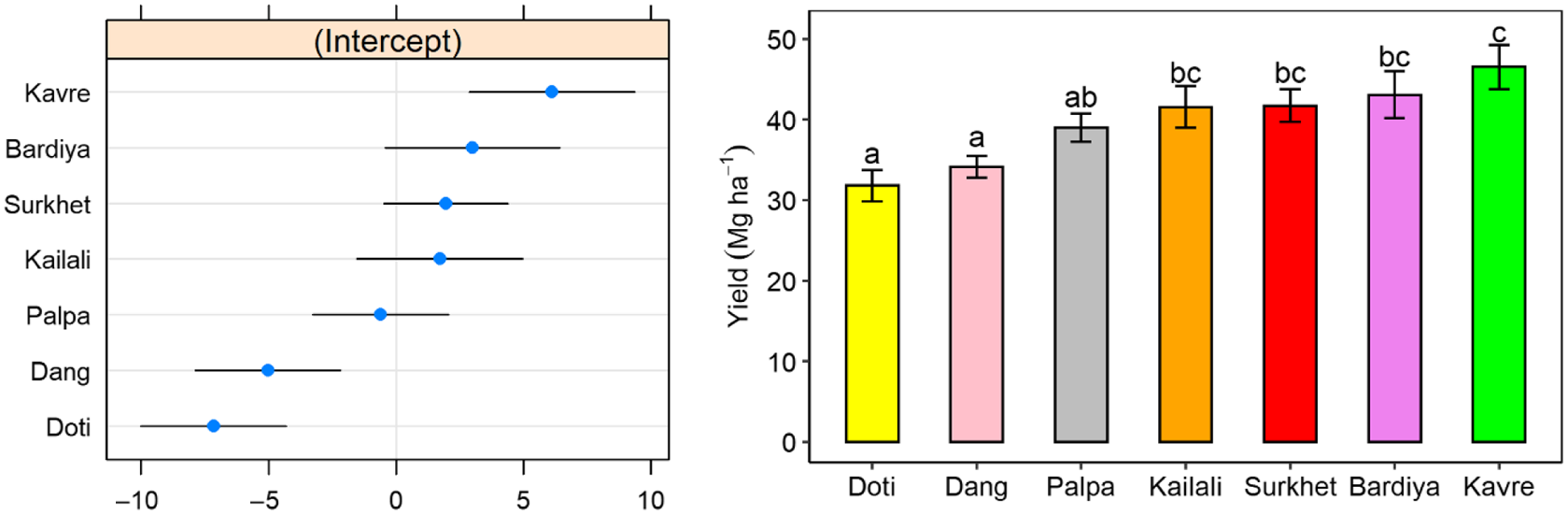
Cauliflower yield was significantly (p < 0.05) affected by both N source (Figure 2) and site (Figure 3). EENFs (PCU, SCU and UB) produced significantly higher cauliflower yield compared with CU and FP (Figure 2). PCU, SCU and UB increased cauliflower yield by 22% (47.1 ± 1.6 t ha−1), 21% (46.7 ± 1.7 t ha−1) and 24% (48.0 ± 1.6 t ha−1) compared with CU (36.7 ± 1.1 t ha−1), respectively (Figure 2.a). Similarly, PCU, SCU and UB increased cauliflower yield by 44, 43 and 46%, respectively, over FP (26.6 ± 0.7 t ha−1). The use of the EENFs resulted in yields higher than those of CU and FP across agroecological regions, with a greater effect in the Terai than the Mid-hills (Fig. S4).
Cauliflower yield (mean ± SE) in response to enhanced efficiency nitrogen fertilizers (EENFs), i.e., polymer-coated urea (PCU), sulphur-coated urea (SCU) and urea briquette (UB) along with conventional urea (CU), control (CK) and farmers practices (FP) across the districts in the year 2018 and 2019. Different letters inside a bar and within a year represent significant difference between the treatments at 5% probability level (post hoc-Tukey test, p < 0.05).

Location effect on cauliflower yield across the districts followed by mixed effect model (n = 81). Different letters inside a bar and within a year represents significant difference between the treatments at 5% probability level.

Nitrogen use efficiencies
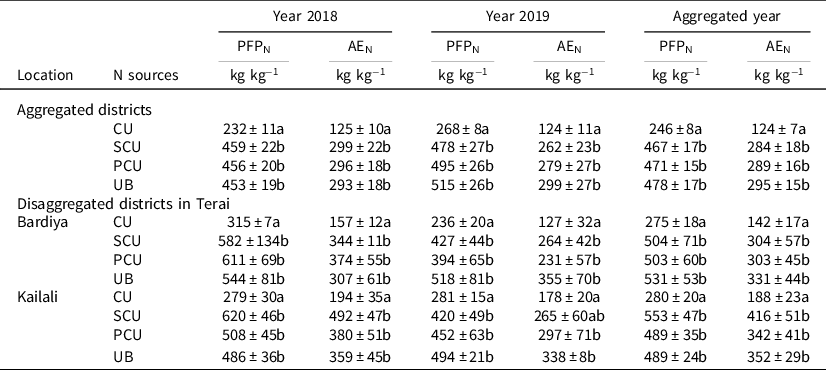
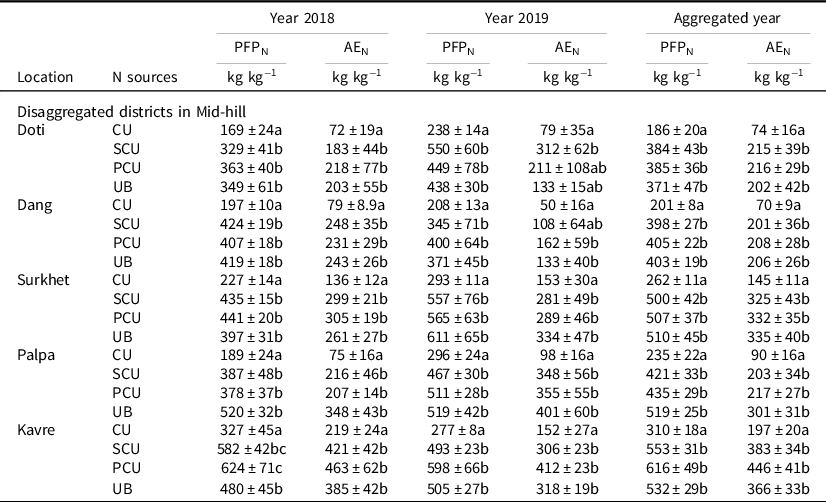
EENFs significantly increased PFPN and AEN over CU in both the Terai (Table 3) and the Mid-hills (Table 4) and with a comparable degree of increase among the three EENFs. On the average, PCU increased PFPN and AEN by 91% (ranging from 363 to 624 kg kg−1) and 133% (ranging from 162 to 463 kg kg−1) over CU, respectively (Tables 3 and 4). SCU increased PFPN by 90% (ranging from 329 to 620 kg kg−1) and AEN by 129% (ranging from 183 to 492 kg kg−1) over CU (ranging from 169 to 315 and 50 to 219 kg kg−1 for PFPN and AEN, respectively). Similarly, UB increased PFPN and AEN by 94% (ranging from 371 to 611 kg kg−1) and 138% (ranging from 133 to 401 kg kg−1), over CU, respectively.
Partial factor productivity of N (PFPN) and agronomic N use efficiency (AEN) across different N source treatments in 2018 and 2019 for aggregated and disaggregated districts in terai agroecological region. PFPN and AEN values are given as mean ± SE. Within a column and districts, means followed by different letters are significantly different at 5% probability level

Partial factor productivity of N (PFPN) and agronomic N use efficiency (AEN) across different N source treatments in 2018 and 2019 for disaggregated districts in mid-hill agroecological region. PFPN and AEN values are given as mean ± SE. Within a column and districts, means followed by different letters are significantly different at 5% probability level

Economic return
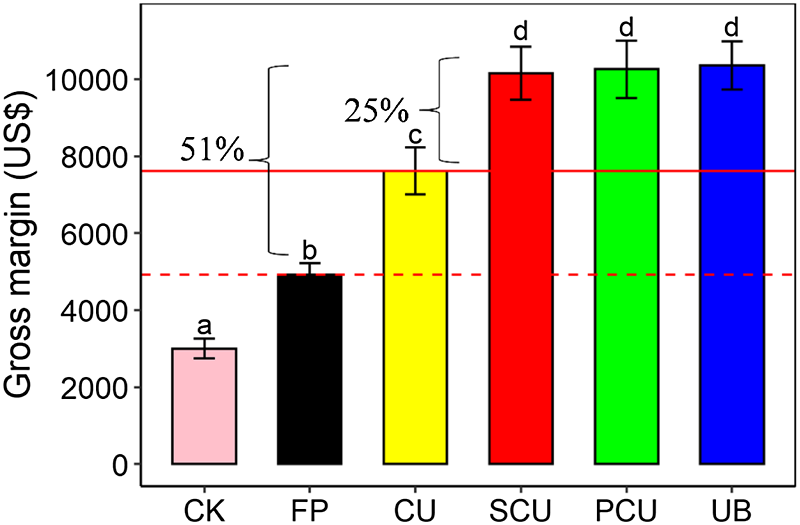
GMs for EFNFs were at least 25% higher than for CU and 50% higher than with FP. Average GM per hectare was significantly (p < 0.05) higher for PCU (USA$ 10 258), SCU (USA$ 10 159) and UB (USA$10 363) than for CU (USA$ 7,618) or FP (USA$ 4,113) (Figure 4), and this difference was consistent across districts and agroecology (Table S1). GM along with their associated production cost for EENFs, CU and FP disaggregated by districts and agroecological region are shown in supplementary information (Table S1).
Average gross margin (mean ± SE) of different N source treatments across the districts (n = 7). Different letters inside a bar represent significant difference between the treatments at 5% probability level (post hoc-Tukey test, p < 0.05). Black and dashed lines inside graph are the lines representing GM values of CU and FP, respectively, and % represents the relative increment of GM with the use of enhanced efficiency nitrogen fertilizer (EENF), i.e., polymer-coated urea (PCU), sulphur-coated urea (SCU) and urea briquette (UB) over conventional urea (CU) and farmers practice (FP), respectively.

Discussion
Yield response across seven districts spread over two agroecological region over two-year period clearly illustrates the positive effect of all three EENFs in increasing cauliflower productivity while saving 33% of the N normally providing using urea fertilizer (Figure 2). There are very few studies that investigated the agronomic effects of these EEFNs on Cole crops and to the best of our knowledge there are no study, specifically on cauliflower. Thus, in this study, we discussed our agronomic result based on the literature broadly available on vegetable productivity to illustrate the mechanistic effect of EENFs on crop growth and productivity.
In our study, yield benefits of both PCU and SCU were 23% higher than with CU (Figure 2). In accordance with this, Wang et al. (Reference Wang, Lv, Coulter, Xie, Yu, Li, Zhang, Tang, Niu and Gan2020) reported that PCU with 31% less N increased vegetable production (winter chives) by 37% compared with CU, although yield increases were not consistent across the reported studies. Some studies have reported no yield benefits in cabbage or tomato with the use of PCU instead of CU (Csizinszky, Reference Csizinszky1994; Van Eerd et al., Reference Van Eerd, Turnbull, Bakker, Vyn, McKeown and Westerveld2017), particularly when CU was applied in multiple splits synchronizing N supply with plant N demand (Guertal, Reference Guertal2009). Similarly, McArdle and McClurg (Reference McArdle and McClurg1986) reported no difference in tomato yield with the use of SCU over CU. In contrast, Brown et al. (Reference Brown, Hornbacher and Naylor1988) reported that the use of SCU at lower N rates significantly increased onion yields, over CU. This variable crop response may be due to the differing nutrient composition of SCU, which is used as a blanket term in many studies (Guertal, Reference Guertal2009), and differences in CU treatments, such as single vs multiple split applications. Different nutrient composition and N release mechanisms in different SCU products may directly influence crop productivity. In our study, SCU contains 39% N and 13.8% sulphur, and there could be a synergistic effect of sulphur and nitrogen on cauliflower productivity, as reported in earlier studies (Liu et al., Reference Liu, Cui, Zhang, Wang, Mi and Gao2020; Rossini et al., Reference Rossini, Provenzano, Sestili and Ruggeri2018). Perveen et al. (Reference Perveen, Ahmad, Skalicky, Hussain, Habibur-Rahman, Ghaffar, Shafqat Bashir, Batool, Hassan and Brestic2021) reported that PCU in combination with sulphur fertilization increased sunflower yield by 32% over CU, without sulphur addition. Considering the higher NUE resulting from use of these EENFs and an improved capacity to meet crop nutrient demands (Carson and Ozores-Hampton, Reference Carson and Ozores-Hampton2012), N input with slow release N fertilizers such as PCU and SCU could be reduced by 25% (Carson and Ozores-Hampton, Reference Carson and Ozores-Hampton2013) or even by as much as 50 to 75%, with the use of PCU, to maintain similar or even higher yields (Ransom, Reference Ransom2014). Improved vegetable productivity despite lower amounts of fertilizer results from the continuous availability of N, as PCU and SCU is encapsulated with a polymeric or resin layer that dissolves very slowly in water, thereby releasing N slowly and synchronizing N supply with plant demand (Guertal, Reference Guertal2009; Morgan et al., Reference Morgan, Cushman and Sato2009; Trenkel, Reference Trenkel2010).
Use of UB with deep placement showed a similar degree of cauliflower productivity as with slow release N fertilizers (PCU and SCU) over CU. Increased cauliflower yield with UB could be due to a continuous supply of N in sub-surface, root-zone soil layers for prolonged periods, allowing uptake by the plant as and when required (Agyin-Birikorang et al., Reference Agyin-Birikorang, Winings, Yin, Singh and Sanabria2018; Baral et al., Reference Baral, Pande, Gaihre, Baral, Sah, Thapa and Singh2020). In addition, the precision application associated with UB could result in a uniform curd size, adding market value, so our study could contribute to future research about the effects of UB on vegetable productivity.
In addition to N fertilizer treatments, site characteristics caused significant (p < 0.05) variation in cauliflower productivity (Figure 3), possibly due to varied soil characteristics (Table 1) and other biophysical (temperature and rainfall) factors. Previous studies reported that vegetable productivity in response to slow release N fertilizers or EENFs varied greatly with soil type and temperature (Morgan et al., Reference Morgan, Cushman and Sato2009). In our study, soil chemical properties such as pH, OM, total N, available P2O5 and K2O were not associated with significant variation in cauliflower productivity (Fig. S5). Moreover, the values for these soil chemical properties were within the range required for proper cauliflower growth (Table 1). Lower cauliflower productivity was observed at Doti and Dang and higher productivity at Kavre (Figure 3). In accordance with this, our previous study on maize in same district reduced crop productivity, which was possibly due to higher soil fertility (high soil OM, total N) that correlates negatively with fertilizer addition (Vanlauwe et al., Reference Vanlauwe, Bationo, Chianu, Giller, Merckx, Mokwunye, Ohiokpehai, Pypers, Tabo and Shepherd2010). Furthermore, lower crop yields could be associated with lower rainfall at the site (Fig. S2), inducing water stress during critical growth periods. Higher crop productivity in Kavre could be due to moderate temperatures (minimum and maximum temperature of 6.7 0C and 19 0C, respectively) (Fig. S2), in a good range for effective photosynthetic activity and crop growth (Rodríguez et al., Reference Rodríguez, Soengas, Alonso-Villaverde, Sotelo, Cartea and Velasco2015). In accordance with this, Ray and Mishra (Reference Ray and Mishra2017) reported the optimum minimum and maximum temperature of 4.6 to 6.8 °C and 15.4 to 19 °C, respectively, for maintaining proper growth and development of cool season cauliflower.
Cauliflower yields were much higher for EENFs (an average increase of 11% compared with CU) than for FP, which features rates that are one-third of the RP (Figure 1), illustrating the potential of PCU, SCU and UB for reducing the current yield gap in cauliflower production in Nepal.
Agronomic nitrogen use efficiency (AEN) is an important index to identify the agronomic potential of added fertilizers on crop productivity. In our study, use of all three EENFs resulted in higher PFPN and AEN than with CU across districts (Tables 3 and 4), which corroborated results of previous studies outside of Nepal (Drost et al., Reference Drost, Koenig and Tindall2002; Wang et al., Reference Wang, Lv, Coulter, Xie, Yu, Li, Zhang, Tang, Niu and Gan2020). Wang et al. (Reference Wang, Lv, Coulter, Xie, Yu, Li, Zhang, Tang, Niu and Gan2020) reported respective PFPN and AEN increases of 58% and 257%, with the use of PCU instead of CU. In general, NUE of CU is 20–35% and may be reduced dramatically from that, under poor conventional nitrogen management practices (Chen et al., Reference Chen, Suter, Islam, Edis, Freney and Walker2008; Naz and Sulaiman, Reference Naz and Sulaiman2016). Previous studies have shown that increased agronomic NUE and crop yields with EENFs were due to synchrony between N supply and plant demand, thereby enhancing uptake efficiency and reducing N losses via leaching, as well as nitrous oxide emissions (Carson and Ozores-Hampton, Reference Carson and Ozores-Hampton2012; Morgan et al., Reference Morgan, Cushman and Sato2009). Sikora et al. (Reference Sikora, Niemiec, Szeląg-Sikora, Gródek-Szostak, Kuboń and Komorowska2020) reported that the use of SRF could reduce total greenhouse gas (GHGs) emissions by 30% and fertilizer emissions by 50%, thus helping to mitigate global warming and climate change (Jiang et al., Reference Jiang, Hu, Sun and Huang2010; Zhang et al., Reference Zhang, Davidson, Mauzerall, Searchinger, Dumas and Shen2015).
In addition to agronomic benefits, our results confirm that the use of EENFs (PCU, SCU and UB) could fetch higher economic return compared with CU and FP (Figure 4), mainly as a result of reduced N inputs and labour costs (single time application over split application of CU) and higher cauliflower yields, which corroborates earlier findings (Simonne and Hutchinson, Reference Simonne and Hutchinson2005; Van Eerd et al., Reference Van Eerd, Turnbull, Bakker, Vyn, McKeown and Westerveld2017; Wang et al., Reference Wang, Lv, Coulter, Xie, Yu, Li, Zhang, Tang, Niu and Gan2020). Per hectare N input costs for EENFs (for PCU, a cost of USA$ 278 and, for SCU, USA$ 285) represented respective increases over the cost CU (USA$ 239) of only 14% and 16% and, for UB (USA$ 234), the difference was even less. These differences were easily covered by the higher cauliflower yields and reduced labour costs of the EENFs, providing farmers with higher net returns over CU. In both the Mid-hills and the Terai, use of PCU, SCU or UB was found to be economically viable and more profitable than use of CU applied in split applications, offering farmers net additional earnings, respectively, of USA$ 2,640, USA$ 2,541 and USA$ 2,745 with the use of PCU, SCU and UB, compared with CU. Moreover, farmers could profit by an additional USA$ 6,145 (PCU), USA$ 6,046 (SCU) or USA$ 6,250 (UB) by changing their traditional nutrient management practices and using EENF products following best management practices.
Research Implications and Way Forward
This study suggests that switching the N source from granular urea to EENFs could help to boost cauliflower productivity and cauliflower farmers’ incomes in Nepal, as well as reducing N input by up to 33%, while increasing the average curd yields by 22%. However, our study could not identify the maximum N reduction rate beyond 33% from EENFs; further research is needed on multiple EENFs application rates to determine the maximum reduction rate of N fertilizer in cauliflower for those fertilizers. The higher economic return for EENFs (at least 25% and 50% compared with CU and FP, respectively) could foster economic growth, agricultural development and poverty reduction among vegetable farmers and in farm communities.
In Nepal, formal supplies of urea meet only about 50% of national demand (Panta, Reference Panta2018). Use of EFNFs could help reduce demand, so that current supplies cover actual need. Hence, there may be a place for policies to foster the availability and use by farmers of EENFs. Particularly, PCU and SCU are not registered in Nepal; policymakers may wish to proceed with registration and promote involvement of public and private actors to obtain and market them. UBs are a registered fertilizer, so policy support for their production in Nepal would foster their widespread availability and affordability for farmers. Given the highest agronomic performance and economic return for UB, the Government of Nepal should allow increased private sector involvement in the production and sale of the UBs, as well as undertaking scaling out and promotional programs, including local training and field demonstrations, in collaboration with relevant stakeholders and farmer organizations.
Conclusion
Use of enhanced efficiency N fertilizers (EENFs) in cauliflower was found agronomically and economically viable compared with the application of CU. EENFs could reduce significant amount of N input due to its higher NUE and maintain higher marketable curd yield compared with the use of CU. Across the districts, farmers use insufficient quantity of fertilizers attributing to larger yield gap; thus, the use of EENFs could be a sustainable approach to close the existing yield gap.
This is the first study that has assessed the agronomic and economic potential of EENFs on cauliflower productivity in Nepal. Thus, further studies are recommended covering diverse agroecological zones with varied soil types to come up with comprehensive conclusion to develop scaling out strategies. Moreover, across the globe, there are very few studies that has assessed the potential of EENFs specifically on cauliflower productivity. Therefore, this study could be of high significance for range of stakeholders including academicians, researchers and extension workers at national and international levels.
Supplementary Material
To view supplementary material for this article, please visit https://doi.org/10.1017/S0014479722000060
CRedit Author Statement
Naba Raj Pandit: Conceptualization, methodology, data curation, formal analysis, writing-original draft. Dyutiman Choudhary: Conceptualization, supervision, writing-review and editing, funding acquisition. Yam Kanta Gaihre: Conceptualization, supervision, writing-review and editing. Shriniwas Guatam: Conceptualization, supervision, writing-review & editing. Shashish Maharjan: Software, formal analysis. Shree Prasad Vista: Resources, writing-review and editing.
Acknowledgements
USA Agency for International Development (USAID) is acknowledged for providing support for this research through ‘Feed the Future Nepal Seed and Fertilizer Project (Cooperative Agreement number AID-367-IO-16-00001).’ EENFs including polymer-coated urea, urea (Thiogro ES) and UB were provided by IFDC through ‘Feed the Future Soil Fertility Technology Adoption, Policy Reform and Knowledge Management (Cooperative Agreement Number AID-BFS-IO-15-00001).’ We thank cooperatives members/volunteers across the district for their support in selecting farmers’ field to conduct the trials. We would like to thank our colleagues (Mr. Surya thapa, Mr Roshan Subedi, Mr. Roshan Shah, Mr. Uttam Kunwar, Mr. Dilli Chalisey, Mr. Resham KC, Mr. Rajendra Upadhyaya, Mr. Kedar Nath Nepal and Mrs. Srijana Poudel) for their practical assistance and regular supervision of the field trials. Finally, we are grateful to Mike Listman for editing to improve the paper’s language usage and clarity.
Conflict of Interest
The authors declare no conflict of interest.