Introduction
A study over 20 years ago examined the looting of archaeological sites, and the dismay at what is thereby lost, by exploring its consequences, material and intellectual.Footnote 1 The example that it used was Cycladic figures, the late prehistoric sculptures whose coincidence in form – not by chance – with twentieth-century modernist sculpture made them very desirable as collectables.Footnote 2 Later, another study showed that similar consequences are endemic in Classical antiquities generally.Footnote 3 This study explored the issue of how modern creations of Cycladic figures have corrupted the corpus of knowledge, thereby distorting the interpretation of the past. The recognition that such false figures have been presented in public exhibitions of Cycladic culture serves as a reminder that secure information about objects needs to be established as part of the research agenda.Footnote 4 The suspicion that some of these figures were forgeries, and the proposal that their attribution to named sculptors should be considered as insecure, is now confirmed by the personal testimony of one of those involved in the process.Footnote 5
A high regard for Cycladic figures continues in the art market: one Cycladic figure, which “surfaced” without stated archaeological source in the Christie’s antiquities auction on 9 December 2010 in New York (lot 88), was sold for US $16,882,500. The provenance given by Christie’s was:
Collection of Madame Marion Schuster, Lausanne, acquired before 1965.
with Robin Symes, London, 1990s.
US Private Collection.
with Phoenix Ancient Art, Geneva.
However, there are some serious issues related to the people and company named in the provenance section: Marion Schuster was the partner of the antiquities collector Charles Gillet. After Gillet’s death in 1966, Schuster apparently inherited all or most of Gillet’s collection.Footnote 6 However, Gillet’s collection is often cited by the market as a source of antiquities that in fact never passed through the Gillet/Schuster collectionFootnote 7 and later were proven to be illicit – for example, the 20 Attic red figure plates attributed to the Bryn Mawr Painter that were repatriated to Italy.Footnote 8
Convicted antiquities dealers Giacomo Medici and Robin Symes (with his partner Christos Michaelides) sold mainly illicit antiquities (including the 20 plates that appear in both the confiscated Medici and Symes archives) and fakes.Footnote 9 Illicit antiquities and fakes were also found at the Phoenix Ancient Art gallery, owned by the brothers Hicham and Ali Aboutaam. Ali was convicted in Egypt in absentia for antiquities smuggling; Hicham pleaded guilty in the United States for the falsification of at least one customs document.Footnote 10 In 2009, the Aboutaam brothers returned to the Italian state 251 antiquities worth $2.7 million.Footnote 11 The Phoenix Ancient Art gallery has sold illicit antiquities that were confiscated in 2021 from the collector Michael Steinhardt in Manhattan and were repatriated to their countries of origin.Footnote 12 Additionally, the Greek illicit antiquities dealer ‘Nikola’ Koutoulakis, discussed later in this article, was supplying the Gillet collection with antiquities and fakes.Footnote 13 Koutoulakis sold Gillet at least two Cycladic figurines, both in 1955: one is now in the Shelby White/Leon Levy collection.Footnote 14
A great many Cycladic figures were looted, especially in the later twentieth century, “surfacing” in museums, collections, dealers’ stores, and sale rooms without reliable archaeological information or without any archaeological information – that is, we knew, and now know, nothing of where they come from or only the name of an island, rather than a better report of context, and often that island is qualified with “said to be from.” At the same time, the same lack of information supports the possibility that at least several of those objects were fakes. While Cycladic looting was at its peak, it was common knowledge that Cycladic figures were also being faked in the islands and in Athens. Therefore, the corpus of Cycladic figures we now work with is corrupt. Because the corpus is corrupt, we do not know how corrupt it is. This article provides the first first-person account of the production of fake “Cycladic” figures and explores what little else we know about the faking of Cycladic figures.
The Forger’s tale: The narration
One of us has interviewed a man who reported to us his work in the 1980s and 1990s as a faker of Cycladic antiquities. We here offer the complete account of his story, together with some related remarks and observations, especially concerning where his story is in accordance with what is known in other ways. We know his real name, but, in this article, we refer to him simply as “the Forger.”Footnote 15 What we present here is as much as can be published: we dearly wish both that we knew much more and that we could print everything of what little we know. We tell his tale as a straightforward autobiographical narrative, collated from three conversations with the primary author in Greek and translated by the primary author. The reader will notice that its story is not always really clear, even about the practical procedures of fakery: true stories and reminiscences of decades ago are rarely told in a neat and orderly way, unambiguous, complete, with anomalies resolved, and loose ends tied up (see below for a brief report on looting with the same traits). Interpolations in square brackets are by the primary author.
For many years I was working unofficially as a dealer of illicit antiquities. In nearly all the cases I acted as a middleman, someone who had to buy from the looter as cheap as he could, and then to sell on and up the chain, to a bigger dealer or a collector at a higher price.Footnote 16 Since I was familiar with the people involved in these activities, the way these things were taking place and the way the Greek black market of illicit antiquities was operating, I decided that by acting as a small dealer I could earn easy money with low risk.
Soon enough, this activity of mine proved very profitable and by the mid-1980s I realized that money would never be a problem for me again. By that time, I had made valuable contacts with looters, dealers and collectors and each one of them proved to be for me a real “school” that offered me precious knowledge. One of the most interesting things I’ve learned was that each marble Cycladic idol was estimated at 1.5 million drachmas per centimetre up to 25 centimetres high [equivalent to approximately 5,000 euros and US $7,400 at the 2009 exchange rate, at the time the three interviews were taken in 2009 and 2010]. If the piece was taller, the price was much higher, and the dealer negotiated with the buyer on a different basis. Since I was acting as the first dealer in a chain of buying and selling the same piece until this reached its final destination – usually a museum or a private collector – it was difficult for me to buy “second hand” from another dealer, because the price I had to pay then would have been higher, even if the risk of earning “big money” from a collector was surely very tempting.
Everything began in 1986 or 1987, I cannot really remember exactly when…. I met a guy who painted Greek Orthodox icons and at the same time he was restoring old ones, too. When we confided in each other, I spoke to him about my “profession” as a first middleman of illicit antiquities, and he mentioned that he used to work with marble when he was young. Immediately, I told him that we could earn easy money, if we could produce fake Cycladic figurines in a way that could deceive a collector’s eye. He replied that it wouldn’t be easy, that it would take great effort, time and practice to reach a high level, but the cause – the serious money – was worth serious effort. He advised me to follow the exact process of production that the ancient Greek Cycladic manufacturers followed. He insisted that this was the only way if we wanted to succeed.
First of all, we had to find marble. But, of course, not just any kind of marble. For that reason I travelled to the islands of Naxos and Paros to find pieces of this special kind of marble, the exact one that was used to produce the original idols. The pieces must be up to 50 centimetres long, to be free of lines of any other color or geological layer and to be thin-grained marble, he advised me. The ancient quarries were easy to locate; usually, what archaeologists do not know, the local people are more familiar with. Since it was technically impossible for me to cut any kind of marble, I took the opportunity to choose among many pieces that were lying all around the area, in a variety of shapes, so on each island I filled a small suitcase with the most suitable ones.
When I returned to Athens we went to a small factory where people operated machines that cut, shape and polish marble pieces. We cut and roughly shaped our pieces and the next step was to get the appropriate tools for more accurate and detailed work – rasps and materials for working the marble to give a very general shape. To avoid hard work in the early phases, we developed an easy and interesting technique: I used to go often to Bakakos, the most well-known pharmacy in Omonoia Square in the centre of Athens, and buy a shot of liquid iron mixed with other liquid metals, which had a dark orange-brown colour, the colour that corroded iron objects full of rust have when we dig them out of the earth. It was expensive, I remember it cost 9,000–13,000 drachmas per litre, and it was sold in a tin.Footnote 17 Then I bought Aquaforte [a brand of hydrochloric acid], a strong liquid chemical that can burn the skin if used improperly, liquid polish glue for furniture [colourless varnish] and … sugar! The procedure was as follows: on the surface of a marble piece, my “colleague”Footnote 18 used to put some varnish with a paint brush; then he put on sugar (as coarse-grained as we could find in the market), but in a way to form a general human figurine form. Then he lifted the piece to allow any sugar that wasn’t glued to the varnish area to leave the marble surface. On the remaining sugar surface he used to throw spits of liquid iron, and at the very end of this procedure he used to pour Aquaforte on the whole marble area. The result, especially for me when I saw it for the first time, was quite impressive: Aquaforte caused an instant and massive corrosion that destroyed everything, but left untouched the area that was covered by sugar and so protected by it! My “colleague” replied to the startled expression on my face that this was not a widely known characteristic of sugar. Plus, on the sugared area, the interaction of Aquaforte with the liquid iron created a fine brown patina and gave the impression that this piece must undoubtedly have been in the soil for a very long time.Footnote 19 Using this technique, we easily and quickly got rid of the excess marble we had no need of, and, at the same time, we added “age” to our marble piece.
My “colleague” insisted that we must find obsidian, a kind of flint, a product of volcano eruption that ancient Greeks used to take out from quarries, well known since prehistoric times on the island of Melos, in the Cyclades. That was the material that Greeks used in the Cyclades to make tools, with which they produced the famous figurines. In many of the original ones, an expert can notice easily, by using a microscope, traces made by obsidian tools. So that was what we needed and used. My “colleague” used to work on marble with obsidian in order to sculpt a detailed figure, so no one could find out or positively prove that our figurine wasn’t original.
The last step was the polishing. This also had to be done in the ancient Cycladic manner: using hay. We used to rub for many days on each figurine produced, until the surface acquired the desired look. On some occasions we buried some figurines in buckets full of soil that we carried from the islands of Naxos and Paros and often we used to plant something upon it, like a basil plant. This created an excellent last impression and added the perfect finish to our final result.
Until the time when we managed to create our first good-looking figurine, many months passed. My colleague used to give the general shape. I was working on the details and the patina. We usually produced small pieces, up to 15 centimetres, because they didn’t seem unusual in the market. Sometimes we made longer ones, about 40–50 centimetres, like our first successful one. We always worked using a couple of copies, bought from the Goulandris Cycladic Art Museum, for the dimensions, details, and so on.Footnote 20
We experimented with different quantities of each of the elements we used. The results at the beginning were disappointing. Our first figurine was ready in mid-1987, if I remember well. It was about 40 centimetres long. We asked for this 6 million drachmas [about 30,000 euros at today’s value] instead of the 80 million drachmas that would have been its actual price at the end of the chain of dealers it would pass through. We used another middleman as a dealer, and we finally sold the piece easily for 8.5 million drachmas (with the commission of 2.5 million drachmas for the middleman). We used the same dealer to sell most of our figurines to the same Greek guy, Ioannis Perdios,Footnote 21 who had connections with a foreign airline and who was unaware that the figurines were fakes.
But three of the figurines, violin shaped, were sold directly by me to a Greek collector, George Tsolozidis, a successful dentist who was forming a collection of antiques and antiquities, who spent a lot of money and always – especially for Cycladic figurines – used as an advisor an authority working for the Greek state. When Tsolozidis showed the figurines to the authority, the authority said: “You don’t have to ask me about these. It’s obvious that they are original!” The authority advised him never to buy stolen antiquities.Footnote 22 I remember that one of the violin figurines was about 22 centimeters long. It had a fine patina. I asked 22 million drachmas for it. I sold it for 13 million, he paid me by cash and a cheque, and everyone was happy. I cannot forget that when I went to get the last cheque from his office, he had a huge marble head of a man in a bag, which a looter I used to know in Marathon and Nea Makri (outside Athens) had just brought to him. I have no idea what he did with that head. I later heard that Tsolozidis died, and the collection is now in the hands of his daughter (Mata Tsolozidis-Zissiadis), who is a resident of Thessaloniki. If I saw the figurines now, I could easily recognize them.
An example I remember clearly was the production of another violin-shaped figurine. I made it on my balcony, using water, Aquaforte, and red soil to create a nice patina. I remember that one side was slightly brown and the other matt white. I sold this figurine through Perdios who was a good friend of Koutoulakis, an antiquities dealer in Switzerland; his business is now run by his son (Emmanuel [Manolis] Koutoulakis), I think. We sold the piece for 18–20 million drachmas, but they somehow found out after a month that it was fake. They tried to get their money back, but they had no luck, of course. Again, if I saw this piece in a photograph, I could easily recognize it.
I also want to add that I and my “colleague” weren’t the first that produced fake Cycladic figurines, nor were we the most successful. I know that Nikolas Koutoulakis – “Nikola” or “the French” were his nicknames in the market – organized with other partners a big production of fake “Cycladic” figurines. They also had an archaeologist – I think, a Swiss one – who was verifying their authenticity! Koutoulakis had a gallery in Paris, and some people had complained that he was selling fake antiquities amongst original ones. I think one of the biggest collectors that used to buy from Koutoulakis and complained of having bought some fakes was George Ortiz.Footnote 23
This is what we have, all we know autobiographically of the world of Cycladic fakers. Now it is 30 or so years since the faking may have peaked. Given the rare circumstances for the granting of this interview, we regard it as unlikely that something else was narrated to another party and at some point will surface from an archive. It is possible, even probable, that nothing more will ever be told. We will be the first to agree that it is not the full account that anyone concerned with the truth about Cycladica desire!
The Forger’s tale: Value of the narrative and related evidence
By verifying various elements, ranging from the names of well-known figures in the modern antiquities market to small details and dates, we are able to evaluate the validity of the narrative in the testimony of the Forger; to use it in order to uncover the true paths that fake objects follow in order to find their places in various collections; and to highlight valuable provenance information that no one involved in the trade of these objects was ever willing to provide. This is valuable new knowledge that springs out of the tale, but we consider that an equally valuable contribution of this narrative is the first-hand presentation – for the first time – of the different stages and elements used to create a method for the production of fake Cycladic figures. We did not test the latter by trying to produce a figure, Footnote 24 but, by publishing this procedure, we are offering it as a possibility to other researchers.
The Forger’s tale, largely self-contained, does mention a few events that we can explore independently of his account. First of all, we cannot estimate how many forgeries our sculptor of the false figures made. There are clear hints that at least some, perhaps most, went to private collectors in the Arabian Gulf. An obvious link and route is provided by Perdios, the local manager in Athens of a national airline in the Arab world who was the Forger’s chief dealer and who was unaware (as the Forger claims) that what he was receiving were fakes. If the Forger’s creations indeed mostly went to private collections in the Gulf and are still today in that region, this might explain why we are not aware of many surfacing in European or North American markets at a later date.
We have been able to definitively track down two, possibly three, of the Forger’s works. The Forger himself has corroborated this identification by identifying these figures as his own works from the photographs we showed him. These three figures are in a private collection of antiquities owned by Tsolozidis. Under the standard Greek legal provision for registering private collections of antiquities, the relevant EphorateFootnote 25 located under the Acropolis was notified of this collection in the early 1990s; a more detailed register, with descriptions and photographs, was compiled and lodged with the Ephorate in the mid-2000s. The Forger recognized two, perhaps three, items in those registration photographs as his own works. At our second meeting, the Forger specified that he sold to Tsolozidis at least two violin-shaped figurines and one human-shaped figurine. First, he sold the human-shaped one, made by both forgers, then a violin-shaped one produced entirely by himself. Among many other irrelevant photos depicting Cycladic figurines that we showed to him, the Forger immediately spotted the ones in the collection of Tsolozidis. He identified one violin-shaped figurine and one human-shaped figurine; he expressed some doubts about a second human-shaped one, and he also described a fourth figure, which was not among those depicted in the register of Tsolozidis’ objects, as violin shaped with a diagonal break on the surface of the front of the body. We now quote from the catalogue of the George Tsolozidis Collection:Footnote 26
No. 31. ΣΤ 740
Marble human figurine. Early Cycladic I period (3200–2800 BC). Slightly chipped. Reassembled. Height: 0.145 m. Off-white marble. “Violin” figurine. Arms schematically rendered by semicircular protuberances. Incised angle at base of neck.
No. 32. ΣΤ 741
Marble female figurine. Early Cycladic II period (2800-2400 BC). Spedos type. Section of the feet missing. Slightly chipped, with chipped sections restored. Preserved height 0.18 m. White marble. On tiptoe, with knees slightly bent. Head tilted upwards. Only facial feature delineated is the nose. Arms folded beneath breasts. Pubic triangle and fingers incised. Bears an incision around the neck and down to spinal column.
No. 33. ΣΤ 742
Marble female figurine. Early Cycladic II period. Part of the top of the head is missing. Chipped. Reassembled. Preserved height 0.155 m. Off-white marble. Similar to cat. No. 32. Gap between the legs.Footnote 27
In the register of the Ephorate (now diminished to a Department), all three figures are dated to “Early Bronze Age,” without any bibliographical reference. It appears that the initial documentation of the Tsolozidis collection took place in 1991–92 (which agrees with the narration of the Forger),Footnote 28 after three supplementary applications had been made on Tsolozidis’s behalf to the Ephorate with declarations for newly acquired objects in January, April, and July 1991. The Forger was sure the first two were his work. The third, he said, was most probably produced by him, but he could not be as sure as he was for the other two figures because the photo was of poor quality. Combining this information with the Forger’s narration gives a reasonably exact date for the sale of the forgeries to Tsolozidis.
Learning from the Forger’s tale: Is it true?
Not all stories told as true are true; stories are invented, elaborated, modified, and misrepresented in many ways for many reasons. People are daily convicted after denying an allegation, offering a different story that the judge or jury does not believe. The police equally know that the person who confesses to a crime is not always the criminal; to the point that British criminal courts no longer convict on the basis of a confession alone. We do not know if the Forger’s tale is true, but, on the balance of probability, we think it is. We know that, since Koutoulakis, Perdios, and Tsolozidis are all dead, the Forger felt able to make his story public. Footnote 29 Where it should match with what is known from other sources, such as the selling of fakes to Ortiz, it is consistent.Footnote 30 But there are fewer matches than we would like. We see no obvious motive for this faking story itself to be faked. Telling it and allowing us to publish it puts the Forger at risk of the police taking an interest if his labors are seen as criminally fraudulent; puts him at risk of legal action from deceived purchasers; and puts him at risk of direct action from those purchasers if they feel a physical response is fitting. We know a little about why he has now decided to make his story public, and that reason also rings true. But all of these reasons are, separately and together, weak arguments.
In relaying the tale in this publication, should we believe it ourselves? Should we ask readers of the International Journal of Cultural Property to believe it? This is asking much of ourselves and even more of our readers who have not met the Forger. But we have noticed that statements about the history of antiquities on the market – often so vague as “said to be from Paros,” “supposedly from Naxos,” “from Asia Minor,” and so on – are also insecure, and they are very rarely supported by reliable documentary evidence. (And supporting documentary evidence itself may be forged, as it was for the Getty Kouros.)Footnote 31 If the Forger’s tale is too insecure, so are a great many statements made about objects on the antiquities market, statements that scholars then depend on when they seek to deduce the real truth about various antiquities, such as on which island was a particular distinctive kind of Cycladic figures made, amongst many other research questions.
Forgeries can in time reveal themselves: Will the “Cycladic” forgery do so?
There are no grounds at all for optimism that the place of recent forgeries in the Cycladic corpus will ever be clarified.Footnote 32 There is slight long-term cause for hope in a common pattern seen in forgeries. Inescapably, the over-confident restorer and the faker who does more than reproduce exactly an ancient object is a person of their own, modern time. Rather than following directly the ancient model, they can and must follow the ancient model as it is seen by and through their own modern eye. As time passes and the modern viewpoint shifts, so do the restorations, and the forgeries begin to resemble not only, or even not so much, the ancient models as they do the aesthetics and values of the time when they were actually made. One sees this, for example, in the celebrated re-paintings of the Minoan frescoes at the Palace of Minos, Crete, commissioned by Sir Arthur Evans. These large-scale compositions, extrapolated from very small fragments and painted by the father-and-son team of artists both named Émile Gilliéron, now look Art Nouveau / Art Deco, strongly reflecting the aesthetic values of the time when they were created after Evans finished his excavations in 1905 – they now look more twentieth-century ad than bc in style.Footnote 33 And the “Fitzwilliam Goddess,” the faked “Minoan” marble statue of a snake goddess, probably made in the 1920s or a little before,Footnote 34 now also shows the same and particular aesthetic of that time. The same points may become evident in the Koutsoupis harpist at the Metropolitan Museum of Art in New York (see the discussion in the following section) as the harpist itself becomes a centuries-old object.
The complexity of forging is revealed in an anecdote recounted by Leonard Woolley, who recalled an incident in Crete during the 1920s. Woolley went with Sir Arthur Evans and Duncan Mackenzie to hear the confession of one of the restorers of antiquities at Knossos on his deathbed:
The police went, they raided, and they found exactly what he said, and they asked Evans to come and look, and I never saw so magnificent a collection of forgeries as those fellows had put together.
There were things in every stage of manufacture. For instance, people had been recently astounded at getting what they call chryselephantine statuettes from Crete. … These men were determined to do that sort of thing, and they had got there everything, from the plain ivory tusk and then the figure rudely carved out, then beautifully finished, then picked out with gold. And then the whole thing was put into acid, which ate away the soft parts of the ivory giving it the effect of having been buried for centuries. And I didn’t see that anyone could tell the difference.Footnote 35
Circumstantial evidence suggests that this incident took place in the spring of 1921.Footnote 36 It is a reminder that some of those involved with the forging process had intimate knowledge of the originals and thus were able to deceive the leading experts in the field.
So it may be that with the passing decades, perhaps centuries, the fake “Cycladics” will reveal themselves by their characteristic late twentieth-century traits. They will declare themselves to be Cycladic figures as Cycladic was visualized in the late twentieth century because they bear traits inconsistent with the ancient Cycladic aesthetic. We do not yet recognize those traits, and so discriminate the fakes, because we are ourselves still close to the time of their forging. Time will out them, and it will help if the forgeries prove to be few in the corpus.Footnote 37 But if they are many, even to the point of being the majority of the Cycladic corpus as we believe it to be today, it will be harder for them to identify themselves. If the forgeries numerically dominate the whole corpus, then their types surely will dominate future understanding.
The Koutsoupis harpist: A recent pastiche
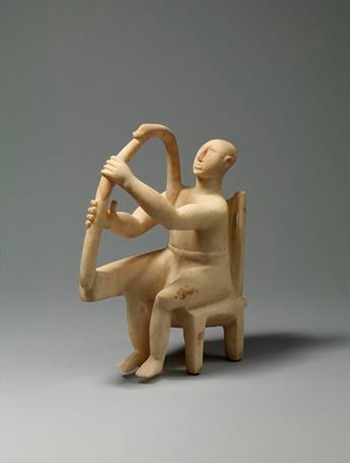
Almost 20 years ago, John Craxton and Peter Warren identified a harpist – a musician and member of one of the worrying classes of Cycladic figurines (worrying because not enough come from secure archaeological contexts) – as indeed being a modern object. This harpist was made at an unknown date not long before January 1947 on Ios by a local sculptor named Angelos Koutsoupis, who had been commissioned by an Athenian antiquities dealer, Theodoros Zoumboulakis.Footnote 38 A sketch made of it by Koutsoupis luckily survives, and using the sketch to match the two, Craxton and Warren identified it with good confidence as being the harpist now in the Metropolitan Museum of Art in New York (see Figure 1).Footnote 39
The “Cycladic” harpist at the Metropolitan Museum of Art in New York (Accession no. 47.100.1); the image is part of the Met’s Open Access Policy, which allows the free distribution of the image.

This figure, now presented as authentic, is celebrated by the museum as a masterpiece of its Greek collections.Footnote 40 Seán Hemingway, the museum’s current curator in charge of the Greek and Roman Department, has used the figure as illustrative of the museum’s Aegean Bronze Age art.Footnote 41 Maintaining its “authenticity,” he perceives that the statue was “an early predecessor of the professional performers of the heroic Mycenaean age who are alluded to in Homer’s epic poems and in the rich tradition of oral poetry in ancient Greece.” It has been commended by Pat Getz-Gentle for its merits.Footnote 42 It had also been questioned as a possible modern forgery as long ago as 1963Footnote 43 – independently and long before the account of its making surfaced.Footnote 44
More recently, Bo Lawergren has explored the unusual features of the harpist.Footnote 45 Concerns raised by Pat Getz-Preziosi and Saul Weinberg relating to a “paint ghost” on the head were dismissed; they had argued its existence proved that it was genuine since forgers did not know about these ghosts.Footnote 46 On this subject, Lawergren has commented: “But Getz-Preziosi and Weinberg’s argument is unconvincing since forgers may be as observant as (or more observant than) art historians, and abrasive cleaning agents might produce the alleged ghosts. To evaluate their argument, one needs to know the erosion mechanism and the possibility of modern imitations.”Footnote 47 It is an important reminder that we must not assume that those creating works are unable to insert features that we might assume are genuine.
The question of paint and paint ghosts is a complex one. Museums in the early twentieth century know that at least some of the figures had been painted following such reports by Paul Wolters in 1891 and Robert Bosanquet in 1896–97. Then Cycladic figures came to be admired for their pristine whiteness as if they were modernist twentieth-century sculptures in color as well as in form. So it was that, in the 1960s, most of the Ashmolean figures, and also the marble vessels, were cleaned to remove “unwanted deposits.”Footnote 48 Soon, articles by A. Colin Renfrew in 1969 and by Getz-Preziosi and Weinberg in 1970 prompted archaeologists to again think of paint and museums to wonder if such vigorous cleaning was correct.Footnote 49
Was the Koutsoupis harpist made innocently as a pastiche or with deception in mind? As Craxton and Warren comment, “[w]e level no criticism against Koutsoupis; there is no evidence that he knew his commission was to be used as a forgery.”Footnote 50 But they also report what Koutsoupis also told Craxton in 1947: “[T]hat he had made quite a few Cycladic figures and that he placed them in a stream in Ios, which encrusted them with lime.” This quotation may bring into question the authenticity of those unusual Cycladic figures said to be from Ios. Comparing the information related to the Koutsoupis harpist at the Metropolitan Museum of Art with the Forger’s tale, there are some obvious similarities but also a few differences: both accounts refer to the ways in which a patina was created on the surface of the figures, and both accounts allow us to believe that, to at least some extent, Koutsoupis was creating figures with an intention to deceive, something that is unquestionable about the Forger and his accomplice.
However, Koutsoupis was adding unprecedented characteristics to at least one figure he created (at the Metropolitan Museum of Art), while the Forger was copying characteristics from known authentic figures in an attempt to avoid his products being detected as fakes. One of the ways that the Forger’s tale can be valued is that it verifies that there were indeed groups of people working on creating pastiches resembling as much as possible characteristics of the authentic figures, while others, like Koutsoupis, were adding “rare,” naturalistic characteristics, which eventually could give away more easily the true nature of these figures.
Early Cycladic forgers and forgeries
If the Koutsoupis harpist was made so innocently, it only became a fake when it was presented as genuine, for faking does not reside in the made object but, rather, in how it is declared: a fake is offered as ancient and genuine when it is modern and a pastiche. In truth, this figure may not be ancient and, at the same time, has never been a fake, and it is not a fake now. Suppose this is its story: it was made as a pastiche, it was sold as a pastiche, and, as it was passed on, it chanced to lose its story. Then, the true account of it having been lost, it was recognized as being of Cycladic character by its immanent properties, and, identified therefore as ancient, it was again sold on or otherwise acquired by the Metropolitan Museum of Art. That is, it was never falsely presented. This is a generous story; a more likely one, we admit and also fear, is that at some point it was falsely presented.
Since a fake is an object falsely presented, then the deception is not in the object or its making as such but, rather, in the presentation, in how it is seen and described, and in how a would-be acquirer is allowed to gain a false understanding. The object itself does not change when it is so treated. We think it is useful instead to use the more neutral word “pastiche” as a name for the object, which does not imply – as do false, forgery, copy, replica, and other words often used – a certain attitude, a certain context for the physical thing.Footnote 51
Forgers in the Cyclades are now known to include Angelos Batsalis (“Niotis”) (1885–1953), who started his faking career at least by the time of World War I. He is important: clearly his output means that we cannot have confidence (alas) that Cycladic figures that surfaced in – say – the 1930s, two decades before the postwar collecting boom, are safely assured to be genuine.Footnote 52 It seems that the Athenian antiquities dealer Theodore Zoumboulakis was “requesting” the creation of Cycladic figures by an artisan to supply the market.Footnote 53 Interestingly, there is the suggestion that the creator of the “copies” was unaware of the commercial use of his creations,Footnote 54 illustrating the point just made that “fake” or “forgery” is not something residing in the object itself. Consistent with this notion, out of one group of three uncanonical figures, for which there are grounds to fear are fake, two surfaced as early as 1925 (displayed at Metropolitan Museum of Art) and the third in 1934 and were said to be from Ios (purchased from Zoumboulakis by Winifred Lamb for the Fitzwilliam Museum in Cambridge).Footnote 55
Dealing in fake Cycladic objects, dealing in illicit Cycladic objects: The protagonists
Nikolaos or Nikolas Koutoulakis was a Greek antiquities dealer. He was born in 1908 in the Cretan town of Archanes, a location significant for the Minoans, which he later partially looted, digging under his own house.Footnote 56 He was educated in the 1920s and 1930s in Paris since his uncle, Manolis Segredakis, maintained an antiquities gallery there (Gallerie Segradakis).Footnote 57 After Segredakis’s death in 1948, Koutoulakis inherited the antiquities gallery, which is when he acquired his nicknames “Nikola” or “the French,” even among the inhabitants of Archanes.Footnote 58 Koutoulakis studied archaeologyFootnote 59 and opened a second antiquities gallery in Geneva, which was advertised in the final pages of the catalogue of the 1976 exhibition Kunst der Kykladen in the Badisches Landesmuseum Karlsruhe.Footnote 60 Nikola Koutoulakis also maintained warehouses in the Free Port of Geneva, gradually becoming the foremost dealer of (mainly) illicit antiquities in the international market,Footnote 61 “handling some of the greatest pieces of our time.”Footnote 62 For example, among the four illicit antiquities repatriated to Greece in 2007 from the Getty Museum in California, there was a marble archaic statue of a kore, which Koutoulakis sold to Robin Symes and Christos Michaelides,Footnote 63 before they sold it to the Getty.Footnote 64 Koutoulakis’s involvement in the case became one of the most valuable arguments of the Greek state in its negotiations with the Getty.
“Nikola” never smuggled antiquities himself but, rather, arranged for others to export antiquities illegally. Footnote 65 However, Koutoulakis also became a supplier of fakes to some of the greatest museums and private antiquities collections formed after World War II, such as the GettyFootnote 66 and the collections of Charles Gillet and George Ortiz,Footnote 67 and he was involved in some of the most famous cases of illicit antiquities, including the so-called Gospel of Judas.Footnote 68 During the 1950s alone, Koutoulakis sold 16 antiquities to the Louvre Museum and donated to the same museum 19 more,Footnote 69 while the Metropolitan Museum of Art in New York acquired many masterpieces from him.Footnote 70
His son, Manolis Koutoulakis (who also studied archaeology), was arrested on 10 September 1983 in the port of Patras in Greece, where he was about to illegally export 16 Mycenaean antiquities to Italy; for this crime, he was sentenced on 29 May 1984 to 20 months of imprisonment by the Greek court “for illegal ownership and attempting to export illegally a considerable quantity of antiquities of great value.”Footnote 71 Manolis Koutoulakis was absent from the court procedure due to treatment he was receiving in a mental institution in Switzerland after he claimed that he suffered a severe psychological episode.Footnote 72
When “Nikola” Koutoulakis died in 1996, an anonymous donor presented a rare Minoan Larnax as a gift to the Metropolitan Museum of Art in New York. The museum accepted the donation, and, ever since, the object has been on exhibition accompanied by a label that reads: “Anonymous Gift,Footnote 73 in memory of Nicolas and Mireille Koutoulakis [his wife], 1996 (1996.521a, b).” This case is one of the numerous examples of other unprovenanced antiquities that passed through the hands of “Nikola” Koutoulakis, exactly in the same way unprovenanced authentic or fake – Cycladic or “Cycladic” – figures passed through his hands. Regarding the involvement of “Nikola” Koutoulakis in looted Cycladic figures, “we know that one of the ringleaders of the looting that took place in Keros was Nikola Koutoulakis.”Footnote 74 In 2014, a Cycladic figure 88 centimeters long was repatriated to Greece from the Badisches Landesmuseum in Karlsruhe;Footnote 75 its provenance was “Nikola” Koutoulakis.Footnote 76
It is unsurprising that the same dealer should handle both looted and fake antiquities. They both fall into the same category of desirable objects offered to the market about which the truth cannot be said openly, and we guess the two classes of objects move about together. Any savvy buyer – even 40 years ago and most certainly now – will be aware that there are looted objects and that practically any genuine Cycladic figure being sold outside Greece must have been unlawfully exported. So the savvy seller will not be expected to provide a full story – origin, archaeology, and early history of when and how it left Greece – of a looted figure.Footnote 77 This expected reticence or silence enables fakes to be mixed with the genuine as no full story has to be concocted, as it was for the Getty Museum’s Kouros. This common pattern has recently been seen yet again in Chinese antiquities newly “surfacing” outside China, which are characteristically found to be a mixture of genuine and first-rate pastiches – presented together as underground exports for which it is impossible to give any kind of full account.Footnote 78
Epilogue
Many licit and illicit, fake and authentic figures, related one way or another to the Cycladic civilization, have been circulating in the international market and in state and private collections for more than 100 years and without reliable provenance information that could prove their legality and authenticity. In this study, we presented the first known first-person account of how fake “Cycladic” figures were produced and sold during the 1980s and the 1990s. We referred to the new knowledge that this narrative is offering, both in valuable provenance information and paths that fakes have taken into the market, which would otherwise remain forever lost. We have offered the possibility of future research to colleagues who may choose to test the method narrated in the details, although we ourselves, due to our research background, have chosen to examine other elements of the ‘Forger’s tale, comparing them with relevant knowledge that has proven to be true, indicating that his narrative must be true.
Acknowledgments
Christos Tsirogiannis acknowledges support from the European Union’s Horizon 2020 research and innovation program under the Marie Sklodowska-Curie Grant Agreement no. 754513 and the Aarhus University Research Foundation. We thank many friends, colleagues, and strangers for information, intelligence, and advice. We thank Helen Van Noorden for proofreading the English. We thank Susan Sherratt for her assistance in further exploring the insights that can be gained from her remarkable study of the collection of Cycladic figures in the Ashmolean.