Introduction
Safavid ideology, rooted in multiple cultures, has intrigued and inspired scholars since the mid-1950s. These scholars, many of whom studied the origins of Safavid Shiʿism in Iran, include Klaus-Michael Rohrborn, Hans Robert Roemer, Alessandro Bausani, H. A. R Gibb, and Michel Mazzaoui. Additionally, scholars such as Roger Savory, Andrew Newman, Kathryn Babayan, Sholeh Quinn, Azfar Moin, Sussan Babaie, Kishwar Rizvi, and Colin Mitchell, among many others, have examined representations of Safavid ideology, the dissemination of Safavid power among the masses, and the legitimization of the dynasty from different perspectives and in various contexts. Alessandro Bausani examined the relationship between Sufism and Shiʿism under Mongol rule in Iran in the Cambridge History of Iran. Mazzaoui examined the shared culture between Islamic mythology, Shiʿi ghulāts,Footnote 1 and mystic groups predating the Safavids. Kathryn Babayan concentrated on the origins of Safavid Shiʿism. She explained the religious and cultural hybridization in premodern Iran as evident in symbols and coded language of the Safavids. She argued that the Safavid culture was responsive to two dominant cultural systems: pre-Islamic Persianate culture and the Islamic-Alid belief system. Thus, Safavid cultural materials and poetry demonstrated that the Safavid monarchs appreciated both “mythistory” and the icons of Islamic prophecy and Shiʿite hagiography. Mythistory is a term that W. H. McNeil used to refer to the Achaemenian and Sasanian periods; Mitchell used it to refer to the relationship between Safavid and pre-Islamic Persian kings. Colin Mitchell argued that imperial and pre-Islamic Persian icons stood side by side as the greatest figures of Shiʿi narrations. King Darius, Jamshīd, and Anūshīravān appeared along with the Prophet Muḥammad, Imam ʿAlī, and Imam Jaʿfar Ṣādiq for legitimizing purposes. This is not in itself surprising. During the medieval Islamic period, Uzbeks, Mughals, Ottomans, and even the Timurids compared themselves to the mythical heroes and historical kings of Iran praised in Shāhnāmeh (Book of Kings) while emphasizing their own pious character in line with Sharīʿa. In the case of the Safavids, the kings were expected to rule on behalf of the imams (twelve imams descending from the Prophet Muḥammad) and to keep the Shiʿi traditions alive. In addition to this trilateral foundation of the Safavid ideology (i.e. pre-Islamic Iranian kingship, Abrahamic Prophetic traditions, and imami hagiography), the Safavids benefited from Turkic and Mongolian elements of sovereignty (particularly the idea of ṣāḥib-qirān),Footnote 2 which could help them to position themselves as world conquerors similar to Tīmūr and use their Turkoman tribal clans and kinsmen for military purposes.Footnote 3
This background on Safavid ideology and its shifting legitimacies bring us to the present discussion. Babayan and Quinn, by studying the legitimizing patterns in Shāh Ṭahmāsb’s Taẕkireh and the Safavid chronicles, respectively, were able to further describe the ideological shifts occurring in the Safavids’ core concepts. The present study operates from a similar perspective. However, it differs in its focus on ideology as manifested in Safavid cultural materials and poetry. Ideology in this paper refers to the trilateral pillars of the Safavid ideology: presenting the Safavid king as (1) the representative of the Hidden Imam; (2) the shadow of God on earth; and (3) the head of the Safavid Sufi order. By ideology, I mean any discourse related to these three pillars that reinforced the Safavid kingship—the ideas that appeared in different forms and shapes to legitimize this monarchical dynasty as the guardian of Shiʿi doctrines in a Muslim community.
This paper argues that the Safavids enacted a multi-pronged strategy projecting a unified political and religious legitimacy in distinct registers for different audiences. This is demonstrated in the benedictions and titles preserved on coins, and Safavid royal seals that mostly emphasize notions of Timurid legitimacy and love for the family of the Prophet. The Safavids’ strategy is also evident in several inscriptions on mosques and madrasehs. Shiʿi legitimacy and expression of love for the family of the Prophet are the most dominant patterns in these materials. Furthermore, orations and notes remaining from the day of enthronements represent a combination of Shiʿi legitimacy with comparison between Safavids and pre-Islamic Persian kings. Finally, panegyrics that are dedicated to Safavid kings work towards legitimizing the Safavid power. However, unlike most of the cultural materials of the period, they do not distinguish between a Shiʿi and a Sunni ruler. By analyzing these written representations of power, this analysis suggests that there was no shifting legitimacy in Safavid manifestations of power. Nevertheless, Safavid power was disseminated through a combination of various forms of ideology in different places in which the Safavid monarchs could be represented. The combination of different ideologies, central to Safavid power, allowed the Safavid monarchs to widely advertise their power throughout Persian empire and abroad, to change the religio-political ideology of the empire and remain in power for more than two centuries.
In the following sections, I analyze representations of Safavid power from four types of cultural materials: numismatic, architectural, royal investiture orations and ceremonies, and panegyrics.
Numismatic EvidenceFootnote 4
Coinage systems are important historical sources for studying the core ideology of any dynasty. Coinage is a public medium. Similar to any forms of art, coinage can also communicate ideas. The titles, benedictions, and iconography of specie illustrate how each king was perceived during his rule. Tracing the changing titles on the Safavid coins reveals distinct differences among each Safavid court’s ideology. While obverses of coins from the courts of some Safavid kings reveal grandiose Sunni religious and imperial titles, others display titles portraying servitude to Shiʿi imams. Still others feature phrases borrowed from the Timurids. Ṣāḥib-qirān, which was pervasively known in association with Tīmūr, was widely used by kings after Shah ʿAbbās I (d. 1629). Also, after Shah ʿAbbās I, the coins present an interest in using rhythmic Persian lines. The title ṣāḥib-qirān usually appears in a one-line poem. This change suggests that there was a desire among the Safavid kings to distance themselves from Sunni Muslim kingship, and to show more appreciation towards forming a cultural system of kingship specific to the Persian community. The titles of servitude towards the Shiʿi imams during the reign of Shah ʿAbbās I, and Persian poetry later in the period post-Shah ʿAbbās, speak of this interest.
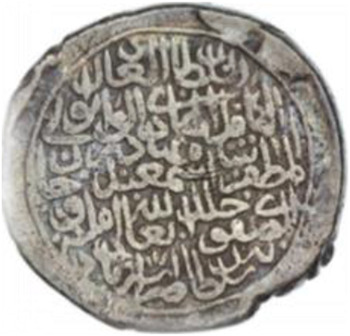
Starting from the beginning of Shah Ismāʿīl’s reign, the obverse of Safavid coins displayed the words of the shahādat. Moreover, the phrase ʿAlī valī Allāh (‘Alī is the vice-regent of Allah), and the names of twelve Shiʿi imams, also added. When he occupied the throne, Shah Ismāʿīl adopted the Aq Quynlu (r. 1378–1501 CE)Footnote 5 prototypes with comparable titles and benedictions. To already existing titles such as al-sulṭān (the sovereign), al-ʿādil (the just), and al-kāmil (the complete), he added titles such as al-hādī (the guide), and al-vālī (the vicegerent) to introduce himself as the substitute of imams. Shah Ismāʿīl added titles such as bahādur (courageous) and abu al-muẓaffar (the father of victorious) to underscore his physical power. Titles such as al-ḥusaynī and al-ṣafavī, which accentuate the religious background of the king, mark the royal inscriptions on his coins (see Figure 1).Footnote 6
Coin of Shah Ismā‘īl minted in Astarabad.
ID Number: 5000-06-00741
The sovereign, the just, the guide, the vicegerent, the father of victorious Shah Ismāʿīl, the courageous, may Allah preserve his kingdom and his sultanate.
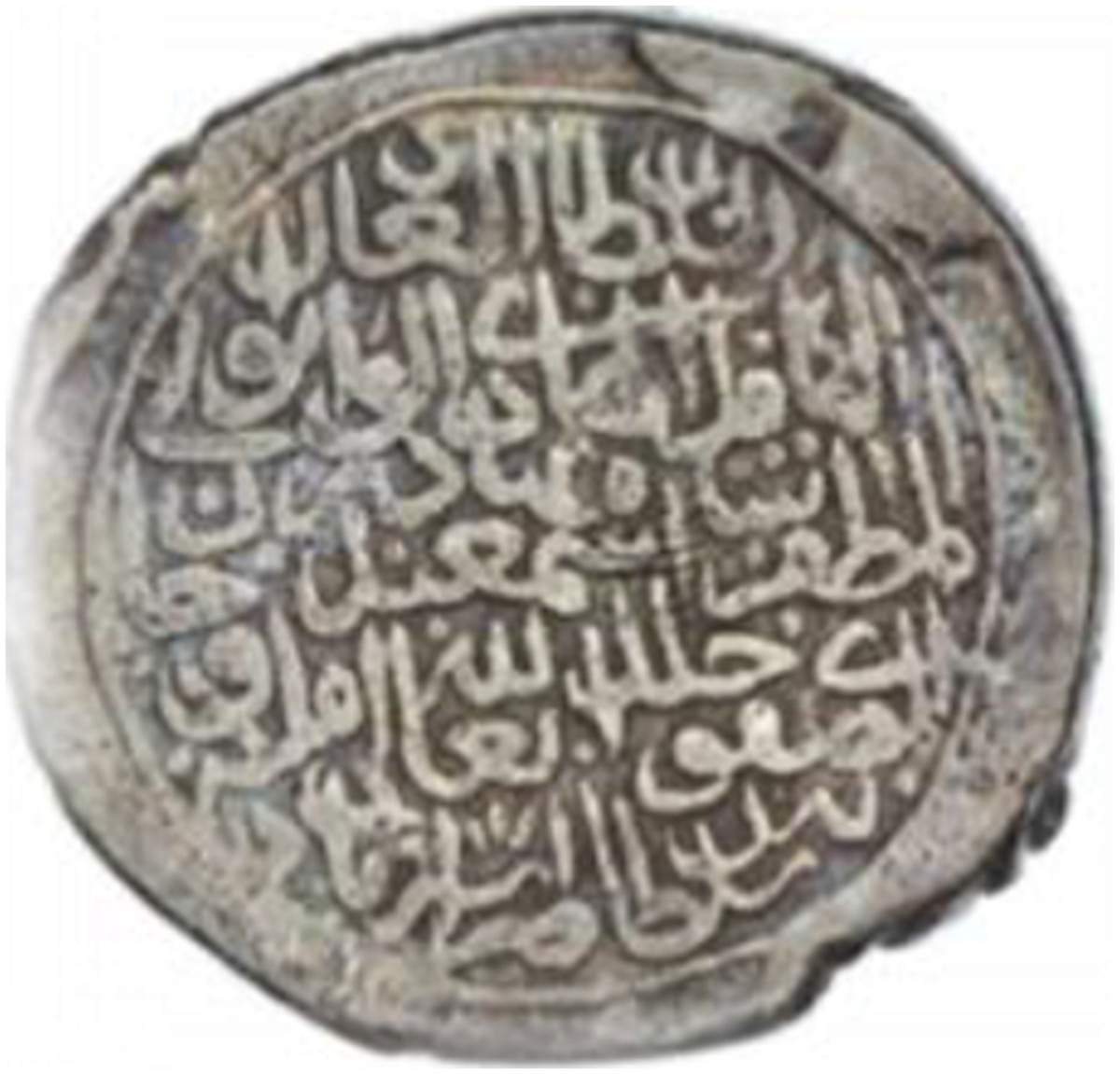
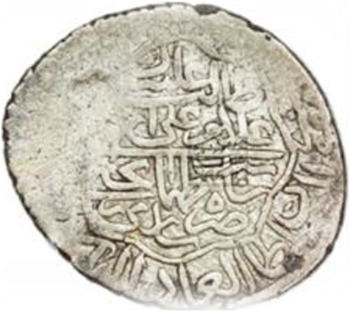
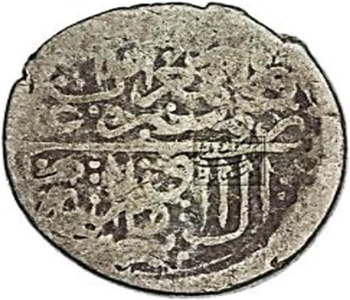
The coinage system under Ṭahmāsb (d. 1576) was similar to Ismāʿīl’s,Footnote 7 but one main change is evident. Expressions of servitude began to appear, which revolved around the king’s central goal of reinforcing the idea of ruling in the absence of a Shiʿi imam (see Figure 2). Stemming from this desire, phrases such as ghulām-e Imām Mahdī (the servant of Mahdī) and ghulām-e Imām ʿAlī (the servant of ʿAlī) were added to titles such as sulṭān al-ʿādil (the just sovereign) phrases. These phrases soon were revoked when Ṭahmāsb’s son, Ismāʿīl II (d. 1577), came to power. Iskandar Beyg Munshī mentioned that Ismāʿīl II believed that if a non-Muslim touches a coin, especially the words of shahādat, the coin would be untouchable and equal in status to excrement. Therefore, he ordered the elimination of all Shiʿi expressions and the names of Shiʿi imams from coins.Footnote 8 Nevertheless, in order to demonstrate loyalty to his Sufi family, and to placate Shiʿi religious scholars and the community that practiced Shiʿism, the king ordered the replacement of ʿAlī valī Allāh (ʿAlī is the representative of Allah) with a Persian verse: “If there is one imam from West to East / It is ‘Alī and his family who are enough for us” (see Figure 3).Footnote 9
Coin of Shah Ṭahmāsb minted in Sari.
ID number: 5000-06-00801
The phrase “servant of Imām ‘Alī” is on the reverse.
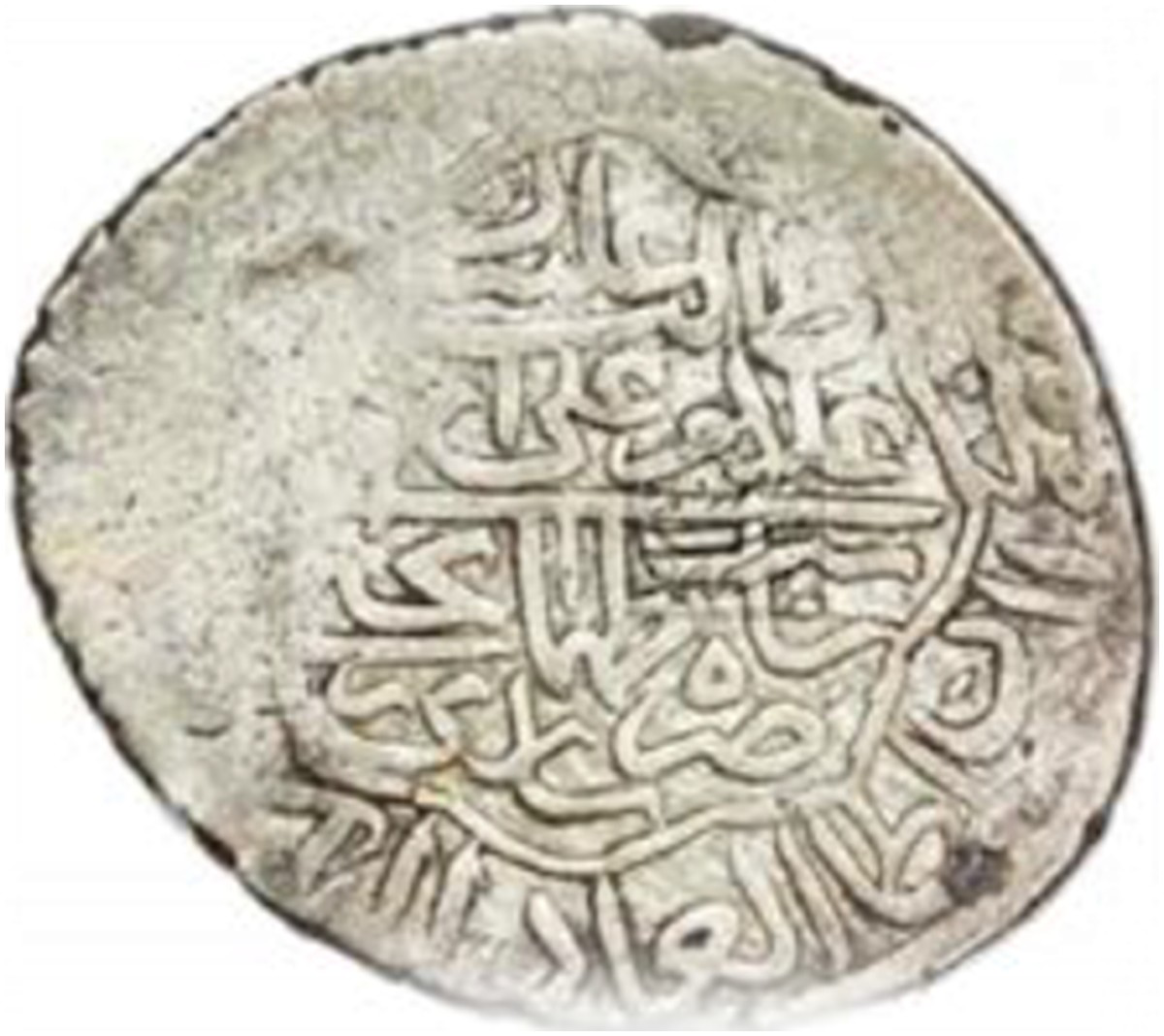
Coin of Shah Ismā‘īl II minted in Dar al-Muvahid Qazvin.
ID number: 5000 06 0742
“If there is one imam from West to East / It is ‘Alī and his family who are enough for us.”
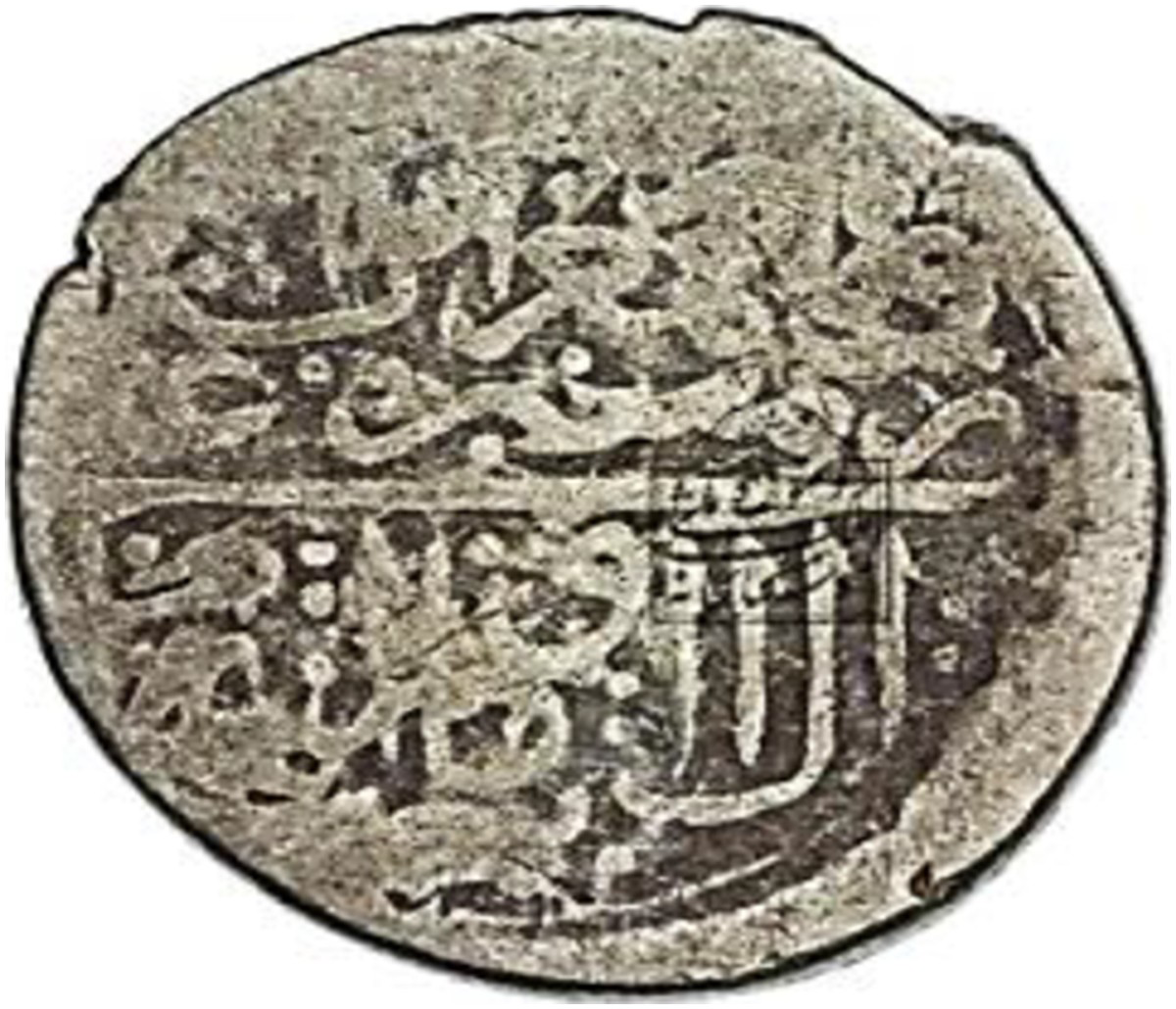
The most marked change to phrases on coins occurred during the reign of Shah ʿAbbās I. Initially, he built his political influence based on that of his father and by negotiating power between religious scholars and people of various cultural groups and religions. However, he soon detached himself from unorthodox religious practices and established his position between the people, the state, and religious scholars by emphasizing Shiʿi doctrines. Piety and subservience to the “true” religion were the best ways for the king to compel ordinary people, the elite, and religious scholars to accept him as the righteous ruler in the absence of an imam and to follow his commands. Shah ʿAbbās’ system of reign was very similar to Shah Ṭahmāsb’s; however, it was more systematic. By distancing himself from the regular symbols of power in public, and by further announcing his servitude toward Shiʿi imams, Shah ʿAbbās moved the monarchy away from the Safavid past and took serious steps towards increasing the orthodox character of the Safavid dynasty as a Shiʿi state.Footnote 10
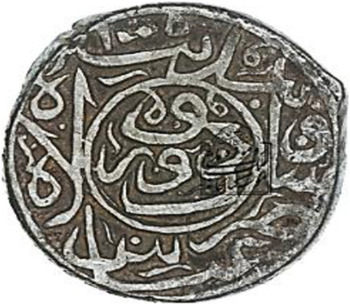
The dominant script on his coins, bandeh-ye shāh-e vilāyat (the servant of the king of sovereignty), reflects this transition. This script was institutionalized in Shah ʿAbbās I’s reign and commonplace thereafter.Footnote 11 This script, casting Shah ʿAbbās as a mere servant of Shiʿism, foregrounds the king’s Shiʿi desires. It linked the Safavid king to Shiʿi doctrine and implied obedience to the one and true caliph after the Prophet (i.e. Imam ʿAlī). On the one hand, by connecting himself to Imam ʿAlī, Shah ʿAbbās I and his courtiers were presented as pious retainers of Imam ʿAlī’s instructions and legacies. On the other hand, they presented new views of power and sovereignty, which distinguished them from the other Muslim rulers. For example, Shah ʿAbbās was unique as being known for a protective attitude towards his subjects and for supporting the poor against the unfair tradesmen of the timeFootnote 12 (see Figure 4).
Coin of Shah ‘Abbās I minted in Duraq.
ID number: 5000-06-00714
Margin: The servant of the King of Sovereignty ʿAbbās.
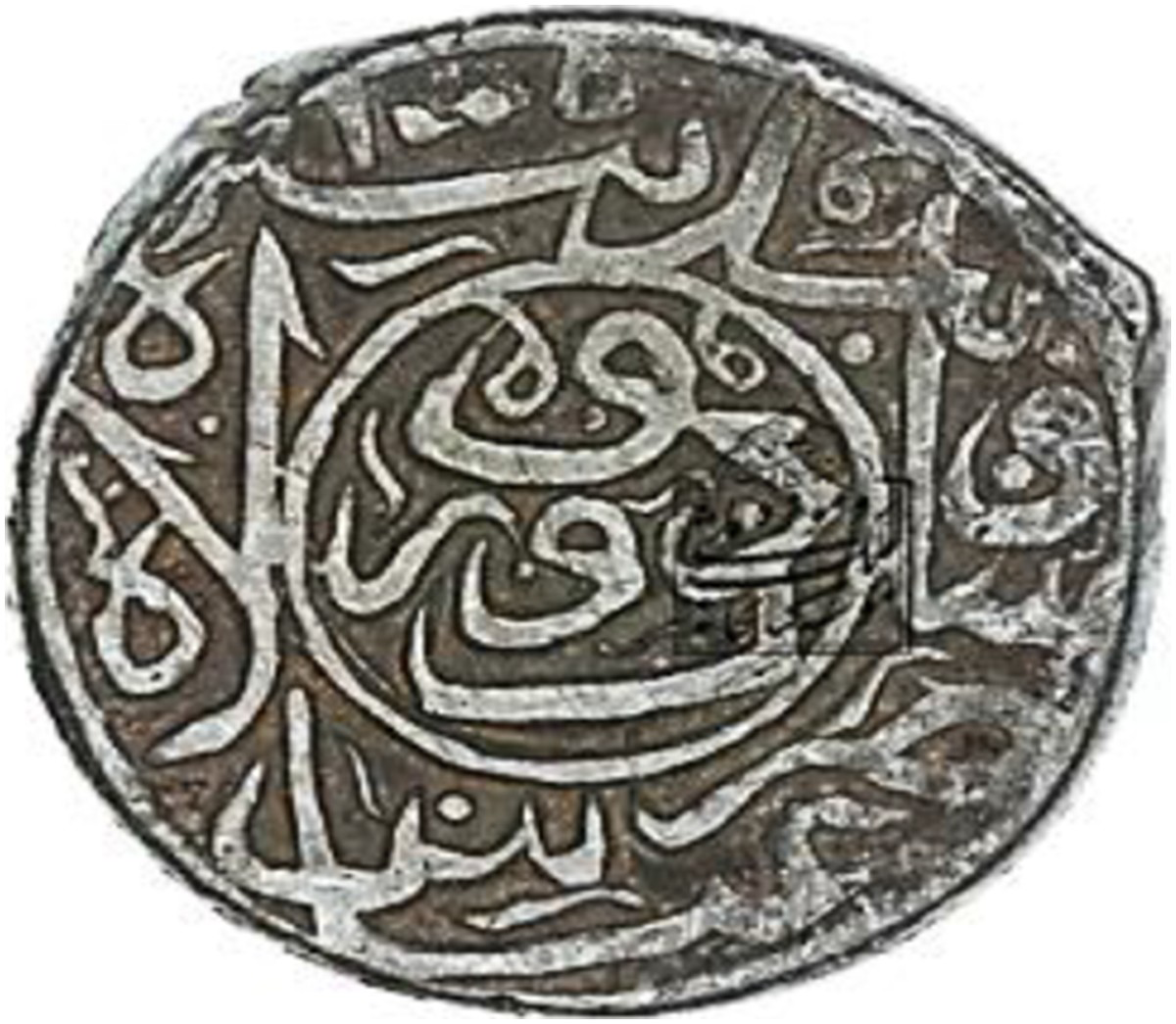
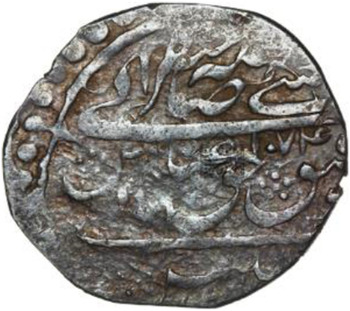
Although historians of Shah ʿAbbās’ time applied the title ṣāhib-qirān for legitimizing purposes, connecting Shah ʿAbbās to the conqueror Tīmūr (d. 1405 CE),Footnote 13 Safavid coins do not support this connection. Nevertheless, the connection was made for one of Shah ʿAbbās’ successors, Shah ʿAbbās II. Beginning with his reign, the title ṣāhib-qirān (Lord of the Conjunction) appeared on the coins along with the king’s name and lineage (see Figure 5).Footnote 14Ṣāḥib-qirān augured predestined and everlasting success for its fortunate possessor.Footnote 15 The expression sikkeh-ye ṣāhib-qirānī (the coin of the Lord of the Conjunction) was used in a Persian verse on the reverse side of the coinage, a combination that emphasized ideas of both Persianate and Timurid kingship. Similarly, in other periods, the coins’ reverse displayed the names of imams. Ṣāhib-qirān stayed on coins during the reign of Ṣafī II, famous as Shah Sulaymān I (d. 1692). Sulaymān did not change the expression, and by invoking his father’s name, he applied his father’s legitimacy and power to his own kingship:
Coin of Shah ‘Abbās II minted in 1074 AH (1663).
ID Number: 30001-06-00094
By God's help, Shah ʿAbbās II/minted a ṣāḥib-qirānī coin in this world.
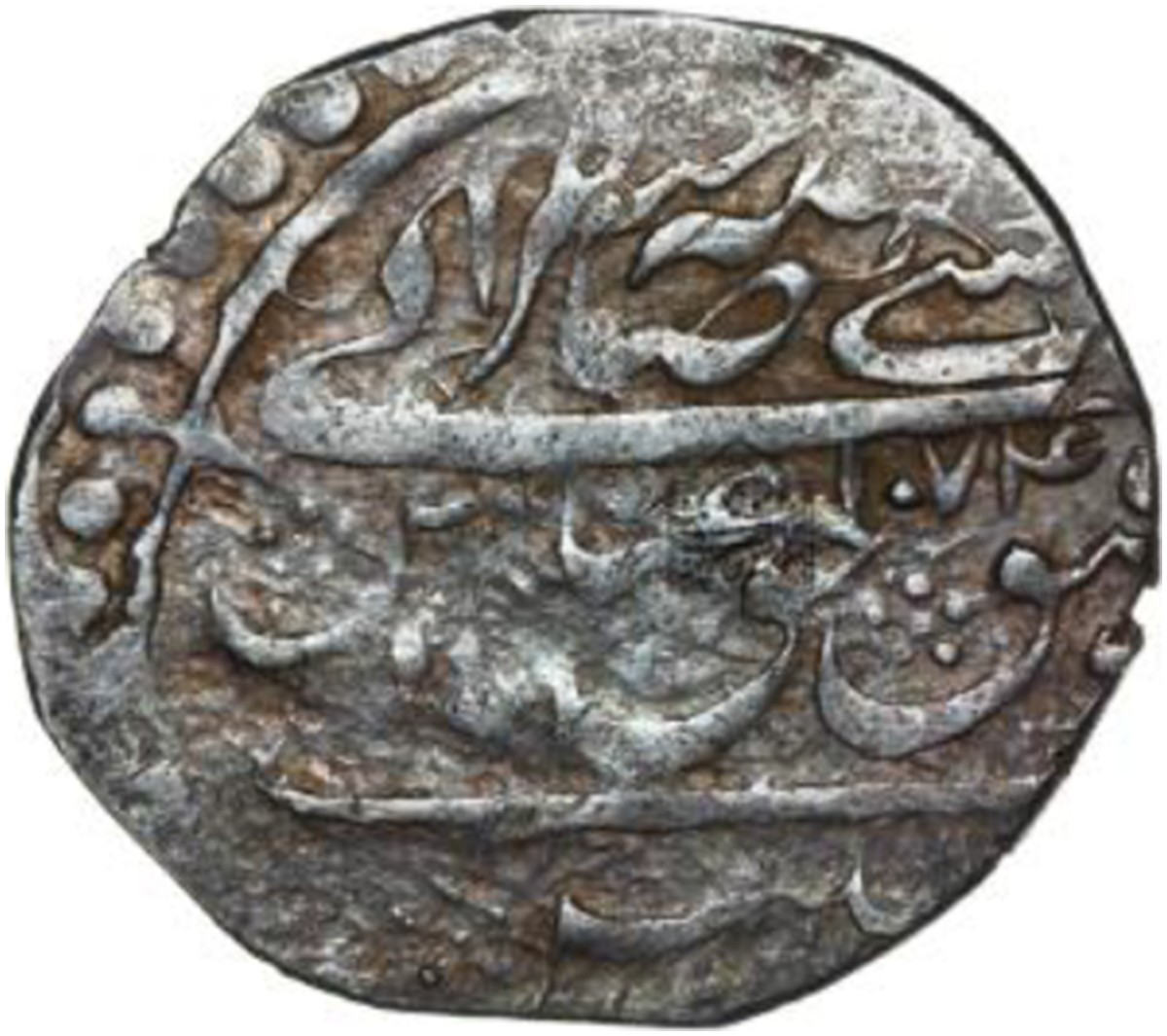
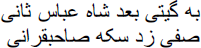
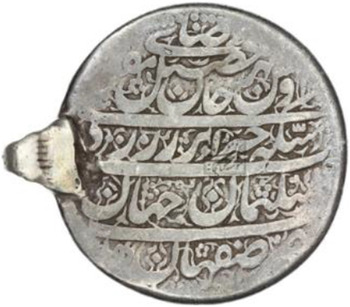
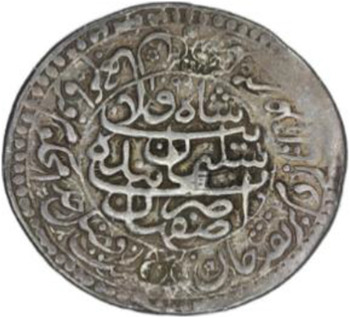
The interest in having Persian verses on the coins is specifically evident on the coins that were minted after Ṣafī II’s second enthronement in 1668 (see Figures 6 and 7):


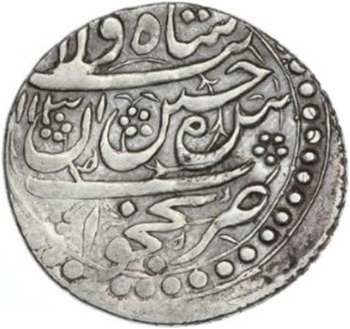
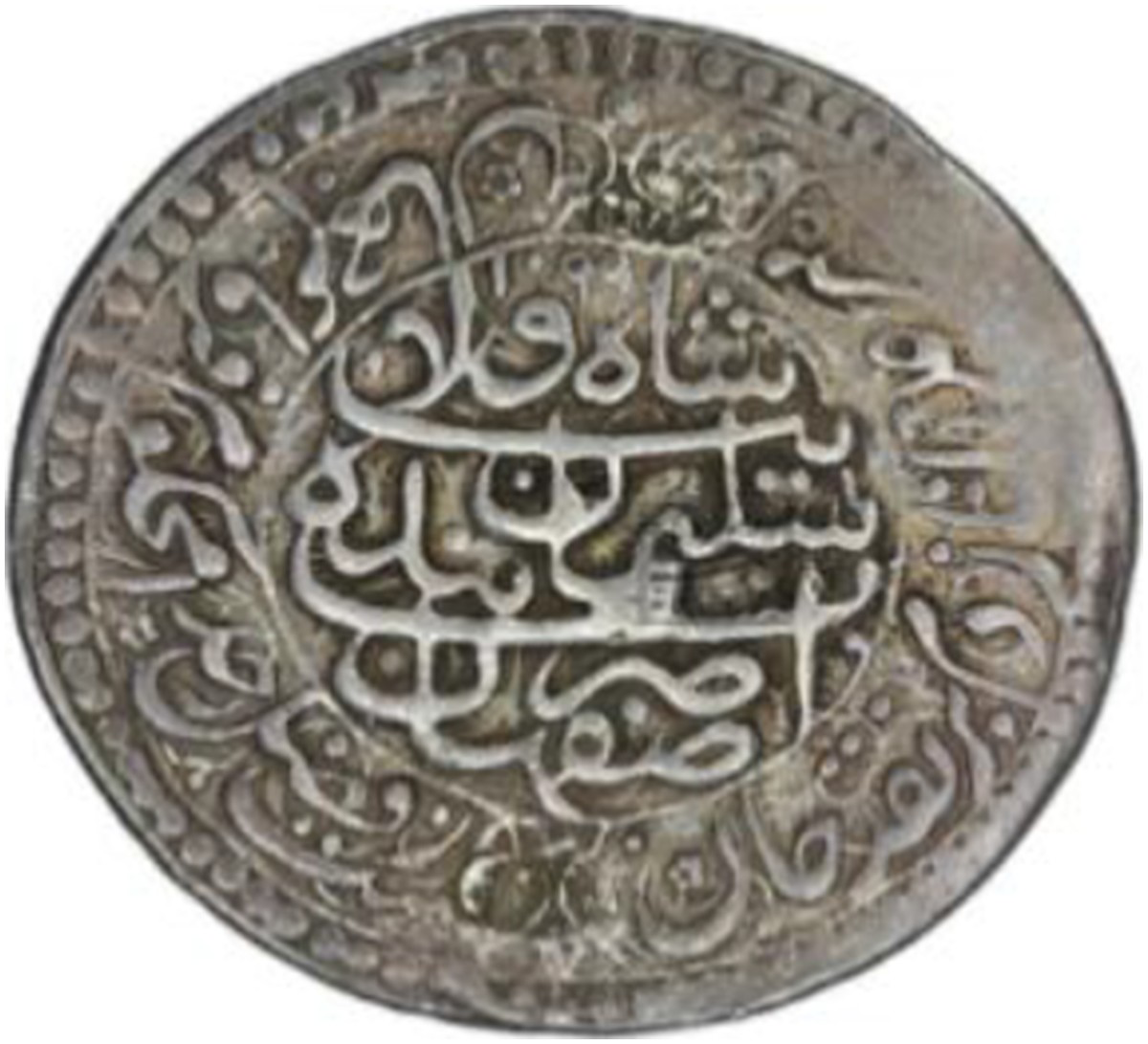
The tradition of Persian poetry writing on coins persisted until the fall of the Safavid dynasty. In addition to bandeh-ye shāh-e vilāyat and ṣāhib-qirān, Shah Sulṭān Ḥusayn (d. 1726) retained the Persian poems on his coins.Footnote 18 The similarity between the coins’ titles during the reign of Shah Sulṭān Ḥusayn and the first two Safavid kings suggests an interest in Shah Sulṭān Ḥusayn conforming in rule to early Safavid kings and in presentation to Shah Ismāʿīl and Shah Ṭahmāsb (see Figure 8).Footnote 19
Coin of Shah Sulaymān's era minted in Isfahan.
ID Number: 5000-06-00798
To have the confirmation of [Imām ‘Alī] whom human and non-human follows Sulaymān of the world minted gold coins for charity.

Coin of Shah Sulaymān minted in Isfahan.
ID Number: 5000-06-00753
King Central cartouche: The servant of the Sovereignty, minted of Sulayman, in Isfahan. Margin: Since I minted the coin of love for ʿAlī on my soul, By God's kindness, the world became obedient to my orders.
Architectural Evidence
In this section, I discuss the numerous inscriptions remaining from the Safavid period, especially from Isfahan’s buildings. The architectural inscriptions were multicultural in ideology, available to the public residential population as well as to visitors to the Persian empire during the Safavid dynasty. Architectural inscriptions such as those of mosques, domes, and schools are among the materials that support our understanding of the public image of the Safavid kings. These inscriptions also elucidate the dynamics of the kings’ search for legitimacy in the eyes of those who convened in those public places. The content of these inscriptions speaks of the Safavid kings’ interest in using these materials for dissemination of their religio-political ideology among everyday people. In general, these materials are about the incorporation of terms that portray the king’s desire to be affiliated with the family of the Prophet, to express love for Imam ʿAlī, as well those that introduce the Safavid kings as the propagators of Shiʿi legacies. Although numerous architectural inscriptions from the Safavid period exist, only a few are available from each Safavid court to enable a comprehensive analysis of all religio-political ideologies and legitimacies constituted in these inscriptions. I will begin with the earliest inscriptions remaining from the Shah Ismāʿīl period, and then trace them up to the fall of the dynasty.
Coin of Shah Sulṭān Ḥusayn minted in Nakhjavan.
ID Number: 5000 06 00856
The servant of the king of sovereignty Ḥusayn.
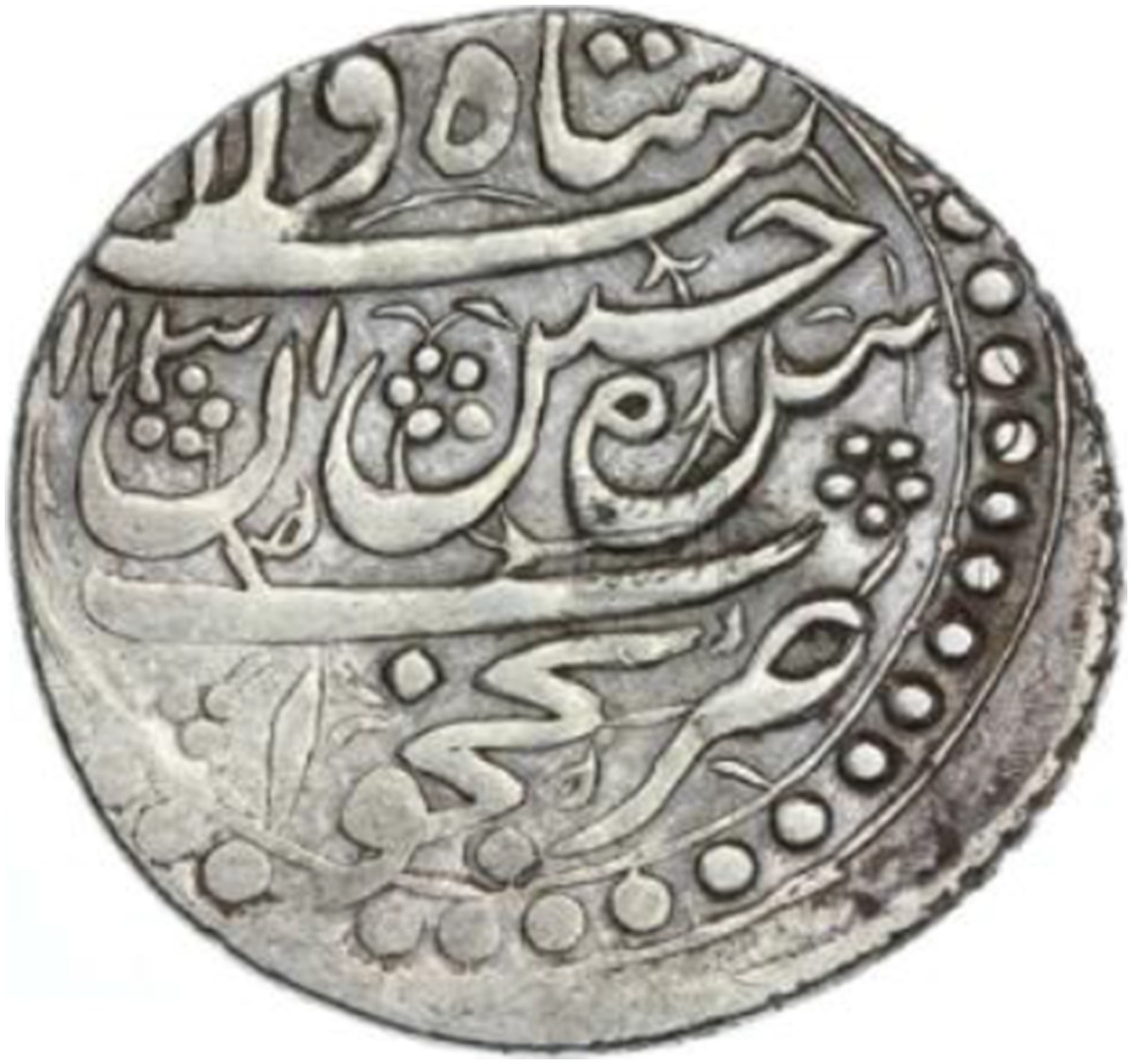
Ālī Qāpū Gate in Qazvin.

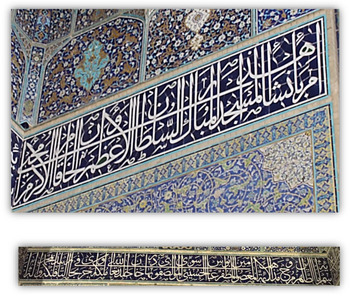
The inscriptions on the Hārūn Vilāyat mosque are among the earliest remaining from the time of Shah Ismāʿīl I. The inscription on this mosque depicts Shah Ismāʿīl as the warrior deserving to be a caliph. Although the inscription implies the religious aspect of his kingship, it also emphasizes his right to kingship because of his power and strength in fighting for truth in the path of God:

In the [ruling] days of the guardian of the banner of guardianship on the horizon, the entitled owner of the throne of Caliphate, the conqueror in the cause of Allah with a vigorous proof, the patron of the believers, the father of the triumphant, Sulṭān Shah Ismāʿīl Bahādur Khān. believers, the father of the triumphant, sulṭān Shah Ismāʿīl bahādur khān.
Ismāʿīl’s messianic claims played an important role in forming his sacred authority.Footnote 21 Public claims of divination, magic, and prophecy in different stages of his reign helped the social process by which the “sacred” charisma of Safavid kings was produced and institutionalized.Footnote 22 As a result, Shah Ismāʿīl’s qizilbāsh’s supporters believed him to be sacred by virtue of being born into a Sufi family. This idea allowed him to gain and keep the respect and trust of his devotees throughout most of his reign. For example, an Italian traveler indicated that Shah Ismāʿīl’s followers adored him as a prophet and that the rug he sat upon when celebrating Mihrigān,Footnote 23 having been touched by the sacred Ismāʿīl, was torn into pieces to be used by his followers. European travelers also wrote that Ismāʿīl’s followers considered him to be divine. Because of his special power and devotees, and especially because of his spiritual genealogy, they regularly compared him with Alexander the Great or with Xerxes and Darius, conveying the same respect for him as for pre-Islamic kings of the Persian empire.Footnote 24
This emphasis on the sacred charisma of Shah Ismāʿīl can be seen in the inscription of the ʿĀlī Mosque. It mentions that the number of kings’ names in the abjad system is equal to the times the name of the twelve imams repeated in the Quran is a karāmat.Footnote 25 Thus, the inscription claims the king is sacred and the rightful person to lead the Muslim community:

This mosque … [I] established [it] in the days of him, who holds the keys of time. [He is] al-Sulṭān the son of al-Sulṭān the son of al-Sulṭān. [The value of] his beautiful name, the father of triumph al-Sulṭān Shah Ismāʿīl, is equal to the times that the name of the twelve imams, the peace of God upon them, has repeated in the Quran.
As seen on mosque inscriptions of Shah Ṭahmāsp’s period, the title ḥusaynī was added after the king’s name on Quṭbiyyeh and Darb-e Jūbāreh, two mosques of Shah Ṭahmāsb’s period, to claim the relationship between the king and the family of the Prophet. The inscription of Darb-e Jūbāreh refers to the king as “the vanguard of Imam Mahdī’s army.”Footnote 27 These titles reinforce the claim that Shah Ṭahmāsb desired to legitimize his rule in the absence of Imam Mahdī.
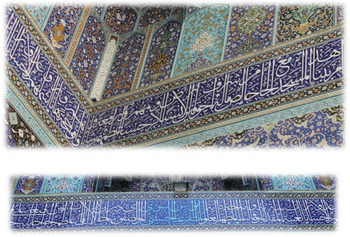
Shiʿi and Sufi genealogy became a dominant element of inscriptions during the reign of Shah ʿAbbās I (see Figure 10). The expression “the propagator of the right religion of Twelver Shiʿism” was also engraved. Inscriptions from Maqṣūd Beyg’s mosque, which were engraved in 1603, blended the notions of the king’s personal characteristics and his material power with notions of Twelver Shiʿism. In this inscription, the king’s glory is compared to Jam’s while the presence of angels in his army endows the king with sacred charisma similar to Shah Ismāʿīl’s:
Shaykh Luṭfullāh mosque, Royal Square, Isfahan.
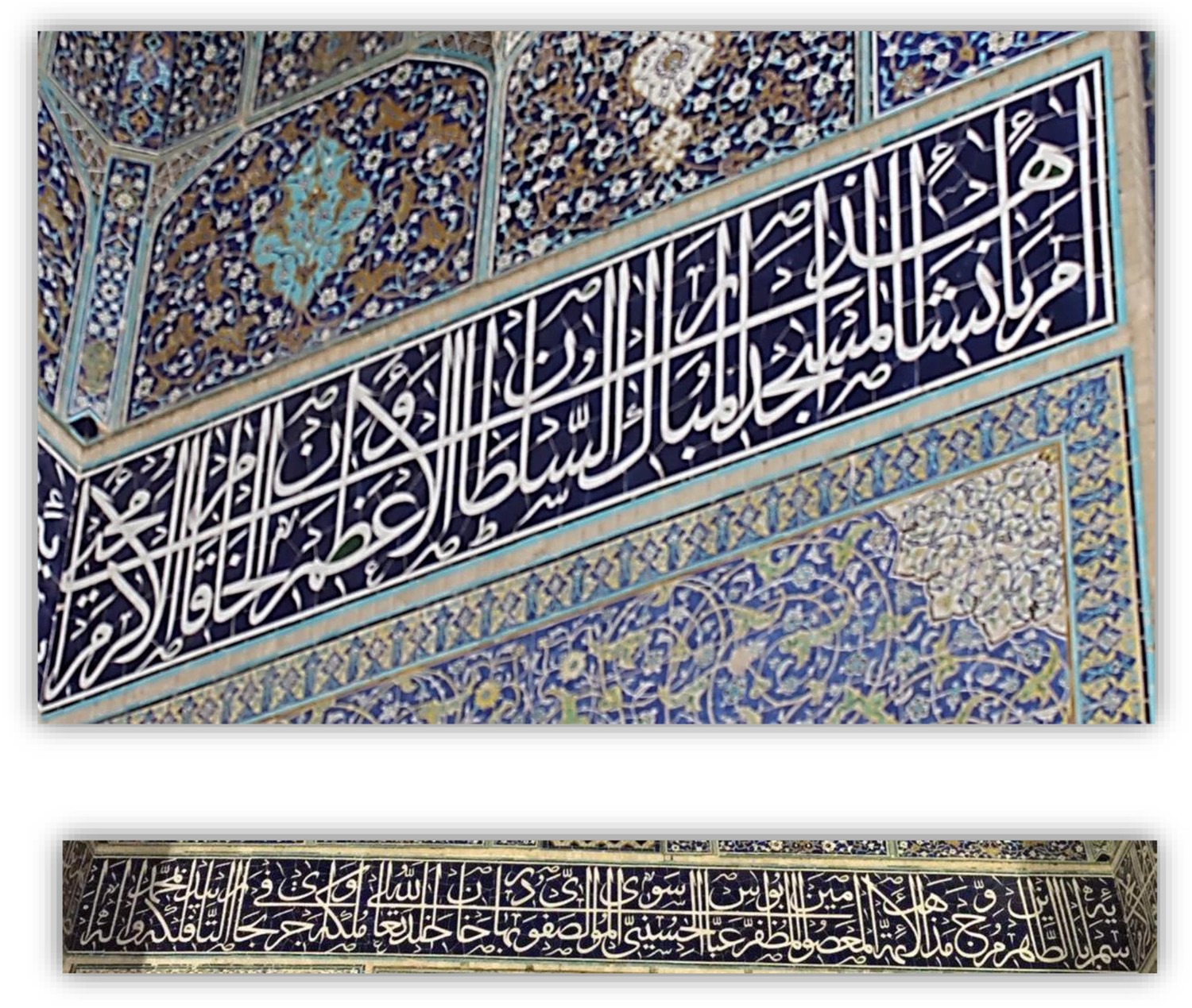

In the days of the rule of a king whose glory is similar to Jam, a king whose army consists of angels [and] whose palace is the heavens. [He is] the propagator of the faith of the Twelve Shiʿi Imams, peace of God upon them from the most honorable, the just and the greatest king, the father of triumph, Shah ʿAbbās al-Mūsavī al-Ṣafavī al-Ḥusaynī.
A distinct difference is evident between the inscriptions of Shah ʿAbbās I’s period and early inscriptions of Shah Ismāʿīl and Shah Ṭahmāsb’s time. As previously discussed, the titles of the coins in Shah ʿAbbās’ reign portrayed him as a mere servant of Imam ʿAlī and far from a traditional image of a mighty king. However, the inscriptions on the mosques and palaces he built included the kingly titles and names of pre-Islamic Persian kings together to increase the king’s dynastic authority. The inscriptions on gates and walls of the buildings in Maydān-e Naqsh-e Jahān indicate Shah ʿAbbās I’s desire to project the image of a king serving the religion (see Figure 11). His Shiʿi genealogy and his public religious actions, which various cultural products of his time emphasize, validate this point. The inscription on Shaykh Luṭfullāh's Mosque, for example, introduces him as the reviver of his ancestors’ traditions. At the same time, it portrays the king as the disseminator of the religion of infallible Imams:

Ordered to construct this blessed mosque was the great sovereign and the honorable king, the reviver of the traditions of his pious fathers. [He is] the disseminator of the innocent Imams. [He is] the father of the triumphant, ʿAbbās al-Ḥusaynī al-Ṣafavī al-Mūsavī Bahādur Khān, may Allah, exalt him, and eternalize his reign and sail his ship in the oceans of support, by the virtue of Muḥammad and his noble, pure and infallible family, the peace of God on him and them.
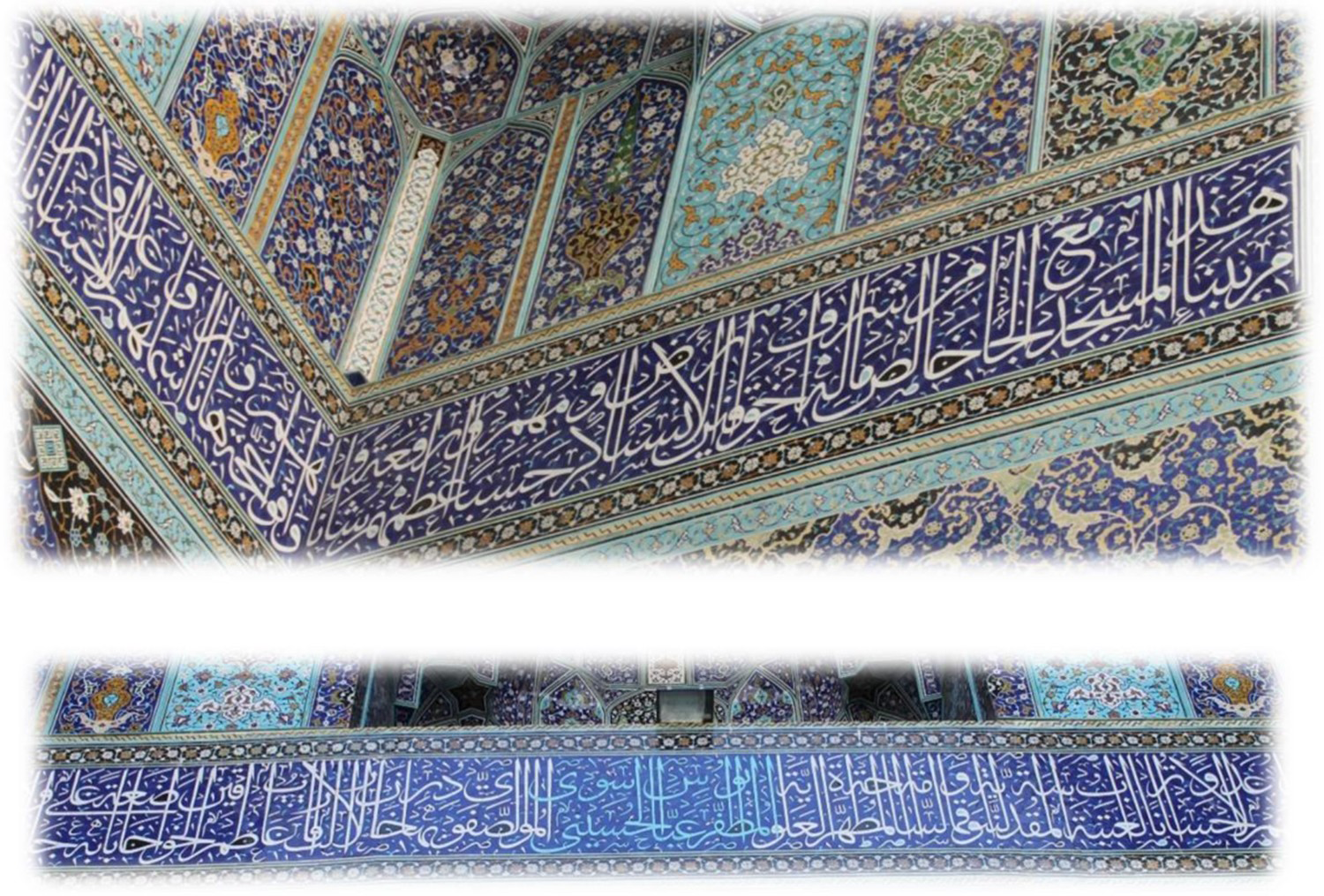
As a further example, the inscription on the Royal Mosque about Shah ʿAbbās I invokes notions of genealogy. In this inscription there is no mention of kingly titles, as establishing a mosque is known as an act of piety and not demonstration of a king’s mighty character. The king, in terms of nobility, positionality, rationality, and the judiciary, was placed above all other kings. The inscription introduced him as the symbol of the Family of the Prophet:Footnote 30

Ordered to construct this congregational mosque from his personal wealth was the king with the noblest descent on the earth and the most honorable family. [He is] the greatest of all in position and the most respected one. [He is] the strongest of them in proof [of power] and his justice is the most inclusive and the most generous. [He is] the dust on the sacred threshold of the Prophet, and [he is] the rubbish of ʿAlid's pure square. [He is] the father of triumph, ʿAbbās al- Ḥusaynī al- Mūsavī al-Ṣafavī.
The main entrance of the Royal Mosque, Royal Square, Isfahan.
In contrast to his coins, the inscriptions of Shah ʿAbbās II’s time intended to emphasize the king’s military prowess and authority in the eyes of the people. An expression such as “the leader of the Arab and Persian kings,” which was inscribed on Sufrehchī and Jārchī mosques, is an example of the king’s desire to be known in by his leadership ability, authority, and power. This expression appeared in two inscriptions of Shah ʿAbbās II’s period along with a range of titles that emphasized the king’s imperial power. “The greatest sovereign,” “the owner of people’s necks,” and “the hero of waters and lands” are among the titles that reminded audiences of the king’s earthly power and his authority over Muslims. This is the inscription of madraseh-ye Mīrzā Taqī:

[He] was successful in building this school in the days of the rule of the greatest king, and the most honorable king, the supporter of all Arab and Persian kings, the hero of waters and lands, the propagator of the religion of infallible Imams, peace upon them, al-Sulṭān the son of al-Sulṭān the son of al-Sulṭān, the Khāqān the son of the Khāqān the son of the Khāqān, al-Sulṭān Shah ʿAbbās II al-Ṣafavī al-Mūsavī, Bahādur Khān.
This is the inscription of Jūrjīr Mosque in Isfahan, which also demonstrates the king’s power and authority:

in the days of the guardian of al-Sulṭān the most honorable, the greatest, the best just king, the bravest, the hero of the oceans and lands, the leader of all Arab and non-Arab kings, the father of warriors, the father of triumph, the father of victory, the father of triumph, Shah ʿAbbās Bahādur Khān.
While some of the remaining inscriptions from Shah ʿAbbās II’s period referred to him as “the propagator of the right religion of the Twelver Imams,” the term disappeared from the majority of the remaining inscriptions following his reign. The inscriptions of Shah Sulaymān’s buildings emphatically mix the religious role of the king with titles that portray his material power. In the inscriptions of Khalvat Nishīn mosque, the king is compared with Solomon and Alexander the Great. The expression ẓill Allāh (the shadow of God) is also used for legitimizing purposes. In depicting the king, one of the last inscriptions of Sulaymān’s period demonstrates this coexistence between religion and state. This inscription of madraseh-ye Kārgarān is dated 1685, the last year of the king’s rule:

It was built by support of God and under the shadow of the noblest king’s support, the custodian of the flag of the brightest legacies, the establisher of the knowledge and faith’s foundation, he is the branch of the pure tree of the Prophet’s Family, the highest branch in a plane, the Khāqān the son of the Khāqān the son of the Khāqān, al-Sulṭān Sulaymān al-Ḥusaynī al-Mūsavī al-Ṣafavī.
The interest in applying the names of pre-Islamic Persian kings to Safavid kings can be traced in the inscriptions of Shah Ṣafī’s time. Darb-e Ṭuqchī Mosque includes the names of Persian kings who were famous for their power and glorious nature:

During the reign of the king whose wisdom matches Jamshīd, whose authority matches Alexander, whose farr matches Firīdūn, and whose retinue matches Darius. He is the father of the triumphant and his polity is glorious, the Sulṭān, Shah Ṣafī al-Ḥusaynī, al-Mūsavī, al-Ṣafavī, Bahādūr Khān.
The inscription of ‘Ᾱlī Qāpū’s gate, which was engraved after the palace’s construction, is a culmination of all previously mentioned discourses demonstrating the king as the leader of religion by serving its legacies, owning spiritual power, and being the king of kings.

(O Allah) … The king of the religion (O Muḥammad) the judge and the religion nurturer of the land of Iran (O ʿAlī help) the dog of the threshold of ʿAlī who is the honor of all kings (O ʿAlī help), the supporter of the Prophet’s religion … (O Muḥammad) who from the water of mercy and the clay of heaven (O ʿAlī help), he is as powerful as the fate (O Allah), the powerful column of his court is with no veil (O Muḥammad) the place where the sun rises (O ʿAlī help) is under the king whose attitude matches the fate, (O Allah) … the shah of the religion, the shah of the age, Sulṭān Ḥusayn (O Allah), Ibn Sulaymān, whose palace is similar to Solomon.
As is evident from these materials, after the reign of the powerful Shah ʿAbbās I, there was a desire to declare the kings’ imperial authority and power. The purpose of doing so was to demonstrate the continuity of Safavid power. The inscriptions cited in this section seem to de-emphasize Shiʿism and the religious role of the king, as compared to the coinage discussed in the first section. Considering the internal conflicts and the chaos after the death of Shah ʿAbbās I, this emphasis on the imperial power of the king for the general population seems to have been necessary for consolidating power within the Persian empire’s borders.
Evidence from Royal Investiture Ceremonies
Royal investiture orations and ceremonies are among the sources through which Safavid legitimacy could be discussed. The interest in making ties between the Safavid kings and pre-Islamic Persian kings is particularly evident in the khuṭbah (enthronement oration) that Muḥammad Bāqir Majlisī (b. 1627; d. 1699), the renowned and very powerful Iranian Shiʿi scholar, delivered for Shah Sulṭān Ḥusayn. Khuṭbah (enthronement oration) is an address delivered by a khatīb (orator) as part of a religious service. The oration was a means of legitimizing the kingship.Footnote 37 Speech elements in orations for Safavid kings speak of the loyalty between the religious scholars and the kings in managing the affairs of religion and the state.Footnote 38 As religion was meant to guide life in general, religious charisma could bestow legitimacy on non-religious activities, including kingship. Unfortunately, few documents about orations given for earlier Safavid kings are available.
The available documents provide a unique perspective on the nature of Safavid kingship and authority. Quinn’s study of historiography of Safavid coronations in a number of narrative sources reveals interesting points about notions of kingship in Safavid Iran throughout the dynasty’s history. Ghiās al-dīn Khvāndamīr in Ḥabīb al-siyar “ combines symbols of pre-Islamic Persian kingship with both Islamic and specifically Shiʿi symbols of authority” when describing the coronation of Shah Ismāʿīl I. Based on this narration, “pre-Islamic, ancient Persian notions of a just king, the shadow of God on earth” worked together with Imami Shiʿi ideas to legitimize the first Safavid king.Footnote 39
In contrast, considering Shah Ismāʿīl II’s attempt to return the country’s religious orientation to Sunni Islam, the narratives of his coronation comprise a different sort of information and provide fewer details of the event itself. Muḥaqqiq Karakī (d. 1533), famous as Muḥaqqiq al-Sānī and a supporter of Shah Ismāʿīl and Shah Ṭahmāsb in making Shiʿism the state religion, had a son called Shaykh ʿAbdul ʿAlī. This son spread the “rug of sovereignty”Footnote 40 for the ascension of Shah Ismāʿīl II and Muḥammad Khudābandeh (d. 1595).Footnote 41 In the seventeenth century, when Isfahan became the permanent capital of the Safavid rulers and Shiʿism was the state religion, the inauguration of a new monarch was entrusted to the hands of the Shaykh al-Islām of the capital. Mīr Dāmād (d. 1631) conducted the coronation for Shah Ṣafī. The event appeared in Tārīkh-e ʿālam ārā-ye ʿabbāsī by Iskandar Beyg Munshī, and the continuation of this work, Zayl-e ʿālam ārā-ye ʿabbāsī. Quinn identified three significant changes between the two documented narrations of this event. In Zayl-e ʿālam ārā-ye ʿabbāsī, Munshī “add[ed] the presence of sayyids and ‘ulamā to the ceremony, replace[d] a reference to prayer carpet as the family heirloom used in the coronation with a throne, and replace[d] the ceremony of kissing the king’s feet with a general ‘giving congratulations’.”Footnote 42
A second coronation for Shah Ṣafī, which took place one day after the first, was recorded in Khulāṣat al-siyar by Muḥammad Maʿṣūm b. Khvājagī Iṣfahānī.Footnote 43 He wrote that the day “contained the blessing time”; therefore, it was a perfect day for the king, who “deserved the throne and crown,” to be announced as the king. Khvājagī Iṣfahānī made use of the descriptors “completeness” and “comprehensiveness” for Mīr Dāmād in order to show that when such a religious scholar legitimizes a king, the king is definitively God’s representative on earth.Footnote 44 Interestingly, Iṣfahānī did not mention the use of coronation regalia. Instead, he stated that they used Shah Ismāʿīl’s belt and sword in the coronation ceremony, a practice that goes back at least to Seljuq period.Footnote 45 Comparing these narratives, Quinn concluded that by Ṣafī’s time, the power of qizilbāsh had declined, while the presence of ‘ulamā demonstrated that the religious establishment had become very powerful.Footnote 46
The oration of the last Safavid king, Shah Sulṭān Ḥusayn, clearly establishes a tie between the concept of kingship and imamship. Shah Sulṭān Ḥusayn asked Muḥammad Bāqir Majlisī to give the oration for his appointment, which took place in the ʿAbbāsī Congregational Mosque. The oration started with notes about the creation of Adam and the necessity of having a spiritual leader since then. Majlisī, by starting the oration with a discussion of the prophets’ responsibility in guiding the people, opened up the path toward comparing the prophets and imams with the Safavid king. He argued that the prophets, who organized matters of dīn (religion) and dunyā (world), came to this world to guide the people who were lost in the deserts of confusion and deviation. Then, he connected the necessity of guidance with the concept of kingship and introduced Safavid kingship, the righteous form of kingship in the absence of Imam Mahdī. The Safavid kingship was therefore to take the responsibility of people’s guidance. In this oration, two elements were present and intermingled. First, the notions of Persianate kingship were seen in titles that also were used to refer to Shah Ismāʿīl. Second, Shiʿi ideas of kingship were seen in references to Shiʿi doctrine as well as the expressions of servitude towards the Shiʿi Imams that were similar to the dominant expressions during Shah ʿAbbās I’s reign. These two elements were combined in order to declare power for this king.

After that, the sun of the sky of Prophecy disappeared in the world of eternity; and after hiding the moons of Imamate under the mask of Absence and the clouds of secrecy; the unfailing competitor, and the generous Creator, because of its kindness and generosity toward this nation, entrusted the keys of rule and conquest in competent hands and the knowing grasp of kings with tact; the kings whose nameplate is justice and the kings whose power is similar to eternity. His purpose provided for the entire subjects and all people a shadow under which they rest in peace and security; and to save them from the oppression and enmity of the lords of injustice and revolt.
The khuṭbah continued to describe the kings in terms of their justice, power, and mercy. Their appointment to rule was the choice of God, who seeks blessings for his people. God is merciful, and this is evident from God’s choice of a king who is kind, just, and caring:

The undying will of God … put the dress of sulṭān and world-guarding on the enduring body of a king who, the target of his eyes and his sun-like wisdom is perpetuating kindness, justice and covering all people under the wings of mercy and compassion.
Majlisī continued his speech by indicating that the people would live in comfort and ease for many years under the just kingship of the Safavids. He claimed that the people enjoyed unlimited favors from the Safavid kingship and that, under their rule, people were saved from the darkness of infidelity and wandering. Majlisī saw it as the people’s duty to respect the Safavid kings and appreciate their efforts. He described Safavid kings as suns of the elevated skies and moons of guidance.

It is the responsibility of all Shiʿites and the believers whose soul is lightened by the brightness of faith to appreciate the blessing of prosperity from the bravest people of this family, who are the suns of high and glorious skies and the moons of guidance and leadership.
Unlike the patterns on coins, which avoided using the royal titles to refer to the kings from Shah ʿAbbās’ time, Majlisī did not hesitate to draw a parallel between the Safavid kings and the pre-Islamic kings of Persia. Majlisī applied the names of historical Persian kings to the current Safavid king to invoke the former’s sacredness for the latter. He also highlighted the link between the Safavid kings and the family of Muḥammad and ‘Alī to argue for Shah Sulṭān Ḥusayn’s legitimacy:

The owner of kingship and the giver of the sulṭānate … dressed up the robe of kingship to a seedling tree with sublimity … I mean the just, generous king whose court is the heaven, his army is from the angels, his retinue is similar to Jamshīd’s, his glory is similar to Firīdūn’s, and his dignity is comparable to Alexander’s. Darius is his doorkeeper. He is the best flower of the muṣṭafavī garden, and the new fruit of murtażavī garden. He is the tree of prophecy and the new branch of the tree of the imamate and sovereignty … The upholder of the flag of religion and governance, the basis of kingship and nation, the pole of sky of power, the center of the sky of justice and dignity, the executive of religion traditions and propagator of religious imams.
In the following section of this oration, the names of historical Persian kings were used along with Shiʿi expressions for legitimizing purposes. This combination demonstrates the significance these two pillars of legitimacy for the last Safavid king:

The sultan who nurtures religion, the khāqān who distributes justice, and whose seal is similar to Jam and his glory to Firīdūn. His place is similar to Solomon whose crown is the sun. His dignity is prophetic, and he descends from Murtażā [ʿAlī]. His religion is of the Imam Jaʿfar and his manner is of Moses. He deserved the throne and crown of Kianids. He inherited the high-valued position of Solomon … The king whose glory is similar to [the glory of] Jam, his power is heavenly, he is the judge who nurtures the religion, appointed by the creator of the heavens and the earth. He is the true hero and the controller of the water and earth, the true servant of Amīr al-Muʾminīn [ʿAlī], the shelter of the greatest sultans, the shelter of the best khāqāns, the supporter of the religion’s realm, the guardian of the Prophet’s laws and the traditions of the purest imams.
This oration presents Shah Sulṭān Ḥusayn through a culmination of all the previous sources of legitimacy outlined above. Majlisī legitimized the role of kingship in the absence of a just imam by discussing the king’s special characteristics, such as his sense of justice, military prowess, and God-given wisdom. He also emphasized the kings’ similarity to ancient Persian kings. With regard to his sense of justice, he was compared to Jam, and in possessing farr, was compared to Firīdūn. He also mentioned the Shiʿi family lineage of the king. Therefore, having both the Persian kings and Shiʿi imams in his background, Majlisī argued that Shah Sulṭān Ḥusayn is the king who can manage the issues of state and religion; therefore, the people must follow this king and submit to his authority.
Panegyric Evidence
Panegyrics were the production of court systems and they were predominantly produced when a king was in power. By considering the nature of panegyric, as written for receiving rewards, the poets’ portrayal of kings is traditionally “assumed” to be the closest to the kings’ self-image. Although it is generally understood that panegyric was “a formal, public poem which was presented to the ruler and performed in the presence of the court on ceremonial occasions,”Footnote 52 there are distinct differences between a panegyric that is written solely for seeking the patronage of kings and one that was produced for recitation to a broader public audience. For example, the poems of triumph that Ṣāʾib Tabrīzī (d. 1676) wrote for Shah ʿAbbās II differ significantly compared to panegyrics that Salīm Tehrānī (d. 1647)Footnote 53 or Faṣīḥī Hiravī (d. 1639)Footnote 54 wrote for Safavid kings, both in references to Safavid ideology and language use. While the triumph poems of Ṣāʾib are occupied with religious references, the panegyrics of Salīm Tehrānī or Faṣīḥī are written with no religious references. Furthermore, there are sometimes differences between legitimizing patterns in cultural materials Shah ʿAbbās I had a role in creating and panegyrics that poets dedicated to him. Most Safavid cultural materials present Shah ʿAbbās as a king who served the Shiʿi imams and the people. However, some of the panegyrics that are dedicated to him refrained from such a depiction. The images of kingship in these poems suggest that they were designed for submission to the court or for recitation at smaller gatherings. In other words, they were not rehearsed for a broader audience as they lack Shiʿi references.
For example, Salīm Tehrānī wrote a qaṣīdeh for Shah ʿAbbās in which none of the dominant elements of Safavid ideology is available. Salīm Tehrānī portrayed Shah ʿAbbās as an approachable, sympathetic, and generous king. This image is in line with the general ideology of Shah ʿAbbās. Shah ʿAbbās attempted to distance himself from the imperial kings of Sunni culture. His emphasis on practicing public piety and expressing servitude towards imams with titles such as “the vanguard dog of Imam ʿAlī” speak of such intentions. Nevertheless, Salīm’s panegyric did not comment on the relation between the king and Shiʿi doctrines. Salīm’s qaṣīdeh starts with an introduction about morality and ethics and further continues with poets’ miseries in life, as well as his perfect poetic skills. Later, the poet highlights the king’s Sufi character by emphasizing the king’s spiritual and sacred power on the life of his people:
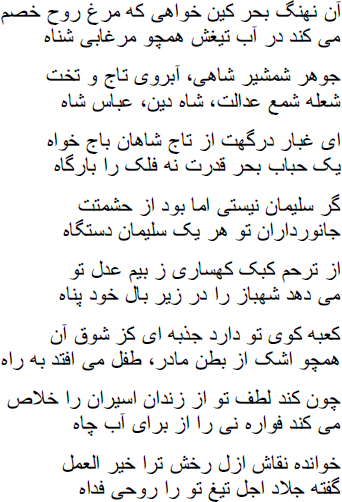
The metaphors used in the poem include a dove, a candle and a flame, and a bubble in the sea. These metaphors portray the king, but not necessarily one of power. In the first line, when the poet speaks of the king’s revenge, he compares the enemy’s soul to a dove, a metaphor that, by considering the context in which this metaphor had previously been used to refer to a spiritual Sufi and human beings, reflects the lack of animosity between the king and his enemy. In the second line, where the dominant theme is the king’s authority over religion and the state, Salīm applies the image of a candle and flame to refer to the king’s justice. This image more commonly appears in romantic narratives than kingly ones, and consequently it contrasts with the ideas and concepts that are represented in the next line. The concept of travel is expressed through the poet’s passion for the king’s residence. This image positioned the king as similar to a spiritual leader and a beloved. These ranging images are not combined with images that represent the king’s power and dominance.
Shānī Takallū (d. 1614), the most famous poet at the court of Shah ʿAbbās, also did not praise his patron with notions that were dominant in the cultural materials of his time. Shānī did not become a popular poet until after he wrote a qaṣīdeh in praise of Imam ʿAlī, which greatly pleased the shah. He received his weight in gold as a reward for the poem.Footnote 56 Most of Shānī’s works are in praise of Shiʿi imams, especially Imam Ḥusayn, Riżā and Mahdī. He also wrote panegyrics in praise to some of the courtiers of the time. Nevertheless, in praising Shah ʿAbbās I, there are no direct references to Shiʿism. Instead, Shānī attempted to portray the king as a sacred person with Sufi traits. Although, the king’s military prowess was still central to his poetry, the images do not show similarity with the kings or the heroes of pre-Islamic times. Shānī pointed to the king’s good fortune by referring to the his falcon-like power in order to demonstrate him as a sacred king.

Shānī rarely used the terms “king” or “kingship” to refer to Shah ʿAbbās. The shah has not been known to be responsible for the dissemination of religion, but his sword and power were compared to Imam ʿAlī’s:

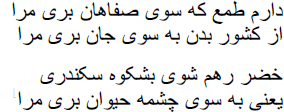
Claiming lineage from Sufi shaykhs was a practice stemming from Ṣafvat al-ṣafā and imitated by later Safavid histories such as Futūḥāt shahī and Ḥabīb al-siyar. These two sources introduced Imam Mūsā al-Kāẓim as the ancestor of the early Safavid leaders. In Tārīkh-e ‘abbāsī, Ibrāhīm Yazdī traced Shah ʿAbbās’ family lineage on both sides back to Imam ʿAlī Ibn Abī Ṭālib through Imam Ḥusayn and Zayn al-ʿᾹbidīn.Footnote 60 Yet the lineage was not an important issue for Shānī and his depiction of the king. In Shānī’s poem about Shah ʿAbbās I, the shah was not depicted in service of Shiʿism; however, his sacred personality was emphasized through images that claim his similarity to the Sufi shaykhs. For example, in a tarkīb-band that supposedly was written after moving the capital of the empire to Isfahan, the king was compared to Khiżr and a murshid-e kāmil, who could save the poet by inviting him to Isfahan. Isfahan is portrayed as the life-giving lake:
Ṣāʾib’s panegyrics for Shah ʿAbbās II and Ṣafī suggest that his poems were recited for the broader public. In these poems, Ṣāʾib moves between the various cultures involved with Safavid ideology while he emphasizes Shiʿi aspects of kingship. To legitimize him, the poet portrays the king as a religious leader. The image of his patron-monarch is constructed through a combination of concepts such as “light,” “elevation,” “fortune,” and “power,” which imply the king’s divinity and sacredness. Ṣā’ib portrays his monarch-patrons with images that relate them to the pre-Islamic kings of Persian empire. He compares them to retainers of Twelver Shiʿism, pious leaders possessing abilities similar to those of the Sufis. Their responsibilities included fighting against the “infidels in the name of jihād-e akbar” (the greater war).Footnote 62
Ṣāʾib frequently compares his patrons (Ṣafī I and ʿAbbās II) to the sun and light. The comparison of royalty to the sun and to the broader symbolism of light as a metaphor for splendor is ubiquitous in Iranian, Mesopotamian, Hellenistic, and later Roman kingship.Footnote 63 In ancient Iranian kingship, the king’s charisma was sometimes physically apparent as light to his subjects and it was sometimes associated with the attributes of a crown. While the king’s administration of justice or knowledge is like the sun illuminating the world, he is also the shadow of God, which provides shade where peace and security flourish.Footnote 64 Therefore, the concept of light connects the Safavid kings to the House of the Prophet.Footnote 65
To illustrate, Ṣāʾib combines the concept of light with vilāyat (sovereignty), a religious term which is associated with the legitimacy of Muslim leadership. It juxtaposes the king with imams who were believed to have the exclusive right to Muslim leadership after the Prophet Muḥammad:

Or in a similar context:

Ṣāʾib succinctly invokes the different discourses of Safavid legitimacy and further ties them together with the concept of light. In doing so, he attributes to the king a sacred and sovereign image, calling for the Safavid king to be accepted as the righteous ruler.
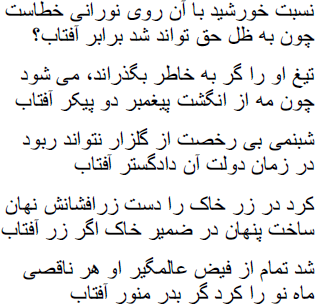
Another place where the concept of light frequently appears is in introductory lines or the main body of the qaṣīdehs. There, it builds the foundation of the poetic presentation of a legitimate ruler. Ṣāʾib’s tashbībs (introductory lines in qaṣīdeh) represent the world in growth and prosperity, usually depicting nature as calm and full of happiness. Ṣāʾib’s tashbībs usually present spring or the end of winter, when the world finds a fresh soul after its seasonal death. Nature is described in terms of its beauty, its light, and its fragrance. This combination of beauty and illumination was a response to the new king coming to the throne. Additionally, light as seen in celestial references plays an important role in the overall structure of Ṣāʾib’s poetry. The illuminated world under the Safavid ruler is usually presented through portraying a cluster of shining objects (mostly the stars) and ideas such as ṣāḥib-qirān, saʿd (with good omen), saʿādat (fortune), light, and the sun. This interest in utilizing the themes of nature and light for praise is demonstrated especially in one of Ṣāʾib’s qaṣīdeh in which āftāb (the sun) is its radīf.Footnote 68 The king is known as “the sun,” who gives his army enough security to conquer the world with him. In the section praising the king, the poet uses the sun to describe the king’s attributes, especially the features that portray him as a spiritual and religious leader. Both the sun and the king are bright, and both are generous. The sun’s brightness makes all stars look smaller and dimmer. This is intended to show the king’s superiority over other rulers. The everlasting nature of the sun has also been used to refer to the king’s constant effort in praying. The sun is bright and shining because it never sleeps, and it is thus similar to the king, who does not sleep because he prays continuously.
In the antistrophe,Footnote 69 the poet takes another stance in comparing the sun with the king. The king and the sun no longer resemble each other, because the king is “the shadow of God” and it is impossible for the shadow and the sun to be equal:
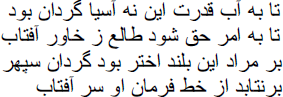
Ṣāʾib ends this qaṣīdeh by referring to the authority of the king in the absence of Imam Zamān (the twelfth imam), who is also represented in the metaphor of the sun:
Another example further illustrates the use of metaphors of light in qaṣīdehs. In the following lines, which constitute the beginning of a qaṣīdeh in praise of Shah ʿAbbās II, Ṣāʾib utilizes light and related ideas in four consecutive lines and in three discourses related to Safavid ideology. The presence of morning upon the king’s forehead is a metaphor for light and is a supernatural event, which was considered to be exclusive to the friends of God. By this description, Shah ʿAbbās II is identified as one of God’s friends (awlīyā). This idea presents the king as the leader of a Sufi order. In the second line, pure, noble (sharīf), and jewel or lineage (gawhar) are all images that remind the reader of attributes such as “clean” and “bright” that refer to the king’s stately genealogy, going back to Imam Mūsā al-Kāẓim, the seventh imam. Safavid Shiʿi genealogy holds a significant position for Ṣāʾib. He attests that the connection between the family of Safavids and the Prophet is a privilege for the Safavid kings, giving them the right to rule in other places as well. The idea of light is used in the third line to refer to the king’s military skills by connecting him to Imam ʿAlī. In the fourth line, the sun refers to the title “the shadow of God on Earth,” which is the basis of the third pillar of Safavid legitimacy and is in line with pre-Islamic notions of Persian kingship:
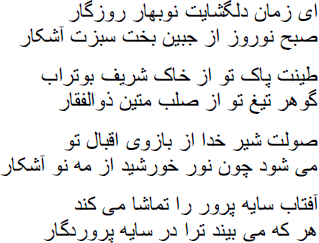
Images dealing with the king’s virtues play an important role in legitimizing the Safavid king as the rightful ruler. Shah Ṣafī has the right to rule not only because of his genealogy, but also because he possesses virtues that no other kings possess. Ṣāʾib, in a eulogy for Ṣafī, describes the king with taqaddus (sacredness/holiness) along with adjectives such as “bright-hearted,” “dervish-like,” and āyat-e khudā (God’s sign) to combine the characteristics of both Sufis and imams and to argue for the religio-political authority of the king:
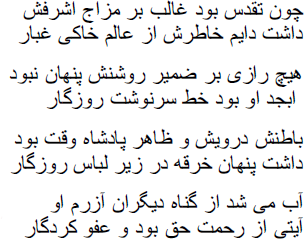
Ṣāʾib develops the idea of a Safavid king as a spiritual leader by applying the title murshid-e kāmil or considering ‘iṣmat (infallibility) for his patron, a feature that generally is reserved for Sufi leaders and imams:
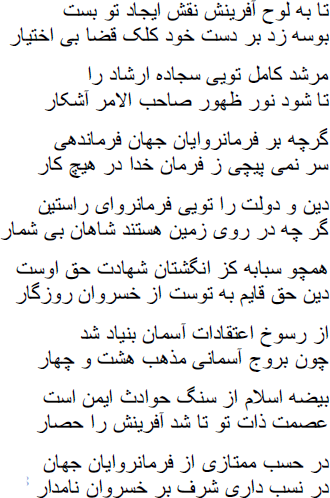
Furthermore, the poet claims “perfect knowledge” for the king that was granted to him by God’s will.Footnote 79 Divine knowledge was understood as knowledge that could be gained without conventional education. It is achieved by God’s grace and attention towards specific individuals, such as prophets and imams:
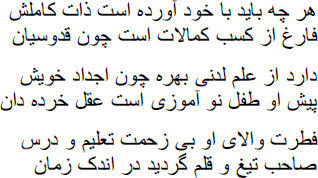
The way Ṣāʾib praises his patrons is different in terms of structure and content from how Faṣīḥī writes for Shah ʿAbbās II. Faṣīḥī’s qaṣīdeh, similar to Salīm’s qaṣīdeh in praise of Shah Ṣafī I, did not make a direct affiliation between Shah Ṣafī and the house of the Prophet. He started his praise for the king with the king’s political authority, which soon shifted to the king’s generosity and his other personal characteristics. The poet did not center his praise on the political authority of the king; instead, he speaks of the king’s personal traits such as magnanimity and a hot temper:
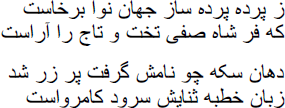
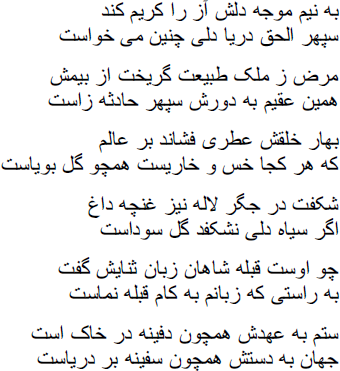
Faṣīḥī’s language in a qaṣīdeh that he writes for Shah ʿAbbās gives a caring, sympathetic portrait of the king. This is not the image of an awe-inspiring king but rather of a king whose presence drives out illness and brings prosperity. This language continues when the poet describes the sorrow following Shah ʿAbbās I’s death. The sacred and spiritual characteristics of the king demonstrated itself in the influence that the king had over the world:
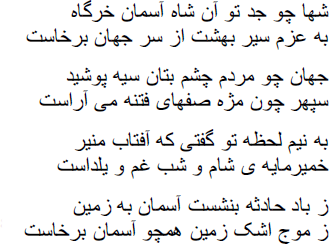
The poet compares the advent of Shah Ṣafī to a new sun for the world bringing justice with it:

The poet applied no expressions of Alid sentiments or Mahdism to praise the king. The king Faṣīḥī represented is not a Shiʿi king. The king is divine, and the world responds to his spiritual character, but this spirituality does not relate to his role as a Shiʿi leader of the empire.
As seen, in some of these panegyrics there are no indication of patterns that usually and extensively were used in other materials to discuss the king’s legitimate right to rule. The lack of references to those dominant patterns points to the limited audience of these materials.
Conclusion
This paper, through an analysis of numismatic and architectural evidence, in addition to royal investiture orations, enthronement ceremonies and panegyrics, has argued that the main elements of the Safavid ideology—similar to the pre-Islamic Persian kings, possessing the spiritual characteristics of the Sufi saints, and ruling as the shadow of God on earth—were not uniformly emphasized throughout Safavid history. A different combination of these ideologies appears in various materials and places to encourage acceptance of the Safavid monarchs as legitimate kings, substitutes for a just imam, and Sufi leaders. Coins that traveled over the Persian empire’s borders emphasized the idea of a world-conqueror Shiʿi sovereign king. However, the cultural materials distributed within the Persian empire’s borders benefited from a language that, as Babayan argued, demonstrated an interest in showing respect to Imam ʿAlī and the family of the Prophet. Additionally, it drew from the stories of Shāhnāmeh and the idea of Persianate kingship to make ties between the Safavid dynasty and the pre-Islamic Persian kings, who were revered as sacred kings and the appointees of God. Nevertheless, the interest in Shiʿism does not appear in most of the panegyrics that are dedicated to Safavid kings. These poems, in terms of praising kings, do not offer a significant change from poems written for Sunni Muslim kings. This paper argues that despite the differences in legitimizing patterns in these cultural materials, there was no change or shift in the main ideology of the Safavid rulers. Indeed, a combination of ideologies that existed before the Safavids and were practiced by people of different culture and religion allowed the Safavid monarchs to spread their power wide and find roots among the people.
The author would like to express appreciation to professors Yaseen Noorani, Sholeh Quinn, Sunil Sharma, Austin O’Malley, and Anne Betteridge. Without their support, advice, and feedback writing this paper would not have been possible. My deep thanks also to anonymous reviewers and also the editors of Iranian Studies, who took time to double-check my work, suggested additional resources, and identified areas to be polished.
 Farhangī,