In 2003, roughly 23 million people living in the member states of the European Union had been born outside of the country they resided in. From all over the world, they constituted between around 1 per cent (Lithuania, the Czech Republic) and 35 per cent (Luxembourg) of their host country's populations. While many of these immigrants moved to their adopted countries in the process of decolonization (like South Asians to Britain or North Africans to France), others came as guest-workers to help build and sustain European economies in the aftermath of the Second World War (e.g., Turks and Yugoslavs in Germany and Denmark) or arrived as refugees seeking to escape war and persecution from countries such as Iran, Iraq, Afghanistan and Sri Lanka.Footnote 1 Remarkably, at the dawn of the new millennium, foreign-born persons constituted more than 10 per cent of the total population in many European nations, with countries such as Austria, Switzerland, Luxembourg, Ireland, Germany and Sweden recording proportions of foreign-born residents as high as or even higher than those found in traditional immigration countries like the United States.Footnote 2
Undoubtedly, immigration leaves a mark on the political, economic and social life of both immigrant sending and receiving countries; conversely, receiving countries shape the lives immigrants lead.Footnote 3 The rioting in French banlieues, protests in Denmark against cartoons of the Prophet Muhammad, and lobbying in favour of new mosques in Germany or Muslim women's right to wear veils are only the most conspicuous examples of a growing awareness among immigrant communities across Europe that politics influences their rights and interests. Given the increasing dependence of European economies on foreign-born labour, legions of retirees on the horizon and the potential for conflict, one critical issue on the minds of voters and policy makers alike is the smooth and successful integration of foreign-born residents into the political fabric of receiving countries.
To date, the political impact of migration has been studied mainly with an eye towards the immigration-related attitudes and behaviour of native populations,Footnote 4 or the immigration policies pursued by host governments.Footnote 5 As a consequence, we know little about immigrants themselves – in particular, whether participation patterns vary between natives and migrants, or among migrants themselves.Footnote 6 Alongside this, we have limited information about the sources of such differences – if they in fact exist – and whether they are due to individuals’ status as citizens, their formative experiences or something else entirely.
Below, we address these issues by examining political participation in Europe: we focus on differences between citizens and non-citizens, and between foreign-born and native-born individuals. We argue that citizenship is a resource that enables immigrant political engagement, but that its power to shape political engagement varies systematically across individuals and types of participation. In particular, we expect citizenship to foster political engagement among immigrants whose socialization experiences in their country of origin would normally depress participation and for political actions that are more costly. Thus, understanding patterns of immigrant political action and the role citizenship can play in shaping these requires that we take into account the interplay of citizenship, immigrant socialization experiences and the nature of political actions. We test these arguments using the European Social Survey (ESS) data collected in nineteen European countries in 2002–03.
This article seeks to make several contributions to research on immigrant political participation and political incorporation. First, given that the quality of democratic life across Europe will increasingly depend on whether people have opportunities to express their grievances peacefully, contribute to collective policy deliberation and develop a stake in the political system, our research redirects attention away from natives and policy makers towards immigrants themselves. Secondly, on a theoretical level, we highlight the critical, but complex, role that citizenship plays in shaping immigrant participation and the variable effects it can have among different kinds of individuals and on different types of participation. Thirdly, by distinguishing theoretically and empirically between the effects of citizenship and of being foreign-born, we develop a more nuanced understanding of the interplay between socialization experiences and citizenship status in forming the patterns of political engagement among migrants. Finally, our analysis breaks new empirical ground by going beyond the single most heavily studied case of immigrant participation – the United States – a country that in many ways is an unusual case. Instead, we test existing arguments against a varied and extensive sample of European nations with diverse groups of foreign-born residents.
We proceed as follows: the next three sections present and elaborate our argument. We then describe our data and measures, present our results and conclude by offering suggestions for further research.
Citizenship and Immigrant Political Participation: Prior Studies
Although European countries have long experienced significant migration, we know little about its consequences for countries’ patterns of civic life. In good part, this is because research on immigrant political participation has focused on immigrants’ voting behaviour (usually turnout or registration). To be sure, voting is a key consideration when it comes to the demand side of democratic politics, but the focus on voting has meant that scholars have paid limited attention to the role of citizenship: after all, since non-citizens do not have the right to vote in national elections, they are typically excluded from the growing number of studies on immigrant electoral participation.Footnote 7 This creates a disconnect between debates about citizenship laws, which revolve around the question of immigrant incorporation and integration, and empirical studies whose focus on electoral participation fails to capture the full range of participation by all immigrants.
The predominant focus on electoral participation is not surprising, considering that most studies of immigrant participation have concentrated on the United States, a country where native-born persons acquire citizenship at birth and foreign-born individuals usually arrive as non-citizens.Footnote 8 But this has meant that most studies of immigrant political participation have examined a single case with a particular citizenship regime and, we would argue, an unusual history of migration among the advanced industrialized democracies. Conversely, the histories of immigration and citizenship policies across Europe vary quite distinctly, with some countries more heavily influenced by their colonial past and history of democratization, while others are more dependent on recent economic changes.Footnote 9
As a result of the focus on the US case, scholars have centred their attention mainly on differences in electoral participation between native-born and foreign-born citizens, while, by design or perhaps unwittingly, ignoring the distinction between foreign-born citizens and foreign-born non-citizens, or excluding non-citizens altogether.Footnote 10 Focusing on the behaviour of naturalized citizens can produce empirical and theoretical ambiguities regarding the consequences of citizenship, however. An example of the confusion that can arise from conflating citizenship status and nativity can be found in a paper by Louis DeSipio,Footnote 11 which argues that the process of naturalization in the United States should encourage people to behave as good citizens. Here, citizenship acquisition is understood not merely as a change in legal status but also a process of mandatory socialization and learning. To test this idea, DeSipio focused on the differences in the political behaviour of naturalized and native-born citizens, while excluding all foreign-born non-citizens from the analysis. Although DeSipio expected the experience of naturalization to contribute positively to political participation, he found just the opposite – namely, that naturalized citizens actually participated less than native-born citizens.
This result, however, is not surprising in the light of other studies, which consistently reveal that foreign-born individuals participate at lower rates than native-born ones.Footnote 12 In fact, a number of reasons may explain the failure to detect the hypothesized effect of citizenship on political participation, but perhaps chief among them is the exclusion of non-citizens from the analyses, thereby precluding the possibility of empirically distinguishing between the impact of being foreign-born and that of naturalization/citizenship.Footnote 13 For example, if foreign-born status has a more powerful (and perhaps negative) impact on political engagement than the expected positive effect of citizenship, then it would not be surprising that their combined effect – captured by a single variable (foreign-born citizens), rather than two – turns out to be negative.
Speaking more generally, existing studies are ambiguous about the role that citizenship can be expected to play in shaping political engagement among foreign-born individuals, and no existing studies differentiate among all the different categories of citizens/non-citizens and native/foreign-born individuals.Footnote 14
Conceptualizing the Influence of Citizenship on Political Participation
Aside from the ambiguity that arises from conflating citizenship and native-born status, research into the connection between citizenship and political participation has occasionally conflated the two through the use of participation as an indicator of active – that is, ‘virtuous’ or ‘effective’ – citizenship.Footnote 15 Blurring the distinction between citizenship as a legal category and as a set of behaviours is problematic, because citizenship provides people with opportunities to participate, but it does not guarantee that they will actually take advantage of these.Footnote 16
To cut through these empirical and conceptual ambiguities, we start by conceptualizing citizenship as legal status.Footnote 17 Based on the well-documented premise that participation requires resources, we treat the legal status of citizenship as a resource that facilitates political engagement. Citizenship contains instrumental and psychological dimensions.Footnote 18 Instrumentally speaking, the state has always regulated political activity by defining which forms of participation are legal and who has the right to participate in them. The key ways in which it has done so is by defining membership in the political community through citizenship that gives individuals certain rights and protections not shared by non-citizens.Footnote 19 Thus, citizenship is a resource provided by the state, and one that has the capacity to lower the legal risks and the potential costs of participation.
Most obviously, citizenship provides an admission ticket for voting.Footnote 20 The right to cast a ballot in elections should for obvious legal reasons be an overwhelmingly powerful marker between voters and non-voters (the cost of voting legally is much lower than the cost of trying to vote illegally). However, citizenship's influence as a resource can be expected to go beyond the ballot box since it provides a number of other rights and protections that may be particularly influential in shaping non-electoral political action. Specifically, the costs of participation can vary considerably for citizens and non-citizens. While citizens might be fined for participating in an illegal protest, individuals lacking citizenship status might be deported or lose the chance ever to naturalize since many countries bar the criminally convicted from becoming citizens.Footnote 21
Beyond its instrumental value, citizenship is also likely to provide a psychological boost to political engagement resulting from its role as a social identity. Speaking generally, citizenship defines who is and who is not a full member of the political community. We posit that the identity effects of citizenship may be particularly pronounced among immigrants because they acquire citizenship through a process of naturalization that requires learning about the rights and responsibilities of citizenship and professing loyalty to the democratic order of a country. As such, citizenship can also be conceptualized in psychological terms as a resource that encourages people to internalize the democratic ideals of active citizenship and, in doing so, makes cognitive engagement with politics less costly.Footnote 22
Thus, if citizenship is more than a legal entitlement to vote and functions as a resource that helps individuals to offset the costs of participation, we would expect citizens to engage in non-electoral forms of political action at higher rates than non-citizens, and foreign-born citizens (rather than merely residents) to participate as much as native-born citizens.Footnote 23 This implies that the influence of citizenship on political engagement is broader than existing studies of immigrant electoral behaviour surmise and contributes positively to forms of participation that do not require formal membership in a nation state.
Citizenship, Socialization and the Varieties of Political Action
When considering the impact of citizenship as a resource on participation among immigrants, the question arises as to whether this presumed effect is uniform or whether it can be expected to vary across different types of political acts or individuals. We argue that it is unlikely that citizenship has a ‘one size fits all’ effect. Specifically, we posit that the resource of citizenship should be particularly potent in mobilizing more costly political acts and among individuals whose socialization experiences are inauspicious for political engagement.
Citizenship and Varieties of Participation
Given the variable costs associated with different political acts, we expect citizenship to facilitate immigrant engagement in more costly forms of participation. One way to identify such acts is to take a broad view of political engagement and to differentiate between those that are less costly because they are formalized, routinized and have a developed mobilization ‘infrastructure’ and those that are not. This distinction maps onto the empirical and theoretical categorization of political acts into conventional, institutionalized political acts (mostly) orientated towards electoral processesFootnote 24 and unconventional, uninstitutionalized forms of participation that take place outside of electoral politics and often involve more spontaneous, episodic and disruptive political acts.Footnote 25 Because uninstitutionalized acts, by definition, are less formalized and routinized, often require more effort and co-operation, and run the risk of being less socially acceptable, they are more costly than institutionalized activities. As a result, if citizenship is a resource for political mobilization, we expect it to be a more powerful catalyst in shaping uninstitutionalized political acts than conventional activities.
Citizenship and Varieties of Socialization Experiences
The difficulty of specifying the effects of citizenship on political participation among foreign-born individuals empirically lies partially in the complex task of disentangling the effects of citizenship from the effects of being a foreigner – that is, people's socialization experiences. At the level of individuals, this comes down to differentiating between citizenship on one hand and place of birth on the other. The conceptual distinction between nativity and citizenship status suggests a fourfold typology among a country's residents: (1) native-born citizens (the largest share of population in most countries), (2) native-born non-citizens (present in countries without jus soli), (3) foreign-born citizens (who can be either naturalized residents or foreign-born offspring of citizens) and (4) foreign-born non-citizens. This distinction is important for empirical reasons as well because it raises the question of whether citizenship (or the lack thereof) exerts an effect on participation patterns once we have accounted more fully for what it means to be a foreigner. Below we focus on a factor that has been identified as a likely source of differences in the patterns of political engagement among the foreign-born: socialization experiences in the country of origin.
Regardless of whether one has become a citizen, being an immigrant means having been born into and having lived in a different political environment. These experiences are bound to leave a mark, and researchers have sought to trace how much and what kind of an impact they leave. Studies have shown that standard explanations, such as the socio-economic model of political participation, are helpful but insufficient for understanding why immigrants engage in politics. In particular, since foreigners are socialized in a political system that is different from the one they currently inhabit, explaining their participation patterns more fully requires accounting for these experiences.Footnote 26
A critical factor shaping the experiences of foreign-born individuals prior to their arrival has long been thought to be the level of democracy in the country of origin. Less democratic regimes are usually associated with less exposure to democratic norms, a weaker sense of civic responsibility, and fewer skills and less knowledge necessary for political engagement in liberal democracies.Footnote 27 Moreover, scholars tend to assume that arrivals from less democratic countries typically have lower levels of political trust due to their previous experiences with state-sponsored oppression.Footnote 28 Conversely, previous exposure to democratic governance is expected to facilitate immigrant adaptation and their political integration into a democratic host country.Footnote 29 Thus, because the skills and knowledge necessary for political involvement learned from an early age in full-fledged democracies are likely to be systematic factors shaping participation, we hypothesize that immigrants from more democratic countries face a lower hurdle of political involvement than immigrants from less democratic ones.Footnote 30
An important question in the context of our hypothesized effect of democratic socialization experiences is whether citizenship is an equally valuable resource among individuals with differential predispositions to participate in politics because of experiences in their countries of origin. We posit that such a resource is likely to be particularly useful for individuals who are less inclined to engage in politics in the first place. That is, viewed from the perspective of citizenship as a resource discussed above, we posit that the two – citizenship and socialization – interact, such that citizenship serves to moderate the impact of socialization experiences on engagement. Specifically, given the hurdle that socialization experiences in autocratic societies pose to democratic engagement, citizenship should help to offset the negative impact that growing up under an autocratic regime may have on participation.
Data and Measures
The individual-level data analysed below come from the European Social Survey (ESS) conducted in 2002–03. The ESS is a biennial academically-driven social survey that has been conducted since 2002 and now covers more than thirty countries. Funded by the European Commission, the European Science Foundation and academic funding bodies in each participating country, the project is known for its high standards of methodological rigour in survey design and data collection.Footnote 31 Hour-long face-to-face interviews are carefully designed for optimal comparability of survey questions across countries following rigorous translation protocols and pre-testing. To ensure high representativeness of national populations, the survey relies on strict random probability sampling that is based on full coverage of the eligible residential populations of 15 years old or older who are resident within private households, regardless of nationality, citizenship, language or legal status. The target minimum response rate is 70 per cent, and minimum effective sample sizes (completely responded units) are 1,500 or 800 where the total population is smaller than 2 million inhabitants.Footnote 32 Since we are particularly interested in foreign-born respondents who constitute a minority of those surveyed and because a portion of our analyses focuses on foreign-born respondents only, we sought to verify that our samples of foreigners from different countries closely match the characteristics of the populations under investigation.
We did so by conducting two additional analyses. First, we calculated the percentages of foreign-born respondents in the ESS sample and compared these to data measuring the actual percentages of foreign-born individuals collected by the European Union's statistical agency, Eurostat. The Pearson correlation between the percentages of foreign-born individuals in the surveys and foreign-born residents according to Eurostat census figures in the countries included in our study was 0.98, indicating an extremely close fit between survey and official statistics. Secondly, using a question about respondents’ country of origin, we investigated the extent to which our samples of foreign-born respondents were representative of populations in the countries under investigation by calculating the percentages of individuals from different regions of the world.Footnote 33 The Pearson correlation between the percentages of foreign-born individuals in our surveys from specific regions and the Eurostat data on foreign-born residents in the countries from these regions was 0.90, indicating yet again a very close fit between survey and official statistics.
In addition to providing high-quality data, the ESS is among the very few cross-national data collection efforts that sample non-citizens and ask questions related to people's citizenship, country of origin and length of stay in the receiving country alongside standard questions about political participation (it is also the only set of surveys that ask these questions in identical format across a range of countries). The relevant survey items and macro-level variables were available for nineteen European countries:Footnote 34 Austria, Belgium, the Czech Republic, Denmark, Finland, France, Germany, Greece, Ireland, Italy, Luxembourg, the Netherlands, Norway, Portugal, Slovenia, Spain, Sweden, Switzerland and the United Kingdom.Footnote 35
Dependent Variables
Our dependent variables are designed to measure non-electoral political engagement in several ways to account for the varieties of actions people engage in but also for the fact that the frequency with which people engage in any one act is relatively low. First, we constructed an additive index from the number of such activities respondents reported having engaged in over the course of the last year: contacting politicians or government officials; working for a political party; action group or another organization; wearing or displaying a campaign badge or sticker; signing a petition; boycotting or buying products for political; ethical or environmental reasons; donating money to political organizations; and participating in lawful demonstrations and illegal protest activities. This measure captures (non-electoral) political engagement in a very broad way; it allows individuals to choose their preferred form of participation and provides us with a wide variety of political acts that individuals can choose to engage in. The index ranges from 0 to 10, with higher values indicating more political action.Footnote 36
Since we hypothesize that the impact of citizenship will vary across types of political engagement, we also follow the extant literature and separate the overall index of participatory acts into institutionalized and uninstitutionalized forms of political engagement.Footnote 37 Institutionalized participation in politics is an additive index of the following five activities respondents reported having engaged in: contacting a politician or a government or local government official; working in a political party or action group; working in another organization or association; wearing or displaying a campaign badge or sticker; and donating money to political organizations. Uninstitutionalized participation is based on the following five activities: signing a petition; boycotting or buying products for political, ethical or environmental reasons; and participating in lawful demonstrations or illegal protest activities. Both measures of participation range from 0 to 5, with higher values indicating higher levels of political engagement.
Consistent with prior research, we find that overall levels of participation are quite low; the mean score on the political action index is 1.36 (on a 0–10 scale). Thus, individuals on average engage in (slightly more than) one kind of political activity. Looking at the underlying distribution of reported acts, about 44 per cent of respondents said that they had engaged in none of the activities, and another 34 per cent had been involved in only one or two, with the remaining 22 per cent of respondents engaging in more than two activities.
Independent Variables
Our key independent variables – citizenship and foreign-born status – are derived from two survey questions: ‘Are you a citizen of this country?’ and ‘Were you born in this country?’ Using responses to these questions, we created four dichotomous variables that classified respondents as foreign-born citizens, foreign-born non-citizens, native-born citizens and native-born non-citizens. Pooling the data across countries generates a sample of 3,174 foreign-born respondents, 1,752 of whom (55.27 per cent) are foreign-born citizens and 1,418 (44.73 per cent) foreign-born non-citizens.Footnote 38
To capture immigrant socialization experiences, we rely on two variables: level of democracy in the respondent's country of origin and an individual's duration of stay in the host country. Virtually all prior studies have measured democratic origin by categorizing respondents with regard to whether they come from a democratic or undemocratic country. Such a simple categorization misses considerable variation in immigrants’ political experiences, and it confounds a number of factors that may be associated with a country's level of democracy. To overcome these shortcomings and provide a more fine-tuned indicator of democratic socialization, we measure democracy in the country of origin with the help of three survey questions and a measure of democracy from the Polity IV dataset.Footnote 39
To identify respondents’ country of origin, they were asked, ‘Were you born in this country?’ If the answer was ‘No’, the follow up question was ‘In which country were you born?’ To identify when respondents arrived in the host country, those who were born abroad were asked, ‘How long ago did you first come to live in this country?’ We then matched information about the immigrant's country of origin and the time of migration with Polity IV data that measure the level of formal democracy (the extent to which citizens can express preferences about alternative policies and leaders, constrain executive power, and are guaranteed civil liberties in their daily lives) in the country of origin at the time of their departure (see Appendix for further details). To facilitate interpretation of the results, we rescaled the original polity variable so that the resulting variable of democracy in the immigrant's country of origin ranges from 0, indicating that someone was socialized in a ‘strongly autocratic regime’, to 20, which indicates that someone came from a ‘strongly democratic regime’.Footnote 40
Control Variables
Our multivariate analyses include a range of control variables past research has identified as consistent micro- and macro-determinants of political engagement: at the level of individuals, we include a standard set of demographic variables (age, gender, marital status) as well as indicators of people's socio-economic resources and status (income, education and employment). Moreover, we control for immigrant-specific experiences, such as how recently a respondent had arrived in the host country and whether a respondent immigrated from a member state of the European Union (EU). Finally, we include respondents’ religiosity and religious denomination, as well as measures of social connectedness and residential stability. At the macro-level, we take into account host countries’ political and economic characteristics, such as a level of economic prosperity and growth, the extent of state intervention in the economy, and a country's experience with democratic governance. In addition, we control for immigration-specific contextual characteristics, such as the size of the foreign-born population and the country's citizenship policy regime. Details on control variables and coding procedures are listed in the Appendix.
Analysis and Results
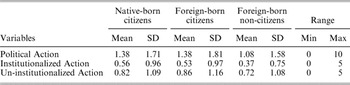
A first look at the data reveals that, on average, citizens participate more in politics than non-citizens: the mean values on the political action scale are 1.38 for citizens and 1.08 for non-citizens. This difference applies to both institutionalized (citizens: 0.56; non-citizens: 0.37) and uninstitutionalized political acts (citizens: 0.82; non-citizens: 0.72). Moreover, native-born citizens report roughly the same overall engagement in politics as foreign-born citizens both overall (1.38 on the political action scale) and with regard to institutionalized (native-born citizens: 0.56, foreign-born citizens: 0.53), and uninstitutionalized participation (native-born citizens: 0.82, foreign-born citizens: 0.86).
Descriptive Statistics of Political Participation by Citizenship and Nativity Status in Nineteen European Countries, 2002–03

Source: The European Social Society (ESS), 2002–2003.
To isolate with greater statistical precision the relative effects that citizenship, immigrant status and other factors have on patterns of participation, our analysis proceeds in three steps. First, we establish a baseline for the impact of citizenship on participation across all countries and all respondents. Comparing native-born and foreign-born respondents enables us to see whether observed differences between these groups are due to citizenship or having been born abroad. As a second step, we focus exclusively on foreign-born individuals to examine whether citizenship exerts an independent effect on political action, and whether it interacts with immigrant experiences in country of origin in shaping their political engagement in their new homeland. Finally, to ensure that any differences in the levels of political participation among foreign-born individuals are indeed due to citizenship status rather than some unobserved heterogeneity that drives both citizenship acquisition and political participation, we present two-stage instrumental variable estimations designed to address the potential problem of omitted-variable bias.
Citizenship, Foreign Birth and Political Participation: Baseline Models
Because the analysis requires that we combine information collected at the level of individuals and at the level of countries, the dataset has a multi-level structure (one level, the individual, is nested within the other, the country). To avoid a number of statistical problems associated with such a data structure (clustering, non-constant variance, underestimation of standard errors, etc.),Footnote 41 we estimated multi-level mixed-effects maximum likelihood models with random intercepts (to allow for cross-country heterogeneity in levels of participation), random slopes for our citizenship variables (to allow for cross-country variability in the magnitude of citizenship coefficients) and respondents clustered at the level of countries.
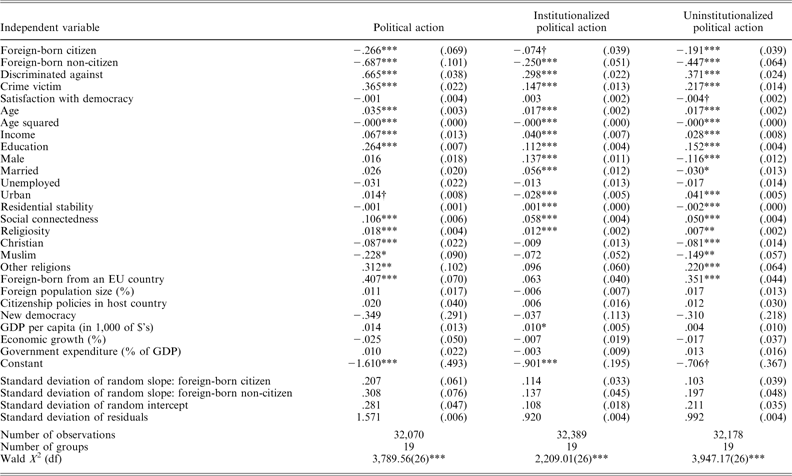
To assess the impact of citizenship on participation across all countries and all respondents in our base-line model, we included two dummy variables for foreign-born citizens and foreign-born non-citizens, using native-born citizens as the comparison group. The results, shown in Table 2, indicate that political engagement among foreign-born individuals is systematically lower than among native-born citizens, and is particularly low for foreign-born non-citizens. This finding is consistent across different types of political action and suggests that the key difference is between foreign-born non-citizens on the one hand and citizens (both native and foreign-born) on the other.Footnote 42
Political Participation in Nineteen European Countries, 2002–03

Note: Results are mixed-effects maximum likelihood estimates using STATA 11.0's xtmixed command. Numbers in parentheses represent standard errors. †p < 0.1, *p < 0.05, **p < 0.01, ***p < 0.001 (two-tailed). ‘Native-born citizens’ is the reference category for foreign-born citizens and foreign-born non-citizens; ‘non-religious’ – for Christians, Muslims and other religions.
Our analysis so far shows that citizenship matters for political engagement when we compare foreign-born citizens, foreign-born non-citizens and native-born citizens. This is an important baseline for pursuing the question of whether citizenship matters. However, statistically speaking, the estimates do not show conclusively whether participation rates among foreign-born citizens and foreign-born non-citizens are significantly different from each other, nor do they shed any light on the question of whether citizenship continues to have a positive impact on participation once we take into account immigrant experiences and characteristics more fully.Footnote 43 To do so, we turn to a more detailed analysis of foreign-born individuals.
Citizenship and Immigrant Participation
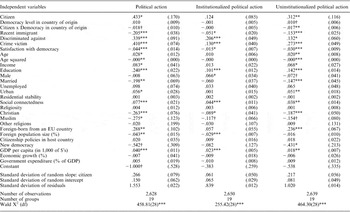
To examine the effects of citizenship on political participation among first-generation immigrants, and to see whether citizenship is more than just a placeholder for other individual differences, such as immigrant socialization experiences, we focus exclusively on foreign-born respondents as a next step. We estimate models similar to those reported in Table 2, with several additions: first, we now include a measure of citizenship; secondly, we control for the length of time respondents have lived in the country; thirdly, we include our measure of democratic socialization in the country of origin; and, finally, we include an interaction term of democratic socialization and citizenship to gauge the presumed conditional effect of citizenship on participation among individuals raised in less democratic environments. The results of these estimations are shown in Table 3.
Political Participation among Foreign-Born Individuals in Nineteen European Countries, 2002–03

Note: Results are mixed-effects maximum likelihood estimates using STATA 11.0's xtmixed command. Numbers in parentheses represent standard errors. †p < 0.1, *p < 0.05, **p < 0.01, ***p < 0.001 (two-tailed). ‘Non-religious’ is the reference category for Christians, Muslims and other religions.
They reveal that citizenship is positively related to political participation, but that its impact should not be considered in isolation. First, citizenship is not the only determinant of immigrant political action. Our results indicate that duration of stay in the receiving country also powerfully shapes political participation among the foreign-born. Specifically, we find that more recent immigrants engage in fewer political acts than foreigners who arrived many years ago. Thus, immigrants, regardless of citizenship, learn participation in the sense that prolonged exposure to the host country steadily builds capacity for political engagement.
Secondly, our results show that the impact of citizenship on political participation is conditioned by immigrant political socialization before arrival in the host country, and this is especially true for less institutionalized political acts. We find that the interaction term for citizenship and the level of democracy in the country of origin is negative, indicating that the positive effect of citizenship on political participation is systematically smaller among individuals who grew up in democratic countries. This means that the added benefit of citizenship is less valuable to individuals who hail from more democratic countries and more valuable to those who grew up in undemocratic ones.Footnote 44
Instrumental Variable Estimations of the Effects of Citizenship on Participation
While the results so far unanimously provide consistent evidence for our hypotheses, they are not ironclad. One particular difficulty with assessing the impact of citizenship on political participation is that people may self-select into the process of naturalization.Footnote 45 By this we mean that individuals who decide to seek citizenship may also be more motivated to participate in politics compared to immigrants who choose not to naturalize. As a result, the positive impact of citizenship on political participation could be spurious and instead result from some other characteristics – such as intrinsic individual motivations to engage in politics – that operate on both naturalization and political participation, rather than from citizenship per se.
There are two ways of addressing this possibility. First, to guard against spurious inferences in a traditional regression setup, it is important to control for important potentially confounding factors. This is a strategy we pursued in the estimations reported in Table 3. As the results showed, controlling for a host of attitudinal and demographic characteristics of individuals as well as the country-context in which they are located did not render the coefficients for citizenship insignificant.
As a second estimation strategy, we re-examined our models with the help of a two-stage instrumental variable (IV) approach. This approach can be used for a number of different reasons, but is employed here specifically because of its demonstrated ability to address the potential problem of omitting an unobserved but relevant explanatory variable.Footnote 46 Ignoring such a variable produces biased and inconsistent estimates; fortunately, these can be corrected using the IV approach, assuming that valid instruments can be identified.Footnote 47 Substantively, this will allow us to avoid the possible entanglement of our independent and dependent variables due to the potential selection of individuals with particular characteristics into acquiring citizenship.
We argue that geographic distance between an immigrant's country of origin and the new homeland as well as familial ties to the host country can be used as such instruments. Naturalization studies suggest that geographic distance between sending and receiving countries encourages citizenship acquisition because of a reduced likelihood of return migration. Conversely, greater geographical proximity presents more opportunities for immigrants to maintain frequent, continuous ties with their nearby homelands; this lowers the cost of return journeys, generating fewer incentives for immigrants to fully integrate in their host societies.Footnote 48
Having native-born parents also facilitates naturalization, as this allows foreign-born children to demonstrate blood ties to their host societies. Citizenship acquisition by descent – that is, on the basis of one's parents’ or grandparents’ nationality (also referred to as jus sanguinis) – is an important and in many countries the primary route to formal membership in a nation state.Footnote 49 All countries (including those that rely on jus solis) have provisions for citizenship acquisition by descent. For example, US government regulations specify that children born abroad can acquire US citizenship if: (1) both parents are citizens of the United States, and one of them resided in the United States before the birth of the child; or if (2) one parent is a citizen of the United States who resided in the United States for at least five years before the birth of the child.Footnote 50 Similarly, most European countries grant citizenship to foreign-born children if at least one parent is a citizen of that country.Footnote 51 This suggests that a foreigner with at least one parent who is a national of a host country is more likely to hold citizenship of that country, and having both parents who are native to the host country increases the chances of this even more.Footnote 52
While geographic distance and native-born parents matter for naturalization, we know of no theories of immigrant political participation arguing that these factors directly influence immigrant political participation. Thus, we have theoretical and empirical reasons to justify the selection of our instruments; however, we still need to demonstrate that our instruments meet the assumptions for the IV approach to provide consistent estimates. The assumption that the instruments are statistically independent from the disturbance process cannot be verified in the data directly.Footnote 53 However, since our model is over-identified, we can provide evidence that the instruments are adequate by reporting test statistics below.Footnote 54
Geographic distance is measured using geodesic distances between an immigrant's country of origin and the new home country based on the dyadic country dataset developed by the Centre d'Etudes Prospectives et d'Informations Internationales (CEPII). In our dataset, this variable ranges from 0 for immigrants who come from contiguous countries to 19,147 kilometres for the most distant country of origin. To measure familial ties to one's host country, we rely on two survey items asking whether the respondent's father and mother were born in this country. The variable ‘foreign-born parents’ ranges from 0 if both parents are native-born to 2 if both parents are foreign-born, with 1 indicating that one parent was born abroad and another is a native to the host country.Footnote 55
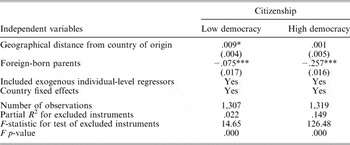
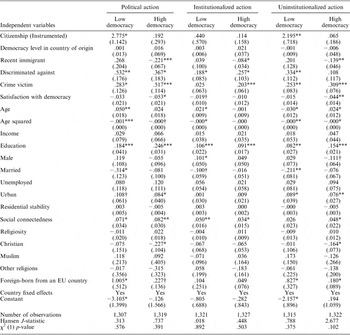
We report the results of the two-stage IV estimations in Tables 4 and 5 below. The first stage is designed to predict citizenship status among foreign-born respondents using our instruments while controlling for all variables specified in the model of political participation. Since the IV approach does not allow for multi-level modelling, we follow standard prescriptions in the statistical literature by also including country fixed effects to account for cross-country heterogeneity that might be influencing political participation, and estimate our models using robust standard errors.Footnote 56 The second stage then employs an instrumented citizenship variable as an independent variable in the model of political participation among foreign-born individuals. These estimations also include country fixed effects but drop substantive macro-level controls previously used in multi-level models due to collinearity.
Predicting Citizenship among Foreign-born Individuals in Nineteen European Countries, 2002–03

Note: The results are OLS coefficient estimates and their robust standard errors (in parentheses): *p < 0.05, **p < 0.01, ***p < 0.001.
Instrumental Variable Estimates of Political Participation among Foreign-born Individuals in Nineteen European Countries, 2002–03

Note: The results are IV coefficient estimates and their robust standard errors (in parentheses): †p < 0.1, *p < 0.05, **p < 0.01, ***p < 0.001. Citizenship is instrumented using geographical distance from foreigner's country of origin and foreign-born parents. ‘Non-religious’ is the reference category for Christians, Muslims and other religions.
Since our key hypothesis focuses on the interactive effects of citizenship and democratic socialization on political participation, we had to make one additional modification to our original model specification. Both stages in the IV models are estimated simultaneously; as a result, we cannot test for interaction effects with the help of a multiplicative term, given that the instrumented citizenship variable is produced between the two stages. An alternative way of dealing with independent variables that are hypothesized to have an interactive effect with another independent variable on the dependent variable of choice is to stratify the sample into two subsamples.Footnote 57 Therefore, we split our sample between immigrants from less and more democratic regimes using the median value of the democracy score (17.6 on a scale from 0 to 20) in our dataset to ensure that both samples were of similar size. If our interaction hypothesis is correct, we should observe a positive and statistically significant effect of citizenship among respondents from less democratic countries, but a smaller or insignificant effect among those from more democratic regimes.
The first stage of the IV estimations, reported in Table 4, indicates that both instruments have the anticipated signs and are significantly correlated with citizenship.Footnote 58 We find that, controlling for all predictors of political participation as well as country fixed effects, immigrants from more geographically distant countries of origin are more likely to enjoy citizenship status, as are foreigners who have native-born parents. The magnitude of coefficients, however, depends on whether immigrants come from less or more democratic regimes: while having two foreign-born parents significantly reduces citizenship acquisition among new arrivals from highly democratic countries, geographic distance is particularly important for naturalization among foreigners from less democratic regimes.
To systematically assess the validity of our instruments, we rely on several test statistics. First, the F-statistic for testing excluded instruments is equal to 14.6 for immigrants from countries with low levels of democracy, and 126.48 for those who arrived from highly democratic countries. Despite this difference, in both cases the F-statistic is significant at less than 0.001, indicating that our instruments are jointly significant. Furthermore, the Hansen J-test statistic in all models recorded in the second-stage estimations reported in Table 5 is statistically insignificant, indicating that the instruments are appropriately uncorrelated with the error term in the second-stage estimations. Taken together, the results indicate that the selected instruments are relevant and statistically independent from the disturbance process, satisfying the key requirements of valid instruments of the IV approach.
The results of the second-stage estimations, shown in Table 5, are fully in line with our expectations and the multi-level results reported above. As before, we find that citizenship has a positive effect on immigrant political action, but this effect exists only among immigrants from less democratic regimes. Moreover, the positive impact of citizenship is particularly pronounced in the model of uninstitutionalized acts, while it falls short of conventional levels of statistical significance when it comes to predicting institutionalized participation in politics. Hence, our results indicate that the impact of citizenship on immigrant political engagement is not spurious but genuine and in the causal direction posited above: citizenship indeed encourages foreigners from less democratic countries to be more involved in uninstitutionalized political acts.
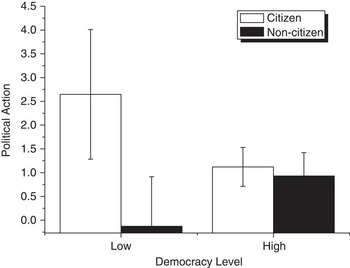
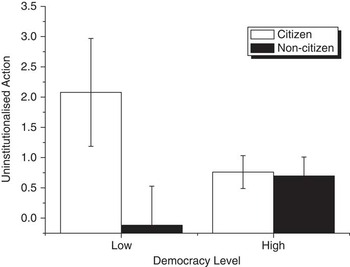
How much does citizenship matter? To assess our results in greater detail, we calculate the marginal effect of citizenship on political participation among foreign-born individuals at various levels of democracy in their countries of origin. Figure 1 plots the magnitude of this effect for the political action variable and Figure 2 for uninstitutionalized acts, using the instrumental variable estimations reported in Tables 4 and 5. The white bars indicate the levels of political engagement among foreign-born citizens and the black bars participation by foreign-born non-citizens; the vertical lines show the 95 per cent confidence intervals.Footnote 59
Marginal effects of citizenship status on political action among foreign-born from countries with low and high levels of democracy Note: Vertical lines indicate 95% confidence intervals

Marginal effects of citizenship status on uninstitutionalized political action among foreign-born from countries with low and high levels of democracy Note: Vertical lines indicate 95% confidence intervals.

Calculations of the substantive effects reveal that our key variables of interest indeed have a sizeable impact on immigrant political participation. Specifically, Figure 1 indicates that the political action score for an immigrant who grew up in a country with a low level of democracy and who is a citizen exceeds the score of a similar individual who is not a citizen by 2.774 points (+2.647 vs. −0.127). In contrast, the gap in the levels of political action between citizens and non-citizens is reduced to only 0.192 for immigrants from highly democratic countries: the score for citizens is 1.121, while non-citizens are close behind with a value of 0.929 on the political action scale. The pattern for uninstitutionalized acts is very similar: while immigrants from less democratic regimes participate at a level of 2.078, non-citizens have a significantly lower score of −0.117. In contrast, the difference between citizens and non-citizens from more democratic countries is only 0.064 (0.761 vs. 0.697). In short, citizenship has a positive effect on non-electoral participation among foreign-born respondents, but it is substantively and statistically significant only among those who arrived from less democratic regimes.
Discussion
Across the European democracies, few issues have been more sensitive, explosive or politically effective in changing party electoral fortunes and arousing public passions than the topic of immigration and citizenship, perhaps because it touches raw nerves closely connected to a country's identity and sovereignty.Footnote 60 On one hand, sceptics of immigration fear that changing the racial, ethnic and religious composition of European societies introduces new social tensions, particularly in hard economic times and when immigrants are poorly integrated into their host societies. On the other hand, proponents of immigration believe that ethnic and racial heterogeneity enrich the cultural fabric of societies and bring important economic benefits such as a younger and more flexible labour force necessary to replace ageing populations. Considering that migration to Europe is unlikely to recede,Footnote 61 migrant integration in their host countries will remain a pressing issue for governments and citizens alike.
In recent years, a number of European countries have debated the question of how to treat migrants, and in particular, how to define citizenship. Virtually every country in the EU-15 has revisited – though not necessarily revised – its citizenship laws.Footnote 62 A prominent example is Germany, which in 1999 fundamentally redefined who was eligible for citizenship by moving from a pure jus sanguinis to a mixed form of jus sanguinis and jus soli and for the first time giving individuals born in Germany, but not necessarily to German parents, the right to citizenship.Footnote 63 This change took place against the background of increased migration from the former Soviet bloc since the fall of the Berlin Wall, as well as the presence of a large proportion of residents from Turkey whose children had been born and raised in Germany. In sharp contrast, the 1990s saw the tightening of citizenship laws in France, where Charles Pasqua, the French minister for the interior, introduced a law in 1993 that, among other things, made it more difficult for immigrant children born in France to become French citizens.Footnote 64 Similarly, some aspects of citizenship laws became more restrictive in Ireland and Italy.Footnote 65
Defining who is eligible for or entitled to citizenship is more than an academic or moral question, however. In a democracy, it also affects who has the right to choose the government, stand for office and influence policy making. To better understand the consequences that granting citizenship has on immigrant political participation in European democracies, we focused on several important but unanswered questions: do foreign-born respondents differ with respect to their political engagement from native-born ones? Does it matter what kinds of political acts we examine? Do the patterns of participation for citizens diverge from those of non-citizens once we control for whether people are born in another country? And, finally, are differences in participation among foreigners due to citizenship or something else?
Thus, our study sought to shed light on an understudied question – the role of citizenship versus immigrant status for political participation – but also aimed to put prior, but contested, arguments about socialization experience to a more stringent test across a wider range of cases and outside the US context. We argue that, when it comes to political engagement, it is useful to conceptualize citizenship as a legal and psychological resource that facilitates and encourages participation. Moreover, we posit that it is important to distinguish the impact of having or lacking citizenship from the effect of having been born and raised in a foreign country. Our results show that citizens – regardless of whether they are foreign-born or native-born – participate in politics at higher rates than non-citizens.
We also argue that a fuller understanding of immigrant political participation and the impact of citizenship on foreign-born individuals requires that we distinguish the experiences individuals have as immigrants from the effects we observe as a consequence of citizenship. Our results lead us to conclude that, while citizenship quite naturally divides voters from non-voters, its positive impact on participation beyond casting ballots is contingent on the type of political activity and the level of democratic socialization immigrants experience in their country of origin. Specifically, we find that citizenship has a particularly powerful effect in boosting uninstitutionalized participation in politics, especially among individuals who were socialized in less democratic countries. This suggests that granting immigrants citizenship indiscriminately is unlikely to be sufficient for fostering political engagement among foreign-born residents. Instead, the effects of citizenship are most apparent among those immigrants whose socialization experiences are least auspicious for democratic engagement and for acts of participation that are least institutionalized.
This conclusion may not be politically congenial to everyone. But recall that our results also show that citizenship has the strongest effect among individuals socialized under undemocratic regimes and thus counteracts the negative traces that the country of origin may leave on immigrant participation. Thus, citizenship matters and enhances participation, but not for everyone and not for every kind of political act. Whether these results generalize outside of the European context and whether they hold true for all immigrants socialized under undemocratic regimes or across immigrant generations are of course questions in need of further investigation. Moreover, given the variety in citizenship regimes, research on immigrant political behaviour would also benefit from more detailed studies of whether particular naturalization policies or democratic socialization procedures are more effective in mobilizing immigrant political engagement than others. For example, we would speculate that citizenship regimes that contain a heavier component of teaching civic skills and knowledge are more effective in inculcating new citizens with the resources to become politically engaged.
Moreover, little is known about how political organizations, especially labour unions and ethnic community institutions, as well as the nature of migration and residential concentration of foreigners affect their involvement in politics across European countries. And while citizenship is one conceptual lens through which to view patterns of immigrant incorporation, we hasten to add that non-citizens are not all created equal. While some foreign-born non-citizens – for example, citizens of EU member states – have various political, economic and social rights, others – third-country nationals – do not, and this may well affect how they become politically engaged. These are rich but complex questions that deserve further investigation.
We conclude that, while governments cannot control immigrant socialization experiences in their country of origin, they are not completely powerless when it comes to shaping the civic engagement of immigrants. Our results suggest that there is good reason to believe that citizenship can counteract particularly detrimental effects of growing up in less democratic countries; as well, they imply that giving immigrants time to adjust to their new environment and facilitating their learning about democratic governance might be a promising and straightforward way of producing a high quality of civic life in contemporary democracies.
Appendix: Measures and Coding
Political Action. Based on the following survey questions: ‘There are different ways of trying to improve things in [country] or help prevent things from going wrong. During the last 12 months, have you done any of the following? (1) Contacted a politician, government or local government official, (2) Worked in a political party or action group? (3) Worked in another organization or association? (4) Worn or displayed a campaign badge/sticker? (5) Signed a petition? (6) Taken part in a lawful public demonstration? (7) Boycotted certain products? (8) Deliberately bought certain products for political, ethical or environmental reasons? (9) Donated money to a political organization or group? (10) Participated in illegal protest activities?’ The additive index ranges from 0 to 10, with higher values indicating more politically active respondents.
Institutionalized Action. Based on the following survey questions: ‘There are different ways of trying to improve things in [country] or help prevent things from going wrong. During the last 12 months, have you done any of the following? (1) Contacted a politician, government or local government official, (2) Worked in a political party or action group? (3) Worked in another organization or association? (4) Donated money to a political organization or group? (5) Worn or displayed a campaign badge/sticker?’ The additive index ranges from 0 to 5, with higher values indicating more politically active respondents.
Uninstitutionalized Action. Based on the following survey questions: ‘There are different ways of trying to improve things in [country] or help prevent things from going wrong. During the last 12 months, have you done any of the following?: (1) Taken part in a lawful public demonstration? (2) Boycotted certain products? (3) Deliberately bought certain products for political, ethical or environmental reasons? (4) Participated in illegal protest activities? (5) Signed a petition?’ The additive index ranges from 0 to 5, with higher values indicating more politically active respondents.
Citizen. Based on survey question: ‘Are you a citizen of [country]?’ 1: ‘Yes’, 0 ‘Otherwise’.
Foreign-born. Based on survey question: ‘Were you born in this country?’ 0: ‘Yes’, 1: ‘No or no answer’.
Foreign-born Citizen. Based on two survey questions: ‘Are you a citizen of [country]?’ and ‘Were you born in [country]?’ Respondents who answered ‘Yes’ to the first question and ‘No’ or gave no answer to the second were coded 1, Otherwise 0.
Foreign-born Non-citizen. Based on two survey questions: ‘Are you a citizen of [country]?’ and ‘Were you born in [country]?’ Respondents who answered ‘No’ or gave no answer to both questions were coded 1, Otherwise 0.
Native-born Citizen. Based on two survey questions: ‘Are you a citizen of [country]?’ and ‘Were you born in [country]?’ Respondents who answered ‘Yes’ to both questions were coded 1, Otherwise 0.
Recent Immigrant. Based on survey question: ‘How long ago did you first come to live in [country]?’ 5 ‘within last year’, 4 ‘1–5 years ago’, 3 ‘6–10 years ago’, 2 ‘11–20 years ago’, 1 ‘more than 20 years ago’.
Democracy in Country of Origin. Based on the following survey questions: ‘Were you born in [country]?’ If a respondent answered ‘No’, then the follow-up question was: ‘In which country were you born?’ – and ‘How long ago did you first come to live in [country]?’ Information about immigrant country of origin and the timing of immigrant arrival was matched up with the polity scores from the Polity IV dataset http://www.cidcm.umd.edu/polity/. Since the ESS survey was conducted in 2002 and the timing of immigrant arrival is a categorical variable that captures only approximate number of years in host country, those who arrived more than twenty years ago were assigned an average value of their origin country 1972–81 polity score, those who arrived 11–20 years ago an average 1982–91, those who arrived 6–10 years ago an average 1992–96 score, those who arrived 1–5 years ago an average 1997–2001 score, and those who arrived within the last year a 2002 score. This generated a variable measuring the level of democracy in immigrant country of origin that ranges from 0 ‘least democratic regime’ to 20 ‘most democratic regime’ (recoded from the original polity measure that ranges from −10 to +10).
Geographic Distance from Country of Origin. We used the Centre d'Etudes Prospectives et d'Informations Internationales (CEPII) dyadic country data on geodesic distances to measure geographic distance between foreigner's host country and country of origin in the ESS data (in thousands of kilometres). We relied on the CEPII ‘simple distance’ measure calculated following the great circle formula, which uses latitudes and longitudes of the most important cities/agglomerations (in terms of population). For more information, please see http://www.cepii.fr/anglaisgraph/bdd/distances.htm.
Foreign-born Parents. Based on two survey items measuring whether respondent's father and mother are native-born. The variable ranges from 0 to 2, where 0 means that both parents are native-born, 1 ‘One parent is foreign-born’ and 2 ‘Both parents are foreign-born’.
Discrimination. Based on survey question: ‘Would you describe yourself as being a member of a group that is discriminated against in this country?’ 1 ‘Yes’, 0 ‘No’.
Crime Victim. Based on survey question: ‘Have you or a member of your household been the victim of a burglary or assault in the last 5 years?’ 1 ‘Yes’, 0 ‘No’.
Satisfaction with Democracy. Based on survey question: ‘And on the whole, how satisfied are you with the way democracy works in [country]?’ 0 ‘Extremely dissatisfied’, 10 ‘Extremely satisfied’.
Age. Number of years.
Income. Based on survey question: ‘Which of the descriptions on this card comes closest to how you feel about your household's income nowadays?’ 0 ‘Very difficult on present income’, 1 ‘Difficult on present income’, 2 ‘Coping on present income’, 3 ‘Living comfortably on present income’.
Education. The highest level of education achieved: 0 ‘Not completed primary education’, 6 ‘Second stage of tertiary education’.
Male. 1 ‘Male’, 0 ‘Female’.
Married. 1 ‘Married’, 0 ‘Otherwise’.
Unemployed. 1 ‘Not in paid work’, 0 ‘Employed or self-employed’.
Urban. Based on respondent's description: 0 ‘Farm or home in countryside’, 1 ‘Country village’, 2 ‘Town or small city’, 3 ‘Suburbs or outskirts of big city’, 4 ‘A big city’.
Residential Stability. Number of years in current area of residence.
Social Connectedness. Based on survey question: ‘How often do you meet socially with friends, relatives or work colleagues?’ 1 ‘Never’, 2 ‘Less than once a month’, 3 ‘Once a month’, 4 ‘Several times a month’, 5 ‘Once a week’, 6 ‘Several times a week’, 7 ‘Every day’.
Religiosity. Based on survey question: ‘Regardless of whether you belong to a particular religion, how religious would you say you are?’ 11-category variable, ranging from 0 ‘Not at all religious’ to 10 ‘Very religious’.
Religious Denomination. Based on two survey items: ‘Have you ever considered yourself as belonging to any particular religion or denomination?’ If ‘Yes’ ‘Which one?’ Response categories were used to create dummy variables for Christians, Muslims, other religions and non-religious.
Foreign-born from an EU Country. Based on the following survey questions: ‘Were you born in [country]?’ If a respondent said ‘No’, then the follow up question was, ‘In which country were you born?’ Response categories were coded as 1 if a foreigner reported that he or she was born in a country that was an EU member state at the time of the survey (2002–03) and 0 ‘Otherwise’.
Foreign Population Size. Percentage of total population. Source: Eurostat 2001 Census data.
Citizenship Policies in Host Country. Citizenship Policy Index.Footnote 66 Additive index based on three indicators: (a) citizenship by birth 0 ‘Not allowed’ 1 ‘Allowed’; (b) residency requirement for naturalization: countries that require at least ten years are coded 0 ‘Difficult’; those that require six to nine years of residence are coded 1 ‘Medium’, and those that require five years or less are coded 2 ‘Easy’; (c) acceptance of dual citizenship for immigrants: 0 ‘No’ 1 ‘Yes’. The resulting variable ranges from 0 ‘Restrictive citizenship policies’ to 6 ‘Liberal citizenship policies’.
New Democracy. Dichotomous variable: respondents from two newer democracies in our sample – the Czech Republic and Slovenia – were assigned a value of 1, otherwise 0.
GDP per Capita. Based on purchasing power parity (PPP) in constant 2000 international dollars (in 1000 s) in 2002. Source: World Bank Development Indicators, World Bank (2005) CD-ROM.
Economic Growth. Annual percentage growth rate of GDP in 2002. Source: World Bank Development Indicators, World Bank (2005) CD-ROM.
Government Expenditure (% of GDP). General government final consumption expenditure as a percentage of GDP in 2002. It includes all government current expenditures for purchases of goods and services (including compensation of employees). It also includes most expenditure on national defence and security, but excludes government military expenditure that is part of government formation. Source: World Bank Development Indicators, World Bank (2005) CD-ROM.