

Parental divorce or separation is the second most prevalent adverse childhood event (Sacks, Murphy, & Moore, Reference Sacks, Murphy and Moore2014), and it affects 30–40% of children prior to the time they reach the age of 15 (Andersson, Reference Andersson2002; Kennedy & Bumpass, Reference Kennedy and Bumpass2008). A recent population-based report estimates that more than eight million children in the United States live with a divorced parent (US Census Bureau, 2018). Despite being a highly prevalent stressful life event, the vast majority of children who experience parental divorce do not develop long-lasting problems (Amato, Reference Amato1993, Reference Amato2001; Amato & Sobolewski, Reference Amato and Sobolewski2001; Hetherington, Cox, & Cox, Reference Hetherington, Cox, Cox and Lamb1982). Nevertheless, youth who experience parental divorce, relative to their peers who remain in two-parent households, are at increased risk for a host of difficulties, including higher rates of psychopathology, substance use disorders, and academic underachievement (e.g., Amato, Reference Amato2000).
Exposure to high levels of interparental conflict is one of the most well-documented factors accounting for the increased risk for problem outcomes of children who experience parental divorce (Amato, Reference Amato1993, Reference Amato2001; Amato & Sobolewski, Reference Amato and Sobolewski2001; Johnston, Reference Johnston1994; Kelly, Reference Kelly, Kuehnle and Drozd2012). This is not surprising considering that conflict between parents is a significant risk factor for the development of psychopathology in children, regardless of family structure (Cummings & Davies, Reference Cummings and Davies2010). There is a great deal of evidence that interparental conflict is related to internalizing and externalizing problems, as well as academic problems, in children in divorced families (Amato, Reference Amato1993; Buchanan, Maccoby, & Dornbusch, Reference Buchanan, Maccoby and Dornbusch1991; Buehler et al., Reference Buehler, Anthony, Krishnakumar, Stone, Gerard and Pemberton1997; Hetherington & Kelly, Reference Hetherington and Kelly2002; Johnston, Reference Johnston1994; Kelly & Emery, Reference Kelly and Emery2003; Kline, Johnston, & Tschann, Reference Kline, Johnston and Tschann1991; Long, Slater, Forehand, & Fauber, Reference Long, Slater, Forehand and Fauber1988; Shaw & Emery, Reference Shaw and Emery1987; Vandewater & Lansford, Reference Vandewater and Lansford1998). Some evidence suggests that interparental conflict may become even more salient for youth after divorce compared with those in married families due to increases in the intensity of interparental conflict, conflicts over loyalty to the divorced parents (i.e., denigration or badmouthing of the other parent), and an increased focus on child-related issues (Grych, Reference Grych2005).
Prevalence and Trajectories of Postdivorce Interparental Conflict
Some degree of conflict around the time of separation and divorce is typical among divorcing parents (Hetherington et al., Reference Hetherington, Cox, Cox and Lamb1982) and can be seen as a marker of the stressful, but normal, process that parents experience as they reorganize their family life. Interparental conflict typically diminishes within the first few years of separation, but some parents remain embroiled in conflict for many years following divorce (Hetherington & Kelly, Reference Hetherington and Kelly2002; Hetherington et al., Reference Hetherington, Cox, Cox and Lamb1982; King & Heard, Reference King and Heard1999). For example, the landmark longitudinal study by Hetherington and colleagues documented that 20%–25% of parents reported engaging in conflictual behavior six years postdivorce (Hetherington & Kelly, Reference Hetherington and Kelly2002). Another study of families mired in custody disputes found that 15–20% of mothers and fathers reported ongoing conflict at the 12-year follow-up (Sbarra & Emery, Reference Sbarra and Emery2005). Other researchers have used cross-sectional designs to describe how the level of interparental conflict differs over time following divorce. A large, nationally representative study of divorced adults in the Netherlands showed that among those with children, 56–67% reported antagonistic contact one year after divorce (Fischer, de Graaf, & Kalmijn, Reference Fischer, de Graaf and Kalmijn2005). In the group where participants were 3 to 10 years postdivorce, 26–29% reported antagonistic contact and among those who had been divorced for more than 10 years, 10% reported antagonistic contact.
These data provide important snapshots of the prevalence of interparental conflict following divorce and establish firm evidence of persistent high levels of conflict in a subpopulation of divorcing families (Fischer et al., Reference Fischer, de Graaf and Kalmijn2005; Hetherington & Kelly, Reference Hetherington and Kelly2002). However, the current data are limited in that they only provide percentages of divorced families with high levels of conflict at different points in time, and they do not describe differential patterns or trajectories of conflict within families over time. We are not aware of any published peer-reviewed study that has examined profiles of within-family change in interparental conflict over time.Footnote 1 This is a critical gap in the literature because different trajectories of conflict over time may have different implications for children's psychopathology and well-being. For example, in some families, interparental conflict may always be relatively low, whereas in others, it may be high at the time of separation but decrease over time, or the level of conflict may start high and remain high for several years following the divorce. Despite many scholars’ surmising that chronic conflict is likely to be the most damaging for children (e.g., Grych, Reference Grych2005; Smyth & Moloney, Reference Smyth and Moloney2017), researchers have not assessed the effects that differential trajectories of exposure to interparental conflict may have on children's psychopathology. Elucidating distinct longitudinal trajectories and their prospective associations with children's psychopathology, as well as factors that may predict which trajectory a family is likely to follow, such as parental hatred (Smyth & Moloney, Reference Smyth and Moloney2019), child age, concerns about the other parent's parenting behavior, legal conflict, parental psychopathology (Johnston, Reference Johnston1994), or coparenting arrangements (Bauserman, Reference Bauserman2012; Nielsen, Reference Nielsen2017), is important to identifying high-risk families who may benefit from preventive interventions.
Another limitation of the literature on levels of exposure to conflict over time is that all studies use parent rather than child reports of conflict. The relation between parent and child reports of interparental conflict in divorced families is relatively modest and variable, ranging from r = .21 to .61 across studies (Camisasca, Miragoli, Di Blasio, & Grych, Reference Camisasca, Miragoli, Di Blasio and Grych2017; Fear et al., Reference Fear, Champion, Reeslund, Forehand, Colletti, Roberts and Compas2009). Research indicates that children's perception of the conflict is critical to the processes that link exposure to mental health problems (Grych & Fincham, Reference Grych and Fincham1993; Grych, Harold, & Miles, Reference Grych, Harold and Miles2003) and that children's reports of conflict are more strongly related to measures of their adjustment problems than are parent reports of conflict (Cummings, Davies, & Simpson, Reference Cummings, Davies and Simpson1994; Grych, Seid, & Fincham, Reference Grych, Seid and Fincham1992).
Theoretical Frameworks for Understanding the Relations between Interparental Conflict and Child Psychopathology
Two major theoretical frameworks have been proposed to describe the processes by which exposure to interparental conflict influences children's psychopathology and well-being. The Emotional Security Theory (EST) posits that exposure to interparental conflict threatens a child's sense of emotional security within the family system and specifically within the parental subsystem (Davies & Cummings, Reference Davies and Cummings1994). An impaired sense of safety and security in the family system interferes with the child's capacity to regulate emotions and behaviors in the face of stress, which confers risk of psychopathology and other forms of maladjustment (Cummings & Davies, Reference Cummings and Davies2010; Cummings, George, McCoy, & Davies, Reference Cummings, George, McCoy and Davies2012). Another prominent theory, the Cognitive-Contextual Framework (CCF), focuses on children's cognitive reactions to the conflict as the key mediators linking exposure and development of psychopathology (Grych & Fincham, Reference Grych and Fincham1990). CCF posits that the child's cognitive appraisal of the conflict event is influenced by the context in which the conflict occurs, which in turn, determines their emotional and behavioral responses, such as reactivity and coping efforts. Research based on this framework found that children's negative cognitive appraisals of the conflict are critical determinants of their subjective distress and the negative influence of the conflict on their well-being (Grych & Fincham, Reference Grych and Fincham1993). For example, studies showed that the extent to which children felt threatened and blamed themselves in response to interparental conflict mediated the association between interparental conflict and the development of internalizing and externalizing problems (Grych, Fincham, Jouriles, & McDonald, Reference Grych, Fincham, Jouriles and McDonald2000; Grych et al., Reference Grych, Harold and Miles2003).
Effective Coping as a Protective Factor against the Effects of Interparental Conflict
There is considerable evidence that children's coping behaviors can be protective, leading to better adjustment for children who experience a wide range of stressors (Compas et al., Reference Compas, Jaser, Bettis, Watson, Gruhn, Dunbar and Thigpen2017). For children from divorced families, active coping strategies, such as problem solving and cognitive reframing, have been found to be associated with lower child mental health problems cross-sectionally and five months later (Sandler, Tein, & West, Reference Sandler, Tein and West1994). Similarly, higher use of secondary control coping strategies, such as distraction and acceptance, in response to interpersonal stressors is associated with fewer mental health problems in youth with depressed parents (Jaser et al., Reference Jaser, Champion, Reeslund, Keller, Merchant, Benson and Compas2007). The overarching goal of effective coping is to regulate emotional responding and reduce risk of becoming overwhelmed during stressful moments and to solve problems and marshal resources to enable children to successfully meet the challenges posed by stressful events. In this way, effective coping may mitigate the pathways in the EST and CCF theoretical models that link exposure to interparental conflict and development of psychopathology. For example, from the perspective of EST, coping strategies might counteract the extent to which children's emotional safety and security is undermined (Cummings & Davies, Reference Cummings and Davies2010), thereby decreasing negative appraisals, such as self-blame or threat, (Grych & Fincham, Reference Grych and Fincham1990) and reducing emotional reactivity (Cummings, Schermerhorn, Davies, Goeke-Morey, & Cummings, Reference Cummings, Schermerhorn, Davies, Goeke-Morey and Cummings2006). From the perspective of the CCF, coping strategies may enable children to appraise conflict in ways that involve less blame of themselves or others. Before discussing the ways in which coping may counteract the theoretical pathways through which conflict may affect the development of child psychopathology, it is first necessary to discuss research on the assessment of the dimensions of children's coping strategies.
There is consensus in the literature that, at the broadest level, a useful distinction is made between coping efforts that are active or approach-oriented versus avoidant or disengagement-oriented (Ayers, Sandler, & Twohey, Reference Ayers, Sandler and Twohey1998; Billings & Moos, Reference Billings and Moos1981; Compas, Connor-Smith, Saltzman, Thomsen, & Wadsworth, Reference Compas, Connor-Smith, Saltzman, Thomsen and Wadsworth2001). Within the domain of active coping, however, scholars and researchers have demarcated subtypes that comprise different strategies (i.e., cognitive or behavioral efforts to modify one's experience of a stressor) in a variety of ways. The most widely recognized model by Lazarus and Folkman (Reference Lazarus and Folkman1987) distinguishes subtypes of coping based on whether one's efforts are focused on regulating emotions that arise in reaction to the stressor (i.e., emotion-focused) or on having a direct influence on the stressor itself (i.e., problem-focused). This typology has frequently been applied to the search for matching coping strategies to context, as emotion-focused strategies are often presumed to be adaptive in the face of uncontrollable stressors, whereas problem-focused strategies are seen as adaptive in situations in which the individual has the ability to exert control and modify the stressor itself (Compas, Banez, Malcarne, & Worsham, Reference Compas, Banez, Malcarne and Worsham1991; Compas et al., Reference Compas, Jaser, Bettis, Watson, Gruhn, Dunbar and Thigpen2017; Kerig, Reference Kerig, Grych and Fincham2001). More recently, Compas and colleagues advocated for distinguishing active (i.e., engagement) strategies according to the motivational goals underlying one's coping efforts. Active strategies that are directed at primary control include those that are focused on changing the situation or the consequences of one's reaction to the situation (e.g., problem solving, emotion regulation, hiding emotional expression). Strategies directed at secondary control include those that are focused on adapting to the situation (e.g., cognitive reappraisal, distraction, acceptance, positive thinking) (Compas et al., Reference Compas, Connor-Smith, Saltzman, Thomsen and Wadsworth2001; Connor-Smith, Compas, Wadsworth, Thomsen, & Saltzman, Reference Connor-Smith, Compas, Wadsworth, Thomsen and Saltzman2000).
A growing area of research has investigated the effects of different coping strategies as vulnerability or protective factors for children exposed to interparental conflict and parental divorce. Several studies with children from married families have investigated whether children's coping with interparental conflict moderates the relations between exposure to conflict and children's psychopathology (e.g., Nicolotti, El-Sheikh, & Whitson, Reference Nicolotti, El-Sheikh and Whitson2003; Shelton & Harold, Reference Shelton and Harold2008; Tu, Erath, & El-Sheikh, Reference Tu, Erath and El-Sheikh2016). Illustratively, Tu et al. (Reference Tu, Erath and El-Sheikh2016) found that higher levels of engaged secondary control strategies (e.g., positive thinking) protected against the effects of conflict on externalizing problems, whereas higher levels of both engaged primary (e.g., problem solving) and secondary control coping (e.g., cognitive restructuring) with conflict increased risk from exposure to conflict on internalizing problems. To our knowledge, only one study has investigated whether children's general style of coping with stressors moderates the effect of conflict on mental health problems (Shelton & Harold, Reference Shelton and Harold2007). This study, which was conducted with children in married families, found that higher levels of coping by venting negative emotion exacerbated the prospective relations between conflict and higher levels of anxiety–depression. We know of no study that has investigated children's coping with interparental conflict following divorce, and only one project has studied children's coping as a moderator of the effects of postdivorce stressors on children's psychopathology in divorced families. Although this study did not specifically examine coping as a moderator of postdivorce interparental conflict, it did find that an active coping style featuring positive cognitive restructuring and problem-focused coping was a significant moderator of the negative effects of multiple divorce-related stressors (including interparental conflict) on children's mental health problems (Sandler et al., Reference Sandler, Tein and West1994).
An alternative perspective for understanding the effects of coping on children's adjustment to interparental conflict is to focus on the efficacy of coping rather than specific strategies that are used to cope with stress. Coping efficacy refers to people's subjective appraisals as to how effective their coping efforts were in dealing with the demands of the stressful situation (Sandler, Tein, Mehta, Wolchik, & Ayers, Reference Sandler, Tein, Mehta, Wolchik and Ayers2000). Theoretically, an appraisal of coping efficacy can affect the level of emotional arousal in a stressful situation and influence the likelihood of using effective coping strategies to deal with future stressors (Bandura, Reference Bandura1997; Lazarus & Folkman, Reference Lazarus and Folkman1984; Skinner & Wellborn, Reference Skinner, Wellborn, Featherman, Lerner and Perlmutter1994). Appraisals of coping efficacy may be made for specific situations, and with repeated success may lead to a general belief that one can successfully deal with the stressors in one's life. It may be that the feelings of efficacy, rather than the specific coping strategy, most strongly predict children's ability to adapt to the stressor. Theoretical models posit that coping efficacy can increase the likelihood that one will use a strategy that they expect to work and diminish negative emotional reactivity in response to a stressor (Smith & Lazarus, Reference Smith and Lazarus1991; Lazarus & Folkman, Reference Lazarus and Folkman1984) as well as facilitate effective regulation of thoughts and feelings during stressful situations (Bandura, Reference Bandura1997). Previous evidence indicates that coping efficacy mediates exposure to interparental conflict and children's distress reactions (Camisasca et al., Reference Camisasca, Miragoli, Di Blasio and Grych2017) and mental health outcomes (Cummings et al., Reference Cummings, Davies and Simpson1994) in married families. In divorced families, general coping efficacy has been shown to mediate the association between active and avoidant coping strategies and children's psychopathology, with active coping strategies being associated with higher levels of coping efficacy and lower mental health problems and avoidant strategies being associated with lower levels of coping efficacy and higher mental health problems (Sandler, Tein, Mehta, Wolchik, & Ayers, Reference Sandler, Tein, Mehta, Wolchik and Ayers2000). Based on these findings, in addition to studying which coping strategies are protective or detrimental for children in high conflict situations, it is also crucial to understand the role of general coping efficacy for children who are exposed to different trajectories of interparental conflict over time.
Coping in Context
Understanding effective coping requires that we consider the context of the stressor (Aldao, Reference Aldao2013; Forsythe & Compas, Reference Forsythe and Compas1987; Greenaway, Kalokerinos, & Williams, Reference Greenaway, Kalokerinos and Williams2018). For example, one contextual factor is whether the conflict occurs between parents who are married or parents who are separated or divorced. In married families, interparental conflict may lead children to experience a lack of security of the continuation of the family unit (Cummings & Davies; Reference Cummings and Davies2010). In divorced families, the threat from conflict may involve issues such as concern about the well-being of the parents or of the children's continued relationship with one of the parents (e.g., Sheets, Sandler, & West, Reference Sheets, Sandler and West1996). Little research has focused on youth coping processes in the context of postdivorce interparental conflict (for an exception focused on litigating families, see Radovanovic, Reference Radovanovic1993). More broadly, the vast majority of studies examining the links between interparental conflict and psychopathology has been conducted with youth from married families (Cummings & Davies, Reference Cummings and Davies2010; Fosco & Grych, Reference Fosco and Grych2008).
Sandler (Reference Sandler2001) proposed that the ecology of adversities themselves (i.e., setting, temporal and cumulative nature) create important contextual factors in understanding the associated risks and likely outcomes of experiencing adversity during childhood. Several aspects of the ecology of interparental conflict have been studied in depth, and researchers have found that such conflict has a more negative effect on children when it crosses domains (e.g., financial, parenting practices); has a high level of intensity (i.e., anger, hostility, physical aggression); and when it goes unexplained or unresolved (Goeke-Morey, Cummings, & Papp, Reference Goeke-Morey, Cummings and Papp2007; Ha, Bergman, Davies, & Cummings, Reference Ha, Bergman, Davies and Cummings2018; Johnston, Reference Johnston1994). However, the temporal and cumulative nature of interparental conflict and how contextual characteristics are related to the development of children's psychopathology have rarely been studied. Although prior research has shown that the mean level of postdivorce conflict decreases over time following divorce, the mean level of change likely masks different trajectories of change in conflict across families. Differential trajectories of exposure to interparental conflict over time is a potentially critical aspect of the ecology of conflict, as the temporal quality of adverse conditions is a well-documented predictor of negative outcomes related to stressful events in general (Danese & McEwen, Reference Danese and McEwen2012; Wadsworth, Reference Wadsworth2015). It may be that different trajectories of conflict over time have differential effects on children. For example, does the effect of postdivorce conflict on children differ if it occurs for a relatively short period following separation and then dissipates over time as compared with divorces in which the level of conflict is never very high and remains low over time, or with divorces in which the children are exposed to chronic high levels of conflict for many years? Furthermore, how do different coping strategies or perceptions of coping efficacy predict child psychopathology outcomes over time in the context of exposure to different trajectories of conflict? We argue that elucidating how different trajectories of exposure to conflict over time are associated with children's mental health and how coping is related to child outcomes in the context of those different trajectories will provide information that will help identify high-risk families and better understand children's risk for psychopathology after divorce.
Current Study
The present study addresses critical gaps in the literature on the relations between interparental conflict and the development of psychopathology for children from divorced families by: (a) identifying trajectories of postdivorce interparental conflict over time and factors that predict differential trajectories of conflict, (b) assessing the relations between trajectories of conflict over time and psychopathology of children, and (c) assessing how children's coping prospectively predicts the development of psychopathology for children exposed to different trajectories of interparental conflict following divorce.
First, we employed growth mixture modeling to identify subgroups of children exposed to different trajectories of interparental conflict over a 6- to 8-year period following parental divorce. We hypothesized that there would be distinct trajectories of interparental conflict over time, including a group characterized by stable, low levels of conflict; a group characterized by stable, high levels of conflict; and a group demonstrating declines in conflict over time (i.e., high-to-low). Given previous evidence that the majority of families report conflict in the first year following divorce, and a subgroup of approximately 20%–30% report some degree of conflict several years after separation (Hetherington & Kelly, Reference Hetherington and Kelly2002; Hetherington et al., Reference Hetherington, Cox, Cox and Lamb1982; King & Heard, Reference King and Heard1999), we expected the smallest group to be represented by a trajectory of chronically high interparental conflict over time. We speculated that there might be groups that have trajectories other than those described above. For example, a fourth group might be characterized by levels of conflict that fluctuate over time based on the presence or absence of other stressors, such as the remarriage of one parent, which we know from previous research is very common by six years’ postdivorce (i.e., 70%–80%; Hetherington & Kelly, Reference Hetherington and Kelly2002). However, given the spacing of our measurement occasions, we were not sure that this group could be identified in the current study.
After identifying subgroups based on longitudinal trajectories of conflict, we then explored the relations between theoretically-derived predictors (e.g., the residential parent's feelings about the other parent's relationship with the child, allocation of parenting time, child gender and age, and absence of the nonresidential parent) and interparental conflict trajectories. We then examined the relations between interparental conflict trajectories and children's mental health at the first time point of the trajectories and mental health and substance use problems and risky sexual behavior at the last time point. We expected that the group characterized by chronically high levels of interparental conflict over time would demonstrate the highest levels of problematic outcomes. Finally, we tested main and interactive effects of children's coping styles (i.e., problem-focused, cognitive restructuring, avoidant) and coping efficacy with trajectories of conflict to prospectively predict mental health problems, substance use, and risky sexual behavior six years later.
Method
Participants
Participants were 240 youth ages 9 to 12 whose mothers participated in a clinical trial of a preventive intervention, the New Beginnings Program (NBP), within two years of filing a divorce decree (see Wolchik et al., Reference Wolchik, Sandler, Millsap, Plummer, Greene, Anderson and Haine2002 for full details about the eligibility criteria and intervention). Families were primarily identified through random selection of decrees in a computerized court record system, and they were invited to participate via letters and telephone calls. Eligibility criteria included: (a) fluency in English; (b) no current mental health treatment for mother or child; (c) primary maternal residential custody; (d) no remarriage, cohabitation, or plans to remarry for the mother; and (e) no planned changes to custody arrangements during the study period. Families were referred out for treatment when deemed necessary based on predetermined criteria, including a score higher than 17 on the Children's Depression Inventory (Kovacs, Reference Kovacs1985), endorsement of suicidal ideation, or a score higher than the 97th percentile on the externalizing subscale of the Child Behavior Checklist (Achenbach & Rescorla, Reference Achenbach and Rescorla2001). The average time since the date of parental separation was 26.88 (SD = 17.23) months, and the average time since the legal divorce was 12.23 (SD = 6.41) months. Participants were randomly assigned to one of two intervention conditions, mother program (MP) or mother program plus child program (MPCP), or an active literature control condition (LC).
Procedure
The current study used data from the first five waves of the NBP study, which includes baseline (T1), posttest (T2), three-month follow-up (T3), six-month follow-up (T4), and six-year follow-up (T5). The post-test occurred approximately three months after the pretest. Of the 240 families who completed the pretest, 98% (234) completed assessments at T2–T4 and 91% (218 families) of the sample was retained at the six-year follow-up (T5). Youth and mothers were interviewed in their homes by trained research staff and informed consent/assent was obtained from all participants. Families were compensated $45 at T1 through T4, and both mothers and children were compensated $100 at T5.
Measures
Interparental conflict
Youth's perception of frequency and intensity of interparental conflict was assessed at each measurement occasion (T1–T5) using the six-item frequency and seven-item intensity subscales of the Children's Perception of Interparental Conflict scale (CPIC; Grych et al., Reference Grych, Seid and Fincham1992). “Your parents got really mad when they argued,” and “You never saw your parents arguing or disagreeing” are examples of intensity and frequency items, respectively. The CPIC was rated on a 3-point scale (1 = true, 2 = sort of true, 3 = false) and scored as an average rating, with higher scores indicating higher levels of perceived interparental conflict. The CPIC has well-established psychometric properties in samples of children and adolescents (Bickham & Fiese, Reference Bickham and Fiese1997; Grych et al., Reference Grych, Seid and Fincham1992). Internal consistency for this sample ranged from α = .74–.88 across T1–T5. At the six-year follow-up, items assessing child-report of interparental conflict were skipped for youth who reported no contact with their fathers or no contact between their parents, as it was assumed that under these conditions there was no opportunity for exposure to interparental conflict, making the items irrelevant. Thus, for these participants, the interparental conflict variable was coded as zero, the lowest possible score, to represent no exposure to conflict.
Youth coping efforts and coping efficacy
Youth dispositional coping was assessed using the 36-item Child Coping Strategies Checklist-Revised (CCSC-R; Ayers, Sandler, West, & Roosa, Reference Ayers, Sandler, West and Roosa1996) at each measurement occasion (T1–T5). Assessments of coping and coping efficacy (see below) at the first four waves (T1–T4) were used in the current study. The 12-item avoidant coping (e.g., “You tried to stay away from things that upset you”), 12-item positive cognitive restructuring coping (e.g., “You told yourself that it would be okay”), and 12-item problem-focused coping (e.g., “You tried to make things better by changing what you did”) subscales were treated as separate constructs for the purposes of the current study. CCSC-R items were rated on a 4-point scale (1 = never, 4 = most of the time) and scored as an average, with higher scores indicating more use of coping strategies within the respective category. Ranges of internal consistency for this sample were α = .68–.81 across T1–T4 for avoidant coping, α = .82–.90 across T1–T4 for positive cognitive restructuring coping, and α = .79–.90 across T1–T4 for problem-focused coping. Previous research has linked these aspects of children's coping with mental health problems in children who have experienced divorce (Sandler et al., Reference Sandler, Tein, Mehta, Wolchik and Ayers2000).
Youth also completed the seven-item Coping Efficacy Scale (CES; Sandler et al., Reference Sandler, Tein, Mehta, Wolchik and Ayers2000), a measure of their satisfaction with the way they have handled problems in the past and the way they anticipate handling problems in the future, at each measurement occasion. This scale has been shown to be negatively related to children's internalizing and externalizing problems in previous studies (Sandler et al., Reference Sandler, Tein, Mehta, Wolchik and Ayers2000). An illustrative item is “Overall, how well do you think that the things you did during the last month worked to make the situation better?” The CES was rated on a 4-point scale (1 = did not work at all, 4 = worked very well) and scored as an average rating, with higher scores representing higher levels of coping efficacy. Internal consistency for this sample ranged from α = .71–.83 across T1–T4.
For the purposes of this study, we created longitudinal composite measures of each coping construct by averaging ratings across the first four measurement occasions (T1–T4) to gain a better global assessment of the child's coping across the first year of the study (which was within approximately 2 to 3 years of the divorce). To assess longitudinal stability in the measurement of coping, we first examined intercorrelations across the four waves. The correlation coefficients ranged from r = .33 to .61, with adjacent scores being more strongly correlated (e.g., T3 and T4 correlations ranged from r = .56 to .61). We further assessed longitudinal stability of our coping measures using the trait–state measurement model (STARTS; Kenny & Zautra, Reference Kenny, Zautra, Collins and Sayer2001) to increase our confidence in creating a composite of coping assessments across study waves. Results indicated that the stable components (i.e., trait and autoregressive latent factors) accounted for the majority of variance in the repeated assessments of coping at T1–T4, ranging from 62% for problem-focused coping to 91% for avoidant coping. The random component (i.e., state or occasion-specific factor) accounted for 9–38% of the variance. Because the proportion of the total variance explained by the stable components exceeded the variance explained by the random component, which supported the assumption of longitudinal stability of coping style over this period, we created a composite of coping scores across this 1-year period.
Youth mental health problems
Internalizing and externalizing problems were assessed at each measurement occasion (T1–T5), and data for the current study include baseline (T1) and six-year follow-up (T5) assessments. Youth completed the 27-item Child Depression Inventory (CDI; Kovacs, Reference Kovacs1985) and the 28-item revised Children's Manifest Anxiety Scale (RCMAS; Reynolds & Richmond, Reference Reynolds and Richmond1978). These inventories have well-established reliability and validity data (Lee, Piersel, Friedlander, & Collamer, Reference Lee, Piersel, Friedlander and Collamer1988; Reynolds, Reference Reynolds1981; Reynolds & Paget, Reference Reynolds and Paget1981; Saylor, Finch, Spirito, & Bennett, Reference Saylor, Finch, Spirito and Bennett1984; Timbremont, Braet, & Dreessen, Reference Timbremont, Braet and Dreessen2004). For the current sample, internal consistency estimates for the CDI were α = .76 (T1) and .85 (T5). For the RCMAS internal consistencies were α = .88 (T1) and .89 (T5). Scores from these two measures were standardized and averaged to form a composite representing internalizing problems. As a measure of externalizing problems, youth completed the 25-item Divorce Adjustment Project Externalizing Scale, based on the Youth Self-report Hostility Scale (Cook, Reference Cook1986) at T1, and a 27-item questionnaire comprising the original 25 items and two additional items from the Youth Self-Report (Achenbach & Rescorla, Reference Achenbach and Rescorla2001) assessing delinquent behavior at T5. In the current study, internal consistency was α = .83 at T1 and α = .84 at T5. We used standardized scores from this sample for youth self-report of internalizing and externalizing problems in all analyses.
Mothers completed the 31-item internalizing subscale and the 33-item externalizing subscale of the Child Behavior Checklist (Achenbach & Rescorla, Reference Achenbach and Rescorla2001). This inventory has demonstrated good psychometric properties, including test-retest and internal consistency reliability as well as construct and predictive validity. Internal consistency estimates in this sample were α = .88 at T1 and α = .86 at T5 for the internalizing subscale and α = .87 at T1 and α = .89 at T5 for the externalizing subscale. In the current study, mother reports of internalizing and externalizing problems are represented by norm-referenced T scores.
At T5, mental health and substance use disorders were assessed using youth and parent versions of the Diagnostic Interview Schedule for Children (DISC; Shaffer, Fisher, Lucas, Dulcan, & Schwab-Stone, Reference Shaffer, Fisher, Lucas, Dulcan and Schwab-Stone2000). Diagnoses were made based on two criteria: (a) youth met diagnostic criteria for at least one mental health or substance use disorder based on either self or parent report, and (b) if diagnostic criteria were met, impairment was rated as intermediate or severe by endorsement of at least two items. For these analyses, we used a dichotomous outcome variable representing presence or absence of any mental health or substance use disorder diagnosis. Mental health disorders and substance use disorders were used as separate outcomes.
Youth substance use
At T5, youth completed a self-administered questionnaire with selected items from the Monitoring the Future Scale (Johnston et al., Reference Johnston, Miech, O'Malley, Bachman, Schulenberg and Patrick2018), which has established reliability and validity psychometric qualities. Alcohol and marijuana use were measured on a 7-point scale representing the number of times youth had used the substance during the past year (1 = 0 to 7 = >40). We analyzed past year alcohol and marijuana use separately.
Youth risky sexual behavior
At T5, youth reported on the number of different sexual partners they had since their mothers and/or they had completed the intervention via a self-administrated questionnaire.
Family variables
Family variables collected at T1 that were used in the current analyses included the number of overnights per month that the child spent with their nonresidential parent (ranging from 0 to 30), time elapsed since the separation, whether or not the child's father moved out of the geographic area or remarried (dichotomous yes/no), and the extent to which the mother held a positive view of the child's relationship with their father (assessed by an average rating on 6 items developed in-house; an illustrative item is “How do you feel about your ex-spouse having a relationship with your child?” rated on a 7-point scale where 1 = strongly discourage it, 7 = strongly encourage it; α = .85).
Covariates
For the current study, we used demographic variables of child age and gender, and one study design variable, intervention condition (because the current study did not focus on intervention effects), as covariates in statistical analyses to account for variance explained by these factors extraneous to our primary research questions. Autoregressive controls of baseline mental health problems were included for analyses on youth- and parent-reported internalizing and externalizing problems, but because substance use and risky sexual behaviors were only assessed at T5, no autoregressive controls were included for these outcomes.
Data Analysis Approach
For preliminary analyses, we performed regression diagnostics by examining global influence statistics to identify potentially influential cases and then inspecting the observed change in the coefficients of theoretical predictors when the potentially influential case was included (using cutoffs proposed by Cohen, Cohen, West, & Aiken, Reference Cohen, Cohen, West and Aiken2003). We also identified cases with a Cook's distance exceeding .20 (Bollen & Jackman, Reference Bollen and Jackman1985). The results of these procedures identified two potentially influential cases across all analyses. Analyses were run with and without these data; for analyses in which the results changed when the influential case was excluded, we report the discrepancy.
All of the analyses were conducted with Mplus (Version 8; Muthén & Muthén, Reference Muthén and Muthén1998-2017). We used full information maximum likelihood to handle missing data due to attrition in longitudinal analyses. To characterize longitudinal trajectories of change in interparental conflict, we conducted growth mixture modeling analyses to identify the number of unobserved subgroups based on patterns of change in children's reports of interparental conflict across five waves (T1–T5). Prior to modeling, we assessed the longitudinal measurement invariance of our measure of interparental conflict (see Preliminary Analyses section). Specifically, we tested longitudinal measurement invariance using a categorical factor model approach with weighted least squares mean and variance (WLSMV) estimation and the probit link to define observed variable thresholds due to the ordinal nature of the item response options (see Grimm, Ram, & Estabrook, Reference Grimm, Ram and Estabrook2017; Millsap & Yun-Tein, Reference Millsap and Yun-Tein2004).
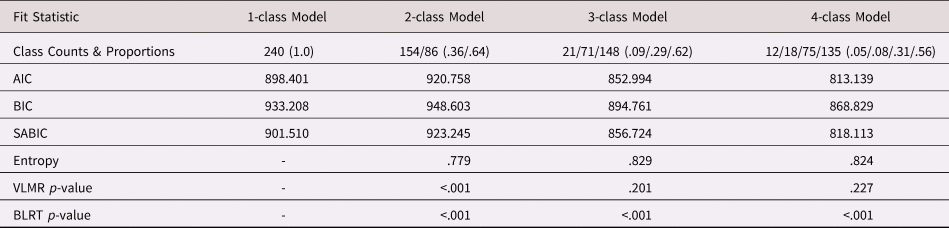
We evaluated 2, 3, and 4-class growth mixture models. We repeated models with multiple sets of start values to avoid getting local maximum solutions and ensure the best log-likelihood value was replicated (Muthén & Muthén, Reference Muthén and Muthén1998-2017). We determined the optimal number of classes based on the Bayesian information criterion (BIC; Schwarz, Reference Schwarz1978), sample-size adjusted Bayesian information criterion (SABIC; Sclove, Reference Sclove1987), Vuong-Lo-Mendell-Rubin likelihood ratio test (VLMR; Lo, Mendell, & Rubin, Reference Lo, Mendell and Rubin2001), parameter bootstrapped likelihood ratio test (BLRT; McLachlan & Peel, Reference McLachlan and Peel2000), and substantive interpretations (see Tein, Coxe, & Cham, Reference Tein, Coxe and Cham2013). In addition, we relied on entropy to gauge whether the latent classes were highly discriminating (Muthén & Muthén, Reference Muthén and Muthén1998-2017). We fixed the covariance between intercept and slopes within class to zero to aid model convergence and avoid Heywood cases (i.e., negative variances). Assuming high entropy (>.80) and using the optimal class solution, each child was assigned to the most likely class based on the estimated posterior probabilities for each class. We then used the classification variables to examine the remaining hypotheses: (a) examining trajectory mean differences in child mental health at baseline (T1) as well as child mental health and risky sexual behavior outcomes at the six-year follow-up (T5) and (b) examining the moderation effects of coping styles and global coping efficacy on the relations between conflict trajectories and children's mental health and substance use problems and risky sexual behavior.
Applying dummy coding for the classification variable of the trajectory, we used multiple regression analyses to examine differences of child mental health and substance use outcomes at baseline and six-year follow-up among the latent trajectories. We used negative binomial regression for the risky sexual behavior outcome because it was a count variable (i.e., number of sexual partners) with the majority of the sample (57.9%) reporting a value of zero.
Finally, we conducted moderation analyses to test interaction effects between trajectories and the coping subscales on T5 mental health (child-reported internalizing and externalizing problems, mother-reported internalizing and externalizing problems, and mental health diagnoses), substance use (past year alcohol and marijuana use), and risky sexual behavior (number of sexual partners). Following moderation analyses, we conducted post-hoc comparisons for significant interactions to determine which trajectories differed significantly. We plotted the slopes within each trajectory and assessed the significance of the within-group simple slope relating the coping measure to the outcome. For analyses in which the interaction effect was nonsignificant, we removed the interaction term and tested the additive effect of the coping subscales. We report only significant effects from moderation analyses in the results section.
Results
Preliminary Analyses
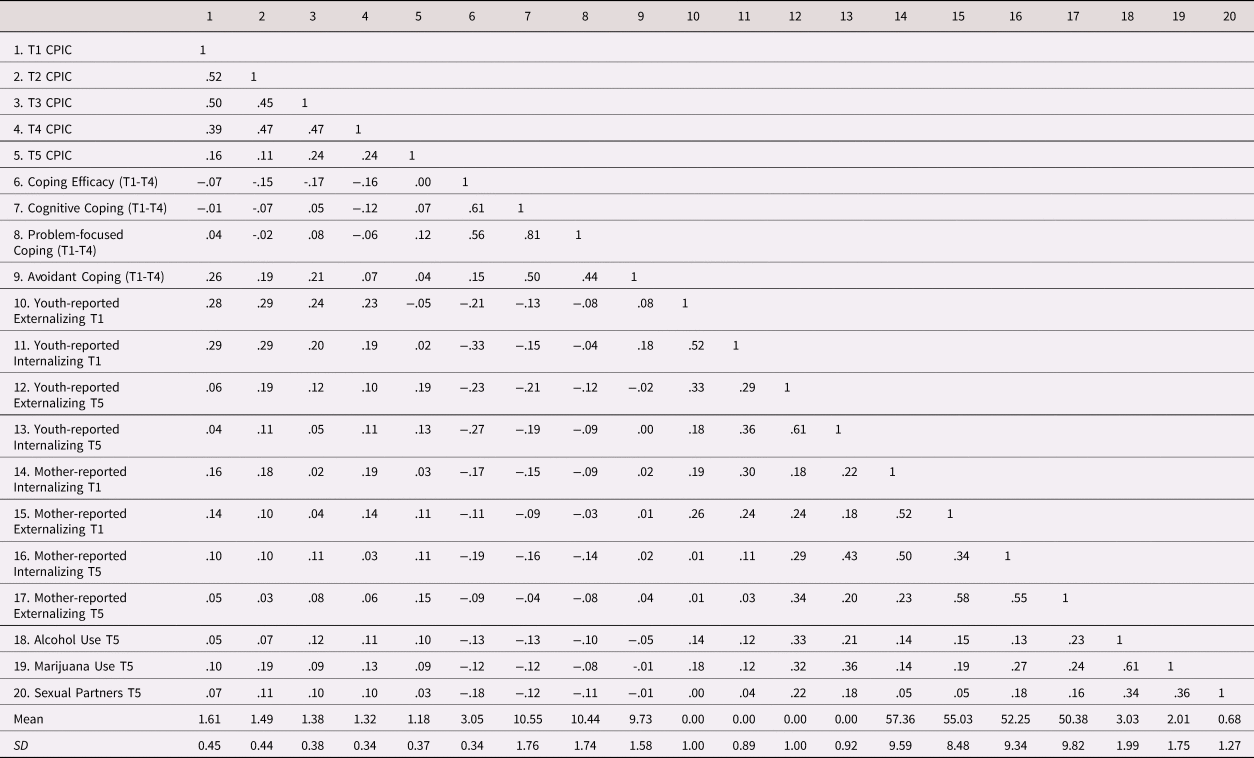
Table 1 displays descriptive statistics and zero-order Pearson product-moment correlations for all study variables and covariates. Children's reports of interparental conflict were significantly and positively correlated across all time points, with the exception of T2 and T5; in general, T5 had the lowest intercorrelations with other time points. The subscales of coping were positively and significantly correlated, with the exception of avoidant coping and coping efficacy. Mother and youth reports of internalizing and externalizing problems were significantly correlated. There was a strong correlation between past year alcohol and marijuana use, and both types of substance use were moderately correlated with risky sexual behavior.
Intercorrelations and descriptive statistics for study variables
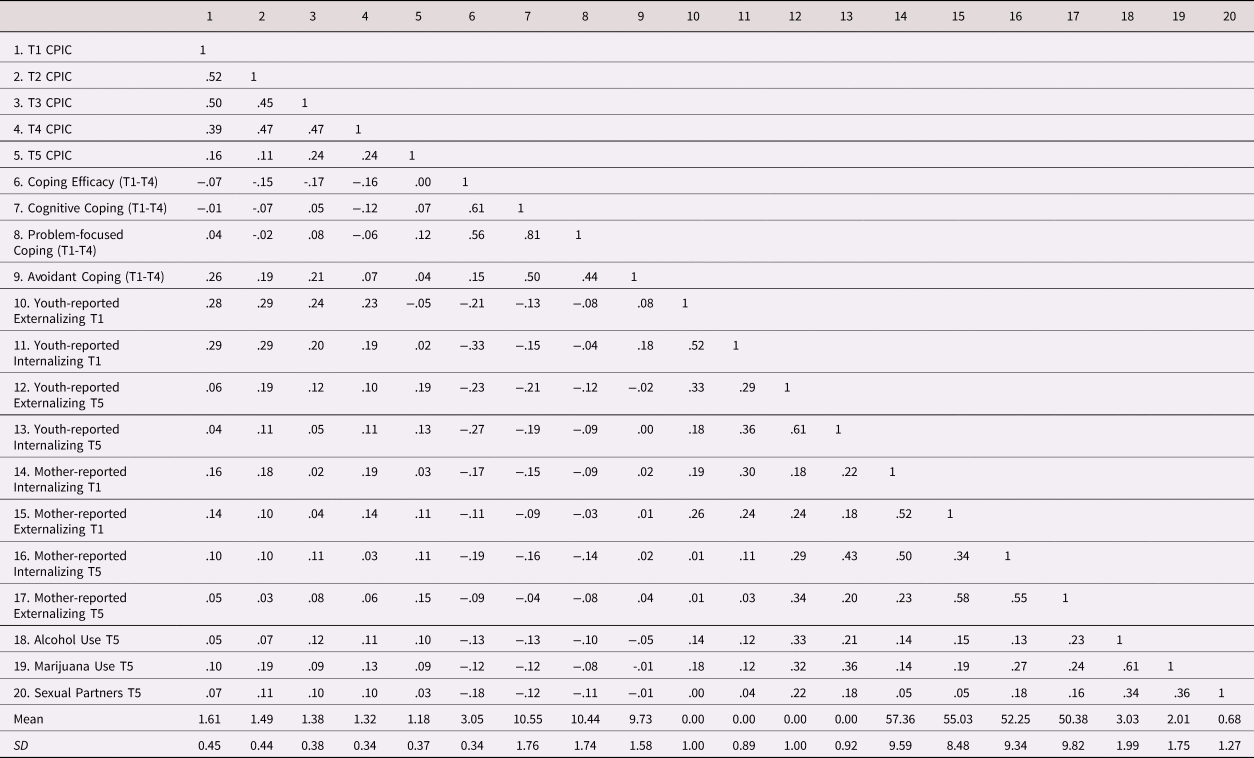
Note: CPIC = Children's Perception of Interparental Conflict scale (Grych et al., Reference Grych, Seid and Fincham1992). T1 = baseline, T5 = six-year follow-up.
Given our primary focus on longitudinal change in interparental conflict, we first tested the assumption that the measurement of these items was invariant across time to establish that we were measuring the same construct at different measurement occasions (Grimm et al., Reference Grimm, Ram and Estabrook2017; Pitts, West, & Tein, Reference Pitts, West and Tein1996). We first conducted a confirmatory analysis with the 13 items from the CPIC frequency and intensity subscales at T1. The model fit was adequate, χ2 (65) = 221.98, p < .01; RMSEA = .0101 [0.086–0.115]; CFI = .905; TLI = .886. We dropped three items due to low contribution (i.e., low factor loading [β ≤ .30]; e.g., “parents discuss disagreement quietly”) and one item (“parents pushed/shoved during argument”) due to lack of variance at T5 (i.e., 99% of the sample gave one response); the final model included nine items. Good model fit was confirmed at each subsequent time point, and the poorest model fit statistics across all five waves were χ2 (27) = 50.512, p < .01; RMSEA = .062 [0.035–0.089], CFI = .972; TLI = .963. We then fitted and evaluated evidence for configural, weak, and strong invariance models through a stepwise process of imposing model constraints. There was no evidence of significant decreases in model fit according to global (i.e., no significant change in χ2) and absolute (i.e., CFI/TLI change of less than .01) fit indicators; the root mean square error of approximation remained within the confidence interval of the less restrictive model fit statistics. The strong factorial invariance model fit the data well, χ2 (1035) = 1209.73, p < .001; RMSEA = .027 [0.019–0.003]; CFI = .957; TLI = .959, and standardized factor loadings were positive and ranged from .56 to .98.
Research Objective 1: Characterize Longitudinal Trajectories of Child-Reported Interparental Conflict
Growth mixture model selection
As our base model, we fitted a single-group piecewise growth model, with the first piece modeling change from T1 to T4 and the second piece modeling change from T4 to T5 based on previous research and initial visual inspection of the raw data. First, because previous research suggests that the first few years after parental divorce represents a period of acute change and adjustment (Hetherington & Kelly, Reference Hetherington and Kelly2002), we were interested in differentiating between short-term and long-term trajectories of conflict. Second, plotting the raw data revealed apparent linear change over the initial four waves of data collection (baseline, posttest, 3-month follow-up, 6-month follow-up) and a distinct pattern of linear change between the 6-month and six-year follow-up assessment periods.
Three-class solution of conflict trajectory profiles
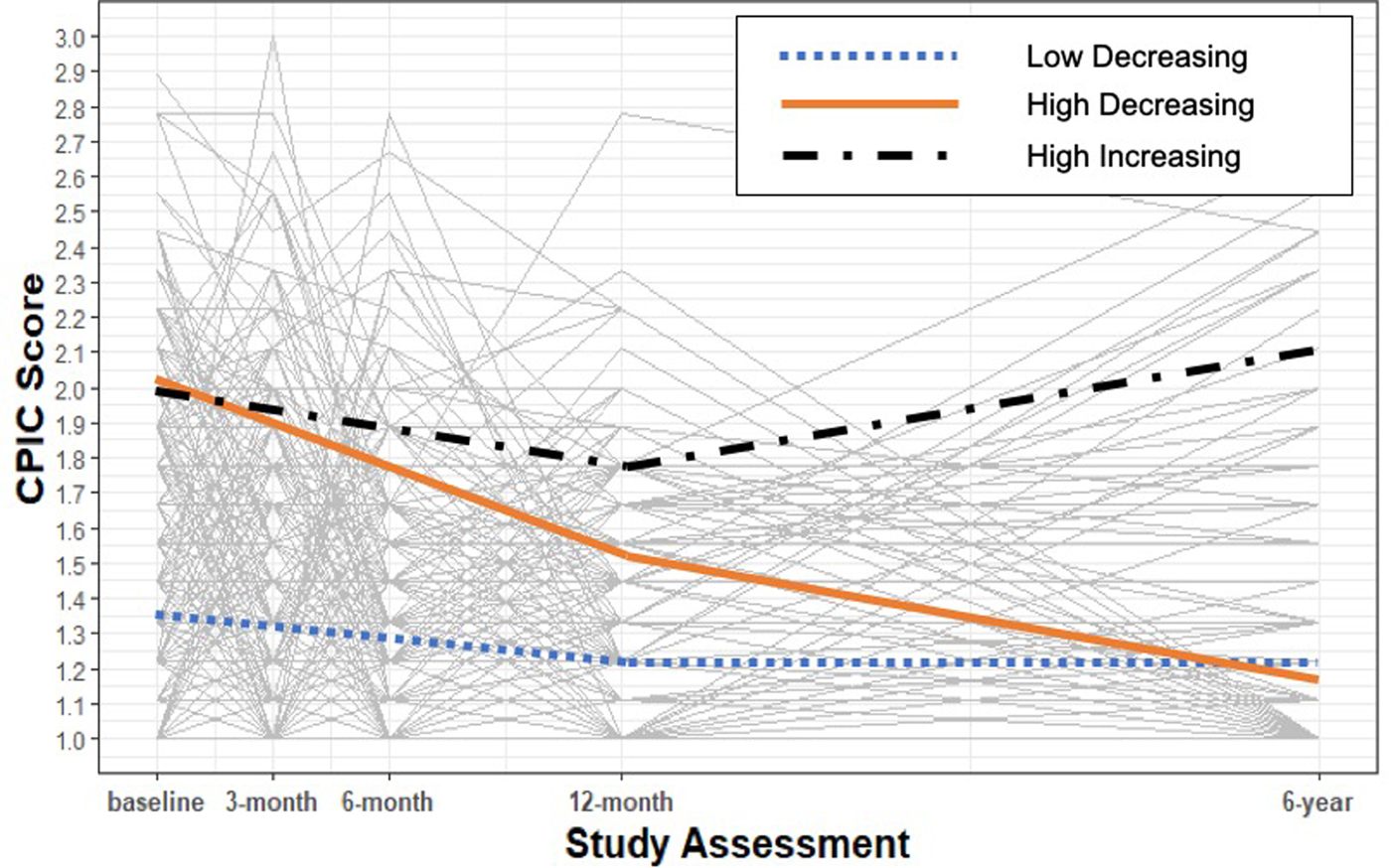
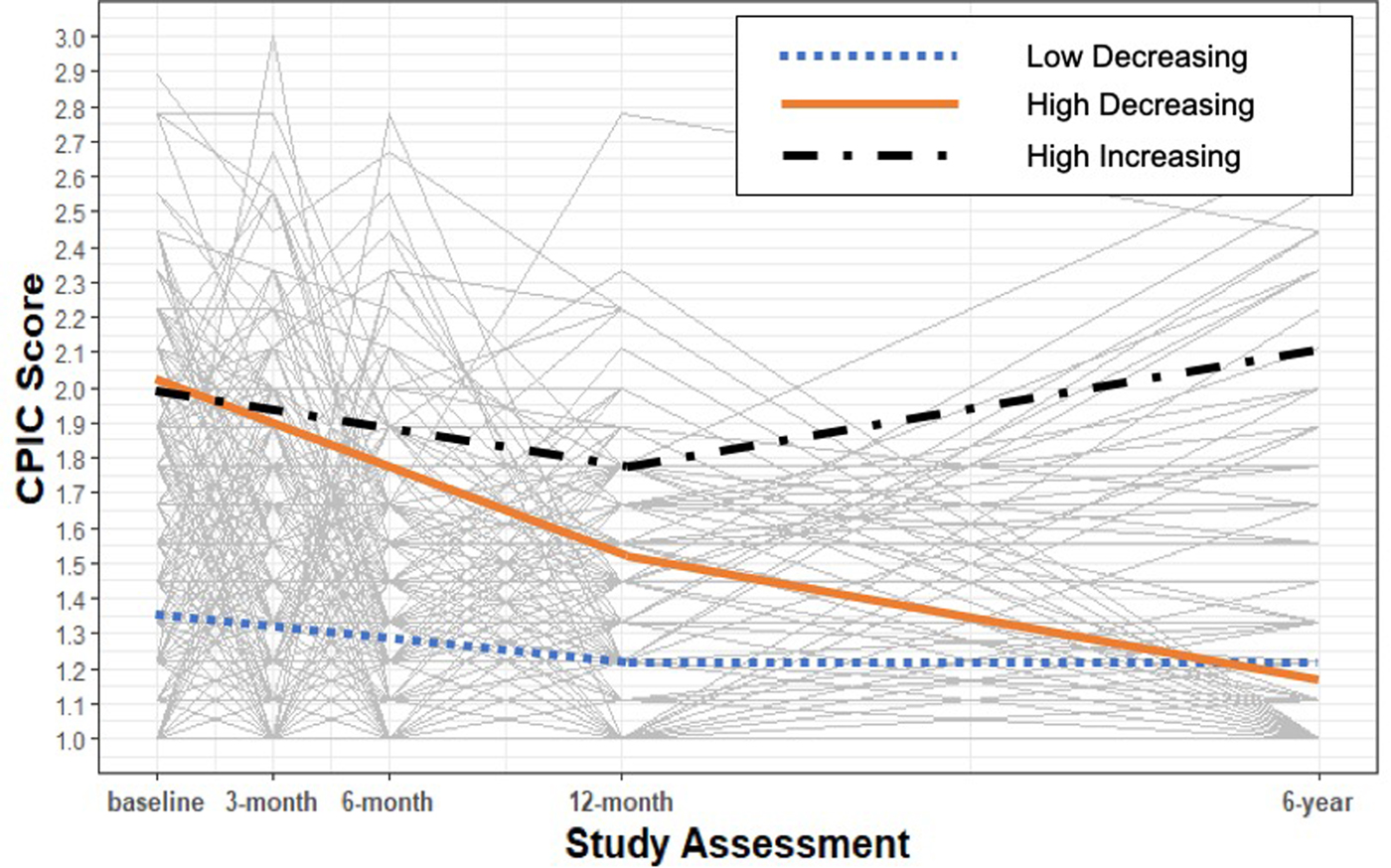
The three-class model was determined to be the best-fitting and most interpretable and useful model (see Table 2 for fit indices for all solutions). A four-class model was also considered based on fit statistics, but it was ultimately rejected due to two classes (one of which represented only 5% of the sample) having the same patterns of change (i.e., significant linear decline of both slopes), reducing the usefulness of separating them. See Figure 1 for a graphic representation of the three longitudinal trajectory profiles. The average trajectory of the largest class (n = 148, 62%) was characterized by a relatively low initial level of interparental conflict at baseline (g 0n = 1.34, SE = .03, z = 42.51, p < .001), which declined over the initial period of 9 months (g 1n = -0.25, SE = .04, z = −5.74, p <.001) and remained stable over the follow-up period of 6 years (g 2n = −0.01, SE = .01, z = −1.38, p = .168). The next largest class (n = 71, 30%) had a relatively higher mean baseline value of interparental conflict (g 0n = 2.01, SE = .10, z = 20.12, p <.001) that declined over initial period (g 1n = −0.73, SE = .12, z = −5.98, p <.001) and then declined again over the follow-up period (g 2n = −0.06, SE = .01, z = -6.06, p < .001). The smallest group (n = 21, 9%) also had a relatively higher mean baseline value of interparental conflict (g 0n = 1.96, SE = .18, z = 10.83, p <.001), but there was no significant change over the initial period (g 1n = −0.33, SE = .19, z = −1.70, p =.089) and an increase over the follow-up period (g 2n = 0.07, SE = .02, z = 3.02, p =.003). The trajectories were labeled Low Decreasing, High Decreasing, and High Increasing, respectively.
Estimated trajectories and observed individual values. CPIC = Children's Perception of Interparental Conflict scale (Grych et al., Reference Grych, Seid and Fincham1992).
Model fit information for 1-class baseline piecewise growth model and 2-, 3-, and 4-class piecewise growth mixture models
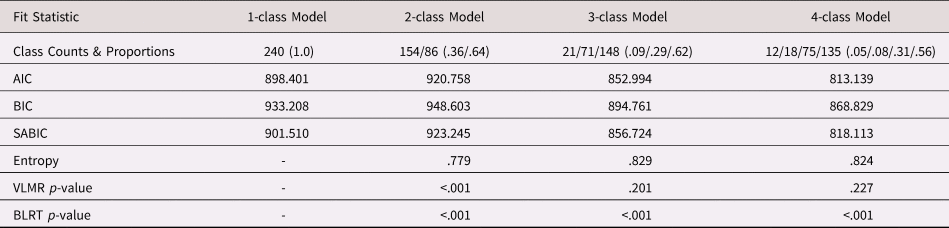
Note: AIC = Akaike information criterion; BIC = Bayesian information criterion (Schwarz, Reference Schwarz1978); SABIC = sample-size adjusted Bayesian information criterion (Sclove, Reference Sclove1987); VLMR = Vuong-Lo-Mendell-Rubin likelihood ratio test (Lo et al., Reference Lo, Mendell and Rubin2001); BLRT = bootstrapped likelihood ratio test (McLachlan & Peel, Reference McLachlan and Peel2000).
Research Objective 2: Examine Predictors of Group Membership and Group Differences among Trajectory Profiles
Predictors of group membership
Results of multinomial regression analyses revealed no differences, χ2 (2) = .80, p = .670, among the three trajectories of conflict in the proportion of families between the intervention groups (combined MP and MPCPFootnote 2), and active control group (LC). Neither child age, χ2 (2) = 1.05, p = .591, nor gender, χ2 (2) = .16, p = .925, significantly predicted trajectory membership. There were no differences in likelihood of group membership based on the number of overnights the child spent with their father, χ2 (2) = 1.95, p = .378, time since parental separation, χ2 (2) = 2.53, p =. 282, or whether or not the child's father moved out of the area following the divorce, χ2 (2) = 2.21, p = .332, or remarried, χ2 (2) = 2.24, p = .327. Finally, the extent to which mothers held a favorable view about the relationship between the child and their father marginally predicted group membership, χ2 (2) = 4.86, p = .088. Mothers in the High Decreasing trajectory endorsed less favorable attitudes than those in the Low Decreasing trajectory, b = -0.05, p = .041; Exp(B) = .948, 95% CI = [.902, .998].
Group differences among trajectory profiles
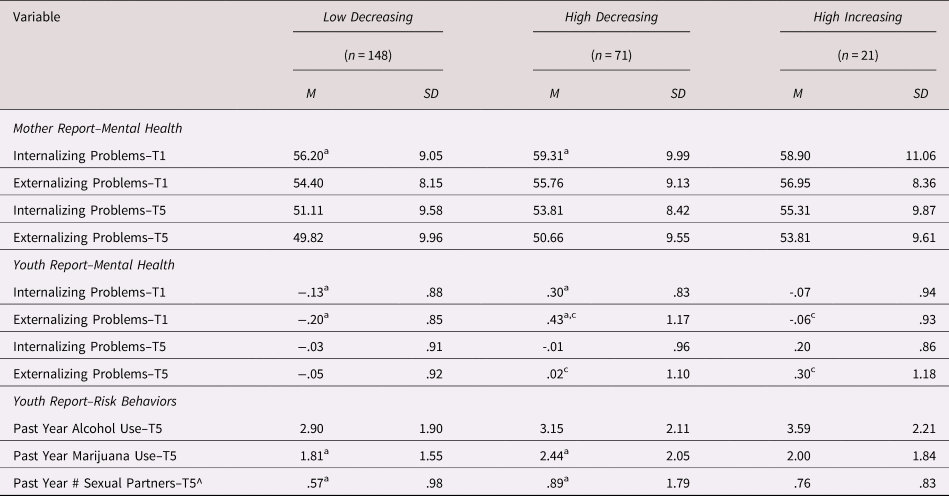
See Table 3 for means and standard deviations for all dependent variables across the trajectories.
Means and standard deviations for child mental health outcomes by conflict trajectories

Note: T1 = baseline; T5 = six-year follow-up. ^ indicates that a negative binomial regression model was used for the count outcome of number of sexual partners.
asignificant mean differences between Low Decreasing and High Decreasing trajectories
bsignificant mean differences between Low Decreasing and High Increasing trajectories
csignificant mean differences between High Decreasing and High Increasing trajectories
Mother-reported mental health problems
At T1, mothers reported significantly higher child internalizing problems in the High Decreasing trajectory than in the Low Decreasing trajectory (b = 3.14, p = 0.02). The High Increasing trajectory was not significantly different from High Decreasing (b = -0.52, p = .82) or the Low Decreasing (b = 2.63, p = .23) trajectories on T1 mother-reported internalizing problems. There were no significant differences in mother-reported externalizing problems at T1 nor in T5 mother-reported internalizing and externalizing problems.
Self-reported mental health problems
At baseline, youth reported significantly higher internalizing problems in the High Decreasing trajectory than in the Low Decreasing trajectory (b = 0.42, p < 0.001). The High Increasing trajectory was not significantly different from High Decreasing (b = -0.36, p = .10) or the Low Decreasing (b = 0.07, p = .74) trajectories on T1 self-reported internalizing problems. Youth also reported significantly higher baseline externalizing problems in the High Decreasing trajectory than in the High Increasing trajectory (b = 0.50, p = 0.03) and the Low Decreasing trajectory (b = 0.62, p < 0.001). At six-year follow-up, youth in the High Increasing trajectory reported significantly higher externalizing problems than youth in the High Decreasing trajectory (b = 0.51, p = 0.05). The difference in means of the Low Decreasing vs. High Increasing (b = 0.38, p = .11) and vs. High Decreasing (b = -0.12, p = .42) trajectories were not significantly different. There were no significant differences in T5 self-reported internalizing problems.
Self-reported risk behaviors
At T5, youth in the High Decreasing trajectory reported significantly higher past-year marijuana use (b = 0.69, p < 0.001) and number of sexual partners (b = 0.61, p = 0.04) than youth in the Low Decreasing trajectory. The High Increasing trajectory was not significantly different from the High Decreasing (b = −0.45, p = .33) or the Low Decreasing (b = .24, p = .58) trajectories on T5 marijuana use. Similarly, the High Increasing trajectory was not significantly different from the High Decreasing (b = −0.10, p = .81) or the Low Decreasing (b = 0.51, p = .18) trajectories on T5 number of sexual partners. There were no significant differences among the trajectories on past year alcohol use.
Mental health and substance use disorders
At T5, youth in the High Decreasing trajectory were significantly more likely to meet criteria for a mental health disorder (b = 0.98, p = .012) than youth in the Low Decreasing trajectory. The odds ratio between the two trajectories was 2.66 (95% CI = [1.238, 5.726], indicating that the odds of being diagnosed with a mental health disorder was 2.66 times as likely in the High Decreasing trajectory as in the Low Decreasing trajectory. Examination of relative percentages indicated that 13% of youth in the Low Decreasing trajectory met diagnostic criteria for a mental health disorder, and 27% of youth in the High Decreasing trajectory met these criteria. The youth in the High Decreasing trajectory had a range of mental health disorders, with the most common being oppositional defiance disorder, attention-deficit hyperactivity disorder, and major depressive disorder. There were no statistically significant differences in diagnoses across the trajectories for substance use disorders.
Research Objective 3: Interaction Effects between Coping and Conflict Trajectory in the Prospective Prediction of Mental Health Problems and Risk Behaviors
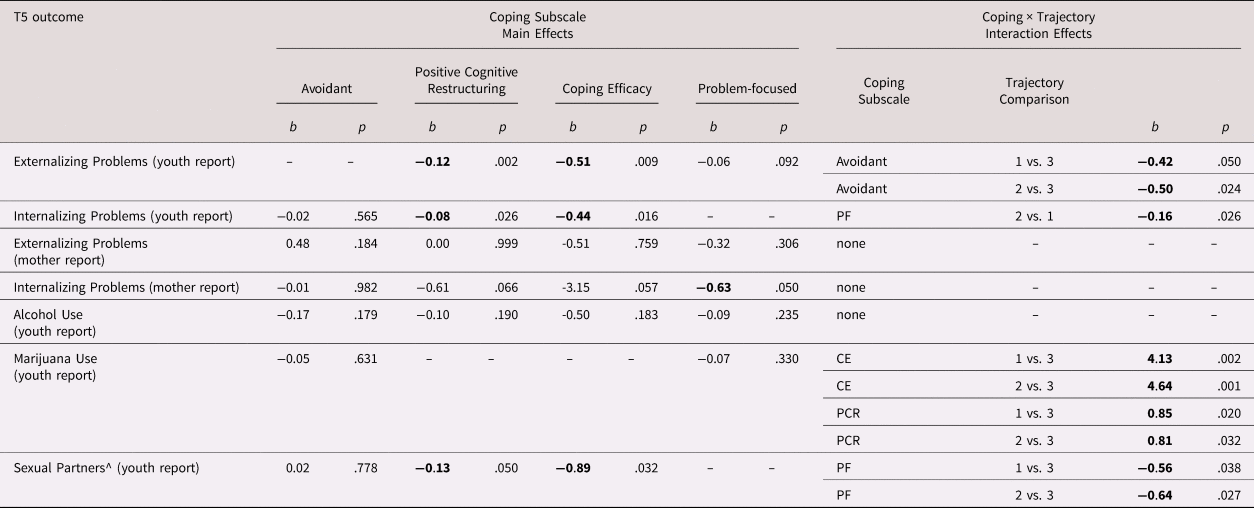
See Table 4 for the main effects of each coping subscale and significant Coping × Trajectory interaction effects for all of the dependent variables.
Main effects of coping subscales and interaction effects of trajectory by coping subscales on six-year follow-up (T5) child mental health, substance use, and risky sexual behavior outcomes
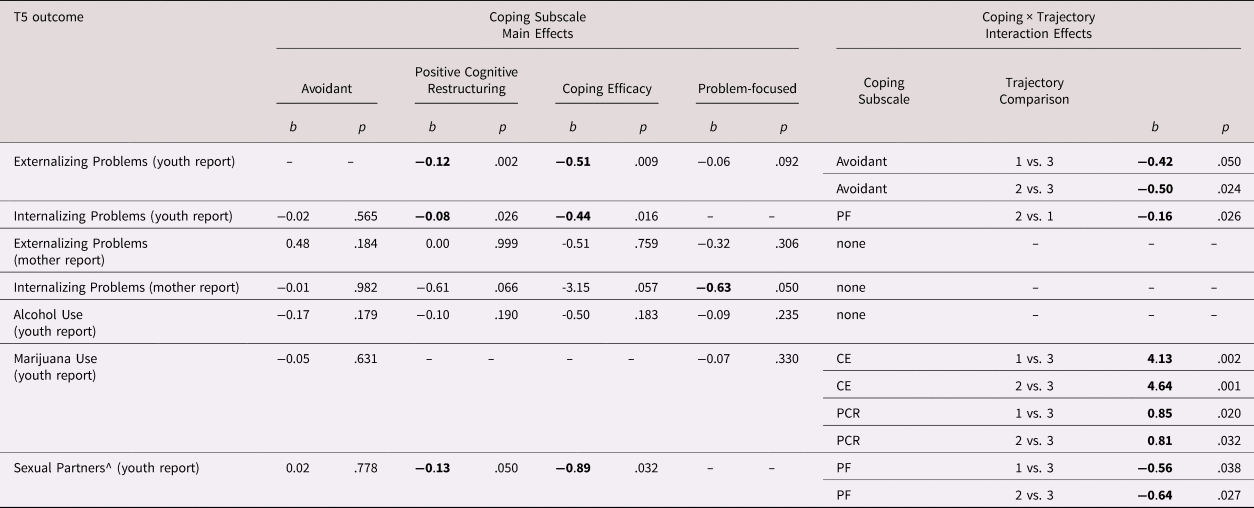
Note: Trajectory 1 = Low Decreasing, Trajectory 2 = High Decreasing, Trajectory 3 = High Increasing; PF = Problem-focused coping; PCR = Positive Cognitive Restructuring coping; CE = Coping Efficacy. ^ indicates that a negative binomial regression model was used for the count outcome of number of sexual partners. Bolded regression coefficients indicate statistical significance at p ≤ .05.
Problem-focused coping
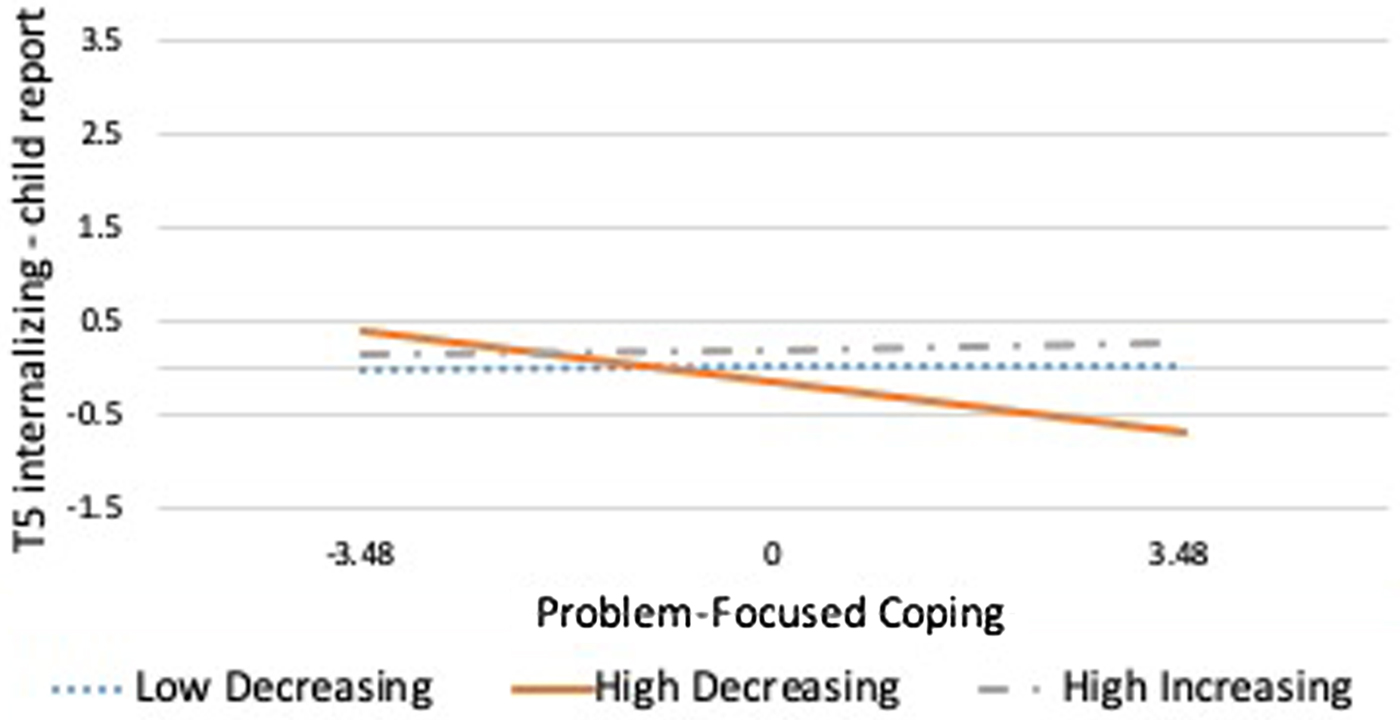
We found a significant problem-focused Coping × Trajectory interaction on youth-reported internalizing problems at T5 (see Figure 2). Pairwise comparisons indicated that the prospective association between problem-focused coping and youth reported internalizing problems significantly differed for youth in the High Decreasing trajectory relative to those in the Low Decreasing trajectory (b = −0.161, p = .026), controlling for T1 youth-reported internalizing problems. The association was not different for youth in the High Increasing trajectory compared with either the High Decreasing or the Low Decreasing trajectory. Simple slope analyses indicated that the within-group slope for the High Decreasing trajectory was significant and negative (b = −0.159, p = .008), indicating that higher levels of problem-focused coping were associated with lower levels of internalizing problems for these youth. There was also a significant problem-focused Coping × Trajectory interaction on youth-reported number of sexual partners at T5. Pairwise comparisons indicated that the prospective association between problem-focused coping and youth-reported risky sexual behavior significantly differed for youth in the High Increasing trajectory relative to those in both Low Decreasing (b = -0.557, p = .038) and High Decreasing (b = -0.636, p = .027) trajectories. However, simple slope analyses indicated that the within-group slopes did not significantly differ from zero for any trajectory.
Association between problem-focused coping on T5 (six-year follow-up) child reported internalizing problems as a function of conflict trajectory. Problem-focused coping is mean-centered and displayed range represents ±2 standard deviations.
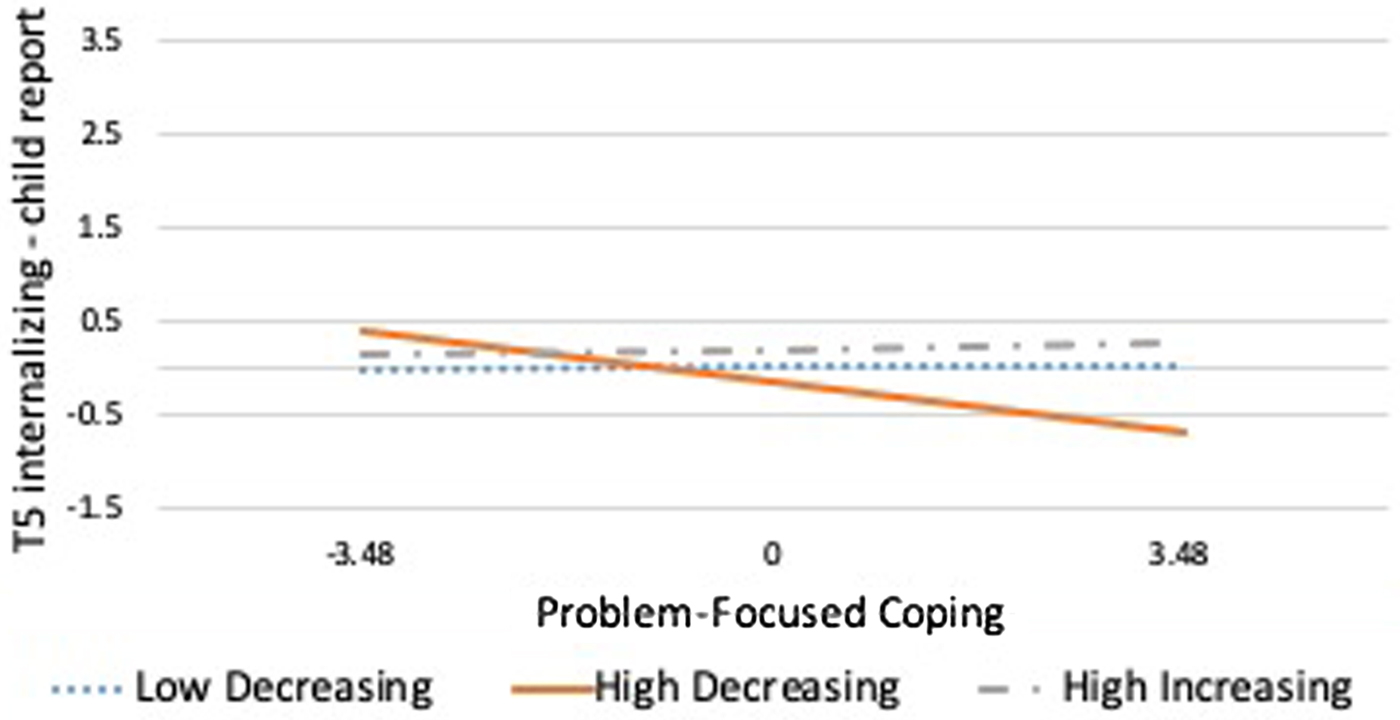
We also found a significant main effect of problem-focused coping on mother-reported internalizing problems (b = −0.627, p = .050), indicating that higher levels of problem-focused coping were associated with lower levels of child internalizing problems at T5 across the three trajectories.
Positive cognitive restructuring coping
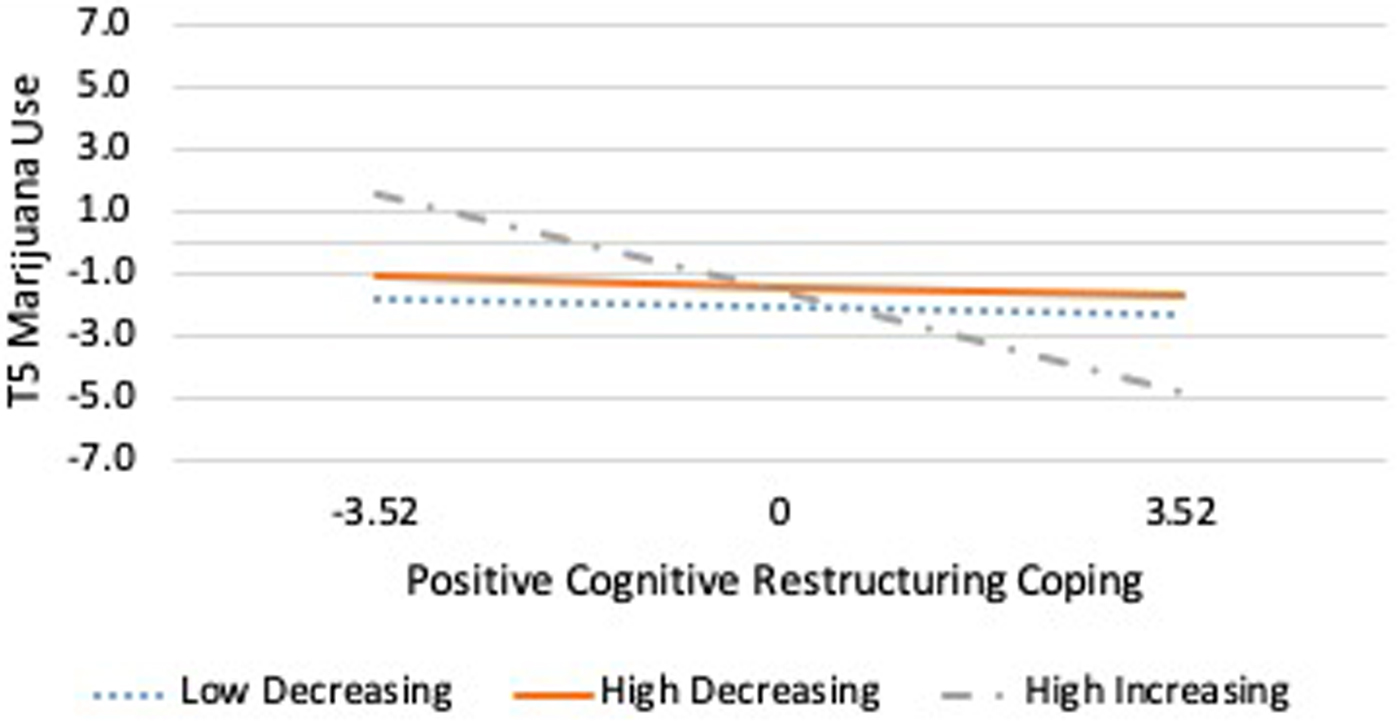
We found a significant positive cognitive restructuring Coping × Trajectory interaction on T5 marijuana use (see Figure 3). Pairwise comparison tests indicated that the association was significantly different for youth in the High Increasing trajectory compared with those in both the Low Decreasing (b = 0.848, p = .020) and the High Decreasing trajectories (b = 0.810, p = .032). The Low Decreasing and High Decreasing trajectories were not significantly different. Simple slope analyses indicated that the within-group slope for the High Increasing trajectory was significant and negative (b = -0.907, p = .010), indicating that higher levels of positive cognitive restructuring coping were associated with lower levels of past year marijuana use for these youth.
Association between positive cognitive restructuring coping on T5 (six-year follow-up) marijuana use as a function of conflict trajectory. Positive cognitive restructuring coping is mean-centered and displayed range represents ±2 standard deviations.
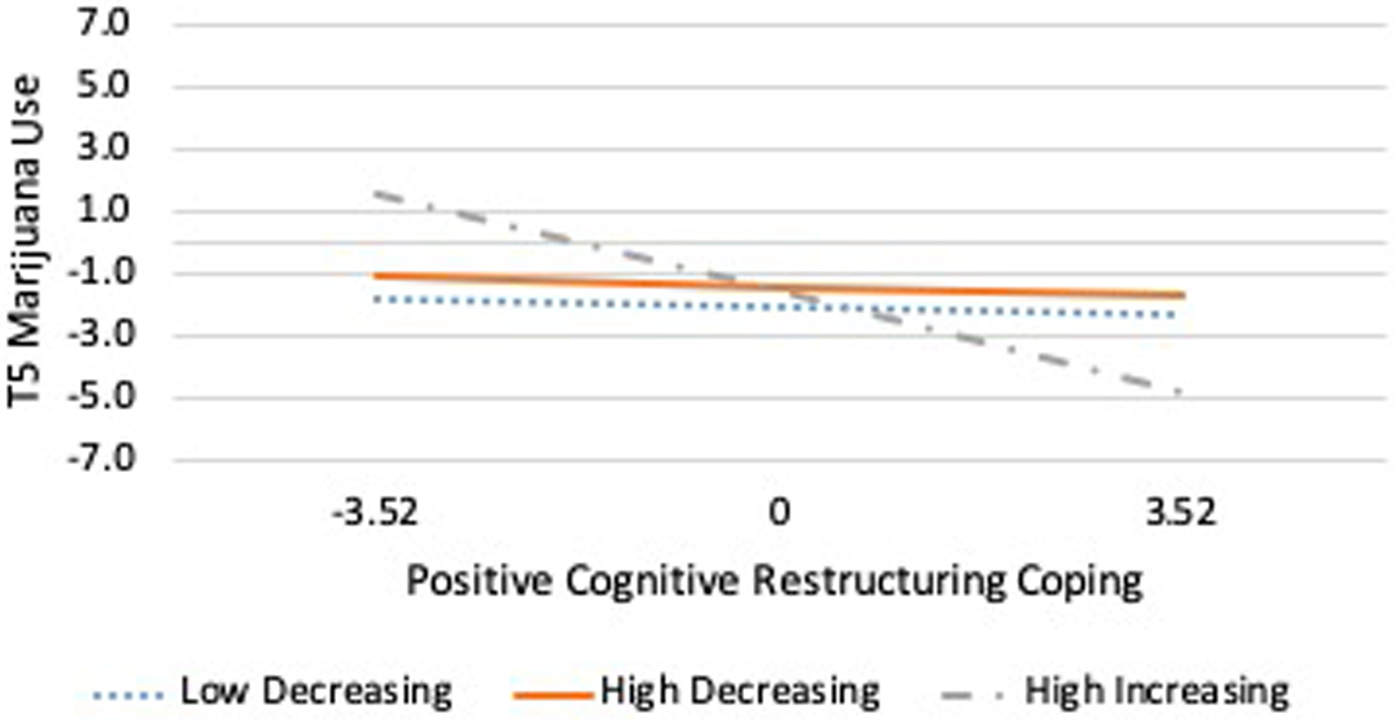
We also found a significant main effect of positive cognitive restructuring coping on youth-reported internalizing problems (b = -0.078, p = .026), youth-reported externalizing problems (b = -0.117, p = .002), and number of sexual partners (b = -0.134, p = .050), indicating that higher levels of positive cognitive restructuring coping were associated with lower levels of self-reported youth mental health problems and risky sexual behavior at T5 across all trajectories. Results of regression diagnostics identified one potentially influential case for the analysis involving the number of sexual partners. When this analysis was re-run without the identified case, the main effect was no longer significant (b = −0.105, p = .110). Thus, this finding should be interpreted with caution.
Avoidant coping
We found a significant Avoidant Coping × Trajectory interaction on youth-reported externalizing problems at T5. Pairwise comparison tests indicated that the association significantly differed for youth in the High Increasing trajectory compared with those in both the Low Decreasing (b = −0.415, p = .050) and High Decreasing trajectories (b = −0.499, p = .024). The Low Decreasing and High Decreasing trajectories were not significantly different. However, simple slope analyses indicated that the within-group slopes did not differ from zero for any trajectory, although the relation between avoidant coping and externalizing problems for the High Increasing trajectory was positive and marginal (b = .386, p = .063). There were no significant main effects of avoidant coping.
Coping efficacy
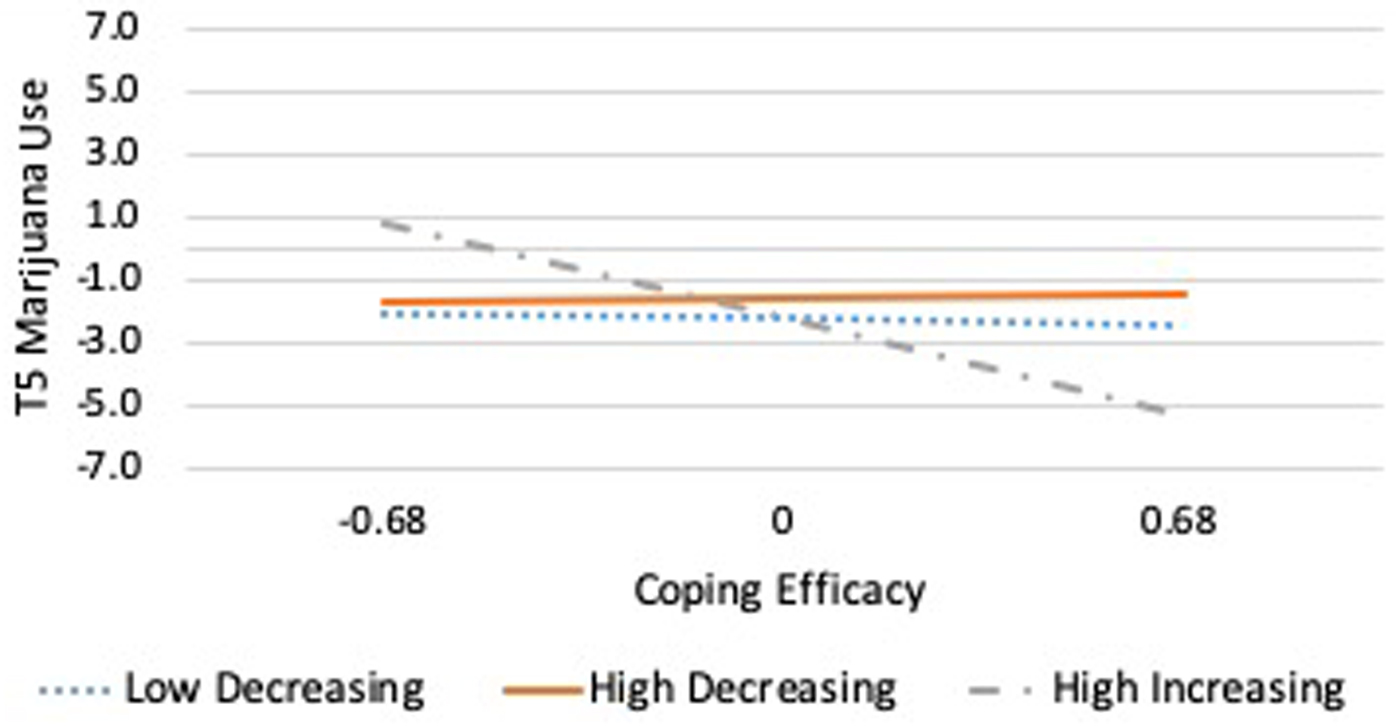
We found a significant Coping Efficacy × Trajectory interaction on T5 marijuana use (see Figure 4). Pairwise comparison tests indicated that the association was significantly different for youth in the High Increasing trajectory compared with those in both the Low Decreasing (b = 4.128, p = .002) and High Decreasing trajectories (b = 4.644, p = .001). The Low Decreasing and High Decreasing trajectories were not significantly different. Simple slope analyses indicated that the within-group slope for the High Increasing trajectory was significant and negative (b = −4.466, p < .001), indicating that higher levels of coping efficacy were associated with lower levels of past year marijuana use.
Association between coping efficacy on T5 (six-year follow-up) marijuana use as a function of conflict trajectory. Coping efficacy is mean-centered and displayed range represents ±2 standard deviations.
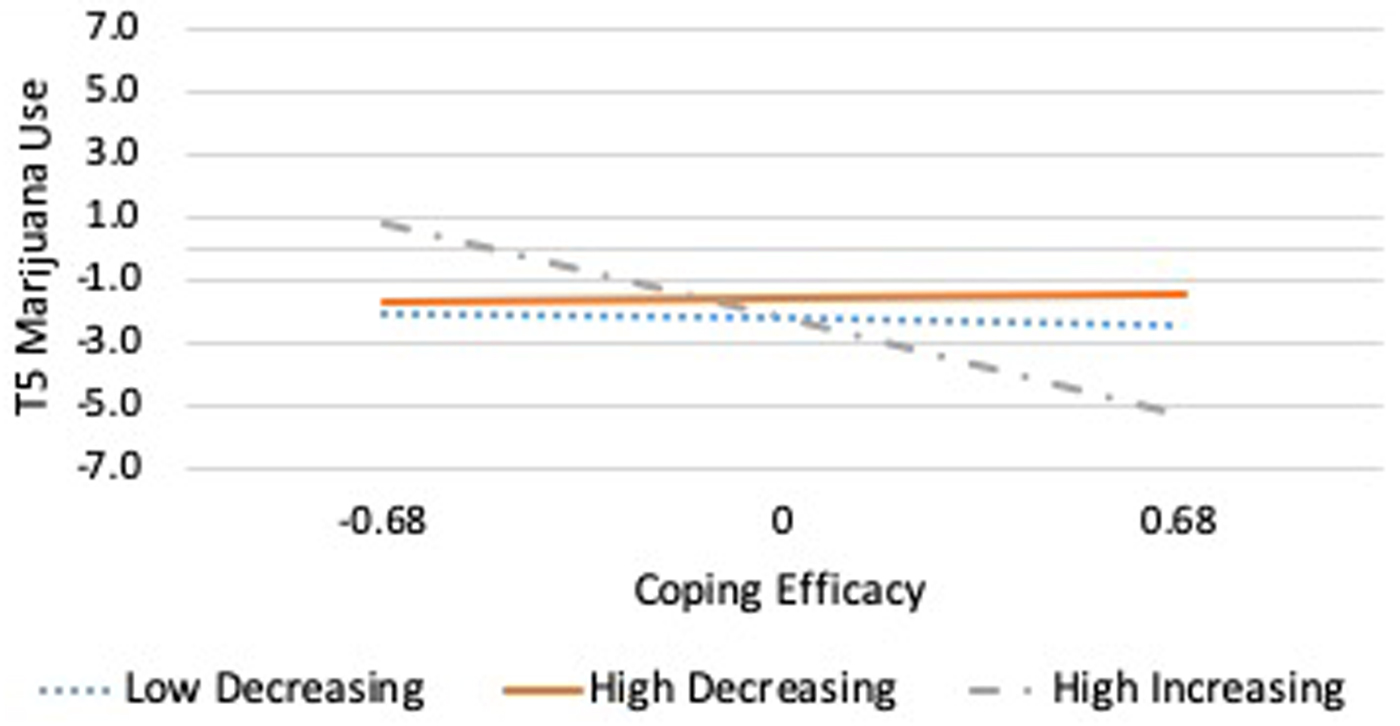
We also found a significant main effect of coping efficacy on youth-reported externalizing problems (b = −0.509, p = .009), internalizing problems (b = −0.443, p = .016), and number of sexual partners (b = −0.892, p = .032), indicating that higher levels of coping efficacy were associated with lower levels of self-reported youth mental health problems and risky sexual behavior at T5. When this analysis was re-run without the identified influential case on the outcome of number of sexual partners, the main effect was no longer significant (b = -0.378, p = .234). Thus, this finding should be interpreted with caution.
Discussion
It is appropriate that this paper is in the special issue that honors Tom Dishion. Tom was a champion of longitudinal research that probed the pathways that lead to children's psychopathology. He had a special interest in the measurement of constructs in our developmental theories, and he sought to use new and more powerful measures of each of these constructs. Most of all, Tom was devoted to developing and testing theories that had a direct link to interventions to prevent the development of psychopathology. Although the specific population and constructs that are the focus of this paper were not the focus of Tom's work, this study fits well with his distinguished body of work, which demonstrated the fruitfulness of this kind of rigorous, longitudinal research with its focus on improved methods of measurement and implications for improving the lives of children.
This study makes two noteworthy contributions to the literature on interparental conflict and youth's coping in the context of parental divorce. First, to our knowledge, it is the first to identify distinct longitudinal trajectories of change in youth-reported interparental conflict over six years and demonstrate that two trajectories (high initial levels that decrease over time and high initial levels that increase over time) confer risk for mental health and substance use problems compared with trajectories that are characterized by low initial conflict that decreases over time. Second, it is the first study to examine how trajectories of conflict interact with various aspects of youth's coping to predict mental health, substance use, and high-risk sexual behavior outcomes six to eight years after the divorce. Some interaction effects emerged, indicating that problem-focused coping, positive cognitive restructuring, and coping efficacy may be particularly strong factors that are prospectively related to problem outcomes (e.g., marijuana use) for children exposed to higher levels of conflict over time. However, other aspects of coping, mainly positive cognitive restructuring and coping efficacy, exerted prospective main effects on youth's internalizing and externalizing problems. These findings extend prior research by identifying the long-term prospective effects of children's coping styles and coping efficacy on mental health problems following parental divorce (Sandler et al., Reference Sandler, Tein, Mehta, Wolchik and Ayers2000). We discuss results from each study objective and contextualize the findings by discussing how the findings fit with prior literature and theoretical models on youth's coping in the context of interparental conflict. We end with a discussion of the theoretical and intervention implications of the findings as well as the limitations of the study and directions for future research.
Longitudinal Trajectories of Child Reported Interparental Conflict
We identified three distinct trajectories of conflict over the course of six to eight years after parental divorce. One group had the lowest relative level of baseline conflict, decreased over the course of the first year of the study, and then remained low and stable at the six-year follow-up. We labeled this trajectory Low Decreasing. The size of this group (62%) aligns with previous literature suggesting that despite the ubiquitous nature of some level of conflict around the time of divorce, interparental conflict decreases over the first few years following parental divorce for most families (Hetherington & Kelly, Reference Hetherington and Kelly2002). The second largest group (30%) had a relatively high level of baseline conflict, but the conflict declined over the course of the first year of the study and declined even further at the six-year follow-up. We labeled this trajectory of conflict High Decreasing. This group is distinguished from the former group because, although interparental conflict declines for both trajectories and both have a similar level of conflict at the six-year follow-up, the High Decreasing trajectory started out having higher levels of conflict, so children in this group spend more time being exposed to a relatively high level of conflict. The smallest group (9%) also had a relatively high level of baseline conflict, but it did not significantly change over the course of the first year of the study, and then it increased at six-year follow-up. We labeled this trajectory of conflict High Increasing. This trajectory likely represents the families who are enmeshed in high levels of chronic conflict for many years following divorce/separation. Theoretically, the youth exposed to this trajectory of interparental conflict are likely to have the most severe consequences. The proportion of families displaying this longitudinal trajectory is smaller than the estimated number of families engaged in high levels of conflict following divorce in reported in previous studies: 20–25% (Hetherington, Reference Hetherington and Kelly2002) and 15–20% in Sbarra and Emery (Reference Sbarra and Emery2005). However, these point-in-time estimates do not assess the trajectory of change in conflict over time, which the current study finds is important to understanding the long-term association between conflict and children's postdivorce adjustment problems.
Relations between Theoretical Predictors and Longitudinal Trajectories of Change in Interparental Conflict
Based on previous research, we attempted to relate the conflict trajectories to theoretical predictors (i.e., information collected at baseline) that might help inform how we can prospectively predict which families will end up exhibiting the different trajectories of conflict. We tested variables that were demonstrated in previous studies to be related to level of conflict and available to use in the dataset. Factors related to child demographics (i.e., age, gender) and postdivorce family circumstance (i.e., father relocation and remarriage, time since separation) were not related to membership in a conflict trajectory. Maternal attitude toward the relationship between father and child was the only factor that marginally predicted membership in one group versus another. Families in which mothers held less favorable views about their child's relationship with the father were more likely to be in the High Decreasing versus Low Decreasing trajectory. To note, the group means in the High Increasing and High Decreasing trajectories were very similar (within .17 raw units on a scale with a range of 26); the lack of significant differences between the High Increasing and Low Decreasing trajectories is likely due to the small size of the High Increasing trajectory. To the extent that this effect is replicable, parental attitudes about the child's relationship with the other parent may be a key factor in identifying families at high-risk for damaging trajectories of interparental conflict. Future research on parental attitudes about one another should incorporate new concepts about the fundamental dynamics that characterize the conflict, such as entrenched interparental hatred (Smyth & Moloney, Reference Smyth and Moloney2017, Reference Smyth and Moloney2019).
Relations between Concurrent and Prospective Mental Health Problems and Risky Behaviors and Trajectories of Interparental Conflict
The three trajectories of interparental conflict differ in levels of youth's baseline and six-year mental health and substance use problems. At baseline, there were significant differences among the trajectories in the level of internalizing problems according to both mother- and self-reports. Youth in the High Decreasing trajectory demonstrated higher levels of mother- and child-reported internalizing problems relative to those in the Low Decreasing trajectory. In addition, according to self-report only, youth in the High Decreasing trajectory had higher levels of externalizing problems relative to those in the Low Decreasing and High Increasing trajectories. The findings that youth in the High Decreasing trajectory showed higher levels of child mental health problems than those in the Low Decreasing trajectory likely reflects the influence of their higher levels of conflict at baseline. The finding that youth in the High Decreasing trajectory showed higher levels of externalizing than those in the High Increasing trajectory at baseline does not hold over the six years, as discussed below. This suggests that there may be other important contextual factors at play beyond exposure to interparental conflict. For example, youth in the High Decreasing trajectory may be more prone to experiencing a higher number of nonconflict, divorce-related stressors, highlighting the importance of future research to extend the investigation of contextual correlates of the different trajectories.
The trajectories were also useful for predicting group differences at the six-year follow-up. Youth in the High Decreasing trajectory demonstrated higher marijuana use and risky sexual behavior and were more likely to be diagnosed with a mental health disorder than were youth in the Low Decreasing trajectory (OR = 2.66). In terms of clinical significance, youth in the High Decreasing trajectory were more than twice as likely to have a diagnosable mental health disorder six years later than were youth in the Low Decreasing trajectory. With regard to relative percentages, 13% of youth in the Low Decreasing trajectory had a diagnosable mental health disorder according to either parent- or self-report on the DISC at the six-year follow-up compared with 24% and 27% of youth in the High Increasing and High Decreasing trajectories, respectively. This is the first study we know of to identify the long-term consequences of exposure to postdivorce interparental conflict in terms of diagnosable mental disorders. Notably, at the six-year follow-up, youth in the High Decreasing trajectory did not have higher levels of conflict than those in the Low Decreasing trajectory, indicating that the long-term problems experienced by children in the High Decreasing trajectory may reflect the persistent negative effects of earlier exposure to interparental conflict.
Interestingly, the differences in externalizing problems changed between baseline and six-year follow-up for youth in the High Increasing and High Decreasing trajectories. At baseline, youth in the High Decreasing trajectory had the highest level of externalizing problems, but at the six-year follow-up, those in the High Increasing trajectory demonstrated the highest level of externalizing problems, significantly higher than youth in the High Decreasing trajectory. Similarly, although the youth in the High Increasing trajectory were indistinguishable from those the Low Decreasing trajectory at baseline, higher rates of externalizing problems emerged in this trajectory at the six-year follow-up, potentially reflecting the cumulative effects of exposure to chronic conflict over an extended period of time.
Taken together, it appears that the youth in the two high-conflict trajectories, regardless of whether it eventually declines or remains high, show deleterious effects on one or more measures of mental health, substance use, and risky behavior problems at the six-year follow-up. There is some evidence of more consistent adverse effects among youth in the High-Decreasing trajectory than among those in the High-Increasing trajectory. However, the magnitude of the differences is quite modest. It is possible that there are important differences between the two trajectories in the pattern of conflict to which the children were exposed prior to the study period (i.e., prior to and immediately following separation), the nature and number of other divorce-related stressors that occurred prior to the baseline assessment, or both, that may explain the modest differences. Research that includes a larger number of families in the High-Increasing trajectory and assesses conflict and other stressors before and immediately after the separation is an important direction for future research.
Together, the two high-risk trajectories identify 39% of the sample as being at risk due to exposure to postdivorce interparental conflict, which is a considerably higher percentage of high-conflict divorces compared with previous point-in-time estimates (Sbarra & Emery, Reference Sbarra and Emery2005; Hetherington & Kelly, Reference Hetherington and Kelly2002). These findings are consistent with decades of previous research on youth exposed to interparental conflict (see Rhoades, Reference Rhoades2008 for a meta-analysis). However, this is the first study to demonstrate that trajectories of interparental conflict over time are associated with problem outcomes and that exposure to high interparental conflict is associated with higher prevalence of diagnosed mental disorder.
Prospective Relations of Coping with Problem Outcomes across Trajectories of Interparental Conflict
We found both main effects of coping and Coping × Trajectory interaction effects in predicting problem outcomes at the six-year follow-up. The prospective effects of coping over six years extend prior evidence on the short-term relations between coping and mental health problems of children from divorced families (Sandler et al., Reference Sandler, Tein, Mehta, Wolchik and Ayers2000, Reference Sandler, Tein and West1994). First, we found unique effects of problem-focused coping on youth-reported and mother-reported internalizing problems. Higher levels of problem-focused coping predicted lower levels of mother-reported internalizing problems for all youth. Using child report, the relation between problem-focused coping and internalizing problems was conditioned by trajectory, demonstrating a protective effect for youth in the High Decreasing trajectory. The finding that the effects of problem-focused coping was particularly strong for youth in the High Decreasing trajectory seems counter to the expectation that the use of problem-focused coping would be ineffective or even iatrogenic in dealing with uncontrollable stressors such as the conflict between parents (e.g., Tu et al., Reference Tu, Erath and El-Sheikh2016). Children cannot stop their parents from fighting, and attempts to do so are likely to be highly stressful. However, the group for whom problem-focused coping was found to be most helpful was the one in which there was high initial conflict that decreased over six years. These youth may be using their problem-solving skills to find new ways to find satisfying life experiences as their parents’ conflict wanes over time. It is also important to note that problem-focused coping as assessed in this study includes behaviors beyond direct problem solving, such as thinking about all the ways to solve or handle a problem. This highlights the importance of considering differential effects of coping strategies that may fall under a broad category of coping. Although direct problem solving may not be effective in the context of interparental conflict, thinking about one's options (beyond direct intervention) for handling a seemingly uncontrollable problem may have a very different effect. Taken together, the main and interaction effects indicate that a coping style high in use of problem-focused strategies may be protective against internalizing problems, potentially even more so for youth exposed to high conflict during the first few years following divorce.
The patterns of association related to positive cognitive restructuring coping and coping efficacy were nearly identical. Significant negative main effects for both positive cognitive restructuring and coping efficacy occurred for youth-reported internalizing and externalizing problems. These aspects of coping have been found in previous research to have generally protective effects, although this is the first study to show that they prospectively relate to lower levels of child mental health problems over six years for children from divorced families. It is possible that these skills enable children to make positive appraisals of the conflict, reassuring them that although they are in conflict with each other, their parents care about them and that they are not to blame for the conflict. In addition, a subjective sense of coping efficacy may enhance their sense of control over the stressors in their lives. Future research on the mediating processes that explain positive effects of coping on outcomes for children in high-conflict families is needed. Interestingly, the effect of positive cognitive restructuring and coping efficacy on youth's reports of past year marijuana use differed by group. Positive cognitive restructuring coping and coping efficacy had a protective effect for youth in the High Increasing trajectory, but there were no effects of either aspect of coping on marijuana use among youth in the other two trajectories. These results suggest that coping efficacy and positive cognitive restructuring are generally adaptive for all youth who experience divorce and may be particularly important in buffering against substance use for youth exposed to high levels of chronic conflict. The findings of the current study demonstrate that positive cognitive restructuring and coping efficacy may be protective for all children, including those exposed to high conflict.
Finally, we found that for youth in the High Increasing trajectory, there was a marginally significant relation between avoidant coping and higher youth-reported externalizing problems. Although this effect was only marginally significant and thus requires replication, it is consistent with prior research showing adverse effects of avoidant coping (Aldao, Nolen-Hoeksema, & Schweizer, Reference Aldao, Nolen-Hoeksema and Schweizer2010; Compas et al., Reference Compas, Jaser, Bettis, Watson, Gruhn, Dunbar and Thigpen2017; Nicolotti et al., Reference Nicolotti, El-Sheikh and Whitson2003; Sandler et al., Reference Sandler, Tein and West1994; Tu et al., Reference Tu, Erath and El-Sheikh2016). These results suggest that high use of avoidant coping may be particularly detrimental for youth who are exposed to high levels of chronic conflict over time.
It is important to emphasize the findings that were corroborated by mothers’ report of child mental health problems given concerns about shared method variance associated with the use of youth report of the study variables in the majority of the models. Both youth and mother reports indicated that youth in the High Decreasing trajectory demonstrated higher internalizing problems relative to those in the Low Decreasing trajectory. In addition, the main effects of positive cognitive restructuring and coping efficacy on internalizing problems at T5 were consistent across youth and mother reports, but the effects were marginal for mother reports.
The current findings extend prior evidence on the effects of coping with interparental conflict in several ways. First, although there is extensive evidence that the ways in which children respond to or cope with interparental conflict moderates the effect of their exposure to conflict and maladjustment (Cummings et al., Reference Cummings, Davies and Simpson1994; Jenkins, Smith, & Graham, Reference Jenkins, Smith and Graham1989; Nicolotti et al., Reference Nicolotti, El-Sheikh and Whitson2003; Shelton & Harold, Reference Shelton and Harold2007; Tu et al., Reference Tu, Erath and El-Sheikh2016), the majority of this work has been conducted with children from married or two-parent families (Cummings et al., Reference Cummings, Davies and Simpson1994; Jenkins et al., Reference Jenkins, Smith and Graham1989; O'Brien, Bahadur, Gee, Balto, & Erber, Reference O'Brien, Bahadur, Gee, Balto and Erber1997; Tu et al., Reference Tu, Erath and El-Sheikh2016), and most of the focus has been on the child's proximal responses to conflict. The current findings extend this work by demonstrating a significant long-term prospective protective relation between general coping styles and children's mental health and risky behaviors in divorced families and showing that the effect is particularly strong for children exposed to high levels of conflict, even if the conflict decreases over time.
Integrating Theoretical Frameworks for Children's Coping with Postdivorce Conflict
The findings from this study can be understood from the perspective of a broad conceptual model that identifies the ecology of adversity (Sandler, Reference Sandler2001) as one of two key constructs for understanding adaptation to adversities such as interparental conflict. Sandler (Reference Sandler2001) proposed that the ecology of adversity includes factors such as the broader context and the settings in which it occurs, particularly its intensity and temporal and cumulative nature. One way that the current study extends evidence on the effects of conflict across family contexts is by studying conflict in the context of divorced families rather than married families, where much of the prior research has been conducted. A second way the current study extends our understanding of the effects of the ecology of conflict is by identifying how the temporal and cumulative nature of interparental conflict is related to the development of children's mental health outcomes. This study demonstrates that understanding the effects of exposure to interparental conflict following divorce on children's mental health requires that we consider the contextual aspects of exposure to conflict, including the different trajectories of conflict exposure over time, children's cognitive and behavioral coping strategies, and the interaction between the two.
Implications for Intervention Development
The findings from the current study have several implications for the design of preventive interventions for children exposed to postdivorce interparental conflict. The finding that 39% of the sample was exposed to a high-risk trajectory of postdivorce conflict indicates that, although the majority of children adapt well following divorce, a substantial subgroup could benefit from preventive interventions. The finding that the trajectory of exposure to conflict is associated with diagnosable mental disorders and both child and parent reports of mental health problems emphasizes the potential public health benefit of effective preventive parenting interventions that target reductions in conflict. The prospective relations between coping and children's mental health and substance use problems provide important information about how improving youth's general capacity to cope adaptively can be seen as a potentially modifiable protective factor for children exposed to postdivorce interparental conflict. Findings from this study indicate that positive cognitive restructuring coping, problem-focused coping, and coping efficacy appear to be effective for all children facing parental divorce and, depending on the outcome, are particularly helpful for those exposed to trajectories involving high postdivorce conflict. Thus, teaching these strategies may be beneficial as mechanisms of change to be targeted in child-focused preventive interventions. This is consistent with prior studies that have reported positive effects of coping interventions for children from divorced families (Boring, Sandler, Tein, Horan, & Vélez, Reference Boring, Sandler, Tein, Horan and Vélez2015; Pedro-Carroll, Reference Pedro-Carroll2005; Pedro-Carroll & Cowen, Reference Pedro-Carroll and Cowen1985). Although these trials have not studied long-term effects, the current findings of long-term prospective effects of coping on child mental health problems indicates that it is reasonable to expect that teaching coping will have long-term benefits for children following divorce. The finding that the trajectory of exposure to interparental conflict is associated with long-term problem outcomes indicates that children in families with high levels of postdivorce conflict are a particularly appropriate group to target for coping-focused preventive interventions. From the perspective of precision medicine, or individualized prevention, matching treatment components to an individual's contextual data, including family-level factors, is crucial to improving the effectiveness and efficiency of mental health interventions (Bickman, Lyon, & Wolpert, Reference Bickman, Lyon and Wolpert2016).
It is important to note that the current study used data from a preventive intervention trial of a parenting program that targeted improvements in positive parenting practices and reductions in interparental conflict. Although the current study is not focused on intervention effects, we did find that the intervention condition did not discriminate the conflict trajectories. This finding is consistent with previous reports showing a lack of NBP program effects on interparental conflict (Wolchik et al., Reference Wolchik, West, Sandler, Tein, Coatsworth, Lengua and Griffin2000). The absence of intervention effects is likely due to the limited attention to interparental conflict in the program (i.e., one session). Future research could test the effects of a modified program that includes additional attention to teaching strategies and skills to reduce interparental conflict. It may also be that for significant reductions in conflict to occur, both fathers and mothers need to learn effective conflict management skills.
A limitation of these findings for the design of interventions is that coping was assessed as a general style, not as coping specifically with the stressor of exposure to interparental conflict. The findings of this study are silent as to the effects of youth coping strategies in the moments when they are being exposed to interparental conflict. We know from previous research that conflict between parents can take on many forms and that a range of behaviors, including engaging in intense and hostile arguments, denigrating the other parent to the child, placing the child in the middle of an argument, or asking them to act as a go-between, can be damaging to a child (Bradford & Barber, Reference Bradford and Barber2005; Buchanan et al., Reference Buchanan, Maccoby and Dornbusch1991; Davies et al., Reference Davies, Hentges, Coe, Martin, Sturge-Apple and Cummings2016; Johnston, Reference Johnston1994; Rowen & Emery, Reference Rowen and Emery2018). Because the current study assessed general coping strategies rather than coping with the specific challenges posed by different conflict situations, research that identifies such situation-specific coping strategies is needed to help design preventive interventions.
Limitations and Future Directions for Research
Several limitations must be considered. First, growth mixture modeling is an exciting method of statistically identifying unobserved subgroups, but the exploratory and data-driven nature of the approach should not be dismissed. These findings need to be replicated in an independent sample, preferably a large sample that allows for more precise estimation of the correlates of the smallest group in this sample. Second, we attempted to ensure that our measure of coping was stable enough to represent the construct of youth's coping across the first year of the study period, which corresponded with coping within the first 2 to 3 years following parental divorce. However, it should be noted that the stability estimates differed across the coping subscales, with the lowest (problem-focused coping) having an autoregressive standardized path coefficient of .38. Interpretations about the magnitude of stability coefficients are a topic of debate among researchers and inherently subjective, particularly as they relate to a theoretical understanding of stability as a continuum that encompasses traits to styles or habits (Kenny & Zautra, Reference Kenny, Zautra, Collins and Sayer2001). Clearly, more work on longitudinal stability in the measurement of youth's coping is needed. Third, the current study used data from an intervention study that targeted children with mothers as primary caretakers and that included primarily White, non-Hispanic families. Given the changing landscape with regard to the demographic characteristics of divorcing families and allocations of parenting time following divorce (Meyer, Cancian, & Cook, Reference Meyer, Cancian and Cook2017), future studies should include youth from more ethnically diverse samples and families with a broad range of parenting time arrangements. Including children in families with a range of parenting time arrangements may be particularly important given the mixed nature of findings from prior research on whether shared parenting in the presence of high interparental conflict is protective or increases risk for children (Mahrer, O'Hara, Sandler, & Wolchik, Reference Mahrer, O'Hara, Sandler and Wolchik2018; Mahrer et al., Reference Mahrer, Sandler, Wolchik, Winslow, Moran, Weinstock, Drozd, Saini and Olesen2016). Fourth, children and mothers who were participating in mental health treatment at the time of the study were excluded, so these findings may not be generalizable to all recently separated families, especially those struggling with significant mental health problems. Finally, interparental conflict is typically at its highest during the first year following parental separation. The average time since physical separation in this study was two years. Thus, the absence of information during the initial months following separation means that the conflict trajectories derived from these data do not capture the period in which conflict is likely to be highest for many families. Similarly, there was a 5-year gap between the fourth and fifth assessments, limiting our ability to describe the changes in conflict that occurred between these two measurement points. An important area for future studies will be to prospectively follow families from an earlier time point, ideally prior to or immediately following the separation, using more frequent assessments to provide improved precision about questions pertaining to change over time in levels of interparental conflict.
Financial Support
The research was supported by grants from the National Institute of Mental Health (R01MH057013 and P30MH39346). The first author's work on this paper was supported by a postdoctoral fellowship provided by the National Institute on Drug Abuse (T32DA039772) through the Psychology Department and the Research and Education Advancing Children's Health (REACH) Institute at Arizona State University. The third author's work was supported by a grant from the Eunice Kennedy Shriver National Institute of Child Health and Human Development (R01HD094334).