The 2009 influenza A (H1N1) pandemic created a critical public health challenge and global social disruption. The virus first appeared in Mexico on March 28, 2009, and rapidly spread Mexico, the rest of North America, and across the world. On April 29, 2009, the World Health Organization (WHO) raised the influenza pandemic alert from phase 4 to 5 and declared this crisis a pandemic on June 11, 2009.Reference Chan 1 Novel viruses are invisible, unpredictable, and potentially fatal; thus, they can cause massive disturbances among the public. Risk communication efforts and an open and empathetic style of communication in emergency situations have the potential to earn the public’s trust during public crises.Reference Reynolds and Quinn Crouse 2 However, when this process does not work effectively, the public may experience diverse forms of emotional, cognitive, and behavioral responses,Reference Glik 3 such as massive anxiety and fear (emotional responses), spreading of incorrect information and false rumors as well as loss of trust in authorities (cognitive responses), and discrimination, prejudice, and stigmatization toward affected people (behavioral responses).
In the case of Japan, authorities commenced quarantine measures at international airports on April 28, 2009. On May 16, teenagers with no history of foreign travel were identified as flu positive in the city of Kobe. Within 3 days, in-school transmissions were reported in the Kobe and nearby Osaka regions. This outbreak triggered serious nationwide disruption,Reference Shigemura, Nakamoto and Ursano 4 , Reference Kawaguchi, Miyazono and Noda 5 although it was later found that the country’s fatality rate for H1N1 cases was very low (0.2 deaths per million population versus 2.2–3.3 deaths per million in northern hemisphere countries).Reference Kamigaki and Oshitani 6 People canceled travel to these regions, and the economic loss amounted to ¥238 billion. 7 , 8 Numerous companies ordered employees to avoid North American travel. Scientific institutes, which supposedly follow evidence-based precautions, placed travel restriction on researchers. Television cameras repeatedly showed flu-positive persons being transferred from airplanes for further quarantine measures. School executives in Kobe and Osaka became targets of public criticism for spreading the disease within their schools and communities.Reference Shigemura, Nakamoto and Ursano 4
During public health crises, the media plays a crucial role in determining responses of the public and are a powerful source of information for health promotion. Information shared through the media enables people to take necessary countermeasures. On the other hand, media reports can be sensational; they may send messages that are incorrect, uncertain, or ambiguous. Such inaccurate information also has the potential to stigmatize affected people.Reference Barrett and Brown 9 , Reference Goodwin and Sun 10
To obtain a better understanding of the relationship between news reports and public psychosocial responses in the midst of the Japanese outbreak, we assessed the contents of Internet news-site articles reporting adverse public psychosocial responses, in particular, rumor-related (eg, rumor, panic, demagoguery) and exclusive behavior (maladaptive negative behaviors, eg, condemnation, denouncement, discrimination, and bullying) coverage. We conducted a retrospective information review to identify associations between this coverage and accompanying information mitigating public responses, such as health information (eg, coping methods, information on virus toxicity) and emphasis on information quality (eg, articles stating that information from credible source is important, cautions about “over-hypes”).
Methods
To collect Internet news-site articles reporting national psychosocial responses associated with the H1N1 pandemic, we used the online news article search service provided by Yahoo! Japan (http://gsearch.news.yahoo.co.jp/), a major search engine in the nation at that time. This service provides online searches of Internet news articles from 3 national Japanese newspaper websites (the Mainichi Shimbun, the Sankei Shimbun, and the Yomiuri Shimbun). According to a nationwide survey of Japanese residents, 84% of respondents read newspapers, and 49% use online sites. 11 Targets of this review were news-site articles published between April 28 and June 26, 2009, a period 60 days after the airport quarantine initiation. By the end of June, sporadic outbreaks were identified in many prefectures, but no major epidemic was detected.Reference Wada 12
We identified articles reporting 2 major forms of adverse public psychosocial responses: rumor-related and exclusive behavior coverage. The following search terms were used to find articles reporting these reactions: reputation, rumor, panic, and demagoguery (fuuhyou, uwasa, panikku, and dema in Japanese) for rumor-related coverage; and condemnation, denouncement, discrimination, slur, prejudice, and bullying (hihan, hinan, hibou, sabetsu, chuushou, henken, and ijime in Japanese) for exclusive behavior coverage. In Japanese, some of these terms (uwasa, hihan, hinan, hibou, sabetsu, and chuushou) are used as either verbs or nouns depending on their context. A total of 154 newspaper articles reporting these types of coverage were analyzed (Mainichi, n=76, 49.4%; Yomiuri, n=54, 35.1%; Sankei, n=24, 15.6%).
Two independent categorical variables (rumor-related coverage and exclusive behavior coverage) were created by coding whether or not the site reported on the 2 respective domains. After thoroughly reviewing the articles, we categorized whether or not they simultaneously reported public health information or had an emphasis on information quality. Public health information was defined as articles reporting coping methods (eg, hygiene, cough etiquette) and resources on virus toxicity. Information quality articles referred to articles stating that information from credible source is important or that public cautions are necessary for the public toward “over-hypes”. We subdivided the number of reports into 4 periods (days 1-15, 16-30, 31-45, and 46-60).
Differences in proportions of independent and dependent variables were examined using χ2. IBM SPSS Statistics version 21 (IBM Japan, Tokyo, Japan) was used for statistical analysis, and the significance level was set at P<.05 (2-tailed). Only public information was used throughout the study; thus, it was exempt from ethics committee approval.
Results
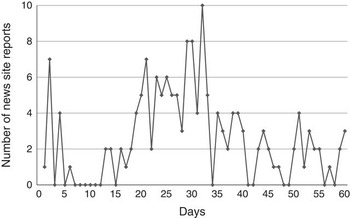
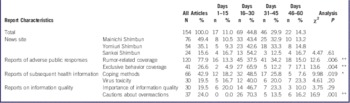
Figure 1 shows the chronological trend of news-site report counts on adverse public psychosocial responses. The report numbers had 3 peaks on days 2 (n=7), 21 (n=7), and 32 (n=10). These days corresponded with the dates of the WHO phase 5 declaration, first report of in-school transmissions in Kobe/Osaka, and nationwide outbreak, respectively. Table 1 presents the frequency of articles among all periods on psychosocial responses, coping information, and information quality. Approximately three-fourths of the reports appeared during days 16–30 (n=69, 44.8%) and 31-45 (n=46, 29.9%).
Number of H1N1 Influenza News Site Reports on Adverse Public Psychosocial Responses (April 28-June 26, 2009)

Frequency of News-Site Reports on Adverse Public Psychosocial Responses, Coping Information, and Information Quality

*P<.05; **P<.01.
About 3 out of 4 articles (n=120, 77.9%) had rumor-related coverage (reputation, 114 [74.0%]; rumor, 3 [1.9%]; panic, 6 [3.9%]; demagoguery, 6 [3.9%]). The majority of these articles were reported during day 16–30 and 31–45 (n=45 [37.5%] versus n=41 [34.2%]; P =.006). Approximately 1 out of 4 reports (n=41, 26.6%) contained exclusive behaviors (criticism, 10 [6.5%]; denouncement, 10 [6.5%]; discrimination, 8 [5.2%]; slur, 26 [16.9%]; prejudice, 7 [4.5%]; bullying, 3 [1.9%]). About 2 out of 3 of these reports were during days 16–30 (n=27, 65.9%; P=.004).
Nearly half (n=66, 42.9%) of the materials simultaneously provided coping methods, whereas fewer reports published virus toxicity information (n=30, 19.5%), had an emphasis on information quality (n=30, 19.5%), or cautioned about overreactions (n=37, 24.0%). These reports were mostly published during days 16–30, although significance was observed only for coping methods (n=32, 48.5%; P=.019) and cautions about overreactions (n=26, 70.3%; P=.001).
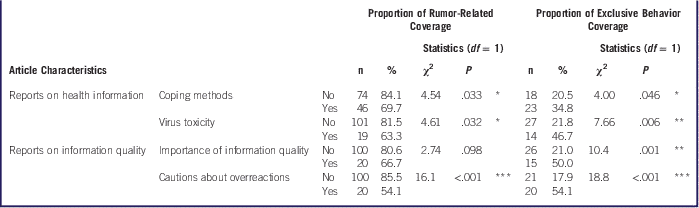
Table 2 shows the associations between the independent and dependent variables. Articles with rumor-related coverage, compared with articles without such content, were less likely to provide information about coping methods, virus toxicity, or cautions about overreactions (P<.05). In contrast, articles reporting exclusive behaviors were more likely to provide public health information or cautions about overreactions (P<.05).
Associations Between Reports on Health Information, Quality of Information, and Rumor-Related and Exclusive Behavior Coverage

Abbreviation: df, degrees of freedom.
*P<.05; **P<.01; ***P<.001.
Discussion
Our study indicated that in the midst of the 2009 H1N1 pandemic, Internet news-site articles with rumor-related coverage were less likely to provide information on coping methods, virus toxicity, and cautions about overreactions, even though these materials might help to mitigate adverse public responses. There is little evidence that public health crises provoke widespread panic.Reference Mawson 13 However, people rely on various types of information to make their health decisions. Such information may be inconsistent, inaccurate, or ambiguous, which can eventually lead to rumors and/or skepticism regarding health-related messages.Reference Glik 3 Therefore, if rumors are reported, health information is pivotal to reduce misunderstandings among the public. After the reported H7N9 cases in 2013, various governments disseminated health information (eg, epidemiological information, hand and respiratory hygiene, contact with poultry) using the Internet.Reference Harada, Alexander and Olowokure 14 Our data suggest a relative absence of health information transmission during the H1N1 pandemic. When authorities, health experts, and the media choose to share public reactions, health-related countermeasures should be incorporated in news reports. Doing so will help the public acquire successful coping skills for the given situation. However, further scientific studies are required to test this recommendation.
Our results show that when exclusive behaviors are discussed, public health information, along with cautions about overreactions, is more likely to be reported. When there is an invisible biohazard, people experience massive fear owing to its ambiguity and potentially serious health outcomes. Additionally, affected people are often at risk of being targets of discrimination and stigma.Reference Barrett and Brown 9 , Reference Person, Sy and Holton 15 Such responses were observed in Japan during the H1N1 pandemic Reference Shigemura, Nakamoto and Ursano 4 and in the 2003 SARS (severe acute respiratory syndrome)Reference Person, Sy and Holton 15 and 1918 influenza pandemics.Reference Barrett and Brown 9 Exclusive behaviors harm not only affected persons but also the public. Stigma manifests as a barrier to seeking health care and a cause of social marginalization, distrust of authorities, disobedience regarding public health measures, and, in the worst-case scenario, mass panic.Reference Barrett and Brown 9 Those delivering messages should make efforts to minimize discrimination and stigma among affected people, and these messages need to be culturally competent.Reference Glik 3
The public needs a certain amount of information in order to take recommended behavioral changes, but for some people this may result in maladaptive avoidance actions.Reference Rubin, Amlôt and Page 16 About 1 out of 3 (377/997; 37.8%) respondents reported taking recommended behavior changes, whereas approximately 1 out of 20 (n=49, 4.9%) had taken avoidance behaviors. Interestingly, a strong predictor of behavioral change was avoidance behaviors. This relationship between public perceptions, anxiety, and behavior changes is a challenge for organizations that deliver health-related messages. Message senders, such as authorities, the media, and health care professionals, should plan and implement pre-event crisis communication simulations and training sessions to solidify cross-organizational coordination. Such strategies may be applicable to other health crises when health-threatening agents are unknown and/or invisible, such as nuclear disasters.Reference Bromet and Havenaar 17
Our study has several limitations. The targets of the review were articles from only 3 news sites regarding a single event. Although a wide majority of the Japanese read newspapers and news websites, our results do not generalize to the media of Japan or the world or to other media formats. Many people collect information from multiple media sources, along with social networks and/or opinion leaders.Reference Glik 3 We were unable to use any validated scales to identify our variables because such scales were not identified. We dichotomously coded our variables, limiting precise material analyses. Because we used only publically available resources, we did not evaluate other variables related to the outcomes of risk communication, such as public trust in authorities and professionals and/or cultural issues.
Despite these limitations, our study sheds light on relationships among rumors, exclusive behaviors, and risk communication implications during public health crises. When reporting public responses in the media, disaster preparedness and response plans should incorporate strategies to simultaneously disseminate public health information so that the public can actively cope with critical situations.
Conclusions
During the 2009 H1N1 pandemic crisis in Japan, Internet news articles with rumor-related coverage were less likely to report public health information (eg, toxicity information, health support information, and cautions about overreactions). Articles with coverage of exclusive behaviors (eg, discrimination, prejudice) were more likely to report public health information or cautions about overreactions. Given that rumors and exclusive behaviors have adverse effects on the public, preparing for public health crises should involve the provision of accompanying public health information to aid the public in taking proactive coping actions.
Acknowledgments
Portions of this article were presented at the International Society of Traumatic Stress Studies 26th Annual Meeting, Montreal, Canada, November 4, 2010, and the 16th Congress of the Japanese Association for Disaster Medicine, February 12, 2011, Osaka, Japan. The views expressed in the manuscript are those of the authors and do not reflect the views or policies of author institutions, the Japanese government, or any of its subagencies.