INTRODUCTION
By obtaining such goods from afar, persons of influence, or elites, are involved in symbolically charged acts of both acquisition and transformation by which resources originating from locales outside society are obtained and brought inside society where they may be materially altered and/or symbolically reinterpreted or transformed to meet particular political-ideological requirements. (Helms Reference Helms1993:4)
On a Late Postclassic (ca. a.d.1200–1500) wall at Tulum on the east coast of the Yucatan peninsula (see Figure 1), a painted figure remains frozen in a centuries-old ritual act, carrying a food offering and a pouch probably holding incense (Figure 2). His zoomorphic headdress is Maya, yet his body proportions, bold outline, and facial markings speak a visual language of central Mexican origin. In these aspects, he would not look out of place in a contemporary Late Postclassic Nahua divinatory manuscript from Puebla or Tlaxcala, or in a Mixtec historical screenfold from Oaxaca. His striped visage signals his identification as a Nahua deity, either Xiuhtecuhtli (Taube Reference Taube1992:125) or Tezcatlipoca (Miller Reference Miller2012:233). The blue stripes depict turquoise mosaic, an equally foreign material in Yucatan, imported from the southwestern United States and northern Mexico via central Mexican intermediaries. The external connections reflected in the image are striking, yet the viewer who focuses on them to the exclusion of the figure's context might risk forgetting that Tulum is a Maya site, though a cosmopolitan one, and the artist and patrons were ethnically Maya.
Map of Mesoamerica. Drawing by Philip Winton, reproduced from Miller Reference Miller2012:14–15, Figure 6, by permission of Thames and Hudson Ltd., London.

Tulum Structure 1-sub mural. Drawing by Christopher Lessley after Miller Reference Miller2012:233, Figure 182, and drawing by Miguel Angel Fernández reproduced at http://www.danielschavelzon.com.ar/?p=356, accessed January 2014.

Far to the south, in the Peten lowlands of Guatemala, a figure in a similar pose and likewise bearing a container of incense, but carved in relief rather than painted, moves across a stela on display at the visitor's center at Tikal (Figure 3). It was not, however, found at that Classic-period metropolis, but on the island of Flores in Guatemala's Lake Pétén Itzá, the site of Tayasal (see Figure 1), the last Maya city to fall to the Spanish invaders in 1697. Probably the majority of tourists visiting this exhibit at Tikal pass over this monument in favor of the more naturalistic and often less fragmentary Classic-period stelae on view, but like the mural from more trafficked Tulum, this figure's body proportions and costume elements are as if he could have stepped out of the pages of a Nahua or Mixtec codex. Yet, he is rendered in stone on a monument form uncommon in the Late Postclassic in central Mexico, but with a long and prestigious local history extending back millennia before the presumed Postclassic manufacture of this stela, thus blending foreign forms with a traditionally Maya format.
Stela 4, Flores. Drawing by Christopher Lessley after Navarrete Reference Navarrete1988:Figure 3a.

Late Postclassic Maya participation in the broadly “Mexican” visual tradition defined by the pioneering Mesoamerican archaeologist Nicholson (Reference Nicholson and Wallace1960, Reference Nicholson and Boone1982) as the “Mixteca-Puebla style,” and by art historian Robertson (Reference Robertson1970) as the “International Style” of the Postclassic, has long been recognized in the murals of Maya sites like Santa Rita Corozal in Belize, Tulum and Tancah in Yucatan, and more recently, mural discoveries at the cosmopolitan center of Mayapan. Since the early observations of scholars like Eduard Seler in the late nineteenth and early twentieth centuries, similar central Mexican “influence” has also been discerned in portable painted works produced by the Late Postclassic Maya, the surviving bark paper codices. Building on the foundations laid by Seler, research in the last three decades has identified not only iconographic but detailed conceptual links between Nahua divinatory manuscripts of the Borgia group from central Mexico and the Maya Dresden and Madrid Codices (e.g., Boone Reference Boone, Smith and Berdan2003; Pohl Reference Pohl, Vail and Aveni2004b:374–376; Vail and Hernández Reference Vail and Hernández2013:211–214, 241–250). Mexican deity images, attempts to render their Nahuatl names in Maya hieroglyphs in the Dresden Codex (Vail and Hernández Reference Vail and Hernández2013:288–289), and shared details of calendars and almanac forms show direct connections between these cultures across hundreds of miles.
Interpretations of these phenomena have changed alongside the march of new discoveries. Much of the past century of scholarship, like our hypothetical viewer of the Tulum Structure 1-substructure mural, focused exclusively on the exotic content rather than the local context of Maya art works reflecting International Style traits, leading to theories based on mechanistic notions of “waves of influence” emanating outward from central Mexico or Mexican invaders bringing their art styles to the Maya region (e.g., Miller Reference Miller1982, Reference Miller, Sabloff and Andrews V1986; Quirarte Reference Quirarte and Stone1982) to explain the similarities. Such models were promoted by central Mexican and Maya specialists alike, despite the general resistance of many of the latter to acknowledging the impact of central Mexican ideas on the Maya of the Classic period. The Classic Maya were credited by many of their twentieth-century admirers (e.g., Morley [Reference Morley1946]) with complete originality in the development of their art, rated as more naturalistic than, and therefore superior to, that of other regions of Mesoamerica. Some of these same Mayanists (including, in addition to Morley, Thompson [Reference Thompson1954]), however, often embraced central Mexican “influence” or invasion to explain the divergences from Classic styles among the Postclassic Maya, both at Early Postclassic Chichen Itza and in Late Postclassic works in the International Style. Since the Postclassic Maya were framed as “decadent” by comparison with their privileged Classic predecessors, central Mexican outsiders often got credited with a major role in their alleged cultural and aesthetic decline (see Jones Reference Jones1995:21–104 and Jordan Reference Jordan2014:77–80 for critical historiographies). Later in the twentieth century, some Mayanists began to reverse the flow of “influence” to claim selected aspects of Postclassic central Mexican art, particularly at Early Postclassic Tula, as reflections or imitations of Maya ideas (e.g., Miller Reference Miller1985; Schele and Mathews Reference Schele and Mathews1998:200–201, 358–359), sometimes couched in stigmatizing terms as inferior provincial copies (e.g., Kubler Reference Kubler1961; Lincoln Reference Lincoln1990:189–194)
Over the past few decades, however, explanatory frameworks for Maya adoptions of the Mixteca-Puebla style emphasize the active participation of the Late Postclassic Maya in pan-Mesoamerican communication, trade, and political networks, as well as the local content and context of the murals and other works with International Style features. By 1994, even Nicholson had abandoned his “waves of influence” model for the spread across Mesoamerica of the style he helped to define and was invoking long-distance trade and shared religious ideologies as explanatory mechanisms (Nicholson and Quiñones Keber Reference Nicholson, Keber, Nicholson and Keber1994:xiv–xv). Among Maya specialists, alongside a shift away from stigmatizing the Postclassic as a period of decline, there has been increasing recognition of Maya participation in long distance cultural exchange with central Mexico in the Classic as well (e.g., Fash et al. Reference Fash, Tokovonine, Fash, Fash and Luján2009; Stuart Reference Stuart, Carrasco, Jones and Sessions2000; Sharer and Martin Reference Sharer, Martin, Fields and Reents-Budet2005), though debate continues over the nature of this interaction (see the papers in Braswell [Reference Braswell2003a], and especially Braswell [Reference Braswell and Braswell2003b] for a historical review and summary of positions).
In this article, after briefly reviewing current models and interpretations of lowland Maya appropriation of style elements and iconography in the Mixteca-Puebla/International Style, I examine two examples: a series of mural paintings emphasizing solar imagery at Mayapan and the unusual Stela 4 from Flores, to elucidate how they reflect Late Postclassic Maya uses of the Mexican Other in the service of local political and religious power. I argue that these artistic allusions to prestigious distant polities and “foreign” ritual art represent a Late Postclassic continuation of a long Maya tradition of using central Mexican forms and iconography as exotic ideological “prestige goods” to reinforce the status of local elites. They cannot be understood separately from this history. The International Style succeeded no less “international” connections between the Maya and central Mexico during the Early Classic (ca. 250–600 a.d.), Late Classic (ca. 600–900 a.d.), and Terminal Classic/Early Postclassic (ca. 800–1200 a.d.) periods. In particular, the Mixteca-Puebla style has roots in the art of the preceding Early Postclassic period, in the shared forms and iconography of the visual traditions of sites as widely separated as the Toltec capital of Tula in Hidalgo and the Maya center of Chichen Itza in Yucatan. The network of ideological and artistic connections across Mesoamerica during this time of transitions was the cradle and matrix in which the later International Style developed, and Maya deployment of the latter cannot be seen in isolation from this past. Had any form or symbol appropriated from afar had been completely alien to the Late Postclassic Maya, it would not have served local elites to use it in artistic strategies of legitimation, nor would it be readily adopted if there were no local conceptual parallels.
Not only did Late Postclassic borrowings of central Mexican forms and themes have precedents in these earlier cultural exchanges, but some of the iconography in question in the case of the Mayapan murals may actually have been appropriated from the Maya area to begin with by central Mexican patrons and artists during the Early Postclassic. Its appearance at Mayapan may represent a return of such imagery to its culture of origin via a complex series of interactions across several centuries. In the case of Flores Stela 4, we have a rare example of a major stone monument in the Mixteca-Puebla style, which has been defined in the past as confined largely to painted pottery, codices, and (more rarely) murals, and to small-scale media like gold work and bone carving. I argue that this stela represents not only a combination of a foreign art style with an old traditional Maya monument form—a mixture of local revival and exotic allusions, both potential boosts to the prestige of Tayasal's elites—but may be connected as well with the unusual employment of Mixteca-Puebla style and iconography in monumental sculpture at contemporary Mixtec centers. The Mixtec examples draw in turn on earlier Toltec monuments featuring processing figures to forge a simultaneously new and old visual language in support of the legitimation of regional rulers, and similar allusions may be referenced in their Peten counterpart.
A NOTE ON TERMINOLOGY
The terms employed for the phenomenon examined here have shifted over the years and with use by different writers, yet the basic concepts and definitions remain fairly consistent, if broad. For example, in their relatively recent formal definition of the Postclassic International Style, Boone and Smith (Reference Boone, Smith, Smith and Berdan2003:187–188) emphasize most of the same features as Nicholson (Reference Nicholson and Wallace1960, Reference Nicholson and Boone1982) in his seminal descriptions of the Mixteca-Puebla style, while their list of conventions for depicting the human figure derives from Robertson (Reference Robertson1970). They prefer the latter's term “international” to avoid implications of endorsing theories attributing the origins of the style to specific areas. Their formulation also takes greater account of regional stylistic variation, explicit in Smith's (Reference Smith, Smith and Berdan2003:182) conceptualization of the Postclassic International Style as “a broad grouping of regional painting styles that exhibit similar use of form, line, color, spatial arrangement.” While the framers of the Mixteca-Puebla/International Style concept, Nicholson and Robertson, clearly recognized stylistic and iconographic variations among regions, media, and individual works, Boone and Smith, like Masson (Reference Masson, Smith and Berdan2003) in the same volume, divide the Postclassic International Style into local variants, including the Coastal Maya Mural Style (encompassing inland Mayapan as well as coastal sites like Tulum). In this regard, their approach is consistent with Quiñones Keber's (Reference Quiñones Keber, Nicholson and Keber1994) critical paper on the term “Codex Style” as applied to Late Postclassic painted ceramics in the International Style, emphasizing the diversity of the works assigned to that category and questioning the homogeneity implied in traditional definitions. While earlier efforts sometimes conflated style and iconography in their definitions, Boone and Smith follow Robertson in emphasizing that form and content need to be addressed separately in any definition or analysis of the International Style. Nonetheless, they remain closely linked. Thus, Masson (Reference Masson, Smith and Berdan2003:194) stresses iconographic elements like temple forms, solar disks, Venus/star/rosette motifs, and vessel shapes as traits shared by the Coastal Maya Mural tradition with the Mixtec and Nahua variants of the International Style.
In the usage employed here, the Postclassic International Style and Mixteca-Puebla style are broadly synonymous since, on the formal level, the definitions are very similar, and to show, appropriately for a paper that discusses ancestors and lineage, the roots of current concepts in Nicholson's and Robertson's pioneering work. No endorsement of a locale of origin is implied by my use of “Mixteca-Puebla.” The style discussed here, though with many variants, is characterized by bold outlines and bright, flat colors, with humans and anthropomorphic deities depicted with a type of twisted perspective combining frontal and side views of the anatomy of the same figure. Deities are easily identified by cartoon-like exaggeration of features and a set of clearly recognizable and standardized iconographic markers, especially costume elements. In contrast with Classic Maya art, but in line with the general trend of previous central Mexican art traditions from Teotihuacan onward, the style does not resemble Western naturalism or illusionism. Human bodies are not shown with realistic proportions, but their short limbs and torsos and large heads often seem to serve predominantly as a frame or scaffold for the identifying costumes. Poses are stiff and conventionalized, and a limited repertoire of hieratic gestures serves to represent action. While locales are signified through formalized place signs, there are no illusionistic landscapes to serve as backgrounds for the actions of the depicted protagonists.
A highly standardized set of images, likewise rendered in a simplified and easy to read fashion, makes up the rest of the tradition's iconographic content. These include conventionalized representations of aspects of the cosmos like the sun and moon, sky and earth bands, water and fire and their combination in the atl-tlachinolli sign. Isolated parts of the human anatomy related to themes of sacrifice include hands, hearts, skulls, crossed femurs (often in rows of painted decoration alternating with crania), and sacrificial themes are also represented by bloodletting implements like thorns and knives (the latter frequently personified). Day signs in the 260-day Mesoamerican ritual calendar are likewise conventionalized, and human characters and sometimes divinities as well are often named by their birth dates in this system. The style is characteristic of the Late Postclassic though having earlier antecedents and disappears with the Spanish Conquest, between approximately a.d. 1350 and a.d. 1550 (Pohl et al. Reference Pohl, Fields, Lyall, Fields, Pohl and Lyall2012:31), though it may extend even later into the colonial period in Yucatan and the Peten (see below).
I employ “appropriation” here in place of unfortunate earlier terms like “influence” which still occasionally haunt the literature like ghosts of theories past. “Influence” is an ill-defined, mechanistic, non-explanation for artistic interactions, saddled with problematic baggage from its traditional use in art history. In the earlier days of the discipline, a major preoccupation lay in tracing the “influence” of one individual artist, school, or tradition on another, the latter usually framed as in some way inferior to and/or derivative from the former, based on formal and iconographic comparisons. Many of these attempts to create trajectories of forms and imagery from the privileged donor tradition (usually the one in which the author specialized as both expert and posthumous advocate) to the “borrowers” ignored or minimized the social context of the interaction and the motivation and agency of the “influenced.” In much of this literature, the latter are portrayed as if they are the victims of influence in the original medieval astrological and magical sense of the word, behaving as if magically compelled to imitate works produced by other hands/lands to varying degrees of fidelity. Why they always seemed to reject some aspects of the “donor” traditions and modified others usually went poorly explained, if at all. The connotations of the inferiority and lack of originality of the receiver of “influence” often paralleled the rhetoric of the European and North American colonialism and imperialism that formed the historical context of much of this early scholarship. The extreme manifestation of this tendency appeared as the “diffusionism” that dominated art historical studies of “primitive” (i.e., pre-Columbian, African, and Oceanic) art in the 1950s and 1960s, when the “influence” of certain privileged “civilized” art traditions (e.g., those of India and China) was invoked to explain the ultimate origins of the “primitive,” absence of convincing historical and archaeological evidence (not to mention improbability based on the vast geographic distances involved) aside (e.g., Fraser Reference Fraser1962). In studies of interactions between the Maya and peoples of other regions of Mesoamerica, the discourse of “influence” in the last century frequently recycled colonialist tropes and stereotypes of Native Americans going back to the European conquest and colonization of the New World (Jones Reference Jones1995:22–26). The Maya were usually framed as the “good Indians” or “noble savages,” while the central Mexicans were the barbarians that either led them astray as (literal) bad influences or stood in passive need of enlightenment from their Maya neighbors (see Jordan Reference Jordan2014:78–80 for further discussion and Pasztory Reference Pasztory and Rice1993 and Stone-Miller Reference Stone-Miller and Rice1993 for additional critical remarks on “influence” as commonly used in pre-Columbian art history).
Appropriation, as used by the Oceanic art historian Thomas (Reference Thomas1991,Reference Thomas1999), is better suited to describe the processes under discussion. Thomas employs this term for the conscious borrowing and modification of objects and images, both by Pacific peoples from European colonists and by Western “primitivists” from indigenous Oceanic peoples (Reference Thomas1991:183–184). It has the advantage of stressing the agency of the “borrowers” over the suggestion of passivity in “influence,” though of course any term can potentially become overused and its meaning overextended or blurred once entrenched in the discourse of any field. The possible social mechanisms for the selective adoption and adaptation of images and styles from outside of a polity, ethnic group, or culture are many and varied (see Jordan Reference Jordan2014:86–93, 190–193), as the discussion below reflects. They include the far journeying of elite ritual specialists to acquire exotic sacra (both objects and ideas) to bolster their prestige at home (Helms Reference Helms1988, Reference Helms1993), the ritual “purchase” of foreign cults and their paraphernalia (Pohl Reference Pohl, Fields and Zamudio-Taylor2001), trade, gift exchanges between elites, and religious pilgrimage (Ringle et al. Reference Ringle, Negrón and Bey1998). Even in situations of historically or archaeologically documented conquest of one group by another, the dominated often select and actively modify styles, motifs, and aspects of religious ideology, in the interest of both negotiated adaptation and resistance, as has been recognized over the last few decades of scholarship on indigenous Mesoamerican art under Spanish colonialism (e.g., Edgerton Reference Edgerton2001; Katzew Reference Katzew2011).
RECLAIMING THE LOCAL SUBJECT
In one of the last major works to argue for invasion or migration as an explanation for the Mexicanized style of the murals of Tulum, Miller (Reference Miller1982) nevertheless devoted the last chapter to a persuasive interpretation of the content of these paintings in terms of Maya cosmology. More recent interpretations of International Style art in the Maya area likewise emphasize local context in the subject matter as well as in the deployment of “foreign” style elements. Chase and Chase (Reference Chase and Chase1988; Chase Reference Chase1985), while using the central Mexican Codex Borgia and the Mixtec Codex Nuttall for comparison to the portrayal of ritual objects in the Santa Rita Corozal murals, nonetheless find the meaning of the actions portrayed in these paintings in Maya ritual practices documented in written sources from the conquest era. They criticize previous use of these murals as evidence of foreign intrusion as neglecting to take into account the other excavated materials at the site, which show no sign of such a putative migration or invasion, as well as underestimating the long reach of Postclassic Maya trade and communication (Chase and Chase Reference Chase and Chase1988:81–83). Santa Rita Corozal's elites had a cosmopolitan outlook and were quite aware of distant developments in other regions of Mesoamerica, but this does not make them or their art “non-Maya.”
Along similar lines, Masson (Reference Masson2000:41, Reference Masson, Smith and Berdan2003:194) identifies many “core” Maya images in both the Santa Rita Corozal and Tulum murals. At Tulum, these include censer forms, elite regalia (including an effigy of the Maya deity Kaawi'il), offerings of tamales, and gods (e.g., Chaak, the Maya rain god since at least the Late Formative period, a millennium and a half before these murals) (Masson Reference Masson2000:235). She points out that Maya glyphs, rather than central Mexican day signs, accompany the Santa Rita Corozal murals (Masson Reference Masson2000:41). Despite the International Style elements, the faces of the Santa Rita figures are Maya, and Masson (Reference Masson2000:245, Reference Masson, Smith and Berdan2003:198), identifies them as local dignitaries alongside Maya gods (echoing Milbrath Reference Milbrath1999 and Taube Reference Taube1992), in a scene representing the rotation of ritual offices (for an alternative interpretation in terms of Maya creation myths, see Vail and Hernández Reference Vail and Hernández2013:177–180). Like Chase and Chase, she interprets the Mexican formal qualities of these murals as the result of an active “outward-looking” attitude of the Maya elite patrons rather than a passive acquiescence to outside “influence.” Foreign artifacts in domestic contexts indicative of intrusive populations are lacking in the archaeological record at both Tulum and Santa Rita Corozal.
At Mayapan, the content of Mixteca-Puebla style art also seems embedded in local concerns. Murals in the Temple of the Niches (Q80) (Proskouriakoff Reference Proskouriakoff and Pollock1962:Figure 3D) show conventionalized temple structures and associated serpents with parallels in the Nahua Codex Borgia and Mixtec Codex Nuttall, and in Cholula polychrome pottery, respectively (Milbrath and Peraza Lope Reference Milbrath and Lope2003:26–27). However, Pugh (Reference Pugh2001:255) argues convincingly that they represent temples in Mayapan itself rather than structures in distant polities. The well-known ceramic effigy censers associated with the site may owe their ultimate inspiration to Mixteca-Puebla xantile figures from Puebla and/or similar objects from Oaxaca (Rice Reference Rice, Rice and Rice2009:303; Masson Reference Masson, Smith and Berdan2003:197), and some have been identified as central Mexican divinities, including Tlahuizcalpantecuhtli, Xipe Totec, Tlazolteotl, and Huehueteotl (Taube Reference Taube1992:120–126, Figures 63a, 64a–64c, 65a, 66a; Masson and Peraza Lope Reference Masson and Lope2014:466–469). However, the majority depict Maya deities (Masson and Peraza Lope Reference Masson and Lope2014:430), like the sky and creation god Itzamna. Many others lack attributes of specific gods, Maya or Mexican, and might represent local ancestors (Masson Reference Masson2000:239). A ceramic effigy censer recently excavated by Peraza Lope at the Templo del Crematorio seems to display the canine snout and pendant tongue of the Nahua Venus deity Xolotl, but combines these features with the traditional Maya iconography of scribes (stylus, shell paint pot, and monkey-like features [Lyall Reference Lyall, Fields, Pohl and Lyall2012:128]). Similarly, a Mayapan plaster architectural sculpture identified by some scholars as the Mexica deity Tlazolteotl (e.g., Milbrath and Peraza Lope Reference Milbrath and Lope2003:26) lacks the distinctive facial paint of this divinity, and has recently been more convincingly identified as the Maya goddess Ixchel portrayed in a central Mexican style (Masson and Peraza Lope Reference Masson and Lope2014:463).
Masson's (Reference Masson2000) analysis reveals that many of the works of the Coastal Maya Mural Style combine Mixteca-Puebla features with local themes of ancestor veneration. At Tulum, the Structure 16 murals allude to Maya concepts of ancestor worship and incorporate associated traditional iconography, including a framing serpent mouth derived from Classic Vision Serpent imagery (Masson Reference Masson2000:234). As in earlier Maya art, apparent ancestors are situated in upper portions of the composition, above sky bands. The figures in the Temple 16 and Temple 5 frescoes may represent the genealogies of local ruling lineages, including images of specific historical individuals. Paxton (Reference Paxton and Kowalski1999), while noting formal parallels to Codex Borgia in the depiction of mouths of the underworld, gives a different, though not mutually exclusive, reading of the Temple 16 murals as reflecting local concerns with rain and agricultural rituals.
EXPLANATORY FRAMEWORKS
Among current theoretical options for explaining Maya appropriations of the International Style, the most promising include the many variants of world-systems theory stemming from the seminal work of Wallerstein (Reference Wallerstein1974), which, in turn, traces its intellectual lineage ultimately back to Marx. Wallerstein's theories, which sought to explain changes in the capitalist world from the 1970s, have in the intervening decades been adapted, modified, and, indeed, appropriated in various forms by anthropologists to serve as analytic tools for the study of pre-capitalist societies. As applied to Mesoamerican studies, the various offshoots of world-systems theory share an attempt to frame prehispanic Mesoamerican cultural interactions in terms of networks of economic relations between different regions and polities (e.g., Blanton and Feinman Reference Blanton and Feinman1984; Kepecs Reference Kepecs, Kowalski and Kristan-Graham2007; Kepecs and Kohl Reference Kepecs, Kohl, Smith and Berdan2003; Kepecs et al. Reference Kepecs, Feinman and Boucher1994; Smith Reference Smith, Smith and Berdan2003). The range of possible processes mediated by these networks includes elite exchange of prestige goods and high-status ritual objects, larger-scale trade in lithics, ceramics, and other objects, warfare and conquest, diplomatic interaction, including elite intermarriage and participation in shared rituals (e.g., feasting), and exchanges of esoteric information, including ritual practices, astronomical and calendric material, and, importantly here, art styles and iconography. Such processes condition changes in all of the participating regions, cultures, and religious-political centers, making the whole network the basic unit of development and, therefore, of analysis. In emphasizing reciprocal interactions, world-system theories reject the unidirectional, mechanistic “influence” and archaeologically unsubstantiated invasions and mass migrations of earlier explanations. They provide a foundation for an understanding of Mesoamerican culture history in terms of multidirectional communication, an interconnected web of processes, a more decentralized, if also necessarily more complex, framework. The emphasis on mutual effects in multiple regions helps maintain a focus on Mesoamerica as a whole instead of privileging the priority or inventiveness of one region or another as scholarly fashions and bias dictate.
One drawback of some variants of world-systems shared with some of their Marxist predecessors is a tendency to relegate art and other ideological manifestations to the level of the “superstructural,” mere secondary outgrowths of economic and social relations, unworthy of the same attention as the economic “base” (Shannon Reference Shannon1996:205). This type of approach ignores the well-documented observation that in non-capitalist societies (including indigenous groups in pre-Columbian Central America) esoteric knowledge and the ideological trappings associated with long-distance imported prestige objects can function as elite “commodities” (Helms Reference Helms1979:128–143, 175–179, Reference Helms1988, Reference Helms1993:3, 96–99), as well as those variants of Marxist theory assigning these “superstructural” issues an important role in maintaining the legitimacy of ruling classes (e.g., Gramsci Reference Gramsci1971). In Mesoamerican studies, this deficit is avoided by recent world-systems analyses of the International Style as a means of elite communication among politically linked but linguistically diverse groups (Boone Reference Boone, Smith and Berdan2003; Boone and Smith Reference Boone, Smith, Smith and Berdan2003; Masson Reference Masson, Smith and Berdan2003; Pohl Reference Pohl, Smith and Berdan2003). While pointing, like some earlier models, to movement of physical goods as part of the process by which the International Style reached the Maya (e.g., Boone Reference Boone2007:234–235; Masson Reference Masson, Smith and Berdan2003:197), these newer approaches emphasize the spread of ideology in the form of symbols and ritual and the role of local motives and meanings in their selection.
Pohl (Reference Pohl, Vail and Aveni2004b:376), for example, suggests that the International Style spread through Mesoamerica via religious/economic transactions or “buying and selling ritual,” as well as through intermarriage and political-military alliances between elites, beginning in the Mixtec and Nahua regions where he argues it originated. Besides the visual language of the style, the ideological “ingredients” of this alliance system included shared creation myths and sagas and related ceremonial practices, mediated via trade and the exchange of goods at elite feasts (Pohl et al. Reference Pohl, Fields, Lyall, Fields, Pohl and Lyall2012:26). He concurs with many other scholars (e.g., McCafferty Reference McCafferty, Nicholson and Keber1994) that Cholula was the ultimate source of the style, which was disseminated along this central Mexican city's extensive trade and pilgrimage networks. Some formal features of the style and associated iconography may also have reached the Maya via portable objects like effigy censers carried along trade routes through the Gulf Coast and Tehuacan Valley. Nevertheless, local agency was always involved in the selection and modification of these pan-Mesoamerican motifs, styles, and practices.
In Pohl's (Reference Pohl, Vail and Aveni2004b:401) model, ceremonial exchange or purchase of exotic sacra may have been legitimized by the dreams or visions of local elites or ritual specialists, representing supernatural endorsement of such transactions. He compares the borrowing of aspects of the Mixteca-Puebla style by the Maya to the Mixtecs' appropriation of it from its putative point of origin in Puebla-Tlaxcala (Pohl Reference Pohl, Smith and Berdan2003). In both cases, local religion and social structures stayed the same, and the new art style was adapted to fit them, as evidenced by regional differences in pottery and codices, calendars, and emphasis on gods among the Nahuas vs. ancestors among the Mixtec (Pohl Reference Pohl, Vail and Aveni2004b:385). For example, the Nahua elites preferred their International Style polychrome ceramics with images of skulls, femurs, hearts, eyeballs, knives, blood-letting thorns, and eagles, jaguars, and butterflies, reflecting the ritual and military concerns of the priestly dual rulership of Cholula, while the Zapotec and Mixtec courts used ceramics emphasizing the less sanguinary themes of flowers, shells, parrots, and feathered serpents.
Hernández and Bricker (Reference Hernández and Bricker2004:31) suggest “elite gifting,” an aspect of business transactions and trade alliances between nobility, as the mechanism by which Nahua codices in the Mixteca-Puebla style found their way to Yucatan and the scribes of the Madrid Codex. They propose that this exchange of calendrical books between areas derived from the need to correlate the calendars regulating high-level ritual exchange. Boone (Reference Boone, Smith and Berdan2003:220) speculates that the thorough integration of the Nahua elements in the Dresden Codex “suggests that the book's audience was Maya, but Maya who were familiar with Mexican gods and their realms, and may have appreciated the spice of added Mexican gods in their Venus almanac.” Why such ideological condiments might be appreciated in Yucatan is addressed by Masson (Reference Masson2000:19), who links use of International Style elements to Postclassic Maya elite claims of descent from Mexican lineages, paralleled by similar legitimating (if fictive) foreign ties invoked by other Mesoamerican ruling groups. As elsewhere, invoking the ancestors and appropriating the foreign fused in supporting local elite claims to power (Helms Reference Helms1993:167–170).
LAYERS OF MEANING ACROSS TIME
Such visual “name dropping” of distant connections by elites has a long history in the Maya area. The adoption of Teotihuacan iconography by the Early Classic Maya and the diverse visual allusions to central Mexican Toltec and other traditions (Gulf Coast, Oaxacan) at the Early Postclassic Maya center Chichen Itza represent earlier examples of such processes. While debate continues over the nature of Maya-Teotihuacan contacts (Braswell Reference Braswell2003a), models involving active manipulation of foreign forms have long supplanted invasion and migration scenarios at Chichen Itza (e.g., Jones Reference Jones1995; Kowalski and Kristan-Graham Reference Kowalski and Kristan-Graham2007).
In a speculative interpretation of the Codex Nuttall, Jansen and Pérez Jiménez (Reference Jansen and Jimenez2007:229–239) interpret the Mixtec king 8 Deer's journeys with the “Toltec” 4 Jaguar as literal voyages to Chichen Itza and Mayapan. They suspect that these interactions between the elites of distant centers, which they date to the eleventh century, may be related to the origins of the Mixteca-Puebla style. While more local settings have been convincingly proposed for the locales of the 8 Deer saga (Pohl Reference Pohl, Hendon and Joyce2004a), and some of these heroes' peregrinations may represent supernatural rather than terrestrial voyages (Byland and Pohl Reference Byland and Pohl1994:152–155), the suggestion that long-distance elite contacts prior to the Late Postclassic contributed to the formation of the International Style remains solidly founded. High level pilgrimages, mediating the spread of prestige goods and art styles/motifs, are part of the mechanics of what Ringle's called a Quetzalcoatl cult (Ringle Reference Ringle2004; Ringle et al. Reference Ringle, Negrón and Bey1998), a model of Epiclassic through Early Postclassic interactions relevant to the origins of the International Style. Ringle identifies feathered serpent imagery and a related complex of cultural traits (e.g., chacmool sculptures, shell mosaic serpent helmets, the Reptile Eye glyph, an intensification of interest in the Mesoamerican ball game, and elite ceramic wares like Fine Orange and Plumbate) as markers of a pan-Mesoamerican Epiclassic to Early Postclassic “world religion” of Quetzalcoatl, ranging in geographical scope from Cacaxtla, Tula, and Xochicalco in central Mexico, across the Maya sphere from Putun Tabasco through Yucatan, and south into the Cotzumalguapa sites of Pacific Coastal Guatemala. In this model, the major Mesoamerican centers of this era participated in a network of linked pilgrimage centers doubling as regional political capitals or Tollans used, like medieval Rome, for the investiture rituals of kings. The widely shared cult thus functioned as an ideology of legitimation for local elites. The Mixteca-Puebla style figures in Ringle's reconstruction as a Late Postclassic development out of the earlier “Maya-Toltec” style, exemplified by the art of Tula and Chichen Itza, associated with the feathered serpent cult (see also Robles Castellanos Reference Robles Castellano, Vail and Hernàndez2010:37–38). Earlier, Nicholson (Reference Nicholson and Boone1982:230) had initially considered the art of Tula and Chichen Itza to represent an early variant of his Mixteca-Puebla style which later combined with other ideas to give rise to the fully developed classic version, though he later abandoned this idea (Nicholson and Quiñones Keber Reference Quiñones Keber, Nicholson and Keber1994:xi).
Masson (Reference Masson2000:249, Reference Masson, Smith and Berdan2003:192) suggests that Late Postclassic Maya deployment of the International Style and symbol set built on these earlier connections. She cites in support stucco male faces on the façade of Tulum's Structure 16, which houses International Style murals in its interior, displaying “serpent eyes” and feathered brows that Ringle identifies as Epiclassic feathered serpent cult iconography (Masson Reference Masson2000:233). Such earlier exchanges occasionally make it difficult to ascertain whether “Mexican” elements in Late Postclassic Maya art reflect contemporary contacts with other regions, represent the heritage of earlier interactions, or both. In any given case, we may be dealing with new appropriations of potent styles/symbols from abroad mixed with earlier assimilated forms, combining contemporary allusions to the Other with older borrowings that retained their original exotic power as well as accruing additional layers of local meaning. The past and local connections would have added both ancestral associations and easy recognition to the prestige of new ideas from distant places.
BASKING IN REFLECTED SUNLIGHT AT MAYAPAN
The murals showing “Mexican” sun disks excavated in the 1990s in the colonnade of the Palace of the Solar Symbols (Q161) at Mayapan (Barrera Rubio and Peraza Lope Reference Barrera Rubio, Lope and de la Fuente2001:Láminas 16–23; Milbrath and Peraza Lope Reference Milbrath and Lope2003:28) illustrate the need to take earlier contacts into account in understanding Maya use of the International Style. In eight scenes, two figures identified as warriors or standard bearers flank a central solar disk from which descending beings emerge (Figures 4 and 5). Though each of the descending entities appears distinct from the others in costume and attributes, their details are difficult to discern because of damage to the murals (Masson and Peraza Lope Reference Masson and Lope2014:82).
Solar disk mural from Mayapan Q161. Photograph by Joel Skidmore, used by his permission.

Descending figure in sun disk from mural, Mayapan Q 161. Drawing by Jay Scantling after Jose Francisco Villaseñor in Ruiz Gallut, Trejo, and Gutiiérrez Reference Ruiz Gallut, Trejo, Gutiérrez and de la Fuente2001:267, Figure 4.

The suns portrayed have four rays with broad flaring bases, within the canon of solar depictions in the International Style. Although Milbrath and Peraza Lope (Reference Milbrath and Lope2003) noted the resemblance of these solar images to those depicted in International Style murals at Mitla in Oaxaca and Santa Rita Corozal, as well as in the Nahua manuscript Codex Borgia, they initially suggested that the Mayapan murals are more closely related to Aztec art. They observed that the composition of these paintings, with figures flanking sun disks, is paralleled in Mexica relief sculpture, and that the figures lack the thick black outlines central to most definitions of Mixteca-Puebla or International styles (Milbrath and Peraza Lope Reference Milbrath and Lope2003:29). The descending entities evoked for these writers “Aztec images of deceased warriors serving as companions to the sun” (Milbrath and Peraza Lope Reference Milbrath and Lope2003:28), although they also suggested that they represent solar supernaturals linked to an eight year Venus almanac, a reading bolstered by the star eyes in the upper frames (see Masson and Peraza Lope Reference Masson and Lope2014:81). The Aztec comparison harmonized with these authors' assertion of significant Mexica connections at Mayapan, as well as with Miller's (Reference Miller1982:74–75) earlier speculations about Triple Alliance interventions in Yucatan in connection with manifestations of the Mixteca-Puebla style in the murals of Tancah and Tulum.
Pohl (Reference Pohl, Vail and Aveni2004b:404), on the other hand, disputes Aztec ties to the Mayapan murals. For him, they fall within the range of variation of the Mixteca-Puebla or “Mixteca-Nahua” style. For Lombardo de Ruiz (Reference Lombardo de Ruiz and de la Fuente2001:136–137), they fit within a “Mayapan Variant” of her Schematic Polychrome Style, which includes the International Style figure from Structure 1 Sub at Tulum with which I opened this study. Barrera Rubio and Peraza Lope (Reference Barrera Rubio, Lope and de la Fuente2001:438) and Ruiz Gallut et al. (Reference Ruiz Gallut, Trejo, Gutiérrez and de la Fuente2001:267) emphasize the stylistic and iconographic links of the Mayapan paintings to the solar deity images of Codex Borgia (Figure 6), congruent with the more recent suggestion that the descending beings may be “avatars of the sun” (Masson and Peraza Lope Reference Masson and Lope2014:81). Chronological and archaeological considerations also make Aztec connections at Mayapan increasingly unlikely (Robles Castellanos Reference Robles Castellano, Vail and Hernàndez2010:64–65; Masson and Peraza Lope Reference Masson, Lope, Vail and Hernàndez2010). No Aztec ceramics or any other portable trade objects, for example, have ever been found at the city (Masson and Peraza Lope Reference Masson and Lope2014:77). Peraza Lope (Masson and Peraza Lope Reference Masson, Lope, Vail and Hernàndez2010, Reference Masson and Lope2014) has since changed his opinion and now attributes any artistic similarities to central Mexico to broad inter-elite contacts via pilgrimage and trade rather than an archaeologically unsupported Aztec presence in the city.
Tonatiuh, in Codex Borgia:f. 71. Loubat facsimile edition image in public domain reproduced from Wikimedia Commons (https://commons.wikimedia.org/wiki/Codex_Borgia).

Complicating any interpretation of these images is the fact that, whatever the immediate Late Postclassic sources involved, the “Mexican” solar imagery here is not new to the Maya area, and arguably is ultimately of Maya origin. Barrera Rubio and Peraza Lope (Reference Barrera Rubio, Lope and de la Fuente2001:438) and Masson (Reference Masson, Smith and Berdan2003:195; Masson and Peraza Lope Reference Masson and Lope2014:81) correctly compare it to the Early Postclassic figures in solar cartouches that appear in the art of Chichen Itza (Figures 7 and 8), and note that Schele and Mathews (Reference Schele and Mathews1998:225; see also Ringle Reference Ringle2004:170) identify these as deified ancestors manifesting through supernatural portals. Most of the Chichen Itza solar figures are seated or standing rather than descending like the Mayapan examples, but one relief from the North Colonnade shows an armed figure diving out of a sun disk (Taube Reference Taube, Faust and Richter2015:108, Figure 5.9), a possible local antecedent for the Mayapan images (Figure 9). It may also be a forerunner of another group of probable ancestral representations in Late Postclassic Maya art, the “diving” figures from Tulum (Masson Reference Masson, Smith and Berdan2003:199), which I suggest represent a more likely (and local) analog for the Mayapan images than deceased Aztec warriors. In a book published after the submission of this paper in June 2014, Masson and Peraza Lope (Reference Masson and Lope2014:83) independently drew attention to the parallel between the Mayapan images and the diving gods at Tulum. They suggest on the basis of this comparison that the descending figures in the Mayapan murals may be noble ancestors, perhaps the founders of the elite lineages ruling the site in coalition, conjured by the figures flanking the solar images “to sanction political actions in this life” (Masson and Peraza Lope Reference Masson and Lope2014:82–84). Given both the emulation of Chichen Itza in Mayapan's architecture as part of the younger city's strategy of legitimation (Masson and Peraza Lope Reference Masson and Lope2014:75–76) and the ancestor veneration generally reflected in Late Postclassic Yucatec art, these Mayapan solar images may simultaneously invoke ancestral themes and current prestigious external contacts with central Mexico. Such polyvalent imagery would underline the legitimacy of ruling groups at Mayapan by mixing exotic connections with allusions to the worship of local forbears.
Solar figures from lintels from the Upper Temple of the Jaguars, Chichen Itza. Drawing by Linda Schele, © David Schele, used courtesy of the Foundation for the Advancement of Mesoamerican Studies, Inc. (www.famsi.org).

Chichen Itza, solar figures. Top, from mural painting, Upper Temple of the Jaguars. Drawing by Vivian Schafler after Milbrath Reference Milbrath1999:80.

Bottom, relief, now housed at the site hacienda. Drawing by Jay Scantling after Lincoln Reference Lincoln1990:174a, Figure 1.

The situation becomes more complex on further examination. Some participants in the interminable Tula-Chichen Itza debates over the nature and timing of the artistic connections between those centers argue that the Chichen Itza solar figures are themselves of central Mexican origin. López Austin and López Luján (Reference Lopez Austin, Lujan, Jones, Carrasco and Sessions2000:55–56) identify the form of the enclosing nimbus at Chichen Itza as distinctively central Mexican, while Milbrath (Reference Milbrath1999:82) compares its pointed rays to solar imagery in later central Mexican Mixteca-Puebla manuscripts and murals. Chronological considerations rule out Mixteca-Puebla connections at Chichen Itza; any central Mexican contribution would be Toltec. A similar solar figure appears in an ostensibly Toltec rock painting at Ixtapantongo in the state of Mexico (Figure 10; Taube Reference Taube1992:141, Figure 77c), and an additional image of a deity or ancestor in a solar disk in the style of Tula occurs on a stela from El Cerrito in Querétaro (Figure 11; Crespo Reference Crespo, Crespo and Brambila1991:Figure 17b). Interestingly, the rays of the El Cerrito disk with their flaring bases are not characteristic of the art of Chichen Itza but, rather, of later Mixteca-Puebla solar imagery (e.g., Taube Reference Taube, Vail and Hernández2010:166–167, Figures 17, 19), including the Mayapan examples. Miller (Reference Miller1982:73) identified the looped rays of disks on Postclassic ceramics from Tancah as “Mixtec-Aztec,” but the El Cerrito stela indicates a greater time depth for this form in Mesoamerica, as does a painted depiction of a solar deity from the Classic Veracruz site of Las Higueras (Taube Reference Taube, Vail and Hernández2010:164, Figures 16e–16f).
Figure diving out of solar nimbus, relief from the North Colonnade, Chichen Itza. Reproduced from Taube Reference Taube, Faust and Richter2015:108, Figure 5.9, by permission of Karl Taube.

Toltec rock painting of solar figure from Ixtapantango, Estado de Mexico. Drawing by Christopher Lessley after Taube Reference Taube1992:Figure 77c.

Tula-style figure in solar disk (note shape of rays) from stela, El Cerrito, Querétaro. Drawing by Christopher Lessley after Crespo Reference Crespo, Crespo and Brambila1991: Figure 17.

If we accept the Mayapan sun disks as “Mixteca-Puebla,” bestowing a foreign cachet upon their patrons, do they simultaneously refer back to whatever elite contacts occurred between Chichen Itza and Tula during the glory of the former site, in which Mayapan's lords later attempted to bask? Milbrath and Peraza Lope (Reference Milbrath, Lope, Cecil and Pugh2009:185, 192–193, 195–200) suggest that both the allusions to Chichen Itza in Mayapan's architecture and the Mixteca-Puebla borrowings reflect the ideology of the Cocom, one of the competing ruling lineages governing the city. The Cocom claimed descent from Chichen Itza and also cultivated contacts with and employed mercenaries from the Mexicanized Maya groups of the Gulf Coast of Tabasco and Campeche. Did the prestige of earlier artistic appropriations from central Mexico enhance those derived from contemporary dealings with the Gulf Coast or areas further west? Have these informational “prestige goods,” like the elite pilgrims themselves in Ringle's model, made far journeys and returned with added power? Such an interpretation might not be inconsistent with the ring that one of the descending figures in the Mayapan murals displays in his headdress and is carried by or is a costume element of another. Masson and Peraza Lope (Reference Masson and Lope2014:82) call attention to its similarity to Tlaloc goggles, a central Mexican war symbol portrayed in the art of Chichen Itza (e.g., on the reclining relief figures on the Temple of the Warriors and Platform of the Eagles [Tozzer Reference Tozzer1957:Figures 243, 431]) and Tula (e.g., Jiménez García Reference Jiménez García2010:38, Photos 18, 74, Figure 54). This attribute is not only shared by these Early Postclassic centers, but was part of the Teotihuacan war imagery adopted by the Maya during the Early Classic (see Headrick Reference Headrick2007:127–129 on Tlaloc goggles and atlatl rings at Teotihuacan).
On the other hand, was the solar disk motif originally a Maya ideological “export” to central Mexico? Taube (Reference Taube and Prem1994), while arguing convincingly for a Toltec origin for many aspects of Chichen's iconography, suggests that Toltec solar imagery may have originated at Chichen (Taube Reference Taube, Faust and Richter2015:122). Taube (Reference Taube1992:140–141, Reference Taube and Prem1994) identifies the Chichen Itza sun figure as an early version of the Nahua sun god Tonatiuh, who frequently appears in central Mexican Mixteca-Puebla art with a similar solar enclosure (e.g., Codex Borgia, f. 71—see Figure 6 above). He speculates that this deity was modeled on Maya rulers, or ajawob, since central Mexican peoples associated the Maya region with the east and dawn (Taube Reference Taube and Prem1994:224–225, Reference Taube, Lujan, Carrasco and Cué2006:162; supported by Solís and Velasco Alonso Reference Solís, Alonso, Moctezuma and Solís2004:85–88). Taube (Reference Taube1992:142, Reference Taube and Prem1994:225) identifies the costume of Tonatiuh, including his representations in both the Chichen Itza and Ixtapantango figures, as Classic Maya royal regalia. If so, was this Maya-derived sun disk complex then “returned” in modified form to the Maya area as part of the International Style of the Late Postclassic, to be combined with its earlier local antecedents?
It has been suggested that the Maya were major contributors to the formation of the International Style. Smith (Reference Smith, Smith and Berdan2003:182) hypothesizes that aspects of International Style iconography derive via his “Early Postclassic symbol set” from Late Classic Maya iconography disseminated along Ringle's Quetzalcoatl cult networks. McCafferty (Reference McCafferty, Nicholson and Keber1994:73), a principal excavator of Cholula, and Lind (Reference Lind, Nicholson and Keber1994:98) seek the nativity of the Mixteca-Puebla style in the Early Postclassic polychrome ceramics of Cholula, but discern Maya formal similarities in the latter. Their comparative analyses of Cholulan polychrome wares with Late Classic Maya parallels identify what they consider strong formal resemblances, an observation echoed by other excavators. For example, Cristina Polychrome, a Cholulan ware (in Lind's classificatory system) antecedent to Mixteca-Puebla polychrome ceramics and dated ca. a.d. 1000–1200, includes in its iconography Maya sun signs as well as the “reptile eye” glyph associated with Ringle's Quetzalcoatl cult, while the contemporary Marta and Estela Polychromes at Cholula resemble Maya painted pottery (Rice and Cecil Reference Rice, Cecil, Rice and Rice2009:268). Images strongly reminiscent of the Maya God M adorn Early Postclassic Tecama Phase ceramics from Cholula (Pohl et al. Reference Pohl, Fields, Lyall, Fields, Pohl and Lyall2012:31, 27, Figures 10, 117). It may be relevant that God M or Ekchuah is a merchant deity, suggesting the role of long-distance trade in mediating these apparent Maya contacts with Cholula.
Both McCafferty and Lind link these observations to traditional histories, recorded after the Spanish Conquest in the sixteenth century, of the invasion of Cholula by a people called the Olmeca-Xicallanca, whom McCafferty identifies with the Putun Maya of the Gulf Coast. In these archaeologists' models of Mixteca-Puebla origins, after the Epiclassic conquest of Puebla by the Olmeca-Xicallanca, “a syncretism of Classic Lowland and Central Highland cosmology may have been forged at Cholula, which succeeded in integrating diverse peoples throughout Mesoamerica into a new world order exemplified by the Mixteca-Puebla style” (McCafferty Reference McCafferty, Nicholson and Keber1994:98). These speculations await further support from archaeological and art historical research, and the veracity of the indigenous histories of the Olmeca-Xicallanca, their relevance for interpretations of Epiclassic central Mexican archaeology, and even the existence of the Olmeca-Xicallanca have recently been called into question (Brittenham Reference Brittenham2008, Reference Brittenham2011; Santana Reference Santana2011:11–31; Smith Reference Smith, Kowalski and Kristan-Graham2007) It is also clear that other sources contributed to the formation of the Mixteca-Puebla style as reflected in the ceramics of Cholula. McCafferty (Reference McCafferty2001:120), for example, notes Gulf Coast parallels, as well, consistent with the Olmeca-Xicallanca model. The recent discovery pushing back the beginnings of the Aztatlán polychrome ceramic tradition of Pacific coast West Mexico, which shares many stylistic similarities and much iconographic content with central Mexican Mixteca-Puebla style ceramics, to around a.d. 750–800 in Sinaloa (Arqueología Americana 2014; INAH Boletín 2014) at least hints that West Mexico may have played a more important part in the formation of the International Style than hitherto suspected. This possibility is consistent with the West Mexican economic connections of Cholula and the other Nahua and Mixtec centers where the style seems to have been synthesized (Pohl et al. Reference Pohl, Fields, Lyall, Fields, Pohl and Lyall2012:30, Figure 13).
Nonetheless, earlier Maya connections to the International Style might help explain the facility with which later Lowland Maya elites adopted aspects of it: parts of it may have been coming home. Simultaneously exotic and familiar, they were readily adopted as prestigious foreign allusions but intelligible and harmonious with local concerns. This dialectic of familiar and foreign, ancestral and Other, plays out repeatedly in the artistic interaction between Maya and Mexican elites from at least the age of Teotihuacan, and Lombardo de Ruiz (Reference Lombardo de Ruiz and de la Fuente2001:137) and Ruiz Gallut et al. (Reference Ruiz Gallut, Trejo, Gutiérrez and de la Fuente2001:267) note Teotihuacan parallels for the composition of these Mayapan murals, extending the temporal depth of any central Mexican connections. A repeated pattern of flux and reflux, a circulation of ideological “commodities” around Mesoamerica through time as they gained layers of shifting local and long distance value, characterizes the long history of these relationships better than unidirectional “influence” in one slice of time. Mexican and Maya forms and content repeatedly interpenetrate in such complex fashion that simplistic hypotheses fail to account for phenomena like the Mayapan solar imagery. When networks are used as a model for Maya-Mexican interactions in diachronic perspective, the possibility of multiple interactions and reciprocity is magnified in the consequent busy blur. This is not to say that it is always impossible to determine the specific origin points of motifs or styles. For example, the occurrence of reclining figures in Toltec style, nearly identical to later examples from Early Postclassic Chichen Itza, at the Epiclassic ceremonial center of Tula Chico at Tula strongly support the origin of this imagery in central Mexico (Suárez Cortés et al. Reference Suárez Cortés, Healan and Cobean2007; Mastache et al. Reference Mastache, Cobean, Healan, Fash and Luján2009; Jordan Reference Jordan2015). However, in other cases, like the Mayapan solar disks, the multiple layers of transactions across space and time enfolded into a shared iconographic feature reflect complexities that make the pinpointing of origins uncertain and point to multidirectional processes as the more appropriate, if more difficult to entangle, level or focus of study.
MARCHING THROUGH TIME AT FLORES
A little-known Postclassic monument from the Peten region of Guatemala illustrates the multiple local and distant meanings embedded in Maya uses of the International Style, with novel exotic and local ancestral references deployed together as strategies of legitimation. This sculpture, designated Stela 4 or Monument 3 (Navarrete Reference Navarrete1988; Barrios Reference Barrios, Laporte, Arroyo and Meijía2009, though Barrios Reference Barrios2008:13 calls it Stela 1) from Flores, is part of a group of stelae and altars from the site of the Itza capital of Tayasal, the last Maya city to fall to the Spanish invaders 1697. These sculptures were unearthed in 1975 during reconstruction efforts at the town's church. They were discovered under the church's original foundations on the north side of that edifice (Barrios Reference Barrios2008:13), “in the back room of a low structure that had been located beneath the church” (Chase Reference Chase1983:1074). When photographed shortly after its discovery by Hellmuth (Reference Hellmuth1978:66), Stela 4 was propped up against the police station next to the town jail. Subsequently escaping its modern penal setting, it is presently housed in the bodega of stelae at Tikal (Barrios Reference Barrios2008:13, Reference Barrios, Laporte, Arroyo and Meijía2009:1216).
The relief carving on this monument depicts a male figure wearing ornate sandals, strings of circular elements at the knees, a loincloth under a skirt-like covering, bracelets, and a square pectoral (Figure 3) (Navarrete Reference Navarrete1988:9, Figure 3A; Barrios Reference Barrios, Laporte, Arroyo and Meijía2009:1216, 1230, Figure 8a). He processes to the left, carrying an incense or offering pouch in his single visible (right?) hand. Unfortunately, the upper portion of the slab is damaged, the top of the figure lost. Traces of the facial profile are visible but the features are obscured. The headdress is missing, though a possible ear ornament remains. The torso is extremely short, the head large, the outlines stiff, the workmanship of the relief derided by Barrios (Reference Barrios2008:13) as of low quality. The probable date of the monument is Postclassic (Rice Reference Rice2004:216), and likely Middle (Chase Reference Chase1983:1074) to Late Postclassic (Hellmuth Reference Hellmuth1978:66), on both stylistic and archaeological grounds. Sherds belonging to the Cocahmut ceramic complex, which dates to between ca. a.d. 1200 and a.d. 1450 (Chase Reference Chase1984:37), were collected on the north side of the church at the time of the discovery of the stela (Chase Reference Chase1983:1075). More recent salvage archaeology has revealed that the area around the discovery was the focus of intensive occupation during the Postclassic (Barrios Reference Barrios2008:14). Chase (Reference Chase1983:1074) compared the style of this stela to a Postclassic Aztatlàn culture stone carving from Nayarit (Meighan Reference Meighan1976:321, Plate 15). As we will soon see, there are other analogs to Stela 4 that are closer in style and geography but Chase's observation is relevant in that the Aztatlàn style shared many aspects of both form and iconography with the Mixteca-Puebla Styles (Kelley Reference Kelley, Foster and Gorenstein2000:140–141).
The body proportions, simplified form, and posture of the figure on the stela are consistent with central Mexican styles. Similar processing figures are characteristic of Teotihuacan art but stylistically this image is very different from the visual traditions of that Classic center. Among other points, the feet and footwear of the Stela 4 figure are not Teotihuacano in form. In fact, Navarrete's (Reference Navarrete1988:9) and Barrios's (Reference Barrios2008:13) Postclassic dating stands (literally) largely on the basis of the “taloned” sandals and downward-curving toes. But their suggested stylistic linkage of Stela 4 with the Late Postclassic Yucatec Maya Dresden Codex is problematic. What Rice (Reference Rice2004:216) calls disparagingly “the stiff, blocky style” of the “poorly proportioned” stela image shows little formal resemblance to the more graceful, elongated figures of that screenfold manuscript, though this may in part reflect the difference in medium.
The image on the stela also varies in proportions and execution, though perhaps not radically so, from another probable Postclassic Flores monument, Stela 5 (though also called Stela 2 in Barrios Reference Barrios2008:215). This work, discovered in the same reconstruction of the church's foundations in 1975, displays a descending or “diving” figure and an ambiguous hieroglyphic date that supports a range of readings from a.d. 879 to a.d. 1392, though Rice (Reference Rice2004:217–218) favors the latest possibility (Figure 12). Though Chase (Reference Chase1983:1075) attempted to date this stela on stylistic grounds to the Early Postclassic and linked it to the art of Chichen Itza, the diving figure is consistent with the iconography of the Coastal Maya Mural variant of the Mixteca-Puebla Style, supporting the Late Postclassic date. However, the figure looks more “Maya,” with longer body proportions than that on Stela 4. The Stela 4 figure's proportions are likewise more compact than most of the International Style figures in the murals of Mayapan, Tulum, or Santa Rita, though there are some notable exceptions. The latter include paintings from Quintana Roo: the processing figures in the mural from Structure A VI at Xcaret (Figure 13c; Lombardo de Ruiz Reference Lombardo de Ruiz and de la Fuente2001:146, Lámina 36; Con Reference Con and de la Fuente2001:488–489, Láminas 5–6, Figure 7) and Mural 2 from the interior sanctuary of the House of the Jaguar at Xelhá (Figure 13b; Lombardo de Ruiz Reference Lombardo de Ruiz and de la Fuente2001:149, Lámina 41; Miller Reference Miller1982:Plate 46; Staines C. Reference Staines C. and de Ruiz1987:Figures 356–357; Taube Reference Taube, Vail and Hernández2010:162, Figure 13a) The last two are closer in style to Stela 4, although featuring more ornate and complex costume elements. Given the very late occupation of Tayasal, it may be of relevance that Lombardo de Ruiz (Reference Lombardo de Ruiz and de Lombardo2001:150) places her “Xelhá style” at the end of the Late Postclassic and even into the early Colonial period, though her date seems based on stylistic considerations and is presented without a clearly explicated argument.
Flores, Stela 5. Drawing by John Williams after Rice Reference Rice2004:217, Figure 7.9.

(a) Flores Stela 4 (drawing by Chris Lessley) compared with figure from (b) Xelha, Mural 2 from the House of the Jaguar (Taube Reference Taube, Vail and Hernández2010:162, Figure 13a, reproduced by permission of Karl Taube) and figure from (c) Xcaret, mural from north wall of Structure A-VI (drawing by Jay Scantling after Con Reference Con and de la Fuente2001:488, Figure 7).

In any case, the form and posture of the Stela 4 figure has multiple parallels in the Borgia group manuscripts (particularly the Codex Borgia) as well as in related Mixteca-Puebla murals from the central Mexican states of Puebla and Tlaxcala. The legs of the Stela 4 figure, with one slightly bent, the other advancing, resemble, for example those of the Codex Borgia's images of deities on folio 14 (Figure 14b; Anders et al. Reference Anders, Jansen and García1995:f. 14), Tezcatlipoca (e.g., Figure 14c; Anders et al. Reference Anders, Jansen and García1995:f. 21), and Ehecatl (Figure 14d; Anders et al. Reference Anders, Jansen and García1995:f. 19). Lacadena (Reference Lacadena, Vail and Hernandez2010:394–395) calls this pose the “lambda position” after its resemblance to the Greek letter and identifies it as a trait of the International Style introduced from central Mexico to the Maya area in the Late Postclassic. The sandaled feet with downward-pointing toes and the single arm in front of the body directly under the face are also consistent with the Borgia group (see the aforementioned Ehecatl and Tezcatlipoca figures for comparison). There are also similarities in posture and proportions to the Mixtec screenfolds (e.g., Codex Nuttall, f. 1). Compare also the skirt-like covering of the Stela 4 figure to that worn by Tlaloc in folio 67 of Codex Borgia (Figure 15; Anders et al. Reference Anders, Jansen and García1995). Pectorals with attachments similar to the one sported by the personage depicted on Stela 4 appear in the Codex Borgia (e.g., f. 25, Tlaloc; f. 51, Xochipilli) (Figures 16a–16b), while the pouch with its pendant recalls both Borgia group (e.g., similar, but with a double pendant, carried by Ehecatl in folio 19) and Mixtec examples (e.g., Codex Nuttall, Nuttall Reference Nuttall1975:f. 15, top register, center-left figure, f. 18, bottom descending figure), as well as the more complex type in the Tulum mural with which I opened this paper.
(a) Lambda pose of figure on Flores Stela 1 (drawing by Christopher Lessley) compared to Codex Borgia (b) f. 14, (c) f. 21, and (d) f. 19, detail, Ehecatl. Loubat facsimile edition image in public domain reproduced from Wikimedia Commons (https://commons.wikimedia.org/wiki/Codex_Borgia).

Tlaloc, in Codex Borgia:f. 67. Loubat facsimile edition image in public domain reproduced from Wikimedia Commons (https://commons.wikimedia.org/wiki/Codex_Borgia).

Deities with pectorals similar to the one depicted on Flores Stela 4 in the Codex Borgia. (a) Top, f. 25, Tlaloc; (b) bottom, f. 51, Xochipilli (top register left, and bottom register to the right of the temple). Loubat facsimile edition image in public domain reproduced from Wikimedia Commons (https://commons.wikimedia.org/wiki/Codex_Borgia).

Supporting an International Style affiliation for Flores Stela 4 is a similar figure incised on a bone pendant found during construction at Flores and in a private collection (Figure 17; Navarrete Reference Navarrete1988:Figure 3B). Though the context of this accidental find is unknown, it does bear a strong visual similarity to Stela 4. Sadly, like the stela, it is damaged and the face and front torso of the figure lost, though four plumes of the headdress remain. What is left shows a costumed male of similar proportions to the one depicted on Stela 4 advancing to the right. He carries a round shield that obscures most of the surviving torso, from the rear of which project the feathered shafts of three darts or arrows. Here again there are strong formal and iconographic parallels to both the Borgia group and Mixtec screenfolds, though most of the projectiles in these images are oriented vertically rather than horizontally. Although Navarette (Reference Navarrete1988:11) dates this bone carving later than Stela 4, the close resemblance suggests the two works are contemporary, both Late Postclassic. The International Style is also present in the Late Postclassic Peten in the form of painted designs on pottery. Some of these from the site of Topoxte near Flores resemble the Late Postclassic ceramics of Cholula (Rice and Cecil Reference Rice, Cecil, Rice and Rice2009:260–261).
Incised bone from Flores. Drawing by Christopher Lessley after Navarrete Reference Navarrete1988:Figure 3b.

Thus, formally the relief on Stela 4 fits comfortably into the International Style, an attribution supported by other manifestations of this pan-Mesoamerican visual language from the archaeological record of the Peten. However, this is at first somewhat surprising and puzzling since the Mixteca-Puebla style is usually associated with painted images—murals, codices, and ceramic decoration—and not with monumental sculpture (Pasztory Reference Pasztory1983:46). All of the variants of the International Style, unless Aztec art is included, tend to be mostly expressed in painting. Nicholson originally considered Aztec monumental sculpture to be a substyle of Mixteca-Puebla, but by 1994 had come to favor separating them into different, albeit related styles (Nicholson and Quiñones Keber Reference Quiñones Keber, Nicholson and Keber1994:xi), a view shared by specialists in Aztec art (e.g., Pasztory Reference Pasztory1983:47). Yet, here the style appears in the medium of relief sculpture on that supposedly most Maya of monumental forms, the stela. How might the traditional and novel combine here to create a statement beneficial to the status of the slab's patrons?
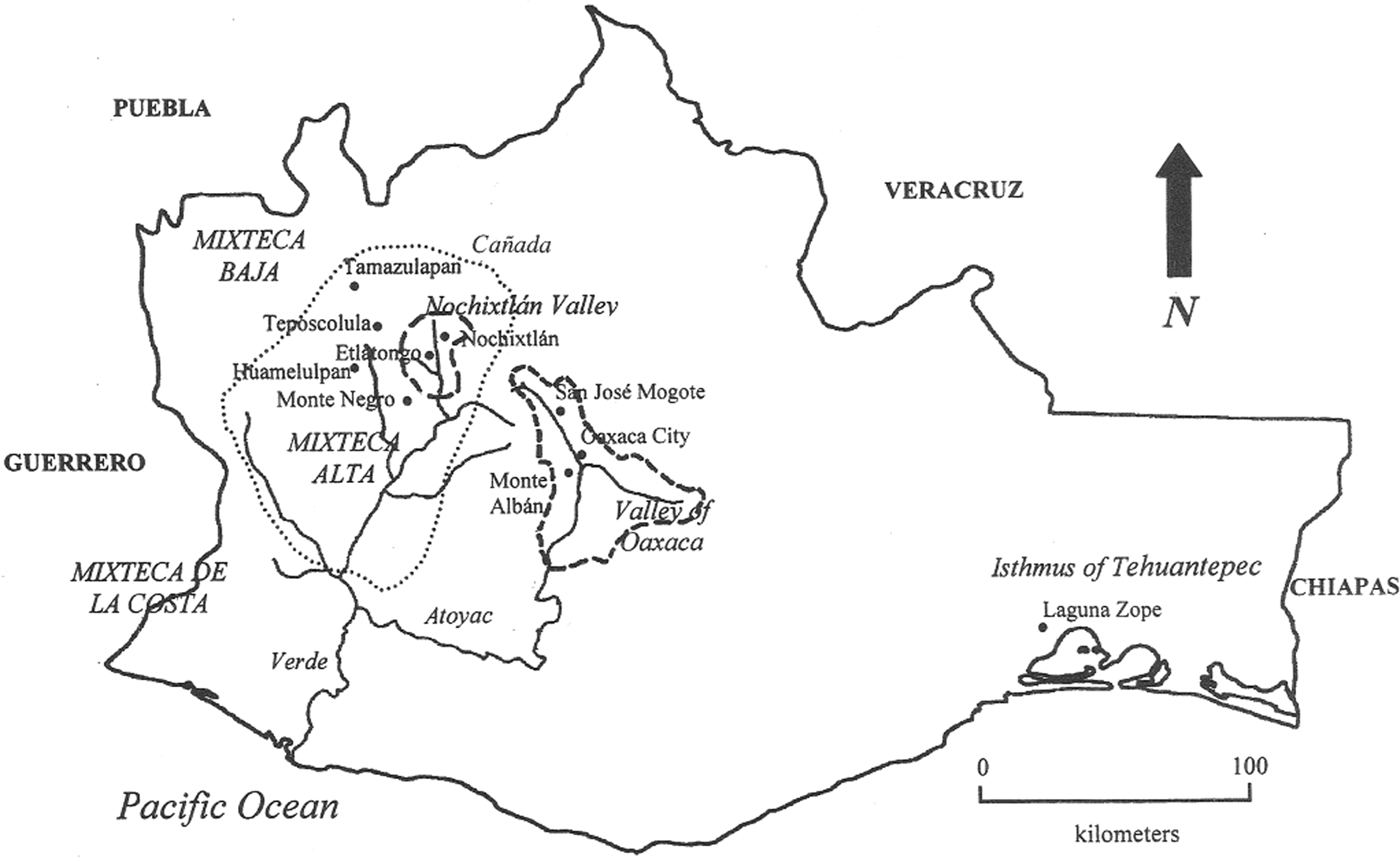
A possible parallel for stone carvings in another region deploying a simpler variant of the International Style than the usual painted forms, and which also provides a conceptual analogy for the significance of Stela 4, comes from the Late Postclassic Mixteca. Blomster (Reference Blomster and Blomster2008) has identified a number of reliefs of similar processing figures at Mixtec sites in Oaxaca. At Etlatongo (Figure 18), he investigated a stone slab bearing the damaged image of a male figure (Figure 19a), accidentally uncovered in the construction fill of a Late Postclassic structure, probably a palace (not enough of the building was excavated to determine its function with certainty) (Blomster Reference Blomster and Blomster2008:305, Figure 9.6). Though the context suggests reuse, Blomster (Reference Blomster and Blomster2008:304–305, 317) dates the relief by comparison to the Mixtec codices to the Late Postclassic and identifies the style as Mixteca-Puebla. The high status personage portrayed carries an object on his extended arm that may be a pouch for bloodletting implements and other sacra or a rectangular shield (Blomster Reference Blomster and Blomster2008:309). Though the figure's proportions are even more compact than the Flores Stela 4 image (and most Mixtec manuscript paintings) and the costume far more elaborate, the parallels in the unusual medium for an International Style work, as well as in pose, proportions, and concept, are noteworthy.
Map showing the location of Etlatongo. Reproduced from Blomster Reference Blomster and Blomster2008:Figure 1.2, by permission of Jeffrey Blomster.

(a) Etlatongo relief, from Blomster Reference Blomster and Blomster2008:Figure 9.6, reproduced by permission of Jeffrey Blomster and University Press of Colorado. (b) Tilantongo relief, drawing by Javier Urcid (after Blomster Reference Blomster and Blomster2008: Figure 9.7), reproduced by permission of Javier Urcid.

Blomster (Reference Blomster and Blomster2008:307, Figure 9.7) compares the Etlatongo relief to another carved stone in the Mixtec variant of the International Style from a probable palace at 8 Deer's Tilantongo (Pohl et al. Reference Pohl, Fields, Lyall, Fields, Pohl and Lyall2012:127), showing another processing male, identified by calendrical signs as Lord 5 Death (or 10 Death, according to Pohl et al. Reference Pohl, Fields, Lyall, Fields, Pohl and Lyall2012), carrying a round shield, darts and atlatl, and pouch, wearing an elaborate headdress with four long plumes. While, again, the figure wears more ornate costume elements and carries a richer array of prestige items than the Stela 4 figure, the resemblance to the Flores monument (and bone pendant) is striking (Figure 19b). Another Mixtec relief panel in similar style portraying the famed ruler 8 Deer from Teposcolula is reproduced by Spores (Reference Spores, Fields, Pohl and Lyall2012:154–155, Figure 8), though here the figures are seated rather than ambulating. A similar relief occurs on a Mixtec tomb jamb reused in a colonial church in Yanhuitlan (Blomster Reference Blomster and Blomster2008:311–313, Figure 3.9).
These Mixtec slabs parallel Stela 4 in their style and iconography but they do not appear to be stelae. Blomster (Reference Blomster, Nichols and Pool2012:44) interprets the Etlatongo and Tilantongo slabs as panels from sculptured daises with Toltec antecedents in the “warrior benches” of Tula, and Aztec parallels at Tenochtitlan. He compares the objects held by the Etlatongo processing figure to the maguey spines carried by the Toltec-inspired processing figures in the Eagle House at the Templo Mayor. He suggests that in creating these works, the Mixtec rulers, like the Mexica, appropriated Toltec imagery for legitimation (Blomster Reference Blomster and Blomster2008:317). (Perhaps this strategy was less than successful at Etlatongo, since Joyce [Reference Joyce2010:280] suggests that the carved slab was deliberately damaged in pre-Columbian times, though given the soft stone used for the carving and the circumstances of its accidental modern rediscovery by a farmer in the course of agricultural work, this is uncertain [Blomster, personal communication 2016].) These borrowed forms were at once exotic in origin and invoked the past, both the glories of Tula as a model for later polities and local claims for earlier alleged “Toltec” sponsorship of Mixtec elites (like 8 Deer's investiture by 4 Jaguar). But in representing these forms that simultaneously addressed foreign alliances and ancestral claims to power, they used their local variant of the Mixteca-Puebla style. The processions represent a sculptural reflection of similar scenes in the Mixtec codices (Blomster Reference Blomster and Blomster2008:324).
Blomster (Reference Blomster and Blomster2008) compares these Oaxacan monuments to Postclassic Highland Guatemala Maya parallels: the painted processions of Iximché (Figure 20a—compare the figure on the right to Flores Stela 4; Lombardo de Ruiz Reference Lombardo de Ruiz and de Lombardo1987:75, Figure 22, Reference Lombardo de Ruiz and de la Fuente2001:149, Figure 114; Schele and Mathews Reference Schele and Mathews1998:Figure 8.9) and the murals in the palace in the Quiche capital of Utatlán (see Figure 20b and compare to Flores Stela 4; Carmack Reference Carmack1981:295–299, Figure 9.2). These murals are also in the International Style (in the tentatively defined “southwest Maya style” proposed by Smith [Reference Smith, Smith and Berdan2003:182]), with similar references to a past both exotic and local in real or imagined Toltec ancestry. Carmack (Reference Carmack1981:296–299) identifies the painted processing figures at Utatlan as formally in the Mixteca-Puebla style but the round shield the personage he reproduces in his Figure 9.2 holds is a Toltec reference, an allusion to the purported Toltec ancestry of the Quiche ruling groups, and the solar disk at the figure's neck links him to Tohil, their patron deity. While it is unclear whether the Ixmiche murals represent ancestors, living elites, or deities (Schele and Mathews Reference Schele and Mathews1998:302), their poses suggest ritual activity, and one has his tongue pierced by perforators, recalling the objects similar to Mexica bloodletters carried by the Etlatongo figure. Both style, reflecting a contemporary foreign connection, and content, redolent of past prestigious links with distant places, advertised the power of the patrons in Oaxaca and Guatemala. In both places, artistic strategies for bolstering elite hegemony “combined general notions of a sacred past and ancestors with locally constructed notions of foreignness as the elites both forged and adopted an ideology of past Toltecs” (Blomster Reference Blomster and Blomster2008:319).
(a) Late Postclassic mural from Iximché, Guatemala. Drawing by Jay Scantling after Schele and Mathews Reference Schele and Mathews1998:303, Figure 8.9. (b) Figure from Late Postclassic mural from Utatlan, Guatemala. Drawing by Jay Scantling after Carmack Reference Carmack1981:297, Figure 9.2.

As a possible analog for explaining how similar International Style images wound up translated in stone far from Oaxaca in Flores, Blomster's (Reference Blomster and Blomster2008) analysis of the Etlatongo stone is a fruitful heuristic parallel. As at Etlantongo, at Flores variants of the International Style (the Maya Mural style in the case of Stela 5 and a more central Mexican style for Stela 4) were translated into stone relief. In Oaxaca, the results took the form of an earlier, non-local monument type, the bench frieze. At Flores, the form employed was decisively local. Stelae are not part of the International Style but, of course, were a Peten Maya tradition from the Middle Preclassic to the Terminal Classic. With their connection to the Maya royalty of the Classic past, they were an ideal form for revivalist trends or ancestor worship in the Postclassic. It is clear that some Late Postclassic Maya selectively revived the erection of stelae (Masson Reference Masson2000:266). The inhabitants of Mayapan both carved new figural stelae and erected a greater number of plain ones in a brief revival of the tradition. Thirteen figural and twenty-five plain examples had been reported for the site by the 1962 publication of the Carnegie Institution's report on its excavations at Mayapan, while two more were discovered in the recent excavation and restoration efforts of the Institutio Nacional de Antropológia e Historia (INAH) (Masson and Peraza Lope Reference Masson and Lope2014:52, 128). Three carved examples have probable dates in the twelfth and thirteenth centuries (Masson and Peraza Lope Reference Masson and Lope2014:80). As may have been the case with the Etlatongo relief, this stela revival was not completely successful, since the monuments were subsequently destroyed and removed from their supporting platform, then re-erected at the time of city's destruction in a civil war (Milbrath and Peraza Lope Reference Milbrath, Lope, Cecil and Pugh2009:194, 202). At long-lived Lamanai in Belize, the Postclassic inhabitants set up two platforms supporting plain stelae (Pendergast Reference Pendergast, Chase and Rice1985:98–99). In the Peten, the Late Postclassic rivals and enemies of the Itza ruling lineages at Flores/Tayasal, the Kowoj, reset Classic stelae at their ritual and political center at Zacpeten (Pugh and Rice Reference Pugh, Rice, Rice and Rice2009:153), a revivalist gesture paralleled by their reuse of Classic building materials in their own constructions and by the reappearance of Classic traits in the Late Postclassic pottery of the Peten (Rice and Cecil Reference Rice, Cecil, Rice and Rice2009:264). By fusing “foreign” style and iconography with a revived sculptural form, the Postclassic Itza of Flores may have created a Janus-faced testament to their supremacy, advertising the long heritage of the Peten (and perhaps their Mayapan origins as well) alongside their connections to other elites in the Late Postclassic Mesoamerican world system.
Such ancestral concerns and cults are apparently reflected in the diving figure of Flores Stela 5. The identity of the figures on Stela 4 and the bone pendant is not clear. Rather than individual divine ajawob, long superseded by coalitions of noble lineages as the main actors in Maya politics, the Mayapan stelae depict deities or the ritual activities of local nobility dressed as gods (Miller and O'Neil Reference Miller and O'Neil2014:181; Masson and Peraza Lope Reference Masson and Lope2014:79–80). It is possible that the Flores stela and bone pendant represent gods. But like the Mixtec bench figures and the highland Maya murals, they may represent contemporary members or ancestors of elite lineages.
Deeper references in time to both local lineages and long-distance relationships might be alluded to by the form of the Stela 4 figure. In his discussion of the Mixtec reliefs, Blomster (Reference Blomster and Blomster2008) raises the possibility of Maya origin of the Toltec bench frieze that served as their model (though in a different sculptural style). This question is part of the perennial imbroglio over the primacy of Chichen Itza versus Tula in generating their shared art styles, a way of framing that debate that looks increasingly antiquated in a world of world-systems and network models. However that issue is resolved, the processing dignitaries from the frozen files of figures at Tula are similar in pose and concept (though different in style) to the Mixtec carvings (Figure 21; Mastache et al. Reference Mastache, Cobean and Healan2002:107–127). Both the Tula and Chichen Itza examples may hold a similar relationship to Flores Stela 4. Given the Yucatan origins and connections of the Itza ruling lineages at Flores and claims to “Toltec” ancestry, might this stela also recall bench frieze figures such as those from the North Colonnade and Mercado at Chichen Itza, or a more general allusion to the processing figures in the art of that center? At the Mixtec sites, Toltec images were recast in a local variant of the International Style. Might the same have happened with “Toltec” imagery at Late Postclassic Flores? Again, images of power with prestigious connections to Chichen Itza and possibly to Early Postclassic central Mexico may have been combined with the International Style.
Bench figures from Tula. Drawing by Elizabeth Jiménez García from Mastache, Cobean, and Healan Reference Mastache, Cobean and Healan2002:Figure 5.28, reproduced by permission of Robert Cobean and Elizabeth Jiménez García.

The processing figures of the Tula and Chichen Itza bench friezes are a feature shared by both sites with Teotihuacan. In applying a “Mexican” image to a Maya stela, the carvers and patrons of Stela 4 also had local precedents going back to the Early Classic. As earlier Teotihuacan symbols were appropriated in the Peten during the Early Classic and translated into a Maya material expression in the form of stelae (e.g., Stela 11 at Yaxhá and Stela 32 at Tikal), so at Flores the language of the International Style—itself incorporating Teotihuacan forms and symbols—was combined with the stela form. The result was an artistic discourse of power in which the local and the exotic were combined, in the context of a history of multiple transmissions and permutations of ideas in a series of elite interactions going back centuries. By the Late Postclassic, local rulers could draw on imagery with a wealth of layered meanings that spoke simultaneously to local traditions and politically potent exotica, familiar enough to be understood, distant enough to wrap the rulers in the potent aura of the Other. They were agents in selecting from the palette of past and present, near and far, to create visual languages of power, but the palette itself was shaped by a long history of reciprocal connections and interactions. To paraphrase Marx, Late Postclassic Maya elites were creators of their own history (and their art), rather than recipients of “influence” or victims of invading Mexican armies. But they did not do so in circumstances of their own choosing, as their choices were embedded within the history of Mesoamerica as a whole.
CONCLUDING SKEPTICAL POSTSCRIPT
Some closing caveats:
Earlier twentieth century models of cultural interaction referred to “waves of influence” paralleling the development of radio and television, or culture-bearing invaders in the model of current colonialisms. Now, in the internet era, it is all about networks of information. One need not be a vulgar Marxist to see the roots of these ideas in their contemporary contexts, reminding us of the limitations and relativity of our approaches to the past. By necessity, our constructs of ancient Mesoamerica are formulated in a different historical setting than the realities they attempt to model, in essence making them appropriations. They often function as ideological prestige items, transmitted across academic networks marked by elites invoking their (intellectual) ancestral lineages (and occasionally interacting in warfare, albeit thankfully of a bloodless variety). Such insights remind us of the fact that our models are by necessity reflections of ourselves even as they attempt to interpret the past.’
RESUMEN
La participación de los mayas en el estilo posclásico mixteca-puebla del centro de México o el llamado estilo “Internacional” ha sido reconocido en los murales y en la pintura de manuscritos desde los tiempos de Eduard Seler pero ha habido un cambio en las explicaciones de este fenómeno en las últimas decadas de invasión o “influencia” a teorias enfatizando la selección y modificación activa por los mayas de elementos de estilo y icongrafía extranjeros. Estos elementos se combinaban en contextos locales con imágenes e ideas locales para apoyar el poder de los élites indígenas. Las ideas extranjeras viajaban por medio de contactos entre las clases gobernantes en regiónes distintas de Mesoamérica con bienes de prestigio y funcionaban también como bienes de prestigio incorpóreos. Las teorias diversas de sistemas mundiales proveen modelos dinámicos de estos procesos y ayudan en comprender los “préstamos” del México central por los mayas del periodo posclásico en el contexto histórico de interacciónes artisticas más tempranas entre la región maya y el altiplano de México central. Desde esta perspectiva, las interacciónes en el periodo clásico terminal parecen ser los origenes de la forma y los símbolos del estilo Mixteca-Puebla.
Examinamos aqui dos ejemplos, las pinturas murales solares de Mayapan y la Estela 4 de Flores, para aclarar como reflejan las utilizaciones por los mayas del “Otro” mexicano para reforzar el poder local político y religioso. En el caso de los murales de Mayapan, la forma y la icongrafia parecen aludir simultáneamente al arte “exótico” del México central y el pasado local en las imágenes de figuras de ancestros o deidades rodeadas por discos solares en el arte de Chichen Itza. Es posible que estas figuras solares del periodo clásico terminal de Chichen Itza fueran de origen mexicano también, ya que se parecen a imágenes del sol en el arte de los toltecas. Pero tambien es igualmente posible que la iconografia de las deidades del sol en el estilo Mixteca-Puebla fuera de origen maya. Las interacciones posibles fueron muy complejas pero en cualquier caso, sin la familaridad previa con estas imágenes solares, los mayas de Mayapan no las adoptaron.
La Estela 4 de Flores fue hallada debajo de la iglesia del pueblo en 1975 y por su contexto y estilo parece fechar al posclásico tardío. Muestra un personaje masculino ambulante en un variante del estilo Mixteca-Puebla/Internacional similar a los variantes de los códices del grupo Borgia, los códices históricos de la Mixteca y algunos murales del posclásico tardío de Yucatan. No obstante, esta figura de estilo muy parecido a estos estilos pintados, aparece en bajo relieve en la forma arquetípica del monumento maya del periodo clásico, la estela grabada. Esta escultura se combina una forma del pasado clásico del Peten con un estilo exótico del México central y alude a los ancestros locales y los élites extrajaneros para ganar el prestigio por la clase dominante de este centro posclásico maya. Hay paralelismos entre este monumento y un grupo pequeño de esculturas en bajo relieve de la Mixteca, tambien fechadas al posclásico y que también combinan un estilo pictórico con la técnica de escultura. Es posible que la Estela 4 y los monumentos mixtecos aludían también a los frisos de personas ambulantes de los toltecas y invocaban ancestros ficticios o actuales de las clases gobernantes de Oaxaca y el Peten del posclásico tardío.
ACKNOWLEDGMENTS
Thanks to Tim Pugh for introducing me both to Flores Stela 4 and the concept of appropriation, Jeffrey Blomster for critical feedback on an earlier draft of this paper as well as permission to reproduce illustrations from his published works, Mary Miller for feedback on an earlier presentation of this material in 2014 and for assistance in getting permission to reproduce the map in Figure 1, and Robert Cobean, Elizabeth Jiménez Garcia, Karl Taube, Javier Urcid, and Thames and Hudson Ltd. for permission to reproduce images from their publications. This paper is dedicated to H.B. Nicholson, in memoriam, and to my teacher Eloise Quiñones Keber for her scholarship on the Mixteca-Puebla Style.