INTRODUCTION
Malawi is the world's most tobacco-reliant economy, with the crop contributing over 60% of annual export earnings, most of which come from one type: burley tobacco. Malawi's dependence on fodya (tobacco) is not new, as the country has relied on semi-processed tobacco exports for most of the last century (see McCracken Reference McCracken1983; Ng'ong'ola Reference Ng'ong'ola1986; Wilshaw Reference Wilshaw1994). But what is relatively new is that smallholders now grow most tobacco, in contrast to the first three decades after independence when the two premier types of tobacco – burley and flue cured – were exclusively reserved for the estate sub-sector (defined not by size, but by land tenure: see Ng'ong'ola Reference Ng'ong'ola1986).
During the Malawi Congress Party (MCP) era which ended in 1994, the political elite became heavily involved in estate tobacco production (see Kydd & Christiansen Reference Kydd and Christiansen1982; McCracken Reference McCracken and McCracken1984; van Donge Reference van Donge2002a). The scale of estates changed considerably during this period. Through the 1960s the Farmers' Marketing Board (which became the Agricultural Development Marketing Corporation, ADMARC, in 1971) bought estates abandoned by European settlers, sold them to the political elite, and provided loans and management services (Kydd Reference Kydd1984). Estate production was particularly attractive after Rhodesia's Unilateral Declaration of Independence in 1965, and the imposition of sanctions in 1966, which increased demand for Malawian flue-cured tobacco (ibid.).Footnote 1
During the 1970s, the political elite and government-affiliated institutions created and took control of dozens of large-scale estates, and grew flue-cured and burley tobacco using labourers and tenants respectively (see Kydd & Christiansen 1982; Mkandawire et al. Reference Mkandawire, Jaffee and Bertoli1990; van Donge Reference van Donge2002a).Footnote 2 This estate expansion was based partly on the alienation of communal land, and partly on the compulsory purchase of European-owned estates (McCracken Reference McCracken and McCracken1984; van Donge Reference van Donge2002a). For example, many Europeans in the Central Region had their estate licences revoked in 1970 (Thomas Reference Thomas1975).Footnote 3
At the centre of estate expansion at this time was Press Corporation. As van Donge (Reference van Donge2002b: 657) highlights, ‘Press farmed tobacco, Press traded tobacco, and Press was instrumental in financing the growing of tobacco’. For example, the two divisions of Press Agriculture (General Farming, jointly owned by President Banda and the FMB; and Press Farming, owned by the Malawi Congress Party) increased estate holdings considerably through the 1970s. Press Corporation took a 42% stake in a key leaf merchant company, Limbe Leaf, controlled by Universal Leaf (the world's largest tobacco merchants), and a shareholding in the Commercial Bank of Malawi, a key source of finance for estate expansion (ibid.). However, by the end of the 1970s the close relationships between key economic institutions (such as Press Corporation, ADMARC and the Commercial Bank), which had sustained growth in large-scale tobacco estates in the 1970s, came under strain (see van Donge Reference van Donge2002a; Harrigan Reference Harrigan2001), and estate expansion in the next decade was on an altogether different scale.
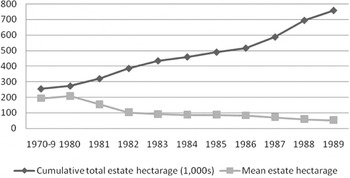
Estates in the 1980s became much smaller, with mid-level civil servants, estate managers and ‘graduating’ smallholders obtaining leasehold tenure over tracts of communal land (see Conroy Reference Conroy1993; Sahn & Arulpragasam Reference Sahn and Arulpragasam1991). The rapid increase in the number and area of estates, and their decreasing mean size, is illustrated in Figure 1.
Small-scale estate expansion in the 1980s.

Whilst new estates were opened in the north of the country, estate expansion in the 1980s was fastest in the Central Region (Sahn & Arulpragasam Reference Sahn and Arulpragasam1991: 15), and almost entirely based on tenant production of burley tobacco (Kydd & Hewitt Reference Kydd and Hewitt1986). As on large-scale estates growing burley, this often took the form of the visiting tenant system, where migrant (or local) households were loaned inputs and basic food rations at the start of the agricultural season (October/November), with their cost (plus interest) deducted from the fixed prices paid by the estate owner for the cured tobacco leaf (set nationally by the Tobacco Association of Malawi – TAMA). Such tenants rarely managed to save income or accumulate assets, as TAMA prices were substantially below auction floor prices.
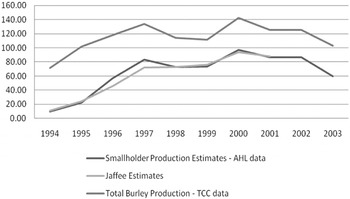
But from 1990 onwards, and especially after 1994, tobacco production and marketing in Malawi underwent substantial reform, allowing smallholders to legally grow and market burley tobacco.Footnote 4 The aim of the reform process was to improve smallholders' incomes and food security, and boost the non-farm rural economy (Orr Reference Orr2000; Tobin & Knausenberger Reference Tobin and Knausenberger1998; USAID 1994; World Bank 1994).Footnote 5 Smallholders responded enthusiastically to this opportunity. For example, the number of registered smallholder burley clubs increased from 502 in 1990 to 2,458 in 1995 (the last year when clubs were allocated production quotas), to 29,225 in 2000, before declining to 17,001 in 2003 (Tobacco Control Commission data). Figure 2 shows estimates of the smallholder share of total burley production from 1994 to 2003 (including estimates of the proportion of smallholder-grown burley marketed through an intermediate buyer or estate registration number).Footnote 6 It suggests that smallholder burley production increased from about 10,000 tons in 1994 to over 97,000 tons in 2000, before declining to about 60,000 tons in 2003. These estimates suggest that between 1997 and 2003 about 60% of total national burley production (averaging about 120,000 metric tonnes) was grown by smallholders.Footnote 7
Smallholder Share of Burley Production 1994–2003 (millions of kgs).

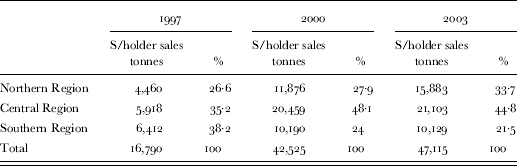
But although smallholder burley production has increased growers' incomes (for example, see Carvalho et al. Reference Carvalho, Gordon, Hirschmann, Martella and Simmons1993; Orr Reference Orr2000; Zeller et al. Reference Zeller and Diagne1998), little is known about smallholders' expenditure patterns from burley. This is significant because, as the World Bank (1997: iv) notes, ‘smallholder profits from burley sales have provided the largest ever cash injection of income in rural Malawi’. Whilst some studies highlight how smallholder burley production led to multiplier effects in local economies (Orr Reference Orr2000; Orr et al. Reference Orr and Mwale2001; Zeller Reference Zeller1997), few studies have provided clear details on how or where burley income is spent. There are exceptions. One is the longitudinal work of Peters in Zomba district (for example, see Peters Reference Peters1996, Reference Peters1999, Reference Peters2006; Peters et al. Reference Peters and Herrera1989). In this work we can glean that burley income is spent on building materials, clothes, fertiliser and setting up small businesses. But however insightful these studies are, they tell us little about the manner in which most smallholder burley income is spent. This is because smallholder burley production is now mainly located in the Central and Northern Regions, not the Southern Region. To illustrate this point, Table 1 shows the amount of burley tobacco sold on the auction floors in 1997, 2000 and 2003 through a smallholder registration number by region. The Southern Region's share of smallholder burley production declined from 38·2% in 1997 to 21·5% in 2003, much lower than the 33·8% from the Northern Region, and 44·8% from the Central Region.Footnote 8
Burley tobacco sold through smallholder registration number by region
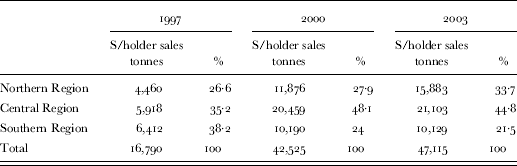
Source: Auction Holdings datasets.
In addition, there is an important reason why a high proportion of smallholder burley was grown in the Southern Region in the early years of burley reform. As burley production was framed in terms of poverty alleviation and improving food security, the main donor agencies involved in the reform process (USAID and the World Bank) ensured that 75% of smallholder production quotas were allocated to rural households with less than 1 hectare (World Bank 1994). This took the form of geographical targeting, and meant that in the early 1990s almost 50% of smallholder quotas were allocated to extension planning areas in the Southern Region, where landholding sizes are smallest. But such geographical targeting did not ensure that burley quotas were received by poor, land-constrained farmers, as intended by the reform process. Instead, quotas and early burley clubs were dominated by the upper strata of rural communities (see Orr Reference Orr2000; Peters Reference Peters1996; Tobin & Knausenberger Reference Tobin and Knausenberger1998). As the pace of burley reform increased, in 1996 the quota system was replaced by a registration system which facilitated access to the auction floors for all smallholder growers. Table 1 suggests that smallholders in the Central and Northern Regions responded most enthusiastically to this opportunity. In this respect, it may be unwise to extrapolate data on how burley income is spent, and on the effects of burley production more broadly, from the Southern Region to the centre and the north. This is especially the case if one considers particular characteristics of the Southern Region which are not replicated in the other regions: the smaller landholding sizes, the easier access to urban markets, and the cross-border trade with Mozambique (Orr & Mwale Reference Orr and Mwale2001; Orr et al. Reference Orr and Mwale2001; Whiteside Reference Whiteside1998).
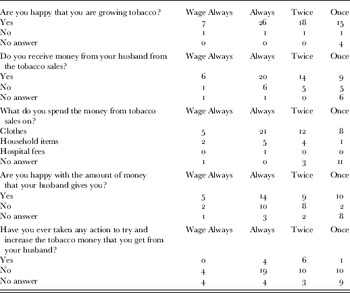
Intra-household distribution of tobacco income

Source: Household survey.
This paper aims to aid understanding of smallholder expenditure patterns and practices associated with burley income in the Central Region of Malawi. It does not describe survey expenditure data, but takes a sociological perspective and offers data generated from a variety of research methods conducted during nineteen months of fieldwork between August 2002 and June 2004. Fieldwork took place in four different stages: an initial period of four months based in Lilongwe; a subsequent period of six months when the author was introduced into a rural community and began micro-level research; an intensive eight-month period when most of the micro-level research was conducted; and a final period of one month in Lilongwe. Specific locations for the research were not predefined, but emerged from the research process. In Lilongwe, research locations included air-conditioned bureaucrats' offices, seminars at hotels, and amongst the tobacco bales on the auction floors. At the district level, research was conducted in offices of agricultural and government institutions, as well as in bars and restaurants where civil servants, wage earners and tobacco farmers socialised. The location for micro-level research was guided by spatial analysis to find an area of concentrated burley production, and methods included participatory rural appraisal techniques, household surveys in four villages (with husbands and wives interviewed separately and simultaneously), life history interviews, and focus group discussions (including the presentation of preliminary findings to participants). In addition, the research involved the long-term direct observation of social practices – in Kasungu town, in a rural trading centre and, to a lesser extent, in the four village communities. The commitment to the ethnographic method mainly informs the first two sections of the paper. Data from life history interviews, a household survey, and focus group discussions, mainly inform the last two.
Using data from this mix of research methods, the paper offers a sociological interpretation of why some smallholder tobacco growers in the Central Region immediately spend a proportion of burley income on alcohol and consumer goods in rural towns and trading centres, known as kuziziritsa ku khosi (lit. ‘to cool the throat’, but referred to as ‘cooling off’). It argues that this practice is a form of conspicuous consumption through which smallholders, in an expression of inculcated behaviour, attempt to attain the status of a tobacco bwana (boss/master). The argument is made by constructing an idealised ‘cultural model’, mainly from ethnographic data. The first two sections of the paper show how at the national and district levels the tobacco industry in Malawi reifies the ‘cultural model’ of the tobacco bwana, and how the behaviour of smallholder growers in the Central Region reproduce key elements of this model. The last two sections of the paper discuss some implications of this form of conspicuous consumption: first, by describing the contrasting fortunes of two non-farm rural enterprises; and second, by discussing limited data on how tobacco production and ‘cooling off’ is viewed by wives, and the crop preferences of both husbands and wives. The paper concludes by suggesting that the concept of conspicuous consumption may provide an alternative prism through which to view apparently unintelligible investment decisions in African economies to the instrumental lens of neo-patrimonialism.
CONSTRUCTING THE ‘CULTURAL MODEL’ OF THE TOBACCO BWANA
This section draws out similarities in the culture of the national-level tobacco industry in Malawi, and the status of estate owners in Kasungu district, to offer a stylised description of the ‘cultural model’ of the Malawian tobacco bwana. It highlights how tobacco production in Malawi is influenced by a racialised, gendered and class-based set of norms and practices.
The starting point in this exercise is to recall that the reservation of burley and flue- cured tobacco for estates, only rescinded in the 1990s, was originally based on the racialised separation of ‘light’ tobaccos, such as flue-cured, for whites, and ‘dark’ tobaccos, such as fire-cured, for black Africans.Footnote 9 It was also partly based on a colonial belief that light tobaccos were too technical for Africans to grow (see Wilshaw Reference Wilshaw1994). The tobacco industry in Malawi is still to some extent imbued with such colonial-style views regarding white racial superiority and bigotry.
These features are brought into relief at the annual tobacco seminar, when all the different stakeholders in the industry come together around a conference table. The constituency at the table is almost exclusively male. Many of the participants are notable by their bulk, smart suits, and number of cigarettes they smoke, thus displaying their attachment to the commodity that pays their bills. Most of them are black Malawians, apart from one side of the table where white estate owners sit adjacent to white tobacco leaf company managers. The main tobacco leaf merchants are almost exclusively white, from Malawi, South Africa and Zimbabwe.Footnote 10 The leaf companies hold great power in the industry due to their close relationships with, and contractual obligations to, international cigarette manufacturers, and their control over the capital goods which process tobacco before export.Footnote 11
The difference between white estate owners and white leaf company managers became clear during the course of the seminar. Whilst white estate owners conversed (sometimes in chiChewa) and socialised with all participants, the leaf company managers kept themselves to themselves, ensuring physical and social segregation: they stayed at a different hotel, ate meals separately, and failed to participate in social functions. Whilst many open-minded African whites work in the tobacco industry, particular leaf companies still have a reputation for racism. In addition, the culture of leaf company bosses in Lilongwe is particularly macho: de rigueur elements include huge jeeps, short-sleeved blue shirts, brais (barbeques), Castle lager, blue label Johnnie Walker whisky and Peter Stuyvesant cigarettes. A handful of senior black Malawian employees in the leaf companies embrace this white tobacco culture, exhibiting similar practices, clothing and accessories to their better-paid colleagues (see Fanon Reference Fanon1968; Rutherford Reference Rutherford2001).
Black Malawian tobacco culture in Lilongwe is likewise very macho and alcohol-dominated. It is also strictly differentiated along class lines. The black Malawian managerial strata within tobacco institutions are very much part of the political elite and fraternise in these circles. Black Malawian mid-level managers and leaf buyers are part of the middle class in Lilongwe, often frequenting bars and clubs in town, and straddle paid employment with farm and non-farm business activities. The mass of those employed by the tobacco industry – labourers – form one of the most significant industrial workforces in the country, and in their spare time many labourers can be found in the Chibuku bars alongside the auction floors and around the city.
In some ways, chauvinism in the industry reflects its history: throughout the last century, tobacco production for export has been seen as an exclusively masculine endeavour (see Wilshaw Reference Wilshaw1994). As part of the implicitly male colonial project of conquering distant lands, tobacco production was seen as an example of the ‘chaos’ of the African bush being wrenched into order and brought under productive control. In the post-colonial era, tobacco production by the male black Malawian elite was part of the wider pan-African, and predominantly masculine, process of nation-building and self-determination (see Mkandawire Reference Mkandawire and Mkandawire2005). Tobacco in Malawi is a man's world. A clear indication can be gleaned from a cursory look at the auction floors during any sale: it is highly unusual to find women working in the tobacco industry other than in a secretarial capacity.Footnote 12
In addition to race and gender, tobacco production in Malawi has also, until recently, been based on a strong class division. From colonial thangata labour regimes in the Southern Region, to the visiting tenant system initiated by I. Conforzi in the 1950s, and institutionalised by the MCP from the 1970s, tobacco production has always relied on controlling and exploiting labour. During the large-scale estate expansion of the late 1960s and 1970s, this was either direct wage labour to grow flue-cured tobacco (due to the high labour and capital requirements of this crop), or visiting tenants for burley production. Estate owners' ability to offer employment (in the form of annual tenancies or ganyu – piecework), the security implications of such relationships, and estate owners' political and business connections, have contributed to them (in the Central Region at least) being accorded high social status within rural areas.
A brief description of the two largest estates, and one small-scale estate owner, in the area of Kasungu district where most micro-level fieldwork was conducted helps to illustrate this point. As we saw earlier, the political elite and government-related organisations took over dozens of large-scale tobacco estates in the 1970s. One example is the Chimbwazi estates, the largest in the area, opened by A. F. Barron in the 1950s but taken over by President Kamuzu Banda, in a personal capacity, in about 1970. Kamuzu extended these estates, displacing villages from communal land, built flue-cured barns on two of the three estates, and started to grow flue-cured tobacco (tenants grew burley on the third). In about 1975 Kamuzu handed control of the estates to his nephew's company (part of the Chamwavi Group, closely aligned to the president's family's business interests). For the next two decades, the estates grew flue-cured and burley tobacco, employing both migrant and local workers (although the size of the estates decreased as a portion returned to the traditional authority due to encroachment by land-scarce villagers). By the late 1990s the Chamwavi Group was in financial difficulties, and the estates were subsequently leased to ADMARC and a tobacco leaf company.Footnote 13
The owner of the second largest estate in the area also held a position of considerable power. The Sesa estate opened around 1975, and was owned by a senior figure in the Malawi Young Pioneers (MYP), the paramilitary youth league of the Malawi Congress Party. The 300-hectare estate grew flue-cured tobacco using direct labour, with managers and some workers coming from MYP training centres. Again, this estate ran into financial difficulties at the end of the 1990s and was later leased by a tobacco leaf company.
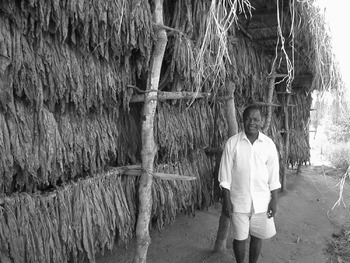
The high social status of estate owners is also reflected in the brief biography of one small-scale estate owner who started growing burley in the 1980s. Bishopo Tsoka (pseudonym) was born in rural Kasungu as a son to a labour migrant who worked in the mines in South Africa. After finishing school he married in 1952, and farmed maize and groundnuts. From crop sales to the FMB he set up a small tea room and grocery close to his village, and married a second wife in 1956. Between 1956 and 1981 he farmed, ran a grocery and, as a sing'ang'a (herbalist), became renowned for his powerful mankwala (medicine). In the early 1980s Mr Tsoka's fortunes improved: he became a chairman of a National Bank farming club, and later leased his first estate. Through the 1980s he opened three further estates, and up until 2004, with the assistance of his wives and children, managed up to a hundred tenants per year and invested in maize mills, vehicles and grocery stores (see Figure 3, which shows Bishopo in front of his huge burley barn). From the perspective of a smallholder (who may well have worked on these estates), all of these estate owners held positions of great power and prestige, albeit in very different ways.
Bishopo Tsoka (pseudonym).

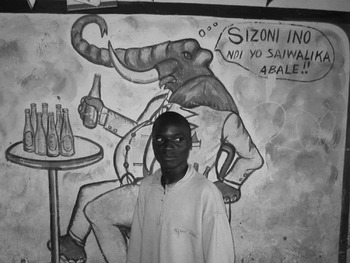
This national and district-level analysis allows us to construct a highly stylised ‘cultural model’ of the black Malawian tobacco bwana. A clear illustration of this model can be found in a bottle store on the tarmac road to Kasungu town. Along one wall of the bottle store is a painting, framed by tobacco leaves. In Figure 4 an overweight njobvu (elephant) is sitting at a table exclaiming: ‘This season is unforgettable my friends’. The table is full of bottles of Carlsberg green, a premier Malawi-brewed beer. Bottles stick out of the pockets of his suit. Wealth and status are represented in his huge physical size, his attire and his ostentatious purchases. The next section suggests that this model of ‘success’ – that of the black Malawian tobacco bwana – has percolated into norms and practices in the Central Region, and that some smallholders attempt to (temporarily) attain the same status through the practice of kuziziritsa ku khosi or ‘cooling off’.
Sizoni ino ndi yosaiwalika abale (this season is unforgettable my friends).

becoming a bwana: cooling off in kasungu town
Burley tobacco production pervades village life in rural Kasungu through the crop marketing season of April–August: bales of tobacco are shunted by ox carts; men, women and children tie burley leaves under barns; Zambian traders lodge at grocery stores, illegally buying burley for shipment across the border. However, an extended residence in rural Kasungu provided no immediately apparent expression of a smallholder tobacco culture equivalent to the obvious racially and class-segmented culture in Lilongwe. The main reason was because this culture is expressed not in rural areas, but in town.
From September to March, visitors to the major urban centre in the district – Kasungu boma – find a subdued town housing the requisite governmental and financial institutions, trading stores, shops, stalls, in addition to a smattering of NGOs. However, entering the same place in the crop marketing season, visitors are greeted by an altogether different scene: streets are filled with vendors and hawkers plying their wares, freshly painted shops advertise their commodities on the pavements, minibus conductors compete vigorously for passengers, and the markets, restaurants, bottle stores and rest houses are all doing brisk business. As a hot spot for burley production, tobacco money percolates around Kasungu, attracting people, produce, traders and entertainment.
When collecting tobacco income from the bank in Kasungu, some smallholder burley growers (always men), dressed in their finest clothes, stay in town for a while ‘cooling off’. During this time they buy consumer goods such as radios, watches, branded clothing, smart shoes, bags and stereos, and replicate the actions of the njobvu in Figure 4 by consuming as much Carlsberg Green as possible (instead of drinking the cheaper and conventional rural beer, Chibuku).Footnote 14 While it is hard to generate data on the prevalence of this practice, survey data on 120 smallholder households offer some indication.Footnote 15 These data suggest that a quarter of the forty-seven smallholders who collect tobacco income from a bank in Kasungu (or 10% of smallholders surveyed) stay in town for between two and thirty days after collecting their money (with an average stay of ten days, and a median figure of one week).Footnote 16 Although practised by a minority of burley growers, if this prevalence of ‘cooling off’ is the same across rural Kasungu, it suggests a figure of about 10,000 smallholders per year in this one district.Footnote 17
Importantly, the consumer choices of these tobacco growers are striking because they are practised in an intentionally conspicuous and provocative way: Carlsberg beer was bought by the crate, not by the bottle; and fashionable clothes and accessories were often flaunted and paraded. The extent to which smallholders ‘cooled off’ in town seemed to far exceed the means at their disposal. The generic practice of kuziziritsa ku khosi was described by one smallholder in the following way:
A husband hears that his bales of burley have been sold on the auction floors, and he arranges to go into town to collect his money. When he has collected his money from the club treasurer and joined his friends, he says ‘no, let us just take Green because this time it is tobacco time – I have been working hard in my tobacco fields for six months so now it is the time for enjoying’. So after Chibuku he buys bottles of Green, and then more as it tastes so good. Instead of taking the bus home with relish for his wife to prepare for dinner, he takes more Green with his friends, and spends the night enjoying himself in town drinking and dancing. When he wakes up in the morning in a rest house he has spent over Kw2,000. On leaving the rest house he walks up the main street passing the bottle stores and nightspots of the night before, then the vendors and hawkers lining the street. He starts looking for a gift for his wife so that his return to the mudzi (village) will be smoother. In the market he buys a chitenje for Kw400. To regain some strength he then takes nsima from a restaurant, and on his way to the bus station he stops for one packet of Chibuku. Here he meets some friends from the previous night, and as Chibuku is usually drunk in a group, more Chibuku arrives and before long the headache from the previous night has gone. The day leads into night and the drinks change from Chibuku to Greens, and later he will be dancing again in the nightclubs. The next day maybe he returns home carrying meat, paraffin, clothes for the children and the chitenje. With two bales of tobacco still in the shed, the money is forgotten about. However the problem comes when the smallholder is borrowing money to buy fertiliser the following December.Footnote 18
Branded Carlsberg beer, especially Carlsberg Green, appears central to the practice of kuziziritsa ku khosi. In rural Kasungu it was widely perceived that Carlsberg Green tastes like tobacco, and some believe it is made from tobacco.Footnote 19 Clothing and style are also important elements of kuziziritsa ku khosi.Footnote 20 While older men would dress smartly, reminiscent of the suits popular during the MCP era (as seen in Figure 4), younger generations invest in branded jeans, t-shirts and accessories.Footnote 21
A further element of ‘cooling off’ involves longer-distance migrants arriving from various parts of the country. As tobacco money circulates around Kasungu, the town becomes the destination for an influx of mahule (prostitutes), many of whom exhibit urban-based fashion accessories and styles – such as hair extensions and tight trousers – distinguishing them from rural women. Business is brisk with smallholders ‘cooling off’ in town.Footnote 22 The seasonal dimension to prostitution in Kasungu is evidenced by data from Population Services International (PSI), a USAID-funded agency. PSI distributes Chishango condoms throughout Malawi, and data on sales can be used as crude proxy for sexual activity. Data for 2003 show that sales in Kasungu town increased by over a factor of four in the crop marketing season compared with other times of the year (apart from a second increase in demand around Christmas).Footnote 23
It is clear that the practice of kuziziritsa ku khosi allows smallholders to engage in practices from which they are usually excluded. Moreover, the ostentatious manner in which some smallholder growers purchase bottled beer and branded clothing suggests that these consumer practices are intended for a wide audience. But how can we understand such expenditure patterns and practices?
The starting point for an explanation is the observation that kuziziritsa ku khosi is a form of conspicuous consumption (Veblen Reference Veblen1899). Veblen theorised that an individual's status in a society derives from others' interpretation of that individual's wealth. In other words, that it is not intrinsically what one has that makes one wealthy or poor, but how this compares to what others have.Footnote 24 Veblen suggested two principal means through which individuals tend to display their wealth: first, the ability to participate in leisure activities (conspicuous leisure); and second, the extravagant purchase of goods and services (conspicuous consumption, which is our focus here). The main reason why these activities display wealth ‘lies in the element of waste that is common to both’ (ibid.: 85).
Veblen (ibid.) further theorised that consumer preferences are determined in a hierarchical manner according to social class. In other words, he posited that individuals emulate the consumer patterns of higher social classes (Campbell Reference Campbell1995). In this formulation, individuals participate in leisure activities, or exhibit the symbols of financial wealth, to impress others and therefore ‘gain their esteem or envy’ (ibid.: 39). Importantly, Veblen (Reference Veblen1899: 85) suggests that even the poorest social classes engage in the extravagant purchase of goods and services to display their wealth. For example, he notes that ‘no class of society, not even the most abjectly poor, forgoes all customary conspicuous consumption. The last items of this category of consumption are not given up except under stress of the direst necessity.’Footnote 25
Veblen's understanding of conspicuous consumption has been widely criticised (Campbell Reference Campbell1995; Trigg Reference Trigg2001). For example, the concept relies excessively on vertical downward transmission of consumer preferences (as opposed to horizontal, circular or upward transmission), and by focussing only on luxury goods it negates the importance of subtle forms of distinction (see Trigg Reference Trigg2001). Here, we focus on just one criticism: that the concept is unclear about whether the ‘operative motives should be viewed as conscious, subconscious, “instinctive” or merely embodied in habitual practices’ (Campbell Reference Campbell1995: 45). In this respect, instead of trying to understand the practice of ‘cooling off’ as one of emulation, we can understand it as constituted, on the one hand, by unconscious, embodied and habitual practices which can be summarised as inculcated behaviour; and on the other, by conscious intentional ‘action’ imbued with subjective meaning (ibid.).Footnote 26 Put simply, this paper suggests that smallholder growers' expenditure decisions and practices when ‘cooling off’ are partly an expression of inculcated behaviour. In other words, that these expenditure decisions reproduce the actions of black Malawian estate owners characterised earlier in the ‘cultural model’ of the tobacco bwana, because this is how some smallholder growers understand success. Indeed, focus groups who, at the end of the research process, were asked to explain why men engaged in the practice of ‘cooling off’, offered responses which support such an interpretation:Footnote 27
Men when they have cash they rush to town to cool off leaving a wife at home without money. Men they feel that people who drink Carlsberg are people who have chuma (wealth), they feel like a rich person.
The tobacco growers want to spend money on [Carlsberg] green when they have received it as they want to revenge those who have been working on a salary all year and can enjoy every month end.
Farmers want to drink [Carlsberg] green to want to be able to show that they are bwanas.
But what are the consequences of such conspicuous consumption? The following two sections discuss this question by, first, comparing the attempts of two smallholder growers to finance and sustain a successful non-farm rural enterprise; and, second, describing limited data on how tobacco production and ‘cooling off’ are viewed by wives, and the crop preferences of both husbands and wives.
‘COOLING OFF’ AND TWO NON-FARM RURAL ENTERPRISES
The prevalence of ‘cooling off’ in the Central Region does not mean, of course, that most burley income is spent in this manner. On the contrary, data from the household survey suggest that this income is spent mainly on buying fertiliser and food, and also on clothing, household utensils, materials for household construction and repair, and repaying credit. But as the account of ‘cooling off’ above makes clear, kuziziritsa ku khosi limits the use of burley income for other, often more productive, purposes. To illustrate how ‘cooling off’ can, amongst other factors, have a detrimental influence on the success of household investments, this section compares the life histories of two smallholder burley growers who initiated successful non-farm rural enterprises. As indicated above, smallholder burley production was expected to boost the non-farm rural economy. The two cases presented here are rare examples of smallholder growers who managed to graduate into successful enterprise ownership, and compare the trajectory of one smallholder who ‘cooled off’ – Jejema Phiri – with that of one who did not – Macfield Msipu. Overall, the fortune of Mr Msipu contrasts strongly with the decline of Mr Phiri.Footnote 28 The analysis which follows first details factors that have contributed to the success of both enterprises, before outlining how ‘cooling off’ was only one of the reasons for the failure of one of them.
Case 1 – Macfield Msipu
Macfield Msipu was born in 1973 in Lusaka, Zambia as the son of a sugar cane worker. He stayed in Lusaka until his parents divorced, when his mother took Macfield and his older sister to her village adjacent to a trading centre in Kasungu district. This was in 1989 when Macfield was sixteen years old. His sister soon married and moved to Mzimba district.
On his arrival in the trading centre, Macfield found some piecework with the Ministry of Agriculture, and used the payment to start selling usipa (dried fish), travelling to the lake at Nkhotakhota to buy supplies. In 1993 he married, and from the proceeds of the fish business bought two pails of fertiliser and applied these to half an acre of burley tobacco. He yielded 3 bales and marketed these through a nearby estate. Macfield grew tobacco again the following year but failed to make a substantial profit. He withdrew his capital from tobacco production in 1995 and started buying goats, and later cows, to slaughter and sell on market days.
More importantly, Macfield also started smuggling goods across the border with Zambia. This was facilitated by his father's kin who lived in Lundazi district close to the border with Malawi. To start with he would take Maheu (a non-alcoholic millet beer) across to Zambia, and return with zitenje (materials) and shoes. He would travel using matolas (pick ups) but would avoid the customs post by taking tracks in the bush. He sold the goods to Asian traders in Kasungu town. As the smuggling business proved increasingly lucrative, he stopped working as a butcher.
In 1997 Macfield married a second wife and built a further house just outside his mother's village. The following year he started buying tobacco illegally at the trading centre and marketed it on the auction floors through an estate registration number. Trading in burley enabled him to move to the market in 1999, where he opened a small grocery which was run by his first wife. Trading in burley also allowed him to start growing burley tobacco again, this time with a seasonal worker. Between 1999 and 2004 Macfield continued to grow and buy burley, and continued the lucrative trade across the border from Zambia to sell to the traders in town.
During the peak of the famine year of 2001/2, Macfield took a large gamble and travelled north to Tanzania. He returned in a truck with over 1 tonne of maize. In the famine in 2001/2 Macfield was a key source of maize for many people around the trading centre. Selling at 100 kw per plate, at a time when a goat was selling for 50 kw, and a bicycle for 150 kw, he became wealthy. By the 2003/4 agricultural season, he was engaging seven workers to produce burley on communal land, in addition to his grocery and trading activities. Reflecting on his numerous business activities, Macfield felt that the most important business for him was the smuggling of goods across the border. This is where he claims that the capital came from to fund his other enterprises, such as trading in tobacco and maize. In response to the question whether he had any relatives who help him with his multiple enterprises, Macfield laughed. ‘No,’ he replied, ‘ndili ndheka’ (I am alone).
Case 2 – Jejema Phiri
Jejema Phiri was born in 1967 and grew up in Dowa district. He moved with his parents and brothers close to the same trading centre in 1986, where they settled some distance from the main mudzi (village). In 1991 Jejema married and began trading goats – buying from the Zambian border, and selling in the trading centre. He also farmed maize, groundnuts and a small amount of burley tobacco.
In 1994 his uncle gave Jejema a loan to invest in burley production. With this injection of cash he expanded burley production and soon married a second wife. With capital and plenty of household labour, he started to lease unused communal land from neighbours in his village to expand his burley business. This was successful, and in 1997 Jejema started to engage workers to grow burley for him on the land he was leasing. In the following three years he and his two wives managed a business with up to twelve workers farming on communal land. His expansion of burley production was conducted without any recourse to formal credit or loans. He bought all of his fertiliser with cash. As is common among smallholder burley farmers, he was fond of spending some burley income ‘cooling off’ in Kasungu town during the crop marketing season.
By 2000 Jejema had paid back the loan to his uncle, and purchased a second-hand minibus. With this he initiated the first minibus service to Kasungu town from the trading centre. By leaving earlier than the daily Stagecoach service, he ensured that the minibus was full on the first run to town. Not having a licence, he employed a friend as a driver, and worked as the conductor collecting fares from passengers. Back in the village his burley business was going strong and in the 2001/2 rainy season he applied more than seventy bags of fertiliser to his burley crop. However, this was the famine year. With all of his capital tied up in fertiliser, no savings, and with demand for his minibus business non-existent, in February 2002 Jejema was forced to borrow money from a local money lender to buy maize at famine prices to feed his extended family and workers. Even after buying maize, his extended family still had to resort to eating nsima ya ntochi (mealie from banana roots) to survive. Surprisingly, he managed to send over 70 bales of burley to the auction floors in 2002. However, the poor quality of the leaf, reflecting the lack of care and attention paid to the plants, meant that he received very low prices. With the local money lender threatening punitive action, he was forced to sell the minibus at a highly discounted rate to supplement his auction floor income. Thus ended Jejema's dream.
In 2003 Jejema's wealthy uncle died, but he was unable to contribute to the funeral costs. The following agricultural season he and his wives did not engage any workers, did not grow any burley tobacco, but instead planted soya as a cash crop. Soon afterwards his second wife left him, and in the 2003/4 season he was growing groundnuts and trading in nyemba (beans) trying to build up the capital to start growing burley again.
The two cases presented here suggest a number of reasons why Macfield and Jejema were able to initiate successful non-farm rural enterprises. Three factors stand out. First, both are alendo (strangers). Macfield came to the area when he was sixteen, and does not have a close relationship with his mother's kin. This is shown geographically: his two houses were located far from the heart of the village. Jejema is also a mlendo (stranger) having moved to the area with his mother when he was nineteen. Again, both their houses are some distance from the main village.
Second, both Macfield and Jejema married twice. There can be little doubt that the successes of both businesses were to a large extent predicated on the labour of their respective wives.Footnote 29 Both businesses also relied on hired labour: in Jejema's case this was by employing seasonal workers, and a friend to drive the minibus; for Macfield, his initial attempts at growing burley with his wife in 1993 and 1994 failed. It was only later, from 1999 onwards, when he employed a seasonal worker that he started to profit from burley production.
Third, both individuals relied on extended social relations to initiate a trajectory of accumulation. Macfield utilised his father's relatives and contacts in Lundazi district, Zambia, to initiate his smuggling business across the border. Jejema received a substantial loan from his wealthy uncle who lived in town. Without such assistance from kin, there is a fair chance that neither business would have become successful.
The cases also suggest that ‘cooling off’ was only one of the factors that contributed to the success of one business and failure of the other. Whilst Jejema was well known for spending time drinking in Kasungu town, other factors in these case histories appear much more significant. Two are highlighted here. First, the role of burley in the sequence of livelihood strategies. For Jejema, burley production was the basis on which his non-farm rural business was founded. However, for Macfield, burley production was an outcome from numerous non-farm enterprises (especially smuggling and trading). In other words, burley production was an investment channel for Macfield's profits as opposed to a source of capital for his other enterprises. This is shown through his initial ‘failure’ in burley production prior to engaging a tenant. It is also illustrated by him marketing his burley via an estate registration number until 2001 (if burley had been a key accumulation strategy, it is likely that Macfield would have joined a smallholder club, as the transaction costs are less in this marketing channel).
The second key factor was the impact of the chaka cha njala and control over food. Whilst Macfield generated substantial wealth by becoming an international maize trader, Jejema's production of burley tobacco came to an end as a result of borrowing money to buy maize. Jejema's actions resonate strongly with the wider experience of smallholder burley producers at his time: many disposed of assets at knock-down prices to feed not only their immediate family but also wider kin, and many rural households were forced into adverse coping strategies (see Bryceson Reference Bryceson2006; Conroy Reference Conroy and Levy2005).
Overall, the two cases presented here suggest that whilst ‘cooling off’ may limit the use of burley income for other productive purposes, in most cases other factors (such as kin relations, the availability of labour, livelihood diversification and food prices) probably contribute to household accumulation or impoverishment to a greater extent. In this respect, it would be a mistake to attribute too much importance to the loss of capital that is part and parcel of ‘cooling off’. We now turn to intra-household issues.
‘COOLING OFF’ AND INTRA-HOUSEHOLD RELATIONS
To get an initial idea of how ‘cooling off’ was viewed by wives, semi-structured interviews investigated the extent to which married women received a fair proportion of burley income. The results from these interviews were inconclusive. Therefore, questions about the intra-household distribution of burley income were included in the survey questionnaire conducted with wives. The responses to these questions are shown in Table 2, and are split into four categories: households in rural wage employment (Wage Always), all of whom were consistent tobacco growers; those which grew tobacco every year for the last three years (Always); those which grew tobacco twice in the last three years (Twice); those which grew tobacco once in the last three years (Once).Footnote 30
Table 2 shows that wives across all four categories welcomed the production of burley tobacco, and that most wives received money after tobacco sales (and spent this mainly on clothes, and to a lesser extent on household items). But despite welcoming burley production, 37% of wives who responded stated that they were not happy with the amount of money given to them by their husbands. When asked directly whether the non-receipt of tobacco monies led to any action, most wives stated that they had not tried to increase their personal gains from burley production (the eleven who had taken action asked for a greater share of income). In this respect, the research found no evidence to support the hypothesis that wives withdraw labour from, and support for, burley cultivation if they do not receive a fair proportion of income (which is certainly less likely if the husband spends income ‘cooling off’ in town).Footnote 31
Wives' support for growing tobacco is particularly interesting, and is further illustrated by survey data that compares husbands' and wives' choice of the most important crop in the household. Figure 5 suggests that wives are much stronger advocates of burley production than their husbands, and vice versa regarding husbands' belief that maize is the most important crop. This finding conflicts with the commonly held view of male and female preferences for food and cash crops in Malawi (where cash crops are said to be male, and food crops female). To shed some light on possible reasons, at the end of the research process village focus groups were shown the above charts and were asked to interpret them. An extract from one discussion of the wives' chart is as follows:
Men (in unison): ‘Clothes’.
Husband I: ‘Women like tobacco so much because women like clothes …. They want to wear nice clothes!’
Husband II: ‘Women need more clothes than men – they wear five or six at a time. So for them tobacco is important because of clothes!’
Wife I: ‘No. We like tobacco because after buying fertiliser and maize we can buy some household essentials. That is why we like tobacco.’
Wife II: ‘I asked my husband – why have you not started growing tobacco yet? I want things for the house and to have new zitenje (materials) and fashionable clothes. Tobacco can bring these things.’
Similar explanations were given by other focus group participants:
Wife: ‘Tobacco is the most important crop because when we grow tobacco and sell it we obtain money which we use it for growing maize and buying clothes. With maize we gain less profit after selling it. That's why we prefer growing tobacco.’
Wife: ‘Azimayi (women) say that tobacco is the more important crop because they get money for maize mill and to buy clothes.’
These focus groups corroborated some of the survey data. For example, that burley income is spent mainly on buying fertiliser and maize, and that wives tend to spend their portion of burley income on buying clothes and household essentials.
Husbands' and wives' choice of most important crop.

Overall, and in a similar fashion to section three, the final section of this paper presents data which suggests that it is important not to overstate the significance of ‘cooling off’. In terms of the intra-household distribution of burley income, almost all wives appear to receive money from tobacco sales, and many spend this on clothes and on household items (including money for the maize mill). Moreover, almost all are happy to be growing tobacco, and wives are much greater advocates of burley production than their husbands. Such findings suggest that whilst ‘cooling off’ may divert resources from other productive purposes, it has not significantly reduced the gains that burley production has brought smallholder households. In other words, there is no contradiction between potlatch spending by husbands in Kasungu town and wives' support for burley production: even with extravagant consumer behaviour in Kasungu town, burley production appears to have generated sufficient income for wives to receive substantial benefits.
* * *
Although based on geographically limited fieldwork, the material presented here may have wider relevance, relating for example to debates on neo-patrimonialism in Malawi and elsewhere. Despite the shift from authoritarian rule to an ostensibly liberal democratic system of governance, politics in Malawi has been described as being influenced by neo-patrimonial and clientelist tendencies (see Booth et al. Reference Booth, Cammack, Harrigan, Kanyongolo, Mataure and Ngwira2006; Cammack Reference Cammack2004). This is illustrated by the chameleon nature of politics in the democratic era (Englund Reference Englund2002), where politicians change allegiance, or ‘cross the floor’ in parliament, frequently. A significant contribution to this debate is Lwanda's (Reference Lwanda2006) discussion of the role of achikulire (patrons or ‘big men’) in the Malawian polity. Lwanda argues that there are two main forms of achikulire in Malawi. First, the conventional rural/peasant achikulire embedded in village-level social, political and cultural hierarchies, who have very little traction over national-level politics; and second, the urban/elite achikulire, based on the creation of patron–client political networks and trading activities, who have considerable power at the national level. Lwanda contends that by informally financing political activities, urban/elite achikulire have become key power brokers and have stymied the emergence of young cadres of politicians who are independent of patron–client relations.Footnote 32
One could interpret the practice of kuziziritsa ku khosi in Kasungu district through such a patrimonial lens: that the ostentatious consumer behaviour during the crop marketing season was aimed at fostering patron–client relations – for example, that ‘cooling off’ was a means for smallholders to temporarily shift status from a rural/peasant achikulire status to that of an elite/urban achikulire by creating clientelist networks via extravagant spending patterns.Footnote 33 But such an interpretation forces an instrumental logic onto the lavish consumer behaviour which there are insufficient data to support. Nor does it account for the ‘element of waste’ that is an inherent element of ‘cooling off’ (that smallholders' consumer choices appeared profligate and decadent), and for the fact that such consumption appeared to be conducted for other people's benefit.
Instead, this article argues that ‘cooling off’ may better be understood as a form of conspicuous consumption, where smallholders display their ephemeral wealth to try to achieve the status of one model of success in this district – the tobacco bwana. Such an interpretation accounts for the ‘waste’ and performativity integral to the practice to a greater extent than a neo-patrimonial one.
Understanding ‘cooling off’ in this manner – as a search for status – may thus have some relevance for other apparently unintelligible investment decisions in the region, and in African economies more generally. Through the conspicuous nature of ‘cooling off’, we can see how wealth (and poverty) are intrinsically relational – that people compare what they have with what others have, particularly those whom they live near or work with (in other words, within reference groups). This competition between people in terms of income and status, referred to as a process of rivalry (Layard Reference Layard2003), is part and parcel of our human nature, and is very much apparent in rural Malawi, as reflected in the names of groceries and other investments in Kasungu district: Njilu Ipinduranji (Jealousy brings you what benefit?); Ambili Sakondwera (Many people are not happy, i.e. with my wealth); Mudaranji? (Why do you hate me?). But, as Layard (Reference Layard2003) outlines, while rivalry between people in terms of status makes sense at the individual level (for it increases your rank above those around you), at the level of society as a whole it makes no sense: it is a zero-sum game because the total of rank is fixed.
In this respect, Veblen's (Reference Veblen1899) work on conspicuous consumption, and the ‘element of waste’ at its core, offers an alternative perspective from which to view investment decisions which at first glance may appear incomprehensible and illogical, to the functional interpretation of neo-patrimonialism where resources are misallocated through the creation of clientelist networks.