





Obesity is a major public health concern with a global prevalence that has increased steadily over the past decade. 1 In South Korea, obesity has been defined as a body mass index (BMI) ≥ 25 kg/m2 according to the World Health Organization criteria for the Western Pacific Region and the guidelines of the Korean Society for the Study of Obesity. Reference Bae, Haam, Jeon, Kang, Song and Park2 South Korea has witnessed a steady increase in obesity rates, which have reached approximately 38.4% in men and 27.8% in women. Reference Jeong, Jung, Yang, Kim, Cho and Lee3 Although BMI has traditionally been used to classify obesity, clinical practitioners and researchers now emphasise the use of direct body fat mass measurements such as dual-energy X-ray absorptiometry (DEXA) or bioelectrical impedance analysis (BIA), because BMI may not adequately reflect actual adiposity. Reference Rubino, Cummings, Eckel, Cohen, Wilding and Brown4
Studies have examined the relation between obesity and mental health. A systematic review has revealed that obesity is linked to both depression and suicidal behaviours. Reference Amiri and Behnezhad5,Reference Luppino, de Wit, Bouvy, Stijnen, Cuijpers and Penninx6 Although relatively few studies have investigated the relation between obesity and anxiety symptoms, some have shown that individuals with obesity have a high risk of anxiety symptoms. Reference Amiri and Behnezhad7,Reference de Wit, Have, Cuijpers and de Graaf8 The relation between obesity and mental health problems is bidirectional: excess body fat can cause deterioration of mental health, which may in turn lead to changes in body fat through poor health behaviours. Reference Friedman, Chang, Amin, Rajan, Singh and Yousefzai9 Although the precise mechanisms linking adiposity and mental health problems have not been fully elucidated, it has been suggested that both biological and psychosocial mechanisms contribute to systemic inflammation and weight-related social stigma. Reference Fulton, Decarie-Spain, Fioramonti, Guiard and Nakajima10–Reference Emmer, Bosnjak and Mata12
Despite studies demonstrating a strong relationship between obesity and mental health problems, several gaps remain in the literature. First, most studies used BMI, with limited numbers of studies directly measuring fat mass using methods such as DEXA or BIA. Although recent studies have found a positive association between directly measured fat mass and depressive symptoms, Reference Zhang, Wang, Ma, Li, Sun and Zhao13,Reference Gu, Bao, Li, Xiang, He and He14 there has been little exploration of any specific link with anxiety symptoms. Second, sex differences are an important aspect to consider when examining the relationship between body fat mass and mental health problems, Reference Wilcosky and Wing15,Reference Ul-Haq, Smith, Nicholl, Cullen, Martin and Gill16 and studies have produced mixed findings in this regard. For instance, some studies have reported that fat mass measured using DEXA or BIA is positively associated with depressive symptoms among women but not men, Reference Ul-Haq, Smith, Nicholl, Cullen, Martin and Gill16,Reference Li, Li, Sun, He, Liu and Li17 whereas another study found that the associations of body fat percentage with depression were more pronounced in men than in women. Reference Gu, Bao, Li, Xiang, He and He14 Significant sex-based differences in the distribution and physiology of body fat are well documented, and societal attitudes towards body image also differ markedly by sex; both of these factors may contribute to potential sex-specific relationships between body fat and mental health problems. Reference Baldini, Casagrande and Estadella18 However, to the best of our knowledge, sex differences in the association of body fat mass with anxiety symptoms have not yet been investigated according to the existing literature. Therefore, in this study, we aimed to explore sex-based differences in the association of body fat mass indices with anxiety symptoms among South Korean adults.
Method
Study participants
Samples from the 2022 and 2023 South Korea National Health and Nutrition Examination Survey (KNHANES) were included in this study. The KNHANES is an annual cross-sectional survey intended to collect information on the health status of people living in South Korea. Participants were invited using a multistage clustered probability sampling procedure to achieve a nationally representative sample. For the selected participants, a face-to-face survey was administered during a household visit by researchers from the Korea Disease Control and Prevention Agency (KDCA) in mobile examination vehicles. Detailed information on the sampling procedure, survey methodology and quality control can be found in the data profile article. The raw data were anonymised by researchers at the KDCA and are accessible at https://knhanes.kdca.go.kr. The 2022 and 2023 KNHANES were implemented following approval from the Institutional Review Board of the KDCA (2018-01-03-4C-A, 2022-11-16-R-A).
A diagram depicting the sample selection procedure is shown in Supplementary Fig. 1 available at https://doi.org/10.1192/bjo.2026.12063. Initially, 11 229 adults aged >18 years from the 2022 and 2023 survey years of the KNHANES were included. Individuals who did not undergo BIA, such as pregnant women, those with pacemakers or those with prosthetic limbs, were excluded from the study (n = 816). After exclusion of participants with missing values (n = 1547), 8866 individuals (3856 men and 5010 women) were included in our sample.
Body fat mass indices
BIA was performed using a bioelectrical impedance analyser (InBody 970, Biospace, South Korea) in accordance with a standardised protocol. The participants were fasted, and they stood upright with their arms extended and gripped the electrodes with both hands. For quality control, examiners received training twice a year, and onsite quality assessments and equipment maintenance were also conducted twice a year to ensure proper BIA performance. In the South Korean population, the bioelectrical impedance analyser (InBody 970, Biospace, South Korea) has shown criterion validity for measurement of both whole-body and regional fat mass, with a strong correlation (R 2 = 0.929) for percentage body fat compared with measurements obtained using DEXA. Reference Yi, Baek, Lee, Jung and Jang19 The body fat indices used in this study included whole-body, trunk, arm (bilateral) and leg (bilateral) fat. Fat mass indices were calculated by dividing each fat mass by height squared (kg/m2). In addition, body fat percentage was derived by dividing the whole-body fat mass by total body weight.
Anxiety
The Generalized Anxiety Disorder-7 (GAD-7), a screening questionnaire to assess anxiety symptoms that has been validated in the South Korean population, Reference Spitzer, Kroenke, Williams and Lowe20,Reference Ahn, Kim and Choi21 was used in this study. The GAD-7 includes seven items, with each item scored on a scale of zero to three. The range of the total GAD-7 score is 0–21, and individuals with a score ≥10 were classified as having anxiety symptoms. Reference Spitzer, Kroenke, Williams and Lowe20 Cronbach’s alpha was 0.89 in this study, indicating good reliability.
Confounders
The following sociodemographic characteristics were included: age (continuous scale), educational level (middle school or below, high school, or college or above), income (lowest, low, high or highest), employment status (worker or unemployed), marital status (married, unmarried or other), physical activity (no or yes), smoking status (no or yes), alcohol use (no or yes) and survey year (2022 or 2023). Income levels were categorised into four groups using quartile values of the distribution of individuals’ monthly net income among the sample. Physical activity was assessed using the Global Physical Activity Questionnaire and classified as ‘yes’ if individuals participated in ≥150 min per week of moderate-to-vigorous exercise. Alcohol use was categorised as ‘yes’ if individuals consumed alcohol at least once a month.
Statistical analysis
Sample characteristics were examined on the basis of the presence of anxiety symptoms. In addition, the distributions of body fat mass indices and body fat percentages among those with and without anxiety symptoms were examined using a density plot. For the main analyses, we investigated the associations between body fat mass indices and body fat percentage and anxiety symptoms using logistic regressions; the change in odds of experiencing anxiety symptoms per standard deviation increase was estimated for each index, and both unadjusted and adjusted models were fitted. To explore sex-based differences, we included interaction terms between sex and each index (sex × index) in the regression models, and the corresponding P-values were calculated. In addition, models were stratified by sex to examine whether the associations manifested differently according to participants’ sex. In addition to odds ratios, average marginal effects that corresponded to the mean probability differences were determined using R package ‘margins’. Reference Norton, Dowd, Garrido and Maciejewski22 Finally, to examine the nonlinear relation between each index and anxiety symptoms, we used the restricted cubic spline function Reference Desquilbet and Mariotti23 and visualised the results using the ‘ggplot2’ R package. Statistical analyses were performed using R software for Windows (version 4.4.1; R Foundation for Statistical Computing, Vienna, Austria; https://www.r-project.org). The ‘survey’ R package was used to reflect the complex survey design. Reference Lumley24 Model fit statistics (Akaike information criterion, Bayesian information criterion and pseudo-R 2) were used to compare models across fat mass indices. We also calculated P-values adjusted by false discovery rate to address multiple testing across five adiposity indices. Previous studies of South Korean adults have recommended a cut-off of GAD-7 score > 6 for classification of anxiety; Reference Lee, Shin, Kim, Jeon, Yoon and Ko25,Reference Kim, Kim, Yang, Kim, Kim and Kwon26 therefore, this alternative cut-off was used in the sensitivity analysis. In models mutually adjusting for body fat mass indices with either BMI or waist circumference, substantial multicollinearity was observed (variance inflation factor > 5); therefore, the results of these models are not presented.
Ethics statement
The 2022 and 2023 KNHANES were implemented following approval from the Institutional Review Board of the Institutional Review Board of the KDCA (2018-01-03-4C-A, 2022-11-16-R-A). All participants provided written informed consent. We assert that procedures contributing to this work comply with the ethical standards of the relevant national and institutional committees on human experimentation, and with the Helsinki Declaration of 1975 as revised in 2013.
Results
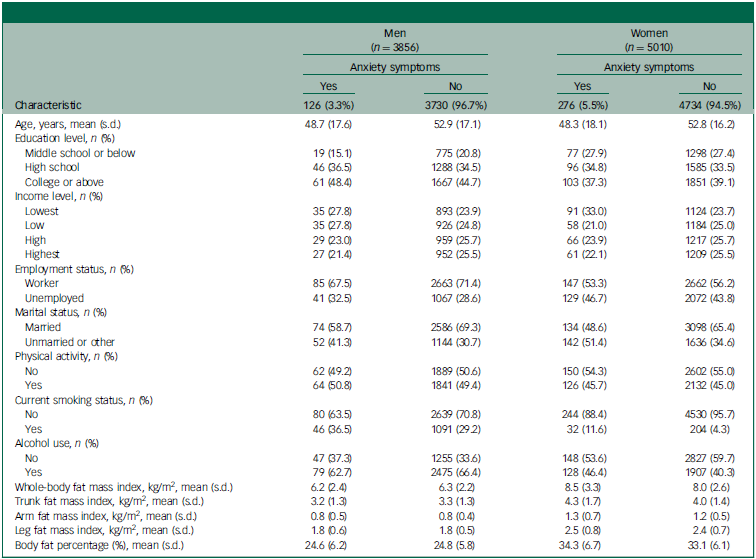
The prevalence of anxiety symptoms was 3.3% among men and 5.5% among women (Table 1). Those with anxiety symptoms were more likely to be younger, to have a lower income level, to be unemployed and to be current smokers than those without anxiety symptoms in both groups.
Distribution of characteristics among participants

Table 1 Long description
The table compares the prevalence of anxiety symptoms among men and women based on various characteristics. It has 19 rows and 8 columns. The columns are labeled as follows: Characteristic, Men (n=3856) with sub-columns Yes and No, and Women (n=5010) with sub-columns Yes and No. The rows are labeled as follows: Anxiety symptoms, Age (years), Education level, Income level, Employment status, Marital status, Physical activity, Current smoking status, Alcohol use, Whole-body fat mass index (kg/m^2), Trunk fat mass index (kg/m^2), Arm fat mass index (kg/m^2), Leg fat mass index (kg/m^2), Body fat percentage. Each row provides the count and percentage of participants with and without anxiety symptoms for each characteristic. Notable trends include higher prevalence of anxiety symptoms among younger individuals, those with lower income levels, the unemployed, and current smokers in both men and women.
Figure 1 presents density plots comparing the distributions of fat mass indices and body fat percentages between individuals with and without anxiety symptoms. Although the distributions of fat mass indices and body fat percentage largely overlapped among men, the distribution of body fat indices tended to shift slightly to the right among women with anxiety symptoms compared with women without such symptoms.
Distribution of adiposity indices among individuals with and without anxiety symptoms.

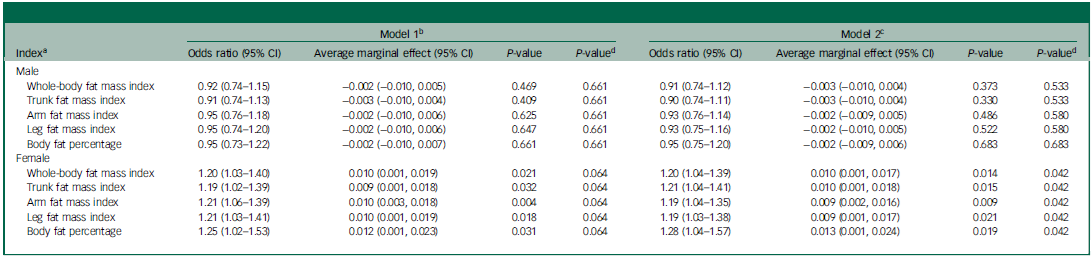
Table 2 shows associations among fat mass indices, body fat percentage and anxiety symptoms in men and women. No clear associations of body fat mass indices or body fat percentage with anxiety symptoms were identified in either the unadjusted or fully adjusted models among men. Among women, in the adjusted model, the odds ratios (95% CIs) for the association of a one-standard-deviation increase in each body fat index with anxiety symptoms were 1.20 (1.04–1.39) for whole-body fat mass index (P = 0.014), 1.21 (1.04–1.41) for trunk fat mass index (P = 0.015), 1.19 (1.04–1.35) for arm fat mass index (P = 0.009), 1.19 (1.03–1.38) for leg fat mass index (P = 0.021) and 1.28 (1.04–1.57) for body fat percentage (P = 0.019). When model fit statistics were compared across various body fat mass indices among female participants (Supplementary Table 1), the model including the arm fat mass index exhibited the lowest Akaike information criterion (2104.445) and Bayesian information criterion (2186.674) values and the highest pseudo-R 2 (0.06).
Associations among body fat mass indices, body fat percentage and anxiety symptoms among men and women

Table 2 Long description
A table with two models comparing associations among fat mass indices, body fat percentage, and anxiety symptoms in men and women. The table has 12 rows and 11 columns. The columns are labeled as Index, Model 1 Odds ratio (95% CI), Model 1 Average marginal effect (95% CI), Model 1 P-value, Model 1 P-value*, Model 2 Odds ratio (95% CI), Model 2 Average marginal effect (95% CI), Model 2 P-value, and Model 2 P-value*. The rows are labeled as Male and Female, with subcategories for Whole-body fat mass index, Trunk fat mass index, Arm fat mass index, Leg fat mass index, and Body fat percentage. Each cell contains specific values for odds ratio, average marginal effect, and P-value. Notable trends include higher odds ratios and significant P-values among women compared to men.
a. Units were defined as a one-standard deviation increase for each index.
b. Unadjusted model.
c. Adjusted for age, education, income, employment status, marital status, smoking status, physical activity, alcohol use and survey year.
d. P-values adjusted by false discovery rate.
Supplementary Table 2 shows the P-values for the sex-based interactions between each body fat index and anxiety symptoms; these were 0.025, 0.020, 0.029, 0.057 and 0.065 for whole-body fat mass index, trunk fat mass index, arm fat mass index, leg fat mass index and body fat percentage, respectively. Supplementary Table 3 shows the results of sensitivity analyses based on the imputed data-sets, in which the associations of body fat index with anxiety symptoms were consistent with those identified in the primary analyses. The results using the alternative GAD-7 cut-off produced similar findings that were comparable with those of the main analyses and supported positive associations between fat mass indices and anxiety among women (Supplementary Table 4).
Figure 2 illustrates the nonlinear relationships of body fat mass indices and body fat percentage with the predicted probability of anxiety symptoms. Among men, no clear positive associations were observed, and a slight decreasing trend was noted across the body fat mass indices. By contrast, among women, increasing fat mass indices and body fat percentages were associated with an increasing trend in the probability of anxiety symptoms.
Nonlinear associations between body fat mass indices and anxiety symptoms in men and women based on restricted cubic spline model.

Discussion
This study explored sex differences in the associations of body fat mass indices and body fat percentage with anxiety symptoms in South Korean adults. The findings indicate that both whole-body and regional body fat mass indices are positively associated with anxiety symptoms in women. By contrast, no clear associations were observed in men.
The results of this study corroborate previous findings showing that body fat mass indices are positively associated with poor mental health. Reference Zhang, Wang, Ma, Li, Sun and Zhao13,Reference Gu, Bao, Li, Xiang, He and He14 Building upon previous research that has identified a positive association between obesity and anxiety, Reference Amiri and Behnezhad7,Reference de Wit, Have, Cuijpers and de Graaf8 our study contributes to the literature by demonstrating a potential link between fat mass, measured via BIA, and anxiety, especially in women. Inconsistent findings regarding sex-based differences in the association between body fat and mental health problems have been reported. For instance, a study of UK adults showed that body fat percentage was positively correlated with risk of depression during follow-up among women, but there was no clear association among men. Reference Ul-Haq, Smith, Nicholl, Cullen, Martin and Gill16 In addition, whole-body and regional body fat mass measured using DEXA have been found to be positively associated with depression, especially among women. Reference Li, Li, Sun, He, Liu and Li17 By contrast, another study reported that the link between body fat mass and depressive symptoms was more pronounced in men than in women. Reference Gu, Bao, Li, Xiang, He and He14 Unlike previous studies that were predominantly conducted in Western populations, the present study was based on an Asian population. Considering sociocultural context and ethnic variability with respect to body image and body fat characteristics, our study thereby represents a valuable contribution to the literature.
The previous literature demonstrates that multiple mechanisms may link body fat mass and anxiety symptoms. First, systemic inflammation may serve as an important mediator in this relation. Adipose tissue hypertrophy stimulates release of inflammatory cytokines such as IL-6 and TNF-α, thereby inducing systemic inflammation. Reference Reilly and Saltiel27 Subsequently, neuroinflammation can lead to alterations in anxiety-related brain circuitry, which may contribute to the pathophysiology of anxiety. Reference Won and Kim28 Second, alterations in gut microbiota induced by excess body fat can contribute to mental health problems. Reference Saravanan, Khatoon and Winner29 Although the mechanism is not yet fully understood, changes in the gut microbiome may influence the neuroendocrine system or hypothalamic–pituitary–adrenal axis, contributing to the development of depression or anxiety. Reference Saravanan, Khatoon and Winner29 Third, in addition to physiological pathways, the psychosocial implications of body fat should be considered. For instance, individuals with excess body fat are more likely to be stigmatised as lazy or lacking self-discipline, making them vulnerable to social isolation and discrimination. Reference Emmer, Bosnjak and Mata12 Such chronic stress may contribute to the onset of anxiety symptoms.
The observation of significant sex-based differences in the association between body fat mass indices and anxiety symptoms is notable. The exact mechanisms underlying these sex differences are not fully understood. First, studies have indicated that adiposity induces a more pronounced activation of inflammatory pathways in women than in men. For instance, the elevation of high-sensitivity C-reactive protein among individuals with obesity is more pronounced in women than in men. Reference Choi, Joseph and Pilote30,Reference Nari, Jang, Kim, Park and Jang31 Previous studies have also reported a notable sex-specific relationship between body fat distribution and inflammation. Reference van den Munckhof, Bahrar, Schraa, Brand, Ter Horst and van der Graaf32,Reference Vijayakumar, Pantha, Budha Magar and Dhakal33 Although women exhibit greater subcutaneous fat accumulation, whereas men tend to accumulate more visceral fat, subcutaneous adipose tissue volume in women was linked to inflammatory responses, including elevated levels of leptin and increased expression of CD68, TNF-α and IL-1α. Reference van den Munckhof, Bahrar, Schraa, Brand, Ter Horst and van der Graaf32 Consequently, heightened systemic inflammation among women with excess body fat accumulation may contribute to poor mental health outcomes through neuroinflammatory pathways. Reference Saravanan, Khatoon and Winner29 Second, there are substantial sex differences in sociocultural factors related to body image and their influence on psychological outcomes. Social media significantly influences individuals’ body image, often leading to preoccupation with appearance and body shape dissatisfaction among women. Reference Brasil, Mims, Pritchard and McDermott34 Specifically, in women, the idealisation of thinness may lead to a stronger association between higher body fat and anxiety or depression than in men. Reference He, Sun, Zickgraf, Lin and Fan35 Recent sociocultural expectations emphasising a curvier body image for women may also contribute to body dissatisfaction. Reference Walker, Gaither, De Los Santos, Keigan, Schaefer and Thompson36 By contrast, the link between body fat mass and body dissatisfaction may be less pronounced in men. Reference Brasil, Mims, Pritchard and McDermott34,Reference He, Sun, Lin and Fan37
This study had some limitations. First, the causal effects of body fat mass on anxiety could not be established because of the cross-sectional design of the study. The possibility of reverse causation, in which anxiety symptoms lead to increased body fat, should also be considered. The relationship between body fat and mental health problems is bidirectional. Reference Milaneschi, Simmons, van Rossum and Penninx11,Reference Markowitz, Friedman and Arent38 For example, individuals experiencing anxiety are more likely to engage in maladaptive behaviours, including emotional eating or alcohol consumption, which can contribute to an increase in body fat. Reference Dakanalis, Mentzelou, Papadopoulou, Papandreou, Spanoudaki and Vasios39 Therefore, future longitudinal studies should examine the directionality of this association. Second, several unmeasured factors, including genetic predispositions, history of psychiatric diagnosis and medication use, may influence the relationship between body fat mass and anxiety. However, these factors could not be adjusted for in the present analysis because of a lack of information. Thus, residual confounding may have resulted in overestimation in the relationship between body fat mass indices and anxiety in this study. Third, although the GAD-7 was originally developed as a screening tool, it is a validated measure of anxiety symptoms. Future studies may benefit from incorporating more objective assessments such as physician-confirmed diagnoses.
Despite these limitations, our study had several strengths. First, a complex survey design was used to achieve a representative sample of study participants, which enhanced the generalisability of the findings. Second, body fat mass was directly measured using BIA, in contrast to studies that have relied on proxy indicators of adiposity such as BMI. This methodological approach means the present study contributes meaningfully to the existing literature.
Supplementary material
The supplementary material is available online at https://doi.org/10.1192/bjo.2026.12063
Data availability
The data are publicly accessible at https://knhanes.kdca.go.kr.
Acknowledgement
We thank the researchers at the Korea Disease Control and Prevention Agency (KDCA).
Author contributions
Conceptualisation: S.-U.B. and J.-H.Y.; methodology, formal analysis, data curation, software, investigation, visualisation, writing – original draft: S.-U.B.; writing – review and editing, and supervision: J.-H.Y.
Funding
This research did not receive a specific grant from any funding agency, commercial or not-for-profit sectors.
Declaration of interest
None.



 Open access


eLetters
No eLetters have been published for this article.