Introduction
Juvenile nasopharyngeal angiofibroma accounts for 0.05 per cent of all head and neck tumours,Reference Lund, Stammberger, Nicolai, Castelnuovo, Beal and Beham1 and is the most common nasopharyngeal tumour in paediatric and adolescent age groups as seen in Kolkata, India.Reference Biswas, Saha and Bera2 Clinically juvenile nasopharyngeal angiofibroma presents with recurrent unprovoked, painless, profuse epistaxis, with a nasal or nasopharyngeal mass often pushing down the palate or extending into the cheek or orbit. The repeated blood loss, anaemia and hypoproteinaemia hinder the proper growth of these patients, and pose problems to their mere survival in India. The excessive haemorrhage both pre- and intra-operatively pose a definite morbidity risk, with a substantial risk of mortality. Juvenile nasopharyngeal angiofibroma occurs exclusively in adolescent males, and its hormone dependence is universally accepted. A predilection for males with fair skin and red hair has been reported,Reference Thompson3 but this may not stand true in an Indian context (tanned skin with dark hair). However, its aetiopathogenesis has been debated.
The annual incidence of juvenile nasopharyngeal angiofibroma is approximately 1:150 000, although incidences in Egypt and India have been reported to be slightly higher than in Europe and the American subcontinent.Reference Gullane, Davidson, O'Dwyer and Forte4, Reference El-Banhawy, Ragab and El-Sharnoby5 Maran and Lund have also suggested a higher incidence in the Middle East and India than in Europe.Reference Maran, Lund, Maran and Lund6 Being a relatively uncommon condition, the majority of published case series worldwide are limited in terms of numbers of patients. A limited number of centres in north India, excluding ours, have published on small series. The absence of any registry makes it difficult to predict the exact incidence. Shamim et al., in a study from Karachi (adjoining northwest India), reported only 18 patients in 9 years (2000–2008), and stated that the exact incidence in Pakistan is not known.Reference Shamim, Ghias and Khan7 Only 32 cases were reported at the Tata Memorial Hospital in Mumbai over a span of 13 years (1998–2001).Reference Mistry, Qureshi, Gupta and Gupta8 In contrast, a university hospital in Kolkata reported 37 cases within 3 years (1998–2001).Reference Ghosh, Saha, Chandra, Nandi and Bera9 These reports indicate a significant difference between the incidences in southeast versus southwest regions of India.
Our centre has been reported (in the British reference book Scott-Brown's Otolaryngology, fifth edition (Rhinology section)Reference Chew, Kerr and Groves10) to have the highest incidence of juvenile nasopharyngeal angiofibroma across the world.Reference Bhatia, Mishra and Prakash11 If this part of the world still truly harbours the maximum load of juvenile nasopharyngeal angiofibroma cases, this needs to be further established. At our centre, we have seen a change in the incidence and pattern of juvenile nasopharyngeal angiofibroma across seven decades. This study therefore attempted to examine its occurrence over time. To the best of our knowledge, no study in the English literature to date has reported on the changing pattern of occurrence with time. The likely main reason for this is the limited number of cases in the studies. It may be possible that the growing incidence is still not significant in other parts of the world as it is in this part of the East.
Materials and methods
This study involves the retrospective analysis of data (obtained through the archival index) of juvenile nasopharyngeal angiofibroma patients admitted over the past seven decades (from the late 1950s to 2013) to the Department of Otolaryngology and Head and Neck Surgery, King George's Medical University in Lucknow, India.
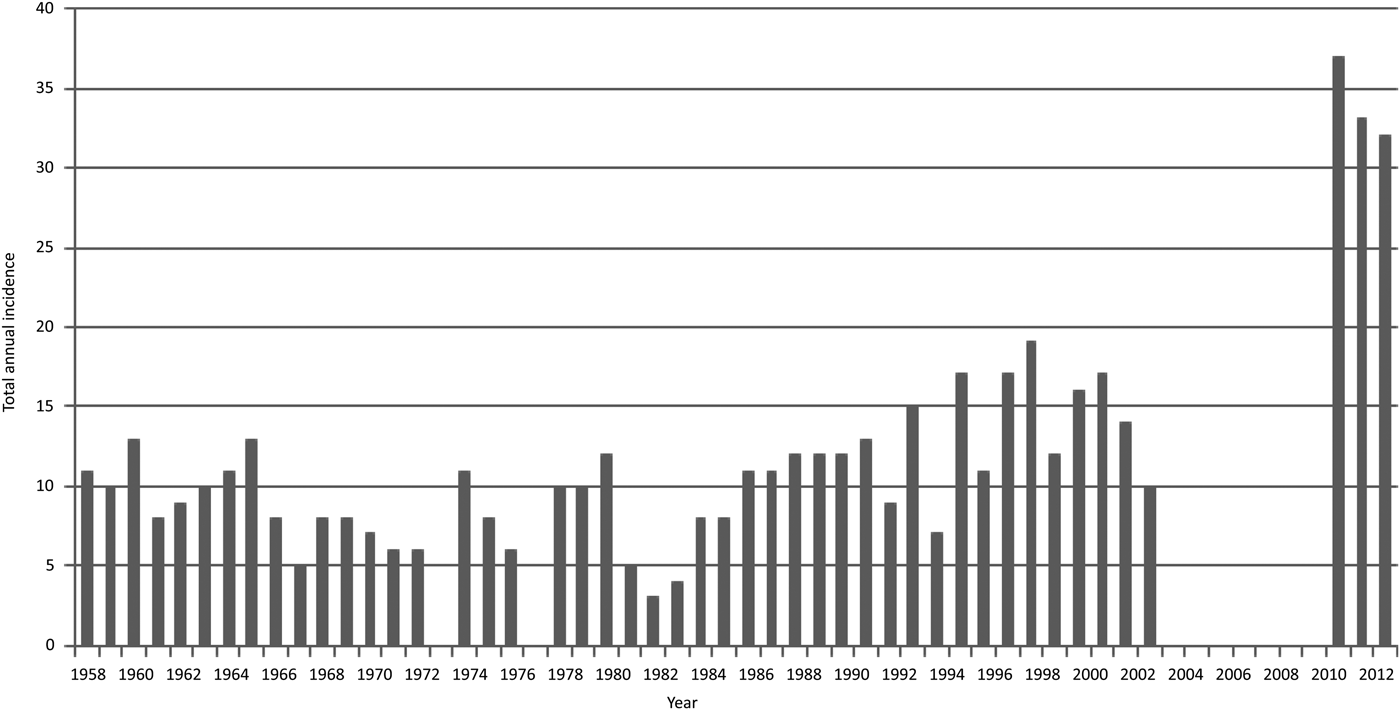
The total number of patients (new and recurrent cases of juvenile nasopharyngeal angiofibroma) included in this study, who presented from 1958 to 2013, was 701. The total number of patients admitted for ENT ailments every month over these seven decades was also recorded. The archival data could not be obtained for eight years (1977, and 2004 to 2010), as the relevant records were destroyed.
The English-language literature was searched for publications incorporating larger series of juvenile nasopharyngeal angiofibroma cases. Attempts were made to search for any juvenile nasopharyngeal angiofibroma registries worldwide, and for any publication pertaining to the incidence and prevalence of the disease. In the absence of these, and with an aim to depict the global distribution (trends) of juvenile nasopharyngeal angiofibroma in the last two decades (1990–2012), we included all of the published English-language literature reported in a recent systematic review of surgical management.Reference Boghani, Husain, Kanumuri, Khan, Sangvhi and Liu12 Accordingly, the distribution of centres reporting a larger series have been represented on a world map as per the respective countries.
Results
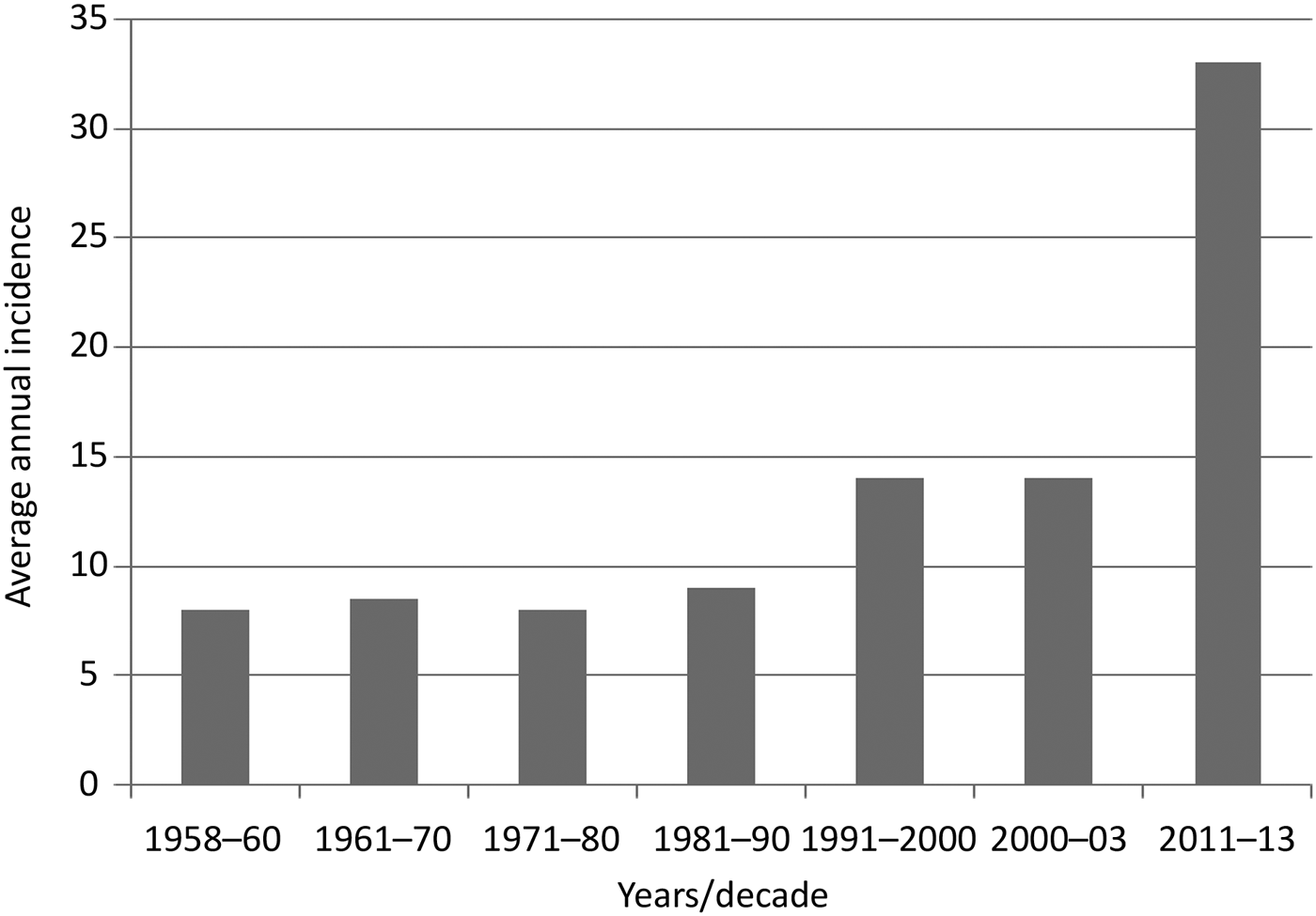
The average annual admission of patients with juvenile nasopharyngeal angiofibroma (referred to as incidence) over the past seven decades in our department is shown in Figure 1, while Figure 2 shows the total incidence across the years.
Average annual incidence of juvenile nasopharyngeal angiofibroma cases in our department over the past seven decades.

Total incidence of juvenile nasopharyngeal angiofibroma cases in our department for each year, from 1958 to 2013. The data for years 1977 and 2004–2010 are missing (as mentioned in the text).
A more or less ‘constant’ trend can be seen in the first three decades starting from the late 1950s, but this was soon followed by a slow increase in incidence during the subsequent two decades. The rapid increase in incidence in the current decade may reflect a significant change in tumour biology, with a questionable effect of an altered environmental interaction. The average number of admissions, which indirectly reflects the number of surgical procedures performed, was around 900 per year for the first 5 decades. This is in contrast to the average of over 1200 surgical procedures per year in the current decade. This increase in the overall patient load, however, is not proportionate to the increasing incidence of juvenile nasopharyngeal angiofibroma. A comparison of the incidence of juvenile nasopharyngeal angiofibroma across all 12 months revealed no difference for any particular season of presentation. The general low incidence during the difficult winter months was not surprising in this geographical belt.
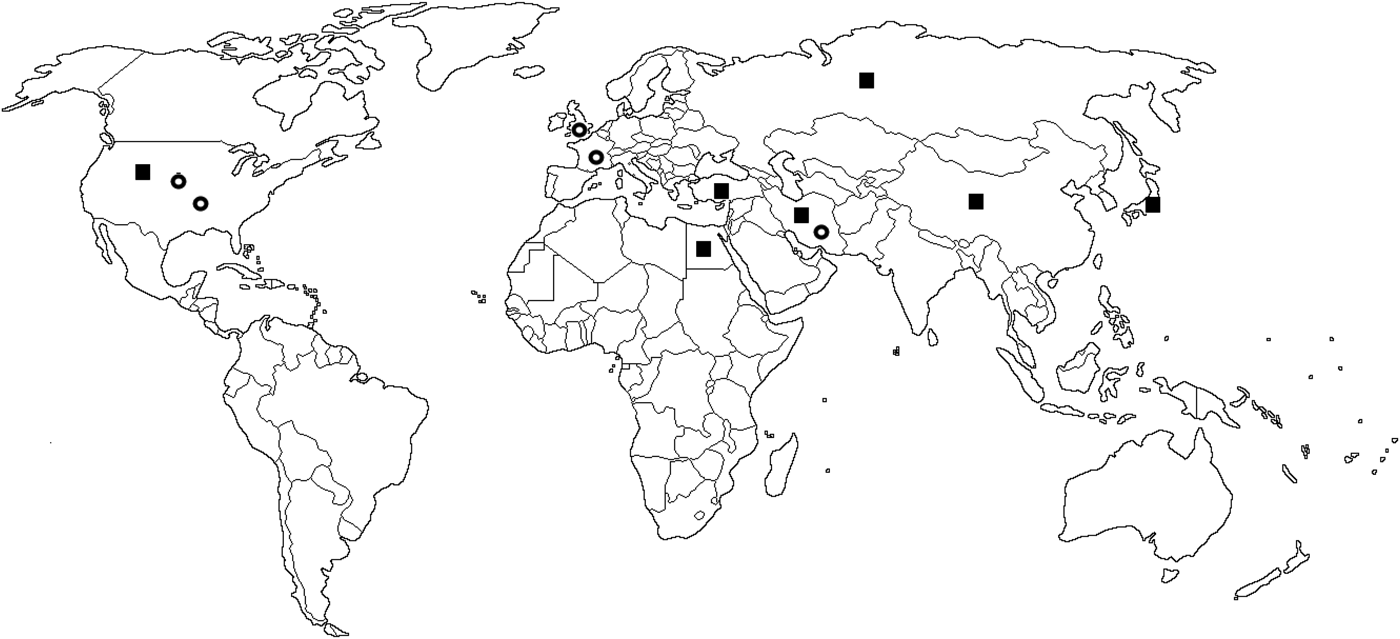
The worldwide distribution of juvenile nasopharyngeal angiofibroma incidence has been depicted in Figure 3. The map shows those centres reporting between 21 and 40 cases, as per a recent systematic review of the world literature on surgical treatment.Reference Boghani, Husain, Kanumuri, Khan, Sangvhi and Liu12 The majority of centres across the world have reported either interesting case reports or small case series only; very few centres have reported larger series as above.
Worldwide distribution of juvenile nasopharyngeal angiofibroma incidence, based on reports of between 21 and 40 cases as per Boghani et al.Reference Boghani, Husain, Kanumuri, Khan, Sangvhi and Liu12 The symbol ‘ ’ denotes a publication reporting 21–30 cases from a particular country, while ‘
 ’ denotes a publication reporting 31–40 cases from a particular country.
The overall picture as indicated in the map is not consistent with the increased prevalence of juvenile nasopharyngeal angiofibroma in central Asia and India, and there is a gross paucity of reports of this disease from the majority of countries worldwide. The more scientifically advanced nations (American subcontinent and Europe) are significant contributors to reports of juvenile nasopharyngeal angiofibroma experience. With regard to the abovementioned systematic review of world literature on surgical treatment,Reference Boghani, Husain, Kanumuri, Khan, Sangvhi and Liu12 only 4 countries reported more than 40 cases from a single institution. These were: EgyptReference Bosraty, Atef and Aziz13 and Turkey,Reference Midilli, Karci and Akyildiz14 reporting 42 cases each; Italy, which contributed the highest number, of 85 cases;Reference Danesi, Panciera, Harvey and Agostinis15 and the USA, reporting just 58 cases.Reference Pryor, Moore and Kasperbauer16 Our centre stands out as having the highest incidence in the world, with an incidence of more than 400 cases between 1990 and 2013.
Discussion
There is gross discrepancy in the reports of juvenile nasopharyngeal angiofibroma from across the globe. Only cases series, from various centres, especially third-level referral centres, have been published so far, most of which focus on treatment. For example, only one country (Egypt) has reported on the surgical treatment of juvenile nasopharyngeal angiofibroma from the largest continent of the world (Africa), probably because of under-diagnosing and under-reporting of this disease, making any comparison questionable. As only the absolute number of juvenile nasopharyngeal angiofibroma cases are reported, the absence of data on population-based incidence rate makes geographical and temporal comparisons unreasonable.
The distribution map (Figure 3) reflects minimal contribution to the literature by the lower-income countries. One of the limitations of this distribution map is the non-inclusion of those reports not mentioning surgical management. This was purposely avoided to prevent the duplication of cases from the centres simultaneously reporting on some other clinical aspect (such as radiological studies of juvenile nasopharyngeal angiofibroma) in addition to separate reports of surgical management. Hence, the biggest systematic review of juvenile nasopharyngeal angiofibroma with uniform selection criteria (1047 cases) was used when mapping the centres contributing larger series to the world literature.Reference Boghani, Husain, Kanumuri, Khan, Sangvhi and Liu12
The distribution of the centres reporting smaller series, as per the aforementioned systematic review,Reference Boghani, Husain, Kanumuri, Khan, Sangvhi and Liu12 (not shown in this paper) is more or less similar to Figure 3, with the addition of a few countries including India. Such a pattern may not reflect the true distribution, but certainly highlights gross differences in reported incidence and emphasises the need to develop a proper registry. Overall, the data utilised can be considered as the best current evidence to map out the contributing sites, especially in the absence of a worldwide tumour registry.
In an earlier comparison,Reference Chew, Kerr and Groves10 the incidence of juvenile nasopharyngeal angiofibroma in Lucknow, India (92 cases in 27 years),Reference Bhatia, Mishra and Prakash11 was more than thrice that in New York, USA (30 cases in 30 years).Reference Witt, Shah and Sternberg17 Although India is the largest contributor of cases, this is not reflected in the literature. This may be because many surgeons with small series feel that this is insignificant with regard to publication, and this may be true for other parts of the developing world too. The current study is first of its kind, reporting 701 cases from a single institution over 7 decades.
Our institutional experience suggests that the behaviour of juvenile nasopharyngeal angiofibroma has not changed much, but management and outcome have definitely improved. The diagnostic modalities in earlier decades were limited to plain roentgenograms and, sometimes, carotid angiograms (with the associated risks) in selected cases. Similarly, the absence of better anaesthetic techniques, including hypotensive anaesthesia, posed additional risks due to intra-operative haemorrhage. To minimise the latter, especially with large tumours, the options of external carotid artery ligation, or blind external carotid artery embolisation with Gelfoam® or muscle were often considered, but these carried additional risks. Hence, the chances of total tumour excision with ‘crude’ techniques were less as compared to modern times, and it is possible that recurrent disease was more frequent than it is today. The older literature of the 1980s reveals a recurrence rate of juvenile nasopharyngeal angiofibroma of 50 per cent.Reference McCombe, Lund and Howard18
The recent increase in cases presenting to our hospital does signify a rise in disease burden, but the increased attendance may have been the result of eased transport in recent years owing to faster transport services, proper road connectivity in villages, better communication networks and so on. This may have further translated into a better penetration of health education across a wide geographical area, enabling appropriate referral of such cases for treatment. The internet is not well utilised amongst our patients, but improved referral is a likely reason for the increased attendance. Unfortunately, our institution is not able to monitor tertiary referral rates over time.
It is noteworthy that 2 to 3 decades previously, there were not more than 10 surgical centres dealing with juvenile nasopharyngeal angiofibroma across the state, but today their numbers have increased to up to 100 across the province. Unfortunately, we do not know if the other centres in our state have shown a similar increase in incidence. The sharing of the patient load with other centres in the state may have reduced the incidence at our institute, which would otherwise have been higher. Even then, there has still been a definite increase in the occurrence of juvenile nasopharyngeal angiofibroma in the past decade. When the number of cases at our department in 1967 (92 over the previous 27 years)Reference Bhatia, Mishra and Prakash11 is compared with the current number, exceeding 400 in the last 24 years, there seems to be a 4-fold increase in the occurrence of this disease.
The reason for this rapid increase in incidence is not easy to establish. Juvenile nasopharyngeal angiofibroma has a varied aetiology. Nevertheless, a probable environmental contribution in this geographical area needs to be mentioned. The rapid industrialisation, urbanisation, globalisation and pollution have likely resulted in some environmental changes. Being hormonally dependent, the factors affecting endocrine status are likely to affect the occurrence of juvenile nasopharyngeal angiofibroma. The environmental trends of precocious puberty, pesticide exposure, milk and food product adulteration, plastic waste, and air and water pollution may contribute to endocrine disturbances.
The factors influencing the hormonal profile in India include obesity, nutritional deficiencies, genetic diseases, socioeconomic differences and even psychological factors. Stress other than that caused by poverty (such as immigration, adoption, insecure relationship with parents) can trigger precocious puberty. The availability of food and energy influences sexual maturation, and these are unequally distributed around the world. The hormone disturbance in the early stages of life may have a long-term effect that persists throughout life. For example, pre-natal stress during the period of hypothalamic differentiation induces negative effects on testicular growth in the embryo, and hence impacts upon the sex hormones.
Numerous studies have focused on correlations between fetal and perinatal exposure to chemical products and disruption of the endocrine system (e.g. dichlorodiphenyltrichloroethane (DDT) pesticide). Pesticide production (quality and cost control) is currently a deregulated sector in India, which is an agriculture-based nation. Chlorinated pesticides, such as endosulphan, are still used extensively in the developing world, including India. Examples of known endocrine-disrupting pesticides include DDT (which still persists in abundance 20 years after being banned in USA), lindane, atrazine, carbaryl and parathion. Children with immature immune systems and detoxifying mechanisms are vulnerable to the toxic pesticides.
A qualitative analysis of milk samples conducted in India confirmed the presence of urea, neutralisers, formalin, detergents and hydrogen peroxide (in 60 per cent, 26 per cent, 32 per cent, 44 per cent and 32 per cent of the samples, respectively),Reference Singuluri and Sukumaran19 thus unveiling the illegal toxic chemicals injurious to health. Carbonates and bicarbonates added to milk can also cause disruption in hormone signalling that regulates development and reproduction. The National Survey on Milk Adulteration 2011, conducted by the Food Safety and Standards Authority of India, also confirmed a countrywide adulteration to the tune of 70 per cent.20 The commercial dairies in India sell milk in plastic bags, without disclosing the ingredients of the plastic material. Another common practice in north India is the transporting of hot tea in thin polythene bags. The known toxic materials in plastic are polyvinyl chloride, which contains phthalates and heavy metals, and Bisphenol A, which is known to disrupt hormones. In addition, mangoes are ripened with calcium carbide, fish is made to look fresh with formalin, and ice cream (consumed more by the young) is adulterated using pepper oil, ethyl acetate, butyraldehyde, amyl acetate, nitrate and washing powder. With regard to food adulteration, the legislation against this unethical practice is virtually non-existent in India.
• No worldwide registry exists for juvenile nasopharyngeal angiofibroma; the absence of population-based data makes epidemiology difficult to define
• The world literature on this disease is poorly represented by lesser-developed countries that encounter the major global burden
• This article constitutes the largest global collection of juvenile nasopharyngeal angiofibroma cases (n = 701 cases)
• The changing incidence of juvenile nasopharyngeal angiofibroma across seven decades is highlighted
• A four-fold increase in incidence was observed at our centre in the past few decades; it is not known if such trends exist elsewhere
• The cause of increased incidence should be considered in an environmental context, to plan prevention policies
Androgen and oestrogen receptors are present in juvenile nasopharyngeal angiofibroma, and there are reports of associated hormonal disorders in such patients. However, Lund et al. regard the hormonal influence on juvenile nasopharyngeal angiofibroma as a controversial issue, as apparently no alterations of hormonal serum levels have been observed.Reference Lund, Stammberger, Nicolai, Castelnuovo, Beal and Beham1
Another noteworthy issue is the rising trend of alternative therapies in India. The majority of those offering such services are unlicensed ‘professionals’, who provide the ill with cocktails of allopathic, Ayurvedic and homeopathic medications that often incorporate high doses of steroids in their preparation.
Whether the Indian population and other ethnic groups differ from their White counterparts remains unestablished. We could not find any conclusive evidence for racial or ethnic predominance. An approach to conclude the same based on the reported cases from different parts of the globe may not be appropriate considering the gross asymmetrical reporting rates.
Conclusion
The global distribution of juvenile nasopharyngeal angiofibroma is not yet established. The findings from our centre, which contributes the largest number of such cases across the globe, suggest increasing trends, especially in the current decade. Environmental and social interactions known for their hormone disruptive actions, which are coincidentally more prevalent in our geographical area, may contribute to altered biology. Efforts must be made to develop a juvenile nasopharyngeal angiofibroma tumour registry, or at least a population-based database, to define a definite epidemiology. The physicians dealing with these tumours worldwide should be encouraged to publish even very small case series, so as to generate a global database and better define the distribution of juvenile nasopharyngeal angiofibroma cases. Analyses of the effects of extraneous environmental and social factors on the occurrence of juvenile nasopharyngeal angiofibroma, in the context of a particular geographical area, may help in the planning of prevention policies.
Acknowledgement
Dr A Mishra would like to acknowledge Dr AM Tripathi (King George Medical University, Lucknow) for his clerical assistance in mapping the incidence of juvenile nasopharyngeal angiofibroma.