Introduction
Within European countries a substantial and still increasing part of the general population consists of non-Western migrant populations. In most European countries the ethnic minority migrant populations are currently reaching an age where dementia is becoming a significant issue. Symptoms of dementia are similar in all races and ethnicities, but cross-cultural assessment of dementia can be challenging because of language problems and lack of cross-culturally validated cognitive instruments and dementia rating scales (Daker-White et al., Reference Daker-White, Beattie, Gilliard and Means2002). Moreover, there is a stigma and taboo attached to mental health problems in some ethnic minorities (Liu et al., Reference Liu, Hinton, Tran, Hinton and Barker2008), which may affect the communication of problems, and prejudices on both parts may influence the doctor-patient and the doctor-caregiver relationship (Michaelsen et al., Reference Michaelsen, Krasnik, Nielsen, Norredam and Torres2004). These challenges have been acknowledged in traditional multicultural societies such as the U.S.A., Canada and Australia for many years. Dementia in elderly ethnic minority populations is, however, still a relatively new phenomenon in most European countries and research in the area is limited. In Europe, research published in English is largely restricted to studies of Indian subcontinent and African Caribbean elders in the U.K. (McCracken et al., Reference McCracken1997; Bhatnagar and Frank, Reference Bhatnagar and Frank1997; Lindesay et al., Reference Lindesay, Jagger, Hibbett, Peet and Moledina1997a; 1997b; Shah et al., Reference Shah, Lindesay and Jagger1998; Lindesay, Reference Lindesay1998; Parker and Philp, Reference Parker and Philp2004; Lawrence et al., Reference Lawrence, Murray, Samsi and Banerjee2008). Population-based studies from both the U.S.A. (Demirovic et al., Reference Demirovic2003; Fitzpatrick et al., Reference Fitzpatrick2004) and the U.K. (McCracken et al., Reference McCracken1997; Livingston et al., Reference Livingston, Leavey, Kitchen, Manela, Sembhi and Katona2001) have found a higher prevalence of dementia in some ethnic minorities compared to the background population, while other studies have found that ethnic minority patients and their carers are not utilizing dementia services to the same extent as others (Lindesay et al., Reference Lindesay, Jagger, Hibbett, Peet and Moledina1997a; Janevic and Connell, Reference Janevic and Connell2001). There is no European consensus on good clinical practice with ethnic minority patients and it is unknown whether European countries are prepared for the increasing demand for assessment and care of these patient groups, who often have different needs and expectations of the dementia service.
Various definitions of ethnicity are used in the literature, and there is little international consensus on terminology regarding ethnic minorities. In Europe most ethnic minorities are first or second generation immigrants. Ethnic minorities cannot be defined by immigrant status alone, however, as indigenous people and ethnic minorities from former colonies may have lived in a European country for generations. Also, not all immigrants may necessarily be perceived as ethnic minorities, e.g. people migrating from one European country to another. For operational purposes, in this study we defined ethnic minority patients as persons who are first generation immigrants or refugees from countries outside the extended EU, Canada, U.S.A., Australia and New Zealand. By choosing this definition, an ethnic minority patient in Europe is restricted to a person who was born in a country outside one of these countries.
The aim of this study was to evaluate the current status and practice for assessment of dementia in ethnic minority patients in clinical centers of expertise of the European Alzheimer's Disease Consortium (EADC). The EADC is a network of 53 European centers of excellence in 18 European countries specializing in Alzheimer's disease (AD). The development of EADC was funded by the European Union with the purpose of defining operational standards of excellence for the diagnosis and treatment of patients with cognitive and behavioral disturbances.
Methods
A questionnaire was mailed to a leading dementia expert in each of the EADC centers. The experts were asked to reply on behalf of their center, or to delegate completion of the form to an equally or better qualified colleague in their center.
The questionnaire form was mailed in a printed format with a request for it to be returned after completion. A pilot study evaluating the questionnaire was conducted in four participating centers prior to initiation of the survey. The questionnaire items investigated different points in the clinical assessment of dementia in ethnic minority patients and the perceived challenges of solving this task. The questionnaire consisted of five main sections: organization of the center, assessment techniques, culture and language, use of interpreters, and assessment of ethnic minority patients (see Appendix 1 for the questionnaire items). The first section concerned the center and the service delivered, especially whether it received referrals of patients from ethnic minority backgrounds. The second section concerned the current practice of assessing ethnic minority patients and the staff's perceived influence of ethnic minority background on various clinical investigations and procedures. The third section focused on the influence of cultural and linguistic factors on the clinical evaluation of dementia in ethnic minority patients. The fourth section focused on issues in interpretation, and the fifth section focused on the staff's general perceptions of challenges and skills in assessment of dementia in ethnic minority patients. Additional items concerned the cognitive screening instruments and dementia rating scales the centers would prefer to be available for ethnic minority patients. The questionnaire form contained space at the end for additional comments.
In the first section of the questionnaire respondents were asked to give approximate percentage values for the description of their center; the rest of the questionnaire required scores on three versions of five-point Likert scales: “Never”, “Rarely”, “Sometimes”, “Often”, “Always”; or “Very difficult”, “Difficult”, “Not different”, “Easy”, Very easy”; or “Very bad”, “Bad”, “Neither good nor bad”, “Good”, “Very good”.
To analyze differences between countries with different histories of non-Western immigration, countries were grouped into countries with a long history of immigration (France, Netherlands, Spain, Portugal and the U.K.), and countries with a more recent history of immigration (Belgium, Denmark, Finland, Germany, Greece, Italy, Poland, Romania, Sweden and Switzerland). Countries with a long history of immigration were countries that, for historical and political reasons, had a tradition for influx of non-Western immigrants from former colonies. In countries with a recent history of immigration, non-Western immigration was a more recent phenomenon.
Using SPSS statistical software (Version 15.0 SPSS Inc., Chicago, IL, USA), the responses from countries with different histories of immigration were compared. Fishers Exact Test was used to investigate the significance of differences in whether or not regular referrals of ethnic minority patients were received. Mann-Whitney U test was used to examine the level of significance of responses concerning cognitive testing and use of interpretation.
Results
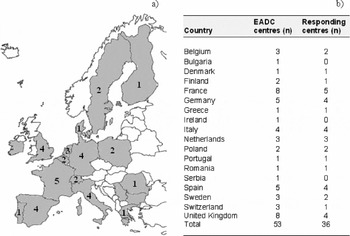
Of the 53 EADC centers contacted, 36 (68%) centers from 15 countries responded to the invitation to participate in the survey. The geographical distribution of EADC centers and the distribution of centers responding to the survey are shown in Figure 1. The participating centers were generally large centers with 82% receiving more than 300 new referrals per year. The medical specialties of neurology, psychiatry and geriatrics were equally represented (39%, 25% and 36% respectively). Ethnic minority patients were seen on a regular basis in 69% of the surveyed centers. In 80% of these centers, ethnic minority patients comprised less than 5% of the total number of referred patients, while 8% reported ethnic minority patients to comprise more than 20% of all referred patients. Though there were apparent differences in the ethnicity of patients referred for assessment in the centers, the most commonly referred ethnic minority patients were immigrants from Middle Eastern and North African countries (especially immigrants from Turkey and Morocco) followed by immigrants from non-EU East European countries. This reflects the general immigration pattern in Europe. Sixty percent of the centers reported that less than 20% of newly referred ethnic minority patients received a dementia diagnosis. This number was much lower than the percentage of dementia diagnoses given to all newly referred patients (both minority and majority patients), which was generally in the range of 41–80%.
Distribution of participating EADC centers. a) Geographical distribution of EADC centers. The gray color denotes countries with an EADC center. The numbers in each country denote the number of participating centers within that country in this particular study. b) A list of countries with EADC centers and the number of centers responding to the survey.

The services of the centers were fully or partly covered by compulsory health insurance in 80.6% and 13.9% of the centers respectively.
Diagnostic evaluation of ethnic minority patients in Europe
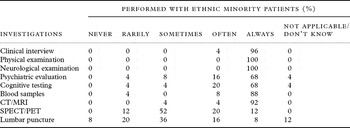
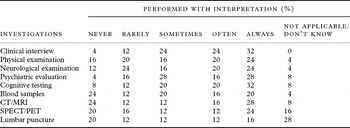
Diagnostic evaluation of ethnic minority patients in the participating EADC centers receiving referrals is summarized in Table 1. The diagnostic evaluation was in accordance with evidence-based clinical guidelines (Waldemar et al., Reference Waldemar2007) in 84–100% of the centers. Table 2 summarizes the use of an interpreter with ethnic minority patients during diagnostic evaluation. Interpretation was always or often used during clinical investigations in 44–56% of the centers and in 28–44% of the centers when giving information about ancillary investigations. When interpretation was necessary 71% of the centers always or often relied on family members, 46% on professional interpreters and 13% on staff members.
Diagnostic evaluation of ethnic minority patients in EADC centers (n = 25)

CT/MRI = computerized tomography/magnetic resonance imaging; SPECT/PET = single photon emission computed tomography/positron emission tomography.
Use of interpretation during diagnostic evaluation of ethnic minority patients in EADC centers (n = 25)

CT/MRI = computerized tomography/magnetic resonance imaging; SPECT/PET = single photon emission computed tomography/positron emission tomography.
Indicators of culture sensitive dementia services in the centers were generally sparse. Sixteen to thirty two percent had information sheets, cognitive screening instruments or dementia rating scales directed at commonly referred ethnic minority patients and no more than 8% had knowledge of specialized dementia services for patients with ethnic minority backgrounds in their area. The cognitive screening instrument most centers would prefer to be available for their ethnic minority patients were ethnically modified versions of the Mini-mental State Examination (MMSE; Folstein et al., Reference Folstein, Folstein and McHugh1975).
The apparent lack of culture sensitive dementia services in the index centers could not be explained by availability of other better services in their areas.
Influence of ethnic minority background on the diagnostic evaluation
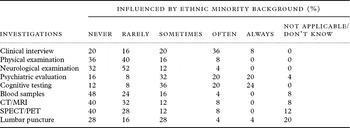
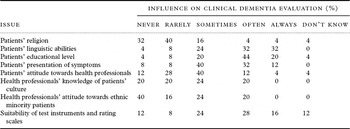
The influence of the patients’ ethnic minority background on various investigations is illustrated in Table 3. As expected most centers reported that the ethnic minority background affected those clinical investigations that relied more on verbal communication. Some 20–52% of the centers also reported that the ethnic minority background frequently affected obtaining consent for ancillary investigations. Challenging issues in the clinical evaluation of ethnic minority patients that were highlighted by the centers were the way the patients presented dementia symptoms and their often limited linguistic abilities and educational level. Another important challenge to good clinical evaluation was the lack of suitable cognitive test instruments and dementia rating scales. Religious issues were reported to influence the clinical evaluation at a few centers (Table 4).
Influence of ethnic minority background on clinical and ancillary investigations (n = 25)

CT/MRI = computerized tomography/magnetic resonance imaging; SPECT/PET = single photon emission computed tomography/ positron emission tomography.
Issues influencing clinical dementia evaluation (n = 25)

Based on the results of this survey it is not surprising that the majority of centers (64%) found assessment of dementia in ethnic minority patients to be more challenging than in majority patients. However, 48% still found their skills to be good in assessing dementia in ethnic minority patients.
Comparison of countries with different histories of immigration
When comparing countries with a long history of immigration, no significant differences were found in whether or not regular referrals of ethnic minority patients were received (Fishers Exact Test, p = 0.588). However, when comparing issues concerning cognitive testing, and use of interpretation, significant differences were found. In countries with a more recent history of immigration, cognitive testing was found to be more challenging (U = 39, p = 0.028), and available cognitive test instruments and dementia rating scales were found to be less suitable (Mann-Whitney U = 26, p = 0.019). No significant differences were found in the use of interpreters during clinical investigations. In countries with a more recent history of immigration interpretation was used significantly more when giving information about SPECT or PET scans (U = 23, p = 0.021), blood tests (U = 32, p = 0.036) and lumbar punctures (U=26, p = 0.019).
Discussion
This is the first European survey to evaluate the status and practice of assessing dementia in ethnic minority patients. We found that most centers had regular contact with ethnic minority patients. They generally considered diagnostic evaluation of the patients to be challenging because of communication problems and lack of adequate assessment tools, and they were generally unprepared to provide adequate services for patients and families with ethnic minority backgrounds. Not surprisingly, strategies for overcoming cultural and linguistic barriers were suboptimal. Most centers performed cognitive assessment with instruments that are only validated in Western cultures and they frequently relied on family members for interpretation, although professional interpreters were also commonly used.
Nonetheless, use of translated instruments and efforts to develop adequate assessment tools were identified in some centers, indicating that efforts to create better conditions for ethnic minority patients do exist. Evidence-based clinical guidelines (Waldemar et al., Reference Waldemar2007) were followed for ethnic minority patient referrals in practically all centers, indicating that discrimination regarding the application of clinical and ancillary investigations was not an issue. On the other hand, it is obvious that the available clinical investigations were often inadequate for evaluation of ethnic minority patients. Two-thirds of the centers reported evaluation of dementia in ethnic minority patients to be more challenging compared to majority patients, and in more than half of the centers less than 20% of referred ethnic minority patients received a dementia diagnosis. It seems unlikely that this is due to the challenges of diagnosing dementia in ethnic minority patients alone. It probably also reflects the fact that some of the referred patients have cognitive symptoms associated with psychiatric disorders. In line with several other studies (Lindesay, Reference Lindesay1998; Daker-White et al., Reference Daker-White, Beattie, Gilliard and Means2002), the main challenges in evaluation of dementia in ethnic minority patients were reported for clinical investigations relying on verbal communication, i.e. clinical interview, psychiatric evaluation and cognitive testing. Surprisingly, more than one-fifth of the centers also reported difficulty in gaining consent to do blood tests, brain scans and especially lumbar punctures.
Though ethnic minorities are prevalent in all European countries almost one-third of the surveyed centers reported that they did not receive referrals of patients from ethnic minority backgrounds, and no differences were found between countries with a relatively recent history and those with a long history of immigration. Reasons for ethnic disparities in access and use of health services are complex and often poorly understood (Mayberry et al., Reference Mayberry, Mili and Ofili2000). Although ethnic minorities in Europe generally have a lower socioeconomic status (Stronks et al., Reference Stronks, Ravelli and Reijneveld2001) this should not exclude them from accessing dementia services as these were covered by compulsory health insurance in practically all centers. Ethnic minority patients do, however, often face linguistic and cultural barriers when they try to access the health care systems. Studies have found that ethnic minority patients are under-represented in specialized health care (Lindert et al., Reference Lindert, Schouler-Ocak, Heinz and Priebe2008) and have different pathways to a diagnosis of dementia compared to others (Hinton et al., Reference Hinton, Franz and Friend2004), which suggests that patients with ethnic minority backgrounds may not be referred to specialized dementia services to the same extent as others. At the same time, several studies do, however, indicate that patients and families from ethnic minorities may not seek medical help for dementia symptoms to the same extent as others because of differences in perceptions of dementia and help-seeking behavior (Dilworth-Anderson and Gibson, Reference Dilworth-Anderson and Gibson2002; Purandare et al., Reference Purandare, Luthra, Swarbrick and Burns2007; Lawrence et al., Reference Lawrence, Murray, Samsi and Banerjee2008). Furthermore, disparities in access to health services might be attributed to a lack of knowledge about specialized services, or a reluctance to get into contact with the health-care sector, whose services may be perceived as inappropriate (Lindesay et al., Reference Lindesay, Jagger, Hibbett, Peet and Moledina1997a; Daker-White et al., Reference Daker-White, Beattie, Gilliard and Means2002). Most likely all of these factors contribute to the ethnic disparities in access and use of specialized dementia services.
Cognitive deficits are the cardinal symptoms in dementia (World Health Organization, 1993) and clinical assessment and cognitive testing are essential for its correct evaluation. However, certain pitfalls are associated with assessment of elderly ethnic minority patients because they often have limited linguistic abilities in the dominant language (Lindesay, Reference Lindesay1998; Daker-White et al., Reference Daker-White, Beattie, Gilliard and Means2002) and often present their dementia symptoms in a different way to other patients (Chandra et al., Reference Chandra2001). Issues concerning cross-cultural cognitive assessment were found to be less problematic in countries with a long history of immigration, which probably reflects the fact that the main ethnic minority populations in these countries are immigrants from former colonies. Because of the historic ties between the countries of origin and the receiving country, these ethnic minority populations generally have a better understanding of the dominant language and culture compared to ethnic minority populations in other countries. However, this survey strongly suggests that referred ethnic minority patients in European dementia centers often have limited or no schooling and thus are unfamiliar with the test or assessment situation (Ardila, Reference Ardila2005). It can be inappropriate to use cognitive tests developed in Western cultures to assess cognitive function in these patients and the test scores will often be misleading (Lindesay, Reference Lindesay1998) as the majority of the available cognitive instruments used to assess dementia are affected by cultural variation (Parker and Philp, Reference Parker and Philp2004; Ardila, Reference Ardila2005). Norms adjusted for sociodemographic variables, including cultural background and educational level, are essential in the evaluation of dementia. Some immigrants can read and write in a non-dominant language while others are virtually illiterate. Also, recent immigrants from rural areas have probably never had any reason to learn about complex geometric figures or exact dates. Therefore, if the patients’ educational level and cultural background are not taken into account, the interpretation of cognitive test scores will most likely lead to misdiagnoses (Parker and Philp, Reference Parker and Philp2004).
Both structural imaging and cognitive testing are standard requirements in the guidelines for good clinical practice. But while practically all centers always performed CT or MRI with ethnic minority patients, this was only the case in approximately two-thirds of the centers when it came to cognitive testing. This most likely reflects the aforementioned challenges of performing cross-cultural cognitive assessments without suitable cognitive test instruments and dementia rating scales.
The most widely used cognitive instrument is the MMSE and this was also the cognitive screening instrument most centers had available or would prefer to be available for their ethnic minority patients. Several studies have, however, reported the MMSE to be highly influenced by ethnicity and educational level (Parker and Philp, Reference Parker and Philp2004). The mean score on the MMSE for 64–69-year-old Americans with 0–4 years of education is, for example, 22/30 points (Crum et al., Reference Crum, Anthony, Bassett and Folstein1993). The MMSE has been translated into numerous languages and different modifications and strategies have been proposed to make the instrument more suitable for different ethnic groups and people with limited education (Lindesay et al., Reference Lindesay, Jagger, Mlynik-Szmid, Sinorwala, Peet and Moledina1997b; Parker and Philp, Reference Parker and Philp2004). As an example, a Gujarati version of the MMSE has been developed and validated in the U.K. (Lindesay et al., Reference Lindesay, Jagger, Mlynik-Szmid, Sinorwala, Peet and Moledina1997b; Shah et al., Reference Shah, Lindesay and Jagger1998). It is not feasible, however, to translate, make cultural modifications and validate the MMSE in all ethnic minority populations in Europe. A better solution would be to make efforts to develop cognitive screening instruments that are less affected by culture and language or implement already existing examples of such instruments (Storey et al., Reference Storey, Rowland, Basic, Conforti and Dickson2004).
Evaluation of dementia is mainly a clinical discipline relying on verbal communication and observation of behavior. Efficient interpretation is thus crucial when seeing patients from other linguistic backgrounds. European countries differ in their health care policies regarding interpretation. While patients have a formal right to an interpreter in some countries, the use of interpreters is generally poorly facilitated by national governments (Meeuwesen et al., Reference Meeuwesen, Twilt, Ten Thije and Harmsen2009).
Interpretation was used routinely in approximately half of the centers during clinical investigations with ethnic minority patients and in about one-third of the centers when informing them about ancillary investigations. Interpretation was used less frequently when giving information about ancillary investigations in countries with a long history of immigration, which probably reflects better familiarity with the dominant language. Family members were routinely used for interpretation in more than two-thirds of the centers and professional interpreters in almost half of the centers. The reasons for using relatives as interpreters are mostly practical and organizational (Greenhalgh et al., Reference Greenhalgh, Voisey and Robb2007). The literature on medical interpretation recommends the use of professional interpreters, because of fewer mistakes as well as greater physician and patient satisfaction (Flores, Reference Flores2005). Although studies on communication in informal interpretation are scarce (Aranguri et al., Reference Aranguri, Davidson and Ramirez2006), there is a generally negative attitude regarding the use of informal interpreters because of the lack of professional standards and greater risk of miscommunication (Flores, Reference Flores2005).
Numerous studies have shown that patients’ satisfaction and outcomes are positively affected by the use of professional interpreters (Flores, Reference Flores2005) and we suspect that the reported challenges of obtaining consent for ancillary investigations reflect the fact that professional interpreters were rarely used when giving information about these procedures.
A limitation of this study was that the data were based on a survey and therefore reflect the perceptions of the respondents. This may have led to over- or under-estimations in the responses. Also, as respondents were not anonymous, it is possible that some results reflect the fact that respondents wanted to demonstrate a high quality of care for patients from ethnic minorities in accordance with international standards. Another limitation was that the sample might not be representative, because only dementia experts from the EADC were sent the survey rather than a random selection of clinical dementia centers in European countries. Thus, we cannot be certain that our results would have been the same had we conducted the survey in a sample of smaller, less specialized centers. The descriptions from experts based in leading dementia centers in Europe does, however, give an impression of the current status and practice of assessment of dementia in ethnic minorities in Europe, which is an area that has not yet been properly described. The main strengths of the study were the high response rate to the survey (68%), and the fact that European countries were broadly represented in the sample. Also, the neurological, psychiatric and geriatric medical specialties were all well represented in the sample.
In conclusion, the current practice of assessment of dementia in ethnic minority patients in Europe is suboptimal. Culture-sensitive dementia services are lacking and the specialized dementia services do not appear to be prepared for an increase in demand for the assessment and care of patients from different cultural and linguistic backgrounds. There is a general need to increase health professionals’ awareness of the implications regarding cross-cultural assessment of dementia, and there appears to be an urgent need to develop appropriate assessment methods for patients from the ethnic minority populations in Europe.
Conflict of interest
None.
Description of authors’ roles
T. R. Nielsen designed the study, collected the data, analyzed the data and wrote the paper. Asmus Vogel and Gunhild Waldemar assisted in designing the study, supervised the data analysis and assisted in writing the paper. Matthias W. Riepe, Alexandre de Mendonça, Guido Rodriguez and Flavio Nobili assisted in designing the study and assisted in writing the paper. Anders Gade assisted in writing the paper.
Acknowledgments
The authors would like to thank the Danish Council for Independent Research / Humanities (FKK) for financial support of the study. The authors also thank the Health Insurance Foundation and the Ministry of Health and Prevention for financial support to the Danish Dementia Research Center.
We thank the following EADC investigators (in alphabetical order) who participated in the survey: M. Barcikowska (Warsaw, Poland), R. Bernabei (Roma, Italy), A. Burns (Manchester, U.K.), V. Camus (Tours, France), J. M. R. Casado (Madrid, Spain), M. Costa-Tsolaki (Thessaloniki, Grece), A. Cruz (Madrid, Spain), J. F. Dartigues (Bordeaux, France), G. Frisoni (Brescia, Italy), L. Frolich (Frankfurt, Germany), R. Jones (Bath, U.K.), A. Kurz (Munich, Germany), P. Mecocci (Perugia, Italy), L. Minthon (Malmö, Sweden), J. L. Molinuevo (Barcelona, Spain), M. G. M.Olde-Rikkert (Nijmegen, Netherlands), F. Pasquier (Lille, France), P. Robert (Nice, France), M. Rossor (London, U.K.), E. Salmon (Liége, Belgium), F. Sanches-Lopez (Cordoba, Spain), A. Schneider (Goettingen, Germany), P. Scheltens (Amsterdam, Netherlands), H. Soininen (Kuopio, Finland), D. Smith (Oxford, U.K.), R. Spiegel (Basel, Switzerland), L. Spiru (Bucharest, Romania), T. Sobów (Lodz, Poland), R. Vandernberghe (Leuven, Belgium), B. Vellas (Toulouse, France), F. Verhey (Maastricht, Netherlands), B. Winblad (Stockholm, Sweden).
Appendix 1
Survey questions
organization of center
1. In which medical specialty is your center based?
2. How is the dementia service from your center delivered?
3. As much as you can tell, is there a specialized service for patients from ethnic minority backgrounds in your area?
4. How many new patients were examined in your center last year?
5. How many new patients were diagnosed with dementia in your center last year?
6. Do you receive referrals of ethnic minority patients for diagnostic evaluation of dementia in your center?
7. Do you have staff members from ethnic minorities employed in your center?
assessment techniques
8. How often do you and the staff in your center attempt to include the following clinical investigations when evaluating ethnic minority patients?
9. How often do you and the staff in your center attempt to include the following procedures when evaluating ethnic minority patients?
10. How often do you and the staff in your center use interpretation during the following clinical investigations when evaluating ethnic minority patients?
11. How often do you and the staff in your center use interpretation in giving information about the following procedures with ethnic minority patients?
12. Does your center have information sheets and consent forms in the languages of ethnic minority patients?
13. Do you and the staff in your center find that the success of performing the following clinical investigations may be influenced by patients’ ethnic minority background?
14. Do you and the staff in your center find that the success of getting consent to any of the following procedures may be influenced by a patient's ethnic minority background?
15. Do you use translated versions of the MMSE in your center?
16. Do you use separate cognitive screening instruments or dementia rating scales when evaluating ethnic minority patients?
17. Which cognitive screening instruments or dementia rating scales would you prefer to be available for the ethnic minority patients in your center?
culture and language
18. Do you and the staff in your center find that any of the following issues influence the clinical evaluation of ethnic minority patients?
interpretation
19. When interpretation is necessary who will interpret?
assessment of ethnic minority patients – general
20. In general, how do you and the staff in your center find assessment of dementia in ethnic minority patients compared to ethnic majority patients?
21. In general, how do you and the staff in your center consider your skills in assessing dementia in ethnic minority patients?