Introduction
The inevitable infestation of young grazing lambs with gastrointestinal (GI) nematode parasites above an infection threshold can cause a considerable loss of productivity with severe implications for animal welfare and financial returns for the producer. These losses are manifested largely through a reduction of nutrient utilization as a consequence of increased demand for energy and/or protein for the development and maintenance of immunological function and tissue repair coupled with reduced voluntary feed intake (VFI) (van Houtert and Sykes, Reference van Houtert and Sykes1996). Supplementation of infected lambs with protein has been shown to reduce the apparent disruption to performance, as animals supplemented with protein or offered a diet with greater protein content are able to maintain superior levels of production than their counterparts with poorer protein supply (Bown et al., Reference Bown, Poppi and Sykes1991a; van Houtert et al., Reference van Houtert, Barger and Steel1995; Kyriazakis et al., Reference Kyriazakis, Anderson, Oldham, Coop and Jackson1996). This effect has been attributed to reduced parasite burdens as a consequence of an enhanced immune response (Bown et al., Reference Bown, Poppi and Sykes1991a; Coop et al., Reference Coop, Huntley and Smith1995) and presumably reflects a greater ability of animals in a high-protein environment to meet the proteinaceous demands of such reactions or repair of parasite-induced pathophysiology (MacRae, Reference MacRae1993). In addition, it is possible that supplementation could have supplied protein in excess of that required for the acquisition of immunity, allowing more protein to be partitioned to productive functions (Coop and Kyriazakis, Reference Coop and Kyriazakis1999).
Recent studies by Greer et al. (Reference Greer, McAnulty, Stankiewicz and Sykes2005a and Reference Greer, Stankiewicz, Jay, McAnulty and Sykes2005b) involving the use of corticosteroid-induced immuno-suppression have raised the possibility that immunological signalling specific to the development phase of the immune response may be responsible for both the reduction in feed intake and nutrient utilization in nematode-infected lambs. These authors reported that neither immuno-suppressed lambs nor immune-competent ewes experienced the 0.30 reduction in feed intake or 0.20 reduction in efficiency of utilization that was suffered by immunologically normal but previously parasite-naïve lambs, allowing the conclusion that it is the phase of acquisition of specific immunity that imposes the greatest nutritional cost to the animal. Therefore, it can be hypothesized that manipulations that enhance the development of specific immunity may be expected to reduce the immune-mediated nutritional penalty that is experienced by the animal during the acquisition of immunity. In other words, the enhanced productivity consistently exhibited by nematode-infected animals when offered a high-protein diet may reflect a more rapid transition through the acquisition phase of immunity to an established (mature) immune response that is less nutritionally disruptive. Therefore, the current trial utilized corticosteroid-induced immuno-suppression to investigate the effect of dietary protein supply on the loss of efficiency of metabolizable energy (ME) utilization associated with the development of immunity in lambs infected with the nematode Trichostrongylus colubriformis.
Material and methods
Fifty-two mixed-sex Coopworth lambs were maintained with minimal nematode exposure through weaning and housing at 6 weeks of age until the start of the trial at 5 months of age. Twenty-four were from dams that were grazing pasture and 28 were from dams that had been housed for other experimental purposes. All lambs from the former treatment group were drenched with 1 ml/5 kg liveweight (LW) of a combination drench (37.5 g/l levamisole and 23.8 g/l albendazole, Arrest; Ancare New Zealand Ltd, Auckland, New Zealand) when removed from pasture. Lambs were penned individually and allocated into one of eight groups that were balanced for LW, animal origin (housed or pasture) and sex (castrated male or female) and had a mean LW of 27.6 ± 1.8 kg. Four groups were offered a low-protein (L-) and four a high-protein (H-) diet. Within each dietary treatment, one group was trickle infected in a three-times-weekly dosing regime with the equivalent of 2000 L3 T. colubriformis/day from day 1 until day 73 (-IF; n = 8); a second group (-immuno-suppressed with methylprednisolone acetate (-ISIF); n = 8) received the same infection while also being treated with weekly intramuscular injections of the glucocorticoid methylprednisolone acetate (Depo-Medrol, 40 mg methylprednisolone acetate/ml; The UpJohn Company, Kalamazoo, USA) at a rate of 1 ml/30 kg LW from day 1 to day 71 in order to suppress immune function. This dose rate was chosen as it has been demonstrated to provide effective immuno-suppression while having little effect on food intake (Greer et al., Reference Greer, McAnulty, Stankiewicz and Sykes2005a and Reference Greer, Stankiewicz, Jay, McAnulty and Sykes2005b). A third group received only the glucocorticoid (-immuno-suppressed-only (IS); n = 4) and the fourth remained as a control (-C; n = 6), giving a 2 × 2 × 2 factorial design. In addition, dry matter (DM) digestibility of the L and H diets offered and the effect of corticosteroid treatment on DM digestibility was assessed as described by Greer et al. (Reference Greer, Stankiewicz, Jay, McAnulty and Sykes2005b). Briefly, a further eight male hogget rams, which were obtained from the same pool of animals, were adjusted to the diet for 10 days and then housed in metabolism crates. At the initiation of the trial, and weekly thereafter, four animals received intramuscular injections of methylprednisolone acetate as previously described for IS and ISIF animals. Daily individual feed intakes and faeces production were measured for 10 days with subsamples taken for the determination of DM for each after drying at 90°C for 72 h. Animals were then adjusted to the H diet for 10 days and the procedure repeated. The digestibility of DM was calculated using the formula: (1 − DM faeces produced/DM intake) × 100. The work was carried out with approval from and in accordance with the Lincoln University Animal Ethics Committee: Authority LU25/02.
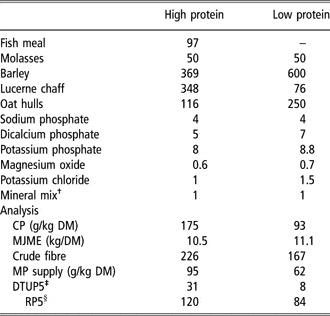
Animals were offered fresh water and a complete ruminant ration ad libitum daily to supply high or low levels of metabolizable protein (MP) as described in Table 1. Individual feed refusals were collected and weighed weekly from the start of infection. Subsamples of feed offered and refused were taken for determination of DM after drying for 72 h at 90°C. LW was recorded weekly and fasted LW (after 24 h of food deprivation) was also measured on days 1 and 77 of infection to enable the estimation of body composition by computed tomography (described below). Blood samples were taken weekly from day 1 using jugular venipuncture into a 10 ml vacutube (Becton Dickinson, VACUTAINER Systems, Rutherford, NJ, USA) and stored at 4°C for 24 h. After centrifugation at 2500 r.p.m. for 10 min serum was separated and stored at −20°C. Weekly faecal samples were taken directly from the rectum for the determination of faecal nematode egg concentration (FEC; eggs/g (epg)) (Ministry of Agriculture, Fisheries and Food (MAFF), 1979). From day 42, the remainder of the faecal sample not required for FEC was used to estimate faecal DM %, after drying for 72 h at 90°C. Infected lambs were fasted for 24 h before slaughter on day 77. Slaughter of infected animals, worm recovery and counting were as described by Donaldson et al. (Reference Donaldson, van Houtert and Sykes2001) with carcass weight (CW) recorded.
Diet composition (g/kg DM) and analysis for the high-protein (H) and low-protein (L) rations that were offered ad libitum

DM=dry matter; CP = crude protein; MJME = mega joules of metabolizable energy; MP = metabolizable protein.
†1 kg contains: 5 MIU vitamin A, 1 MIU vitamin D, 7500 IU vitamin E, 1 g Co, 1 g I, 20 g Mn, 26 g Fe, 25 g ZN, 210 g Mg, 4 g P, 0.25 g Se and 560 g Ca.
‡Estimated digestible true undegraded protein at 5% rumen outflow rate (Agriculture and Food Research Council (AFRC), 1993).
§Estimated rumen degradable protein at 5% rumen outflow rate (AFRC, 1993).
Changes in the bone, muscle and fat content of the carcass were estimated in vivo using X-ray computed tomography on days −8 and 76 of infection using three reference slices at the ischium, thoracic vertebrae 8 and lumbar vertebrae 5, which were correlated to whole-carcass estimates using the calvaleri principle outlined by Donaldson et al. (Reference Donaldson, van Houtert and Sykes2001). Sedation, restraint, scanning procedure and interpretation were as described by Greer et al. (Reference Greer, Stankiewicz, Jay, McAnulty and Sykes2005b) with the exception of the following formula: fat % of the carcass = (1.0295 × fat % in the reference slices) − 0.2989 (R 2 = 0.99); muscle % of the carcass = (0.9743 × muscle % in the reference slices) + 0.4211 (R 2 = 0.95). For all animals, CW at both scanning occasions was estimated using the formula: CW (kg) = (0.5091 × fasted LW) − 0.9005, which was obtained by regressing actual CW of the animals slaughtered on day 77 with fasted LW (R 2 = 0.95). The net energy (NE) deposited in the carcass gain was calculated assuming muscle tissue consisted of 0.20 protein and using energy values of 38.9 and 22.2 MJ/kg for fat and protein, respectively (Blaxter and Rook, Reference Blaxter and Rook1953). Animals were shorn on days −5 and 77 of infection and greasy fleece weight recorded on the latter date used as a measure of total wool production. A sub-sample of mid-side fleece wool was taken at shearing from each animal on day 77 and scoured for estimation of clean fleece yield by repeated plunging in water at 60°C containing 1 ml/l Teric GN-9 (ICI Australia Limited, Melbourne, Australia) before washing in clean water and drying at 60°C in a forced air oven. Energy deposition in the fleece was calculated assuming 23.7 MJ/kg clean fleece weight (Agriculture and Food Research Council (AFRC), 1993).
Antibodies (total and immunoglobulin A (IgA)) specific to T. colubriformis L3 larvae in serum were measured using an ELISA with dilutions of 1 : 200 and 1 : 10, respectively, as described by Xie et al. (Reference Xie, Stankiewicz, Huntley, Sedcole, McAnulty, Green and Sykes2004) with the exception that colour was developed for 15 and 40 min for total antibody and IgA, respectively. Serum phosphate, total protein and albumin concentrations were determined using a Cobas Mira Plus Auto-analyser (Roche Diagnostics GmbH, Mannheim, Germany) using kits #1489348, #1553836 and #1970569, respectively (Roche Ltd, Basel, Switzerland).
Data were analysed using GENSTAT statistical package (Lawes Agricultural Trust, 2003) as a 2 × 2 × 2 factorial arrangement with the factors being diet, infection and suppression and were blocked for both sex and animal origin. Animal origin was found to have no effect on any of the parameters and was subsequently excluded from the analysis. All values are group means unless otherwise stated. Uninfected animals were excluded from analysis for faecal egg counts, total egg output and for worm burdens, all of which were performed on log-transformed (log10 (count + 1)) data. Worm burden, wool production, LW gain and carcass composition were analysed by a general analysis of variance (ANOVA). All remaining measurements underwent sequential comparison of ante-dependence structures for repeated measures before being analysed by restricted maximum likelihood (REML) with time included as a factor. Discrepancies in IgA production were observed (described later). Further analysis of animals that were classified as L3 IgA responders or non-responders was carried out on infected animals only as described above as a 2 × 2 arrangement with factors being diet (H or L) and responder (R or N). Diet digestibility data were analysed by ANOVA in a 2 × 2 factorial arrangement with diet and suppression as factors.
Results
General observations
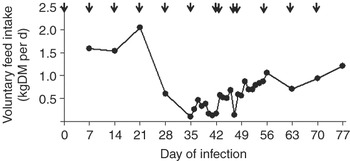
Two animals from the L-IF group suffered from severe anorexia, weight loss and became non-responsive to external stimuli and were consequently euthanized, one on day 31 and the other on day 73. One L-IS animal died on day 37 from suspected blood poisoning due to high Escherichia coli counts in liver tissue, while one from the H-IS died of pleurisy in the apical and cardiac lobes of the lung on day 57. One L-ISIF animal died on day 76 shortly after CT scanning. Although the exact cause of death could not be determined by autopsy, it was found to have hepatization of the right apical and half of the cardiac lobes of the lung in addition to peritonitis in the gut cavity. Data from the dead animals were included in the statistical analyses with the missing values from the point of their departure from the trial estimated. One L-ISIF individual (no. 20) suffered a severe reduction in appetite after 4 weeks of infection, with daily measurements of food intake demonstrating only short-term increases in intake for several days after steroid administration (Figure 3). Consequently, this animal received two additional steroid doses on days 41 and 48, after which intake returned to acceptable levels. Data from this animal are included in the statistical analysis.
Faecal DM
Mean faecal DM values between day 42 and 63 were 0.35 ± 0.086, 0.38 ± 0.097, 0.36 ± 0.127 and 0.39 ± 0.110 for L-IF, L-ISIF, L-IS and L-C, respectively, and were 0.33 ± 0.084, 0.36 ± 0.086, 0.36 ± 0.126 and 0.34 ± 0.094 for H-IF, H-ISIF, H-IS and H-C, respectively. Between day 63 and 77, mean faecal DM was 0.31 ± 0.110, 0.36 ± 0.129, 0.39 ± 0.196 and 0.39 ± 0.161 for L-IF, L-ISIF, L-IS and L-C, respectively, and were 0.28 ± 0.100, 0.37 ± 0.130, 0.37 ± 0.211 and 0.42 ± 0.150 for H-IF, H-ISIF, H-IS and H-C, respectively. Overall, for faecal DM there were infection × suppression (P < 0.05), suppression × time (P < 0.05) and infection × time (P < 0.01) interactions, which reflected a reduction with time in IF but not in ISIF, IS or C animals.
Feed intake
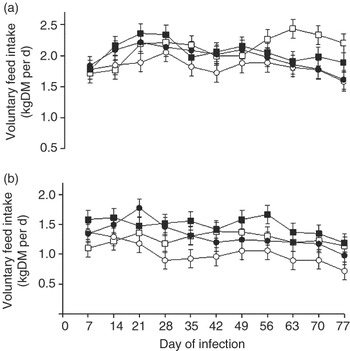
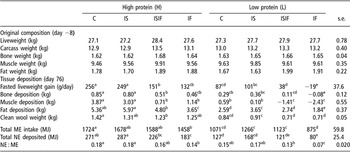
VFI (kg DM/day) measured at weekly intervals is shown in Figure 1. Overall, there was a diet × time interaction (P = 0.001) that reflected maintenance of intakes in H-fed animals while intakes of L-fed animals were reduced with time. In addition, there was an infection × suppression × time interaction (P < 0.05) as up until day 49 immuno-suppression prevented the reduction in feed intake that was experienced by infected animals while having no effect on uninfected animals. However, from day 56 the intakes of ISIF and IF animals were similar. Total ME intake (Table 2) was lower in L compared with H (P < 0.01), in infected compared with non-infected (P = 0.01) and in non-suppressed compared with suppressed animals (P < 0.05).
Mean voluntary feed intake (kg DM/day) of lambs offered (a) high-protein (H-) or (b) low-protein (L-) diets while (○) infected with 2000 T. colubriformis/day (IF), (●) similarly infected but immuno-suppressed (ISIF), (▪) immuno-suppressed only (IS) or (□) controls (C). Error bars represent s.e.m.

Computer tomographically estimated carcass growth, wool production and metabolizable energy (ME) utilization for net energy (NE) deposition in lambs offered high (H) or low (L) protein diets and infected with 2000 L3 T. colubriformis larvae/day (IF), similarly infected and immuno-suppressed (ISIF), immuno-suppressed only (IS) or control (C)Footnote †

† Values within rows with different superscripts are significantly different (P < 0.05).
Faecal egg counts
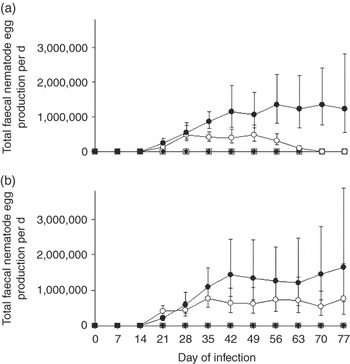
Faecal egg counts (FEC) displayed a diet × suppression × time interaction (P < 0.001), which was reflected in counts in H-IF animals reaching a plateau of 1900 epg from day 28 until day 49, thereafter declining to less than 100 epg by day 70. For all of the remaining infected groups FEC continued to increase, reaching peak concentrations at day 77 of 5400, 13 800 and 12 100 epg for H-ISIF, L-IF and L-ISIF, respectively. Given the influence of both faecal throughput and faecal DM on FEC, total daily egg production was calculated using the measurements of FEC, DM intake, DM digestibility and faecal DM (total egg production = (1 − DM digestibility) × DM intake/faecal DM × FEC). However, since faecal DM was only measured from day 42, the faecal DM % for days 21 to 35 was extrapolated from the measurements on day 42. Back-transformed total 24 h faecal nematode egg excretion is shown in Figure 2. Overall, there was a diet × suppression × time interaction (P < 0.001), which was due to an increase in total egg excretion to a plateau of 1.2 × 10⁶ eggs/day by day 42 in both ISIF groups and 400 000 to 700 000 eggs/day in both IF groups, which declined in H-IF from day 56 to less than 100 000 eggs/day by day 70.
Mean back-transformed (log10) total nematode egg production/day of lambs offered (a) high-protein (H-) or (b) low-protein (L-) diets while (○) infected with 2000 T. colubriformis/day (IF), (●) similarly infected but immuno-suppressed (ISIF), (▪) immuno-suppressed only (IS) or (□) controls (C). Error bars represent the upper and lower thresholds for 95% confidence intervals.

Worm burden at slaughter
Arithmetic mean worm burdens of infected groups at slaughter with the range given in parenthesis were 19 246 (0–48 650), 78 368 (49 785–102 055), 50 486 (29 035–96 545) and 69 654 (53 320–88 945) for H-IF, H-ISIF, L-IF and L-ISIF, respectively. For all groups, 0.97 of the total worm burden were adults, of which the proportion that were female was 0.67, 0.62, 0.61 and 0.59, and for H-IF, H-ISIF, L-IF and L-ISIF, respectively. For total, adult and immature worm burdens, there tended to be an immuno-suppression × diet interaction (P = 0.06, 0.06 and 0.08, respectively), with ISIF animals having greater worm burdens than their IF counterparts in H-fed but not L-fed groups. Worm burdens were greater in L-IF than in H-IF across all larval development stages, whereas no effect of protein was observed in immuno-suppressed animals.
LW gain, carcass composition, wool growth and nutrient utilization
Mean fasted LW gains are given in Table 2. LW gain was lower in those animals that were offered low-protein compared with high-protein diets (P < 0.001) and in infected compared with non-infected animals (P < 0.001) and was not influenced by immuno-suppression (P > 0.05).
Carcass tissue weights of animals, estimated by computed tomography at day −8 and 76 of infection, and calculations of gross efficiency of energy utilization are given in Table 2. There were no differences between groups for any of the carcass components at day −8 (P > 0.05). Overall, bone, muscle, fat and wool deposition was reduced by both infection and the low-protein diet (P < 0.01 for all). Immuno-suppression did not affect bone, muscle or wool deposition (P > 0.05 for all) but did increase fat deposition (P < 0.01). NE deposition and the gross efficiency of ME utilization were greater in high than low protein (P < 0.01 for both), was reduced by infection (P < 0.001 and 0.01, respectively) and was increased by immuno-suppression (P < 0.05 and P = 0.06, respectively).
Serum measurements
Mean serum total protein concentrations at day 1 were 64.4 and 58.9 g/l for H-C and L-C animals, respectively. Overall, there were diet × infection × time and suppression × time interactions (P < 0.01 for both), which were reflective of the maintenance of the total protein in L-IF animals while all remaining groups displayed an increased concentration. Mean increases in total protein from day 56 relative to day 0 were 3.5, 7.0, −1.3 and 5.3 g/l for H-IF, H-ISIF, L-IF and L-ISIF, respectively. Mean serum albumin concentrations at day 1 were 30.8 g/l and were similar for all groups. There were diet × infection × time and suppression × time interactions (P < 0.01 for both), which reflected a reduction in albumin concentrations in infected animals from day 35 compared to their uninfected counterparts and which were greater in L-fed animals but reduced by immuno-suppression. Mean reductions in concentration were 5.5, 2.8, 9.7 and 5.1 g/l for H-IF, H-ISIF, L-IF and L-ISIF, respectively. Mean serum phosphate concentrations at day 1 were 9.64 and 8.24 g/l for H and L groups, respectively. Overall, there tended to be a diet × infection × time (P = 0.06) interaction due to a decrease in all infected groups to a concentration of less than 6 g/l from day 21 followed by an increase in H-IF animals only from day 63 to levels similar to those of H-C. Serum PO4 concentration was not affected by corticosteroid treatment (P = 0.10).
Absorbance of total antibody specific to L3 T. colubriformis antigen tended to exhibit a diet × infection × suppression × time interaction (P = 0.06) due to similar mean concentrations amongst groups of 0.20 from day 1 until day 49. Thereafter, absorbancies increased to levels that were 2.0-, 1.7-, 1.5- and 1.1-fold their respective controls at day 77 for H-IF, H-ISIF, L-IF and L-ISIF, respectively. Mean absorbance of IgA specific to L3 T. colubriformis-specific antigen for all groups at day 1 was 0.08. Overall, IgA absorbance was increased by immuno-suppression (P < 0.05) and there was an infection × time (P < 0.001) interaction, which reflected an increase in IgA absorbance from day 49 in infected animals. IgA absorbance peaked at levels that were 1.9-, 2.4-, 1.6- and 2.0-fold greater than their uninfected controls on days 63, 63, 63 and 77 for H-IF, H-ISIF, L-IF and L-ISIF, respectively.
DM digestibility
Mean DM digestibility values for L and H diets were 0.59 ± 0.018 and 0.60 ± 0.015 and were not affected by protein level (P = 0.78) or corticosteroid treatment (P = 0.80).
Discussion
These results support the hypothesis that the nutritional penalty associated with the acquisition of immunity to GI parasites can be reduced by enabling a more expedient development of specific immunity by increasing the dietary protein supply to the animal.
Corticosteroid treatment of ISIF animals provided a crude method of immuno-suppression and has previously been shown to have a wide range of effects on metabolism including a net catabolic effect that may result in reduced wool production (Panaretto, Reference Panaretto1979) and decreased fractional synthesis rates of protein in the muscle and intestine (Huang et al., Reference Huang, Gazzola, Pegg and Sillence1998; Turini et al., Reference Turini, Boza, Gueissaz, Moennoz, Montigon, Vuichoud, Gremaud, Pouteau, Piguet, Perrin, Verguet, Finot and German2003). Their effect on intake in sheep has been varied, with small single doses of 0.1 mg dexamethasone/kg (equivalent to 0.5 mg methylprednisolone) stimulating short-term increases (Adams and Sanders, Reference Adams and Sanders1992) while larger single doses of 6 mg dexamethasone/kg have resulted in a short-term depression of intake (Panaretto, Reference Panaretto1979). The chronic weekly administrations of 1.3 mg/kg LW to IS animals in the current study, perhaps surprisingly, did not cause a reduction in wool growth, but did stimulate fat deposition, reduced muscle deposition and had no significant effect on intake, observations that are consistent with those of Greer et al. (Reference Greer, Stankiewicz, Jay, McAnulty and Sykes2005b). As expected, corticosteroid treatment did not suppress all immunological functions as evidenced by the elevated serum parasite-specific antibody levels in ISIF animals. Nevertheless, the much greater worm burden and nematode egg excretion of ISIF animals, especially H-ISIF, provides strong evidence that the regime of corticosteroid treatment used in the current study did provide effective suppression of an immune response that was capable of regulating the parasite population.
Corticosteroid treatment of infected animals appeared to substantially reduce the infection-induced reductions in growth and ME utilization that were experienced by their IF counterparts. Even ISIF animals harbouring in excess of 69 000 worms at slaughter and excreting over 1 × 10⁶ eggs per day (12 000 epg) suffered no significant reduction in feed intake, efficiency of ME utilization or any clinical sign of parasitism. This was despite comparable reductions in serum phosphate to those observed in normally infected animals, and which are most probably explained by damage to the GI tract sufficient to reduce phosphate absorption (Wilson and Field, Reference Wilson and Field1983) and is consistent with both H- and L-ISIF animals experiencing comparable intestinal pathology to their IF counterparts. The lesser reduction in serum albumin in ISIF than their IF counterparts can be interpreted as due to an enhanced ability to replace (synthesize) serum albumin since leakage of plasma proteins across the GI tract during infection was not reduced by corticosteroid treatment (Vaughan et al., Reference Vaughan, Greer, McAnulty and Sykes2006). The difference in the utilization of ME for NE deposition between IS and ISIF animals provides an estimate of reduction in ME utilization caused by the parasite per se while the difference between C and IF animals represents the overall reduction in ME utilization caused by parasite infection, which includes the penalty associated with generating the immune response and the reduction in appetite per se. These comparisons suggest that the proportionate reduction in the efficiency of ME utilization for NE deposition that can be attributed to the immune response was 0.11 in high-protein animals and 0.27 in low-protein animals. These differences in the efficiency of use of ME are unlikely to be explained by differences in ME supply as DM digestibility was not affected by diet or corticosteroid treatment nor is it likely to be significantly affected by infection with this nematode (Sykes and Coop, Reference Sykes and Coop1976; Bown et al., Reference Bown, Poppi and Sykes1991b). In fact, calculations of the efficiency of ME utilization for NE deposition for L-fed animals from the information given in Table 2 are likely to provide an underestimate of the overall penalty as the carcass composition data at day 76 and subsequent nutrient utilization calculations do not include data from the two L-IF animals that were euthanized after suffering clinical parasitism.
The feeding of the high-protein diet during infection appeared to have similar advantages to corticosteroid-induced immuno-suppression in limiting the reduction in overall efficiency of use of ME for NE deposition during infection. Thus, while immuno-suppression moderated the nutritional costs of infection of sheep fed the low-protein diet (L-IF v. L-ISIF), there was much less benefit to sheep on the high-protein diet (H-IF v. H-ISIF and H-C). Without pair-fed controls it is difficult to separate and quantify the precise importance of the two components of reduced feed intake and increased nutrient costs for overall efficiency. The calculation of the effect of infection on both VFI and nutrient utilization is heavily dependent on the duration and extent of the pathophysiology of infection, which several studies have shown is greatest during the period immediately preceding the host’s ability to limit FEC (Steel et al., Reference Steel, Symons and Jones1980; Kimambo et al., Reference Kimambo, MacRae, Walker, Watt and Coop1988). The benefit of the higher protein diet in the present work appears to have been in either permitting or accelerating the development of an effective immune response as H-IF sheep were able to regulate FEC by day 70 while there was no evidence for such ability in L-IF sheep. There is prior evidence for more rapid acquisition of ability to limit FEC in sheep in response to improved dietary protein supply (Bown et al., Reference Bown, Poppi and Sykes1991a; van Houtert et al., Reference van Houtert, Barger and Steel1995). Once the competent immune response is established, nutritional demands and effect on VFI would be expected to be reduced (Greer et al., Reference Greer, Stankiewicz, Jay, McAnulty and Sykes2005b). Development of the acquired immune response involves the transition of the immune response from a non-specific pro-inflammatory (Th1) to a cell-mediated (Th2) reaction and these two components of the immune response may well have very different nutrient implications for appetite and nutritional costs. This transition has, moreover, been shown to be sensitive to dietary protein supply. Ing et al. (Reference Ing, Su, Scott and Koski2000) observed that protein-deficient mice maintained a Th1-type reaction to Heligmosomoides polygrus while those on a protein-sufficient diet were able to promote a Th2-type response that was, and is now, generally considered (Else, Reference Else2005) to be associated with the ability to expel worms.
In practice, however, the severity of pathophysiology and associated change in VFI and nutrient use during acquisition of immunity is important for livestock producers for welfare issues and for timeliness of marketing. The mean reduction in VFI during days 21–63 tended to be greater in L-IF than in H-IF animals (0.25 and 0.15, respectively), a finding consistent with that of Kyriazakis et al. (Reference Kyriazakis, Anderson, Oldham, Coop and Jackson1996) who observed 0.18 and 0.11 reductions in VFI in sheep offered diets containing 86 and 206 g CP/kg DM, respectively, when infected with the same nematode species as the present sheep. Similar findings have been observed in infections with Haemonchus contortus (Abbott et al., Reference Abbott, Parkins and Holmes1988; Datta et al., Reference Datta, Nolan, Rowe and Gray1998) and with urea supplementation during mixed infections with H. contortus and T. colubriformis (Knox and Steel, Reference Knox and Steel1999). While there are examples in the literature during monospecific infections with T. colubriformis where increasing urea (Knox and Steel, Reference Knox and Steel1999) or increasing dietary protein intake (Kahn et al., Reference Kahn, Kyriazakis, Jackson and Coop2000) has not resulted in amelioration of the reduction in intake, the results from a majority of the studies appear to be consistent with the notion that diets with greater dietary protein concentrations may enable a more rapid transition to an acquired immune response and, consequently, a less-prolonged and severe period of pathophysiology with its associated reduction in appetite.
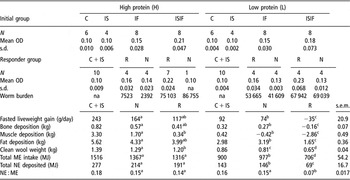
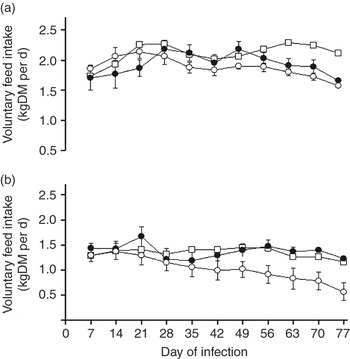
During the course of the trial, temporary increases followed by rapid relapse in food intake were observed in some ISIF animals in the 1–2 days after weekly corticosteroid treatment. The pattern of such intake is shown on a daily basis for one animal in Figure 3. This pattern raised concern about the effectiveness of the immuno-suppressive treatment. The worm burdens at slaughter and pattern of total daily egg excretion (Figure 2), however, confirmed that the ability to limit worm population and its fecundity was indeed compromised by corticosteroid treatment. In view of the putative role of IgA in the regulation and expulsion of nematodes (Stear et al., Reference Stear, Bishop, Doligalska, Duncan, Holmes, Irvine, McCririe, McKellar, Sinski and Murray1995) and the negative relationship between rise in serum IgA and VFI observed by Greer et al. (Reference Greer, Stankiewicz, Jay, McAnulty and Sykes2005b), the serum IgA responses of these sheep were carefully examined. This provided the surprising observation that IgA responses were not, as anticipated, suppressed in more than 50% of immuno-suppressed (H- and L-ISIF) sheep and, moreover, elevation of serum IgA did not occur in over 50% of normally infected (L-IF and H-IF) sheep, even in individuals able to limit FEC and worm burden (Table 3). Consequently, all infected animals within each dietary treatment, regardless of corticosteroid treatment, were termed IgA responders (R) if they promoted a serum IgA response that was greater than three standard deviations from the mean of their respective controls (C or IS animals) for two consecutive blood samples. Infected individuals that did not promote such an IgA response were termed as non-responders (N). This resulted in the 16 H- and 16 L-infected animals being divided into high-protein IgA non-responder (H-N), high-protein IgA responder (H-R), low-protein IgA non-responder (L-N) and low-protein IgA responder (L-R). The uninfected animals for each dietary treatment were combined into high-protein uninfected (H−C + IS) and low-protein uninfected (L − C + IS) for comparison. The numbers falling into each category are given in Table 3. Feed intake and efficiency of nutrient utilization were then recalculated for these re-assigned groups and compared with data for C and IS sheep combined within H- and L-treatment groups. This showed greater separation of feed intake (Figure 4) and efficiency of ME utilization for deposition as NE (Table 3) for groups constructed in this way than for the original treatment groups. This adds weight to the observations of Greer et al. (Reference Greer, Stankiewicz, Jay, McAnulty and Sykes2005b) that the immune system processes related with IgA production may be associated with greater pathophysiology and poor resilience to infection. Further support for this hypothesis is in associations between reduced LW gains and elevated serum IgA (Douch et al., Reference Douch, Green and Risdon1994), increased pro-inflammatory responses (Pernthaner et al., Reference Pernthaner, Shaw, McNeill, Morrison and Hein2005), IgA expression (Pernthaner et al., Reference Pernthaner, Cole, Morrison, Green, Shaw and Hein2006) and reduced growth rate and wool production (Morris et al., Reference Morris, Vlassoff, Bisset, Baker, Watson, West and Wheeler2000 and Reference Morris, Wheeler, Watson, Hosking and Leathwick2005) in sheep genotypes selected for low FEC, compared to susceptible (high FEC) counterparts. One functional explanation may be that production of IgA, which has a cysteine-rich hinge region (Zhou et al., Reference Zhou, Hickford and Fang2005), may sequester this potentially rate-limiting amino acid at the expense of other demands. Tentative support for this hypothesis can be obtained from the greater reductions in both muscle deposition and wool production in L-R animals in the present work and amelioration of the reduction in wool growth in animals infected with T. colubriformis following cysteine supplementation (Barger et al., Reference Barger, Southcott and Williams1973). Clearly, further elucidation of the potential trade-off between animal performance and IgA production is required before strong conclusions can be drawn.
Voluntary feed intake (kg DM/day) of an L-ISIF individual (no. 20) displaying short-term effects of immuno-suppressive treatment. Daily feed intake was monitored from day 35 to 56. Arrows indicate weekly steroid administration, with additional doses given on days 41 and 48.

Mean and standard deviation (s.d.) of the absorbance (optical density (OD)) of IgA specific to L3 T. colubriformis antigen in serum collected from lambs during day 49 to day 77 of infection with 2000 L3 T. colubriformis larvae/day and mean worm burden for animals offered high protein (H) and low protein (L) diets according to initial immuno-suppressed (ISIF) or non-suppressed (IF) treatments and re-classified groups termed L3 IgA responders (R) and non-responders (N) (changes in liveweight gain, carcass composition estimated by computed tomography and the effect on gross efficiency of metabolizable energy (ME) utilization for net energy (NE) deposition for the reclassified groups are also givenFootnote †)

C=control; IS=immuno-suppressed only; IF=infected with the equivalent of 2.000 L3 Trichostrongylus colubriformis/day; ISIF=immuno-suppressed and infected.
† Values within rows with different superscripts are significantly different (P < 0.05).
Mean feed intakes (kg DM/day) of lambs offered (a) high-protein (H-) or (b) low-protein (L-) diets that (○) displayed an L3 IgA response after infection with 2000 T. colubriformis/day (R), (●) were similarly infected but did not display an L3 IgA response (N) or (□) immuno-suppressed only and controls combined (IS + C). Error bars represent s.e.m. Statistical comparisons were performed on R and N groups only. Data from IS + C groups are displayed for completeness.

In conclusion, these results suggest that the reduction in ME utilization that can be attributed to the acquisition of a specific immune response in nematode-infected lambs may be influenced by the dietary supply of MP. In addition, this study provides further evidence to suggest that components of the immune response that are associated with the production of IgA specific to L3 antigen may contribute to reduced performance during infection. It is suggested that further elucidation of the immunological signalling that is invoked during an immunological cascade during nematode infections is required to gain a better understanding of this phenomenon.
Acknowledgments
The authors would like to thank Chris Logan, Martin Ridgway and Christina Lima for their expertise and assistance. At the time of this work, A.W.G. was in receipt of the Sir Charles Hilgendorf Scholarship. A.R.S. is supported by Meat and Wool Innovation, New Zealand.