Introduction
Crosslinguistic studies on the acquisition of tense-aspect markers have reported that children acquiring various languages associate past-perfective marking with telic verbs (i.e., accomplishment and achievement verbs), general imperfective marking with atelic verbs (i.e., states and activities), and progressive marking with activity verbs at the early stages of tense-aspect acquisition. Despite general agreement on such observations (Shirai, Slobin, & Weist, Reference Shirai, Slobin and Weist1998), there is no consensus on the underlying reason. One influential hypothesis argues for an innate bioprogram (Bickerton, Reference Bickerton1981), which postulates that children are predisposed to map grammatical markers of the tense-aspect with particular semantic features. Bickerton’s Language Bioprogram Hypothesis (Reference Bickerton1981, Reference Bickerton1984) argues that children’s early use of past tense marking is used to denote punctuality (or telicity in aspectology), and progressive/imperfective marking to denote the lack of telicity because the punctual–nonpunctual distinction (PNPD) has a special status in his theory. In contrast, the distributional bias hypothesis (the DBH; Andersen, Reference Andersen, Hyltenstam and Viberg1993; Andersen & Shirai, Reference Andersen and Shirai1994) proposes that children make such associations between tense-aspect markers and verbal semantics based on the bias observed in the input that the children are exposed to. The DBH argues that such associations observed in crosslinguistic language acquisition stem from a distributional bias of such combinations in input; this was supported by Shirai and Andersen (Reference Shirai and Andersen1995), who analyzed input data for mother–child interactions in English. In this paper, we report on a study that analyzed Korean data to examine whether Korean children follow the acquisition pattern described as a universal tendency by existing research. We also look at the relation between caretakers’ speech and children’s speech to better understand the sources of universal tendencies in tense-aspect acquisition in light of the DBH.
The Aspect Hypothesis
We first discuss the notion of lexical aspect, which is used to categorize the semantics of verb phrases and their relationship with tense and aspect morphology. Vendler (Reference Vendler1957) categorized the temporal semantics of verbs into four classes. “State” terms describe a situation that continues to exist without any additional input of energy. “Activity” terms denote a dynamic and durative situation with an arbitrary endpoint. In contrast, “accomplishment” terms denote a situation that is dynamic and durative, yet entails a natural endpoint. Finally, “achievement” terms denote a situation that can be reduced to a point on a time axis – that is, it is instantaneous and punctual (Andersen & Shirai, Reference Andersen and Shirai1994).
L1 acquisition researchers have observed an interesting correlation between tense-aspect markers and the temporal semantics of verbs. This set of observations, often called the Aspect Hypothesis (Andersen & Shirai, Reference Andersen and Shirai1994; Shirai & Andersen, Reference Shirai and Andersen1995), point out the following (Andersen & Shirai, Reference Andersen, Shirai, Ritchie and Bhatia1996, p. 533):
-
A. Learners first use past marking or perfective marking on achievement and accomplishment verbs, eventually extending its use to activities and stative verbs.
-
B. In languages that encode the perfective/imperfective distinction, imperfective past marking begins with stative verbs and activity verbs, then extends to accomplishment and achievement verbs.
-
C. In languages that have the progressive aspect, progressive marking begins with activity verbs, and then extends to accomplishment or achievement verbs.
-
D. Progressive markings are not incorrectly overextended to stative verbs.
If we apply the Aspect Hypothesis to Korean, the target language of our investigation, prediction A is testable because Korean has the verbal suffix -ess, which denotes past or perfective marking. However, for prediction B, Korean does not have the perfective/imperfective distinction, and imperfective past marking does not co-occur with stative verbs. Therefore, prediction B cannot be tested in Korean. Regarding prediction C, Korean has a progressive aspect -ko iss, and therefore it can be tested. One complication is that the Korean progressive aspect has a closely related imperfective aspect marker, -a iss, which is a resultative imperfective marker. We will explain this in detail in the next section, but the present study will target the progressive -ko iss, to test prediction C. As for prediction D, Korean stative verbs, strictly speaking, consist only of i-ta ‘be’, iss-ta ‘exist’, eps-ta ‘not exist’, and sokha-ta ‘belong’ (Ahn, Reference Ahn1995). Accordingly, the number of target verbs was five or less. Therefore, we will not address prediction D in this study, although the error of overextending progressive marking -ko iss to ida ‘be’ was not found in the data of our study. In sum, we will test predictions A and C of the Aspect Hypothesis in this paper.
Korean tense-aspect markers: -ess (past-perfective) and -ko iss (imperfective)
Korean is commonly assumed to have a tense distinction between past and nonpast, represented by the presence and absence of -ess, parallel to the Japanese -ta (Martin, Reference Martin1992; Sohn, Reference Sohn1995). Although we refer to the morpheme -ess as the past tense marker in this paper, Korean -ess can yield different temporal readings: past tense, perfect, and perfective aspect. To explain in detail, the Korean suffix -ess has been analyzed as (i) a past tense marker (Choe, Reference Choe1965; Sohn, Reference Sohn1995; Yoon, Reference Yoon1996), (ii) a perfective aspect marker (Na, Reference Na1971; Nam, Reference Nam1978), and (iii) a perfect aspect marker (H.S. Lee, Reference Lee1991; Han, Reference Han1996; Chung, Reference Chung2005; Kang, Reference Kang2014).
Examples (1) to (3) below are children’s utterances. These are the first sentences that each child used with past tense marking in our data. If we apply the above analysis, the suffix -ess of example (1) can be considered a past tense marker, example (2) a perfective aspect marker, and example (3) a perfect aspect marker. Moreover, the distribution of the different temporal readings of -ess seems to be related to the inherent aspectual properties of the verbs with which it occurs (cf. Shin, Reference Shin2005; Lee & Ryu, Reference Lee and Ryu2010; Choi, Reference Choi2015): when -ess occurs with atelic verbs (states, activities), it gives rise to a past reading, whereas with telic verbs (accomplishments, achievements), it yields a present/resultant state reading. In example (1), -ess occurs with an activity verb (neynney ha-ta, sleep), causing a past reading: ‘Did s/he sleep?’. In contrast, in example (2), -ess occurs with an accomplishment verb (ilk-ta, read), yielding a resultant state: ‘I have read it all’. In example (3), -ess also occurs with an achievement verb (tway-ta, finish), yielding a resultant state: ‘I am done’.


However, despite numerous existing studies about whether -ess is considered a past marker (Choe, Reference Choe1965) or a perfective marker (Nam, Reference Nam1978), given the fact that past and perfect/perfective aspect are realized on the surface in the same suffix -ess (H.S. Lee, Reference Lee1993), the present paper treats -ess as a past tense marker involving perfective meanings. The Aspect Hypothesis (Andersen & Shirai, Reference Andersen and Shirai1994), which we try to verify in this paper, points out that learners first use past marking or perfective marking on achievement and accomplishment verbs, eventually extending its use to activities and stative verbs. Andersen and Shirai (Reference Andersen and Shirai1994) mention “past marking or perfective marking,” not separating perfective marking from past marking.
Korean imperfective aspect markers can denote two meanings: progressive meaning and resultative meaning (Martin, Reference Martin1992). Imperfective versus perfective is one basic viewpoint of aspectual contrast grammaticized in many languages. The imperfective aspect conveys an internal view, whereas the perfective aspect conveys an external view (Comrie, Reference Comrie1976). An external view conveyed by the perfective aspect disregards the internal structure of a situation and presents a given situation as a whole, whereas an internal view conveyed by the imperfective aspect presents a situation focusing on the temporal structure from within. Typically, the progressive denotes an action-in-progress meaning as a class of the imperfective aspect (e.g., English progressive), while the resultative state focuses on the duration of the resultative state that is obtained after a change of state (Shirai, Reference Shirai1998a).
The Korean tense-aspect system consists of two major imperfective aspect markers: -ko iss and -a iss. The -ko iss form is considered to denote the progressive (K. Lee, Reference Lee1993; Martin, Reference Martin1992), and the -a iss form the resultative state (Ahn, Reference Ahn1995; K. Lee, Reference Lee1993; Martin, Reference Martin1992). When expressing progressive meaning, -ko iss is used as the progressive marker, combined with activity and accomplishment verbs. When expressing a resultative meaning, -ko iss or -a iss are attached to achievement verbs.Footnote 3 Syntactically, when expressing a resultative state, -ko iss is attached to transitive verbs, and -a iss to intransitive verbs (H.S. Lee, Reference Lee1991). Therefore, -ko iss can refer to both progressive meaning (with dynamic atelic verbs) and resultative meaning (with transitive achievement verbs). This paper focuses on the imperfective -ko iss (both progressive and resultative meanings) and does not investigate the resultative imperfective -a iss. Although it is not conventional to treat the resultative as imperfective, here, we follow Shirai (Reference Shirai1998a), which is based on Smith’s (Reference Smith1997) two-component theory of aspect. Examples (4) to (6) are sentences uttered during the month each child started using imperfective aspect markers -ko iss and -a iss in our data. In example (4), -ko iss is used as a progressive marker combined with an activity verb (mek-ta, eat). In contrast, -ko iss in example (5) is used as a resultative marker combined with a transitive achievement verb (tha-ta, ride). In example (6), -a iss is used as a resultative marker combined with an intransitive achievement verb (anc-ta, sit).


As noted above, -ko iss has been generally regarded as a progressive marker as in (7a) and (8), but unlike the progressive be -ing in English, it is not obligatory to describe an ongoing event. In Korean, the simple present (i.e., nonpast) form (7b) can encode an ongoing situation at a reference time, just as in the Romance languages. Examples (4), (5) and (8) are the first sentences each child used with the imperfective marker -ko iss in our data.


In addition, -ko iss can also denote a resultative meaning with some transitive verbs, such as verbs of wearing (ip-ta ‘wear’), carrying (ssu-ta ‘carry’), and body posture (swuki-ta ‘bow one’s head’) (Ahn, Reference Ahn1995; H.S. Lee, Reference Lee1991), judging from the context of interaction.

Furthermore, cognitive/emotive verbs (e.g., alta ‘know’, salanghata ‘love’, choahata ‘like’) in Korean, which are stative verbs in English and many other languages, naturally occur with -ko iss. We searched for children’s utterances that use the verbs alta ‘know’, salanghata ‘love’, choahata ‘like’ with -ko iss. However, there was no example of this kind in children’s utterances in our data. We have a few such examples from YUN’s caretaker (e.g., example (10)).

Unlike in English, where stative verbs such as know, love, believe, have, and so on are not normally used with the progressive –ing, the corresponding verbs in Korean naturally occur with the -ko iss form. Ahn (Reference Ahn1995) refers to these verbs as know-class verbs, and they are classified as achievement verbs. These verbs pattern together with achievement verbs, with regard to event descriptions, in their syntactic and semantic behaviors (Ahn, Reference Ahn1995; Hong, Reference Hong1991), and thus they can be classified as a type of achievement in Korean. This illustrates that the same notion is not always lexicalized with the same inherent aspectual value in different languages (Li & Shirai, Reference Li and Shirai2000). Korean verbs such as alta ‘know’, sokhata ‘belong to’, and kacita ‘have’ are similar to Japanese siru ‘know’, syozokusuru ‘belong to’, and motu ‘have’, which are achievements that refer to entry into a state and thus require the imperfective -te i (Shirai, Reference Shirai2000).
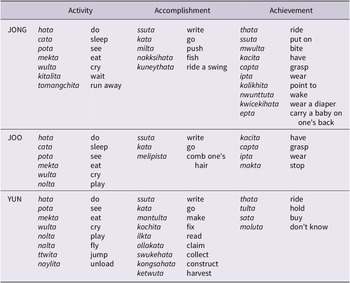
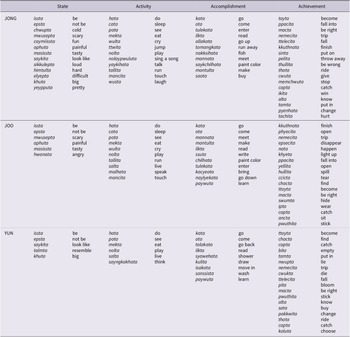
All verb tokens with the progressive marker -ko iss included in our data were classified according to the meaning they denote (progressive or resultative), and for lexical aspect based on the operational tests by Kim and Lee (Reference Kim, Lee and Song2006). Kim and Lee (Reference Kim, Lee and Song2006) developed operational tests for reliable classification of lexical aspect that were similar to the one in Shirai (Reference Shirai1991, Reference Shirai1998b). Determination between a state and activity was made based on whether the verbs allow the progressive, -nun cwung-i-, ‘be in the course of -ing’ and whether they allow a habitual reading in the present tense form. Determination between an activity and an accomplishment (that is, the test of telicity) was made by asking if X is V-ing, does it mean that X has V-ed? (Shirai, Reference Shirai1991). Determination between an accomplishment and an achievement (that is, the test of punctuality) was mostly made by the test of the use of ‘almost’ (keuy): whether a verb encoded with ‘almost have -en’ entails the beginning of the event, which means that the verb refers to an accomplishment. With these tests, Kim and Lee decided that motion verbs in Korean, ota (come) and kata (go), are accomplishments, unlike English come and go, which are often classified as achievements (e.g., Shirai, Reference Shirai1991). In this study, we adapt the criteria of Kim and Lee (Reference Kim, Lee and Song2006) to classify verbs produced by children.Footnote 4 We list all verb types used with the progressive marker -ko iss for each child (see Appendix 1). Regarding the past tense marker -ess, we did not list all verb types because there were almost 1,500 such tokens. However, we did list frequently used verb types (see Appendix 2).
Previous studies
A number of studies have reported a strong relationship between tense-aspect markers and the lexical aspect of verbs to which the markers are attached in the first language acquisition of various languages (e.g., Aksu-Koç, Reference Aksu-Koç1988, in Turkish; Antinucci & Miller, Reference Antinucci and Miller1976, in Italian; Bloom, Lifter, & Hafitz, Reference Bloom, Lifter and Hafitz1980, in English; Bronckart & Sinclair, Reference Bronckart and Sinclair1973, in French; Stephany, Reference Stephany, Dale and Ingram1981, in Greek; Weist, Wysocka, Witkowska-Stadnik, Buczowska, & Konieczna, Reference Weist, Wysocka, Witkowska-Stadnik, Buczowska and Konieczna1984, in Polish). However, only a small number of studies have been conducted on the acquisition of Asian languages (Chen & Shirai, Reference Chen and Shirai2010; Li & Bowerman, Reference Li and Bowerman1998, in Mandarin Chinese; Gökmen & Lee, Reference Gökmen and Lee2002, in Korean; Shirai, 1993, Reference Shirai1998b in Japanese). In particular, studies of L1 acquisition of Korean have been limited. According to Slobin (Reference Slobin2014), the Journal of Child Language published only 10 articles on L1 acquisition of Korean between 1974 and 2013, compared to 23 on Japanese, 27 on Mandarin, and 11 on Cantonese, which suggests that research on Korean language acquisition lags behind other Asian languages, which are already limited compared to European languages (English, 975; French, 61, etc.). In this paper, we use Korean longitudinal speech data and investigate the relationship between tense-aspect markers and the lexical aspect of the predicates to which these markers are applied by analyzing the factors from various perspectives.
One previous study that investigated the development of the past tense marker -ess was Gökmen and Lee (Reference Gökmen and Lee2002). They investigated the development of tense-aspect marking among three Korean children (in addition to L1 Turkish among 30 Turkish children, which will not be discussed here). They found that Korean children (1;2–2;4) use past marking mostly with accomplishments and achievements first, suggesting that the acquisition of the past marking -ess in Korean follows the Aspect Hypothesis. However, they did not investigate the development of the Korean progressive marker. Furthermore, they were not able to analyze input from their caretakers because they analyzed the longitudinal diary data of the three Korean children based on notes taken by their parents.
Lee (Reference Lee, Lee, Simpson, Kim and Li2009) examined how early mood/modal elements, along with temporal/aspectual and other functional elements, are acquired in Korean, analyzing data in his longitudinal diary notes of four children, searching for the emergence and stages in the development of mood/modality indicators and their types. Although his research targets were numerous (e.g., mood, modality, speech level, negation, and agreement), results also included the past marking -ess and the progressive marking -ko iss, which are related to the present study. According to Lee (Reference Lee, Lee, Simpson, Kim and Li2009), the past marking -ess occurs at around 1;4, and it is remarkable that the past tense marker in children’s speech occurs predominantly with telic (i.e., achievement/accomplishment) verbs in Korean. However, regarding the imperfective marker -ko iss and -a iss, he only mentioned their emergence (that is, these two grammatical aspect forms are acquired at around two years of age) and listed observed utterances but was not concerned with the acquisitional pattern between -ko iss and -a iss with regard to verb semantics.
Another study, Ryu and Shirai (Reference Ryu, Shirai, Nam, Ko and Jun2014), investigated the L1 acquisition of -ko iss and -a iss as Korean imperfective aspect markers by three children. They used the data consisting of longitudinal video-recorded interactions of three children and their caregivers. They analyzed 2,255 tokens (163 tokens from the three children and 2,092 tokens from their caretakers in which they used the imperfective aspect markers -ko iss and -a iss) and examined the emergence of aspectual markers and their subsequent development in the children’s speech. The results indicated that there was no clear relationship between the children’s use of -ko iss and -a iss and progressive meaning or activity verbs, and that the three children did not exhibit a common pattern in acquisition. In other words, individual variations were observed. Two of the children associated imperfective aspect marking -ko iss- and -a iss- with achievement verbs during an early stage, but one child often used imperfective aspect marking -ko iss- with activity verbs early on. Their results regarding the influence of input (i.e., the DBH) are slightly less clear. According to their data, two of the children used patterns similar to their caregivers’, but one did not. Once again, individual variations were observed. Thus, it is not yet clear whether Korean follows the universal pattern predicted by the Aspect Hypothesis and what factors influence the acquisition of tense-aspect markers in Korean. It is necessary to separate the progressive (i.e., dynamic imperfective) marker -ko iss from the resultative imperfective markers -ko iss and -a iss (see Table 1) because the Aspect Hypothesis refers only to progressive marking in its prediction C: in languages that have the progressive aspect grammaticized, progressive marking starts with activity verbs, and then spreads to accomplishment and achievement verbs. As noted earlier, -a iss only co-occurs with intransitive achievement verbs expressing a resultative meaning. Further, -a iss does not have a progressive meaning or the extension of meaning from the progressive to the resultative. Thus, in this paper, we focus on the imperfective marker -ko iss.
Imperfective Marking in Korean (-ko iss and -a iss)

In sum, the acquisition of Korean tense-aspect markers so far presents a mixed picture: the acquisition of the past tense marker -ess appears to support the Aspect Hypothesis (Gökmen & Lee, Reference Gökmen and Lee2002), while that of imperfective aspect markers is inconclusive (Ryu & Shirai, Reference Ryu, Shirai, Nam, Ko and Jun2014). Further, not much is known about the effect of input distribution for the acquisition of these grammatical markers. Accordingly, we address the above issues in the present study. More specifically, the following research questions were investigated:
-
1. Is the Aspect Hypothesis supported in the L1 acquisition of the Korean past tense marker -ess and progressive aspect marker -ko iss?
-
2. Is there a relationship between child-directed speech (input) and children’s speech in the distributional pattern of tense-aspect markers?
Based on previous crosslinguistic research, we hypothesize that the Aspect Hypothesis holds true for the L1 acquisition of Korean. Thus, we predict that the acquisition proceeds as follows (Shirai, Reference Shirai, MacLaughlin and McEwen1995):

We also hypothesize that there is a close relationship between child-directed speech and children’s speech, supporting the Distributional Bias Hypothesis.Footnote 5
Method
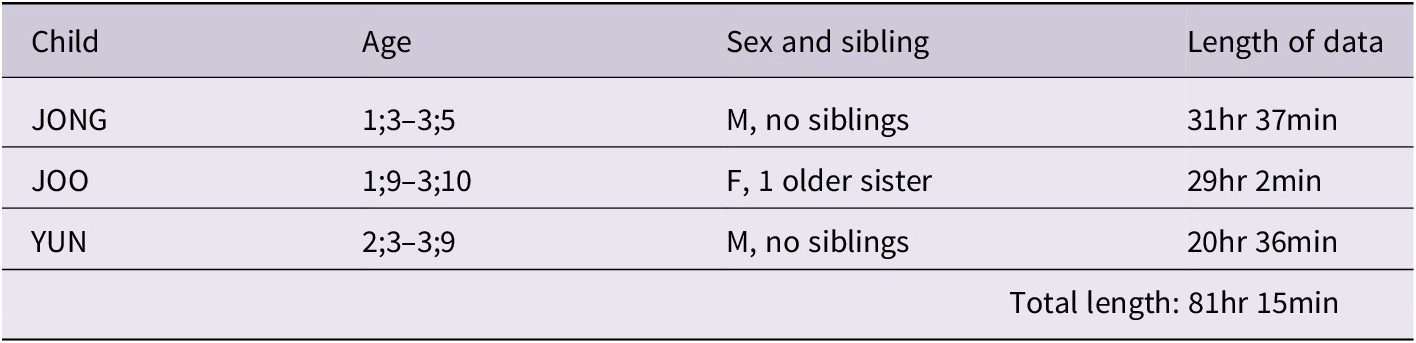
We analyzed a Korean corpus (Ryu-Corpus; Ryu, Reference Ryu2020) in the CHILDES database (MacWhinney, Reference MacWhinney2000). The corpus serves as a record of natural utterances collected from three children (two boys and one girl) between 1.5 and 3.5 years of age, learning Korean as their L1 and interacting with their caretakers (see Table 2). The length of the collected video recordings for each child was between 20 and 31 hours, totaling about 81 hours of data.
Details of the Longitudinal Data Sample

The Ryu-Corpus consists of video-recorded data collected every 2 weeks for 30 minutes, starting with a book reading, followed by natural interactions such as everyday conversation, describing pictures, playing with toys, and eating snacks. Data were recorded at the children’s homes. This data sample encompasses an extension period of acquisition and contains comparatively early phases of development, which is crucial for investigating the emergence and consecutive developmental patterns of tense-aspect markers in children’s utterances. The child-directed speech (input) consists of speech from mothers, fathers, grandmothers, and grandfathers as caretakers, who were all native speakers of Korean. For the data analysis, we identified all sentences in which -ess and -ko iss were used by a child or a caretaker, by using the CLAN program provided by CHILDES.
Results and discussion
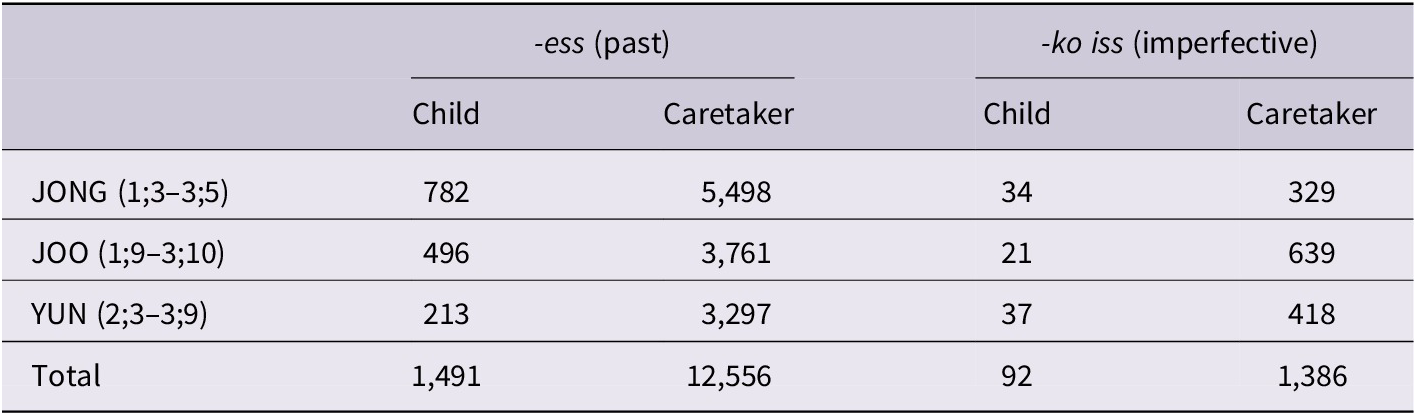
Table 3 represents token counts of -ess and -ko iss produced by the children and their caretakers. Regarding the past marker -ess, the three children produced 1,491 tokens, and their caretakers produced 12,556 tokens. As for the imperfective (i.e., progressive/resultative) -ko iss, the three children produced 92 tokens, and their caretakers produced 1,386 tokens. In total, 15,525 tokens were analyzed, excluding contiguous exact repetitions of the utterance in a consecutive turn.
Tokens of -ess and -ko iss Produced by Children and Caretakers

Table 4 indicates the emergence of the past tense and imperfective markers. JONG starts to use past marker -ess at 1 year 7 months and imperfective -ko iss at 1 year 11 months. However, JOO and YUN start to use past markers -ess after their second birthday (2;2 and 2;3, respectively) and imperfective -ko iss at 3;3 and 2;7. As is evident, there was a large difference among the three children regarding the age of emergence of tense-aspect markers. In particular, JONG and YUN started to use the imperfective -ko iss 4 months after the past marker first emerged in their speech, whereas JOO took more than a year before she started using -ko iss after she first used the past marker -ess. Given these results, it seems that the age of the emergence of the tense-aspect markers is unrelated to their later course of development.
Emergence of -ess and -ko iss

Note. Numbers in square brackets [ ] denote the mean length of utterance (MLU). Prog = Progressive; Result = Resultative.
We also analyzed the MLU (mean length of utterance) and age of emergence for the three children in Table 4. For the Ryu Corpus, we adopted an MLU calculation method based on “separation.” Korean, like English, has the feature of writing words with “separation.” This means writing a sentence with a space between words. For example, the phrase “Emma-ka sakwa-lul mek-ess-ta (Mom-nom apple-acc eat-pst-dec; Mom ate an apple)” has three words and one utterance based on “separation” and an MLU of 3.0. The results are presented in Table 4. Although the data show a broad variation in the age of emergence, minor differences were found in the MLU for each child’s first use of the past tense and imperfective markers. Apparently, Korean children start to use the past marker -ess when the MLU is approximately 2.2 to 2.4, whereas the imperfective marker -ko iss emerges around 2.6 to 2.8.
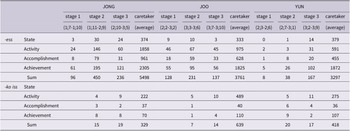
Table 5 shows the usage of -ess and -ko iss by the children and their caretakers, which shows the longitudinal development of the past marker -ess and imperfective marker -ko iss over time. We divided the whole period into three stages to investigate the developmental patterns. Stage 1 is the period from the emergence of the past -ess to the emergence of the imperfective -ko iss. Stage 2 is the period from the emergence of the imperfective -ko iss to its stable usage. Stage 3 is the stable usage period for both -ess and -ko iss. Therefore, there is no Stage 1 for the imperfective -ko iss. Caretakers’ usage was calculated as token counts, including pre-emergence and post-emergence.
The Usage of -ess (past) and -ko iss (imperfective) by the Children and Caretakers (Token Count)

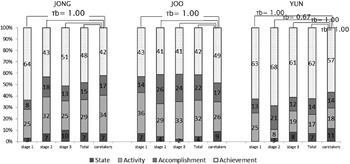
Table 5 indicates that all three children used the past marker -ess most frequently with the achievement verbs. Therefore, the results show that in the early stages of development, the three Korean children used the past marker -ess predominantly with telic verbs (accomplishment and achievement), supporting the Aspect Hypothesis. To investigate the influence of input, we calculated the Kendall rank order correlation coefficient (i.e., Kendall’s tau-b), between caretakers’ token frequencies and children’s token frequencies at each stage and for each verb type. Figure 1 suggests that all children’s usage closely reflects the frequency of usage of their caretakers.
The Percentage of Usage of Past Tense -ess by the Children and Caretakers

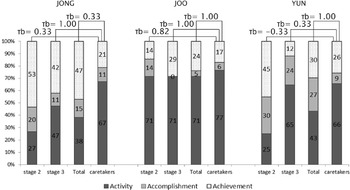
Regarding the acquisition of the imperfective marker -ko iss, we hypothesized that the Aspect Hypothesis would be supported, predicting that the Korean imperfective marker -ko iss would be used with activity verbs first, denoting the progressive meaning rather than with transitive achievement verbs to refer to the resultative state. However, as Figure 2 indicates, only JOO, who used 71% of her -ko iss with activity verbs at Stage 2, followed this prediction. JONG and YUN used transitive achievement verbs (53% and 45%, respectively) at Stage 2, expressing resultative meaning (e.g., riding a car, holding something, wearing clothes/hats), which was more frequent than their use of activity verbs (27% and 25%, respectively) to denote progressive meaning. Thus, the acquisition of the Korean imperfective marker -ko iss does not seem to follow the Aspect Hypothesis.
The Percentage of Usage of Imperfective Aspect -ko iss by the Children and Caretakers

Regarding the Distributional Bias Hypothesis, Figures 1 and 2 also compare the relationship between children and caretakers’ use of the past -ess and imperfective -ko iss markers, respectively, by reporting correlation coefficients. Regarding past -ess, Kendall’s tau-b has a perfect correlation (1.0) for all comparisons except one, for all three children (see Figure 1). More specifically, the frequency ranking was achievement > activity > accomplishment > state, except for one coefficient (correlation between YUN’s Stage 2 and his caretaker’s speech, which was 0.67). In contrast, the correlation is far from perfect for the imperfective -ko iss, ranging from 0.33 to 1.00 for JONG and YUN, and 0.82 to 1.00 for JOO (see Figure 2). Thus, we conclude that the caretakers’ input did not have a strong influence on the children’s use of the imperfective aspect marker -ko iss in terms of its association with verbs of different lexical aspect types.
To recap, Research Question 1 asked whether our data about L1 acquisition of Korean tense-aspect markers corroborate the Aspect Hypothesis. Regarding the past marker, the answer is yes. Our results indicate that the L1 acquisition of the Korean past marker -ess follows the universal pattern captured by the Aspect Hypothesis. However, in the case of the imperfective marker, the answer appears to be negative. Our results suggest that JONG and YUN did not associate the imperfective -ko iss more with activity verbs.
Previous research has supported the claims of the Aspect Hypothesis on the acquisition of numerous languages, including French (Bronckart & Sinclair, Reference Bronckart and Sinclair1973), Italian (Antinucci & Miller, Reference Antinucci and Miller1976), English (Bloom et al., Reference Bloom, Lifter and Hafitz1980; Shirai & Andersen, Reference Shirai and Andersen1995), Turkish (Aksu-Koç, Reference Aksu-Koç1988), Russian (Stoll, Reference Stoll1998), and Mandarin Chinese (Chen & Shirai, Reference Chen and Shirai2010). Our results revealed that the L1 acquisition of Korean follows the Aspect Hypothesis with regard to the past tense marker, replicating the results of Gökmen and Lee (Reference Gökmen and Lee2002). In contrast, the developmental pattern of the imperfective marker does not seem to follow the Aspect Hypothesis. Interestingly, it is observed that Japanese, a language that is typologically close to Korean, has a result that deviates from the prediction of the Aspect Hypothesis (Li & Shirai, Reference Li and Shirai2000). For example, Shirai (Reference Shirai1998a) showed how three Japanese children used the past marker with stative verbs at an early learning stage, and that only the development of one of the three children associated the imperfective marker more with activity verbs. Shirai proposes that the universal tendencies predicted by the Aspect Hypothesis are still valid, but are mediated by multiple factors, such as typological factors and input. In the paragraphs below, we discuss the language-specific system of aspectual semantics in Korean from a crosslinguistic perspective to better understand our findings.
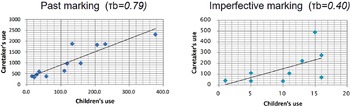
Research Question 2 addressed the influence of input. In the case of past marking, all children’s usage closely reflects the frequency of their caretakers’ usage. This suggests that child-directed speech influenced the distributional pattern of past marking in the children’s speech, supporting the Distributional Bias Hypothesis. However, in the case of imperfective marking, our results did not show an influence of input directly. Figure 3 shows the scatter diagrams of past and imperfective markers. These scatterplots are calculated based on the total token frequencies, with each data point representing the token frequency of a verb type (e.g., achievement) produced by the three children and their caretakers. Thus, there are 12 data points for -ess (3 pairs of child and caretaker times 4 verb types), and only 9 data points for -ko iss, as it did not appear with stative verbs in our data. Figure 3 shows that the frequency of past marking in caretaker speech has a strong association with the frequency of past marking -ess in children’s speech, as shown by the high correlation coefficient. In contrast, the correlation coefficient of the imperfective aspect -ko iss was low.
Scatter Diagrams of the Past and Imperfective Markers

Therefore, our results regarding the influence of input are not clear. According to our data, the children’s usage pattern of the past marker was similar to that of their caretakers, but their usage pattern of the imperfective marker was not. Thus, it is difficult to argue that the Distributional Bias Hypothesis can fully explain the L1 acquisition of the Korean tense-aspect markers.
How, then, do we interpret the results? To see the difference in input frequency between the past tense -ess and imperfective -ko iss, we calculated the percentages of each marker relative to the total utterances of the caretaker. As Table 6 indicates, the past tense -ess is much more frequent, used nearly 10 times more than the imperfective marker -ko iss. High-frequency input involving consistent form-meaning association may have a strong influence on children’s speech, and we suspect that this could be the reason for the past tense usage following the Aspect Hypothesis, while the imperfective aspect does not.
The Usage Percentage of -ess and -ko iss in Caretakers’ Utterances

From a usage-based perspective, many research studies on children’s utterances have observed that children acquire a particular word or construction that they hear frequently, early. For example, Naigles and Hoff-Ginsberg (Reference Naigles and Hoff-Ginsberg1998) and Theakston, Lieven, Pine, and Rowland (Reference Theakston, Lieven, Pine and Rowland2004) have indicated that there is a significant correlation between the order of emergence of particular verbs and the frequency of use in language addressed to children. In our study, the three Korean children might have comprehended the mapping between a form and its function of the past marker -ess that they hear frequently, earlier and more accurately, than the imperfective marker -ko iss that they hear only infrequently. They might have a cognition that the past marker -ess predominantly associates with telic verbs (accomplishment and achievement), supporting the Aspect Hypothesis, by analyzing what they have heard. Next, the children could have actively produced the past marker -ess close to the adults’ usage pattern. Meanwhile, for the imperfective -ko iss, there may not be enough quantity of input for the children to recognize the form-function mapping of the Korean imperfective system. They heard the imperfective marker -ko iss in only 1.4% of the caretakers’ utterances, compared with 12.8% of the past tense marker. As Figure 2 indicates, the usage pattern of -ko iss by the caretakers is very stable: 66–77% with activity verbs, 6–11% with accomplishment verbs, and 17–26% with achievement verbs. However, the usage pattern of children at an early developmental stage is unpredictably different. JONG and YUN used transitive achievement verbs (53% and 45%, respectively), expressing resultative meaning, which was more frequent than their use of activity verbs (27% and 25%, respectively) to denote progressive meaning. Thus, from an input frequency perspective, we suggest that the underlying reason that the past tense marker is acquired earlier than the imperfective marker, and why the acquisition of the Korean imperfective marker -ko iss does not seem to follow the Aspect Hypothesis, is the frequency and variability factors in the input.
Another possibility is the language-specific system of aspectual semantics. The Korean imperfective aspect system is complex because it has two meanings and two morphemes, -ko iss and -a iss (see Table 1). The meaning of the imperfective aspect is dependent on the inherent aspectual value of the verbs to which -ko iss or -a iss is attached. Activity and accomplishment verbs combine with -ko iss to express the progressive meaning, whereas achievement verbs express the resultative meaning. Shirai (Reference Shirai1998a) has argued that the resultative and progressive are actually similar, contrary to a common assumption, by using examples from Chinese, Japanese, Korean, and English. Even though the distinction between the perfective and imperfective is the most fundamental aspectual distinction made by the grammatical marking of aspect, an analysis of these languages shows that this distinction can sometimes be nebulous. Furthermore, these languages’ aspect systems, with the resultative and progressive be grammaticized in one single morpheme, are at odds with Bybee, Perkins, and Pagliuca’s (Reference Bybee, Perkins and Pagliuca1994) claim that there are two distinct paths of grammaticization of tense/aspect markers: the perfective path and the imperfective path. Bybee et al. (Reference Bybee, Perkins and Pagliuca1994) suggested that a resultative or completive marker often develops into an anterior (perfect) marker, which later develops into a perfective aspect or a simple past tense marker (the Perfective Path), while a progressive marker often develops into a general imperfective aspect marker or into a present tense marker (the Imperfective Path). The Korean tense-aspect system does not neatly fit this prediction, with two imperfective markers denoting both resultative and progressive meanings in one construction. The complex language-specific characteristics of Korean imperfective marking may contribute to the form-function mapping difficulty that children need to address in the acquisition of the Korean tense-aspect system, resulting in a deviation from the prediction of the Aspect Hypothesis.
Finally, we also need to consider individual variations because our participants showed clearly different patterns regarding the acquisition of the imperfective aspect. Specifically, even though the three children received input of -ko iss with the highest percentage of activity verbs (JONG, 67%; JOO, 77%; YUN, 66%), only JOO followed the input distribution, with 71% activities in her speech, while the other two children had a low ratio of activities (JONG, 27%; YUN, 25%) and used achievements most frequently, denoting the resultative meaning. Thus, individual variation seems to be at work in the acquisition of tense-aspect markers in Korean, analogous to Budwig (Reference Budwig, Slobin, Gerhardt, Kyratzis and Guo1996) regarding pronominal case acquisition in English. Budwig (Reference Budwig, Slobin, Gerhardt, Kyratzis and Guo1996) found that of the six children who received similar input patterns, three exhibited an acquisitional process different from the others. Individual differences have also been observed in the imperfective acquisition of Japanese, which has an aspectual system quite similar to Korean. Shirai and Suzuki (Reference Shirai, Suzuki, Frellesvig and Sells2013) note that of the nine children studied, three showed some preference for linking activity verbs to the progressive, while five showed some preference for linking achievement verbs to the resultative, and one did not show any preference. In light of these observations, individual variation seems more prominent than has been acknowledged in the literature, both in Japanese, and in Korean as in the present study.
Conclusion
This study investigated whether Korean children follow the acquisition pattern predicted by the Aspect Hypothesis (Andersen & Shirai, Reference Andersen and Shirai1994). An important feature of the current study is that it is the first longitudinal study to use a corpus of natural utterances collected from Korean children and their caretakers to research the development of Korean tense-aspect markers. By analyzing the corpus, we calculated the input to investigate the relationship between caretakers’ and children’s speech. The results of the current study are significant for the L1 acquisition of temporal morphology in Korean. Regarding Korean acquisition, we can conclude that the past marker -ess is used predominantly with telic verbs (accomplishment and achievement), supporting the Aspect Hypothesis. However, the imperfective marker ko iss is not associated with activity verbs at the early stages of development, in contrast to the Aspect Hypothesis. To account for these results, we investigate the role of the input frequency. Regarding the past marker -ess, all children’s usage closely reflects the frequency of their caretakers, yielding a high correlation. In contrast, for the imperfective marker ko iss, caretakers’ input did not correlate with the children’s use of the imperfective marker. To better understand the effect of input frequency, we examined the usage frequency of the past marker -ess and the imperfective marker -ko iss in the caretakers’ utterances. Our results suggest that since children hear the past marker -ess more frequently, they acquire it earlier than the imperfective marker -ko iss. We also suggest that multiple factors need to be considered in the L1 acquisition of tense-aspect markers, such as a language-specific system of aspectual semantics, and individual variation.
We should, of course, test the hypotheses generated by our naturalistic studies with experimental studies. Specifically, the developmental pattern of the imperfective marker -ko iss is still not clear in the present study or in previous studies such as Ryu and Shirai (Reference Ryu, Shirai, Nam, Ko and Jun2014). Experimental studies may clarify the difficult problem of cognition and usage on tense-aspect morphology; for example, eye-tracking studies of L1 Korean children to test the sentence comprehension process of the imperfective aspect markers -ko iss and -a iss. Further research employing various methods is needed to reveal the mechanism of L1 Korean acquisition.Footnote 6
Acknowledgments
The study reported in this paper was presented at BUCLD 43 and an earlier version of the paper was published in the conference proceedings. This work was partially supported by a grant from JSPS (Japan Society for the Promotion of Science) (Grant Number JP18K12384) awarded to the first author, which is gratefully acknowledged.
Verb types used with the progressive marker -ko iss

Verb types used with the past marker -ess

Note. For each child, all verb types are listed for state, activity, and accomplishment verbs. Achievement verbs used with past marker –ess were so numerous that only the most frequent 18 types are listed for each child.