Introduction
Schizotypal personality disorder (SPD) was introduced as a specific personality disorder in DSM-III, to include the subclinical schizophrenia-like symptoms observed in the relatives of patients with schizophrenia (Spitzer et al. Reference Spitzer, Endicott and Gibbon1979). The American Psychiatric Association defined (DSM-IV-TR) SPD as a ‘pervasive pattern of social and interpersonal deficits marked by acute discomfort with, and reduced capacity for, close relationships as well as by cognitive or perceptual distortions and eccentricities of behavior, beginning by early adulthood’ (APA, 2000, p. 697). Previous research has shown the importance of studying SPD as it provides insight into prodromal phases of schizophrenia, including the aetiology, neuropathology and treatment of this disorder (Seeber & Cadenhead, Reference Seeber and Cadenhead2005).
The two distinct approaches to the assessment of schizotypal personality reflect categorical/clinical and dimensional/personality conceptualizations (Raine, Reference Raine2006). The dimensional approach to schizotypy that complements the categorical assessment (as measured by SCID-II; First et al. Reference First, Spitzer, Gibbon and Williams1995) originated from psychosis-proneness scales, where physical and social anhedonia are the fundamental features (Chapman et al. Reference Chapman, Chapman and Raulin1976). The term schizotypy is a multidimensional concept and rather than implying subsymptomatic psychotic experience, it refers to a range of personality traits putatively placing an individual at greater risk of a psychotic disorder, primarily but not exclusively schizophrenia. For most commentators, these traits, at least in their more extreme manifestations, are taken to be the phenotypic indicators related to a genetic vulnerability to schizophrenia (Meehl, Reference Meehl1962). For some in the Meehlian tradition this is a taxon (schizotaxia), of which membership confers heightened risk. For others, schizotypy represents an inherited general vulnerability to psychopathology that falls on a continuum between healthy variation and severe mental illness (van Os et al. Reference van Os, Hanssen, Bijl and Ravelli2000; Rossi & Daneluzzo, Reference Rossi and Daneluzzo2002; Verdoux & van Os, Reference Verdoux and van Os2002; Hanssen et al. Reference Hanssen, Bak, Bijl, Vollebergh and van Os2005).
Regardless of whether a taxon or dimensions underpin schizotypal traits, it is indisputable that the majority of schizotypal individuals will never make the transition to psychosis; however, they will exhibit a range of positive, negative and disorganized symptom-like experiences (Cochrane et al. Reference Cochrane, Petch and Pickering2010) also found in schizophrenia (Liddle, Reference Liddle1987; Arndt et al. Reference Arndt, Alliger and Andreasen1991; Raine, Reference Raine1991; Chen et al. Reference Chen, Hsiao and Lin1997; Fonseca-Pedrero et al. Reference Fonseca-Pedrero, Paino-Pineiro, Lemos-Giraldez, Villazon-Garcia and Muniz2009). Therefore, schizotypy is a multidimensional construct and factor-analytical studies of the different schizotypy scales have shown that schizotypy may consist of a two-factor [cognitive/positive (e.g. unusual perceptions, magical thinking, ideas of reference, suspiciousness) and interpersonal/negative symptoms (e.g. restricted affect, lack of close friends) (Crow, Reference Crow1980)], three-factor [with the addition of disorganized symptoms (e.g. odd/eccentric behaviour, poverty of speech) (Liddle, Reference Liddle1987; Raine et al. Reference Raine, Reynolds, Lencz, Scerbo, Triphon and Kim1994; Gruzelier, Reference Gruzelier1996; Chen et al. Reference Chen, Hsiao and Lin1997; Reynolds et al. Reference Reynolds, Raine, Mellingen, Venables and Mednick2000; Rossi & Daneluzzo, Reference Rossi and Daneluzzo2002; Fossati et al. Reference Fossati, Raine, Carretta, Leonardi and Maffei2003)], four-factor [impulsive non-comformity (Mason, Reference Mason1995; Vollema & Vandenbosch, Reference Vollema and Vandenbosch1995; Stefanis et al. Reference Stefanis, Delespaul, Smyrnis, Lembesi, Avramopoulos, Evdokimidis, Stefanis and van Os2004a ,Reference Stefanis, Smyrnis, Avramopoulos, Evdokimidis, Ntzoufras and Stefanis b )] or even a five-factor structure [including traits such as social anhedonia, unusual beliefs and experiences, social anxiety, mistrust, and eccentricity/oddity (Diduca & Joseph, Reference Diduca and Joseph1999; Chmielewski & Watson, Reference Chmielewski and Watson2008)].
Nevertheless, these schizotypal traits are also considered to increase the likelihood of transition to clinical psychosis. As suggested, high scoring individuals perform in similar ways to individuals with clinically diagnosed psychosis, displaying neurocognitive, behavioural and social deficits, albeit quantitatively less severe (Berenbaum et al. Reference Berenbaum, Valera and Kerns2003; Myin-Germeys et al. Reference Myin-Germeys, Spauwen, Jacobs, Lieb, Wittchen, van Os, Gattaz and Hafner2003; Campbell & Morrison, Reference Campbell and Morrison2007; Laurens et al. Reference Laurens, Hodgins, West and Murray2007). Evidence for this continuum approach to psychosis is gained from many experimental studies in which psychosis-like symptoms (Myin-Germeys et al. Reference Myin-Germeys, Spauwen, Jacobs, Lieb, Wittchen, van Os, Gattaz and Hafner2003; Laurens et al. Reference Laurens, Hodgins, West and Murray2007) are commonly experienced in childhood and adulthood (van Os et al. Reference van Os, Hanssen, Bijl and Vollebergh2001; Johns et al. Reference Johns, Cannon, Singleton, Murray, Farrell, Brugha, Bebbington, Jenkins and Meltzer2004). In addition, a genetic relationship between schizotypy and schizophrenia was observed in biological relatives of individuals with schizophrenia who exhibited higher levels of schizotypal traits compared to those without a family history of the disorder (Clementz et al. Reference Clementz, Grove, Katsanis and Iacono1991; Kendler & Walsh, Reference Kendler and Walsh1995; Vollema et al. Reference Vollema, Sitskoorn, Appels and Kahn2002). This suggests that SPD can be viewed either as an attenuated form of schizophrenia (its premorbid or prodromal stage) or as the natural extension of normally distributed individual differences in the general population (Raine, Reference Raine2006).
Besides evidence of phenomenological continuity in form and structure, continuity between clinical and subclinical phenotypes (Vollema & Vandenbosch, Reference Vollema and Vandenbosch1995; Gruzelier, Reference Gruzelier1996; Vollema & Hoijtink, Reference Vollema and Hoijtink2000; Mata et al. Reference Mata, Gilvarry, Jones, Lewis, Murray and Sham2003) is also demonstrated by transitions over time (Kwapil, Reference Kwapil1998), even over periods longer than 15 years (Chapman et al. Reference Chapman, Chapman, Kwapil, Eckblad and Zinser1994; Poulton et al. Reference Poulton, Caspi, Moffitt, Cannon, Murray and Harrington2000; Hanssen et al. Reference Hanssen, Bak, Bijl, Vollebergh and van Os2005). There is also evidence of aetiological continuity with familial co-clustering of the clinical and the subclinical (Kendler et al. Reference Kendler, Mcguire, Gruenberg, Ohare, Spellman and Walsh1993), sharing of risk genes (MacDonald et al. Reference MacDonald, Pogue-Geile, Debski and Manuck2001; Linney et al. Reference Linney, Murray, Peters, MacDonald, Rijsdijk and Sham2003; Stefanis et al. Reference Stefanis, Delespaul, Smyrnis, Lembesi, Avramopoulos, Evdokimidis, Stefanis and van Os2004a ), sharing of other environmental risk factors such as cannabis (van Os et al. Reference van Os, Bak, Hanssen, Bijl, De Graaf and Verdoux2002; Arseneault et al. Reference Arseneault, Cannon, Witton and Murray2004; Hanssen et al. Reference Hanssen, Krabbendam, Vollema, Delespaul and van Os2006) and childhood trauma (Read et al. Reference Read, van Os, Morrison and Ross2005; Steel et al. Reference Steel, Marzillier, Fearon and Ruddle2009; Lovatt et al. Reference Lovatt, Mason, Brett and Peters2010), dose–response effects of the early environment (van Os et al. Reference van Os, Hanssen, Bijl and Vollebergh2001), similar neurocognitive deficits (Dinn et al. Reference Dinn, Harris, Aycicegi, Greene and Andover2002; Bergida & Lenzenweger, Reference Bergida and Lenzenweger2006; Cochrane et al. Reference Cochrane, Petch and Pickering2012), and also similar associations with demographic factors, for example sex differences (Roy et al. Reference Roy, Maziade, Labbe and Merette2001), age-related reduction in schizotypal traits/psychosis-proneness and the positive association with social disadvantage (Verdoux et al. Reference Verdoux, van Os, Maurice-Tison, Gay, Salamon and Bourgeois1998; Peters et al. Reference Peters, Joseph and Garety1999; van Os et al. Reference van Os, Hanssen, Bijl and Ravelli2000; Johns & van Os, Reference Johns and van Os2001).
A growing body of literature also suggests an association between childhood trauma and increased schizotypal traits (Johnson et al. Reference Johnson, Cohen, Smailes, Skodol, Brown and Oldham2001; Berenbaum et al. Reference Berenbaum, Valera and Kerns2003; Steel et al. Reference Steel, Marzillier, Fearon and Ruddle2009; Myin-Germeys et al. Reference Myin-Germeys, Heins, Simons, Lataster, Delespaul, Krabbendam and van Os2011). Numerous studies have found that increased childhood trauma is experienced by a greater number of schizotypal individuals in comparison with controls (Berenbaum et al. Reference Berenbaum, Valera and Kerns2003; Campbell & Morrison, Reference Campbell and Morrison2007), which could not be accounted for by parental psychopathology alone (genetic vulnerability) (Johnson et al. Reference Johnson, Cohen, Brown, Smailes and Bernstein1999, Reference Johnson, Smailes, Cohen, Brown and Bernstein2000, Reference Johnson, Cohen, Smailes, Skodol, Brown and Oldham2001). Schizotypal symptoms were associated with all measures of childhood trauma (physical abuse, emotional abuse, sexual abuse and neglect), with the association between neglect and SPD symptoms being particularly strong and not moderated by gender (Johnson et al. Reference Johnson, Cohen, Brown, Smailes and Bernstein1999, Reference Johnson, Smailes, Cohen, Brown and Bernstein2000; Berenbaum et al. Reference Berenbaum, Valera and Kerns2003).
Despite the increasing number of studies exploring the association between childhood trauma and schizotypal traits, a systematic review of this literature has not yet been published. An overall association between childhood trauma and both psychosis-like symptoms and psychotic disorders has been reported (Varese et al. Reference Varese, Smeets, Drukker, Lieverse, Lataster, Wolfgang, Read, van Os and Bentall2012) but it is unclear whether, and how conclusively, this has now been demonstrated for schizotypy. Therefore, we have undertaken a systematic review of the available empirical literature to examine the relationship between different types of childhood trauma (psychological/emotional/physical/sexual abuse, physical/emotional neglect, bullying and parental loss or separation) and schizotypal traits in community samples but also in some clinical cases (mainly SPD).
Method
Search strategy
The search was conducted in the databases PsycInfo, PubMed, EMBASE and Web of Science, using two sets of search terms. Only the PsycInfo database offers an option to use Medical Subject Headings (MeSH) terms along with a key word search, which helped to broaden the search further. (MeSH is a controlled vocabulary thesaurus that detects citations, even when authors use different terms for the same concept; see http://nnlm.gov/training/resources/meshtri.pdf.) We used the following sets of key words:
-
1. trauma* OR maltreat* OR abuse OR advers* OR neglect OR bully* OR victim* OR parental loss OR separat* AND adolescen* OR child*
AND
-
2. schizoty* OR psychos* OR psychotic OR illusion OR hallucination OR delusion OR derealisation OR depersonalisation OR social isolation OR hypersensitivity OR magical ideation OR introversion OR referential thinking OR suspiciousness OR restricted affect
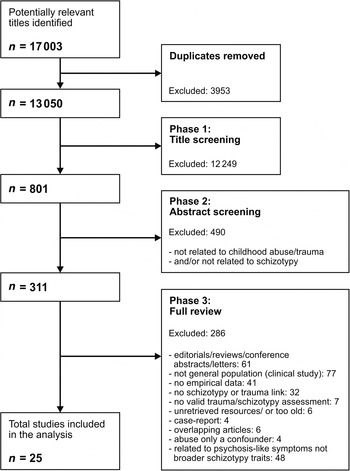
The search covered publications from 1806 to 1 March 2013 and resulted in 17 003 articles in total. After transferring the data into Reference Manager and extracting the duplicates, 13 050 articles were identified for the title screening. Title screening yielded 801 potentially relevant articles, which were narrowed down to 311 after further abstract screening. Through the full-text screening of the remaining articles, we identified the 25 studies that are used in our analysis.
Inclusion and exclusion criteria
For papers to be included they had to meet the following criteria: (a) an original research paper, (b) written in English, (c) use a measure of childhood trauma (either emotional, physical or sexual abuse, neglect or bullying; separation from parents or parental loss, or other traumatic experiences, such as household discord, a life- or an injury-threatening event) for occurrences before the age of 18 years, (d) test whether there is an association with schizotypal traits (any standardized or non-standardized measure, assessing either a single schizotypal trait or multidimensional schizotypy), (e) use general population/community samples and not clinical (psychotic) cases, with the exception of SPD (because of the limited number of non-clinical studies involving schizotypal traits), and (f) include full information on design and measures used in the study to allow completion of a quality assessment tool designed for this analysis (e.g. exclusion of conference abstracts because of limited information). The reasons for excluding articles at each stage are documented in Fig. 1.
Flowchart of studies included in the literature review.

Quality assessment tool
Full criteria and scoring are provided in the online Supplementary material. In brief, the quality indicators assessed included the method of sample selection, the percentage of individuals approached who agreed to participate, the size of the sample, the type of assessment tool used to ascertain a history of childhood trauma and the presence of schizotypal traits, whether different types of trauma were considered separately in the analysis, and whether analyses were adjusted for potentially confounding factors (demographic information and other risk factors such as genetic risk, substance use or depression). Each article was assigned a score of 0, 1 or 2 points for each item with a maximum possible score of 14. All scorings were completed by one researcher.
Results
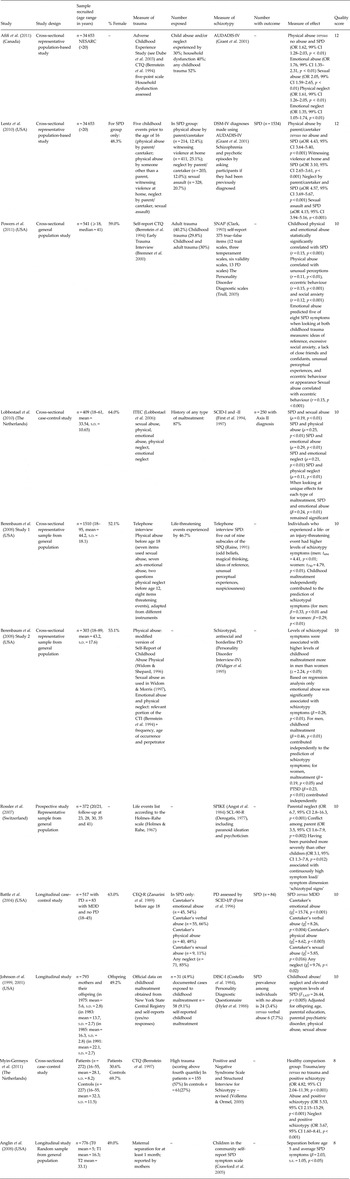
Following the inclusion criteria, 25 articles were identified and included in our analysis. Using the quality assessment tool designed for the purpose of this review, we are only providing full information on the papers that had the highest assigned weight (⩾8 points out of a maximum of 14; Table 1) to focus on the most methodologically robust studies. Details of the other papers can be found in the online Supplementary Table S1.
Summary of studies on childhood trauma and schizotypal traits (ordered by quality score)

NESARC, National Epidemiologic Survey on Alcohol and Related Conditions; AUDADIS-IV, Alcohol Use Disorders and Associated Disabilities Interview Schedule – DSM-IV Version; SPD, schizotypal personality disorder; OR, odds ratio; aOR, adjusted odds ratio; CI, confidence interval; CTQ, Childhood Trauma Questionnaire; SNAP, Schedule for Nonadaptive and Adaptive Personality; PD, personality disorder; ITEC, Interview for Traumatic Events in Childhood; SCID-I and -II, Structured Clinical Interview for DSM-IV Axis I and II Disorders; SCID-I/P, Structured Clinical Interview for DSM-IV Axis I Disorders, Patient Edition; SPQ, Schizotypal Personality Questionnaire; CTI, Childhood Trauma Interview; PTSD, post-traumatic stress disorder; SPIKE, Semi-Structured Psychopathological Interview; SCL-90-R, Symptom Checklist-90-Revised; MDD, major depressive disorder; CEQ-R, Childhood Experiences Questionnaire – Revised; DISC-I, Diagnostic Interview Schedule for Children; s.e., standard error; r, Pearson correlation coefficient; ρ, Spearman's rank correlation coefficient; β, beta regression coefficient; t, T test; z, Kruskal–Wallis test; χ2, chi-squared test.
Association between childhood trauma and schizotypal traits
We examined the relationship between childhood trauma and schizotypal traits in the 25 studies identified. All of the studies support the association between at least one type of trauma and schizotypal traits. Looking at the relationship between overall trauma and schizotypy, the odds ratios (ORs) ranged between 2.01 (Afifi et al. Reference Afifi, Mather, Boman, Fleisher, Enns, MacMillan and Sareen2011) and 4.15 (Lentz et al. Reference Lentz, Robinson and Bolton2010) when adjusted for gender, age, marital status and income. In the studies where different types of trauma were treated separately, particularly strong associations with schizotypy were observed for physical and sexual abuse and neglect. For physical abuse the ORs ranged between 1.62 (Afifi et al. Reference Afifi, Mather, Boman, Fleisher, Enns, MacMillan and Sareen2011) and 5.84 (for the trait unusual perceptions) (Steel et al. Reference Steel, Marzillier, Fearon and Ruddle2009). For neglect, the ORs ranged between 1.35 (Afifi et al. Reference Afifi, Mather, Boman, Fleisher, Enns, MacMillan and Sareen2011) and 6.7 (Rossler et al. Reference Rossler, Riecher-Rossler, Angst, Murray, Gamma, Eich, van Os and Gross2007) and for sexual abuse the range was between 2.05 (Afifi et al. Reference Afifi, Mather, Boman, Fleisher, Enns, MacMillan and Sareen2011) and 4.15 (Lentz et al. Reference Lentz, Robinson and Bolton2010). There was also evidence that a history of bullying was associated with all three factors of schizotypy (interpersonal, disorganized and cognitive-perceptual) (Raine et al. Reference Raine, Fung and Lam2011). It is also suggested that not only victimization but also being a perpetrator of bullying is associated with higher psychoticism (with even higher scores when a child is a victim and a bully at the same time) (Mynard & Joseph, Reference Mynard and Joseph1997); however, as only one study examined this relationship, further research is needed. Emotional abuse remained associated with schizotypy even after adjusting for different types of trauma, with an OR of 1.76 (Afifi et al. Reference Afifi, Mather, Boman, Fleisher, Enns, MacMillan and Sareen2011). Emotional abuse alone also predicted five out of eight SPD symptoms: ideas of reference, excessive social anxiety, a lack of close friends, unusual perceptual experiences and eccentric behaviour or appearance (Powers et al. Reference Powers, Thomas, Ressler and Bradley2011). The evidence for a strong association between emotional trauma and schizotypy comes from multiple studies (Gibb et al. Reference Gibb, Wheeler, Alloy and Abramson2001; Berenbaum et al. Reference Berenbaum, Valera and Kerns2003; Battle et al. Reference Battle, Shea, Johnson, Yen, Zlotnick, Zanarini, Sanislow, Skodol, Gunderson, Grilo, McGlashan and Morey2004; Lobbestael et al. Reference Lobbestael, Arntz and Bernstein2010).
Looking at the schizotypy dimensions independently (positive, negative and disorganized), the data were particularly strong for the positive schizotypal dimension. Individuals who reported childhood trauma were 4.82 times more likely to report positive schizotypal traits than individuals without such experiences, with abuse (defined as emotional, physical or sexual childhood abuse) showing stronger associations (OR 5.53) than neglect (OR 3.67) (Myin-Germeys et al. Reference Myin-Germeys, Heins, Simons, Lataster, Delespaul, Krabbendam and van Os2011). Physical and sexual abuse in particular were also strongly associated with paranoia; for physical abuse the OR was 5.84 (Steel et al. Reference Steel, Marzillier, Fearon and Ruddle2009) and for sexual abuse the OR was 4.49 (Steel et al. Reference Steel, Marzillier, Fearon and Ruddle2009), with physical abuse also predicting unusual perceptions (Powers et al. Reference Powers, Thomas, Ressler and Bradley2011).
Similarly, looking at positive schizotypy, total trauma (including emotional, physical and sexual abuse and emotional and physical neglect) predicted higher precognition, spiritualism, witchcraft and superstition (Perkins & Allen, Reference Perkins and Allen2006) and fantasy proneness (Merckelbach & Jelicic, Reference Merckelbach and Jelicic2004) and physical and sexual abuse predicted unusual beliefs/experiences (Startup, Reference Startup1999; Berenbaum et al. Reference Berenbaum, Valera and Kerns2003). Furthermore, there was evidence for an association between adverse childhood experiences and negative schizotypy, for example the association between physical abuse and social anxiety (Powers et al. Reference Powers, Thomas, Ressler and Bradley2011). An association was also found for childhood trauma and the disorganized schizotypy dimension, including the trait of eccentric behaviour (Powers et al. Reference Powers, Thomas, Ressler and Bradley2011), which was observed for bullying (Raine et al. Reference Raine, Fung and Lam2011), physical/emotional abuse and physical/emotional neglect (Irwin, Reference Irwin2001). Studies that also examined the severity of traumatic experiences and schizotypal symptomatology reported a dose–response relationship (Berenbaum et al. Reference Berenbaum, Thompson, Milanak, Boden and Bredemeier2008; Myin-Germeys et al. Reference Myin-Germeys, Heins, Simons, Lataster, Delespaul, Krabbendam and van Os2011).
Discussion
There seems to be a considerable amount of evidence that supports the association between different types of childhood trauma and schizotypal traits, with the strongest evidence coming from the highest quality papers (Rossler et al. Reference Rossler, Riecher-Rossler, Angst, Murray, Gamma, Eich, van Os and Gross2007; Lobbestael et al. Reference Lobbestael, Arntz and Bernstein2010; Afifi et al. Reference Afifi, Mather, Boman, Fleisher, Enns, MacMillan and Sareen2011). Even though there is some evidence of a differential effect of trauma on schizotypy, with especially strong predictors being emotional abuse (Powers et al. Reference Powers, Thomas, Ressler and Bradley2011) and neglect (Berenbaum et al. Reference Berenbaum, Valera and Kerns2003), this remains inconclusive. Some studies have reported no differential effect between trauma types (Afifi et al. Reference Afifi, Mather, Boman, Fleisher, Enns, MacMillan and Sareen2011) whereas others suggested no association with particular types of trauma after adjusting for all trauma types; for example, no association between emotional abuse and schizotypy (Steel et al. Reference Steel, Marzillier, Fearon and Ruddle2009), between sexual abuse and schizotypy for men and women (Berenbaum et al. Reference Berenbaum, Thompson, Milanak, Boden and Bredemeier2008), and between physical abuse and schizotypy in women only (Berenbaum et al. Reference Berenbaum, Thompson, Milanak, Boden and Bredemeier2008).
Exploring the evidence of age, gender differences and possible mediators that underlie the relationship between childhood trauma and schizotypy might help us to understand the aetiology of psychotic symptoms as well as psychotic disorders. Although gender differences have been shown to play an important role in the association between childhood abuse and psychosis (Fisher et al. Reference Fisher, Morgan, Dazzan, Craig, Morgan, Hutchinson, Jones, Doody, Pariante, McGuffin, Murray, Left and Fearon2009), including the possibility of different mechanistic pathways leading to psychosis for men and women (Myin-Germeys & Van Os, Reference Myin-Germeys and van Os2007), this remains less clear for the association between childhood abuse and schizotypy. With the exception of a few studies, there was no evidence of moderation by sex (Lentz et al. Reference Lentz, Robinson and Bolton2010; Lobbestael et al. Reference Lobbestael, Arntz and Bernstein2010; Myin-Germeys et al. Reference Myin-Germeys, Heins, Simons, Lataster, Delespaul, Krabbendam and van Os2011). However, it was reported that, in women, childhood trauma and post-traumatic stress disorder (PTSD) contributed independently to the prediction of schizotypal symptoms whereas in men only childhood trauma, and not PTSD, contributed to the prediction of schizotypal symptoms (Berenbaum et al. Reference Berenbaum, Thompson, Milanak, Boden and Bredemeier2008). Thus, a partial mediation effect of PTSD on the association between emotional abuse and SPD in women has been postulated to provide a link between childhood abuse and schizotypal symptoms, especially unusual perceptual experiences and eccentric behaviours (Powers et al. Reference Powers, Thomas, Ressler and Bradley2011). The association between childhood traumatic events and schizotypy in men, however, was significantly moderated by neurodevelopment disturbance (Berenbaum et al. Reference Berenbaum, Thompson, Milanak, Boden and Bredemeier2008). Thus, as with psychotic-like experiences, these findings suggest that gender-specific mechanisms may underlie the trauma–schizotypy association. Besides gender, similar heterogeneity occurs for age, with one study suggesting the link between neglect and schizotypy for men increasing with age (Berenbaum et al. Reference Berenbaum, Thompson, Milanak, Boden and Bredemeier2008) whereas another reported a tendency for such traits to decrease with age (Rossler et al. Reference Rossler, Riecher-Rossler, Angst, Murray, Gamma, Eich, van Os and Gross2007).
Further exploration is therefore needed to fully understand the differential effects of types of trauma on more specific schizotypal traits, including the consideration of other adversity-related factors such as age of occurrence, severity and frequency of trauma, and multiple victimization and perpetrators. In addition, combination effects and multiple traumas have not been fully measured. Nevertheless, the few studies that did look into the severity of traumatic experiences have all reported a dose–response effect of traumatic experiences on schizotypal symptomatology (Berenbaum et al. Reference Berenbaum, Thompson, Milanak, Boden and Bredemeier2008; Myin-Germeys et al. Reference Myin-Germeys, Heins, Simons, Lataster, Delespaul, Krabbendam and van Os2011).
There is emerging evidence identifying some symptom-specific and exposure-specific underlying mechanisms; for example, neglect was associated with positive and negative schizotypy whereas childhood abuse (emotional, physical and general) was only associated with the positive schizotypy dimension (Myin-Germeys et al. Reference Myin-Germeys, Heins, Simons, Lataster, Delespaul, Krabbendam and van Os2011). These differential effects between abuse and neglect might be explained by the impact each type of trauma has on the developing brain, with neglect being associated with more severe cognitive and psychosocial deficits (Colvert et al. Reference Colvert, Rutter, Kreppner, Beckett, Castle, Groothues, Hawkins, Stevens and Sonuga-Barke2008).
Similarly, some specificity was apparent for personality dysfunction, where emotional maltreatment was associated with schizotypy in particular, but sexual abuse correlated with more generalized personality dysfunction (Gibb et al. Reference Gibb, Wheeler, Alloy and Abramson2001). By contrast, another study reported that physical and sexual abuse was associated with higher levels of paranoia/suspiciousness and unusual perceptual experiences whereas emotional maltreatment in childhood showed no relationship to any of these experiences (Steel et al. Reference Steel, Marzillier, Fearon and Ruddle2009). Individuals who experience paranoia and suspiciousness were also more likely to have high negative-self and negative-others beliefs and high levels of anxiety and depression, which lie beneath the mistrust associated with development of paranoid ideation (Freeman et al. Reference Freeman, Garety, Kuipers, Fowler and Bebbington2002). Pathways between traumatic experiences and unusual perceptual experiences are less clear, and are seen as either an artefact of intrusive memories of traumatic events (Morrison, Reference Morrison2001) or the effect of underlying biological vulnerability caused by early trauma (Garety et al. Reference Garety, Kuipers, Fowler, Freeman and Bebbington2001).
Furthermore, childhood trauma demonstrated an especially strong association with positive schizotypy. This is consistent with the hypothesis that negative/disorganized symptoms are more associated with alterations in early brain development (Heckers et al. Reference Heckers, Goff, Schacter, Savage, Fischman, Alpert and Rauch1999; Rowland et al. Reference Rowland, Spieker, Francis, Barker, Carpenter and Buchanan2009) linked to genetic risk (Goldman et al. Reference Goldman, Pezawas, Mattay, Fischl, Verchinski, Chen, Weinberger and Meyer-Lindenberg2009), whereas positive symptoms are thought to be influenced more by environmental risk factors (self-reported trauma, cannabis exposure, urbanicity). This suggests two parallel pathways to psychosis: the first endogenous pathway determined mainly by biological factors and a second pathway characterized more by environmental influences (Ross et al. Reference Ross, Anderson and Clark1994; Dominguez et al. Reference Dominguez, Saka, Lieb, Wittchen and van Os2010). Again, this indicates the complexity of the childhood trauma and schizotypy relationship and supports the idea that genes and environment interact in complex ways to produce dimensionality of schizotypal traits, which stands as further evidence against any single taxon.
Methodological issues
The studies varied greatly in the age of the participants, the range being from 6 to 95 years, with about half of them using a wide range of ages, from 18 to ≥ 55 years (Lobbestael et al. Reference Lobbestael, Arntz and Bernstein2010; Myin-Germeys et al. Reference Myin-Germeys, Heins, Simons, Lataster, Delespaul, Krabbendam and van Os2011), whereas others were limited to children and/or adolescents populations (Mynard & Joseph, Reference Mynard and Joseph1997; Raine et al. Reference Raine, Fung and Lam2011). The different age ranges make it more difficult to compare the findings, especially as certain schizotypal personality traits have been shown to be associated with age. For example, introverted anhedonia is positively correlated with age whereas unusual perceptual experiences show a negative correlation (Rawlings et al. Reference Rawlings, Claridge and Freeman2001; Mason & Claridge, Reference Mason and Claridge2006). In addition, by using younger samples, especially children up to the age of 14, the possibility that participants might still express schizotypal traits in the future could not be fully excluded as they had not yet passed through the crucial period of risk.
There was also heterogeneity in the types of trauma used between different studies, with some only including one type of trauma (Raine et al. Reference Raine, Fung and Lam2011) and others using trauma in a much broader context (including, for example, any life-threatening event, conflict among parents, early interpersonal experiences) (Berry et al. Reference Berry, Band, Corcoran, Barrowclough and Wearden2007; Rossler et al. Reference Rossler, Riecher-Rossler, Angst, Murray, Gamma, Eich, van Os and Gross2007; Berenbaum et al. Reference Berenbaum, Thompson, Milanak, Boden and Bredemeier2008). However, the majority of studies did compare different types of childhood trauma (physical, sexual or emotional abuse and neglect), which were also treated separately in the analysis (Lobbestael et al. Reference Lobbestael, Arntz and Bernstein2010; Sommer et al. Reference Sommer, Daalman, Rietkerk, Diederen, Bakker, Wijkstra and Boks2010; Afifi et al. Reference Afifi, Mather, Boman, Fleisher, Enns, MacMillan and Sareen2011; Powers et al. Reference Powers, Thomas, Ressler and Bradley2011). The definition of childhood trauma differed between studies, with some of them including trauma below the age of 16 only (Lentz et al. Reference Lentz, Robinson and Bolton2010); however, most the of studies expanding the age range of trauma occurrence to 18 years (Berenbaum et al. Reference Berenbaum, Thompson, Milanak, Boden and Bredemeier2008; Afifi et al. Reference Afifi, Mather, Boman, Fleisher, Enns, MacMillan and Sareen2011).
As the majority of studies we included in our review were assessing childhood trauma retrospectively, it is not possible to rule out ‘reverse causality’, that is the possibility that individuals with more schizotypal traits might be more likely to be exposed to violence and trauma. However, the few prospective and longitudinal studies that have been conducted suggest a similar association between childhood trauma and subsequent schizotypy to that demonstrated in cross-sectional retrospective studies (Rossler et al. Reference Rossler, Riecher-Rossler, Angst, Murray, Gamma, Eich, van Os and Gross2007).
The vast majority of studies relied on crude measurements of childhood trauma, either a self-administered checklist or a checklist format completed by an interviewer (Lentz et al. Reference Lentz, Robinson and Bolton2010). It is also important to note that some of the studies only used yes/no responses to assess childhood traumatic events, which may result in slightly skewed data (Johnson et al. Reference Johnson, Cohen, Brown, Smailes and Bernstein1999; Steel et al. Reference Steel, Marzillier, Fearon and Ruddle2009). Only one study (Berenbaum et al. Reference Berenbaum, Thompson, Milanak, Boden and Bredemeier2008) reported on age of occurrence, frequency and perpetrator. Less than one-third of the studies used a semi-structured interview to measure childhood trauma (Berenbaum et al. Reference Berenbaum, Thompson, Milanak, Boden and Bredemeier2008; Lobbestael et al. Reference Lobbestael, Arntz and Bernstein2010) or a medical examination or records from social services (Johnson et al. Reference Johnson, Cohen, Brown, Smailes and Bernstein1999), which would have provided a better quality of data. Most of the interviews and questionnaires were based on retrospective reports, which raises the issue of under- or over-reporting and recall bias (McFarland & Buehler, Reference McFarland and Buehler1998). There is evidence, however, that childhood trauma reports are reasonable reliable and stable over a long period of time even among clinically psychotic patients (Fisher et al. Reference Fisher, Craig, Fearon, Morgan, Dazzan, Lappin, Hutchinson, Doody, Jones, McGuffin, Murray, Leff and Morgan2011).
The studies included in this review ranged from large representative general population studies (Berenbaum et al. Reference Berenbaum, Thompson, Milanak, Boden and Bredemeier2008; Afifi et al. Reference Afifi, Mather, Boman, Fleisher, Enns, MacMillan and Sareen2011; Raine et al. Reference Raine, Fung and Lam2011) to cohort studies (Sommer et al. Reference Sommer, Daalman, Rietkerk, Diederen, Bakker, Wijkstra and Boks2010; Powers et al. Reference Powers, Thomas, Ressler and Bradley2011), case–control studies (Simeon et al. Reference Simeon, Guralnik, Schmeidler, Sirof and Knutelska2001; Myin-Germeys et al. Reference Myin-Germeys, Heins, Simons, Lataster, Delespaul, Krabbendam and van Os2011) and convenience samples (Perkins & Allen, Reference Perkins and Allen2006; Berry et al. Reference Berry, Band, Corcoran, Barrowclough and Wearden2007; Steel et al. Reference Steel, Marzillier, Fearon and Ruddle2009), which again suggests caution when comparing their findings. The sample sizes varied widely from 75 to 34 653 but mainly ranged between 100 and 1000 participants. In addition, 90% of the studies were carried out in the USA or Europe, making it difficult to generalize conclusions to other contexts.
When looking at the outcome measure, similar heterogeneity occurs. In some studies schizotypy was measured using standardized measures administrated by clinicians (Afifi et al. Reference Afifi, Mather, Boman, Fleisher, Enns, MacMillan and Sareen2011; Myin-Germeys et al. Reference Myin-Germeys, Heins, Simons, Lataster, Delespaul, Krabbendam and van Os2011), although some individual schizotypal traits were assessed by non-standardized methods and self-reports (Rossler et al. Reference Rossler, Riecher-Rossler, Angst, Murray, Gamma, Eich, van Os and Gross2007; Powers et al. Reference Powers, Thomas, Ressler and Bradley2011), and in some cases only a few questions were used. Therefore, this review incorporates the broad range of measures to assess these traits in the general population studies (Berenbaum et al. Reference Berenbaum, Thompson, Milanak, Boden and Bredemeier2008; Lentz et al. Reference Lentz, Robinson and Bolton2010) along with personality traits in some clinical cases (individuals with personality disorders) (Battle et al. Reference Battle, Shea, Johnson, Yen, Zlotnick, Zanarini, Sanislow, Skodol, Gunderson, Grilo, McGlashan and Morey2004), although this also adversely impacts on the ability to compare the findings from the different papers.
It is also not possible to fully exclude the potentially confounding effect of other factors when looking at trauma–schizotypy relationships. Studies have mainly adjusted for general sociodemographic factors, with only two studies adjusting for other risk factors such as psychiatric family history, depression and anxiety (Berenbaum et al. Reference Berenbaum, Thompson, Milanak, Boden and Bredemeier2008; Steel et al. Reference Steel, Marzillier, Fearon and Ruddle2009), following which the childhood trauma and schizotypy association remained similarly strong.
Future research/clinical implications
Building on methodological limitations of previous studies, further exploration of this complex relationship between childhood trauma and schizotypy and the mechanistic pathways underlying this association would potentially help to uncover important clues regarding the aetiology of psychotic symptoms and subsequently psychotic disorders. Focusing on schizotypy, which provides a framework for detecting fundamental features of liability to psychosis prior to the illness itself, could have important implications for clinical assessment and treatment formulation. Most importantly, childhood trauma is a risk factor for an array of psychopathology later in life (Bechdolf et al. Reference Bechdolf, Thompson, Nelson, Cotton, Simmons, Amminger, Leicester, Francey, McNab, Krstev, Sidis, McGorry and Yung2010), so early intervention might help to prevent the transition to later mental health problems.
Conclusions
This literature review suggests that childhood trauma is associated with increased risk of developing schizotypal traits, especially positive schizotypy in a dose–response manner. The strongest and most consistent effect is shown for emotional abuse; however, there are discrepancies with regard to the differential effects of trauma types on the development of schizotypal traits. Because of methodological limitations, including heterogeneous samples and use of inconsistent measures of trauma and schizotypy, it is difficult to compare findings robustly between the studies included in this review. However, all of the studies did report an association between at least one type of trauma and schizotypal traits. There is also emerging evidence that points to symptom- and exposure-specific underlying mechanisms that support the childhood trauma–schizotypy association, although this issue still requires detailed exploration in future research.
Supplementary material
For supplementary material accompanying this paper visit http://dx.doi.org/10.1017/S0033291714002086.
Declaration of Interest
None.