Antenatal maternal anxiety significantly increases the risk for early childhood socioemotional and behavioral problems as well as later affective disorders in the offspring (Field et al., Reference Field, Diego, Hernandez-Reif, Schanberg, Kuhn and Yando2003; Hettema, Neale, & Kendler, Reference Hettema, Neale and Kendler2001; Murray, Creswell, & Cooper, Reference Murray, Creswell and Cooper2009; Rosenbaum et al., Reference Rosenbaum, Biederman, Bolduc-Murphy, Faraone, Chaloff and Hirshfeld1993; Van den Bergh, Mulder, Mennes, & Glover, Reference Van den Bergh, Mulder, Mennes and Glover2005). It is important that the effects of antenatal maternal anxiety are apparent even after controlling for postnatal maternal anxiety (Huizink, de Medina, Mulder, Visser, & Buitelaar, Reference Huizink, de Medina, Mulder, Visser and Buitelaar2002; Van den Bergh et al., Reference Van den Bergh, Mulder, Mennes and Glover2005). These findings suggest a relation between antenatal maternal anxiety and the development of neural systems that underlie socioemotional development. Studies with rodents and primates reveal profound effects of prenatal maternal stress on cognitive–emotional function and stress reactivity in the adult offspring (Clarke & Schneider, Reference Clarke and Schneider1993; Coe et al., Reference Coe, Kramer, Czeh, Gould, Reeves and Kirschbaum2003; Weinstock, Reference Weinstock1997). Moreover, translational studies in humans show that antenatal stress and anxiety affects fetal physiology (Abelson, Khan, Liberzon, & Young, Reference Abelson, Khan, Liberzon and Young2007; Risbrough & Stein, Reference Risbrough and Stein2006; Staufenbiel, Penninx, Spijker, Elzinga, & van Rossum, Reference Staufenbiel, Penninx, Spijker, Elzinga and van Rossum2013; Teixeira, Fisk, & Glover, Reference Teixeira, Fisk and Glover1999) and later associates with difficult temperament in infancy. Anxiety disorders are linked to dysregulated hypothalamic–pituitary–adrenal function (Abelson et al., Reference Abelson, Khan, Liberzon and Young2007; Risbrough & Stein, Reference Risbrough and Stein2006; Staufenbiel et al., Reference Staufenbiel, Penninx, Spijker, Elzinga and van Rossum2013) and antenatal cortisol associates with alterations in amygdala volume in childhood (Buss et al., Reference Buss, Davis, Shahbaba, Pruessner, Head and Sandman2012). Antenatal maternal anxiety also associates with decreased gray matter in the frontal cortex in the offspring at childhood (Buss, Davis, Muftuler, Head, & Sandman, Reference Buss, Davis, Muftuler, Head and Sandman2010) and predicts alterations in performance on prefrontal-dependent tasks (Buss et al., Reference Buss, Davis, Muftuler, Head and Sandman2010; Mennes, Stiers, Lagae, & Van den Bergh, Reference Mennes, Stiers, Lagae and Van den Bergh2006; Qiu et al., Reference Qiu, Rifkin-Graboi, Chen, Chong, Kwek and Gluckman2013). Moreover, recent findings from our own group suggest the influence of depressive symptomatology and anxiety on limbic structures at birth (Rifkin-Graboi et al., Reference Rifkin-Graboi, Bai, Chen, Hameed, Sim and Tint2013) and their subsequent development (Qiu et al., Reference Qiu, Rifkin-Graboi, Chen, Chong, Kwek and Gluckman2013). These findings highlight the importance of the fetal period of development and suggest that the parental effect is not solely accounted for by the transmission of heritable, sequence-based genetic variation or postnatal parenting effects. Rather, vulnerability for psychopathology emerges as a function of genotype–environment interaction (Caspi, Hariri, Holmes, Uher, & Moffitt, Reference Caspi, Hariri, Holmes, Uher and Moffitt2010; Meaney & Ferguson–Smith, Reference Meaney and Ferguson-Smith2010; Rutter, Moffitt, & Caspi, Reference Rutter, Moffitt and Caspi2006).
Epigenetic Mechanisms
A critical issue for the study of the developmental origins of psychopathology is that of how the influences of the early environment are biologically embedded, and thus exert an enduring influence on neural function. Studies over the past decade reveal stable effects of environmental conditions, including parental “signals,” on the epigenome in brain regions associated with affective illness (Champagne, Reference Champagne2012; Essex et al., Reference Essex, Boyce, Hertzman, Lam, Armstrong and Neumann2013; Heim & Binder, Reference Heim and Binder2012; Labonte et al., Reference Labonte, Yerko, Gross, Mechawar, Meaney and Szyf2012; McGowan et al., Reference McGowan, Sasaki, D'Alessio, Dymov, Labonte and Szyf2009; Roth & Sweatt, Reference Roth and Sweatt2011; Zhang & Meaney, Reference Zhang and Meaney2010). These epigenetic marks control the structure and function of the genome, and potentially explain variations in genotype–phenotype relations (i.e., identical twins). Because certain classes of epigenetic marks, notably DNA and histone methylation, are stably maintained in mitotic and postmitotic cells, this “environmental epigenetic” hypothesis provides a candidate mechanism for the enduring influences of the social environment on neurodevelopment and mental health (Bateson et al., Reference Bateson, Barker, Clutton-Brock, Deb, Udine and Foley2004; Feil & Fraga, Reference Feil and Fraga2011; Jirtle & Skinner, Reference Jirtle and Skinner2007; Meaney & Ferguson-Smith, Reference Meaney and Ferguson-Smith2010; Zhang & Meaney, Reference Zhang and Meaney2010). Support for this hypothesis is derived from studies of the methylation of a glucocorticoid receptor gene promoter that reveal stable associations between levels of DNA methylation and both pre- and postnatal adversity (Bromer, Marsit, Armstrong, Padbury, & Lester, Reference Bromer, Marsit, Armstrong, Padbury and Lester2013; Filiberto et al., Reference Filiberto, Maccani, Koestler, Wilhelm-Benartzi, Avissar-Whiting and Banister2011; Hompes et al., Reference Hompes, Izzi, Gellens, Morreels, Fieuws and Pexsters2013; Labonte et al., Reference Labonte, Yerko, Gross, Mechawar, Meaney and Szyf2012; McGowan et al., Reference McGowan, Sasaki, D'Alessio, Dymov, Labonte and Szyf2009; Mulligan, D'Errico, Stees, & Hughes, Reference Mulligan, D'Errico, Stees and Hughes2012; Oberlander et al., Reference Oberlander, Weinberg, Papsdorf, Grunau, Misri and Devlin2008; Perroud et al., Reference Perroud, Paoloni–Giacobino, Prada, Olie, Salzmann and Nicastro2011, Reference Perroud, Dayer, Piguet, Nallet, Favre and Malafosse2014; Radtke et al., Reference Radtke, Ruf, Gunter, Dohrmann, Schauer and Meyer2011; Steiger, Labonte, Groleau, Turecki, & Israel, Reference Steiger, Labonte, Groleau, Turecki and Israel2013; Tyrka, Price, Marsit, Walters, & Carpenter, Reference Tyrka, Price, Marsit, Walters and Carpenter2012). These findings emerge from studies using cells obtained from blood sampling as well as those involving postmortem human hippocampus, suggesting that environmental influences on epigenetic states of at least certain genomic regions are apparent across multiple tissues.
The epigenome is, at least in part, a product of genotype-dependent environmental influences that are reflected in genotype and environment interactions on the epigenome. Klengel et al. (Reference Klengel, Mehta, Anacker, Rex-Haffner, Pruessner and Pariante2013) found that the interaction of the FK506 binding protein 5 (FKBP5) genotype and early childhood trauma affects methylation of FKBP5 intron 7, FKBP5 expression, and subsequent deregulation of glucocorticoid receptor signaling. In a previous study of the Growing Up in Singapore Towards Healthy Outcomes (GUSTO) cohort (Teh et al., Reference Teh, Pan, Chen, Ong, Dogra and Wong2014), we used a genome-wide survey of DNA methylation with DNA obtained from umbilical cords in relation to a wide range of measures of antenatal maternal health and well-being, including maternal mood. We identified 1,423 variably methylated regions (VMRs; Ong & Holbrook, Reference Ong and Holbrook2013) and used statistical modeling to examine whether the variability in DNA methylation at individual regions was best explained by sequence-based genetic variation, antenatal maternal environmental influences, or the interaction between the two factors. The results revealed that variation in DNA methylation was best explained by genetic factors in approximately 25% of the VMRs. These effects commonly involved single nucleotide polymorphisms (SNPs) in proximity to the individual cytosine–phosphate–guanine (CpG) site. In contrast, a Gene × Environment interaction model best explained approximately 75% of the VMRs. In no cases were VMRs best explained by environmental conditions alone, acting independent of the genome. The findings underscore the importance of Gene × Environment interactions for the establishment of individual differences in DNA methylation and may explain why a previous study, which did not account for infant genotype, found no effect of antenatal maternal depression on neonatal DNA methylation using genome-wide analysis with DNA obtained from umbilical cord blood (Schroeder et al., Reference Schroeder, Smith, Brennan, Conneely, Kilaru and Knight2012).
Gene × Environment Interactions
The impact of severe childhood maltreatment on mental health is moderated by variants in genes that encode for products involved in the regulation of stress responses (Binder et al., Reference Binder, Bradley, Liu, Epstein, Deveau and Mercer2008; Bradley & Corwyn, Reference Bradley and Corwyn2008; Caspi et al., Reference Caspi, Hariri, Holmes, Uher and Moffitt2010; Heim & Nemeroff, Reference Heim and Nemeroff2009; Xie et al., Reference Xie, Kranzler, Poling, Stein, Anton and Farrer2010). These variants may associate with enhanced sensitivity to adverse circumstance. However, many of these variants appear to also associate with enhanced susceptibility to more favorable environmental conditions. Thus, both the serotonin transporter linked polymorphic region of the SLC6A4 gene and the Val66Met polymorphism of the brain-derived neurotropic factor (BDNF) gene associate not only with an increased risk for affective disorders under adverse conditions but also with a decreased risk under more propitious setting (Casey et al., Reference Casey, Glatt, Tottenham, Soliman, Bath and Amso2009; Chen, Li, & McGue, Reference Chen, Li and McGue2013; Devlin, Brain, Austin, & Oberlander, Reference Devlin, Brain, Austin and Oberlander2010; Gatt et al., Reference Gatt, Nemeroff, Dobson-Stone, Paul, Bryant and Schofield2009; Hilt, Sander, Nolen-Hoeksema, & Simen, Reference Hilt, Sander, Nolen-Hoeksema and Simen2007; Pluess & Belsky, Reference Pluess and Belsky2011; Pluess et al., Reference Pluess, Velders, Belsky, van IJzendoorn, Bakermans–Kranenburg and Jaddoe2011; Suzuki et al., Reference Suzuki, Matsumoto, Shibuya, Ryoichi, Kamata and Enokido2012; Taylor et al., Reference Taylor, Sanfilippo, McDermott, Baddeley, Riensche and Jensen2010; Uher & McGuffin, Reference Uher and McGuffin2008; Wagner, Baskaya, Dahmen, Lieb, & Tadic, Reference Wagner, Baskaya, Dahmen, Lieb and Tadic2010). These findings led to the consideration of “plasticity genes” that associate with differential susceptibility to environmental context, rather than with risk, per se (Belsky, Bakermans-Kranenburg, & van IJzendoorn, Reference Belsky, Bakermans-Kranenburg and van IJzendoorn2007; Belsky et al., Reference Belsky, Jonassaint, Pluess, Stanton, Brummett and Williams2009; Boyce & Ellis, Reference Boyce and Ellis2005; Ellis, Boyce, Belsky, Bakermans-Kranenburg, & van IJzendoorn, Reference Ellis, Boyce, Belsky, Bakermans–Kranenburg and van IJzendoorn2011). However, the influence of specific genetic variants on environmental regulation on genome-wide epigenetic states has not been examined, and this issue seems particularly interesting in relation to the study of differential sensitivity to context. Because the epigenome, as with other measures of phenotype, reflects gene and environment interactions, we would expect that that the impact of clinically relevant environmental conditions would be moderated by relevant “plasticity” genotypes.
In this study, we examined association of antenatal maternal anxiety on DNA methylation profiles as a function of BDNF genotype across the neonatal offspring of mothers enrolled in the mother offspring cohort study, GUSTO. The BDNF gene is of particular interest because it encodes for brain-derived neurotrophic factor, a neurotrophin closely linked to synaptic plasticity throughout the central nervous system (CNS). There is a common SNP (rs6265) in the human BDNF gene (Val66Met; Egan et al., Reference Egan, Kojima, Callicott, Goldberg, Kolachana and Bertolino2003). This SNP leads to a change from valine to methionine at amino acid position 66 within the pro-domain of BDNF. Approximately 30% of the Caucasian population are carriers of the methionine allele, with ~4% being homozygous methionine (Met)/Met, with a substantially higher frequency of the methionine allele in Asian samples (Petryshen et al., Reference Petryshen, Sabeti, Aldinger, Fry, Fan and Schaffner2010). The methionine allele leads to a reduction in the activity-dependent release of BDNF (Chen et al., Reference Chen, Ieraci, Teng, Dall, Meng and Herrera2005, Reference Chen, Jing, Bath, Ieraci, Khan and Siao2006; Egan et al., Reference Egan, Kojima, Callicott, Goldberg, Kolachana and Bertolino2003) and is associated with hippocampal-dependent memory function (Hariri et al., Reference Hariri, Goldberg, Mattay, Kolachana, Callicott and Egan2003) as well as with a variety of neuropsychiatric disorder (Duman & Monteggia, Reference Duman and Monteggia2006; Groves, Reference Groves2007; Rybakowski, Reference Rybakowski2008). The BDNF Val66Met polymorphism is also associated with direct measures of plasticity, such as structural plasticity in the cortex during learning and memory (Kleim et al., Reference Kleim, Chan, Pringle, Schallert, Procaccio and Jimenez2006; McHughen et al., Reference McHughen, Rodriguez, Kleim, Kleim, Marchal Crespo and Procaccio2010; Wang et al., Reference Wang, Zhang, Liu, Long, Yu and Jiang2014). Multiple studies report that the BDNF Val66Met polymorphism moderates the impact of environmental conditions on brain-based phenotypes (Gunnar et al., Reference Gunnar, Wenner, Thomas, Glatt, McKenna and Clark2012; Hayden et al., Reference Hayden, Klein, Dougherty, Olino, Dyson and Durbin2010; Juhasz, Foldi, & Penke, Reference Juhasz, Foldi and Penke2011; Mata, Thompson, & Gotlib, Reference Mata, Thompson and Gotlib2010; Willoughby, Mills-Koonce, Propper, & Waschbusch, Reference Willoughby, Mills-Koonce, Propper and Waschbusch2013). We used DNA obtained from umbilical cord samples from a longitudinal birth cohort study to examine whether the BDNF Val66Met polymorphism moderates the influence of antenatal maternal mental health on genome-wide DNA methylation. We then extended this analysis by exploiting available brain imaging data collected in the same individuals to perform an exploratory analysis to study whether putative Maternal Anxiety × BDNF Val66Met Polymorphism interactions at the level of DNA methylation were brain-region specific. The fact that tissue collection for DNA analysis was performed at the same stage in development as the neuroimaging studies (postnatal days 4–14) was a distinct advantage of this data set. Our analyses reveal evidence for brain region-specific, differential susceptibility such that the resulting Maternal Anxiety × BDNF Val66Met Polymorphism interactions at the level of the epigenome are reflected differently in the structure of the amygdala and the hippocampus, limbic regions associated with the risk for psychopathology.
Methods
Participants
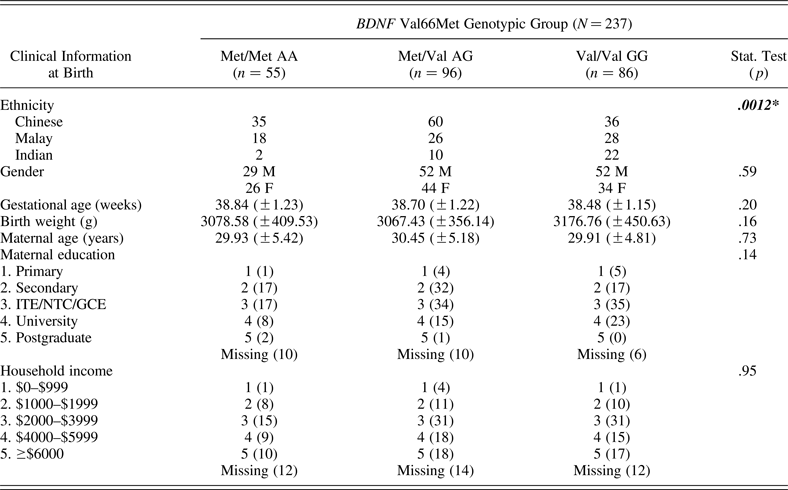
We used data from the GUSTO study (Soh et al., Reference Soh, Tint, Gluckman, Godfrey, Rifkin-Graboi and Chan2013), which is a prospective mother–offspring cohort study in Singapore consisting of 1,247 women recruited between June 2009 and September 2010. All specimens were from babies born at the Singapore KK Women's and Children's Hospital (KKH) and the National University Hospital. Written parental consent was obtained at recruitment, and ethical approval for the study was granted by the Institute Review Board and the Domain Specific Review Board of KKH and National University Hospital, respectively. Demographic data, including socioeconomic status, physical activity, smoking and alcohol status, and obstetric and medical history, were collected from the women at 26–28 weeks gestation during the follow-up clinic visit. Information, including obstetric and neonatal complications, infant sex, and mode of delivery, was obtained at delivery. The characteristics of the studied subjects in three genotypic groups of BDNF Val66Met are shown in Table 1. Maternal age, birth weight, gestational age, gender, ethnicity, and socioeconomic status (maternal education and household income) were compared in three genotypic groups. The p values were calculated by analysis of variance (maternal age, birth weight, and gestational age) or chi-squared test (gender, ethnicity, and socioeconomic status). Ethnicity was the only statistically significant factor (p = .0012) in three groups and was thus considered as the main covariate in the further linear regression models. The ethnic composition of the GUSTO cohort maps closely onto that of the Singaporean population, which according to 2013 data, is 74.2% ethnic Chinese, 13.3% ethnic Malay, and 9.1% ethnic Indian (http://www.singstat.gov.sg/publications).
The demographic characteristics of the studied subjects in three genotypic groups of infant BDNF Val66Met

Maternal anxiety measures
Pregnant women enrolled in the GUSTO birth cohort were assessed with the State–Trait Anxiety Inventory (STAI, Form Y-2) at 26 weeks gestation for antenatal maternal anxiety. The STAI is a commonly used self-report tool for assessing anxiety and consists of two subscales (state and trait anxiety) with each containing 20 items on a 4-point rating scale. State anxiety reflects a “transitory emotional state or condition of the human organism that is characterized by subjective, consciously perceived feelings of tension and apprehension, and heightened autonomic nervous system activity.” (Spielberger, Gorsuch, & Lushene, Reference Spielberger, Gorsuch and Lushene1970). In contrast, trait anxiety denotes “relatively stable individual differences in anxiety proneness” and refers to a “general tendency to respond with anxiety to perceived threats in the environment.” (Spielberger et al., Reference Spielberger, Gorsuch and Lushene1970). Previous studies on antenatal and postnatal assessment of maternal anxiety (Dennis, Coghlan, & Vigod, Reference Dennis, Coghlan and Vigod2013; Grant, McMahon, & Austin, Reference Grant, McMahon and Austin2008) indicated good internal consistency, with Cronbach α values between 0.94 and 0.95. The STAI was self-administered by the women at 26–28 weeks of gestation.
Genome-wide DNA methylation assay
We obtained genomic DNA from 244 umbilical cord samples from the GUSTO cohort that were then interrogated for genome-wide variation in DNA methylation using the Infinium HumanMethylation450 Bead Chip assay (described in detail below). Technical replicates were designed for quality control of chip effect and batch effect. The 23 individual chips were processed in four batches. Seven samples failed at quality assurance, and 237 samples were left for further data analysis. Data was processed as previously described (Pan et al., Reference Pan, Chen, Dogra, Ling Teh, Tan and Lim2012; Teh et al., Reference Teh, Pan, Chen, Ong, Dogra and Wong2014). After preprocessing, 411,107 CpGs were filtered for the further analysis. The methylation data can be accessed in the National Center for Biotechnology Information Gene Expression Omnibus (NCBI GEO) under accession number GSE53816.
We examined DNA methylation states using the Infinium HumanMethylation450 Bead Chip array, which permits quantification of methylation status with single-base resolution across 482,421 CpG sites and 3,091 non-CpG sites. This array avoids the complications associated with capture-dependent approaches, such as antibody specificity, and focuses on genomic regions of greatest interest for the study of individual differences in the epigenome. Our studies with this technology suggest strong reproducibility and good correlation with bisulfite sequencing, including RRBSseq (Pan et al., Reference Pan, Chen, Dogra, Ling Teh, Tan and Lim2012). The array uses beads with target-specific probes to interrogate individual CpG sites. Methylation is quantified using genotyping of bisulfite-converted DNA. The 3′ terminus of the probe compliments the base directly upstream of the site, while single base extension results in the addition of a labeled G to an unconverted (methylated) C or to a nonconverted (unmethylated) T. The 50-mer probe can independently analyze up to 3 underlying CpG sites. The array covers almost all (98.9%) of the UCSC RefGenes (17.2 CpG sites/gene), and includes sites lying within the gene body (9.9 CpG sites/gene) as well as promoters at 200 (3.7 CpG sites) and 1500 (4.3 CpG sites) base pairs from the transcriptional start site. The array also includes 3′ and 5′ untranslated regions as well as coverage of first exons.
Bisulfite converted genomic DNA was isothermally amplified at 37 °C for 22 hr; enzymatically fragmented, purified, and hybridized on an Infinium® HumanMethylation 450 BeadChip; scanned using the Illumina® iScan system; and the image data were processed with the Genome Studio Methylation Module software.
Infinium 450 K DNA methylation data processing
Data was processed as previously described (Pan et al., Reference Pan, Chen, Dogra, Ling Teh, Tan and Lim2012; Teh et al., Reference Teh, Pan, Chen, Ong, Dogra and Wong2014). Briefly, signal extraction was performed in Genome Studio Methylation Module on the intensity files (.idat) produced by the Illumina iSCAN system. Raw values were extracted from Genome Studio. CpGs with two beads or fewer for either methylated or unmethylated signal, for any sample; or with signal detection p values (calculated from the individual bead intensities) less than .01, for any sample, were discarded for all samples. The green signals were normalized to the red channel signals by multiplying them by the product of the red channel control value divided by the green channel control value. Background subtraction was performed on the assays from both channels using the negative probe control values (the green negative control value was adjusted in the same way). At this point, β values were calculated for further analysis. β values are the ratio of the methylated probe intensity and the overall intensity; for example, the β value for an ith interrogated CpG site:
 $${\rm \beta}_i = \displaystyle{{\max \lpar {y_{i\comma {\rm methy}}}\comma \; 0\rpar } \over {\max \lpar {y_{i\comma {\rm unmethy}}}\comma \; 0\rpar + \max \lpar {y_{i\comma {\rm methy}}}\comma \; 0\rpar + a}}\comma$$
where y i,methy and y i,unmethy are the intensities measured by the ith methylated and unmethylated probes, respectively, averaged over the replicate beads; a is a constant offset, by default 100. Therefore, β values range between 0 and 1, with 0 representing no methylation and 1 representing 100% methylation. The β values were further processed to scale the percent methylation range of the Type 2 probes to the Type 1 probes using the procedure suggested by Dedeurwaerder et al. (Reference Dedeurwaerder, Defrance, Calonne, Denis, Sotiriou and Fuks2011).
Sex chromosomes were removed, and quantile normalization was implemented. Batch effects were observed between different runs in the processed data and removed by a commonly used empirical Bayes method (Johnson, Li, & Rabinovic, Reference Johnson, Li and Rabinovic2007). After preprocessing, 411,107 CpGs were filtered for the further analysis. The raw data can be accessed in the NCBI GEO (http://www.ncbi.nlm.nih.gov/geo/) under accession number GSE53816.
Genome-wide genotyping assays
We obtained genotyping data from all 237 samples using the Illumina omniexpress + exome genotyping assay (www.illumina.com/products/human_omni_express_beadchip_kits.ilmn), which was performed by the service provider, Expression Analysis Inc. This array provides better coverage of genetic diversity in Asian populations than do the other widely used arrays (Jiang, Willner, Danoy, Xu, & Brown, Reference Jiang, Willner, Danoy, Xu and Brown2013). Data were processed in Genome Studio Genotyping Module. Genotyping calls were made by the GenCall software, which incorporates a clustering algorithm (GenTrain) and a calling algorithm (Bayesian model). The GenCall score of each SNP probe and the call rate of each sample are generated. The genotypes with a GenCall score less than 0.15 are not assigned genotypes. There were no poorly performing samples as defined by a low sample call rates or low GenCall score. Derived genders and ethnicities from the data matched sample annotations exactly. The BDNF Val66Met genotypes (rs6265) of 237 neonates were extracted from the array. The genotype data can be accessed in the NCBI GEO under accession number GSE54445.
Neuroimaging
The neuroimaging procedures have been previously described in detail (Qiu et al., Reference Qiu, Rifkin-Graboi, Chen, Chong, Kwek and Gluckman2013; Rifkin-Graboi et al., Reference Rifkin-Graboi, Bai, Chen, Hameed, Sim and Tint2013), including the approaches for imaging of nonsedated children. Briefly, infants underwent magnetic resonance imaging (MRI) scans at 4–17 days after birth using a 1.5 Tesla GE scanner at the Department of Diagnostic and Interventional Imaging of the KKH. The imaging protocols were as follows: (a) fast spin-echo T2-weighted MRI (axial acquisition; repetition time = 3500 ms, echo time = 110 ms, field of view = 256 × 256 mm, matrix size = 256 × 256, 50 axial slices with 2.0 mm thickness); (b) fast spin-echo T2-weighted MRI (coronal acquisition; repetition time = 3500 ms, echo time = 110 ms, field of view = 256 × 256 mm, matrix size = 256 × 256, 50 axial slices with 2.0 mm thickness). No sedation was used, and precautions were taken to reduce exposure to MRI scanner noise. A neonatologist was present during each scan. A pulse oximeter was used to monitor heart rate and oxygen saturation through the entirety of the scans. The left and right volumes of nine brain regions (amygdala, caudate, cerebellum, globus pallidus, hippocampus, thalamus, white matter, gray matter, and midbrain) and total brain volume were delineated from MRI.
Linear regression models
All 237 samples were segregated into three genotypic groups of Val66Met (AA, AG, and GG). In each group, the associations between methylation levels of the 148,890 variable CpGs (defined as having an absolute methylation difference across the range of more than 15%) and maternal/infant measurements were analyzed using two models. In Model 1 maternal variables (STAI state and trait anxiety) were the independent variables (STAI), while methylation levels of CpGs are the dependent variables (Meth).
 $${\rm Meth} \sim {\rm STAI} + {\rm Ethnicity} + {\rm STAI} \times {\rm Ethnicity}.$$
In Model 2, methylation levels of CpGs are the independent variables (Meth), while brain volumes are the dependent variables (BrainVol). GA_MRI is the summation of gestational age and the days of life at scan, which controls for variation between the estimated time of conception and that of imaging. TBV is total brain volume.
 $$\eqalign{{\rm BrainVol}\sim {\rm Meth} + {\rm Ethnicity} + &{\rm Meth} \times {\rm Ethnicity}\cr & \qquad + {\rm GA}_{{\rm MRI}} + {\rm TBV}.}$$
As shown in Table 1, there were only two Indian samples in the AA genotypic group. In case of a possible rank deficiency problem, we excluded these two samples when running the two models in the AA group.
Identifying covarying CpGs in a BDNF Val66Met genotypic group
For each results set of CpG methylation values against STAI or brain volumes, the number of CpGs with p < .05 were reported and denoted covarying CpGs (cvCpGs). The ratio (r) was calculated of the number of cvCpGs in the genotypic group with the most cvCpGs to the average number of cvCpGs in other two groups. We also examined the distribution of p values in each genotypic group. If a null hypothesis is true, p values should follow a uniform distribution. A two-sample Kolmogorov–Smirnov goodness of fit hypothesis test (one tail and larger, p kstest) was performed to compare the distribution of p values in each genotypic group with uniform distribution. The distribution with p kstest < .001 was considered as significant positive skewed distribution. Variables with r ≥ 2.0 and p kstest < .001 in the genotypic group with the most cvCpGs were considered to show a disproportionate pattern. In addition, the Wilcoxon signed rank test was used to compare the p value distributions. All analyses were performed in MATLAB 2013b. Statistics toolbox, bioinformatics toolbox, and parallel computing toolbox were used in this study.
Results
BDNF genotype affects associations of antenatal maternal anxiety with the epigenome
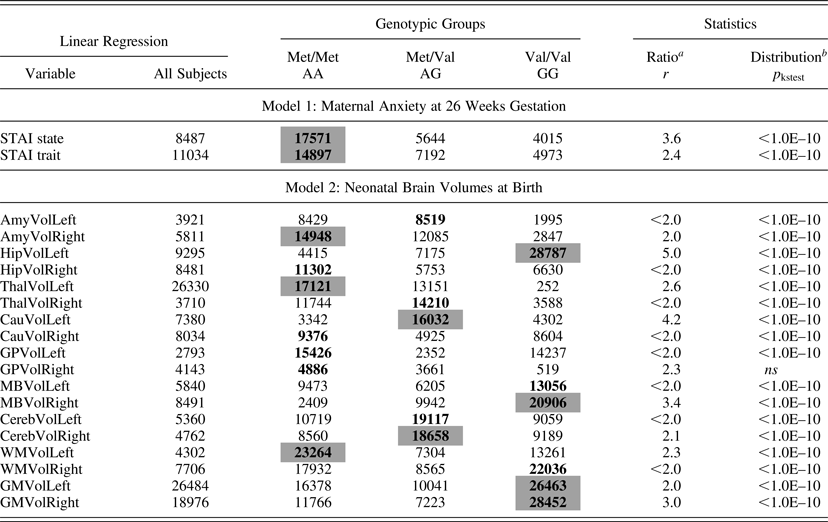
STAI state and trait anxiety were examined at 26 weeks gestation and, as expected, were highly correlated (Pearson r = .84; p < .0001). We then surveyed both state and trait antenatal maternal anxiety against all variable 148,890 CpGs using the linear regression analysis of Model 1 and segregated by infant BDNF Val66Met genotypes. The Met/Met (AA) genotypic group returned a greater number of CpGs that were significantly associated with both trait and state STAI anxiety scores than did either the Met/valine (Val) (AG) or the Val/Val (GG) groups (Figure 1a and Table 2). In both instances, there were a three- to fourfold greater number of cvCpGs associated with antenatal maternal anxiety in umbilical cord samples from Met/Met compared to Val/Val newborns. The numbers of cvCpGs for state anxiety and trait anxiety (Figure 1a) tended to increase with increasing dosage of the methionine allele (i.e., Met/Met > Met/Val > Val/Val). More than 10% of total variable CpGs were significantly covarying with both anxiety scores in Met/Met group, suggesting that antenatal maternal anxiety was a significant source of variation in DNA methylation across the genome among Met/Met carriers.
(Color online) (a) The number of covarying cytosine–phosphate–guanine sites (cvCpGs) for maternal anxiety is disproportionately high in the Met/Met group when subjects are segregated by infant BDNF Val66Met rs6265 genotype (r state = 3.6 and r trait = 2.4). The y axis shows the numbers of differentially methylated cvCpGs in three genotypic groups of BDNF rs6265 for the two measures of prenatal maternal anxiety (State–Trait Anxiety Inventory state and trait anxiety). (b) There is no disproportionate pattern of cvCpGs for maternal anxiety among the genotypic groups, when subjects are segregated by maternal BDNF Val66Met rs6265 genotype (r state = 1.2 and r trait = 1.1).
The numbers of differentially methylated covarying CpGs (p < .05 and methylation range > 15%) in three genotypic groups of infant BDNF Val66Met for the maternal and neonatal variables
Note: The variable values in shaded boxes show a disproportionate pattern for cvCpGs for one of the genotypic groups.
aThe ratio of the number of cvCpGs in the significant genotypic group (bold) to the average number of cvCpGs in other two groups
bThe distribution p kstest is the p value calculated by a two–sample Kolmogorov–Smirnov goodness of fit hypothesis test (one tailed, larger) for the genotypic group with the maximum number of cvCpGs (bold values). The nonsignificant (ns) p kstest > 1.0E-3.
We further explored the influence of maternal anxiety by comparing the number of variably methylated CpGs significantly associated with STAI state versus STAI trait using the models of Meth ~ STAI_state + gender + GA + ethnicity and Meth ~ STAI_trait + gender + GA + ethnicity. We found 6,911 CpGs had p < .05 for STAI_state and 6,445 CpGs had p < .05 for STAI_trait. There were 2,370 CpGs common between the two results sets. This overlap is significantly greater than expected by chance (p < 1.0E-100), but allows for differential effects of the two measures. This finding is consistent with earlier studies emphasizing the importance of maternal trait anxiety (see Introduction) as well as more recent studies documenting the effects of pregnancy-related anxiety (e.g., Buss et al., Reference Buss, Davis, Muftuler, Head and Sandman2010), which might reflect state measures.
It is important that the relationship between antenatal maternal anxiety and infant DNA methylation was affected by infant, but not maternal, genotype (Figures 1a and 1b). These findings reveal that the increased number of cvCpGs among Met/Met infants was not directly inherited through transmission of the maternal BDNF Val66Met genotype, but was a reflection of the interaction of maternal anxiety with infant BDNF genotype.
The p-value distribution for regression of CpG methylation values against STAI state further reflected the strong relationship between methylation and maternal anxiety existing only in the Met/Met group (Figure 2a–c). In the Met/Met group, the p-value distribution was significantly skewed to the left, suggestive of a signal above chance (p kstest < 1.0E-10; Figure 2a). The p-value distributions for the Met/Val and Val/Val groups were flat or even skewed to the right (Figure 2b, c), suggestive of no signal or heteroskedasticity (i.e., differential variability for subpopulations of subjects) in the data set (Barton, Crozier, Lillycrop, Godfrey, & Inskip, Reference Barton, Crozier, Lillycrop, Godfrey and Inskip2013). The distributions of p values for both state and trait (data not shown) anxiety scores were similar. The difference in p-value distributions across the genotypic groups were significantly different when subjected to a Wilcoxin sign test p < 1.0E-100)
(Color online) The distribution of p values in three genotypic groups of neonatal rs6265 for State–Trait Anxiety Inventory state anxiety (a) Met/Met: p kstest < 1.0E-10. (b) Met/Val: p kstest > .9 (c) Val/Val: p kstest > .9 suggest that there is a signal for maternal anxiety in only the Met/Met group.
Neonatal brain volumes are differently associated with disproportionate covariant DNA methylation in BDNF Val66Met genotypic groups
We performed linear regression analysis using brain regional volumes determined by MRI shortly after birth. We included left and right hemispheres for nine brain regions, including the amygdala, caudate, cerebellum, globus pallidus, hippocampus, and thalamus, as well as total white matter, midbrain, and gray matter. Volume data were regressed against all variable CpGs (148,890) separately for three groups of infants defined by BDNF Val66Met genotype, adjusting for total brain volume, ethnicity, and gestational age plus days of life at scan using Model 2 (see Methods Section). Nine of the 18 brain variables had significantly disproportionate numbers of cvCpGs in at least one of the three BDNF Val66Met genotype groups (highlighted in gray boxes in Table 2).
The right volume of amygdala (AmyVolRight) showed disproportionately higher numbers of cvCpGs in the Met/Met group (r AmyVolRight = 2.0 and p kstest < 1.0E-10; Table 2 and Figure 3). In contrast, regression analysis of the left hippocampal volume (HipVolLeft) returned a disproportionately higher number of cvCpGs within the Val/Val genotypic group (Figure 3; r HipVolLeft = 5.0 and p kstest < 1.0E-10). The numbers of cvCpGs gradually increased with the increasing dosage of valine allele (Table 2, Figure 3). Approximately 19% of total variable CpGs were significantly associated with the volume of the left hippocampus for the neonates carrying the Val/Val genotype, while 5% of total variable CpGs were significant in Met/Val and 3% of total variable CpGs were significant in the Met/Met group.
(Color online) The numbers of differentially methylated covarying cytosine–phosphate–guanine sites in three genotypic groups of neonatal rs6265 for brain regions. AmyVolRight: disproportionate pattern in Met/Met (r AmyR = 2.0); HipVolLeft: disproportionate pattern in Val/Val (r HipL = 5.0); Amy, amygdala; Hip, hippocampus.
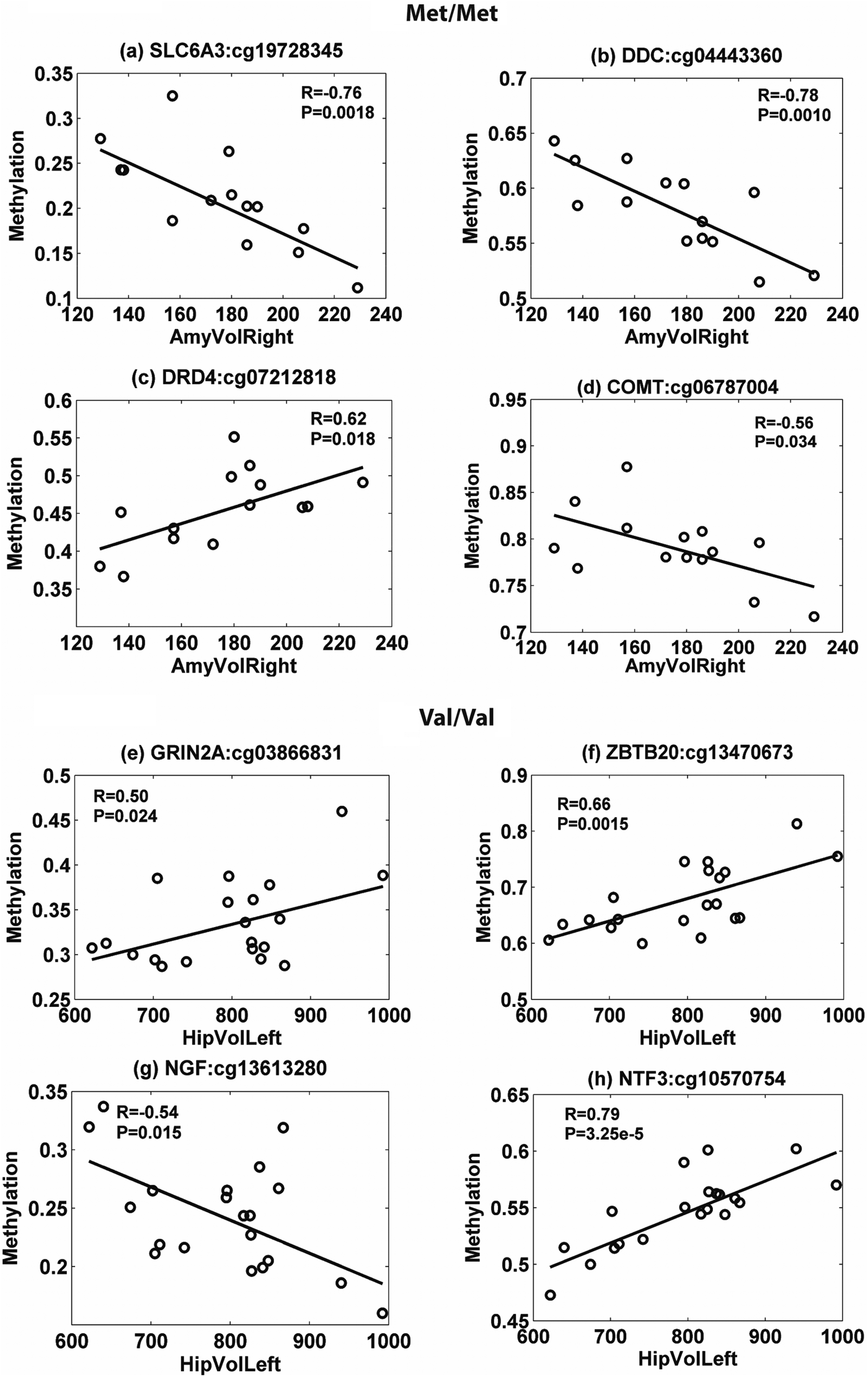
For the purpose of illustration, we selected individual cvCpGs that were selectively associated with the right amygdala volume (AmyVolRight) among Met/Met subjects and with the left hippocampal volume (HipVolLeft) among Val/Val subjects (Figure 4). Genes containing cvCpGs that showed a significant correlation with right amygdala volume included a number of regions that code for products implicated in dopamine signaling, including the dopamine transporter (SLC6A3; 2 cvCpGs), dopamine decarboxylase (DDC; 4 cvCpGs), dopamine receptor D4 (DRD4; 4 cvCpGs), and catechol-O-methyltransferase (COMT; 2 cvCpGs). Genes containing cvCpGs that showed a significant correlation with left hippocampal volume included a number of regions that code for products implicated in hippocampal synaptic development, including the nerve growth factor (NGF; 6 cvCpGs), Zinc Finger and BTB Domain Containing 20 (ZBTB20; 7 cvCpGs), neurotrophin 3 (NTF3; 5 cvCpGs), as well as the genes encoding both the 2A and 2B subunits of the NMDA subtype of the glutamate receptor (e.g., GRIN2A; 5 cvCpGs).
Methylation levels at example covarying cytosine–phosphate–guanine sites (cvCpGs) in Met/Met (AA) and Val/Val (GG) genotypic groups against brain region volumes. Only Chinese subjects are shown. (Top) Scatterplots of selected cvCpG's with AmyVolRight in Met/Met subjects. (Bottom) Scatterplots of selected cvCpG's with HipVolLeft in Val/Val subjects.
Discussion
Our findings reveal that the association between antenatal maternal anxiety and variation in DNA methylation across the genome at birth is strongly affected by infant, but not maternal, Val66Met BDNF genotype. We found evidence for a greater influence of antenatal maternal anxiety on the neonatal epigenome among Met/Met compared to Val/Val carriers, with a trend for a dosage effect of the methionine allele (Figure 1a). Imaging studies with the GUSTO cohort (Qiu et al., Reference Qiu, Rifkin-Graboi, Chen, Chong, Kwek and Gluckman2013; Rifkin-Graboi et al., Reference Rifkin-Graboi, Bai, Chen, Hameed, Sim and Tint2013) reveal that the level of antenatal maternal anxiety predicts variation in volume and microstructure in the neonatal brain regions that are associated with emotional function (Etkin & Wager, Reference Etkin and Wager2007; Meaney, LeDoux, & Leibowitz, Reference Meaney, LeDoux, Leibowitz, Tasman, Kay, Lieberman, First and Maj2008). Here we showed a disproportionate number of cvCpGs in the Met/Met group for right amygdala volume. In contrast, there was a disproportionate number of cvCpGs in the Val/Val group for left hippocampal volume.
The association between antenatal maternal anxiety and neonatal DNA methylation reported here is in contrast to a previously published study examining the potential influence of antenatal maternal depression on DNA methylation using genome-wide analysis with DNA obtained from umbilical cord bloods (Schroeder et al., Reference Schroeder, Smith, Brennan, Conneely, Kilaru and Knight2012). While we focus here on the effects of antenatal maternal anxiety, depressive and anxiety symptoms are often comorbid and there is a high correlation between scores on screening scales of anxiety and depression, such as the Edinburgh Postnatal Depression Scale and the STAI. The contradictory findings can be explained by several critical differences between this earlier study and that reported here. First, our use of the Infinium 450 K array provides analysis of approximately 20-fold higher number of CpGs than the Infinium 27 K array used in the Schroeder et al. study. Second, and most of the importance, the Schroeder et al. study examined variation in CpGs methylation levels associated with the Edinburgh Postnatal Depression Scale across all subjects regardless of genotype and to a statistical significance that passed correction for multiple testing. Our approach differed because we report only the number of CpGs that pass a nominal significance level and instead show that these numbers differ substantially when accounting for infant BDNF Val66Met genotype.
BDNF and differential susceptibility
The BDNF gene is an ideal candidate for differential susceptibility to context, and thus as a plasticity gene. BDNF encodes for a neurotrophin, brain-derived neurotrophic factor that is widely expressed throughout the CNS and often obligatory for experience-dependent synaptic plasticity. Our findings are consistent with previous studies revealing differential susceptibility in carriers of the BDNF Met/Met compared to the Val/Val genotype. Several population-based studies examined the interaction between the BDNF Val66Met polymorphism and early adversity on adult depression (Aguilera et al., Reference Aguilera, Arias, Wichers, Barrantes-Vidal, Moya and Villa2009; Carver, Johnson, Joormann, Lemoult, & Cuccaro, Reference Carver, Johnson, Joormann, Lemoult and Cuccaro2011; Chen et al., Reference Chen, Li and McGue2013; Gatt et al., Reference Gatt, Nemeroff, Dobson-Stone, Paul, Bryant and Schofield2009; Wichers et al., Reference Wichers, Kenis, Jacobs, Mengelers, Derom and Vlietinck2008). The results of these studies suggest that early adversity has a greater impact on the risk for affective disorders in BDNF methionine allele carriers than among those with the Val/Val genotype. Likewise, mice carrying the Met/Met variant show increased anxiety-like behaviors under conditions of stress (Chen et al., Reference Chen, Jing, Bath, Ieraci, Khan and Siao2006). The methionine allele has been shown to increase child sensitivity to both positive and negative familial influences (Hayden et al., Reference Hayden, Klein, Dougherty, Olino, Dyson and Durbin2010). Children with Val/Met or Met/Met genotypes adopted from orphanages exhibited fewer attention regulatory problems than those with Val/Val genotypes when adopted very early and more symptoms when adoption occurred later in development (Gunnar et al., Reference Gunnar, Wenner, Thomas, Glatt, McKenna and Clark2012).
In contrast to these findings of increased evidence for enhanced sensitivity to context among Met/Met carriers, there is also evidence for greater sensitivity among those bearing the Val/Val BDNF Val66Met genotype. Human neuroimaging research demonstrates that methionine allele carriers show a deficit in fear conditioning and impaired aversive memory acquisition relative to Val/Val carriers (Hajcak et al., Reference Hajcak, Castille, Olvet, Dunning, Roohi and Hatchwell2009; Lonsdorf et al., Reference Lonsdorf, Weike, Golkar, Schalling, Hamm and Ohman2010). These findings suggest increased plasticity among Val/Val carriers. Two imaging studies provide direct evidence for increased experience-dependent neuroplasticity among Val/Val carriers of the BDNF Val66Met polymorphism. These studies used neuroimaging to show increased training-dependent plasticity in the motor cortex (Kleim et al., Reference Kleim, Chan, Pringle, Schallert, Procaccio and Jimenez2006; McHughen et al., Reference McHughen, Rodriguez, Kleim, Kleim, Marchal Crespo and Procaccio2010), revealing increased plasticity in Val/Val subjects. There is also evidence of greater stress-induced hypothalamus–pituitary–adrenal activation (Alexander et al., Reference Alexander, Osinsky, Schmitz, Mueller, Kuepper and Hennig2010; Shalev et al., Reference Shalev, Lerer, Israel, Uzefovsky, Gritsenko and Mankuta2009) among Val/Val carriers. Likewise, BDNF Val/Val mice demonstrate a greater stress-induced reduction in social activity compared with Met/Met mice (Krishnan et al., Reference Krishnan, Han, Graham, Berton, Renthal and Russo2007).
Although somewhat speculative, our studies provide a potential explanation for the inconsistent findings in studies comparing Met/Met and Val/Val carriers. There are studies that associate the Met/Met variant of the BDNF Val66Met polymorphism either with anxiety disorders or with anxiety-related endophenotypes, such as harm avoidance (Jiang et al., Reference Jiang, Xu, Hoberman, Tian, Marko and Waheed2005; Montag, Basten, Stelzel, Fiebach, & Reuter, Reference Montag, Basten, Stelzel, Fiebach and Reuter2010). As noted above, transgenic BDNF Met/Met mice manifest increased anxious-like behaviors (Chen et al., Reference Chen, Jing, Bath, Ieraci, Khan and Siao2006). We found a significantly greater number of cvCpGs associated with right amygdala volume among newborns with the Met/Met compared to the Val/Val BDNF genotype. These findings are consistent with earlier reports. For example, carriers of the methionine variant showed stronger amygdala activation in the right hemisphere in response to emotional stimuli compared to neutral stimuli (Lau et al., Reference Lau, Goldman, Buzas, Hodgkinson, Leibenluft and Nelson2010; Montag, Reuter, Newport, Elger, & Weber, Reference Montag, Reuter, Newport, Elger and Weber2008). There is also strong evidence for a selective association between measures of activity in the right amygdala and conditions of anxiety (Etkin & Wager, Reference Etkin and Wager2007). Individuals at risk for anxiety disorders show increased activity in the amygdala (Stein, Simmons, Feinstein, & Paulus, Reference Stein, Simmons, Feinstein and Paulus2007) as do patients with anxiety disorders (Rauch, Savage, Alpert, Fischman, & Jenike, Reference Rauch, Savage, Alpert, Fischman and Jenike1997; Wright, Martis, McMullin, Shin, & Rauch, Reference Wright, Martis, McMullin, Shin and Rauch2003), and there is evidence for selective associations between anxiety and the right insula, which is closely connected to the right amygdala (Buss et al., Reference Buss, Davis, Shahbaba, Pruessner, Head and Sandman2012; Paulus, Rogalsky, Simmons, Feinstein, & Stein, Reference Paulus, Rogalsky, Simmons, Feinstein and Stein2003; Wright et al., Reference Wright, Martis, McMullin, Shin and Rauch2003). Antenatal maternal cortisol levels, presumably reflecting greater maternal distress, are selectively associated with increased right amygdala volume in the offspring during childhood (Buss et al., Reference Buss, Davis, Shahbaba, Pruessner, Head and Sandman2012). We suggest that the disproportionate number of CpGs that covary with antenatal maternal anxiety and right amygdala volume in Met/Met infants (Figures 1a and 3, Table 2) is consistent with the association of this brain region with anxiety-like states.
In contrast, there is a disproportionate number of CpGs that covary selectively with left hippocampal volume in Val/Val infants (Figure 3, Table 2). The studies reviewed above, including those involving fear conditioning, examined hippocampal-dependent forms of learning and memory. The brain-region specific associations of CpGs (right amygdala vs. left hippocampus) in the Met/Met and valine carriers is consistent with the idea that the BDNF genotype of the offspring determines the nature of the effect of maternal anxiety and other uterine environments on the epigenome and neurodevelopment of the offspring. We suggest that the confusion in the literature concerning the apparent differential susceptibility of the Met/Met and Val/Val genotypes occurs because of the different neural structures or systems under study. Our findings suggest that the evidence for greater sensitivity to antenatal maternal anxiety at the level of the epigenome among Met/Met or Val/Val carriers is dependent upon whether we considered variation in DNA methylation that also covaried with neonatal hippocampal or amygdala volume. Thus, differential susceptibility to context associated with the Val66Met polymorphism is likely to depend upon the specific neural function under study: we should not expect that variants in genes that mediate neuroplasticity will necessarily reveal uniform differential susceptibility regardless of the nature of the functional outcome and the underlying neural systems.
BDNF biology
An obvious question concerns the biology underlying the potential diversity of effects associated with the Val66Met BDNF polymorphism. BDNF acts as a trophic factor that moderates activity-dependent synaptic strength throughout the CNS. Thus, the specificity of the effect of maternal anxiety is unlikely to be only associated with factors that underlie BDNF signaling. BDNF acts within the synaptic context in concert with multiple neurotransmitter systems, such that the specificity of a BDNF effect is defined by signaling partners that are commonly classical neurotransmitter systems. Therefore, the impact of BDNF polymorphisms is moderated by variants of genes that moderate local neurotransmitter signaling. Hunnerkopf, Strobel, Gutknecht, Brocke, and Lesch (Reference Hunnerkopf, Strobel, Gutknecht, Brocke and Lesch2007) report an interaction effect of BDNF Val66Met and a variation on the dopamine transporter gene (DAT) on “harm avoidance.” Other studies report interaction effects of BDNF Val66Met and the SLC6A4 polymorphism on serotonin-dependent emotional states such as depression (Kim et al., Reference Kim, Cheon, Koo, Ryu, Lee and Chang2007; Martinowich & Lu, Reference Martinowich and Lu2008), obsessive–compulsive disorder (Wendland, Kruse, Cromer, & Murphy, Reference Wendland, Kruse, Cromer and Murphy2007) and a three-way interaction effect of BDNF Val66Met, the SLC6A4 polymorphism, which affects the transcription of the serotonin transporter mRNA, and child adversity on depressive symptoms (Wichers et al., Reference Wichers, Kenis, Jacobs, Mengelers, Derom and Vlietinck2008). Because synaptic plasticity occurs as a function of multiple, interacting signals, each potentially affected by numerous sequence variants, regional variation in the influence of the Val66Met polymorphism might be expected. Although qualitative, we found that the Met/Met variant was often associated with differential DNA methylation in genes associated with dopamine signaling, while the Val/Val variant was more so associated with genes that encode for products that directly regulate synaptic strength (e.g., NGF).
Limitations and implications
This study has a number of caveats. While our sample size is comparatively large for studies of Genotype × Environment interactions on the epigenome, it is seriously underpowered as an epigenome-wide association study (Rakyan, Down, Balding, & Beck, Reference Rakyan, Down, Balding and Beck2011). Our study was designed to examine the determinants of variation in DNA methylation across the genome and not to identify individual, specific candidate CpG methylation sites that associate with a phenotypic outcome (e.g., Davies et al., Reference Davies, Krause, Bell, Gao, Ward and Wu2014 and Schroeder et al., Reference Schroeder, Smith, Brennan, Conneely, Kilaru and Knight2012). The associations between individual cvCpG and brain volume are intended to compliment the analysis, suggesting differential effects of antenatal maternal anxiety as a function of the Val/Val and Met/Met BDNF genotypes, and not to imply causal relations between DNA methylation at any particular site and brain volumes. Although DNA methylation commonly associates with changes in transcription, our data set does not permit confirmation of the functional importance of the individual cvCpGs. Instead, our paper describes analyses of a unique data set to examine the origins of variability across the human methylome. The findings reveal evidence for a clear association with antenatal maternal emotional well-being and interaction with infant genotype. Moreover, the capacity to examine multiple outcomes in the same individuals reveals that candidate “plasticity genes” may have diverse effects that depend upon the target neural function and should not necessarily be considered as exerting a universal influence of susceptibility to context. This conclusion bears potential significance for the study of differential susceptibility within the context of treatments, including intervention programs. If the effects of Gene × Environment interactions are brain-region and thus function specific, as might seem reasonable to assume, then we should not expect that genotype will not exert a common influence on treatment outcomes independent of the targeted neural system or function. The results of Gene × Environment studies of intervention outcomes are likely to vary depending upon the outcome under study.