Introduction
The Catalogue of the Flowering Plants and Gymnosperms of Peru (Brako & Zarucchi, 1993) recognises 76 species of Peruvian Begonia, 38 of which are endemic. Since 1993 this number has grown slightly with the publication of two additional endemic species (Tebbitt, Reference Tebbitt2011, Reference Tebbitt2015a) and one range extension that newly includes Peru (Tebbitt et al., Reference Tebbitt, Toapanta and Pérez2015). Recent herbarium studies and fieldwork have identified two additional new species, one of which is also suspected to grow in Bolivia but apparently has not been collected there. Begonia urubambensis is endemic to southern Peru, being known only from the Cusco Region. Begonia heliantha has been collected in Sandia Province (Puno Region) in southern Peru, and has also tentatively been identified from photographs taken in Bolivia’s Sud Yungas Province (La Paz Department).
Begonia heliantha is here classified in B. sect. Eupetalum (Lindl.) A.DC., which is composed of perennating herbs with perennial tubers or fleshy rhizomes and relatively large flowers restricted to the Andes (Doorenbos et al., Reference Doorenbos, Sosef and De Wilde1998; Tebbitt et al., Reference Tebbitt, Toapanta and Pérez2015). This species is notable among Andean Begonia in having yellow tepals, and is the first yellow-flowered Begonia known to occur in Peru. Only six yellow-flowered Andean Begonia species (out of an estimated c.150 total species [Tebbitt, unpublished]) have been described previously, all of which are currently classified in B. sect. Eupetalum (Tebbitt, Reference Tebbitt2015b). Little is currently known regarding the phylogenetic relationships of these species but it is suspected, based on the considerable morphological differences within this group, that yellow flowers originated in Andean Begonia on at least two separate occasions (Tebbitt, Reference Tebbitt2015b). Begonia heliantha is likely closely related to at least some of the yellow-flowered species from Bolivia and neighbouring northern Argentina, and is particularly similar in morphology to B. pearcei Hook.f. and B. chrysantha Tebbitt. Begonia heliantha shares with these two species vegetative parts with an indumentum of hairs, an upper leaf surface with very pale green main veins and intervenal lamina infused with bronze-green, and similar-shaped tepals in both the male and female flowers. All three species also occupy a distinct microhabitat on moist, shaded, moss-covered cliff faces.
Begonia urubambensis belongs to a group of 10 Andean species (also including: B. acerifolia Kunth, B. arrogans Irmsch., B. erythrocarpa A.DC., B. leathermaniae O’Reilly & Kareg., B. ludwigii Irmsch., B. serotina A.DC., B. triramosa Irmsch., B. velata L.B.Sm. & B.G.Schub., and B. wollnyi Herzog) that are currently classified in the polyphyletic B. sect. Knesebeckia (Klotzsch) A.DC. This group of 10 Andean species is herein referred to as the B. acerifolia group. Molecular data (Moonlight et al., Reference Moonlight, Richardson, Tebbitt, Thomas, Hollands, Peng and Hughes2015) indicate that the B. acerifolia group (represented in Moonlight et al. [Reference Moonlight, Richardson, Tebbitt, Thomas, Hollands, Peng and Hughes2015] by B. ludwigii) is only distantly related to the type species of B. sect. Knesebeckia – B. incarnata Link & Otto (a species native to Mexico) – and instead is closely related to B. sect. Eupetalum. Begonia sect. Knesebeckia as currently circumscribed in Doorenbos et al. (Reference Doorenbos, Sosef and De Wilde1998) is, therefore, polyphyletic. Ongoing molecular and morphological studies (Moonlight et al., unpublished) aim to better circumscribe the B. acerifolia group and in particular determine how it can be distinguished from B. sect. Eupetalum.
The species in the B. acerifolia group and in B. sect. Eupetalum are unusual among Begonia in typically being adapted to relatively high altitudes and seasonally dry environments. Morphologically the species in these two groups are relatively similar to one another compared with other Andean Begonia but the mechanism by which the species in the two groups survive seasonal dry periods and/or cold temperatures is, however, different. This suggests that they likely represent distinct but closely related evolutionary lineages. In members of B. sect. Eupetalum the above-ground parts die back during dry or cold periods and these species perennate via tubers or swollen rhizomes. In contrast, the members of the B. acerifolia group lack tubers or swollen rhizomes, have perennial above-ground stems that tend to be woodier and thicker than those of most Begonia, and temporarily lose their leaves during the dry season (Tebbitt, unpublished). Thus the members of the B. acerifolia group rely on energy reserves stored in their above-ground stems to survive periods of drought. Begonia urubambensis is morphologically more similar to the members of the B. acerifolia group than it is to the species classified in B. sect. Eupetalum. However, this new species differs from the rest of the B. acerifolia group by being acaulescent (members of B. sect. Eupetalum may be either acaulescent or caulescent). It is not known if the leaves of B. urubambensis persist year-round or if they are deciduous. If the latter is the case then the species’ rhizome likely acts as a perennating organ. If this is the case then the perennating rhizomes of B. urubambensis likely arose independently from similar perennating organs found in members of B. sect. Eupetalum, since B. urubambensis appears to be a relatively derived member of the B. acerifolia group.
Begonia urubambensis is most similar in terms of its overall appearance to B. serotina A.DC. This general resemblance is due in particular to their very similar leaf morphologies. In both species the leaves are peltate, of a similar size and shape, and are glabrous to puberulent. The distribution of B. urubambensis is, however, considerably disjunct from B. serotina, the closest populations of which occur over 1280 km to the northwest in the Tumbes Region of Peru. Given this large disjunction, and the fact that B. urubambensis shares even more characters (though less obvious ones) with the sympatrically distributed B. erythrocarpa A.DC., it appears that B. urubambensis is more closely related to B. erythrocarpa than it is to B. serotina. Characteristics shared by B. urubambensis and B. erythrocarpa but not other members of the B. acerifolia group include relatively few flowers per inflorescence (B. urubambensis and B. erythrocarpa have fewer than 15 flowers per inflorescence, while B. serotina has 20–50 flowers per inflorescence), globose anthers (B. serotina has obovoid anthers), tepals that do not persist in fruit (the tepals of B. serotina remain attached to the dehiscent fruit), and unequal fruit wings (B. serotina has subequal fruit wings). Furthermore, while the leaves of Begonia erythrocarpa usually differ from those of B. urubambensis and B. serotina by usually having lobed margins and a dense indumentum of hairs, its leaves, in common with B. urubambensis and B. serotina, are often peltate (a character state that is otherwise rare in Andean Begonia). However, while Begonia urubambensis and B. serotina always have peltate leaves, B. erythrocarpa individuals may have either peltate or basifixed leaves. Begonia erythrocarpa has a distribution that overlaps that of both B. urubambensis and B. serotina (although B. erythrocarpa has never been observed to co-occur with either of these species at the same site). Given this distribution pattern and the pattern of morphological variation found in these three taxa, it is suggested that the ancestor of Begonia erythrocarpa was perhaps the progenitor of both B. serotina and B. urubambensis. Ongoing molecular studies (Moonlight et al., unpublished) aim to test this hypothesis. Because the members of the B. acerifolia group will require a future change to their sectional classification this new species is not herein assigned to a section.
Taxonomic Treatment
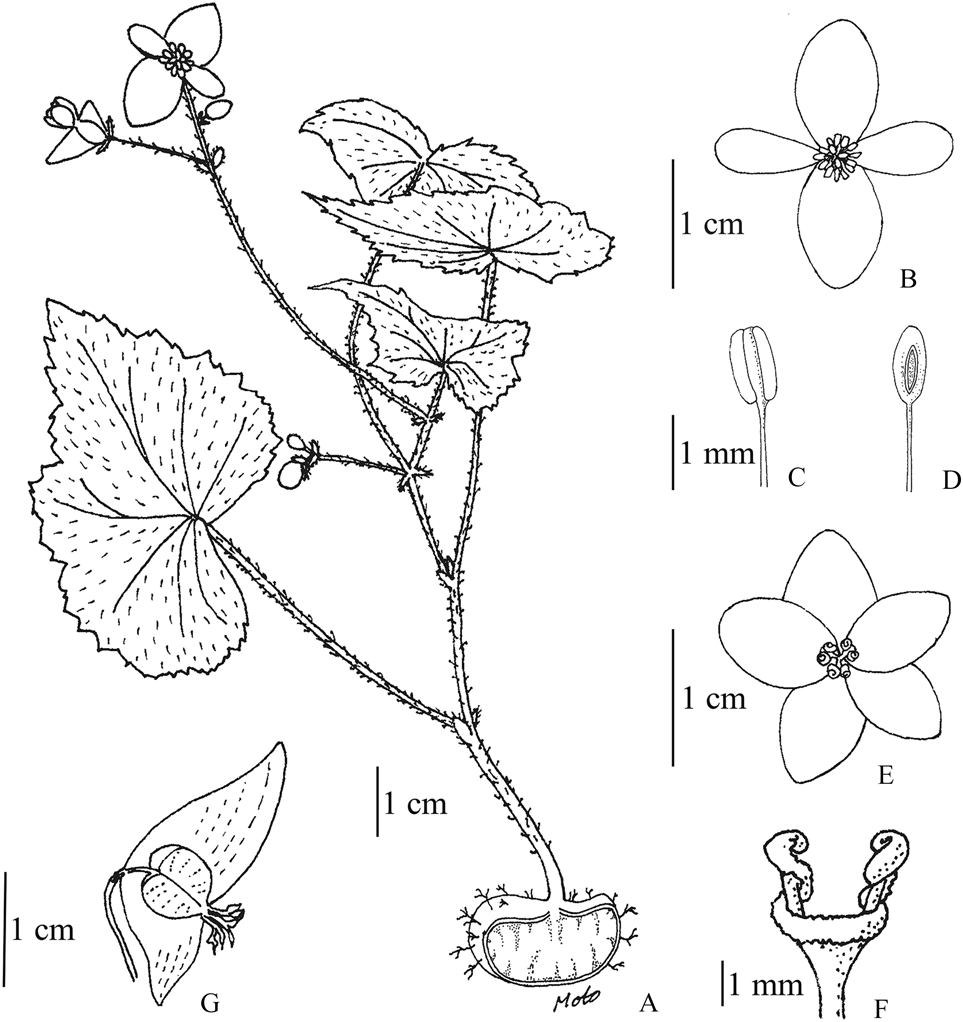
Begonia heliantha Tebbitt, sp. nov. Sect. Eupetalum. Figs 1, 3.
Begonia heliantha Tebbitt is closely allied to B. pearcei Hook.f. and B. chrysantha Tebbitt but differs from both these species by having an indumentum of glandular hairs on its stem, petioles and peduncles (B. pearcei and B. chrysantha have an indumentum of non-glandular hairs), by its paired bracteoles at the base of the ovaries (B. pearcei and B. chrysantha lack bracteoles), and by its bright yellow tepals (B. pearcei has pale yellow tepals, while B. chrysantha has golden yellow tepals). – Type: Peru, Puno Region, Prov. Sandia, entre Sandia y Tambopata, Vargas 16417-A (holo US; iso CUZ [2]).
Begonia heliantha Tebbitt. A, habit; B, male flower; C, stamen (front view); D, stamen (side view); E, female flower; F, style; G, mature fruit. A–E drawn from Vargas 16417-A (CUZ), F drawn from Vargas 16417-A (US).

Caulescent, tuberous herb. Tuber ellipsoid, 1.1–2.5 cm in diameter. Stem erect, 4.5–10 cm tall, unbranched, internodes 1.5–3.1 cm long, sparsely glandular pubescent. Stipules persistent, ovate, 1–3.5 × 0.5–2 mm, apex acute ending in a 1.5–2.5 mm long hair, margin fimbriate. Leaves: 3 to 6, alternate, basifixed; petiole joining blade at an angle, 1.7–5 cm long, densely glandular pubescent, hairs c.0.75–1 mm long; blade asymmetric, ovate, 2.5–5.1 × 1.6–3.5(–4.1) cm, apex long acute, base cordate, basal lobes spreading and not overlapping, sinus 0.5–1 cm deep, margin shortly lobed, lobes triangular-crenate, lobes themselves dentate, lobes 2–5 mm deep, teeth 0.25–1 mm long, upper surface green with pale whitish green veins, intervenal lamina usually with patches of bronze-green, lower surface paler green, upper surface moderately pubescent, hairs non-glandular, 0.5–2 mm long, lower surface veins densely pubescent, intervenal lamina moderately pubescent, hair morphology as on upper surface, veins palmate, 7 to 9. Inflorescences 1 to 3, axillary, erect, cymes, up to twice-branched, few-flowered, male flowers opening first but soon female flowers also opening so that both present concurrently; peduncle 5–8 cm long, moderately pubescent, hairs glandular as in petioles but up to 1 mm long; pedicels of male flowers 0.3–1.3 cm long, moderately pubescent, hairs c.0.5 mm long, glandular; pedicels of female flowers 1–1.4 cm long, moderately pubescent, hairs c.0.5 mm long, glandular; bracts persistent, lower pair obovate or ovate, 1.25–3.5 × 0.5–2 mm, apex rounded, margin ciliate with glandular hairs, hairs 0.25–0.5 mm long, surfaces glabrous; upper bracts ovate, 1.5–2 × 0.75–1 mm, apex acute, margin ciliate, hair morphology as in lower pair of bracts, surfaces glabrous. Male flowers: tepals 4, spreading, bright yellow, outer pair elliptic to ovate, 0.8–1.4 × 0.5–1.1 cm, apex obtuse, margin entire, surfaces glabrous; inner pair narrowly obovate, 0.8–1.1 × 0.3–0.5 cm, apex obtuse, margin entire, surfaces glabrous; stamens c.25 to 35, attached along the length of a c.1 mm tall torus, filaments 1–2 mm long, anthers symmetrically basifixed, cuboid, c.1 mm long, dehiscing via lateral slits along each locule, connectives not projecting. Female flowers: bracteoles paired at base of ovary, deciduous, lanceolate to lanceolate-ovate, c.2 × 1 mm, apex acute, margin ciliate, surfaces moderately pubescent, hairs non-glandular; tepals not persisting in fruit, 5, spreading, bright yellow, ovate, elliptic or ovate-elliptic, subequal, 0.6–1.2 × 0.4–0.5 cm, apex obtuse, margin entire, surfaces glabrous; ovary body ellipsoid to almost spherical, 3–9 × 3–5 mm, glabrous, unequally 3-winged, longest wing triangular, apex acute to obtuse, 0.5–1 × 0.3–1.2 cm, shorter 2 wings triangular, apex acute, 3–5 × 3–5 mm; 3-locular, placentas not observed; styles 3, free to base, c.4 mm tall, bifid, branches erect, stigmatic papillae in a spiral band. Fruiting pedicel c.3 cm long. Mature dehiscent fruit subnutant, body broadly ellipsoid, to 9 × 5 mm, longest wing triangular, to 1.3 × 0.7 mm, shorter two wings triangular, to 7 × 7 mm.
Phenology. Flowering and fruiting from February to August.
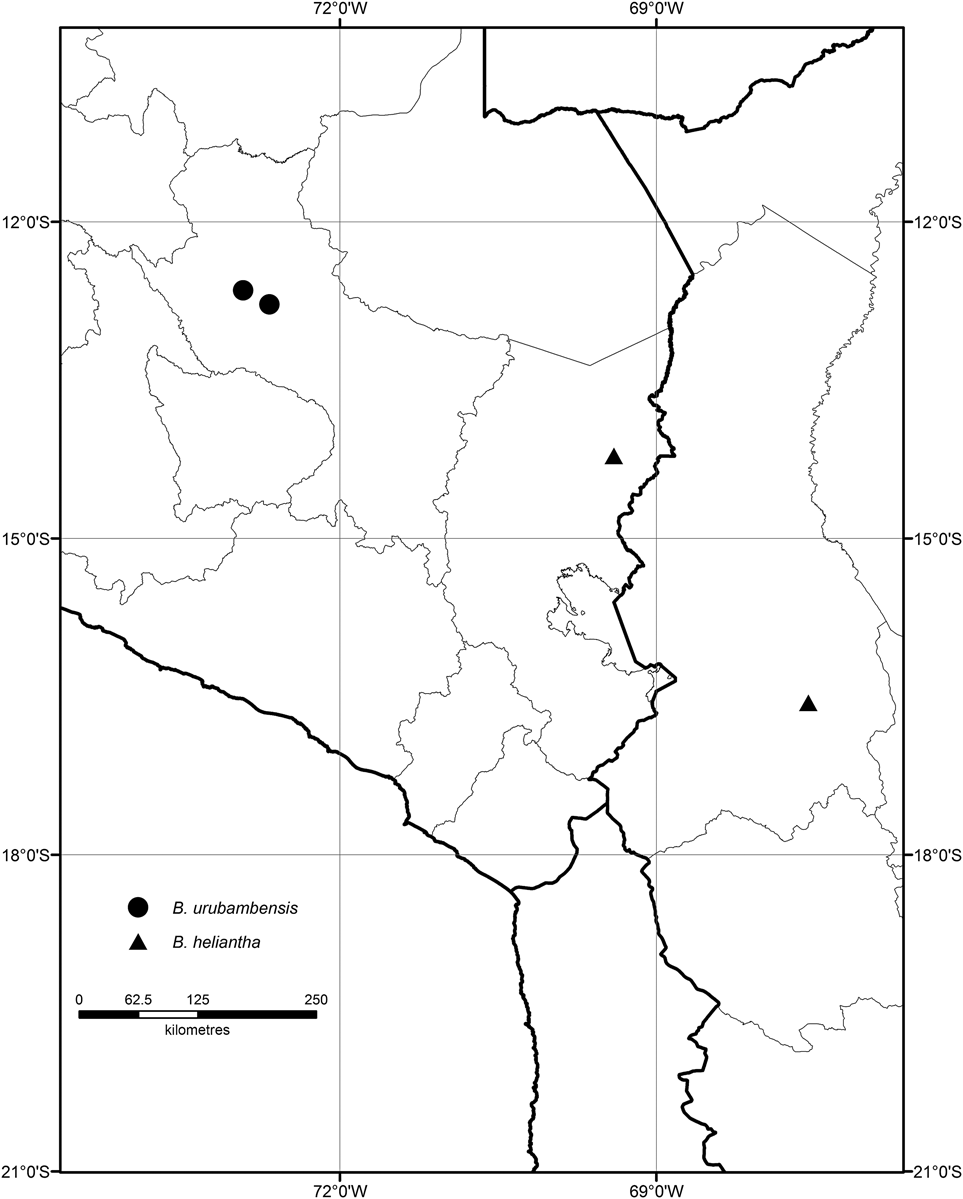
Distribution. Southern Andean Peru (Puno Region) and probably northern Andean Bolivia (La Paz Department).
Habitat. Moist south-facing slopes below overhanging rocks at an elevation of 1600 to 2200 m.
IUCN conservation category. Begonia heliantha has been collected from a short stretch of roadside cliff NE of the town of Sandia (Puno Region) in southern Andean Peru. I have also examined photographs of what appears to be this species taken 275 km to the SE near the town of Chulumani (Sud Yungas Province, La Paz Department), Bolivia. I have not had the opportunity to observe Begonia heliantha in the wild, being unable to relocate this species when I visited its known location in Sandia Province in January 2015. Accordingly I assess Begonia heliantha as Data Deficient (DD), according to IUCN criteria (IUCN Standards and Petitions Subcommittee, 2014).
Etymology. Begonia heliantha is named for the species’ bright yellow sun-like flowers.
Additional specimens examined. Peru. Puno: Sandia Province, c.17 km on road below Sandia, 14°13′S, 69°24′W, R.T. Pennington, T.D. Pennington & A. Daza 1113 (E, K).
Notes. Begonia heliantha is similar to B. pearcei and B. chrysantha but differs from both these species by having an indumentum of glandular hairs on its stem, petioles and peduncles (B. pearcei and B. chrysantha have an indumentum of non-glandular hairs), by its paired bracteoles at the base of the ovaries (B. pearcei and B. chrysantha lack bracteoles), and by its bright yellow tepals (B. pearcei has pale yellow tepals, while B. chrysantha has golden yellow tepals). In addition Begonia heliantha differs from B. pearcei in its denser indumentum of hairs, its cuboid anthers (B. pearcei has obovoid anthers), its unbranched stem (B. pearcei has a few-branched stem), its stipules with fimbriate margins (B. pearcei has entire stipule margins), and its smaller parts (e.g. the leaf blades of B. heliantha are 2.5–5.1 × 1.6–4.1 cm, while those of B. pearcei are 6–10.5 × 3.5–8 cm). In addition Begonia heliantha differs from B. chrysantha in the colour of its hairs (B. heliantha has white hairs, while those of B. chrysantha are either white in their upper half and red in their lower half or red throughout), its smaller stipules (1–3.5 mm long in B. heliantha vs. 5–10 mm long in B. chrysantha), and its green leaf undersurfaces (B. chrysantha has purple leaf undersurfaces).
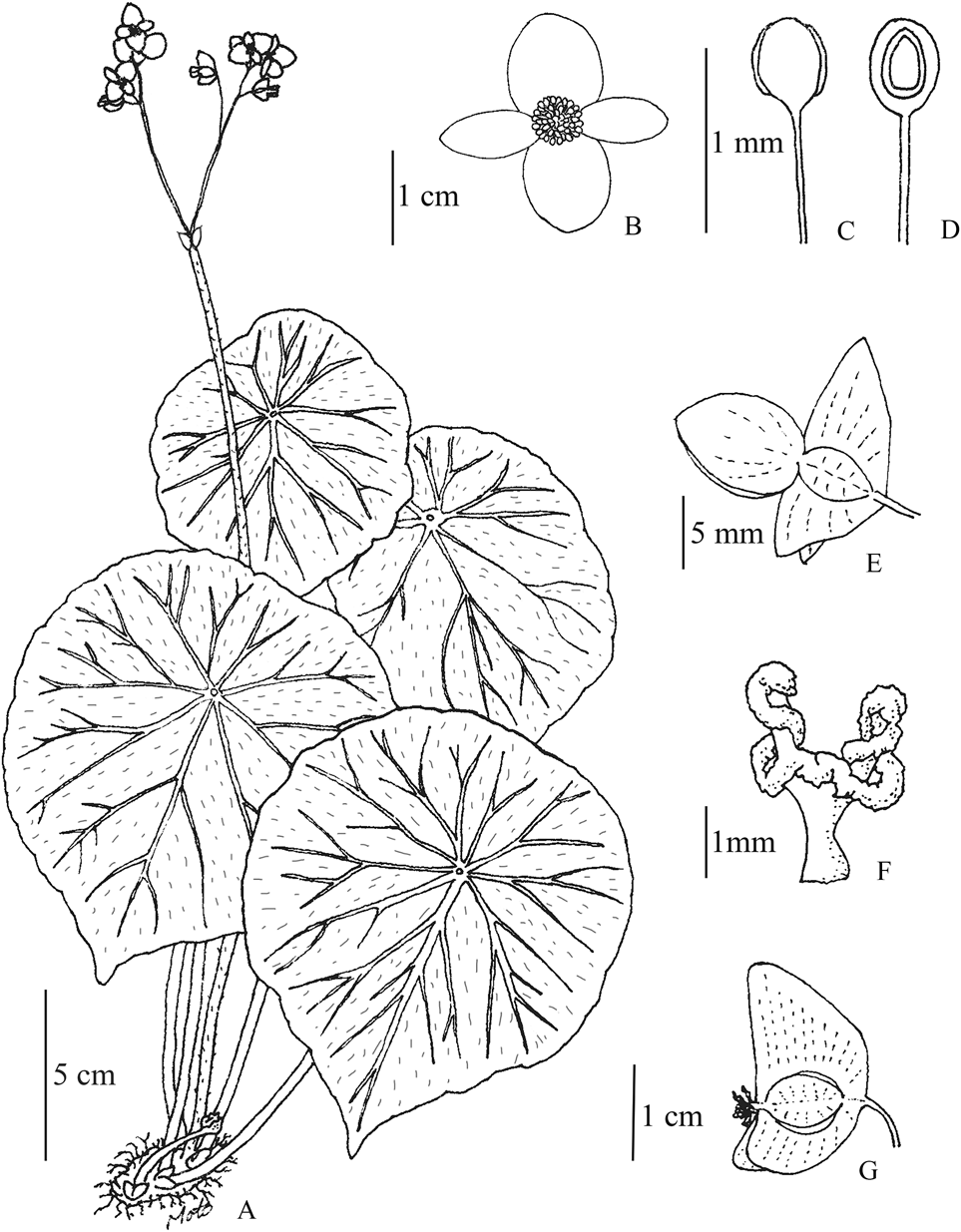
Begonia urubambensis Tebbitt, sp. nov. Sect. unassigned. Figs 2, 3.
Begonia urubambensis Tebbitt is similar to Begonia erythrocarpa A.DC. and B. serotina A.DC. but differs from both these species by lacking an aerial stem, by its more asymmetrical inflorescences, and by its inner pair of male tepals being elliptic. – Type: Peru, Cuzco Region, La Convencion, Distrito Echarate, Kiteni y alrededores del margen izquierda del río Alto Urubamba, 12°47′S, 72°40′W, P. Núñez, M. Palma & J. Arque 10092 (holo CUZ; iso MO, US).
Begonia urubambensis Tebbitt. A, habit; B, male flower; C, stamen (front view); D, stamen (side view); E, female flower (side view); F, style; G, mature fruit. Drawn from Valenzuela et al. 6652 (US, USM).
The distributions of Begonia urubambensis Tebbitt in southern Peru and B. heliantha Tebbitt in southern Peru and northern Bolivia.
Acaulescent herb, with a short fleshy rhizome 1–4 cm long. Stipules deciduous, narrowly lanceolate to lanceolate, 3–5 × 1.5–2 mm, apex acute, margin entire. Leaves c.4, alternate, peltate; petioles 10–30 cm long, glabrous; blade ovate-orbicular, 7–18 × 13–17 cm, apex acuminate, margin minutely crenate toothed, upper surface mid-green, lower surface greyish-green, veins same colour as lamina or sometimes pink tinged, raised below, upper surface with a moderate cover of minute short stiff hairs, lower surface glabrous, veins 7 to 9. Inflorescence 1 or 2, an asymmetric cyme, erect, up to 4-branched, majority of flowers male, male and female flowers open concurrently; peduncle 30–40 cm long, sparsely pubescent, hairs simple, c.0.5 mm long; pedicels of male flowers 0.3–1.5 cm long, glabrous; pedicels of female flowers c.1.5 cm long, glabrous; bracts deciduous, lower bracts oblong-elliptic, 5–8 × c.2 mm, apex acute and shortly apiculate, margin entire, upper bracts not observed. Male flowers: tepals 4, spreading, white, outer pair broadly ovate or broadly elliptic, 1.1–1.3 × 0.8–1.1 cm, apex obtuse, margin entire, surfaces glabrous, inner pair elliptic, 1.1–1.3 cm × c.5.5 mm, apex obtuse, margin entire, surfaces glabrous; stamens c.50, attached directly to receptacle, filaments c.3 mm long, free to base, anthers slightly asymmetrically basifixed, globose, 0.5–0.75 mm long and wide, dehiscing via short slits along sides of locules, connective not projecting. Female flowers: bracteoles absent, tepals not persisting in fruit, spreading, 5, white, outermost broadly elliptic, c.6 × 4.5 mm, apex obtuse, margin entire, glabrous, inner tepals not observed; ovary body ellipsoid, 4–5.5 × 3–5 mm, glabrous, unequally 3-winged, longest wing triangular-oblong, c.9 × 5.5 mm, shorter two wings c.4 × 5.5 mm, triangular; 3-locular, placentas not observed; styles 3, free, c.3 mm long, bifid from c.1 mm above base, branches erect, stigmatic papillae in a once spiral band. Fruiting peduncle to 40 cm long, subnutant, fruiting pedicel to 3.5 cm long, body broadly ellipsoid to almost spherical, to 1 × 0.85 cm, glabrous, wings same shape as in ovary, longest wing to 2 × 1.5 cm, shorter two wings to 1.3 × 1.45 cm.
Phenology. Flowering and fruiting in February and March.
Distribution. Southern Andean Peru (Cusco Region).
Habitat. Growing on steep rocky cliffs in shady situations above the Río Urubamba at an elevation of 700 to 1310 m.
IUCN conservation category. Begonia urubambensis is known only from a short stretch of roadside cliff located between Palma Real and Kiteni (Cusco Region) in southern Andean Peru, where it is locally abundant. The species’ small population size (less than 10,000 individuals composed of subpopulations with less than 1000 individuals), limited area of occupancy (less than 10 km2) and the fact that its unprotected roadside habitat could potentially be degraded by future roadwork place this species in the IUCN category of Vulnerable (VU-D2) (IUCN Standards and Petitions Subcommittee, 2014).
Etymology. Begonia urubambensis is named after the Urubamba River. The species is known only from rocky slopes above this river.
Additional specimens examined. Peru. Cusco: La Convencion Province, río Manguriari (Manguyari), Alto Urubamba upstream to río Manguriari, 12°47′S, 72°40′W, P. Nunez & G. Ortiz 12802 (USM); La Convención Province, Echarate District, San Antonio, 12°39′S, 72°55′W, L. Valenzuela, J. Farfán & I. Huamantupa 6652 (MO, US, USM); La Convención Province, Echarate District, 3–4 km south of Palma Real to Kiteni, M.C. Tebbitt & A. Daza Y. 800 (E, MOL, USM).
Notes. Begonia urubambensis is similar to B. erythrocarpa and B. serotina but differs from both these species by lacking an aerial stem, by its more asymmetrical inflorescences, and by its inner pair of male tepals that are elliptic (versus obovate in B. erythrocarpa and spatulate in B. serotina). In addition Begonia urubambensis differs from B. erythrocarpa by its unlobed leaf margins and its less dense indumentum of hairs on the leaves, peduncles and pedicels. Begonia urubambensis differs from B. serotina by its deciduous female tepals (the female tepals of B. serotina persist in fruit), its unequal fruit wings (the fruit wings of B. serotina are subequal), its longest fruit wing being oblong with an obliquely rounded apex and up to 2 cm long (the longest fruit wing in B. serotina is subdeltoid and up to 1.5 cm long), and its leaf blade margins with minutely crenate teeth (those of B. serotina are denticulate, or rarely serrately toothed).
The GPS data on the specimen Nunez & Ortiz 12802 (USM) appears to be in error. This GPS location does not match the description of the collecting location. A search of the locality indicated by the GPS data was unsuccessful in finding either the species or suitable habitat, whereas the species was located at the site described on this sheet.
Acknowledgements
I thank the curators of AAU, B, BKL, BM, BR, BRIT, C, CAS, CGE, COL, CPUN, CUZ, E, E-GL, F, G, GB, G-DC, G-DEL, GH, GOET, HOXA, HUT, K, LIL, LPB, MEDEL, MO, MOL, MOL-WEB, NY, OXF, P, QCA, QCNE, QPLS, S, SEL, TEX, UC, US, USM, USZ, W and Z for loaning material or allowing me to work in their herbaria. I am grateful to Aniceto Daza (MOL) for his assistance in the field, to Peter Moonlight for his comments on a draft of the manuscript and for providing me with photographs of living and herbarium material of Pennington et al. 1113, and to Dominique Permingeat for providing me with photographs of Begonia cf. heliantha taken in Bolivia. I thank the Ministerio del Ambiente del Perú for granting me permission to conduct the fieldwork and collect specimens, and the American Begonia Society for funding the fieldwork.