Introduction
Pisa syndrome or pleurothotonus, is a delayed axial dystonia characterised by trunk rotation, lateral flexion and the head to one side Reference Suzuki and Matsuzaka1. It has usually been thought to be due to medications, mostly antipsychotics; for this reason it is named secondary Pisa syndrome (SPS) Reference Suzuki and Matsuzaka1. Female gender, old age and organic brain disorders are considered its most common risk factors Reference Villarejo, Camacho and García-Ramos2. Normal pressure hydrocephalus, on the other hand, is a complex and prevalent, albeit potentially reversible, disorder causing dementia in the geriatric population Reference Hakim and Adams3. It is characterised by abnormal gait, urinary incontinence and behavioural disturbances, described by the Colombian physician Salomon Hakim, in 1965 Reference Hakim and Adams3. The annual incidence found in recent surveys performed in Germany and Norway was in between 1.8/100 000 and 5.5/100 000 inhabitants, and the prevalence was 22/100 000 Reference Pereira Damasceno4. We report a case of reversible sporadic truncal dystonia, with typical findings of primary Pisa syndrome (PPS), in a young Colombian patient suffering idiopathic normal pressure hydrocephalus (iNPH).
Methods and results
A 26-year-old, male patient, without past medical history of cerebrovascular, infectious or traumatic disease, presented labile mood, short-term memory disorders, personality changes which turned to be compulsive, hyperarousal, isolation and no fear at age 23. Depression was initially diagnosed, and then paranoid schizophrenia was considered by some family physicians that took care of him elsewhere. In the following year, the patient developed gait and balance disturbances and a lean to the right while standing; then, left arm dystonia, distal tremor in upper limbs and loss of balance were noted. By that time, urinary and fecal incontinence as well as severe insomnia became evident. Five milligrams of olanzapine was prescribed by private clinical neurologist, confirmed by general psychiatrics, with no improvement of clinical symptoms at all. Rehabilitation was never considered by clinicians.
Neurological exam performed by our group, 3 years after disease starting revealed ideomotor apraxia, and the mini-mental state examination validated for spanish-speaking countries Reference Leon-S, Pradilla, Villamil, Vesga and Dallos5 was 17/30; attention and calculation, orientation to place and complex demands were impaired. Likewise, the patient reported anosmia since the beginning of the disorder. He had decreased pin-prick and facial palsy in left hemiface, stage II in the House Brackmann scale, cogwheel rigidity in upper limbs and left leg, left laterocolis and postural tremor in hands. Generalised brisk reflexes, bilateral patellar clonus, positive glabella and billateral marinesco signs were also present; fundoscopia was normal. In addition, Pisa syndrome and ‘magnetic gait' was observed. Sequels or current brain trauma, stroke, infectious disease or any other parenchymal cerebral lesion were ruled out by medical history, neuroimaging and at clinical exam.
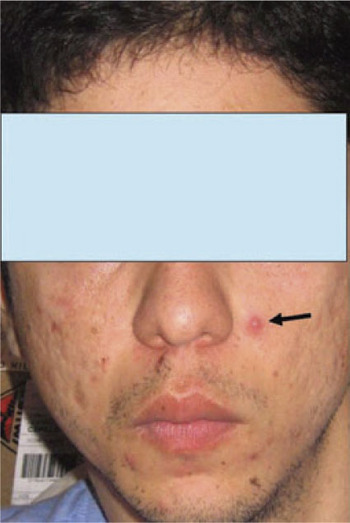
Since the beginning of these medical complaints the patient developed papules and plaques in face, trunk and limbs histologically reported as granulomatous dermatitis (Fig. 1).
Granulomatous dermatitis (arrow) present since the beginning of the disease.

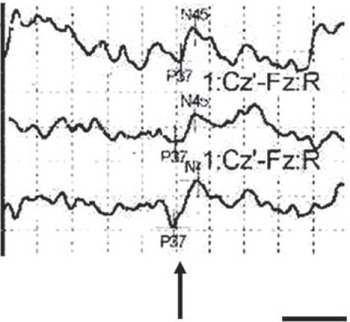
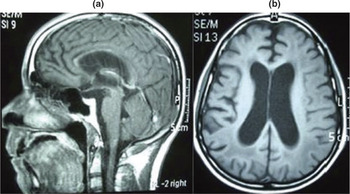
Functional neurological studies were performed following methodologies explained elsewhere Reference Leon-S, Gomez, Kimura, Toro, Yepes and Palacios6. Briefly, electrically elicited blink reflexes at supraorbital nerves and recorded in the orbiculari oculi muscles bilaterally were performed with patient's eyes open; they showed instability of late responses (R3) as well as an early contralateral left R1 response Reference Leon-S, Arimura, Sonoda, Arimura and Osame7; left to right difference of somatosensory cortical N20 latencies, obtained by left and right median nerve stimulation was found (left N20: 22.9 ms, right N20: 19.8 ms); latencies and amplitudes elicited by left tibial nerve stimulation were also abnormal (Fig. 2); F waves persistence in left median and tibial nerve was 5%; Conventional electroencephalography was unspecific. More importantly, magnetic resonance imaging of the brain displayed generalised cerebral atrophy and ventricles enlargement (Fig. 3); stroke, trauma or infectious diseases were ruled out by neuroimaging as well.
Somatosensory evoked potentials recorded at somatosensory cortex after stimulating left tibial nerve. The three traces show the reproducibility of the latency prolongation, and low amplitude of the cortical response (P37). Horizontal: 20 ms.

Sagital (a) and axial (b) T2 magnetic resonance imaging of a patient with chronic (normal pressure) hydrocephalus. Note the corpus callosum atrophy, lateral ventricles enlargement as well as cortical and white matter atrophy. Likewise, it is possible to observe transependymal flow and rounded horns.

On the basis of the aforementioned clinical and laboratory findings idiopathic NPH was diagnosed Reference Leon-S, Pradilla, Calderon and Duque8, Reference Relkin, Marmarou and Klinge9. Therefore, a cerebral spinal fluid (CSF) tap drainage test was performed, and 40 ml of CSF was drained. The opening pressure was 110 mm Hg; protein was 23 mg/dl, glucose was 54 mg/dl (blood sugar was 98 mg/dl), cell counts showed two lymphocytes.
Twenty-four hours after performing the spinal tap procedure, behavioural and sleep disturbances improved, as commented elsewhere Reference Leon-S, Pradilla, Calderon and Duque8; mini-mental state examination score also improved to 23/30 (in orientation to place and complex demands items). A significant decrease of ‘magnetic’ gait was noted, balance and left laterocollis improved, and Pisa syndrome disappeared completely. After this, the patient was sent to the neurorehabilitation unit under specific protocol, but he was lost in the follow-up. A wider description and pathophysiological explanation of clinical and laboratory findings including focal cranial nerve involvement and long tract neurological findings were reported elsewhere, in Spanish Reference Leon-S, Pradilla, Calderon and Duque8, Reference Leon-S, Pradilla and Calderon10.
Discussion
Pisa syndrome with no previous exposure to neuroleptics or PPS and its improvement following spinal tap drainage, an interventional measure used in iNPH, has never been reported in young people. If we were to follow the commonly proposed criteria in older people suffering iNPH Reference Leon-S, Pradilla, Calderon and Duque8, Reference Relkin, Marmarou and Klinge9, the age of the patient would be against iNPH diagnosis. However, since several years ago, this disorder has indeed been diagnosed in people younger than 20 years old Reference Bret and Chazal11. Being unaware of these facts could confuse local practitioners elsewhere, who wrongly prescribed olanzapine, which triggers PPS Reference Suzuki and Matsuzaka1, and worsened the primary axial dystonia this patient had as a consequence of presenting iNPH.
Germane to this report, PPS has also been reported in multiple system atrophy Reference Colosimo12, Alzheimer disease Reference Patel, Tariot and Hamill13, as a possible consequence of peripheral nerve injury Reference Bhattacharva, Giannakikou, Munroe and Chaudhuri14, and after receiving electroconvulsive therapy Reference Lee, Shiah, Chen, Lin and Shen15. This indicates that PPS is a separate clinical entity that was indeed present in our patient. Due to the limited amount of publications on PPS, its pathophysiology is still uncertain and probably more complex than thought; however, some considerations can be advanced from the mechanisms proposed in SPS.
Brain cortical atrophy, ventricular dilatation Reference Suzuki and Matsuzaka1, striatonigral degeneration Reference Kan16 or asymmetric distribution of dopaminergic receptors Reference Ouchi, Nakayama, Kanno, Yoshikawa, Shinke and Torizuka17 reported in SPS could account, at some extent, for the clinically established PPS as well. Moreover, brain asymmetry in iNPH affects neurotransmitters function Reference Kondziella, Sonnewald, Tullberg and Wikkelso18, downregulating D2 receptors in the striatum due to nigrostriatal dopaminergic pathways alteration Reference Krauss, Regel, Droste, Orszagh, Borremans and Vach19. Thus, it is conceivable that the uneven enlargement and structural deformities found in the brain of our young patient originated a widespread brainstem-thalamocortical dysfunction Reference Leon-S, Arimura, Sonoda, Arimura and Osame7, Reference Leon-S, Pradilla, Calderon and Duque8, downregulating extrapyramidal, cognitive and behavioural circuits and its corresponding neurotransmitters leading to the myriad of signs and symptoms reported here. Further, the abnormal clinical motor output reflected as axial dystonia in our patient was very likely perpetuated by dopamine dysfunction at sensory pathways level that made defective the afferent signal–noise ratio Reference Peiser and Fisher20, leading to display the instability of the brainstem responses. However, more work has to be done in PPS to better understand this new clinical entity.
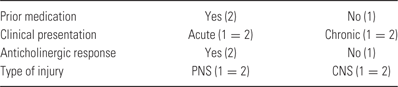
Although the axial dystonia found in this unique case seemed to be due to central nervous system alterations, other movement disorders (e.g. parkinsonism), found very often in iNPH, when brain asymmetry is detected Reference Morishita, Foote and Okun21, present scoliosis, which is another type of focal dystonia thought to be part of abnormal movements associated with afferent sensory system injuries Reference Doménech, Tormos, Barrios and Pascual-Leone22, Reference Bohlhalter, Leon-S and Hallett23. Interestingly, 3 out of 18 patients with axial primary dystonia and an unexpected higher prevalence of previous peripheral trauma had scoliosis-like symptoms resembling PPS Reference Bhatia, Quinn and Marsden24. And, blepharospasm, another focal dystonia with chronic afferent sensory dysfunction, also preceded PPS Reference Patel, Tariot and Hamill13. These facts, along with the novel abnormalities found by us in patients with primary focal dystonia-associated peripheral nerve injury, assessed nauromagnetically Reference Bohlhalter, Leon-S and Hallett23, support the contention that peripheral trauma may precede PPS as well Reference Bhattacharva, Giannakikou, Munroe and Chaudhuri14. Therefore, a new classification on Pisa syndrome emerges here that will help in offering better neuromodulatory approaches to improve the quality of life of these patients (Table 1).
Classification of primary (1) and secondary (2) Pisa syndrome
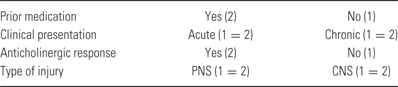
CNS, central nervous system; PNS, peripheral nerve system.
Equal sign means that the probability of having PPS or SPS is similar.
Other less understood abnormalities present in iNPH involve altered serotonin, noradrenalin and acetylcholine neural transmission Reference Suzuki and Matsuzaka1, which modulate smell function Reference Hawkes and Doty25. Of remark, olfactory nerves have the greatest contribution to cerebrospinal drainage; if affected, as in iNPH, it would alter smell function Reference Kapoor26. Although we did not quantify the patient's olfactory dysfunction, we anticipate that smell testing might be a very sensitive predictor and useful follow-up tool in iNPH. Incidentally, the dermatological abnormality appearing at the beginning of the disorder has been associated to rheumatologic problems Reference Crowson and Magro27. Its significance in iNPH is unknown.
Acknowledgements
The authors would like to thank Dr Carlos V. Rizzo-Sierra and Dr Richard L. Doty for their help during the preparation of this manuscript. The input gave by Dr Salomon Hakim (deceased) to an earlier version of this manuscript is greatly appreciated. Dr F. E. L-S. was supported by the US National Institutes of Health (RO1DA019055-04) and the Department of Defense (USAMRAA 8100002). The authors declare no conflict of interest. All authors equally contributed to the conception, analysis, preparation and writing of the manuscript; they all have approved the final manuscript.