Introduction
Couples’ demand for fertility (or children) is closely related to the direct economic or market costs of regulating fertility through access to efficient regulation and the actual costs of use of contraceptives, as well as the indirect or opportunity costs of having children. Organized family planning programmes, and convenient access to these, directly affect demand for fertility, mainly by reducing access costs and increasing the availability of efficient fertility regulation (Easterlin, Reference Easterlin1975; Lapham & Mauldin, Reference Lapham and Mauldin1984). As for opportunity costs, Willis (Reference Willis1973), in one of the earliest analyses of fertility as an economic behaviour, measured the cost of having children as an opportunity cost, or the value to the parents of the opportunities foregone in having an additional child, and the benefit as the utility gained by the characteristics (or quality) of children.
The implementation of family planning programmes in developing countries gained momentum in the 1960s with concerns over rapid population growth. Although the main motive of family planning initiatives was to reduce fertility rates, additional benefits included the reduction of maternal, perinatal and neonatal mortality, the decrease in the number of unwanted pregnancies and risky abortions, the prevention of sexually transmitted diseases and to provide for the needs of the public regarding reproductive health services (Cleland et al., Reference Cleland, Bernstein, Ezeh, Faundes, Glasier and Innis2006; Canning & Schultz, Reference Canning and Schultz2012). While convenient access to family planning information and adequate counselling help women to achieve effective and safe contraception use, women’s selection of a particular contraceptive method is still probably affected by demographic and cultural characteristics, religious beliefs and socioeconomic status (Oddens & Lehert, Reference Oddens and Lehert1997).
Turkey’s first family planning initiatives were implemented in 1965 and included the promotion of birth control methods and education of the public, the provision of family planning services and the liberalization of abortion. These efforts have increased awareness in the country of ‘at least one family planning method’ over time and instituted a positive attitude towards contraceptive use among the public, according to the Turkey Demographic and Health Surveys (DHSs) conducted from 1988 to 2013 (e.g. Sahin & Sahin, Reference Sahin and Sahin2003; Demir, Reference Demir2016; Ozdemir, Reference Ozdemir2017). However, in 2013, the year of the latest DHS, only half of married women of reproductive age in Turkey (47%) reported that they currently used modern contraceptive methods (HIPS, 2014). Thus, while information about, and accessibility of, family planning have been increasing over the years, there still appears to be a gap between available knowledge and active use of effective contraceptives, indicating that better access to modern contraceptive methods still has the potential to improve the lives of women in the country. Access to, and use of, family planning services, and consequently choice of contraceptive method, are still bound by socioeconomic, traditional and cultural factors in Turkey, as might be the case elsewhere in the developing world. Thus, the present study investigated the impact of a woman’s socioeconomic status, as implied by their education level, employment status and occupation type, as well as their status within the household, on their likelihood of current use of contraception and choice of methods (modern versus traditional) in Turkey.
Literature review
Economics of fertility
Early studies of the economic determinants of fertility can be divided into two separate strands: one emphasizing the demand for children, and the other focusing on the supply of children, treating fertility as purely random and exogenous (Rosenzweig & Schultz, Reference Rosenzweig and Schultz1985). Easterlin (Reference Easterlin1975) and Easterlin and Crimmins (Reference Easterlin and Crimmins1985) brought the two strands together by modelling fertility as being determined by the dynamic interaction between demand for, and supply of, births under a regime of costly fertility regulation. Then, the determinants of fertility work through one or more of the following three categories: (i) demand for children, which depends on a couple’s tastes, income and child-cost considerations; (ii) supply of children, which reflects a couple’s natural fertility and chances of child survival; and (iii) the cost of fertility regulation, reflecting both the subjective costs and objective costs relating to access to fertility control methods and supplies.
On the demand side, Willis (Reference Willis1973) argued that a married woman’s initial stock of human capital raises the opportunity cost of children (by raising the ‘shadow value’ of a woman’s time), therefore depressing fertility. Furthermore, more-educated couples may move towards ‘quality’ and away from ‘quantity’ of children, which again lowers fertility demand (Becker & Lewis, Reference Becker and Lewis1973).
On the supply side, educated women tend to enjoy greater health, which increases fertility, but such women are more likely to delay marriage and postpone childbearing longer after marriage (Michael, Reference Michael1973; Caucutt et al., Reference Caucutt, Guner and Knowles2002; Buckles, Reference Buckles2008; Isen & Stevenson, Reference Isen and Stevenson2010; Bertrand et al., Reference Bertrand, Cortes, Olivetti and Pan2016).
As for fertility control, Michael (Reference Michael1973) argued that more-educated couples are more likely to select more-effective contraceptive methods to prevent pregnancy because education lowers contraceptive costs (i) by reducing information (or access) costs (which are related to the availability of, and access to, family planning); (ii) by raising the marginal product of a couple’s time; and (iii) because ‘unwanted children’ represent a larger loss to more-educated couples, and hence the more-educated are more motivated to make an effort to prevent timing and quantity failures. In the same vein, according to Singh (Reference Singh1994), increased education and literacy of women have the following further effects on fertility. First, as women become more educated, they become more exposed to information available on family planning and contraceptive use, and also become more able to effectively use and process this information to their own advantage. Secondly, more-educated women have higher exposure and access to information about available family planning and health services, which reduces their number of risky pregnancies and infant mortality, which in turn decreases the average births per woman.
Economic theory predicts heterogeneity of demand for effective contraceptive across education groups via the relationship between education and employment. For educated women in a career path, time spent out of the labour force, particularly at the early stages of a career, due to childbirth, negatively affects their career prospects and opportunities to advance human capital accumulation (Tanfer et al., Reference Tanfer, Cubbins and Brewster1992; Gupta & Smith, Reference Gupta and Smith2002; Amuedo-Dorantes & Kimmel, Reference Amuedo-Dorantes and Kimmel2005). In particular, if a woman stays out of the labour force during the childbearing period, she loses the opportunity to accumulate job training and experience, and may be subject to atrophy and even depreciation (Gupta & Smith, Reference Gupta and Smith2002; Adda et al., Reference Adda, Dustmann and Stevens2017). Hence, by postponing childbearing, women tend to accumulate more work experience, and this strengthens their attachment to the labour market and helps raise their wages (Bratti, Reference Bratti2015). Moreover, in the context of an ‘overlapping generations’ model, Kimura and Yasui (Reference Kimura and Yasui2007) argued that since there is a trade-off between education to accumulate skills and childrearing, as both are time-sensitive activities, a skilled worker tends to choose to have fewer children than an unskilled one, and thus a rise in the fraction of skilled workers would lead to a decrease in average fertility rate. Accordingly, as Tanfer et al. (Reference Tanfer, Cubbins and Brewster1992) suggested, for employed women, particularly those who have regular full-time jobs with long-term career prospects, the opportunity cost of an unintended or mistimed birth is higher than is the case for women who are not in the labour force. Consequently, women who have higher human capital and who are employed, especially in professional positions, are expected to have a greater preference for more-effective contraceptive methods, and to successfully delay fertility, than women who are not as educated or do not work at all.
Effectiveness of modern and traditional contraceptive methods
In the reproductive health literature, the general consensus is that the more-effective methods are the modern ones, which involve some degree of invasive or medical procedure, while less-effective methods are the natural or coitus-dependent ones. Mansour et al. (Reference Mansour, Inki and Gemzell-Danielsson2010) ranked contraceptive efficacy in descending order as follows: (1) female sterilization and long-acting hormonal contraceptives; (2) intra-uterine devices (IUDs) with a surface area greater than 300 mm2; (3) IUDs with a surface area less than 300 mm2 and short-acting hormonal contraceptives (injectables, oral contraceptives, the patch and the vaginal ring); and (4) barrier methods/natural methods. Similarly, Moreau et al. (Reference Moreau, Trussell, Rodriguez, Bajos and Bouyer2007) concluded that the IUD had the highest effectiveness, followed by the pill, the condom, fertility awareness methods (periodic abstinence or safe period by temperature), withdrawal and spermicides. Ranking contraceptive methods by failure rates, Fu et al. (Reference Fu, Darroch, Haas and Ranjit1999) found that while the implant and injectables have the lowest failure rates, followed by the pill, diaphragm, cervical cap and condom, the highest failure rates were reported for periodic abstinence, withdrawal and spermicides. In a more-recent study, Bradley et al. (Reference Bradley, Polis, Bankole and Croft2019) also found contraceptive failure to be more common for users of short-acting and user-dependent methods, and failure rates to be particularly high for traditional methods such as withdrawal and periodic abstinence.
Factors affecting choice of contraceptive methods
Especially in the context of developing economies, many empirical studies have explored the relationship between women’s changing socioeconomic status as well as their involvement in household decision-making processes and their use of birth control methods to regulate fertility. Women’s socioeconomic status is essentially approximated by education level and work status, and the general consensus in these studies is that after controlling for other factors, women’s education is positively related to the use of contraceptives, and even small improvements in educational attainment raise the probability of contraceptive use in a host of developing countries, ranging from sub-Saharan African countries to India, Turkey, Oman and Egypt (e.g. Govindasamy & Malhotra, Reference Govindasamy and Malhotra1996; Ainsworth et al., Reference Ainsworth, Beegle and Nyamete1996; Chacko, Reference Chacko2001; Al Riyami et al., Reference Al Riyami, Afifi and Mabry2004; Alpu & Fidan, Reference Alpu and Fidan2006; Bozkurt et al., Reference Bozkurt, Özkan, Onan, Korucuoğlu, Aygün and Himmetoğlu2007). In particular, both women’s and husbands’ education levels significantly increase the use of contraceptives, and the impact of women’s education on the likelihood of using contraceptives is stronger than that of their husbands (see Koç (Reference Koç2000) for the case of Turkey, and Moursund and Kravdal (Reference Moursund and Kravdal2003) for India). Furthermore, Koç (Reference Koç2000) found that women with secondary or higher education were more likely to choose a modern method over a traditional method of birth control compared with women with lower education levels. Also, Bozkurt et al. (Reference Bozkurt, Özkan, Onan, Korucuoğlu, Aygün and Himmetoğlu2007) reported that, in Turkey, unsafe or ineffective birth control methods are most commonly used by women of low educational status. Cindoglu et al. (Reference Cindoglu, Sirkeci and Sirkeci2008) found that, although withdrawal (a traditional method) remained the most common method in Turkey, empowerment of women in terms of better socioeconomic status and better education reduced the use of withdrawal as the main method of contraception. In a comparative study of Iran and Turkey, Erfani and Yuksel-Kaptanoglu (Reference Erfani and Yuksel-Kaptanoglu2012) determined that, while the use of withdrawal as a contraceptive method over modern methods was higher among less-educated and less-wealthy women in Turkey, its use was more-prevalent among women who were more educated and who lived in wealthier households in Iran. Since educated women in Iran were reported to be more aware and fearful of the side-effects of modern methods and face greater spousal co-operation, women prefer the withdrawal method over modern methods in Iran.
The effect of women’s work status on contraceptive use in developing countries is more mixed and inconsistent (Shapiro & Tambashe, Reference Shapiro and Tambashe1994; Gage, Reference Gage1995; Govindasamy & Malhotra, Reference Govindasamy and Malhotra1996; Hogan et al., Reference Hogan, Behanu and Hailemariam1999). For example, in Southern Ethiopia having cash employment does not necessarily lead to women’s empowerment and thus contribute to women’s choice of use of contraceptives in the way higher level of education does; what really matters is who controls the money that the woman earns (Hogan et al., Reference Hogan, Behanu and Hailemariam1999). On the other hand, in India, Moursund and Kravdal (Reference Moursund and Kravdal2003) established that, although having employment with cash earnings increased a woman’s probability of using contraceptives, having a higher-status occupation did not necessarily stimulate more contraceptive use. Nevertheless, Koç (Reference Koç2000) showed that women who worked in the non-agricultural sector in Turkey were more likely to use modern contraception methods than those who worked in the agricultural sector or those who were not in the labour force. Furthermore, according to Ergöçmen et al. (Reference Ergöçmen, Koc, Senlet, Yıgit and Roman2004), after controlling for other factors, women working with social security coverage (i.e. in formal employment) had a lower likelihood of using withdrawal, a traditional method, than those who did not work with any social security coverage (i.e. informal employment, mostly in agriculture as unpaid family worker) in Turkey.
In a broader context, women’s contraceptive use is also associated with women’s empowerment, defined as ‘the expansion of freedom of choice and action to shape one’s life’ (Do & Kurimoto Reference Do and Kurimoto2012). Among the diverse dimensions of women’s empowerment, one that stands out in related studies is the participation of women in the decision-making process within the family concerning household economy and family size, and healthy communication between the wife and the husband on these issues, including the use of contraceptives (Bentley & Kavanagh, Reference Bentley and Kavanagh2008). Studies show that women who feel they have less control in the relationship with their partners have less ability to negotiate their reproductive and sexual objectives, including the use and choice of contraception to prevent unwanted pregnancies (Stephenson et al., Reference Stephenson, Bartel and Rubardt2012). That said, as medicalized and female-controlled modern contraceptive options such as the contraceptive pill and the IUD became more attainable and started to replace traditional or ‘co-operative’ methods such as withdrawal, condoms and the rhythm method, which require the involvement of both partners, women have been more able to regulate their own fertility, regardless of men’s consent (Le Guen et al., Reference Le Guen, Ventola and Bohet2015).
Trends in women’s education, employment and fertility in Turkey
Similar to the general trend elsewhere in the world, fertility rates in Turkey have been steadily declining in the past few decades and the Total Fertility Rate (births per woman) has decreased from 6.4 in 1960 to 4.4 in 1980 and to 2.07 in 2015 (World Bank, n.d.). The decline in fertility has been accomplished in part by an increase in modern contraceptive use; however, the rates of modern contraceptive use are still low by international standards. In fact, based on the 1988 Population and Health Survey of Turkey (TPHS), Goldberg and Toros (Reference Goldberg and Toros1994) attributed the sharp decline in fertility rates in Turkey to the widespread use of a traditional method, the withdrawal method, with induced abortion as a backup method for ending unwanted pregnancies, although an increasing reliance on more modern methods could also be observed over time. In a study exploring why Turkish couples rely heavily on the withdrawal method more than those in any other developing country, Kulczycki (Reference Kulczycki2004) argued that women prefer using it due to the perceived side-effects of other methods, particularly oral pills, and because the withdrawal method forces men to share responsibility for contraception; on the other hand, most men consider the withdrawal method to be reasonably effective, convenient and healthy and not too difficult to use. Kulczycki (Reference Kulczycki2008) further asserted that since using withdrawal as a contraceptive method requires active spousal co-operation, there is no strong evidence that inter-spousal power relations play a significant explanatory role in contraceptive choice in Turkey.
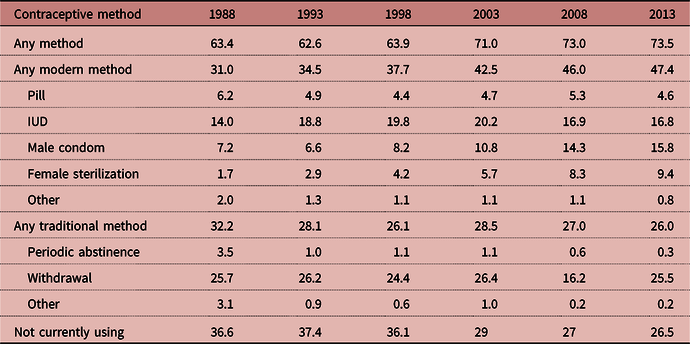
Since 1988, when the first TPHS was conducted, the use of modern birth control methods has been steadily increasing among surveyed married women in Turkey (Table 1). While the current use of modern contraceptive methods such as the pill, IUD, sterilization and condoms remained at 31% of surveyed married women in 1988, it increased to 47.4% in 2013 (the latest available survey). Among the available modern methods, the most preferred method has been the IUD at 16.8%, followed by the male condom by 15.8%. It is notable that female sterilization was used by 9.4% of currently married women in 2013, while only 4.6% used the pill. Considering the age distribution of married women, modern methods were preferred most by women in the 35–39 age group at 59%. However, looking into individual birth control methods, both traditional and modern, withdrawal still appeared to be the most prevalent method adopted by all age groups of married women, ranging from 23% of those aged 45–49 to 28% of those aged 15–19. The use of modern birth control methods also varied by region and women’s education levels: in rural regions, 40% of married women used modern methods, while this increased to 49.3% in urban region. Regarding education levels, 54% of married women with high school education or higher chose modern birth control methods, while only 36% with no education used modern methods.
Trends in percentage distribution of current use of contraception by women aged 15–49 years in Turkey, 2013 Turkey DHS

Source: HIPS (2014).
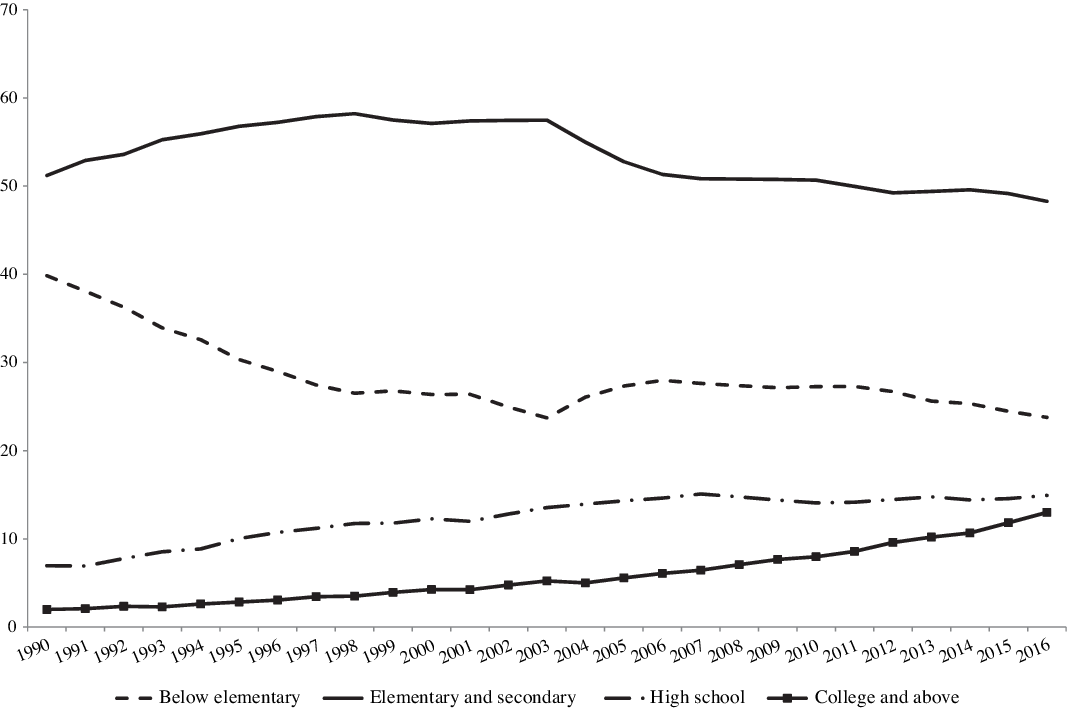
Over the same time period, when women’s fertility rates were declining, women’s educational attainment showed an increasing trend in Turkey. Figure 1 shows that the share of women over the age of 15 with below elementary school education decreased from about 40% in 1990 to 24% in 2016, while the share with high school education increased from 7% to 15%. Also, the share of women with at least a university degree increased from only 2% to 13%. The improvement in women’s educational attainment in recent decades in Turkey can be attributed to campaigns, crucial measures and policy changes aimed at increasing girls’ attendance at school – particularly the ‘8-year-compulsory schooling law’ that was introduced in 1997.
The distribution of educational attainment of women in Turkey: percentage of women population above the age of 15.

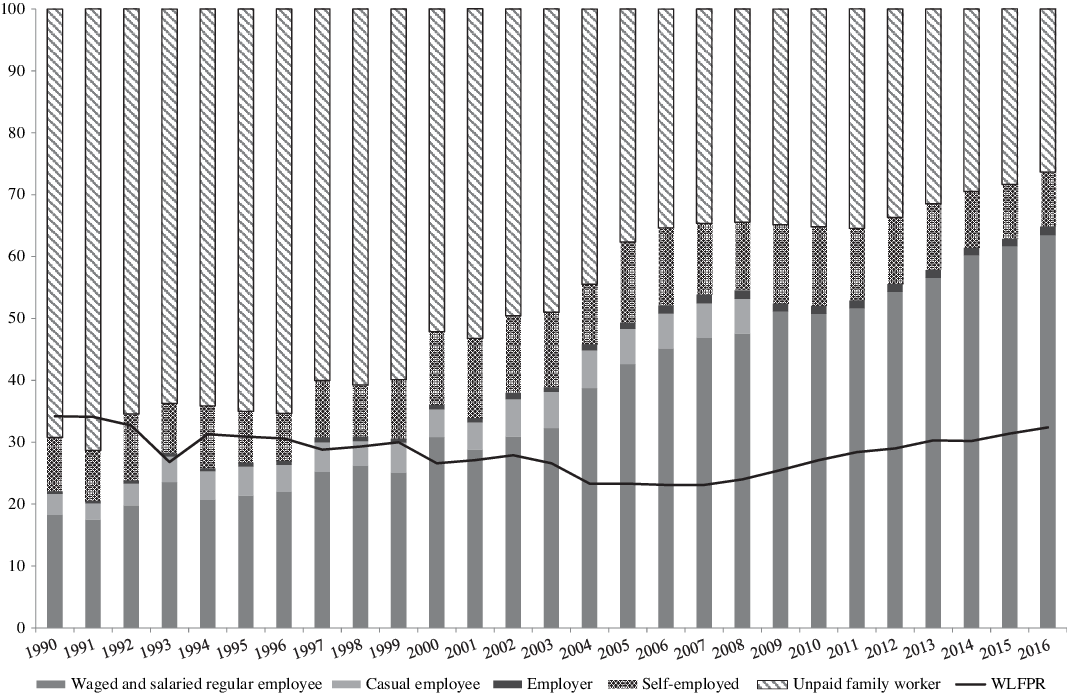
The changes in women’s educational attainment have also led to changes in the occupational and educational composition of women’s employment. In the past, women with low levels of education were more likely to be in the labour market than those who were more highly educated. In 1980, most employed women were working in agriculture as unpaid family workers, but with the implementation of export-led industrialization policies and the subsequent exit of labour from agriculture, women’s labour force participation actually fell from 46.2% in 1980 to 34.2% in 1990, to 26.6% in 2000, and only slightly increased to 32.4% as of 2016 (see Fig. 2). As stated by Ilkkaracan (Reference Ilkkaracan2012), in the period following the policy shifts after 1980, unpaid women family workers who exited agriculture were not been fully absorbed into urban non-agricultural employment, although the export-led growth strategy has to some degree led to the feminization of manufacturing employment, particularly in labour-intensive, low-technology industries such as textiles, apparel, leather products and food processing (e.g. Cagatay & Berik, Reference Cagatay and Berik1991; Ozler, Reference Ozler2000). Dayıoğlu and Kırdar (Reference Dayıoğlu and Kırdar2010) attributed the fall in women’s labour force participation chiefly to urbanization. Given this structural transformation, it can be seen that among the women who are employed, progressively more hold regular, waged and salaried jobs, and fewer are employed as unpaid family workers. In fact, while the share of employed women with regular paid work was around 20% in the 1990s, and the share of unpaid women family workers was upwards of 60%, this has gradually changed, and as of 2016, a reversal in these shares was observed: 64% of employed women held salaried and waged jobs, and only 26% were unpaid family workers (TurkSTAT database, n.d.).
Occupational composition of women’s employment and women’s labour force participation rate (%), Turkey. WLFPR indicates ‘Women’s Labour Force Participation Rate’. Source: TurkSTAT.

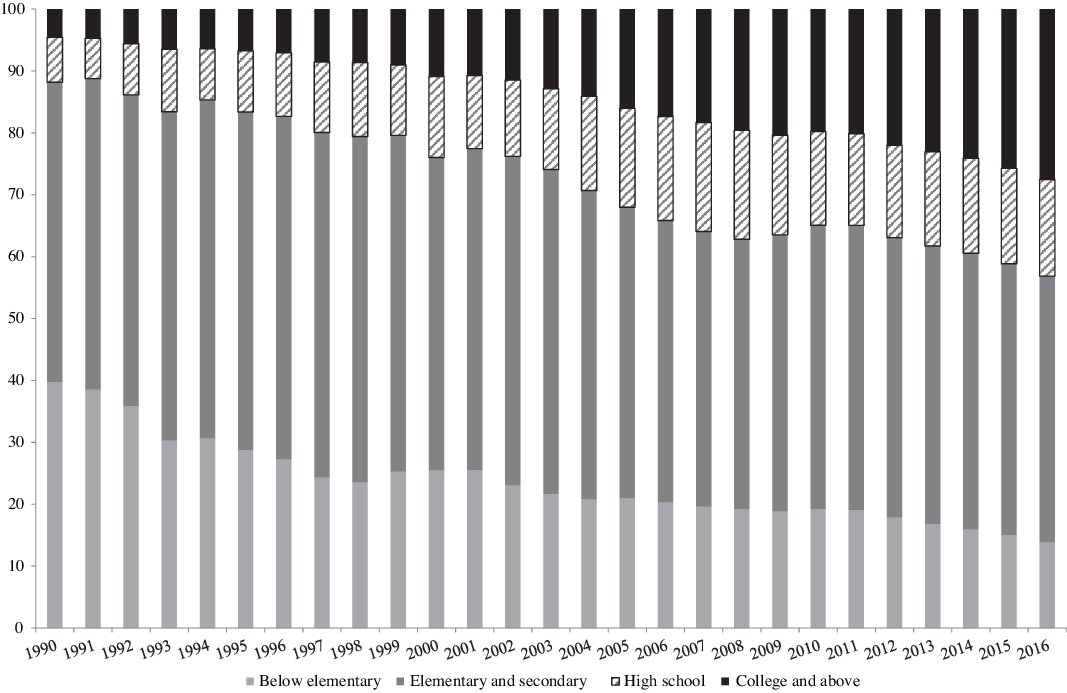
In addition to these occupational composition shifts, women’s employment has also exhibited a notable transformation over the last few decades in Turkey. The share of employed women with below elementary school education (illiterate and never completed elementary school) declined from 48.4% in 1990 to 25.5% in 2000 and to 13.9% in 2016 (Fig. 3). At the other extreme, the share of college graduates in women’s employment increased from only 4.6% in 1990 to 27.5% in 2016.
Educational composition of women’s employment (%), Turkey. Source: TurkSTAT.

Nevertheless, in Turkey, the inter-relationship between education and employment is not as strong as it is in other countries with comparable development levels: more-educated women have lower labour market participation rates in Turkey than more-educated women in other countries (Kolaşin et al., Reference Kolaşin, Paker-Uncu, Cansuz and Kökkızıl2015). In particular, as of 2017, although the employment rate among young women aged 25–34 with at least a college degree (64%) was higher than among those with less than a college degree (35% for those with high school education and 27% for those with less than secondary school education), this rate is still well below the OECD average of 80%. In addition, there is a considerable gap between the employment rates of college graduated men and women with a similar degree (OECD, 2018). The relatively lower rate of women’s labour force participation may be explained by factors such as low wages, gender inequality and cultural views of ideal gender roles in Turkey. For instance, Kolaşin et al. (Reference Kolaşin, Paker-Uncu, Cansuz and Kökkızıl2015) argued that for women with a high school or college education, the decision of whether to remain in the labour market is still shaped by the perceptions of traditional gender roles, which still obligate educated women in Turkey to make a choice between work and children.
Methods
Data
Data were from the 2013 round of the DHS for Turkey conducted by the Hacettepe University Institute of Population Studies (HIPS). The DHS has been conducted every five years since 1988 and the 2013 version is the most recent. The data set has detailed information on the health and reproductive issues of women of reproductive age (between 15 and 49 years). It contains several questions on women’s current pregnancy status, last menstrual cycle and choice of birth control methods, as well as information on both the woman’s and the husband’s demographic and socioeconomic status (for instance, couples’ employment statuses, types of occupation and education levels, and the wealth index category of the household). Finally, it contains information about the region where the couple lives and their ethnicities, as well as married women’s empowerment issues such as having an arranged marriage or having a husband with controlling behaviour. It is therefore a good source of the determinants of choice of birth control methods in Turkey.
The 2013 DHS includes 9746 observations of women aged 15–49 years. The present sample was restricted to currently married women for two main reasons. First, according to the 2013 DHS, 68% of women of reproductive age were married, and the shares of women who were married were 7.1%, 46.3%, 78.1%, 89.1%, 89.3%, 91.0% and 86.3% for age groups 15–19, 20–24, 25–29, 30–34, 35–39, 40–44 and 45–49, respectively. This indicates that the prevalence of marriage increases as women get older and being married is common among the adult population in Turkey. Secondly, due to traditional, cultural and/or religious norms (98% of people in Turkey are of the Muslim faith; HIPS, 2014)), single and widowed/divorced women tend not to reveal being sexually active and hence do not disclose information about their use of birth control. Married women who are pregnant or suspect pregnancy were also excluded from the sample. Finally, married women who were in menopause or had had a hysterectomy were omitted. Hence, the sample included 6025 observations of women aged 16–49 years.
Variables
Since the study objective was to examine statistically the choice to use modern contraceptives, traditional contraceptives or no contraceptives, a simultaneous regression model was estimated. The model allowed first the determinants of a woman’s contraceptive decision, i.e. to use or not to use, to be observed, and then the factors that increased the probability of using modern contraceptive methods, if any contraceptive method was used, to be examined. Following DHS categorization, the IUD, pill, male condom, female sterilization and any other modern method involving medical or invasive procedures were referred to as modern contraceptive methods. The traditional contraceptive methods category comprised periodic abstinence, withdrawal and other traditional or coitus-dependent methods.
Independent variables included in the model were the individual and household characteristics of the sample women. Individual characteristics included woman’s age, ethnicity (Turkish, Kurdish, Arabic and other following Güneş (Reference Güneş2015), defined as the woman’s mother tongue), education level, measured by the woman’s reported years of schooling, employment status and occupation type. Employment status was divided into the three categories ‘employed’, ‘unemployed’ and ‘inactive’, where ‘unemployed’ includes women who do not work and are seeking a job, and ‘inactive’ includes women who do not work but are not searching for a job. The ‘unemployed’ and ‘inactive’ categories were merged to form a new category ‘not employed’, since the distinction between being unemployed and being inactive is ambiguous in Turkey, as in most developing countries with a large informal employment base. Occupation type is formed according to woman’s type of employment. In DHS data set employment types are as follows: employer, regular wage-earner, government worker, unpaid family worker, regular/irregular self-employed and seasonal/temporal worker. Based on this information, woman’s occupation type was defined as ‘formal’ if the woman was an employer, regular wage earner, government worker or regularly self-employed; it was defined as ‘informal’ if the woman was an unpaid family worker, irregularly self-employed, a seasonal/temporal worker or engaged in other types of employment. The explanatory variable ‘occupation’ is important because it reflects a woman’s labour market attachment and is expected to influence contraceptive choice.
Household characteristics included region of residence (urban/rural), number of children below 5 years, whether the woman had at least one son, husband’s education level, measured by the husband’s reported years of schooling, and household wealth status, measured by wealth indices. There are five wealth indices in DHS data, and in this study they were defined as ‘poorest’, ‘poor’, ‘middle’, ‘rich’ and ‘richest’. Although some sections of Turkish society have overcome the prejudice of having at least one son, in more-traditional families the presence of a son in a family remains as an important issue. Previous literature has shown that having at least one son significantly alters a couple’s fertility decisions in Turkey. For instance, Altındag (Reference Altindag2016) showed that couples whose first child was male had fewer children than those whose first child was female, and also showed that in families with one child, the child is more often male and in families with more children, the last birth is generally male. In addition, Berik and Bilginsoy (Reference Berik and Bilginsoy2000) stated that couples prefer male children to let the family name continue. The authors also argued that economic reasons play an important role in son preference, since parents expect to have higher returns from the labour of male children. Hence, in the empirical analysis the hypothesis was established such that if a woman already had a son, then she may be more likely to use effective birth control methods to avoid pregnancy regardless of the other factors. Therefore, following Erfani and Yüksel-Kaptanoğlu (Reference Erfani and Yuksel-Kaptanoglu2012), the econometric model included both the number of children in the household and the presence of a son as control variables. The presence of a son was an indicator variable that equalled 1 if the woman had at least one son and 0 if she had daughter(s) or had no child. This allowed comparison of the contraceptive use decision of women with at least one son with that of women with no son or no child.
Finally, indicators of woman’s empowerment within the household, i.e. whether the marriage was an arranged marriage and whether the husband had a controlling attitude towards the woman, were considered. Husband’s controlling behaviour included preventing the woman from seeing her female friends, limiting contact with her family, insisting on knowing about, and distrusting, the woman with money and accusing the woman of being unfaithful. If the husband demonstrated at least one of these behaviours, then he was assumed to have a controlling attitude towards the woman. In the empirical analysis, the related variable was a dummy variable that equalled 1 if the husband had a controlling attitude and 0 if he did not. Lastly, the ‘contribution to the decision to marry’ variable included information about whether the marriage was arranged by the family (with or without the consent of the woman) or whether the woman took the decision herself together with her partner.
Analysis
A bivariate probit model with selection was estimated. In the model, the first dependent variable indicated whether the woman used any birth control method, and the second indicated whether a contracepting woman used modern birth control methods. The bivariate probit model allowed for correlation across the two error terms such that women who were not likely to contracept at all will be more likely to use traditional methods than if they did contracept. Therefore, a bivariate probit model with selection was considered to be the best model to deal with sample selection issues, which were very likely to occur in the current case.
Results
Summary of descriptive statistics
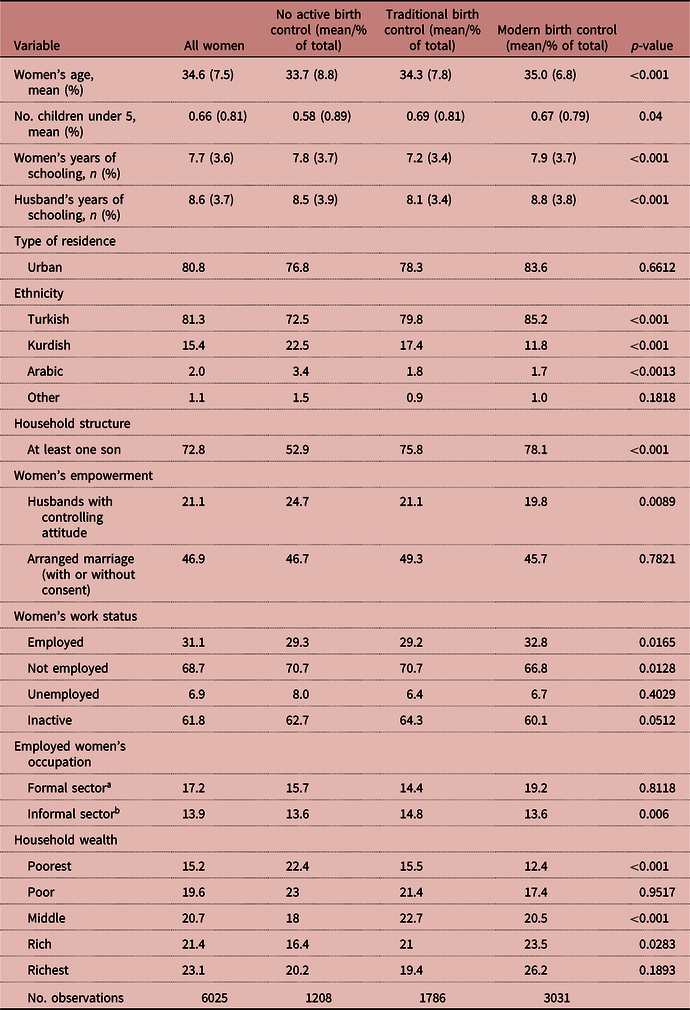
Table 2 presents the descriptive statistics of the sample women by their use of birth control. The first column of presents the weighted statistics for the whole sample, while the remaining columns show the weighted statistics differentiated by women’s birth control behaviour. Overall, 80.8% of the women resided in urban areas, and 81.3% were of Turkish ethnicity. Only 31.1% were employed, and 61.8% were ‘inactive’.
Distribution of sample women by use of birth control and use of traditional versus modern methods, Turkey, 2013

a Formal sector: employer, waged worker, government employee or regular self-employed.
b Informal sector: seasonal/temporal worker, irregular self-employed, unpaid family worker or other job.
Table shows weighted statistics. Standard errors are in parentheses.
Authors’ calculations using data from the 2013 Turkey DHS (HIPS, 2014).
Women who did not to use any birth control method tended to be younger than those who actively used birth control (Table 2, column 2). Among the women who currently used any birth control method, on average, modern method users were slightly older than traditional method users (column 3). Women using modern methods were more educated than those not using any birth control method and those using traditional methods. A similar pattern was observed for husband’s education level.
Married women who used modern birth control methods were more likely to reside in urban areas and to be of Turkish ethnicity. The use of a modern contraceptive method was more prevalent among women with at least one son compared with women with no sons or no children. In addition, 32.8% of married women who used modern birth control methods were employed, whereas the rate of employment decreased to 29.2% among married women who used traditional birth control methods and to 29.3% among those who did not use any birth control method at all. Also, modern contraceptive method users were more likely to have regular or formal jobs and traditional method users were more likely to have irregular or informal jobs. This particular statistical outcome concurs with the opportunity cost approach – that women with higher labour market attachment and professional career paths are more likely to use more effective birth control methods to defer fertility; for example, women working in the government sector are more likely to hold permanent and higher status jobs, and are more likely to have opportunities to advance in their careers. Hence, their opportunity costs with respect to time, foregone wages and career progress are much higher compared with those with no jobs or those with low wages and no career prospects.
Bivariate probit model results
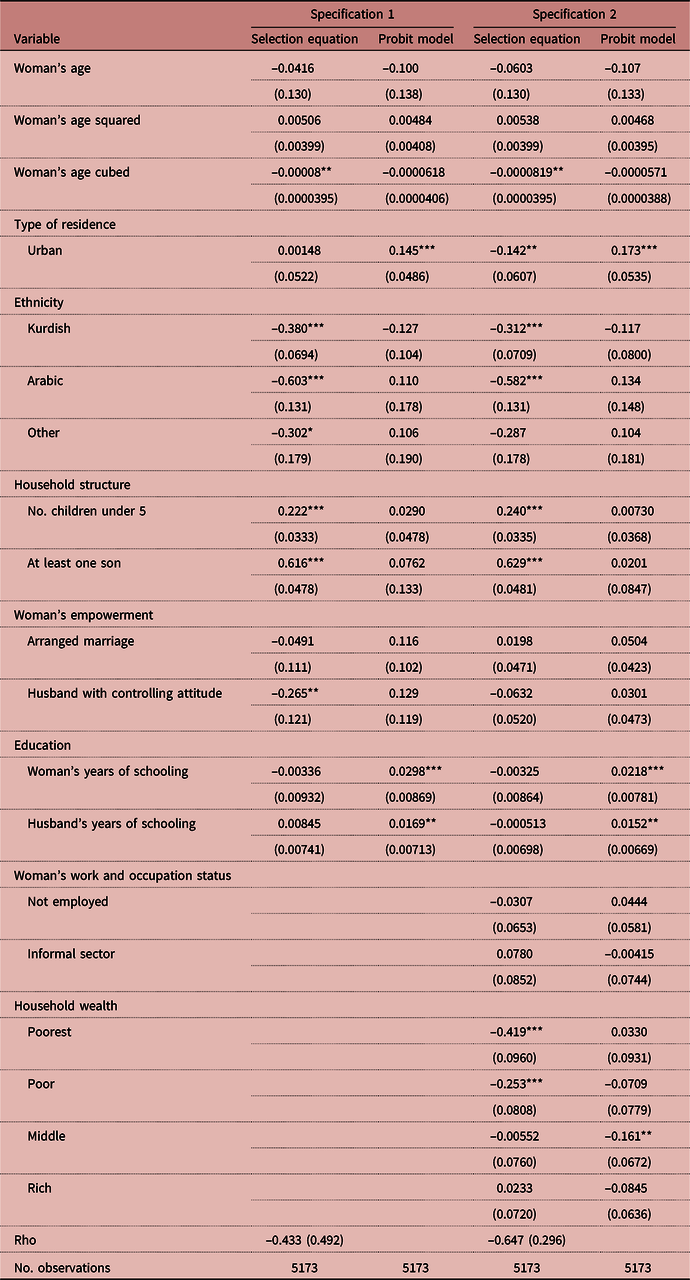
The results from the bivariate probit model, with selection for the whole sample, are given in Table 3. In the first specification (columns 1 and 2), the variables related to woman’s employment status and household wealth were excluded from the regression analysis in order to circumvent suspicions relating to endogeneity, such as that between woman’s employment status and education level. These variables were subsequently included in the second specification (columns 3 and 4).
Bivariate probit model with selection estimation results, with ‘use of any birth control method’ as the dependent variable

In each specification, the interaction terms of woman’s empowerment issues with woman’s level of education were also included. Without wealth and employment variables in the regression, the results suggest that women whose husbands had controlling attitudes were more likely to use any contraceptive method if they had a higher education level. This effect was significant at p<0.10. Other interaction effects were found to be insignificant. All regressions included a constant term. Standard errors are in parentheses.
***p < 0.01; **p < 0.05; *p < 0.1.
According to the results for the first specification, older women of reproductive age were less likely to use any birth control method, but when one was used, the women were more likely to use traditional methods, although the effect was not statistically significant. Considering non-linearity in the effect of woman’s age, the square and cubic powers of woman’s age were added into the specification. The non-linear effect of age on a woman’s decision to use any birth control method was plausible, because a woman’s contraceptive decision may change as she gets older. For instance, square of age has a positive effect on birth control decision, implying that women tend to use some kind of a contraceptive method more during early mid-age (i.e. during their 30s). However, cubic power of age had a negative impact on contraceptive use, implying that at later ages (in the late 40s), close to the end of the reproductive years, women have a lower incentive to use birth control, probably because they do not expect to conceive at older ages.
Living in an urban rather than a rural area did not significantly affect the choice to use any contraception method, but women living in urban areas who used any contraception method were more likely to use modern than traditional methods compared with contracepting women in rural areas. Women of Kurdish and Arabic ethnicities were less likely to use any birth control method compared with women of Turkish ethnicity. Him and Hoşgör (Reference Him and Hoşgör2011) showed that, despite the rapid decline in fertility in Turkey, high fertility rates persist in eastern provinces of Turkey, including Van, where the Kurdish-speaking population is concentrated. Their interpretive study among urban-migrant Kurdish women in Van concluded that women’s persistently high fertility rates can be closely related to the domineering form of patriarchy exercised in the region, which minimizes women’s reproductive autonomy, among other rights.
As the number of young children in the household increased, women were more likely to use some type of birth control; furthermore, if a woman has already at least one son, then she has a higher probability of using birth control relative to women with no sons (i.e. no children or only daughters). Regarding education level, it was found that contracepting women were more likely to use modern birth control methods, rather than traditional methods, as both woman’s and their husbands’ years of schooling increased.
By and large, the statistically significant outcomes for the first set of independent variables were not affected by the inclusion of employment and household wealth variables in the second model, except for the type of residence variable. Therefore, in general, there was no inconsistency in the estimates due to a possible endogeneity problem across variables. For employment status, the results showed that women who were not employed were less likely to use any birth control compared with women with regular or formal jobs, but the effect was statistically insignificant. Furthermore, there was no significant difference between women employed in the formal sector and informal sector in terms of contraceptive use and choice of method. Lastly, regardless of other factors such as education and number of small children in the household, women from the lowest socioeconomic groups had a lower probability of using any birth control method compared with women from the highest socioeconomic group. Conceivably, compared with women of lower socioeconomic status, women of highest socioeconomic status probably have greater access to, and greater means of benefiting from, available birth control resources.
Heterogeneity in the sample
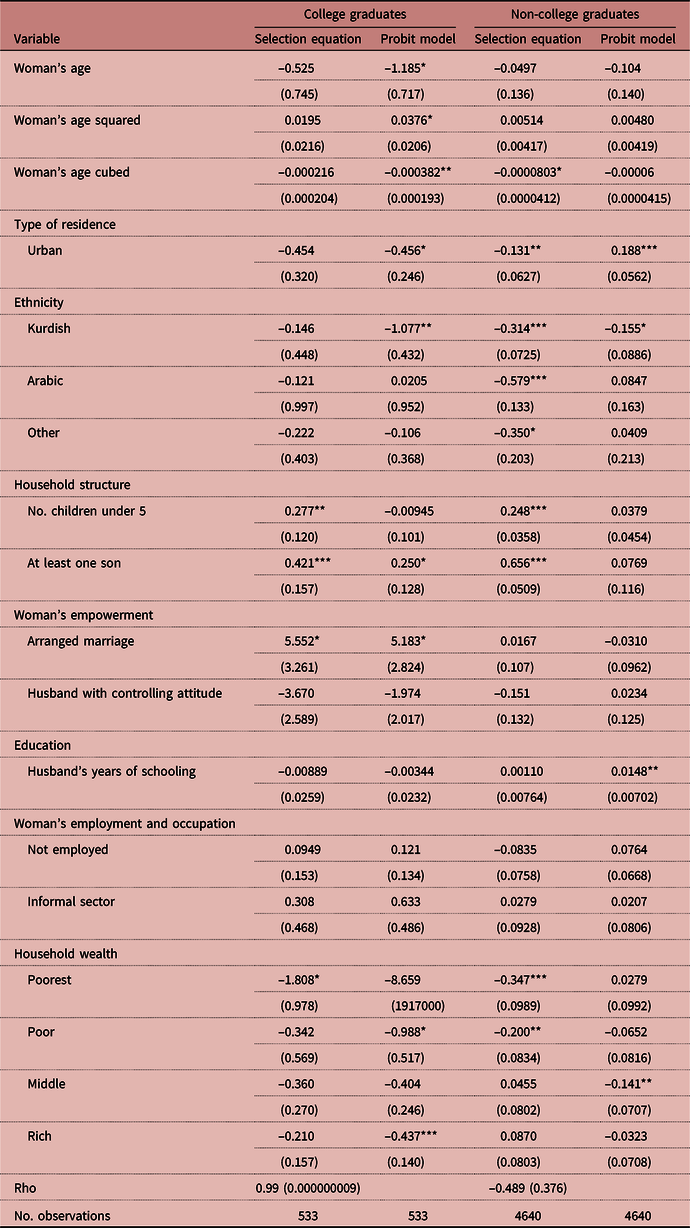
Table 4 presents the results from two subsamples: women with a college or a higher degree and women with less than a college degree. This allowed the different regressors to have different impacts for the two subsamples. The results indicated that to some extent, the determinants of contraceptive usage varied across the two education levels. For instance, for women without a college degree, age did not have a significant effect on contraceptive usage, whereas it did for women with a college or higher degree. The latter were significantly less likely to use modern contraceptive methods. For contracepting women with college degrees, those in urban areas were less likely to use modern methods than rural college-educated women, while this was reversed for non-college-educated women, who were more likely to use modern methods than rural non-college-educated women.
Bivariate probit model with selection estimation results by woman’s education level, with ‘use of any birth control method’ as the dependent variable

See footnote to Table 3 for explanation of specifications.
Standard errors are in parentheses.
***p < 0.01; **p < 0.05; *p < 0.1.
The presence of at least one son in the household increased the likelihood of using any birth control in both subsamples but the choice of method was affected for college-educated women. These women were significantly more likely to use modern methods in the presence of at least one son in the household, while women without a college degree who had a son did not differ in their choice of modern versus traditional methods compared with women without a son. Moreover, for contracepting women who were non-college educated, husband’s education level significantly increased the likelihood of using modern contraceptives, while for contracepting women who were college educated, husband’s education level did not significantly affect their choice of contraceptive method.
As observed for the full sample, for both college-educated and non-college-educated women, the impact of not being employed was not significantly different from the impact of being employed; that is, woman’s employment status was not a defining factor in her birth control decision and choice of method regardless of her education. Furthermore, for both sub-samples, the effect of being employed in the informal sector did not significantly differ from the effect of being employed in the formal sector, and hence woman’s occupation type was also not a factor in her contraceptive decision. Lastly, some variation across the two sub-samples in the effect of household wealth on birth control was detected. Thus, for lower wealth categories, the results suggested that the birth control behaviours of college-educated and non-college-educated women were more or less the same, but for higher wealth categories, the behaviour changed across the two sub-samples. Contracepting college-educated women in the highest wealth category were significantly more likely to use modern methods than contracepting college-educated women in the second-highest wealth category, but a similar effect was not observed among contracepting non-college-educated women.
Discussion
This study of contraceptive use among married women in Turkey using 2013 DHS data found that, in line with results from many other countries, both developed and developing, one of the principal factors affecting choice of birth control method in Turkey is woman’s education level. Among women using any contraceptive method, more-educated women were found to be more likely to choose a modern contraceptive method over a traditional method. Under a regime of costly fertility regulation, education lowers the demand for children, as a married woman’s initial stock of human capital raises the opportunity cost of the woman’s time (Willis, Reference Willis1973), and at the same time, educated women tend to delay marriage and postpone childbearing longer after marriage begins, and thus the supply of children is expected to fall (e.g. Michael Reference Michael1973). Furthermore, according to Michael (Reference Michael1973) and Singh (Reference Singh1994), education lowers the information and access costs to available family planning and health services. The finding that more-educated women tend to choose more-effective methods of birth control to delay fertility is in line with the predictions of the theoretical literature on demand and supply of children under costly fertility regulation. In this context, not only is the woman’s own education level a significant factor in the decision to use modern and effective birth control methods, but the husband’s education level is also important, implying that as a couple’s education level increases, method of birth control is highly likely to be a joint household decision (Koc, Reference Koç2000). However, interestingly, the empirical results indicate that contracepting college-educated women are more likely to take the use of modern contraceptive method decision on their own irrespective of their husband’s education level.
Furthermore, the results clearly show that urban residence increased the likelihood of using modern rather than traditional birth control methods. Thus, convenient access to relevant health care services, and widespread availability of family planning services in urban areas, increase the use of modern birth control methods. Central and local governments should increase the availability and promotion of family planning programmes, particularly to women in rural areas, who are less likely to use modern and more effective contraceptive methods, if the women use any, and to women from lower socioeconomic segments of society, regardless of where the women live, as the findings indicate that women from the lowest wealth quintiles are consistently less likely to use any birth control method compared with women from the highest wealth quintile.
Unlike the studies of Koc (Reference Koç2000) and Ergöçmen et al. (Reference Ergöçmen, Koc, Senlet, Yıgit and Roman2004), the present study did not find a significant effect of women’s work or occupation on their contraceptive behaviour in Turkey – either the decision to use any birth control or the choice of method. This finding indicates that women’s employment, occupation and, implicitly, wage status have not yet reached the stage where childbearing and parenting constitute an important opportunity cost to being employed and to the type of work done in Turkey. Therefore, it may be concluded that the use and choice method of contraceptives among married women in Turkey are still strongly influenced by accessibility and available information on birth control (facilitated by education and urban residence), rather than by work and occupation-related opportunity costs posed by childbearing and parenting, as primarily observed in developed economies.
Last, it is important to note that employment and fertility decisions are very likely to be endogenous (Connelly et al., Reference Connelly, DeGraff, Levison and McCall2006). Women with more children are less likely to be employed, and women who decide to participate in the labour force are more likely to delay fertility and thereby use contraception. Similarly, unobserved factors may simultaneously affect both the fertility decision and the labour force participation decision. The study attempted to deal with the possible endogeneity problem by considering two different specifications of the model such that the possible endogenous regressors (employment status and wealth) were first omitted from the empirical analysis, and then included in the second specification of the model. The results did not notably differ. This provides some evidence that the endogeneity problem was not serious. Nevertheless, in future research, addressing the endogeneity problem between employment and fertility decisions by using proper instruments may strengthen the findings on the relationship between contraceptive use and woman’s employment status.
Acknowledgments
An earlier version of this study was published as an ERC Working Paper in Economics (No. 18/03) entitled ‘Women’s education, employment status and the choice of birth control method: An investigation for the case of Turkey’ by the Middle East Technical University, Ankara, Turkey. The authors would like to thank the participants of the 27th IAFFE Annual Conference at New Paltz, NY, for useful comments and suggestions.
Funding
The study was not funded by any source.
Conflicts of Interest
The authors have no conflicts of interest to declare.
Ethical Approval
For the empirical analysis, the authors used the 2013 round of the Turkish Demographic and Health Survey data set prepared by the Hacettepe University Institute of Population Studies. The data set was requested from Hacettepe University Institute of Population Studies and the institute allowed the authors to use the data set to conduct this research.