INTRODUCTION
Sierra Leone's elections for a new president and parliament in 2007 were the most competitive since 1967, when the APC narrowly edged the incumbent SLPP in parliamentary elections. The SLPP leadership's refusal to accept the results of the 1967 elections plunged the country into protracted crisis, triggering two military takeovers within forty-eight hours and aborting the first post-independence flirtation with constitutional democratic rule (Cox Reference Cox1976; Fisher Reference Fisher1969). Forty years later, an unpopular SLPP limped into the 2007 elections facing the same opposition APC, albeit in a radically different post-war environment. These were the second post-conflict elections, and the first since the departure of United Nations peacekeepers in 2005. The SLPP won the 1996 and 2002 elections, and was seeking a third consecutive term under a new leader and presidential candidate, Solomon Ekuma Berewa, who was hand-picked, as was his running mate, by outgoing president Ahmad Tejan Kabbah. Neither Kabbah's stewardship as president nor the two men he chose to lead the SLPP were particularly helpful to the incumbent party's cause in the 2007 elections.
Although he was not on the ballot, Kabbah's impact on the 2007 elections cannot be overstated. Many in the SLPP believe that he destroyed their party by allowing corruption to thrive under his watch and by tapping two of his retainers to lead the party in the 2007 elections.Footnote 1 Kabbah's rogue (yuki yuki) credentials span at least four decades and can be traced back to the late 1960s, when he served as permanent secretary in the Ministry of Trade and Industry. The Beoku-Betts commission of inquiry that investigated financial malpractices and irregularities involving officials of the ministry and the Sierra Leone Produce Marketing Board (SLPMB) in 1967 concluded that Kabbah ‘lacks integrity … and could easily lapse into corrupt practices … which disqualifies him from holding any high office for which good character and integrity are prerequisites’.Footnote 2
As president three decades later, this integrity deficit was on full display as Kabbah routinely privileged his interests over country and party in the discharge of his presidential duties.Footnote 3 He attracted and surrounded himself with cronies, supplicants and opportunists whose unrelenting rapacity alienated the public, impoverished society and threatened the country's fragile peace and security.Footnote 4 A July 2007 report by the International Crisis Group (ICG 2007) noted how ‘the perception that the state is corrupt has grown since the war ended … as incomprehensible administrative discretion and bogus procedures create opportunities for graft’.Footnote 5 The Anti-Corruption Commission (ACC), whose operational costs are underwritten by British taxpayers, was largely ineffective and moribund under Henry Joko-Smart, a spent crony whose appointment to run the commission amounted to nothing more than a retirement benefit from the president.Footnote 6 Given the fact that corruption and the mismanagement of the country's resources were the underlying causes of the country's decade-long armed conflict, Kabbah's woeful failure to tackle these endemic problems damaged his party's prospects in the 2007 elections.
Two forms of donor assistance – development assistance and capacity building assistance – helped pave the way for the SLPP's electoral demise. External donors (United Kingdom, European Union, United States, Japan, Norway, Netherlands) and financial institutions (World Bank, IMF, African Development Bank) fund 80% of Sierra Leone's national budget, and Official Development Assistance (ODA) as a share of GDP rose from 16·31% in 2004 to 24·68% in 2005.Footnote 7 This assistance was channelled through the office of Solomon Berewa, who was responsible for awarding contracts, the recipients and beneficiaries of which were mostly cohorts and clients of the former vice-president and SLPP presidential candidate.Footnote 8 Donor funds earmarked for poverty alleviation, education, health and infrastructural development did more to improve the material lot of SLPP leaders (many, including MPs, doubled as contractors) than the living conditions of the people.Footnote 9 The SLPP's management of donor funds had a direct impact on the elections, suggesting that a high level of development assistance can help or hinder an incumbent party's electoral chances, depending on how these funds are utilised and who benefits from them (Moss Reference Moss2005). Development assistance can improve the re-election prospects of incumbents if it is vigorously leveraged into improving socio-economic conditions and building institutional capacity. On the other hand, the gross misappropriation of these funds by rogue incumbents, especially those in charge of countries on international dole, is more than likely to bring about their defeat in free and fair elections.
Enhancing the operational capacity of state institutions and a plethora of local NGOs is the second form of donor assistance that had an impact on Sierra Leone's 2007 elections. It would have been very difficult, if not impossible, for the National Electoral Commission (NEC) to conduct free and fair elections without the support of external donors, who underwrote 70% of the costs of the elections. The United Nations Integrated Office in Sierra Leone (UNIOSIL) was instrumental in revamping the organisational structure of the commission, upgrading its administrative capacity, hiring a competent staff and moving employees into new offices. Funded by USAID, the International Foundation of Electoral Systems (IFES) provided assistance in establishing NEC offices in the four regional capitals, and worked closely with the Political Parties Registration Commission (PPRC) to develop a code of conduct for political parties, and organise district code of conduct monitoring committees in each of the country's fourteen districts. The United States-based National Democratic Institute (NDI) also trained local NGOs to help with voter education and registration. By breathing new life into the NEC and other state institutions, especially the army and police, and by facilitating the active participation of civil society organisations (Network Movement for Justice and Development, Campaign for Good Governance, Common Ground, National Election Watch, Hope Sierra Leone, 50/50 Group, to name a few) in the electoral process, capacity building assistance from donors made it extremely difficult for the SLPP to rig the elections. Donors, however, may be displacing rather than building institutional capacity because they seem to be less interested in capacity enhancement than in delivering the ‘services that the capacity is meant to provide’ (Fukuyama Reference Fukuyama2004: 4; Hudock Reference Hudock1997). The 2007 elections represented a victory for democracy, but it is far less certain whether donor input strengthened the administrative capacity and autonomy of the electoral commission beyond these elections.Footnote 10 Securing a democratic outcome under the neo-trusteeship of external donors (Caplan Reference Caplan2007) is a far cry from assuming ownership of the electoral process and building a sustainable democratic electoral system.
With donors insisting on a non-fraudulent electoral outcome, it is not surprising that the SLPP blamed the international community for its defeat. SLPP leaders (especially the party's secretary general and publicity secretary) and newspapers (Awareness Times, Democrat, New Vision, Unity Now) went out of their way to denounce the international community for emboldening the opposition, withholding budgetary support for the government, and exerting ‘undue’ influence over the electoral commissioner and process. The vilification of Victor Angelo, the executive representative of the UN secretary general in Sierra Leone (ERSG), by an SLPP government that owed its very existence to UK and UN intervention betrayed the ahistorical mindset and self-destructive impulse of the SLPP leadership. Frustrated by their inability to manipulate the electoral process and dictate its outcome, SLPP partisans accused the electoral commissioner of serving as conduit of an unspecified ‘international conspiracy’ to unseat their government, and were as disparaging and withering in their attacks on the commissioner as they were on the donor community. Although SLPP hostility to external democracy assistance did not rise to the level of Robert Mugabe's frontal assault on democratisation in Zimbabwe, it was nonetheless consistent with patterns observed in stalled or crested ‘third wave’ democracies (Gershman & Allen Reference Gershman and Allen2006; Huntington Reference Huntington1991).
By sandbagging the SLPP into reluctantly conforming to liberal rules and procedures of electoral competition, the international community played a critical role in ensuring a popular outcome to the 2007 elections. The international community, however, did not determine or pick winners in these elections; they simply made it counter-productive for the SLPP leadership to subvert the wishes of the electorate by rigging them. It is in this sense that donor assistance can contribute to democratisation in societies emerging from wars caused by predatory governance. Arthur Goldsmith's (2001) observation of a meaningful correlation between levels of development assistance and democratisation in Africa is broadly supported by recent evidence from Sierra Leone, where the last two elections, not to mention the restoration of state capacity, bear the indelible imprint of the international community. As a post-conflict test case of the liberal peace project in Africa, Sierra Leone is relatively peaceful today, but the conditions that gave rise to armed conflict in the 1990s have not disappeared (Hanlon Reference Hanlon2005). Free and fair elections provide a safety valve for electoral democracies, but they do not guarantee transparency in governance or address the inequities that cause domestic armed conflicts. Liberalising a predatory regime in Sierra Leone does not advance the cause of democratic consolidation, nor does the globalisation of a neo-liberal economy that weakens state capacity, exacerbates social tensions, externalises economic policy making, and is unresponsive to the welfare and equity concerns of the impoverished majority (Mkandawire Reference Mkandawire1999). Both the cultural particularity of the neo-liberal agenda and the absence of hegemonic local political classes whose interests are commensurate with this homogenising project (Taylor Reference Taylor2007) help account for the ‘shallowness of democratization in the latter part of the third wave’ (Diamond Reference Diamond1996: 28).
What follows is a critical analysis of the participants, results and governance implications of Sierra Leone's second post-conflict elections. The 2007 polls in Sierra Leone are the first post-conflict elections in Africa in which an incumbent party was defeated. Post-conflict elections in Angola, Mozambique and the Democratic Republic of the Congo (DRC) have not produced any alternation of parties in power, and dislodging liberation parties (Angola, Mozambique) may prove to be more daunting than unseating predatory oligarchies in post-conflict societies like Sierra Leone. In the case of Liberia's 2005 elections, a combination of donor leverage and the absence of an incumbent or hand-picked successor improved the odds of a satisfactory democratic outcome (Harris Reference Harris2006). Choosing a successor, as Daniel arap Moi of Kenya and Jerry Rawlings of Ghana discovered, does not always guarantee the presidency for the chosen individual. This is particularly true of post-conflict environments like Sierra Leone and Liberia, where aid dependency and restive mass publics combine to severely circumscribe the options of political incumbents.
the national electoral commission (nec)
The 1991 Constitution, the Electoral Laws Act (2002) and the Political Parties Act (2002) provided the legal framework for the 2007 elections. The National Electoral Commission (NEC) delimited electoral boundaries, registered voters, and administered the elections. Led by Christiana Thorpe, a former nun and schoolteacher, the commission performed admirably in a hotly contested exercise that resulted in the incumbent party losing power. Thorpe's principled and unwavering refusal to succumb to SLPP enticements, pressure and intimidation won her the admiration and respect of the electorate. Right down to the moment before declaring Ernest Koroma the winner of the presidential run-off, the commissioner was under immense pressure from SLPP leaders to delay certification of the result, and two of the commission's regional bosses who happened to be sympathetic to the SLPP walked out of the press conference that was convened to announce the result.Footnote 11 The SLPP's frantic efforts to secure a court injunction that would have prevented the declaration of a presidential winner only succeeded in steeling the determination of the commissioner to respect the verdict of the electorate.
After experimenting with proportional representation in 1996 and a district block system in 2002, Sierra Leone reverted in 2007 to a simple plurality (first past the post) voting system with single-member districts. For the elections, the country was divided into 112 constituencies, with each returning one representative to parliament. A third (thirty-nine) of the constituencies were in the Northern Province, followed by the Eastern Province (twenty-seven), Southern Province (twenty-five) and Western Area (twenty-one). The NEC registered 2,621,313 voters (or 91% of an estimated voting population of 2,873,000), with males comprising 51% (1,328,756) of this number. The average voting age was thirty-five years but 25% of the voting public were between the ages of eighteen and twenty-two, and 41% were aged twenty-seven and below. The Northern Province had the largest number of registered voters (846,557), followed by the Eastern Province (632,438), Western Area (605,375) and Southern Province (536,943).Footnote 12 The most populous district was the Western Urban District, while Bonthe in the south was the least populous. There were widespread reports of voter registration fraud involving members of the SLPP but, although the police arrested a few individuals, the incumbent party was never penalised for violating many of the country's electoral laws and the code of conduct for political parties.Footnote 13
Questions regarding the eligibility of candidates for the presidential and parliamentary elections were not resolved until a few weeks prior to the elections. Both presidential candidates of the SLPP and APC faced litigation in the Supreme Court that challenged their eligibility as presidential candidates. Petitions filed in the Supreme Court by Hinga Norman, the former Kamajor leader (now deceased), and Charles Margai, the PMDC leader, sought to disqualify Solomon Berewa from contesting the presidential elections on the grounds that the constitution required public officials to resign their positions at least twelve months prior to running for office. Although the court ruled in favour of Berewa and the SLPP, the inconsistent application of this rule was evident in Port Loko district (Constituency 57), where a schoolteacher was disqualified from contesting the elections as a PMDC candidate because he had failed to resign his teaching position. The National Democratic Institute (NDI 2007: 9), among others, took exception to this law and issued the following pre-election statement:
Public servants, whose salaries are drawn from the consolidated fund, cannot stand as candidates unless they resign from their posts twelve months prior to elections. The election date, however, was set less than twelve months in advance, thereby preventing public servants from running for office. This had the effect of removing many individuals. For example, teachers and nurses, many of whom are women, are included in this group and, therefore are prohibited from running in the elections.
Upholding a constitutional requirement in the case of a local parliamentary candidate but not for a sitting vice-president seeking the presidency highlighted the advantages of incumbency and the selective application of the country's electoral laws.
A code of conduct outlawing a variety of electoral malpractices was supposed to be in force for the elections, but neither the NEC nor the PPRC was capable of implementing corrective measures, even in cases of flagrant violations of the code. The code of conduct, for example, prohibited the use of ‘state power, privilege or influence of other public resources for campaign purposes’, but this was precisely what the incumbent party was guilty of doing right through the elections.Footnote 14 Other provisions of the code banned intimidation, coercion, the forcible occupation of polling stations and interfering with the duties of election officials. Many of the violations of the code of conduct involved SLPP supporters, but to its credit the electoral commission invalidated results from polling stations (mostly in Kailahun district, an SLPP stronghold) where returns exceeded the number of registered voters, before announcing the final result of the presidential run-off. This was a welcome departure from the past two elections, in which over-votes were either explained away by the electoral commissioner (2002), or arbitrarily deducted from the tally of the victorious party (1996).Footnote 15
Although the commission performed competently, it could not avoid a few operational hiccups and setbacks as it prepared for the elections. There were numerous problems with the voter registration exercise, from the shortage of registration materials to the hoarding of voter registration cards by SLPP operatives. The number of voter registration centres was inadequate, especially in remote areas of the provinces where prospective voters had to walk long distances to the nearest centre. It was also quite evident that at least three (the executive secretary and commissioners for the east and south) of the top officials of the commission were openly sympathetic to the SLPP, and were stealthily working to advance the interests of the incumbent party inside the commission.Footnote 16 Polling agents were not well paid and this increased their susceptibility to bribes. The commission's voter education efforts focused primarily on reducing violence in the elections, and HOPE Sierra Leone, a local NGO funded by donor patrons, assisted the commission in promoting the need for violence-free elections; National Election Watch (NEW), another donor-funded local group, placed observers at every polling station during the first round of balloting. Local and foreign election observers were, however, prevented from entering Kailahun district by SLPP thugs during the presidential run-off campaign and election.
PARTIES AND PRESIDENTIAL CANDIDATES
A Political Parties Registration Commission (PPRC), with power to deny registration to any party, was in charge of the registration of political parties. To be registered, an organisation had to meet some basic requirements: submit two copies of the party's constitution to the commission; provide the business address (with a five-year minimum lease) of the political party in Freetown and in each of the three provincial headquarter towns; and pay a registration fee of Le2.5 million (equivalent to $US850). Parties were barred from organising and holding public meetings prior to their registration, and the executives of political parties were required to comprise individuals who were qualified to be elected as members of parliament. Ethnic parties or those with national executives consisting mainly of individuals ‘belonging to a particular religious faith, tribal or ethnic group’ were to be denied registration.Footnote 17 Parties were required to declare their assets to the commission, but neither the ruling party nor its opponents did so prior to the elections. Suspicion that the SLPP was intent on using the registration process to exclude the PMDC from participating in the electoral process was put to rest by the provisional registration of the party in February 2007. The presence of the British and American ambassadors at the registration of the PMDC was a clear indication of the commitment of donors to ensuring free and fair elections. In all, seven political parties were registered but only three – SLPP, APC, PMDC – were serious contenders.
Unlike the direct face-off between the country's two oldest political parties in the 2002 elections, the 2007 contest came down to a three-way race between the incumbent SLPP and the opposition APC and PMDC. The SLPP led the country to independence in 1961 and was in power until 1967, when it was defeated in parliamentary elections by the APC. After languishing in the political wilderness for over two decades, the SLPP made a political comeback in 1996 by winning the country's first democratic elections since 1967 (Kandeh Reference Kandeh1998; Riley Reference Riley1996). But the SLPP entered the 2007 contests in a far weaker position than in 2002, when it was re-elected in landslide victories for parliament and president (Kandeh Reference Kandeh2003). The party was credited at the time with ending the war, while the opposition APC was blamed for causing the war. But eleven years (1996–2007) of SLPP rule had not moved the country forward, as massive bureaucratic shakedown of donor funds deprived the state of critical resources that could have laid the foundation for sustainable development and democratic governance. Compounding the SLPP's problem was the absence of internal democracy in the party, which allowed outgoing President Kabbah to impose his vice-president, Solomon Berewa, and foreign minister, Momodu Koroma, as its presidential and vice-presidential candidates. The circumstances leading to the death of Hinga Norman, the former leader of the Kamajor militia, also caused significant defections from the party (at both elite and grassroots levels) ahead of the elections.Footnote 18
The growing unpopularity of the SLPP came at a time when the APC was experiencing a revival of sorts.Footnote 19 A key factor in the APC's resurgence was the return of prodigal northern parties to its fold. These included the United National People's Party (UNPP), which had temporarily displaced the APC as main opposition party and runner-up in the 1996 elections, and the People's Democratic Party (PDP), whose leaders entered coalitions with the SLPP after the first round of the 1996 elections and in the 2002 presidential election. The vast majority of UNPP and PDP leaders and supporters deserted their floundering outfits for the APC in advance of the 2007 elections. In declaring his party's merger with the APC, the PDP Secretary-General, Ibrahim Kamara, noted: ‘We have no real reason to continue our alliance with the SLPP. We are opting instead to resume our coalition with the APC. The PDP is an offshoot of the APC and it is now time to come together to fight a common enemy – the SLPP’.Footnote 20 Also pitching tent with the APC was the Revolutionary United Front Party (RUFP), whose leader, Samuel Gbessay Kanu, announced in July 2007 that ‘the RUFP membership has effectively merged with the APC’ and advised ‘all members of the RUFP to switch to the APC’.Footnote 21
This ingathering of northern elites and the coalescence of northern support behind the APC raised the stakes in the competition for the party's leadership. Prominent old guards (Edward Turay, Abdul Serry Kamal, M. L. Bangura, among others) challenged the leadership of Ernest Bai Koroma, the party's presidential candidate in 2002 and eventual winner of the 2007 elections. Some party leaders accused Koroma of tampering with the party's constitution in his bid to become leader, while others saw him as an imposter who had once dissociated himself from the APC.Footnote 22 But, in sharp contrast to the mass defections caused by SLPP infighting, APC leaders settled their differences in a manner that improved the party's electoral prospects and minimised defections. The selection of a virtual unknown in the person of Samuel Sam-Sumana, a businessman, as Koroma's running mate raised quite a few eyebrows, especially in light of reports that Koroma's choice was influenced by a substantial infusion of funds into the party's campaign coffers by Sam-Sumana's fly-by-night foreign diamond operators.Footnote 23
The People's Movement for Democratic Change (PMDC) was the third major party in the 2007 elections. Relatively new on the political scene, the party was led by Charles Margai, son of Sierra Leone's second prime minister, Sir Albert Margai (1964–7). Charles Margai wanted to be the presidential candidate of the SLPP in 1996, 2002 and 2007, but failed on each occasion to outmanoeuvre entrenched interests and personalities in the party and government. The contrived outcome of the SLPP's 2005 Makeni convention, where delegates were bought over by Kabba and Berewa with large sums of money and forced to take an oath by chewing a slice of raw goat meat and kola nut to guarantee unwavering loyalty to Berewa, precipitated the formation of the PMDC.Footnote 24 Compared with the SLPP and APC, the PMDC had to rely more on the name recognition of its leader to attract support among voters, especially in the south and east, where the SLPP is entrenched. PMDC support in the Western Area was limited to disaffected youths alienated by the impoverishing corruption of the SLPP. The party was also popular among university students, but gained no significant following in the north. There was no competition for party leader, and Margai's choice of running mate in the person of Dr Ibrahim Tejan Jalloh, a medical doctor and former minister of health and sanitation in Kabbah's first cabinet, surprised many and caused some fallout in the party. Not having a track record in office played to the advantage of the PMDC, but this was also a hindrance in areas like the north where the Margai name does not resonate quite as positively as in the south.
The three main presidential contenders – Berewa, Koroma and Margai – differed less in ideology or vision for the country than in their personalities and the public's perception of them. Before becoming vice-president, Berewa had served as Kabbah's secretary in the National Advisory Council (NAC), a body set up by the National Provisional Ruling Council (NPRC) to produce a new constitution and help shepherd the transition to electoral democracy. Kabbah later brought him into the government as his Attorney General in 1996, and among his list of accomplishments are the ignoble 1998 executions and the 1999 Lome ‘appeasement’.Footnote 25 Berewa was subsequently catapulted to the position of Vice-President, where he once again did the bidding of his boss with stunning loyalty. Since Berewa and his running mate did not rise to the top on account of genuine popular support within the SLPP, the party's presidential ticket was handicapped both by the personalities chosen by Kabbah, and by the latter's disappointing tenure as president.
Ernest Koroma, the APC flag-bearer, presented himself as the face of the ‘new APC’. As presidential candidate of the party in 2002, he polled 28% of the national popular vote but bested Kabbah in the north with 56% of the regional vote. Koroma worked as an insurance executive before making his first foray into national politics under the banner of the PDP. As the only viable northern presidential candidate in the race (Berewa and Margai are southerners), Koroma actively supported the candidacy of Margai and had a cordial relationship with the PMDC leader before and after the elections. The APC leader expressed solidarity with the PMDC by attending the latter's registration at the Walpole street offices of the PPRC. Ensuring that the PMDC was registered obviously played to Koroma and the APC's advantage, as it made the southern vote far more competitive than the northern vote. This was a complete reversal of what had happened in 2002, when the northern vote was more fragmented and in play than the southern vote.
Involved in politics since the 1970s, Charles Margai turned out to be more than a thorn in the flesh of the SLPP. SLPP leaders initially dismissed him as irrelevant and the PMDC was derided as pikin Margai don crase (young Margai has lost his head). But Margai persevered and in the end helped deny the SLPP what he could not secure for himself through the ballot box. A lawyer by profession, Margai first threw his hat in the country's political ring as an SLPP candidate in the 1977 parliamentary elections, the last multi-party elections before the declaration of a one-party state in 1978. He was one of a handful of parliamentary aspirants from the opposition SLPP to win a seat in parliament, but was never allowed to take his seat; he was jailed for a year and released only after he had become ineligible to be seated due to his prolonged absence from the legislature. Rather than join many of his colleagues in the SLPP who crossed the political aisle to become card-carrying APC members after the declaration of a one-party state, Margai quietly returned to his legal practice in the southern headquarter town of Bo. He was later instrumental in reviving the SLPP after the ban on multi-party politics was lifted in 1991, but was denied the party's nod as presidential nominee in 1996, 2002 and 2007.
CAMPAIGN AND VOTING
Official campaigning for president and parliament commenced on 10 July and ended on 10 August, a day before the elections. Very little differentiated the parties other than their regional base of support, proximity to the seats of power, party symbols and colours.Footnote 26 The SLPP claimed to have erected the foundations of peace and promised to deliver ‘prosperity to all’ if re-elected. As outlined in its manifesto, the SLPP (2007: 7) was seeking a ‘new mandate to complete the unfinished tasks of installing good governance, … eradicating poverty and taking on the challenges of the march to prosperity’. The APC tried to distance itself from its past by claiming to be a ‘new’ and rejuvenated party whose primary governance objective was to ‘lift this country from its current state of disrepair and desperation by rebuilding its human resources, its social services and physical infrastructure’ (APC 2007: 2). The PMDC promised ‘positive change’, and was able to attract support from disaffected voters who were fed up with both the SLPP and APC.
The most important issues in the 2007 elections were corruption, youth unemployment (estimated at 70%), and the SLPP government's failure to leverage donor funds into tangible social benefits for the people.Footnote 27 The suspension of budgetary support by the United Kingdom, which was prompted by lack of progress in meeting certain benchmarks for combating corruption, did not help the incumbent party's chances in these elections. Damaging allegations of SLPP malfeasance involving two shiploads of rice donated to the people of Sierra Leone by Libya's Colonel Mouamar Gaddafi in 2002 fuelled voter outrage in the weeks leading to the elections. The public first heard about this relief donation during a transit visit by Gaddafi in June 2007. Although Section 118 (7) of the 1991 constitution requires the president to report all gifts to parliament, President Kabbah, who received the gifts on behalf of the country, failed to do so. The government's explanation of what happened to the rice – that it was sold and the proceeds used as seed money to establish the National Social Security and Insurance Trust (NASSIT) – fell short of persuading the average voter.Footnote 28 Sensing considerable political damage, the SLPP hierarchy arrested the editor of the Standard Times newspaper for publishing a report under the caption ‘Bombshell: Colonel Gaddafi Exposes Government’, in which it was alleged that Gaddafi had ‘exposed’ Kabbah by informing the public of the rice donation during his stopover visit.Footnote 29 The SLPP, in a press release, denounced the Standard Times publication as ‘mischievous, malicious’ and intended to ‘excite public disaffection against the president and his government’.Footnote 30 Philip Neville, managing editor of Standard Times, was charged with seditious libel under the notorious Public Order Act, and was only released after posting a whopping Le200 million ($75,000) bail and spending about a week in police detention.Footnote 31
The three main parties took turns showing their strength in numbers by organising political rallies in Freetown and the main provincial towns. The carnivalisation of these rallies added excitement, levity and theatre to the campaigns, and provided outlets for unvarnished revelry. Symbolic coffins emblazoned with President Kabbah's name and image were routinely paraded at opposition rallies, and songs celebrating the departure of the president (as in ‘Di Pa Dey Pack for Go’ – the old man is packing to leave) and satirising his lack of accomplishment, enlivened these events.Footnote 32 The issue of whether political incumbents are ‘landlords’ or servants of the people was the subject of competing campaign songs in the weeks leading to the elections. Responding to a popular opposition campaign jingle, titled ‘Ejectment Notice’, the SLPP released a song that portrayed its leaders as ‘landlords’ who could not possibly be evicted from power by tenants (the voting public). Although the SLPP campaign song did not resonate with the voting public, it nonetheless reminded voters of the arrogance, elitism and callous indifference of SLPP leaders.
The SLPP's outsized campaign war chest, derived largely from state and donor funds, was unmatched by the combined resources of all the other parties. The SLPP raided the Bank of Sierra Leone and parastatals like NACSA, Sierra Leone Roads Authority (SLRA) and the Petroleum Unit to fund its campaign. Rivalry and competition for the number two spot on the SLPP presidential ticket was exploited by Berewa, who demanded huge campaign donations from those aspiring to be his running mate.Footnote 33 NACSA's former boss, Kanja Sesay, is reported to have donated Le500 million ($175,000) to Berewa's campaign coffers. Other aspiring VP candidates who chipped large sums into what turned out to be a losing campaign were Kadi Sesay, the former trade minister (Le200 million or $75,000), and Alpha Timbo, the former labour minister (Le100 million or $33,000); Timbo stopped attending Berewa campaign meetings after he was passed over for the number two spot.Footnote 34 The PMDC was the least resourced of the three parties, and had to rely mainly on Olufemi Hebron, a local businessman, and the contributions of members and supporters in the United States and Europe, to fund campaign events and programmes.Footnote 35
No-go areas declared by SLPP partisans in the eastern province of Kailahun marred an otherwise peaceful electoral campaign. Both the PMDC and APC were prevented from campaigning in the district, and their presidential candidates were attacked when they attempted to make a joint campaign appearance there before the presidential run-off. Violence in Kailahun was instigated by John Benjamin, the former finance minister, and John Karimu, the former commissioner of the National Revenue Authority (NRA). The two men hail from the district and had served as top civilian operatives in the NPRC, the junta that ousted the APC from power in 1992 and ruled until 1996. Benjamin and Karimu were fearful of APC retribution for atrocities committed by the NPRC (mostly against former APC leaders), and made no secret of their determination to do everything possible to prevent the APC from coming back to power. Joined in this anti-APC posture were two former military leaders of the NPRC, Julius Maada Bio and Tom Nyuma. Deported from the United States in 2007, Nyuma was suspected of involvement in an alleged attempt to assassinate the leader of the APC and was badly beaten by the latter's security detail in the southern provincial town of Bo.Footnote 36 Bio, who replaced Valentine Strasser as head of state three months before handing over power to Kabbah in 1996, went so far as to declare his intention of leaving the country in the event of an APC victory.Footnote 37 With NPRC atrocities coming under retrospective international scrutiny, it was not clear where Bio and other NPRC chieftains could flee to, in a world that is becoming increasingly hostile to harbouring human rights violators.
There were other reported incidents of violence and intimidation across the country, especially in Pujehun and Kono districts.Footnote 38 A spate of house burnings targeting PMDC members and supporters in Pujehun was blamed on SLPP thugs determined to chase PMDC residents out of the district and deny them the right to vote, since they could only vote in the district where they were registered. Clashes between SLPP and APC supporters in Kono district prompted the president to threaten a state of emergency if the violence continued. Although reports of assassination attempts targeting Koroma and Margai were never substantiated, they nonetheless fomented tensions and suspicion among voters that the SLPP had no intention of playing by the rules. A stand-off between APC and SLPP supporters in Freetown, which brought the capital to a complete standstill a few days before the second round of presidential balloting, was only resolved by the timely intervention of the police force. In a strange but ominous twist, Berewa accused the police force of bias after a member of his security detail was beaten and arrested on suspicion of attempting to stuff ballot boxes for his boss. Apart from the anomaly of an incumbent party crying foul, the police generally maintained a semblance of impartiality throughout the campaign and elections.
The three main political parties had access to a relatively free media. Berewa and the SLPP were actively promoted by several newspapers (Awareness Times, Concord Times, Democrat, Independent Observer, New Vision, Unity Now), some of whose editors were bought over by weekly cash payments from the former vice-president.Footnote 39 In addition to its party organ, We Yone, the APC operated a radio station that informed listeners about party events, positions and strategies. The PMDC also boasted a newspaper, Positive Change, but its media and public relations efforts generally lagged behind the other two main parties. There were a few instances of intimidation of journalists by the government, but nothing it did could deter independent newspapers like Peep and Standard Times from airing the SLPP's dirty laundry. A popular nightline radio presenter at UN radio, who goes by the name ‘DJ Base’, was summoned by the Attorney General to appear before him and answer to questions regarding comments made about the Libyan rice scandal during one of his call-in nightline shows.Footnote 40 Coming on the heels of Philip Neville's (Standard Times) incarceration over the same Libyan rice issue, the attempted intimidation of DJ Base may have unnerved a few independent journalists.
Presidential and vice-presidential debates were organised and well attended by local representatives, foreign dignitaries and election observers, but the SLPP chose to boycott both debates.Footnote 41 Neither Berewa nor Momodu Koroma showed up for their respective debates, a move that was politically unwise and reflective of the disconnect between SLPP leaders and the voting public. The reason given by Berewa for his absence at the presidential debate – that he would not debate with the leader of a party (APC) with a violent history – was disingenuous in light of the fact that most of the violence in the 2007 elections was orchestrated by SLPP supporters who were neither prepared nor willing to face the reality of defeat.Footnote 42 Ducking the debates was further proof that SLPP leaders were out of touch with reality and could not defend their record in an open democratic forum.
After the excitement of the campaign period, voters came out in droves (75·8% of registered voters) to cast their ballots for president and parliament on 11 August. Long lines started forming outside polling stations in Freetown hours before the start of voting at 7 a.m., with many people determined to vote for the first time in their lives. There were a few isolated incidents of violence between supporters of rival political parties and candidates, but on the whole the first round of voting was relatively peaceful. The counting of ballots by the electoral commission was a rather slow process, but since counting was done at each polling station before the results and accompanying ballots were sent to the electoral commission, the public was privy to outcomes before the commission announced them. Counting of votes in the presidential run-off was more contentious than in the first round, with the SLPP insisting that returns from polling stations where the total votes exceeded the number of registered voters (mostly in Kailahun district, an SLPP stronghold) should be included in the certified election results. While the commission's decision to exclude ballots from polling stations with over-votes did not affect the outcome of the presidential run-off, it nonetheless stoked the animosity of SLPP partisans towards the electoral commissioner.
PARLIAMENTARY ELECTION RESULTS
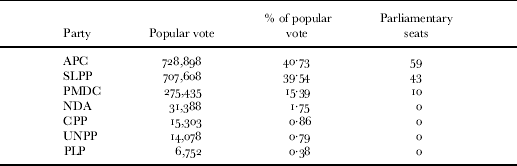
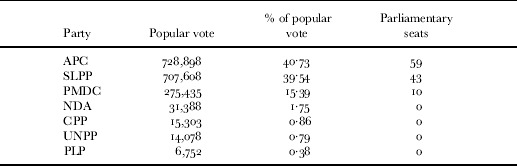
The top three vote-getters in the 2007 parliamentary elections were the APC with 40·7% of the popular vote, the SLPP with 39·54%, and the PMDC with 15·39% (see Table 1). The APC captured 59 of 112 parliamentary seats, more than doubling its share of seats (twenty-seven) in the 2002–7 Parliament, while the SLPP's share of parliamentary seats plummeted from eighty-three in 2002 to forty-three in 2007. Despite fielding candidates for the first time as a party, the PMDC managed to win ten parliamentary seats in the southern province. The PMDC's most impressive showing was in the southern district of Bonthe, where it swept all three parliamentary seats in previously uncontested SLPP territory. All the Western Area seats (twenty-one) and all but three of the thirty-nine northern parliamentary seats went to the APC. Outside the Western Area and Northern Province, the APC won only two seats, one in the southern district of Moyamba and the other in the eastern district of Kono. The APC vice-presidential candidate, Samuel Sam-Sumana, was soundly defeated in the parliamentary election for his home district of Kono (constituency 20) by the SLPP's Tamba Kaingbanja.Footnote 43 The APC lost three of sixty seats in its northern and western strongholds to the incumbent SLPP, while the latter lost a total of twelve out of fifty-two seats in its southern and eastern strongholds to the PMDC (ten seats) and the APC (two seats). These twelve seats were all won by the SLPP in 2002, an election in which the APC was not competitive in the south and east.
Results of parliamentary elections
Source: National Electoral Commission at <http://www.necsierraleone.org>
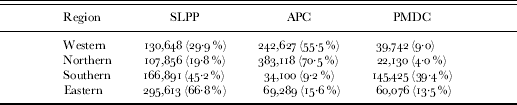
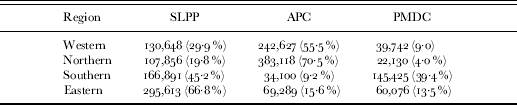
A comparative regional analysis of SLPP and APC votes in the parliamentary elections of 2002 and 2007 (see Table 2 for 2007 figures) reveals considerable erosion of support for the SLPP in its southern stronghold. The SLPP's share of southern and eastern votes in the last two parliamentary elections declined respectively from 93·2% and 93·1% in 2002 to 45·2% and 66·8% in 2007, while the APC's share of the northern vote in the same elections climbed from 50·8 to 70·5%. A spike in support for the APC in the Western Area increased the party's share of the western vote from 30·0% in 2002 to 55·5% in 2007. The SLPP lost ground not only in its southern and eastern strongholds but also in the north and west, where its regional vote dipped from 30·8% to 19·8% (north) and 45·8% to 29·9% (west). By contrast, the APC gained some traction in the south and east, clawing its way up from 3·1% and 3·9% of the respective regional votes in 2002 to a respectable 9·2% and 15·6% in 2007. The SLPP won two thirds of the seats in the Western Area in the 2002 elections, but failed to pick up a single seat (twenty-one in all) in the region in 2007. What this comparison illustrates is that, while erosion of support for the SLPP was most pronounced in the north and west, the same trend was also discernible in its southern and eastern strongholds.
Parliamentary results by party and region
Source: National Electoral Commission.
The southern vote for parliament was more fragmented than the northern vote. Neither the SLPP nor the fringe northern parties gave the APC much of a contest in the north. The PMDC, on the other hand, was the ultimate spoiler in these elections. All the seats won by the PMDC in the south were previously held by the SLPP. Without the PMDC in the race, it would have been very difficult for the APC to win the 2007 parliamentary elections. While the PMDC had no significant impact on northern parliamentary races, it certainly helped determine the outcome in many southern parliamentary contests, and may have affected a few close races in some Western Area constituencies. Assuming the APC could have won all Western Area seats without the PMDC on the ballot, it is also just as likely that the SLPP could have carried the popular vote for parliament but still lose control of the legislature to the APC. This is because the combined seats of the north and west (sixty) exceed those of the south and east (fifty-two). If the APC had held on to the two seats it won in Kono (eastern province) and Moyamba (southern province), and the SLPP had retained the three seats won in Kambia and Koinadugu (northern province), the parliamentary seat distribution would have still favoured the APC with fifty-nine seats to the SLPP's fifty-three (including the ten seats won by the PMDC in the south). As it turned out, however, the PMDC's impact was far greater in the presidential than in the parliamentary elections. Although it was possible for the APC to edge the SLPP in the parliamentary contest without the PMDC in the race, it is less likely that Koroma, a northerner, could have been elected president without the backing of the PMDC, a predominantly southern party.
PRESIDENTIAL ELECTION RESULTS
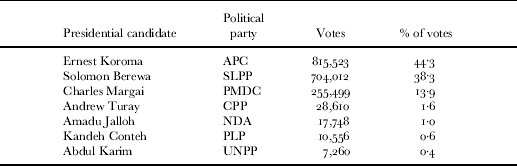
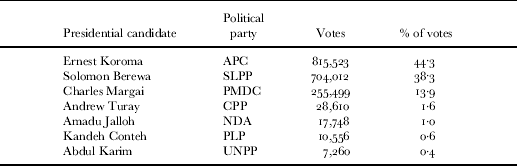
The outcome of the first round of presidential balloting (see Table 3) indicated a clear preference for the opposition. Koroma received more votes (815,523 or 44·3%) in the first round of the presidential contest than his party in the parliamentary elections (728,898 or 40·73%), while the parliamentary votes for the SLPP (707,608 or 39·5%) and PMDC (275,435 or 15·3%) surpassed Berewa's (704,012 or 38·3%) and Margai's (255,499 or 13·9%) first round presidential vote totals. What this comparison suggests is that Koroma was more popular than the APC while Berewa and Margai lagged behind their respective parties in voter support.
First round presidential election results
Source: National Electoral Commission.
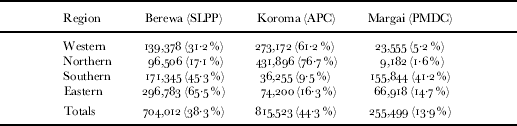
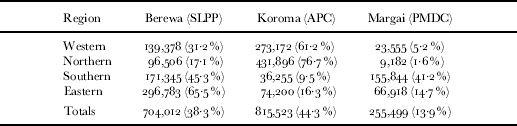
More than half (52·9%) of Ernest Koroma's popular vote came from the north, followed by the Western Area (33·4%), eastern (9·0%) and southern (4·4%) provinces. Berewa's votes were predominantly eastern (42·1%) and southern (24·3%), followed by the Western Area (19·7%) and Northern Province (13·7%). The majority of southerners voted against Berewa (a southerner) in the first round, mainly due to the candidacy of Margai, another southerner, who polled 41·2% of the popular southern vote (see Table 4). The bulk (60·1%) of Margai's popular vote was southern, with the rest coming from the east (26·1%), west (9·2%) and north (3·5%). Voter support for Margai was the most regionalised of the top three candidates, and this had the effect of diminishing Berewa's electoral chances while bolstering those of Koroma.
First round presidential results by region
Source: National Electoral Commission.
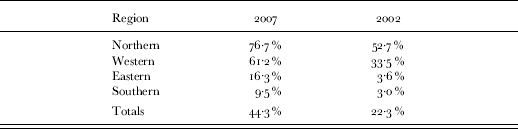
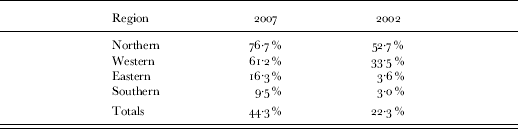
Koroma received over 50% of the popular vote in the north and west, compared to Berewa who clinched the popular vote only in the Eastern Province. Koroma's performance in the north (76·7%) dwarfed Berewa's showing in the south (45·3%) and east (65·5%). Berewa had a better electoral outcome in the north (17·1%) than Koroma in the south (9·5%), but the latter made up for his paucity of southern votes with a fairly decent showing in the east (16·3%). In effect, Koroma's combined southern and eastern vote total (110,455) trumped Berewa's share (96,506) of the northern popular vote. A comparison of Koroma's performance in 2007 and 2002 is further illustrative of the gains made by opposition forces since the 2002 elections (see Table 5). Koroma received 44·3% of the popular vote in the first round of presidential balloting in 2007, compared with 22·3% in 2002. He increased his percentage share of the popular vote in all regions in 2007, making impressive gains in the Northern Province and Western Area. Quadrupling his modest share of the popular vote in the east and tripling it in the south helped pave the way for Koroma's ultimate victory in the presidential run-off.
Comparative first round presidential votes for Ernest Koroma
Sources: National Electoral Commission; Kandeh (Reference Kandeh2003).
Since none of the presidential candidates obtained the required 55% of the popular vote to be declared winner in the first round of presidential balloting, a run-off between Koroma and Berewa was held on 7 September 2007. Frantic efforts by the SLPP leadership to secure the support of the PMDC by appealing to ethno-regional loyalties were rebuffed by the PMDC leader, who chose instead to throw his support behind the APC's Koroma. Margai was denounced as a traitor by SLPP partisans who tried to spook southerners into voting for their candidate by warning that an APC victory would result in the physical elimination of southerners. To counter the APC–PMDC electoral alliance, the SLPP hastily co-opted two fringe parties, the National Democratic Alliance (NDA) and the Peoples Liberation Party (PLP), whose combined share of the popular vote was 1·6%.Footnote 44 While every vote counts in democratic elections, it was difficult to imagine how an alliance with also-rans could improve the SLPP's prospects in the presidential run-off. Far more critical to gauging the outcome of the presidential run-off was how PMDC supporters would vote.
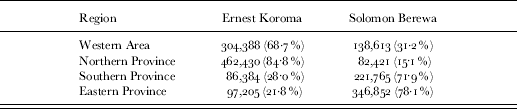
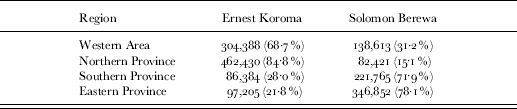
From all indications, a third of PMDC supporters followed the advice of their leader and voted for Koroma in the presidential run-off. This explains the sharp increase in Koroma's numbers from the south and east, where he received 28·0% and 21·8% of the respective regional votes in the second round (see Table 6), compared with 9·5% and 16·3% in the first round. Support for Koroma in the Southern Province tripled in percentage terms, even though the raw numbers show his southern votes were up from 36,255 in the first round to 86,384 in the second. The additional 50,129 votes picked up by Koroma in the south could only have come from PMDC supporters, and since Margai had 155,844 southern votes in the first round, it can be surmised that one out of every three PMDC voters in the south chose Koroma over Berewa in the presidential run-off election.
Presidential run-off results by region
Source: National Electoral Commission.
In the north, Koroma was able to pad his already impressive numbers from the first round, increasing his regional vote from 431,896 (76·7%) to 462,430 (84·8%) in the run-off. The Western Area run-off results also showed movement towards the APC presidential candidate, with his support climbing from 61·2% (273,172) to 68·7% (304,388) of the western vote. Koroma's most impressive victories were in the districts of Bombali, Tonkolili and Port Loko, and his worst showing was in Pujehun district where he polled only 7% of the total district vote. The fact that Pujehun (and to a lesser extent Kailahun) voters were the most reluctant to cast their ballots for Koroma and the APC may not be unrelated to simmering discontent in these districts that can be traced back to the last time the APC was in power (1968–92).Footnote 45 Pujehun, however, is sparsely populated and Koroma performed remarkably well in the other southern districts of Bonthe and Moyamba, where he increased his vote total from 1,597 (3·1%) to 20,018 (41·4%) and from 14,448 (18·1%) to 26,485 (34·6%) respectively. Even in Berewa's home district of Bo, Koroma was able to attract a quarter of the total vote. Also noteworthy was Koroma's competitiveness in the eastern district of Kono, where his share of the district vote rose from 35·1% (43,556) in the first round to 41·5% (52,908) in the second.
EXPLAINING THE RESULTS
How could an incumbent party that ‘brought peace’ to the country and won landslide victories in the 2002 presidential and parliamentary elections lose so convincingly five years later? Could the SLPP have won, as some of its partisans contend, without the PMDC in the race or with a different presidential ticket? Why did southern voters desert the SLPP in large numbers to vote for the PMDC and APC, and what explains the resurrection of the APC as an alternative to the SLPP? Why did the SLPP concede defeat, and what are the implications of these elections for democratisation and good governance in Sierra Leone?
First, the performance of the SLPP government was the underlying cause of its defeat.Footnote 46 SLPP leaders handed the APC and PMDC the proverbial rope with which their party was hung in these elections. Not providing basic amenities and social goods even as donor funds poured into the country seriously damaged the party's credibility and electoral prospects. Discredited internally by predatory governance and hemmed-in externally by the insistence of donors on free, competitive, elections, the SLPP was left with no realistic option but to reluctantly accept the will of the people as expressed through the ballot box. Antipathy to the SLPP was most palpable in the Western Area, the political bellwether of the country, where it captured two thirds of parliamentary seats in 2002 but failed to win a single seat in 2007.Footnote 47 The Western Area municipal election of 2004, in which the SLPP was also defeated by the APC, was a harbinger of its defeat in the 2007 elections.Footnote 48 SLPP leaders arrogantly dismissed their loss of support in the Western Area as insignificant, and lulled themselves into a false sense of invulnerability that was predicated on the belief that southern voters would never desert their party. They failed to take into account the changing political landscape of the country, and the rising levels of political awareness among the youth segment of the population.
Second, party infighting was the proximate cause of the SLPP's defeat. There were many issues that divided SLPP members, but the two most contentious were the party's relationship with the Kamajor militia and the fallout from its 2005 Makeni convention. The fact that Kamajor leaders, who fought against rebels and on the side of the SLPP government, were behind bars while those on whose behalf they took up arms were dismissive of their plight rankled the Kamajor rank and file. Before he died in the custody of the Special Court of Sierra Leone, Hinga Norman, the Kamajor leader, had instructed his followers to support the PMDC rather than the SLPP, the party to which these civil defence irregulars are historically, culturally and politically aligned. The impact of Kamajor defections from the SLPP was strongly felt in Bonthe district, home of the imprisoned Kamajor leader Moinina Fofana, where the SLPP was routed by the PMDC.
Other fissures within the SLPP crystallised at the 2005 Makeni convention, where Berewa, at Kabbah's behest, secured the party's nomination as presidential candidate. The undemocratic circumstances surrounding Berewa's ascendancy to the party's top position alienated long-standing partisans who saw Berewa as an interloper or ‘Johnny come lately’ to their party. But Kabbah circled the official SLPP wagons around the candidacy of Berewa, and by doing so provoked a wave of resignations and defections from the party that led to the formation of the PMDC. These elections were the first time the SLPP had to contend with a formidable opposition in its own backyard, and although the PMDC did not win the elections, it may have done more than the APC to defeat the SLPP. Had the SLPP hierarchy allowed a popular choice of presidential candidate to emerge from within the party's broad leadership ranks, the PMDC would not have been formed and the party's electoral prospects would have been much brighter, especially if the hypothetical ticket ran on a platform of change rather than the continuity symbolised and promised by Berewa and his running mate.
Personal ambition, rather than principles or the performance of the government, drove Margai to part company with the SLPP. Margai had earlier resigned from the SLPP in 1995 to join the National Unity Party (NUP) after losing the party's presidential nomination contest to Ahmad Tejan Kabbah. His defection from the SLPP at the time had no impact on the party's electoral chances, because the principal targets of public discontent in 1996 were the NPRC and APC, not the SLPP. As in 1995, Margai's decision to resign from the SLPP was motivated by personal calculations, but the same cannot be said for the plurality of PMDC supporters whose defection from the SLPP had more to do with issues than personalities. PMDC supporters crossed ethno-regional lines to support the APC less because Margai told them to do so than because they felt newcomers (especially former APC notables) with suspect SLPP credentials had hijacked their party. Lingering resentment over the SLPP leadership's complicity in the demise of Hinga Norman (a war hero to many PMDC members and supporters), and fears that a Berewa presidency would unleash a wave of vindictive reprisals against prominent PMDC members, drove many southerners to vote for the APC in the presidential run-off. Two thirds of PMDC supporters, however, ‘stayed home’ or voted for Berewa in the second round because southerners have far less difficulty voting against than for the APC.
Third, the coming together of APC leaders and their supporters helped to revive and re-energise what had become a listless party. The APC had experienced its own fragmentation in the early 1990s, and was not a factor in the 1996 elections because it was widely seen as the party that plunged the country into armed conflict. However, it began to regroup in time for the 2002 elections, as many of its offshoot reincarnations folded and merged with the APC. Disagreements over leadership were settled before the elections and in a manner that did not cause defections from the party, as was the case with the SLPP. APC supporters were also more united behind their party than their SLPP counterparts, but nothing the APC did to win the elections could equal the gift it was handed by the SLPP's disappointing performance in office.
The resurrection of the APC is quite remarkable for a party that eliminated democracy and introduced unprecedented levels of violence in the country's politics. Left for dead after it was ousted in a military coup in 1992, many observers could not have predicted its sudden return to power. Relevant to understanding the APC's reversal of fortunes is the growing realisation among voters that both parties are essentially the same in terms of governance logic and practices. This lack of differentiation between the two main parties, and the high rates of party switching (locally referred to as ‘watermelon politics’), did more to hurt the SLPP than APC in the 2007 elections – the APC could not improve its positives or shed some of its political baggage, but the SLPP managed to drive up its own negatives enough to forfeit the advantage it had enjoyed in popular acceptance over the APC in 2002.Footnote 49 SLPP performance, in short, brought the APC back to life and boosted the PMDC's electoral chances. Neither the APC nor the PMDC stood any chance of unseating the SLPP had the latter's performance minimally approximated popular aspirations.
Fourth, ethno-regional loyalties and solidarity may help explain some voting patterns, perhaps more so in the north than in the south, where a significant number of voters deserted the SLPP to cast their ballots for the APC in the presidential run-off. Interestingly, the patterns in 2002 were reversed – voting in the north in 2002 was more competitive than in the south and east, where the SLPP captured all the parliamentary seats and over 90% of the regional popular votes. In 2002, the electoral landscape was bipolar (SLPP v. APC) in the north and west, and unipolar (SLPP) in the south and east; in 2007, the landscape shifted to unipolar domination of the APC in the north and west, multipolar competition in the south and unipolar dominance by the SLPP in the east. This situation advantaged the APC, since it faced little more than token opposition in its northern stronghold and only had to worry about the SLPP in the south and east. The SLPP, on the other hand, had its hands full not only with the APC but with the pesky PMDC, a party once dismissed as irrelevant by SLPP leaders but which turned out to be a ‘king-maker’ in the presidential run-off. Because the popularity (2002) and unpopularity (2007) of the SLPP cut across regions, it is difficult to argue that ethno-regional loyalties and considerations dictated both the SLPP's victory in 2002 and its defeat in 2007. While ethnicity clearly shaped voting patterns in both elections, it did not uniquely determine their outcomes.
Fifth, the dislocations and intense privations caused by the country's decade-long armed insurgency helped loosen parochial loyalties and awaken the average citizen to the realities of the country's leadership and systemic woes. Cut loose from their traditional moorings, Sierra Leone's young, uprooted generation is less wedded to affective political solidarities and more inclined to support candidates and parties irrespective of ethnicity, party or region of origin. The protest music of local artists (Emmerson's ‘Tu Fut Arata’, ‘Borbor Pain’, ‘Borbor Belle’ and ‘Swegbe’ come to mind) resonated with the public precisely because the lyrical jibes against the political class are intimately expressive of conditions in the country and the true feelings of citizens. Many youths expressed their frustration at the country's leadership by constantly and openly alerting the latter to their rising levels of disillusionment and despair. ‘Man den nor gladi oh’ (the youths are not happy) gained currency under the SLPP as one of many protest bywords among urban youths.Footnote 50 In the end, the youth vote, which was overwhelmingly anti-SLPP, particularly in the Western Area, helped determine the outcome of these elections.
Related to the above explanations are the reasons why the SLPP conceded defeat. Unlike what happened in Nigeria's fraudulent elections of 2007 (Suberu Reference Suberu2007), SLPP leaders could not manipulate the electoral process or fix the outcome. The electoral commissioner stood her ground and refused to be bullied or intimidated by incumbents desperate to hang on to power. Backed by the donor community, she performed her duties with integrity and favoured no single party, group or individual. She was not, contrary to SLPP propaganda, doing the bidding of the international community or the opposition in discharging her duties; rather, what she did was simply validate the will of the people and their desire for change in the country's political leadership. In the end, even Kabbah felt constrained to side with the commissioner if only to preserve his quasi-democratic legacy.
Perhaps the most important reason the SLPP accepted the verdict of the electorate is the international community, whose role in ensuring a fair and credible outcome cannot be discounted. If nothing else, donor assistance handicapped SLPP leaders, making it very difficult for them to steal the elections. The potential consequences (withdrawal of donor support, outbreak of armed conflict) of rigging the elections would have been too costly for the SLPP and a country that is less than a decade removed from armed conflict, but the possibility of such a contrived outcome was not lost on external patrons, who had vested interests in ensuring a legitimate process and outcome, and the voting public. Too much was at stake for both the people of Sierra Leone and the international community, and the latter were not about to watch their investment go up in smoke because a rogue incumbent could not accept electoral defeat. Still, it is doubtful whether Berewa would have accepted defeat had he been the incumbent president; more than likely, he would have gone out of his way, like Mwai Kibaki in Kenya, to blatantly rig the elections and damn the consequences.Footnote 51
Last and most important, the public's demand for political change was simply irresistible and irrepressible. Resisting the will of the people was not an option in these elections, and there was the real possibility of the country sliding back into armed conflict had the SLPP rigged them and remained in power. In the end, the ‘landlords’ of the SLPP were forced to come to terms with the fact that their so-called ‘tenants’ (the voting public) have the final say in deciding who shall govern them.
***
The struggle between rogue incumbents desperate to hold on to power and a politically awakened electorate determined to toss them out of office defined the broad parameters of Sierra Leone's second post-conflict elections. These elections were primarily about establishing the right of the people to elect and change their government through the ballot box. Sierra Leone had never experienced a peaceful transfer of power from one elected government to another and, now that this transition has occurred, it remains to be seen whether the newly elected APC government will allow the rules of democratic engagement to continue to take root the next time an opposition leader wins a presidential election. The trend across the continent in this regard is not particularly encouraging – with the exception of Benin, where Mathieu Kerekou and Nicephore Soglo have lost elections as incumbents, ‘second turnovers are almost unheard of in Africa’ (Goldsmith Reference Goldsmith2001: 423). It is therefore premature to equate the opposition victory in the 2007 elections with the establishment of a democratic tradition in Sierra Leone.
Elections are not uniquely constitutive of democracies but ‘you cannot have democracy without elections’ (Bratton & Posner Reference Bratton and Posner1999: 379). Consolidating electoral democracy entails regularising competitive elections and improving the legitimacy of procedures and outcomes. In terms of quality and significance, the elections of 2007 were cleaner than those of 1996 and 2002, with the electoral commission demonstrating greater autonomy from the incumbent party than in the two previous contests. But unlike Ghana and Senegal, where the quality of elections has also improved with alternations of parties in power but where the electoral system is not donor-driven, the continued independence and competence of the electoral commission in Sierra Leone remains uncertain. Sierra Leone has not autonomously organised free and fair national elections since 1967, and unless the country assumes ownership of its electoral system, the survival of a multi-party electoral regime will remain in doubt.
How leaders and parties exit power in Africa is a significant indicator of democratic progress and political institutionalisation. The growing importance of elections as mechanism of political change in contemporary Africa is evidenced by the increase in their number and regularity since 1990, by their intensity and competitiveness, and by the declining number of military coups and violent takeovers. These trends suggest that ‘whereas African leaders were two to three times more likely than leaders elsewhere in the world to leave power by violent means in the 1960s, 1970s, and 1980s, they are equally likely – or to be more precise, equally unlikely – to leave power under violent circumstances today’ (Posner & Young Reference Posner and Young2007: 129). Non-violent exits, however, should not be confused with democratic change. More significant for democratisation is for an incumbent president to lose power to an opposition candidate, or for an outgoing incumbent's choice of successor to be rejected by the electorate. Sierra Leone falls into the latter category, including Kenya (2003) and Ghana (2000), where electorates rejected the anointed successor of an outgoing president. Short of actually defeating a presidential incumbent, denying the presidency to an outgoing president's choice for the office is the next best thing that can happen to unconsolidated democracies in Africa.
Democracy cannot be consolidated, nor are market reforms sustainable, in the absence of an effective state (Przeworski Reference Przeworski1995). State effectiveness in protecting citizens, establishing the rule of law, extracting revenue, allocating resources and promoting mass welfare is largely a function of the interplay of capacity and legitimacy. State capacity can be enhanced by institutional autonomy, procedural transparency and the distancing of public power from private wealth (Bates Reference Bates1999). Decoupling state and government and establishing the relative autonomy of state institutions requires subordinating elected governments to state institutions, and allowing these institutions to operate independently of the narrow interests of political incumbents. Effectiveness in safeguarding citizens and providing basic social goods is the surest way of building public support for democratic institutions in impoverished societies like Sierra Leone. Political incumbents, on the other hand, undermine democracy when they extract resources on behalf of the state but fail to provide social goods or protect citizens. This failure can be traced to a mode of accumulation that is predatory, unproductive and inimical to social and institutional development.
It is this mode of accumulation, which enfeebles institutions and impoverishes society, and the corresponding absence of a hegemonic ruling class, that pose the most formidable obstacle to the consolidation of democracy in Sierra Leone. While the liberal peace project is embedded in the values, frameworks and agendas of a ‘transnationalised neo-liberal hegemony, in Africa the basic foundations of a domestic hegemonic project are mainly absent’ (Taylor Reference Taylor2007: 562). This absence of local hegemony is mainly due to a mode of wealth acquisition that defies legitimation and retards development. Implementing a hegemonic global democratic project in the absence of local political elites whose interests are compatible with the normative underpinnings of such a project is not likely to succeed unless there is a radical shift in elite attitudes to democratic governance. Consolidating democracy in Sierra Leone requires transformation in the organisation and exercise of power, strengthening of state capacity, improving the ‘horizontal accountability’ of leaders, routinising the rule of law, combating corruption and eradicating mass poverty. It matters less how many times political parties alternate in government if such changes merely result in the election of the same people under the guise of different political parties. From all indications, this is what is happening in ‘post-conflict’ Sierra Leone, where elected governments (SLPP and APC) have been feverishly engaged in recreating some of the very conditions that led to armed conflict in the 1990s.
Democracy, as Samuel Huntington (Reference Huntington1997: 7) reminds us, is a ‘parochialising’ rather than ‘cosmopolitanising’ process, and democratic elections do not always produce leaders who are committed to the maintenance and consolidation of a democratic political system. The APC was first elected to power in 1967 but eliminated electoral competition and all traces of liberal democracy by the late 1970s. While an authoritarian reversal may be difficult to sustain in the contemporary period, the APC leadership is no more committed to democracy or less corrupt than its SLPP counterpart. What remains to be seen is whether the newly elected APC government will concede defeat in future elections, or ply the route of ‘false’ democracies in Africa.