Introduction
The ‘greying’ of Western democracies has increased the interest in senior citizens as a political contingent. Due to their sheer number and higher propensities to vote, elders are not only believed to exert an increasing influence over representative democracy (Franklin Reference Franklin2004; McManus Reference McManus1996; Peterson Reference Peterson1999), but also to challenge the political sustainability of mature welfare programmes such as pension systems (Myles and Pierson Reference Myles, Pierson and Pierson2001; Schulz and Binstock Reference Schulz and Binstock2006). However, such prophecies are often based on stereotypic and generalised images of older people as political beings (Wilson Reference Wilson2000). Although differences between older and younger generations no doubt exist – older people are, for example, more inclined to vote whereas younger people are more drawn to protest (Goerres Reference Goerres2009, Reference Goerres and Tremmel2010; Quintelier Reference Quintelier2007) – elders do not constitute a homogeneous group as to their political preferences and behaviour. Moreover, much of what is known about the political engagement of older people originates from studies that have either juxtaposed those over 65 years with younger cohorts, or concentrated only on one or very few types of participation, mostly voting (Campbell Reference Campbell2003). Lately, however, political scientists have made important contributions that specify our understanding of elders as political beings in relation to other age groups (e.g. Goerres Reference Goerres2009). The political participation of elders has also become of interest to social gerontologists. For instance, the idea of engagement, as opposed to that of disengagement, has been considered a central aspect of successful or active ageing, since engagement is believed to be beneficial to wellbeing, quality of life or health (Bond and Corner Reference Bond and Corner2004; Franklin and Tate Reference Franklin and Tate2009; Rowe and Kahn Reference Rowe and Kahn1998). Furthermore, political participation can also be seen as essential for the social inclusion and anti-discrimination of elders (Burr, Caro and Moorhead Reference Burr, Caro and Moorhead2002; Hoskins and Mascherini Reference Hoskins and Mascherini2009; Walker Reference Walker2002, Reference Walker2006; Wilson Reference Wilson2000).
The aim of this paper is to analyse political participation among 65- and 75-year-olds in the West-Finnish region Österbotten/Pohjanmaa by using survey data retrieved in 2005 [the GERDA (gerontological regional database) survey]. The analysis focuses on two research questions. The first question relates to patterns of political participation. What kind of political activities do elders in this region predominantly engage in and to what extent? On the basis of previous research, we expect elders to be keen voters but less active when it comes to non-institutionalised activities like protesting or boycotting (Campbell Reference Campbell2003; Goerres Reference Goerres2009; Jennings and Markus Reference Jennings and Markus1988). The second research question relates to the determinants of political participation. According to the so-called resource model of civic voluntarism (Verba, Schlozman and Brady Reference Verba, Schlozman and Brady1995), the main driving forces behind civic engagement are to be found in ‘participatory factors’ surrounding the individual. Consequently, we can expect elders that possess more of these participatory resources, for example education or social capital, to be more active. The strength of this relationship can, however, be expected to vary between institutionalised and non-institutionalised dimensions of participation (Goerres Reference Goerres2009) and to be influenced by age-specific and contextual circumstances, such as socio-cultural differences within this particular group of seniors.
The paper makes two specific contributions to the literature on political participation of senior citizens. First, it shows that older people in this region are more inclined to vote than to participate in other types of political participation. Second, by focusing on elders in a specific region, it tells us something about the relevance of established theoretical explanations in a context-specific setting. The paper is organised as follows. The first section is a literature review and presents the theoretical starting points for the empirical study. In the second section the data and methods are discussed. The third section three presents the findings from the empirical results. Finally, the conclusions are presented along with a short discussion on the results.
Elders and political participation
The concept of a senior citizen is often difficult to approach since old age has different meanings in different contexts (Wilson Reference Wilson2000). In this paper terms like senior citizens, older people and elders are used side by side when referring to persons aged 60 or more (Goerres Reference Goerres2009: 4). Although this somewhat arbitrary way of delimiting seniority may contribute to the stereotypic constructions that this paper sets out to unravel, it is nonetheless a practical demarcation point since the age of 60 largely corresponds to the average retirement age in Finland (The Finnish Centre for Pensions 2007), representing a social division between working life and retirement.
Another central concept is political participation, which is also somewhat elusive due to its many forms and dimensions. Political participation can be seen either as an individual or a collective phenomenon. Furthermore, it can refer to activities with different degrees of institutionalisation or proximity to representative democracy. In this paper, political participation refers to the individual, non-professional and voluntary participation in activities that aim, directly or indirectly, at influencing political outcomes, changing the institutional premises for politics or affecting the selection of personnel or their choices (Barnes et al. Reference Barnes, Kaase, Allerbeck, Farah, Heunks, Inglehart, Jennings, Klingemann, Marsh and Rosenmayer1979: 59; Verba and Nie Reference Verba and Nie1972: 2; Verba, Schlozman and Brady Reference Verba, Schlozman and Brady1995: 38). This definition precludes, for example, paid political work, lobbying or running for office as well as actitivities that merely represent attentiveness or interest in politics (e.g. reading newspapers) or an ambition to express oneself in order to make a moral statement (e.g. wearing a badge). Also the engagement in voluntary organisations, such as pensioner's organisations, falls outside this definition.
There is considerable variation between different types of political participation, in terms of what they actually tell political elites. For example, whereas voting can be seen as an efficient way of exercising pressure but a less efficient way of conveying preferences, a petition usually works in the opposite manner (Goerres Reference Goerres and Tremmel2010; Verba, Nie and Kim Reference Verba, Nie and Kim1978; Verba, Schlozman and Brady Reference Verba, Schlozman and Brady1995). An important distinction can be made between institutionalised political participation, which refers to organised, formal forms of participation such as voting, and non-institutionalised political participation, which relates to more spontaneous, informal forms of participation such as contacting politicians or boycotting (Borg Reference Borg2005; Goerres Reference Goerres2009; Kaase Reference Kaase1999; Stolle and Micheletti Reference Stolle, Micheletti, O'Neill and Gidengill2006). Whereas institutionalised participation is today losing ground in most western democracies (e.g. Blais et al. Reference Blais, Gidengil, Nevitte and Nadeau2004; Campbell Reference Campbell2003; Franklin Reference Franklin2004; Putnam Reference Putnam2000), non-institutionalised forms of participation are gaining terrain, not least among younger citizens (Dalton Reference Dalton2006; Kaase Reference Kaase1999; Norris Reference Norris2002). These changes have been seen as reflections of changing value structures (Inglehart Reference Inglehart1990) or changes in the overall political integration, especially of younger generations (Blais et al. Reference Blais, Gidengil, Nevitte and Nadeau2004; Goerres Reference Goerres and Tremmel2010; Quintelier Reference Quintelier2007). Much of the existing evidence suggests that older people are less likely than younger people to engage in non-institutionalised activities (Barnes et al. Reference Barnes, Kaase, Allerbeck, Farah, Heunks, Inglehart, Jennings, Klingemann, Marsh and Rosenmayer1979; Campbell Reference Campbell2003; Goerres Reference Goerres2009; Jennings and Markus Reference Jennings and Markus1988; Norris Reference Norris2002). However, these findings are not entirely unequivocal. When it comes to the phenomenon of writing letters to representatives, for instance, Campbell (Reference Campbell2003) found no clear differences between older and younger citizens in the United States of America (USA). Similarly, Kam (Reference Kam2000) found very little support for the thesis that non-institutionalised activities are rarer among older people in Hong Kong. Only in the case of so-called informal activities, such as sit-ins and writing letters to newspapers, were elders found to be less active.
We turn now to a short review of previous research on political participation and the expectations that can be made concerning participation among elders in the study. In their influential work on political participation, Verba and Nie (Reference Verba and Nie1972) argued that participation in a broad sense is more likely among persons with higher levels of socioeconomic resources such as education, income and occupational status. Also Wolfinger and Rosenstone (Reference Wolfinger and Rosenstone1980) found evidence supporting this thesis. In particular, education was found to have a triggering effect on voting (Martikainen, Martikainen and Wass Reference Martikainen, Martikainen and Wass2005). The civic voluntarism model developed by Verba, Schlozman and Brady (Reference Verba, Schlozman and Brady1995) continued along these lines. According to this model, participation in politics is stimulated by three main groups of ‘participatory’ factors: resources, engagement and mobilisation. On the one hand, education, political skills and income can be seen as examples of socioeconomic resources that facilitate participation. On the other hand, interest in politics, political knowledge and belief in one's own capacity to affect politics has also been considered as aspects that are crucial for a person's connectedness with the political system. Thirdly, political participation is likely to be triggered by mobilisation, that is, social networks that simulate political participation, such as one's affiliation with voluntary organisations or the workplace.
This resource model has been tested and modified on several occasions (Campbell Reference Campbell2003; Goerres Reference Goerres2009; Martikainen, Martikainen and Wass Reference Martikainen, Martikainen and Wass2005; Norris Reference Norris2002). For example, it has been suggested that internal and external political efficacy, as well as trust in political institutions, can be seen as important for an individual's integration in the political world, and consequently for political participation (Bäck and Kestilä Reference Bäck and Kestilä2009; Goerres Reference Goerres2009; Grönlund and Setälä Reference Grönlund and Setälä2007; Kaase Reference Kaase1999). Whereas internal political efficacy has been found to be beneficial for both voting and non-institutionalised activities (Goerres Reference Goerres2009), institutional trust has been found to trigger voting (Grönlund and Setälä Reference Grönlund and Setälä2007) but not non-institutionalised participation (Kaase Reference Kaase1999). Another, different, aspect of political integration refers to the prevalence of ageist attitudes in society. On the one hand, it has for example been argued that negative attitudes towards elders in politics may hamper political engagement of older people (Cuddy, Norton and Fiske Reference Cuddy, Norton and Fiske2005), but on the other hand, studies on Social Security and Medicare in the USA show that recipients of these benefits became more politically active when they felt that their interests were threatened (Campbell Reference Campbell2002, Reference Campbell2003).
Advocates of the ‘social capital school’, most notably Robert Putnam (Reference Putnam2000), have suggested that the mobilising factors in a person's social life mainly consist of two aspects of social capital, a cognitive and a structural aspect, both having a positive effect on democracy and civic engagement. Whereas the former aspect relates to interpersonal trust, the latter relates to a person's engagement in voluntary organisations. Allegedly, socially connected persons with higher trust in other people are more likely to engage in politics than others (Teorell Reference Teorell2003). The impact of ‘social capital’ is, however, likely to be less important for non-institutionalised forms of participation (Kaase Reference Kaase1999), since such activities are often characterised by some sort of dissent and may be fuelled by a lack of trust in institutionalised forms of civic engagement.
On the basis of this literature review, political participation can thus – somewhat simplified – be seen as a function of the socioeconomic resources, the level of political integration and the social capital that an individual possesses. How relevant, then, is this modified resource model (Verba, Schlozman and Brady Reference Verba, Schlozman and Brady1995) when applied to the political participation of senior citizens in a specific region of Finland? Although the political behaviour of older people in this region can be expected to follow the logic of the model, unique circumstances may have a certain impact on the results. For example, it is possible that elders share a higher propensity to vote due to historical facts. They belong to a cohort that experienced war, became more educated than their parents and witnessed the heyday of welfare-state development. They also reached their statutory voting age (21 years) during a period of time when turnout rates in Finland were exceptionally high and voting was seen as a duty (Jussila, Hentilä and Nevakivi Reference Jussila, Hentilä and Nevakivi2009; Nousiainen Reference Nousiainen1998; Wass Reference Wass2008). But it is also possible that cultural factors may have an impact on the political behaviour of elders in this region. For instance, it has been shown that Swedish-speakers are generally more prone to engage in politics as a result of an ambition to preserve their interests and rights against the Finnish-speaking majority (Allardt Reference Allardt1956; Sundberg Reference Sundberg1984). Another factor is the legacy of gender equality. Not only was Finland among the first countries in the world to grant women the right to vote (1906), the Finnish welfare state has also facilitated a high level of female labour participation and ensured women a relatively high degree of equality in terms of political rights (Anttonen Reference Anttonen, Palme and Kangas2005). Thus, although women in older cohorts are generally expected to be less active in politics due to a gender-biased political socialisation (Andersen and Hoff Reference Andersen and Hoff2002; Inglehart and Norris Reference Inglehart and Norris2003; Welch Reference Welch1977), we can expect to find only small differences between older women and men in this region.
Data and empirical design
The data for this paper were collected in 2005 as a part of a wider interdisciplinary research project, the Gerontological Regional Database and Resource Centre project (GERDA 2011). The overall aim of this project was to map the living and health conditions of elders in the Bothnia region, i.e. on both sides of the Gulf of Bothnia, in Västerbotten in Sweden and in Österbotten/Pohjanmaa in Finland. This paper, however, concentrates solely on the latter region. Finnish is the majority language in Finland but there is also a Swedish-speaking minority of approximately 6 per cent. In Österbotten/Pohjanmaa, however, 52 per cent of the population is Swedish-speaking which makes this region (alongside the Åland archipelago) the foremost stronghold of Swedish language in Finland. Eight of the 18 municipalities in Österbotten/Pohjanmaa were bilingual with a Swedish-speaking majority, three were monolingual (Finnish) and the rest were bilingual with a Finnish-speaking majority. In this study, the language group was determined through the reported mother tongue of respondents.
The data were retrieved by selecting all 65- and 75-year-old persons living in the countryside and every second person living in the town of Vaasa. The total sample consisted of 2,340 persons, but 17 persons were excluded on the basis of sickness, disability and refusal. In August 2005, an 84-item questionnaire was sent to a total of 2,323 elderly persons. On the basis of information from the official citizen register, every person in the sample was sent a questionnaire in her/his own native language. One reminder was posted some weeks later to those participants that had not answered the questionnaire in due time. In total, 1,547 persons aged 65 and 75 answered the questionnaire, resulting in a total response rate of 66.6 per cent. In order to avoid an overrepresentation of rural citizens, the respondents living in Vaasa (74 Swedish-speaking and 197 Finnish-speaking respondents) were weighted by the factor 2, which resulted in an overall N value of 1,818. In this study, however, elders with a different native language than Finnish or Swedish were excluded from the analysis due to their small number (seven). Similarly people that had not reported their native language were excluded from the sample (23). This resulted in a final N value of 1,788. An analysis of the dropout rate (Herberts Reference Herberts2005) showed a somewhat lower response rate in the eldest cohort, notably the male, Finnish-speaking group. In most surveys of this kind, the dropout rate is generally higher among those with frailty and those in care. In this sample, only a small proportion of 65- and 75-year-olds (3.2 and 8.3%, respectively) reported poor health, and a very small proportion lived in a service facility for seniors (0.3 and 0.9%, respectively).
The empirical design was based on a statistical analysis of the 11 items on political participation in the GERDA survey. These items largely correspond to the variables used in earlier research (Goerres Reference Goerres2009) and ranged from institutionalised forms of engagement such as voting in parliamentary elections to non-institutionalised forms of action like joining demonstrations.Footnote 1 The list also included the variables church council voting and appealing against decrees launched by authorities. Although it is debateable whether these two activities represent forms of political action (Barnes et al. Reference Barnes, Kaase, Allerbeck, Farah, Heunks, Inglehart, Jennings, Klingemann, Marsh and Rosenmayer1979; Norris Reference Norris2002) we chose to include them since they can be seen as deliberate actions seeking to influence or bring about changes in existing conditions. Moreover, the participation in boycotts (of products, companies or countries) was used as a form of non-institutionalised participation, since this kind of activity can also be seen to represent a deliberate attempt to influence society (Stolle, Hooghe and Micheletti Reference Stolle, Hooghe and Micheletti2005; Stolle and Micheletti Reference Stolle, Micheletti, O'Neill and Gidengill2006).
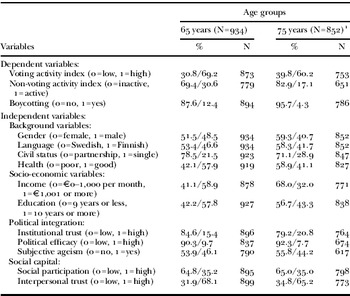
In the first step of the empirical analysis, the 11 items were investigated separately in order to discern the overall patterns of participation. As a next step, we performed an explorative factor analysis that revealed three underlying dimensions of participation. On the basis of these three dimensions, we constructed three dichotomised dependent variables of political participation: voting activity, non-voting activity and boycotting.Footnote 2 These variables were then analysed by using logistic regression models with three sets of independent variables representing a modified version of the resource model discussed in the preceding section. Two variables related to socio-economic resources: income (0 = less than €1,000/month, 1 = €1,001 or more) and education (0 = 9 years or less, 1 = 10 years or more). The second set related to political integration: institutional trust (0 = low, 1 = high), political efficacy (0 = low, 1 = high) and subjective ageism (0 = no, 1 = yes).Footnote 3 The third set concerned social resources (or ‘social capital’): social participation (0 = low, 1 = high) and interpersonal trust (0 = low, 1 = high).Footnote 4 Most of these variables, apart from subjective ageism, have been used as predictors of political participation (‘participatory resources’) in previous research (Goerres Reference Goerres2009; Norris Reference Norris2002; Verba, Schlozman and Brady Reference Verba, Schlozman and Brady1995). By controlling for subjective ageism we seek to assess the effect that age-discriminatory attitudes to elders have on their political participation. In addition, five socio-demographic variables were also included: age (0 = 65 years, 1 = 75 years), gender (0 = female, 1 = male), language (0 = Swedish, 1 = Finnish), civil status (0 = in a partnership, 1 = single) and self-rated health (0 = poor, 1 = good). Age, gender and language were included as general control variables. Self-rated health and civil status were included in order to control for their effects on participation. We also controlled for interactions between age group and the (independent) resource variables (not reported here) in order to investigate whether the association between the participatory resources differed between the two age groups, but no such effects were found. Table 1 presents the distribution of respondents by age group and variable set.
The distribution of respondents by variables and age groups (N = 1,788)

Notes: The proportions for each variable are based on the number of valid cases. Voting activity, non-voting activity, social participation and interpersonal trust are indexes. 1. Two respondents had not reported their age.
The proportion of 65-year-olds with a ‘high’ voting activity (that had voted in all four elections) was somewhat larger than among 75-year-olds (69.2 and 60.2%, respectively). The activity rates were considerably lower for non-voting activities (30.6 and 17.1%, respectively) and boycotting (12.4 and 4.3%, respectively). A large share of the elders (in both age groups) reported low institutional trust as well as low political efficacy. It is also worth noting that the number of missing cases was relatively high for the non-voting index (20%), political efficacy (15.5%) and subjective ageism (21.3%). An analysis of the missing value patterns (not reported here) indicated no clear patterns that would suggest a bias in the sample.
Findings
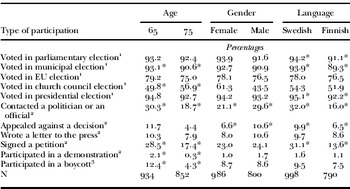
The first research question related to the patterns of political participation of older people. The overall levels of participation varied across different types of political activities as well as age, gender and language (Table 2). Whereas electoral activities, notably presidential, parliamentary as well as municipal elections, were found to be highly popular activities, non-institutionalised activities were found to be rarer phenomena. These results should, however, be interpreted with some caution due to the fact that self-reported participation tends to be overestimated while protest activities underreported (Barnes et al. Reference Barnes, Kaase, Allerbeck, Farah, Heunks, Inglehart, Jennings, Klingemann, Marsh and Rosenmayer1979; Martikainen, Martikainen and Wass Reference Martikainen, Martikainen and Wass2005).
Participation in different types of political activities among older people in Österbotten/Pohjanmaa by age, gender and language (N = 1,788)

Notes: 1. Relates to the latest election. 2. Relates to the previous five-year period and the share of respondents that had engaged once or several times in the particular activity. 3. Relates to the previous year and the share of respondents that had boycotted a product, company or country. The proportions for each variable are based on the number of valid cases.
Significance levels: Significant differences between age, gender and language groups: * p < 0.05.
Approximately 90 per cent of the respondents in each subgroup reported that they had voted in the latest presidential, parliamentary or municipal election while the proportions that had voted in European or church council elections were much smaller (approximately 75 and 50%, respectively). Apart from these two elections, the voting levels must be seen as extremely high, even in an international comparison. For example, the proportion of respondents who reported that they had voted in the latest parliamentary election surpassed the overall turnout rate in Finland (69.7% in the 2003 parliamentary election) by almost 20 per cent (Statistics, Finland 2009), even after allowance is made for the risk of overestimation and bias from missing values. A plausible explanation may be that voting represents a sense of civic duty (Goerres Reference Goerres2009) and that the Swedish-speaking elders, due to their status as a cultural minority (Bengtsson and Christensen Serup Reference Bengtsson and Christensen Serup2009; Bengtsson, Djupsund and Karvonen Reference Bengtsson, Djupsund, Karvonen and Herberts2008; Sundberg Reference Sundberg1984) push the average participation level upwards. In contrast, approximately one in four reported that they had contacted a politician or signed a petition during the last five-year period whereas very few reported having participated in a demonstration. On the whole, the results thus suggest that elders in this region are keen voters but unlikely protesters.
It should also be pointed out that about one-quarter of the respondents reported that they had contacted a politician or a civil servant, or signed a petition. This means that the picture of elders as political beings is not so clear cut, and becomes even more nuanced when age, gender and language are brought into the equation. For example, about one-third of the 65-year-olds and Swedish-speakers had contacted a politician or signed a petition during the last five-year period. Similarly, over 10 per cent of the 65-year-olds had appealed against a decision, written a letter to the press or boycotted a product, a company or a country.
Apart from church council voting, engagement levels were generally lower among the 75-year-olds, which can be related to a higher prevalence of fragility and reduced social networks. As to the effect of gender, older women were not only found to be highly active in politics, they were also found to engage in different activities than men. While women are more likely voters, men are more likely to engage in non-institutional activities. The high female engagement can perhaps be seen as a legacy of the relatively high gender equality in Finnish political terms and it tends to support the notion that women are increasingly catching up with men when it comes to political engagement (Inglehart and Norris Reference Inglehart and Norris2003). Interestingly enough, Swedish-speaking elders displayed a higher participation in all 11 aspects of political participation, which suggests the existence of an important socio-cultural cleavage which is manifested through the respondents' mother tongue.
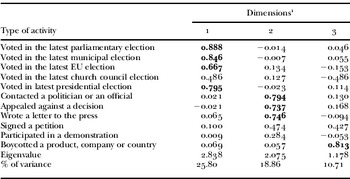
In order to obtain a more aggregated picture of political participation among older people in this particular region, an explorative factor analysis of the 11 dimensions in Table 2 was performed. On the basis of earlier research (e.g. Verba et al. Reference Verba, Nie and Kim1978), we expected political participation to be structured according to a number of underlying dimensions, since people who engage in one particular type of activity usually also tend to engage in similar types of activities. This procedure resulted in three dimensions that are presented in Table 3.
Dimensions of political participation among 65- and 75-year-olds in Österbotten/Pohjanmaa (N = 1,788)

Notes: The table reports factor loadings generated by principal component analysis (varimax rotation with Kaiser normalisation) of the 11 items on political participation mentioned in Table 2. Loadings stronger than 0.60 are reported in bold. 1. The extracted dimensions are: (1) voting activity, (2) non-voting activity, (3) boycotting.
As to the first dimension, voting activity, we found strong loadings for all of the voting variables, except for church council elections. The second dimension, non-voting activity, was formed by strong loadings for contacting politicians, appealing against official decrees and writing columns, but not for signing petitions and protesting. The third and final dimension related to boycotting. Whereas the first dimension refers to institutionalised participation, the two latter dimensions can be seen as dimensions of non-institutionalised participation (Goerres Reference Goerres2009; Kaase Reference Kaase1999). Interestingly enough, demonstrations did not load on any of these dimensions, nor did they form a separate dimension. On the whole, these results tend to confirm the image of elders as active voters but they also suggest two other trends. First, they confirm that elders do engage in non-institutionalised participation. Second, they suggest that such (non-institutionalised) participation is characterised by a passive disposition of disapproval rather than open manifestations of protest. Older people in this study are not very likely to take to the streets in order to protest against or influence policies; instead they tend to work the system from within, i.e. to contact elected politicians, to use the legal system or to ventilate their views in news columns.
On the basis of the dimensions found in Table 3, we constructed three (dependent) variables, voting activity, non-voting activity and boycotting (see Note 2). An initial analysis of the relationship between these three variables and age, gender and language (not reported here) underlined the patterns found in Table 2. While the overall engagement rate was high for voting activity, it was found to be significantly lower for non-voting activity and boycotting. Sixty-five-year-old women were found to be the most active voters (voted in all four elections), while 75-year-old men were most likely to have voted in one to three elections, or to have remained inactive. As to non-voting activity and boycotting, the most active group was Swedish-speaking, 65-year-old men, whereas Finnish-speaking, 75-year-old women was the least active group.
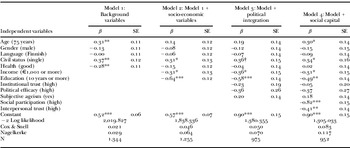
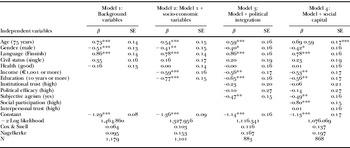
This brings us to the second research question, the motives for political participation. In the following analysis we assess the effect that different sets of participatory resource variables have on the three dimensions of participation while simultaneously controlling for background variables. Table 4 reports coefficients from logistic regressions models of voting activity (estimated category: voted in all four elections). As shown in model 4, when all sets of independent variables are included, 65-year-old, married/cohabiting, well-off, well-educated, socially embedded and trusting elders are more likely than others to have voted in all of the four elections that were included in this index variable (parliamentary, municipal, European Union and presidential elections). By and large, the results thus support the so-called resource theory by suggesting that older people with high levels of resources, such as education and mobilising networks, engage more vigorously in voting. The effect of political integration, on the other hand, was found to be weak or non-existent, which contradicts results found in earlier research (Goerres Reference Goerres2009). Subjective ageism, i.e. the experience of negative attitudes towards older people, also did not have an effect on the likelihood of voting. Among the background variables, age and civil status were found to be significant predictors of voting. Also health was found to be related to voting, although the effect of this variable disappeared when we added the resource variables to the model. It should, however, be pointed out that the fit of the model was rather poor. A control for interactions between age and the independent variables (not reported here) did not improve the model fit, nor was it improved by omitting variables from the models or changing the model structure.
The effect of background variables, socio-economic variables, political integration and social capital on voting activity (logistic regression)

Notes: The table reports unstandardised estimates (β-coefficients) and standard errors (SE) from logistic regression models. Reference categories are presented in parentheses. Dependent variable is a dichotomised variable on the basis of the voting activity index (estimated category: voted in all four elections).
Significance levels: † p < 0.10, * p < 0.05, ** p < 0.01, *** p < 0.001.
Table 5 reports the determinants of non-voting activity index (estimated category: participated in at least one non-voting activity). As can be seen, the likelihood of having participated in at least one non-voting activity during the last five-year period is higher for 65-year-old, Swedish-speaking men that are well off, highly educated, socially connected and that perceive a negative attitude towards older people. As noted earlier, Swedish-speaking Finns have generally been found to be more active voters since they belong to a minority that feel compelled to safeguard their interests against a Finnish-speaking majority (Sundberg Reference Sundberg1984). It is interesting to note, though, that the driving forces behind non-voting activity are somewhat different than voting activity. Not only was the impact of background variables much stronger here, the effect of subjective ageism was found to be an important predictor of non-voting engagement as well, while interpersonal trust was not. This suggests that engagement in non-voting activities among senior citizens follows a different rationale than in voting and that these activities are likely to be triggered by sentiments of disadvantage or threats from policy makers (Campbell Reference Campbell2003; Jennings and Markus Reference Jennings and Markus1988). Although these models help to explain participation, it should be noted that the model fit is still poor, under 20 per cent.
The effect of background variables, socio-economic variables, political integration and social capital on non-voting activity (logistic regression)

Notes: The table reports unstandardised estimates (β-coefficients) and standard errors (SE) from logistic regression models. Reference categories are presented in parentheses. Dependent variable is a dichotomised variable on the basis of the non-voting activity index (estimated category: participated in at least one non-voting activity during the last five-year period).
Significance levels: * p < 0.05, ** p < 0.01, *** p < 0.001.
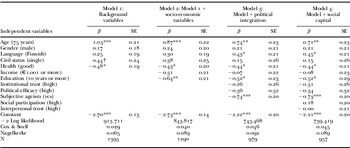
Table 6, finally, reports the regression coefficients for boycotting (estimated category: participated in a boycott during the last year). Here also, we found a strong effect of age, but also effects of civil status and health as well as education and subjective ageism. Accordingly, healthy, Swedish-speaking and well-educated 65-year-olds that believe that there is a negative attitude toward older people are more likely to have participated as boycotters than other elders. Interestingly, income did not have an effect on boycotting, nor was social capital associated with this kind of participation. It is also interesting to note that adding subjective ageism to the equation (model 3) reinstalled the significance of language while an introduction of social capital variables in model 4 did not improve the model.
The effect of background variables, socio-economic variables, political integration and social capital on boycotting (logistic regression)

Notes: The table reports unstandardised estimates (β-coefficients) and standard errors (SE) from logistic regression models. Reference categories are presented in parentheses. The dependent variable is boycotting (estimated category: participated in a boycott during the last year).
Significance levels: † p < 0.10, * p < 0.05, ** p < 0.01, *** p < 0.001.
Table 6 indicates that boycotting is only weakly associated with the social connectedness of elder people, their trust in other people, trust in politics or one's political efficacy. Therefore boycotting can be interpreted as an expression of an individualised and ‘consumerist’ way of influencing society, rather than a collectively shared or traditional channel for political action. Instead of trying to influence the choice of government personnel or their choices (Verba and Nie Reference Verba and Nie1972), elders that engage in boycotts seek primarily to influence actors and phenomena outside the formal political domain (Stolle and Micheletti Reference Stolle, Hooghe and Micheletti2006).
Discussion
This paper set out to examine political participation among senior citizens living in the West-Finnish region Österbotten/Pohjanmaa. The paper addressed two central questions. The first related to the patterns and levels of political engagement of older people in this region. The second question concerned the relevance of the (modified) civic voluntarism theory to explain older people's participation from a region-specific perspective. On the basis of the results the following two conclusions can be made.
First, the patterns of political participation of elders in Österbotten/Pohjanmaa tend to follow the patterns of engagement elsewhere, as we found the elders in this study to be very active when it comes to institutionalised participation whereas the participation levels regarding non-institutionalised participation were considerably lower, a pattern that is observed for the Finnish population as a whole. Furthermore, we found political participation to be structured around three dimensions, voting, non-voting activity and boycotting, of which the latter two dimensions correspond to a non-institutional aspect.
The exceptionally high voting participation reported here may reflect a strong sense of duty among elders in general, which in turn can be traced back to their political socialisation. As turnout rates were relatively high in the early 1950s and early 1960s and voting was generally conceived of as a moral obligation (Nousiainen Reference Nousiainen1998), this may have left a lasting imprint on first-time voters at that time. Moreover, the political behaviour adopted in the impressionable years of youth is likely to be reinforced over the years due to habituation and an increasing adherence to social norms (Franklin Reference Franklin2004). This could, in a way, suggest that this cohort has always participated in the same way and that the results have nothing to do with age. But it is also possible that the high level of voting activity reflects a region rather than an age effect, although this is something that needs further analysis since we do not know if younger people in this region also have the same participation patterns as those cohorts studied here.
However, the difference between institutionalised and non-institutionalised participation is not clear cut, since a relatively large proportion of elders, notably younger and Swedish-speaking ones, reported that they had participated in non-institutionalised politics as well. The relatively high engagement of 65-year-olds in terms of non-institutionalised participation can perhaps be interpreted against the changing socio-political environment at the time that this survey was conducted, notably in the context of the 2005 pension reform. It is plausible that this reform created some incitement among those who were about to retire or had recently retired to express their worries or disapproval concerning the changes in the pension formula or the introduction of a flexible pension age (Campbell Reference Campbell2002, Reference Campbell2003).
Thus, although the results largely corroborate those of earlier research in terms of a high inclination to vote among older people (e.g. Campbell Reference Campbell2002, Reference Campbell2003; Goerres Reference Goerres2009; Kam Reference Kam2000), they also suggest that more attention needs to be given to the changing profile of older people as political beings in the future. Elders of tomorrow are not only likely to display a more multi-faceted political behaviour, but more likely to engage also in non-institutionalised activities as well.
The second conclusion relates to the significance of the resource model (Verba, Schlozman and Brady Reference Verba, Schlozman and Brady1995). As shown in the results, educational and financial resources as well as social capital had a strong effect on the voting behaviour of elders in this study. We also found resources to have a visible effect on non-voting activities, even though some of their explanatory power was lost when controlling for background variables and subjective ageism. In addition, boycotting was related to education, but not to income or social capital. We can therefore conclude that the resource theory can explain political participation among this particular sample of senior citizens. However, the regression models only accounted for a small proportion of the variance in the three dimensions of political participation. This in turn suggests that a considerable share of the driving forces behind political participation of this particular group of elders may be found elsewhere. Therefore, one way of improving the explanatory value of these models would be to build multi-level models that separate the effect of contextual factors (such as political traditions on a municipal level) from those of the individual-level variables used here. Specifically the effect of language is interesting here, since it may influence the way political participation is necessitated or legitimated at the municipal level. As shown in the results, Swedish-speakers were found to be more active than Finnish-speakers in terms of non-institutionalised activities but not in the case of voting. This result can perhaps, in combination with the visible effect of subjective ageism, be interpreted as an expression of disapproval in relation to recent social policy reforms (such as the 2005 pension reform or cutbacks in health services) or to politics in a general sense (e.g. perceived threats to the privileges of the Swedish-speaking minority on a local level). It is therefore possible that we could find some kind of explanatory effect relating to the language cleavage that is hidden on the contextual level.
Finally, the high level of engagement found among elders in this region has several practical implications. One is the capacity of this group to influence societal decision-making processes and to safeguard the interests of elders. Another implication is that a high level of political participation is likely to promote high levels of activity on other areas of life. According to the active ageing perspective (e.g. Burr, Caro and Moorhead Reference Burr, Caro and Moorhead2002; Walker Reference Walker2006, Reference Walker2002), this may in turn have beneficial effects for democracy as well as the wellbeing of elders (Bond and Corner Reference Bond and Corner2004; Franklin and Tate Reference Franklin and Tate2009).
Acknowledgements
The authors wish to thank the editor and the two anonymous referees for their valuable comments and recommendations. Also the contributions of Fredrica Nyqvist and Elisabeth Hästbacka are warmly acknowledged.