




No CrossRef data available.
Rural Work, Household Subsistence, and the North American Working Class: A View from the Midwest
Published online by Cambridge University Press: 10 February 2005
Abstract
This essay examines seasonal rural work as part of the survival strategies of rural and urban households and individuals in the Midwestern United States. Using workers' memoirs and data from government investigations, the lives of so-called “hobo” workers are examined in relation to communities, labor markets, gender and sexuality, and class formation. “Hobo” was a colloquial term for seasonal migrant workers; most were young, immigrant and US-born men of European ancestry employed in crop harvesting, logging, mining, railroad construction, and other short-term jobs. The seasonal labor market drew together a heterogeneous workforce including farm owners, farm laborers, displaced industrial workers, and young men seeking adventure, as well as criminals, marginally employable drunkards, and disabled men. The essay traces the lives of individual workers, explains labor market structures, and places the mostly-male seasonal workforce in the context of families and communities. The history of rural work in the Midwestern US confounds notions of class formation that posit a one-way trip from peasant to worker, and suggests the ways in which theories of class formation have leaned too heavily on an unexamined image of rural life.
Information
- Type
- Research Article
- Information
- Copyright
- © 2004 The International Labor and Working-Class History Society
In the fall of 1921 Nels Anderson enrolled as a graduate student in the University of Chicago Sociology Department and, two years later, published one of the landmark studies of the discipline's emerging “Chicago School.” Based on cutting-edge research methods including participant-observation, The Hobo: the Sociology of the Homeless Man remains one of the best descriptions of the life and culture of migrant workers during the Progressive Era. Predominantly young immigrant and US-born men, the so-called “hoboes” labored in highly seasonal rural industries such as logging, railroad construction, and crop harvesting. During the winter slack season many settled in cities like Chicago, Minneapolis, Milwaukee, and Kansas City where they lived on their accumulated earnings or eked out a livelihood through short-term service and industrial jobs. For Anderson's teacher and editor, sociologist Robert Park, the hobo was but one example of how human nature was changing in the face of urbanization and modernity. “The man whose restless disposition made him a pioneer on the frontier tends to become a ‘homelessman'—a hobo and a vagrant—in the modern city,” Park wrote in the introduction to Anderson's book.1
Nels Anderson, The Hobo: The Sociology of the Homeless Man (a study prepared for the Chicago Council of Social Agencies under the direction of the Committee on Homeless Men) (Chicago, 1961 [1923]), xxiii.
Ignored or downplayed by Anderson, Park, and the Chicago Committee on Homeless Men which sponsored Anderson's research was the fact that the author of The Hobo had once been a hobo himself. Growing up in a working-class family, he moved around the country regularly following his father's quest to earn enough to purchase a farm. Eventually the family settled on a northern Michigan farm that would be their permanent home. But the cutover land was not very profitable and his father took a job in a nearby iron foundry to supplement the family's income. Nels attended high school in town and eagerly awaited letters from his older brother who was working on a railroad construction crew in rural Illinois. Bored with farm life and inspired by his brother's tales of adventure, he stole his father's pay envelope and headed west. Although his wages were sufficient to quickly repay the stolen money, Anderson became a pretty typical “hobo,” shuttling between city and countryside, working on construction crews and farms, and sometimes begging for money. After several years on the road he settled in Utah where he worked on a ranch, finished high school and attended college. He traveled by freight train to graduate school in Chicago, and slept on the floor of the University heating plant the night before registering. In the morning he cleaned up in the bathroom of a printing plant, put on a tie, and began his passage into the academy. As he noted in the introduction to the 1963 reissue of The Hobo, unlike other participant-observer sociologists of the day, “I did not descend into the pit, assume a role there, and later ascend to brush off the dust.” Instead, writing The Hobo was his ticket out of the working class.2
Anderson, The Hobo, xiii, xxvii. Anderson was not necessarily hiding his past, and his academic advisors and friends in the social welfare community were well-aware of it. The omission speaks more to the values and appearances of social scientific “objectivity” in the formative period of Sociology. For a fuller account of Anderson's life story see Nels Anderson, The American Hobo: An Autobiography (Leiden, 1975); Martin Bulmer, The Chicago School of Sociology: Institutionalization, Diversity, and the Rise of Sociological Research (Chicago, 1984), 98; Todd A. DePastino retells Anderson's story for different analytic purposes in his book, Citizen Hobo: How a Century of Homelessness Shaped America (Chicago, 2003), 127–131.
Anderson's life story presents labor historians with a complex mix of class experiences, identities, and narratives. He was a worker, but he was also a farmer's son, a beggar, a student, and a professional sociologist. His father, a Swedish immigrant, had been a hobo, a lumberjack, a factory worker, and a farmer, while his mother had been a domestic, a factory worker, and a farm laborer. What are we to make of these working-class lives? Shifting back and forth between rural and urban employment, wage labor and petty-proprietorship, engagement with and withdrawal from the labor market, they defy easy classification.
Despite several recent studies, rural work remains a marginal topic for historians of US working-class history, especially those who focus on the industrial North and Midwest.3
See for example Cecilia Danysk, Hired Hands: Labour and the Development of Prairie Agriculture, 1880–1930 (Toronto, 1995); Cindy Hahamovitch, The Fruits of Their Labor: Atlantic Coast Farmworkers and the Making of Migrant Poverty, 1870–1945 (Chapel Hill, 1997); Gunther Peck, Reinventing Free Labor: Padrones and Immigrant Workers in the North American West, 1880–1930 (Cambridge, UK, 2000). See also Montgomery, Fall of the House of Labor, 58–111.
Thomas Dublin, Transforming Women's Work: New England Lives in the Industrial Revolution (Ithaca, 1994); Mary Blewitt, Men, Women and Work: Class, Gender, and Protest in the New England Shoe Industry, 1780–1910 (Urbana, 1988); Deborah Fink, Cutting into the Meatpacking Line (Chapel Hill, 1998); David Griffith and Ed Kissam, Working Poor: Farmworkers in the US (Philadelphia, 1995).
See among others, Hal S. Barron, Mixed Harvest: The Second Great Transformation in the Rural North, 1870–1930 (Chapel Hill, 1997); Mary Neth, Preserving the Family Farm: Women, Community and the Foundations of Agribusiness in the Midwest, 1900–1940 (Baltimore, 1995); Katherine Jellison, Entitled to Power: Farm Women and Technology, 1913–1963 (Chapel Hill, 1993); Jane Adams, The Transformation of Rural Life: Southern Illinois, 1890–1990 (Chapel Hill, 1994). An earlier and still useful collection that deals with nineteenth-century rural history is Steven Hahn and Jonathan Prude, eds., The Countryside in the Age of Capitalist Transformation: Essays in the Social History of Rural America (Chapel Hill, 1985).
See Daniel Nelson, Farm and Factory: Workers in the Midwest, 1880–1990 (Bloomington, IN, 1995).
Studies of the American South and West are more likely to find class a relevant issue in the countryside and to link rural experiences to the history of capitalist social relations, familiar as they are with capital intensive agriculture, migrant workers, and sharecropping.7
Among the many studies see Robin D.G. Kelley, Hammer and Hoe: Alabama Communists during the Great Depression (Chapel Hill, 1990); Edward L. Ayers, The Promise of the New South: Life after Reconstruction (Oxford, 1992); Cletus Daniel, Bitter Harvest: A History of California Farmworkers, 1870–1941 (Ithaca, 1981); Don Mitchell, The Lie of the Land: Migrant Workers and the California Landscape (Minneapolis, 1996).
The life stories of men like Nels Anderson suggest possibilities for integrating rural work into our understanding of working class formation in North America. Drawing from my research on seasonal migrant workers in the Midwestern United States this article aims to place so-called “hobo” workers more solidly within the history of labor circulation on the North American continent and the transnational labor flows that characterized the age of mass migration. I make my case in four sections below. First, I sketch the history of rural work and hobo workers in the Midwest. Second, I outline the connection to individual laborers' life histories and social identities. Third, I describe the role of wage labor in sustaining rural communities and patterns of household subsistence in the rural Midwest generally. And finally, I assess labor historians' use of class formation in light of the history of rural work and hobo workers. Before I begin with the history, however, I need to lead my readers on a small conceptual detour that may serve to highlight some of the reasons labor historians have difficulty finding a place for rural work. Three crucial terms in this article are hobo, household, and class experience, each with a variety of conflicting definitions and connotations.
First, the term hobo and its correlates. During the pre-World War One period hobo came to mean a person (usually male) who migrated in search of work (usually in construction, timber, and crop harvesting). Hobo was often contrasted with tramp which was taken to mean a person who sometimes worked to facilitate travel but for whom travel was of primary importance, and bum a derelict person who neither travels or works. Social scientific literature often used the terms floating laborer, as well as casual and migratory laborer. All of these terms point to the hobo's place in what both socialist and progressive social scientists called the “industrial reserve army,” that portion of the working population for whom there were no steady jobs and whose existence tends to drive down wages for all workers. They became in Marx's phrase, “a mass of human material always ready for exploitation.”8
Karl Marx, Capital: A Critique of Political Economy (Chicago, 1926), 693.
William Leiserson, “The Problem of Unemployment Today,” Political Science Quarterly 31 (March 1916), 1–24; Sumner Slichter, Turnover of Factory Labor (New York, 1919); Stanley B. Mathewson, Restriction of Output among Unorganized Workers (New York, 1931); Marx, Capital, 703–711. My sense is that the term migrant worker became common only after the mid-1940s.
A second important term for this paper is household, which I use in addition to gender to suggest the slightly different valences of the two. Whereas gender suggests cultural understandings about differences between men and women and what these differences imply for social life, I use household to suggest not simply family, but the social organization of subsistence into family and family-like units. Alice Kessler-Harris has argued that the household, “as the central provider of life-sustaining goods and services for most of historical time,” has structured when and where workers enter the labor market. From the perspective of the household, she writes, “wage work becomes merely another form of sustenance.”10
Alice Kessler-Harris, “Treating the Male as ‘Other': Redefining the Parameters of Labor History,” Labor History 34 (Spring-Summer 1993): 197; see also John Bodnar, The Transplanted: A History of Immigrants in Urban America (Bloomington, IN, 1985), xvii.
Finally, let me briefly explore a terminological tension in my paper between what labor historians would call the class experience of migrants, and what economists would call the labor market. I use these terms somewhat interchangeably, not because I think they are equivalent, but because I am looking for a more satisfying description of the social life than either provides on its own. The labor market itself was less a free nexus of exchange than a field of interaction and contest between employers and their agents, people seeking wages, and the organized power of society acting through various levels of government. Men looking for work in the seasonal labor market brought with them divergent personal and family goals. Some expected to quickly earn money for their own farms, others sent their earnings home to support their parents' household. Still others simply hoped for a “winter stake,” that is, enough cash to support themselves during the off-season. Working and living side-by-side, however, men with very different life goals might find common cause and act together to redress their grievances. In other words, they might act as a class in relation to particular market conditions.11
John R Hall, ed. Reworking Class (Ithaca, 1997), 1–31.
For a fuller discussion see Higbie, Indispensable Outcasts, chapter 2. See also, Margo J. Anderson, The American Census: A Social History (New Haven, 1988); Joan Scott, “A Statistical Representation of Work: La Statistique de l'industrie à Paris, 1847–1848” pp. 113–138 in Gender and the Politics of History (New York, 1988); James Clifford, and George Marcus, eds., Writing Culture: The Poetics and Politics of Ethnography (Berkeley, 1986); Mary O. Furner, “Social Scientists and the State: Constructing the Knowledge Base for Public Policy, 1880–1920,” pp. 145–181 in Leon Fink, Stephen T. Leonard and Donald M. Reid, eds., Intellectuals and Public Life: Between Radicalism and Reform (Ithaca, 1996).
Rural Work in the Midwest, 1850–1950
As Anderson knew from first-hand experience, the so-called “hoboes” were part of a system of migration that provided labor to the pressing tasks of the North American West between the 1850 and 1950. They extracted minerals, harvested crops, and built the infrastructure of Euro-American political and economic control. The complex and shifting seasonal labor market of the western US drew together a diverse workforce: farm owners, homesteaders, and farm laborers mingled with displaced industrial workers, men who migrated from one side of the country to the other seeking work, as well as criminals, marginally employable drunkards, addicts, and disabled men. In today's shorthand, they were the “working poor” and the “underclass.” To be certain, in the early years seasonal rural workers were very often young men scouting out new lands which they later purchased. As David Schob noted in his classic study of hired hands on the Midwestern frontier, however, despite the romantic aura of pioneering these early farm laborers nevertheless contended with difficult employer relations. Neither were they simply local “rural folk.” Digging canals through open farm country, Irish and German immigrant laborers often took harvest jobs. As grain production spread across Illinois, Iowa, Wisconsin, and Minnesota in the 1870s, an early migrant stream followed the harvest from south to north.13
David Schob, Hired Hands and Plowboys: Farm Labor in the Midwest, 1815–1860 (Urbana, 1975); Peter Way, Common Labor: Workers and the Digging of North American Canals, 1780–1860 (Cambridge, 1993); Richard Mahon, “Wage Labor and Seasonal Migration in the Wheat Economy of the Upper Mississippi Valley, 1850–1875,” December 9, 1988, Chicago Area Labor History Group, Newberry Library Archives.
Although the circulation of labor was not solely regional, this article focuses on the Midwest and Great Plains where a relatively defined pattern of labor migration developed around rail, timber, mining and wheat harvesting. Consider the yearly cycle of work migration, circa 1910: Winter was the slack season for many migrants. They retreated to the larger cities where they lived on accumulated earnings, or pieced together odd jobs. Chicago, Milwaukee, Minneapolis, Kansas City, Omaha, and Sioux City, Iowa, all housed wintering migrants. Other migrants returned to family farms and homesteads. Still others took logging jobs in northern Michigan, Wisconsin, and Minnesota where the winter snow and ice facilitated timber harvesting. In the spring, railroad and farm work picked up at the same time that lumber work trailed off. Summer provided more or less constant work, with the wheat harvest season beginning in June in Texas and Oklahoma, reaching the Dakotas by late July and following northward into Canada. Threshing began in October and could last until late November depending on weather conditions. Corn, potatoes, sugar beets and other crops provided alternative agricultural employment in the fall, while railroad work (and rural surface road construction increasingly in the 1920s) helped farmers and city-based laborers piece together a living.
The circulation of labor was facilitated by the dense rail network throughout the region and the services of private labor agents. Even fairly remote locales had daily passenger rail service, and (more importantly) frequent freight service. As often as not, migrants traveled by stealing rides on freight trains, a practice tolerated by the railroad companies in part because their employees profited by extorting fares from “trespassing” hoboes. Private employment agents, known derisively by laborers as “job sharks,” charged fees ranging from $1 to $10 for jobs and transportation to the hinterland. Progressive reformers and radical laborers attacked this system as exploitive, and by World War One many states had instituted free public employment agencies with mixed success. Laborers' memoirs, the records of state regulatory agencies, and contemporary newspapers detail the variety of abuses in the private system ranging from high fees, to nonexistent jobs, to bribery, and physical abuse. These same sources indicate that laborers often were able to manipulate the system to their own ends, especially using free transportation vouchers to finance travel.14
Many journalists, social scientists, and historians have researched the hobo migration. Among the more journalistic studies see, Josiah Flynt, Tramping with Tramps (1889); Walter Wyckoff, The Workers (1898); and Whiting Williams, What's On the Worker's Mind By One Who Put on Overalls to Find Out (1920). For social scientific studies based on participant-observation see among others, Peter Alexander Speek, “The Psychology of Floating Workers,” The Annals of the American Academy of Political and Social Science 69 (January 1917): 72–78. For hobo histories, see Roger Bruns, Knights of the Road: A Hobo History (New York, 1980); Eric Monkkonen, ed., Walking to Work: Tramps in America, 1790–1935 (Lincoln, NE, 1984); Salvatore Salerno, Red November, Black November: Culture and Community in the Industrial Workers of the World (Albany, 1989); Courtwright, Violent Land; Kenneth Kusmer, Down and Out, On the Road: The Homeless in American History (New York, 2002); Nigel Sellars, Oil, Wheat and Wobblies: The Industrial Workers of the World in Oklahoma, 1905–1930 (Norman, Ok, 1998); Todd DePastino, “From Hobohemia to Skid Row: Homelessness and American Culture, 1870–1950” (Ph.D. Thesis, Yale University, 1997); Greg Hall, “Harvest Wobblies”; Frank Tobias Higbie, “Indispensable Outcasts: Seasonal Laborers and Community in the Upper Midwest, 1880–1930,” (Ph.D. Thesis, University of Illinois, 2000).
Over the course of the 1910s and 1920s these labor market patterns were changing in ways that rank-and-file workers often were able to perceive. The steam shovel was a major culprit as the mechanization of construction—and especially ditch digging—undermined a crucial part of the seasonal round of work. The end of the railroad-building boom during the 1914 depression had a similar effect, as did the exhaustion of high quality timber and iron resources in the upper Midwest. For a time, mechanization in the wheat harvest actually increased demand for labor as it allowed farmers to expand their wheat fields. But this too would change as the combined harvester-thresher became common in the southern Great Plains by the late 1920s. Although farmers in the Dakotas were slower to adopt this new technology, migrants could no longer count on earning their winter stake from the wheat harvest. Similarly, a generation of intensive logging in the region's pine forests forced the timber industry to shift its major facilities out of the upper Midwest by the years of the First World War. Nevertheless a series of strikes in 1936 and 1937 brought union representation to many northern lumber camps. The CIO claimed to represent 4,000 lumber and sawmill workers in its 1946 negotiations with employers in Duluth.15
John N. Webb, The Migratory-Casual Worker (WPA Research Monograph VII) (Washington DC, 1937); “The New Ditch Diggers,” International Socialist Review (1915). For a fictional account of the work experience of digging pipelines in the 1920s see Jack Conroy, The Disinherited (Columbia, MO, 1991), 244–260. On lumber see George B. Engberg, “Collective Bargaining in the Lumber Industry of the Upper Great Lakes States,” Agricultural History 24 (October 1950): 205–211; John E. Haynes, “Revolt of the ‘Timber Beasts': IWW Lumber Strike in Minnesota,” Minnesota History 42 (Spring 1971): 163–175.
The super-heating and subsequent collapse of the American economy that accompanied the war and immediate postwar years (1916–1921) marked a decisive reorientation of labor markets. As in other sectors, the cut-off of European migration along with increased production brought remarkable increases in wages and commodity prices. Perhaps most importantly, the wages of farm laborers and industrial laborers increased at the same rate between about 1910 and 1921. However, farm wages did not bounce back as quickly as urban wages from their collapse during the 1921–1922 depression, and they remained static while industrial wages rose between the early 1920s and the 1940s.16
Paul H. Douglas, Real Wages of Farm Laborers and Unskilled Laborers, 1890–1926 (Boston, 1930), 182, 187; Daniel J. Ahearn, Jr., The Wages of Farm and Factory Laborers, 1914–1944 (New York, 1945), 20.
Life Stories and the Social History of Migration
Nels Anderson's unusual path to the academy suggests how our understanding of internal migration is deeply connected to individual life histories and to the emergence of state-sponsored investigation and regulation of the labor market. Embedded within Anderson's sociological narrative—itself a kind of hidden autobiography—are the partial life stories of men and women he met in Chicago's Hobohemia. Life history was by the early 1920s a standard investigative strategy in sociology, reflecting a broader move toward empirical field work across the social sciences. In 1912 University of Chicago sociologist William Thomas had laid out a research protocol for the study of immigrant and African American cultures, drawing heavily from anthropology, designed to guide the research of young sociologists. His multi-volume work with Florian Znanieki, The Polish Peasant in Europe and America foregrounded sources such as family letters and life histories in order to track the reorganization of immigrant society in America. As historian Dorothy Ross suggests, Thomas's work carried two competing messages. On the one hand, empirical fieldwork suggested cultural relativism because subjects were described as much as possible in their own words. One the other hand, Thomas strove for what he called “an empirical and exact social science ready for eventual application,” a science of social intervention.17
William I. Thomas, “Race Psychology: Standpoint and Questionnaire, with Particular Reference to the Immigrant and the Negro,” American Journal of Sociology 17 (May 1912): 725–772; Dorothy Ross, The Origins of American Social Science (Cambridge, 1991), 351–353; Bulmer, The Chicago School, 45–63.
The same was true of several other major Progressive Era social investigations such as the US Commission on Industrial Relations which made wide use of life histories to document conditions of hobo workers. Even the US Census, as social historians have explained, is structured on assumptions about family, class, and race.18
Anderson, American Census; Margaret R. Somers, “Deconstructing and Reconstructing Class Formation Theory: Narrativity, Relational Analysis, and Social Theory,” in Hall, ed., Reworking Class, 73–105.
Consider the life stories of three laborers, the first two gathered by the US Commission on Industrial Relations in 1914, and the third a memoir written in the 1970s. Norman Daniel was born in New Orleans around 1880, labored in the Rocky Mountain West, and served with the US Army in the Philippines. Between 1913 and 1914 he followed migrant work from the Gulf of Mexico to North Dakota and back to Kansas. He worked on railroad extra gangs, as a harvest hand, on an excavation crew, and he begged for nickels and odd jobs on the streets of St. Louis and Kansas City. Encountering Daniel in the 1914 Kansas wheat harvest, investigators concluded, “This man appears to be on the verge of falling into the hobo class” (see map 1).

Job History of Norman Daniel, based on data in U.S. Commission on Industrial Relations, 1912–1915: Unpublished Records of the Division of Research and Investigation (Frederick, 1985). Drawn by Emily Kelley.
The Norwegian immigrant Andrew Hanson also traveled widely in search of work. Arriving in the US around 1904, Hanson went directly to work on the Iowa farm of fellow Norwegians, and afterwards entered the floating labor population. He worked on construction sites in Colorado, as a roundhouse laborer in Minnesota, as a farm laborer in North Dakota, as a railroad and dock laborer in Minnesota, and as a lumberjack in Minnesota and Washington (see map 2). Cheated by employers and robbed by drinking buddies, Hanson was broke when USCIR investigators interviewed him in Olympia, Washington, where he was filing a complaint with state labor officials. Of Hanson, they concluded, “All hope gone—believes that he does not amount to anything. Ambition is gone; willpower is weakened . . . He is sorrowful, even when drunk.”19
Life stories of Norman Daniel and Andrew Hanson collected by Peter A. Speek may be found in US Commission on Industrial Relations, 1912–1915: Unpublished Records of the Division of Research and Investigation (Frederick, MD, 1985).

Job History of Andrew Hanson, based on data in U.S. Commission on Industrial Relations, 1912–1915: Unpublished Records of the Division of Research and Investigation (Frederick, 1985). Drawn by Emily Kelley
The life story of a third migrant laborer suggests a wider range of life possibilities. Andrew Devich was the fifth son of his Croatian family to immigrate to the US. Greeted by his older brother upon arriving in Duluth in 1913, Devich received a set of work clothes and a job in a lumber camp. He shifted regularly between lumber and mining work in northern Minnesota. During a miner's strike he traveled to North Dakota to work in the wheat harvest. After World War One, he went “on the ‘bum'” with a friend, riding in freight cars as far south as New Orleans before returning north to central Illinois where he found work through “lumberjack friends” in the coal mines. Later he went to Chicago, worked for two years in a steel mill, and boarded with a Croatian family. On the advice of a fortune teller, Devich returned to northern Minnesota, found work in the iron mines, and settled into the Croatian community where he would marry and raise a family.20
Andrew Devich, “My Memoirs,” July 1976, Andrew Devich Papers, Immigration History Research Center (IHRC), Minneapolis, MN.
Progressive Era observers would have considered each of these three men “floating laborers,” hoboes, or perhaps even tramps. Their movement from one job to the next was often spontaneous and uncontemplated. The life stories of Daniel and Hanson detailed manipulation by unscrupulous employers and employment agents, and the dangers of alcoholism. As part of a larger body of life histories they became raw material for both the USCIR report and popularizations of the Commission's findings.21
Will Irwin, “The Floating Laborer: Some Humble Biographies,” Saturday Evening Post (June 6, 1914): 8–9, 61–63; “The Floating Laborer: The Case of John Smith” Saturday Evening Post (May 9, 1914): 3–5, 41–51; “The Floating Laborer: The Need for Teamwork,” Saturday Evening Post (July 4, 1914): 14–15, 45–46.
As the range of experiences in migrant life histories suggests, it is difficult to define the “typical” migrant. With no census category for “floater” or “hobo” it is necessary to piece together information from a variety of sources. It is clear that laborers working in highly seasonal industries (perhaps the best proxy for “hoboes”)22
The following statistics are based on 1910 Census samples for the West North Central region taken from Integrated Public Use Micro Data Series (IPUMS), 1995 Release, <http://www.hist.umn.edu/~ipums/>. “Seasonal laborers” include men classed as farm wage laborers; family farm laborers; lumbermen, raftsmen, and woodchoppers; and laborers, not elsewhere classified. For more detailed information see Frank Tobias Higbie, “Indispensable Outcasts: Seasonal Workers and Community in the Upper Midwest, 1880–1930” (Ph.D. Thesis, University of Illinois, 2000), 141–146, 329–330.
Samuel Alan Schrager, “‘The Early Days:' Narrative and Symbolism of Logging Life in the Inland Northwest,” 163–164; Arnold R. Alanen, “Years of Change on the Iron Range,” in Clifford E. Clark, Jr., ed., Minnesota in a Century of Change (St. Paul, 1989), 179; John Syrjamaki, “Mesabi Communities: A Study of Their Development,” 257–275 (Ph.D. Dissertation, Yale University, 1940); Powers Hapgood, “Journal,” p.5., Peter Speek, “Report on Investigation of Floating Laborers in Detroit, [and] in the Lumber Camps of Charlevoix County, Mich., Jan. 1914, p. 14, USCIR Unpublished Records. On “white men's camps” in Colorado mining, see Elizabeth Jameson, All That Glitters: Class, Conflict, and Community in Cripple Creek (Urbana, 1998), 140–160.
Summarizing in 1915 the findings of his investigation for the US Commission on Industrial Relations, Peter Speek noted that the difference between white men and foreigners was based more on “mode of living than the racial differences underlying these terms.” He characterized a white man as “an extreme individualist, busy with himself and looking [out] for himself only.” Foreign laborers, Speek observed, were “more sociable” and had a “higher sense of comradeship” with those of their own nationality.24
Speek, “Report on Psychological Aspects of the Problem of Floating Laborers,” 31, USCIR Unpublished Records. See also US Immigration Commission, Reports of the Immigration Commission, Immigrants in Industries, Vol. 18, Part 22, The Floating Immigrant Labor Supply (Washington, DC, 1911), 425–431.
Employers had conflicting notions about the relative value of “white men” and “foreigners.” A 1913 report on railroad labor camps in Wisconsin, for instance, noted that “Foremen almost invariably testify that a hobo gang can do four or five times the work of a gang of Greeks or Bulgarians, and that is one of the reasons why the ‘white men' get more pay.” However, the downside to employing whites was their tendency to quit after short periods at work, whereas immigrant laborers tended to stay on for the entire season.25
William Leiserson, “Labor Camps in Wisconsin,” Industrial Commission of Wisconsin (Madison, 1913), 4.
Peter Speek, “Report on Investigation of Floating Laborers in Detroit, [and] in the Lumber Camps of Charlevoix County, Mich., Jan. 1914,” 10, USCIR Unpublished Records.
The relative “steadiness” of workers had much to do with the labor market structures that brought them to the work sites spread across the North American continent. In his study of immigrant labor bosses and workers, Gunther Peck reveals how large mining and railroad employers relied on ethnic intermediaries to provide a steady supply of workers. Known as “padrones,” these intermediaries connected their countrymen with work, helped them negotiate international borders, and created a network of communication between workers in North America and communities abroad. Peck argues that padrones essentially created the market in immigrant workers by recruiting men abroad, financing their travel to North America, and provisioning laborers at the point of production. Despite their control over their countrymen, padrones were never able to institutionalize their power and often lost their businesses to rival padrones, corporations, or to government intervention. Railroad and mining employers had a hand in creating the myth and reality of padronism by granting immigrant middle-men exclusive rights to jobs in specific locations. Even when padrones were not involved, railroad employers attempted to segregate work along national and racial lines, for instance, designating Italians and Bulgarians to different tasks, or by housing African American workers in separate accommodations.27
Peck, Reinventing Free Labor, 1–9; Hahamovitch, Fruits of Their Labor, 38–54; Higbie, “Indispensable Outcasts,” 146–149.
See, for instance, General Superintendent to L. W. Hill, 28 February 1906; Takahashi to Gruber, 21 January 1909; General Manager to Williams, 12 November 1908; Takahashi to Gruber, 9 September 1908, all in Great Northern Railway Collection, Minnesota Historical Society, St. Paul, Minnesota.
Being a “white man,” whatever the content of that identity, tended to make life a bit easier for laborers. For instance, African American migrant Harry Haywood found that although white hoboes might befriend him, his skin color made him an easy mark for the exploitation of railroad crews.29
Harry Haywood, Black Bolshevik: Autobiography of an Afro-American Communist (Chicago, 1978), 40–41 (thanks to Jim Grossman for directing me to this source). See also Webb, The Migratory-Casual Worker, 88–90.
Len De Caux, Labor Radical: From the Wobblies to the CIO, a Personal History (Boston, 1970), 37. See also Williams, What's On the Workers' Mind, 23.
Dominic T. Ciolli, “The ‘Wop' in the Track Gang,” The Immigrants in America Review 2 (July 1916): 61–64.
As the sugar beet sector emerged in the Midwest, many of these dynamics of racial segmentation of the labor market were revisited, this time with Mexican and Mexican-American workers as the primary labor force. Prior to 1920, Mexican workers had concentrated in major industrial centers like Pittsburgh and Chicago where they worked in foundries, railroad and highway construction, and packinghouses. US Department of Labor investigator George T. Edson estimated a total of about 50,000 Mexicans worked in the booming sugar beet industry during the late 1920s concentrated in the central Great Plains and Michigan with smaller but growing numbers in Iowa, North Dakota, and Minnesota. Like other rural workers, these sugar beet laborers found temporary jobs harvesting tomatoes, corn, grain and hay when their beet fields did not require tending and, as historian Zaragosa Vargas argues, many found their way into more steady industrial employment on railroad crews, in packinghouses, and in manufacturing.32
George T. Edson, “Mexicans in Minneapolis and St. Paul,” 1927, Paul S. Taylor Papers, Box 13, Folder 32, The Bancroft Library, University of California, Berkeley; George T. Edson, “Mexicans in the North Central States,” 1927, Taylor Papers, Box 13, Folder 38, Bancroft Library; George T. Edson, “Mexicans in Sugar Beet Work in the Central West,” 1927, Taylor Papers, Box 13, Folder 39, Bancroft Library; George T. Edson, “Northern Sugar Beet Mexicans,” 1927, Taylor Papers, Box 13, Folder 40, Bancroft Library; Zaragosa Vargas, Proletarians of the North: A History of Mexican Industrial Workers in Detroit and the Midwest, 1917–1933 (Berkeley, 1993), 21, 27; Dennis Nodin Valdés, Barrios Norteños: St. Paul and Midwestern Mexican Communities in the Twentieth Century (Austin, 2000), 53. See also, Valdés, Al Norte: agricultural workers in the Great Lakes region, 1917–1970 (Austin, 1991), and Kathleen A. Mapes, “Defining the Boundaries: Family Farmers, Migrant Workers, Rural Industry and the State in the Rural Midwest, 1898–1945” (Ph.D. diss: University of Illinois, 2000).
George T. Edson, “Mexicans in Sugar Beet Work in the Central West,” 1927, Taylor Papers, Box 13, Folder 39, Bancroft Library; Edson, “Mexicans in the North Central States,” 1927, Taylor Papers, Box 13, Folder 38, Bancroft Library.
However, employers and supervisors did not always act upon occupational, racial, and ethnic stereotypes; rather, they employed them selectively to make sense of their cosmopolitan workforce, and to divide and discipline workers when it suited their purposes. The fluidity of the labor market—that is, the relative ease with which workers could quit and find another job—militated against over-strict segregation. At the same time, immigrant laborers with sufficient English language skills could use their ethnic ties to find work on a “foreign gang,” or hire out American-style as a “white man.”
The elaboration of categories—migratory laborer, hobo, tramp, and bum; white men and foreigners—served the end of terminologically stabilizing the seasonal labor force. This was as true for working-class people who struggled to make a livelihood in the cosmopolitan workforce as it was for the government and welfare functionaries who classified workers in order to rationalize the provision of services. In the hands of social scientists, however, classification took on a much more direct political valence. The goal of the US Commission on Industrial Relations investigation of “floating labor,” according to Selig Perlman's research protocol, was to find ways to make the “stable unionism” of the AFL work among migrants (this despite the fact that no AFL union had ever suggested an interest in organizing migrant workers).34
Selig Perlman, “A plan of an investigation of the IWW and of unskilled and floating labor” 1914, 1, USCIR Unpublished Records.
Household Subsistence and Rural Work
The relative “steadiness” of workers was closely connected to households and communities in ways that were not always understood by Progressive Era investigators. Although seasonal migrants were often cast as “homeless men,” samples of manuscript censuses and other sources suggest that the image of the seasonal laborer as radically cut off from family and community are overdrawn. For instance, surveys of 32,000 wheat harvest hands taken between 1919 and 1921 found that eighty percent had homes to return to after the harvest. Although this statistic might be read in the negative, that twenty percent of the harvest labor force was truly “homeless,” it also suggests that homelessness is not the only story.35
Don D. Lescohier, “Harvest Labor Problems in the Wheat Belt,” USDA Bulletin No. 1020 (Washington DC, 1922); “Sources of Supply and Conditions of Employment of Harvest Labor in the Wheat Belt,” USDA Bulletin No. 1211 (Washington DC, 1924); “Conditions Affecting the Demand for Harvest Labor in the Wheat Belt,” USDA Bulletin No. 1230 (Washington DC, 1924).
Instead what we are seeing is the dynamic interaction between community and the labor market in three important ways. First, the social scientific discourse on migrants placed them outside of communities by virtue of their transience. In this sense, concepts of community and its opposites were linked to modernization narratives highlighting the supposed loss of community through migration, urbanization or proletarianization.36
As Raymond Williams notes of the term community, “unlike all other terms of social organization (state, nation, society, etc.) it seems never to be used unfavorably, and never to be given any positive opposing or distinguishing term.” Raymond Williams, Keywords: A Vocabulary of Culture and Society (Oxford, 1983), 65–66.
My thinking on labor markets and community is influenced by John Hall, “Introduction,” Reworking Class. See also, Richard Whipp, “Labour markets and communities: an historical view,” The Sociological Review 33 (November 1985): 768–791; Robert Gordon, Richard Edwards, and Michael Reich, Segmented Work, Divided Workers (1982); Richard Edwards, Contested Terrain: The Transformation of the Workplace in the Twentieth Century (New York, 1979).
Josiah Flynt, Notes of an Itinerant Policeman (Boston, 1900), 19; Edmond Kelly, The Elimination of the Tramp (New York, 1908). See also David Montgomery, Citizen Worker: The Experience of Workers in the United States with Democracy and the Free Market during the Nineteenth Century (Cambridge, 1993), 83–89; Amy Dru Stanley, “Beggars Can't Be Choosers: Compulsion and Contract in Postbellum America,” Journal of American History 78 (March 1992): 1265–1293.
In a very different way, communities also could provide laborers with an important margin of freedom from the labor market. Family groups, friends, and subsistence activities like gardening, hunting, and fishing allowed men and women to remove themselves from the labor market temporarily.39
Deutsch, No Separate Refuge, 30–40; Lewis, “Expectations, Economic Opportunities, and Life in the Industrial Age,” 31–39; Joe William Trotter, “Race, Class, and Industrial Change: Black Migration to Southern West Virginia, 1915–1932,” in Trotter, ed., The Great Migration, 60–61; John Bodnar, Roger Simon, and Michael P. Weber, Lives of Their Own: Blacks, Italians, and Poles in Pittsburgh, 1900–1960 (Urbana, 1982), 31–33.
Montgomery, Fall of the House of Labor, 109–111; James R. Barrett, “Americanization from the Bottom Up: Immigration and the Remaking of the Working Class in the United States, 1880–1930,” Journal of American History 79 (December 1992): 996–1020; Hahamovitch, Fruits of the Their Labor. My thinking on this is also influenced by Frederick Cooper, “Colonizing Time: Work Rhythms and Labor Conflict in Colonial Mombasa,” in Nicholas B. Dirks, ed., Colonialism and Culture (Ann Arbor, 1992), 209–245; and On the African Waterfront: Urban Disorder and the Transformation of Work in Colonial Mombasa (New Haven, 1987).
Rural households and farm families played an important role in this process as they carefully negotiated their integration into labor and commodities markets. Midwestern farms had always been deeply involved in commodity markets; but the vagaries of weather and prices, along with the cash-poor nature of rural economic life, meant that farm families carefully balanced production for home consumption with production for the market.41
Barron, Mixed Harvest, 7–16; John Gjerde, The Minds of the West: Ethnocultural Evolution in the American Middle West, 1830–1917 (Chapel Hill, 1997), 147–152; Jellison, Entitled to Power, 108, 119; Neth, Preserving the Family Farm, 40–70; Jane Adams, The Transformation of Rural Life: Southern Illinois, 1890–1990 (Chapel Hill, 1994), 49–53; Harriet Friedmann, “World Market, State, and Family Farm: Social Bases of Household Production in the Era of Wage Labor,” Comparative Studies in Society and History 20 (October 1978): 545–586.
Gjerde, Minds of the West, 150.
Jellison, Entitled to Power, xx; Deborah Fink, Agrarian Women: Wives and Mothers in Rural Nebraska, 1880–1940 (Chapel Hill, 1992), 59–63; Neth, Preserving the Family Farm, 17–40; Adams, Transformation of Rural Life, 84–89; Gjerde, Minds of the West, 152–153; Dublin, Transforming Women's Work, 29–75.
As farm families confronted what Hal Barron calls the “Second Great Transformation” of rural life, conflicts arose between farm operators who embraced new agricultural methods and those who resisted change, or were too poor to afford modern improvements. So-called “progressive farmers” looked to state agriculture colleges and county extension agents to learn about fertilizers, new machinery and hybrid crops. Typically the more prosperous and market-oriented farmers, progressive farmers tended to attribute farm failures to individual ineptitude rather than structural economic causes. Community conflicts grew as progressive farmers turned to mechanization, opted out of neighborhood labor-sharing arrangements, and hired fewer laborers. Less prosperous farmers suffered doubly from these changes since they had relied on community labor to bring in their own crops, and on the extra cash from harvest jobs to make ends meet. Nor could they match the productivity of the mechanized, progressive farms.44
Barron, Mixed Harvest; Mary Neth, Preserving the Family Farm, 71–96, 211–13. Percy S. Hardiman, Tape 5, side 1., Wisconsin Agriculturalist Oral History Project, State Historical Society of Wisconsin, Madison, Wisconsin.
Laboring work intersected this negotiation between households and markets in two ways. First, hired hands were members of families negotiating the tension between self-sufficiency and market-orientation. The earnings of farmers' sons and daughters helped sustain the home sphere at the same time that their families' reliance on wage labor tied them closer to farming-as-a-business. Secondly, whether they were from a different ethnic group or simply ill-mannered, hired laborers represented the incursion of the outside world into the moral and economic structure of the farm household. As Hamlin Garland wrote of the man his father hired to help on the farm for a season, “Jack came from far lands, and possessed . . . unusual powers of dancing and playing the fiddle. He brought also stirring stories of distant forests and strange people and many battles.” In contrast to the hired man Jack who was simply mysterious, the temporary harvest hands were “the wild and lawless element,” and “strange nomadic fellows, which the West had not yet learned to call tramps.”45
Hamlin Garland, Boy Life on the Prairie (Boston, 1926 [1899]), 44–45, 215, 151; see also William Duffus, “Labor Market Conditions in the Harvest Fields of the Middle West,” Report to the U.S. Commission on Industrial Relations, December 1, 1914, USCIR Unpublished Records, 7; Robert Saunders, “The Road,” 131, Robert Saunders Papers, Western Historical Manuscripts, University of Missouri, Columbia.
Andrew J. Berdahl, The Berdahl Family (Sioux Falls, SD: 1942), 23–24.
Within the farm household/workplace, hired workers often faced the same expectations as family members. This is especially evident from the experience of women hired to work on larger operations where they assisted with household chores such as cooking and washing. At times, women were expected to work as part of a family group, as was the case when a Nebraska farmer filed an application for farm help with the US Employment Service saying he needed a “man, wife and two boys.” The wife's wages were “to be included in the husbands and duties as a housewife.”47
Application of J.A. Anderson, November 3, 1917, USES, Box 1, RG 183, NARA Kansas City.
Lorena Hickok, unfinished autobiography, chapter 2, pp. 15–16, Lorena Hickok Papers, Franklin D. Roosevelt Library, Hyde Park, New York, as quoted in Thomas Isern, Bull Threshers and Bindlestiffs: Harvesting and Threshing on the North American Plains (Lawrence, 1990), pp. 99–100; see also Mary Dodge Woodward, The Checkered Years: A Bonanza Farm Diary, 1884–1888 (1937, Reprinted St. Paul, 1989).
Life History of Harvey Raymond, USCIR Unpublished Records; Henry McGuckin, Memoirs of a Wobbly (Chicago, 1987), 12–13; Charles P. Brown, Brownie the Boomer: the Life of Charles P. Brown, an American Railroader, edited by H. Roger Grant (DeKalb, IL, 1991), 7–13. See also, Joy Parr, Labouring Children, British Immigrant Apprentices to Canada, 1869–1924 (Montreal, 1980).
Interview with Jack Maloney by Sal Salerno and Peter Rachleff, April 21–25, 1988, 20th Century Minnesota Radicalism Project, Minnesota Historical society (MHS).
Saunders, “The Road,” 122; McGuckin, Memoirs of a Wobbly, 12–14; Life Story of Raymond Harvey, USCIR; Woodward, The Checkered Years; Brown, Brownie the Boomer, 7–13; Robert C. Nesbit, Wisconsin, A History (Madison, 1989), 299. For a fictional account of life as a young rural laborer see Geoffrey Dell Eaton, Backfurrow (New York, 1925).
Despite these disparate expectations of farmers and their hired workers, it is worth remembering that the categories farmer and worker were not always so distinct. Instead, following Mary Neth's analysis of farm families, we might think of the bulk of the working population of the upper Midwest as orienting themselves to a wide range of opportunities to “get by” or “make do,” that is to earn a living for themselves and their families. Farm owners, for instance, often worked for wages themselves, or hired out their teams of horses to construction crews and neighbors with larger farms. Likewise, because employment in most industries was irregular and unreliable, workers often sought to escape wage labor by taking up farming, hunting, fishing, and other subsistence activities.52
US Fish and Wildlife Service, Records of the Joint Commission on US—Canada Fisheries, 1893–95, RG 22: Box 5, Folder 1, Lake Superior Field Notes, 1894, p. 20–21, 26; see also, Interview with William Teddy, July 15, 1894, Box 9, Vol. III, and Interview with C.O. Flynn, Duluth, n.d., Box 7, Vol. I, Joint Commission on Fisheries. For similar examples see Hilda Elizabeth Warra Gonska, “Cradle of Iron” (n.d., probably 1973); Interviews with Robert Lundin (A-88-1027), Cecilia and Arthur Sabattini (A-91-2387), Arvid and Fred Ukura, John Begich (A-84-292), and Richard Graff, Iron Range Research Center, Hibbing, Minnesota; Floyd V. Ames, “Fairwell to Wilderness,” Floyd V. Ames Papers, Bentley Historical Library, University of Michigan, Ann Arbor.
US Immigration Commission, Reports of the Immigration Commission, Immigrants in Industries, Vol. 21, Part 24 (vol. 1), Recent Immigrants in Agriculture (Washington DC, 1911), 426–427, 421–422. See also the section on Polish and Native American cranberry workers, US Immigration Commission, Reports of the Immigration Commission, Immigrants in Industries, Vol. 21, Part 24 (vol. 2), Recent Immigrants in Agriculture (Washington DC, 1911), 555–561. On blacklisted Finnish miners taking up farming see Syrjamaki, “Mesabi Communities,” 218; Sam Tanenhaus, “Gus Hall, Unreconstructed American Communist of 7 Decades, Dies at 90,” New York Times, October 17, 2000; Arne Halonen, “The Role of Finish-Americans in the Political Labor Movement” (Masters Thesis, University of Minnesota, 1945), 83. On Native Americans and seasonal wage labor see Sixty-First Congress, Second Session, US Senate, Hearings Before the Senate Committee on Indian Affairs on Matters Relating to the Wisconsin Indians (Washington DC, 1910), 697–709; Felix M. Keesing, The Menomini Indians of Wisconsin: A Study of Three Centuries of Cultural Contact and Change (Philadelphia, 1939), 184–5, 227–8; “‘We Can Not Get a Living as We Used To': Dispossession and the White Earth Anishinaabeg, 1889–1920,” American Historical Review 96 (April 1991): 377.
For government correspondence on homestead claimants working for wages away from their claims see US General Land Office, Duluth Land Office, Letters Received from the General Land Office, Box 37, Minnesota Historical Society, St. Paul: see letters in re. Minnie B. Sheridan, Carl M. Lanquist, Richard D. Guptil, Ellen A. Hughes, Julius Schoening, Balser Schisler, Dan McDonnell v. Edwin S. Sanders. See also US General Land Office, Crookston Land Office, Rejected Homestead Claims, Box 1, “Cross Examination of Peter Peterson and others by Special Agent Laird in the case of Peter Peterson, 19 November 1903; Copy of Affidavit of John G. Stein, 13 June 1904, and several others, MHS. See also William Z. Foster, Pages from a Worker's Life (New York, 1970 [1939]), 30–33; Interview with Raymond Wright by Carl Ross, 1992, pp. 34–35, MHS.
Despite the growing divergence of farm and factory wages in the 1920s, working people continued to cycle back and forth between agricultural and nonagricultural work. Although labor historians tend to focus on the industrial hubs of Chicago and Detroit, the Midwestern countryside was dotted with small industrial towns like Sheboygan, Wisconsin, Austin and Albert Lea, Minnesota, and Ottumwa and Sioux City, Iowa. Employers in these towns were happy to employ hard-working farm people who were themselves in dire need of extra cash, as Minnesotan Cheri Register recounts in her family memoir Packinghouse Daughter.55
Wilson Warren, Struggling with ‘Iowa's Pride': Labor Relations, Unionism, and Politics in the Rural Midwest since 1877 (Iowa City, 2000); Cheri Register, Packinghouse Daughter: A Memoir (New York, 2001), 73–96; Roger Horowitz, “Negro and White, Unite and Fight!” A Social History of Industrial Unionism in Meatpacking, 1930–1990 (Urbana, 1997), 104–123; Walter Uphoff, Kohler on Strike: Thirty Years of Conflict (Boston, 1966), 23–25; Deborah Fink, Cutting into the Meatpacking Line, chapter 2; Shelton Stromquist, ed., Solidarity and Survival: An Oral History of Iowa Labor in the Twentieth Century (Iowa City, 1993), 25–42.
C.P. Loomis, Joseph J. Lister, and Dwight M. Davidson, Jr., Standards of Living in the Great Lakes Cut-Over Area, USDA, Farm Security Administration and Bureau of Agricultural Economics, Social Research Report no. 13 (Washington DC, 1938), 38–40.
Scattered evidence suggests that rural work remained an important source of income for poor families through the 1940s, especially for women and young people, even as federal farm labor programs imported laborers from abroad. A nationwide survey by the US Bureau of Agricultural Economics (BAE) found that the number of workers in seasonal farm labor shifted from a high of nearly 2.4 million in September 1939 to a low of just over 1 million in March 1940 (twenty percent of the total were in the Midwest while more than half were in the South). A second BAE study found that even in the full-employment years of World War Two large numbers of working men were shifting between manu facturing and agriculture, while many working women shifted between domestic service and agriculture. A study of the tomato and strawberry harvests of western New York state in 1945 found that although recently laid-off industrial workers from Buffalo and other cities “were loath to shift immediately to work in the fields at farm wage rates” while they could stay home and get unemployment compensation, women and children from these families were not so disinclined. Due to the steady work of war years, the report noted, “industrial workers' families have found it less necessary than before to supplement their factory earnings with agricultural employment.” However a study based on Bureau of the Census population surveys in 1945 and 1946 suggested that about twenty percent of the US farm workforce shifted regularly between farm and nonfarm employment.57
Bureau of the Census, Bureau of Agricultural Economics, and Farm Security Administration, Analysis of Specified Farm Characteristics for Farms Classified by Total Value of Products (Washington DC, 1943); L.J. Ducoff and M.M. Hagood, The Farm Working Force of 1943 (Washington DC, 1944), both quoted in Harold Schwartz, Seasonal Farm Labor in the U.S. with Special Reference to Hired Workers in Fruit and Vegetable and Sugar Beet Production (New York, 1945), 8–11; US Bureau of Agricultural Economics, Wages and Wage Rates of Seasonal Farm Workers in the Harvest of Tomatoes, Beets, and Strawberries in Selected Areas of New York State, 1945. Surveys of Wages and Wage Rates in Agriculture, Report No. 11 (Washington DC, 1946), 2–3, 30; US Bureau of Agricultural Economics, Farm and Nonfarm Wage Income of the Hired Farm Working Force in 1946 (Washington DC, 1947), 6–7, 16, 22. See also, Marion Hathway, “The Migratory Worker and Family Life” (Ph.D. Diss.: University of Chicago, 1933); Carey McWilliams, Ill Fares the Land: Migrants and Migratory Labor in the United States (Boston, 1942); Stromquist, Solidarity and Survival: An Oral History of Iowa Labor in the Twentieth Century (Iowa City, 1993), 252–255; Carl E. Feather, Mountain People in a Flat Land: a Popular History of Appalachian Migration to Northeast Ohio, 1940–1965 (Athens, OH, 1998).
Homesteading, fishing, hunting and harvest work represented opportunities to “make do” in the context of an irregular, and often disadvantageous, wage labor market. Instead of seeing distinct classes of farmers and workers, we might view all of these people as part of the same flexible labor force that often found the line between making do and losing out not at the center of commodity and labor markets, but at their margins.
If wage work helped to sustain rural households by supplementing inadequate farm incomes, what did work in the countryside mean to urban workers? In the early twentieth century, urban society increasingly associated the countryside with economic decline, isolation, and poverty. The Country Life Movement and state agricultural colleges, for instance, decried the poverty and inefficiency of American farms, and advocated increased mechanization. Likewise, for urban workers in more stable occupations, seasonal laborers themselves were a physical and figurative reminder of why class, or at least craft, organization was necessary. For example, during the height of the 1915 IWW free speech fight in Sioux City, Iowa, union steam fitter Edward Ashland urged compassion for the Wobblies arrested and confined to an outdoor prison. As Ashland wrote to his fellow craft unionists, the seasonal laborers who supported the IWW were “the necessary product of conditions under which they have been raised. They were taken out of school at a tender age, and all the physical development they got was hanging onto the handles of a plow, and the most inspiring scene before their eyes was the rear end of a mule, and now reduced to premature old age, with vitality sapped and form bent earthwards, [their] ambition [is] blasted and hopes blighted.” While Ashland's was a call for compassion, radicals from diverse perspectives considered hoboes part of a lumpenproletariat that posed an active danger to the interests of more organizable class fragments. Victor Berger considered floaters to be a pool of strikebreakers and easily-bought votes. William Z. Foster, who was certainly in a position to know having been a hobo himself, once called the unorganized “human parasites” and the “real enemy of labor.”58
For Berger see Solidarity, February 18, 1911, p. 3, quoting from the New York Call of February 4, 1911; for Foster see James R. Barrett, William Z. Foster and the Tragedy of American Radicalism (Urbana, 1999), 66–7.
Others considered the seasonal rural work associated with hoboes as part of a longer tradition of pioneering opportunity in America, although they did not necessarily endorse the floating lifestyle. “Leave the city before you are too poor to get away,” intoned the immigrant daily Skandinaven in March 1909, “for life in the cities is becoming harder year by year.” Pointing to the numerous Norwegian farmers in the Midwest, the paper declared that many had “won their farms by way of the farm-worker route, and they have no regrets.”59
“Get a Farm,” Skandinaven, March 19, 1909, Chicago Foreign Language Press Survey, University of Chicago Special Collections (CFLPS), Box 30. See also “Lack of Workers,” Skandinaven, April 23, 1900, CFLPS, Box 30.
“Government Land,” Dziennik Zwiazkowy, November 16, 1911, CFLPS, Box 34. See also “Polish People Migrating to Washington,” Dziennik Chicagoski, January 7, 1904, CFLPS, Box 34; “To Farms,” Dziennik Zwiazkowy, April 19, 1909, CFLPS, Box 34; Dziennik Zwiazkowy, September 19, 1912, CFLPS, Box 34.
Whether or not they wanted to farm, many young men who went west remembered it as a difficult but transformative rite of passage. As the poet Carl Sandburg wrote of his hoboing experiences, “I was meeting fellow travelers and fellow Americans. What they were doing to my heart and mind, my personality, I couldn't say then nor later and be certain. I was getting a deeper self-respect than I had had in Galesburg [his hometown], so much I knew. I was getting to be a better storyteller.” Coming of age also had a political component, if memoirs and oral testimonies are to be believed. Many future liberals and radicals first came into contact with militant, class-conscious workers while working in the countryside or riding in freight cars. (This includes well known radicals like Ray Dunne and Ralph Chaplin, lesser known activists like Sam Swanson, Walter Harju, Robert Saunders, Anton Johannsen and Henry McGuckin, ex radicals like labor historian Philip Taft, who was an IWW activist in his youth, and others: Minnesota governor Karl Rolvaag and even Supreme Court Justice William O. Douglas).61
Sandburg, Always the Young Strangers, 391; McGuckin, Memoirs of a Wobbly (Chicago, 1987); Interview of Vincent Raymond Dunne by Lila Johnson Goff, April 17, 1969, MHS; Interview with Walter Harju, MHS; Hutchins Hapgood, The Spirit of Labor (New York, 1907); Interview with Karl Rolvaag (Radicalism in Minnesota Oral History Project); William O. Douglas, Go East, Young Man: The Early Years (New York, 1974); Robert S. Saunders Papers, Western Historical Manuscripts, Univ. of Missouri, St. Louis.
What is more, this was not necessarily a heterosexual manliness. The countryside was also a place for men to forge intimate relationships with each other. As a middle-class economist concluded of the so-called floating laborers, “there are social dangers which a group of demoralized, womenless men may engender under such conditions [that are a] greater menace than the stereotyped ill effects of insanitation and malnutrition.”62
Carleton Parker, The Casual Laborer and Other Essays (New York, 1920), 74.
Hapgood, The Spirit of Labor, 49; Len De Caux, Labor Radical: From the Wobblies to CIO, a Personal History (Boston: Beacon Press, 1970), 51, 59; William Z. Foster, Pages From a Worker's Life, 260–262; Carl Sandburg, Always the Young Strangers, 383; Caroline Sandoz Pifer and Jules Sandoz, Jr., Son of Old Jules: Memoirs of Jules Sandoz, Jr. (Lincoln, 1987), 92–93.
Anderson, Document 122 and Document 31, Burgess Paper; Anderson, The Hobo, 148; George Chauncey, Gay New York: Gender, Urban Culture, and the Making of the Gay Male World, 1890–1940 (New York, 1994).
Thus the countryside was a space in which urban working-class men confronted difficult social and personal issues. It was a cultural space for coming of age, regardless of whether the central issue of their coming of age was class politics, sexuality, or both as was often the case. But if the hard knocks of seasonal labor in the countryside seemed to make men out of boys, we can also peel away the narrative layer of stoic masculinity to reveal an undercurrent of painful memories of hunger, injury, fear and shame of being an outcast. Reflecting on his first reading of Henry McGuckin's autobiographical manuscript, for instance, IWW leader Fred Thompson explicitly linked the pain of outsider status to the experience of traveling in the countryside. Thompson felt that support for the union sprang “from a consciousness of kind, born not of books, but of the very unpleasant sense of singularity when on a summer day one walks through a small town with a winter overcoat over one arm, knowing he will need it to keep warm that night, even though it marks him as a pesky go-about meanwhile.”65
Fred Thompson to Henry McGuckin, Jr., June 10, 1974, Charles H. Kerr Company Records, Box 7, Newberry Library, Chicago.
The Countryside and Working-Class Formation
This brief exploration of hobo workers' place in working-class formation suggests some of the problems with traditional approaches to labor history that look to one industry, one community, and one workplace as the nexus of emerging class identities and social structures. Sociologist Sonya Rose has dubbed this the “quintessential worker problem”: historical narratives based more on ideal types than lived experience.66
Sonya O. Rose, “Class Formation and the Quintessential Worker,” in John Hall, ed., Reworking Class (Ithaca, 1997), 138–139; Ava Baron, “Gender and Labor History: Learning from the Past, Looking to the Future,” in Work Engendered.
See the discussion about British industrialization and class ideology of missionaries in Jean and John Comaroff, Of Revelation and Revolution: Christianity, Colonialism, and Consciousness in South Africa (Chicago, 1991), 70–75.
Although US labor historians identify urban areas with the process of class formation, most synthetic treatments of working-class history evoke rurality as the key counterpoint to the familiar, history of proletarianization. Bruce Laurie's Artisans into Workers opens with Noah Webster noting that each eighteenth century American was “a husbandsman in summer and mechanic in winter.” They were “the epitome of self-sufficiency and versatility,” Laurie states, “independent yeomen farmers as adept at mending a rake or cobbling a shoe as at plowing a field.” But the emerging market economy would soon “erode self-sufficiency and remake yeomen, artisans, and their children into workers dependent upon wages.”68
Bruce Laurie, Artisans into Workers: Labor in Nineteenth Century America (Urbana, 1989), 15.
Although few labor historians would embrace such a stark vision of class formation today, the drama of modernization continues to exert a gravitational force on our attention. In part this is due to the profound influence of early sociologists, often through the evidence in their empirical studies, on the discourse of social history. But it is also a result of the compelling interpretations offered by the founders of the New Labor History. Echoing E.P. Thompson's work on the emergence of modern time-discipline, Herbert Gutman identified the defining element of American history as the recurrent influx of rural, non-industrial migrants. More than mere labor power, Gutman argued, migrants brought with them “whole cultures” that had to be industrialized. Where European societies went through this painful process only once, “the American working class was continually altered in its composition by infusions, from within and without the nation, of peasants, farmers, skilled artisans, and casual day laborers who brought into industrial society ways of work and other habits and values not associated with industrial necessities and the industrial ethos.”69
Harry Braverman, Labor and Monopoly Capital: the Degradation of Work in the Twentieth Century (New York, 1974) p. 276; Gutman, “Work, Culture, and Society in Industrializing America,” 15. See also, Thompson, “Time, Work-Discipline, and Industrial Capitalism”; Eric Hobsbawm, Primitive Rebels: Studies in Archaic Forms of Social Movement in the 19th. and 20th. Centuries (London, 1959), 2–3.
To be sure, were he writing today Gutman would likely drop the characterization of immigrant cultures as “preindustrial,” just as historians no longer use the earlier and more pejorative term “premodern.” Writing in the late 1980s, immigration historian John Bodnar called for a less sweeping approach to the everyday culture of immigrants in America that would replace a “linear progression” of assimilation with “a continual dynamic between economy and society, between class and culture.” However, Bodnar also considered the real drama of immigrant life to be an urban story.70
John Bodnar, The Transplanted: A History of Immigrants in Urban America (Bloomington, 1985), xx.
Montgomery, Fall, 60, 70. See Bodnar, The Transplanted, xvii–xix.
In his fascinating new study of Guatemalan immigrant workers in North Carolina, Leon Fink evokes the drama of modernization in order to complicate and contextualize our understanding of that drama within an ongoing global economic dynamic. The 1995 strike of Highland Maya immigrants against an anti-union poultry processing company, Fink writes, “suggested a most dramatic confrontation between what Joseph Schumpeter called the ‘creative destruction' of market capitalism and the social organization of one of the hemisphere's oldest cultures.” But as Fink shows in The Maya of Morganton, with their direct links to the civil-war ravaged Guatemalan countryside and their tenacious organizing campaign, these workers are both “communal” and historical.72
Leon Fink, The Maya of Morganton: Work and Community in the Nuevo New South (Chapel Hill, 2003), see especially chapter 2.
Similarly, the life histories of hobo workers like Nels Anderson reflect the complexity and contingency of working class life in the era of industrialization. The child of workers-turned-farmers, Anderson easily shifted between industrial and agricultural labor in his early life. The “hobo migration” was a passing phenomenon closely linked to a particular period in North American industrial and agricultural development, just as Anderson's own experience as a hobo was a passing phase in his life. We might be tempted, therefore, to agree with the notion that working class history runs only in one direction, from the country to the city. After all, the depopulation of the countryside is a well-known fact of twentieth century history. Doing so, however, would confuse a geographic transition with the emergence of a working class. Although those who left the countryside also often left behind the family farm and the family business, they rarely shook the desire for independence they associated with farm ownership. In much the same way that immigrant small business owners emerged from working class communities often to return after failure,73
Ewa Morawska, For Bread with Butter: The Life-Worlds of East Central Europeans in Johnston, Pennsylvania, 1890–1940 (Cambridge, 1986).
Footnotes
Portions of this essay are drawn from Frank Tobias Higbie, Indispensable Outcasts: Hobo Workers and Community in the American Midwest, 1880–1930 (Urbana, IL, 2003). The author thanks Cindy Hahamovitch, Rick Halpern, James Grossman, and participants in the “Repositioning North American Migration History” seminar for their helpful suggestions.
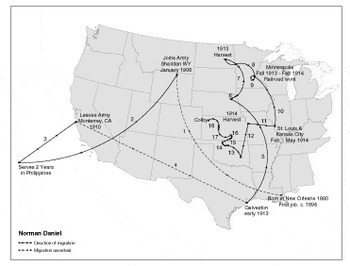
Job History of Norman Daniel, based on data in U.S. Commission on Industrial Relations, 1912–1915: Unpublished Records of the Division of Research and Investigation (Frederick, 1985). Drawn by Emily Kelley.
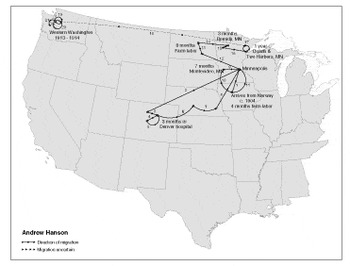
Job History of Andrew Hanson, based on data in U.S. Commission on Industrial Relations, 1912–1915: Unpublished Records of the Division of Research and Investigation (Frederick, 1985). Drawn by Emily Kelley
 You have Access