

In recent years, there has been an increasing rate of enrolment of students with disabilities in mainstream schools in Australia and other countries, and at the same time a strong focus on inclusive education in the research literature (Dally et al., Reference Dally, Ralston, Strnadová, Dempsey, Chambers, Foggett and Duncan2019; Ralston, Dally, & Dempsey, Reference Ralston, Dally and Dempsey2019). Australian schools are becoming increasingly diverse, with growing numbers of students with disabilities and students from a multiplicity of ethnic, religious, and language backgrounds, as well as from Aboriginal or Torres Strait Islander backgrounds (Anderson & Boyle, Reference Anderson and Boyle2019). The capability of the primary and secondary education workforce is of paramount importance to the achievement of inclusive education for students with disabilities and students with a range of diverse needs. How school principals perceive the roles and responsibilities around building effective inclusive education workforce capability (IEWC) is important for further understanding how such capability can be improved.
Principals and School Culture
School leadership, in particular the direction of the school principal, plays an essential role in the degree to which inclusion is successfully achieved in schools (Billingsley, DeMatthews, Connally, & McLeskey, Reference Billingsley, DeMatthews, Connally and McLeskey2018; Urton, Wilbert, & Hennemann, Reference Urton, Wilbert and Hennemann2014). One way in which principals create effective inclusive schools is through their encouragement of a culture and vision supportive of inclusion. Carter and Abawi’s (Reference Carter and Abawi2018) findings emphasised the importance of school leadership in promoting a philosophy and school culture to support inclusion. In their intensive study of an Australian primary school with a high level of student diversity and good academic performance levels, they reported that ‘school leadership for inclusion involves making hard decisions. … consciously targeted effort, advocacy. … and acknowledgement that for all stakeholders inclusion is a constant journey toward a shared vision’ (p. 49). A Scottish study found that teachers’ feelings of self-efficacy towards teaching children with intellectual disabilities were predicted by positive perceptions of the school environment or climate, involving the principal’s leadership and relationships between teachers (Wilson, Woolfson, & Durkin, Reference Wilson, Woolfson and Durkin2020). In a study of teachers in Canada, Woodcock and Woolfson (Reference Woodcock and Woolfson2019) concluded that many of the key issues in achieving successful inclusion reside in the school climate and culture, which are strongly influenced by leadership at the school and systemic level.
The Role of the System
Broader systemic and policy conditions play an essential part in supporting principals’ and teachers’ inclusion efforts (Ainscow & Sandill, Reference Ainscow and Sandill2010; Woodcock & Woolfson, Reference Woodcock and Woolfson2019). Researchers from Canada (Woodcock & Woolfson, Reference Woodcock and Woolfson2019) and Australia (Woodcock & Hardy, Reference Woodcock and Hardy2019) reported that teachers and principals have, at times, found this broader systemic support to be inadequate. Woodcock and Hardy’s study of principals’ understanding of inclusion policy found that the complexity of policies related to inclusion led to principals feeling confused and merely ‘coping’ with translating policy to practice.
Workforce Capability
For inclusive education to be effective, general education teachers must be equipped with the necessary knowledge, skills, and attitudes to effectively teach students with disabilities (Dally et al., Reference Dally, Ralston, Strnadová, Dempsey, Chambers, Foggett and Duncan2019) and students with diverse needs and challenges that may be related to sociocultural factors (Ralston et al., Reference Ralston, Dally and Dempsey2019). Studies from Australia and other countries have indicated that many general education teachers are not adequately prepared and lack confidence in their skills and knowledge to meet the learning needs of all students in their classrooms (Round, Subban, & Sharma, Reference Round, Subban and Sharma2016; Urton et al., Reference Urton, Wilbert and Hennemann2014; Woodcock & Hardy, Reference Woodcock and Hardy2017). Principals place a high level of importance on teachers having the requisite skills, knowledge, and pedagogical practices for inclusion to be effective (Carter et al., Reference Carter, Stephenson, Clark, Costley, Martin, Williams and Bruck2014). Australian studies have indicated the importance of the role of principals in building workforce capability for inclusive education, in particular through professional learning in areas such as legislative requirements and the delivery of appropriate adjustments and supports for students with disabilities (Dickson, Reference Dickson2014; Iacono, Keeffe, Kenny, & McKinstry, Reference Iacono, Keeffe, Kenny and McKinstry2019).
However, little research has reported principals’ perspectives about building a workforce with the capability to provide a truly inclusive education. The current study is part of a larger investigation of Australian school principals’ perspectives about IEWC. The first part of the study involved a survey completed by 113 principals of primary and secondary schools (Duncan, Punch, & Croce, Reference Duncan, Punch and Croce2021). The survey responses reported the professional learning types, topics, and modes of delivery provided by these principals and indicated that principals considered that their primary role in building workforce capability was to act as instructional leaders. The participants reported that the most common barrier to IEWC was a lack of financial resources and time. The findings also indicated that some principals lacked understanding regarding the role of legislation in inclusive education.
The current article reports on the study’s second, qualitative, stage, which sought to gain further understanding of principals’ perspectives of the interrelated roles and responsibilities of school principals, education systems, and teacher registration boards in ensuring IEWC. In the Australian context, the ‘system’ refers to the state and territory government education departments, Catholic education, or independent school systems. Teacher registration boards are responsible for the registration of teachers in individual Australian states and territories to ensure educators meet all legal requirements.
Specifically, the study aimed to answer the following three research questions:
1. How do principals perceive their role in IEWC?
2. How do principals perceive the role of the system in IEWC?
3. How do principals perceive the role of teacher registration boards in IEWC?
Method and Design
A qualitative approach was used to extend the mainly quantitative findings from the first stage of the study. Semistructured interviews were conducted with a proportion of the principals who participated in the study’s first stage. Ethics approval was granted by the University of Newcastle Human Research Ethics Committee (H-2018-0070).
Participants and Procedure
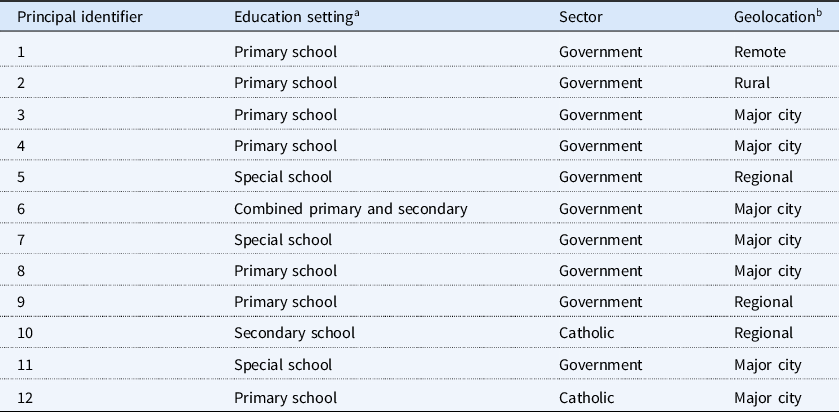
Participants were recruited by invitation from professional association emails with a link to the participant information statement and opportunities for consent to participate in interviews. Twelve principals agreed to participate in a telephone interview of 15 to 20 minutes duration. The majority of principals were from government schools (n = 10), in a primary setting (n = 8), and a major city (n = 7). Three principals were responsible for a special school. Five principals were from South Australia, three from New South Wales, three from Victoria, and one from Western Australia (see Table 1 for participant educational setting description).
Participant Education Setting

aParticipants identified their school as a ‘special school’ without clarification. bGeolocations are based on the Accessibility/Remoteness Index of Australia (University of Adelaide, Hugo Centre for Population and Housing Research, 2018).
The interviews were conducted by telephone by the first author, who was unknown to 11 of the 12 participants. One participant had attended professional learning with the first author previously; however, the two did not know each other well and both agreed there was no conflict of interest. With the permission of the participants, all interviews were audio-recorded, and the recordings were transcribed in full by a professional transcription service. Participants were emailed the transcripts to verify accuracy and make further comment if desired. Once participant transcription verification was received, the audio recordings were deleted.
Interview Questions
The basis of the interviews consisted of three questions related to the participants’ views about IEWC. Principals had the opportunity to respond at length, with the interviewer occasionally using probes to obtain further insights into the participants’ responses. The three questions were:
1. What should be the role of the principal in IEWC?
2. What should be the role of the system in IEWC?
3. What should be the role of teacher registration boards in IEWC?
After the principals had answered three school setting questions (education setting, sector, and geolocation, as per Table 1) and before commencing the interviews, the interviewer read this statement to participants:
For this research, IEWC simply means the ability of school personnel to meet individual student needs. So, inclusivity means all children — with disability, children who identify perhaps as Aboriginal, for example, so it’s all children, and it is how the workforce, any employee in the school, has the capability to meet individual student needs.
Data Analysis
Both authors conducted a thematic analysis of the data, following the phases outlined by Braun and Clarke (Reference Braun and Clarke2006), beginning with thoroughly familiarising themselves with the data, then generating initial codes, which were further collated into potential themes or patterns of meaning. The process of analysis was facilitated by the use of NVivo 12 qualitative data analysis software (QSR International Pty Ltd, 2018). The two authors conferred at the coding level and the generation of themes, with the further two stages of reviewing and defining themes providing the opportunity for discussion and final agreement as to the themes and subthemes.
Results
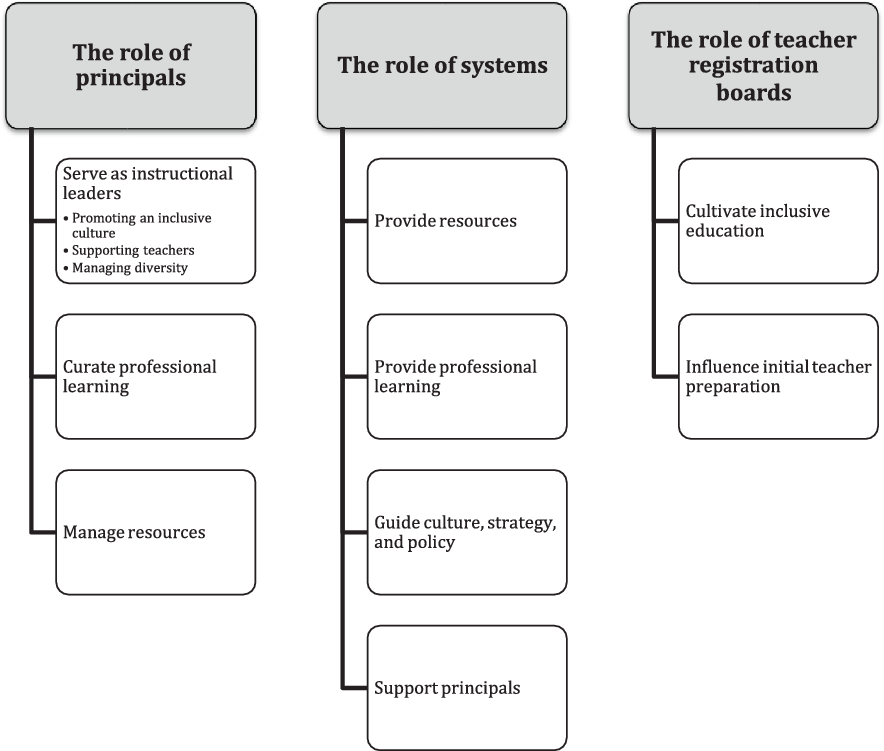
The data analysis identified nine major themes across the three roles about which participants were asked: the principal’s role, the system’s role, and the teacher registration boards’ role. In addition, three subthemes were identified within one of the themes. The themes are reported separately for each of the roles, as shown in Figure 1.
Principals’ Perceptions of Role Differentiation.

The Role of Principals
The analysis identified three primary themes related to the role of the principal in IEWC: serving as an instructional leader, curating professional learning, and managing resources. The instructional leader theme is further divided into three subthemes: promoting an inclusive culture, supporting teachers, and managing diversity.
Serve as instructional leaders
Participants overwhelmingly indicated that the role of the principal in IEWC was as an instructional leader; all participants identified various aspects of this function at least once in their responses. Overall, principals expressed the view that their role involved ‘facilitating the conditions for inclusive education to occur’ (P9).
Promoting an inclusive culture. Many of the responses referred to the principal’s role in promoting a culture of inclusion in the school. Participants spoke about modelling inclusivity across the whole school, setting expectations around inclusion, and encouraging all teachers to value inclusion and understand its importance. One principal said, ‘probably to me the most important thing is to model for all staff an inclusive approach and an empathetic approach to including and engaging all students’ (P3). The same principal further stated that a part of this role was ‘to confront directly any aspect or behaviour that is exclusive, intended or not, raise awareness of it and to support a staff member to change’.
Supporting teachers. A large part of the role of instructional leader in IEWC was related to directly supporting teachers and monitoring their capabilities in inclusive education. Participants specified that it was their role to support the classroom teacher so that all children in the class could be fully included, and that it was their responsibility to ensure that the staff had the capability and competencies needed to work with all students. This extended to monitoring teacher effectiveness; as one participant stated, ‘it’s important that I do performance development with all staff to make sure they are meeting the needs of students’ (P2). Another principal spoke about skills analysis: ‘the principal’s role is to be alert to the level of skills within the staff and to be able to identify where there’s a mismatch in skills and capability and what’s actually being required to promote inclusion’ (P7). One principal described monitoring at the level of teacher programming: ‘The role of the principal should be to ensure that the teacher programs cover inclusive practices and are linked to the children’s prior knowledge, background, in terms of their cultural group’ (P4). Principals’ support role extended to responding to inclusion efforts made by teachers and ‘reinforcing when people are getting it right or when they are accommodating a diverse range of student needs’ (P1).
Managing diversity. The findings indicated that part of the principal’s role of instructional leader and supporting teachers in their inclusion efforts involved managing the diversity of students in their schools, and participants spoke about the increasing nature of this diversity and the challenges it posed. It was common for participants to speak not only of students with disabilities but also of students from migrant or refugee backgrounds with little English language or with differing cultural norms, as well as students who had experienced trauma, and the challenges for teachers of managing such diverse classrooms. This principal stated,
There’s not one teacher here who’s not tried to meet the needs of every child. However, just pure numbers, you know, and added to your numbers of ASD [autism spectrum disorder], which is increasing in our system, dyslexic children which we are now identifying which we didn’t do many years ago, hearing loss, children coming from trauma, Aboriginal students, and some of those children are both a learning difficulty or a disability plus trauma plus environmental things that we can’t control, like poor families and very bad family environments, a classroom is a very, very, very complex place now. (P2)
Participant 2 went on to describe efforts to structure each classroom so that there were not ‘too many students with significant issues’ in any one class, thereby making it easier for teachers to achieve optimal inclusion and differentiation of teaching.
Curate professional learning
All participants discussed the importance of professional learning and the role of the principal in providing and managing professional learning for IEWC. Principals described their role as curators of professional learning so that the workforce understood how to meet individual student needs, how to differentiate teaching and learning, and how to accommodate all students. The principal’s role went beyond organising professional education to ensuring the workforce was integrating expert knowledge into their teaching practice; this could be assessed by the principal observing teachers, talking with students, and obtaining feedback from parents.
Participants described the purpose of professional learning as enabling teachers to put in place strategies that address student needs and to provide teachers with a ‘toolbox of alternative strategies because one size does not fit all’ (P6). In the words of another participant, ‘it’s about floor-to-ceiling tasks, open-ended tasks, differentiation of the curriculum’ (P2). This principal went on to explain that the floor-to-ceiling tasks were particularly relevant to literacy and numeracy instruction for at-risk students.
Several principals described providing professional learning on a needs basis through assessing staff capabilities to identify areas requiring improvement and then arranging appropriate professional education as necessary. For instance, this principal explained,
It’s around ensuring that staff have the proper skills and knowledge and, if they don’t, organising the training for that to happen. So, we do a skill audit of the whole staff, of what training they have, what experience they have. Then we identify areas of need and organise training to fill that need and then also through feedback and what’s happening for students and monitoring progress and things like that. (P9)
The same principal later discussed providing professional learning on a ‘just-in-time’ basis:
We tend to do it at need. So when we have students in classes with particular needs, we tend to upskill teachers in anticipation of those students if they don’t already have those sorts of skills. So if they have somebody, for example, coming into the class with autism, then we send them off to do some training in autism or whatever. (P9)
Most of the participants’ discussion of professional learning related to the skills and knowledge of class teachers; however, two participants also mentioned that support staff needed professional development to ensure they had the competencies to work to individual students’ needs. In addition, two participants reported the necessity that principals themselves maintain high knowledge levels around inclusion to support teachers’ professional learning. One spoke of the need for the principal to have ‘a reasonable understanding of the inclusion needs of particularly high-needs kids that are enrolled in your school’ (P7). A second spoke of the need to be ‘upskilled and highly knowledgeable’ (P5) about state and federal legislation, such as the Disability Discrimination Act 1992 (Australian Government, 1992) and the Disability Standards for Education 2005 (Australian Government, 2005).
Manage resources
The third theme from the analysis of the data on the principal’s role was managing resources. Although principals discussed resources to a lesser extent than they did their role as instructional leader and curator of professional learning, there were some very clear opinions expressed about resources. For example, this participant stated,
I think my role, the most critical role, is that we have the sufficient resources and support structures to allow the child to be mainstream and also to support the teacher in the classroom so that the classroom can operate and so that the child and the rest of the class can achieve the best they can or achieve outcomes. So it’s a matter of making sure that there is the required help, support, training, whatever you need so that this can work. (P12)
Another principal stated, ‘I see my role in terms of inclusive education is making sure that all possible funding is secured to support students who have needs that are outside of what can be provided just by pure quality differentiation’ (P6). Principals’ resource allocation was sometimes dependent on the school and class structure. For example, one participant mentioned that in a team-teaching context a principal might ‘flood the grade with additional resources like English as an additional language or dialect teachers or support teachers or learning difficulties, other professionals like speech, OT, our community nurse’ (P8).
The Role of Systems
Participants expressed four central ideas regarding the role of the system in IEWC: to provide resources; to provide professional learning; to guide culture, strategy, and policy; and to support principals.
Provide resources
Participants strongly expressed the view that the role of the system should be to provide school, principal, and teacher resources to ensure the workforce was able to achieve inclusive education. More specifically, they stated that systems should provide resources so that the workforce understands how to operationalise inclusive education. Not all of the content of participants’ responses referred to resources directly related to IEWC; principals also spoke about the system’s role in providing resources to support inclusion more generally. A typical comment was ‘the role of the system is to actually resource us so that we are able to accommodate inclusive education’ (P1).
Resourcing schools extended to specific funding models. An appropriate funding model was described as necessary so that principals could provide the highest quality programs and deliver the maximum quality outcomes for all students. In the opinion of one principal, the system provided resources to identify students with specific learning needs and teaching assistants to support them:
I think the system needs to do a great deal more. … we need to have more funding around support personnel. And also, that identification is so narrow. For example, none of our dyslexic children get any additional support because intellectually they’re not disabled, it’s a learning difficulty. So those children get no support. (P2)
Participants described the ideal funding model as flexible with a mechanism to review the resource requirements so that the workforce could make reasonable adjustments as required and not simply on a one-off basis.
Several principals spoke about students with issues that are not readily recognised or funded, such as those who had suffered trauma and the resulting need for teachers to have additional supports or skills. One of them explained,
And in today’s world there are lots of children in classrooms who have special needs that aren’t recognised by our system as being special needs that need to be resourced, and what I’m talking about here is trauma, trauma-affected children. Often, they are not accommodated as far as receiving extra funding for more individualised support, and that is of concern because often trauma is demonstrated through behaviour and it is challenging for teachers sometimes to accommodate those individual needs because they haven’t got the time or the expertise to do that. (P1)
Although not directly related to IEWC, it is noted that several participants spoke about the need for funding for school building and classroom premises. These principals thought that systems should provide centralised funding to support physical access requirements that are above and beyond the regular school budget. This included modifying some classrooms to be less open-space so that students could better access and participate in learning spaces; one principal reported, ‘there’s been massive improvement for our children with hearing loss, ASD, ADD [attention deficit disorder], by just closing up those rooms’ (P2).
Sometimes participants equated resourcing to the system-level workforce. For example, they indicated that the role of the system is to ensure that it employs public servants at the system level who understand inclusive education and who hold expertise in such things as curriculum modification for students with specific learning needs, and to make this expertise available to schools. It was the opinion of some principals that the level of IEWC held by the system itself was less than adequate, and this added to principals’ difficulties in ensuring IEWC.
Provide professional learning
Nearly all participants strongly indicated that it is the role of the system to provide professional learning opportunities to optimise IEWC. This participant asserted that
The system needs to provide options for students who have different learning needs, and if the system recommends that all students attend their local school, then local school staff need to have the professional development and support to be able to provide quality learning rather than just babysitting. (P6)
Participants sometimes expressed the view that the current role of the system in IEWC is in some ways inadequate. For instance, Participant 2 said, ‘they offer some training and development for people, but the impact on sites is limited’. The same participant expressed concerns around teachers’ capabilities to support students with psychological or emotional difficulties due to having suffered trauma:
I mean, our teachers are trained as teachers. They’re not trained as counsellors or psychologists. So, they can be empathetic, they can bring in strategies, but they can’t actually effectively support these kids because they don’t have the background training. And we’ve done some online training, but that really wasn’t that useful. (P2)
Principals believed that professional learning could incorporate a range of formats, including access to experts, mentoring, and coaching in the classroom, as well as structured courses. However, schools in rural or remote areas faced particular barriers in accessing professional learning, as this principal explained:
Particularly in remote areas, or country areas, it’s very, very difficult to access the expertise of specialists in whatever field it is that you’re looking for. Say a student with a disability; it’s very difficult sometimes to obtain expert help. And so, people are just trying to accommodate that child without that expert advice and support. (P1)
Guide culture, strategy, and policy
Most participants referred to aspects of the system’s role in guiding culture, strategy, and policy concerning IEWC. Just as participants reported that part of the principal’s role was to build an inclusive culture in their school, they also indicated that the system had a role to play in creating an inclusive culture. In the words of one principal, ‘the system … needs to have a cultural mindset that is fed through to all principals within the system that individual students’ needs can be met not necessarily in specialised settings’ (P6). Another participant explained,
The system should be reflecting the notion of inclusivity, social equity, social capital in its policies and procedures, in its curriculum, and even down to local management … so we know with confidence that it comes from and is supported by the system. (P3)
Principals addressed the need for the system to have a strategic focus on IEWC and a good understanding of inclusive education and how it is best implemented to develop policies, including policies around the identification of students with specific learning needs. The system should provide clear policies so that schools and teachers have guidelines to manage inclusivity. One principal purported that inclusive education should not be left to every school to ‘do their own thing’ (P12); principals and schools need clear guidelines and structured policies.
Some participants suggested a need for more rigour in hiring the education workforce, insofar as the system should employ sufficient staff with the requisite skills and capability to work with students with disabilities or learning difficulties. A special school principal suggested that it is not always possible to hire staff with the qualifications required by the schools, resulting in the need for principals to hire teachers believing they can develop the necessary competencies through professional learning or co-teaching. This was described as a system conundrum rather than a school-based problem. Another participant stated that the system itself needed to have
… a good understanding of certain diagnoses and labels applied to students and what that might mean in terms of their education. It needs to provide curriculum-oriented people who have the expertise to visit schools and advise teachers on how to provide for individual students who may have conditions or learning difficulties that are unusual. (P6)
Several participants spoke about the system’s policies around accountability measures, such as the amount of paperwork required, reporting that they were too onerous for schools and impeded the achievement of appropriate and timely supports for students with additional needs. In the words of one principal, ‘Accountability has gone nuts in our system and … every step of the way it seems like there is another block in the system that stops somebody accessing support they need to accommodate a child’ (P1).
Support principals
Several participants emphasised that it was the role of the system to support principals. For example, Participant 5 stated, ‘I think the primary role should be around supporting principals in schools to build their staff capacity more than anything’. Another principal summed it up this way:
They’re there to support me in terms of my role and also my teachers, and that might be including providing the professional learning or being able to access professional learning that we require, it could be looking at the resources that are required. So if I need resources to make a reasonable adjustment — not everything is in a dollar value, but social capital advice, but high-level quality advice based on evidence, based on research, not just hearsay advice. (P8)
The same principal went on to say that the system should be a ‘default setting behind me whereby I can access [help] when I need’. Thus, the system’s role should involve supporting principals to support the entire workforce.
The Role of Teacher Registration Boards
Principals expressed two central ideas when reflecting on what the role of teacher registration boards in IEWC should be: to cultivate inclusive education and to influence teacher preparation programs.
Cultivate inclusive education
The majority of the principals stated that the teacher registration boards currently play little or no role in IEWC. In the words of one participant, ‘they’re at arm’s distance from all of the quality of teaching’ (P11). The participants’ view was that boards hold regulatory authority but do not make a difference to how teachers teach: ‘I don’t think they really worry about whether they [teachers] can differentiate curriculum to accommodate all students’ (P1). Principals from some states reported that although the registration boards are responsible for ensuring that each registered teacher completes 20 hours of professional learning per year, there is no requirement that a component of it is related to inclusion.
Participants stated that teachers have professional standards through the Australian Institute for Teaching and School Leadership (AITSL), and if the workforce was meeting those standards, there would be no need for the teacher registration boards to police IEWC. However, it was their opinion that in practice many teachers are not graduating with these essential preservice standards related to inclusive education and that the registration boards could play a more active role by cultivating inclusive education and supporting IEWC; for example,
I would say that the [teacher registration board] needs to take a more active role in ensuring that staff continue to be contributors to the school and to the system. I think that they need to have a more present influence, a more present approach, to supporting teachers and in ensuring that their skills and capabilities are appropriate. (P5)
In the view of one participant, the requirements and benchmarks of the registration system should not be overly prescriptive and ‘one size fits all’ across the highly diverse range of schools in the state; rather, the school context should be considered more. Professional learning is nuanced and depends on the school, teacher, and student needs; in addition, ‘you need a carrot with the stick’ (P8) to encourage uptake of professional learning.
Some participants discussed potential problems if the registration boards were to have more influence over the type of professional development required of teachers. In the view of one principal, it could be ‘very political’ if it included ‘broadening knowledge around multicultural beliefs, around immigration, refugees’ (P3). Another participant expressed concern that if additional professional learning requirements were placed on the teachers, it would compound the challenges faced by rural schools where obtaining the necessary relief teachers was difficult.
Several participants saw the current role of the teacher registration boards as purely administrative, requiring compliance and documentation, but not providing support. In the words of one principal,
So for me, it’s about supporting teachers, not necessarily ticking the box that they are doing inclusive education. It is our job. We have to do it. It’s part of the Disability Act. But teachers need support from the teacher registration board, so things like, show us an exemplary program, where is a school doing this well, where can people visit and have opportunities to co-teach with an experienced educator in this area. So it shouldn’t be a big stick approach that you must tick this box. It needs to be support and support needs to be from exemplar schools that are similar to your own school so you can actually see how could we do that at our place, so we can contextualise the learning. (P10)
Influence initial teacher preparation
Some participants identified teacher registration boards as a potential influence on initial teacher preparation. These principals reported that many teachers were graduating without critical knowledge and skills necessary for inclusive education; for example, ‘to actually understand what that [theory] means in practice and how to accommodate that with a range of learners is a step up from that and teachers don’t understand that when they come out often’ (P1). Similarly, another participant stated,
I think there needs to be a much greater focus on this [IEWC] in preservice training, and I am not sure what pressure the registration board has to bear on the training institutions. I guess that there is some dialogue there. But while they’re asking as part of the AITSL teaching standards — it recognises meeting those needs, but it is all very well to say ‘you need to be doing this’, but if people are graduating without any experience on how to do that, that’s a real gap. (P7)
Discussion
These findings from interviews with 12 school principals across four Australian states provide insights into principals’ perceptions about major roles and responsibilities involved in the achievement of optimal IEWC. The findings extend the results from the first part of this study in which we collected data from 113 principals through a survey, which included an open question asking about the role of the principal in IEWC (Duncan et al., Reference Duncan, Punch and Croce2021). The findings about the principal’s role in this second stage of the study reflected those of the survey respondents in that the principals interviewed were clear in their perception that their role in building IEWC was as an instructional leader. In addition, the interview findings showed the importance the participants placed on promoting an inclusive culture throughout their school. This is consistent with research that indicates the benefits to teachers’ inclusive education capabilities that flow from a strong school culture of inclusion and the necessity for principals to promote such a culture (Carter & Abawi, Reference Carter and Abawi2018; Wilson et al., Reference Wilson, Woolfson and Durkin2020; Woodcock & Woolfson, Reference Woodcock and Woolfson2019). In the current study, the methods principals used to promote an inclusive culture included modelling inclusive behaviour and instructing and encouraging staff to understand and value inclusion. Participants emphasised their role in supporting teachers through monitoring, assessing, and encouraging teachers’ effectiveness in inclusive teaching. In addition, principals felt that the system, as well as principals, needs to foster and encourage an inclusive culture that will have a cascading influence on IEWC.
Not surprisingly, a major theme in the findings was the provision of professional learning in inclusion to the education workforce. The participants saw themselves as curators of professional learning and spoke in some detail about how they provided and monitored professional learning. Principals discussed providing various types of professional learning, including mentoring and monitoring progress after professional learning events. These principals’ practices reflect research showing that such follow-up is an important factor in the development of teachers’ understanding and practice of differentiation and inclusive teaching (Sharp, Jarvis, & McMillan, Reference Sharp, Jarvis and McMillan2020). However, some participants expressed concern that available professional learning opportunities in inclusion were insufficient for the needs of their staff. Participants emphasised the responsibility of the system to provide professional learning to schools. Some principals also pointed out specific barriers to accessing professional learning, particularly for schools outside of urban centres.
The participants saw their role as managing increasing levels of student diversity and were concerned about the difficulty of ensuring adequate IEWC given the extremely diverse range of personalised learning needs of students, including those with disability, those with little English, and those who had suffered trauma. They expressed concern for the demands on teachers of having numbers of students with significant issues in their class.
Few of the principals interviewed mentioned the need for familiarity with Australian legislation for inclusion, such as the Disability Discrimination Act 1992 or Disability Standards for Education 2005. However, there is evidence that levels of confidence in teaching students with disabilities increase with enhanced familiarity with the legislation (Forlin, Loreman, Sharma, & Earle, Reference Forlin, Loreman, Sharma and Earle2009). The findings of a recent review study of Australian disability discrimination legislation and its impact on educational inclusion indicated a strong need for principals and teachers to increase their understanding of legislative requirements for inclusion, particularly around making reasonable adjustments for students’ needs (Duncan, Punch, Gauntlett, & Talbot-Stokes, Reference Duncan, Punch, Gauntlett and Talbot-Stokes2020).
Participants spoke about the role of education systems in terms of where they are currently falling short of what they could be doing to support IEWC. These principals’ concerns about the insufficiency of financial and human resources and lack of provision of adequate professional learning for optimal inclusion are consistent with those expressed by teachers in previous studies (Round et al., Reference Round, Subban and Sharma2016; Woodcock & Woolfson, Reference Woodcock and Woolfson2019) and with the principals surveyed in the first stage of the current study (Duncan et al., Reference Duncan, Punch and Croce2021). Participants emphasised that education systems should ensure that they employ adequate numbers of teachers with the requisite capabilities for teaching students with a range of diverse needs, as well as experts in inclusive education who can provide expertise and professional learning to support teachers in a timely and accessible manner, including in rural and remote areas. Principals wanted the system to provide clear policies and guidelines on inclusive education, reflecting Woodcock and Hardy’s (Reference Woodcock and Hardy2019) findings of Australian principals struggling to translate policy to inclusive practice in their schools.
Many participants expressed the view that teacher registration boards currently play little or no role in IEWC. Some of these principals stated that the boards should have a more active and continuing role in ensuring teacher standards and capabilities for inclusive education. Participants also suggested that teacher registration boards should have more influence on university education courses to ensure that graduating teachers are adequately prepared with the capabilities to translate their learning into inclusive practice in the classroom. Certainly, there are concerns among researchers that many graduating teachers in Australia and elsewhere are not fully equipped to teach in inclusive classrooms (Dally et al., Reference Dally, Ralston, Strnadová, Dempsey, Chambers, Foggett and Duncan2019; Sharma & Sokal, Reference Sharma and Sokal2015). There is a recognised need for university programs to ensure that they are providing effective instruction in inclusion to improve preservice teachers’ attitudes and self-efficacy about teaching in inclusive classrooms (Forlin et al., Reference Forlin, Loreman, Sharma and Earle2009; Sharma & Sokal, Reference Sharma and Sokal2015).
Limitations
Qualitative research using interviews for data collection provides an opportunity to gain more depth and detail about a topic than can be gathered in surveys, but the smaller numbers of participants involved can limit the generalisability of the findings. In addition, the current study may be limited by selection bias insofar as the 12 participants who volunteered to participate in an interview may have had particularly strong opinions about the topic that they wished to express and in this way may not be representative of the views of the wider population of Australian school principals. A randomly selected sample of principals across a broad range of demographic characteristics would be desirable; however, this is unlikely to be achievable unless larger numbers of principals volunteer to participate in research.
Conclusion
As one participant stated, ‘a classroom is a very, very, very complex place now’ (P2). Given the diversity within schools and classrooms today, it is difficult to imagine that a teacher preparation program can prepare a teacher to meet the learning needs of every student in every learning context. Instead, ensuring a well-prepared inclusive education workforce requires a collective effort beginning with the individual educator and extending to the principal and the system. Further, teacher registration boards could join this collective endeavour by promoting the need to expand workforce preparedness for inclusive education via their relationship with both teachers and teacher preparation programs. This united effort is likely to bring Australia closer to its pledge of inclusive education and equal access to education for all students.
Acknowledgements
The authors are grateful to the research participants and the professional associations that assisted in participant recruitment.
Conflict of interest
The authors have no conflict of interest to declare.
Funding
This research was funded by the University of Newcastle, Faculty of Education and Arts, NewStart Grant.