INTRODUCTION
Countries in the region are communicating vessels.Footnote 1
A regional approach is not so much the fashion of the day, it is a necessity.Footnote 2
Despite a regional peace deal in 2002, and the formal ending of transition periods in Rwanda, Burundi and the Democratic Republic of Congo (DR Congo), peace in the Great Lakes Region remains uncertain. While each of the countries has its own history of conflict, developments are also similar or strongly related. All three experienced Belgian colonisation, resulting in states organised on the basis of ethnic and regional differences. Politics and violence in Rwanda since independence have strongly impacted on developments in Burundi and vice-versa. Flows of refugees, military intervention by neighbouring countries and cross-border war economies have further contributed to the regional character of conflict.
Over recent years, a discourse has developed that the strongly interlinked problems in the individual countries require approaches that transcend the level of individual countries. Regional approaches for peacebuilding are required. Thus, the last few years have witnessed an increase in the regional activities of international organisations, governments and non-government organisations (NGOs). This promotion of regional approaches to peacebuilding resonates in international support to the peacebuilding efforts of local civil society. Many international organisations and donors assume that regional cooperation and exchange between local civil society organisations contribute to peace at regional level, and provide an alternative to single-country interventions or regional diplomatic initiatives.
Regional approaches to conflict and civil society peacebuilding are also gaining ground in other parts of the world. Nonetheless, this is a relatively new idea. Most civil society peacebuilding efforts remain focused on single countries, even in the Great Lakes Region. The current attention to regional peacebuilding thus raises several questions. Why would a regional approach to peacebuilding be more effective than an approach focusing on individual countries? How can regional interpretations of conflict be successfully translated into regional peacebuilding strategies? What are the experiences so far with civil society regional peacebuilding? Hence, is the shift to regional approaches for peacebuilding in fact desirable?
This paper attempts to provide insights into these questions by exploring how regional peacebuilding works out in practice. It explores the case of international NGOs and local civil society organisations in the Great Lakes Region. Its starting point is that regional discourses are ordering mechanisms to understand complex conflict dynamics (cf. Law Reference Law1994). In the encounters between civil society organisations, however, it remains difficult to translate awareness of the regional character of conflict into practicable regional responses. This reflects theoretical difficulties of regional analysis and programming. At the same time, arriving at a shared understanding of regional issues and possible strategies among civil society organisations is not only a theoretical, but also a political, endeavour. In the Great Lakes Region, local civil society organisations are deeply embedded in the politics of regional conflict. Consequently, the shift to regional peacebuilding approaches remains theoretical with limited actions on the ground. Finally, the paper comments on the ambitions of international organisations supporting regional civil society peacebuilding.
The paper is based on research conducted from September 2004 to September 2005, in the context of a research programme on peacebuilding policy and practice.Footnote 3 This included interviews with representatives of forty-nine local and twenty-nine international organisations and donors. For practical reasons, the research was limited to organisations working in Burundi, Rwanda and the Kivu provinces in eastern DR Congo. During the research period, I was based in Burundi, where I conducted research on land disputes and local dispute resolving mechanisms with the Catholic organisation CED-Caritas (see van Leeuwen & Haartsen Reference van Leeuwen2005), with whom I organised a regional symposium on land disputes.
This paper is organised as follows. First, I reflect on current thinking on regional approaches and their effectiveness for peacebuilding. This is followed by a review of the regional dynamics of conflict in the Great Lakes Region, and an overview of the strategies currently employed by international and local civil society organisations. Thereafter, I reflect on how those strategies work out in practice, and what this implies for international organisations supporting civil society regional peacebuilding.
GLOBAL DISCOURSES OF REGIONS AND REGIONAL PEACEBUILDING
The fact that internal conflicts generally produce instability at the regional level means that effective strategies to proactively engage conflict situations will require a co-ordinated regional approach. (OECD-AC 1997, par. 293)
Contemporary conflict analysis highlights the intra-state nature of conflicts and their civilian character, but also acknowledges that many conflicts are not simply ‘internal’ wars: their causes and consequences often transgress national borders. Terms such as ‘trans-national war’ (Kaldor Reference Kaldor2001), or ‘regional conflict formation’ (Rubin Reference Rubin2001) point to this regional character of contemporary conflict. Several authors suggest that, since the end of the Cold War, conflicts have ‘regionalised’, as an outcome of Cold War strategies or a by-product of globalisation (Collier Reference Collier2000; FitzGerald Reference FitzGerald1999; World Bank 2000). But the interest in the regional dynamics of conflict may also be seen as a policy response to failures in dealing with conflicts in individual countries, or as a lack of engagement with those conflicts. Here, the current attention to regional approaches is treated as a discourse: a particular representation for understanding and acting upon the world around us. There are always multiple discourses, and these are constantly renegotiated (Hilhorst Reference Hilhorst2003). The regional discourse comes as an alternative to the preoccupation with ‘nations’ as the central protagonists in conflicts, and coincides with an increasing attention to ‘the region’ within development debates.
The emphasis on the regional character of conflict resonates in the international support for civil society peacebuilding. Since the early 1990s, civil society has been attributed important roles in peacebuilding, in particular in contributing to good governance and democracy. Civil society organisations are seen as representing the forces in favour of peace, or the ‘shared vision’ of a local population as opposed to the machinations of states. Often, civil society is defined as politically neutral, or even apolitical (see Crowther Reference Crowther2001; Goodhand Reference Goodhand2006; Pearce Reference Pearce2005; Rupesinghe Reference Rupesinghe1998; van Rooy Reference van Rooy1998). In the light of the regional peacebuilding discourse, civil society organisations are considered to facilitate the coming together of communities in favour of peace, which are separated by state borders. Further, civil society organisations are seen as alternative or complementary to regional diplomatic initiatives, and are considered more supportive to peace than the heads of states in the region (see also Lund Reference Lund, Mekenkamp, van Tongeren and van der Veen1999: 57; Mbabazi & Shaw Reference Mbabazi, Shaw, Lewis and Wallace2000). This paper considers the initiatives of international organisations to facilitate regional exchange and collaboration of their partners from civil society, as well as the regional projects and imaginations by civil society itself.
Assumptions about regional peacebuilding
Various ideas circulate as to why ‘the region’ would be an appropriate and more effective entry for peacebuilding. First, an important notion is that regional cooperation contributes to peace as it creates mutual benefits and dependences (Alagappa Reference Alagappa1995). In particular in Africa, there is much attention to regional bodies, such as the regional diplomatic initiatives of the African Union, and the peacekeeping mechanisms of regional economic communities such as IGAD and ECOWAS (see e.g. Juma & Mengistu Reference Juma and Mengistu2002). Such bodies are promoted on the assumption that conflicts may be earlier detected, and more easily resolved, through them.Footnote 4 In addition, regional bodies may reduce the necessity for the international community to intervene in conflicts, while diplomatic intervention by governments from the region is supposedly more effective (e.g. OECD-DAC 1997: par. 297). In the Great Lakes Region, a localised version of this idea proposes building on cross-border cultural and linguistic affinities, or continuities in the form of family relations, trade and intellectual exchange.
A related idea is that mutual dependence can bring parties together who otherwise are not on speaking terms. For example, a hydro-electrical power plant in the Ruzizi River at the DR Congo/Rwanda-border was never affected by conflict, and some see such economic dependences in the region as starting points for regional peace. Within debates on natural resources and conflict, a developing idea is that cooperation on shared ecological challenges might be a prelude to peacebuilding. Even if wider dialogue has come to an end, discussion on shared natural resources may be established or continue. In addition, the resolution of cross-border ecological problems may be a precondition for broader peace (Conca et al. Reference Conca, Carius and Dabelko2005; Turton et al. Reference Turton, Patrick and Julien2006), while development corridors and trans-frontier natural parks offer alternatives to regional conflict (Shaw Reference Shaw2003).
Thirdly, many people interviewed in the course of this research share the core assumption that, if conflicts in a region are connected, focusing on their manifestations in individual countries separately is ineffective. Examples of such ineffective strategies are strengthening good governance in one country in a ‘bad neighbourhood’ of failing states, and addressing fluid cross-border networks for trading small arms only in particular states (see Kaldor Reference Kaldor2001; Tschirgi Reference Tschirgi2002). This implies that strategies for peacebuilding should address conflict dynamics in different countries at the same time.
The positive version of this argument is that developments in one country may also positively influence developments in another. For example, regional approaches may help to surpass patriotic discourses, and to acknowledge how developments in one's own country impinge on the history of other countries. An exponent of this idea is Mamdani (Reference Mamdani2001), who identifies Rwanda as the epicentre of the wider crisis in the Great Lakes Region. He sees Rwanda as the source of a citizenship problem, in which full citizenship is denied to residents who are branded as ethnic strangers. In his view, a regional reform of citizenship is necessary to reform Rwanda. Political reform in Burundi could be significant, as past developments in Burundi have been read by Rwanda as prophetic signs of their common fate and vice versa (Mamdani Reference Mamdani2001: 280). In a similar vein, in 2005, expatriates in the Great Lakes Region expected a positive influence from successful elections in Burundi on the electoral process in DR Congo. Several development organisations pointed to the peacebuilding potential of the media at regional level. Exchanges and common programmes for journalists would enhance freedom of expression in individual countries, and stimulate mutual understanding in the region.
Lastly, an assumption underlying various regional perspectives is that the region offers the opportunity to surpass the country level, and go beyond individual governments and their particular sensitivities. In this perspective, the region is a forum where the international community can intervene and launch opinions, criticism and ideas, without addressing and confronting particular governments. The idea of the region as a safe haven for the generation of ideas also underlies initiatives for regional programmes with civil society organisations. This is based on the assumption that these are in a position to influence their governments to accept compromises without losing face, or to introduce new ideas. On a more practical level, regional perspectives are assumed to provide the opportunity for civil society organisations to take advantage of experiences from elsewhere in the region. To realise this potential, exchanges and meetings between different actors from the region are stimulated. The exchange of experiences is the major objective of most civil society regional initiatives so far taking place in the Great Lakes Region.
Defining regions
Realising that conflicts have regional dimensions is one thing, analysing them and defining regional strategies is another. Tschirgi (Reference Tschirgi2002) points out that the external dimensions of internal conflicts are often seen in terms of ‘spill-over effects’, while in fact many conflicts need to be seen as ‘trans-national’ in nature rather than as an aggregation of internal conflicts. Moreover, it is difficult to deal with the notion of ‘region’. While regions may be defined in terms of social groups or political identities (countries, provinces), in many cases regional conflicts include actors and networks that are far beyond such limitations. These may involve networks of armed groups, but also (illicit) economic or social networks, or region-wide grievances that mobilise people (Tschirgi Reference Tschirgi2002: 8). Regions should then be seen more as arenas for networked interactions than as geographic entities. Networks may expand or diminish, and their focus may shift. In the Great Lakes Region, the centre of regional conflict was perhaps located in Rwanda in the early 1990s, but later moved to DR Congo (Rubin Reference Rubin2001: 3).
An important question is then how to define regions. In daily parlance, the use of the term is confused, including for example ecological regions (the Sahel), economic regions (the European Union), and political or historical regions (the Eastern Bloc). A conceptual note on regions is thus necessary. In the remainder of this chapter, regions are referred to as social constructions resulting from identification. Such an understanding draws on constructivist perspectives within geography that try to understand regions as a result of the meaning people give to their surroundings, and the regional identity they inscribe on them (Simon Reference Simon2004). The constructed identity of a region may be accepted by others and be reproduced, or be rejected or redefined. To substantiate their interpretation of regions, people may refer to attributes such as cultural–historical inheritance, ethnicity, religion, language (Pater et al. Reference Pater, Groote and Terluow2002: 127ff). This notion comes close to the work of Anderson (1983/Reference Anderson1991), who talks of nations as ‘imagined communities’ – i.e. a nation comes into being because individuals feel related to each other and hence form a community. Similarly, regions may be seen as imagined communities that are a collective social achievement. Regions are thus constructs of their inhabitants, but also of others, such as national states, international development organisations, and analysts. Those outsiders may recognise and build on local imaginations of regions, or rather give their own meaning to what constitutes ‘the region’. The case study of the Great Lakes Region demonstrates how local and international actors have their own interpretations of what constitutes the region. Their interpretations depend on what characteristics are considered, what issues are looked at, how these are analysed, and by whom. Such interpretations are often heavily politicised. This paper explores how national civil society organisations and international organisations imagine and construct the region and try to apply this in practice.
A BRIEF HISTORY OF REGIONAL CONFLICT IN THE GREAT LAKES REGION
Conflict in the Great Lakes Region has a long history that goes back at least to colonial times. Colonial policies in Rwanda and Burundi resulted in an institutionalised antagonism between Hutu and Tutsi populations (Malkki Reference Malkki1995; Prunier 1995/Reference Prunier1997; Reijntjens Reference Reijntjens1994). During and after the decolonisation process, this resulted in several rounds of ethnic violence and refugee flows to neighbouring countries. In the early 1990s, when negotiations for the repatriation of Rwandese refugees did not succeed, this led to guerrilla intrusions into Rwanda by the Rwandese Patriotic Front (RPF) made up mainly of Tutsi refugees residing in Uganda. When in April 1994 the president of Rwanda was killed in the shooting down of his plane, this meant the abrupt beginning of a genocide, in which probably more than 800,000 Tutsi and moderate Hutu were killed. The genocide resulted in a mass exodus of Hutu refugees to then eastern Zaire.
From the refugee camps, extremist militia and members of the former army of Rwanda launched attacks on Rwanda and Burundi. The presence of Rwandese refugees in the eastern Kivu provinces of Zaire fed strongly into local tensions. It was here that in 1996 the Kabila-led rebellion started that – with support from Rwanda and Uganda – resulted in the dethroning of president Mobutu in 1997. However, internal support for Kabila vanished rapidly, and his failure to remove Rwandan and Ugandan rebels from Congolese soil soured relations with his allies. A new rebellion by the Rassemblement Congolais pour la Démocratie (RCD) started in the Kivus in 1998, again supported by Rwanda, Uganda and Burundi, evolving into the second Congolese war. Zimbabwe, Angola, Namibia, Chad and Sudan intervened on Kinshasa's side. At the end of 1999, half of Congolese territory was in the hands of various rebels, and a stalemate developed. Relations between Rwanda and Uganda soon turned sour, and their troops started fighting in north-east DR Congo, resulting in the splintering of the RCD into several factions.
International diplomatic interventions in this regional crisis led to the signing of the Lusaka ceasefire agreement, the deployment of a UN force in eastern Congo, and an ‘Inter-Congolese Dialogue’ to facilitate a transition to a democracy. Over the course of 2002, a national agreement on power-sharing was reached. Rwanda agreed to a complete withdrawal of troops, and in exchange Kinshasa would disarm the extremist Rwandan rebels on its soil. In 2003 a transitional period started which concluded with the elections in 2006. Nonetheless, violence in eastern DR Congo continued into 2005, resulting from the presence of various militia and troops from Rwanda and Uganda, as well as the indigenous Mai-Mai movements and other local defence forces. In the eastern Kivu provinces, the relationship between the local RCD faction and the populations under its control remained problematic. Kivutians perceived the RCD as dependent on Rwanda's Tutsi leadership, trying to profit as much from the ‘occupied territories’ as possible. In June 2004, the temporary takeover of Bukavu by an RCD commander led to the flight of thousands of Banyamulenge (who had become closely identified with the Rwandese), fearing reprisals by the Congolese army. As a result of the incident, fighting broke out north of Bukavu and around Goma, and Rwandese troops allegedly crossed the border to intervene and clashed with the DR Congo army. While Rwanda remained relatively stable, at the time of fieldwork, some rebels in Burundi had not laid down their arms, despite various dialogues.
Though each of the countries in the region has its own history of conflict, developments are also similar or strongly related. This regional character of conflict results from several elements. The first is the failure in all countries to establish inclusive political systems, guaranteeing equal access to decision-making and resources. In DR Congo, Mobutu established a system of governance characterised by corruption, personal enrichment, patronage and ethnic favouritism (ICG 2003b: 25ff.; Rogier Reference Rogier2003: 3). Democratisation in the early 1990s facilitated the further development of the ethnic divisionism introduced under Mobutu, with ethnic identity, citizenship and land rights getting closely connected (Mamdani Reference Mamdani2001: 25ff.; see also Young Reference Young2006). In both Rwanda and Burundi, states were established on the basis of ethnic and regional differences (Prunier 1995/Reference Prunier1997; Reijntjens Reference Reijntjens1994). Rwanda became characterised by a high level of institutionalisation, with a hierarchical, omnipresent and forceful state system (Reijntjens Reference Reijntjens1994). Political exclusion is often seen as the key to understand the difficult relations between Hutu and Tutsi in Burundi and Rwanda, and Banyarwanda and non-Banyarwanda in eastern Congo (e.g. Lemarchand Reference Lemarchand, Harbeson and Rothchild2000: 326–7).
Secondly, ethnicity is a regional issue in itself. Ethnicised political violence in either Rwanda or Burundi has stimulated civil violence in the neighbouring country. After the Rwanda genocide, cross-border ethnic affiliations have facilitated the reproduction of ethnic faultlines to North Kivu (ICG 2003b; Vlassenroot & Huggins Reference Vlassenroot, Huggins, Huggins and Clover2005) and South Kivu (Jackson Reference Jackson2002). Ethnic solidarity is understood as an important reason for Rwanda's engagement in DR Congo (Longman Reference Longman and Clark2002). Since 1996, all Tutsi in eastern Congo were increasingly referred to as Banyamulenge (Lemarchand Reference Lemarchand, Harbeson and Rothchild2000). Various organisations in eastern DR Congo also underscored the importance of language in the antagonism between various Congolese groups and Kinyarwanda-speaking people. For example, the violence that erupted in Masisi in 1993, in the context of growing land shortage, was directed against all Kinyarwanda speakers – both Hutu and Tutsi – who had acquired large properties in the region. After the June 2004 takeover of Bukavu, civil society in Goma split up into two ‘factions’: Kinyarwanda speakers and non-Kinyarwanda speakers. Resentments by the indigenous population in North Kivu were reignited by local leaders who suggested the involvement of Kinyarwanda speakers in alleged intentions of Rwanda to annex the area.
Further, the large-scale refugee movements in the Great Lakes Region played important roles as ‘vectors of contamination’ (Lemarchand Reference Lemarchand, Harbeson and Rothchild2000: 332) in the reproduction of ethnic polarisation across borders. Moreover, refugee camps have been used as training and recruitment camps for rebel militias, and as bases for attacks on the home countries. This was the case in the ‘Mulelist’ insurgency in 1964–5 in eastern Zaire, the RPF rebellion in Rwanda that started from Ugandan refugee camps in 1990, and the attacks on Rwanda from militia that reorganised in the refugee camps in eastern DR Congo after the 1994 genocide (Prunier 1995/Reference Prunier1997; Reijntjens Reference Reijntjens1994). According to Lemarchand (Reference Lemarchand, Harbeson and Rothchild2000: 331), the ‘dynamics of violence in the Great Lakes involves the transformation of refugee-generating violence into violence-generating refugee flows’.
The regional character of conflict is also related to an abundance of mineral resources. Mineral wealth in DR Congo provides decision-makers with continuous resources to sustain violence (Collier Reference Collier2000). In the absence of an effective state system in DR Congo, a warlord system of exploitation has come into being, which includes not only the Congolese elite, but also those of Rwanda, Uganda, Burundi and Zimbabwe (UNSC 2001). This war economy has reached such a scale that several observers have come to regard it as an explanation in itself for the failure of the peace accords and the continuation of the war, with control over mineral resources becoming a military objective in itself (see Reijntjens Reference Reijntjens2001: 312).
Finally, scarcity of resources also contributes to conflict, with land shortages having resulted in violence through political manipulation. This analysis was initially made for Rwanda, where the economic situation and pressure on land has been explained as a central cause of the 1994 violence (Pottier Reference Pottier1997; Prunier 1995/Reference Prunier1997: 364). Land was highly politicised, and the Rwanda government used the scarcity of land as an argument against those Tutsi in exile who wanted to repatriate (African Rights 1994). In Burundi, land problems related to the reintegration of returning refugees and IDPs are a sensitive issue, considering that the expected return of Hutu refugees and their reclamation of land was one of the issues triggering violence in 1993 (ICG 2003a; Kamungi et al. Reference Kamungi, Oketch and Huggins2004: 19). However, land disputes are also common among the on-staying population (van Leeuwen & Haartsen Reference van Leeuwen and Haartsen2005). Land plays a dominant role in local disputes and has been a root cause of violence in Ituri and the Kivu provinces (Vlassenroot & Raeymaekers Reference Vlassenroot and Raeymaekers2004). Various authors analyse how, in eastern DR Congo, land access has become linked to citizenship, as being considered indigenous became a necessity for ethnic groups to gain access to land (Mamdani Reference Mamdani2001; Vlassenroot & Huggins Reference Vlassenroot, Huggins, Huggins and Clover2005: 150).
Developments in the Great Lakes Region thus make conflicts regional. There is no agreement among observers on the relative importance of each of these, nor on how they interrelate to each other. Lemarchand (Reference Lemarchand2005: 4) has for example pointed to how theories explaining conflict from the abundance of natural resources sometimes contradict those starting from shortages of land. As we will see, local and international organisations alike differ considerably on how they understand the interrelatedness of conflict in the region.
At this point, two issues are remarkable about the regional analyses as they appear in the reports and policy documents of international NGOs, UN agencies and donor governments. First, most analyses explain the regional character of conflict in the Great Lakes by reference to a series of key events, often starting with the 1994 genocide,Footnote 5 followed by the 1996 and 1998 rebellions in eastern Congo. Little attention is given to related economic and political developments and violence before 1994. It is as if regional conflict starts from scratch with the genocide.
Second, while there is a consensus on the similarities between countries from the region, most analyses gloss over the differences that also exist. While the system of governance established under Mobutu resulted in a very weak state, the Rwandese state is characterised by a relatively high level of institutionalisation. In DR Congo, in the absence of healthy state structures, civil society took far-reaching responsibilities for development and the provision of services, and became strong and well organised. In Rwanda, on the other hand, civil society has always been state-controlled and conformist. And while both Burundi and Rwanda have been divided in the past by ethnic violence, the significance of ethnicity between those ‘false twins’ (see Reijntjens Reference Reijntjens1994) has been rather different. For example, while ethnicity has been abolished by government decree in Rwanda, peace agreements in Burundi included a power-sharing arrangement guaranteeing balanced political participation of both groups.
REGIONAL RESPONSES TO THE CRISIS
The region of the Great Lakes is an unstable region that for long has been characterised by armed conflicts, ethnic struggle, failing states, flows of refugees and under-development. In such a context, to assure an effective Dutch contribution, an integrated as well as regional approach was needed (Netherlands MFA 2003: 1).
Ethnic, linguistic and economic ties between the countries have deep roots in the region's history. The economic and social situation is similar across the three countries, and the causes of poverty and conflict are strongly interlinked. Instability easily spills over national boundaries. Consequently, efforts to solve the region's problems are bound to fail if they do not take into account such cross-border dynamics. (EURAC 2004)
Dans la région des Grands Lacs, il est clair que le processus de réconciliation dans un pays est fortement lié à ceux des autres. Toute solution viable aura donc un caractère régional. (PaxChristi 2003)
At the time of fieldwork, many international and local organisations were convinced of the need for regional approaches to peacebuilding,Footnote 6 and various organisations developed regional policies. In the first place, several diplomatic initiatives were taken. Prominent among these was a series of regional conferences convened by the Special Representative of the Secretary-General of the UN. The initiative built on the notion of regional cooperation to enhance peace. The first meeting in Dar-es-Salaam in November 2004 resulted in a declaration of the Heads of State expressing commitment to promote peace, stability and unity in the region through the promotion of economic growth. DR Congo President Kabila held the door open for regional arrangements for the exploitation of natural resources in eastern DR Congo. In follow-up meetings, proposals were elaborated on issues such as the proliferation of small arms, joint border security management, and refugees. The revival of the Communauté Economique des Pays des Grands Lacs was considered, to promote economic and social integration, and to prevent and resolve conflicts.
Civil society within countries in the region themselves is of great importance, in particular in light of the large problems confronting the region and for the cross-border nature of problems. Ethnic ties, economic relations and other communal characteristics imply that civil society might play an important role in regional processes … The establishment of an open and pluriform society cannot be enforced from above, but needs to develop, in which civil society from the countries concerned has to fulfil an essential role. (Netherlands MFA 2003: 14)
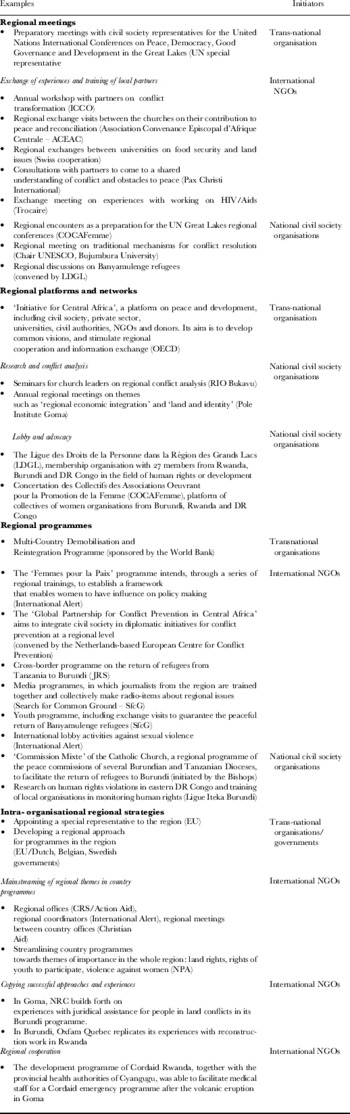
Secondly, many initiatives of a less diplomatic character developed. International organisations specialising in civil society peacebuilding felt a need for regional approaches. They considered that regional exchange and cooperation between local civil society organisations could contribute to regional peace, and complement regional diplomacy. Organisations such as the UN and the EU, several donor governments and international development organisations thus searched ways to facilitate exchanges. Their efforts were complemented by those from Rwandese, Burundese and Congolese organisations themselves. International organisations also reflected on how their own development programmes could become more regionally oriented. Various regional civil society peacebuilding strategies came into being, examples of which are given in Table 1.
Examples of strategies for regional peacebuilding involving civil society

The most common regional peacebuilding strategy was the organisation of regional meetings. Facilitated by international agencies, national civil society organisations liaised regularly with partners from neighbouring countries, primarily to exchange experiences in their fields of expertise or policy analyses. To international organisations, regional partner meetings were useful for training partners, or for enhancing their own lobby-work. Often, a direct objective of the partner meetings organised by international development was to contribute to reconciliation between partners from different counties.
Some regional meetings formalised into regional platforms or networks (such as the human rights network LDGL and the women's network COCAFemme). For local organisations, such regional networks gave credibility to their members and facilitated encountering sponsors (cf. Verkoren Reference Verkoren2006). Regional networks further provided protection to their members against their governments, or served as a means of collectively voicing dissent. For example, civil society organisations protested together after a parliamentary inquiry in Rwanda in 2004 singled out various human rights organisations as ‘divisionist’; they also came up with a collective declaration after the murder of the Vice-Secretary of LDGL in Bukavu in 2005.
Another strategy was programmatic cooperation at a regional level. This included the implementation of similar activities by civil society organisations in different countries, cross-border exchange visits, or programmes implemented collaboratively by civil society groups from different countries. Regional programmes by international organisations often focused on joint lobbying at an international level. Some of these started programmes to mobilise civil society groups to exert influence on policymaking, or to participate in diplomatic initiatives. Other international organisations had national programmes with a strong regional focus.
A notable regional programme was that initiated by the Centre Canadien d'Étude et de Coopération Internationale (CECI). For its 4-year project Action Citoyenne pour la Paix (Acipa), regional offices were established in Rwanda, Burundi and the Kivu provinces, each focusing on their own prioritised themes of public participation, non-violent conflict resolution, promotion of human rights, and access to information. The offices each had their own partners, but met regularly to guarantee a common context-analysis, and to harmonise activities. CECI/Acipa also supported the regional networks LDGL and COCAFemme, and helped facilitate the input of civil society into UN-organised conferences for the Great Lakes Region, by organising meetings in Goma and Kigali.Footnote 7
Finally, for some international organisations, a regional strategy was more of an internal organisational affair. Examples are the integration of region-specific themes in diverse country programmes, or the regional exchange of best practices. Some considered programmatic regional cooperation as a means to increase operational efficiency, for example, by sharing emergency supplies between country offices. However, this was little tried and few successful examples could be identified.
The idea of approaching conflicts regionally, and in particular civil society regional peacebuilding, is relatively new. Though many international and local organisations discuss regional peacebuilding, the actual scale of its implementation remains unclear. Most current peacebuilding interventions continue to focus on single countries. Further, despite the fact that many civil society organisations from the region are interested in regional strategies, most initiatives are still the result of efforts by international organisations. Though various regional meetings among local civil society organisations aimed at establishing programmatic cooperation, regional civil society programmes remained limited. Most existing regional programmes were actually initiated by international rather than local organisations. Why was it so difficult for civil society organisations from the regions to realise regional peacebuilding? To provide some answers to this question, let us explore some of the practices of regional civil society peacebuilding.
REGIONAL APPROACHES TO PEACEBUILDING IN PRACTICE
To start the exploration of regional approaches in practice, let us reflect on one particular example: the regional association of Catholic Bishops ACEAC, and specifically one of the regional meetings it organised. This regional initiative was supported by Caritas International and several members of the international Caritas network, including the UK-based development agency CAFOD and the Dutch development organisation Cordaid.
In November 2004, ACEAC convened a two-day regional forum on peace and reconciliation in Bujumbura, attended by about eighty priests and members of the diocesan development bureaus and justice and peace commissions from Burundi, Rwanda, eastern DR Congo and Tanzania. Its aim was to identify whether agreement could be reached at a regional level on how the Catholic Church could contribute to peace at community, national and regional levels. The first day consisted of presentations by several bishops from the region, to provide their perspectives on regional conflict. The archbishop of Bujumbura emphasised the evolving economic rather than ethnic marginalisation of groups in Burundi, and the involvement of the church in local reconciliation activities. The bishop of Kilwa-Kasenga (DR Congo) underlined the role the Catholic Church played in providing basic services to local communities, the protection provided to refugees from Burundi and Rwanda, and the efforts of the church in preparing communities for the upcoming elections. The archbishop of Kigali pointed out the difficulty of achieving reconciliation in Rwanda, with the Hutu population's continuing insecurity about land, and large numbers of traumatised people. He underscored the important role justice should play in the aftermath of the genocide, and considered how the impending gacaca courts might contribute to this. On the basis of these presentations, the participants discussed the regional importance of trauma and local reconciliation, as well as local justice.
During the second day, the discussion focused on the question of how the churches in the region could work together for peace in the region. One of the working groups emphasised the importance of sharing experiences, and debating analyses of local conflict. A participant pointed out the need to look not so much at ethnicity in those conflicts but at how ethnocentrism pervaded politics within all the countries in the region. Another participant suggested that to develop a regional analysis of conflict, an outside neutral research institute should be invited to come to an interpretation acceptable to all. Among the participants, agreement could be reached on some regional issues, in particular the presence of arms and the need for demobilisation throughout the region. The group acknowledged a need for ‘moral formation’ to assure the proper reintegration of ex-combatants into the communities. A second working group focused on how, through local-level activities, people could be mobilised to exchange experiences, for example of agricultural projects or youth activities. Though representatives of international organisations present at the meeting introduced ideas for various regional activities (a representative of Caritas France proposed demonstrations in border regions, referring to the burning of candles on a bridge in Sarajevo; another mentioned the organisation of diaspora meetings involving different nationalities), the focus of most participants was on exchanges and collaborative lobbying on commonly experienced human rights violations.
Striking in this example is that discussions on the regional dynamics of conflict primarily concerned shared victimhood of human rights violations, and trauma. The presentations of the bishops during the first day did not delve into the regional politics underlying violence, but pointed rather to the effects of violence on the population. Consequently, in considering responses to violence, the focus was on protection, reconciliation and healing. When discussing possible collaborative strategies, participants suggested exchanging experiences on local reconciliation, and attuning human rights advocacy. Though sharing experiences and concerns, organisations perceived little need for, or could not imagine, more substantial forms of regional collaboration. Such an outcome was quite common in regional peacebuilding workshops.
However, in the above example, beneath the difficulties in arriving at more substantial regional collaboration, more was at stake. In the plenary sessions, little reference was made to regional dynamics like those analysed earlier in this paper, or to regional political developments. In contrast, when meeting in private, participants from DR Congo would precisely outline how and why the violence in the Kivu region was closely related to Rwanda's political and military involvement. Burundian participants pointed to how political unrest spread from South Kivu into their country. For many participants, it was very difficult to talk about politics openly. The impossibility of making regional political analyses resulted in depoliticised regional strategies that focused on the local rather than the regional dynamics of conflict, on effects rather than causes.
The difficulties in regional analysis and programming
Many organisations found it difficult to analyse the regional character of conflict, and to establish how to take account of it in their programmes. A number of factors hindered collaborative analysis and programmes. A practical limitation to regional analysis and programming was that many local and international organisations lacked regional experience and expertise. Organisations which sought to give more attention to regional dynamics in their work encountered few scientific analyses on the interconnectedness of conflict, peace and development in the region (notable exceptions are Chrétien Reference Chrétien2003; Clark Reference Clark2002; Lemarchand Reference Lemarchand, Harbeson and Rothchild2000; Reijntjens Reference Reijntjens1994), let alone practical ones pointing out how to deal with regional dynamics.
Next to these practical limitations, there were theoretical difficulties in arriving at a regional understanding of conflict. In theory, a distinction could be made between common problems (for example, the exclusionist character of states, or the politicisation of ethnicity in various countries), related or cross-border problems (for example, the presence of refugees or militia from other countries, or the spill-over of identity conflicts from one country to the other), and problems without borders (for example, the illegal exploitation of natural resources, and the spread of arms).Footnote 8 In practice, it was difficult to make such distinctions.
Land-related conflicts were identified as a (critical) regional dimension in various regional platforms of local civil society organisations.Footnote 9 However, it was often difficult to agree on the regional character of such conflicts, which were interpreted both as a ‘common’ regional issue and as a ‘cross-border’ problem. In North Kivu, local land problems were seen as inextricably linked to the issue of nationality. A case in point was Masisi, where over recent years large tracks of land had been bought by a small group of people, many of whom were Kinyarwanda speakers, and (senior) members of the RCD and the Rwandese politico-military establishment.Footnote 10 By some, the conflicts resulting from this development were considered a cross-border issue, a direct result of the presence of the Rwandese. However, several organisations in Goma argued that the problem was basically about citizenship, and the failure of local land administration. In their view, land problems were more a ‘common’ issue: land disputes in the region were similar in that they resulted from past failures of local land administration and the erosion of local dispute resolving mechanisms.
Hence, in regional meetings, organisations often could not agree on the extent to which local manifestations of conflict were related to cross-borders developments, rather than just showing similarities. It was even more difficult to agree on how different issues and conditions interacted. For example, to what extent could land disputes resulting from land shortage be interpreted in the same way as conflicts resulting from the abundance of natural resources? And in what ways should problems of governance – such as exclusionism or criminalisation of the state – be addressed simultaneously with other issues such as the cross-border spread of small arms?
As a result of these difficulties, it often depended more on the scope of interventions envisaged by organisations whether they considered conflict dynamics as ‘common’ or as cross-border issues, and if they focused on one or several conflict dynamics. In cases where organisations had the means to work regionally, their analysis tended to be more regional and focused also on cross-border dynamics. In cases where they worked locally, their analysis focused on similarities between countries.
As a result of these conceptual difficulties, many organisations did not really consider the regional character of particular issues. They simply saw instability spilling over from one country to the other inevitably, or always having repercussions in other countries. If instability was contagious, any problem in any country required a regional strategy. Other organisations, aware of the regional character of conflict, assumed a certain comparability in the region, on the basis of which best practices could be replicated from one country to the other. For example, considering their country in a later stage of transition from conflict, Rwandese organisations promoted their experiences for demobilisation and community reconciliation in Burundi. Various international development organisations also copied intervention strategies from one country to the other. As a result, regional and country-specific analysis was de-emphasised, at the risk of glossing over both connections and differences in the region.
In the absence of regional analyses, organisations found it particularly difficult to define regional programmes as a collaborative effort of organisations from different countries. In theory, regional issues could be addressed in different ways, including regional programmes coordinated among organisations, similar programmes copied in different countries, or local programmes that take regional dimensions into account. Interventions could target geographic areas (for example, the Kivu provinces), or influential groups that fulfil key positions in linking conflicts (for example, civil society, regional media, trade networks), or focus on key issues (for example, small arms) (Armstrong & Rubin Reference Armstrong and Rubin2002). In practice, local organisations often failed to arrive at a focused analysis, identifying different levels of intervention and related strategies, and ended with amorphous shopping lists of issues and related projects. One example was a network of women's organisations that in its regional analysis identified nine pages of themes, and projects to address them. In the end, each participant selected her preferred themes and projects, and no collective prioritisation and programming was done.
Various organisations, rather than identifying developments they considered at the core of regional conflict in the Great Lakes Region, prioritised some general themes: ‘governance’, ‘ethnicity’, ‘gender’, ‘trade in arms’. Such a strategy reduced region-specific dynamics of conflict to general trends that legitimised standard interventions. Others took a ‘minimalist’ regional approach, which only considered the (potential) influence of regional issues on their own interventions (cf. Tschirgi Reference Tschirgi2002).Footnote 11
As a result, there were few regional programmes with regional activities. Exceptions were various programmes on refugees: the Catholic Church organised exchange visits between refugees and people from their home areas in order to entice refugees to go home, and the LDGL platform conducted cross-border research on the background and situation of refugees. Another exception was a cross-border radio programme organised by the US-based peace organisation Search for Common Ground.
In the end, interpretation of regional conflict dynamics and appropriate strategies depended mostly on the type and expertise of organisations and their context of operation. Analyses of international organisations often focused on issues of governance. Organisations from the region tended to see governance in the context of regional dynamics of land, ethnicity and citizenship. And while civil society organisations in Bukavu and Goma highlighted the presence of Rwandese rebels and troops on Congolese soil and their influence on the local population, organisations in Uvira emphasised local insecurity caused by the Mai-Mai. In contrast, civil society organisations in Kinshasa were more concerned about elections and the process of democratisation. Organisations from Bujumbura city highlighted the political dimensions of violence, while organisations in the countryside also considered how violence in the rural areas had gained an ethnic dimension. Staff members of human rights organisations highlighted impunity, and the deplorable record on human rights of various politicians, in their regional analyses. Farmers' organisations emphasised the problems of land and the return of refugees. Regional approaches and strategies did not logically present themselves from the context in which organisations operated. Consequently, organisations tended to focus on those themes fitting their expertise and organisational priorities.
Regional analysis and programming thus came out as processes of defining the region. How the region was constructed around particular issues depended much on how, and by whom, problems were analysed. Regional discourse is an ordering practice, creating coherence out of fragmented ideas, experiences and practices – or, in other words, a way of understanding or framing the world, by which we make sense of complexity (Law Reference Law1994). Different regional approaches developed in the practice of civil society organisations, depending on the expertise, operational context and, above all, the identification of the region by the organisations concerned. Since it was difficult for civil society organisations to arrive at a shared understanding, common regional programming was complicated. Each organisation created an image of the region that suited its programmes.
The politics of regional imagination
Civil society organisations make ideological choices, and wittingly or unwittingly play political roles. Rather than being just value-driven and apolitically taking care of the interests of local communities affected by conflict, their members personally experience the impacts of conflict, and also position themselves within conflict discourses. The emergence of civil society regional approaches therefore cannot be separated from the developing regional political context. Imagining regional approaches for the Great Lakes Region was deeply embedded in politics. Coming to a shared analysis among civil society organisations from the region was not only a theoretical endeavour, but also a political one.
A first obstacle for regional initiatives is sensitivity to instability and the day-to-day conflict experiences of the participating civil society organisations. Progress made in months could be undone in a matter of days. The anarchy after the rebellion by a group of RCD soldiers in Bukavu in June 2004 set back rapprochement programmes between the Banyamulenge (who were perceived as close to the Rwandese) and the other communities, thereby complicating the return of Banyamulenge refugees from Burundi. Continuing instability in DR Congo and Burundi brought many to question whether it was the appropriate time for regional approaches. This made some conclude that internal political change was needed before international rapprochement was possible.
Secondly, tensions between governments from the region were replicated in civil society relations, due to the closeness of civil society organisations to their governments and political movements. While in the past civil society in eastern DR Congo was often considered activist and outspoken, violence and insecurity had severely restricted organisations' freedom of action. Civil society had become ethnicised and no stranger to partisan tendencies (Romkema Reference Romkema2001). The Catholic Church was not exempt from these divisions. The bishop in Goma and many priests there were considered pro-Rwandese, while in Bukavu the Catholic Church was seen as a major symbol of resistance against the RCD. In some instances, the distinction between civil society and formal politics was blurred, with civil society organisations functioning as a springboard to state politics. In Rwanda, although there was an active associational life, NGOs had always been state-controlled, and had difficulties developing an oppositional attitude towards the government (see also Unsworth & Uvin Reference Unsworth and Uvin2002). Rwandese civil society organisations had to participate in umbrella groupings, which were said to be firmly government controlled. NGOs working in Rwanda had to perform a balancing act in the themes they could work on, and in their criticism of government policies.Footnote 12 Congolese and Burundese organisations doubted the independence of the Rwandese organisations they encountered in meetings. There were for example indications that, for preparatory meetings to the UN regional conference, Rwandese civil society representatives had been appointed by the presidential office. In Burundi, in recent years, civil society had started to openly express itself politically, partly in opposition to and partly in conjunction with the government (Ntsimbiyabandi & Ntakarutimana Reference Ntsimbiyabandi and Ntakarutimana2004). Many insiders and outsiders doubted the independence of Burundese civil society, as associational life seemed dominated by Tutsi organisations, and rumours abounded about organisations being supported by politicians.
As a result of this, civil society organisations often associated themselves with national discourses of conflict in their home countries. Many representatives of international and local organisations interviewed over the course of this research considered the involvement of civil society in conflict politics as the major challenge to regional civil society peacebuilding. As a result of the affiliation of civil society to national political discourses, regional encounters were a platform for political confrontation, as well as for exchange.
At the time of fieldwork, the relationship between the Burundese and Rwandese governments was fair, with the electoral victory of the ethnically mixed CNDD-FDD in Burundi in late 2005 even resulting in further rapprochement. Rwandese–Congolese relationships continued to be tense. Serious political divisions continued within the Kivu provinces, in particular between political leaders connected to the RCD power-holders, and those supporting the Kinshasa government. These tensions were directly reflected in relations between civil society groups from the region.
A crucial point of disagreement between civil society groups from Rwanda and North Kivu was their different understanding of the presence of the Interahamwe. The Rwandese authorities had blamed the Congolese for not taking action against the presence of those militia – main perpetrators in the Rwanda genocide – on Congolese territory, and this had been the legitimisation for entering DR Congo. However, several Congolese civil society organisations considered the Rwanda government part of the problem because it would not provide space for dialogue on the possible return of the Interahamwe. Its presence in DR Congo was also seen to cover up interests in resource exploitation. Furthermore, many Congolese organisations in Bukavu were disappointed by the lack of understanding from their Rwandese colleagues for the suffering the Interahamwe were inflicting on their people. This issue broke up many regional initiatives.
At a regional women's conference in Kigali in mid-2004, as a preparation for the UN Great Lakes regional conference, the participants were unable to reach agreement on what peace in the Great Lakes Region should look like. Before the meeting, the representatives from DR Congo were urged ‘not to go and talk to our attackers’. At the meeting, Rwandese and Congolese organisations had difficulty in distancing themselves from the discourses of their governments. The Rwandese women focused on the genocide in their country, and the ensuing right of Rwanda to fight the militia responsible that were still residing on Congolese soil. To the Congolese women, it appeared that the Rwandese women condoned the violence from their government in DR Congo, and failed to see that ‘peace for the Rwandese is a continuation of human rights violations by the Interahamwe in our areas’.Footnote 13
In other cases, the political positions taken by civil society organisations turned regional encounters into events where power was renegotiated, positions could be strengthened and legitimised, and the definition of the region could be contested. At various regional exchanges, the status of participants was fiercely debated, especially between organisations from eastern DR Congo and Rwanda. Often, the Congolese regarded civil society from Rwanda as representing the vision of their authorities rather than of their Rwandese constituents. At the same time, various Congolese organisations interpreted singling out the eastern Kivu provinces in donor programmes as supporting claims for a different status in the Congolese state, and threatening national sovereignty.
In 2002, the CECI-Acipa programme deliberately included Kinshasa-based organisations, to counter the impression among Congolese groups that it favoured Kivu civil society, which was perceived as collaborating with Rwanda. In a workshop in 2004, a full day was lost on discussing the new location of the secretariat. The Rwanda and Burundi delegations proposed Goma, and strongly opposed Kinshasa, afraid of problems with Congolese migration offices when travelling there. Goma, however, was unacceptable to most Congolese, who considered it under Rwandese influence, and argued that their capital was Kinshasa. The Congolese proposed Bukavu as a middle course, which was refused by Rwanda and Burundi. Finally the office remained in Rwanda.Footnote 14
Rather than civil society organisations serving as forces for peace, and a counterbalance to their national governments or sub-national contenders for political power, civil society organisations were deeply involved in regional politics. The political complications of regional civil society initiatives, and the fact that several regional civil society meetings had been accused of partisan tendencies, made some donors hesitant about getting involved in regional approaches.
The political engagement of civil society in regional politics strongly affected the analysis of regional issues. The affiliation of regional civil society organisations to their home governments fuelled suspicions on the sincerity and intentions of the other players in regional encounters. This reduced the willingness to talk openly about issues of regional concern.
To deal with returning refugees and rationalise land use, in 1996 the Rwanda government started a programme for villagisation and resettlement (Imidugudu) (see van Leeuwen Reference van Leeuwen2001). During preparatory meetings for a regional workshop on land issues in Bujumbura, organised by the Catholic organisation CED-Caritas, representatives of Rwandese organisations were quite critical of the programme and underlined the practical problems in its implementation. In the meeting itself, those same people gave presentations of the programme that were fully in line with the position of the Rwandese government. This also happened at other regional meetings. Subsequently, several organisations in Burundi came to consider the Imidugudu programme a good example for dealing with land problems in their own country.
A frustrating experience for international organisations was that often the preparation of regional meetings was a transparent process, in which civil society organisations from different countries or regions voiced their independent opinions, while during the regional encounters they moved towards the positions of their governments. Suspicion of the intentions of others and identification with the positions of their respective governments obstructed a genuine exchange of experiences.
Various international development organisations, in convening regional meetings between their partners, deliberately chose not to discuss regional politics, considering this too sensitive. Regional political issues were also circumvented because of their sensitivity at the November 2004 regional forum of ACEAC discussed above. In the formal parts of the encounter, participants made little reference to government politics at national level, and discussed conflict in their home regions without the slightest reference to the regional conflict history.
A few days before the forum, the first of a series of UN regional conferences had taken place in Dar-es-Salaam. During the breaks between sessions, participants discussed the outcomes of this conference, and commented on the renewed threat of the Rwandese president after the conference to intervene militarily in DR Congo, disregarding commitments made a few days earlier. No comments were made on this in the formal parts of the forum. During the breaks, I had also various discussions with participants from DR Congo on the role of Rwandese military in the insecurity affecting their areas. People also commented on the likely cooperation between militia from DR Congo and the Burundese FNL, and the latter's involvement in the Gatumba massacre in August 2004 (see HRW 2004). Representatives from different countries participated in, or listened attentively to, such discussions. In the official parts of the forum, regional politics was not talked about.
Such political sensitivities had consequences for the regional strategies envisaged. In the case of the ACEAC forum, the unwillingness or inability of participants to address regional conflict issues resulted in a concern for the effects of conflict (and how to deal with them), rather than the causes. To circumvent conflict between the participants, regional strategies focused on technical rather than political cooperation, such as exchange of experiences, and replicating best practices.Footnote 15
In many regional encounters considering solutions for regional problems, the outcomes likewise reflected a preference for national strategies rather than regional ones. For example, various expatriates considered that land scarcity in Burundi and Rwanda implied a need for a regional solution, including regional economic specialisation and more flexibility in migration policies. Organisations from the region considered the scarcity of land in their own countries as a given, and to them the problem was the failure of governments to develop agriculture or promote alternative ways of making a living. To them, the considerations of the expatriates would become relevant only after their heads of state had reached regional agreements. Suggestions on regional solutions to national land problems were also way ahead of what could be imagined by organisations from North Kivu, considering the problematic presence of Kinyarwanda speakers in the region and the perception of a historical process of Rwandese infringement on Congolese borders.
Highlighting the national character of problems and solutions rather than their regional political aspects was probably also a political strategy in itself. Though the Rwanda government has emphasised the harmful presence of Hutu militia, and the ethnicisation of community relations in eastern DR Congo, regional dynamics seldom play a role in the discourse of the Rwandese government explaining the build-up to the 1994 genocide.Footnote 16 Nor was this issue much discussed between Burundese and Rwandese civil society organisations. One could speculate that emphasising such regional dimensions might have drawn the character of the Rwandese and Burundese state into the analysis. This was an issue which organisations were willing to discuss in private, but not in meetings with representatives from the other countries, as they did not want to be seen criticising their respective governments.
The ‘politics of regional imagination’ thus played an important role in how regional civil society peacebuilding in the end came about. In many cases, the difficulties in reaching a shared analysis were the result not so much of a lack of analytical power, but of deep political cleavages. One might even speculate that the difficulties discussed earlier in arriving at collaborative regional analyses were not so much a technical or conceptual problem, but resulted from organisations circumventing thorny political issues, and de-emphasising the regional linkages between problems. Emphasising shared victimhood was then a first step in coming closer to each other.
The regional imaginations of international organisations
As a final point, in reviewing the difficulties in realising regional civil society peacebuilding, the ambitions of donors and international development organisations supporting such efforts require review. International organisations often assumed that regional exchanges and cooperation would be to the advantage of their partners, who would learn from each other, and whose collaborative efforts would be more effective than their separate programmes. It was however questionable how far organisations from the region shared this assumption. Rwandese organisations interviewed in the course of fieldwork often suggested that organisations from other countries could profit from their experiences, but did not assume they could learn anything from others. This attitude did not contribute to their motivation to participate in regional meetings. Various representatives of local and international organisations observed that, without motivation from donors to exchange experiences, local partners were not inclined to meet. For many local civil society organisations, it was already problematic to work in synergy at a national level, let alone the regional level. They considered this the major shortcoming of civil society regional initiatives, which in their eyes were ‘talk shops’ in which organisations participated to entice their donors, but which did not translate into action.
Further, apart from those specialised in lobbying and advocacy, civil society organisations often found it difficult to imagine regional strategies with direct relevance for their ongoing work. Most (peace) activities of local organisations were on a local scale. Though experiencing the impact of regional developments on their local interventions, they had the feeling that they could continue business as usual, with or without a regional approach.
As noted earlier, various regional platforms of local civil society organisations discussed land-related disputes. Many of the participants – having expertise in agricultural programmes for enhancing community conflict resolution – were primarily concerned about the impact of land conflicts. They acknowledged that similarities existed with other parts of the region, and were interested in exchanging experiences on local reconciliation practices. The cross-border causes of land conflicts were less of an issue to them, as these were beyond the reach of their interventions.
Many local organisations felt no urgent need for regional exchange and cooperation. In their daily practice, regional approaches and strategies did not logically present themselves. While for some organisations regional cooperation had advantages (being a member of a network provided protection), for other organisations such advantages were far less. It was thus questionable whether the imagined advantages of regional exchange and cooperation were as important for civil society organisations from the region as they were for their international supporters.
Moreover, in the perception of local civil society organisations, the international insistence on regional approaches contrasted starkly with the fact that only a few donors were willing to fund regional activities – often because regional activities did not fit their funding practices, which were organised on a country basis. This further decreased the motivation of local organisations for regional analysis and programming.
Finally, international organisations and donors considered regional strategies with civil society as alternative or complementary to diplomacy. In their view, they provided an opportunity to circumvent the sovereignty of states. Through working with civil society at a regional level, international organisations would contribute opinions, criticism and ideas, without confronting particular governments. As such, regional civil society encounters were complementary to regional initiatives at diplomatic level. The question was whether the political aspirations of supporting organisations matched the ambitions, mandates and expertise of their partners in this respect. These aspirations built on an image of civil society as a counterweight to governments, a role to which many of their partners did not aspire.
* * *
International organisations all have the same agenda. Everybody works on peace and security and a regional approach, everybody works with the same partners. What is the added value of a regional approach? The regional approach is a hype. (Diplomat, interview, Kigali, 10.1.2005)
The above quotation shows the belief of several interviewees that regional discourses were no more than a fashion in the development scene. To them, regional discourses reflected an institutional need to regularly come up with new notions to legitimise the existence of the sector. Alternatively, they considered talking of regional approaches a discursive practice to hide the failure of national and international organisations to effectively address conflict in the Great Lakes Region. Nonetheless, many representatives of national and international organisations considered regional approaches imperative because they contributed to a better understanding of what conflict was about, and indicated the need to operate regionally. For a variety of reasons, however, the shift to regional approaches remains more theoretical than practical.
Many local and international organisations found it difficult to analyse the connectedness of regional issues in a way that would result in regional programming, and to arrive at a shared regional understanding. Regional discourses were different ways of making sense of complex conflict dynamics. Improved understanding of complexity, however, did not provide for strategies to deal effectively with this complexity.
Moreover, regional discourses on peacebuilding were shaped in a political process and related to the political space for civil society organisations, and their relationship with their governments. Civil society organisations appeared to be fundamentally political in nature, and deeply involved in the everyday politics of peace and conflict. This political nature of organisations meant that regional platforms for peace were not necessarily peaceful. Rather than working towards an ‘imagined regional community’ (cf. Anderson 1983/Reference Anderson1991) of civil society organisations – as hoped for by many outsiders – state borders and the regional political map continued to play an important role in how civil society identified itself. As a result, it was difficult to facilitate exchange of experiences and establish regional cooperation, and to realise shared understanding of regional issues and regional solutions. Rather than providing neutral spaces for generating ideas and launching opinions and criticism, regional fora and exchanges were often interfaces where different regional discourses met, representing different readings of conflict. At many regional exchanges, such differences were silenced to circumvent conflict between the participants. The outcomes were depoliticised regional strategies that focused on the similarly experienced consequences of regional conflict, rather than on the underlying political differences.
The challenge of civil society regional peacebuilding is thus not just about acknowledging the regional character of conflict, but more about reconciling the differences between the civil society organisations involved, and coming to a shared regional imagination. Some considered that, in order for this rapprochement to happen, agreement between governments was first required. However, a less pessimistic picture evolves when considering existing networks that had overcome regional differences to some extent. The question is whether civil society organisations will be able to challenge the regional policies of their governments or other regional players, as long as they have not overcome the differences between themselves. This may be too much to expect of civil society organisations. As Mamdani (Reference Mamdani2001) suggests, regional reform may also come about through the example set by other countries in the region. Perhaps the most important role civil society organisations can play in achieving regional peacebuilding is bringing about political reform within their own countries. In this, regional dialogues may inspire processes of reform in other countries.
What could be the role of international organisations in this? Civil society regional approaches for peace require the fostering of regional identification between civil society organisations, rather than assuming it. International organisations might support and facilitate this. Regional identification will never come about without encountering the other players from the region; thus I agree with Galtung (1996/Reference Galtung2003: 271) on the need to ‘let one thousand conferences blossom’. To achieve a shared regional identification, maybe the sharing of similar experiences is indeed more important than exchanging dissimilar views on what conflict is about. Exchanges and platforms may therefore be more important than regional civil society programmes. More prominence could also be given to enhancing already existing regional contacts, such as those between universities and trade networks. Even if the resulting exchanges are depoliticised, we should consider them as a first necessary step in a process of regional identification and (finally) reconciliation. At the same time, we should not disregard the relevance of meeting backstage in regional encounters, where politics may be discussed informally, and acknowledgement of regional connectedness may be achieved.
Finally, international organisations should not have too high ambitions in supporting regional civil society peacebuilding. They should be careful not to expect levels of cooperation that often do not even exist at a national level, or to assume that their local partners share their expectations of the benefits of regional programmes and exchange. Donors' imagination of a regional civil society doing what their governments failed to do – bringing regional peace – was far beyond the realities of their partners. Before drafting programmes and setting expectations, donors should realise that there is no such thing as a Great Lakes Region in a singular sense, and ask instead how local people imagine (the possibilities of) their region.