Introduction
When reflecting about the political consequences of economic and fiscal reforms, the former president of the European Commission, Jean-Claude Juncker, once famously said that ‘we all know what to do, but we don’t know how to get re-elected once we have done it’ (Buti et al., Reference Buti, Turrini, Van den Noord and Biroli2009). The late economist Alberto Alesina disagreed: his research consistently showed that engaging in a fiscal consolidation does not reduce the incumbent governments’ re-election probability (Alesina et al., 2011, Reference Alesina, Favero and Giavazzi2019). If consolidations restore economic growth and voters are more fiscally conservative than assumed, Juncker’s concern may not rest on firm grounds.
In this paper, we follow Juncker’s intuition and ask what we can learn from previous consolidation episodes about the political fallout of such measures. Specifically, we study their effect on incumbent governments: does fiscal austerity reduce government popularity, or can governments come through a period of consolidation relatively unscathed? This question is important for a number of reasons. If governments believe that a consolidation is politically costless, they will be more eager to pursue such a policy than if they expect it to be politically expensive. Already after the Financial Crisis and during the Euro crisis, the anticipated political cost of austerity was a major issue on politicians’ minds (Blyth, Reference Blyth2013). Political considerations may also affect the choice of specific consolidation measures. For example, popularity concerns may induce governments to pursue revenue-based consolidation, even if expenditure-based measures would perhaps be less harmful to the economy.
Naturally, we are not the first to study whether fiscal austerity entails a cost to governments in the form of declining popularity. This question is the subject of much discussion in the empirical literature on fiscal consolidation in economics and political science (Alesina et al., Reference Alesina, Carloni and Lecce2011; Hübscher and Sattler, Reference Hübscher and Sattler2017; Arias and Stasavage, Reference Arias and Stasavage2019; Hübscher et al., Reference Hübscher, Sattler and Wagner2020). While studies based on electoral outcomes suggest that austerity can be implemented with impunity at the polls, those using individual-level public opinion measures tend to find that austerity is inherently unpopular.
We argue that these divergent results reflect the length of the causal chain connecting the consolidation episode and the specific outcome measures. The longer this chain, the smaller are the measurable political consequences of austerity.
In this paper, we study the effect of consolidations on government approval (Carlin et al., Reference Carlin, Hartlyn, Hellwig, Love, Martinez-Gallardo and Singer2020) and argue that fiscal consolidations decrease governments’ popularity. Approval has important advantages over other measures of the political fallout of consolidations. Firstly, it taps much more directly into the popularity of fiscal measures than election outcomes. Therefore, approval is less subject to the strategic behavior of governments. Since governments may time consolidation or elections strategically and may introduce compensatory measures just before an election, electoral outcomes do not reflect the full political cost of consolidation. Moreover, voters’ capacity to punish governments at the ballot box also depends on the behavior of other parties. If there is no viable alternative, voters may stick with a government at the next election, even if they strongly dislike its fiscal policies. At the same time, a loss of approval comes with real political costs, since approval is an important measure of a government’s political capital: a decline in approval decreases governments’ political room to maneuver, weakens the grip of the executive on its own party, and increases the risk of conflict between coalition partners (Canes-Wrone and De Marchi, Reference Canes-Wrone, De and Marchi2002; Bond et al., Reference Bond, Fleisher and Wood2003). Moreover, approval is a necessary element in a causal chain from austerity policies to electoral effects: austerity must first reduce government approval before leading to electoral losses. If austerity does not have an effect on approval, it is highly unlikely to have electoral effects.
We operationalize austerity as fiscal consolidations: the conscious decision to retrench expenditure or increase taxes in order to decrease budget deficits. Consolidations are measured with the narrative approach, which focuses on policy decisions rather than on budget outcomes (Pescatori et al., Reference Pescatori, Leigh, Guajardo and Devries2011). We have data on government approval and consolidations in 14 advanced economies.Footnote 1 In contrast to research showing that governments’ chances of re-election are not affected by austerity, these data show that fiscal consolidations, especially spending cuts, have a direct political cost for governments: introducing austerity measures significantly and substantially reduces government approval, in particular when austerity is expenditure-focused. However, the effect of austerity on approval disappears if consolidation measures are taken in good economic times. In bad times, fiscal consolidations’ impact on government approval is very clear. Interestingly, we do not find that government partisanship conditions the relationship between fiscal consolidation and approval: left-wing governments are not more likely to be punished for implementing austerity than right-wing governments.
We develop our argument in four steps. In the next section, we review the literature on the political costs of fiscal austerity and derive hypotheses about the effect of austerity on government popularity. In the research design section, we discuss the measurement of the dependent variable in detail and present our modeling choices. In the empirical section, we estimate the average effect of consolidation on approval and compare our results with a model predicting government turnover or vote shares in elections. Then, we present conditional effects based on parties’ ideology and on macroeconomic contexts. We address issues of endogeneity and posttreatment bias with an augmented inverse probability weighting (AIPW) estimator (Blackwell, Reference Blackwell2013) in the robustness check section. The final section discusses the implications of our findings.
Theory: austerity and governments’ popularity
The question of consolidations’ political costs is highly contested in political science and economics. While some authors argue that fiscal consolidations may improve economic growth and even help governments, others point to the unpopularity of the direct losses that consolidation measures impose on citizens. This is not just an academic debate. Whether governments engage in consolidation and how they design consolidation packages likely depends on their anticipated political costs (Blyth, Reference Blyth2013: 175).
The main proponent of the idea that consolidations do not hurt incumbents was Alberto Alesina. In studies with several co-authors, Alesina argues that governments that introduce austerity policies are not more likely to be voted out of office at the next election (Alesina et al., Reference Alesina, Perotti and Tavares1998; Alesina et al., Reference Alesina, Carloni and Lecce2011; Alesina et al., Reference Alesina, Favero and Giavazzi2019). This finding is supported by Ardanaz et al. (Reference Ardanaz, Hallerberg and Scartascini2019) for a set of Organization for Economic Co-operation and Development (OECD) countries, and by Arias and Stasavage (Reference Arias and Stasavage2019), who study leadership turnover over almost 150 years and find no effect of austerity policies. Relatedly, Brender and Drazen (Reference Brender and Drazen2008) argue that running a budget deficit reduces the likelihood of re-election. These studies claim that thriftiness is not just good economics but also good politics.
These studies typically measure the political fallout of austerity by considering election outcomes, such as government turnover measured by ideological change in government. As critics have pointed out, this may underestimate the political costs of austerity for a number of reasons. Firstly, there is an issue of selection bias, as Alesina et al. (Reference Alesina, Carloni and Lecce2011) acknowledge: it may be that only popular governments engage in fiscal consolidation in the first place. Secondly, and relatedly, governments may time austerity policies strategically, by introducing them at the beginning of their term (Hübscher and Sattler, Reference Hübscher and Sattler2017). Thus, the effects of austerity may have faded when the election approaches (Chen et al., Reference Chen, Dabla-Norris, Rappaport and Zdzienicka2019). Thirdly, governments may react to the unpopularity of austerity measures by introducing other, more popular policies as a compensation. Election outcomes already factor in this government response (Hübscher et al., Reference Hübscher, Kemmerling and Sattler2015). Fourthly, whether voters can express their discontent with austerity policies at the ballot box depends on the alternatives that opposition parties offer (Hübscher et al., Reference Hübscher, Sattler and Wagner2019). If the opposition advocates even harsher austerity measures, voters may have no choice but to stick with the government, even if they disapprove of the policy (Horn and Jensen, Reference Horn and Jensen2017).
These arguments imply that re-election is a very specific measure of the political costs of austerity that does not capture other substantial costs for governments. Studies that take these arguments into account and use alternative dependent variables indeed tend to find negative political effects of austerity. For example, austerity policies have been found to increase social unrest (Ponticelli and Voth, Reference Ponticelli and Voth2020) and to reduce stated vote intentions for the government (Talving, Reference Talving2017). In addition to these observational studies, survey experiments also indicate that voters dislike austerity policies (Bremer and Bürgisser, Reference Bremer and Bürgisser2019; Hübscher et al., Reference Hübscher, Sattler and Wagner2020). Finally, detailed studies of specific austerity policies in a single country show an electoral reaction among those regions and those individuals most directly affected by austerity (Fetzer, Reference Fetzer2019). However, while such detailed studies can identify a causal impact of austerity, it is less clear to what extent they generalize across political settings.
Taken together, these contributions suggest that detecting empirical effects of austerity depends, to an important extent, on the choice of the dependent variable. We argue that these divergent results reflect differences in the length of the causal chain connecting the consolidation episode and the measurement of the public’s reaction. The longer the chain from the policy to the consequence of interest, and the more the potentially countervailing factors can intervene between the policy and the outcome, the smaller the measurable political consequences of austerity should be.
Descriptive or experimental surveys have clearly demonstrated that consolidation measures are unpopular at the individual level (1). However, other outcome variables may reveal no effect of austerity, because they are further down the causal chain and are also affected by other factors. For example, negative attitudes toward specific policies may not necessarily translate into declining government popularity (2). People may express opposition to austerity in the abstract but may not perceive these policies nor connect them to the government (Arias and Stasavage, Reference Arias and Stasavage2019). Moreover, declining popularity may not necessarily translate into declining vote intentions (3), since they also depend on the behavior of other parties, or on people’s identification with specific parties. Finally, to the extent that there is a temporal gap between the introduction of the policy and the next election, electoral outcomes (4) may also reflect the medium-run effects of the policy.
We argue that the causal chain depicted in Figure 1 reflects a trade-off in the choice of the dependent variable. The further removed from the policy, the bigger is the political impact of an effect, but the less likely such an effect is to occur. Studies that focus on electoral outcomes maximize the potential political impact of their measure but may miss austerity’s costs on prior steps. Studies that focus on individual responses to specific policy proposals maximize their chance to find an effect but use a measure that may have little political importance. After all, governments may ignore citizen’s policy preferences expressed in surveys as long as they do not translate into a loss of approval or a decline in vote intentions.
Causal chain from austerity policies to different political consequences.

Importantly, governments may already perceive politically relevant consequences before an election. Demonstrations may force governments to revoke some of the intended measures. A loss in popularity may create internal conflicts within the government and weaken the position of government leaders. As a consequence, governments may feel compelled to introduce policies to regain popularity, even if these measures were not on the government’s original agenda. Moreover, government popularity is a necessary intermediate step for the unpopularity of policies to translate into electoral outcomes.
Against this background, we argue that government popularity is a particularly important measure of the consequences of austerity. Popularity is a consequential measure that is close enough to the original policy to be likely to pick up a relatively undistorted effect of austerity packages but already incorporates the crucial step of linking a negative opinion about a policy to a specific government.
We thus develop our hypotheses about the relationship between austerity and government popularity. We start with the aggregate effect of austerity before developing more specific hypotheses about the type of austerity and the type of government.
On the most aggregate level, we ask whether fiscal consolidations reduce the popularity of the incumbent government. Pocketbook voters should be opposed to consolidations because they reduce their disposable income by increasing taxes and/or reducing government spending (Hübscher et al., Reference Hübscher, Sattler and Wagner2020). The typical adjustment program we study lasts four and a half years and represents spending cuts and/or tax increases of an average of 1.6% of Gross Domestic Product (GDP) for each of these years. These large adjustments are necessarily salient and reduce citizens’ disposable income in the immediate, often increasing income inequality (Agnello and Sousa, Reference Agnello and Sousa2014) and reducing economic growth in the short term (Auberach and Gorodnichenko, Reference Auerbach and Gorodnichenko2012; Born et al., Reference Born, Müller and Pfeifer2020). While consolidations may increase growth in the medium and long term (Alesina et al., Reference Alesina, Favero and Giavazzi2019), they impose direct costs on voters but generate only diffuse benefits in the future, while voters have a clear preference for policies offering short-term benefits (Jacobs and Matthews, Reference Jacobs and Matthews2012). Moreover, citizens may react more strongly to the negative consequences of austerity than to its positive effects due to negativity bias (Pierson, Reference Pierson2001). Against this background, we hypothesize that:
H1: Fiscal consolidation is associated with decreasing government popularity
In addition to this question about the general effects of austerity, the design of austerity packages is also an important determinant of voters’ reactions to fiscal consolidations (Bansak et al., Reference Bansak, Bechtel and Margalit2019). The ‘expansionary austerity’ school of thought, again spearheaded by Alberto Alesina, argues that consolidations focusing on the expenditure side are less harmful to the economy and more likely to achieve a permanent reduction of budget deficits (Alesina et al., Reference Alesina, Favero and Giavazzi2019). Since expenditure-based consolidations are better for the economy, they may also be better for governments: if voters engage in retrospective economic voting, they should be more supportive of governments that minimize the economic damages of consolidation. Vice versa, tax-based consolidations would be particularly detrimental to government’s re-election prospects, because they are more harmful to the economy (Chen et al., Reference Chen, Dabla-Norris, Rappaport and Zdzienicka2019; Ciminelli et al., Reference Ciminelli, Furceri, Ge, Ostry and Papageorgiou2019).
While this argument focuses on economic consequences, a different argument focuses on the immediate popularity of different policies and concludes that expenditure-focused consolidations may be more unpopular with voters (Hübscher et al., Reference Hübscher, Sattler and Wagner2020). After all, spending cuts are usually highly regressive, while tax increases may be distributionally neutral and are often even progressive (Alpino et al., Reference Alpino, Asatryan, Blesse and Wehrhöfer2020). Indeed, spending-based consolidations increase income inequality more than tax-based consolidations (Mulas-Granados, Reference Mulas-Granados2006; Agnello and Sousa, Reference Agnello and Sousa2014). Bremer and Bürgisser (Reference Bremer and Bürgisser2019) find that tax increases on high-income individuals are particularly popular, while general support for tax-based consolidation is lower than for spending-based consolidation. Alpino et al. (Reference Alpino, Asatryan, Blesse and Wehrhöfer2020) find that consolidations often lead to an increase in top tax rates. Moreover, given that social spending is by far the biggest item in public budgets, it is highly unlikely that governments can design an expenditure-based package that spares the most popular forms of public spending.
Again, a main difference between these two arguments is on which level they look for political consequences. The second argument focuses on the unpopularity of policies, which should be visible in the very moment that the policy is introduced. The first argument, by contrast, focuses on the popularity of outcomes, which only emerge over time. Since we focus on the popularity of governments right after the policies have been introduced, we expect to mainly pick up these direct effects of the popularity of different policies. Any indirect effects through higher or lower economic growth should only occur later. Hence, we hypothesize that expenditure cuts reduce government popularity more strongly than tax increases.
H2: Expenditure-driven consolidation is associated with a larger decline in government popularity than tax-based consolidation
In addition to the debate about tax- and spending-based austerity, there are questions about the conditional effects of consolidations on popularity. The first of these questions is whether different types of governments are more or less likely to be punished for austerity. It is likely that conservative parties are punished less, as they own the issue of budget balancing and can thus more easily claim credit for reducing deficits (Grittersová et al., Reference Grittersová, Indridason, Gregory and Crespo2016; Kraft, Reference Kraft2017). Moreover, welfare state retrenchment has a long-term negative effect on the electoral successes of the left (Horn, Reference Horn2020). We thus expect that it is mainly left governments that pay a price for austerity measures.
H3a: Austerity is associated with a stronger decline of government popularity for left governments than for right governments.
Moreover, the effect of austerity on different parties may depend on the specific design of austerity packages. As several authors have argued, left parties own the issue of the welfare state and are punished more heavily for welfare state cuts than parties that do not own the issue (Giger, Reference Giger2010; Schumacher et al., Reference Schumacher, Vis and van Kersbergen2013). Since these parties also tend to represent the beneficiaries of government expenditure, their popularity may decline more in response to expenditure-focused consolidation. Right governments, in turn, might be particularly affected by revenue-focused consolidation, since they usually advocate for lower taxes and typically represent voters in higher tax brackets. Foucault et al. (Reference Foucault, Seki and Whitten2017) find that left governments may even win votes when they increase taxes.
H3b: Left-wing governments lose approval when they implement spending cuts, while right-wing governments lose approval when they implement tax increases.
In addition to effects heterogeneity caused by government partisanship, we are interested in how the economic context conditions the impact of austerity on government popularity. Specifically, we study whether economic conditions influence how much voters blame governments for implementing cutbacks. The literature on economic voting suggests that the effect of the economy on vote choice is larger during bad times than during good times (Lewis-Beck and Paldam, Reference Lewis-Beck and Paldam2000). Nyman (Reference Nyman2016) argues that economic growth reduces the impact of austerity on incumbents because it diminishes the visibility of cuts. Cutbacks can be obfuscated when the economy grows as wage increases erode the importance of public transfers in individuals’ disposable income. In contrast, in a difficult economic situation, people become more dependent on the state. Moreover, since the fiscal multiplier of government spending is larger during recessions than during expansions, implementing cutbacks in hard times is likely to prolong the recession (Auerbach and Gorodnichenko, Reference Auerbach and Gorodnichenko2012; Born et al., Reference Born, Müller and Pfeifer2020). Many studies have found that fiscal consolidations, or structural reforms more generally, implemented during recessions reduce government’s likelihood of re-election more than consolidations during economic expansions (Nyman, Reference Nyman2016; Alesina et al., Reference Alesina, Favero and Giavazzi2019; Chen et al., Reference Chen, Dabla-Norris, Rappaport and Zdzienicka2019). We thus test whether austerity measures are less detrimental to government popularity when they are introduced in a context of strong economic growth.
H4: The effect of fiscal consolidations on approval is stronger during periods of low economic growth than during periods of high growth.
Research design
In the preceding section, we derived a number of hypotheses about the effect of austerity on government popularity. To test these hypotheses, we need accurate measures of popularity and of austerity. As we argued, popularity should be measured close enough to the policy decision and should be a pre-strategic measure of people’s attitudes. Moreover, the measure should be comparable across countries. Since election outcomes are problematic on all three counts, the two main candidates for the dependent variable at the aggregate level are vote intentions and government approval.
Vote intentions have already been used in the literature on the political impact of austerity (Hübscher et al., Reference Hübscher, Kemmerling and Sattler2015; Talving, Reference Talving2017; Bojar, Reference Bojar2018) and have clear advantages over election outcomes. Nevertheless, we argue that government approval is an even better measure. After all, vote intentions, like electoral results, depend on the policy positions of other parties on austerity. Even if voters dislike austerity, they may still lack an alternative they could vote for. Indeed, Armingeon and Giger (Reference Armingeon and Giger2008) find that the effect of welfare state cutbacks on incumbent vote share is conditional on the salience of the austerity measure at the next election/in other parties’ election manifestos. By contrast, approval directly captures the impact of policy changes on citizens’ perceptions of the government; citizens do not need to be provided with an alternative to disapprove of the government.
Moreover, using approval alleviates some of the challenges that occur in multiparty governments. It is quite straightforward for voters to adjust their overall approval of the government as they experience consolidation measures, even in a coalition government. It is much more complex for voters to evaluate the respective responsibility of the different parties of a coalition government in order to shift their voting intentions in response to consolidation measures.
A main difference between vote intentions and approval, finally, is that vote intentions are stickier, since they are strongly affected by partisan identification (PID). Government partisans may disapprove of government policies but still intend to vote for the government, while positive approval may still not change the vote intentions of opposition partisans. Approval should thus mainly affect the vote intentions of independents (Pickup, Reference Pickup2010). Since we know that governments tend to protect their own supporters from the cost of austerity (Walter, Reference Walter2016), these nonpartisans who may approve the government are potentially the most reactive voters to austerity measures. Moreover, since PID has been declining over the period of our investigation (Dalton, Reference Dalton2016), the relationship between austerity and vote intention may have changed over time. By contrast, the relationship with approval should have been more stable.
The main weakness of the approval measure is that it may be considered as ‘cheap talk’. To put it bluntly, governments care about re-election, not about approval. While this is true to some extent, we argue that a loss of approval also has a direct cost to governments as it is a crucial form of political capital for the executive in both parliamentary and presidential systems (2015). When the government is popular, government leaders will find it easy to keep their parties disciplined and to avoid major conflicts between coalition partners. Moreover, popular governments are more likely to succeed in applying pressure on other actors, such as interest groups or subnational governments, to achieve the policy goals they seek. Thus, popular governments have more room for maneuver to press ahead with their preferred projects (Canes-Wrone and De Marchi, Reference Canes-Wrone, De and Marchi2002) and high approval gives the executive a mandate for passing their preferred policies (Bond et al., Reference Bond, Fleisher and Wood2003). When the government is unpopular, by contrast, government leaders will hardly be able to do so, since they will have to focus on the cohesion of their parties and the coalition (Camerlo and Pérez-Liñán, Reference Camerlo and Pérez-Liñán2015). In short, popular governments have leverage that unpopular governments lack. Approval is thus a non-negligible goal.
Another difference between approval and vote intentions is that approval is more volatile. However, because our measure of consolidation is annual, we use yearly measures of approval averaging multiple surveys, which should dampen the volatility of the measure. As described in Figure 1, because approval is causally closer to the policy decision than both vote intentions and electoral outcomes, an effect of austerity on approval is a necessary condition for finding effects that are causally further from the policy. If we do not find an effect of fiscal consolidations on approval, this would strongly suggest that austerity has no political consequences further down the causal chain.
To measure approval, we thus use the Executive Approval Dataset (Carlin et al., Reference Carlin, Hartlyn, Hellwig, Love, Martinez-Gallardo and Singer2020) which provides a comprehensive measure of approval with comparable questions and measurement between countries. The measure extracts multiple surveys of public support for the executive into a summary measure of positive government approval.Footnote 2 We complement the dataset with measures of executive approval in Sweden provided by the SOM survey firm, accessible via the Swedish National Data Service (2020).
The main independent variable relies on the narrative approach to fiscal consolidation, which consults policy documents such as budget speeches, reports from national fiscal authorities and from international organizations (IMF, OECD, and World Bank) to identify the precise amount of tax increases and spending cuts implemented to reduce budget deficits, relative to a baseline of no policy change (Alesina et al., Reference Alesina, Favero and Giavazzi2019). Measures that are announced but not implemented are not included. The measure, expressed as a percentage of GDP, is from Alesina et al. (Reference Alesina, Favero and Giavazzi2019). This measurement strategy is significantly better than using a threshold based on changes to the cyclically adjusted primary balance (CAPB). The CAPB can be affected by many exogenous factors that are unrelated to the decision to implement consolidations or to any visible policy changes. Identifying consolidations based on the CAPB involves setting an arbitrary threshold of changes in deficits at which a consolidation would be occurring. It cannot distinguish between deficit-driven consolidations from adjustment to the primary balance that are driven by a desire to cool down an overheated economy. The latter may not dampen government’s popularity as these are simply countercyclical policies, while deficit-driven spending cuts or tax increases may be more painful and visible. Guajardo et al. (Reference Guajardo, Leigh and Pescatori2014) show that while the narrative approach and the CAPB broadly agree regarding the size and frequencies of consolidations, the narrative approach more accurately identifies deficit-driven consolidations when there are large discrepancies between the two approaches. For all these reasons, the narrative approach has become the most common measure in political economy studies on fiscal consolidations.
To our knowledge, we are the first study to use the narrative approach to fiscal consolidations to analyze the impact of austerity on government approval. Our dataset size is constrained by the availability of our main dependent and independent variable. We have an unbalanced panel of 14 countries from 1978 to 2014 (N = 470). The appendix presents the distribution of approval and consolidations.
We incorporate several control variables from the literature on government approval and economic voting. Firstly, we control for the unemployment rate, GDP per capita growth and the inflation rate, since general economic circumstances may affect the decision of whether and when to consolidate and certainly have an effect on government approval. Public debt is also controlled for since it might affect how people perceive the need to consolidate. We also control for trade opennessFootnote 3 since it might condition the extent to which citizens blame governments for economic conditions (Hellwig and Samuels, Reference Hellwig and Samuels2007). In addition to these economic controls, we include several political controls that may influence the willingness to pursue austerity policies and may also affect government approval such as the composition of the governmentFootnote 4 and a government right-left index based on the Comparative Manifesto Project (CMP) (Seki and Williams, Reference Seki and Williams2014).Footnote 5 Finally, we include several measures of government age, since this may directly affect popularity and because governments are known to time austerity measures strategically. Specifically, we add a dummy for election year, a « fatigue » variable measuring the number of years since the same party is in office and a government turnover variable, which is coded one when the ideological composition of government changes after an election. Table A1 in the appendix presents the descriptive statistics and the sources of the variables included in the analysis.
After modeling the direct effect of fiscal consolidations on approval, we estimate several interaction models to test Hypothesis 3 and Hypothesis 4. To test the partisanship hypothesis, we use the aforementioned CMP index. To ensure that our results are not dependent on variable measurement, we alternatively use the Comparative Political Dataset’s (Armingeon et al., Reference Armingeon, Wenger, Wiedemeier, Isler, Knöpfel, Weisstanner and Engler2019) measure of the ideological orientation of the government based on the share of cabinet seats held by different parties. In the appendix, we complement this with a measure that we call ‘fiscal expansion pledge’, based on specific statements in the CMP. To test Hypothesis 4, we interact our consolidation measures with real GDP growth per capita.Footnote 6
Modeling strategy
Firstly, we performed several unit roots tests. All the variables are stationary, except debt levels. We first difference debt levels in each regression to make it stationary. Secondly, we tested for the lag length of the relationship between consolidation and approval. The first lag of consolidation has a negative effect on approval, while none of the other lags (up to four) have a significant effect on approval. Even if the contemporaneous measure of consolidations rarely has a positive effect on approval, some of the other covariates, such as GDP growth, have a direct short-term effect on approval at time T. Thus, we use an autoregressive distributed lag (ADL) model which is a general dynamic model that does not make any restrictions about the lag structure and the short- and long-term effects.Footnote 7 However, we restrict the ADL to one lag, since more lags do not have a significant effect and reduce the degree of freedoms. A Hausman test suggests using random effects rather than fixed effects. Hence, our main models use random effects, but we perform robustness checks with fixed effects. The ADL models thus estimate Equation 1:
 $${Y_{it}} = \;a0 + \alpha 1{Y_{it - 1}} + \;\beta 0{X_{it}} + \;\beta 1{X_{it - 1}} + \;controls + {\psi _i}\; + \;{{\rm{\tau }}_{it}}\; + \;{\varepsilon _{it}}$$
where Y is the approval rate, X is the measure of the level of fiscal consolidation (tax and/or spending-based) to which we add a constant
 $$a0\;,\;{\rm{a}}\;$$
vector of controls, as well as a set of random intercepts
 $${\psi _i}$$
and a country-specific time trend parametrized by
 $${{\rm{\tau }}_{it}}$$
and an error term
 $$\varepsilon $$
. With such models, the short-term effect of consolidation is given by
 $$\beta 0,\;$$
while the long-run multiplier, which is the total effect of X on Y, as X reaches ∞, can be calculated as
 $$\beta 0 + \beta 1\;/\left( {1 - \;\alpha 1} \right)$$
. All models presented below are robust to removing one country at a time.
Our baseline interaction models use the ADL form and interact both the contemporaneous and lagged values of the constitutive terms as in Equation 2:
 ${Y_t} = a0 + \alpha 1{Y_{it - 1}} + \beta 0{X_{it}} + \beta 1{X_{it - 1}} + \beta 2{Z_{it}} + \beta 3{Z_{it - 1}} + \beta 4{Z_{it}}{X_{it}} + \beta 5{Z_{it - 1}}{X_{it - 1}} + controls + {\psi _i} + {{\text{\tau }}_{it}} + {\varepsilon _{it}}$
We perform several robustness checks with the interaction models to ensure that the assumption of linearity holds and to ensure common support, so that at any given value of the moderator Z, there are enough data points where there is variation in the treatment X (Hainmueller et al., Reference Hainmueller, Mummolo and Xu2019).
Results
Before moving to our own empirical analysis, we start by replicating models of the effect of austerity on government turnover or on vote shares with the 14 countries present in our dataset. Firstly, we run a probit regression to predict a dummy variable measuring government turnover, replicating the same model as in Alesina et al. (Reference Alesina, Carloni and Lecce2011).Footnote 8 We use the narrative approach to fiscal consolidations instead of changes to the CAPB. In line with the original results by Alesina et al., models 1 to 4 in Table 1 reveal no significant effect of consolidations on government turnover probability. This suggests that differences between Alesina’s findings and our findings below are not due to the set of countries, the operationalization of consolidation, or the choice of control variables but are driven by the dependent variable and the move from electoral outcomes to annual approval data. Models 5 to 8 in the table switch to a cabinet-level analysis and measure the aggregate loss or gain of votes of the governing party(ies) from one election to the next, following Grittersová et al. (Reference Grittersová, Indridason, Gregory and Crespo2016).Footnote 9 These models reveal that consolidations have no significant effect on vote shares.
Models predicting ideological change in government (probit) and vote shares (OLS), using country-fixed effects and economic and political control variables

Robust standard errors in parentheses.
*P < 0.1, **P < 0.05, ***P < 0.01.
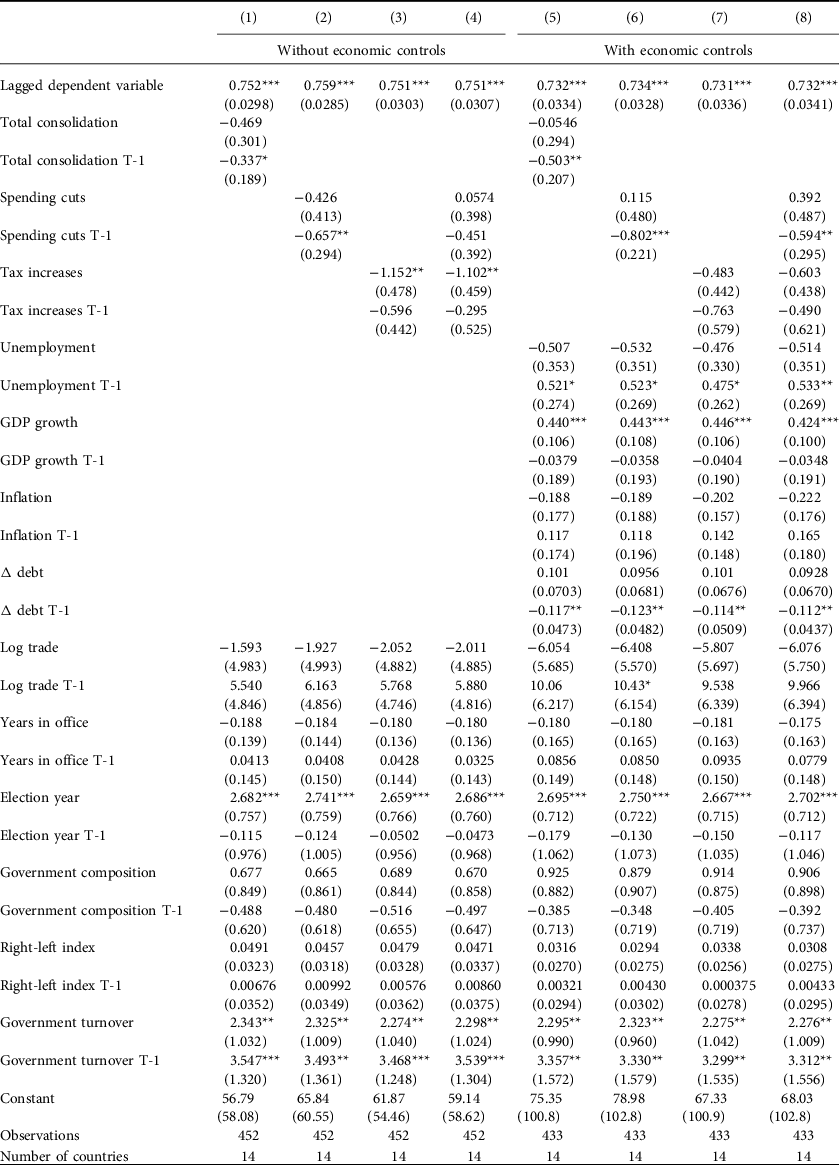
We now turn to the analysis of government approval. Empirical research on the impact of austerity on politics faces a trade-off between posttreatment bias and omitted variable bias: on the one hand, fiscal consolidation at time T-1 has an effect on economic variables at time T-0, that are also impacting approval, leading to posttreatment bias. On the other hand, economic conditions affect the decision to impose austerity in the first place, have a direct effect on approval, and moderate the correlation between austerity and approval. Hence, our models likely suffer from omitted variable bias if we do not control for economic conditions. Bellemare et al. (Reference Bellemare, Masaki and Pepinsky2017) warn against relying on lagged variables alone to solve this problem. In the section on endogeneity below, we instead use an AIPW estimator to deal with these concerns (Blackwell, Reference Blackwell2013). For now, we compare models in which we remove the economic variables that are most likely to suffer from posttreatment bias (models 1–4 in Table 2) with models that include them (models 5–8). We keep trade openness in all models because it is unlikely to suffer from posttreatment bias like the other economic controls.
ADL models with random effects and country-specific time trends

Robust standard errors in parentheses.
*P < 0.1, **P < 0.05, ***P < 0.01.
Table 2 reveals that consolidations have a significant negative effect on approval in all models, except in model 7, using tax-based consolidations. In models 1 and 5, total consolidation has a significant effect on approval. Interestingly, in models 3 and 4, tax-based consolidations have a significant short-term effect (increasing taxes by 1% of GDP reduces approval by 1.1%), while their effect becomes insignificant in models 7 and 8 when economic conditions are controlled for. The comparison between model 4 and model 8, where both tax- and spending-based consolidations are included, reveals that spending-based consolidations are significant in full models, while tax-based consolidations are significant only in models excluding economic variables. This suggests that the effect of tax-based consolidations on approval goes via its negative effect on economic growth; when controlling for economic growth, tax-based consolidations do not have a negative effect on approval. Tax increases’ effect is only significant in the short term, while the effect of spending cuts is significant in the long term. We can thus confidently reject the null of Hypothesis 1 and Hypothesis 2.
To illustrate our substantive findings, long run multipliers based on models 5 and 6 of the previous table are presented in Figure 2 with 95% confidence intervals. Based on model 6, a 1% of GDP spending-based consolidation reduces approval by 0.8 points after 1 year, by an additional 0.59 points after 2 years to reach minus 1.82 after 3 years. After 4 years, the effect is only significant at the 10% level. The total long-run multiplier calculated with the Bewley transformation is -3.01 (p = 0.08) as T reaches ∞. Considering that the mean of approval is 41% and the standard deviation of an annual change in approval is 5.85, the effect of a spending cut of 1% of GDP represents a decline of approval of approximately a third of a standard deviation in 3 years. The effect of a 1% spending-based consolidation is significantly larger than an equivalent decline of growth, which would reduce approval in the long term by 1.87% when calculated with the Bewley transformation. Also, consolidations tend to last longer and to be considerably larger than 1% of GDP. A 1% point increase in total consolidation (based on model 5) reduces approval by 0.5 points in the first year, by an additional 0.37 points in the second year, to reach −1.34 after 4 years, but it is significant at P > 0.05 only until the second year.
Cumulative long-term effects of total consolidations (based on model 5, left figure) and spending cuts on approval (based on model 6 right figure), 95% confidence intervals.

Thus, the impact of consolidation on approval takes 1 year to unfold and then accumulates until the third year when it loses its significance. The annual marginal effect of consolidations on approval decays overtime, but citizens continue to blame the government for up to 3 years, after which a new government may be elected. The cumulative effect of consolidation on approval is somewhat unexpected, since the strategic timing argument proposes that governments implement consolidation at the start of their mandate to minimize electoral losses (Hübscher and Sattler, Reference Hübscher and Sattler2017). This cumulative effect can be explained by the fact that very few consolidations last only 1 year, and our statistical model almost certainly picks up the effects of these sustained fiscal consolidations. Moreover, it may to some extent be an artifact of our data structure: the annualized approval measure is an average of several different surveys, some of which may be conducted before the austerity measures were implemented. Hence, the effect of these measures will only be fully incorporated in the measure of the next year.Footnote 10
Regarding control variables, Table 2 reveals that GDP growth, ideological change in government, and election years have a positive effect on approval, while increases in public debt decrease approval.
Models using fixed effects instead of random effects are significant only when we remove the country-specific time trends (shown in the appendix). This is because the country trends wipe out the within-country effects of consolidations in such a relatively short time series and a small number of panels. The placebo tests, shown in the appendix, confirm that approval does not react to ‘fake’ consolidations occurring 1 year prior to the real episode.
In brief, this section reveals that consolidations do not necessarily increase the likelihood that a government will lose the election but reduce the public’s approval of the government.
Effects heterogeneity: the conditioning role of economic conditions
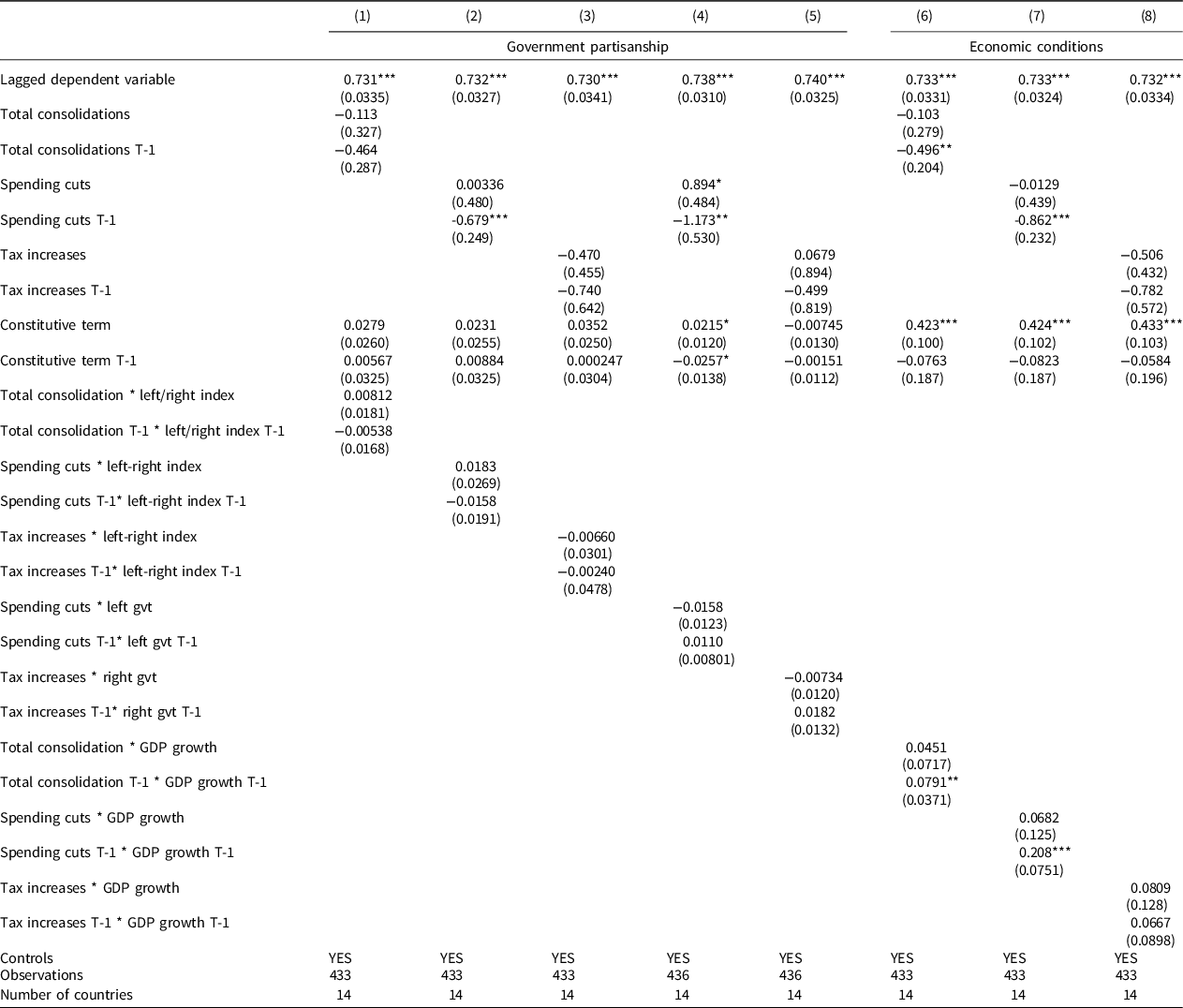
We now move to the interaction models of consolidations with government partisanship and economic growth. We use the same controls as in Table 2 but do not display them to save space. In Table 3, we start by analyzing the role of partisanship (Hypothesis 3) in models 1 to 5. Models 1 to 3 use the right-left index of Seki and Williams’ calculations based on the CMP, while models 4 and 5 use the Comparative Political Dataset measure and directly interact right-wing governments with tax increases and left-wing governments with spending cuts. Regardless of model specification, the interactions of consolidations with partisanship or with a fiscal expansion pledge (shown in the appendix) are not significant. Hence, both left and right governments are similarly punished for implementing fiscal consolidations; spending cuts are not particularly detrimental to left-wing governments, while right-wing parties are not particularly affected by tax increases. We cannot reject the null of Hypotheses 3a and 3b.
ADL models predicting approval, random effects, and country-specific trends, with control variables

Robust standard errors in parentheses.
*P < 0.1, **P < 0.05, ***P < 0.01.
We test Hypothesis 4 in models 6 to 8. The interaction between lagged total or spending-based consolidations and lagged growth is significant (models 7 and 8), supporting Hypothesis 4. The models of Table 3 suggest that the impact of spending-based consolidations on approval is more meaningful than the effect of tax-based consolidations, which never reaches statistical significance in any of the interactions (models 3, 5, and 8).
We present interaction plots to interpret the results. Figure 3 presents the results of models 4 and 5, interacting total and spending-based consolidations with economic growth per capita. It reveals that spending-based consolidations have a negative effect on approval only in countries where economic growth is below the sample average of 1.77%, while the effect of total consolidation becomes significant and negative only when growth is below 1%. In both cases, the negative impact of consolidations on approval increases as economic conditions deteriorate. The steeper slope for spending-based consolidations suggests that spending cuts during recession are particularly likely to result in a decline of approval and confirms our argument that spending cuts are the main drivers of consolidation’s effect on approval. For example, a 1% of GDP consolidation conducted in a mild recession (−1% of GDP growth) leads to a reduction of approval by about 1% point the same year. Most countries that pursued consolidation in the period of slow growth following the 2008 Great Recession have seen significant declines in approval. For example, the fiscal consolidation in France reached 9% of GDP from 2012 to 2014, while the Hollande government’s approval dropped from 37% to 19% during the period. In countries with relatively high growth, consolidations do not have a negative impact on approval.
The effect of total and spending-based consolidation on approval conditional on economic growth, based on model 4 (left) and 5 (right).

Robustness checks of the interaction models are presented in the appendix. Our interaction models do not suffer from nonlinearity or lack of common support between the treatment and the moderator. In the appendix, we use the techniques developed in Hainmueller et al. (Reference Hainmueller, Mummolo and Xu2019) to demonstrate that the interaction is linear and that there are enough situations of fiscal consolidations at high and low levels of per capita growth. The results are also robust to removing extreme values (1% or 2% at each end of the distribution of the moderator). All interaction models are robust to the use of fixed effects. In brief, consolidations conducted in good economic times are not reducing government approval, while consolidations during bad economic times are significantly related to lower approval, especially for spending-based consolidations.
Issues of Endogeneity
There are obvious problems of endogeneity in any research on the impact of austerity on politics since specific circumstances, such as government’s popularity or its ideology, might dictate the decision to consolidate. Our main concern is about the endogeneity between government approval and the decision to consolidate. Indeed, we know from previous research that governments strategically time fiscal consolidations in order to reduce their punishment at the polls (Hübscher and Sattler, Reference Hübscher and Sattler2017). However, the difference of approval between governments who engage in a fiscal consolidation (average approval is 43.1%) and those that do not (average is 41.9%) is not significant (p = 0.334).
Still, to correct for potential endogeneity bias and also to deal with the posttreatment bias between consolidations and growth, we implement an AIPW (Blackwell, Reference Blackwell2013; Ardanaz et al., Reference Ardanaz, Hallerberg and Scartascini2019). This is a two-stage model which constructs a predictive model of the likelihood of consolidation based on a rich set of covariates in the first stage. In the second stage, more weight is given to episodes of fiscal consolidations that are not well predicted by the first stage, as those episodes are considered to be less endogenous (Ardanaz et al., Reference Ardanaz, Hallerberg and Scartascini2019: 21). This model shows that the treatment effect of consolidations on approval remains negative and significant (total and spending-based consolidations reduce positive approval by 3% using this method), after correcting for the self-selection of units into consolidations (treatment effects are reported in the appendix). If anything, models that are not correcting for endogeneity are underestimating the effect of austerity on approval, as the coefficient of the AIPW models are larger than those presented in Table 2. The inclusion of economic variables subject to a posttreatment bias only in the first stage and not in the second stage does not modify the results. To sum up, our main result of a negative effect of consolidation on approval is robust to models aiming to correct for these endogeneity and posttreatment biases.
Summary of the findings and discussion
The models above confirm that spending-based consolidations have a clear negative effect on government approval. In contrast, tax-based consolidations do not have a negative effect on approval. Also, interaction effects are significant only when spending-based consolidations are part of the constitutive terms of the interaction. The results are robust to an empirical technique aiming to correct for the endogeneity between approval and consolidations.
Thus, our findings reveal a trade-off in the politics of fiscal consolidations. While spending-based consolidations may be less detrimental to economic growth than tax-based consolidations, tax-based consolidations are less politically damaging. This may be related to the fact that tax-based consolidations do not contribute to rising inequality, while spending cuts have clear detrimental effects on the poor (Agnello and Sousa, Reference Agnello and Sousa2014). Our divergent results from previous studies can be explained by our dependent variable, government approval, which gives a more accurate portrait of voters’ reaction to changes in fiscal policies than election outcomes, which are often measured several years after fiscal consolidations and dependent on other parties’ positions on austerity.
In contrast to most political science literature focusing on welfare state cutbacks, we find that consolidations are unpopular, regardless of governments’ ideological orientation; left governments are not more affected by consolidations than right-wing governments. There are many potential reasons for this null finding. Two effects of consolidations might be canceling each other out: on the one hand, left-wing governments displease their core constituencies when they retrench public spending, but on the other hand, consolidations move left-wing governments toward the median voter (Bojar, Reference Bojar2018) and signal credibility to markets and voters (Tavares, Reference Tavares2004). Also, we recognize that the null effect may be simply due to the few instances of left governments implementing consolidations: left governments are present in only 27% of the country-years and there are only 40 country-years of left governments implementing consolidations and even less implementing spending cuts.
Finally, the negative effect of spending-based consolidation can be mitigated if economic growth is high, because citizens do not feel the negative effect of the cuts. Cutbacks during a recession have a particularly negative effect on approval. However, if austerity reduces growth, there might be relatively few situations during which the economy is solid enough so that a government can implement austerity without suffering from lower approval. If governments implement fiscal consolidation before economic conditions significantly recover after a recession, they might lose the confidence of the public and nourish the destabilization of party systems witnessed since the last round of austerity following the 2008 recession (Hernandez and Kriesi, Reference Hernandez and Kriesi2016).
Supplementary material
To view supplementary material for this article, please visit https://doi.org/10.1017/S1755773921000035.
Acknowledgments
The authors wish to thank Leo Baccini, Björn Bremer, Reto Bürgisser, Costin Ciobanu, Antoine Genest-Grégoire, Evelyne Hübscher, Achim Kemmerling, and Dietlind Stolle for the comments on previous versions of the paper, as well as workshop participants at McGill University and the Council of European Studies online conference in 2020. Olivier Jacques acknowledges the financial support of the Fonds de Recherche du Québec Société et Culture.