Introduction
Symptoms, course and outcomes in schizophrenia vary considerably between individuals. To date, several prognostic indicators have been linked to clinical features, long-term outcome and treatment response of schizophrenia (Davidson & McGlashan, Reference Davidson and McGlashan1997). Neurocognitive functioning is a prominent manifestation of the illness related to functional outcome (Green et al. Reference Green, Kern, Braff and Mintz2000). Although an increasing number of studies are examining the predictive utility of cognitive deficits for functional (Green et al. Reference Green, Kern and Heaton2004) and clinical outcomes (Moritz et al. Reference Moritz, Krausz, Gottwalz, Lambert, Perro, Ganzer and Naber2000; Verdoux et al. Reference Verdoux, Liraud, Assens, Abalan and van Os2002), predictors of cognitive deficits themselves remain unclear. Determining the predictive value of pretreatment variables such as clinical dimensions, pre-morbid adjustment, duration of untreated illness, age of onset, gender and familial loading for cognitive deficits may well be crucial for clinical and theoretical purposes. Examining these relationships may be useful to predict the magnitude and course of cognitive deficits and to define phenotypic features of the illness or possible subsyndromes that, in turn, may help to identify those individuals most in need of receiving early and intensive intervention.
There are substantial inconsistencies in the literature regarding the influence of pretreatment variables on cognitive deficits. Since Liddle (Reference Liddle1987) originally postulated a three-syndrome model related to distinctive patterns of neuropsychological deficits, subsequent studies examining the relationships between clinical and cognitive dimensions have produced contrasting results. Overall, cross-sectional first-episode studies suggest that cognitive performance is related to negative (Mohamed et al. Reference Mohamed, Paulsen, O'Leary, Arndt and Andreasen1999; Bilder et al. Reference Bilder, Goldman, Robinson, Reiter, Bell, Bates, Pappadopulos, Willson, Alvir, Woerner, Geisler, Kane and Lieberman2000; Fitzgerald et al. Reference Fitzgerald, Lucas, Redoblado, Winter, Brennan, Anderson and Harris2004; Heydebrand et al. Reference Heydebrand, Weiser, Rabinowitz, Hoff, DeLisi and Csernansky2004) and disorganized (Lucas et al. Reference Lucas, Fitzgerald, Redoblado-Hodge, Anderson, Sanbrook, Harris and Brennan2004; Daban et al. Reference Daban, Amado, Bourdel, Loo, Olie, Poirier and Krebs2005) symptoms more than positive symptoms. Long-term longitudinal first-episode studies have also related predominately negative symptoms to cognition (Censits et al. Reference Censits, Ragland, Gur and Gur1997; Gold et al. Reference Gold, Arndt, Nopoulos, O'Leary and Andreasen1999).
Conversely, the relationship between pre-morbid functioning and the severity of deficits in cognitive functions has been established in previous studies (Addington & Addington, Reference Addington and Addington1993; DeQuardo et al. Reference DeQuardo, Tandon, Goldman, Meador-Woodruff, McGrath-Giroux, Brunberg and Kim1994); however, some studies have reported associations mainly with academic adjustment (Rund et al. Reference Rund, Melle, Friis, Larsen, Midboe, Opjordsmoen, Simonsen, Vaglum and McGlashan2004; Norman et al. Reference Norman, Malla, Manchanda and Townsend2005b), and others with social adjustment (Silverstein et al. Reference Silverstein, Mavrolefteros and Close2002, Reference Silverstein, Mavrolefteros and Turnbull2003).
Recent reviews have highlighted discrepant results for the influence on cognitive functioning of other potentially relevant pretreatment variables such as duration of illness (Norman et al. Reference Norman, Lewis and Marshall2005a; Perkins et al. Reference Perkins, Gu, Boteva and Lieberman2005) and gender (Leung & Chue, Reference Leung and Chue2000). Early age of onset has often been associated with worse cognitive outcomes across several domains (Bellino et al. Reference Bellino, Rocca, Patria, Marchiaro, Rasetti, Di Lorenzo, Paradiso and Bogetto2004; Tuulio-Henriksson et al. Reference Tuulio-Henriksson, Partonen, Suvisaari, Haukka and Lonnqvist2004), but not in a first-episode study (Joyce et al. Reference Joyce, Hutton, Mutsatsa and Barnes2005). Finally, the so-called familial-sporadic distinction has been linked to different patterns of cognitive deficits in chronic population studies (Sautter et al. Reference Sautter, McDermott, Cornwell, Black, Borges, Johnson and O'Neill1994, Reference Sautter, McDermott, Cornwell, Johnson, Borges, Wilson, Vasterling and Foundas1995).
Methodological concerns may be obscuring the true nature of these associations. Mixed or small samples, sampling biases (i.e. disproportionate representation of chronically disabled patients), low number of cognitive tests used or arbitrary grouping of test measures into neurocognitive domains are some limitations of previous studies. Moreover, if the above-mentioned pretreatment variables are shown to have an influence on cognitive performance, study designs should take them all into consideration and isolate the specific part of each independent variable; hitherto, this has not been performed consistently. Finally, a first-episode design minimizes the risk of confounding by chronicity of the illness, effects of treatment, and long-standing substance abuse (Hafner et al. Reference Hafner, Hambrecht, Loffler, Munk-Jorgensen and Riecher-Rossler1998); and at this time pretreatment variables can be more reliably measured.
The aim of the current study was to examine the value of pre-morbid functioning and other variables present prior to treatment initiation, such as duration of illness, age of onset, gender, familial loading and clinical symptoms at intake as predictors of cognitive deficits in a group of stabilized first-episode psychosis patients.
Method
Participants
From February 2001 to February 2005 all referrals to an intervention program of first-episode psychosis (PAFIP) carried out in the region of Cantabria, Spain, were screened for patients who met all of the following criteria: aged 15–60 years; met DSM-IV criteria of diagnosis of schizophrenia, schizophreniform disorder, schizo-affective disorder, brief reactive psychosis or psychosis not otherwise specified (NOS); and lived in the catchment area. Those eligible patients with a history of neurological disease, head injury, mental retardation (DSM-IV criteria) or drug dependence (DSM-IV criteria) were not included in the study. All patients were randomly assigned to haloperidol, olanzapine or risperidone (for a detailed description, see Crespo-Facorro et al. Reference Crespo-Facorro, Perez-Iglesias, Ramirez-Bonilla, Martinez-Garcia, Llorca and Vazquez-Barquero2006).
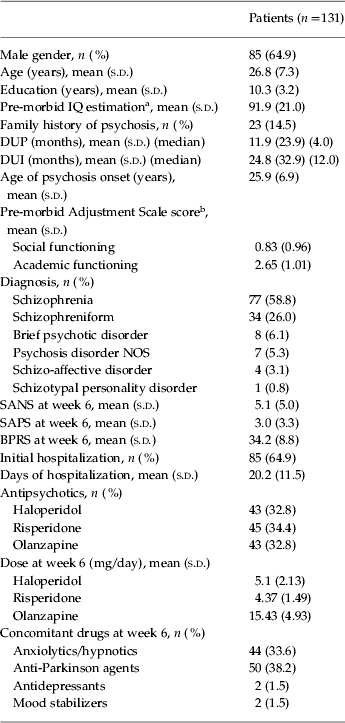
Of the 174 consecutive admissions who met the criteria for enrolment, 75.3% (n=131) agreed to participate in the study. Patients not included in the study did not differ in any of the clinical and sociodemographic measures from those included (for a detailed description of sample representativeness, see González-Blanch et al. Reference González-Blanch, Crespo-Facorro, Álvarez-Jiménez, Rodríguez-Sánchez, Pelayo-Terán, Pérez-Iglesias and Vázquez-Barquero2007). Thus, a final sample of 131 patients (85 male, 46 female) completed the baseline neurocognitive assessment. Patients' initial diagnoses were reassessed using the Structured Clinical Interview for DSM-IV (SCID-I; First et al. Reference First, Spitzer, Gibbon and Williams1995), 6 months after inclusion in the program, by an independent psychiatrist attached to the project. Demographic and clinical characteristics of the final sample are shown in Table 1. All participants provided written consent after detailed explanations of the study procedures had been given to them. The study was approved by the Ethics Committee of the University Hospital ‘Marqués de Valdecilla’.
Demographic, clinical and treatment characteristics

DUP, Duration of untreated psychosis; DUI, duration of untreated illness; NOS, not otherwise specified; BPRS, Brief Psychiatric Rating Scale; SANS, Scale for the Assessment of Negative Symptoms; SAPS, Scale for the Assessment of Positive Symptoms; s.d., standard deviation.
a Pre-morbid Intelligence Quotient (IQ) scores estimated from the Wechsler Adult Intelligence Scale – III Vocabulary subtest.
b Mean scores for childhood, early adolescence, late adolescence.
Neurocognitive testing
All subjects completed a battery of neurocognitive tests aimed to measure basic neurocognitive functioning in schizophrenia spectrum disorders. To maximize collaboration and avoid state effects of acute psychosis, the cognitive battery was applied following clinical stabilization of acute psychotic symptoms, with a mean of 10.58 [standard deviation (s.d.)=3.98] weeks after treatment initiation. Previously, we have argued that the optimal period to conduct a baseline neurocognitive assessment for first-episode psychosis patients was between weeks 6 and 13 (González-Blanch et al. Reference González-Blanch, Alvarez-Jimenez, Rodriguez-Sanchez, Perez-Iglesias, Vazquez-Barquero and Crespo-Facorro2006). The neurocognitive battery was divided to be administered by a trained psychologist across two sessions lasting approximately 1 hour each.
Based on a previous exploratory factor analytic study with the same sample, 24 cognitive subtests scores were grouped into eight cognitive dimensions. Test measures with factor loading exceeding 0.40 and no cross-loadings greater than 0.10 were assigned to factors. Data were standardized to z scores (with an average of 0 and s.d.=1) using the healthy control group data. The mean of subtests scores that fulfilled the previous criteria was used to compute factors scores (González-Blanch et al. Reference González-Blanch, Crespo-Facorro, Álvarez-Jiménez, Rodríguez-Sánchez, Pelayo-Terán, Pérez-Iglesias and Vázquez-Barquero2007). Six out of those eight dimensions were significantly below values for healthy controls after Bonferroni corrections for multiple comparisons. Those dimensions comprised the following subtest variables:
(1) Verbal learning and memory: Rey Auditory Verbal Learning Test (Spreen & Strauss, Reference Spreen and Strauss1998): immediate memory span, new learning, recall following short and long delay periods, and recognition memory.
(2) Verbal comprehension abilities: Wechsler Adult Intelligence Scale – 3rd edition (WAIS-III) subtests (Wechsler, Reference Wechsler1999): Vocabulary, Similarities, Information, Comprehension. Additionally, the Vocabulary subtest was used to estimate pre-morbid IQ.
(3) Speed processing and executive functioning: Trail Making Test (TMT), parts A and B (Lezak et al. Reference Lezak, Howieson and Loring2004); Cancellation test (Spreen & Strauss, Reference Spreen and Strauss1998); Digit Symbol-Coding and Digit Span-backward (Wechsler, Reference Wechsler1999).
(4) Visual memory: Rey Complex Figure Test immediate and delayed recall (Rey, Reference Rey1987).
(5) Motor dexterity: Grooved Pegboard (Spreen & Strauss, Reference Spreen and Strauss1998)
(6) Sustained attention/vigilance: Continuous Performance Test Degraded-Stimulus (CPT-DS) hits and reaction time (Cegalis & Bowlin, Reference Cegalis and Bowlin1991); and Brief Test of Attention (Schretlen et al. Reference Schretlen, Bobholz and Brandt1996).
Pretreatment variables
The following measures were used to assess clinical status at study entry: the presence of positive and negative psychotic symptoms was assessed by the Scale for the Assessment of Positive Symptoms (SAPS; Andreasen, Reference Andreasen1983) and the Scale for the Assessment of Negative Symptoms (SANS; Andreasen, Reference Andreasen1981). The Brief Psychiatric Rating Scale (BPRS) was used to assess the severity of general psychiatric symptoms (Overall & Gorham, Reference Overall and Gorham1962); data from this scale are provided for descriptive purposes. In line with previous studies, we divided psychopathology into three dimensions (negative, positive and disorganized), which were calculated using sums of global scores from the SANS/SAPS (Grube et al. Reference Grube, Bilder and Goldman1998). The positive symptom dimension was the sum of global scores for hallucinations and delusions. The negative symptom dimension score was the sum of global scores for alogia, affective flattening, avolition–apathy, and anhedonia–asociality. The disorganized symptom dimension comprised the global scores of positive formal thought disorder, disorganized/bizarre behavior, and inappropriate affect.
The Pre-morbid Adjustment Scale (PAS) was used to evaluate pre-morbid functioning (Cannon-Spoor et al. Reference Cannon-Spoor, Potkin and Wyatt1982). The PAS is designed to measure pre-morbid functioning from a developmental perspective, conceptualizing good pre-morbid adjustment as the achievement of age-appropriate development and social milestones. The pre-morbid period is divided into four areas of development: (1) sociability/withdrawal; (2) peer relationships; (3) scholastic performance; and (4) adaptation to school at each of four age periods: childhood (up to age 11), early adolescence (12–15 years), late adolescence (16–18 years) and adulthood (19 and up). The scoring range of each item is 0–6, with 0 indicating the best level of functioning and 6 the worst. The general scale was not used because previous studies have raised concerns regarding its usefulness with first-episode samples (van Mastrigt & Addington, Reference van Mastrigt and Addington2002). To focus on early adjustment, and given the high number of missing values for the adulthood period (because participants were already exhibiting psychotic features in that age period), we created composites scores for social and academic domains based only on the first three areas of development [i.e. childhood and (early and late) adolescence]. Reports from the patient and a key relative who knew the patient's pre-morbid development and behaviour were considered. A consensus was achieved by the raters, a social worker and a psychiatrist attached to the project.
Age of onset of psychosis was defined as the age at which the emergence of the first continuous (present most of the time) psychotic symptom (hallucinations, delusions, bizarre behavior, formal thought disorder or inappropriate affect).
Duration of untreated psychosis (DUP) was defined as the time from the first continuous psychotic symptom corresponding to a score of 4 or more on one of the SAPS items to initiation of an adequate antipsychotic drug treatment. DUP was determined after interviewing the patient and a close relative. Duration of untreated illness (DUI) was defined as the time from the first non-specific symptom related to psychosis (for such a symptom to be considered, there should be no return to previous stable level of functioning) to initiation of adequate antipsychotic drug treatment.
First-degree family history of psychotic illness (e.g. schizophrenia spectrum disorders or bipolar disorder with psychotic symptoms) was based on informants (patient and close relative) reports. The informants were asked about each person in the pedigree regarding mental health, medication, psychotherapies, hospitalization and suicide.
Statistical analyses
Analyses were conducted with SPSS version 12.0 (SPSS Inc., Chicago, IL, USA). We used χ2 tests to analyse any differences between groups for categorical variables, and Student's t tests for differences in means between groups on continuous variables. When more than two groups were compared, differences were assessed by one-way analysis of variance (ANOVA). The effect size measure reported for t tests was Cohen's d. As normality for some variables could not be assumed, Spearman correlations were calculated between cognitive dimensions and pretreatment variables [pre-morbid adjustment, clinical dimensions, age of onset, and duration of illness (DUP and DUI)]. All tests were two-tailed. Given the multiple comparisons of cognitive, functional and clinical measures in the analyses, only p values <0.01 are reported as significant.
To determine the capacity of the different pre-morbid factors to predict cognitive functioning, a stepwise multiple linear regression analysis was conducted. An analysis using the G-Power program (Faul & Erdfelder, Reference Faul and Erdfelder1992) was performed to determine the number of predictors that could be introduced while keeping an acceptable power (>0.80) to detect a medium effect size, using an F test with an α level of 0.05. Stepwise regression automatically includes significant variables in the model in the order of the most variance accounted for. The values for p to enter and to be removed from the regression models were 0.05 and 0.10 respectively. We included clinical dimensions, social and academic adjustment, gender, DUP, age of onset and family history as independent variables, and each of the cognitive dimensions as dependent variables. We closely examined residuals plots to ensure that underlying assumptions regarding normality, linearity and homoscedasticity of the residuals were met. To avoid nonlinearity in the regression analyses, the DUP was transformed into a dichotomous variable by splitting the sample into two halves by the median score (4 months). DUI variable was not included because of strong correlations with the DUP, which could lead to collinearity problems.
Results
One hundred and thirty-one stabilized first-episode psychosis patients were assessed for neurocognitive functioning 10.58±3.98 weeks after the initiation of standard pharmacological treatment. No differences were found between treatments (olanzapine, risperidone and haloperidol) in any of the cognitive measures (all p values >0.15).
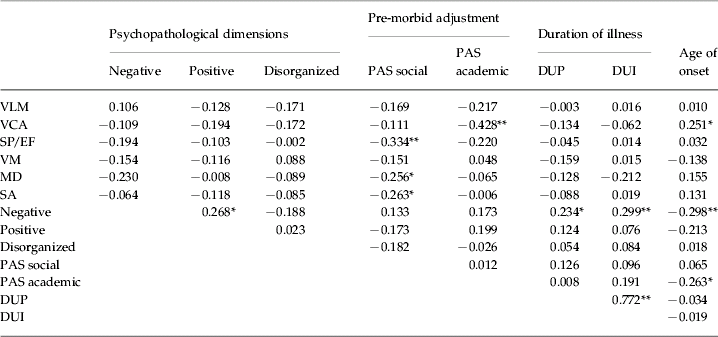
Social and academic pre-morbid functioning as measured by the PAS were not correlated (r=0.012, p=0.896). Social adjustment was significantly associated with specific cognitive areas: executive functioning (r=−0.334, p<0.001), motor dexterity (r=−0.256, p=0.006) and sustained attention (r=−0.263, p=0.005). However, academic adjustment was solely associated with verbal comprehensive abilities (r=−0.428, p<0.001). These results consistently showed that poorer pre-morbid adjustment was associated with worse cognitive performance (see Table 2).
Spearman correlations for cognitive dimensions, psychopathological dimensions, pre-morbid adjustment, age of onset and duration of illness (n=131)

VLM, Verbal learning and memory; VCA, verbal comprehensive abilities; SP/EF, speed of processing and executive functioning; VM, visual memory; MD, motor dexterity; SA, sustained attention/vigilance; PAS, Pre-morbid Adjustment Scale; DUP, duration of untreated psychosis; DUI, duration of untreated illness.
* p<0.01, ** p<0.001.
Age of onset was related to verbal comprehension abilities (r=0.251, p=0.006). To further investigate the relationship between cognition and age of onset, we divided the sample into two halves by setting several cut-points for pre-morbid IQ estimation (as measured by the Vocabulary subtest) and we compared the resulting subsamples.
When we set a cut-point of z score=0 (which equates to an average pre-morbid IQ for healthy controls), patients below that cut-off exhibited an earlier age of onset compared to those above (t=2.096, p=0.038, d=0.44). This finding was replicated when we set as the cut-point to z score=−1 (t=2.096, p=0.038, d=0.44). Likewise, earlier age of onset was associated with poorer academic adjustment (r=−0.263, p=0.003).
DUP and DUI were highly intercorrelated (r=0.772, p <0.001). Duration of illness (DUP and DUI) was not correlated with any cognitive dimension (Table 2). Verbal learning and memory showed a near significant level (before any corrections for multiple comparisons), with females performing better than males (t=−2.26, p=0.026, d=0.40) All other comparisons between genders were not significant (all p values >0.15). No differences were found between patients with familial loading (n=23) and those without familial loading (n=108) of psychosis (all p values >0.30). (Data not shown are available on request.)
Prediction of basic neurocognitive deficits
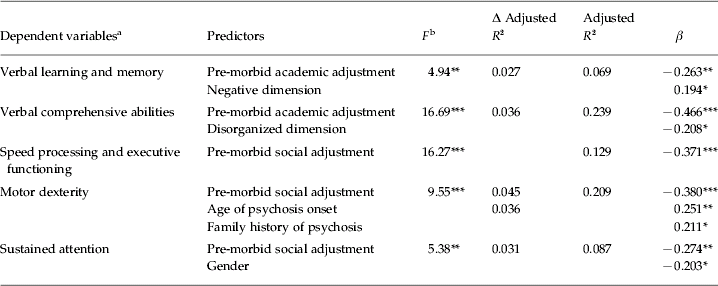
A sample size of 131 subjects achieves sufficient power (>80%) to detect a medium effect size of 0.15 (which will detect an R 2 of ⩾0.13) attributed to nine predictors, using an F test with an α level of 0.05. Regression equations yielded significant overall probability levels in all dependent variables, except for visual memory factor (Table 3). Pre-morbid functioning was the main predictor for every model. Pre-morbid social adjustment was related to executive functioning, motor dexterity and sustained attention whereas pre-morbid academic functioning contributed to the prediction model of verbal comprehension abilities and verbal learning and memory. Age of onset, family history of psychosis, gender and symptoms had limited value as predictors. To confirm the value of these results for a more stringent definition of schizophrenia spectrum disorders, we re-ran the analysis using only data for schizophrenia and schizophreniform disorders (n=111), which constitute 84.7% of the sample. Pre-morbid adjustment was again the main predictor, and social and academic domains were related in the same way with cognitive dimensions; however, verbal learning and memory model lost the significance, probably due to sample reduction.
Stepwise multiple linear regression model summary for each cognitive dimension (n=131)

β, Standardized coefficient; adjusted R 2, adjusted squared multiple correlation – explained variance; Δ adjusted R 2, adjusted R 2 increments after first step.
a No predictors for Visual Memory dimension emerged.
b Model significance. Predictors included in each model: pre-morbid social adjustment, pre-morbid academic adjustment, clinical dimensions (negative, positive and disorganized), gender, age of psychosis onset, duration of untreated psychosis, and family history of psychosis.
* p<0.05, ** p<0.01, *** p<0.001.
Discussion
This study examined the predictive value of pre-morbid functioning and several pretreatment variables for short-term neurocognitive outcome in a sample of stabilized first-episode psychosis patients. Pre-morbid social and academic difficulties were related to a worse performance in basic cognitive dimensions. Specifically, pre-morbid social maladjustment was related to a worse functioning on cognitive dimensions that have previously been shown to have pronounced deficits (González-Blanch et al. Reference González-Blanch, Crespo-Facorro, Álvarez-Jiménez, Rodríguez-Sánchez, Pelayo-Terán, Pérez-Iglesias and Vázquez-Barquero2007). Academic functioning was associated with verbal memory and comprehension abilities. A second finding of the present study was that traditionally favorable prognostic features such as female gender, early age of onset, short DUP and non-family history of psychosis had a negligible value as predictors of neurocognitive functioning in the early stages of the illness. Additionally, comparisons between antipsychotic drugs did not show a statistically significant difference in any neurocognitive dimension.
The contribution of social and academic pre-morbid functioning: a distinctive pattern
Previous research has established a relationship between pre-morbid functioning and cognitive performance, but it has been somewhat inconclusive regarding the particular pre-morbid functioning domains that correlate with specific cognitive dimensions. Silverstein et al. (Reference Silverstein, Mavrolefteros and Close2002, Reference Silverstein, Mavrolefteros and Turnbull2003) have reported an association of cognitive measures with social and school adaptation but not with academic performance. However, other studies, with first-episode samples, have shown an association between poor pre-morbid academic functioning and a worse verbal learning and working memory outcomes (Rund et al. Reference Rund, Melle, Friis, Larsen, Midboe, Opjordsmoen, Simonsen, Vaglum and McGlashan2004), or have reported an overall cognitive dysfunction mainly related to the academic component of pre-morbid adjustment (Norman et al. Reference Norman, Malla, Manchanda and Townsend2005b). We found that both pre-morbid social and academic adjustment had significant and independent contributions to cognitive domains. It is debatable whether these differences with other first-episode studies are as a result of cultural differences or artifacts of the instrument. For example, in our study there was no significant correlation between social and academic subscales of the PAS (r=0.01), while in the study by Norman et al. (Reference Norman, Malla, Manchanda and Townsend2005b), there was moderate correlation (r=0.37) between those subscales. Notwithstanding these discrepancies, the present data provide strong support to the hypothesis that pre-morbid functioning is linked to cognitive deficits in early psychosis. It is worth noting, however, that this accounted for only a small amount of the explained variance in cognitive functioning. Longitudinal studies have reported the predictive value of cognitive assessment for functional outcome (Green et al. Reference Green, Kern and Heaton2004). Cross-sectional studies have found specific cognitive domains such as verbal memory, executive functioning and vigilance to be related to specific functional outcome (Green et al. Reference Green, Kern, Braff and Mintz2000). In this sense, our data extend this link retrospectively to the pre-morbid period by showing that neurocognitive dimensions are distinctively associated with early social and academic functioning. In particular, early social maladjustment seems to be a manifestation of vulnerability to a worse outcome in those cognitive domains most impaired in this population: attention, executive functions and motor dexterity.
Negligible contribution of well-accepted good prognostic factors to cognitive outcome
Female gender
The available studies on gender differences provide conflicting results that can be attributed to the methodological disparity between studies. Most of the research reporting gender differences has been based on chronic samples (Leung & Chue, Reference Leung and Chue2000). First-episode studies have provided a different view. Bilder et al. (Reference Bilder, Lipschutz-Broch, Reiter, Geisler, Mayerhoff and Lieberman1992) reported no gender differences during the early phase of illness, but greater impairment in men over time, suggestive of a more deteriorating course of illness in men. Similarly, Hoff et al. (Reference Hoff, Wieneke, Faustman, Horon, Sakuma, Blankfeld, Espinoza and DeLisi1998) found no gender-related differences in an acute first-episode sample after corrections for age, age of onset, pre-morbid IQ and symptom severity. Some first-episode programs have reported significant differences in verbal and performance IQ subtests, both suggesting a better level of functioning in men (Norman et al. Reference Norman, Townsend and Malla2001). In the present study, male gender was associated with a better performance in the sustained attention dimension after controlling for potential confounders. However, taking into account the small contribution of gender as a predictor of that dimension, it would be questionable to assert there are any lawful gender differences. Long-term follow-up studies with first episode samples may help to clarify if the course (and severity) of the illness accounts for the discrepancy between chronic and first-episode studies.
Non-family history of psychosis
The subdivision of patients based on the so-called familial-sporadic distinction has been related to different patterns and degrees of neuropsychological deficits, which may be constituted as markers of vulnerability and liability for psychosis (Lewis et al. Reference Lewis, Reveley, Reveley, Chitkara and Murray1987). In the present study, patients who are enriched for genetic risk showed similar outcomes to the remainder of participants on all cognitive dimensions. Family history of psychosis only made a contribution to the prediction of motor dexterity (a composite as measured by Grooved Pegboard preferred and non-preferred hands). This is partially consistent with the findings reported by Sautter and colleagues. They showed focal deficits in abstraction, problem-solving (as measured by the Wisconsin Card Sorting Test, WCST) and fine-motor control (as measured by the Grooved Pegboard) in recent-onset patients with a family history of psychosis, whereas non-familial participants with schizophrenia test scores were associated with a pattern of less severe generalized deficits (Sautter et al. Reference Sautter, McDermott, Cornwell, Black, Borges, Johnson and O'Neill1994, Reference Sautter, McDermott, Cornwell, Johnson, Borges, Wilson, Vasterling and Foundas1995). Wolitzky et al. (Reference Wolitzky, Goudsmit, Goetz, Printz, Gil, Harkavy-Friedman and Malaspina2006) reported similar pattern of deficits compared to population norms, but lower scores in digit symbol and object assembly WAIS-R subtests for those patients who had one first- or second-degree relative with chronic non-affective psychosis compared to the sporadic group. A number of reasons could account for the discrepancies between our data and prior studies that have found determining differences in degree or patterns of impairments. First, instead of individual tests scores to assess cognitive performance, we used factor scores. This method, based on a factor analytic study, provides more meaningful results and minimizes type I error, but reduces intra-individual variability, and may therefore conceal some differences between groups. Second, familial loading was limited to first-degree relatives and they were not assessed directly. This could increase the risk for under-reporting or misclassifying familial loadings. Even so, the family history method has respectable sensitivity when broad but well-specified criteria are used (Andreasen et al. Reference Andreasen, Rice, Endicott, Reich and Coryell1986). It seems unlikely that a broader definition of familial loading would have substantially changed its role as a predictor of cognitive outcome because, in fact, a narrow definition of schizophrenia spectrum disorders did not cause a substantial change.
Late age of onset
The contribution of age of onset to the prediction of cognitive dysfunction was minimal. Early age of onset has often been associated with a worse cognitive outcome in, among others, verbal learning and memory (Bellino et al. Reference Bellino, Rocca, Patria, Marchiaro, Rasetti, Di Lorenzo, Paradiso and Bogetto2004), executive functioning and sustained attention (Tuulio-Henriksson et al. Reference Tuulio-Henriksson, Partonen, Suvisaari, Haukka and Lonnqvist2004). Of note, Joyce et al. (Reference Joyce, Hutton, Mutsatsa and Barnes2005), in a study with first-episode patients that attempted to investigate the heterogeneity of cognitive outcomes in schizophrenia, found that between those patients with a profile of intellectual deterioration and those with a preserved global intelligence, there were no differences in the age of onset. Nevertheless, those patients with low IQ (without deterioration in relation to pre-morbid IQ) had an earlier illness onset. We have replicated the results in the present study. Patients with low pre-morbid IQ had an earlier illness onset. Likewise, those patients with a pre-morbid IQ ranging above average (z scores >0) had a later onset of the illness. These findings are in agreement with reports that indicate that low pre-morbid IQ in childhood and adolescence is associated with increased risk for schizophrenia spectrum disorders (Cannon et al. Reference Cannon, Caspi, Moffitt, Harrington, Taylor, Murray and Poulton2002). In a recent review of the ‘cognitive reserve’ in neuropsychiatric disorders, Barnett et al. (Reference Barnett, Salmond, Jones and Sahakian2006) concluded that this concept, which has demonstrated its usefulness for acute brain injury and degenerative disorders, may also be a resilience factor in schizophrenia.
Short duration of illness
The robustness of the neurotoxic effects of psychotic symptoms hypothesis (Wyatt, Reference Wyatt1991) has been questioned by recent research with first-episode psychosis samples (Norman et al. Reference Norman, Townsend and Malla2001; Heydebrand et al. Reference Heydebrand, Weiser, Rabinowitz, Hoff, DeLisi and Csernansky2004; Rund et al. Reference Rund, Melle, Friis, Larsen, Midboe, Opjordsmoen, Simonsen, Vaglum and McGlashan2004). The present results do not support the neurotoxic hypothesis. By this, we are not arguing against early intervention aims. On the contrary, overestimating DUP importance may be misleading by resulting in an over-focus on the treatment of psychotic symptoms at the expense of ignoring other outcomes. For example, it has been suggested that delay in intensive psychosocial treatment may be a more important predictor of negative symptoms at 6 years’ outcome than is delay in starting antipsychotic medication alone (de Haan et al. Reference de Haan, Linszen, Lenior, de Win and Gorsira2003). Regardless of practical or theoretical advantages of early intervention, there are no reasons for delay. However, given the increasing evidence, the relevance of the DUP concept should be reconsidered.
Strengths and limitations
The present study has unique characteristics in the investigation of pretreatment predictors of cognitive performance. This is a fairly large, first-episode representative sample comprehensively assessed shortly after treatment initiation. The present methodology allowed us to examine the predictive value of several pretreatment variables for cognitive deficits in basic dimensions, after controlling for mutual effects and antipsychotic treatment. However, the cross-sectional design and retrospective methods used are a limitation. The most obvious limitation in using cross-sectional data is the inability to infer causality. Another issue is the fact that retrospective methods biases cannot be neglected. Certainly these methods are more reliable in first-episode samples with reports from close informants available. Finally, a more conclusive investigation would require a sample large enough to detect small effect sizes. The present study design would have required a sample size of about 800 patients. Such a study reasonably would require cooperation from a multi-site project. It is arguable, however, whether the identification of pretreatment variables with small effect size would have any practical implications in terms of prediction of short-term cognitive deficits in early psychosis.
Acknowledgments
We thank Drs Natividad de Benito (IFIMAV, Santander, Spain) and Joe Buckby (EPPIC, Melbourne, Australia) for their helpful comments on early drafts of this manuscript. The present study was performed at the Hospital Marqués de Valdecilla, University of Cantabria, Santander, Spain, under the following grant support: Instituto de Salud Carlos III, FIS 00/3095 and G03/032, and SENY Fundació Research Grant 2005-0308007, Fundación Marqués de Valdecilla A/02/07.
Declaration of Interest
None.