Introduction
Dementia is a clinical syndrome characterized by a progressive decline in cognition and level of functioning (Engedal and Haugen, Reference Engedal and Haugen2009). People with severe dementia are in need of 24-hour care, most of them living in NHs. Almost 80% of residents in Norwegian NHs have dementia (Strand et al., Reference Strand, Tambs, Engedal, Bjertness, Selbaek and Rosness2014).
NH residents with moderate to severe dementia often have reduced capacity to concentrate and little energy left to participate in any group activity or even to motivate themselves to rise from the chair (Egan et al., Reference Egan, Hobson and Fearing2006). Participating in group activities could provide interaction with others, make residents experience physical wellness, re-create contact with life stories, etc. (Hasselkus, Reference Hasselkus1998). Various activities are promoted, such as music therapy, reminiscence, aromatherapy, etc. (Kverno et al., Reference Kverno, Black, Nolan and Rabins2009; Livingston et al., Reference Livingston2014). Interactions with visitation dogs are also promoted, and reviews describe findings like reduced agitation and apathy, often related to increased levels of oxytocin producing stress reduction, improved degree and quality of social interactions, and increased mood (Williams and Jenkins, Reference Williams and Jenkins2008; Bernabei et al., Reference Bernabei2013).
A newer form of animal interaction is with animal-looking, socially assistive robots, also called emotional robots, and studies with robotic cat, dog, and baby seal show similar findings as for human–animal interventions (Bernabei et al., Reference Bernabei2013; Mordoch et al., Reference Mordoch, Osterreicher, Guse, Roger and Thompson2013). In contrast to live dogs, the slow pace of robotic animals facilitates following for people with dementia, in addition to being more hygienic and not causing allergic reactions. Paro is shaped like a baby seal with a swiveling head and moving legs and tail, and it also has speakers that make the authentic sounds of a real baby harp seal. Paro is adaptive, recognizes voices, and can respond to repeated words (Wada et al., Reference Wada, Shibata, Saito and Tanie2004). Its artificial fur contains 12 sensors, creating interactivity between users and the robot as it responds to users’ repetitive motions, such as petting.
The aim of using robotic animals is to provide social, psychological, and physiological benefits through an engaging interaction (Shibata et al., Reference Shibata, Wada, Saito and Tanie2004; Feil-Seifer and Mataric, Reference Feil-Seifer and Mataric2005). A model of factors influencing engagement describes a mechanism of how perceived interesting stimuli could affect expressed behaviors in people with dementia (Cohen-Mansfield et al., Reference Cohen-Mansfield, Dakheel-Ali and Marx2009). Attributes of the stimuli, such as Paro, and/or in the person, creates an interaction, which creates engagement with Paro. A change in affect caused by this engagement will influence the presentation of behavior in the person, such as being calmer. In addition, there could be a calming effect caused by sensory stimulation, such as petting, hugging, and kissing Paro, via increased oxytocin levels, as in human–animal interaction.
Studies of video-based analysis of interactions with Paro demonstrate not only increased social interactions between residents and Paro but also increased interaction among individuals in group settings (Giusti and Marti, Reference Giusti and Marti2006; Klein and Cook, Reference Klein, Cook, Ge, Khatib, Cabibihan, Simmons and Williams2012; Chang et al., Reference Chang, Šabanović, Huber, Herrmann, Pearson, Lenz, Bremner, Spiers and Leonards2013; Robinson et al., Reference Robinson, Macdonald, Kerse and Broadbent2013; Robinson et al., Reference Robinson, Broadbent and MacDonald2015a). One randomized controlled trial (RCT) with video analysis on individual Paro activities demonstrated that Paro created more laughter and positive expressions compared with a stuffed toy (Takayanagi et al., Reference Takayanagi, Kirita and Shibata2014). Other studies have shown high levels of talking to and talking about Paro, also with affective communication toward Paro (Giusti and Marti, Reference Giusti and Marti2006) and an increased amount of utterances in general through one year of interaction with Paro (Wada et al., Reference Wada, Shibata, Kayoko and Tanie2005). Paro could also be a trigger to start conversations and interactions that would not otherwise take place (Klein and Cook, Reference Klein, Cook, Ge, Khatib, Cabibihan, Simmons and Williams2012). An ethnographic study of one agitated resident describes Paro as a means for open communication in severe dementia (Marti et al., Reference Marti, Bacigalupo, Giusti, Mennecozzi and Shibata2006). Better knowledge about a range of behaviors toward Paro is required. Care technology is increasingly a focus of white papers (Ministry of Health and Care Services, 2011), and Paro is implemented in studies worldwide. In addition, we need knowledge about how Paro creates engagement and influence behaviors in people with dementia when using it as a non-pharmacological treatment.
We recently published findings from a cluster-RCT on activity with Paro showing effect on agitation and depression (Joranson et al., Reference Joranson, Pedersen, Rokstad and Ihlebaek2015). This paper presents analysis of video recordings of Paro groups performed early and late during Paro intervention as additional knowledge of Paro intervention in a group setting. The aim of this study was to investigate in a systematic way the variety of behaviors seen in people with dementia during group activity with Paro. We also wanted to investigate differences in behaviors related to dementia severity and explore changes in behaviors during the course of the intervention.
Method
NH units were recruited to the trial through the Centre for Development in NHs in three counties in Norway. Participants who had been part of an intervention in a cluster RCT that engaged in a 12-week semi-structured group activity with Paro were video recorded early and late during the intervention period to observe change in behaviors. For a detailed description of the cluster RTC, see Jøranson et al. (Reference Joranson, Pedersen, Rokstad and Ihlebaek2015).
Participants
Thirty participants from five adapted units in NHs were recruited to participate in the Paro intervention, each unit forming a group. Three participants dropped out during the intervention period, and four participants attended only one of the video-recorded sessions. Inclusion criteria were age over 65 years and having a dementia diagnosis. Showing an interest in Paro was also an important inclusion criterion.
Ethical considerations
Nurses attached to the project recruited participants by oral and written information specially adapted for this patient group and assessed their ability to perform informed consent for participation. Participants gave oral consent and next-of-kin gave informed written consent. The project was reviewed and approved by the Regional Committees for Medical and Health Research Ethics in Norway.
Paro activity
All sessions were conducted in a quiet, separate room in each NH in accordance with our protocol. Participants were sitting close on chairs in a half circle facing toward the activity leader (AL) conducting the sessions. All participants had regular seats to secure predictability in the setting.
Trained nurses from each unit and connected to the project participated in a three-hour mandatory Paro course ahead of the intervention to become an AL. ALs were supervised by the same project member post-sessions during the first two weeks, aiming to make the sessions as similar as possible for the sake of comparison.
Sessions were semi-structured and facilitated by an AL. All sessions started with the AL presenting Paro as an articulated doll, aiming to reduce misinterpretations. The AL distributed Paro to participants’ laps for an equal period of time, preferably during two rounds to reduce waiting time. Sessions involved activities naturally occurring between participants and Paro, and between participants. The AL promoted all participants to interact with Paro. All participants were included in conversations by the AL through themes, such as their perception of Paro, of previous pets, or through other related themes. If participants were engaged or entertained in the activity, no discussion topic was needed. Participants were encouraged to interact with Paro, such as to pet or cuddle it, talk with it, sing to it, or play with it. All sessions were closed by the AL encouraging participants to tell Paro good-bye before turning it off.
Procedures
Recordings of Paro sessions in all groups were conducted during weeks 2 and 10 of the 12-week intervention period (a total of ten recordings). An ethogram was used to define and distinguish different behaviors in participants from the recordings. An ethogram is a catalog of descriptions of relevant behaviors of the subjects of the study (Troisi, Reference Troisi1999). The ethogram in this study was developed by members of the project group. Relevant behaviors were included based on pre-viewing several video recordings, also determined by the first, second, and third author of this paper.
Data collection
NH staff obtained background information, including information about activity level and animal contact, from each participant. Stage of dementia was measured using the Clinical Dementia Rating (CDR) scale, with ratings from 0 (no cognitive impairment) to 3 (severe dementia) (Hughes et al., Reference Hughes, Berg, Danziger, Coben and Martin1982). To film the group sessions, the video camera was placed to record all participants in the camera's eye simultaneously and for as much time as possible. Data based on video recordings in the ethogram were imported into the data program Solomon Coder beta 14.03.10 (Péter, Reference Péter2014). One project member conducted the video analysis.
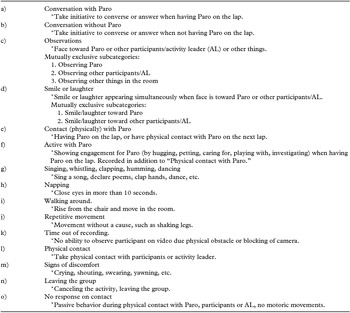
Behaviors were defined both with and without having Paro on the lap to identify nuances in behaviors of direct Paro activity or social activity. Observations of specific behaviors in each participant were registered with duration in seconds during a session (see overview in Table 2). Several variables could be registered in parallel, such as “Observing Paro” and “Smile/laughter toward Paro.” Two behaviors in the ethogram had mutually exclusive subcategories; category c) with observation of different objects and category d) with smiles and laughter (Table 2). The subcategory in observation of different objects, c), was changed if the participant changed spot of observed object in more than two seconds.
Analysis
The statistical analyses were conducted using SPSS version 22. The level of statistical significance was set at 0.05.
Sample characteristics at baseline were summarized by descriptive statistics using frequencies.
Registrations in the ethogram were imported to a spreadsheet for calculation of time for each behavior, recorded in seconds. Time out of camera was withdrawn for each participant, leaving the remaining time in each behavior converted to percentage of time for the sake of comparison in the analysis.
The behavior “Conversation with Paro” was only registered when the participant physically had Paro on the lap when communicating. The behavior “Contact with Paro” was registered when the participant physically had Paro on the lap or touched Paro on the next lap. Percentage of time for these variables had to be low as compared to the other variables due to the distribution of Paro among participants’ laps. Percentage of time with Paro if distributed among six attending participants in a 30-minute session would result in a maximum 16%–17% occurrence in these variables. The behavior “Active with Paro” was only registered simultaneously as “Contact with Paro” to describe engagement when having contact with Paro. It would therefore always have a lower occurrence than registrations of “Contact with Paro.”
Behaviors without registrations, or with registrations on only very few participants, were excluded to avoid biased results regarding the limited sample, resulting in a total of nine variables, all on a scale level. The variables g) to o) in Table 1 did not meet the inclusion criteria.
Variables in ethogram-observed behaviors recorded with time duration in seconds

*Description of observed behavior in the participant.
We tested occurrence in each behavior in week 2, aiming for overview of the variables early in the intervention by one-way ANOVA. To test for differences in behaviors between dementia severity among the participants, the CDR groups were divided into two subgroups in a dichotomous variable. CDR scores 1 (n = 2) and 2 (n = 11) were merged (n = 13) to represent participants with mild to moderate dementia, while CDR score 3 (n = 10) described participants with severe dementia. The dichotomous variable was set as factor in the one-way ANOVA.
Level of development in the included behaviors from weeks 2 to week 10 on a group level was tested by paired t-test.
Results
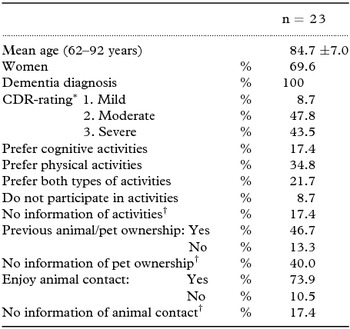
A total of 16 women and seven men (n = 23) were included in the statistical analysis, ranging in age from 62 to 92, mean 84.65 ±7.0. The CDR rating showed that 47.8% of the participants had moderate dementia (CDR 2) and 43.5% had severe dementia (CDR 3). Many of the participants preferred physical activities, and many enjoyed animal contact. See Table 2 for baseline descriptions.
Personal and medical characteristics at baseline

*CDR = Clinical Dementia Rating scale.
†Missing information in background information form.
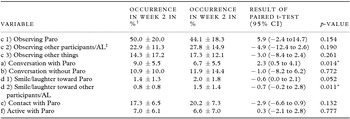
Behaviors from a) to f) (Table 1) were the most frequent behaviors observed from the video recordings and were therefore included in the analysis. The most frequent behaviors registered in week 2 were “Observing Paro,” which had the highest occurrence (50% of the time); “Observing other participants/AL,” which was registered more than 20% of the time; and “Contact with Paro,” which was observed 17% of the time (Table 3). The variable “Observing other things” was registered more than 14% of the time. Conversation, which was divided into the behaviors “Conversation with Paro on the lap” and “Conversations without Paro on the lap,” were each registered about 10% of the time, resulting in a total conversation time of 20%. Smile and laughter, divided into “Smile/laughter toward Paro” and “Smile/laughter toward other participants/AL,” were registered more than 2% of the time (Table 3).
Occurrence of each behavior in means (±S.D.) and results of paired t-test

*Statistical significant at 0.05-level.
S.D. = Standard deviation.
CI = Confidence interval.
†Values are given as percentage of total session time.
‡AL = Activity leader in the Paro sessions.
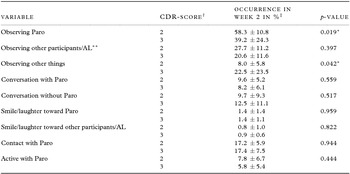
Next, we compared the different behaviors between participants with different degrees of dementia during week 2 (Table 4). We found a significant higher percent of time for the variable “Observing Paro” among participants with mild to moderate dementia (58.5%) compared to those having severe dementia (39.2%, p = 0.019). The variable “Observing other things” also showed a significant difference; participants with mild to moderate dementia had a mean percentage of time of 8.0% compared to 22.5% among participants with severe dementia (p = 0.042).
Results of occurrence in week 2 comparing severity of dementia in means (±S.D.)

*Statistical significant at 0.05-level.
†CDR-score 2 = CDR-level 1 (mild dementia) and 2 (moderate dementia), CDR-score 3 = CDR-level 3 (severe dementia).
‡Occurrence in percentage of total session time.
**AL = Activity leader in the Paro sessions.
In Table 3, we report changes in behavior from week 2 to week 10. We found statistically significant differences of mean percentage in two variables. “Smile/laughter toward other participants/AL” showed a mean change from 0.8% to 1.5%, an increase of −0.7 (p = 0.011). The variable “Conversation with Paro on the lap” showed a decrease from 9.0% to 6.7%, a change of 2.3 (p = 0.014). There were no significant changes in any of the other variables on group level during the intervention, although the variable “Smile/laughter toward Paro” showed increasing tendency.
Discussion
In this systematic investigation, we describe different behaviors in participants, such as observing objects, conversations, smiles and laughter, and contact with Paro during the video-recorded sessions. Participants with mild to moderate dementia were more likely to observe Paro than participants with severe dementia. Participants with severe dementia showed highest occurrence in observing things other than Paro or people. During the course of the intervention, we found statistically significant increases in smiles and laughter toward others in the group while there was a decrease in conversations when the participants had Paro on the lap. In the following, we will explore and discuss these findings.
Behaviors in Paro group activity
Video recordings from ten sessions with five different Paro groups produced a broad description of behaviors, which we measured in duration. This combination has not been conducted previously in Paro studies. Some studies have measured various interactions among participants and with Paro (Chang et al., Reference Chang, Šabanović, Huber, Herrmann, Pearson, Lenz, Bremner, Spiers and Leonards2013; Sabanovic et al., Reference Sabanovic, Bennett, Chang and Huber2013), but our study also describes other behaviors in addition to interactions.
In our study, the behavior “Observing Paro” had the highest observational time from the start of the intervention, indicating that Paro was catching interest from the first sessions. All our participants showed a pre-interest in Paro in the recruitment process in this study. Inclusion of participants’ pre-morbid likings for pets and present likings of animal contact (see Table 2) has been described in dog-assisted therapy (Perkins et al., Reference Perkins, Bartlett, Travers and Rand2008) and could contribute to explain the high attention toward Paro in participants.
We also included a less positive behavior toward Paro activity, such as participants observing objects other than Paro or other participants/ALs. This type of behavior could be interpreted as participants’ struggle with concentration over time due to the cognitive impairment. Such information could be important when staff consider participants for group activity or for individual activity with Paro in terms of how long each individual is able to focus on the activity. This finding will be discussed in the section of differences due to dementia severity.
The two activities of conversations, with or without having Paro on the lap, were found to be almost equal in duration. Conversation is an important part of the social interactions. Only one small (n = 7), unpublished study, which measured duration of behaviors, also showed statistical significant increase in interactions when participants did not have Paro contact (Sabanovic et al., Reference Sabanovic, Bennett, Chang and Huber2013). This means that participants do not need to have Paro on the lap to contribute in conversations, and it might indicate that Paro is suitable for use in a group setting to increase interactions.
Several behaviors from our study are described in other studies with video analysis, but mainly qualitatively and without accurate descriptions of change in behaviors during weeks of interactions (Giusti and Marti, Reference Giusti and Marti2006; Klein and Cook, Reference Klein, Cook, Ge, Khatib, Cabibihan, Simmons and Williams2012; Robinson et al., Reference Robinson, Broadbent and MacDonald2015a). Our investigation is important in terms of detecting and measuring various behaviors quantitatively, making statistical analysis of Paro activity possible. In addition, the described behaviors could be seen as expressed engagement during interactions, also knowledge of significance in Paro interventions. Chang et al. (Reference Chang, Šabanović, Huber, Herrmann, Pearson, Lenz, Bremner, Spiers and Leonards2013) published a statistical analysis of video recordings measuring durations of behaviors, describing verbal interactions with Paro or with other participants or with therapist, and physical interactions (petting, holding, etc.). The results showed increased physical and social interactions. The RCT from Takayanagi et al. (Reference Takayanagi, Kirita and Shibata2014) measured behaviors with frequencies and describes interactions systematically during six minutes of individual interaction. They found that participants talk and laugh more with Paro than with a toy lion and that participants with severe dementia had more neutral expressions toward the toy lion than Paro.
Differences due to severity of dementia
Participants with mild to moderate dementia paid significantly more attention toward Paro (“Observe Paro”) compared to participants with severe dementia, which could indicate that Paro is less interesting for participants with severe dementia. To explore this finding, we must consider the severe cognitive impairment in this patient group when performing activities. People with severe dementia often struggle with holding focus due to easily being distracted (Engedal and Haugen, Reference Engedal and Haugen2009). Comments or laughter from other participants could draw their attention away from Paro. However, participants with severe dementia observed Paro twice as much as they observed other participants/ALs. An ethnographic study describes persistent attention toward Paro as a quality of the intervention understood as an increased affection for Paro (Marti et al., Reference Marti, Bacigalupo, Giusti, Mennecozzi and Shibata2006). This indicates that Paro both captures and retains interest in participants with severe dementia. Performing engaging activities in dementia could provide meaning for the person (Hasselkus, Reference Hasselkus1998). Persistent attention toward Paro among participants with severe dementia could therefore be explained by Paro activity being perceived as a meaningful occupation. Many participants had a pre-morbid liking for pets and present liking for animal contact. Previous interests or past role identities in an individual will influence engagement in people with dementia, and an engaging stimulus, such as Paro, will create affection in the person interacting with it (Cohen-Mansfield et al., Reference Cohen-Mansfield, Dakheel-Ali and Marx2009). There were no observations of negative behaviors in the recordings, which could underpin our explanations of engagement.
We found a significant higher occurrence in the variable “Observing other things,” including attention toward all other things than Paro or people in participants with severe dementia. This behavior during the sessions could be interpreted as an attempt from participants with severe dementia to be engaged in something. Because NH residents struggle with both to participate and engage in activities, engagement in something will be better than no engagement, often resulting in napping or withdrawal, due to the fact that dementia impairs their attention capacity and wakefulness (Engedal and Haugen, Reference Engedal and Haugen2009). Assessments of potential activities must be based on participants’ individual ability to stay engaged during the session.
Changes on group level
We found an increasing amount of smiles and laughter toward other participants or ALs during the course of the intervention. This was expected and in accordance with previous research describing increased laughter and positive expressions (Takayanagi et al., Reference Takayanagi, Kirita and Shibata2014). In the group setting based on our design, participants were sitting close in the half circle in order to facilitate social interactions in the group. Reactions and comments from other participants and staff toward participants in Paro interaction also increase smiles and laughter in the group which are previously described (Marti et al., Reference Marti, Bacigalupo, Giusti, Mennecozzi and Shibata2006). In addition, Paro is described to work as an ice-breaker between staff and residents (Robinson et al., Reference Robinson, Broadbent and MacDonald2015a) in terms of working as a medium in communication. Even though the occurrence of smile and laughter was low when compared with other behavior variables, the main issue is the positive development in this behavior during the intervention period. In addition, we saw a tendency of increased smiles and laughter directly toward Paro. Paro is described to be an impetus toward social interactions (Klein and Cook, Reference Klein, Cook, Ge, Khatib, Cabibihan, Simmons and Williams2012; Robinson et al., Reference Robinson, Broadbent and MacDonald2015a). Increase in smiles and laughter toward others, not only toward Paro, highlights the purpose of using Paro in the right group setting, also to create additional effects of Paro activity.
The significant decrease in conversation with Paro on lap was unexpected compared with previous research (Wada et al., Reference Wada, Shibata, Kayoko and Tanie2005; Chang et al., Reference Chang, Šabanović, Huber, Herrmann, Pearson, Lenz, Bremner, Spiers and Leonards2013). This could most likely be a consequence of the group dynamics working in the Paro groups over time. After attending the sessions several times, the participants would feel more secure in the setting, as shown in other studies through physiological effects, such as lower blood pressure (Robinson et al., Reference Robinson, MacDonald and Broadbent2015b) and reduced cortisol levels (Wada et al., Reference Wada, Shibata, Saito and Tanie2004) after interactions with Paro caused by increased levels of oxytocin from the tactile stimulation in addition to be influenced by social interactions in the group setting (Uvnäs-Moberg, Reference Uvnäs-Moberg1998). Positive experiences from Paro activity seem to increase participants’ attention toward each other and the general social interactions, as described above. However, on a group level, the participants observed Paro more than twice the time they spent observing other participants in week 2. A decreased observation time toward Paro in week 10 could be explained in the context of Paro being a novelty, and the attention gradually being replaced by increasing social interactions in the group setting, as already described. However, the tendency of increasing conversations without having Paro on the lap could also explain the increasing social interactions caused by the group setting. Such development is described previously in a unit were Paro was found to have a cumulative socially mediating role to increase interactions in general to enable indirect cognitive engagement (Sabanovic et al., Reference Sabanovic, Bennett, Chang and Huber2013).
Strengths and limitations
This study has a relatively large sample, and several behaviors with duration were analyzed systematically through video recordings with an ethogram. To use video recordings above consecutive notes from mapping during the sessions produce possibilities to observe recorded sessions several times, which strengthens the internal validity of the study. Production of quantitative measures of behaviors makes statistical analysis possible; however, lack of statistical analysis from video analysis in other studies prevents comparisons with our study. Nevertheless, more participants could explain the difference between dementia groups.
In this study, we found changes in only two variables on the group level. The lack of significant findings for change in behavior in other variables might partly be due to several of the observed variables already having high occurrence from the beginning and therefore did not change significantly toward week 10, or it might be due to small sample size (type 2 error). However, when considering our explanations and discussion in view of theory of engagement in dementia, Paro seems to create an increasing engagement in the participants, despite few significant changes in the behaviors to quantify this.
Conclusion
In this study, only positive behaviors turned out to be included in the analysis, describing Paro as a positive activity for NH participants. We found Paro to create engagement in participants through high attention from the start. Our study also showed that participants with severe dementia had difficulty in holding focus on the activity, although benefiting from the group setting as described in previous findings (Joranson et al., Reference Joranson, Pedersen, Rokstad and Ihlebaek2015). Care staff should be aware of the challenges toward maintaining attention for people with severe dementia and consider shorter duration, fewer participants in the group setting, or, if necessary, individual Paro activity.
Interactions changed during the course of the intervention as conversations with Paro on the lap decreased and smiles and laughter toward others in the group increased. Paro could be a medium to increase social interactions, as added value from the group activity for those who are able to participate in activities together with others.
Future studies should include satisfying sample sizes to investigate development of behaviors with stratification on dementia severity. It would also be interesting to investigate topics of conversations to produce clearer pictures of verbalized emotions arising in participants interacting with Paro.
Conflict of interest
None.
Description of authors’ roles
Nina Jøranson was the main researcher of this study, formulating the research question, carrying out the study, analyzing the data, and writing the article. Ingeborg Pedersen participated in formulating the research question, designing the study, analyzing the data, and writing the article. Camilla Ihlebæk, Anne Marie Mork Rokstad, and Christine Olsen had a role in formulating the research question, designing the study, and writing the article. Geir Aamodt helped with the statistical analyses of the study and assisted with writing the article.
Acknowledgments
The authors are grateful to all the participants and staff at the nursing homes participating in the Paro project, for conducting group activities and contributing to data collection. We would also like to thank the Centre for Development of Institutional and Home Care Services, to consultant Eva Nyhus in Vestfold County, R&D manager Elisabeth Østensvik in Østfold County and project manager Kari Anette Os in Akershus County for recruiting nursing homes. Thanks also to Nina Heileman (RO) for conducting Paro courses and lending us the second Paro. The project was funded by grant number 217516 Oslofjordfondet and RFF Hovedstaden.