1. Introduction
The Cambrian Period is characterized by a suite of seemingly cosmopolitan and temporally restricted taxa, with few representatives found in younger strata (Conway Morris, Reference Conway Morris1989). Many of these organisms possess morphologies unlike those of their extant counterparts however, and have defied precise systematic placement. Gould (Reference Gould1989) coined the term ‘weird-wonder’ for such taxa, popularizing the notion of evolutionary experimentation and morphological flexibility during the early evolution of animal life. This view was superseded with the advent of cladistic analyses (Brysse, Reference Brysse2008) and many previously enigmatic taxa are recognized as belonging to the stem-groups of extant clades (Budd & Jensen, Reference Budd and Jensen2000). The disappearance of these taxa from the fossil record has been linked to the closure of a taphonomic window which persisted throughout the Cambrian Period (Orr, Benton & Briggs, Reference Orr, Benton and Briggs2003), although the possibility remains that they were decimated during a late Cambrian extinction event (Conway Morris, Reference Conway Morris1989) or were gradually outcompeted by members of the so-called ‘Palaeozoic fauna’ (sensu Sepkoski, Reference Sepkoski1981) during the Great Ordovician Biodiversification Event (GOBE). Burgess Shale-type preservation is unfortunately rare after middle Cambrian times, precluding efforts to understand faunal turnover during the GOBE. However, recently described material from the upper Cambrian Weeks Formation (Lerosey-Aubril et al. Reference Lerosey-Aubril, Ortega-Hernández, Kier and Bonino2013) and the Lower Ordovician Fezouata Formation (Van Roy et al. Reference Van Roy, Orr, Botting, Muir, Vinther, Lefevbre, Hariri and Briggs2010) are helping to bridge this gap. Here we report the occurrence of a new arthropod belonging to an otherwise exclusively Cambrian group, from the Middle Ordovician (Darriwilian) Llanfallteg Formation of SW Wales. This locality has previously yielded soft tissue preservation in the form of antennae and intersegmental bars in the trilobite Placoparia cambriensis (Whittington, Reference Whittington1993), with continued excavation revealing a diverse soft-bodied fauna. The preservation of such Burgess Shale-type organisms during the peak of the GOBE (Webby et al. Reference Webby, Paris, Droser and Percival2004) allows for a greater understanding of causal mechanisms related to the perceived decline of these faunas after the Cambrian Period.
2. Geological setting
The Llanfallteg Formation is exposed in northern Pembrokeshire within several fault-bound blocks. The block containing Cat's Hole Quarry, where material described in this paper was recovered, is bound by the Penfordd Fault which up-throws older strata to the north, and by faulted blocks of younger calcareous strata to the south. The Llanfallteg Formation comprises interbedded ash-rich siltstones and volcaniclastic sediments, including ash fall laminae and welded lapilli-tuffs. Volcaniclastic material likely derives from the rhyolitic arc volcanoes of Eastern Avalonia (Brenchley et al. Reference Brenchley, Rushton, Howells, Cave, Brenchley and Rawson2006). The Cat's Hole Quarry biota is dominated by graptolites, particularly Didymograptus artus, and includes expansograptids and Glossograptus armatus, which suggest a middle Darriwilian assignment (Fortey & Owens, Reference Fortey and Owens1987; Fortey et al. Reference Fortey, Harper, Ingham, Owen, Parkes, Rushton and Woodcock2000). This age is compatible with the trilobite fauna that includes agnostids, phacopids (Whittington, Reference Whittington1993) and asaphids. Minor faunal elements include palaeoscolecids, lingulid brachiopods, conulariids, sponges and non-trilobite arthropods, the latter consisting primarily of ceratiocarid fragments, Etainia howellsorum gen. et sp. nov. and a taxon comparable to Furca bohemica from Ordovician deposits of the Czech Republic (Rak, Ortega-Hernández & Legg, Reference Rak, Ortega-Hernández and Legg2013).
3. Materials and methods
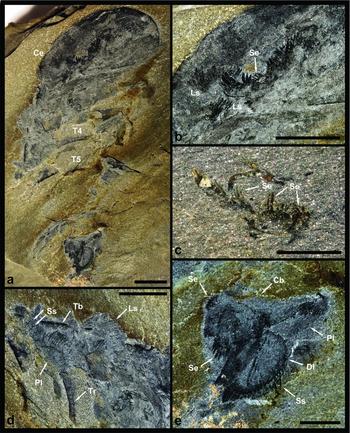
The studied material includes two specimens collected by Ced Conolly from the Cat's Hole Quarry exposure of the Llanfallteg Formation. The holotype OUMNH B. 4615 consists of part (Fig. 1a, b, d, e) and counterpart, collected on 26 August 2011 from an ash-rich siltstone situated c. 1.5 m above the scree slope on the northwest wall of the quarry. OUMNH B. 4615, representing the cephalic and anterior trunk region, is preserved by fine aggregates of framboidal pyrite with slight relief in dorsal aspect, with the appendages evident in areas where the dorsal exoskeleton has been removed. Part and counterpart of an isolated appendage assigned to this taxon, OUMNH B. 4623 (Fig. 1c), are preserved as a pyritic cast. Specimens were photographed using a Canon EOS 500D digital SLR camera fitted with an EF-S 60 mm f2.9 Macro Lens. Contrast between the specimen and matrix was enhanced using a polarizing filter. All materials referred to Etainia howellsorum gen. et sp. nov. are deposited in the Oxford University Museum of Natural History (Oxford, UK; OUMNH).
Etainia howellsorum gen. et sp. nov. from the Llanfallteg Formation, Darriwilian (Didymograptus artus Zone), Pembrokeshire, Wales. (a–e) All specimens photographed under polarized light. (a, b, d, e) Holotype (OUMNH B. 4615a), dorsoventrally compressed specimen preserved by fine aggregates of framboidal pyrite. (a) General view of entire specimen. (b) Cephalic appendages. (c) Paratype (OUMNH B. 4623), an isolated appendage (white arrows indicate podomere boundaries). (d) Anterior trunk appendage and tergites. (e) Disarticulated trunk appendage. Accompanying camera lucida drawings in Figure 2. Abbreviations: Cb – coxal bar; Ce – cephalon; Ls – lamellar setae; Pl – proximal exopod lobe; Se – spinose endites; Ss – spinose setae; T4, T5 – trunk tergites 4 and 5; Tb – lateral tergal boundary; Tr – transverse posterior tergal ridge. Scale bars represent (a, b, d) 5 mm and (c, e) 2 mm.

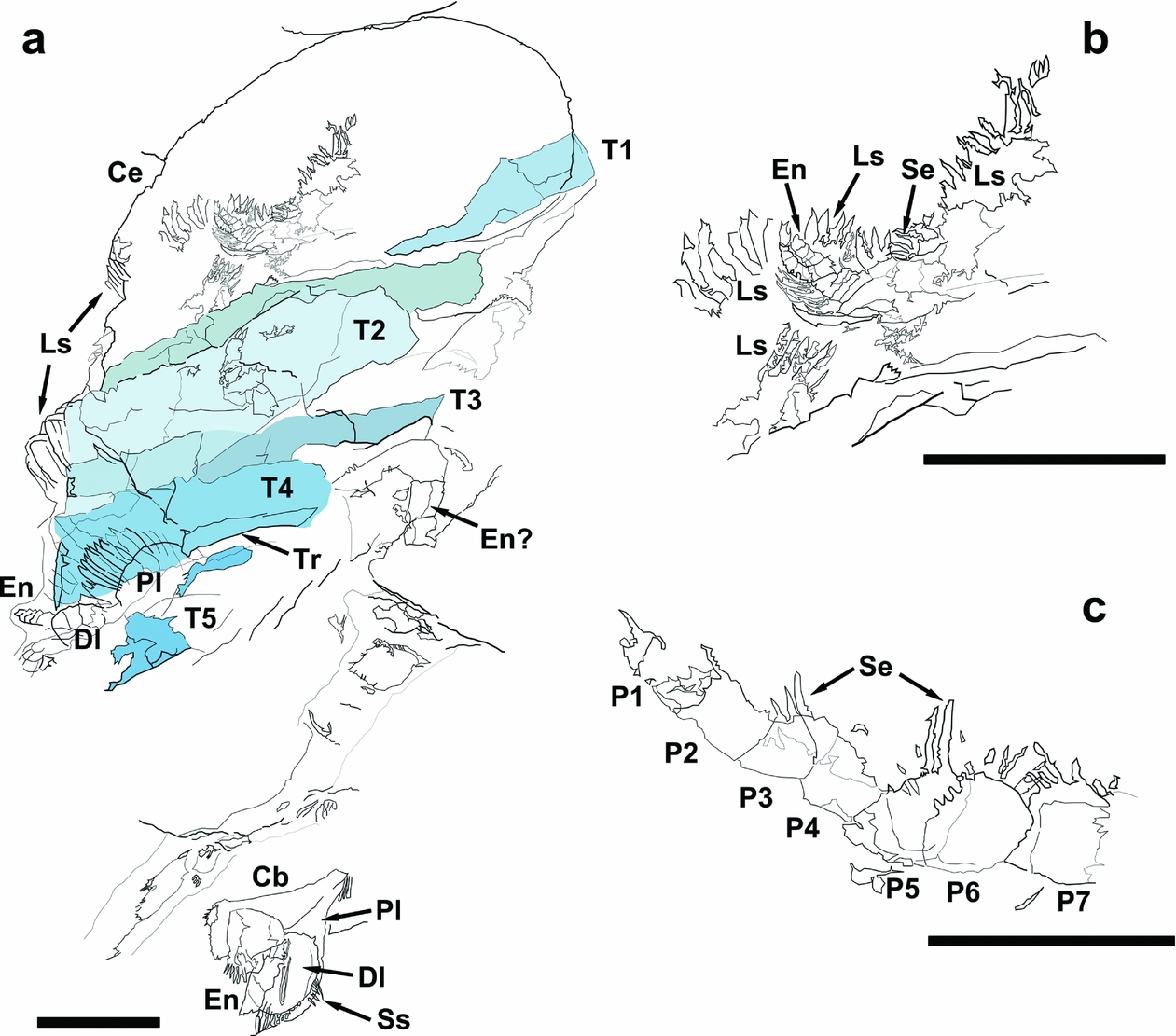
Camera lucida drawings of Etainia howellsorum gen. et sp. nov. from the Llanfallteg Formation, Darriwilian (Didymograptus artus Zone), Pembrokeshire, Wales. (a, b) Holotype (OUMNH B. 4615a). (b) Detailed view of cephalic appendages. (c) Paratype (OUMNH B. 4623), an isolated appendage. Additional abbreviations: En – endopod; P1–P7 – podomeres 1–7. Scale bars represent (a, b) 5 mm and (c) 2 mm (c).
4. Systematic palaeontology
Phylum ARTHROPODA Siebold, Reference Siebold, von and Stannius1848
Unnamed rank VICISSICAUDATA Ortega-Hernández, Legg & Braddy, Reference Ortega-Hernández, Legg and Braddy2013
Order “XENOPODA” Raymond, Reference Raymond1935
Genus Etainia gen. nov.
Type species. Etainia howellsorum sp. nov. (by monotypy).
Etymology. After Étaín, a mythical Celtic princess who was reborn after being transformed into a butterfly and ingested by the wife of Étar. This name refers both to the arthropod affinities of this taxon and the absence of unequivocally closely related forms in the middle Cambrian – Middle Ordovician fossil record.
Diagnosis. Arthropod characterized by the possession of a short (sagittally) semi-circular cephalon; transverse ridges on the posterior of the trunk tergites; appendages with clusters of elongate spinose endites; and bipartite exopods with rounded proximal lobes bearing broad lamellae and ovoid distal lobes bearing spines.
Remarks. The morphology of Etainia gen. nov., especially of its appendages with their robust spinose endites and large subovoid distal lobes of the exopods, indicates affinities with xenopod arthropods, particularly Emeraldella (Stein & Selden, Reference Stein and Selden2012), Sidneyia (Stein, Reference Stein2013) and possibly Sanctacaris (Briggs & Collins, Reference Briggs and Collins1988). The exact affinities of the xenopods are unclear although most phylogenetic analyses resolve them as part of an assemblage, formally named Vicissicaudata (Ortega-Hernández, Legg & Braddy, Reference Ortega-Hernández, Legg and Braddy2013), also including aglaspidids and cheloniellids (Edgecombe & Ramsköld, Reference Edgecombe and Ramsköld1999; Cotton & Braddy, Reference Cotton and Braddy2004; Paterson et al. Reference Paterson, Edgecombe, García-Bellido, Jago and Gehling2010; Edgecombe, García-Bellido & Paterson, Reference Edgecombe, García-Bellido and Paterson2011; Paterson, García-Bellido & Edgecombe, Reference Paterson, García-Bellido and Edgecombe2012; Legg et al. Reference Legg, Sutton, Edgecombe and Caron2012; Legg, Sutton & Edgecombe, Reference Legg, Sutton and Edgecombe2013; Ortega-Hernández, Legg & Braddy, Reference Ortega-Hernández, Legg and Braddy2013). In such instances xenopods often resolve as paraphyletic with regard to cheloniellids, with Emeraldella (Ortega-Hernández, Legg & Braddy, Reference Ortega-Hernández, Legg and Braddy2013) or an Emeraldella + Molaria clade (Legg, Sutton & Edgecombe, Reference Legg, Sutton and Edgecombe2013) as the immediate sister-taxon of Cheloniellida. Important characters in this regard pertain to the morphology of the abdominal region which is unfortunately not preserved in Etainia gen. nov., precluding further resolution of its phylogenetic position and familial assignment. The position of Sanctacaris is much more contentious (Legg, Reference Legg2014), based primarily on interpretations of its cephalic appendages (e.g. Budd, Reference Budd2002). A recent phylogenetic analysis has however resolved it within Vicissicaudata as sister-taxon to all other vicissicaudates (Legg, Sutton & Edgecombe, Reference Legg, Sutton and Edgecombe2013); similarities between Sanctacaris and Etainia gen. nov. therefore strengthen the assignment of Etainia gen. nov. to this clade.
Etainia howellsorum sp. nov.
Figure 1
Etymology. After William and Sid Howells for their support and devotion to the study of the geology of SW Wales.
Diagnosis. As for genus.
Description. The description refers to OUMNH B. 4615 (Fig. 1a, b, d, e), except where stated otherwise. The holotype is preserved in dorso-ventral aspect (Fig. 1a). The cephalon is semi-circular in outline, with a rounded anterior margin and a straight posterior margin (Fig. 1a). It is sagittally short in relation to the posterior margin of the cephalon. Many cephalic features, such as eyes and a cephalic doublure, are not preserved, and it is unclear if they were ever present. The full complement of cephalic appendages is not preserved and the number of cephalic appendage pairs is therefore unknown. Specialized anterior cephalic appendages, such as antennae or chelicerae, are not preserved. A single cephalic appendage can be distinguished (Fig. 1b). It is composed of at least six podomeres which appear to decrease in relative size distally. Elongate enditic spines are present on the most proximally preserved podomere. These spines are slightly recurved and spaced out along the medial margin of the podomere. A similar morphology is found in the paratype (OUMNH B. 4623), which demonstrates that endites were also present on more distal podomeres (Fig. 1c). Seven podomeres appear to be present, however the poor preservation of the distal podomeres makes their boundaries hard to distinguish. The proximal podomeres are more elongate and bulbous than the distal podomeres and bear elongate endites orientated perpendicular to the medial margin of the podomeres (Fig. 1c). More distal endites are arranged in clusters and apparently restricted to the distal medial margin of the podomeres. The endites also change orientation from perpendicular to almost parallel to the endopod medial margin.
The trunk region is poorly preserved, with only the anterior three tergites partially visible (Fig. 1a). Although the holotype shows little relief, the posterior margins of tergite 2 are slightly raised compared to the underlying (posterior) tergite 3, indicating there was a slight overlap. The lateral tergal margins are straight (Fig. 1d). The posterior margin of at least the third trunk tergite possesses a transverse ridge with a slight relief. In areas where the overlying tergites have been removed, appendages are preserved underneath and show a one-to-one correspondence with the tergites (Fig. 1a, d). The exopods bear a bulbous lobe fringed with thick imbricated lamellae (Fig. 1d). These are lamellar setae, which are also evident in the cephalic region (Fig. 1a, b). Marginal setae are preserved distally of the lamellar setae (Fig. 1d), indicating the exopod was at least bipartite. This is also evident from an appendage preserved more posteriorly on the holotype (Fig. 1a, e) which possesses an ovoid distal exopod lobe with elongate spinose setae evenly distributed along the margin. This distal lobe is attached to a poorly preserved proximal lobe, which in turn is attached to an elongate coxal bar (Fig. 1e). This coxal bar gives the entire coxa a lacrimiform appearance. The medial margin of the coxa bears short endites, giving an almost serrated appearance (Fig. 1e). A partial coxa may also be present elsewhere on the holotype (Fig. 1d).
Discussion. In overall appearance Etainia howellsorum gen. et sp. nov. most closely resembles the xenopods Emeraldella and Sidneyia, both from the middle Cambrian Burgess Shale Lagerstätte (Bruton, Reference Bruton1981; Bruton & Whittington, Reference Bruton and Whittington1983; Stein & Selden, Reference Stein and Selden2012; Stein, Reference Stein2013) and Utah (Briggs & Robison, Reference Briggs and Robison1984; Briggs et al. Reference Briggs, Lieberman, Hendricks, Halgedahl and Jarrard2008; Stein, Church & Robison, Reference Stein, Church and Robison2011). A second species referred to Sidneyia from the lower Cambrian succession of China (Zhang, Han & Shu, Reference Zhang, Han and Shu2002) is doubtfully assigned to this genus (Briggs et al. Reference Briggs, Lieberman, Hendricks, Halgedahl and Jarrard2008). Like Etainia gen. nov. these taxa possess elongate spinose endites on their endopods, as does Sanctacaris uncata, also recorded from the Burgess Shale Formation (Briggs & Collins, Reference Briggs and Collins1988) and to a lesser extent Retifacies abnormalis from the lower Cambrian Chengjiang Lagerstätte (Hou & Bergström, Reference Hou and Bergström1997). The more proximal endopod podomeres of Etainia gen. nov. possess delicate spines. On some podomeres these spines are straight and evenly spaced (Fig. 1c), comparable to the condition in Emeraldella (e.g. Stein & Selden, Reference Stein and Selden2012, fig. 4C). However, on the medial-distal margins of others they are more robust, slightly recurved and concentrated into clusters, more like the endites of Sidneyia (Stein, Reference Stein2013, fig. 7) and Sanctacaris (Briggs & Collins Reference Briggs and Collins1988, plate 71). Also like Sidneyia, Etainia gen. nov. possesses an elongate coxal bar (Fig. 1e).
The varied morphology of the trunk exopod setae of Etainia gen. nov., which possesses lamellar setae on the more proximal elements and spinose setae on the more distal elements, indicates at least a bipartite nature to its exopods. Bi- and tripartite exopods are common amongst artiopodans (Ortega-Hernández, Legg & Braddy, Reference Ortega-Hernández, Legg and Braddy2013, fig. 4), the clade constituting trilobites, trilobite-like taxa (trilobitomorphs), vicissicaudates (Legg et al. Reference Legg, Sutton, Edgecombe and Caron2012) and possibly also chelicerates (Hou & Bergström, Reference Hou and Bergström1997; Legg, Sutton & Edgecombe, Reference Legg, Sutton and Edgecombe2013). The rounded appearance of the proximal lobes and fan-like arrangement of broad lamellar setae in Etainia gen. nov. (Fig. 1d) is reminiscent of Retifacies (Hou & Bergström, Reference Hou and Bergström1997); however, the latter apparently lacks a bipartite exopod. A large ovoid distal exopod lobe is also seen in the aglaspidid-like arthropod Kwanyinaspis maotianshanenesis from the Chengjiang Lagerstätte; however, unlike Etainia gen. nov., the distal setae of Kwanyinaspis are fine and densely packed (Zhang & Shu, Reference Zhang and Shu2005, fig. 2B). The distal setae of Etainia gen. nov. are elongate, spinose and spaced-out along the margin of the distal exopod lobe (Fig. 1e) like those of Emeraldella (Stein & Selden, Reference Stein and Selden2012, fig. 8C), although the latter possesses a more-rhombic distal exopod lobe.
Although poorly preserved, the tergal boundaries of Etainia gen. nov. are delineated by the presence of a thickened transverse tergal ridge (Fig. 1a,d). The relative relief of this segment indicates that it transverses the posterior margin of the tergite. Similar processes are found in Habelia, in which they are typically thicker than the rest of the cuticle and ornamented with tubercles (Whittington, Reference Whittington1981), and in the cheloniellids, particularly Pseudoarthron and Cheloniellon although they appear to be lacking in more basal members of that group (Dunlop & Selden, Reference Dunlop, Selden, Fortey and Thomas1997).
The similarities between Etainia gen. nov., Emeraldella and Sidneyia are indicative of xenopod affinities for Etainia gen. nov.; however, this taxon also displays autapomorphies such as ovoid distal exopod lobes and posterior transverse tergal ridges, confirming its status as a separate taxon.
5. Discussion
The occurrence of Etainia howellsorum gen. et sp. nov. in a middle Darriwilian (Middle Ordovician) deposit extends the temporal range of xenopods by c. 40 Ma, the former youngest unequivocal record being Emeraldella brutoni from the Wheeler Formation of Utah (Stein, Church & Robison, Reference Stein, Church and Robison2011). Such a find demonstrates the significance of taphonomic biases for understanding major biotic events such as the Great Ordovician Biodiversification Event (GOBE). During the GOBE, a period in Earth's Early–Middle Ordovician history, we see an unparalleled increase in biodiversity with a doubling of ordinal diversity, familial diversity increasing threefold and a fourfold increase in generic diversity (Webby et al. Reference Webby, Paris, Droser and Percival2004). During this time the so-called ‘Cambrian fauna’ (sensu Sepkoski, Reference Sepkoski1981), which included many of the aberrant arthropod groups typical of Cambrian Burgess Shale-type Lagerstätten such as xenopods, was replaced by the ‘Palaeozoic fauna’ which dominated until the end-Permian mass extinction (c. 252 Ma). A paucity of upper Cambrian – Ordovician Konservat-Lagerstätten meant that, until recently, most of our knowledge regarding this event was based almost exclusively on the remains of ‘skeletal taxa’ such as trilobites and brachiopods. Ordovician Lagerstätten were typically environmentally restricted and/or of limited diversity (Aldridge, Gabbott & Theron, Reference Aldridge, Gabbott, Theron, Briggs and Crowther2001; Liu et al. Reference Liu, McKay, Young, Witzke, McVey and Liu2006; Young et al. Reference Young, Rudkin, Dobrzanski, Robson and Nowlan2007; Farrell et al. Reference Farrell, Martin, Hagadorn, Whiteley and Briggs2009), a notable exception being the Lower Ordovician (Tremadocian) Fezouata Formation of Morocco (Van Roy et al. Reference Van Roy, Orr, Botting, Muir, Vinther, Lefevbre, Hariri and Briggs2010).
The dearth of Ordovician fossil sites exhibiting exceptional preservation has been linked to increasing bioturbation (Allison & Briggs, Reference Allison and Briggs1993), although others have argued that factors such as benthic anoxia play a more important role in soft-tissue preservation (Gaines et al. Reference Gaines, Droser, Orr, Garson, Hammarlund, Qi and Canfield2012). Ordovician sites possessing Burgess Shale-type taxa possess limited evidence of bioturbation (Van Roy et al. Reference Van Roy, Orr, Botting, Muir, Vinther, Lefevbre, Hariri and Briggs2010). This is also true of fossiliferous layers within the Llanfallteg Formation, which typically possesses a restricted ichnofauna characteristic of a dysoxic environment (Orr, Benton & Briggs, Reference Orr, Benton and Briggs2003). Although a lack of bioturbation may be linked to the presence of a particular taphonomic window, that is, Burgess Shale-type preservation, it does not account for the apparent faunal turnover (from a Cambrian-type fauna to a Palaeozoic-type fauna) which can be observed during the Ordovician. Within the Llanfallteg Formation, Cambrian-type organisms such as Etainia howellsorum gen. et sp. nov. are preserved within darker, siltier sediments bearing fine-grained volcaniclastic materials. Other taxa associated with the Cambrian-type organisms are typically benthic and include articulated atheloptic trilobites, lingulid brachiopods, conulariids and palaeoscolecids. Conversely, the pelagic and/or nektonic elements are preserved in coarser-grained volcaniclastic sediments and show greater levels of fragmentation. These taxa are more typical of a Palaeozoic-type fauna, dominated by graptolites and ceratiocaridids. Rarer elements include bivalves and echinoderm fragments. The Cambrian-type organisms and associated fauna are thought to be autochthonous as they are typically deep-water taxa, articulated and not normally enrolled. This benthic fauna is dominated by arthropods and seems to document an ecosystem with a Cambrian-like structure, lacking the suspension-feeding organisms that dominate the later Palaeozoic benthic environments. The deep-water benthic community was smothered when volcaniclastic sediments were washed into the basin as density currents, bringing with them shallow water and pelagic taxa. This explains the apparent disparity in the preservation between the benthic and pelagic/nektonic taxa. The apparent persistence of a non-mineralizing Cambrian-type taxon in a deep basinal environment may support the offshore migration hypothesis of Jablonski et al. (Reference Jablonski, Sepkoski, Bottjer and Sheehan1983); more ancient taxa were possibly forced into increasingly restricted environments, perhaps due to competition from Palaeozoic-type taxa which were diversifying in shallow-water environments. It appears that Etainia gen. et sp. nov. coexisted with Middle Ordovician taxa in an arthropod-dominated community more typical of the Cambrian evolutionary fauna, with very few suspension-feeding organisms.
6. Conclusions
The Great Ordovician Biodiversification Event (GOBE) is a poorly understood but influential period in Earth's history. The discovery of Etainia howellsorum gen. et sp. nov., a Burgess Shale-type taxon and a taphonomic pathway suitable for its preservation in the Middle Ordovician succession, are helping to close the gap on this interval and provide a much clearer idea of ecological change during this time. The preservational disparity among organisms in the Llanfallteg Formation seemingly separates an autochthonous arthropod-dominated more Cambrian-structured benthic ecosystem, including Burgess Shale-type taxa such as Etainia gen. et sp. nov., from an allochthonous shallow-water fauna of more typical Middle Ordovician structure. This may reflect a forced migration of the Cambrian-like ecosystem into more restricted environments, perhaps due to competition from their shallow-water counterparts.
Acknowledgements
We would like to thank Ced Conolly for bringing this material to our attention and for providing assistance and accommodation during fieldwork at the studied site. We would also like to thank Joe Botting, Lucy Muir and Martin Brasier for their assistance in the field and Allison Daley for help with photography.