Introduction
Adolescent cannabis use, and regular or heavy use in particular, has been implicated as a risk factor for a range of psychiatric symptoms. In young cannabis users, increased rates of externalizing and internalizing problems have been reported, including delinquent behaviour, conduct disorder and attention problems (Fergusson et al. Reference Fergusson, Horwood and Swain-Campbell2002), psychotic symptoms (Arseneault et al. Reference Arseneault, Cannon, Poulton, Murray, Caspi and Moffitt2002) and anxiety and depressive symptoms (Degenhardt et al. Reference Degenhardt, Hall and Lynskey2003). In those who started to use cannabis before the age of 16 years, an elevated rate of symptoms has been reported: psychotic symptoms (Arseneault et al. Reference Arseneault, Cannon, Poulton, Murray, Caspi and Moffitt2002; McGrath et al. Reference McGrath, Welham, Scott, Varghese, Degenhardt, Hayatbakhsh, Alati, Williams, Bor and Najman2010; Schubart et al. Reference Schubart, van Gastel, Breetvelt, Beetz, Ophoff, Sommer, Kahn and Boks2010), adjustment problems including depression, crime and suicidal behaviour (Fergusson et al. Reference Fergusson, Horwood and Swain-Campbell2002), anxiety (Hayatbakhsh et al. Reference Hayatbakhsh, Najman, Jamrozik, Mamun, Alati and Bor2007), externalizing behaviour (Hayatbakhsh et al. Reference Hayatbakhsh, McGee, Bor, Najman, Jamrozik and Mamun2008), and, in the cognitive domain, attentional dysfunction (Ehrenreich et al. Reference Ehrenreich, Rinn, Kunert, Moeller, Poser, Schilling, Gigerenzer and Hoehe1999), poor educational achievement (Horwood et al. Reference Horwood, Fergusson, Hayatbakhsh, Najman, Coffey, Patton, Silins and Hutchinson2010) and poor executive functioning (Fontes et al. Reference Fontes, Bolla, Cunha, Almeida, Jungerman, Laranjeira, Bressan and Lacerda2011). The risk increases with higher frequency and longer duration of use for psychosis (Arseneault et al. Reference Arseneault, Cannon, Poulton, Murray, Caspi and Moffitt2002; Monshouwer et al. Reference Monshouwer, van Dorsselaer, Verdurmen, ter Bogt, de Graaf and Vollebergh2006; Schubart et al. Reference Schubart, van Gastel, Breetvelt, Beetz, Ophoff, Sommer, Kahn and Boks2010; van Gastel et al. Reference van Gastel, Wigman, Monshouwer, Kahn, van Os, Boks and Vollebergh2012), depression and anxiety (Fergusson et al. Reference Fergusson, Horwood and Swain-Campbell2002; Patton et al. Reference Patton, Coffey, Carlin, Degenhardt, Lynskey and Hall2002; Degenhardt et al. Reference Degenhardt, Hall and Lynskey2003; Hayatbakhsh et al. Reference Hayatbakhsh, McGee, Bor, Najman, Jamrozik and Mamun2008) and adjustment problems (Fergusson et al. Reference Fergusson, Horwood and Swain-Campbell2002). In particular, the combination of heavy use and young age at onset is associated with a high risk for psychiatric disorders (Schubart et al. Reference Schubart, van Gastel, Breetvelt, Beetz, Ophoff, Sommer, Kahn and Boks2010; Rubino et al. Reference Rubino, Zamberletti and Parolaro2011).
Although cannabis use has been related to a diverse range of psychiatric symptoms, the relationship between cannabis use and general psychosocial function is unclear. Focusing on psychosocial functioning allows for comprehensive screening and facilitates early detection of symptoms. In a previous study, Hollis et al. (Reference Hollis, Groom, Das, Calton, Bates, Andrews, Jackson and Liddle2008) investigated the relationship between cannabis use and a composite measure of psychosocial functioning. They found an association between cannabis use and mental health problems but it was limited to adolescents at genetic high risk for schizophrenia; such an association was not found in adolescents with attention deficit/hyperactivity disorder (ADHD) and healthy controls. As the focus of public mental health strategies lies in the general population, knowing the relationship between cannabis use and poor psychosocial functioning in the general population is important. In this study, we set out to investigate whether cannabis use in secondary school children is associated with poor psychosocial functioning, in isolation and in combination with an extensive set of other risk factors. In addition, we investigated the association between cannabis use itself and other known determinants of psychosocial functioning.
Method
Participants
The current sample was obtained in the 2007 wave of a regular survey at secondary schools by the Dutch Public Health Service of the greater Utrecht area (GGD Midden Nederland). The survey took place in 71% of all secondary schools in the region, excluding those in the inner city (the city of Utrecht). Reasons for schools not participating were: a full agenda, recent change in management or other ongoing research. All students were asked to complete the digital questionnaire anonymously in the classroom. Of all students in the participating schools, 84% completed the questionnaire. Data were collected on psychosocial functioning, lifestyle and social environment, including perceived school safety, using a computer-based assessment in class. A designated member of staff ensured good research-related communication with parents and students. Students were provided contact information of the Public Health Service. When completing the questionnaire, students could fill in their name and contact information in case they wanted to talk to someone following the survey. A nurse from the Community Health Service contacted these adolescents. Schools in both rural and urban areas were included; about 34% of the study population live in an urban area. Of the total sample, participants outside the age range of 11–16 years were excluded, resulting in a sample of 10 324 adolescents.
Measurements
Psychosocial functioning
Psychosocial functioning was measured by self-report, using the Strengths and Difficulties Questionnaire (SDQ; Goodman et al. Reference Goodman, Meltzer and Bailey1998). The SDQ was developed for adolescents aged 11–16 years and was found to correctly predict psychiatric diagnoses in 81–91% of cases (Goodman et al. Reference Goodman, Renfrew and Mullick2000). The SDQ measures psychosocial adjustment of children and adolescents and assesses the most important domains of child psychopathology, namely emotional problems, conduct problems, hyperactivity and peer problems. Apart from weaknesses, the SDQ also measures strengths, in the form of pro-social behaviour.
The Dutch translation of the self-reported SDQ has been validated (Muris et al. Reference Muris, Meesters and van den Berg2003; Widenfelt et al. Reference Widenfelt, Goedhart, Treffers and Goodman2003). The internal consistency of the total difficulties score was found to be reasonable. The SDQ consists of 25 items on psychological attributes, scoring on a three-point Likert scale (not true/somewhat true/certainly true). The SDQ total difficulties score can be divided into normal (0–15), borderline (16–19) and clinical scores (20–40) (Goodman et al. Reference Goodman, Meltzer and Bailey1998). To identify those with clinically relevant symptoms, the outcome was dichotomized into normal to borderline (−1) and clinical (1).
To further explore the data, the association of cannabis use with the subscales of emotional problems, hyperactivity problems and pro-social behaviour was assessed. These subscales were found to have reasonable internal consistency, unlike the conduct and peer relationship problems scales, which were found to have an internal consistency below acceptable limits (Muris et al. Reference Muris, Meesters and van den Berg2003; Widenfelt et al. Reference Widenfelt, Goedhart, Treffers and Goodman2003). These scores were recoded into normal to borderline (−1) and clinical (1).
Use of cannabis and other substances
Cannabis use was assessed by asking ‘How many times did you use cannabis during the past four weeks?’ (never/monthly/at least weekly/more than five times weekly). The answers were recoded into −1 (no use during the past month) and 1 (used once or more). Smoking cigarettes (classified in the same way as cannabis use) was recoded to current smoking; of the smokers, 60.6% smoked at least weekly. Alcohol use (never/monthly/at least weekly/daily) was recoded to at least once a month. Use of hard drugs was coded as ever use of any illicit drug other than tobacco, alcohol or cannabis.
Sociodemographic factors
Several sociodemographic measures were included: age (in years), gender, ethnicity (Dutch, Dutch Antillean, Turkish, Moroccan or other non-native: dichotomized into native or non-native, when one or more parents were born abroad), level of education (preparatory vocational versus preparatory polytechnic/scientific) and household composition (living with both biological parents versus one or none of them). A mentally ill parent was included as a (crude) proxy for genetic predisposition for mental health complaints (Mattejat & Remschmidt, Reference Mattejat and Remschmidt2008).
School variables
Truancy was coded as never or rarely versus more than 3 h during the past 4 weeks. The student's evaluation of school was measured by the question ‘How do you like school?’ and recoded into ‘not at all/not much’ versus ‘quite/a lot’. Feeling safe in school was measured by ‘Do you ever feel unsafe in school?’, with answers dichotomized into never versus sometimes/often. School victimization was coded ever/never. Absence due to illness was considered regular when a subject missed out on more than 5 schooldays during the past 4 weeks.
Stressful life events
Subjects were asked after lifetime experience of the following: a deceased beloved one, separation of parents, domestic violence (between parents or victimizing the adolescent), molestation by someone other than a parent, sexual abuse, financial problems (of parents or of the adolescent) or any other stressful event. Items were considered a risk factor when they were endorsed to be a nuisance.
Data analysis
All analyses were carried out with SPSS version 20.0 (SPSS Inc., USA). There were 116 missing values for level of education, one for perceived school unsafety and one for victimization; listwise exclusion was applied. First, differences in characteristics between those with a normal or borderline SDQ score (0–20) and those with a clinically relevant score (>20) were assessed by Mann–Whitney U rank sum tests. Second, multicollinearity was investigated by means of bivariate non-parametric correlations (Kendall's τ < 0.8; Stevens, Reference Stevens2002). Third, logistic regression analyses [yielding odds ratios (OR) with 95% confidence intervals (CIs)] were carried out, with the clinical SDQ score as the dependent variable. This was performed univariately, with only cannabis use as a predictor, and repeated in a full model including potential confounders. These were included if significant at p < 0.05 or if they changed the predictive value (OR) of cannabis use by 10% or more (Greenland, Reference Greenland1989; Chaves et al. Reference Chaves, Gargiullo, Zhang, Civen, Guris, Mascola and Seward2007). In addition, interactions of cannabis use with confounders were determined. Post-hoc analyses were performed to specify the association with substance use, by means of dummy variables of smoking, alcohol and cannabis use (never/less than weekly/at least weekly/more than five times weekly or daily). Post-hoc analyses were also performed on the subscales of emotional problems, hyperactivity and pro-social behaviour.
Finally, a logistic regression analysis with cannabis use as an outcome measure and clinical SDQ score as a predictor was performed, selecting predictors based on univariate regressions (threshold of p < 0.05 or a change in OR of at least 10%) and combining them into a full model. Post-hoc analyses were performed for frequency of smoking and alcohol use and for ethnicity.
Results
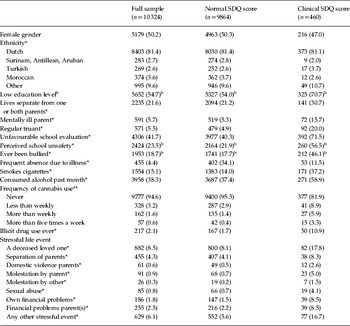
The sample consisted of 5179 girls (50.2%) and 5145 boys (49.8%). The average age was 13.9 years (s.d. = 1.3 years). The characteristics of the sample are presented in Table 1, divided into those with a normal/borderline SDQ total score versus those with a clinically relevant score (Supplementary Table S1 provides this information excluding hard-drug users). Gender, age and ethnicity did not differ significantly between groups, in contrast to all of the other risk factors. Of subjects with a normal or borderline SDQ total score, 4.7% used cannabis during the past month, as opposed to 18.1% in the group with a clinical SDQ score.
Characteristics of the full sample and split for clinically relevant SDQ score (normal or borderline score: 0–19, clinically relevant score: 20–40)

SDQ, Strengths and Difficulties Questionnaire.
Values given as n (% of total).
a For comparison, two groups were created, with native versus non-native for ethnicity and with at least monthly use as cut-off for cannabis use.
b Missing values: 116 for level of education, 1 for perceived school unsafety and 1 for ever been bullied.
* Significant difference between the two groups at p > 0.001, applying a two-tailed Mann–Whitney U rank sum test.
Multicollinearity was improbable because Kendall's τ was below 0.8 for all intercorrelations. Based on univariate analyses, gender, age and ethnicity were not associated with a clinical SDQ score. Cannabis use was not associated with perceived school unsafety and being victimized univariately.
Risk factors for poor psychosocial functioning
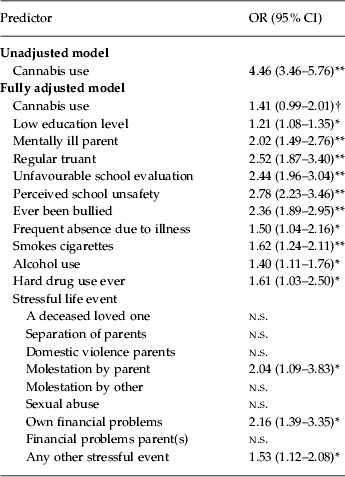
The ORs for a clinical SDQ score are shown in Table 2 (Supplementary Table S2 shows the results for the analysis excluding hard-drug users). The unadjusted OR for a clinical SDQ score in cannabis users (versus never users) was 4.46 (95% CI 3.46–5.76, p < 0.001). After adjusting for the full set of risk factors, the OR was reduced to 1.41 (95% CI 0.99–2.01) and was no longer significant (p = 0.058). Other significant predictors of the SDQ were smoking, alcohol use, hard drug use, a low education level, frequent truancy, an unfavourable school evaluation by the student, perceived school unsafety, having been bullied, frequent absence due to illness, a mentally ill parent, molestation by a parent, financial problems and any other stressful event. Cannabis use in the past month interacted significantly with hard drug use and with a mentally ill parent (both at p < 0.05), indicating that adolescents who use both cannabis and hard drugs and those who have a mentally ill parent and use cannabis are at increased risk for a clinical SDQ score. The full model explained 21.8% of a clinical SDQ total score (Nagelkerke R 2). Post-hoc regression analyses applying dummy variables of substance use showed no significant differences in frequency of cigarette smoking and cannabis use, although we had limited power to detect such differences. For alcohol use, a dose–response effect was found, with an OR ranging from 1.34 for monthly use (95% CI 1.03–1.72, p < 0.05) to 3.26 for alcohol use of more than five times a week (95% CI 1.84–5.87, p < 0.001). Post-hoc analyses on the SDQ subscales of emotional problems, hyperactivity and pro-social functioning revealed no significant predictive value of cannabis use.
Association between cannabis use in the past month and a clinical SDQ score

SDQ, Strengths and Difficulties Questionnaire; OR, odds ratio; CI, confidence interval; n.s., non-significant;
† non-significant, but with trend (p = 0.058).
* Significant at p < 0.05. ** Significant at p < 0.001.
Risk factors for cannabis use
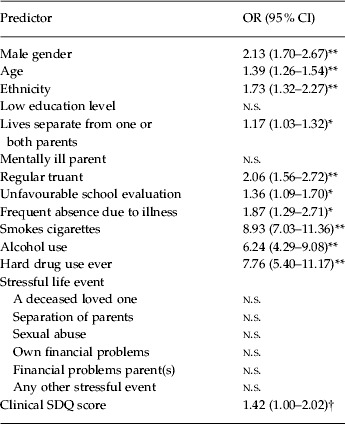
Participants who smoked cigarettes had the highest OR for cannabis use in the past month: 8.93 (95% CI 7.03–11.36, p < 0.000; Table 3 and Supplementary Table S3) Alcohol use, cigarette smoking, hard drug use, frequent truancy, an unfavourable school evaluation by the student and frequent school absence due to illness were also associated with cannabis use (and also with a clinical SDQ score). Furthermore, male gender, being older, non-native ethnicity and living separated from one or both parents were independent risk factors for cannabis use in the past month. A clinical SDQ score predicted cannabis use at a borderline significant level (p = 0.051). In total, 46.3% of cannabis use was explained by these risk factors (Nagelkerke R 2). Post-hoc regression analyses of the quantity of substance use showed a dose–response effect for smoking and also for alcohol consumption on cannabis use. Corrected ORs for using cannabis increased from 4.86 (95% CI 3.26–7.24) for monthly alcohol consumption to 18.02 (95% CI 10.27–31.62, all significant at p < 0.000) for consumption more than five times a week (reference group: no alcohol use in the past month). Corrected ORs for cannabis use increased with frequency of smoking in a similar manner: from 3.57 (95% CI 2.47–5.17) for monthly, to 9.21 (95% CI 7.02–12.08) for daily smoking (all significant at p < 0.000; reference group no smoking during the past month). Post-hoc analyses for ethnicity showed that adolescents with one or more parents born in the Netherlands Antilles had an OR of 1.81 (95% CI 1.01–3.26, p < 0.05) for cannabis use in the past month. Adolescents with parents from a non-native ethnicity other than Dutch Antillean, Turkish or Moroccan had an OR of 1.95 (95% CI 1.42–2.68, p < 0.001) for cannabis use in the past month.
Risk factors for cannabis use in the past month

SDQ, Strengths and Difficulties Questionnaire; OR, odds ratio; CI, confidence interval; n.s., non-significant;
† borderline significant (p = 0.051).
* Significant at p < 0.05. ** Significant at p < 0.001.
Discussion
In this large population-based study in secondary school adolescents, we investigated the relationship between cannabis use and psychosocial functioning. Cannabis use in the past month was significantly associated with poor psychosocial functioning univariately, but significance dropped to trend level after adjusting for confounding by other risk factors. We also found that six risk factors were associated with an increased risk of poor psychosocial functioning and of cannabis use before the age of 16.
This study adds to our knowledge of the association between cannabis use and mental health in adolescence. It shows that cannabis use is associated with a broad measure of psychosocial functioning in a general population sample. Earlier studies were directed to specific symptom dimensions (e.g. Hayatbakhsh et al. Reference Hayatbakhsh, Najman, Jamrozik, Mamun, Alati and Bor2007; Galera et al. Reference Galera, Bouvard, Melchior, Chastang, Lagarde, Michel, Encrenaz, Messiah and Fombonne2010; Schubart et al. Reference Schubart, van Gastel, Breetvelt, Beetz, Ophoff, Sommer, Kahn and Boks2010; van Gastel et al. Reference van Gastel, Wigman, Monshouwer, Kahn, van Os, Boks and Vollebergh2012) or found that the association was limited to adolescents at high genetic risk for schizophrenia (Hollis et al. Reference Hollis, Groom, Das, Calton, Bates, Andrews, Jackson and Liddle2008).
Our results indicate that the relationship with poor psychosocial functioning is due, at least partly, to confounding by factors such as use of other substances, truancy and frequent school absence due to illness, and argue against a direct causal relationship between cannabis use and poor psychosocial functioning. In addition, we found no evidence of a dose–response relationship, which would support a causative effect of cannabis use on poor psychosocial functioning. Our data are consistent with the reverse, whereby poor psychosocial functioning leads to cannabis use, considering that a clinical SDQ score was predictive of cannabis use in a fully adjusted model. However, this association was only borderline significant and residual confounding is likely to play a role. Thus, our results suggest that the relationship between moderate cannabis use and psychosocial functioning in adolescence is best explained by confounding, as was proposed previously by MacLeod et al. (Reference MacLeod, Oakes, Copello, Crome, Egger, Hickman, Oppenkowski, Stokes-Lampard and Davey2004) .
Regardless of the nature of the association, cannabis use can be viewed as a marker for adolescents at risk for mental health problems. If the relationship is indeed due to confounding, intervention strategies aimed at diminishing cannabis use would be to little avail. Public mental health strategies could instead implement these findings by including cannabis use as an indicator of risk. It could serve in a screening profile for adolescents at risk for mental health problems. In particular, the interaction effects between cannabis use and both hard drug use and a mentally ill parent could be valuable for this purpose. Future research should aim at defining such a risk profile, while assessing the sensitivity and specificity of the profile as a whole. Other factors that might serve this purpose are the risk indicators that we associated with both poor psychosocial functioning and cannabis use: cigarette smoking, alcohol consumption, frequent truancy, frequent school absence due to illness and an unfavourable school evaluation by the student. Characteristics that have been previously linked to both cannabis use and psychosocial functioning, but that were not included in the present study, may also be useful. These include low self-esteem, negative mood, peer group substance use, a positive attitude towards substance use and delinquency (von Sydow et al. Reference von Sydow, Lieb, Pfister, Hofler and Wittchen2002; Husler et al. Reference Husler, Plancherel and Werlen2005). It is stressed that, unlike general psychosocial functioning, the relationship between cannabis use and specific symptom dimensions might well be due to more than confounding: longitudinal studies indicate a causal relationship with psychotic symptoms in particular (Arseneault et al. Reference Arseneault, Cannon, Poulton, Murray, Caspi and Moffitt2002; Zammit et al. Reference Zammit, Allebeck, Andreasson, Lundberg and Lewis2002; Henquet et al. Reference Henquet, Murray, Linszen and van Os2005; Moore et al. Reference Moore, Zammit, Lingford-Hughes, Barnes, Jones, Burke and Lewis2007; Kuepper et al. Reference Kuepper, van Os, Lieb, Wittchen, Hofler and Henquet2011).
The most important limitation of this study is its cross-sectional nature. However, the results are in line with longitudinal studies defining risk factors for mental health problems (Hollis et al. Reference Hollis, Groom, Das, Calton, Bates, Andrews, Jackson and Liddle2008; Emerson et al. Reference Emerson, McCulloch, Graham, Blacher, Llwellyn and Hatton2010) and for predictors of cannabis use (Korhonen et al. Reference Korhonen, Levalahti, Dick, Pulkkinen, Rose, Kaprio and Huizink2010). The data were gathered by self-report, possibly leading to either over- or under-reporting of undesirable or sensitive information, such as on cannabis use, financial problems and stressful life events. However, by administering the questionnaires in school classes and by ensuring anonymity, validity and reliability are assumed to improve (Smit et al. Reference Smit, de Zwart, Spruit, Monshouwer and Ameijden2002). Regarding cannabis use, studies comparing psychometric and biometric measures (such as urine and hair tests) show good reliability of self-report measures (Ledgerwood et al. Reference Ledgerwood, Goldberger, Risk, Lewis and Price2008; Zaldivar et al. Reference Zaldivar, Garcia Montes, Flores, Sanchez, Lopez and Molina2009). Nevertheless, the applied measure of cannabis use was rather crude and age at onset of use was not assessed. However, given the age range of our sample, all cannabis users in our study had a young age at first use. The small age range does not allow for effective statistical analysis. At class level, a selection bias could have occurred, missing out truants and those who often miss school due to illness. As truancy is positively associated with substance use and mental health problems, this bias is more likely to have led to an underestimation of the effect. Finally, specific information on socio-economic status and urbanicity was not collected.
Despite its limitations, we consider that the present study is important because it demonstrates the relevance of cannabis use as a risk factor for poor psychosocial functioning in secondary school children. Although we show that confounding partly, if not entirely, explains this relationship, cannabis use is associated with many known risk factors and therefore can be viewed as an indicator of risk for mental health problems at this vulnerable age.
Supplementary material
For supplementary material accompanying this paper visit http://dx.doi.org/10.1017/S0033291712002723.
Acknowledgements
We are grateful to the participating schools and the Public Health Service of the Greater Utrecht area (GGD Midden Nederland) for facilitating data collection. This work was supported by a grant (ZonMW TOP grant no. 91207039) from the Netherlands Organization for Scientific Research (NWO).
Declaration of Interest
None.