Introduction
Chlamydiaceae are Gram-negative obligate intracellular bacteria with a wide host range. Birds are the natural host of Chlamydia (C.) psittaci, which is found extensively in poultry, pet birds, feral pigeons and free-living birds. In addition, C. psittaci also occurs in mammals, for instance pigs and cattle (Eggemann et al., Reference EGGEMANN, WENDT, HOELZLE, JAGER, WEISS and FAILING2000; Vanrompay et al., Reference VANROMPAY, GEENS, DESPLANQUES, HOANG, DE VOS, VAN LOOCK, HUYCK, MIRRY and COX2004; Reinhold et al., Reference REINHOLD, SACHSE and KALTENBOECK2011). Herein, a significant relationship was found between C. psittaci infections in pigs and keeping poultry on pig farms (Eggemann et al., Reference EGGEMANN, WENDT, HOELZLE, JAGER, WEISS and FAILING2000; Vanrompay et al., Reference VANROMPAY, GEENS, DESPLANQUES, HOANG, DE VOS, VAN LOOCK, HUYCK, MIRRY and COX2004). The type strain for C. psittaci is 6BC (ATCC VR 125). In poultry, Chlamydia infections cause important economical losses and are a danger to public health. In fact, C. psittaci is the most important animal chlamydiosis with respect to zoonotic transfer. Transmission to humans occurs by inhalation or direct contact and may cause psittacosis or parrot fever.
China's poultry production and its share on the global market have increased significantly during the last decades. Epidemiological data, prophylactic and therapeutic measures taken as compared to Western practices, and zoonotic transfer of poultry diseases within China are thus of international importance. Chinese surveillance studies of C. psittaci in poultry and case reports on zoonotic transfer are often published only locally in Chinese scientific journals. Therefore, we consider both English and Chinese scientific literature. As several Chinese scientific reports lack an adequate description of applied diagnostic methods, only scientifically documented data and practices are provided here.
Epidemiology of C. psittaci in Chinese poultry
The first case of chlamydiosis in Chinese poultry dates back to 1959. Few outbreaks were reported up to the 1980s. Increased outbreaks in Chinese poultry during the 1980s and 1990s coincided with outbreaks in U.S. turkeys during the 1980s and in European turkeys during the 1990s. This could in part be attributed to higher awareness of the economical and zoonotical impact of chlamydiosis on the fast growing Chinese poultry industry, resulting in increased surveillance. But in general, it was believed that these observed increased incidence rates were real (Zhou and Qiu, Reference ZHOU and QIU2007). Reports on C. psittaci infections in Chinese poultry were frequently published, ever since. Interestingly, the prevalence of C. psittaci infections was directly related to the distribution of poultry species density within China.
Seroprevalence
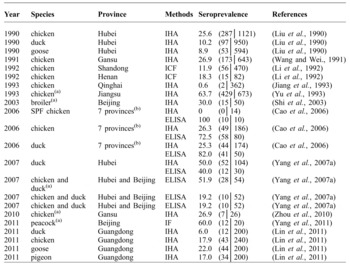
So far, sero-surveillance of avian chlamydiosis by Chinese scientists occurred primarily by indirect haemagglutination assays (IHA). In 2011, for instance, IHA was still used in avian livestock sampled in Guangdong. Seroprevalence was 6% (12/ 200) in domestic ducks obtained from a live market, 17.9% (43/240) in four commercial chicken flocks, 22% (44/200) in geese, and 17% (34/200) in meat-type pigeons obtained from seven commercial flocks (Lin et al., Reference LIN, WANG, YAN, HE, CHENG, WANG, XU, YUAN, ZHANG and ZHU2011). Prevalence data of chlamydial antibodies obtained by IHA in chickens, ducks and geese are available for, respectively, 13, 10 and 2 of China's 32 provinces, autonomous regions and municipals (Table 1).
We must keep in mind that none of the current available serological assays is C. psittaci specific, as they all detect Chlamydiaceae family-specific antibodies. Moreover, species other than C. psittaci might occur in birds. Recently, atypical Chlamydia were found in Chinese chickens (Beeckman and Vanrompay, Reference BEECKMAN and VANROMPAY2010). The above should be taken into account for the interpretation of the sero-prevalence data.
Seroprevalence (%) of chlamydial antibodies in Chinese poultry.

(a)flocks with clinical symptoms consistent with Chlamydia psittaci
(b)Beijing, Hubei, Tianjin, Inner Mongolia, Shangdon, Shanxi and Henan
SPF: specific pathogen free; IHA: indirect haemagglutination assay;
ICF: indirect complement fixation test; ELISA: enzyme linked immunosorbent assay;
IF: immunofluorescence test
C. psittaci culture and direct antigen detection
The obligate intracellular nature of Chlamydiaceae necessitates transportation in an appropriate medium to maintain viability for subsequent culture in yolk sacs of SPF chicken embryos or cell lines. In addition, culture requires a biosafety level three facility, which limits the number of laboratories authorised for diagnosis by isolation (Beeckman and Vanrompay, Reference BEECKMAN and VANROMPAY2010). Only few reports mention diagnosis of C. psittaci by culture or direct antigen detection in China.
Shi et al. (Reference SHI, HE, ZHU and DUAN2003) described symptoms of anorexia, rhinitis, conjunctivitis and respiratory distress in broiler farms in Beijing and Tianjin (Shi et al., Reference SHI, HE, ZHU and DUAN2003). Together with E. coli, C. psittaci was regarded as the etiological agent. They isolated C. psittaci from lung tissue using yolk sac inoculation of seven day-old SPF chicken embryos. Using a direct IF test, the chlamydial antigen was detected in 12 of 20 pharyngeal swabs and four out of five lung samples of peacocks suffering from respiratory distress. Inoculation of those 16 positive samples in McCoy cells resulted in 16 chlamydial isolates (Yang et al., Reference YANG, LING, YUAN, PANG and HE2011). In ducks and chickens with tubal cysts, low egg production and pneumonia, modified Ziehl-Neelsen staining showed a positive result in 18.5% of tested samples, whereas an IF test detecting chlamydial lipopolysaccharide (LPS) (IMAGEN, Chlamydia, Dako Cytomation, UK), revealed a positive rate of 38.2% in these samples (Cao et al., Reference CAO, YANG, YANG, LIU and HE2006). This finding is in accordance to earlier data demonstrating a higher sensitivity and specificity for IF assays compared to cytological staining (Vanrompay et al., Reference VANROMPAY, DUCATELLE and HAESEBROUCK1992).
Molecular characterisation of Chinese C. psittaci isolates
Four reports published in international journals mention molecular characterisation of chlamydial isolates in Chinese poultry, all by sequencing the ompA gene, which encodes for the major outer membrane protein (MOMP). Zhang et al. (Reference ZHANG, LI, YANG, PANG, YANG and HE2008) characterised isolates obtained from oviduct cysts of laying hens with poor egg production as C. psittaci genotype C (Zhang et al., Reference ZHANG, LI, YANG, PANG, YANG and HE2008). Genotyping by Song et al. (Reference SONG, LI, LIU, HE, ZHU and DUAN2009) of a not further specified duck isolate (obtained from the Beijing Veterinary Diagnosis Institute) also revealed C. psittaci genotype C (Song et al., Reference SONG, LI, LIU, HE, ZHU and DUAN2009). The MOMP of an isolate obtained from the liver and spleen of a laying hen during an outbreak of reduced laying performances in Lanzhou city (Gansu) revealed the highest amino acid homology (94.4%) with the MOMP of C. psittaci strain VS225, which is genotype F strain isolated form a parakeet in Texas (US) (Zhou et al., Reference ZHOU, QIU, LIN, CAO, ZHENG, GONG and WANG2010). To the authors knowledge, these two reports are currently the only ones on the occurrence of respectively genotype C and genotype F in chickens. Yang et al. (Reference YANG, LING, YUAN, PANG and HE2011) sequenced the ompA gene of isolates obtained from peacocks (pharyngeal swabs and lung tissue) and peacock farmers (throat swabs) suffering from respiratory distress. Although the ompA gene sequences from the isolates showed high similarity with C. psittaci strains Cal-10 (99.4% homology, genotype E) and 6BC (99.2% homology, genotype A), the authors characterised all isolates as genotype B based on the currently outdated restriction fragment length polymorphism (RFLP) method (Yang et al., Reference YANG, LING, YUAN, PANG and HE2011).
Two additional studies, published in Chinese, report molecular characterisation of the ompA gene of Chinese C. psittaci isolates. First, a not further specified Inner Mongolian isolate was reported to show 91.9% and 83.1% homology of ompA with C. psittaci strains TT3 (genotype D) and 6BC (genotype A), respectively (Wang et al., Reference WANG, ZHANG, ZHANG, YU, GU and SUN2007). Second, sequencing of the ompA gene of isolates obtained from pharyngeal swabs, air sacs and uterine mucosae of commercial and SPF laying hens, broilers and ducks revealed over 99.0% homology with C. psittaci strain 6BC (genotype A) (Zhang et al., Reference ZHANG, LI, YANG, PANG, YANG and HE2008). In the meantime, next to ompA genotyping, multi locus sequence typing (MLST) (Pannekoek et al., Reference PANNEKOEK, DICKX, BEECKMAN, KEIJZERS, VRETOU, VANROMPAY and VAN DER ENDE2010) and multi-locus variable-number tandem repeat (VNTR) analysis (Laroucau et al., Reference LAROUCAU, THIERRY, VORIMORE, BLANCO, KALETA, HOOP, MAGNINO, VANROMPAY, SACHSE, MYERS, BAVOIL, VERGNAUD and POURCEL2008) were used by Western scientists. To our knowledge, they have not been used for typing of Chinese C. psittaci isolates.
Clinical signs and macroscopic lesions
Outbreaks of avian chlamydiosis in broiler chicken farms in Beijing in 2001 and in Tianjin in 2002 were accompanied with a morbidity of 40% and 30%, respectively. Observed clinical symptoms in both regions included anorexia, head shaking (rhinitis), a watery discharge from the eyes (conjunctivitis), dyspnoea and coughing. Autopsy findings were pneumonia, opacity of the air sacs and severe pericarditis (Shi et al., Reference SHI, HE, ZHU and DUAN2003). Yu et al. (Reference YU, MA, ZHU, YANG and WANG1994), and more recently Zhou et al. (Reference ZHOU, QIU, LIN, CAO, ZHENG, GONG and WANG2010), described chlamydiosis in Chinese chicken layers. The morbidity on diseased farms ranged from 20 to 30% (Yu et al., Reference YU, MA, ZHU, YANG and WANG1994; Zhou et al., Reference ZHOU, QIU, LIN, CAO, ZHENG, GONG and WANG2010). A drop in egg production (up to 50%) was observed together with malformed eggs, anorexia, weight loss, depression, diarrhoea and ascites. Autopsy revealed oviducts filled with colourless inflammatory liquid, pneumonia, airsac opacity, pericarditis and hepatosplenomegaly (Zhou et al., Reference ZHOU, QIU, LIN, CAO, ZHENG, GONG and WANG2010). In breeder ducks, chlamydiosis was initially characterised by increased tear production, wet feathers around the eyes and conjunctival flushing, followed by diarrhoea characterised by watery, light green droppings and marked weight loss. Autopsies on sick ducks revealed perihepatitis and hepatosplenomegaly (Yang et al., Reference YANG, HE, YANG, LEI, LIU and ZHANG2007b). One-hundred and twenty day-old C. psittaci infected broiler ducks on a farm in Beijing showed depression, loss of appetite, weight loss, ataxia, tremor, yellow-green droppings, serous or purulent eye and nose discharge, difficult breathing and dead. Autopsy findings were conjunctivitis, keratitis, ocular atrophy, rhinitis, pericardial effusion, liver necrosis, cloudy air sacs, hepatosplenomegaly, pulmonary congestion and intestinal bleedings (Xiao et al., Reference XIAO, HU, LI, WANG and WANG2008). C. psittaci infections in peacocks were characterised by anorexia, weight loss, yellowish droppings, conjunctivitis, sinusitis, pneumonia and mortality. Mortality usually occurred within seven days after the first symptoms were noticed (Yang et al., Reference YANG, LING, YUAN, PANG and HE2011). All together, these data clearly show that C. psittaci infections in economically important avian species of China's poultry industry induce symptoms severe enough to warrant awareness, surveillance, prophylaxis and proper treatment.
Prevention and treatment of avian chlamydiosis in China
vaccination
There are no registered vaccines against C. psittaci to date (Longbottom and Livingstone, Reference LONGBOTTOM and LIVINGSTONE2006; Masubuchi et al., Reference MASUBUCHI, WAKATSUKI, IWAMOTO, TAKAHASHI, KOKUBU and SHIMIZU2010). However literature data on experimental vaccines against avian chlamydiosis show promising results. The majority of reported experimental C. psittaci vaccines are subunit vaccines based on the immuno-dominant MOMP or its encoding DNA (Verminnen and Vanrompay, Reference VERMINNEN and VANROMPAY2009). Lack of availability of prophylactic vaccines and the general advice against routine preventive use of antibiotics highlights the importance of implementing biosecurity measures to avoid introduction of C. psittaci into the flock and to preclude continued dissemination between production rounds.
antibiotic treatment
In China, avian chlamydiosis is mostly treated with tetracycline antibiotics, likewise elsewhere. Chlortetracycline (CTC) and doxycycline are indeed worldwide most often used against chlamydiosis in poultry, as tetracyclines, are still considered to be the treatment of choice for avian chlamydiosis. Tetracyclines can be added to the food or drinking water and they are relatively inexpensive. Tetracycline treatment prevents further losses and shedding of the organism. However, the drug is primarily bacteriostatic and even a thirty-day treatment may result in some carrier birds that can later serve as a source of infection (Andersen and Vanrompay, Reference ANDERSEN and VANROMPAY2000). According to in vitro studies, fluoroquinolones have potent activity against C. psittaci species (Butaye et al., Reference BUTAYE, DUCATELLE, DE BACKER, VERMEERSCH, REMON and HAESEBROUCK1997; Donati et al., Reference DONATI, POLLINI, SPARACINO, FORTUGNO, LAGHI and CEVENINI2002). Nevertheless, they are more expensive and still less potent than tetracyclines.
In China, treatment of chlamydiosis in poultry generally consists of a short three to five day treatment period with tetracycline hydrochloride at a dose of 25-50 mg/kg (VPC-PRC, 2000). The Chinese government has set maximum residue limits (MRLs) for tetracyclines in muscle (100 μg/kg) and promulgated a government standard (GB/T 21317-2007) that established a method for the determination of tetracyclines in animal tissues (Chinese National Standard, 2007).
Chinese traditional medicine
In China, the herbal prescriptions Maxing Shigan (Yang and Shi, Reference YANG and SHI2012) San and Chuanyichai San (Wang, Reference WANG2001) are used as prophylactic and sometimes even as therapeutic treatment in conjunction to antibiotics. Maxing Shigan San is added to the feed or drinking water for 3 to 5 days at a dose of 1 to 1.25 g kg-1 and 1 g L-1, respectively. Half of these doses are used for prophylaxis. The ingredient composition is ephedra (Ephedra sinica, Ma Huang), bitter almond (Prunus armeniaca, Ku Xing Ren), plaster stone (Gypsum fibrosum, Shi Gao) and licorice root (Glycyrrhiza Uralensis, Gan Cao) in a proportion of 1:1:5:1 (VPC-PRC, 2000). A variety of bioactive components was found in Maxing Shigan San with a variety of pharmacological activity (Chen and Chen, Reference CHEN and CHEN2004; Pettis et al., Reference PETTIS, MOLONY and MORRIS2004; Fiore et al., Reference FIORE, BORDIN, PELLATI, ARMANINI and CLARI2008; Hayashi and Sudo, Reference HAYASHI and SUDO2009; Huang and Michael, Reference HUANG and MICHAEL2009; Krizevski et al., Reference KRIZEVSKI, BAR, SHALIT, SITRIT, BEN-SHABAT and LEWINSOHN2010; Huo et al., Reference HUO, WANG, LIANG, BAO and GU2011).
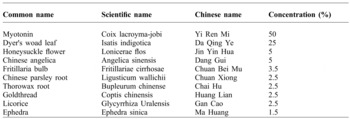
The second traditional medicine used against avian chlamydiosis is Chuanyichai San, which is given to poultry for five to seven days at dose of 2-3 g per bird per day. Its ingredients are presented in Table 2. The herbal prescription have extensive actions in pharmacology, e.g. anti-oxidant, anti-microbial, and anti-inflammatory, vasodilative and anti-coagulant activities (Chen and Chen, Reference CHEN and CHEN2004;Yeum et al., Reference YEUM, LEE, KIM, ROH, LEE and SEO2007; Zou and Koh, Reference ZOU and KOH2007; Kamath et al., Reference KAMATH, SKEELS and PAI2009; Zheng et al., Reference ZHENG, YUE, WU, HU, WU and YANG2011; Han and Guo, Reference HAN and GUO2012).
Ingredient composition of Chuanyichai San.

Psittacosis in China
In China, likewise elsewhere, a confirmed case of psittacosis refers to a clinical case that is laboratory confirmed by isolation of the causative agent or demonstration of its DNA in respiratory secretions, or by at least a fourfold increase in antibody titre between acute and convalescent sera collected at least two weeks apart. Since 2008, psittacosis is enlisted as a notifiable disease in Hong Kong, and since then, four confirmed cases and three additional suspected cases have been reported (Hong Kong centre for health protection: http://www.chp.gov.hk). Furthermore, two cases were confirmed by the Taiwan Centre for Disease Control (http://www.cdc.gov.tw). Official statistics on the prevalence of psittacosis on the mainland of China are not available.
Up to date, reported cases of psittacosis outside China are mostly related to contact with psittacine birds. One could expect a much higher number of cases related to poultry in China compared to Western countries. In the latter, an increased risk for psittacosis is mainly confined to employees in poultry farms or poultry processing plants and veterinarians. In contrast, in China, a broader human population is at risk, as many Chinese people live in close contact with live birds due to the widespread backyard systems. In addition, live markets and the high-risk behaviour of consumers on these markets, like blowing the cloacal feathers of poultry to examine their healthiness and slaughtering poultry on the market, expands the population at risk (Woo et al., Reference WOO, LAU and YUEN2006).
Literature data on occupationally acquired psittacosis in China include reports on infections contracted from ducks, pigeons, chickens and peacocks. The earliest report dates from 1959, and it is on psittacosis in seven of 13 employees of a broiler duck farm in Beijing (Zhou and Qiu, Reference ZHOU and QIU2007). Affected employees showed flu-like symptoms and pneumonia. Serum was examined by a complement fixation test (CFT) and all seven had an antibody titre of 1/32. This is of course no proof of an ongoing chlamydia infection. The examination of convalescent sera would have been more appropriate. Also related to contact with ducks, Zhang and Yang (Reference ZHANG and YANG2009) reported two cases of psittacosis after manipulating dead ducks on a farm in Sichuan (Zhang and Yang, Reference ZHANG and YANG2009). Occupationally contracted psittacosis was also reported after contact with meat-type pigeons in Beijing. Employees of pigeon farms in Beijing were diagnosed as psittacosis by positive CFT and recovered after treatment with erythromycin. (Gao et al., Reference GAO, XU and LV1989; Wang et al., Reference WANG, ZHANG, ZHANG, YU, GU and SUN2007). An engineer employed on a chicken farm was as well diagnosed as chlamydia positive by CFT using convalescent sera (Sun, Reference SUN2010). In 2011, Chlamydial antigen was detected in one out of four employees throat swabs by a direct IF test. Sera of all four employee were positive for immunoglobin G (titre 1:64) against C. psittaci using a semi-quantitative immunofluorescence test (Yang et al., Reference YANG, LING, YUAN, PANG and HE2011) .
Conclusions
China's poultry sector is, even at low prevalence, highly vulnerable to massive economic losses due to disease provoking infectious agents. As in Western poultry producing countries, the economically devastating implications of the occurrence of virulent Chlamydia strains have been repeatedly demonstrated throughout China. In China, avian chlamydiosis is mostly treated with tetracycline antibiotics, as elsewhere. Chinese herbal medicines are used as a prophylactic and sometimes even as therapeutic treatment in conjunction to antibiotics. Chinese occupationally acquired psittacosis cases are on infections contracted from ducks, pigeons, chickens and peacocks. Diagnosis of C. psittaci infections in both poultry and humans is further improving in China.
Acknowledgements
Lizi Yin had a PhD fellowship from the China Scholarship Council (CSC grant; 01SC2812) and from the Special Research Fund of Ghent University (co-funding of CSC grant).