In October 2006 the MFA agreed to return to Italy a series of 13 antiquities (Appendix). These included Attic, Apulian, and Lucanian pottery as well as a Roman portrait of Sabina and a Roman relief fragment.1
For relevant press releases and images, see http://www.mfa.org/press/ (accessed on October 25, 2006). For pottery from Italy in the MFA, see Padgett, Vase-Painting in Italy.
Silver, “Rome Prosecutor Asked Convict to Accuse the Met.” It is reported that perhaps some 4,000 to 5,000 Polaroids were seized during the raid: Watson and Todeschini, The Medici Conspiracy, 22. For earlier reports of the raid: Watson, Sotheby's, 275–78.
Edgers and Celeste, “Case in Italy Suggests MFA Received Stolen Art.” It is reported that some of the Polaroids came from a raid on Hecht's flat in Paris in 2000.
RETURNING ANTIQUITIES FROM MALIBU AND NEW YORK
The Boston return is part of a wider pattern and follows a number of recent cases of deaccessioning. In February 1999 the J. Paul Getty Museum returned to Italy an Attic red-figured cup signed by Euphronios as potter and attributed to Onesimos.4
Malibu 83.AE.362 (Galerie Nefer), 84.AE.80 (Dietrich von Bothmer), and 85.AE.384 (Hydra Gallery). Williams, “Onesimos”; Towne-Markus, Masterpieces, 38–39. We are grateful for Karol Wight, Acting Curator of Antiquities, J. Paul Getty Museum at the Getty Villa, for supplying us with the information about the sources.
Heurgon, “Graffites étrusque”; Spivey, Etruscan Art, 84–85, fig. 67.
Watson and Todeschini, The Medici Conspiracy, 93.
Watson and Todeschini, The Medici Conspiracy, 94–95. For an Apulian loutrophoros in the Shelby White and Leon Levy collection which passed through this gallery, see von Bothmer, Glories of the Past, 173–74, no. 124.
Watson and Todeschini, The Medici Conspiracy, 95.
In 2005 it was agreed that the Getty would return the Asteas krater, which was made in Paestum in southern Italy and acquired by the Getty in 1981.10
Malibu 81.AE.78. Towne-Markus, Masterpieces, 87.
Watson and Todeschini, The Medici Conspiracy, 13–14, 289–90.
Malibu 93.AA.47. Towne-Markus, Masterpieces, 50–51. See also Gill, Review of Masterpieces of the J. Paul Getty Museum: Antiquities. Seen by Gill in Athens September 2006. The stele was presumably unearthed illegally in Boeotia before 1993. The agreement to return the pair of reliefs was signed on August 22, 2006. The other relief was from Thasos and had been stolen from excavation storerooms on the island.
Antiquities are also returning to Italy from New York. In February 2006 the Metropolitan Museum of Art signed an agreement to return a number of antiquities, including the Euphronios krater and the hoard of silver thought to come from Morgantina.14
Watson and Todeschini, The Medici Conspiracy, 327. In November 2005 it was reported that eight pieces in the Metropolitan Museum of Art were linked to Hecht or Medici and were under investigation: Silver, “Smuggling Ring Used Sotheby's 110 Times.” For the official press release, see www.metmuseum.org/press_room. The return of the pieces has been delayed so that they can be displayed in the new galleries for classical art. For donors to this project, see Eakin and Kennedy, “Doubts on Donors' Collection Clouds Met Project.”
von Bothmer, A Greek and Roman Treasury, 54–60, nos. 92–106. Other silver (The Lydian Hoard), which appeared in the same publication, has subsequently been returned to Turkey: Özgen and Öztürk, The Lydian Treasure.
Watson and Todeschini, The Medici Conspiracy, 106. For the full story, see Bell, “La provenienza ritrovata.”
New York, MMA 1996.250. Originally on loan from Mr. and Mrs. Spears of Riverdale, NY, L1980.104.
New York, MMA 1985.11.5. Sotheby's, London, December 13–14, 1982, lot 220.
New York, MMA 1984.11.7.
THE BOSTON ANTIQUITIES: DATES OF SURFACING AND THE MYTH OF OLD COLLECTIONS
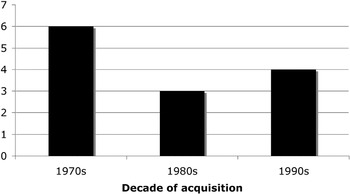
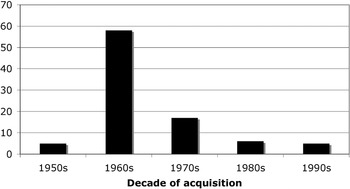
The deaccessioned Boston antiquities do not form a homogeneous group. They were acquired from a number of different sources between 1971 and 1999 (Figure 1). In November 2005 the MFA deputy director, Katherine Getchell, was unconvinced by Italy's request; she is quoted as saying, “There's absolutely nothing we've seen or heard that proves anything to us.”20
Edgers and Celeste, “Case in Italy Suggests MFA Received Stolen Art.”
Edgers and Pinto, “MFA Agrees to Return Disputed Art to Italy.” The agreement was reached in July 2006.

Decade of acquisition for antiquities deaccessioned by the Museum of Fine Arts, Boston.
It is striking that some material was claimed to have been in old collections and thus known for some years or even decades before acquisition. The earliest of the 13 objects to be accessioned by the MFA was a Lucanian nestoris (no. 12) acquired in 1971 from Leo Mildenberg; it was reportedly acquired in 1962, on a Bank Leu invoice of January 21, 1971, from the R. Peirere Collection, Madrid. This in itself is significant because 1971 falls before the declared benchmark of December 30, 1973, set by the Archaeological Institute of America in its resolution on the importation of antiquities.22
1973 is the benchmark that we have used in previous studies to tabulate information: Chippindale and Gill, “Material Consequences of Contemporary Classical Collecting,” 471. A code of ethics addressing these issues was passed by the AIA on December 22, 1997. For text of resolution and code, see www.archaeological.org.
Other deaccessioned objects are claimed to have been in old collections which predate December 30, 1973. For example, an Attic red-figured pelike (no. 7) was purportedly in the Swiss private collection of Mr. Karl Haug in Basel since 1936; during the 1970s it passed through Palladion Antike Kunst in Basel. Is it significant that the Attic red-figure amphora now in the Getty, but which also passed through Palladion Antike Kunst, was documented as being in the British Rycroft collection in 1890, yet was shown in a Polaroid from Medici's warehouse still coated with dirt?23
Watson and Todeschini, The Medici Conspiracy, 345–46.
True, “The Getty Kouros,” 13. The Getty kouros is said to have been acquired from Becchina, and the fake that unmasked it by Medici: Watson and Todeschini, The Medici Conspiracy, 99. True recalls that Jeffery Spier “had finally found the piece of evidence that would prove [the] kouros to be a fake.”
An Attic black-figured lekythos (no. 4) was ostensibly found at Selinus on Sicily in the 1960s. It was reportedly acquired from the French numismatist Hubert Herzfelder, who worked in Sicily from the 1930s. The naming of such a collection normally would not have drawn attention and could seem plausible, but it is unlikely correct given the return of the lekythos to Italy. A second piece in the MFA, an Apulian bell-krater, was also said to have come from this source via the Hecht route.25
Boston, MFA 1976.144. This was said to have been purchased from Herzfelder in 1962.
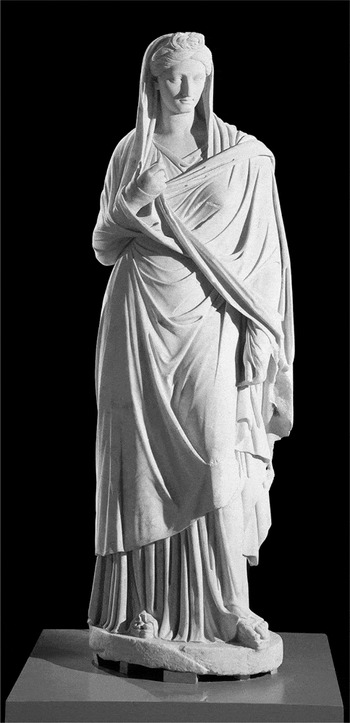
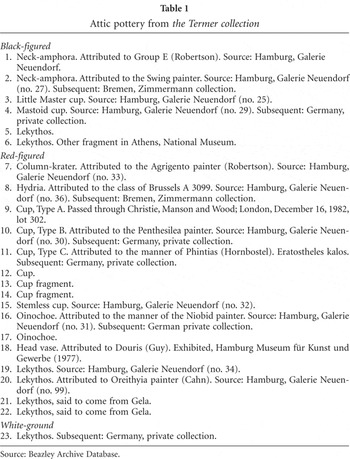
Other MFA pieces from old collections include the portrait of Sabina (no. 1) (Figure 2), which was claimed to have come from “an aristocratic family collection in Bavaria” which has the ring of the anonymous histories so often seen in sale catalogs “Property of a Gentleman.” Given that the piece appears in the Medici Polaroid archive, this history for Sabina is demonstrably false. Finally, the Apulian bell-krater (no. 10) was noted by A. D. Trendall and A. Cambitoglou as formerly residing in the Holger Termer collection in Hamburg.26
Trendall and Cambitoglou, Second Supplement to the Red-figured Vases of Apulia, Part 1, 23.
Termer, Kunst der Antike.

Portrait of Sabina, c. AD 136. Formerly Boston, MFA 1979.556, purchased from Fritz Bürki of Zurich through Robert E. Hecht; Appendix no. 1. Photograph courtesy of Museum of Fine Arts, Boston.
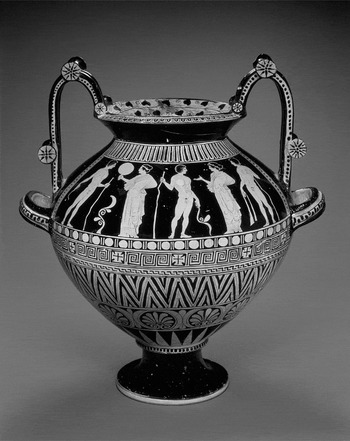
Attic pottery from the Termer collection

THE DEALERS, GALLERIES, AND AUCTION HOUSES
The MFA pieces come from a number of different dealers and galleries. Two of the objects passed through Atlantis Antiquities of New York owned jointly by Robert Hecht and Jonathan Rosen.28
Watson and Todeschini, The Medici Conspiracy, 73.
Trendall and Cambitoglou, Second Supplement to the Red-figured Vases of Apulia, Part 1, 148, pl. 36, 1, no. 47b.
Watson and Todeschini, The Medici Conspiracy, 185–88.
Watson and Todeschini, The Medici Conspiracy, 171–73.
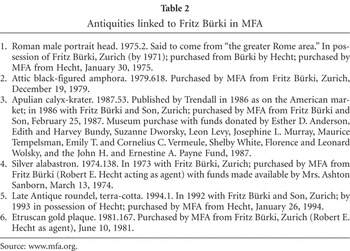
Antiquities linked to Fritz Bürki in MFA


Pottery and sculpture which passed through Robert E. Hecht, Jr. and was subsequently acquired by the Museum of Fine Arts, Boston.
This link between Atlantis Antiquities and Bürki has also emerged from investigations at the Getty concerning a pair of Etruscan antiquities, a tripod and a candelabrum, revealing a close relationship between Giacomo Medici, Bürki, and Atlantis Antiquities.32
Watson and Todeschini, The Medici Conspiracy, 84–86.
Malibu 87.AE.23. Watson and Todeschini, The Medici Conspiracy, 89–90. The pelike had clearly been struck with a single blow which shattered the pot which was reconstructed from a large number of fragments. In November 2006 the J. Paul Getty Museum announced that this pelike would be returned to Italy.
Watson and Todeschini, The Medici Conspiracy, 95–98.
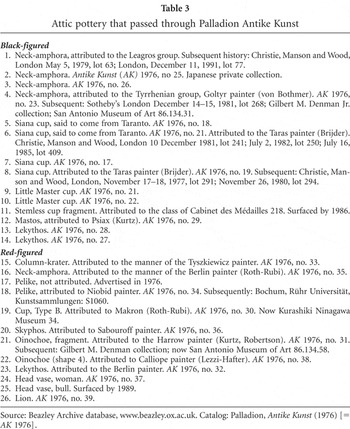
Another of the Swiss dealers and galleries through which Boston acquired antiquities was Palladion Antike Kunst of Basel. Pieces from this source include an Attic black-figured hydria (no. 3), an Attic red-figured pelike (no. 7), and an Apulian bell-krater (no. 10), two of which were sold by the gallery in 1976 (nos. 3 and 10).35
Sale catalog nos. 24, 43.
Mizuta, Schwarz- und Rotfigurige Vasen, 68–69, pls. 58 (108) 1–13, 59 (109) 1–2.
San Antonio 86.134.31. Shapiro, et al., Greek Vases in the San Antonio Museum of Art, no. 36. For a discussion of the pottery in San Antonio: Chippindale and Gill, “Material Consequences of Contemporary Classical Collecting.”
San Antonio 86.134.58. Shapiro, et al., Greek Vases in the San Antonio Museum of Art, no. 69.
Bochum, Ruhr Universität, Kunstsammlungen S1060.
Simon, The Kurashiki Ninagawa Museum, 80–83, no. 34.
Watson and Todeschini, The Medici Conspiracy, 291–293.
Watson and Todeschini, The Medici Conspiracy, 78–79.
Attic pottery that passed through Palladion Antike Kunst

Two MFA pieces passed through Auktion 51 Münzen und Medaillen in Basel (but one was subsequently acquired by Fritz Bürki) in March 1975 (nos. 6 and 8). This gallery was run by Herbert A. Cahn, who was convicted of handling antiquities in Italy in 1976.43
Watson and Todeschini, The Medici Conspiracy, 164–65.
Mannheim, Reiss-Museum CG342, CG343. Lots 125 and 129. The fact that these pieces passed through Münzen und Medaillen does not necessarily imply that they were removed from their archaeological context illicitly.
A Lucanian nestoris (no. 12, see previous text) was sold to the MFA by Leo Mildenberg through Bank Leu of Zurich. Although he did possess a personal collection of antiquities relating to animals in ancient art, the MFA piece was purchased against a Bank Leu inventory. Does this bring into question the history of other pieces acquired through Mildenberg?45
Such as the Attic Little Master cup: Cleveland (OH), Museum of Art: 1993.111.
Shefton, “A Greek Lionhead.” On Mildenburg's death, both pieces were reunited in Newcastle upon Tyne.
There is a London connection to the MFA pieces. Bruce McAlpine purchased the Attic black-figured hydria (no. 3) from Palladion Antike Kunst before selling it to Boston. McAlpine was also selling Greek pottery to other museums at exactly this time.47
Pieces that passed through their hands included the Attic red-figured cup attributed to the Kodros painter acquired by the Fitzwilliam Museum in Cambridge (inv. GR.2.1977) in 1977: Gill, “Fitzwilliam Museum,” 292, no. 20. Other pieces include an Attic Black-figured amphora: Hobart, Univ. of Tasmania, John Elliot Museum: 70; an Attic red-figured neck amphora: Ann Arbor (MI), University of Michigan, Kelsey Museum: 77.7.1.
Watson, Sotheby's. See also Gill, “Sotheby's, Sleaze and Subterfuge.”
The MFA nestoris returned to Sotheby's on 10 December 1996, lot 191.
I am grateful to Ian McPhee of LaTrobe University for informing me that Geddes made the loan though he may not have been the owner of the nestoris.
Information from www.dcita.gov.au (accessed on October 11, 2006). The list of valuers was dated August 2006.
Kunstwerke der Antike 63, June 29, 1983, no. 43.
Such as Sotheby's, London, December 14–15, 1981, lots 336, 337 (= December 10, 1996, lot 167); December 13–14, 1982, lot 255 (=December 8, 1986, lot 327); December 12–13, 1983, lot 411; July 13–14, 1987, lot 408.
Connor and Jackson, Ian Potter Museum of Art. Andrew Jamieson indicates that four pieces were purchased from Geddes: an Ionian cup (1983.0105; cat. no. 14), a column-krater (1998.0007; cat. no. 48), a Pagenstecher lekythos (1990.0020; cat. no. 57), a lekanis (1990.0019; cat. no. 65). The column-krater, attributed to the Comacchio painter, is known as the Peter Connor Memorial Vase; this surfaced in Christie's December 16, 1982, lot 296. Nine other loan items were returned to Geddes in July 1993. This loan included 5 Apulian pots, including a volute-krater the name vase of the Geddes painter, and a Lucanian pelike.
Sonia Puttock informs us, “Most of the objects in our collection were purchased from Graham Geddes but we did have some objects which are on loan from him.”
Inv. 177.94; Loan. Cohen et al., Mother City and Colony, nos. 1, 6 and 9.
We are grateful to Ann Copeland for this information. The pieces have been on loan since at least February 2005.
Attic pottery included lots 229, 230 (Lord Kinnaird collection), 231, 232, 233, 234 (first surfaced in the Bolla collection, Lugano, Switzerland). An Attic red-figured bell-krater attributed to the Komaris painter was offered by Jerome Eisenberg's Royal Athena Galleries around 2000 as ex Graham Geddes, Australia; see also Bonham's, London September 21, 1999, lot 147.

Lucanian nestoris, late fifth century BC. Formerly Boston, MFA 1998.588, gift of Widgie and Peter Aldrich; Appendix no. 13. Photograph courtesy of Museum of Fine Arts, Boston.
One MFA piece that surfaced in Sotheby's was an Apulian loutrophoros (no. 11), which was sold on December 10, 1984, lot 366. This was sold one year before the meeting between Peter Watson and Brian Cook of the British Museum when they discussed the growing number of Apulian pots appearing on the London market.59
Watson, Sotheby's, 114–16. For Apulian pottery on the market: Elia, “Apulian Red-figure Vases.”
Elia, “Apulian Red-figure Vases,” 150.
Watson, Sotheby's, 118.
In New York two of the Apulian pieces, the bell-krater (no. 10) and the loutrophoros (no. 11), were sold by the Royal-Athena Galleries owned by Jerome Eisenberg. Eisenberg draws attention through his gallery web site to the fact that the MFA was a good client.62
“Introduction” on www.royalathena.com (accessed on October 9, 2006). Further on Eisenberg: Butcher and Gill, “Mischievous Pastime.”
www.iadaa.org (accessed on October 9, 2006). For Eisenberg's view on antiquities, see Eisenberg, “Ethics and the Antiquity Trade.”
Edgers, “MFA Returns Art to Italy.”
September 13–October 22 2006. See Apostolidis, Archaiokapilia.
Apostolidis, Archaiokapilia, 269–301, and esp. pl. 45.
THE DONORS
The deaccessioned antiquities represent a number of significant donors, which reflects the complexity of the network of dealers and supporters of museums. Among the well-known collectors were Shelby White and Leon Levy, who gave an Apulian amphora (no. 9) in 1991 supported by funds derived from the Jerome Levy Foundation (named in honor of Levy's father). An earlier study of part of their collection exhibited at the New York Metropolitan Museum of Art suggested that 84% of the items surfaced for the first time after 1973.67
Chippindale and Gill, “Material Consequences of Contemporary Classical Collecting,” 472–74, esp. tables 1 and 2. This study of the collection seems to be surprisingly unknown to Shelby White: White, “Building American Museums.” For the collection: von Bothmer, Glories of the Past.
Watson and Todeschini, The Medici Conspiracy, 353–54. Catalog entries, von Bothmer, Glories of the Past: e.g. nos. 87 (purchased from Symes, 6 months before the exhibition), 102 (purchased from Symes), 104 (Sotheby's, London, July 17, 1985, lot 313), 106 (Sotheby's, London, December 9, 1985, lot 132; purchased from Symes), 107, 117 (purchased from Symes).
An interesting blend of donors who supported the acquisition of an Apulian bell-krater (no. 10) in 1988 included several collectors and dealers (Figure 5). Among them were Barbara and Lawrence Fleischman; a study of their own collection suggests that 91% of objects surfaced after 1973.69
Chippindale and Gill, “Material Consequences of Contemporary Classical Collecting,” 474–75. For them as collectors: White, “Building American Museums,” 172.
Watson and Todeschini, The Medici Conspiracy, 349–52, and see also 121–23.
Watson and Todeschini, The Medici Conspiracy. See also Watson, “The Fall of Robin Symes.”
Meier, “The Case of the Contest Coins”; Meier, “Turkish Government.” The Apulian krater was acquired four years after Vermeule is said to have been contacted over the coins. For Kagan's continuing research links with Spier, see Spier and Kagan, “Sir Charles Frederick.”

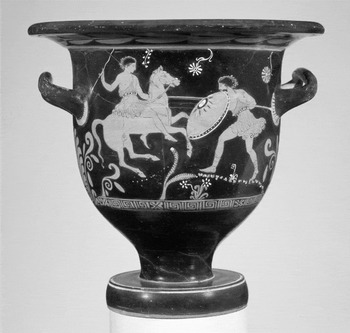
Apulian bell-krater, c. 380–370 BC. Formerly Boston, MFA 1988.532, gift of Alfred Ajami, Esther Anderson, Edith Bundy, Robert S. Czachor, Barbara and Lawrence A. Fleischman, Jonathan H. Kagan, Bruce and Ingrid McAlpine, Josephine L. Murray, Robin Symes, and Catherine C. Vermeule; Appendix no. 10. Photograph courtesy of Museum of Fine Arts, Boston.
Some of the donors of the deaccessioned material are closely linked to the museum. Cornelius C. Vermeule III was the Curator of Classical Art at the MFA from 1957 to 1996. He and his wife Emily, a Harvard professor respected for her research on the Late Bronze Age Aegean, donated three of the deaccessioned items: an Attic red-figured lekythos (no. 8), an Attic red-figured hydria (no. 6), and a Roman candelabrum shaft (no. 2). Vermeule has been linked to several objects that have surfaced in suspicious circumstances, most (in)famously the weary Herakles in Boston that seems to fit a fragment excavated at Perge in Turkey during the 1980s.73
Boston, MFA 1981.783. von Bothmer, Glories of the Past, 237–38, no. 172. Surfaced in Frankfurt/Main and purchased from Mohammad Yeganeh; claimed to have been in his mother's collection and purchased from a German dealer about 1950. Acquired with the support of the Jerome Levy foundation, Shelby White, and Leon Levy.
Peter Aldrich, one of the donors of deaccessioned material, was a trustee of the MFA. He and his wife Widgie purchased and donated two of the deaccessioned items, an Attic bell-krater (no. 5) and a Lucanian nestoris (no. 13). Peter Aldrich is also responsible for gifts of other antiquities to MFA.74
A Sicilian red-figured bell-krater (1995.840) which surfaced at Sotheby's London December 11, 1989, lot 177; a Laconian cup (1995.841) which surfaced in the Merrin Gallery, New York; an Attic rhyton (2004.2008) perhaps surfacing in Paris in 1901, but certainly appearing at Sotheby's London May 23, 1991, lot 321.
CONCLUSION
This small selection of antiquities, which has made its way back to Rome for public display, allows a small glimpse into the murky world surrounding the acquisition of cultural artifacts from the Mediterranean world. The short time between the Italian government's request and the deaccessioning of the objects suggests that the evidence was overwhelming. Yet, is this but the tip of the iceberg? Have the present resting places of all the objects identified in Medici's Polaroid library been identified? Can we expect more returns?
The route by which some of the Boston antiquities traveled through the market suggests that more deaccessioning can be expected. A key figure in the process was Robert E. Hecht Jr. Of more than 1000 objects in the MFA reportedly handled by Hecht, all are under suspicion for having been looted.75
Edgers, “Objects of Inspection.”
Boston MFA 1992.317. For the Summa Galleries: Watson and Todeschini, The Medici Conspiracy, 129–33.
Edgers, “Objects of Inspection.”
Hecht was not just selling antiquities to the MFA; he was known for his association with a cup attributed to Euphronios ostensibly found with the Sarpedon krater.79
Vitelli, “The Antiquities Market,” 273–74; Watson and Todeschini, The Medici Conspiracy, 130.
Cambridge, Fitzwilliam Museum GR.3.1962. Nicholls, “Fitzwilliam Museum,” 1965/6, 46, no. 8. For further illustration, see Gill, “Positivism.”
Nicholls, “Fitzwilliam Museum,” 1970/1, 75–76, no. 25. For reports of the looting, see Mellink, “Archaeology in Asia Minor,” 159. For other fragments, some of which passed through Sotheby's, London: Thomas, “Birmingham City Museum,” 64–70, no. 4; Mellink, “Archaeology in Asia Minor: Addenda,” 281.
Yet, it is the seizure of the Polaroid photographs in the Geneva Freeport that will probably bring about the identification of objects removed from their archaeological contexts by tombaroli. Material in six North American museums, including the Cleveland Museum of Art, the Princeton University Museum, and the Toledo Museum of Art,82
Silver, “Rome Prosecutor Asked Convict to Accuse the Met”; Silver, “Smuggling Ring Used Sotheby's 110 Times.” The Princeton pieces are reportedly the Attic red-figured psykter attributed to the Kleophrades painter (inv. 1989.69), and an Apulian loutrophoros. There are reported to be eight pieces in Cleveland; see also Mazur, “Italy Will Contest Medea Vase.”
There is sadly little to celebrate over the return of these antiquities. The 13 antiquities now back on Italian soil represent 13 destroyed archaeological contexts, scientific knowledge lost forever; and the best scholarship cannot retrieve this information. The MFA's reputation was tarnished, but its trustees should be commended for coming to such a speedy decision to return the objects to Italy; and hopefully, any other requests for the return of antiquities will be met with similar alacrity. Is there an expectation that no further requests will be made by the Italian authorities? Where does this new policy leave antiquities such as the Weary Herakles, which is claimed by Turkey? Should trustees remain in office if they are identified as donors of material that has had to be deaccessioned? Perhaps there will be a move toward more rigorous and ethical acquisition policies that recognize the realities of the antiquities trade. Where does it leave the antiquities residing in private collections? No responsible museum curator is likely to want to accept a gift or bequest of objects that could be the subject of a formal claim by a foreign government; and museum trustees will want to avoid adverse publicity. Should collectors like Shelby White seek to offer their antiquities to appropriate national governments? The energetic calls for the repatriation of antiquities,84
See for example the comments in Sotirakopoulou, The “Keros Hoard”.
POSTSCRIPT
On November 21, 2006 it was announced that the J. Paul Getty Museum had indicated to the Italian Government that it intended to return 26 antiquities. At least 5 of the objects had formed part of the Barbara and Lawrence Fleischman collection. Source: www.getty.edu/news/press/ (accessed on 7 December 2006).
APPENDIX 1: ANTIQUITIES RETURNED BY BOSTON (OCTOBER 2006)
List based on 〈www.mfa.org〉. All were deaccessioned on September 21, 2006.
A. Sculpture
1. Portrait of Sabina, 1979.556. By 1979: with Fritz Bürki, Zurich, Switzerland (reputedly in an aristocratic family collection in Bavaria); purchased by MFA from Fritz Bürki (Robert E. Hecht acting as agent), November 14, 1979.
2. Roman candelabrum shaft, 1992.310. Loaned to MFA as Cornelius Adrian Comstock Vermeule Collection in 1980 (213.1980); gift of Emily T. Vermeule and Cornelius C. Vermeule III to MFA in the name of Cornelius Adrian Comstock Vermeule, June 24, 1992.
B. Pottery
Attic
3. Attic black-figured hydria: 1979.614. By 1976: with Palladion Antike Kunst, Rennweg 51, CH 4052 Basel, Switzerland (Katalog 1976, no. 24); by 1979: with Bruce and Ingrid McAlpine, 60 Brook Street, Mayfair, London W1, England; purchased by MFA from Bruce and Ingrid McAlpine, December 19, 1979.
4. Attic black-figured lekythos, 1989.317. Said to come from Selinus; date unknown in the 1960s: purchased by Robert E. Hecht from Hubert Herzfelder, R. des Sts. Pères, Paris; by 1989: with Atlantis Antiquities, 40 East 69th Street, New York, NY 10021; purchased by MFA from Atlantis Antiquities, November 29, 1989.
5. Attic red-figured bell-krater, 1999.735. By 1995: with Sotheby's, 34–35 New Bond Street, London W1 (Sotheby's auction, December 14, 1995, lot 95); purchased at the Sotheby's auction by Widgie and Peter Aldrich; 1999: partial gift of Widgie and Peter Aldrich to MFA; 2006: remaining interest given by Widgie and Peter Aldrich to MFA, September 20, 2006.
6. Attic red-figured hydria, 1978.45. By 1975: with Münzen und Medaillen, Malzgasse 25, Basel, Switzerland (auction 51, March 14–15, 1975, lot 155); by 1977: with Fritz Bürki; purchased by MFA from Fritz Bürki, January 11, 1978; gift of Mr. and Mrs. Cornelius C. Vermeule III and Miss Emily D.B. Vermeule, by exchange, 1978. Attributed to the Berlin painter.
7. Attic red-figured pelike, 1979.40. By 1971: with Palladion Antike Kunst, Rennweg 51, 4052 Basel, Switzerland (said to have been in the Swiss private collection of Mr. Karl Haug in Basel since 1936); purchased by MFA from Palladion Antike Kunst, February 14, 1979.
8. Attic red-figured lekythos, 1977.713. By 1975: with Münzen und Medaillen AG, Malzgasse 25, Basel, Switzerland, auction 51, March 14–15, lot 150; purchased by MFA from Münzen und Medaillen AG, October 12, 1977; gift of Mr. and Mrs. Cornelius C. Vermeule III, by exchange, 1977.
Apulian
9. Apulian amphora, 1991.437. 1991: New York market, Atlantis Antiquities (according to A. D. Trendall and A. Cambitoglou, Second Supplement to the Red-Figured Vases of Apulia, 1991, p. 148, no. 47b, pl. 36, 1); 1991: with Fritz Bürki & Son, Zurich; Switzerland; 1991, sold by Fritz Bürki & Son to Shelby White and Leon Levy (half interest) and to the MFA with funds given by Jerome Levy Foundation (half interest); 2006: Shelby White and Leon Levy half interest given by Shelby White to the MFA, September 20, 2006.
10. Apulian bell-krater, 1988.532. By 1976: with Palladion, Antike Kunst, Rennweg 51, Basel, Switzerland, Katalog 1976, no. 43; by date unknown: Termer Collection (according to A. D. Trendall and A. Cambitoglou, Second Supplement to the Red-Figured Vases of Apulia, 1991, p. 23); by 1985: with Royal-Athena Galleries, 153 East 57th Street, New York 10022 (Art of the Ancient World, IV, no. 105); purchased by MFA from Royal-Athena Galleries, December 21, 1988; gift of Alfred Ajami, Esther Anderson, Edith Bundy, Robert S. Czachor, Barbara and Lawrence A. Fleischman, Jonathan H. Kagan, Bruce and Ingrid McAlpine, Josephine L. Murray, Robin Symes, and Catherine C. Vermeule, 1988.
11. Apulian loutrophoros, 1988.431. By 1984: with Sotheby's, 34–35 New Bond Street, London (auction, December 10, 1984, lot 366); by 1985: with Royal-Athena Galleries, 153 East 57th Street, New York, NY 10022 (Art of the Ancient World, IV, no. 104 b); purchased by MFA from Royal-Athena Galleries, October 26, 1988.
Lucanian
12. Lucanian nestoris, 1971.49. By 1971: with Dr. Leo Mildenberg, Bank Leu AG, Bahnhofstrasse 32, Zurich, Switzerland (on the Leu invoice, dated January 21, 1971, was the following provenance: acquired in 1962 from the R. Peirere Collection, Madrid); purchased by MFA from Dr. Leo Mildenberg, February 10, 1971.
13. Lucanian nestoris, 1998.588. By 1982: with Sotheby's, 34–35 New Bond Street, London, auction, December 13–14, 1982, lot 298; by 1996: with Sotheby's, London, auction, December 10, 1996, lot 191 (with note that it was on loan 1988–1994 at the Borchardt Library, La Trobe University, Melbourne); purchased at the 1996 auction by Widgie and Peter Aldrich; 1998: partial gift of Widgie and Peter Aldrich to MFA; 2006: remaining interest given by Widgie and Peter Aldrich to MFA, September 20, 2006.