Introduction
Young children are remarkably adept at comprehending and acquiring new words. This ability is achieved, in part, through their knowledge of syntax and morphology. Children are able to make sense of unfamiliar words when they are used in familiar syntactic constructions (Arunachalam & Waxman, Reference Arunachalam and Waxman2010; Bernal, Lidz, Millotte, & Christophe, Reference Bernal, Lidz, Millotte and Christophe2007; Fisher, Hall, Rakowitz, & Gleitman, Reference Fisher, Hall, Rakowitz and Gleitman1994; Lidz, Gleitman, & Gleitman, Reference Lidz, Gleitman and Gleitman2003; Waxman & Booth, Reference Waxman and Booth2001), and when they have familiar morphological structures (Arias-Trejo, Cantrell, Smith, & Canto, Reference Arias-Trejo, Cantrell, Smith and Canto2014; Davies, Xu Rattanasone, & Demuth, Reference Davies, Xu Rattanasone and Demuth2017; Davies, Xu Rattanasone, Schembri, & Demuth, Reference Davies, Xu Rattanasone, Schembri and Demuth2019; Kouider, Halberda, Wood, & Carey, Reference Kouider, Halberda, Wood and Carey2006). Yet it is unclear what other morphosyntactic cues children use to interpret newly encountered words. Agreement, for example, is a potentially powerful tool for facilitating sentence processing. Through agreement, different words in a given syntactic structure share one or more grammatical features (such as number), providing listeners with the means to employ their knowledge of one word to facilitate their comprehension of another. However, it is not known whether young children can employ knowledge of agreement – specifically subject–verb (SV) number agreement – to comprehend unfamiliar nouns.
In English (and many other languages), number may be expressed across multiple words within a sentence. Verbs may agree in number with their subject noun (e.g., the cat is/was happy; the cats are/were happy), and determiners may agree with the number of their head noun (e.g., a/that/this cat; some/those/these cats). For regular nouns, number is expressed through morphology. The word cats is understood as plural because it has the morphological structure of cat + s, containing the plural morpheme -s. By 24 months, children recognise the morphological structure of novel words, showing that they know that find the teps refers to more than one tep (Davies et al., Reference Davies, Xu Rattanasone and Demuth2017). However, in the case of some irregular nouns, agreement is sometimes the only way to determine number (e.g., look at that/those sheep; the fish is/are happy). Therefore, in order to achieve adult-like comprehension, children must learn to be sensitive not only to the syntactic and morphological structure of a sentence, but also to any grammatical agreement that may exist between words. Yet, it remains unclear to what extent young children are able to use number agreement to determine whether a previously unheard word is singular or plural.
There is some evidence that children are sensitive to English SV agreement violations before the age of two (Soderstrom, White, Conwell, & Morgan, Reference Soderstrom, White, Conwell and Morgan2007; Sundara, Demuth, & Kuhl, Reference Sundara, Demuth and Kuhl2011), yet studies of children's comprehension of number agreement appear to yield mixed results. Picture-pointing tasks using familiar words have found that children as old as six years struggle to demonstrate comprehension of SV number agreement (de Villiers & Johnson, Reference de Villiers and Johnson2007; Johnson, de Villiers, & Seymour, Reference Johnson, de Villiers and Seymour2005). In contrast, in an intermodal preferential looking task (IPL; Golinkoff, Hirsh-Pasek, Cauley, & Gordon, Reference Golinkoff, Hirsh-Pasek, Cauley and Gordon1987) 24-month-olds were able to identify (and possibly predict) upcoming novel nouns through copula and determiner agreement (e.g., there are some blickets vs. look at the blickets; Kouider et al., Reference Kouider, Halberda, Wood and Carey2006). Other visual world tasks have demonstrated that children aged from 30 months to six years are able to use plural copula SV agreement (i.e., are) to facilitate comprehension of familiar plural words, but do not seem to do the same with singular copula SV agreement (i.e., is; Lukyanenko & Fisher, Reference Lukyanenko and Fisher2016; Lukyanenko & Miller, Reference Lukyanenko and Miller2018). Another study found that three-year-olds can use both is and are to correctly predict familiar pictures before being explicitly named, yet they had greater accuracy in predicting plural targets (Deevy, Leonard, & Marchman, Reference Deevy, Leonard and Marchman2017). Cross-linguistic differences have also been found. A series of IPL studies showed that French-speaking 30-month-olds were able to comprehend scenes with novel nouns using SV number agreement (Il(z) embrasse(nt) le gef ‘he/they kiss the gef’; Legendre, Barrière, Goyet, & Nazzi, Reference Legendre, Barrière, Goyet and Nazzi2010), yet children of the same age acquiring English (e.g., The boy(s) kiss(es) the naj) or Spanish (besa(n) el micho ‘he/they kiss the micho’) were not (Legendre et al., Reference Legendre, Culbertson, Zaroukian, Hsin, Barrière and Nazzi2014).
One of the differences between studies finding children able to comprehend English SV number agreement and those who did not was the type of SV agreement tested. Those studies finding children unable to comprehend SV agreement examined the third person singular verbal inflection (3sg: e.g., the boy jumps; de Villiers & Johnson, Reference de Villiers and Johnson2007; Johnson et al., Reference Johnson, de Villiers and Seymour2005; Legendre et al., Reference Legendre, Culbertson, Zaroukian, Hsin, Barrière and Nazzi2014), whereas those where children did exhibit comprehension examined the copula (is/are; Deevy et al., Reference Deevy, Leonard and Marchman2017; Kouider et al., Reference Kouider, Halberda, Wood and Carey2006; Lukyanenko & Fisher, Reference Lukyanenko and Fisher2016; Wood et al., Reference Wood, Kouider and Carey2009). While children are sensitive to 3sg from an early age (Soderstrom et al., Reference Soderstrom, White, Conwell and Morgan2007; Sundara et al., Reference Sundara, Demuth and Kuhl2011), this may simply be sensitivity to phonological patterns in their input (Naigles, Reference Naigles2002). Indeed, 3sg is acquired in children's spontaneous speech much later than the copula (Brown, Reference Brown1973; de Villiers & de Villiers, Reference de Villiers and de Villiers1973). The copula is not only highly frequent in children's input, but also changes its surface form to agree with its subject noun in both number and tense, making these forms perceptually distinct from one another (e.g., is, are, was, were). However, it is unclear why differences have been found between children's comprehension of the singular copula is and the plural copula are.
The present study therefore investigated whether three- and four-year-old children could use copula SV agreement in order to identify the number of newly encountered novel words. While previous studies have shown that children are able to use copula plus determiner agreement to identify the number of novel nouns (Kouider et al., Reference Kouider, Halberda, Wood and Carey2006; Wood et al., Reference Wood, Kouider and Carey2009), the present study tested their ability to use copula SV agreement alone. Children were tested using iPads during preschool using a novel-word two-alternative forced choice comprehension task. For each trial, children were presented with two pictures side-by-side. One picture depicted a single novel animal/object, and the other depicted five identical instantiations of a different animal/object. Children were tested on their comprehension of (1) sentences with unambiguous nominal morphology, and (2) sentences with ambiguous nominal morphology, in which the novel nouns all ended in /ks/, the only English stop + fricative final cluster to occur in both singular and plural words (e.g., box, axe vs. clocks, sacks):
(1) where is the tup? / where are the tups?
(2) where is the gex? / where are the gecks?
Given that three-year-olds can use is/are number information to identify target pictures before they are explicitly named (Deevy et al., Reference Deevy, Leonard and Marchman2017), we predicted that children would use the copula to help resolve number ambiguity in novel words ending in /ks/ clusters (e.g., gex), which can either be singular or plural. That is, we predicted that three- and four-year-olds would use SV number agreement (in the absence of other clues) to determine the number condition of a previously unheard word. However, we also hypothesised that children would be more accurate on the conditions containing unambiguous nominal morphology, would be more accurate in trials with the plural copula are, and that four-year-olds would be more accurate than three-year-olds.
Method
Participants
The participants were 58 three-year-olds (35 girls, 23 boys; aged 3;0–3;11; Mage = 3;6, 41.6 months) and 58 four-year-olds (29 girls, 29 boys; aged 4;0–4;11, Mage = 4;5, 53.3 months) recruited from 26 preschools across Sydney, Australia. Parents completed a permission form and a short questionnaire providing information about their child's language exposure, postcode, maternal education, and any known hearing loss or developmental disorders.
All participants reported fewer than 10 hours of exposure to other language(s) per week. Participants’ socioeconomic status was approximated using their postcode and the Socio-Economic Index for Areas Index of Relative Advantage/Disadvantage (ABS, 2013), with an overall mean of 82nd percentile for the state of New South Wales (median = 84, range = 53–100). The reported maximum maternal educational levels were postgraduate degree (32.8%), university degree (47.4%), trade college certification (14.6%), and high school certificate (5.2%). Four three-year-olds and 3 four-year-olds reported speech difficulties (e.g., lisp, stutter, cleft palate, or other minor speech production issues). One four-year-old was diagnosed with ‘mild autism’ a few weeks after participating. No participant reported any hearing loss. All participants passed the PLS-5 Language Screener appropriate for their age (Zimmerman, Steiner, & Pond, Reference Zimmerman, Steiner and Pond2011).
Eleven additional children were excluded from analysis: 3 three-year-olds and 2 four-year-olds failed the language screener, while 4 three-year-olds and 2 four-year-olds failed to complete all test trials.
Twenty native English-speaking adults who grew up in English-speaking households in Australia also participated in the study (fourteen women, six men; age range 19–59 years, Mage = 30.8 years).
Equipment
The task was presented on an Apple iPad Air 2. Auditory stimuli were played through Sennheiser HD 280 pro headphones. The experimental software was constructed using the Serenity Engine (Budziszewski, Reference Budziszewski2003; Xu Rattanasone, Davies, Schembri, Andronos, & Demuth, Reference Xu Rattanasone, Davies, Schembri, Andronos and Demuth2016).
Auditory stimuli and preparation
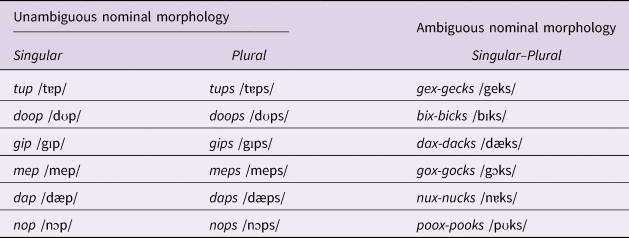
The auditory stimuli were produced by a female native speaker of Australian English in a child-appropriate register and recorded in a sound-attenuated room using Cool Edit Pro 2.0 (at 48 kHz). The novel words are presented in Table 1.
Novel words used in task (IPA transcriptions are for Australian English; see Harrington et al., Reference Harrington, Cox and Evans1997)

The 18 novel words contained only early acquired onset stops (Smit, Hand, Freilinger, Bernthal, & Bird, Reference Smit, Hand, Freilinger, Bernthal and Bird1990) and Australian-English short vowels (Harrington, Cox, & Evans, Reference Harrington, Cox and Evans1997). All plural novel words were inflected with the early-acquired voiceless plural allomorph /-s/ (Davies et al., Reference Davies, Xu Rattanasone and Demuth2017). The plural was perceptually salient in this task as it contrasted in both place and manner to its attached consonant (unambiguous: /ps/, ambiguous: /ks/). The stimuli also included four familiar words, two singular: box and fox; and two plural: clocks and ducks. All stimuli were presented in carrier phrases: where is the X? (singular) and where are the X? (plural).
To control for any phonetic variation, the auditory stimuli were spliced (using Praat; Boersma & Weenink, Reference Boersma and Weenink2016). Each spliced token contained three parts: carrier phrase + word stem + coda burst (and frication). Each unambiguous singular word contained the same /p/ coda burst, each unambiguous plural word contained the same /ps/ coda burst and frication, and each ambiguous word contained the same /ks/ coda burst and frication. The same recorded version of each target word was spliced into both singular and plural conditions (e.g., tup/tups). One version of each carrier phrase was spliced into singular and plural tokens.
Visual stimuli
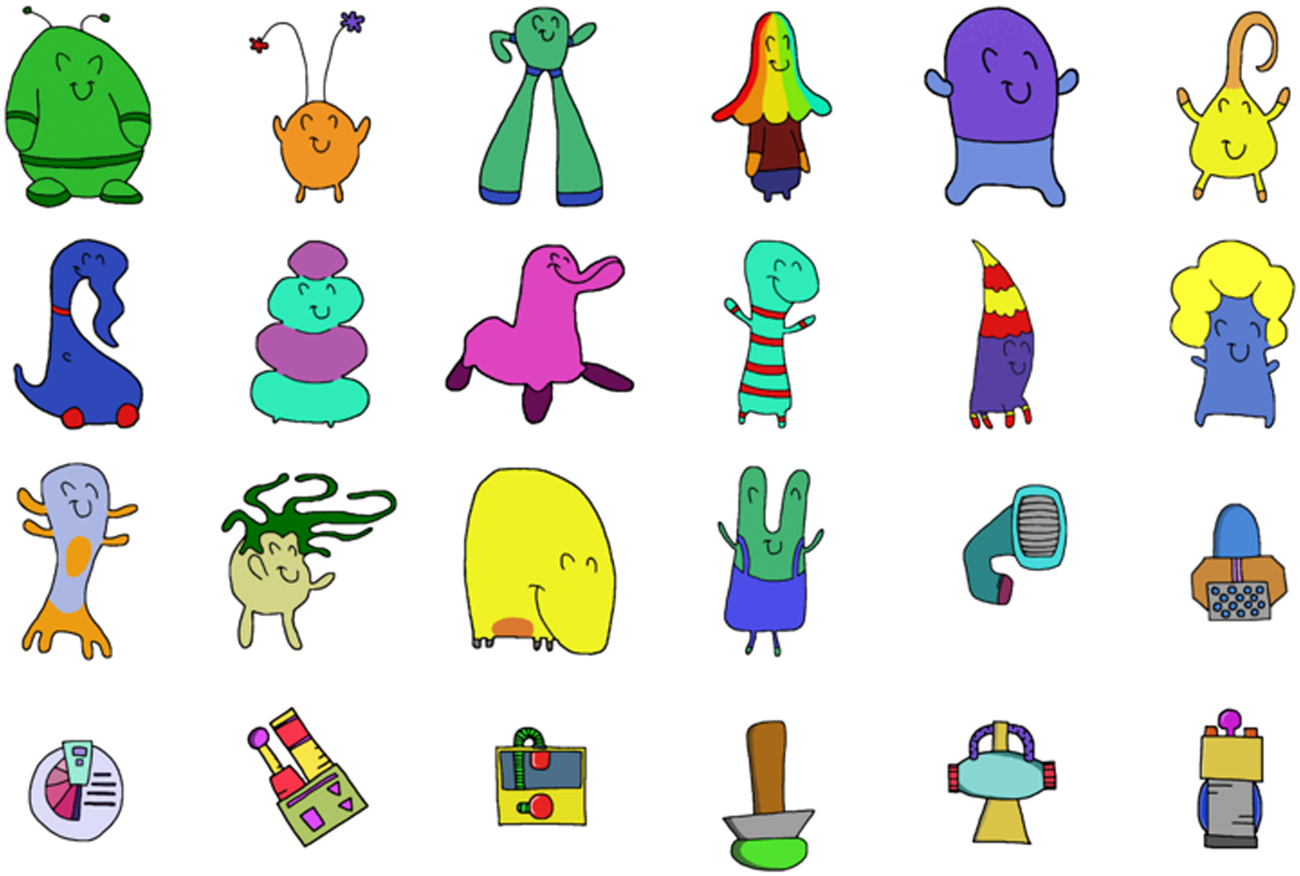
The visual stimuli contained eight novel inanimate objects and sixteen novel cartoon animals. The novel visual stimuli did not resemble anything real or fictional (Figure 1). They were constructed as both single object/animal (singular) pictures and five object/animal (plural) pictures. For the familiar word trials, hat, fox, frog, and box were depicted as singular pictures and clocks, cows, ducks, and shirts as plural pictures.
Animate and inanimate novel visual stimuli.

Procedure
Data for this study were collected alongside a study on children's acquisition of plural morphology (see Davies et al., Reference Davies, Xu Rattanasone, Schembri and Demuth2019). The task was carried out in a quiet area of children's preschools. Participants sat at child-sized tables where both the language screener and the iPad task were carried out. Headphones were worn to minimise any noisy distractions. To ensure that the relevant plural morphemes could be heard, children were played a plural /s/ spliced from the stimuli. If the child indicated they could not hear the /s/ (through repetition or description of the sound), the volume was increased.
Children then completed sixteen trials (twelve novel, four familiar) in which they were presented with two pictures side-by-side, one depicting a solitary object/animal (singular), and another depicting five different objects/animals (plural). The two pictures were matched for animacy (i.e., pictures were either both inanimate or both animate). In the trials with unambiguous nominal morphology, the stimuli contained both a plural morpheme (or not) and the appropriate agreeing copula form (e.g., where is the tup? vs. where are the tups?). In the trials with ambiguous nominal morphology, the target novel word contained a /ks/ coda cluster, which is number-ambiguous (e.g., fox /fɔks/ vs. socks /sɔks/; where is the gex? /geks/ vs. where are the gecks? /geks/). Children were encouraged to touch the novel picture/object that best matched the auditory stimulus. Upon touching a picture, regardless of whether it was the target or the distractor, an audible chirrup would play, and the picture would flash. Familiar word trials were included to maintain children's attention throughout the task, and to remind them of the potential number ambiguity of /ks/ final nouns. While no positive or negative feedback was provided, the experimenters gave participants positive encouragement, e.g., “good try” or “keep up the good work” if they appeared shy or unsure. Adults were tested in a similar manner at a quiet desk at the university.
Design
To avoid any potential picture preference effects, four counterbalanced versions of the experiment were constructed. Across these four versions, each novel animal/object was used once as a singular target, once as a singular distractor, once as a plural target, and once as a plural distractor. Over the four versions, every trial had a unique combination of novel word and novel animals/objects. Unlike the novel trials, the four familiar trials were always presented with the same picture pairings, with the same target words (underlined) across the four versions (clocks vs. hat, cows vs. fox, frog vs. ducks, box vs. shirts).
Results
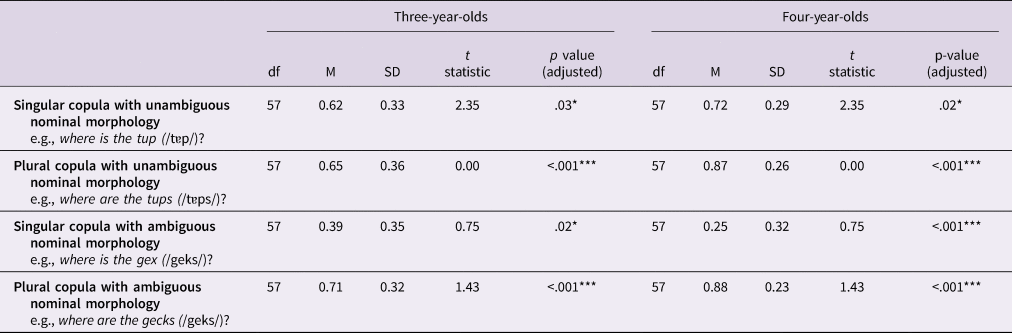
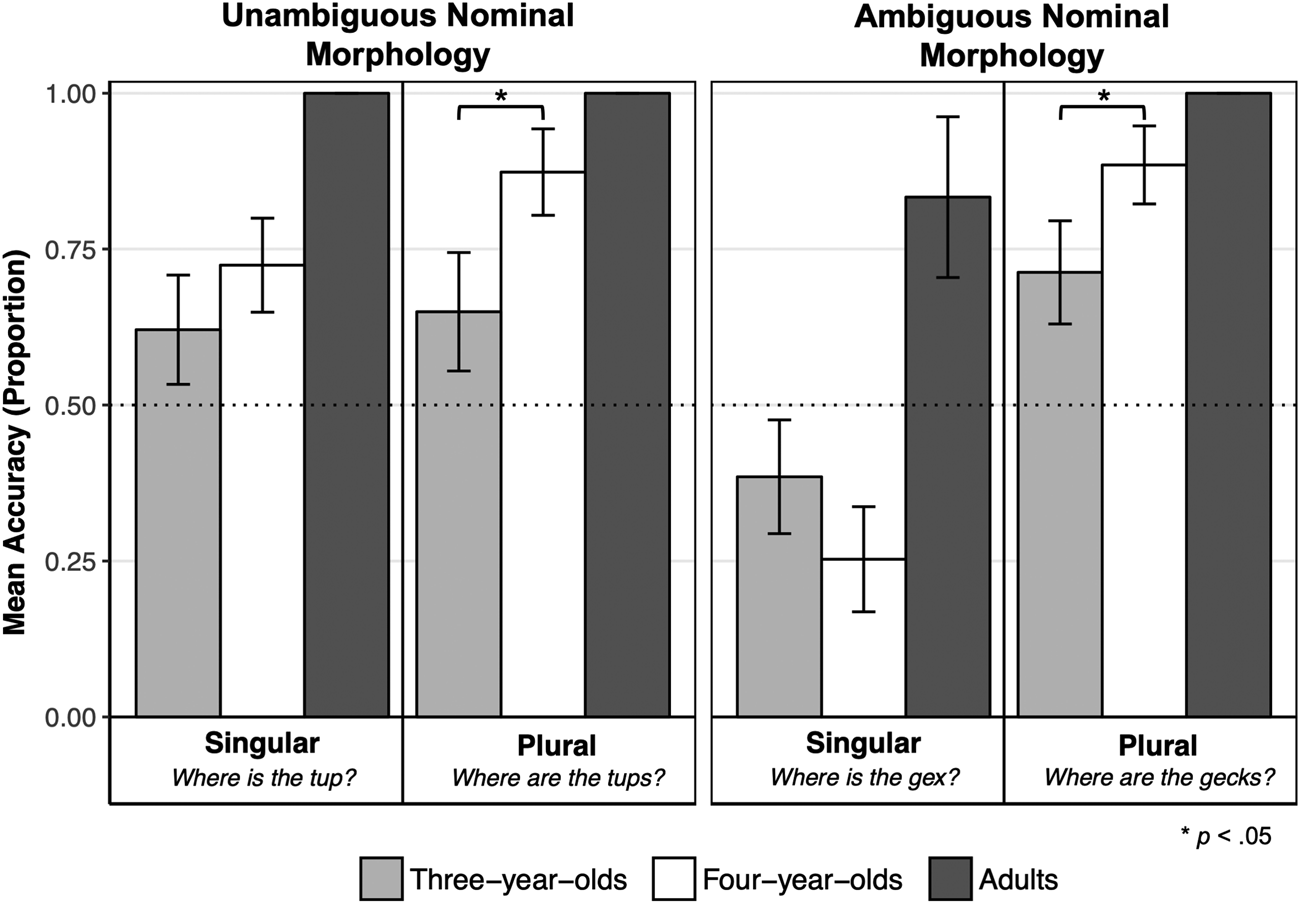
We hypothesised that three- and four-year-olds would use both nominal morphology and copula SV agreement to determine the number condition of novel words. Planned t-tests were therefore used to compare the singular/plural and the unambiguous/ambiguous novel word trials to chance (0.5).Footnote 1 While all conditions were found to be significantly different to chance, three- and four-year-olds were both significantly below chance for the ambiguous singular condition (Table 2). That is, in trials where the auditory stimuli were of the form where is the gex (/geks/), children selected the plural picture. Contrary to prediction, this suggests that children interpreted /ks/-final novel nouns as being inflected for plural, despite SV agreement with the singular copula is.
Planned t-tests of proportion accuracy vs. chance (0.5) for children's trials with ambiguous and unambiguous nominal morphology, by age (p values adjusted using Holm–Bonferroni method)

Note. *p < .05; ***p < .001.
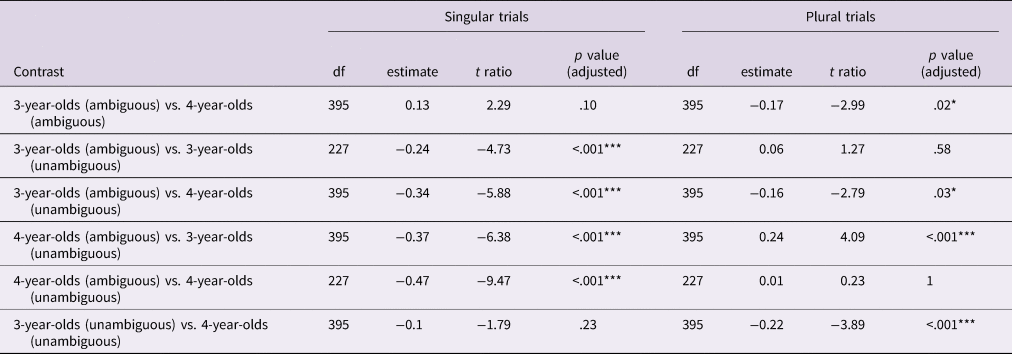
We also predicted that children would be more accurate in the conditions containing unambiguous nominal morphology, would be more accurate in trials with the plural copula, and that four-year-olds would be more accurate overall. Indeed, a three-way mixed ANOVA found significant main effects for Morphological ambiguity (F(1,114) = 42.75, p < .001), Number (F(1,114) = 58.13, p < .001), and Age (F(1,114) = 12.16, p < .001). Significant two-way interactions were found for Morphological ambiguity by Number (F(1,114) = 58.31, p < .001), Morphological ambiguity by Age (F(1,114) = 8.83, p < .01), and Number by Age (F(1,114) = 8.12, p < .01). Post-hoc comparisons of Morphological ambiguity and Age by Number were performed using the emmeans package (Lenth, Reference Lenth2019; Table 3).
Post-hoc comparisons for singular and plural novel-word trials by nominal morphology (unambiguous, ambiguous), and age (three-year-olds, four-year-olds); p values adjusted for multiple comparisons using the Tukey-HSD method

Note. *p < .05; ***p < .001.
Post-hoc comparisons show that the singular ambiguous trials were consistently less accurate than their unambiguous counterparts. That is, children consistently interpreted the ambiguous nominal morphology trials (e.g., where is the gex?) as referring to a plural referent (recorded as incorrect), and the unambiguous nominal morphology trials (where is the tup?) as referring to a singular referent (recorded as correct). No differences were discovered between three- and four-year-olds within the same trial types, suggesting that accuracy on the singular trials did not change with age (also, see Davies et al., Reference Davies, Xu Rattanasone, Schembri and Demuth2019).
For the plural trials, four-year-olds were significantly more accurate than the three-year-olds, suggesting that children attain better comprehension of plurals with age. No differences were found between the unambiguous and ambiguous plural trials, suggesting that novel words such as tups and gecks were equally regarded as plural in the presence of the plural copula are.
Paired t-tests were then used to examine whether the presence of is or are affected children's likelihood of choosing a plural picture in the ambiguous trials. Both the three-year-olds (t(57) = −2.43, p = .02) and four-year-olds (t(57) = –3.17, p < .01) chose the plural picture significantly more often in the plural condition. This could show that (a) the presence of is made the children less likely to interpret an ambiguous noun as plural, or (b) the presence of are made the children more likely to interpret an ambiguous noun as plural, or (c) both of the above.
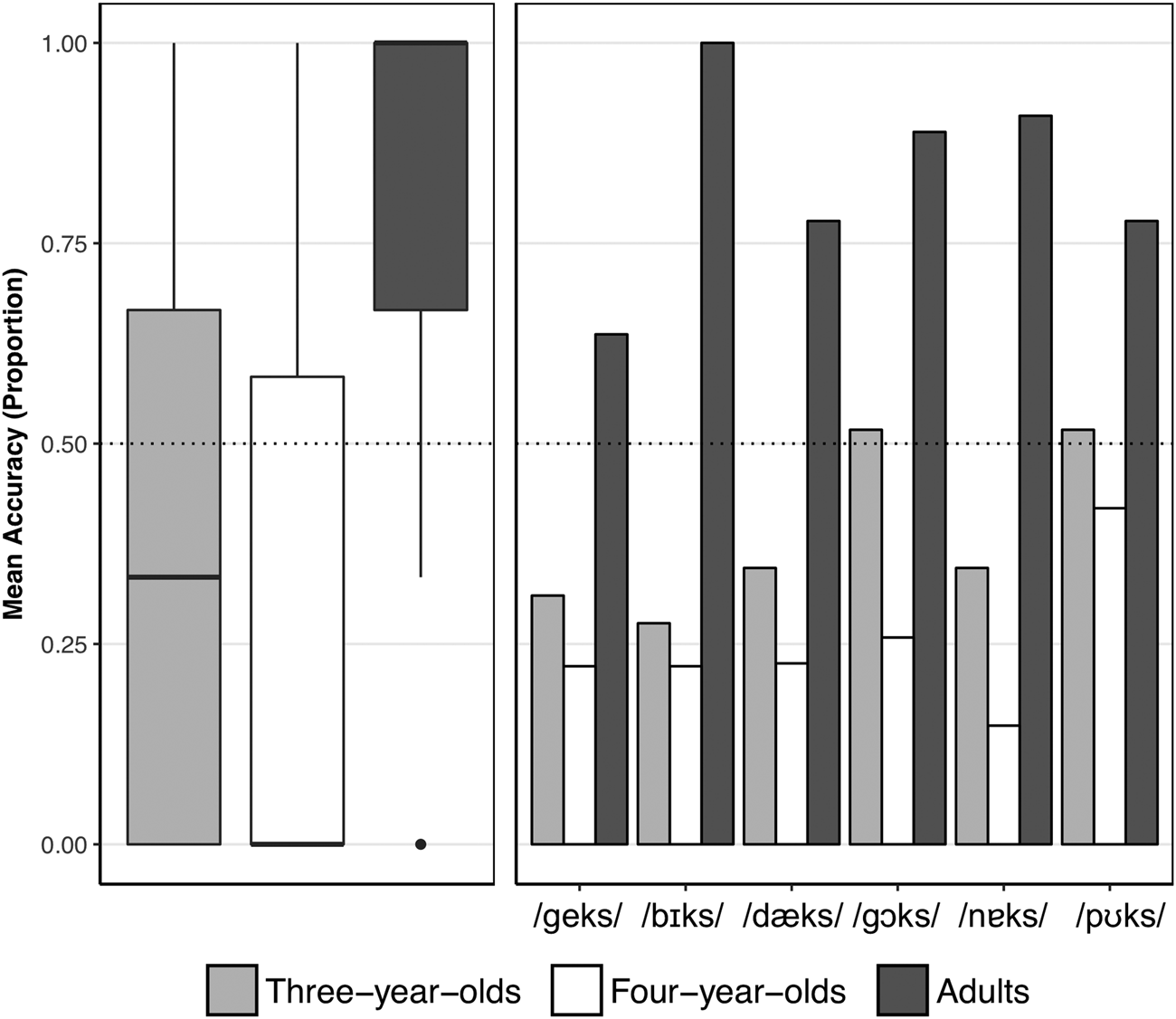
Adult results were not included in the statistical analyses above due to ceiling effects. Every trial was answered correctly for both unambiguous and ambiguous plural conditions and for the unambiguous singular condition. However, adults were not at ceiling for the ambiguous singular condition (M = 0.83, SD = 0.24), though they were still significantly above chance (t(19) = 13.52, p < .001). A Kruskal–Wallis rank sum test (Pohlert, Reference Pohlert2014) revealed a significant effect for trial condition (χ 2 = 22.68, p < .001), with post-hoc pairwise comparisons (Nemenyi test with chi-squared approximation for independent samples; Pohlert, Reference Pohlert2014) revealing ambiguous singular to be different to all other conditions (p < .01). These results were driven by seven adult participants who did not identify all three ambiguous singular trials as referring to the singular target picture; five adult participants identified two out of three as singular, one identified one out of three as being singular, and one identified none as being singular, interpreting all three as plural instead. The adults who did not reach ceiling in the ambiguous singular condition were significantly younger (Mage = 23.3 years, 21–31) than those who identified all trials in this condition as singular (Mage = 34.8 years, 19–59; t(14.81) = 2.81, p = .01). Overall, these results show that adults were paying attention to the copula, but that some of the younger adults sometimes interpreted words such as gex (/geks/) as plural, despite the presence of the singular copula is (Figure 2)
Children's and adults’ accuracy for the novel word trials. Error bars ± 1SE.

.
While the children (and some adults) interpreted the nouns with ambiguous nominal morphology as plural, despite singular copula SV agreement, it was not clear whether participants were simply attending to nominal morphology, or whether they were instead sensitive to other cues. Novel words used in the ambiguous singular trials had phonotactic forms similar to higher-frequencyFootnote 2 /ks/-final singular words (e.g., gox /gɔks/ to box /bɔks/); lower-frequency singulars (e.g., bix /bɪks/ to mix /mɪks/; dax/dæks/ to axe /æks/); extremely low-frequency words not present in the CHILDES corpus database (MacWhinney, Reference MacWhinney2000) (e.g., gex /geks/ to hex /heks/); or had no real-word singular analogues at all (i.e., nux /nɐks/; poox /pʊks/). A one-way ANOVA therefore looked at whether stimulus item (gex, bix, gox, dax, nux, poox) affected children's accuracy in the ambiguous singular trials. A non-significant, yet trending effect was found (F(5,342) = 2.16, p = .06), which appeared to be largely driven by children's slightly better accuracy on ambiguous singular trials with the novel words gox (/gɔks/; which has higher-frequency real-word singular analogues, such as box and fox) and poox (/pʊks/; which has no singular analogues, only plurals such as books; see Figure 3). For the adults, the only stimulus item that was consistently identified as singular was bix (/bɪks/); all other items were identified as being singular roughly 65–90% of the time (Figure 3). However, overall, there is no compelling evidence that stimulus item affected performance.
Participants’ accuracy in the ambiguous singular trials, by age group (left) and age group by stimulus item (right).

Discussion
The present study adds to a growing body of evidence showing that children use morphological structure to facilitate their comprehension of newly heard words (Arias-Trejo et al., Reference Arias-Trejo, Cantrell, Smith and Canto2014; Davies et al., Reference Davies, Xu Rattanasone and Demuth2017, Reference Davies, Xu Rattanasone, Schembri and Demuth2019; Kouider et al., Reference Kouider, Halberda, Wood and Carey2006; Lew-Williams & Fernald, Reference Lew-Williams and Fernald2007). The results expand on previous findings, demonstrating that children (and to some degree, adults) use lexical form as the primary cue to meaning – even in the presence of copula SV agreement. Despite predictions that three- and four-year-olds would use copula SV agreement to comprehend the number of morphologically ambiguous /ks/-final nouns (Deevy et al., Reference Deevy, Leonard and Marchman2017; Lukyanenko & Fisher, Reference Lukyanenko and Fisher2016), we found that children primarily relied on the perceived number information at the end of the word. That is, children interpreted morphologically ambiguous nouns in sentences as such as where is the gex (/geks/)? as plural, disregarding the copula number information. Yet, it was not just children who did so; approximately one-third of the adults also interpreted some of these singular copula sentences as referring to a plural referent. Thus, the present study also adds to a growing body of evidence showing asymmetries between comprehension of the singular and plural copula (Deevy et al., Reference Deevy, Leonard and Marchman2017; Lukyanenko & Fisher, Reference Lukyanenko and Fisher2016; Lukyanenko & Miller, Reference Lukyanenko and Miller2018).
These results seem to sit uncomfortably with previous research showing language processing as a predictive process. Language comprehension is incremental, established moment by moment as the sentence unfolds (Kamide, Altmann, & Haywood, Reference Kamide, Altmann and Haywood2003). Young children show evidence of incremental processing, whether it be through semantic biases, such as in German (Mani & Huettig, Reference Mani and Huettig2012), or grammatical agreement, such as gender in Spanish (Arias-Trejo et al., Reference Arias-Trejo, Cantrell, Smith and Canto2014; Lew-Williams & Fernald, Reference Lew-Williams and Fernald2007) and copula subject–verb agreement in English (Deevy et al., Reference Deevy, Leonard and Marchman2017; Lukyanenko & Fisher, Reference Lukyanenko and Fisher2016). Yet, these results show that children eschew the singular interpretation of where is the gex (/geks/)? despite the copula appearing earlier in the sentence than the noun. However, the present study is unable to tell whether participants were ignoring the verb is completely. Children's (and some adults’) initial interpretation may have been ‘corrected’ upon hearing what was perceived as a plural morpheme. Future studies employing on-line measures (such as eye-tracking) would be better able to investigate whether this was the case.
There is a possibility that these results are merely task-related. Participants were screened on their perception of /-s/ before performing the task, and it was carried out alongside another study looking at plural perception (Davies et al., Reference Davies, Xu Rattanasone, Schembri and Demuth2019). That is, participants may have been primed to interpret fricative-final words as plural. However, the results of Davies et al. show that children do not simply interpret fricative-final words as plural, as /s/- and /z/-final novel words such as koss (/kɔs/) and tizz (/tiz/) are comprehended as being singulars by children as young as three.
One reason for these results might be the participants’ language model. English speakers often mismatch number agreement under certain conditions of non-adjacency (e.g., the cost of the improvements have not yet been estimated; Bock & Miller, Reference Bock and Miller1991), and contraction (e.g., where's your shoes?; Crawford, Reference Crawford2005; Lukyanenko & Miller, Reference Lukyanenko and Miller2018; Meechan & Foley, Reference Meechan and Foley1994). Yet, in the current study the copula was both adjacent to the noun phrase and uncontracted. There are, however, many examples of copula SV agreement mismatches in everyday Australian English, including interviews on television and radio programming, such as: There is a million dollars in the bank account …, There is still further investigations …, and The key question is, what is those emission targets? These results may thus reveal something more broadly about use of the singular copula in Australian English. The adults who did not identify all of the ambiguous singular trials as singular tended to be younger than those at ceiling. This is could be an indication of a stable variation within Australian English, that was (for whatever reason) better captured in the younger adult participants, or alternatively, it may be indicative of language change in progress. Indeed, similar dialects have undergone changes in copula SV agreement, such as New Zealand English (e.g., they was getting loose; Hay & Schreier, Reference Hay and Schreier2004). However, these results are only suggestive; more investigation is needed.
Overall, this study shows that young children make use of the cues provided by nominal morphological structure to comprehend newly heard words, even when potentially ambiguous. This study raises questions about when copula SV agreement is understood in an adult-like way, but also raises questions about what adult-like actually entails. Understanding how children use syntax agreement and morphology to facilitate language processing has important clinical implications for children with hearing loss and developmental language disorder, for example (Conti-Ramsden, Reference Conti-Ramsden2003; Deevy & Leonard, Reference Deevy and Leonard2018; Koehlinger, Owen Van Horne, Oleson, McCreery, & Moeller, Reference Koehlinger, Owen Van Horne, Oleson, McCreery and Moeller2015; McGuckian & Henry, Reference McGuckian and Henry2007). Future studies with older children and speakers of other English dialects would shed further light on these issues. The current study provides a first step in that direction.
Acknowledgements
We thank Fabia Andronos, Nyari Marunda, Kelly Miles, Katherine Revius, Peter Humberg, the Child Language Lab at Macquarie University for assistance and feedback, and Tamara Schembri and Peter Budziszewski from ToyBox Labs for their role in building the experimental app. We also thank the participants, their parents, and the management and staff at the preschools that took part in this study. Finally, we thank the attendees to the 93rd Annual Meeting of the Linguistic Society of America, 2019, for helpful discussion. This research was partially funded by Macquarie University, the Australian Research Council Centre of Excellence in Cognition and its Disorders (CE110001021) and ARC FL130100014.