Introduction
Ancylostoma ceylanicum is a blood-feeding, infectious intestinal parasite that infects dogs, cats and many mammals, mainly occurring in Asia and the Pacific regions. In addition, it has also been reported in South Africa (Baker et al., Reference Baker, Lange, Verster and van der Plaat1989) and the United Arab Emirates (Schuster et al., Reference Schuster, Thomas, Sivakumar and O'Donovan2009). Infection occurs by oral ingestion or via the percutaneous migration of infective L3 from the environment. Clinical presentation includes iron deficiency anaemia, cutaneous larva migrans, gastrointestinal discomfort and, in some cases, severe and life-threatening infections may also occur (Bowman et al., Reference Bowman, Montgomery, Zajac, Eberhard and Kazacos2010).
Besides its veterinary importance, A. ceylanicum can also infect humans, causing zoonotic disease. Since the first report of A. ceylanicum in humans a century ago, it has always been neglected as rarely seen in humans. However, recent studies in Asia suggested that A. ceylanicum was the second most common hookworm in humans (Traub, Reference Traub2013). In Thailand, Laos, Malaysia and Cambodia, 6–52% of hookworm-positive individuals were infected with A. ceylanicum (Traub et al., Reference Traub, Inpankaew, Sutthikornchai, Sukthana and Thompson2008; Jiraanankul et al., Reference Jiraanankul, Aphijirawat, Mungthin, Khositnithikul, Rangsin, Traub, Piyaraj, Naaglor, Taamasri and Leelayoova2011; Conlan et al., Reference Conlan, Khamlome, Vongxay, Elliot, Pallant, Sripa, Blacksell, Fenwick and Thompson2012; Ngui et al., Reference Ngui, Lim, Traub, Mahmud and Mistam2012; Inpankaew et al., Reference Inpankaew, Schaer, Dalsgaard, Khieu, Chimnoi, Chhoun, Sok, Marti, Muth, Odermatt and Traub2014). Current estimates indicate that 19–93 million persons are infected by A. ceylanicum in the areas known to be endemic with this zoonotic hookworm (Traub, Reference Traub2013). Cats (pet animals), as a natural reservoir for A. ceylanicum transmission to humans, pose a threat to public health, where a prevalence range of 4.1–92% has been reported (Traub, Reference Traub2013). Ngui et al. (Reference Ngui, Lim, Traub, Mahmud and Mistam2012) have stated that residents in rural communities in Malaysia, who had close contact with their cats and dogs, were 2.9 times more likely to be infected with hookworm. Similarly, the human infection case reported in Fujian province in China was also associated with a high prevalence of A. ceylanicum in cats and dogs (Chen et al., Reference Chen, Xu, Zhou, Song, Wang and Zhu2012).
Exploring genetic variability within species is central to the study of their epidemiology and population genetics, and also has key implications in relation to control. Mitochondrial DNA has a high evolutionary rate, it provides sufficient levels of intra-species sequence variability compared to internal transcribed spacer (ITS) rDNA. The objective of this study was to estimate the prevalence of hookworm infection in cats in Guangzhou city, southern China, and simultaneously the cytochrome c oxidase subunit 1 (cox 1) gene of A. ceylanicum was amplified and compared with referential sequences of A. ceylanicum isolates from Malaysia and Cambodia, in order to explore its genetic diversity in different geographical locations.
Materials and methods
Collection and examination of faecal samples
From March to April 2014, faecal samples were collected from 112 cats in the district of Conghua, Guangzhou city (South China). The average annual temperature and rainfall of the district were 19.5–21.43°C and 1800–2200 mm, respectively. All cats were abandoned or stray, and stayed in the humane shelters over a month. For each cat, the following data were recorded: age, sex and neutering status.
Fresh faecal specimens were collected from the surface of faeces deposited on the ground, and were transferred immediately to the Parasitology and Parasitic Disease Laboratory, College of Veterinary Medicine, South China Agricultural University. The specimens were stored at 4°C in a potassium dichromate solution (at a final concentration of 2.5% (w/v)). For the detection of hookworm eggs in faeces, direct microscopic examination was done by saturated glucose flotation as described previously (Henriksen & Christensen, Reference Henriksen and Christensen1992).
Molecular analysis
All faecal samples were centrifuged, and the pellets were washed three times with distilled water. After centrifugation, all pellets were pretreated with five cycles of heating at 100°C for 5 min, followed by freezing at − 80°C for 5 min. Genomic DNA was extracted using the PowerSoil DNA Isolation Kit (Mo Bio, Carlsbad, California, USA) according to the manufacturer's protocols. The samples of DNA were stored at − 20°C.
For the identification of hookworm species, a polymerase chain reaction–restriction fragment length polymorphism (PCR-RFLP) protocol newly established in our laboratory was performed, as described by Liu et al. (Reference Liu, Zheng, Alsarakibi, Zhang, Hu, Lin, Tan, Luo, Lu and Li2014). Briefly, PCR amplification was performed for all samples. Amplified PCR products were digested with EcoRII, TapI and BusRI endonucleases in separate tubes at 37°C for 3 h, where EcoRII was used to identify A. ceylanicum and A. braziliense, and TapI was used to distinguish A. ceylanicum and A. caninum, while BusRI can only identify Uncinaria stenocephala. The PCR products and restriction fragments were analysed by gel electrophoresis in 3% (w/v) agarose gels stained with 0.2 μg/ml ethidium bromide, and visualized on a UV transilluminator.
The 12 randomly selected positive A. ceylanicum samples and two positive A. caninum samples were further characterized by analysis of the cox 1 gene. A 440 bp fragment of the cox 1 gene was amplified using a forward primer JB3 (5′-TTTTTTGGGCATCCTGAGGTTTAT-3′) and a reverse primer JB4.5 (5′-TAAAGAAAGAACATAATGAAAATG-3′), verified to be sufficiently conserved for hookworm by sequencing (Hu et al., Reference Hu, Chilton, Zhu and Gasser2002). The PCR reaction mix, of volume 25 μl, contained 2 μl genomic DNA (165.2 ± 4.5 μg/ml), 200 μm deoxynucleoside triphosphates (dNTPs), 25 pmol of each primer, 1 U Taq polymerase (TaKaRa, Dalian, China), 10 mm Tris-HCl, 3 mm MgCl2 and 50 mm KCl. The cycling conditions were 94°C for 5 min; followed by 35 cycles of 94°C for 30 s, 60°C for 30 s, 72°C for 45 s; and a final extension at 72°C for 7 min. A negative control of distilled water was included in the run. Amplicons were purified and sequenced by ABI 377 automated DNA sequencer (BigDye Terminator Chemistry, Oyster Bay, New York, USA).
Fourteen sequences (12 A. ceylanicum, 2 A. caninum) from this study were aligned with 32 cox 1 reference sequences (30 A. ceylanicum, 1 A. caninum and 1 A. duodenale) using Clustal X (Thompson et al., Reference Thompson, Gibson, Plewniak, Jeanmougin and Higgins1997). Sequences of A. ceylanicum were submitted to GenBank under the following accession numbers: KP072069–KP072080. Phylogenetic trees were constructed using MEGA version 5.1 (Tamura et al., Reference Tamura, Dudley, Nei and Kumar2007). Bootstrap analyses were conducted using 1000 replicates to assess the reliability of inferred tree topologies. Neighbour-joining algorithms were applied using the Kimura 2 parameter distance analysis.
Data analysis
Stray cats were grouped by age (young cat, < 1 year; adult cat, >1 year), gender and neutering, and their prevalence was compared pairwise by chi-square test with significance level of P < 0.05.
Results
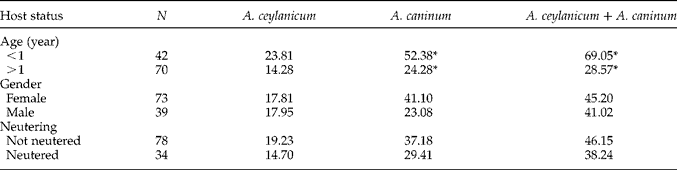
In faecal samples examined from 112 cats, 34.8% were shown to be positive for hookworm using microscopy and 43.8% with PCR, and all positive microscopic findings were also shown with PCR (table 1). The prevalence of all hookworms was significantly higher in young cats than in adults. No statistically significant difference was observed between female and male, or between neutered and non-neutered, cats.
The prevalences (%) of A. ceylanicum and A. caninum in stray cats from Guangzhou; N, number of cats examined.
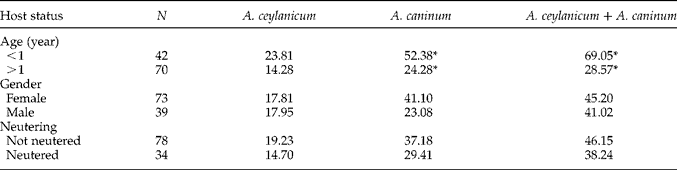
*, Level of significance with P < 0.05.
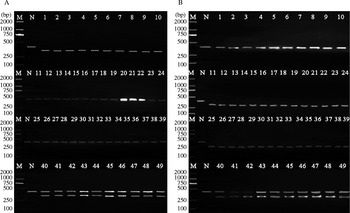
Of 49 positive hookworm samples, 20.4% were identified as single infections with A. ceylanicum (fig. 1A) and 59.2% were identified as single infections with A. caninum (fig. 1B), while the remaining 20.4% were mixed infections with A. ceylanicum and A. caninum. Although the prevalence in young cats was higher than that in adults, there were no significant differences in the prevalence of A. ceylanicum in age groups (P= 0.203). In addition there were no significant differences in the prevalence of A. ceylanicum relative to gender (P= 0.985) and neutering group (P= 0.565) (table 1).
PCR amplicons of Ancylostoma ceylanicum and A. caninum digested with endonucleases EcoRII (A: lanes 1–10, 40–49) and TapI (B: lanes 11–39, 40–49). Lanes: M, DL2000 DNA marker; N, negative control; 1–10, A. ceylanicum; 11–39, A. caninum; 40–49, A. ceylanicum and A. caninum.

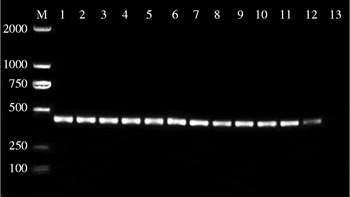
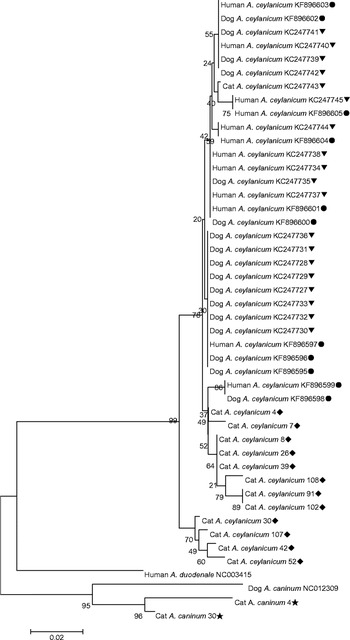
The amplification of the cox 1 gene yielded a fragment of approximate 440 bp (fig. 2), and subsequent sequencing confirmed that all fragments were 441 bp in length. In total, 12 A. ceylanicum and 2 A. caninum sequences were obtained (one sequence for each sample). Sequence comparison revealed that all A. ceylanicum sequences obtained in this study had 97–99% similarity with A. ceylanicum reference sequences (KC247727–247745, KF896595–896605). Phylogenetic analysis showed that A. ceylanicum isolates grouped together and were obviously different from A. caninum and A. duodenale (fig. 3). Within the A. ceylanicum isolates, there were two genetically distinct groups, one comprising four feline isolates (M30, Cm107, Cm42 and Cm52) from Guangzhou, the other comprising isolates from different hosts in Malaysia, Cambodia and Guangzhou. In the latter group, there were eight isolates (M4, M7, M8, Cm26, Cm39, Cm91, Cm102 and Cm108) from Guangzhou, which re-grouped into a minor group, separate from the rest of the isolates from other hosts and areas.
PCR amplification of partial cox 1 gene sequence of A. ceylanicum (lanes 1–12) from cats in Guangzhou, South China. Lane M, DL2000 DNA marker; lane 13, distilled water.

Phylogenetic tree of Ancylostoma ceylanicum and A. caninum based on the partial cox 1 gene sequences with the neighbour-joining algorithm using Kimura 2 parameter distance analysis. ♦ and ★ symbols represent sequences of A. ceylanicum and A. caninum from Guangzhou in the present study; ● and ▾ symbols represent reference sequences of A. ceylanicum from Cambodia and Malaysia.

Discussion
The common hookworms of cats worldwide are A. tubaeforme, A. braziliense, A. ceylanicum and U. stenocephala (Bowman et al., Reference Bowman, Montgomery, Zajac, Eberhard and Kazacos2010). In Guangzhou (southern China), however, A. ceylanicum and A. caninum were the two hookworms isolated from stray cats by our lab. Our result showed that the incidence rate of hookworm infection in 2014 was 43.8%, which is lower compared with the reported value of 95.1% in 2012 (Liu et al., Reference Liu, Zheng, Alsarakibi, Zhang, Hu, Lu, Lin, Tan, Luo and Li2013). Like the case reported in Australia (Palmer et al., Reference Palmer, Traub, Robertson, Hobbs, Elliot, While, Rees and Thompson2007), although anthelmintics were widely used in the present study area, rapid reinfection and drug resistance hamper control efforts.
By using a PCR detection method in present study, 49 samples were discovered to be positive for hookworm, while only 39 samples were positive by microscopy. This result suggests that the PCR method is more sensitive than microscopy, which can be attributed to the rapid destruction and lower number of eggs in stools. Younger cats were notably more often infected with hookworms, due to their immature immune system: whereas adult cats are more resistant to hookworm. This is in line with the general understanding of the epidemiology of hookworms (Speare et al., Reference Speare, Latasi, Nelesone, Harmen, Melrose, Durrheim and Heukelbach2006; Palmer et al., Reference Palmer, Traub, Robertson, Hobbs, Elliot, While, Rees and Thompson2007; Gates & Nolan, Reference Gates and Nolan2009; Little et al., Reference Little, Johnson, Lewis, Jaklitsch, Payton, Blagburn, Bowman, Moroff, Tams, Rich and Aucoin2009; Savilla et al., Reference Savilla, Joy, May and Somerville2011). Gender plays no significant role in hookworm infections; this coincides with the results of Becker et al. (Reference Becker, Rohen, Epe and Schnieder2012) and Robben et al. (Reference Robben, le Nobel, Dopfer, Hendrikx, Boersema, Fransen and Eysker2004), who have examined the prevalence of endoparasites, including hookworm, in cats from animal shelters. The possible explanation is that both male and female cats share a common environment and are similar in health and behaviour. The lower frequency of hookworm infection in neutered cats could be explained by the effect of de-sexing, which can produce a spillover benefit of immuno-protection against hookworm infection (Traub, Reference Traub2013), but the difference is not significant. This result corresponds with the findings in dogs by Visco et al. (Reference Visco, Corwin and Selby1977) and Coggins (Reference Coggins1998). The impact of age, gender and neutering on the prevalence of A. ceylanicum evaluated in this work revealed no significant difference in all groups. One of the main reasons for this reflects the density dependence of intra-specific competition for limited resources, which was previously reported in human hookworm infection (Inpankaew et al., Reference Inpankaew, Schaer, Dalsgaard, Khieu, Chimnoi, Chhoun, Sok, Marti, Muth, Odermatt and Traub2014).
Based on the sequence analysis of the cox 1 gene, A. ceylanicum isolates were divided into two groups: the first group comprising four isolates from Guangzhou and the second comprising those from Malaysia, Cambodia and Guangzhou. This separation was strongly supported by bootstrap analysis (99%). Additionally, in the latter group, all A. ceylanicum isolates from Guangzhou were clustered into a minor group again; the remaining isolates from Malaysia and Cambodia were located in an alternative clade. These data show that A. ceylanicum isolates from Guangzhou are genetically different from those of Malaysia and Cambodia, which are close neighbours. Thus, it supports the previous hypothesis that A. ceylanicum may represent a species complex (Ngui et al., Reference Ngui, Mahdy, Chua, Traub and Lim2013; Inpankaew et al., Reference Inpankaew, Schaer, Dalsgaard, Khieu, Chimnoi, Chhoun, Sok, Marti, Muth, Odermatt and Traub2014). Likewise, similar findings have also been reported for A. duodenale, A. caninum and Necator americanus (Prociv & Croese, Reference Prociv and Croese1996; Hu et al., Reference Hu, Chilton, Zhu and Gasser2002; Miranda et al., Reference Miranda, Tennessen, Blouin and Rabelo2008).
As for the evaluation of zoonotic risk of A. ceylanicum, in contrast to the results of Liu et al. (Reference Liu, Zheng, Alsarakibi, Zhang, Hu, Lin, Tan, Luo, Lu and Li2014) using the ITS sequence, our findings based on the cox 1 gene showed that the A. ceylanicum from cats in Guangzhou and from humans in Malaysia were clustered in separate groups. Therefore, future study on the cox 1 gene of human-derived A. ceylanicum in Guangzhou will be necessary to elucidate this question. Furthermore, analysis of the cox 1 gene of dog-derived A. ceylanicum in this area will be considered in the next investigation.
In conclusion, the present study showed a high prevalence of hookworm infection in stray cats from Guangzhou, especially in young cats. Molecular characterization revealed that A. ceylanicum and A. caninum were the two hookworm species infecting cats in the studied area. Our results support the suggestion that A. ceylanicum may be a species complex worldwide, as the phylogenetic analysis of the cox 1 gene showed that A. ceylanicum from cats in Guangzhou were genetically distinct from those of humans, dogs and cats in Malaysia and Cambodia. However, more genetic loci should be used for the genetic characterization of hookworm as there may be limitations in using only one locus.
Acknowledgements
The authors would like to thank the personnel of the humane shelter for helping to collect the samples.
Financial support
This work was funded by the National and Guangdong Province Natural Science Foundation of China (grant nos 31272551, 2014A020214005).
Conflict of interest
None.