BACKGROUND
Co-occurring substance use disorders and other psychiatric disorders represent important clinical challenges in psychiatry. This is particularly a serious problem in acute psychiatric wards where substance use is prevalent among the patients and complicates both the understanding and the treatment of the patients (Bonsack et al. Reference Bonsack, Camus, Kaufmann, Aubert, Besson, Baumann, Borgeat, Gillet and Eap2006; Flovig et al. Reference Flovig, Vaaler and Morken2009; Mordal et al. Reference Mordal, Holm, Gossop, Romoren, Morland and Bramness2011; Schanzer et al. Reference Schanzer, First, Dominguez, Hasin and Caton2006). At the same time, the wards are usually under pressure with a high workload and characterized by need for rapid clinical evaluations. Optimal treatment requires knowledge of the etiology and reciprocity of the different disorders and diagnostic accuracy, but this is often problematic to attain.
One possibility is to use a semi-structured standardized interview (Miller et al. Reference Miller, Dasher, Collins, Griffiths and Brown2001; Ramirez et al. Reference Ramirez Basco, Bostic, Davies, Rush, Witte, Hendrickse and Barnett2000). A number of widely used diagnostic tools such as the Composite International Diagnostic Interview (CIDI) (Wittchen, Reference Wittchen1994), the Structured Clinical Interview for DSM-IV (SCID) (First et al. Reference First, Spitzer, Gibbon and Williams1995; Spitzer et al. Reference Bryant, Rounsaville, Spitzer and Williams1992) and the Mini International Neuropsychiatric Interview (MINI) (Mordal et al. Reference Mordal, Gundersen and Bramness2010; Sheehan et al. Reference Sheehan, Lecrubier, Sheehan, Amorim, Janavs, Weiller, Hergueta, Baker and Dunbar1998) are also used for comorbid diagnoses (Mordal et al. Reference Mordal, Gundersen and Bramness2010; Samet et al. Reference Samet, Waxman, Hatzenbuehler and Hasin2007). These instruments rely on the judgment of the clinician or the patient to differentiate independent disorders from substance-induced disorders (Samet et al. Reference Samet, Nunes and Hasin2004; Torrens et al. Reference Torrens, Gilchrist and Domingo-Salvany2011). This may result in suboptimal diagnosis and treatment in this group of patients. Therefore, a reliable, valid and feasible instrument to investigate this comorbidity is important both in research and in clinical practice.
The Psychiatric Research Interview for Substance and Mental Disorders (PRISM) is a semi-structured diagnostic interview specifically designed to assess complex diagnoses in individuals with psychiatric disorders who abuse substances (Hasin et al. Reference Hasin, Trautman, Miele, Samet, Smith and Endicott1996). The PRISM was developed at Columbia University in New York City in the 1990s to overcome the difficulties of distinguishing between primary and substance-induced psychiatric disorders. PRISM follows the DSM-IV criteria and assesses 20 Axis I diagnoses (substance use disorders, mood disorders, psychotic disorders, anxiety disorders and eating disorders) and two Axis II diagnoses (antisocial and borderline personality disorder). The PRISM obtains a thorough history of heavy drug and alcohol use prior to other diagnostic sections. The main purpose of the PRISM is to provide valid and reliable diagnosis of DSM-IV disorders by differentiating between the expected effects of intoxication and withdrawal, substance-induced disorders, and primary psychiatric disorders. Specific guidelines throughout the interview aid in this differentiation. Earlier studies of the English and Spanish versions of the PRISM have shown high reliability and validity for substance use disorders and other psychiatric disorders in patient samples (Hasin et al. Reference Hasin, Trautman, Miele, Samet, Smith and Endicott1996; Torrens et al. Reference Torrens, Serrano, Astals, Perez-Dominguez and Martin-Santos2004). However, the interview has, so far, mainly been used in research rather than daily clinical practice. The feasibility of using it in acute psychiatric wards has not been studied sufficiently. The preconditions for use with severely ill patients are not self-evident in this setting. Further, this comprehensive interview might be time-consuming or otherwise difficult to implement.
AIMS
In the present study, we wanted to investigate the feasibility of using the Norwegian version of PRISM in psychiatric inpatients with co-occurring substance use disorders. This was done in an acute psychiatric ward characterised by a heavy patient load, short stays and a need for rapid clinical evaluation.
MATERIAL AND METHODS
Subjects
Participants (N = 61) were consecutively admitted patients to the 36-bed acute psychiatric ward in Blakstad hospital, a psychiatric hospital serving an adult population of about 120,000. The catchment area is close to the capital Oslo and consists of two municipalities representing a typical upper middle class Norwegian population. The lifetime prevalence of substance use disorders among psychotic patients age 18–40 years admitted to Blakstad hospital has previously been shown to be 70% (Helseth et al. Reference Helseth, Lykke-Enger, Johnsen and Waal2009). Patients in this study were between 18 and 65 years old and presented with mood symptoms, psychotic symptoms, or both.
All patients who had possibly misused alcohol, medication or illegal drugs within the previous 30 days were screened using the Alcohol Use Disorders Identification Test (AUDIT) and Drug Use Disorders Identification Test (DUDIT) (Berman et al. Reference Berman, Bergman, Palmstierna and Schlyter2005; Saunders et al. Reference Saunders, Aasland, Babor, de la Fuente and Grant1993). AUDIT and DUDIT screen for substance misuse during the previous year. Male patients with an AUDIT score ≥ 8, females with an AUDIT score ≥ 6 and/or patients with a DUDIT score ≥ 2 were invited to participate in a PRISM interview. Patients currently on opiate maintenance treatment (OMT) were asked to participate regardless of their current substance use (n = 4). Exclusion criteria were insufficient knowledge of Norwegian or English, severe cognitive dysfunction, or patients being in sheltered environments during the whole previous month. Participants were paid NOK 300 (approx. €40) upon completion of the PRISM interview.
PRISM interview
Translation of research instruments has been addressed by several authors (Beaton et al. Reference Beaton, Bombardier, Guillemin and Ferraz2000; Guillemin et al. Reference Guillemin, Bombardier and Beaton1993; Maneesriwongul & Dixon Reference Maneesriwongul and Dixon2004; Wang et al., Reference Wang, Lee and Fetzer2006). The underlying principle is to translate the new language version back to the original language. The PRISM interview (English, DSM-IV paper version; Hasin et al. Reference Hasin, Samet, Nunes, Meydan, Matseoane and Waxman2006) was translated into Norwegian by a professional translation firm (Ganesa Tekst AS, Oslo, Norway). This first Norwegian version was reviewed by the first author (VH) who is a trained psychiatrist in collaboration with clinical and research colleagues at the Norwegian Centre for Addiction Research. Discussions were held to reach consensus on numerous words and expressions. Thereafter, the corrected Norwegian version was translated blindly into English (back translation) by an American psychologist fluent in written Norwegian (Deborah Lynn Reas, Oslo, Norway). The back translated version was then compared to the original version and discrepancies were corrected. The PRISM developers at Columbia University checked and approved the final back translated English version. More information about the PRISM is available at Deborah Hasin’s website (http://www.columbia.edu/~dsh2/). The PRISM interview has previously only been translated into Spanish (Torrens et al. Reference Torrens, Serrano, Astals, Perez-Dominguez and Martin-Santos2004).
Four Norwegian PRISM interviewers were trained and certified by one of the authors (SS), a developer of the PRISM. The four interviewers (three psychiatrists and one psychologist) did 39, 17, 4 and 1 interviews respectively in this study. PRISM interviews were started as soon as patients were capable of giving valid and reliable answers as judged by a psychiatrist. In order to limit patient fatigue, the interview was conducted over several sessions. Sessions were terminated at the patient’s request, at interviewer’s clinical judgment, or because of the daily schedule of the ward. Short (up to 10 minute) breaks occurred during sessions as needed.
Variables recorded
For each patient the following were recorded: gender, age (years), referral procedures, AUDIT score (Saunders et al. Reference Saunders, Aasland, Babor, de la Fuente and Grant1993), DUDIT score (Berman et al. Reference Berman, Bergman, Palmstierna and Schlyter2005), PRISM diagnoses, total time (minutes) spent completing the interview, number of interview sessions in each PRISM interview, time from admission to start of interview (days), time from first to final interview (days), and whether patients were interviewed as an inpatient or outpatient. The Global Assessment of Functioning (GAF) scale (split version) was scored by the physician on duty (Endicott et al. Reference Endicott, Spitzer, Fleiss and Cohen1976).
The PRISM interview has a section for interviewer observations. We recorded the interviewer’s judgment of the patient’s mental status during the interview, the patient’s memory of previous history, the patient’s reaction to interview, how difficult it was to persuade the patient to participate in the interview and whether the patient agreed to include PRISM summary reports in their medical records.
Ethics and statistics
The study was approved by the regional committee of ethics and The Norwegian Data Inspectorate. All included patients gave their written consent. In addition, the clinicians in charge of the treatment signed declarations saying that patients were capable of giving a valid consent for participation. A summary report was made for each patient, based on the PRISM interview indicating substance use and diagnoses. Most patients (84%) gave written consent to include this summary report in their medical record.
The Statistical Package for the Social Sciences (SPSS) version 16.0 was used for data analyses.
RESULTS
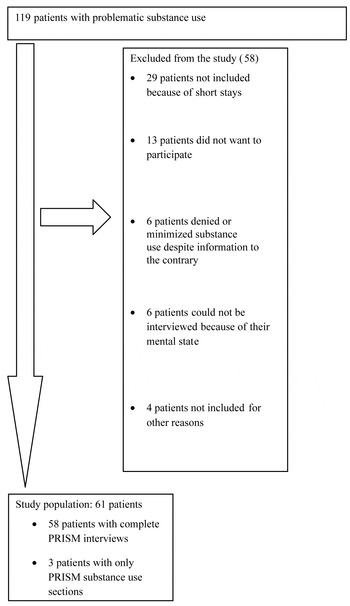
Sixty-one of the 119 eligible patients (51%) were included (Fig. 1). The main reasons for non-inclusion among eligible patients were too short stay in hospital (n = 29) or refusal (n = 13). These short stays had a median admission length of 40 hours (range 10–95) and 12 of these patients were mainly admitted during the weekend. In the study group, 43 patients were men (71%) and their median age was 33 years (range 21–59 years). All but three patients were ethnic Norwegians. All included patients had emergency admissions, and 27 of them (44%) were involuntarily admitted.
Flow chart patient inclusion

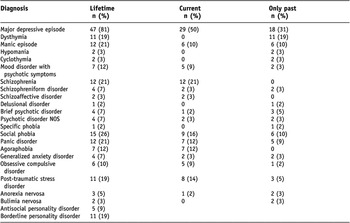
Median GAF function score was 38 (range 13–67). Median GAF symptom score was 40 (range 13–70). Median AUDIT score (alcohol use) was 14 (range 0–39) and median DUDIT score (drug use) was 10 (range 0–44). According to the AUDIT and DUDIT scores, 21 patients (34%) misused alcohol only, 17 patients (28%) misused drugs alone and 23 patients (38%) misused both alcohol and drugs. Psychiatric diagnoses (substance use disorders not included) according to the PRISM interview are shown in Table 1.
Psychiatric diagnoses according to PRISM in the 58 patients with complete interview (several patients had more than one diagnosis; substance use disorders (SUDs) are not included)

A complete PRISM interview was obtained from 58 out of 61 patients. In three patients only the overview, the substance screening and the substance use disorders sections were obtained: One patient did not want to talk more about psychiatric symptoms, one denied all psychiatric symptoms and one interview was impossible to complete because of chronic psychotic symptoms.
The median number of interview sessions per patient was three (range 1–6). The median time from admission to start of interview was nine days (range 1–55). The median time from first to final interview session was four days (range 0–98). Fifty patients (82%) were interviewed during their inpatient stay, five patients (8%) were interviewed after discharge, and six patients (10%) were interviewed both as an inpatient and an outpatient.
Median total interview time (sum of all sessions) was 155 minutes (range 35–435); for one patient interview time was not registered. Total interview time was statistically unrelated to many of the measured parameters (gender, age, number of admissions, involuntary admissions, GAF, and AUDIT). However, the time was related to the DUDIT score (Pearson’s r = 0.286, p = 0.027), the number of substances misused (Pearson’s r = 0.271, p = 0.036), the number of substance use disorders (SUDs) (Pearson’s r = 0.349, p = 0.006), and to the number of non-SUD psychiatric diagnoses (Pearson’s r = 0.404, p = 0.002). Patients without complete PRISM interviews were not included in this last correlation. In a linear regression model using total interview time in minutes as dependant variable and number of non-SUD psychiatric diagnoses as explanatory variable, including only patients with complete PRISM interviews, we found a beta coefficient of 12.8 (SE = 3.9) indicating an increase of about 13 minutes for each additional diagnosis. When we included all patients, we found that an increase in DUDIT score of ten points increased the time for interviewing by 14.6 minutes (SE = 6.4). Again, when we included all patients, we found a beta coefficient of 7.7 (SE = 2.7) indicating an increase of about eight minutes for each additional substance use disorder diagnosis.
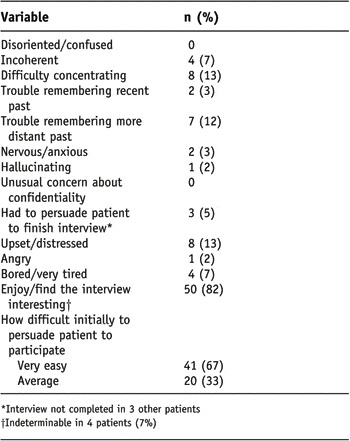
The interviewer observations from the PRISM interview are summarised in Table 2. As can be seen, the interviewers noted very few problems when conducting the interviews. Eighty-two per cent of patients appeared to enjoy the interview or find it interesting. None of the included patients were initially difficult to persuade to participate in the interview.
Patients’ behaviour, attitude and reactions to the PRISM interview as observed during interview by the interviewer (N = 61)

*Interview not completed in 3 other patients
†Indeterminable in 4 patients (7%)
A great majority of patients appeared to have no special problems with remembering their history of substance use and psychiatric symptoms. The exceptions were patients with many previous psychotic episodes. In these cases, the patients’ medical records were needed to map previous symptoms in relation to substance use during specific time periods.
Almost all patients reacted positively to the interview. Some of the comments from patients were:
• “The interview helped me understand the connections between psychiatric symptoms and substance use, it became clearer to me”
• “It was very good to see the timelines, I can then put the substance use behind me, finish it”
• “The structured questions made it easier to focus”
• “The interview is so accurate. I feel confident about the interview. This makes me feel secure and gives a feeling of being important.”
• “The interview allows talking about issues concerned with shame. The interview is therapy, as well.”
DISCUSSION
This study demonstrated that that it was feasible to use PRISM in a busy acute psychiatric ward with a relatively high percentage of involuntary admissions. This is important because the feasibility of any complex diagnostic interview in everyday clinical work is questionable. We succeeded in doing PRISM in half of the eligible patients. The main reason for non-inclusion was too short a stay on the ward, which meant there was not enough time to stabilise the patient and establish the patient–interviewer alliance. The median time from admission to start of interview in this study was nine days (range 1–55). Consequently, it was difficult to carry out the interview in short stay patients. Also, with the current study group, outpatient interviews were difficult to do. Subjects with substance abuse and mental disorders often have rather unstable living conditions and poor adherence to appointments in an outpatient setting. Thus, it seems reasonable to aim at completing the interviews in this group of patients before discharge.
All but two patients required more than one session on different days to complete the PRISM interview. Total interview time was related to the DUDIT score, the number of substances misused, the number of SUDs, and the number of non-SUD psychiatric diagnoses. Thus, we found that the amount of drug use and increasing psychiatric morbidity lengthened the interview.
As shown both in spontaneous comments and in interviewer observations, the patients seemed to appreciate the thoroughness of the examination. Some even expressed increased understanding of how substance use interfered with their mental problems. Patients appreciated the structured way the PRISM interview made them recall their history of substance use and mental disorders. They expressed satisfaction with being so thoroughly diagnosed. We encountered few problems concerning patients’ behaviour during interview. Obviously, the interviewers’ clinical experience with severely ill patients helped the alliance with the patients in this study. Besides, clinical skills ensure valid data when using structured diagnostic interviews (Endicott, Reference Endicott2001).
The feasibility of the PRISM interview has been questioned because of its extensive and time consuming nature. In our study the PRISM interview was indeed time consuming, with a median interview time of 2 hours 35 minutes. This is, however, comparable to, for example, the CIDI interview which in some studies has been described as taking up to two to three hours, with the substance use disorder section being especially time consuming (Wittchen et al. Reference Wittchen, Robins, Cottler, Sartorius, Burke and Regier1991). Some have therefore claimed that the CIDI is too long (Wittchen et al. Reference Wittchen, Robins, Cottler, Sartorius, Burke and Regier1991; Wittchen, Reference Wittchen1994), despite its high reliability and validity (Andrews & Peters Reference Andrews and Peters1998; Wittchen Reference Wittchen1994). The SCID interview has been shown to take less time, but this was found in a community mental health setting (Ramirez et al. Reference Ramirez Basco, Bostic, Davies, Rush, Witte, Hendrickse and Barnett2000). However, for common comorbid disorders SCID has shown only moderate concurrent validity and poor predictive validity in substance abusing patients (Kranzler et al. Reference Kranzler, Kadden, Babor, Tennen and Rounsaville1996). This suggests a need for additional expertise or the use of diagnostic instruments aimed more specifically at substance abuse (Kranzler et al. Reference Kranzler, Kadden, Babor, Tennen and Rounsaville1996). Diagnosing psychiatric disorders in subjects with substance use disorders have been shown to be less reliable when the SCID or the Diagnostic Interview Schedule (DIS) have been used (Bryant et al. Reference Bryant, Rounsaville, Spitzer and Williams1992; Ross et al. Reference Ross, Swinson, Doumani and Larkin1995). Thus, the PRISM interview may have advantages over these other diagnostic options. Shorter diagnostic instruments like the MINI have been developed to shorten the process, but will naturally give less information because of the shorter format (Lecrubier et al. Reference Lecrubier, Sheehan, Weiller, Amorim, Bonora, Sheehan, Janavs and Dunbar1997; Sheehan et al. Reference Sheehan, Lecrubier, Sheehan, Amorim, Janavs, Weiller, Hergueta, Baker and Dunbar1998). Studies have also shown that even the MINI interview has many of the same problems that we encountered with the PRISM interview: it is not feasible for all patients because of short stays on the ward, involuntary admissions, psychosis, and substance use (Mordal et al. Reference Mordal, Gundersen and Bramness2010).
Diagnosing comorbid disorders is difficult (Carey & Correia, Reference Carey and Correia1998). Thus, proper diagnosing of comorbid patients takes time, and earlier studies have shown that structured interviews enhance diagnostic accuracy (Miller et al. Reference Miller, Dasher, Collins, Griffiths and Brown2001; Ramirez et al. Reference Ramirez Basco, Bostic, Davies, Rush, Witte, Hendrickse and Barnett2000). Diagnostic precision leads to cost-effective practices and better patient care (Miller, Reference Miller2002).
As with other standardised, paper-and-pencil diagnostic measures, PRISM interviewers require training, a factor which will naturally limit the use of the PRISM in clinical settings with financial, staffing, and time constraints. In this study, interviewers were easily available for the hospital ward when patients were ready for interviews. PRISM certification is based on participation in a 2-day workshop where an experienced PRISM interviewer evaluates a recorded interview submitted by the trainee. Fortunately, a computer assisted version (PRISM-CV) is currently available and is being translated into Norwegian. The PRISM-CV has the potential to be more user friendly in clinical settings, and beta testing to study this is underway.
CONCLUSION
Despite the extensive format of the interview, it was possible to use the PRISM systematically with psychotic and mood disordered patients in a busy acute psychiatric ward. We succeeded in interviewing 51% of the eligible patients. The main reason for non-inclusion was too short a stay. Patients expressed views that the interview was meaningful and there were very few negative reactions. Therefore, if the PRISM-CV reduces administration time and if a positive cost–benefit analysis can be shown, this will give the necessary momentum to implement the PRISM interview in routine clinical work.