2014, at last, revealed the wreck of HMS Erebus off Canada's Arctic mainland. Two years later, her companion, HMS Terror, was found 40 miles away, off King William Island. The government was already confident enough about their whereabouts in 1992 to declare the entire area a National Historic Site and, among other responses to the retreating ice and increasing shipping, Parks Canada began searching for the wrecks in 2008. Previous investigators had concentrated on tracing and recording the crews: among others, Owen Beattie in the 1980s (Notman et al. Reference Notman, Anderson, Beattie and Amy1987), F.L. McClintock in 1857–1859, and four naval expeditions before that. HMS Investigator was lost in the 1853 search, and her wreck discovered off Banks Island in 2011. Ranging very widely, all of the investigators, and many others, were trying to find out what befell Sir John Franklin's attempt to complete the Northwest Passage between the Atlantic Ocean and the Pacific in 1845–1848. Erebus and Terror were his ships.
Not least thanks to campaigning by his widow, Franklin's fate became a top topic in Britain, Canada and the USA during the 1850s and beyond. The Northwest Passage had eluded explorers for centuries. For the British, national pride was at stake. Moreover, the Arctic was a new frontier; people were eager for tales of ingenuity, endurance and bravery—especially ones cast with pathos. The idea of the polar regions as zones of terrible mystery insusceptible to Victorian civilisation added tingling allure. Yet, even as the failure of successive searches for Franklin enhanced that image, each expedition explained the Arctic better (Loomis Reference Loomis, Knoepflmacher and Tennyson1977).
The story has remained stock in publishers’ trade to today. Now, finds new and old are on display in ‘Death in the ice’ at the National Maritime Museum, in London, which opened in July 2017. It recounts the history with a fresh approach, for the more recent explorations were anthropological and archaeological. Shown alongside the finds, a diverse range of history exhibits and ethnographic pieces provides context. What, then, does archaeology contribute to such a well-known history?
Following an introduction, the exhibition opens with a kayak and mannequins in traditional Inuit (‘Eskimo’) dress to illustrate the communities from whom McClintock gathered reports of corpses on King William Island. The Inuit had filched implements from Franklin's abandoned ships and used them to make tools of their own. McClintock bought some of those tools, and ‘Death in the ice’ shows a couple of them alongside traditional ones without European parts. We learn too how, in 1861, one Inuit report of Europeans led to mine workings of Martin Frobisher's from almost 300 years before! We can hear short recitals of informants’ accounts in English and the region's Inuit language.
The next part explains a little of the nineteenth-century's Arctic craze through melodramatic oil paintings of expeditions and an electronic map to explain Europe's growing knowledge of the region's geography. Accompanied by the ‘ambient’ sound of wind, there are models and drawings of the ships and a profile to show how their hulls were reinforced to withstand the pack ice. There are photographs of Franklin and his officers. Next, with sounds of creaking timbers and music, comes a mock-up of the spartan quarters where crews would have spent their dark winters. A fiddle and playbills, crockery from the Erebus, a sextant and a cat-o’-nine-tails evoke aspects of the experience. Summers were devoted to fieldwork as well as navigation: a floor case displays a little stove, snow goggles, ammunition, clay pipe fragments and other traces recovered by McClintock's expedition from a camp at Cape Felix.
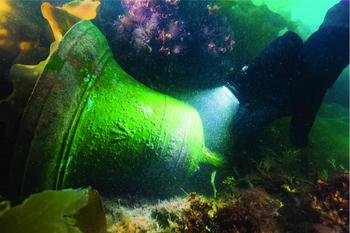
The rest of the exhibition is devoted to the search. Lady Franklin's campaign is illustrated with Staffordshire ware figures of both Franklins c. 1850, a letter of hers to Sir John dated 1853 and one from home to Terror’s cook (“I Wright these few lines to in hopes”, sic) “returned to the sender”. A sledge and a sock from Melville Island are among the exhibits from the Navy's last attempt. We see the messages found by McClintock's team at Point Victory (“All well”, 1846, and, in 1848, “Terror and Erebus [. . .] deserted”, “Franklin died”) and scraps of paper from at least one other search party, in a box apparently bitten by a bear. Then comes a forensic tent (with a mawkish admonition to “be respectful as you enter”) over the model of three graves for early casualties, showing photographs of the interments as opened by Beattie and colleagues, the emaciated bodies preserved very well (Notman et al. Reference Notman, Anderson, Beattie and Amy1987). Each photograph is accompanied by one of the textiles buried with the respective body. Beside this display is a cleverly designed discussion of the causes of death, including the proposition of lead poisoning from the expedition's tins (Kowal et al. Reference Kowal, Beattie, Baadsgaard and Krahn1991: 194). Here too is mentioned the Inuit suggestion that the explorers had resorted to cannibalism in the last days of their trek and the finding that, indeed, a quarter of the human bones found on King William Island were butchered (Mays & Beattie Reference Mays and Beattie2015). The next section, on the discoveries of 2014 and last year, is a bright contrast. Once abandoned, both ships drifted far southward before sinking. Along with a selection of the finds, photographs, a large video screen and models of the Erebus help to explain the techniques of survey and recovery (Figure 1).
Erebus's bell as found. The ‘broad arrow’ indicates British government property (Thierry Boyer © Parks Canada).

“Yet many questions remain”, urges the final panel. It emphasises enigma, illustrated, in the last wall case, by personal possessions including a beaded silk purse. Indeed, the very first exhibit is a surprisingly elegant shoe from the Erebus. ‘Death in the ice’ indulges as much as the Victorians did in ‘human interest’.
The exhibits, more than 200, have been assembled from six museums and archives in Canada, the National Maritime Museum itself—imaginative contributions—and one private collection. The design is thoughtful but restrained, the pieces distributed and lit effectively for diverse sizes, forms, colours and visual textures. In places, suggestive pictures are projected onto the walls. Visitors evidently appreciate the concise wall texts and the variety of printed or aural information, some from touch screens. There is no catalogue, but an attractive booklet illustrates a lot of the exhibits clearly along with admirably concise texts (Ryan Reference Ryan2017). A selection of the finds and many of the pictures (including one of one of the corpses that is much more compelling than the photograph in the gallery) are also shown in a very readable and highly informative book about the story (Hutchinson Reference Hutchinson2017; but not citing more specialised literature).
Archaeology's role so far is, indeed, ‘handmaiden’ to the explorers. Yet ‘Death in the ice’ implies that it will grow. The Terror, in particular, 24 fathoms down, looks largely intact with its hatches shut. Hutchinson (Reference Hutchinson2017: 161, 170) speculates that it preserves the records of scientific observations or (less likely, perhaps, to have been filed tightly enough to survive) notes to confirm why the ships were abandoned. Was the coal exhausted, as she asks, or the larders? Both wrecks too could help us to assess the etiquette of Victorian shipboard life (Hutchinson Reference Hutchinson2017: 61–62, 82–83): were the norms different among men specially chosen for a long exploration; or did discipline change after Franklin's death and during the last months aboard?
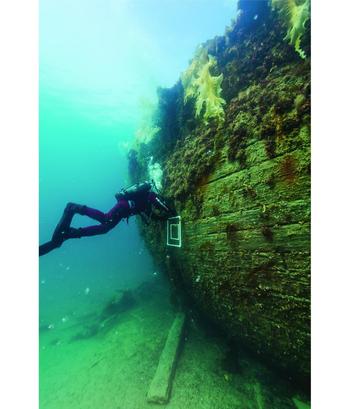
Perhaps there is scope for environmental archaeology too. Has evidence survived of conditions in the quarters, the stores, the galleys and other work spaces? Then too, the Erebus has been colonised by flora (Figures 1–2): could both ships, at their respective depths, provide a terminus post quem for responses of sea life to rising temperature (Yergeau et al. Reference Yergeau, Michel, Tremblay, Niemi, King, Wyglinski, Lee and Greer2017)? If so, could techniques of stratigraphy, vertical or horizontal, be devised for tracing successive colonisations (Parks Canada 2015)?
Sampling Erebus's hull (Thierry Boyer © Parks Canada).

‘Death in the ice: the shocking story of Franklin's final expedition’ remains at the National Maritime Museum until 7 January 2018. The Canadian Museum of History, Ottawa, will show it from March to September 2018.
Acknowledgements
The Museum's impeccable and energetic Rhianon Davies arranged for my visit and provided the figures. Charles Greer discussed the microbiological potential with me; and Claire MacDonald directed me to Loomis's excellent article.