Introduction
Early language input affects children's language development (e.g., Hart & Risley, Reference Hart and Risley1995; Hoff & Naigles, Reference Hoff and Naigles2002). For example, some research shows that children's vocabulary skills correlate with quantitative and qualitative features of input speech that caretakers offer children during day-to-day interactions (Hart & Risley, Reference Hart and Risley1995). However, previous literature has mostly focused on MATERNAL input. Relatively little attention has been devoted to input from other children and adults. In this paper, we will describe input from corpora where other speakers, in addition to mothers, talk to children.
Most previous studies on language input are based on families living in middle-class Euro-American communities. Indeed, Henrich, Heine and Norenzayan (Reference Henrich, Heine and Norenzayan2010) observed that most participants in psychological studies come from a Western, Educated, Industrialized, Rich and Democratic (WEIRD) population sample, and this bias is also obvious in developmental studies (Nielsen, Haun, Kärtner & Legare, Reference Nielsen, Haun, Kärtner and Legare2017). Recent evidence points to the fact that input differs depending on the culture of the family (e.g., Cristia, Dupoux, Gurven & Stieglitz, Reference Cristia, Dupoux, Gurven and Stieglitz2019). What limited literature exists supports the idea that different populations also have different norms about who is expected to speak to children.
Sources of input
In most middle-class Euro-American families, parents are expected to have absolute responsibility over their children. Consequently, most studies focus on parental input, rather than input from non-parental speakers (e.g., Huttenlocher, Waterfall, Vasilyeva, Vevea & Hedges, Reference Huttenlocher, Waterfall, Vasilyeva, Vevea and Hedges2010; Pan, Rowe, Singer & Snow, Reference Pan, Rowe, Singer and Snow2005). Moreover, in these families, the mother typically has the role of primary caregiver (e.g., Roopnarine, Fouts, Lamb & Lewis-Elligan, Reference Roopnarine, Fouts, Lamb and Lewis-Elligan2005). As a result, mother-child dyad speech has long been emphasized in early input studies.
However, the focus on the mother as the primary caregiver might not reflect universal human tendencies. There is evidence suggesting that mothers are not always the sole, or even principal caretakers (e.g., Weisner, Gallimore, Bacon, Barry, Bell, Novaes, Edwards, Goswami, Minturn, Nerlove, Koel, Ritchie, Rosenblatt, Singh, Sutton-Smith, Whiting, Wilder & Williams, Reference Weisner, Gallimore, Bacon, Barry, Bell, Novaes, Edwards, Goswami, Minturn, Nerlove, Koel, Ritchie, Rosenblatt, Singh, Sutton-Smith, Whiting, Wilder and Williams1977). Caretaking of a child by an individual who is not the mother is referred here as alloparental care. Using an ethnographically-detailed sample of more than 170 societies, Barry and Paxson (Reference Barry and Paxson1971) found that, during infancy, people other than the mother had important caretaking roles in 40% of societies. After infancy people other than the mother had important caretaking roles in 41% of societies, and in an additional 29% the mother provided half or even less of the care (see also Weisner et al., Reference Weisner, Gallimore, Bacon, Barry, Bell, Novaes, Edwards, Goswami, Minturn, Nerlove, Koel, Ritchie, Rosenblatt, Singh, Sutton-Smith, Whiting, Wilder and Williams1977).
Even in North America, responsibility for care can be shared among a circle of individuals, kin and non-kin, older siblings, peers or cousins, as part of common daily routine (Fouts, Roopnarine, Lamb & Evans, Reference Fouts, Roopnarine, Lamb and Evans2012). For example, according to the Census 2000 (Simmons & Dye, Reference Simmons and Dye2003), 5.8 million grandparents in the United States were either primary caregivers raising grandchildren, or living as co-residents and helping to care for grandchildren. Additionally, lower income Euro-American families seem to rely more than middle income families on extended kin for child care (Hofferth, Reference Hofferth1995). Caregiving by other adults, such as grandmothers, is common in many cultures, including many African communities (e.g., Thupayagale-Tshweneagae, Reference Thupayagale-Tshweneagae2008).
Anthropological evidence suggests that siblings are frequent alloparental carers across cultures – for example, in Java, (Geertz, Reference Geertz1989); Kwoma of New Guinea (Whiting, Reference Whiting1941); and Polynesia (Martini & Kirkpatrick, Reference Martini, Kirkpatrick, Roopnarine and Bruce1992). In Hawaiian families, caretaking is shared among parents, neighbors, kin, and almost always children (Gallimore, Boggs & Jordan, Reference Gallimore, Boggs and Jordan1974). These results also relate to household size, as larger household size means more opportunities for alloparenting. For example, the total number of siblings and incidence of sibling caretaking seem to correlate in Hawaiian-American families (Gallimore et al., Reference Gallimore, Boggs and Jordan1974). Families tend to be larger cross-culturally than is the case for the United States (Burch, Reference Burch1979).
Siblings might play some caretaking role, even in middle-class Euro-American families. For instance, in an experimental setting with 57 American mothers and their preschool children, Stewart and Marvin (Reference Stewart and Marvin1984) found that when the mother left the room, 51% of older siblings engaged in caretaking activities. Sibling caretaking has also been documented in blue collar African-American and Latino families, where most play also happens among siblings (Zukow-Goldring, Reference Zukow-Goldring and Bornstein2002).
Even when children in the environment are not alloparental carers, they may play with the younger child, and therefore have an opportunity to provide linguistic input. Play in children groups of the same or mixed age is another way to expose oneself to language. Children growing up in middle-class Euro-American families interact in groups of other children on many occasions, such as in preschool and kindergarten (even though these interactions are usually monitored by adults). In Arnhem Land, children are absorbed into peer groups by the age of two years (Hamilton, Reference Hamilton1981). In Guatemala, Mayan children at the age of two years start spending their time with other children and seldom look for adult attention (Rogoff, Reference Rogoff1981).
Despite the prevalence of young children's exposure to a variety of potential speakers, few studies describe input to children produced by other family members such as siblings (but see Hoff-Ginsberg & Krueger, Reference Hoff-Ginsberg and Krueger1991; Weppelman, Bostow, Schiffer, Elbert-Perez & Newman, Reference Weppelman, Bostow, Schiffer, Elbert-Perez and Newman2003), and other adults (but see Shute & Wheldall, Reference Shute and Wheldall1999). Our study takes a step toward filling this gap by analyzing the amount and qualitative features of input speech children receive in diverse communities by mothers, other children, and adults.
Quantity of input
Across cultures, the total amount of input directed to children may differ (for discussion see Bunce et al., 2021; Casillas, Brown & Levinson, Reference Casillas, Brown and Levinson2019; Cristia et al., Reference Cristia, Dupoux, Gurven and Stieglitz2019; Ochs & Schieffelin, Reference Ochs and Schieffelin1994; Shneidman & Goldin-Meadow, Reference Shneidman and Goldin-Meadow2012). More relevant to our study is the quantity of input as a function of different speakers and addressees, which may vary across cultures. The input directly addressed to a child is called child-directed speech (CDS).
For example, according to Shneidman and Goldin-Meadow (Reference Shneidman and Goldin-Meadow2012), the frequency of utterances spoken by other children was higher in their study of a Yucatec Mayan village than in Chicago (68% of CDS vs. 10% of CDS at 24 months). In fact, unlike in Chicago, other children talked to the target child more than other adults did. Indigenous Australian Yakanarra child-aged interlocutors also address markedly more input to younger interlocutors than older interactants do (Loakes, Moses, Wigglesworth, Simpson & Billington, Reference Loakes, Moses, Wigglesworth, Simpson and Billington2013). Mothers were not the major source of language input for Luo, Koya and Samoan children in one study (Snow & Ferguson, Reference Snow and Ferguson1979).
The proportion of speech that is addressed to the key child versus overheard (other-directed speech, henceforth ODS) should also be considered. For example, about 47% of input was CDS and 53% was ODS in Yucatec Mayan children's input at 24 months. Some researchers argue that at least some amount of early language learning must be based on overheard, rather than child-directed speech (e.g., Ochs & Schieffelin, Reference Ochs and Schieffelin1994). Lieven (Reference Lieven, Gallaway and Richards1994) suggests that the child-centered style of speaking is only one way of enabling children to learn language, but it is not essential, and concludes that children around the globe tend to learn language at approximately the same time, despite the many diverse ways of speaking to (and around) them (see e.g., Casillas et al., Reference Casillas, Brown and Levinson2019). Indeed, children are good at observing and learning from interactions taking place around them (e.g., Rogoff, Reference Rogoff2003 – see also behavioral experiments from Akhtar, Reference Akhtar2005; and naturalistic evidence from Barton & Tomasello, Reference Barton and Tomasello1991). We should also consider the fact that ODS is not necessarily speech directed to adults, but it can also be directed to other children, especially in communities where children spend a lot of time together. Speech directed to other children, even though overheard, may be easier to follow and of higher relevance to the child than speech directed to adults.
Qualitative features of input
Quantity is not the only aspect of input that matters. Other qualitative features of input may also be important. CDS can differ from ADS along many dimensions. For instance, maternal CDS is characterized by more questions (e.g., Kruper & Užgiris, Reference Kruper and Užgiris1987), lower lexical diversity and more repetitions (e.g., Hoff, Reference Hoff2006), as well as shorter utterances (e.g., Henning, Striano & Lieven, Reference Henning, Striano and Lieven2005); including a higher prevalence of single word utterances (e.g., Brent & Siskind, Reference Brent and Siskind2001).
Although American English is the most studied language with respect to CDS, there is evidence for some properties of CDS in a variety of languages, including French (Loukatou, LeNormand & Cristia, Reference Loukatou, LeNormand and Cristia2019; Veneziano & Parisse, Reference Veneziano and Parisse2010), Japanese (Fernald & Morikawa, Reference Fernald and Morikawa1993), Hebrew (Adi-Bensaid, Ben-David & Tubul-Lavy, Reference Adi-Bensaid, Ben-David and Tubul-Lavy2015), Turkish and Mandarin Chinese (Shi, Morgan & Allopenna, Reference Shi, Morgan and Allopenna1998), British English (Shute & Wheldall, Reference Shute and Wheldall1999), and others (see Broesch & Bryant, Reference Broesch and Bryant2015; Broesch & Bryant, Reference Broesch and Bryant2018; Moser, Lee-Rubin, Bainbridge, Atwood, Simson, Knox, Glowacki, Galbarczyk, Jasienska, Ross, Neff, Martin, Cirelli, Trehub, Song, Kim, Schachner, Vardy, Atkinson, Antfolk, Madhivanan, Siddaiah, Placek, Salali, Keestra, Singh, Collins, Patton, Scaff, Stieglitz, Moya, Sagar, Wood, Krasnow & Mehr, Reference Moser, Lee-Rubin, Bainbridge, Atwood, Simson, Knox, Glowacki, Galbarczyk, Jasienska, Ross, Neff, Martin, Cirelli, Trehub, Song, Kim, Schachner, Vardy, Atkinson, Antfolk, Madhivanan, Siddaiah, Placek, Salali, Keestra, Singh, Collins, Patton, Scaff, Stieglitz, Moya, Sagar, Wood, Krasnow and Mehr2020, for studies on acoustics and prosody in non-Western populations). For example, CDS addressed to Ngaanyatjarra children in Indigenous Australia has more repetitions and slower speech rate (e.g., Kral & Ellis, Reference Kral, Ellis, Simpson and Wigglesworth2008). Harkness (Reference Harkness, Snow and Ferguson1977) observed that Kipsigis caregivers in Kenya adjust the length and complexity of their utterances to their children's length of utterance.
Although some researchers state that CDS is “simplified”, others disagree. For example, Javanese children are spoken to with complex honorific forms, which are normally reserved for talking to interlocutors of higher status, and even many adults have difficulty using them appropriately (Smith-Hefner, Reference Smith-Hefner1988). Similarly, Kaluli and Samoan caregivers do not engage in morphosyntactic simplification (Ochs & Schieffelin, Reference Ochs and Schieffelin1994), and little language input in Inuktitut-speaking communities is morphosyntactically simplified (Allen & Crago, Reference Allen, Crago, Hughes, Hughes and Greenhill1997). It was noted that, despite less simplification in CDS, there is some documentation that Kaluli, Inuktitut and Samoan children learn language within the range of normal developmental variation (Allen & Crago, Reference Allen, Crago, Hughes, Hughes and Greenhill1997; Ochs & Schieffelin, Reference Ochs and Schieffelin1994).
While some cross-linguistic research has described the distinguishing qualities of CDS, less is known about the way different speakers use CDS across languages and cultures. That is, do other children and adults also engage in such qualitative modifications of speech everywhere? Are the characteristics of CDS similar for non-maternal speakers across societies? For example, very few studies have investigated CDS produced by other children. With respect to siblings in US families, Dunn and Kendrick (Reference Dunn and Kendrick1982) reported that siblings adjusted their speech when talking to their younger siblings. They used short sentences, simple verb tenses, and repeated their sentences twice as much as when they were talking to their mothers. In Lesotho, Connelly (Reference Connelly1984) observed that even two-year-old Sesotho-learning children speaking to younger infants adjust their speech – incidentally, Demuth (Reference Demuth, Schieffelin and Ochs1986) reported that Sesotho-speaking siblings learn complex linguistic forms, such as relative clauses (e.g., “Bring that thing you found”), more from siblings than from adults. Nonetheless, the fact that children may adjust their speech does not entail they do so exactly in the same way and to the same extent as adult speakers. For instance, in a task-oriented study where seven-to-eight-year old siblings from US families played with their toddler siblings using toys, they were found to adjust speech to their younger siblings less than their mothers did (Hoff-Ginsberg & Krueger, Reference Hoff-Ginsberg and Krueger1991). Other studies show that preschool children correct their siblings’ syntax less often than their parents do, ask fewer questions, and provide fewer corrective repetitions (Dunn & Kendrick, Reference Dunn and Kendrick1982; Mannle, Barton & Tomasello, Reference Mannle, Barton and Tomasello1991).
Both similarities and differences in speech to small children have been observed between mother and other adult speakers in American English and French (Pancsofar & Vernon-Feagans, Reference Pancsofar and Vernon-Feagans2006; Rondal, Reference Rondal1980). In Fernald, Taeschner, Dunn, Papousek, de Boysson-Bardies and Fukui (Reference Fernald, Taeschner, Dunn, Papousek, de Boysson-Bardies and Fukui1989), who studied speakers of 6 different languages, both fathers and mothers used shorter utterances when speaking to their children than when speaking to an adult. Once again, the presence of a difference between infant-directed and other-directed speech does not entail that the extent of the changes is equivalent. For instance, in a study by Rondal (Reference Rondal1980), French fathers’ speech to children was more lexically diverse and contained longer utterances than mother's speech, and McLaughlin, White, McDevitt and Raskin (Reference McLaughlin, White, McDevitt and Raskin1983) found that mothers tune their language (American English) more to the child's linguistic abilities than fathers do.
The present study
As this summary hopefully illustrates, there are still large gaps in our knowledge about the nature of language input across cultures. There is strong evidence that CDS from mothers contributes to acquisition. At the same time, in Euro-American families, and especially in less-studied cultures, linguistic input may come from other people, very often children. Little is known about what properties characterize this kind of input. Research is thus needed to provide answers about whether the child is even addressed in these contexts (or is only exposed to surrounding speech), who the speakers are, and whether child-directed speech differs from speech from other addressees in ways similar to those that have been documented in previous work based mainly on maternal speech. This should be investigated both for cultures where the mother is considered the primary caregiver, and for cultures where alloparenting is widespread. Our work will thus focus on the distribution and features of child-directed and other-directed speech produced by different speakers in naturalistic, cross-cultural recordings.
In this study, we take a step towards describing children's input across cultural groups. We describe children's input in middle-class European families in two cities in France, and that of a non-industrial southern African community in Lesotho. The focus on this specific community is theoretically motivated (see Broesch, Crittenden, Beheim, Blackwell, Bunce, Colleran, H, Hagel, Kline, McElreath, Nelson, Pisor, Prall, Pretelli, Purzycki, Quinn, Ross, Scelza, Starkweather, Stieglitz & Mulder, Reference Broesch, Crittenden, Beheim, Blackwell, Bunce, Colleran, Hagel, Kline, McElreath, Nelson, Pisor, Prall, Pretelli, Purzycki, Quinn, Ross, Scelza, Starkweather, Stieglitz and Mulder2020 for guidelines on cross-cultural studies), as it has been documented that children interact with more speakers than just the mothers. Both Lesotho and French corpora were monolingual, mono-cultural communities. However, they differed in size of community and socioeconomic status. We use the same descriptive metrics in order to document the linguistic input children receive in both kinds of communities, from parents and other people. We detail the amount and qualitative features (here, the morphosyntactic, lexical and interactional features of speech) of linguistic input spoken by different people, separately for child-directed speech, and speech directed to others.
We specifically ask, for both communities:
1. How much do different speakers contribute to the linguistic input heard by the child?
2. How much input heard by children is directed to them, and how much is directed to other children and adults, when different speakers are taken into account?
3. What are the qualitative properties of this input as a function of speakers and cultural groups?
In this study, we make use of two corpora with transcriptions available from CHILDES (MacWhinney, Reference MacWhinney2000) to investigate our research questions. One corpus was collected from a non-industrial Sesotho-speaking community in South Africa, and another from two urban French-speaking communities in France. We analyzed these corpora in order to quantify the contribution of different speakers to the overall input, and to analyse the quantity of directed and overheard registers, and specific qualitative speech properties for each register and speaker. Sessions with similar recording methods, target children with older sibling(s) and the same age range were chosen for both corpora.
Method
Data
Sesotho corpus
The Demuth Sesotho Corpus was recorded in a rural community in southern Africa. It was compiled by Katherine Demuth in the country of Lesotho in 1980–1982 (Demuth, Reference Demuth and Slobin1992). Data were collected in a small Lesotho rural mountain village of peasant farmers (550 people) in the district of Mokhotlong. The language spoken is Sesotho (also called Sotho, or Southern Sotho), a southern Bantu language used by three million speakers. All children and parents were monolingual Sesotho-speaking. Nuclear families often reside close to extended families, with grandparents and nieces or nephews typically present during the recordings. All target children had older siblings and cousins.
The Sesotho corpus is a longitudinal study of three target children as they interacted with their caregivers, following each child monthly for a year, resulting in a large body of data (over 34,000 input utterances). The children were aged from 2;1 to 3;2 for Hlobohang (boy, 11,221 input utterances after excluding target child and investigator speech), 2;1–3;0 for Litlhare (girl, 12,669 input utterances after excluding target child and investigator speech) and 2;1–3;2, for ‘Neuoe (girl, 10,502 input utterances after excluding target child and investigator speech). Three-to-four-hour recordings of spontaneous speech took place every month for each child with the presence of the investigator. Hlobohang and ‘Neuoe each had an older cousin in the same household, and Lithlare had an older brother. A directional microphone and a cassette recorder were used for the audio recordings. The transcriptions were morphologically coded and translated to English with the help of the children's mothers and grandmothers. According to her observations (Demuth, Reference Demuth, Schieffelin and Ochs1986, Reference Demuth and Slobin1992), teaching language to the child was an important responsibility of the community, and even children seemed to adjust their speech when talking to younger children, modifying its phonology and syntax. The recorded corpus was used by the investigator in order to study grammatical phenomena, focusing on the target children's production and the use of prompts by caregivers.
According to Demuth (Reference Demuth, Schieffelin and Ochs1986), rural families in Lesotho at the time of data collection often lived in extended family units, with alloparental carers participating in the caregiving of the child. Many Sesotho-speaking men were employed in South Africa and were rarely at home. Siblings typically have a two-and-a-half years age difference, and children as young as 2;1 often spend time in peer groups and with younger siblings (Demuth, Reference Demuth and Slobin1992).
French corpus
In order to obtain data comparable to the Sesotho corpus in size, number of target children, target child age, and presence of siblings, we merged recordings from two French corpora, the Paris corpus (Morgenstern & Parisse, Reference Morgenstern and Parisse2012) and the Lyon corpus (Demuth & Tremblay, Reference Demuth and Tremblay2008). Most target children in these corpora were first-born and were thus excluded for the present purposes, which aimed to look at input in contexts where there were more people than just the mother. Families with more than one child are not considered atypical in France; in 2013, 6 out of 10 families had more than one child (INSEE, 2013). All French-learning children in our sample were middle-class urban residents from two large cities in France. All children and parents were monolingual French-speaking. All family structures were nuclear, with at least one older sibling. The French corpora were collected with a similar method to the Sesotho corpus, as described below.
The Lyon corpus was co-created by Katherine Demuth and Harriet Jisa in order to study the acquisition of morphophonological elements in French. It was compiled by Jisa and colleagues at the University of Lyon 2. The corpus contains longitudinal audio recordings of monolingual, typically-developing French-speaking children from one to three years of age, and focuses on spontaneous interactions. Recordings from Anaïs (girl, 7,022 utterances after excluding target child speech and investigator speech) and Theotime (boy, 4,062 utterances after excluding target child speech and investigator speech) were included in this study, to obtain an age range comparable to the Sesotho corpus. Each child was recorded for one hour every two weeks. Anaïs had two older sisters, and Theotime one older sister. Although the research assistant was not always present during recordings, we only kept the recordings where the assistant was present, in order to increase comparability with the Sesotho corpus. The sessions were recorded with a video recorder placed on a tripod, and a wireless microphone worn by the child. The sessions were transcribed at the Dynamique du Langage Laboratory.
The Paris corpus was co-created by Aliyah Morgenstern and Christophe Parisse. The corpus was used to study the presence of pragmatic cues in speech, such as prosody and gestures, and grammatical development. The corpus contains longitudinal audio recordings of monolingual, typically developing French-speaking children. One child in our study comes from this corpus, Anaé (girl, 7,247 utterances after excluding target child speech and investigator speech). The child was videotaped in her home once a month for an hour, in spontaneous interactions, and the data were then transcribed by the investigators. The chosen recordings also span the Sesotho age range. Anaé has two older brothers.
Data preparation
For both the Sesotho and the French corpus, we quantified the contribution of different speakers to the overall input by measuring the total number of utterances produced by each speaker for the whole corpus, as well as the average number of utterances per recording hour and per session. Speech produced by or addressed to the investigator during the sessions was excluded from the analysis. We took into account local norms regarding family units. In the Sesotho corpus studied in the current study: for example, one target child (‘Neuoe) was growing up in the same household with her cousin, and was being taken care of by her aunt, whom we consider as a mother for the sake of this study.
The target children were selected by the following criteria: for the Sesotho children, all children were included; for the French children, they had to have older sibling(s), the same age range as the Sesotho children, and sessions with similar recording methods to Sesotho (i.e., with investigator present). Although the corpora had already been transcribed, indicating who was speaking and what they were saying, the transcriptions did not contain information on who was being spoken to. Therefore, we added this layer of annotation. The primary annotator for the French corpus was a native French speaker; for the Sesotho corpus, the primary annotator was a proficient English speaker who used the English translation. Each transcript had a single annotator, but there were two primary annotators for each corpus. Our annotators were asked to read the transcriptions of a session, and try to understand who is being spoken to for each utterance. When available, they were provided with descriptions of the situation and comments of the authors and previous annotators. The annotators were instructed to add an addressee annotation only if they were confident (more than 70% sure), indicating whether a sentence is addressed to a target child, or another specific addressee or group of addresses (the primary annotator was not sure for approximately 6% of the input utterances for each corpus). Also, for the French corpus, some parts of the recordings had not been transcribed by the original transcribers (usually parts where the target child did not participate in the conversation). Therefore, the annotators also transcribed the missing sections after consulting the videos.
To check accuracy of the addressee annotation, 20% of the annotations were double-checked by a secondary annotator. For Sesotho, the primary and secondary annotators agreed in 89% of the cases. Where they did not agree, this often was because one coder made a decision and the other was under 70% sure (57% of disagreement cases). A further reliability check was then performed by Demuth, who was present during the original data collection, and any questions were resolved. For French, the primary and secondary annotators agreed in 96% of the cases. Where they did not agree, this often was because one coder made a decision and the other was under 70% sure (47% of disagreement cases). Since the reliability check between the primary and secondary annotator was high, we took into account the annotations of only the primary annotator, excluding utterances where this annotator was uncertain.
Last, we studied the qualitative features of speech input to children using a corpus analysis approach. All scripts related to corpus processing and analysis can be found in this OSF link: https://osf.io/mws9g/?view_only=b116b0c6bb5c48508a547dbc955461b1. We measured lexical diversity by counting the moving average type-token ratio (MATTR) and the ratio of hapaxes (words found only once, i.e., word types with a token frequency of 1). MATTR gives the mean total number of unique words (types) divided by the total number of words (tokens) per chunk of 10 (and 100) words, thus controlling for differences in corpus size. Ratio of hapaxes gives the ratio of hapax words in the corpus, by dividing the number of hapaxes with the total number of word tokens.
We measured morphosyntactic complexity in two key ways. First, we calculated the proportion of utterances that were composed of a single word. Second, we estimated the mean utterance length (MLU) measured twice: in words and in morphemes. It should be noted that, unlike French, Sesotho contains multi-morphemic words, since prefixes to the verbs (subject and object person-number-agreement forms and tense markers) and noun-class prefixes are transcribed as one ‘word’ (specifically, the linguists in charge of the corpus had transcribed it into prosodic words – see definition in Dixon & Aikhenvald, Reference Dixon, Aikhenvald, Dixon and Aikhenvald2002.) Thus, the average number of morphemes per word in the Sesotho corpus is high – approximately 1.9.
We deal with this difference in three ways: (1) We tried to make our French corpus ‘more similar’ to the Sesotho, by combining determiners with the following nouns as one prosodic word (details on Demuth & Tremblay, Reference Demuth and Tremblay2008). Nonetheless, the multimorphemic Sesotho ‘verb’ ke-tla-mo-otla “I-will-him-hit” was counted as one ‘word’, whereas the same phrase was counted as four words in French (“Je vais le frapper”). (2) We provide an additional metric for Sesotho and French counting the mean utterance length in morphemes for both languages. A morphological analysis for Sesotho was provided with the corpus. One third of the corpus had been hand-tagged by Sesotho speakers, and a morphological parser was developed to tag the remaining corpus. The morphological analysis for French was generated with CLAN (MacWhinney, Reference MacWhinney2000). For example, the Sesotho verb ‘ke-tla-mo-otla’ is counted as four morphemes ‘ke tla mo otla’. The same phrase in French ‘Je vais le frapper’ is counted as five morphemes ‘Je vais le frapp er’). (3) Since the two languages differ across these aspects, we only focus on language-internal comparisons – we never compare which language uses longer utterances of more morphemes per word, but we do compare between speakers and registers within each language.
For each conversational pair (e.g., mother as speaker, target child as addressee), we looked at the ratio of questions divided by the total number of utterances produced by this speaker and addressed to this addressee in each session. The utterances were coded using the transcription of the corpus (i.e., via punctuation). Furthermore, we looked at the ratio of conversational turns. We considered as a conversational turn each utterance of the speaker followed by an utterance produced by the person initially addressed to. We then divided the number of these utterances by the total number of utterances produced by this speaker and addressed to this addressee. For example, a mother produces 10 utterances addressed to the target child during a recording session, 5 of which are followed by an utterance produced by the target child. The ratio of conversational turns for the speaker mother and the target child addressee for this session would be 0.5. The results of the above metrics were descriptively compared across different speakers and speech registers.
Results
We looked at input composition in terms of its distribution from each speaker, after categorizing the input as child-directed and overheard, and further looking at the addressee of overheard input (other children or adults).
Quantitative features of input
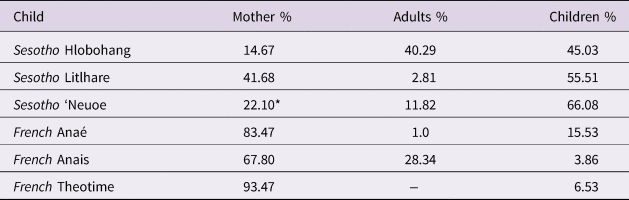
We asked how much different caregivers contribute to the overall linguistic speech heard by the child, both directed and overheard (see Table 1). For the Sesotho-learning children, most speech came from other children. The category “other children” contains all other children (younger than 10 years) present in the linguistic environment of the key children: siblings, cousins, playmates, etc. Speech from other adults varied; for one Sesotho-learning child in particular, Hlobohang, other adult speech (the grandmother) was more abundant than mother's speech. French-learning children received most of their input from mothers, and other children had the smallest contribution to overall input. There was variation in how much input was from other adults across children and corpora.
Percentage of the total number of utterances produced by mothers, other adults and children for each child. The largest number in each row is in bold. * ‘Neuoe's mother is genetically her aunt.

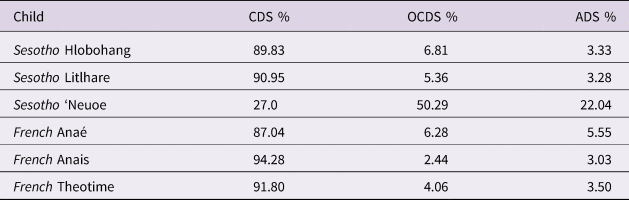
Second, we asked how much input heard by children was directed to them, how much was overheard, and how child-directed versus overheard speech was distributed across speakers. CDS is speech directed to the child. Overheard speech includes speech directed to other children (OCDS), and to adults (ADS). The majority of input was child-directed for both French-learning and Sesotho-learning children, except for ‘Neuoe, who was the younger cousin to 3- to 4-year-old Tsebo, living in the same family, and most speech she was exposed to was OCDS. More details can be found in Table 2.
Percentage of the total number of utterances that was CDS (Child Directed Speech), OCDS (Other Child Directed Speech) or ADS (Adult Directed Speech) for each child. The largest number in each row is in bold. These three do not add up to 100% because the rest of the utterances were unclassified in terms of addressee.

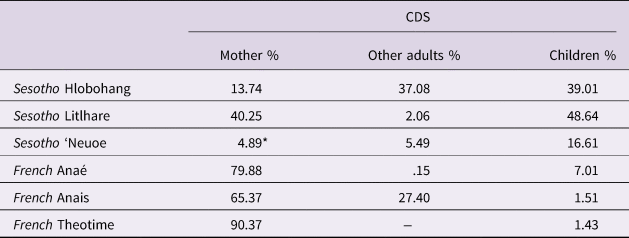
As can be seen in Table 3, CDS was mostly produced by other children for the Sesotho-learning children. For the French-learning children, the mother was the main source of CDS. Information on OCDS and ADS speakers can be found in the Appendix, Table A1.
Percentage of speech produced by mothers, other adults, and other children, when considering CDS for each child. Information on OCDS and ADS speakers can be found in the Appendix. The numbers for ‘Neuoe are small because most speech around the child was not CDS. The largest number in each register-based group of cells is in bold.

Qualitative features of input
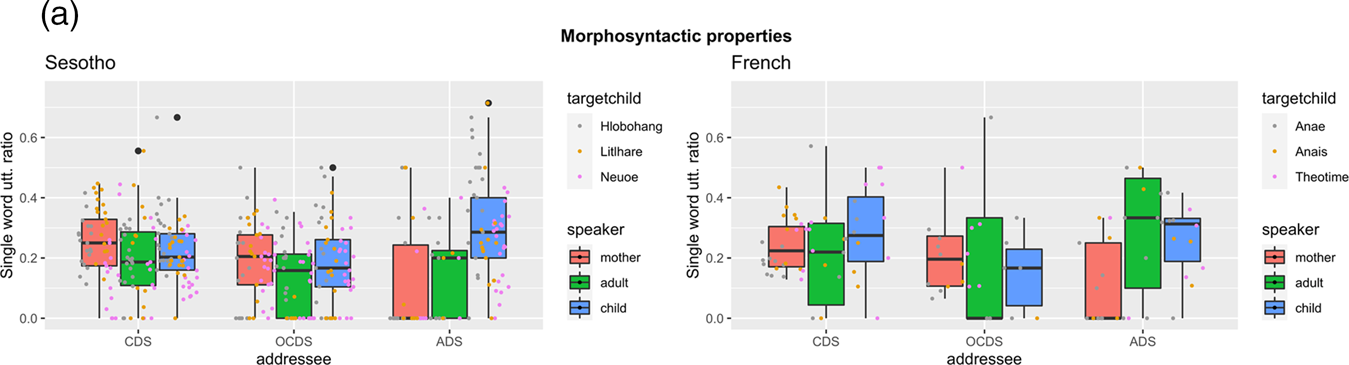
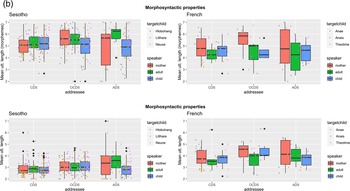
Next, we asked what the qualitative properties of input were, and how they differed across speakers and cultural groups. We focused on morphosyntactic, lexical and interactional properties separately. The raw data can be found in the online supplementary material (Supplementary Materials). We first focus on morphosyntactic properties, which are shown in Figures 1a and 1b. Setting aside differences across speakers to focus on differences across registers, for both Sesotho and French, CDS had the shorter MLU, followed by OCDS and ADS. There were also slightly more one-word utterances in CDS than in OCDS and in ADS.
Single word utterance ratio for Sesotho (left) and French (right). Each point is a recording session (where the corresponding speaker produced at least one utterance). Boxplot colors indicate speakers: adult speakers in red, mothers in blue, and other children speakers in green. Boxplot groups indicate the register, CDS at the left, OCDS at the middle and ADS at the right.

Mean length of utterance in words (bottom) and in morphemes (top) for Sesotho (left) and French (right). Each point is a recording session (where the corresponding speaker produced at least one utterance). Boxplot colors indicate speakers: adult speakers in red, mothers in blue, and other children speakers in green. Boxplot groups indicate the register, CDS at the left, OCDS at the middle and ADS at the right.

Next we focus on differences across speakers (holding register constant). Within both Sesotho and French CDS and OCDS, there were no large differences across speaker types – i.e., the distributions for mothers, other adults, and other children overlap for these two registers. Within ADS, adult ADS has longer MLU and proportionally more multi-word utterances. Overall, OCDS is more similar to CDS than ADS on these two measures.
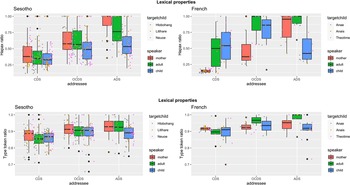
We then analyzed lexical properties (Figure 2). The MATTR with a smaller word window offers the advantage of accounting for more data, and is displayed here. The MATTR with a larger window is based on fewer sessions (the ones with a lot of speech), and can be found in the Appendix (Figure A1). The properties were measured on the entirety of the lexicon (closed class words included). For both Sesotho and French, CDS was the least lexically diverse register and the register with the lowest hapax ratio, followed by OCDS and then by ADS. In Sesotho CDS, there were small differences between speakers with respect to MATTR and hapax ratio. In French CDS, differences between speakers were larger than in Sesotho, maternal speech being the most lexically diverse, and with the lowest hapax ratio of all speaker types.
Type-token ratio (bottom) and hapax ratio (top) for Sesotho (left) and French (right). Each point is a recording session (only sessions where the corresponding speaker produced at least one utterance). Boxplot colors indicate speakers, adult speakers: in red, mothers in blue, and other children speakers in green. Boxplot groups indicate the register, CDS at the left, OCDS at the middle and ADS at the right.

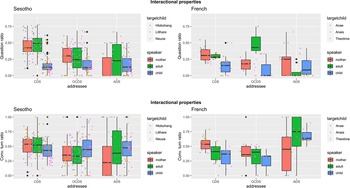
Last, we analyzed two interactional properties related to speech elicitation (Figure 3). For Sesotho, the highest proportion of questions and conversational turns (when an utterance was followed by an utterance produced by the person previously addressed to) was found overall in CDS, followed by OCDS, and then ADS. For French, similar ratios of questions and conversational turns were found in CDS and OCDS. Within Sesotho and French CDS, other adults and mothers had higher question ratios and conversational turn ratios than other children.
Question ratio (top) and ratio of conversational turns (bottom) for Sesotho (left) and French (right). Each point is a recording session (where the corresponding speaker produced at least one utterance). Boxplot colors indicate speakers: adult speakers in red, mothers in blue and other children speakers in green. The x-axis indicates the register, CDS at the left, OCDS at the middle and ADS at the right.

Discussion
In the hope of informing the sparse literature on quantitative and qualitative descriptions of children's input across populations, the current study includes a detailed analysis of input to and around French- and Sesotho-learning children growing up in two very different cultural settings. We used the same descriptive metrics, in order to comprehensively document the linguistic input French and Sesotho-learning children receive from parents and other people. We described the amount and some qualitative features (the morphosyntactic, lexical and interactional features of speech) of linguistic input spoken by mothers, other adults and children, separately for child-directed speech, speech directed to other children and speech directed to adults. We found some differences across cultural groups, but also a great deal of similarity.
The composition of input differed dramatically between cultural groups. Maternal input was more dominant in the French corpus compared to the Sesotho one. In the latter, other children's input was more prevalent than maternal input (see Shneidman & Goldin-Meadow, Reference Shneidman and Goldin-Meadow2012 for a similar observation in a Mayan village). Given that all target children had older siblings, the lower proportion of speech from other children in French may indicate that French children have fewer opportunities to hear speech produced by other children compared to Sesotho children. This difference in composition is also consistent with observations that mothers have more children to attend to in Lesotho, and children are surrounded by more children – at least in this rural village context – than in these urban areas in France. This becomes more challenging in Lesotho from the age of 2;6, either due to the birth of another sibling, or to the increasing independence of the child by this age, facilitating interactions with the larger peer group.
Thus, other children are an important source of input for many learners of Sesotho. This invites further research on how speech from other speakers contributes to children's input (see Sperry, Sperry & Miller, Reference Sperry, Sperry and Miller2019 for a similar suggestion), how essential input is from expert (i.e., adult) speakers, and what amount of adult speech is necessary for language acquisition. That said, maternal speech takes up a large proportion of input in both corpora, and other child speech is not prevalent in the French corpora. These results are in line with previous findings for US families, documenting that siblings address their younger siblings much less frequently than their mothers and other adults do (e.g., Oshima-Takane & Robbins, Reference Oshima-Takane and Robbins2003).
In every other respect, marked similarities between cultural groups were observed. To begin with, CDS was the most prevalent register in both cultural groups. All target children in French settings were mostly exposed to speech directed to them. Two out of three Sesotho-learning children were mostly exposed to CDS, the third listening mostly to OCDS. This points to the need to study diverse cultures; there are not only differences between these industrial urban and non-industrial rural communities, but, given the little CDS found in some non-industrial cultures (e.g., Casillas et al., Reference Casillas, Brown and Levinson2019), there are also large differences between different non-industrial communities.
Another clear convergence across corpora is that CDS seems to have some similar features (e.g., ratio of questions, type-token ratio) in both French and Sesotho. This agrees with previous work showing that CDS is a register that may be adjusted to child listeners in ways that are similar across languages and cultures (e.g., Fernald et al., Reference Fernald, Taeschner, Dunn, Papousek, de Boysson-Bardies and Fukui1989). Moreover, for both cultural groups, OCDS’ features lie halfway between CDS and ADS, and is overall more similar to CDS than ADS. Thus, speech directed to target and other children from all speakers has CDS-like characteristics in both societies. As a result, it is conceivable that children who are exposed to a great deal of OCDS could learn more from this type of overheard speech than from ADS.
These results are relevant to the current discussion on the nature of input (e.g., Brown & Gaskins, Reference Brown, Gaskins, Enfield, Kockelman and Sidnell2014). In our field, there is no standard definition of “input”, and it is not clear whether overheard speech is actually processed or even heard by the child. Whereas some studies show that overheard speech does not correlate with later vocabulary (e.g., Brent & Siskind, Reference Brent and Siskind2001; Shneidman & Goldin-Meadow, Reference Shneidman and Goldin-Meadow2012), others document that children can learn words from overheard speech in laboratory conditions (e.g., Akhtar et al., 2001), and respond to utterances directed to others (e.g., Barton & Tomasello, Reference Barton and Tomasello1991). It has been suggested that in societies where children receive little directed speech, they may attend to speech spoken around them from early on, thus benefiting from overheard speech (Brown & Gaskins, Reference Brown, Gaskins, Enfield, Kockelman and Sidnell2014). Note that some overheard speech may be more relevant to the child than other overheard speech: for example, the presence of a peer enhances phonetic learning from screens (Lytle, Garcia-Sierra & Kuhl, Reference Lytle, Garcia-Sierra and Kuhl2018). Overheard speech produced by or addressed to another child may also be more relevant as opposed to an adult-adult conversation. Over the backdrop of such diverse results, our findings confirm the need to study different kinds of overheard speech, such as the characteristics of OCDS in diverse cultures. Investigating whether children actually prefer OCDS over ADS, and whether they learn more from OCDS than from ADS, may inform us about the question of which types of speech actually contribute to children's input.
In sum, more cross-cultural differences were found with respect to who addresses the key children, than with respect to how they address them. Unsurprisingly, we observe that other adults change their speech in the same ways, and to similar extents, as mothers do when using CDS. This is in line with work looking at CDS versus ADS among adults who aren't mothers, as summarized in the Introduction (e.g., other adults also use child-directed speech when talking to children, Shute & Wheldall, Reference Shute and Wheldall1999).
In addition, child speakers in both cultural groups adapt their speech to children addressees in ways similar to adaptations noted in previous work based on mothers’ speech, especially in its morphosyntactic and lexical features. This suggests that other children also adjust their speech when talking to younger children. However, we cannot say the same with respect to question ratios. Children in both French and Sesotho have a lower ratio of questions than the mothers in our data, in line with previous findings (e.g., Dunn & Kendrick, Reference Dunn and Kendrick1982; Mannle et al., Reference Mannle, Barton and Tomasello1991).
Based on the results of our analysis, all target children grow up in environments where they are very often directly addressed, either by their mother, or by children and other adults, and input from different speakers is not dramatically different in qualitative terms, at least for the majority of the features studied here. This indicates that both French- and Sesotho-learning children grow up in stimulating environments for linguistic development, in agreement with previous anthropological studies (e.g., Connelly, Reference Connelly1984).
At this point, we should highlight the difficulty of comparing linguistic methods across cultures (see also discussion in Kline, Shamsudheen & Broesch, Reference Kline, Shamsudheen and Broesch2018). Our findings are evidence that culturally specific environmental factors, such as peer speech or overheard speech, may be absent in some contexts but important in others, providing a rich learning context. Learning seems to occur across cultures, even when the learning mechanisms differ (Kline et al., Reference Kline, Shamsudheen and Broesch2018).
Before closing, we would like to mention some limitations of the study. This research is based on existing corpora from previous studies where the number of target children recorded was limited, due to the labor-intensive, longitudinal work involved in collecting recordings and annotating fully spontaneous speech. A larger number of target children might have enabled us to conduct statistical tests on differences between registers, speakers and cultures, whereas the current study is purely descriptive.
Second, the metrics chosen here to analyze the children's input are similar to those implemented by previous research (e.g., Fernald & Morikawa, Reference Fernald and Morikawa1993; Henning et al., Reference Henning, Striano and Lieven2005; Hoff, Reference Hoff2006; Mannle et al., Reference Mannle, Barton and Tomasello1991; Loukatou et al., Reference Loukatou, LeNormand and Cristia2019). For example, we focused on the ratio of questions and conversational turns. These metrics are related to conversational interaction and speech elicitation, but do not exhaustively describe children's input; for instance, future work could inspect additional speech-eliciting features and sentence types (e.g., imperatives). Additionally, the data could be further analyzed based on context, semantics and pragmatics (as in Tamis-LeMonda, Kuchirko & Song, Reference Tamis-LeMonda, Kuchirko and Song2014) in future studies, in order to inform us on the language socialization practices of the two cultural groups.
Our annotators also suspected that speech from other children may be underestimated in the French recordings, since older siblings sometimes seemed discouraged from speaking during the recording. Here is an example from Anaé's recording session 020804: when the older brother comes in the room, the mother says to him “Toi tu commences pas. (=Don't start.)” and after a while she says “Toi tu te tais s'il te plaît. (= Don't speak please.)”. It is possible that siblings interact more with each other when they are not recorded, but it is also possible that the same types of interactions happen when families are not recorded, which would mean that these are genuine cultural differences. It may be the case that French parents usually send away a noisy or agitated child when trying to focus on another child whereas Sesotho parents do not, which would partially explain why Sesotho-learning children receive more speech from other children than French-learning children.
Last, as explained above, the Sesotho sessions were recorded in the presence of the investigator and for comparability reasons, we chose to annotate sessions of French corpora where the investigator was also present during the recordings. Speech produced by or addressed to the investigator was removed in both corpora for this analysis. Future studies might be able to use recording devices where the investigator is not present, since the involvement of a stranger in the recording process might change families’ behavior.
Also, in Sesotho, other adults were mostly grandmothers and neighbors, whereas in French they were mostly fathers. In Sesotho, child members were a mixed-age group of siblings, peers and other children, whereas in French child members were mainly older siblings, with ages ranging from five to ten years. Future studies may focus on speech separately for these different speaker roles, looking at similarities and differences between, for example, sibling and peer speech, or father and grandmother speech. Last, we used data-driven measurements, such as length of utterance and lexical diversity for this study. However, language also consists of social patterns and is sensitive to context. For this reason, future studies may need to include more comprehensive analyses, taking into consideration more features of engagement between partners, and the families’ characteristics.
We look forward to further research incorporating more cultures, in order to investigate the impact of non-parental caregivers, and to examine whether speech composition and qualities such as the ones found here are representative of quantifiable distinctions in other cultures.
Acknowledgements
We should thank our annotators Clara Daoud, Lara Oliel, and Emilie Sonnet and our grants 1. Agence Nationale de la Recherche (ANR-17-CE28-0007 LangAge, ANR-16-DATA-0004 ACLEW, ANR-17-EURE-0017) 2. the J. S. McDonnell Foundation Understanding Human Cognition Scholar Award.
Supplementary Material
For supplementary material accompanying this paper, visit https://doi.org/10.1017/S0305000921000623