

1. Introduction
A number of semantic studies of over have been performed (Brugman Reference Brugman1981; Hawkins Reference Hawkins1984; Lakoff Reference Lakoff1987; Vandeloise Reference Vandeloise and Tsohatzidis1990; Dirven Reference Dirven and Zelinsky-Wibbelt1993; Dewell Reference Dewell1994; Kreitzer Reference Kreitzer1997; Taylor Reference Taylor2002, Reference Taylor2003, Reference Taylor2012; Tyler and Evans Reference Tyler and Evans2003; Deane Reference Deane, Hampe and Grady2005; Van der Gucht et al. Reference Van der Gucht, Willems and De Cuypere2007).Footnote 1 Translation equivalents of over in other languages have also been examined (see Bellavia Reference Bellavia, Pütz and Dirven1996, Dewell Reference Dewell, Pütz and Dirven1996, and Meex Reference Meex, Cuyckens and Zawada2001 on German über, and Geeraerts Reference Geeraerts1992 on Dutch over). The studies use the framework of cognitive semantics, and their analyses are imagistic in character. The radial-network analysis of English over by Lakoff (Reference Lakoff1987) is now considered a key example of cognitive semantic analysis of polysemy. Tyler and Evans (Reference Tyler and Evans2003) also analyse over using their own innovative method. This article takes Dewell (Reference Dewell1994) as a point of departure, because his notions of a semicircular path image-schema and segment-profiling image-schema transformation capture the meanings of over more accurately than do the other works mentioned above.
The purpose of the current article is: (i) to show that in the semantic representation of the preposition over, the trajectors (TR) and landmarks (LM) are captured three-dimensionally and topologically; (ii) to present a semantic analysis of the preposition over using the image-schema of the semicircular path, an image-schema transformation of segment profiling which is rather different from Dewell's, and metaphor; and (iii) to present the senses of the preposition over and provide the radial category showing the network relating all the senses of over. In particular, point (i) (where, in all the non-metaphorical uses of over as a preposition, the trajectors and landmarks are captured three-dimensionally and topologically), is a novel analysis that allows us to explain the meanings of over without recourse to the shape and size of the trajector or the landmark as a component of over.
The discussion in this article focuses on over as a preposition. Although over is used as a prefix in words like overeat, overestimate, overflow, and overrate, and can function as an adverbial particle as in examples (1) and (2), we will restrict our discussion to the prepositional semantics.Footnote 2
(1) The fence fell over.(Zlatev Reference Zlatev, Cuyckens, Dirven and Taylor2003: 451)
(2) The game is over.
I will present a semantic analysis of over on the basis of the image-schema of a semicircular path, image-schema transformations, and metaphorical applications of spatial senses to other domains. I will also present the senses of over, and a radial category showing how these are related. The next two sections briefly outline Dewell's (Reference Dewell1994) contribution, and then point out problems with that account. Section 4 proposes an alternative analysis, while section 5 discusses in more depth the metaphorical senses of over.
2. Previous studies
The cognitive linguistic analysis of over began with Brugman (Reference Brugman1981), and was reworked by Lakoff (Reference Lakoff1987). As Taylor (Reference Taylor2012: 233) puts it, “the Brugman-Lakoff account spawned a veritable cottage industry of over-studies” (Vandeloise Reference Vandeloise and Tsohatzidis1990; Dewell Reference Dewell1994; Kreitzer Reference Kreitzer1997; Taylor Reference Taylor2002, Reference Taylor2003, Reference Taylor2012; Tyler and Evans Reference Tyler and Evans2003; Deane Reference Deane, Hampe and Grady2005; Van der Gucht et al. Reference Van der Gucht, Willems and De Cuypere2007). Dewell (Reference Dewell1994) attempted to improve on the Brugman-Lakoff analysis by relying more exclusively on image-schema transformations. In fact, some of Dewell's (Reference Dewell1994) account of over is simpler and more intuition-based than Brugman/Lakoff's seminal work. The image-schema transformations proposed by Dewell (Reference Dewell1994) include segment profiling, resulting state, subjective path to endpoint, linear-extending trajector, edge-trajector, planar-extending trajector, multi-directional planar trajector, etc. The reason that Dewell's analysis is taken as the point of departure, rather than those of Lakoff (Reference Lakoff1987) or Tyler and Evans (Reference Tyler and Evans2003), is that the central schema of a semicircular path and an image-schema transformation called ‘segment profiling’ are very useful for analyzing the senses of the preposition over. Lakoff's (Reference Lakoff1987) analysis of over seems to be overly complex (particularly the image-schemas that he posits), because they make use of all three elements: the shape of the landmark (X, V, VX), contact (C) between trajector and landmark, and no contact (NC). Sandra and Rice (Reference Sandra and Rice1995), based on their experimental findings, also call into question the extremely fine-grained structure proposed by Lakoff. Moreover, sentences like ‘The power line stretches over the yard’ (Lakoff Reference Lakoff1987: 426) should be examples of mental scanning,Footnote 3 but Lakoff does not account for such sentences in this way. Tyler and Evans (Reference Tyler and Evans2003), for their part, hypothesize that the interpretation of traversing is a context-dependent implicature arising from the particular nature of the verb, the trajector, and the landmark as mediated by over. They thus suggest that over does not prompt for an independent ‘path’ sense. However, in developing a general theory of the independent senses of over, it seems reasonable to assume that it includes an independent sense of a path, as discussed in detail in section 4. Incidentally, although Tyler and Evans (Reference Evans2003: 70) state that no motion is involved in the interpretation of the sentence ‘The tree branch extended over the wall’, it should be noted that this sentence also involves mental scanning.
We now turn to Dewell's (Reference Dewell1994) account.
2.1 The central schema and segment profiling
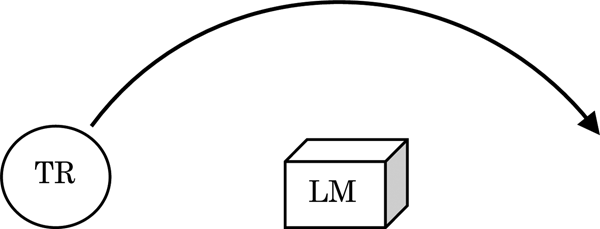
Although Brugman (Reference Brugman1981) and Lakoff (Reference Lakoff1987) presume that the central schema for over is a combination of the stative location ABOVE and the boundary-traversing path of ACROSS, Dewell (Reference Dewell1994) posits as the central schema of over the semicircular path shown in Figure 1. In Figure 1, the path of the trajector (TR) semi-encloses the landmark (LM).
The central schema of over (Dewell Reference Dewell1994: 353)

This ‘semicircular path’ sense is reflected in over, as in (3).
(3) The dog jumped over the fence.(Dewell Reference Dewell1994: 353)
Dewell (Reference Dewell1994) states that if we take the arced path to be central, we can take the image-schema seriously enough to account for all of the variants of over, using natural image-schema transformations or metaphorical applications of spatial senses to other domains.Footnote 4 Dewell (Reference Dewell1994), for example, suggests segment profiling as the most obvious image-schema transformation. Briefly, segment profiling picks out a segment of the path. First, consider examples (4a) and (4b).
- (4)
a. The plane flew over the hill. (Dewell Reference Dewell1994: 352)
b. The bird flew over the yard. (Dewell Reference Dewell1994: 352)
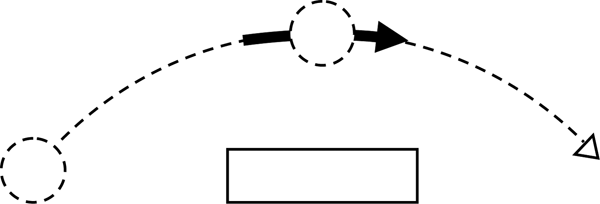
Over, in these sentences, profiles the central region of the arc near the peak, as shown in Figure 2. The rest of the path, upward from the starting point and downward from the peak, is implicit pragmatically.
Profiled central region (Dewell Reference Dewell1994: 355)

Also, according to Dewell (Reference Dewell1994), over, in (5), profiles the upward trajectory in Figure 1 from the starting point to the peak. This over is illustrated in Figure 3.
(5) The sun came up over the mountains.(Dewell Reference Dewell1994: 356)
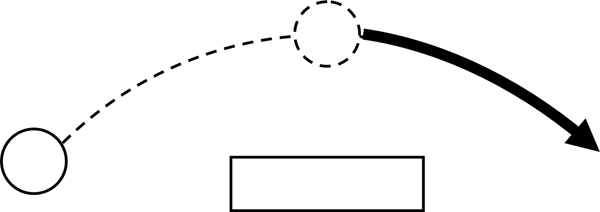
In example (6), over profiles the downward trajectory of the semicircular path illustrated in Figure 1. This variant of over is illustrated in Figure 4.
(6) Sam fell over the cliff.(Dewell Reference Dewell1994: 356)
Profiled upward trajectory (Dewell Reference Dewell1994: 356)

Profiled downward trajectory (Dewell Reference Dewell1994: 356)

Next, according to Dewell (Reference Dewell1994), over in an example like (7) profiles the region of the peak of the semicircular path, as shown in Figure 5, giving what he calls a “freeze-frame at the peak.” In his article, Dewell (Reference Dewell1994) states that this use of over “retains the backgrounded sense of continued motion on a journey that will eventually lead to a landing.”
(7) The plane should be over Baltimore by now.(Dewell Reference Dewell1994: 357)
These four instances of over involve image-schema transformations of segment profiling, in which part of the semicircular path is profiled.
Freeze-frame at the peak (Dewell Reference Dewell1994: 357)

Resulting-state: endpoint location (Dewell Reference Dewell1994: 358)

Subjective path to endpoint (Dewell Reference Dewell1994: 358)

Now consider example (8). Here, a TR (Sam) is at an endpoint location which is reached after a physical movement. Dewell (Reference Dewell1994) describes an image-schema transformation like this as an image-schema transformation to a resulting-state, as illustrated in Figure 6. In resulting-state variants, the entire trajectory is intact.
(8) Sam is over the bridge now.(Dewell Reference Dewell1994: 357)
Over in (9), on the other hand, does not suggest a physical movement. There is no suggestion that this is the path that Sam took to get to the endpoint. Therefore, Dewell (Reference Dewell1994) distinguishes the sense of over in (8) from that in (9). Lakoff (Reference Lakoff1987), in contrast, does not distinguish between these two uses of over. For him, both senses involve the image-schema transformation of “path focus ↔ endpoint focus.” In Dewell's (Reference Dewell1994) framework, the sense of over in (9) is explained by the image-schema transformation of a subjective path to an endpoint, illustrated in Figure 7. In this case, the speaker/interpreter mentally traverses the OVER-path.
(9) Sam lives over the bridge.(Dewell Reference Dewell1994: 358)
2.2 Extending paths: linear-extending trajectors
According to Dewell (Reference Dewell1994), in one reading of (10), the rope is not a holistic TR maintaining a constant shape as it moves entirely over the LM. Rather, it is an extending TR, part of which remains at the starting location.
(10) Sam threw the rope over the limb. (Dewell Reference Dewell1994: 359)
In this case, the focus is on the leading point of the TR. The resulting shape of the whole extended TR corresponds, more or less, to the summarily scanned path taken by the leading point, as shown in Figure 8.
Linear-extending trajector (Dewell Reference Dewell1994: 359)

Dewell (Reference Dewell1994), calling such a path an “extending-path”, describes this type of image-schema transformation as an “extending-path transformation.”
Dewell (Reference Dewell1994) argues that segment profiling also applies to the schema of Figure 8. Consider the sentences in (11):
- (11)
a. He leaned over the rail.(Dewell Reference Dewell1994: 359)
b. We stretched the rope over the yard. (Dewell Reference Dewell1994: 359)
c. We dropped the rope down over the edge. (Dewell Reference Dewell1994: 357)
For Dewell (Reference Dewell1994), the uses of over in (11a), (11b), and (11c) correspond respectively to the left, middle, and right segments shown in Figure 9.
Profiled linear-extending trajector (Dewell Reference Dewell1994: 359)

2.3 A three-dimensional conception
Consider example (12). In Dewell's (Reference Dewell1994: 362) words, “[a] vantage point above the TR reveals its linear shape as an edge extending horizontally and perpendicular to the OVER-path. In effect, each point in the TR may be seen as tracing its own OVER-arc ….”
(12) A line of soldiers marched over the ridge.(Dewell Reference Dewell1994: 362)
According to Dewell (Reference Dewell1994), the image-schema for over in (12) is three-dimensional, as shown in Figure 10.
Edge-trajector (Dewell Reference Dewell1994: 362)

Now consider example (13):
(13) He draped the sheet over the clothesline. (Dewell Reference Dewell1994: 363)
According to Dewell (Reference Dewell1994), the edge-TR image of Figure 10 can be transformed naturally into an image like that in Figure 11. Example (13) can thus be read as a planar TR extending; in this case, the leading edge moves uniformly over the LM.
Planar-extending trajector (Dewell Reference Dewell1994: 363)

Next, look at the sentences in (14):
- (14)
a. She poured the syrup out over the pancakes. (Dewell Reference Dewell1994: 363)
b. He spread the cloth out over the table. (Dewell Reference Dewell1994: 363)
Dewell states that example (14a) describes a situation in which a fluid moves outward in several directions at once, as in Figure 12, and (14b) gives essentially the same image. Figure 12 represents a planar TR with an edge extending outward in multiple directions at once, ultimately semi-enclosing the LM in at least one of those directions. This schema is essentially a curved-edge variant of the schema for planar-extending TRs (Figure 11), profiling the downward arc.
Multi-directional planar TR (Dewell Reference Dewell1994: 364)

3. Problems with Dewell's (Reference Dewell1994) account
In the previous section I described the main points put forward by Dewell (Reference Dewell1994). I now turn to some problems with Dewell's account.
3.1 Problem 1: two-dimensional/three-dimensional image-schemas of over
Dewell (Reference Dewell1994) distinguishes between two-dimensional and three-dimensional image-schemas for over. However, is a distinction between dimensions like this necessary (Ando Reference Ando2007)? The issue is rooted in the spatial-cognitive ability of human beings. We should understand three-dimensionally the image indicating a sense of over, and so the image-schema of over should be captured three-dimensionally (Van der Gucht et al. Reference Van der Gucht, Willems and De Cuypere2007). This is motivated by the fact that a container image-schema is captured three-dimensionally. According to Lakoff and Johnson (Reference Lakoff and Johnson1999: 31–32), a container schema can be instantiated as a “bounded region in space, like a basketball court,”Footnote 5 which suggests that a container schema is captured three-dimensionally (Freeman Reference Freeman1995, Regier Reference Regier1995, Sandra and Rice Reference Sandra and Rice1995, Gibbs Reference Gibbs1996, Sinha and Jensen de López Reference Sinha and de López2001, Evans and Green Reference Evans and Green2006, Radden and Dirven Reference Radden and Dirven2007, Lakoff Reference Lakoff2012).
In cognitive-psychological terms too, images are captured three-dimensionally (Downs and Stea Reference Downs and Stea1973, Roth and Frisby Reference Roth and Frisby1986, Thagard Reference Thagard1996, Richardson Reference Richardson1999, Smith et al. Reference Smith, Nolen-Hoeksema, Fredrickson and Loftus2003, Anderson Reference Anderson2010). In fact, mental rotation in cognitive psychology, first discussed by Shepard and Metzler (Reference Shepard and Metzler1971), is captured stereoscopically, that is, three-dimensionally. We should therefore assume that the image-schema of over is structured three-dimensionally (Vandeloise Reference Vandeloise1991).
3.2 Problem 2: over in (15)
As we saw in section 2, Dewell (Reference Dewell1994) represents over in (15) as in Figure 2, and argues that the rest of the path upward from the starting point and downward from the peak in Figure 2 is implicit pragmatically.
- (15)
a. The plane flew over the hill.(= (4a)), (Dewell Reference Dewell1994: 352)
b. The bird flew over the yard. (= (4b)), (Dewell Reference Dewell1994: 352)
Meanwhile, he states that over in (16) “retains the backgrounded sense of continued motion on a journey that will eventually lead to a landing” (Dewell Reference Dewell1994: 357).
(16) The plane should be over Baltimore by now.(= (7)), (Dewell Reference Dewell1994: 357)
The question I would like to pose about over in (15) is why the rest of the path is “implicit pragmatically”, a question not answered by Dewell. Presumably, the semicircular path (upward from the starting point and downward from the peak) in Figure 2 is drawn by the common knowledge that the plane/bird takes off and lands. Furthermore, Dewell’s (Reference Dewell1994) analysis does not clearly capture the semantic difference between over in (15) versus (16).
3.3 Problem 3: over in (16)
As we saw in the last section, Dewell (Reference Dewell1994) analyzes over in an example like (16) as profiling the region of the peak of the semicircular path. As he puts it, “the TR seems to pause in ‘freeze-frame’ suspension at the peak of the arc” (Dewell Reference Dewell1994: 357). However, can this analysis be correct? I wonder whether speakers use this cognitive process in everyday language. It is technically true that when an object moves parabolically, its vertical velocity is briefly zero when it is at the peak of the path, but this is not something that ordinary speakers can be expected to know. Thus, it seems reasonable to assume that the process proposed by Dewell does not occur when native speakers of English use sentences with over. In fact, some senses of over suggest no actual physical movement, as in (17).
- (17)
a. The picture is over the mantel. (Tyler and Evans Reference Tyler and Evans2003: 110)
b. Hang the painting over the fireplace. (Lakoff Reference Lakoff1987: 425)
As will be argued in section 4, over in (17) expresses a distinct ‘above’ sense.
3.4 Problem 4: on linear-extending trajectors
Dewell (Reference Dewell1994), calling a TR in an example like (18) “linear-extending trajector,” distinguishes between the TR in (18) and that in (19).
(18) Sam threw the rope over the limb. (= (10) (Dewell Reference Dewell1994: 359)
(19) The dog jumped over the fence. (= (3)) (Dewell Reference Dewell1994: 353)
This distinction, however, is unnecessary, for three reasons. First, linear-extending is a physical property of TR. Therefore, we should not attribute it to the meaning of over. Second, in (18) the leading point of the rope moves along the semicircular path, so it should be analyzed as the active zone in the sense of Langacker (Reference Langacker1990) (see also Taylor Reference Taylor2002: 110–111). Finally, although Figure 8 is proposed by Dewell (Reference Dewell1994) as the image-schema of over in (18), that figure is merely a picture that represents the state in which the rope hangs on the limb, and is by no means in line with an image-schema in the sense of Johnson (Reference Johnson1987). In fact, Figure 8 is not based in bodily experience: the notion of linear-extending does not emerge through our bodily experience (see Taylor Reference Taylor2002: 523).
I conclude from this that linear-extending is not part of the image-schema of over. Rather, over in (18) reflects the central schema of the semicircular path.
3.5 Problem 5: the image-schema of over in (20)
Above, we argued against using linear-extending trajectors to account for examples like (18) and rejected linear-extending trajectors. However, even if we had adopted linear-extending trajectors there, over in (20) should profile not the upward trajectory of the path, but the downward trajectory. That is, the image-schema of over in (20) should be the same as that of over in (21).
(20) He leaned over the rail. (= (11a)) (Dewell Reference Dewell1994: 359)
(21) We dropped the rope down over the edge. (= (11c)) (Dewell Reference Dewell1994: 357)
This contradicts Dewell's (Reference Dewell1994) account, where he describes over in (20) as profiling the upward trajectory of the path.
3.6 Problem 6: over in (22)
In my view, over in (22) indicates a ‘covering’ sense. This will be discussed in detail in section 4.
- (22)
a. She poured the syrup out over the pancakes. (= (14a)) (Dewell Reference Dewell1994: 363)
b. He spread the cloth out over the table. (= (14b)) (Dewell Reference Dewell1994: 363)
Although Dewell (Reference Dewell1994) does not recognize a ‘covering’ sense of over, I will argue that it is one of the senses of this preposition.
3.7 Problem 7: whether or not the shape of TRs is involved in meanings of over
As we saw in the last section, Dewell (Reference Dewell1994) distinguishes over in (23) and (24) from over in (25)–(27) on the basis of whether the shape of the TR is linear or planar. However, I am not persuaded that the shape of the TR is part of the meaning of over.
(23) Sam threw the rope over the limb. (= (10)) (Dewell Reference Dewell1994: 359)
- (24)
a. He leaned over the rail. (= (11a)) (Dewell Reference Dewell1994: 359)
b. We stretched the rope over the yard. (= (11b)) (Dewell Reference Dewell1994: 359)
c. We dropped the rope down over the edge. (= (11c)) (Dewell Reference Dewell1994: 357)
(25) A line of soldiers marched over the ridge. (= (12)) (Dewell Reference Dewell1994: 362)
(26) He draped the sheet over the clothesline. (= (13)) (Dewell Reference Dewell1994: 363)
- (27)
a. She poured the syrup out over the pancakes. (= (14a)) (Dewell Reference Dewell1994: 363)
b. He spread the cloth out over the table. (= (14b)) (Dewell Reference Dewell1994: 363)
As was shown in the last section, Dewell (Reference Dewell1994) proposed “edge-trajector” to explain the planar shape of the TR of (25). However, as Ando (Reference Ando2007) points out, one can see a line of soldiers as a single individual. Under that view, the meaning of over in (25) is the same as that of over in (28).
(28) The dog jumped over the fence. (= (3)) (Dewell Reference Dewell1994: 353)
This is based on the idea that the shape of TRs is not involved in meanings of over.
3.8 Problem 8: radial category
Dewell (Reference Dewell1994) states that if we take a semicircular path to be the central schema of over, we can account for the interrelation of all of its spatial senses using only image-schema transformations and its nonspatial senses by metaphorical applications of spatial senses to other domains. However, he does not argue that the senses of over form a radial category, nor does he provide a radial category for over, as Lakoff (Reference Lakoff1987) does. A radial category which displays how all the senses of over are interrelated, as in Lakoff (Reference Lakoff1987), is required (see Geeraerts Reference Geeraerts2010 for a radial network analysis of polysemy).Footnote 6
4. Proposal
For the purposes of the present article, I accept the idea that the central schema of over represents a semicircular path, and I adopt the notion of segment profiling offered by Dewell (Reference Dewell1994). The purpose of this section is to show that the semicircular path sense is central to the image-schema of over, and that the other senses can be derived from this sense. We begin with the working hypotheses in (29).
(29) Working hypotheses
a. TRs and LMs are captured three-dimensionally, and their shape and size are expandable and reducible topologically.
b. Over is unspecified as to contact versus non-contact between TR and LM. That is, whether or not TR is in contact with LM is not part of the senses of over.
c. In segment profiling, it is unspecified whether or not the actual movement of the TR along the backgrounded part of the path is suggested.
d. We assume Lakoff and Johnson's (Reference Lakoff and Johnson1980, Reference Lakoff and Johnson1999) and Lakoff's (Reference Lakoff1987, Reference Lakoff1990, Reference Lakoff and Ortony1993) metaphor theory.
In the subsections that follow, I will present a semantic analysis of the preposition over on the basis of these working hypotheses. The analysis solves the problems with Dewell's (Reference Dewell1994) study which were pointed out in the previous section. For example, by assuming (29a), which is motivated by the cognitive-psychological assumption that images and image-schemas should be structured three-dimensionally and topologically, we can eliminate problems 1, 4, and 6. Hypothesis (29a) enables us to analyze the meanings of over without talking about the shape and size of TRs and LMs, which allows us to simplify the image-schemas of over.
Hypothesis (29a) is also motivated by the fact that speakers operate in three-dimensional space. The move from a two-dimensional to a three-dimensional treatment of TRs and LMs is the most important claim of the present article.
Now consider (30) and (31). In (30) there is no contact between the TR and the LM. In (31), on the other hand, there is contact between the TR and the LM. Lakoff (Reference Lakoff1987) distinguishes between the image-schema of over in (30) and that of over in (31) by specifying whether there is contact between TR and LM. Each schema is named using the abbreviations X ‘extended’, V ‘vertical’, C ‘contact’, and NC ‘no contact’.
(30) The bird flew over the yard. (Schema 1.X.NC) (Lakoff Reference Lakoff1987: 421, Dewell Reference Dewell1994: 352)
(31) Sam drove over the bridge. (Schema 1.X.C) (Lakoff Reference Lakoff1987: 422)
As Evans and Green (Reference Evans and Green2006: 341) note, however, our knowledge about birds (they can fly) and people (they cannot) allows us to infer that birds do not come into contact with yards when crossing over them, while people do. Thus, it will be reasonable to assume that the presence or absence of contact between TR and LM is not part of the meanings of over. Under hypothesis (29b) there is no need to specify the image-schema of over as to whether there is contact between TR and LM.
By positing (29c), we eliminate problem 2, which we saw in the last section. Finally, by assuming (29d), we can account for some examples that Lakoff (Reference Lakoff1987) and Dewell (Reference Dewell1994) did not discuss, as will be argued in section 4.6.
4.1 The central image-schema A
We posit the central image-schema of over as a semicircular path, as in Figure 13 below (Deane Reference Deane1988, Dewell Reference Dewell1994, Lindstromberg Reference Lindstromberg1998). In Figure 13, the TR moves along the semicircular path parabolically, and no part of the path is profiled. Also, as stated in Hypothesis (29a), TRs and LMs are captured three-dimensionally (Gibbs and Colston Reference Gibbs and Colston1995, Sandra and Rice Reference Sandra and Rice1995, Zlatev Reference Zlatev, Cuyckens, Dirven and Taylor2003), and their shape and size are expandable and reducible topologically. In addition, in this case, as stated in Hypothesis (29b), contact/non-contact between TR and LM is unspecified, that is to say, it is irrelevant to senses of over.
The central image-schema of over

Sentences (32)–(39) below are examples of over in this sense, used, as is very common, with action verbs of movement.
(32) The dog jumped over the fence. (= (3))
(33) Sam drove over the bridge. (= (31))
(34) Sam walked over the hill. (Lakoff Reference Lakoff1987: 422)
(35) Sam climbed over the wall.(Lakoff Reference Lakoff1987: 422)
(36) The rabbit hopped over the fence. (Tyler and Evans Reference Tyler and Evans2003: 79)
(37) She threw the rope over the limb. (= (10))
(38) A line of soldiers marched over the ridge.(= (12))
(39) He draped the sheet over the clothesline.(= (13))
Dewell (Reference Dewell1994) treats the image-schema of over in (37)–(39) as distinct from that of over in (32)–(36). In contrast, the account being developed here treats the image-schema of over in (37)–(39) as the same as that of over in (32)–(36), because the shape and size of the TR and the LM are expandable and reducible topologically, as stated in Hypothesis (29a).Footnote 7 Also, although Lakoff (Reference Lakoff1987) subclassifies image-schemas of over by specifying whether there is contact between TR and LM, with the schemas for over in (33)–(35) represented as in C (‘contact’), by Hypothesis (29b) we do not distinguish over in (33)–(35) from cases with no contact between TR and LM, such as (32), (36), and (37).
4.2 Segment profiling: image-schema transformation B
Here, I adopt the notion of segment profiling: the image-schema transformation of profiling part of the semicircular path.Footnote 8 However, the segment profiling proposed here is not the same as that of Dewell (Reference Dewell1994). Although Dewell (Reference Dewell1994) treats over in an example like (40) as profiling the region of the peak at the semicircular path, we do not adopt this view, as discussed in section 3.3.
(40) The plane should be over Baltimore by now.(= (16))
I propose to analyze over in an example like (40) as the profiled central region of the arc, as in section 4.2.1 below.
4.2.1 Profiled central region of the semicircular path: image-schema transformation B1
Consider (41)–(44). In these examples, over profiles the central region of the semicircular path.
(41) The plane flew over the hill.(= (4a))
(42) The bird flew over the yard. (= (4b))
(43) We stretched the rope over the yard. (= (11b))
(44) Lisa just tapped the golf ball, but it still rolled over the cup. (Tyler and Evans Reference Tyler and Evans2003: 83)
The sense of over in these examples can be illustrated as in Figure 14.
Profiled central region

The dotted line in Figure 14 represents the backgrounded part of the path. As stated in Hypothesis (29c), whether the TR actually moves along this part or not is unspecified.
4.2.2 Profiled upward region of the semicircular path: image-schema transformation B2
Consider (45) and (46). In these examples, over profiles the upward region of the semicircular path.
(45) The sun came up over the mountains. (= (5))
(46) The plane climbed high over the city. (Dewell Reference Dewell1994: 356)
The sense of over in examples like these can be illustrated as in Figure 15.
Profiled upward trajectory

The dotted downward trajectory in Figure 15 represents the backgrounded part of the path. As stated in Hypothesis (29c), whether the TR actually moves along this part or not is unspecified. In examples (45) and (46), the TRs (the sun and the plane) actually move along the downward dotted trajectory. However, this is provided by our common knowledge about the sun (it sets) and planes (they land).
4.2.3 Profiled downward region of the semicircular path: image-schema transformation B3
Consider (47)–(51). In these examples, over profiles the downward region of the semicircular path, as shown in Figure 16.
(47) Sam fell over the cliff. (= (6))
(48) We dropped the rope down over the edge. (= (11c))
(49) He leaned over the rail. (= (11a))
(50) He stumbled over a stone.
(51) Bill: “Mum! Joe tripped me with his foot.”
Joe: “No, I didn't, Mum. Bill just tripped over my foot.” (Radden and Dirven Reference Radden and Dirven2007: 24)
Profiled downward trajectory

The dotted upward trajectory in Figure 16 above represents the backgrounded part of the path. As stated in Hypothesis (29c), whether the TR actually moves along this part or not is unspecified. In (47)–(51), the TR does not actually move along the upward dotted trajectory.
Note again that, as stated in Hypothesis (29a), the shape and size of TRs and LMs are expandable and reducible topologically. This means that the TR in (49), he, is captured topologically. We can therefore assert that over in (49) profiles the downward region of the semicircular path. This account of example (49) is more accurate than Dewell's.
4.2.4 Profiled endpoint of the semicircular path: image-schema transformation B4
In (52), over profiles the endpoint of the semicircular path, as illustrated in Figure 17.
(52) Sam is over the bridge now. (= (8))
The dotted arc in Figure 17 represents the backgrounded part of the path. As stated in Hypothesis (29c), whether the TR actually moves along this part is unspecified. As we will see in detail later, over in this case suggests actual movement (Ekberg Reference Ekberg2001 notes that (52) denotes the actual path of the TR).
Profiled endpoint location

4.3 Profiled endpoint of the access path: image-schema transformation C
Consider (53)–(55) below. For Dewell (Reference Dewell1994), these examples profile the endpoint reached after subjective motion (Langacker Reference Langacker1990). Here, there is no suggestion of actual physical movement. According to Lakoff (Reference Lakoff1987) and Ekberg (Reference Ekberg2001), over in these examples can be interpreted as “on the other side of” – or, as Blomberg (Reference Blomberg2015) and Blomberg and Zlatev (Reference Blomberg and Zlatev2015) put it, as the phenomenology of “non-actual motion.”Footnote 9 With respect to over in examples like these, the speaker/interpreter mentally traces the path using the cognitive operation called mental scanning.
(53) Sam lives over the bridge. (= (9))
(54) Sausalito is over the bridge. (Lakoff Reference Lakoff1987: 424)
(55) The mansion is situated over that wall. (Tyler and Evans Reference Tyler and Evans2003: 82)
The sense of over in examples like these can be represented as in Figure 18. Since in these examples, the TR (Sam, Sausalito, and the mansion) do not actually move, the dotted line in Figure 18 is drawn more finely than the one in Figure 17.
Profiled endpoint of the access path

Talmy (Reference Talmy, Bloom, Garrett, Nadel and Peterson1996, Reference Talmy2000) and Matsumoto (Reference Matsumoto and Goldberg1996) call path expressions like these access paths.Footnote 10 Adopting this term, we can say that over in (53)–(55) profiles the endpoint of the access path. For Lakoff (Reference Lakoff1987) and Taylor (Reference Taylor2012: 237), over in these examples and in example (52) has this sense as a result of end-point focus (see section 2.1). However, since the special cognitive process of mental scanning is operating with examples (53)–(55), I distinguish between over in (52) and that in (53)–(55). Linguistic evidence in support of this claim comes from sentences like (56).
(56) Sam is safely over the bridge now.
This sentence profiles the endpoint of the over-path, and suggests actual movement. In fact, in this sentence safely is used. The interpretation of the sentence does not involve subjective motion.
A similar phenomenon can also be seen with across and through, as in (57)–(62).
(57) The child hurried across the street. (Langacker Reference Langacker1999: 301)
(58) The child is safely across the street. (Langacker Reference Langacker1999: 301)
(59) Last night there was a fire across the street. (Langacker Reference Langacker1999: 301)
According to Langacker (Reference Langacker1999), (57) profiles objective movement. Across in (58) shows static location resulting from actual movement. In (59) no physical movement is suggested at all. Rather, across in (59) profiles the endpoint as a goal reached after mentally following the path using mental scanning. In this way, a distinction is already made between the senses of across in (58) and (59). This corresponds to the distinction between over in (52) and that in (53)–(55). The same holds for through, as shown in (60)–(62).
(60) The train rushed through the tunnel. (Lee Reference Lee2001: 39)
(61) Tom is safely through the tunnel now.
(62) My office is located just through that door. (Tyler and Evans Reference Tyler and Evans2003: 222)
Through in (60) represents actual physical movement, while in (61) it shows the location resulting from actual movement of the TR Tom. In (62), through suggests no actual movement, but should be analyzed as profiling the endpoint as goal reached after the speaker/interpreter mentally follows the path. In this way, a distinction can be drawn between through in (61) and that in (62).
From what we have seen above, we can conclude that a distinction should be made between over in (52), which suggests movement of the TR, and that in (53)–(55), which does not.
4.4 The ‘above’ sense: image-schema transformation D
In sentences like (63)–(68) below, over has no sense of following a semicircular path. For sentences like these, Tyler and Evans (Reference Tyler and Evans2003) state that it does not seem possible to form an interpretation in which the TR is following a trajectory. Thus, it seems that over in these examples has a sense distinct from sense A, shown in Figure 13, or sense B1, shown in Figure 14. In (63)–(68), the TR is located physically above the LM, and the semicircular path is excluded. Under my approach, a path is excluded if there is no image in which the TR follows it.
(63) Hang the painting over the fireplace. (= (17b))
(64) The helicopter is hovering over the hill. (Lakoff Reference Lakoff1987: 425)
(65) The helicopter hovered over the city. (Brugman Reference Brugman1981: 40; Tyler and Evans Reference Tyler and Evans2003: 75)
(66) The picture is over the mantel.(= (17a))
(67) The lamp hangs over the table. (Taylor Reference Taylor2003: 113)
(68) The clothesline is suspended over the yard. (Dewell Reference Dewell1994: 360)
Over in this sense, which I term the ‘above’ sense, seems to involve a transformation of the semicircular path represented in Figure 13. We posit the relevant image-schema transformation as follows: the peak of the semicircular path is profiled, and the rest of the semicircular path is excluded, giving the representation in Figure 19.
‘Above’

According to Lakoff (Reference Lakoff1987), over marking this sense is roughly equivalent in meaning to above. However, as shown in (69), sometimes above cannot be replaced by over (Deane Reference Deane, Hampe and Grady2005).
- (69)
a. There are birds somewhere above us. (Kreitzer Reference Kreitzer1997: 308)
b. *There are birds somewhere over us. (Kreitzer Reference Kreitzer1997: 308)
Also, (70a) and (70b) have different meanings. According to Tyler and Evans (Reference Tyler and Evans2003), in (70a) the TR ‘Nora’ is in contact with the LM ‘the polished floor’, whereas in (70b), the TR is not in contact with the LM. A salient interpretation of (70b), but not of (70a), is that Nora refers to some fantastical creature, perhaps a fairy, capable of dancing in the air without actually touching the floor. Thus, over marking the ‘above’ sense in (70a) differs in meaning from above.
- (70)
a. Nora twirled over the polished floor. (Tyler and Evans Reference Tyler and Evans2003: 112)
b. Nora twirled above the polished floor. (Tyler and Evans Reference Tyler and Evans2003: 112)
As we have seen, examples (69) and (70) suggest that over is not completely equivalent in meaning to above. Incidentally, although Taylor (Reference Taylor2003) states that in over indicating the ‘above’ sense, the TR is not in contact with the LM, the TR in (70a) is in contact with the LM.
4.5 The ‘covering’ sense: image-schema transformation E
Consider (71)–(75). The sense of over in these examples involves ‘covering.’ While Lakoff (Reference Lakoff1987) treats this over as a variant of the ‘above’ sense, Taylor (Reference Taylor2003, Reference Taylor2012), Tyler and Evans (Reference Tyler and Evans2003) and Zlatev (Reference Zlatev, Cuyckens, Dirven and Taylor2003) take ‘covering’ to be a separate sense of over.
(71) The board is over the hole. (Lakoff Reference Lakoff1987: 427)
(72) They laid a board down over the hole. (Dewell Reference Dewell1994: 367)
(73) He spread the cloth out over the table. (= (22b))
(74) The tablecloth is over the table. (Tyler and Evans Reference Tyler and Evans2003: 90)
(75) She poured the syrup out over the pancakes.(= (22a))
Some sentences with over mark the sense of ‘covering’ explicitly. In (76)–(80), the spatial relation between the TR and the LM has nothing to do with the vector of actual up versus down. For example, in (79), the transparent plastic sheet is attached to the ceiling and is located below it, while in (80), the hands are at the same level as the face. Examples (76)–(80) thus suggest that we should take the TR and the LM to be in a ‘covering’ relation.Footnote 11 I therefore call the sense of over in examples like (71)–(80) the ‘covering’ sense. Again, as stated in Hypothesis (29a), the shape and size of the TR and the LM are expandable and reducible topologically. Therefore, even if the TR (the syrup) in (75) does not completely cover the LM (the pancakes), and even if the TR (his hands) in (80) is usually smaller than the LM (his face), we can take over in these examples as expressing the ‘covering’ sense.
(76) She put the coat on over her dress. (Dewell Reference Dewell1994: 368)
(77) She held her hands over her eyes.
(78) He hung a curtain over the picture.
(79) They put a transparent plastic sheet over the painted ceiling of the chapel during repairs.(Tyler and Evans Reference Tyler and Evans2003: 91)
(80) He put his hands over his face. (Taylor Reference Taylor2003: 114)
The ‘covering’ sense is derived by a transformation of the semicircular path that is the central image-schema of over. I assume that the image-schema transformation is an extension from the semicircular path-trajectory traced by the TR to an image of covering. Such an image-schema transformation is motivated by the nature of the TR, the shape and size of which are expandable topologically. Since the TR is captured topologically, in this sense of over the TR is perceived as a continuous mass. The sense of over in examples such as (71)–(80) can thus be illustrated as in Figure 20.
Covering

The ‘covering’ sense of over is closely related to the function of the TR (Huddleston and Pullum Reference Huddleston and Pullum2002: 650).Footnote 12 In (74), for instance, the function of tablecloths is to cover tables, while in (76) and (78), the function of a coat and a curtain is to cover a dress and a picture, respectively. In this way, the ‘covering’ sense of over is motivated by the function of the TR as well.
4.6 Metaphorical senses: Mapping F
In what follows, we will consider some metaphorical extensions of over not discussed by Lakoff and Johnson (Reference Lakoff and Johnson1980, Reference Lakoff and Johnson1999) and Lakoff (Reference Lakoff1987, Reference Lakoff1990, Reference Lakoff and Ortony1993) (see Hypothesis (29d).Footnote 13 Lakoff (Reference Lakoff1990) postulated the Invariance Hypothesis, according to which metaphorical mappings preserve the cognitive topology (that is, the image-schema structure) of the source domain (Rudzka-Ostyn Reference Rudzka-Ostyn, Goossens, Pauwels, Rudzka-Ostyn, Simon-Vandenbergen and Vanparys1995). Subsequently, Lakoff (Reference Lakoff and Ortony1993) refined the Invariance Hypothesis as the Invariance Principle, which states that metaphorical mappings preserve the cognitive topology (that is, the image-schema structure) of the source domain, in a way consistent with the inherent structure of the target domain. The Invariance Principle thus guarantees that the cognitive topology of the source domain is invariant across metaphorical mappings (Deignan Reference Deignan1999). Now, we will see that in three specific cases, the cognitive structure of the image-schema represented in Figure 13 is preserved.
4.6.1 Metaphorical sense F1: Time
Consider example (81).
(81) The festival will take place over the weekend. (Tyler and Evans Reference Tyler and Evans2003: 88)
Here, the use of over is metaphorical, reflecting the central image-schema of a semicircular path. The metaphor involved is TIME IS OBJECTS IN SPACE (Clark Reference Clark and Moore1973; Lakoff and Johnson Reference Lakoff and Johnson1980, Reference Lakoff and Johnson1999; Sweetser Reference Sweetser1990; Lakoff Reference Lakoff and Ortony1993; Heine Reference Heine and William1994; Sandra and Rice Reference Sandra and Rice1995; Lindstromberg Reference Lindstromberg1998; Boroditsky Reference Boroditsky2000; Johnson and Lakoff Reference Johnson and Lakoff2002; Torralbo et al. Reference Torralbo, Santiago and Lupiáñez2006; Galton Reference Galton2011). In (81), the LM the weekend corresponds to an entity in space, and the time sense in over is motivated by a metaphorical extension.Footnote 14 Actually, Heine et al. (Reference Heine, Claudi and Hünemeyer1991), based on an examination of many languages, suggest that in metaphor a domain of conceptualization can be mapped from SPACE to TIME, but cannot be mapped from TIME to SPACE. Lyons (Reference Lyons1977: 718) also states that “spatial expressions are more basic, grammatically and semantically, than various kinds of expressions” and that “the spatialization of time is so obvious and so pervasive a phenomenon in the grammatical and lexical structure of so many of the world's languages […].” (see also Traugott Reference Traugott, Greenberg, Ferguson and Moravcsik1978, Alverson Reference Alverson1994, Boroditsky Reference Boroditsky2001, Gentner et al. Reference Gentner, Imai and Boroditsky2002, Moore Reference Moore2006). Casasanto and Boroditsky (Reference Casasanto and Boroditsky2008: 580) likewise state that “we construct representations of time by co-opting mental representations of space, but not necessarily the converse”. In any case, with regard to over in (81), we can say that in the metaphorical ‘time’ sense of over, the cognitive structure of the image-schema represented in Figure 13 is preserved.
A phenomenon similar to over in (81) can be seen with the prepositions in and through. According to Huddleston and Pullum (Reference Huddleston and Pullum2002: 657), in is “the basic preposition for expressing interior location (in the box)” and extends via the temporal metaphor into “a time period conceived as a container within which an event is located (That happened in the winter, ‘at a time included in the winter’).”
The preposition through also has (at least) two senses. One is the more basic ‘space’ sense, as in across an area (Longman dictionary 2008), illustrated in (82), and the other is the metaphorically extended ‘time’ sense, as in from the beginning to the end point of an activity, situation or period of time (Oxford advanced learners dictionary 2010), illustrated in (83).
(82) The burglar got in through the window.
(83) Sometimes I go to bed at 5 a.m. and sleep right through the day.
4.6.2 Metaphorical sense F2: Means
Consider examples (84)–(86).
(84) We talked about it over the telephone.
(85) Yesterday I heard the news over the radio.
(86) A message came over the loudspeaker.
In these examples, over carries the sense of ‘means.’ This sense of over is derived by a metaphorical extension from sense A, the semicircular path sense. I claim that the metaphorical extension of over from the semicircular path sense to the ‘means’ sense involves Reddy's (Reference Reddy and Andrew1979) conduit metaphor, which has also been employed by Lakoff and Johnson (Reference Lakoff and Johnson1980) and whose significance is described in Lakoff (Reference Lakoff and Ortony1993).Footnote 15 Lakoff and Johnson (Reference Lakoff and Johnson1980) structure the complex conduit metaphor as built from the components in (87).
- (87)
a. IDEAS ARE OBJECTS.
b. LINGUISTIC EXPRESSIONS ARE CONTAINERS.
c. COMMUNICATION IS SENDING.(Lakoff and Johnson Reference Lakoff and Johnson1980: 10)
As they put it, “[t]he speaker puts ideas (objects) into words (containers) and sends them (along a conduit) to a hearer who takes the idea/objects out of the word/containers” (Lakoff and Johnson Reference Lakoff and Johnson1980: 10). In (84)–(86), for example, ideas are sent through the conduits of the telephone, radio, or loudspeaker. In this case as well as the case of metaphorical extension F1, the cognitive structure of the image-schema shown in Figure 13 is preserved.
The Oxford English Dictionary 2 (sense 13 of over) gives (88) as an example of the ‘means’ sense.
(88) Persons who, speaking over the field telephones, gave away any information at all […] would be court-martialled. (1928 Blunden Overtones of War iv 43)
From descriptions in the Oxford English Dictionary, it is obvious that in historical terms, the means sense of over developed more recently than the semicircular-path sense.
4.6.3 Metaphorical sense F3: Control
Consider examples (89)–(93):
(89) She has a strange power over me. (Lakoff Reference Lakoff1987: 435)
(90) I have no control over what he does.
(91) He has no authority over me.(Taylor Reference Taylor2003: 115)
(92) He rules over a large kingdom.
(93) Henry VIII reigned over England from 1509 to 1547.
Lakoff and Johnson argue that over in these examples is a metaphorical extension of the ‘above’ sense (Lakoff and Johnson Reference Lakoff and Johnson1980, Lakoff Reference Lakoff1987). Lakoff and Johnson (Reference Lakoff and Johnson1980) state that the relevant metaphor is: “HAVING CONTROL OR FORCE IS UP; BEING SUBJECT TO CONTROL OR FORCE IS DOWN” (Lakoff and Johnson Reference Lakoff and Johnson1980: 15). Indeed, over in (89)–(93) at first appears to be metaphorically extended from the ‘above’ sense in section 4.4, but I challenge this view. Although I agree with the inclusion of ‘above in physical space’ as a sense of over, and accept the conceptual metaphor of “HAVING CONTROL OR FORCE IS UP; BEING SUBJECT TO CONTROL OR FORCE IS DOWN”, I nonetheless claim that the sense of over in (89)–(93) should not be analyzed as a metaphorically extended ‘above’ sense. The reasons for this claim are as follows. First, in examples (89)–(93) the lexical items used in the verb phrases are fixed to some extent, and the verb phrases constitute verbal idioms (Huddleston and Pullum Reference Huddleston and Pullum2002: 273, 288). Second, compared with the sentences in (94), which Lakoff and Johnson (Reference Lakoff and Johnson1980) adduce as examples of the metaphor HAVING CONTROL OR FORCE IS UP; BEING SUBJECT TO CONTROL OR FORCE IS DOWN, it is less clear that over in (89)–(93) involves this metaphor. The reason that this metaphor seems to be operating on over in (89)–(93) is that in each of the verb phrases one of the lexical items power, control, authority, rule, and reign is used.
- (94)
a. He's at the height of his power.
b. He is in the upper echelon.
c. His power rose.
d. He fell from power.(Lakoff and Johnson Reference Lakoff and Johnson1980: 15)
While Lakoff and Johnson (Reference Lakoff and Johnson1980) describe the metaphor involved in (89) as HAVING CONTROL OR FORCE IS UP; BEING SUBJECT TO CONTROL OR FORCE IS DOWN, Lakoff (Reference Lakoff1987) describes it differently, as CONTROL IS UP; LACK OF CONTROL IS DOWN (see also Murphy Reference Murphy1996). We must therefore carefully examine the use of over in examples like (89).
I claim that the sense of over found in (89)–(93) is a metaphorical extension from the central image-schema in Figure 13. I call this metaphorical sense of over ‘control.’Footnote 16 I will show that as Lakoff's (Reference Lakoff and Ortony1993) Invariance Principle requires, the cognitive topology of the source domain is preserved in these examples. As will be argued in detail in the next section, the source domain is physical space, the target domain is a dominion, and the cognitive topology preserved is the image of the structure wherein a TR moves parabolically above and across a LM in physical space.
In this section we have seen that the preposition over has eleven distinct senses, labelled above as A–F, with their subtypes. I will now argue that the senses of the preposition over form a radial category in which A is central, and B–F are derived from A, as shown in Figure 21. More specifically, the senses within this network result from ten transformations or extensions of the central sense: segment profiling (B1–B4), profiling the endpoint of a path that the speaker/interpreter mentally traces (C), profiling the peak of the semicircular path and excluding the rest (D), extending the semicircular path-trajectory to an image of covering (E), and other metaphorical extensions (F1–F3).
The radial category of the preposition over

We take the radial network in Figure 21 as a cognitive model of how categories of lexical meanings are organized. According to Lakoff (Reference Lakoff1987: 438–444), the radial structure is psychologically real and motivates the spatial polysemy of the lexical item independently of the context in which the word appears (Zlatev Reference Zlatev, Cuyckens, Dirven and Taylor2003). The radial structure in Figure 21 is simpler than the radial structures shown by Lakoff (Reference Lakoff1987) and other previous studies. This section has thus provided a natural semantic analysis of the preposition over from a cognitive perspective.
5. Further discussions of metaphor analyses of OVER
In the previous section it was shown that the preposition over has as distinct senses A, B1, B2, B3, B4, C, D, E, F1, F2, and F3. Senses A–E in over are spatial, and based on the hypothesis that image-schemas are captured three-dimensionally and topologically.Footnote 17 In this section, we focus on over’s metaphorical senses F1–F3. Prior studies on the metaphorical uses of over have been carried out by Lakoff (Reference Lakoff1987), Kreitzer (Reference Kreitzer1997), Taylor (Reference Taylor2002, Reference Taylor2003, Reference Taylor2012), among others. However, there is room for more comprehensive and insightful research into the metaphorical extensions of over.
Consider first the metaphorical time-sense F1. It was argued in section 4.6.1 that sense F1 has to do with the metaphor: TIME IS OBJECTS IN SPACE. This metaphor is a type of primary metaphor, provided by Grady (Reference Grady1997).Footnote 18 A primary metaphor “has a minimal structure and arises naturally, automatically, and unconsciously through everyday experience” (Lakoff and Johnson Reference Lakoff and Johnson1999: 46). More specifically, primary metaphors are “part of the cognitive unconscious. We acquire them (primary metaphors) automatically and unconsciously via the normal process of neural learning and may be unaware that we have them” (Lakoff and Johnson Reference Lakoff and Johnson1999: 56). Following Heine et al. (Reference Heine, Claudi and Hünemeyer1991) regarding the directionality of mapping, described in section 4.6.1, we can see that the metaphor TIME IS OBJECTS IN SPACE applied to derive sense F1 is a primary metaphor (Evans Reference Evans2003: 62).
Next, let us turn to the metaphorical means sense (F2). In section 4.6.2, we argued that the metaphor applied to give sense F2 is Reddy's conduit metaphor. It seems clear that the conduit metaphor is not a primary metaphor. Primary metaphors are part of the cognitive unconscious, and we acquire them through embodied experiences (Murphy Reference Murphy1997, Gibbs Reference Gibbs2001, Lakoff Reference Lakoff2012).Footnote 19 In fact, Grady (Reference Grady1997) argues that primary metaphors emerge from a clear experiential basis (see Evans and Green Reference Evans and Green2006: 309). Clearly, the association in the conduit metaphor between the source domain and the target domain lacks this experiential basis. In light of the fact that the conduit metaphor is not a primary metaphor, we can see that sense F2, ‘means’, is less conventionalized than sense F1, ‘time’.
In addition to examples with over, it is easy to find expressions whose central sense involves a path being used to represent means, as in (95) and (96).
(95) It is chiefly through books that we enjoy intercourse with superior minds. William Ellery Channing
(96) He is watching the players through binoculars.
Although it is originally an expression for a path, through in these examples carries the sense of ‘means.’ Even non-native speakers of English can perceive this sense of through as a metaphorical extension of a path.
Last, let us consider sense F3, the ‘control’ sense, discussed in section 4.6.3. I claimed that this sense of over, illustrated in (89)–(93), is metaphorically extended from the central, semicircular-path sense A. This raises the question of what kind of metaphor is involved in that extension. It will be an image metaphor (Lakoff and Turner Reference Lakoff and Turner1989, Gibbs Reference Gibbs1994).Footnote 20 In sense F3, a semicircular image drawn in physical space is mapped into a dominion, preserving the cognitive topology of a semicircular mental image. In the metaphorical mapping applied to sense F3, the source domain is physical space, and the target domain is a dominion; the TR's actual movement above and across the LM does not have to be present. Furthermore, since primary metaphors are part of the cognitive unconscious and emerge from a clear experiential basis, an image metaphor is not a primary metaphor.
In this section we have shown that the metaphor that applies to sense F1 is a primary metaphor, which arises naturally, automatically, and unconsciously through everyday experience. We have also argued that the metaphors that apply to senses F2 and F3 are the conduit metaphor and an image metaphor, respectively, which are not primary metaphors.
6. Concluding remarks
In this article, I have discussed various senses of the preposition over, arguing that the image-schemas of over are structured three-dimensionally, and that the shape and size of the TR and LM are expandable and reducible topologically. I have shown that the preposition over has the distinct senses listed in (97).
- (97)
A: Semicircular path
B1: Profiled central region of the semicircular path
B2: Profiled upward region of the semicircular path
B3: Profiled downward region of the semicircular path
B4: Profiled endpoint of the semicircular path
C: Profiled endpoint of the access path
D: ‘Above’ sense
E: ‘Covering’ sense
F1: Metaphorical extension, ‘time’
F2: Metaphorical extension, ‘means’
F3: Metaphorical extension, ‘control’
I have assumed the semicircular path A to be the central image-schema, and have argued that the senses of over form a radial category where A is central and B–F are derived from A. The senses in B–E are derived via image-schema transformations. Specifically, B1–B4 result from segment profiling. The image-schema transformation involved in C profiles the endpoint of the path the speaker/interpreter has mentally traced. In D, the image-schema transformation profiles the peak of the semicircular path, and excludes the rest of it, while in E the transformation extends semicircular trajectory to an image of covering. The senses in F1–F3, on the other hand, are formed by metaphorical extension.
The main contribution of this article is to provide an alternative analysis of an extensively studied phenomenon which makes possible an improved, simplified cognitive linguistic analysis of the preposition over. The claim made here that TRs, LMs, and image-schemas should be structured three-dimensionally and topologically is crucial to this simplification, and advances our knowledge and understanding of linguistic behavior in important ways, while also contributing to defining and characterizing the semantics of spatial language, in particular of prepositions.