INTRODUCTION
Parasites are pervasive and are known to negatively influence host fitness by reducing reproductive output, growth rate, mating success and survivorship (Price, Reference Price1980). In doing so, parasites can be influential drivers of ecological processes and evolutionary patterns (Hamilton, Reference Hamilton, Anderson and May1982; Hamilton and Zuk, Reference Hamilton and Zuk1982; Lafferty et al. Reference Lafferty, Allesina, Arim, Briggs, De Leo, Dobson, Dunne, Johnson, Kuris, Marcogliese, Martinez, Memmott, Marquet, McLaughlin, Mordecai, Pascual, Poulin and Thieltges2008; Minchella and Scott, Reference Minchella and Scott1991). Parasitism is expected to be a strong source of selection for defensive adaptations that allow hosts to control parasite numbers and mitigate parasite costs. When parasites are present, investment in costly defence mechanisms is expected to be favoured (Schmid-Hempel, Reference Schmid-Hempel2011). Intriguingly, there is considerable variation amongst individuals within populations in their susceptibility to parasites, suggesting that antiparasite defences are costly and/or trade-off with other fitness enhancing traits, and therefore that maximal defence may not be obtainable or adaptive for all individuals (Lazzaro and Little, Reference Lazzaro and Little2009; Sheldon and Verhulst, Reference Sheldon and Verhulst1996). A striking example of among-individual variation in parasite susceptibility is the common phenomenon of sex-biased parasitism, in which one sex is more frequently infected or carries larger mean parasite loads than the other (Forbes, Reference Forbes2007; Krasnov et al. Reference Krasnov, Bordes, Khokhlova and Morand2012; Nunn et al. Reference Nunn, Lindenfors, Pursall and Rolff2009; Zuk and McKean, Reference Zuk and McKean1996). For example, Amo et al. (Reference Amo, López and Martín2005), found that wild male wall lizards (Podarcis murallis) had higher haemogregarine and ectoparasitic mite infection intensities than did females. Similarly, Krasnov et al. (Reference Krasnov, Morand, Hawlena, Khokhlova and Shenbrot2005) found higher flea abundance in males than females in 6 out of 9 species of desert rodents.
Males and females differ in many ways that may partially account for sex differences in parasite infection rates. For example, males and females often differ in body size and larger individuals typically have more parasites (Guégan et al. Reference Guégan, Lambert, Lévêque, Combes and Euzet1992; Poulin and Rohde, Reference Poulin and Rohde1997). Males and females may also be exposed to parasites at different rates due to sex differences in space use or social behaviour (Tinsley, Reference Tinsley1989). Furthermore, sex differences in time and energy allocation to sexual activities (e.g. courting and fighting) and resource acquisition also could drive sex differences in parasite loads through differences in the amount of resources available for investment in defence (Zuk, Reference Zuk1990).
Gonadal steroids play a critical role in sexual differentiation during development, resulting in sex differences in anatomy, physiology and behaviour (Arnold, Reference Arnold2009; Wallen and Baum, Reference Wallen and Baum2002), and therefore may have a long-term influence on sex-biased parasitism by organizing phenotypic characteristics during development which in turn affects parasite defence later in life. However, gonadal steroids can also have a more immediate influence on sex-biased parasitism because variation in circulating hormones in adults can mediate sex differences in immune function (Grossman, Reference Grossman1989; Zuk and McKean, Reference Zuk and McKean1996). Understanding precisely how circulating gonadal steroids influence defence is a crucial step in understanding individual variation in defence, as well as the potential for and magnitude of sex-biased parasitism, which in turn are necessary for understanding host–parasite dynamics in natural systems. To this end, it is essential to evaluate both the role of gonadal steroids during development and the role that circulating gonadal steroids play in parasite resistance in adults.
Here, we studied guppies (Poecilia reticulata) derived from wild populations, and their common and harmful ectoparasites (Gyrodactylus turnbulli), to address the importance of circulating gonadal steroids in determining antiparasite defences, i.e. the effect that steroid hormone systems have on adult resistance to parasites. To this end, we manipulated gonadal steroid levels in adult guppies by administering an androgen receptor antagonist (to demasculinize them), or a combination of an androgen receptor antagonist and an artificial oestrogen (to demasculinize and then feminize them), before assessing their resistance to G. turnbulli.
MATERIALS AND METHODS
The study system
The guppy is a sexually-dimorphic poeciliid fish native to the island of Trinidad and Northern South America (Magurran, Reference Magurran2005). Gyrodactylus turnbulli is a highly prevalent (Harris and Lyles, Reference Harris and Lyles1992) and deleterious ectoparasite of wild guppies (Gotanda et al. Reference Gotanda, Delaire, Raeymaekers, Pérez-Jvostov, Dargent, Bentzen, Scott, Fussmann and Hendry2013; van Oosterhout et al. Reference van Oosterhout, Mohammed, Hansen, Archard, McMullan, Weese and Cable2007a ). These monogenean flatworms transmit through host-to-host contact, and attach to their host's epithelium where they feed and give birth to flukes with fully developed embryos ‘in-utero’ (Bakke et al. Reference Bakke, Cable and Harris2007). Therefore, Gyrodactylus infections are prone to exponential population increase on individual hosts and epidemic dynamics within guppy populations (Scott and Anderson, Reference Scott and Anderson1984), which leads to high guppy mortality in the laboratory (Dargent et al. Reference Dargent, Scott, Hendry and Fussmann2013a ; van Oosterhout et al. Reference van Oosterhout, Smith, Haenfling, Ramnarine, Mohammed and Cable2007b ) and the wild (van Oosterhout et al. Reference van Oosterhout, Mohammed, Hansen, Archard, McMullan, Weese and Cable2007a ).
The guppy-Gyrodactylus host–parasite system is a convenient model to assess the role of gonadal steroids in the defence against parasites. First, the regulatory effect of androgens on guppy behaviour and colouration may play a critical role in the expression of secondary sexual characters and mating success (Bayley et al. Reference Bayley, Junge and Baatrup2002, Reference Bayley, Larsen, Baekgaard and Baatrup2003). Second, correlations between carotenoid colouration, mate preference and defence against parasites have long been recognized in guppies (Houde and Torio, Reference Houde and Torio1992; Kennedy et al. Reference Kennedy, Endler, Poynton and McMinn1987; Kolluru et al. Reference Kolluru, Grether, South, Dunlop, Cardinali, Liu and Carapiet2006), while the ecological and evolutionary drivers of guppy parasite defence have been the focus of much recent research (Dargent et al. Reference Dargent, Scott, Hendry and Fussmann2013a , Reference Dargent, Torres-Dowdall, Scott, Ramnarine and Fussmann b ; Fitzpatrick et al. Reference Fitzpatrick, Torres-Dowdall, Reznick, Ghalambor and Funk2014; Gotanda et al. Reference Gotanda, Delaire, Raeymaekers, Pérez-Jvostov, Dargent, Bentzen, Scott, Fussmann and Hendry2013; Perez-Jvostov et al. Reference Perez-Jvostov, Hendry, Fussmann and Scott2012, Reference Pérez-Jvostov, Hendry, Fussmann and Scott2015; Tadiri et al. Reference Tadiri, Dargent and Scott2013). Missing from this increasingly well-understood model system is the degree to which circulating gonadal steroids influence defence against Gyrodactylus parasites in the guppy.
Guppies used in this research were laboratory-reared from fish collected in Trinidad. In Experiment 1, we used F2 descendants from a Trinidadian population collected in 2013 after having been experimentally translocated in 2009 (Travis et al. Reference Travis, Reznick, Bassar, López-Sepulcre, Ferriere, Coulson, Moya-Laraño, Rowntree and Woodward2014) from a high-predation site in the Guanapo river where Gyrodactylus spp. was present to a tributary stream (Lower Lalaja) where predation was low and Gyrodactylus was absent. In Experiment 2, we used descendants of wild-caught fish collected between 2010 and 2011 from the Aripo and Quare rivers from sites where predation is high and Gyrodactylus spp. is present. These guppies were housed together as a mixed origin population.
Hormone treatments
Two weeks prior to the start of the hormone treatments, sexually mature guppies were isolated into 1·8 L chambers in an aquatic housing system (Aquaneering Inc., San Diego, USA). The fish were physically isolated, but retained visual contact with their neighbours throughout the experiments. The laboratory was maintained at 23 ± 1 °C with a 13 h:11 h (L:D) photoperiod. We used carbon-filtered municipal water that was conditioned with Prime (Seachem Laboratories, Madison, USA), freshwater Biozyme (Mardel, Oklahoma City, USA), and left to stand for 2 days and warm up before being added to the housing systems. The housing system passed water through a filter pad, a biological filter, a set of carbon filters and a UV sterilization device. Subjects were fed with TetraMin Tropical Flakes (Tetra, Melle, Germany) ground into powder and reconstituted with water to form a thick paste that was delivered using Hamilton microlitre syringes (Hamilton Laboratory Products, Reno, USA). Prior to the start of the hormone treatments, subjects were fed ad libitum and their chambers remained connected to the recirculating system, thus each chamber had a complete water change approximately every 8 min.
We gathered data on individual body size (measured as standard length: SL) and mass at two time points: on the first day we began administering the hormone treatments, and 21 days later, the day we began experimental parasite infections (Supplementary Tables S1, S2). To measure SL and mass we anesthetized each guppy in 0·02% Tricaine Methanesulfonate (MS222; Argent Chemical Laboratories, Redmond, USA) buffered to a pH of 7 with NaCO3. Guppies were then weighed to the nearest 0·01 g and photographed on the left side with a Nikon D90 camera (Nikon, Mississauga, Canada). Each image included a ruler for scale.
At the start of the hormone treatments, male guppies (mean ± s.e.m. mass = 0·08 g ± 0·002) were randomly assigned to control, demasculinization or feminization treatments, while females (mean ± s.e.m. mass = 0·13 g ± 0·006) remained untreated. Acetone was used as a solvent to combine the pharmacological agents with ground flake food. We saturated the food with acetone mixed with the hormone treatment and then allowed the acetone to evaporate in a fume hood for 24 hours. Untreated control male and female guppies received food that had been saturated with acetone alone without any pharmacological treatment, guppies in the demasculinization treatment received food that had been dosed with 4·29 mg of the androgen receptor antagonist flutamide (Sigma–Aldrich, Oakville, Canada) per gram of dry food, and guppies in the feminization treatment received food that had been dosed with 4·29 mg of flutamide and 0·04 mg of the synthetic oestrogen 17 β-estradiol (Sigma–Aldrich, Oakville, Canada) per gram of dry food. Each guppy received 5 µL day−1 of paste prepared with their respective treatments (in a 7:8 food:water ratio), which is equivalent to 10·40 µg day−1 guppy−1 of flutamide and 0·10 µg day−1 guppy−1 of 17 β-estradiol. Guppies ingested all of the food provided to them. The flutamide dosage was based on previous dose-response studies in guppies showing effective inhibition of male-specific traits (Bayley et al. Reference Bayley, Larsen, Baekgaard and Baatrup2003; Kinnberg and Toft, Reference Kinnberg and Toft2003), without the increased mortality seen at higher doses (Baatrup and Junge, Reference Baatrup and Junge2001). The dose of 17 β-estradiol per g body weight was based on dose-response work in goldfish demonstrating robust inhibition of male-specific traits, but no associated weight loss (Bjerselius et al. Reference Bjerselius, Lundstedt-Enkel, Olsén, Mayer and Dimberg2001). All hormone treatments lasted for 31 days (i.e. 21 days of treatment without parasite infections and 10 days of treatment after Gyrodactylus infection). We performed 2 consecutive experiments. Experiment 1 had 2 treatments: feminization of males and untreated males. Experiment 2 had the same treatments as Experiment 1 in addition to demasculinization of males and untreated females. These experiments were identical in all regards with the exception of the additional treatments (see below) and the use of different wild-derived guppy populations.
During the 31 days of hormone treatment, the guppies remained in their 1·8 L chambers, which we disconnected from the aquatic recirculating system, chemically isolating the fish to ensure that no hormone treatment passed between the chambers. Visual contact between neighbours was retained throughout the experiment and therefore the fish were not socially isolated at any time. To maintain water quality during the treatment period, we changed 75% of the water in each chamber every 4 days and replaced the chamber with an entirely fresh one every 12 days. Water quality was monitored throughout the experiments by performing visual checks for water clarity and residue presence and by weekly tests, in randomly selected chambers, of alkalinity, pH, nitrite, nitrate, hardness and ammonia. Water quality was within normal range throughout the experiment and we did not detect any sign of water quality degradation at any time, or of negative effects of water quality on the hosts or parasites.
Experimental infections
Twenty-one days after the start of the hormone treatments, all fish were individually anaesthetized in 0·02% MS222 and infected with 2 G. turnbulli each. We infected each guppy by removing a small piece of fin tissue or a scale carrying G. turnbulli from a euthanized infected donor guppy and placing it next to the recipient guppy's caudal fin until we saw, under a Nikon SMZ800 dissecting stereoscope (Nikon Instruments, Melville, USA), that 2 G. turnbulli had attached to the experimental fish. After infection, each guppy was allowed to recover from anaesthesia in its home chamber. We monitored G. turnbulli numbers on each live subject on days 6, 8 and 10 post infection, by anaesthetizing the fish and counting the parasites using the dissecting stereoscope at 18× magnification. We used G. turnbulli from our laboratory population, which was initially obtained in 2009 from domestic guppies purchased from a commercial supplier in Montreal, QC, Canada. This G. turnbulli population has been maintained on domestic-origin host guppies, and therefore has not had any period of co-evolution with the wild-origin guppy populations used in this study.
Analysis
To assess whether hormone treatment and guppy body size (SL) had an effect on G. turnbulli load on each count day, we fitted a generalized linear model (GLM) with a negative binomial distribution and a log-link function and used Tukey HSD for pairwise post hoc comparisons. To assess the general effect of hormone treatment on the growth trajectory of G. turnbulli we fitted a repeated measures GLM with a negative binomial distribution for Experiment 1. We were unable to perform this analysis for Experiment 2 because of the high parasite-induced mortality in the untreated control group. The repeated measures GLM was conducted in SPSS 22 (IBM, New York, USA), all remaining analyses were conducted using the R Language and Environment for Statistical Computing v 3.1.0 (R Development Core Team, 2014). α was set at P < 0·05. Data are archived in the Dryad repository (doi:10.5061/dryad.k8fg7).
Experiment 1
To assess whether guppy resistance was influenced by the action of circulating gonadal steroids we compared 15 untreated males to 14 males that had been treated simultaneously with flutamide (an androgen receptor antagonist) and 17 β-estradiol (a synthetic oestrogen) (Supplementary Table S3). Guppy body size and mass did not significantly differ between treatments (feminization vs untreated) at the start of the experiment (SL: F 1,27 = 0·91; P = 0·35; mass: F 1,27 = 0·23; P = 0·63), nor at the start of infection (i.e. 21 days after the start of hormone treatment; SL: F 1,26 = 0·14; P = 0·71; mass: F 1,27 = 0·01; P = 0·91). Subjects were laboratory-reared F2 descendants from a Trinidadian population experimentally translocated in 2009 (Travis et al. Reference Travis, Reznick, Bassar, López-Sepulcre, Ferriere, Coulson, Moya-Laraño, Rowntree and Woodward2014).
Experiment 2
To disentangle the relative roles of androgens and oestrogens, we ran a second experiment, repeating both treatments in Experiment 1 along with 2 additional treatments: male demasculinization and untreated females, resulting in 4 total treatment groups (Supplementary Table S4). Males under demasculinization were treated with flutamide only, allowing us to investigate male parasite resistance when androgen receptor signalling is blocked. Different gonadal steroids can have contrasting effects on immune function: androgens generally have immunosuppressive effects, while oestrogens often promote disease resistance, although effects can vary (Klein, Reference Klein2000, Reference Klein2004). We also tested untreated females to check for sex-biased parasite resistance in untreated guppies, as this is known to vary between populations (Dargent, Reference Dargent2015; Gotanda et al. Reference Gotanda, Delaire, Raeymaekers, Pérez-Jvostov, Dargent, Bentzen, Scott, Fussmann and Hendry2013; Stephenson et al. Reference Stephenson, van Oosterhout, Mohammed and Cable2015).
As is typical for guppies, the females were larger than the males, both at the beginning of the experiment (mean ± s.e.m. SL: males = 15·46 ± 0·16, females = 17·97 ± 0·3; F 3,65 = 21·28; P < 0·001) and at the time of infection (mean ± s.e.m. SL: males = 15·56 ± 0·14, females = 18·57 ± 0·28; F 3,68 = 36·99; P < 0·001). There was no significant difference in SL among the 3 male treatments at either time point (start of treatments: F 2,47 = 1·1, P = 0·34; infection: F 2,50 = 0·72, P = 0·49). A similar pattern was observed for body mass. Female guppies were heavier than males when they started receiving the hormone treatments (mean ± s.e.m. mass: males = 0·09 ± 0·003, females = 0·13 ± 0·006 g; F 3,65 = 14·73; P < 0·001) and on the first day of infection (mean ± s.e.m. mass: males = 0·08 ± 0·003, females = 0·14 ± 0·006 g; F 3,68 = 31·17; P < 0·001), but mass did not differ between male treatments at the start of the experiment (F 2,47 = 0·38; P = 0·68) nor on the day of infection (F 2,50 = 0·24; P = 0·79). Males did not differ in SL between Experiments 1 and 2 (initial SL: F 1,77 = 0·42; P = 0·52; infection day SL: F 1,79 = 0·004; P = 0·95) but males in Experiment 1 were lighter than those in Experiment 2 (initial mass: F 1,77 = 6·21; P = 0·01; infection day mass: F 1,80 = 4·53; P = 0·04; Supplementary Tables S1, S2).
Post infection mortality was high in Experiment 2 and so we used a Cox proportional hazards model to determine whether hormone treatment and body size (SL) influenced guppy survival up to 13 days post infection (i.e. 3 days after we had finished treating the guppies with hormones). Standard length and its interaction with hormone treatment had no significant effects on survival and thus were dropped from the model by AIC step-wise model selection.
RESULTS
Experiment 1
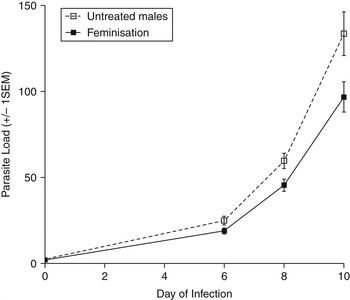
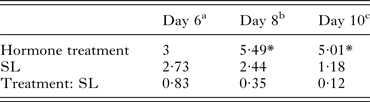
Guppies that underwent feminization via combined treatment with flutamide and 17 β-estradiol had significantly lower G. turnbulli loads than untreated guppies throughout the infection period (repeated measures GLM effect of treatment: F 1,77 = 4·94; P < 0·029), and specifically on both days 8 and 10 of infection (Table 1; Fig. 1; Supplementary Figure S1). We did not detect any significant effect of SL or of its interaction with the hormone treatment on parasite load (Table 1). Mortality following infection was low. Only 3 individuals had died (10%) by day 10 of infection, all of which were in the untreated group (Supplementary Table S3). Gyrodactylus turnbulli populations on individual guppies continued to grow through the duration of the experiment (Supplementary Figure S1). We observed no obvious pathological effects of treatment with flutamide and 17 β-estradiol in concert (feminization) and this treatment significantly increased resistance to G. turnbulli on all guppies.
Mean ± S.E.M.Gyrodactylus turnbulli parasite load per host for untreated male guppies (dashed line) or males treated with flutamide and 17 β-estradiol (feminization – solid line) by day of infection (Experiment 1).

Gyrodactylus turnbulli parasite load is significantly higher in untreated male guppies compared with males under feminization on day 8 and 10 of infection (Experiment 1)

Generalized linear model results for G. turnbulli load (integer variable with a negative binomial distribution) on guppies for days 6, 8 and 10 of infection, with treatment (feminization vs untreated males) as factor and guppy standard length (SL) as a covariate. F-values reported (* = P < 0·05).
a n = 29.
b n = 28.
c n = 26.
Experiment 2
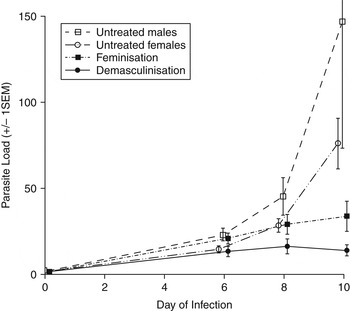
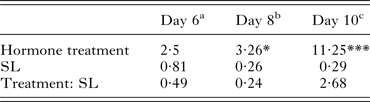
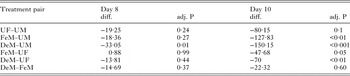
Hormone treatment had a significant effect on parasite load at both day 8 and day 10 (Table 2; Fig. 2; Supplementary Figure S2). As in Experiment 1, males that underwent feminization also had lower G. turnbulli loads on both days 8 and 10 of infection compared with untreated males (Tables 2, 3; Fig. 2), although this difference was only statistically significant on day 10. Males that underwent the demasculization treatment had significantly lower G. turnbulli loads compared with untreated males on days 8 and 10 of infection (Tables 2, 3; Fig. 2). Parasite loads were not significantly different between those males that underwent demasculinization and those that underwent feminization at any time point, and both had lower loads than untreated females on day 10 (Tables 2, 3; Fig. 2). With few exceptions, G. turnbulli populations on individual guppies continued to grow for the duration of the experiment while their hosts remained alive, but growth trajectories differed between treatments (Supplementary Figure S2). We observed no significant effects of SL or any interaction effects between body size and treatment on parasite load (Table 2). Contrary to previous studies on wild guppy populations (Gotanda et al. Reference Gotanda, Delaire, Raeymaekers, Pérez-Jvostov, Dargent, Bentzen, Scott, Fussmann and Hendry2013), we found no evidence that guppies from our Aripo/Quare mixed-origin laboratory-bred population were sexually dimorphic in G. turnbulli resistance (Table 3). In contrast to Experiment 1, guppy mortality after infection with G. turnbulli was high in the mixed Aripo/Quare population: 67% of all fish had died by the 13th day of infection (56% by the 10th day). This mortality was significantly higher in the untreated males than in either group of treated males (demasculinization or feminization) or the untreated females (Table 4; Supplementary Figure S2).
Mean ± S.E.M. Gyrodactylus turnbulli load per host in male guppies treated with flutamide (demasculinization), with flutamide and 17 β-estradiol (feminization), and in untreated males and females, compared across days after infection (Experiment 2). Points are slightly offset on the x-axis to reduce overlap.

Gyrodactylus turnbulli parasite load varies with sex and hormone treatment on day 8 and 10 of infection (Experiment 2)

Generalized linear model results for G. turnbulli load (integer variable with a negative binomial distribution) on guppies for days 6, 8 and 10 of infection, with treatment (untreated males, untreated females, males under demasculinization, and males under feminization) as factor and guppy standard length (SL) as a covariate. F-values reported (* = P < 0·05, *** = P < 0·001).
a n = 72.
b n = 62.
c n = 40.
Post hoc pairwise comparisons of Gyrodactylus turnbulli load by treatment (Experiment 2)

Tukey HSD post hoc pairwise comparison among treatments for guppies in Experiment 2. A negative difference indicates that the second group in a treatment pair had a higher parasite load than the first treatment. UM, untreated males; UF, untreated females; DeM, males under demasculinization; and FeM, males under feminization.
Guppy survival by treatment post infection with Gyrodactylus turnbulli

Cox proportional hazards results for survival until day 13 after infection, ‘day of death’ as a response variable, and ‘treatment’ as explanatory variable. Values are for individuals of a given treatment compared with untreated males.
DISCUSSION
We conducted two independent experiments with different populations of wild-origin guppies and found that gonadal steroids affect the ability of male guppies to control infection by the ectoparasite G. turnbulli. Gyrodactylus turnbulli populations on individual hosts increased over the experiment, but treatment with the androgen receptor antagonist flutamide (resulting in ‘demasculinized’ males) or a combination of flutamide and the oestrogen 17 β-estradiol (resulting in ‘feminized’ males) resulted in reduced G. turnbulli loads compared with untreated males or females. These differences were not explained by differences in body size. Furthermore, males under both feminization and demasculinization treatments showed significantly greater survival compared with untreated males following infection in our second experiment. Variation in G. turnbulli population growth within treatments and between experiments is likely to be influenced by the autocorrelative nature of Gyrodactylus population growth (Ramírez et al. Reference Ramírez, Harris and Bakke2012), yet the effects of gonadal steroid manipulation generated significantly different parasite loads between treatments in both experiments. Taken as a whole, these results suggest that androgens have a detrimental effect on guppy resistance to parasitism.
To our knowledge, only one previous study has experimentally assessed the role of gonadal steroids on Gyrodactylus resistance. Buchmann (Reference Buchmann1997) evaluated the effect of testosterone on female trout's (Oncorhynchus mykiss) resistance to Gyrodactylus derjavini and concluded that testosterone injections led to higher parasite loads. However, the results of the Buchmann (Reference Buchmann1997) study could not distinguish between a detrimental effect of testosterone on host defence and the alternative hypothesis that testosterone has a direct positive effect on Gyrodactylus reproduction. Our results suggest that a detrimental effect of androgens on the host is more likely than a direct effect of testosterone on Gyrodactylus reproduction. Our experimental fish received flutamide, which binds to androgen receptors, broadly inhibiting the host physiological responses to multiple androgens in teleost fishes (including both testosterone and 11-ketotestosterone; de Waal et al. Reference de Waal, Wang, Nijenhuis, Schulz and Bogerd2008; Jolly et al. Reference Jolly, Katsiadaki, Le Belle, Mayer and Dufour2006) without altering the circulating levels of these hormones (Jensen et al. Reference Jensen, Kahl, Makynen, Korte, Leino, Butterworth and Ankley2004).
Oestrogens also may have immunomodulatory effects in teleost fishes (e.g. Cuesta et al. Reference Cuesta, Vargas-Chacoff, García-López, Arjona, Martínez-Rodríguez, Meseguer, Mancera and Esteban2007; Watanuki et al. Reference Watanuki, Yamaguchi and Sakai2002), but the degree to which they enhance or reduce host immunity seems to be highly system- and species-specific (Chaves-Pozo et al. Reference Chaves-Pozo, García-Ayala, Cabas and Kahn2012). When we consider the role of oestrogens on defence against Gyrodactylus, 2 lines of evidence suggest that it did not have a major effect in the guppy. First, male guppies treated with flutamide and 17 β-estradiol did not differ in resistance from male guppies treated with flutamide alone, suggesting that 17 β-estradiol did not have a substantial additional effect on defence. Second, untreated female guppies were not more resistant than males that underwent demasculinization and, in fact, they had higher parasite burdens on day 10 of infection.
Female guppies are larger than males and sexual dimorphism in body size is a common explanation for sex-biased parasitism in vertebrates. The larger sex is expected to have higher parasite loads since larger individuals have a wider area exposed to parasite attacks or a larger resource base for the parasite population to grow (Zuk and McKean, Reference Zuk and McKean1996). However, we did not detect a difference in parasite loads between untreated males and females, nor did body size correlate with variation in resistance in either experiment. This finding might appear surprising, given that field surveys (Gotanda et al. Reference Gotanda, Delaire, Raeymaekers, Pérez-Jvostov, Dargent, Bentzen, Scott, Fussmann and Hendry2013) and laboratory experiments (Dargent, Reference Dargent2015) report sex differences in Gyrodactylus loads in certain guppy populations, and in at least one instance such a sex difference has been linked to size dimorphism (Cable and van Oosterhout, Reference Cable and van Oosterhout2007). However, sex-biased parasitism in guppies is not consistently male biased and appears to be influenced by predation regime. For example, Gotanda et al. (Reference Gotanda, Delaire, Raeymaekers, Pérez-Jvostov, Dargent, Bentzen, Scott, Fussmann and Hendry2013) reported higher Gyrodactylus spp. loads on females compared with males in natural streams where the risk of predation was high, but the reverse pattern at sites where the risk of predation was low, suggesting that body size differences are not a comprehensive explanation for sex-biased parasite loads in guppies. Furthermore, experimentally translocated wild guppies have been shown to rapidly evolve resistance to Gyrodactylus in a sex-specific manner, leading to the loss of sexual dimorphism in resistance (Dargent, Reference Dargent2015). Thus, it is possible that the population we used for Experiment 2 is one that shows minimal sexual dimorphism in resistance to Gyrodactylus, although we did observe higher mortality in untreated males than females. It is possible that the high mortality in the untreated male group, which considerably reduced our sample size, precluded our ability to detect an otherwise significant dimorphism in parasite loads. Nevertheless, our results clearly show that regardless of any initial sexual dimorphism in defence, interfering with androgen signalling augments resistance to G. turnbulli in male guppies.
The significantly higher mortality of untreated males compared with untreated females suggests that androgens may reduce guppy tolerance to Gyrodactylus (i.e. the ability of hosts to reduce the negative impacts of a given parasite load; Raberg et al. Reference Raberg, Sim and Read2007). This line of reasoning is supported by the lower mortality of males that underwent both demasculinization and feminization compared with the untreated males. We did observe a difference in untreated male mortality between Experiments 1 and 2, possibly the result of population differences in subjects' susceptibility to Gyrodactylus induced mortality. Given that laboratory conditions were identical between the two experiments, the most likely cause for particular differences in mortality and parasite loads between Experiments 1 and 2 is the fish population of origin. However, regardless of population origin, guppies that underwent hormone treatments (demasculinization or feminization) experienced lower mortality during infection and carried lower parasite loads than untreated males in both experiments.
The suppressive effect of the androgen system on guppy defence against G. turnbulli suggests a trade-off between resistance to these ectoparasites and other fitness-related traits of male guppies. On the one hand, female guppies typically prefer to mate with males that show brighter carotenoid colouration (Houde and Endler, Reference Houde and Endler1990) and more active courtship (Kodric-Brown and Nicoletto, Reference Kodric-Brown and Nicoletto2001), traits which have positive correlations with circulating androgens (Baatrup and Junge, Reference Baatrup and Junge2001; Bayley et al. Reference Bayley, Larsen, Baekgaard and Baatrup2003), and thus higher levels of circulating androgens would seem to increase male fitness. On the other hand, infections by Gyrodactylus are known to decrease male carotenoid colouration and display rate, and consequently decrease female preference for males with higher Gyrodactylus loads (Houde and Torio, Reference Houde and Torio1992; Kennedy et al. Reference Kennedy, Endler, Poynton and McMinn1987). Furthermore, Gyrodactylus infection may compromise predator evasion, for example, via increased morbidity and decreased swimming performance (Cable et al. Reference Cable, Scott, Tinsley and Harris2002). Thus, Gyrodactylus can decrease male guppy host fitness through the direct effect of increased mortality and through the indirect effect of decreased mating opportunities, which may counterbalance the fitness enhancing properties of their androgen hormones. A further possibility is that an increase in circulating androgens could promote carotenoid accumulation, which in turn counterbalances the immunosuppressive effects of androgens (e.g. Blas et al. Reference Blas, Pérez-Rodríguez, Bortolotti, Viñuela and Marchant2006; McGraw and Ardia, Reference McGraw and Ardia2007). However, this possibility is unlikely here, given that males with intact androgen levels had higher parasite burdens than those under the feminization and demasculinization treatments.
In conclusion, a reduced response of androgen receptors to circulating androgens was found to lead to decreased parasite burdens and parasite-induced mortality. Future work should determine if androgens have a direct immunosuppressive effect or, alternatively, if androgen dependent changes in sexual traits and reproductive investment indirectly affect investment in immunity. Our findings are consistent with the idea that androgens modulate immune function, but run contrary to the view that size determines parasite loads, and therefore help further the understanding of inter-individual variation in parasitism. The developmental and current (circulating) effects of gonadal steroids on the immune system and resistance to infection, as well as their indirect effects on secondary sexual traits that affect fitness, are underappreciated in studies addressing the ecology and evolution of vertebrate defence against parasites. Our results on a model host–parasite system strongly suggest that gonadal steroids should be considered in concert with morphological or behavioural differences when accounting for variation among individuals and between the sexes.
SUPPLEMENTARY MATERIAL
To view supplementary material for this article, please visit http://dx.doi.org/10.1017/S0031182015001286.
ACKNOWLEDGEMENTS
We thank HJ Pak, K White, D Uthayakumar and G Daggupati for laboratory assistance, A Morrill and S Portalier for figure coding advice, and A Hendry for use of his aquatic housing systems (NSERC-RTI #148297). We thank D Reznick, C Ghalambor, E Ruell, D Fraser, and the FIBR team for supplying us with guppies used in Experiment 1.
FINANCIAL SUPPORT
We thank the Quebec Centre for Biodiversity Science (FD); the Natural Sciences and Engineering Research Council of Canada (NSERC) (GFF – #356373-07; SMR – #418342-2012 and #429385-2012; ARR), Richard H. Tomlinson fund (ARR) and the Canada Foundation for Innovation (SMR – #29433). Research at the Ghalambor laboratory was supported by a NSF Faculty Early Career (DEB-0846175). The guppy introductions were funded by a United States NSF Frontiers in Integrative Biological Research grant to D Reznick P.I. (EF-0623632).