Introduction
Harsh parenting refers to coercive acts or negative emotional expressions toward children, which include name-calling, overt expressions of anger, physical threats, and aggression (Chang et al., Reference Chang, Schwartz, Dodge and McBride-Chang2003). It can be seen as a less extreme form of child abuse and maltreatment which can generally be categorized into harsh tactics (e.g., hitting or yelling). While the experiences of child abuse and maltreatment are universally frowned upon, harsh parenting, often considered a milder form of abuse, is usually seen as normative in some cultures. Many countries have outlawed the use of corporal punishment including in households (Berthelon et al., Reference Berthelon, Contreras, Kruger and Palma2020) and there has been a decline in the endorsement of physical punishments by high-income mothers in the US (Ryan et al., Reference Ryan, Kalil, Ziol-Guest and Padilla2016). Yet, the prevalence of harsh parenting practices is still high (Runyan et al., Reference Runyan, Shankar, Hassan, Hunter, Jain, Paula, Bangdiwala, Ramiro, Muñoz, Vizcarra and Bordin2010). According to the latest cross-national data, harsh parenting from caregivers is widespread across all regions of the world (UNICEF, 2023). Past studies suggest that such harsh parenting is associated with greater mental health problems in children and adolescents (Heilmann et al., Reference Heilmann, Mehay, Watt, Kelly, Durrant, Van Turnhout and Gershoff2021). For example, a recent multi-national study showed that parental rejection (e.g., maternal or paternal hostility and aggression) was associated with an increase in either externalizing or internalizing symptoms across ages 7-14 (Rothenberg et al., Reference Rothenberg, Ali, Rohner, Lansford, Britner, Di Giunta and Deater-Deckard2022). In the present study, we use latent change score models, a form of longitudinal modeling with repeated measures, to examine the trajectory of the association of harsh parenting and externalizing and internalizing symptoms across childhood. Past studies that used crossed-lagged modeling found different trajectories in the association between harsh parenting with externalizing and internalizing symptoms in separate sampling (Pinquart, Reference Pinquart2016, Reference Pinquart2017). In our study, we aim to characterize the trajectories of externalizing and internalizing symptoms associated with harsh parenting in one sample which would enable greater clarity on the association between harsh parenting and externalizing and internalizing symptoms. In addition, we also explore the role of socioeconomic status and ethnic background in the association between harsh parenting and mental health conditions. This would rigorously test past cross-sectional findings that suggested ethnic and socioeconomic differences in the association between harsh parenting and externalizing or internalizing symptoms.
Studies have shown that negative parental practices including corporal punishment and harsh parenting are associated with adverse mental outcomes including externalizing and internalizing behaviors (Hecker et al., Reference Hecker, Hermenau, Salmen, Teicher and Elbert2016; Leary & Baumeister, Reference Leary and Baumeister2000; Li et al., Reference Li, Wang, Ma, Sun, Gong and Gao2023; Mackenbach et al., Reference Mackenbach, Ringoot, Van der Ende, Verhulst, Jaddoe, Hofman, Jansen and Tiemeier2014; Pinquart, Reference Pinquart2021). Internalizing behavior refers to covert, overcontrolled behavioral problems directed to oneself (e.g., depression, anxiety, social withdrawal) while externalizing behaviors refer to observable, uncontrolled behaviors directed to the social environment which can be a source of conflict and tension (e.g., conduct problems, delinquency, aggression, rule violation, etc.). A cross-lagged path analysis study that tested the reciprocal association between harsh parenting and conduct problems found that harsh parenting at age 6 not only predicted child conduct problems at age 11 but that child’s conduct problems at age 6 also predicted higher harsh parenting at age 11 (Bauer et al., Reference Bauer, Fairchild, Halligan, Hammerton, Murray, Santos, Munhoz, Barros, Barros and Matijasevich2021). On the contrary, most studies investigating the association between harsh parenting and internalizing symptoms have mostly found a unidirectional association. For example, using cross-lagged path analysis, one British study showed that emotional problems at age 5 were associated with increased harsh parenting at age 7 but not vice versa (Speyer et al., Reference Speyer, Hang, Hall and Murray2022). Another recent study that used latent growth modeling to examine the association between harsh parenting and externalizing or internalizing symptoms across different ages found that harsh parenting at age 9 predicted higher levels of externalizing symptoms at ages 11, 17, and 18 as well as higher levels of internalizing symptoms at ages 17 and 18. When the alternate direction of the association was modeled and tested, externalizing symptoms predicted higher levels of harsh parenting across all time points from ages 9-18 but neither the intercept or slope of internalizing symptoms predicted harsh parenting at any of the assessment time points (Thompson et al., Reference Thompson, Hinnant, Erath and El-Sheikh2024). In addition, two meta-analyses have used crossed-lagged modeling to explore the association between harsh parenting and externalizing or internalizing symptoms. The first meta-analysis examining externalizing symptoms found a reciprocal association between harsh parenting and externalizing symptoms. In other words, harsh parenting predicted an increase in externalizing symptoms, and externalizing symptoms equally predicted an increase in harsh parenting (Pinquart, Reference Pinquart2017). In the second meta-analysis examining internalizing symptoms, harsh parenting only predicted an increase in internalizing symptoms (Pinquart, Reference Pinquart2016). These findings suggest that the developmental trajectory and mechanism through which harsh parenting affects externalizing symptoms may be different from internalizing symptoms. Although past empirical works have used cross-lagged and growth models to investigate the association between harsh parenting and psychopathology, the bivariate latent change score model has some additional advantages over these longitudinal models. For instance, unlike the crossed-lagged model which identifies the association across variables over time without capturing the pattern of growth, the latent change score model takes into account the “growth” within and between variables (Ferrer & McArdle, Reference Ferrer and McArdle2010). It can test the “coupling” between variables across specific time points, a technique lacking in growth models. Thus, using the latent change score model will enable us to test the bidirectional association between harsh parenting and externalizing or internalizing symptoms.
One possible explanation for the bidirectional link found in past studies between harsh parenting and externalizing symptoms may be rooted in the family coercive model (Patterson, Reference Patterson1982). A child’s problematic or oppositional behavior may result in the likelihood of using disciplinary measures by the parents, which in turn increases the child’s externalizing symptoms, resulting in a cycle of conflict in child-caregiver interactions. Alternatively, prolonged periods of harsh parenting can lead to an increased risk of psychopathology through hostile attribution bias (Lewis et al., Reference Lewis, Breitenstein, Henderson, Sowards, Piras, Huentelman, Doane and Lemery-Chalfant2020; Lin et al., Reference Lin, Wang, Cheng and Bai2023). Whereas children with externalizing symptoms engage in a repeated cycle of toxic interaction with their parents and caregivers, it has been noted that those with internalizing symptoms may seek to escape the cycle of negative parental exchanges by withdrawing or avoiding such hostile situations (Bauer et al., Reference Bauer, Fairchild, Halligan, Hammerton, Murray, Santos, Munhoz, Barros, Barros and Matijasevich2021). These meta-analyses and empirical studies provide important insight into the association between harsh parenting and externalizing or internalizing symptoms. However, using a latent change score modeling will provide a framework for testing hypotheses that characterize the patterns of stability and correlated change between harsh parenting, externalizing and internalizing symptoms, and their lagged effects over time.
The role of socioeconomic status and race
In addition to the studies on the association between harsh parenting and externalizing or internalizing symptoms described above, some factors may moderate this association. In Western cultures, race and socioeconomic status of parents play an important role in the use of harsh parenting and its effects on their children. A study in the United States that assessed the role of parents’ socioeconomic status on the use of harsh parenting showed that mothers from lower socioeconomic status households not only endorsed parental physical discipline but also reported using more physical discipline on their children than mothers from higher socioeconomic status households (Ryan et al., Reference Ryan, Kalil, Ziol-Guest and Padilla2016). Similarly, studies have found that the relationship between harsh parenting and externalizing behavior is distinct among ethnic groups in Western countries (Deater-Deckard et al., Reference Deater-Deckard, Dodge, Bates and Pettit1996) and other related studies have observed significant interactions between socioeconomic status, and race on the link between harsh parenting and externalizing behavior (Pinderhughes et al., Reference Pinderhughes, Dodge, Bates, Pettit and Zelli2000). Specifically, Deater-Deckard et al found that the association between harsh parenting and externalizing behavior was only significant among White/European Americans but not among African Americans despite the elevated risk of harsh parenting practices in African American households (Deater-Deckard et al, Reference Deater-Deckard, Dodge, Bates and Pettit1996). This highlights potential cultural variation in perceptions and beliefs around harsh parenting. Another related study also showed that both low socioeconomic status and ethnicity i.e., being African American, especially low-income African American, predicted greater use or endorsement of harsh parenting (Pinderhughes et al., Reference Pinderhughes, Dodge, Bates, Pettit and Zelli2000). Using a sample of studies from all regions of the world, a recent meta-analysis showed that harsh parenting was associated with higher internalizing and externalizing behaviors in all regions and across all compared ethnic groups within Western countries (Pinquart, Reference Pinquart2021) and that this association is partially depended on the cultural norms and acceptance of harsh parenting. For example, the association between harsh parenting and externalizing symptoms is stronger in cultures that have low tolerance for harsh parenting but there was no association between internalizing symptoms and cultural acceptance of harsh parenting (Pinquart, Reference Pinquart2021). These findings taken together not only highlight both socioeconomic and ethnicity-linked variations in the effects of harsh parenting on internalizing and externalizing symptoms but also point to subtle nuances in the trajectory of internalizing and externalizing behaviors relating to the cultural normality of harsh parenting.
The current study
The purpose of our study is twofold. Firstly, using the bivariate latent change score model, we test the hypothesis that (1) the association between harsh parenting and externalizing symptoms across ages 3-7 will be bidirectional and (2) the association between harsh parenting and internalizing symptoms across ages 3-7 will be unidirectional. Most past studies have examined these associations separately and have not rigorously characterized the developmental pathway of harsh parenting with these two psychopathology outcomes in one sample. Latent change score modeling will enable us to test the bidirectional association between harsh parenting and externalizing or internalizing symptoms. By examining the association between harsh parenting and internalizing or externalizing symptoms in the same sample of children in middle childhood, we would gain insight into the developmental trajectories of internalizing and externalizing symptoms linked to harsh parenting across important developmental ages. The developmental ages of the sample children are likely critical given that this is the point at which parents are expected to have asserted authority over the behavioral conduct of their rapidly developing child and in which early stages of hostile and coercive exchanges with parents are likely to be nurtured (and sustained). Secondly, we examine how harsh parenting affects the mental health of children along ethnic and socioeconomic status lines. We specifically use the multi-group modeling approach of the latent change score model to this effect. Past studies of harsh parenting show considerable socioeconomic status and racial differences in the association between harsh parenting and externalizing symptoms (Deater-Deckard et al., Reference Deater-Deckard, Dodge, Bates and Pettit1996; Pinderhughes et al., Reference Pinderhughes, Dodge, Bates, Pettit and Zelli2000). Many of these past studies have been cross-sectional and conducted mostly in the United States. Thus, using a rigorous analytic approach to investigate the trajectory of the groups’ differences will enhance our understanding of how the association between harsh parenting and internalizing or externalizing symptoms differs across various ethnic groups, as well as the interaction of ethnicity and socioeconomic status in this association. This would also provide further insight into specific group dynamics relating to the perception of harsh parenting and its resultant effects on internalizing and externalizing symptoms. Testing this hypothesis on a large British sample will enable us to assess whether harsh parenting has similar or different outcomes as those observed in the United States.
Methods
Participants
We analyzed the Millennium Cohort Study, an ongoing British longitudinal cohort of Children born in England, Wales, Scotland, and Northern Ireland between September 1, 2000, and January 2, 2002. In the present study, we analyzed data obtained across 3 waves, when the children were aged 3, 5, and 7. We used measures of externalizing symptoms (conduct problems), internalizing symptoms (emotional problems), and harsh parenting obtained from mothers when their children were aged 3, 5, and 7. These data were obtained during visits to the participating households by trained interviewers at ages 3, 5, and 7. Approximately 98% of the mothers responded to the harsh parenting, externalizing, and internalizing measures in the Millennium Cohort Study. It is important to note that just like all states in America, “reasonable punishment” is variable across different locations. Corporal punishment by parents is considered lawful in England and Northern Ireland, but unlawful in Scotland and Wales (in all settings including the home). Thus, we controlled for participants’ nationality in our analysis.
The final analytic sample consists of 12,909 participants (Male = 50.22%, Female = 49.78%, Mean age 3 = 3.13, SD = 0.20; Mean age 7 = 6.82, SD = 0.39) who met our inclusion criteria. Participants were only included in the analysis if they had baseline data on harsh parenting, externalizing, and internalizing symptoms at age 3. The baseline data in our analytic sample was 100% provided by the mothers of the participants as was the case for the rest of our measurement timepoints. Our analyzed sample was geographically and ethnically representative, consisting of White (89.09%), Black (2.44%), Indian (1.73%), Pakistani and Bangladeshi (3.30%), Mixed race (2.77%), and other races (0.67%), including Chinese participants. Our analytic sample also varied across socioeconomic status with household income ranging from less than £1700 per annum to greater than £85,000 per annum. Across ages 3-7, the participants’ attrition rate was about 11.18% in our final analytic sample with 8.70% (age 3), 9.80% (age 5), and 12.51% (age 7) of missing data across each of the three waves.
Measures
Harsh parenting
Harsh parenting was measured by the Conflict Tactics Scales (Straus & Hamby, Reference Straus and Hamby1997), designed to measure parents’ physical and non-physical punishment of their children. When the participants were 3, 5, and 7 years old, their mothers, responded to how often (1= never, 2 = rarely, 3 = once a month, 4 = once a week, 5 = daily) they used disciplinary practices whenever their children misbehaved. These questions consist of 3 harsh tactics (e.g., smacking, shouting, and telling off their children). Harsh parental disciplinary scores were obtained by summing the participants’ scores in all the 3 item questions across the 3 waves. The harsh tactics subscale of the Conflict Tactics Scales used in the present study has internal consistency reliability across the three waves: age 3 (alpha = 0.65); age 5 (alpha = 0.65); age (alpha = 0.66). The frequency of harsh parenting across 3-7 in the millennium cohort study is presented in Table 1.
Frequency (%) of harsh parenting across ages 3-7 in the millennium cohort study

Externalizing symptoms
When the children were aged 3, 5, and 7, mothers, completed the conduct problems subscale of the Strengths and Difficulties Questionnaire (Goodman et al., Reference Goodman, Ford, Simmons, Gatward and Meltzer2000). The conduct subscale of the SDQ consists of 5 item questions: “often has temper tantrums,” “generally obedient” (reverse coded), “fights with or bullies other children,” “often argumentative with adults[lies or cheats],” and “spiteful to others[steals from home or school].” These questions are rated on a 3-point scale (Not true = 0, Somewhat true = 1, certainly true = 2). Responses to the 5 questions were summed to create the total scores in the externalizing symptoms which ranged from 0 to 10. Studies have shown that the conduct problem subscale of the Millennium Cohort Study at ages 3, 5, and 7 has good psychometric properties with internal reliability ranging from alpha .77 to .82 (Croft et al., Reference Croft, Stride, Maughan and Rowe2015). The externalizing symptoms subscale used in the present study has internal consistency reliability across the three waves: age 3 (alpha = 0.63); age 5 (alpha = 0.56); age (alpha = 0.59).
Internalizing symptoms
Data on participants’ internalizing symptoms were also obtained at ages 3, 5, and 7 through mothers’ reports of the emotional symptoms subscale of the SDQ. The emotional symptoms subscale is part of the internalizing symptoms designed to test emotional difficulties in children and adolescents. It consists of questions such as “Often unhappy, down-hearted or tearful,” “Often complains of headaches, stomach-aches or sickness,” “Many worries, often seems worried,” “Nervous or clingy in new situations, easily loses confidence,” “Many fears, easily scared.” Just as the conduct problems subscale, responses in the emotional symptoms subscale were rated on a 3-point scale (Not true = 0, Somewhat true = 1, certainly true = 2). These 5 responses were summed to create internalizing symptoms score for each of the 3 waves. The emotional symptoms of the SDQ in the Millennium Cohort Study have a good internal consistency that ranges from 0.76-0.79 across ages 3-7 (Croft et al., Reference Croft, Stride, Maughan and Rowe2015). The internalizing symptoms subscale used in the present study has internal consistency reliability across the three waves: age 3 (alpha = 0.53); age 5 (alpha = 0.60); age (alpha = 0.64).
Analytic strategy
All analyses were performed in R and R studio, mostly within the framework of the structural equation model. We conducted four main statistical tests: a univariate latent change score model, a bivariate latent change score, a multi-group bivariate latent change score model, and a chi-square difference test. Missing patterns were examined by plotting the data and the correlations between missingness and the variables. For example, missingness in harsh parenting at age 7 and externalizing at age 7 is not related to gender, X2 (1) = 1.972, p = 0.160, as was missingness in harsh parenting and internalizing at age 7, X2 (1) = 2.605, p = 0.106. Thus, missing data was assumed to be missing at random and dealt with Full Information Maximum Likelihood, which provides unbiased estimates if data are missing at random (Enders and Bandalos, Reference Enders and Bandalos2001). Before the analyses, all data were rescaled via standard normalization to ensure uniform metrics across all variables at different waves.
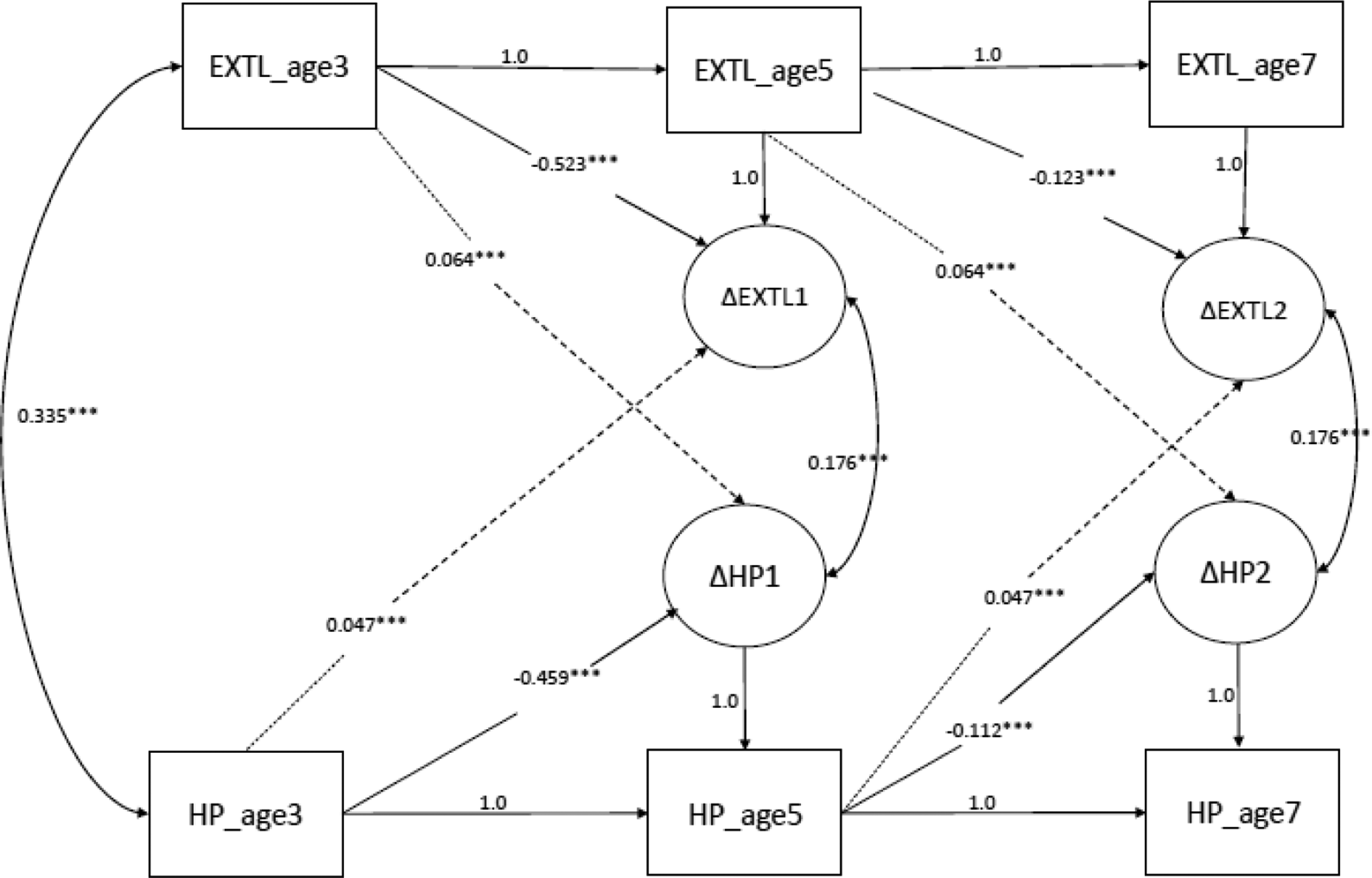
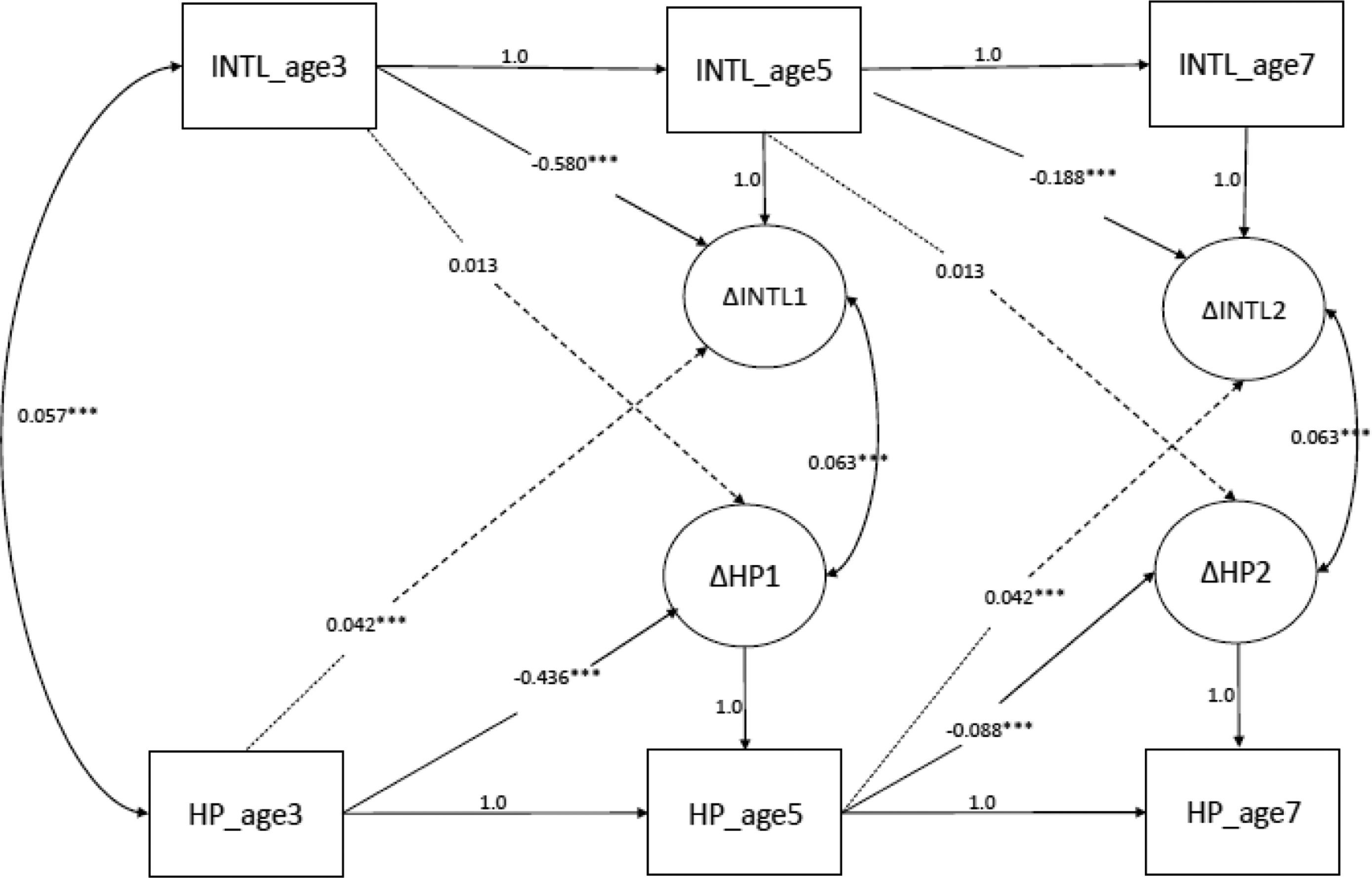
We modeled a bivariate latent change score to examine the long-term association of harsh parenting with externalizing and internalizing symptoms. We tested two bivariate associations – one examining the association between harsh parenting and externalizing symptoms across ages 3-7 and a second model examining the association between harsh parenting and internalizing symptoms across ages 3-7. The latent change score model can test for latent changes in observable scores across two or more time points (e.g., Δ externalizing symptoms in Time 1–Time 2 or Δ externalizing symptoms in Time 2–Time 3, Kievit et al., Reference Kievit, Brandmaier, Ziegler, van Harmelen, de Mooij, Moutoussis, Goodyer, Bullmore, Jones, Fonagy, Consortium, Lindenberger and Dolan2018; Nweze et al., Reference Nweze, Banaschewski, Ajaelu, Okoye, Ezenwa, Whelan, Papadopoulos Orfanos, Bokde, Desrivières, Grigis, Garavan, Gowland, Heinz, Brühl, Martinot, Martinot, Artiges, Nees and Paus2023). Referred to as the self-feedback parameter, this is done by setting the weights of autoregressive parameters and the factor loadings on the latent change scores at Time 2 and Time 3 to 1. The self-feedback parameters capture the association between the Time 1 measure (e.g., Externalizing at age 3) and the change in the measure from T1 to T2 (i.e., Δ externalizing in Time 1–Time 2). In addition, the bivariate latent change score enabled us to test the dynamic coupling in the relations between harsh parenting and externalizing or internalizing symptoms. That is the extent to which harsh parenting at time t predicts changes in externalizing or internalizing symptoms at subsequent measurement points t + 1. In other words, we examined whether harsh parenting at age 3 predicted change in externalizing and internalizing symptoms across ages 3-7, as well as whether baseline externalizing or internalizing symptoms predicted change in harsh parenting across ages 3-7 (See Figure 1 and Figure 2). In estimating the model parameters, the self-feedback parameters were allowed to vary but the coupling parameters were constrained to equality across the 3 timepoints given that we expect this coupling relationship to be stable across timepoints. Model comparisons showed that the coupling parameters constrained to equality did not significantly perform worse than coupling parameters freely estimated. In addition to these bivariate latent change score models, we also modeled the univariate latent change score for each of the 3 study variables (i.e., harsh parenting, externalizing symptoms, and internalizing symptoms). This enabled us to examine the proportional change (i.e., self-feedback) in these variables. The self-feedback parameters were also freely estimated in the univariate latent change score model. Positive self-feedback means that a higher value at baseline is associated with an increased rate of change across subsequent timepoints while negative self-feedback indicates that a higher baseline score is associated with a decreased rate of change in the same variable across subsequent timepoints. We assessed model fit to ensure that they were within the recommended fit indices of the comparative fit index (CFI>0.95), the root mean square error of approximation (RMSEA<0.06), and the standardized root mean square residual (SRMR<0.06) (Hu & Bentler, Reference Hu and Bentler1999).
Bivariate latent change score model examining the association between harsh parenting and externalizing symptoms across ages 3-7. HP = harsh parenting; EXTL = externalizing symptoms. Values in the pathways represent the standardized estimates for variables in each pathway. Coupling parameters were constrained to equality across ages 3-7.

Bivariate latent change score model examining the association between harsh parenting and internalizing symptoms across ages 3-7. HP = harsh parenting; INTL = internalizing symptoms. Values in the pathways represent the standardized estimates for variables in each pathway. Coupling parameters were constrained to equality across ages 3-7.

Next, we tested the moderation of socioeconomic status and ethnic background by modeling a multi-group bivariate latent change score model where we examined ethnic and income differences in the bivariate associations between harsh parenting and externalizing and internalizing symptoms. Specifically, we asked if the association between harsh parenting and externalizing and internalizing symptoms differs based on income and ethnic classifications. To facilitate such comparisons, participants’ ethnic identity was grouped as either White participants, consisting of 89% of the total sample, or non-White participants consisting of the remaining 11%. Family income was also grouped into high-income households (i.e., family income greater than £28,000 per annum), representing about the upper 50th income percentile or low-income households (i.e., family income less than £28,000 per annum) which represent about the lower 50th income percentile of the entire sample. To test whether income or ethnic group differences exist in the association between harsh parenting and externalizing or internalizing symptoms, we ran a multi-group bivariate latent change score model with unconstrained parameters across the groups. In addition, we also fitted a competing model where the coupling parameters and covariance between baseline scores of harsh parenting and psychopathology were all constrained to equality across the groups. We then compared the unconstrained and constrained models using the likelihood ratio test. The groups are assumed to significantly differ if the constrained model performs poorer than the unconstrained model (Griffiths et al., Reference Griffiths, Kievit and Norbury2022; Kievit et al., Reference Kievit, Brandmaier, Ziegler, van Harmelen, de Mooij, Moutoussis, Goodyer, Bullmore, Jones, Fonagy, Consortium, Lindenberger and Dolan2018). To test the interaction of ethnicity and socioeconomic status in the bidirectional between harsh parenting and psychopathology, we fitted multi-group modeling involving participants from White high-income households (45.40%), White low-income households (44.71%), non-White high-income households (5.35%) and non-White low-income households (5.52%). Finally, we conducted a supplementary analysis of multi-group modeling involving a broader, 6-group classification of socioeconomic status, ranging from participants in households with annual income less than £3,300 to participants in households with annual income greater than £55,000. See supplementary material for a detailed description.
In all models, we controlled for relevant demographic variables. Single-parent status, sex, and nationality of the participants were entered as covariates in the model. In both the bivariate latent change score model and the multi-group latent change score model, we report the bi-directional associations between harsh parenting and externalizing or internalizing symptoms. We adjusted our p-values for multiple comparisons using Bonferroni correction and set the level of significance to ɑ = .05/2 = .025.
Results
Descriptive results
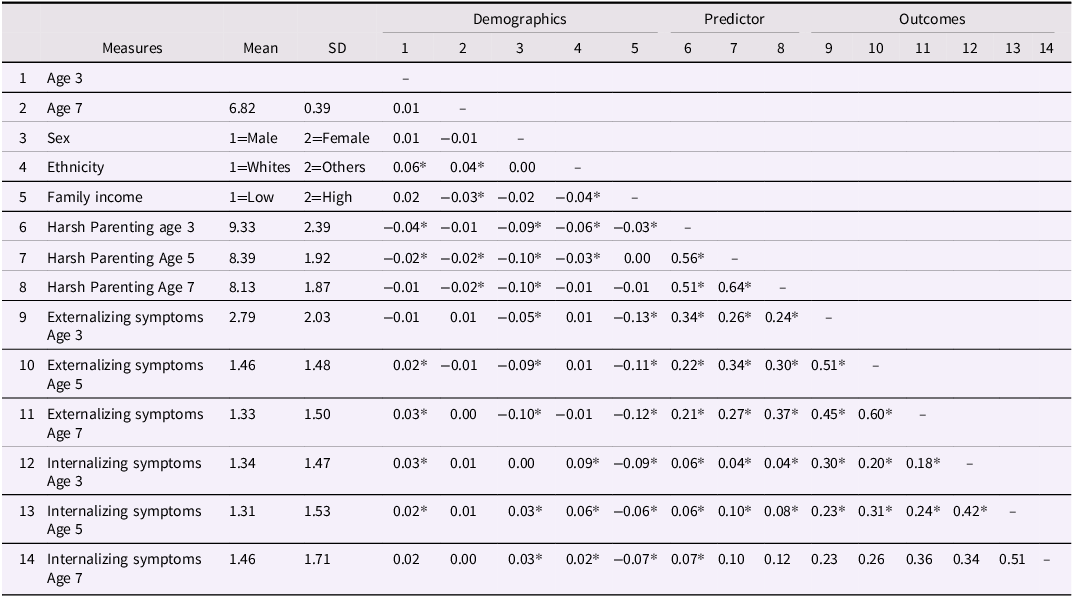
This study used the latent change score model to examine the bidirectional association of harsh parenting on externalizing and internalizing symptoms across ages 3-7. As shown in Table 1, 14.26% (age 3), 11.42% (age 5), and 7.32% (age 7) of mother reported using physical discipline on their child. A higher percentage of mothers (63.60% - 88.98%) reported using verbal discipline such as shouting or telling off their children when they misbehaved. We also examined the descriptive statistics and correlations between basic demographic variables (e.g., age, sex, ethnicity, family income) and the study variables. The correlation coefficients with the mean and standard deviation of the variables are shown in Table 2.
Descriptive statistics and intercorrelations of the study variables

Note: SD = Standard deviation. Mean and SD values are unstandardized. * = Correlation is significant at .05 level.
Univariate analyses: examining unconditional change in harsh parenting; externalizing and internalizing symptoms
We began by fitting a univariate latent change score model for harsh parenting, externalizing, and internalizing symptoms across ages 3-7. The model for harsh parenting fits well, X2 (3) = 1.415, p = 0.702, CFI = 1, RMSEA = 0, SMSR = 0.002. Self-feedback parameters were significant and negative from age 3 to 5 (Std. β = −0.435, p < 0.001) and from age 5 to 7 (Std. β = -0.092, p < 0.001), suggesting that higher harsh parenting at age 3 predicted decrease change from age 3 to 5 as was harsh parenting from age 5 to age 7. The initial mean levels of harsh parenting (Std. β = 0.315, p < 0.001) and change from age 3 to 5 (Std. β = 0.121, p = 0.002) were significant but not the change from age 5 to 7 (Std. β = 0.029, p < 0.446). On the other hand, variance at the initial levels (Std. β = 0.991, p < 0.001), change in variance from age 3 to 5 (Std. β = 0.682, p < 0.001), as well as from age 5 to 7 (Std. β = 0.670, p < 0.001), were all significant, suggesting important individual differences in harsh parenting at both the initial levels and overall rate of change.
The univariate models for externalizing symptoms, X2 (3) = 1.278, p = 0.734, CFI = 1, RMSEA = 0, SMSR = 0.002) and internalizing symptoms, X2 (3) = 1.257, p = 0.739, CFI = 1, RMSEA = 0, SMSR = 0.002) also fit well. The self-feedback parameters were both significant and negative for externalizing (age 3 to age 5: Std. β = -0.501, p < 0.001; age 5 to 7: Std. β = -0.127, p < 0.001) and for internalizing symptoms (age 3 to age 5: Std. β = −0.578, p < 0.001; age 5 to 7: Std. β = -0.183, p < 0.001). These findings suggest that greater externalizing and internalizing symptoms at ages 3 and 5 predicted less change in these measures from age 3 to age 5 and from age 5 to age 7, respectively. For externalizing, the initial mean levels were significant (Std. β = −0.228, p < 0.001) but not change in mean levels from either age 3 to 5 (Std. β = -0.071, p = 0.088) or age 5 to 7 (Std. β = 0.050, p = 0.227). On the other hand, the variance at the initial levels (Std. β = 0.976, p < 0.001), as well as the change in variance from age 3 to 5 (Std. β = 0.734, p < 0.001) and from age 5 to 7 (Std. β = 0.699, p < 0.001), were all significant and suggests variability in externalizing at the initial levels and change overtime. For internalizing, the initial mean levels (Std. β = -0.195, p < 0.001) and change in mean levels from ages 3 to 5 (Std. β = -0.162, p < 0.001) were significant but not change from age 5 to 7 (Std. β = -0.068, p =0.127). However, similar to harsh parenting and externalizing, the variance in internalizing at the initial levels was significant (Std. β = 0.994, p < 0.001), as was the rate of change from ages 3 to 5 (Std. β = 0.824, p < 0.001) and ages 5 to 7 (Std. β = 0.824, p < 0.001).
Bivariate latent change score model: association between harsh parenting and externalizing/internalizing symptoms
To examine the bidirectional long-term association of harsh parenting with externalizing and internalizing symptoms, we fit two separate bivariate latent change score models. The first model (Figure 1 & Table 3) examined the association between harsh parenting and externalizing symptoms while the second model (Figure 2 & Table 3) tested the association between harsh parenting and internalizing symptoms. Models for externalizing: (X2 (8) = 21.615, p = 0.006; CFI = 0.999; RMSEA = 0.011; SRMR = 0.006) and internalizing X2 (8) = 4.353, p = 0.824; CFI = 1; RMSEA = 0; SRMR: 0.002 both fit well. Results of the first model displayed in Figure 1 showed a bidirectional association between harsh parenting and externalizing symptoms across ages 3-7. Specifically, greater harsh parenting at baseline predicted an increase in externalizing symptoms across ages 3-7 (Std. β = 0.047, p < 0.001). On the other hand, higher externalizing symptoms at baseline equally predicted an increase in harsh parenting across ages 3-7 (Std. β = 0.064, p < 0.001).
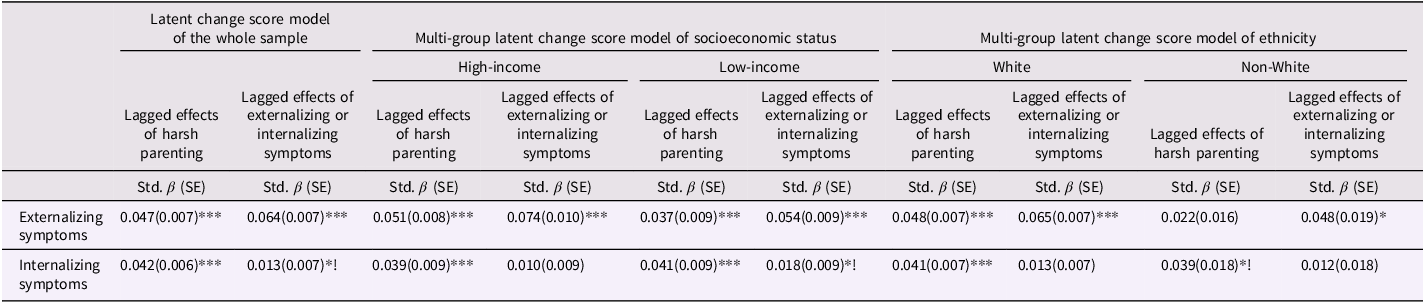
Multi-group latent change score model showing differences in ethnicity and socioeconomic status

***= P < 000; ** p < 0.01; * p < 0.05.
*! = Values with p < 0.05 did not reach significance after correcting for multiple comparisons.
Similarly, we also examined whether harsh parenting across ages 3-7 predicted changes in internalizing symptoms across the same timeframes (Figure 2). Results showed there is a unidirectional association between harsh parenting and internalizing symptoms. Baseline harsh parenting significantly predicted an increased change in internalizing symptoms across ages 3-7 (Std. β = 0.042, p < 0.001). In contrast to externalizing symptoms, baseline internalizing symptoms did not predict changes in harsh parenting across ages 3-7 (Std. β = 0.013, p = 0.041) after corrections for multiple comparisons. Taken together, these findings support past studies that have implicated harsh parenting in internalizing and externalizing problems in children. The results also showed that the trajectory through which harsh parenting manifests in externalizing symptoms may differ from internalizing symptoms across ages 3-7.
Multi-group latent change score model: the role of socioeconomic status and ethnicity in the association of the harsh parenting on externalizing and internalizing symptoms
Moderation of socioeconomic status
We examined if socioeconomic status differences existed in the association between harsh parenting and externalizing symptoms by fitting a multi-group latent change score that included socioeconomic status (high-income families vs low-income families) in our model. Fit indices for the multi-group models examining the association between harsh parenting and externalizing symptoms were within an acceptable range: X2 (28) = 264.533, p < 0.001, CFI = 0.987; RMSEA = 0.040; SRMR = 0.035. Constraining the model parameters (coupling and covariance parameters) to equality did not lead to a significant drop in model fit; ΔX2 (3) = 4.454, p = 0.216, suggesting that participants from high-income and low-income households did not significantly differ from each other in the association between harsh parenting and externalizing symptoms. Parameter estimations showed significant bidirectional associations between harsh parenting and externalizing symptoms among participants in high- and low-income households (all, p < 0.001). These results examining income differences in both high- and low-income households are similar to the findings observed in the bivariate latent change score model in the combined sample and thus, showed that the income groups did not significantly differ in the association between harsh parenting and externalizing symptoms.
In addition, we tested socioeconomic status differences in the model examining the association between harsh parenting and internalizing symptoms. Fit indices for the unconstrained multi-group model were within an acceptable range: X2 (28) = 235.19, p < 0.001; CFI = 0.985; RMSEA = 0.037; SRMR = 0.027. Constraining the model parameters (coupling and covariance parameters) did not also lead to a significant drop in model fit; ΔX2 (3) = 1.094, p = 0.778, an indication that the groups did not significantly differ from each other in the association between harsh parenting and internalizing symptoms. Consistent with the result of the whole sample analysis where we observed a unidirectional association between harsh parenting and internalizing symptoms, we found that after correcting for multiple comparisons, there was no significant association between baseline internalizing symptoms and changes in harsh parenting in the multi-group modeling for participants in either high-income households (Std. β = 0.010, p = 0.303) or low-income households (Std. β =0.018, p = 0.037).
Our supplementary analyses using a broader classification of socioeconomic status groups (consisting of 6 groups) did not reveal significant differences among the groups in the association between harsh parenting and externalizing or internalizing symptoms. See the supplementary material. See also Table 3 & Table S1 for comparison.
Moderation of ethnicity
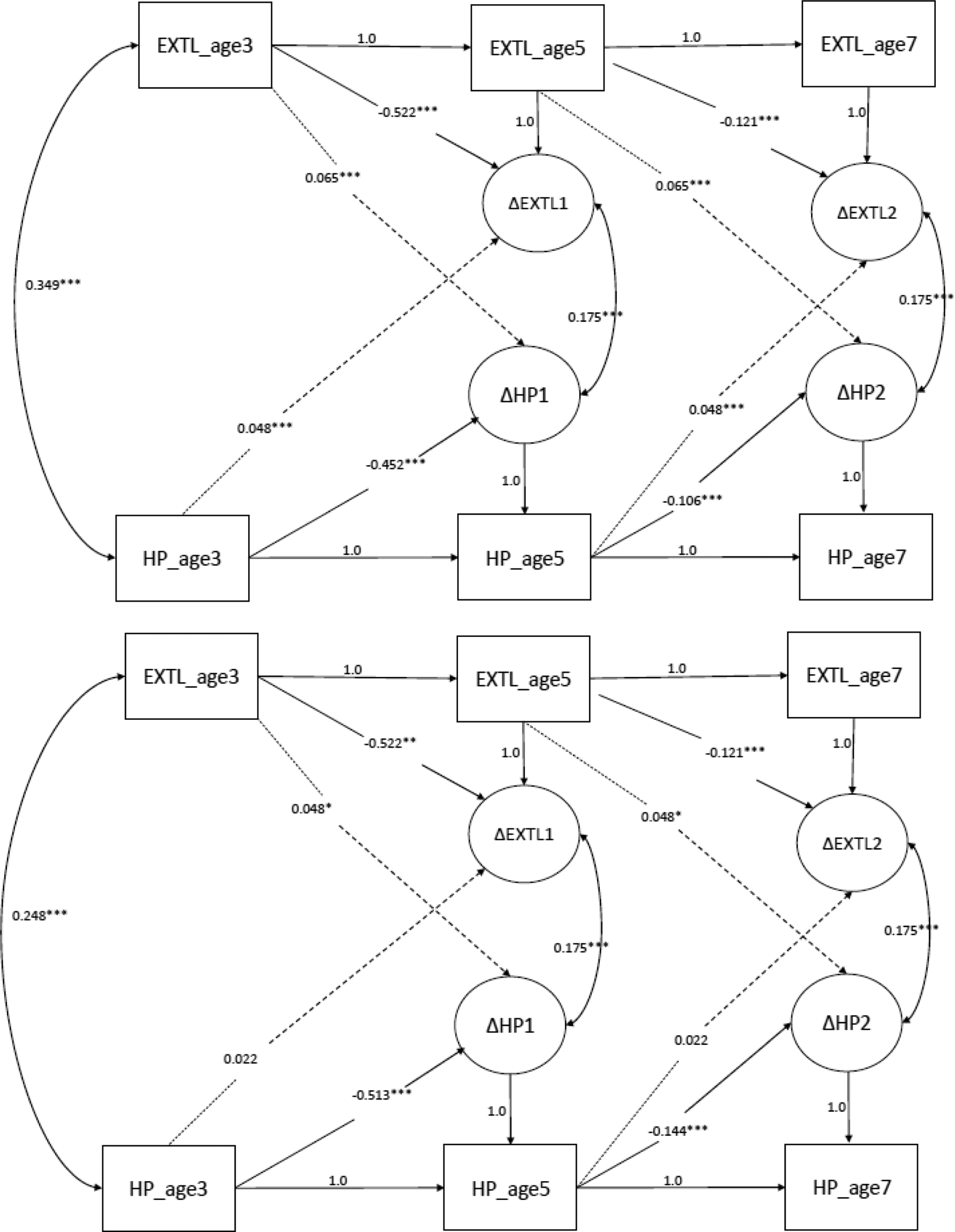
We also examined if ethnic differences existed in the association between harsh parenting and externalizing symptoms by fitting a multi-group latent change score that included ethnicity (White vs non-White participants) in our model. The unconstrained model examining the association between harsh parenting and externalizing symptoms has acceptable fit indices: X2 (28) = 196.136, p < 0.001; CFI = 0.992; RMSEA = 0.031; SRMR = 0.015. Constraining the model parameters (coupling and covariance parameters) to equality across the groups led to a significant drop in model fit relative to the unconstrained model; ΔX2 (3) = 16.497, p<0.001, suggesting that White and non-White participants significantly differed from each other in the association of harsh parenting and externalizing symptoms. Examination of parameter estimates (Figure 3 & Table 3) revealed that greater harsh parenting at baseline predicted an increase in externalizing symptoms across ages 3-7 among White participants (Std. β = 0.048, p < 0.001) but not in non-White participants (Std. β = 0.022, p = 0.163).
Multi-group modeling examining the association between harsh parenting and externalizing symptoms. The top panel shows the estimates of participants from White ethnic background while the bottom panel shows the estimates of participants from non-White ethnic background. HP = harsh parenting; EXTL = externalizing symptoms; INTL = internalizing symptoms. Values in the pathways represent the standardized estimates for variables in each pathway. Coupling parameters were constrained to equality across ages 3-7.

Along similar lines, we also tested a second model examining ethnic differences in the association between harsh parenting and internalizing symptoms. The unconstrained model had acceptable fit indices: X2 (28) = 222.592, p < 0.001; CFI = 0.988; RMSEA = 0.033; SRMR = 0.013. The introduction of equality constraints across the groups in the coupling and covariance parameters did not significantly worsen the model fit: ΔX2 (3) = 0.893, p = 0.827, suggesting that the groups did not significantly differ from each other in the association between harsh parenting and internalizing symptoms. After correcting for multiple comparisons, although parameter estimates showed that baseline harsh parenting was associated with statistically positive change in internalizing symptoms among White participants (Std. β =0.041, p < 0.001) but not among non-White (Std. β = 0.039, p = 0.032) participants, the groups did not differ from each other as shown in the chi-square difference test.
Interaction of socioeconomic status and ethnicity
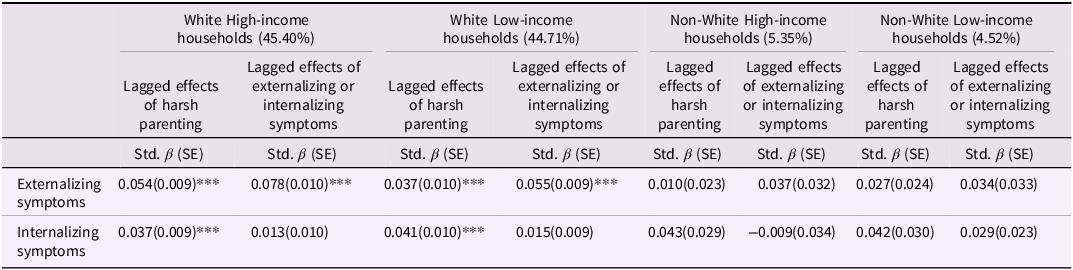
We examined the interaction of socioeconomic status and ethnicity in the association between harsh parenting and psychopathology by fitting a 4 group, multi-group modeling involving participants from White high-income households, White low-income households, non-White high-income households, and non-White low-income households. The first model testing the association between harsh parenting and externalizing symptoms has acceptable fit indices: X2 (60) = 444.202, p < 0.001; CFI = 0.979; RMSEA = 0.049; SRMR = 0.045. Constraining the coupling parameters and covariance between the baseline measures across the groups led to a significant drop in the model fit ΔX2 (10) = 202.47, p<0.001, suggesting that the groups significantly differed from each other in the association between harsh parenting and externalizing symptoms. Examination of parameter estimates (Table 4) showed that there was a bidirectional positive association between harsh parenting and externalizing symptoms among participants from both White high-income and White low-income households (all, p < 0.001). This suggests that harsh parenting at age 3 predicted an increase in externalizing symptoms across ages 3-7 while externalizing symptoms at age 3 predicted an increase in harsh parenting across ages 3-7 among White participants in both high and low-income households. On the contrary, no significant association was observed in either bi-direction in the association between harsh parenting and externalizing symptoms among participants from non-White high-income households (p > 0.354) and non-White low-income households (all, p > 0.251).
Multi-group latent change score model showing the interaction between ethnicity and socioeconomic status

***= P < 000; ** p < 0.01; * p < 0.05.
Values with p < 0.05 did not reach significance after correcting for multiple comparisons.
The second model examining the association between harsh parenting and internalizing symptoms also has acceptable fit indices X2 (60) = 447.772, p < 0.001; CFI = 0.971; RMSEA = 0.049; SRMR = 0.035. The introduction of equality constraints in the coupling parameters and covariance measures did not significantly worsen model fit ΔX2 (10) = 6.954, p = 0.729, suggesting that the groups did not significantly differ from each other in the association between harsh parenting and internalizing symptoms. See Table 4 for details.
Discussion
The study examined the association between harsh parenting and externalizing or internalizing symptoms in childhood using a large population cohort study. Results of the bivariate latent change score model showed a bi-directional association between harsh parenting and externalizing symptoms but only a unidirectional association between harsh parenting and internalizing symptoms across ages 3-7. Multi-group latent change score model, an extension of the bivariate latent change score model, that investigated differences in socioeconomic status and ethnic background showed that there was ethnic, but not socioeconomic status, differences in both the association between harsh parenting and externalizing or internalizing symptoms. The model testing the interaction of ethnicity and socioeconomic status showed a significant bidirectional association between harsh parenting and externalizing symptoms among White high-income and low-income households, but no significant association was observed among non-White participants in both high and low-income households.
Our findings can be interpreted in several ways. Firstly, we found a bi-directional association between harsh parenting and externalizing symptoms across ages 3-7. In one direction, greater harsh parenting at age 3 predicted an increase in externalizing symptoms across ages 3-7. In the second direction, higher externalizing symptoms at age 3 predicted an increase in harsh parenting across ages 3-7. This finding is consistent with past cross-sectional, longitudinal, and meta-analytic studies (Bauer et al., Reference Bauer, Fairchild, Halligan, Hammerton, Murray, Santos, Munhoz, Barros, Barros and Matijasevich2021; Lansford et al., Reference Lansford, Deater-Deckard, Dodge, Bates and Pettit2004; Pinquart, Reference Pinquart2017; Wang & Kenny, Reference Wang and Kenny2014) that have linked harsh parenting to greater externalizing symptoms in childhood. Externalizing symptoms belong to a broader group of externalizing behaviors, which include aggressiveness and delinquency, used to infer how a child reacts to the external environment. As noted by Wiggers & Paas (Reference Wiggers and Paas2022), both the parents and child can proportionally contribute to the behavior that shapes their relationship and interactions. Our findings are consistent with other past longitudinal studies that have shown a reciprocal relationship between harsh parenting and externalizing symptoms (Bauer et al., Reference Bauer, Fairchild, Halligan, Hammerton, Murray, Santos, Munhoz, Barros, Barros and Matijasevich2021; Lee et al., Reference Lee, Altschul and Gershoff2015). Our finding supports the assumption that a child’s problematic behaviors including delinquency and oppositional behavior may have elicited a reactional parental behavior, including the use of harsh disciplinary measures. This, in turn, may have aggravated the child’s externalizing behaviors, resulting in a repeated cycle of conflicts and tension between the child and the caregiver. Thus, through social learning (Bandura, Reference Bandura1973) and coercive family process (Patterson, Reference Patterson1982), a child may become not only resistant to parents’ repeated harsh disciplinary measures but may also act out aggressive behaviors towards other children, which they have learned may be an appropriate measure of resolving disputes or conflicts. Despite the reciprocal association between harsh parenting and externalizing symptoms observed in our study, it is plausible that a child’s externalizing symptoms are a reflection of their mothers’ characteristics, including unstable or excessive emotional reactions, use of aggression, and violence as appropriate tools to enforce compliance or resolve conflicts. Thus, these behaviors observed over time may be imitated by the child as a suitable response to conflicts in social settings.
Contrary to externalizing symptoms, we observed a unidirectional association between harsh parenting and internalizing symptoms. Specifically, initial levels of harsh parenting at age 3 predicted an increase in internalizing symptoms across ages 3-7, but the initial levels of internalizing symptoms at age 3 did not significantly predict an increase in harsh parenting across ages 3-7. Numerous cross-sectional studies have shown that harsh parenting is associated with greater internalizing behaviors like depression and emotional symptoms (Li et al., Reference Li, Wang, Ma, Sun, Gong and Gao2023), which corroborates our findings. Our findings are consistent with past longitudinal and meta-analytic studies that used crossed-lagged modeling which found unidirectional association between harsh parenting and internalizing symptoms. For example, consistent with our findings, past studies found that baseline harsh parenting predicted an increase in internalizing symptoms, but the baseline internalizing symptoms did not predict an increase in harsh parenting at subsequent time points (Bauer et al., Reference Bauer, Fairchild, Halligan, Hammerton, Murray, Santos, Munhoz, Barros, Barros and Matijasevich2021; Pinquart, Reference Pinquart2016). Unlike externalizing behavior, children with internalizing symptoms are believed to be characterized by emotion suppression and avoidance (Compas et al., Reference Compas, Jaser, Bettis, Watson, Gruhn, Dunbar, Williams and Thigpen2017), likely motivated to disrupt the cycle of conflict with caregivers (Bauer et al., Reference Bauer, Fairchild, Halligan, Hammerton, Murray, Santos, Munhoz, Barros, Barros and Matijasevich2021). Thus, it is reasonable to observe that harsh parenting will predict an increase in internalizing symptoms, but contrary to externalizing symptoms, the pathway from internalizing symptoms to harsh parenting will not be as significant as we had hypothesized.
On a different note, when we examined the moderation of socioeconomic status in the association between harsh parenting and internalizing or externalizing symptoms using multi-group modeling, we found no differences in results between participants in low vs high-income households. After correcting for multiple comparisons, all results testing group-income differences were similar to the results observed for all samples. These findings showing no income differences were surprising given that previous studies using samples in the United States have noted income differences in both the endorsement of harsh parenting (Ryan et al., Reference Ryan, Kalil, Ziol-Guest and Padilla2016) and its effects on externalizing symptoms (Scaramella et al., Reference Scaramella, Neppl, Ontai and Conger2008). The lack of observed differences between high vs low-income households in our sample may be connected to differences in the categorization of poverty in the United Kingdom where our sample was drawn and the poverty in the United States. For example, a study has shown that despite higher income in the United States, the poor in that country are poorer than the poor in the United Kingdom (Wang and Sun, Reference Wang and Sun2020). This reflects different dimensions of poverty measured in our sample and those used in past studies. In other words, poverty may be qualitatively different in both countries with likely greater availability or access to social welfare services cushioning the effect of poverty and the risks associated with harsh parenting among the poorest families in the United Kingdom compared to the United States.
In contrast, we observed ethnic differences in the relation between harsh parenting and externalizing symptoms. Specifically, the initial levels of harsh parenting predicted an increase in externalizing across ages 3-7 among White participants, but not among non-White participants. These ethnic differences held when the interaction of ethnicity and socioeconomic status was examined with participants from White high-and-low-income households showing a bidirectional association between harsh parenting and externalizing symptoms which contrasted with the no significant association observed among participants from non-White high-and-low-income households. This result is partly consistent with past studies which showed that parental physical punishment predicted an increase in externalizing behavior among European Americans, but not African American participants (Deater-Deckard et al., Reference Deater-Deckard, Dodge, Bates and Pettit1996) and adds to the growing evidence about a potential cultural variation in the conceptualization, and perception of parental disciplinary measures. For example, harsh parenting may be more normalized and more culturally acceptable in non-White households, than in Caucasian households and if accompanied by regular parental warmth may create a positive impression among children in both high-and-low-income families and subsequently good conduct which the mothers intended to imbibe in the children.
Limitations and future directions
Although our study has several strengths including the use of a large sample of longitudinal data obtained across 3 waves, it also has significant limitations. First, all the measures used in our study were reported by the mothers. Previous studies have shown that parents tend to report higher levels of externalizing behavior compared to the scores obtained from the children themselves (Bein et al., Reference Bein, Petrik, Saunders and Wojcik2015). Future studies could benefit from comparing parent and child reports of externalizing and internalizing symptoms to see if the parent report will be correlated strongly with harsh parenting, relative to child reports. Although our study had sufficient power and we had the ideal sample size requirement for structural equation models in all our multi-group modeling (Wolf et al., Reference Wolf, Harrington, Clark and Miller2013), we acknowledge a significantly disproportionate sample size between White participants and other ethnic minorities, even if this is unlikely to result in any biased estimates. Additionally, in examining the moderation of socioeconomic status in the association between harsh parenting and child outcomes, we dichotomized participants into those from high-income vs low-income households. Although not strongly recommended in psychological research, we did this to take advantage of the multi-group bivariate latent change score modeling. Future studies should think of a creative approach to tackling longitudinal questions using data structure or an analytic approach that may not likely compromise statistical power. Finally, the internal consistency of our study measures was relatively low. This may have been caused by the small number of items constituting the subscale of each analyzed questionnaire (e.g., the harsh tactics subscale of Conflict Tactics Scales has only 3 items).
Conclusion
The study examined harsh parenting and its links to internalizing and externalizing behaviors. Results of the bivariate latent change score model showed a bidirectional association between harsh parenting and externalizing symptoms (i.e., harsh parenting predicted an increase in children’s externalizing behavior while baseline externalizing symptoms equally predicted an increase in harsh parenting). Harsh parenting also predicted an increase in internalizing symptoms. These findings have implications for policy relating to the use of harsh parenting, including in the home. While over 67 countries, (including over 83% of Western European countries) have made it unlawful to use any form of corporal punishment on children, it is still legal in the United States and some parts of the United Kingdom to spank children. Ironically, most of the empirical studies that have implicated harsh parenting with increasing child psychopathology have come from both US and British samples. In light of this empirical evidence, we join several authors (e.g., Gershoff, Reference Gershoff2013) who have previously argued against the use of physical discipline in calling on policymakers and parents to reflect on this ineffective and potentially maladaptive parenting style and urge for an alternative approach to dealing with child misbehavior.
Supplementary material
The supplementary material for this article can be found at https://doi.org/10.1017/S0954579425000306.
Acknowledgement
None.
Funding statement
None.
Competing interests
None.