Implications
Broiler nutrition is a strategic area for successful poultry production that has defined the requirements of nutrients essential for performance maximization. However, little is known about the effect of specific nutrients like amino acids on the metabolic events. Knowing the action of dietary lysine on gene expression opens the possibility of manipulating more-economic diets adjusted for meat production.
Introduction
Lysine is one of the most widely studied amino acids in broiler nutrition, mainly because it is the second most limiting amino acid for growth in corn- and soybean meal-based diets, after the first limiting methionine and cysteine (Fakhraei et al., Reference Fakhraei, Loutfollahian, Shivazad, Chamani and Hoseini2010; Dozier and Payne, Reference Dozier, Corzo, Kidd, Tillman, McMurtry and Branton2012). Because of its broad commercial availability and easy laboratory analysis, lysine has been considered the reference standard for the adjustment of the ideal protein, which has allowed the targeting for body protein deposition and decreased diversion to other metabolic pathways (Garcia et al., Reference Garcia, Batal and Baker2006). Hocquette et al. (Reference Hocquette, Tesseraud, Cassar-Malek, Chilliard and Ortigues-Marty2007) stated that among the amino acids, lysine probably has the most specific effect on the carcass composition and muscle growth.
Determining the digestible lysine requirement for broilers has been the target of many studies (Dozier et al., Reference Dozier and Payne2010; Corzo et al., Reference Corzo, Mejia, McDaniel and Moritz2012) aimed at improvements in performance responses by birds (Kidd et al., Reference Kidd, Kerr, Halpin, McWard and Quarles1998) and body protein deposition (Fatufe et al., Reference Fatufe, Timmler and Rodehutscord2004; Wijtten et al., Reference Wijtten, Prak, Lemme and Langhout2004). However, few studies have addressed the molecular mechanisms affected by the dietary lysine.
The knowledge of the energy requirement for the protein synthesis has been established, and this may require changes in mitochondrial energy production (Buttery and Boorman, Reference Buttery and Boorman1976). However, little is known about the effect of nutrients, or more specifically, the amino acid lysine on the use or production of energy components. The cell production of high-energy molecules like ATP is a feature of the mitochondrial oxidative phosphorylation (OXPHOS), which is composed of two subsystems: the electron transport chain (ETC), which involves complexes I to IV, and ATP synthase, known as complex V (Wallace, Reference Wallace2007).
Given the importance of the mitochondrial DNA (mtDNA) for the encoding of polypeptides that translocate protons via the OXPHOS complex (I, II, III, IV and V), it is of paramount importance to know its regulations in different climatic and/or nutritional conditions, as alterations in these complexes may reduce ATP production, causing a predisposition to the appearance of degenerative and metabolic diseases in humans (Wallace, Reference Wallace2005 and Reference Wallace2007), metabolic syndromes in poultry (Guan et al., Reference Guan, Geng, Silva and Smith2007) and reduction of meat quality in cattle (Mannen et al., Reference Mannen, Morimoto, Oyama, Mukai and Tsuji2003).
Although studies have demonstrated the relationship between animal performance and the mitochondrial function, not much is known yet about the effect of levels of nutrients on the expression of ETC- and OXPHOS-related genes (Ojano-Dirain et al., Reference Ojano-Dirain, Toyomizu, Wing, Cooper and Bottje2007; Bottje and Carstens, Reference Bottje and Carstens2009; Wang et al., Reference Wang, Chen, Kang, Huang, Tian and Wang2012). The increased feed efficiency and protein deposition stimulated by lysine may lead to changes in the gene expression of ETC and OXPHOS, as feed efficiency is related to the mitochondrial function (Bottje et al., Reference Bottje, Pumford, Ojano-Dirain, Iqbal and Lassiter2002; Iqbal et al., 2004; Wang et al., Reference Wang, Chen, Kang, Huang, Tian and Wang2012).
Therefore, this study aimed to evaluate the effects of dietary digestible lysine on the messenger RNA (mRNA) expression of OXPHOS-related genes (NADH dehydrogenase subunit I (ND1), cytochrome b (CYTB), cytochrome c oxidase subunits I (COX I), II (COX II), III (COX III) and ATP synthase F0 subunit 6 (ATP6)) by relating it to body protein deposition and performance of broilers in the starter phase (8 to 21 days).
Material and methods
All procedures applied in this experiment were approved by the Committee on Ethics and Animal Protection of Universidade Federal de Sergipe, Sergipe, Brazil.
Experimental design and animals
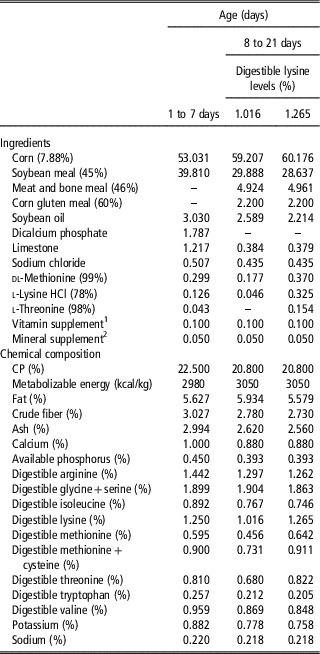
A total of 252 male broilers of the Cobb 500 commercial line, from 8 to 21 days of age, were used in this experiment. From 1 to 7 days of age, birds were reared in a masonry shed with concrete floor littered with wood shavings, where drinkers and feeders were available for free water and feed consumption. At 8 days of age, with an average initial BW of 177±0.28 g, birds were housed in 0.3 m2 metabolic cages, distributed, in a completely randomized design, into four treatments with seven replicates of nine birds per experimental unit. Treatments consisted of diets formulated following the nutritional recommendations suggested by Rostagno et al. (Reference Rostagno, Albino, Donzele, Gomes, Oliveira, Lopes, Ferreira, Barreto and Euclides2011), with four levels of digestible lysine: 1.016%, 1.099%, 1.182% and 1.265%, for the period from 8 to 21 days of age (Table 1). Diets were prepared adopting the dilution technique, in which the experimental diets containing the highest and lowest levels of digestible lysine (1.265% and 1.016%, respectively) were combined with each other at the proportions of 66.67%/33.33% and 33.33%/66.67%, generating diets with intermediate levels (1.099% and 1.182%). Birds and the supplied feed were weighed weekly to determine feed intake, weight gain and feed efficiency. Mortality was checked daily to adjust the performance data. In case of mortality in any experimental unit, the diet reserved to that group would be weighed and considered as intake up to that moment.
Ingredients and calculated nutritional composition of the initial (1 to 7 days) and experimental basal diets (8 to 21 days)

1 The vitamin supplement contained per kg of diet: vitamin A=7000 IU, vitamin D3=2500 IU, vitamin E=18 IU, vitamin K3=1 mg, vitamin B1=1.5 mg, vitamin B2=5.5 mg, vitamin B6=1.6 mg, vitamin B12=12 μg, pantothenic acid=10 mg, biotin=0.05 mg, folic acid=0.9 mg, nicotinic acid=32.5 mg.
2 The mineral supplement contained per kg of diet: iron=30 mg, manganese=60 mg, zinc=50 mg, iodine=2.5 mg, selenium=0.25 mg.
Birds were maintained under a continuous light period (24 h/day), with feed and water available ad libitum. During the entire experimental period, the temperature and humidity of the broiler house were recorded for every 15 min using Thermo-Hygrometers (model ITR 157; Instrutherm Company, São Paulo, Brazil) placed at three different points in the shed (front, middle and back). The temperature ranged from 22.7°C in the morning to 28.5°C in the afternoon. Relative humidity in the rearing facility ranged from 81.0% in the morning to 68% in the afternoon.
Protein deposition
To determine the body protein at time 0 (8 days), 10 chicks were selected and slaughtered by cervical dislocation. To determine the body protein deposition over the experimental period, seven birds from each treatment with a weight close to the average of the group (±10%) were selected at 21 days. Of the selected birds, three were fasted for ~8 h to empty the digestive tract, and slaughtered by cervical dislocation. The remaining four birds were slaughtered by the same method, without previous feed deprivation, and samples of the pectoralis major muscle were collected from these animals. These four birds had their intestinal tract washed with distilled water for removing the intestinal content and were regrouped into the respective treatment for analysis of protein deposition.
Selected birds were slaughtered by cervical dislocation and ground individually with feathers and entrails in a cutter machine for 10 min. After the material was homogenized, a 300-g sample was collected and stored in a freezer at −10°C until analyses. The Kjeldahl method (AOAC, Reference Aoyagi, Tasaki, Okumura and Muramatsu2000) was employed to determine the protein. Daily body protein deposition values were calculated, considering the difference in the amount of protein deposited in the 8- to 21-day period.
Gene expression
For the evaluation of gene expression, four birds were used per treatment, at 21 days of age. Immediately after the slaughter, a sample of the pectoralis major muscle was collected from the center of the left-lateral position and immersed in an RNAholder solution (BioAgency Biotecnologia, São Paulo, SP, Brazil) to stabilize and preserve the mRNA expression of the tissue at the time of collection, kept at 4°C for 24 h, and stored at −20°C until the RNA extraction.
Total RNA was extracted using an RNeasy Mini Kit (Qiagen, Valencia, CA, USA), following the manufacturer recommendations. The RNA concentration was determined in a NanoDrop spectrophotometer (Thermo Fisher Scientific, Waltham, MA, USA). RNA integrity was checked in 1% agarose gel stained with 10% ethidium bromide and visualized under UV light. Total RNA was stored at −70°C until its use. All materials were treated by spraying with an RNaseExterminator decontaminant solution (BioAgency Biotecnologia). The complementary DNA was synthesized from the samples of the pectoralis major muscle using a SuperScriptTM III First-Strand Synthesis SuperMix Kit (Invitrogen, Carlsbad, CA, USA), following the procedures recommended by the manufacturer. Quantitative real-time (qRT) PCR reactions were performed by SYBR Green detection (SYBR Green PCR Master Mix; Applied Biosystems, Carlsbad, CA, USA).
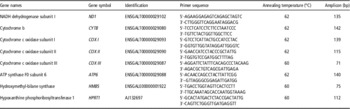
The primers utilized for the amplification reactions for the target genes (ND1, CYTB, COX I, COX II, COX III and ATP6) were obtained from the nucleotide sequences of mRNA of Gallus gallus from the Ensembl database (http://www.ensembl.org/Gallus_gallus). These sequences were used to design the primers using PrimerQuest software, available at http://www.idtdna.com/SciTools/Applications/primerQuest, provided by Integrated DNA Technologies Inc. (Coralville, IA, USA). The mRNA levels of these target genes (Table 2) were normalized to the average hydroxymethyl-bilane synthase and hypoxanthine phosphoribosyltransferase 1 levels (ΔC t ), in accordance with Nascimento et al. (Reference Nascimento, Barbosa, Brito, Fernandes, Mann, Pinto, Oliveira, Dodson, Guimarães and Duarte2015).
Primer pairs used to analyze gene expression

Statistical analyses
Performance and protein deposition data were analyzed using the GLM procedure of SAS software (SAS Institute Inc., Cary, NC, USA). When significant effects were detected (P<0.05), means were compared using the Student–Newman–Keuls test. Results are expressed as means and standard errors. Cq data were analyzed statistically using the %QPCR_MIXED SAS® macro statement (https://msu.edu/~steibelj/JP_files/QPCR.html) developed by commands on SAS PROC MIXED, which considers the independent random effects for target and reference genes in each biological replicate (Steibel et al., Reference Steibel, Poletto, Coussens and Rosa2009).
Results
Performance and protein deposition
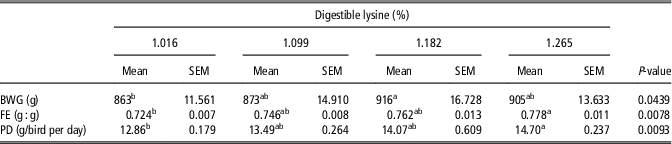
In the evaluation period from 8 to 21 days of age, increasing the level of inclusion of digestible lysine in the diets improved weight gain, feed efficiency and protein deposition (P<0.05) (Table 3). The use of 1.016% digestible lysine provided lower weight gains and feed efficiency when compared with the increasing levels of lysine in the diets. Similar responses were found for feed efficiency and body protein deposition.
Effects of the digestible lysine levels on performance and body protein deposition of male broilers

BWG=BW gain; FE=feed efficiency; PD=protein deposition.
a,bValues within a row with different superscript letters differ significantly at P<0.05.
Gene expression
Results of relative expression were interpreted by contrasting with pairwise comparison between treatments. The results of the qRT-PCR analysis in the pectoralis major muscle of broilers at 21 days of age showed significant differences in gene expression between the dietary treatments. Birds fed diets formulated with 1.099% digestible lysine showed a 3.6 and 3.04 times higher expression of COX II (P<0.05) and COX III (P<0.10) genes, respectively, than those fed 1.016% digestible lysine (Figure 1). Similarly, birds receiving diets with 1.265% digestible lysine displayed a greater ND1 gene expression than birds fed 1.099% (P<0.01) and 1.182% (P<0.10) lysine. For the gene from OXPHOS complexes III (CYTB) and IV (COX I), a significant expression was observed when the diet containing 1.265% lysine was used compared with other dietary lysine levels (Figure 1).
Effect of digestible lysine levels on the relative expression of mitochondrial genes from the pectoralis major muscle of broilers in the starter phase. Results of the three highest levels of digestible lysine (1.099%, 1.182% and 1.265%) are presented as a quantification relative to the lowest level (1.016%). Data on the six genes are presented as mean±Sy.x. Significant differences between treatments are represented by asterisks (*P<0.10, **P<0.05, ***P<0.01). ND1=NADH dehydrogenase subunit I; CYTB=cytochrome b; COX I=cytochrome c oxidase subunit I; COX II=cytochrome c oxidase subunit II; COX III=cytochrome c oxidase subunit III; ATP6=ATP synthase F0 subunit 6.

Discussion
In this study, the diets with increasing levels of digestible lysine provided significant increases in weight gain, feed efficiency and body protein deposition, corroborating other studies (Leclercq, Reference Leclercq1998; Fatufe et al., Reference Fatufe, Timmler and Rodehutscord2004; Wijtten et al., Reference Wijtten, Prak, Lemme and Langhout2004). The observed weight gain has the direct participation of muscle growth, which is influenced by the balance of dietary amino acids, more specifically lysine. Another important aspect that increases weight gain in birds is the tissue hydration, as 3 g of water is retained per gram of protein deposited (Leenstra, Reference Leenstra1986). In this study, there was an average increase of 19% body water gain in birds fed diets with higher lysine levels (data not shown).
In the experimental period, the body protein deposition of 14.7 g/bird per day observed with the digestible lysine level of 1.265% was 14.3% higher than the lowest level utilized (1.016%). Rostagno et al. (Reference Rostagno, Albino, Donzele, Gomes, Oliveira, Lopes, Ferreira, Barreto and Euclides2011) recommended 1.174% digestible lysine in the diet for broilers in the period from 8 to 21 days of age, which can explain why lysine deficiency compromises protein deposition, as was observed by other authors (Fatufe et al., Reference Fatufe, Timmler and Rodehutscord2004; Wijtten et al., Reference Wijtten, Prak, Lemme and Langhout2004). It should be noted that protein deposition depends on the dynamics of the synthesis and degradation processes. In this context, studies suggest that the increased protein deposition with increasing lysine levels in the diet may be a result of the increased synthesis, reduced degradation or changes in both components of the protein turnover (Buttery and Lindsay, Reference Buttery and Lindsay1980; Urdaneta-Rincon and Leeson, Reference Urdaneta-Rincon and Leeson2004). Within the ‘ideal protein’ concept, lysine undoubtedly promotes muscle growth; however, other amino acids such as leucine, glycine and arginine are essentially important for the protein synthesis, especially given their influence on the expression of mechanistic target of rapamycin, an important signaling pathway that regulates the protein synthesis (Wu et al., Reference Wu, Bazer, Dai, Li, Wang and Wu2014).
Broilers, more efficient in feed conversion and weight gain, may show changes in the expression of ETC genes that cause alterations in the use of nutrients (Iqbal et al., 2004 and Reference Iqbal, Pumford, Tang, Lassiter, Ojano-Dirain, Wing, Cooper and Bottje2005; Ojano-Dirain et al., Reference Ojano-Dirain, Toyomizu, Wing, Cooper and Bottje2007). These studies demonstrate that problems in ETC with inefficiency in mitochondrial ATP production are associated with birds with low efficiency in converting nutrients into body components, resulting in low performance. The weight gain and protein deposition observed in this study were related to the alteration in the expression of ETC genes in the pectoralis major muscle of broilers. This observation is supported by the lower expression of ETC genes on the reduced level of digestible lysine in the diet, which probably reduced the availability of ATP in the cells.
The pectoralis major muscle is made up of glycolytic fibers and has few mitochondria compared with muscles with oxidative fibers; however, it has an ~60% higher ATP content (Pearson and Young, Reference Pearson and Young1989). This ATP is important for both rapid contraction metabolism of the glycolytic fibers and because of the need for protein deposition. Protein deposition is a process that demands a large amount of energy. However, protein deposition is not equal to the protein synthesis, but the final result of the synthesis and degradation processes. Considering that four ATPs are required to form a peptide bond, the synthesis of 1 g of protein requires the caloric expenditure of 0.7 kcal (Buttery and Boorman, Reference Buttery and Boorman1976). This value is lower than the 1.28 kcal/g of protein of synthesis proposed by Aoyagi et al. (1988) for broiler chickens, corresponding to 7.52 ATPs per synthesized peptide bond on a molar basis.
The ATP is necessary for the coding and activation of the amino acids as well as for the synthesis of transporter mRNA (Watson et al., Reference Watson, Baker, Bell, Gann, Levine and Losick2013).
Broilers fed diets containing 1.016% digestible lysine showed reduced expression of genes such as ND1, CTYB, COX I, COX II and COX III. In addition, the birds from these groups had the lowest weight gain, feed efficiency and protein deposition, which may demonstrate the relationship existing between gene expression and performance responses. The NADH dehydrogenases are part of complex I, responsible for pumping protons into the inner mitochondrial membrane. The proteins COX I, COX II and COX III that are part of ETC complex IV are responsible for the electron transfer and proton pump, relevant to mitochondrial efficiency. Bottje and Carstens (Reference Bottje and Carstens2009) and Ojano-Dirain et al. (Reference Ojano-Dirain, Toyomizu, Wing, Cooper and Bottje2007) observed lower mRNA expression of COX III in the pectoral muscle of birds with low feed efficiency compared with more-efficient birds. CYTB, as a subunit in the functional center of ETC complex III, may present an expression modified molecularly in broilers with different feed efficiencies. Testing this hypothesis, Tinsley et al. (Reference Tinsley, Iqbal, Pumford, Lassiter, Ojano-Dirain, Wing and Bottje2010) found that CYTB was less expressed in the cardiac muscle of the most efficient birds, whereas Iqbal et al. (Reference Iqbal, Pumford, Tang, Lassiter, Ojano-Dirain, Wing, Cooper and Bottje2005) did not observe differences in the expression of this protein in the liver. It can thus be noted that birds with different efficiencies have mitochondrial genes with distinct expressions in different tissues (Bottje et al., Reference Bottje, Iqbal, Tang, Cawthon, Okimoto, Wing and Cooper2006; Ojano-Dirain et al., Reference Ojano-Dirain, Toyomizu, Wing, Cooper and Bottje2007). ATP synthase consists of two well-defined functional domains – F1 and F0 – which play a direct role in the translocation of protons across the membrane for ATP formation. In our study, no difference was observed in the expression of ATP6 in the different treatments; however, birds that were fed diets with higher lysine levels had the gene expression increased approximately threefold as compared with those fed 1.016% digestible lysine. According to Jonckheere et al. (Reference Jonckheere, Smeitink and Rodenburg2012), the mtDNA ATP6 gene is responsible for encoding the subunit A of the F0 functional domain, which, together with subunit A6L, provides the stabilization of holocomplex V. These authors also stated that the subunit A forms the most important basis for the dimerization of ATP synthases. These observations can explain part of the low performance shown by birds that consumed lower lysine levels.
In conclusion, our findings indicate that broilers fed diets with higher levels of digestible lysine increased the mRNA expression of some genes coded in the mitochondrial ETC (ND1, CYTB, COX I, COX II and COX III). It may be stated that diets with proper levels of digestible lysine, within the ‘ideal protein’ concept, promote the expression of genes, which increases the mitochondrial energy, thereby fostering body protein deposition and the performance of broilers in the starter phase.
Acknowledgments
The authors gratefully acknowledge Capes, CNPq, FAPITEC and Poli-Nutri Nutrição Animal for their support to this research.